



Abstract
There have been two types of scholarly discussion on city branding. On the one hand, city branding has been conceptualised as a differentiation strategy of entrepreneurial cities involved in interspatial competition. On the other hand, researchers have recently emphasised the need to pay attention to increasingly pervasive and transformative forms of city branding, including branding as an urban policy and a form of planning. Drawing on a case study carried out in Helsinki, Finland, this article connects these two approaches by analysing Helsinki’s recent city branding endeavour in the context of the qualitative transformation of the entrepreneurial city. The article shows how city branding highlights and constitutes the city as an entrepreneurial platform and enabler bound up by the extended entrepreneurialisation of society.
Introduction
Researchers have widely discussed city branding as a differentiation strategy that fosters ‘urban competitiveness under the neoliberal vision of entrepreneurialism’ (Joo and Seo, 2018: 242). From this perspective, city branding is closely tied to the emergence of what Harvey (1989) has famously termed the ‘entrepreneurial city’. His thesis is based on the understanding that the crisis of the Fordist-Keynesian system in the 1970s has led to a change in the ‘competitive conditions of existence’ of cities (Peck, 2014: 299). As a result, local governments have gradually adopted principles of product and corporate branding along with a wider entrepreneurial attitude in order to succeed in international competition for resources, jobs and capital (e.g. Anholt, 2005; Anttiroiko, 2015). This approach has directed researchers’ attention to place marketing and city branding as discursive and strategic practices through which cities have adjusted to intensified interspatial competition.
Lately, branding researchers have complemented this approach with new perspectives, which have emphasised more pervasive and potentially progressive forms of city and place branding, including counter-branding campaigns (Lucarelli, 2018) and branding as an instrument of strategic spatial planning, place management and policy-making (Eshuis and Edwards, 2013; Joo and Seo, 2018; Kavaratzis, 2008; Oliveira, 2015). These studies have broadened the traditional understanding of city branding as a growth-inducing neoliberal concept, and highlighted its essence as a process that brings together different actors, rationalities and place-based associations (Kavaratzis and Kalandides, 2015; Lucarelli, 2018).
The action- and process-oriented research on city branding has offered a more nuanced perspective on the motives and rationalities that underlie city branding efforts. Simultaneously, however, it has diverged from recent discussions through which researchers have developed Harvey’s ideas and discussed recent forms and manifestations of entrepreneurialism in the urban context (e.g. Miao and Phelps, 2018; Peck, 2014; Rossi, 2017). This has resulted in a lack of literature concerning the relationship between new, more pervasive forms of city branding and the recent evolution of the entrepreneurial city. The purpose of this article is to fill in this gap by focusing on the connections between city branding as an urban policy and the qualitative transformation of the ‘entrepreneurial city’ (Harvey, 1989). More specifically, the aim of the article is to find out how city branding is negotiated and acted out in relation to what Rossi (2017: 40, 42) calls the ‘third stage’ of urban entrepreneurialism. This stage is characterised by the rise of an increasingly multipolar world and the replacement of hierarchical governance arrangements with flexible forms of governance (Rossi, 2017: 40). These developments are further connected to processes that Rossi (2017) refers to as ‘the entrepreneurialization of the society and the self’– the emergence of increasingly individualistic, entrepreneurial and self-organising citizen-subjects (see also Moisio, 2018: 26).
I have used the case of Helsinki, the capital of Finland, to highlight the city as an entrepreneurial platform and enabler in the context of the third stage of urban entrepreneurialism. From this perspective, city branding is a window on – and an integral part of – both the ‘actually existing entrepreneurialism’ (Miao and Phelps, 2018) that manifests itself in the restructuring of the public sector, as well as the related urban transformation from bureaucratic administration towards flexible urban management based on the engagement of local communities and the related entrepreneurialisation of social encounters. My approach stems from the understanding that there are some universal features in urban entrepreneurialism, but that its manifestations are always context-specific, calling for case studies that illustrate how city branding as a policy is interpreted in particular historical and geographical contexts (see He and Wang, 2018: 2). Helsinki is an interesting example, because it has recently introduced a new brand concept and a related marketing strategy, which view branding as a policy that brings together different actors to rethink urban governance in terms of experimentation and responsibilisation of the self.
This article has two implications. First, it adds to the growing body of research on city branding ‘beyond representations’ by providing clarity on the practices of city branding in relation to the evolution of the entrepreneurial city. In doing so, the article integrates literature on new conceptualisations of city branding into literature on the qualitative shift of urban entrepreneurialism (e.g. Moisio, 2018; Peck, 2014; Rossi, 2017). Second, the article provides new insights into the ways in which city branding as a policy may be used to foster internal changes within the local government and how these changes underpin government responses to external challenges, such as globalisation and neoliberalisation (Miao and Phelps, 2018).
Next, I will draw on the existing literature to discuss city branding in the context of the evolution of the ‘entrepreneurial city’. After that I will briefly introduce the case of Helsinki as well as the data and method used in this study. In the following section, I will use the case of Helsinki to present four mutually constitutive processes that illustrate the relationship between city branding and urban entrepreneurialism, namely civic and stakeholder participation, information sharing, storytelling and production of new urban subjects. Finally, I will conclude the article by discussing the findings of this study in the context of the ‘third stage of urban entrepreneurialism’ and suggesting possible directions for future research.
City branding and the evolution of the ‘entrepreneurial city’
Harvey’s (1989) article on the transformation of urban governance from ‘managerialism to entrepreneurialism’ has become widely accepted as an accurate analysis of the urban transformation that has taken place in western societies as they have moved from Fordism to the post-Fordist regime of flexible accumulation (e.g. Abrahamsson and Ek, 2014; Peck, 2014; Rossi and Vanolo, 2015). As Peck (2014: 397) notes, Harvey’s article captured the ‘early manifestations of neoliberalism’s now-customary forms’. These include intensifying inter-urban competition, public–private partnerships and the establishment of the hegemony of market rationality as the basis of urban action (Harvey, 1989: 7). Furthermore, Rossi and Vanolo (2015) point out that Harvey’s article anticipated later scholarly discussions about the difference between ‘government’ and ‘governance’, through which urban researchers and social scientists have conceptualised a shift from bureaucratic administration (government) towards flexible management of urban development based on public–private partnerships and the engagement of local communities (governance) (Mäntysalo and Bäcklund, 2018).
Harvey’s understanding of the entrepreneurial city has been developed further by other researchers. In this article, I mainly draw on the research of Rossi (2017: 39), who considers urban entrepreneurialism as a ‘key entry point’ to the study of ‘the growing intertwinedness of cities and capitalism in the global age’. He identifies three distinctive stages of the development of urban entrepreneurialism, each with its own spatial scope (Rossi, 2017: 37–43). In the following, I will discuss these stages in relation to the evolution of the practice of city branding, which stands in parallel to the transformation of the entrepreneurial city.
The first stage of urban entrepreneurialism followed the crisis of the Fordist-Keynesian system from the 1970s onwards. This stage focused mainly on the local scale and involved the bridging of public and private actors and communities for the purpose of urban and economic regeneration. It was also closely connected to the development of a distinctive place marketing approach, which sought to manage mental images in order to ‘maximize the attractiveness of the local site as a lure for capitalist development’ (Harvey, 1989: 5) and paved the way for more refined applications of product and corporate branding to the city (Ashworth and Voogd, 1990; Kavaratzis, 2008; Kotler et al., 1999).
The second stage of urban entrepreneurialism started in the early 1990s, when the idea of globalisation was entrenched in public discourse and cities started to resort to international investors and organisations in order to attract global mega-events and brands. This development was closely connected to what Moisio (2018: 23–24) calls ‘knowledge-based economization’, a process that involves the channelling of surplus capital into physical infrastructures such as innovation centres and technology parks. In this context, city branders started to use prominent brands and cultural infrastructure as a tool to improve their positioning within a global network of cities (He and Wang, 2018: 2). Some have considered the Guggenheim museum in Bilbao as a prime example of the benefits of cultural infrastructure to urban regeneration, whereas other more critical commentators have coined the notion of ‘Guggenheimization’ (e.g. Rossi, 2017: 140), which refers to the homogenisation of cities in accordance with the western lifestyle, echoing Harvey’s (1989: 10) critique of ‘the serial reproduction’ of cultural centres.
The third stage of urban entrepreneurialism during the past 15 years has witnessed the emergence of what Peck (2014: 399) terms ‘the late-neoliberal city’– a city characterised by ‘the increased circulation of urban policies and development models’, experimentation and the ramification of cities’‘networks, alliances and coalitions, with the involvement of a broader array of public and private institutions, international organizations and economic players’ (Rossi, 2017: 40). Furthermore, urban entrepreneurialism has become increasingly intertwined with the ‘entrepreneurialization of the society and the self’– processes through which urban citizens are turned into autonomous, active and flexible agents, who are responsible for their own well-being (Rossi, 2017: 82).
At the third stage of urban entrepreneurialism, many governments have started to highlight the role of ‘experimentation’, ‘urban culture’ and the ‘sharing economy’ in value production, as opposed to government funded cultural building projects, which have been increasingly criticised for being expensive and unrealistic after the global economic crisis of 2008 (He and Wang, 2018: 2; Moisio, 2018: 135; Rossi, 2017: 12; Vihinen, 2013). This new discourse has been connected to the will of city governments to foster ‘participatory’ and ‘bottom-up’ approaches to city branding (Eshuis and Edwards, 2013; Joo and Seo, 2018), along with a wider focus on community engagement (Mäntysalo and Bäcklund, 2018).
In this article, I draw on the case of Helsinki to discuss recent conceptualisations and practices of city branding in relation to the third stage of urban entrepreneurialism. I focus especially on the ways in which city branding is used as a way of bringing about internal changes in the local government. Furthermore, I am interested in how these changes are articulated and legitimised by city officials in relation to challenges that stem from the perceived inadequacy of existing governance models to address the external challenges caused by the global competition for resources.
My analysis is informed by an understanding that while the connection between city branding and urban entrepreneurialism has been acknowledged by many researchers, studies that have specifically focused on this relationship have tended to conceptualise city branding first and foremost as discursive practices and symbolic constructions – which may or may not represent urban realities (e.g. Jessop, 1998; Vanolo, 2008). In contrast, more recent studies on city branding have addressed the ‘unconventional city branding that shifts away from market-oriented branding toward a more participatory approach accompanying a new policy paradigm’ (see also Eshuis and Edwards, 2013; Joo and Seo, 2018: 240; Lucarelli, 2018). These studies have paid attention to city branding as a participatory practice, emphasising bottom-up processes as a way of challenging or improving the outcome legitimacy of branding processes. However, they have paid little attention to the ways in which the ‘participatory’ and ‘bottom-up’ practices of city branding are connected to the qualitative changes of the entrepreneurial city. In the following sections, I will therefore undertake an analysis of the participatory and transformative practices involved in Helsinki’s city branding process to give a more nuanced view of the ways in which the symbolic, social and material dimensions of city branding intertwine and co-constitute the city in accordance with contemporary policy paradigms.
The background of Helsinki’s current branding effort and some remarks on the data and methods
The roots of city branding in Helsinki are in tourism promotion that became institutionalised from the 1950s onwards, but the rationality behind the current form of city branding lies in later deindustrialisation and the gradual adoption of entrepreneurial ideas. During the past few decades, Helsinki has followed other western cities in adopting an increasingly-networked governance model and applying the principles of corporate and product branding to the city in order to tackle economic challenges and foster the accumulation of capital (see Harvey, 1989).
Since the 1950s, the core of Helsinki’s city brand has been largely constructed around the same assets, such as interesting contrasts between urban liveliness and nature or the city’s location between ‘East’ and ‘West’ (Jokela, 2018). At the same time, the essence of the city has been negotiated and reformulated in relation to the evolution of the entrepreneurial city described by Rossi (2017). Recently, for example, a plan to build a Guggenheim museum in Helsinki caused a local debate about the relative importance of government funded mega-projects and grassroots urban culture to the city brand. This debate was not only about the image of the city, but also about the ideal forms of entrepreneurialism in securing Helsinki’s competitive advantages in global interspatial competition (see Moisio, 2018: 134–141; Rossi, 2017: 135–140). Eventually, the Guggenheim museum plan was rejected by the city council, who decided to focus instead on local residents’ initiatives and experimentations as the foundation of an attractive city brand. This corresponds with Rossi’s (2017) idea about a shift from the era of mega-events to the entrepreneurialisation of the society and the self.
Helsinki’s new brand concept was developed in 2015–2016 in a participatory ‘Brand New Helsinki 2020’ project led by the City Marketing Unit of Helsinki. This unit was established in 2014 under the Economic Development of the City Executive Office in line with the city council’s policy objective of creating a city brand. Following a government system reform in 2017, issues related to city branding and marketing have recently been moved from Economic Development to a new Communications Division, which is also responsible for participation and citizen information.
The brand concept states that ‘the Helsinki brand needs actions not words’, because the brand is made up of ‘shared experiences that happen wherever and whenever we encounter the city’ (Brand New Helsinki, 2016c). Instead of slogans, the city brand thus emphasises a bold attitude that facilitates the transformation of Helsinki into a ‘city full of people, actions and encounters that make an impact’. The branding effort has been partly legitimised by its alleged benefits to the entire national state. Among others, this has been pointed out by Helsinki’s former Mayor Jussi Pajunen (2005–2017), a right-wing entrepreneur who was involved in initiating the ‘Brand New Helsinki 2020’ project through which Helsinki’s new brand concept and the related marketing strategy were developed: The strengthening of Helsinki’s identity improves the competitiveness of the city and benefits all parties, residents and business life alike. The development of city marketing is part of the development of the well-being and comfort of the whole city as well as the industrial policy, which aims at improving the attractiveness of the whole of Finland. (Jussi Pajunen, in Brand New Helsinki, 2016d)
Along with the new brand concept, the focus of city branding is shifting from marketing efforts towards the enabling of entrepreneurial activity and experiments as part of boosting value creation and profit-making. From this perspective, city branding is a way of fostering competitive advantages, which are increasingly based on intangible assets such as knowledge, innovation and creativity. Through these processes, Helsinki’s branding exercise is intertwined with what Moisio (2018: 35–36) terms ‘knowledge-based economization’– a political and economic process through which societies take seemingly logical steps up the ‘ladders-of-development’ from an industrial stage to a post-industrial stage.
This study is based on the analysis of three mutually supportive sets of data collected in 2017–2018: (1) the documentation of the ‘Brand New Helsinki 2020’ project and the Helsinki City Strategy, 2017–2021; (2) interviews with six experts involved in the branding of Helsinki; and (3) participant observation conducted during four excursions organised for the ‘ambassadors of Helsinki’– the employees of the City of Helsinki, who participate in these excursions on a voluntary basis. The documents analysed include summaries of background research and results of the participatory ‘Brand New Helsinki 2020’ project, as well as slides and reports related to the workshops and events organised as part of the project. My reading of these datasets focused on unravelling the ways in which spatial and growth-related strategies come together in and through the city branding process. I considered both discursive and material practices involved in the process, paying attention to the ways in which the will of the government was expressed and negotiated through these practices.
The excursions of the ambassadors of Helsinki included walking tours and visits to different sites that the representatives of the City Marketing Unit of Helsinki considered important to the development and implementation of the brand concept. During these excursions, I acquainted myself with bodily practices and participatory methods associated with the development of the brand, as well as mundane ways of verbalising it. Sensitivity to the real-life contexts was important, because people may question or modify the ideological configuration of the brand according to their own agendas and needs (Eshuis and Edwards, 2013; Lucarelli, 2018). Fostering trust and building relationships with the other participants of the excursions was important for the participant observation to succeed. Thus, I shared my ideas in group discussions, informed the other participants about my research, shared interesting articles and wrote an article for a professional journal published by the City of Helsinki (Jokela, 2018).
The relationship between participatory city branding and urban entrepreneurialism: Four interrelated processes
Based on my analysis, I have identified four mutually constitutive processes that illustrate the relationship between city branding and urban entrepreneurialism. These are: (1) civic and stakeholder participation; (2) information sharing; (3) storytelling; and (4) production of new urban subjects. Together, these processes co-constitute the city as a platform and an enabler of entrepreneurial action, exemplifying the ways in which branding is changing the city government, and the culture surrounding its operations is also changing, as a response to global challenges.
Civic and stakeholder participation
The ‘Brand New Helsinki 2020’ project was based on participatory approaches which were designed by the City Marketing Unit of Helsinki in collaboration with the Kuudes Kerros (Sixth Floor) design agency and a steering group of 20 people. The project started in 2015 with background research that included analyses of data that had been collected through expert interviews, workshops, picture elicitation, assignments directed at the members of the steering group, studies of competing sites and previous reports and studies on Helsinki’s assets (Brand New Helsinki, 2016d). Simultaneously, a marketing strategy was drafted, based on interviews and workshops in order to ensure that communication about the Helsinki brand would be aligned with the brand concept.
As the project progressed, the City Marketing Unit shared information about the project and the ‘stages involved in creating the Helsinki story alongside various local actors’ (Brand New Helsinki, 2018a). The results of the background research and marketing workshops were displayed in the form of stories about the future of Helsinki that were further commented on by residents and stakeholders, who were selected by the steering group. The latter included representatives of business life, international students, tourism promoters and other actors interested in the development of Helsinki’s reputation. The results of the project were further refined, crystallised and documented at the end of 2015 and beginning of 2016 in several workshops, which involved city officials and stakeholders.
After the ‘Brand New Helsinki 2020’ project was completed, the city government started to build networks of actors, who would implement the city brand through their own actions and relations. According to former Mayor Jussi Pajunen, the goal of the branding exercise was to involve all Helsinki’s citizens in the implementation of the brand (Brand New Helsinki, 2016c). While the government has expressed a will to encourage participation, it is clear that the engagement of citizens has not come without challenges. For example, one of my interviewees involved in the branding exercise noted that one of the big challenges has been to ‘reach the Helsinkians and get them to feel that they have ownership; that they are the ones who realize Helsinki’s brand’.
The City of Helsinki has addressed this challenge by taking two tangible steps to foster citizens’ participation in the implementation phase of the brand concept. Firstly, it has introduced a participation and interaction model along with the governance reform of Helsinki. This model involves annual participatory budgeting of €4.4 million that will be used according to citizens’ proposals and votes. In addition, ‘city coaches’ and ‘business coaches’ will be working in Helsinki’s housing areas to help residents with their initiatives and to promote business activities. Secondly, the city is seeking to strengthen the city branding exercise as an overarching process and platform of collaboration by moving its administration to the new Communications Division of the City of Helsinki. One of the interviewees involved in the branding process commented on this change in the following way: It is a big principled change that the city marketing will be moved to the Communications Division. […] That’s when the city brand and the grand narrative surrounding it will become much more multifaceted. […] After that [the brand] won’t be so closely connected to the economic development. It won’t be like ‘we harness you all to contribute to Helsinki’s economic growth or Helsinki’s business life’. Like, even though [economic development] is an important – and probably the main – motivator here, it excludes quite a few people or limits the group of people interested in [the brand]. (Interviewee involved in the development and implementation of the brand concept)
As this quote shows, the branding process is led by a group of city officials, but their focus on participatory approaches reflects the relational geographies of urban development, ‘breaking away from the rigidities associated with the formal scales of plan-making’ (Allmendinger and Haughton, 2009: 619). This process conveys an awareness of the trend of ‘softening’ of urban governance, by which Allmendinger and Haughton (2009) and Haughton et al. (2013) refer to the emergence of ‘in-between’ spaces of governance ‘outside, alongside or in-between the formal statutory scales of government’. Soft spaces entail the self-organisation of actors around a shared interest, which is one of the organising principles of the contemporary entrepreneurial city. Together with more traditional government-led processes, citizens’ self-organisation may result in ‘a complex reality of governing’ in which different actors and roles compete with each other (Mäntysalo and Bäcklund, 2018: 421).
Information sharing
Besides civic and stakeholder participation, Helsinki’s city branding exercise entails various practices that enable information sharing between local and international experts and city officials. According to the interviewees involved in the branding of Helsinki, city officials have shared information, set up networks and sought coverage at several international events and on a number of international platforms, including the City Nation Place Global Conference, the World Tourism Cities Federation and the Informed Cities Forum. In addition, Helsinki’s city officials closely follow other cities with similar branding projects. These include several cities in Northern Europe (e.g. the capitals of the Nordic countries, Berlin and Hamburg), as well as in Asia and the English-speaking world (e.g. Singapore and New York).
A systematic benchmarking of cities was carried out as part of the ‘Brand New Helsinki 2020’ project in order to identify Helsinki’s strengths and targets for development in relation to its competitors. This exercise included an analysis of 16 cities in 12 countries and five continents, which were selected on the basis of discussions with the steering group of the ‘Brand New Helsinki 2020’ project. The goal of benchmarking was to compare Helsinki with a diverse range of cities with similar qualities, trends or development objectives. Based on the comparison, these cities were grouped under four categories that echoed the qualities of a contemporary entrepreneurial city bound up by knowledge-based economisation. These categories were: (1) ‘weirdness and tolerance’; (2) ‘quality of life’; (3) ‘ambition and talent’; and (4) ‘new urban innovation’ (Brand New Helsinki, 2016a).
Locally, information has been shared through social and bodily practices in training events and excursions organised for the city officials of Helsinki (Table 1). The aim of these events has been to encourage and educate the participants to communicate more boldly and to throw themselves into situations and encounters through which the city administration can be developed and reinvented. The underlying idea has been that ‘the development of work, of city organization – or of the whole city – begins with people, who encounter and serve customers daily’ (City of Helsinki, 2018a).
Training events and excursions organised as part of Helsinki’s branding exercise.
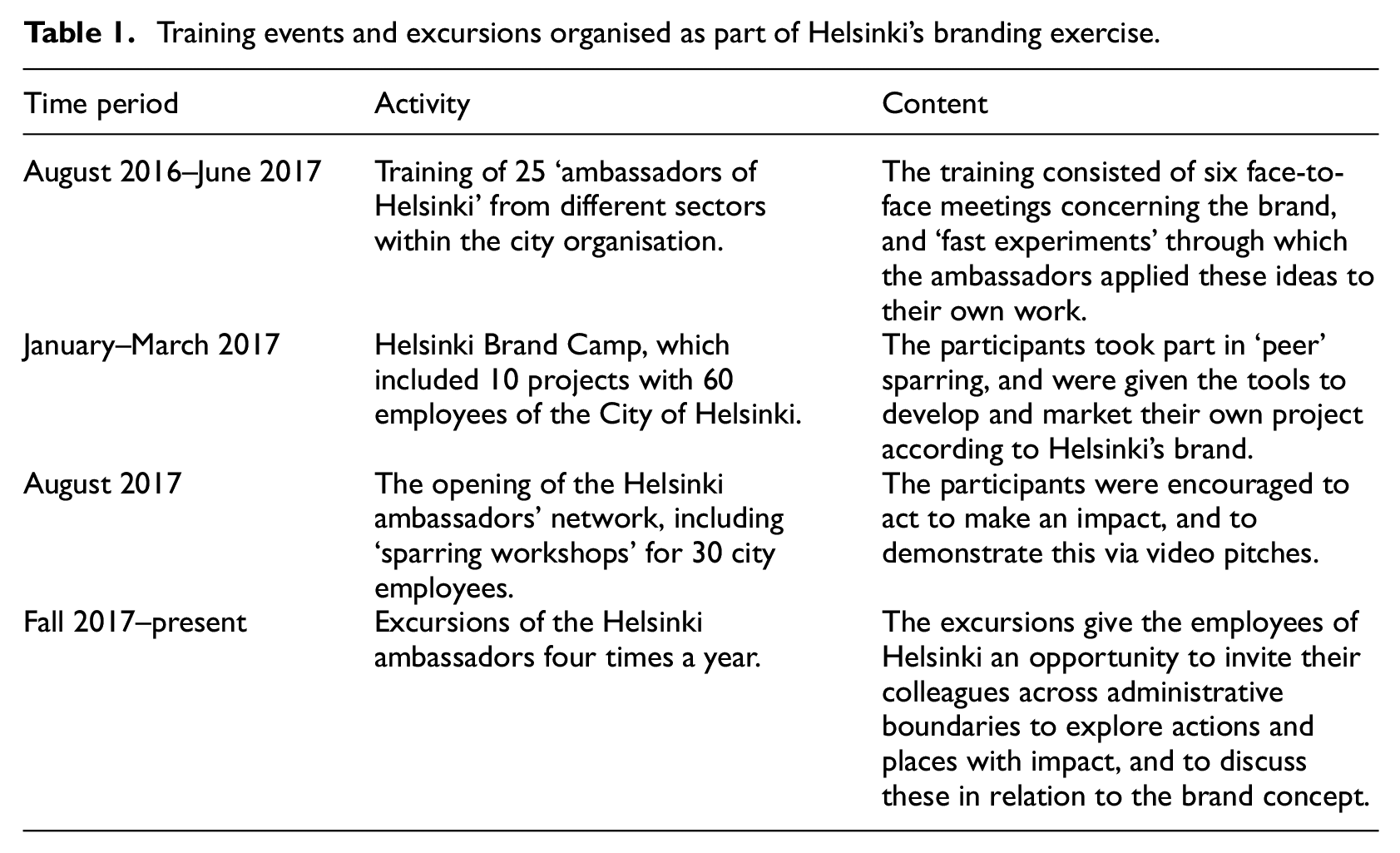
According to an interviewee involved in the implementation of the brand, these events and excursions have attracted a group of reformist individuals who previously lacked an easy way to move their work forward. By meeting likeminded people, the participants have received support for their ideas about how the city could be developed and renewed. For example, the Helsinki ambassadors’ excursions have included a nature trail walk and a seashore yoga session, accompanied by short presentations and reflection on how these existing assets (nature, the seashore) can be used and marketed in support of Helsinki’s brand, and how city employees can utilise them in their own work. Participants have the opportunity to collaborate across administrative borders, to incorporate their own experiences and values in the ideas introduced in the brand concept, as well as to think creatively and combine ideas related to their own work in unusual ways. This is exemplified by the experiences of an interviewee from the Urban Environment Division of the City of Helsinki, who has taken the initiative of integrating the new brand concept into her own project work. She describes her motives in the following way: I became involved in this branding stuff so that … They probably told us about it from the Economic Development [department of the City Executive Office], and traditionally the nature side and business side have been quite far apart and they haven’t had as close collaboration as the nature side has had with, say, the construction or streets and parks or even urban planning, but I think that they probably disseminated information quite well about the brand and the new city strategy and put them into practice around the city. And there were some pretty good baits there concerning nature and especially our project, so I seized them. […] In this project we have had the intention to communicate, so this was one good way of finding new target groups both within and outside of the city [organisation] and to put our project activities in a broader context. (Interviewee working in the Urban Environment Division of the City of Helsinki)
Collaboration and information sharing across administrative and geographical borders thus involve their own ‘“social infrastructure” […] that has sprung up around “best practice” codification, practitioner conferences, learning exchanges, knowledge transfer, and communities of practice’ (Peck and Theodore, 2015: xv). Such a social infrastructure is integral to the ‘deepening relationality of policy-making’ (Adkins and Ylöstalo, 2018: 158), the ramification of cities’ networks in the third stage of urban entrepreneurialism (Rossi, 2017), as well as the emergence of city branding as an increasingly ‘soft space’ that brings together actors and resources from different institutional, administrative and/or geographical contexts (Allmendinger and Haughton, 2009).
Storytelling
The making of Helsinki’s brand is further supported by storytelling through which the people, institutions and organisations involved in city branding negotiate and produce shared visions of the future of the city. Storytelling is related to the enhancing and transformative dimensions of city branding described by Joo and Seo (2018). The enhancing dimension ‘seeks to positively confirm the city’s position and strengthen existing policies or characteristics that are deemed attractive’, whereas the transformative dimension focuses on ‘communicating a local government’s urban policy visions and aspirations to transform the city into something new’ (Joo and Seo, 2018: 243; cf. Kaika, 2010). Along the lines of this analytical framework, storytelling has enhancing and transforming capabilities that contribute to the making of specific urban imaginaries, ‘interpretive grids through which we think about, experience, evaluate, and decide to act in the places, spaces, and communities in which we live’ (Soja, 2000: 324).
According to the ‘Brand New Helsinki 2020’ project documents and an interviewee working in City Marketing, Helsinki’s existing assets such as ‘Nordic mentality’ and a lively urban life should be enhanced to create a powerful city brand. This point of view is also emphasised in the documents of the ‘Brand New Helsinki 2020’ project: Helsinki’s setting is well known, but its content is not. Sights and history evoke interest, but do not give enough reasons to come or move to Helsinki. Instead, intangible things are advanced in Helsinki and, because of that, the attractive urban culture, innovative competence clusters and quality of life should be emphasized more than is done now. (Brand New Helsinki, 2016d)
Emphasising Helsinki’s intangible assets is a subtle way of showing that while Helsinki may not be able to compete with big European cities in terms of architecture and history, it has some of the most important qualities of the post-Fordist city and of a well-performing knowledge-based economy, namely innovativeness, creativity and quality of life. This understanding of Helsinki was further used as the basis of ‘draft stories of My Helsinki 2020’, which were discussed with the citizens and other stakeholders involved in the ‘Brand New Helsinki 2020’ project. The aim of the draft stories was to come up with a shared idea of what Helsinki should be in the future:
‘A city which allows more time for living’
‘A city in which I draw energy from our urban vibe and peace’
‘A city in which we build wellbeing together’
‘The world’s best city for being myself’ (Brand New Helsinki, 2016d)
Besides bringing people together to envision the future of Helsinki, these draft stories mirror the process of the entrepreneurialisation of the self, which attempts to reconcile ‘two mutually exclusive social processes: individualization and community’ (Rossi, 2017: 169). The idea of the urban subject as an atomised and self-directed figure (I/myself) is balanced with implicit references to communal action (we/together) enabled by the city. The final crystallisation of Helsinki’s brand further emphasises people’s communal action and self-directed mindset: ‘Helsinkians are people with the passion to solve meaningful problems and create the world’s most advanced everyday life’ (Brand New Helsinki, 2016c).
In addition to enhancing the existing strengths, storytelling is used to transform the common understanding of what Helsinki is, especially in terms of urban governance. For example, Helsinki’s brand concept outlines that the goal of branding was to lead the city’s transformation ‘in the right direction’ through concrete measures, such as ‘the removal of unnecessary obstacles that hinder encounters and actions with impact’ (Brand New Helsinki, 2016c). The 26-page ‘Helsinki brand concept’ document (Brand New Helsinki, 2016c) mentions ‘impact’ 38 times. These mentions include ‘impact’ in the context of the cornerstone of the brand concept (‘One Hel of an impact’), and of the City of Helsinki organisation’s service promise (‘Let’s act together to make an impact!’). The key message is that the full potential of Helsinki’s assets cannot be utilised unless the culture surrounding the operations of the city is changed to match recent urban transformation, including a shift in urban citizenship: ‘More than ever, urban citizenship is built from the ground up, meaning that individuals and communities – as collectives formed by individuals – are becoming the driving forces of development’ (Brand New Helsinki, 2016e).
As a result, the brand concept reinforces a new model of urban governance, which manifests itself in urban imaginaries that emphasise the role of the city as a platform or an enabler based on flexible administration and bold experimentation: ‘Let’s just go on and try! A change from a city official to an enabler’ (Brand New Helsinki, 2016b).
The imaginary of the city as an enabler or a platform emphasises the importance of dissolving hierarchical governance structures to enable individuals’ and communities’ action. It is part of a growth-inducing urban policy, which reflects the rise of experimentality in national politics, as well as the underlying ‘fast policy’ paradigm (Peck and Theodore, 2015) – the tendency of advanced liberal states to use experiments ‘for developing, testing and evaluating new public policies to address social problems’ (Adkins and Ylöstalo, 2018: 158–159). In parallel with the national aim to encourage experimentality as a way of advancing ‘innovative solutions’ and ‘the promotion of individual initiative and entrepreneurship’ (Adkins and Ylöstalo, 2018: 160), Helsinki has witnessed a shift towards experimentality, which dates back at least to 2012, when Helsinki was the World Design Capital. This was explained by an interviewee working for Helsinki Marketing: I think that the change started […] after the Design Capital year. […] It was six years ago, when the world was quite different. […] [The Design Capital year] was a bit like an exploder among the city officials, [because it made them realise] that, ‘wait a minute, experimental culture is pretty okay and we get new ideas through that and everything should not be forbidden’. […] This brought a new type of urban development into a context – it was not like, you know, just the dabbling of some hippies, but a million-euro project for the city […] The city started to recognise its role as sort of an enabler, which to me is a horrible term, but now it is very much present in, say, the city’s strategy. The city is a platform and an enabler and interesting encounters happen here which generate something new. (Interviewee working for Helsinki Marketing)
The metaphors of ‘platform’ and ‘enabler’ are elaborated in the documentation of the ‘Brand New Helsinki 2020’ project, which suggests that the ‘Finnish legal concept of “Everyman’s Rights”’ should be applied to the city in order to encourage people to ‘create and enjoy ideas, initiatives, events and activities that make the best use of our urban environment and improve our quality of life’ (Brand New Helsinki, 2016c). The idea of the city as a platform cuts across the documents related to the brand concept of Helsinki, as well as Helsinki’s City Strategy 2017–2021, which reflects many of the ideas introduced through the brand concept: Helsinki increasingly understands its role as the creator and enabler of possibilities. Helsinki actively forms partnerships with residents’ organizations and with everyone interested in developing and vitalizing the city. Besides being a service organization, Helsinki is a platform and the world’s most progressive public sector ecosystem. (City of Helsinki, 2018b)
Production of new urban subjects
As the previous examples imply, the urban imaginaries put forth by Helsinki’s brand concept are bound up with the production of new urban subjects with desirable qualities. Citizens’ behaviour is not shaped through the establishment of ‘rules in participatory arrangements’ (Eshuis and Edwards, 2013: 1969), but through rather more subtle formulations. By way of example, desirable citizenship becomes visible in extracts that emphasise the value of people with a bold, experimental mindset: ‘In the future, we want Helsinki to be known for people that boldly experiment and combine new ideas: people that want to positively impact their urban community and change the world for the better’ (Brand New Helsinki, 2016c).
Notions of desirable citizenship are supported by exemplary stories that make the idea of ‘people, encounters and actions with impact’ more tangible. On the ‘Brand New Helsinki 2020’ website, several thought leaders describe their personal relationship to Helsinki, as well as Helsinki’s assets in relation to its competitors (Brand New Helsinki, 2018b). In this context, highlighting ‘impact’ is a way of changing the understanding of city branding from being about polishing the city’s image through slogans and representations, towards being about using branding as a tool of more comprehensive urban development supported by citizens’ activities. As one of my interviewees pointed out, the promotion of ‘people, actions, and encounters with impact’ encourages people to overcome their initial aversion to branding by emphasising a bottom-up approach instead of the traditional view of branding as a ‘superficial’ activity. This change of perspective is significant, because it makes people generally more willing to accept the brand concept as the basis of their own actions and, thereby, paves the way for deeper entrepreneurialisation of the city. This idea is advanced in the documents of the ‘Brand New Helsinki 2020’ project: ‘It is Helsinkians working together that influence the kind of world we will live in tomorrow’ (Brand New Helsinki, 2016c).
The collective ‘we’ in the documents emphasises the inclusiveness of the brand concept, but also implicitly promotes a notion of the people of Helsinki as a uniform group of responsible and self-directed citizen-subjects, who share the values embedded in the brand concept. Ironically, the persuasive tone of these formulations may jeopardise the capability of some local actors to identify themselves with the brand concept and participate in its implementation. This perspective was emphasised by an urban activist who is involved in several projects that take place in urban space. When I asked him whether he can identify himself with the collective ‘we’ of the brand documents, he answered in the following way: For me, that word ‘together’ is somehow problematic. […] The reality is kind of a patchwork quilt of intersecting and conflicting ideas and things. And that is exactly what I would like it to be. […] I get the feeling that I definitely do not believe in [those formulations]. […] I think it would be cool if it were transparent who wants what. If they say ‘we’, then it should be a specific working group who is that ‘we’, or whoever has written that. That we here want … that this working group wants this and after that a city dweller can seize on that: ‘Yeah I want the same thing!’ or ‘No, actually I want something different’. If it is that kind of collective ‘we’, it’s impossible to react to it. (Interviewee involved in urban activism)
This quote makes visible the resistance to persuasive communication as well as the limits of city branding as a ‘soft space’ of urban governance. By bypassing or concealing potential tensions and choices involved in branding, the brand concept depoliticises the processes through which the brand is made and naturalises the ideological viewpoints and values embedded in it. This shows that while city branding may engage a flexible network of actors in the making of the city, the logic and power relations behind the formation of the boundaries of this network may not always be transparent.
Concluding discussion
Several studies have lately emphasised the need to understand city branding as more than a neoliberal concept or a marketing tool (Lucarelli, 2018), due to its important role in urban transformation (Joo and Seo, 2018), which involves the strengthening of citizens’ position in local governance (Eshuis and Edwards, 2013). This article has built on these studies, addressing Helsinki’s ongoing branding exercise as an open-ended process that seeks to assemble local assets, information and people to constitute and manage the future of the city. Since the implementation of Helsinki’s brand concept has started only recently, the work has focused primarily on the city’s organisation and its policy networks, with the aim of bringing about and promoting a new culture of administration. Nevertheless, there is a strong intention within the city organisation to use the brand to reimagine and constitute the city as a desirable location with light regulation, and thereby to empower local communities and to encourage active and innovative people to experiment and make ‘actions with impact’. Thus, the case of Helsinki confirms the findings of these previous studies that there is a shift in city branding from ‘selling’ the city towards the transformation of urban realities in accordance with contemporary policy paradigms.
What is new about this article is the positioning of recent reconceptualisations of city branding in the context of the recent evolution of the ‘entrepreneurial city’ or ‘entrepreneurial urbanism’ (Harvey, 1989; Peck, 2014; Rossi, 2017). My approach has been based on the understanding that the entrepreneurial city is a dynamic entity and that the practices of city branding are adjusted accordingly. From this perspective, the increasing ‘inclusiveness’ of branding processes is not only a sign of ‘progressive transformation’ as proposed by Joo and Seo (2018), but also a way of restructuring public administration as a response to external challenges (Miao and Phelps, 2018), as well as incorporating ‘the society and life itself within the capitalist process’ (see Moisio, 2018: 26; Rossi, 2017: 75). Empirical evidence from Helsinki supports this claim, as the city branders in Helsinki have fostered participatory approaches coupled with ideas of the city as a ‘platform’ and an ‘enabler’ in order to boost value creation through ‘people, actions and encounters with impact’. This interpretation of city branding has been constituted in and through relational policy networks, which are integral to what Rossi (2017) calls the ‘third stage of urban entrepreneurialism’. From this perspective, city branding exemplifies the rapid circulation of policies that foster experimentation and entrepreneurial action as part of crisis-driven neoliberal governance (Adkins and Ylöstalo, 2018; Peck and Theodore, 2015).
My research suggests that it is worth investigating whether branding is emerging as a ‘soft’ space of governance through which people and resources come together in a relational manner to address important strategic issues and adjust the city to ‘global realities’ (Allmendinger and Haughton, 2009; Haughton et al., 2013). As I have shown, the relational geographies of branding are supported by various discourses and practices, including engagement of citizens and stakeholders, information sharing, storytelling and the production of urban subjects with desirable qualities. In future, it may be worthwhile to study how the understanding of the city as a platform is connected to the constitution of new geographies on the city-regional level.
The conceptualisation of city branding as a soft space also points to the possibility of further exploring the relationship between city branding and strategic spatial planning, which, according to Healey (1997: 5), refers to ‘a social process through which a range of people in diverse institutional positions come together to design plan-making processes and develop contents and strategies for the management of spatial change’ (see Oliveira, 2015). While the ‘Brand New Helsinki 2020’ project did not include traditional land-use plans, it painted a broad picture of the ways in which future visions could be achieved. More research is needed to show how the implementation of the brand concept is integrated into spatial planning, for instance through the identification of strategically important issues and sites.
Furthermore, this article encourages further exploration of action- and process-oriented city branding that is based on participatory approaches. Future research can address whether new, increasingly pervasive forms of city branding provide an answer to critique of the mainstream city branding that is associated with the ‘serial reproduction’ of cultural infrastructure (Harvey, 1989: 10) and promotional messages (Vanolo, 2008). Interesting questions include: will new branding efforts result in the emergence of truly ‘bottom-up’ city brands, which reflect the relationally constituted identity of the city rather than ‘simply “announcing” [the brand] in bureaucratic fashion’ (Haughton et al., 2013: 218)? Or will these branding efforts end up reproducing city branding as a tool of neoliberal urban governance by demanding a commitment to ideals of urban entrepreneurialism, including the increased entrepreneurialisation of social life and the self?
Footnotes
Acknowledgements
I would like to thank the research group Spatial Policy, Politics and Planning at the University of Helsinki and three anonymous reviewers for their valuable comments on earlier drafts of this article. I am also grateful to the Academy of Finland for supporting this research (RELATE Centre of Excellence 2017–2019, grant number 307348).
Declaration of conflicting interests
The author(s) declared no potential conflicts of interest with respect to the research, authorship, and/or publication of this article.
Funding
The Academy of Finland supported this research (RELATE Centre of Excellence 2017–2019, grant number 307348).
