




Abstract
Countries of Central and Eastern Europe (CEE) have transformed from a centrally planned communist system to a market economy and liberal democracy after 1990. The rapidly changing social and power relations have been gradually manifested in the spatial pattern of cities. After the turn of the millennium, a growing number of papers reported that the regeneration of inner-city neighbourhoods intensified, generating population change in certain areas. Authors writing on urban renewal and gentrification in CEE have been inspired by the typology of gentrification elaborated in Western contexts, even though historical legacies and specific local conditions set serious limitations on the use of such concepts. The aim of this paper is to scrutinise the essential features of urban change and gentrification in post-socialist cities, discussing the main pre-conditions for, actors in and the resulting types of this process. Existing literature in the field has been systematically collected, analysed and compared. According to our findings the classic stage model of gentrification cannot be used in post-socialist cities, partly because the process is still in its infancy and partly because several hybrid forms of gentrification-like processes hide the spatial effects of market-based renewal. The variegated forms of urban change are the result of historical legacies, path dependencies and a set of factors embedded in local contexts. The paper highlights some of the research gaps in the field.
Introduction
Countries of Central and Eastern Europe (CEE) have transformed from a centrally planned communist system to a market economy and liberal democracy since 1990. By CEE we understand countries that used to lie east of the Iron Curtain, and the European territories of the former Soviet Union. Changes in the socio-economic and political systems of post-socialist states have significantly affected urban life and urban spatial production. The general features of post-socialist urban transformation have been captured by several papers and monographs (e.g. Gentile et al., 2012; Hamilton et al., 2005; Hirt et al., 2016; Kovács, 1999; Scott and Kühn, 2012; Sjöberg, 2014; Stanilov, 2007; Sýkora and Bouzarovski, 2012). Authors agree that the initial phase of transformation was characterised by declining housing construction and the emergence of brownfield sites due to economic restructuring and consequent deindustrialisation (Kiss, 2004; Kunc et al., 2014). After the mid-1990s, suburbanisation as an urban spatial phenomenon became dominant, resulting in the escape of better-off people to the suburbs (see, e.g. Kok and Kovács, 1999; Kubeš and Nováček, 2019; Ouředníček, 2007; Tammaru, 2005; Timár and Váradi, 2001) and the construction of large shopping centres and office parks at peri-urban locations (see, e.g. Kok, 2007; Kotus, 2006). Simultaneously, parts of the prefabricated large housing estates built during state-socialism were affected by relative decline and social erosion (Harth et al., 1998; Kovács and Herfert, 2012; Temelová et al., 2011).
The first signs of neighbourhood renewal were reported in the region in the 1990s, when the upgrading of historical city centres commenced as a result of globalisation and commercialisation (e.g. Kovács, 1994, 1998; Sýkora, 1999a, 1999b). After the turn of the millennium a growing number of papers reported that the renewal of historical neighbourhoods intensified, resulting in physical upgrading and gentrification-like processes (Brade et al., 2009; Földi and Van Weesep, 2007; Kovács, 2009; Murzyn, 2006; Standl and Krupickaite, 2004; Sýkora, 2005). Despite the rapidly growing body of literature on urban upgrading and gentrification in post-socialist cities, a systematic analysis of the preconditions, actors and forms of the process is still lacking. Papers that have appeared in the field deal mostly with single cases, their findings have not yet been contrasted. This is the point of departure for this paper, which aims to focus on the preconditions, actors and the resulting types of urban renewal and gentrification in the inner-city neighbourhoods of CEE cities. A review of the existing literature on the topic may provide solid ground for generalisations and a conceptualisation of the post-socialist experience. A systematic analysis of a specific set of indicators of urban change is beyond the scope of this paper. Yet, we think that such a review can not only extend our knowledge on post-socialist urban changes but it can also provide a basis for comparison with similar processes in North American and West European cities, and hence it might re-energise the gentrification debate (Bernt et al., 2015; Lees, 2000).
The concept of gentrification and its adaptations in a post-socialist context: Research questions
The term gentrification as a wider concept of socio-economic upgrading of inner-city neighbourhoods was first coined by Ruth Glass (1964). Since then, the conventional understanding of gentrification is as a process where the prestige of an inner-city neighbourhood increases because of renewal activities which bring gentrifiers with higher socio-economic status into the area, resulting in the displacement of low-income residents. Although the original concept of gentrification is closely linked to the renovation of inner-city neighbourhoods, the use of the term is no longer confined to inner-city areas and regeneration. Authors extended the concept to spaces outside the inner city, for example to US suburbs (Niedt, 2006), British villages (Phillips, 1993), slums (Janoschka et al., 2014) or recreational sites (Woods, 2004; Perlik, 2011; in CEE, Mamonova and Sutherland, 2015), and to a great variety of locations with new upmarket housing (Davidson and Lees, 2005).
Few terms have sparked such intense and excited debate among urban researchers as ‘gentrification’ (Hamnett, 1991; Lees, 2000), which has become a single label for relatively diverse socio-spatial processes with different dynamics of physical regeneration and population change (Bernt, 2016, 2018), including ‘commercial’ (Beauregard, 1986), ‘entrepreneurial’ (in CEE, Pastak and Kährik, 2016) or ‘environmental gentrification’ (Bouzarovski et al., 2018; Rigolon and Németh, 2018). The chaos in terminology associated with gentrification was criticised by Rose (1984), Beauregard (1986), Bourne (1993), and in the CEE context by Sýkora (1993), Kovács et al. (2015) and Bernt (2016). It seemed as if gentrification had ‘broken loose’ – everyone was researching it, but everyone captured it differently. Nevertheless, Clark (2005) stated that the diversity of approaches to gentrification can be useful in identifying the ‘deeper truths’ of urban changes.
The concept of gentrification has become also extensively used in the literature dealing with post-socialist cities in the past decade. However, the usefulness of concepts imported from Western urban studies seems to be problematic because CEE countries and their cities had different trajectories during state-socialism and in the post-socialist period (Ferenčuhová, 2016; Ouředníček, 2016). Under socialism, land markets were largely absent; the major part of inner-city housing was owned by municipalities and their public housing companies who performed only the most basic repairs in the housing stock. Long-term neglect resulted in younger and better-off residents seeking housing in the newly built mass-housing estates with better quality housing (Hegedüs and Tosics, 1994). In contrast to Western cities, income inequalities remained low in socialist cities and any form of socio-spatial segregation was attacked by planning and housing authorities (Marcińczak et al., 2015). As a consequence, gentrification did not find fertile ground in this part of the world before 1990 (Bernt, 2016). However, in the 1990s the majority of inner-city dwellings became privatised and a real estate market gradually evolved in these cities, which introduced the value gap resulting in gentrification-like urban phenomena. The potential of inner-city upgrading was also recognised by city governments and real estate developers, who launched renovation programmes of different scales (Kovács, 2009; Sýkora, 2005; Wiest and Hill, 2004). Hence, our first research question is:
- What have been the major preconditions and driving forces of urban regeneration and gentrification in post-socialist cities?
Although the basic principles of post-socialist transformation were similar in CEE countries, there were also significant differences in the pace and depth of the process, while local specificities survived (Kovács et al., 2015; Ouředníček and Pospišilová, 2016; Sýkora, 2005). As a result of privatisation and economic restructuring, income disparities gradually grew while, owing to the dismantling of the socialist welfare regime, social subsidies largely disappeared. Socio-economic inequalities increased within these societies (Tammaru et al., 2017). However, as the first rigorous cross-country comparison of socio-economic segregation in CEE cities found (Marcińczak et al., 2015), despite growing income inequalities the level of segregation in post-socialist capital cities was still either low or very low in 2000. This implies that the group of wealthy upper middle-class people from which gentrifiers could be recruited was probably small in post-socialist cities. The second research question for this paper is, thus:
- Who are the gentrifiers in post-socialist cities? Which social strata take part in the process of gentrification?
In the Western literature different stages and varieties of gentrification have been described, from early to middle or late stages of gentrification (Clay, 1979; Karsten, 2003, 2014; Smith, 1987). According to this model, neighbourhood change occurs in successive stages. The classic last stage of gentrification may not be the final one, as super-rich gentrifiers (financifiers) may arrive in attractive inner-city neighbourhoods and push out classic gentrifiers with lower status, in the process of ‘super-gentrification’ (Lees, 2003). Again, others have reported on ‘marginal gentrification’ (Rose, 1984), which is dominated by well-educated and inner-city-oriented people with middle and lower incomes. In this type of gentrification, the socio-economic change in the neighbourhood is less prevalent whereas the shifts in lifestyle and cultural practices of local residents are more pronounced (Rose, 1996). The literature on CEE cities also highlights the role of young, less affluent but inner-city-oriented people in the process of inner-city change (see Haase et al., 2012a), however, it remains unclear if these processes are really comparable with gentrification phenomena described for Western cities. The third and main research question of the paper is, therefore:
- What types of gentrification can be observed in post-socialist CEE cities, and do they correspond to processes described in Western cities?
Method of selection of literature on post-socialist gentrification
For the analysis of gentrification in CEE cities, academic publications in the field were chosen according to the following criteria. The study should focus on urban renewal and gentrification (a1), in post-socialist cities of CEE (a2). The gentrification process should take place in an inner-city neighbourhood (a3), as an outcome of the regeneration of older housing stock or construction of new condominiums, resulting in social change (a4). The study had to be published between 1990 and 2018 (a5) and indexed in the Web of Science and/or Scopus (a6). Only English language publications were included in our study because the leading CEE periodicals in the field also appear in English and they are indexed in Web of Science and/or Scopus.
Articles on the websites of journals specialising in urban geography, sociology and planning were selected by keywords – for example, ‘gentrification Poland’, ‘gentrification Warsaw’ (method b1). Similarly, other papers were chosen from the websites of major publishers of academic journals using ‘search in Publisher’ (b2). Online databases of the Web of Science and Scopus were also thoroughly checked (b3). Other publications were found by using the internet search engines Google and Google Scholar (b4). Additional literature was found on the websites of researchers specialised in urban geography/sociology and project-related materials published by research institutes (b5). Many papers were found in the list of references of already published materials (b6).
The decision on the inclusion of an article, book or a book-chapter in the final list of literature was in some cases difficult, as some had a wider focus (for example, reurbanisation or segregation) or only partially dealt with gentrification. Some of the potential literature had a strong theoretical focus and the extent of empirical research related to gentrification was limited. At the beginning of 2019, a final set of 79 studies was selected (69 articles and 10 book-chapters or books), written by 118 authors. Only one-tenth of the authors were from outside CEE, typically from north-western Europe (including West Germany), which confirms Ouředníček’s (2016) statement about the unprecedented flourishing of urban studies in CEE countries after 1990. This set of papers provided the basis for our analysis.
The temporal appearance of the studies dealing with gentrification reflects the gradual diffusion of the phenomenon in the region. In the 1990s, nine studies appeared, reflecting the first signs of gentrification. In the next decade, 19 studies were published, but from 2010 a total of 51 papers appeared within eight years, indicating that neighbourhood renewal, urban social change and population displacement intensified in the region.
The studies focused on 25 cities in 13 countries in post-socialist CEE. Some of the papers dealt with a single city, others covered two or even more. More than 26% of the papers focused on East German cities; however, many of them dealt only with Berlin, the biggest city in CEE. If Berlin was not included, Polish cities would be first in terms of the number of papers (19 studies) followed by Hungarian and Czech cities. Considering single cities, the greatest attention has been paid to gentrification in Budapest (11.3 studies), Berlin (9.5), Prague (8.8) and Leipzig (7.5). Berlin’s Prenzlauer Berg, which used to be part of communist East Berlin, is to date the most documented inner-city neighbourhood regarding gentrification east of the former Iron Curtain.
Preconditions and driving forces of gentrification in post-socialist CEE cities
Gentrification could not evolve during state-socialism because of the lack of a free housing market, the strictly controlled and relatively low rents, the egalitarian housing allocation system and the lack of potential gentrifiers. However, state-socialism created favourable preconditions for contemporary gentrification in many ways. After the Second World War, the housing stock in inner-city locations was nationalised. Most often it was managed by public housing companies which were unable to maintain the quality of housing properly, because of a lack of financial resources and the low level of rents. This has resulted in a gradual decline, both in terms of the physical and the social environment (Kovács, 1998; Węcławowicz, 1988). There were some inner-city neighbourhoods that had a good reputation already in the pre-socialist period (c1; long-established bourgeois neighbourhoods), that had a good location within the city (c2; close to the centre), with dilapidated housing (c3) and relatively low-income, elderly residents (c4). Such neighbourhoods became especially attractive for wealthier middle-class households and real estate developers after 1990 who wanted to utilise the rent/value gap through renovation activities (c5).
Fundamental transformation of land and property relations including the restitution and/or privatisation of housing was an important prerequisite for urban renewal and gentrification (c6). However, complicated privatisation schemes transferring public housing to sitting tenants often produced mixed ownership in inner-city neighbourhoods, narrowing the opportunities for quick renovation. The discounted sale of public dwellings to sitting tenants also worked against large-scale regeneration (Hegedüs and Tosics, 1994; Kovács, 2009; Marcińczak and Sagan, 2011; Sýkora, 2005). At the same time, the gradual residualisation of the remaining public rental stock provided good opportunities for gentrification because unprotected tenants became vulnerable to displacement (c7).
Mass-renewal of buildings and the purchase of renovated apartments by gentrifiers became possible only after the stabilisation of the financial sector and the creation of a mortgage-system (c8). The re-establishment of mortgage markets gradually took place in the late 1990s/early 2000s in CEE (Holm et al., 2015; Nagy and Timár, 2012). In addition, in cities with a sizeable private rental sector gentrification could evolve only after the abolition of rent regulations (c9; Lux and Sunega, 2010; Sýkora, 1996, 1999a) and the termination of tenant protection before eviction (c10). In the early phase of post-socialist transition, in some of the countries (e.g. Czechia, Poland, Estonia, Slovakia) tenants were strictly protected. However, the termination of a rental contract by a landlord was already possible from 2001 in Czechia, from 2007 in Estonia and from 2012 in Slovakia, and the deregulation of rents in tenement blocks commenced in Poland from 2006, in Czechia from 2012 and in Slovakia from 2015. Real estate developers were important drivers of inner-city regeneration and the emergence of a rent gap (c11), who enabled the transfer of plots and apartments among different actors and facilitated the arrival of younger and better-off households in inner-city neighbourhoods (Badyina and Golubchikov, 2005; Cook, 2010; Ruoppila and Kährik, 2003; Temelová, 2007).
Social stratification and the appearance of a wealthy middle class were also prerequisites for post-socialist gentrification. After the introduction of a market economy, the previously homogeneous societies became gradually fragmented (Gentile et al., 2012; Musil, 2005; Tammaru et al., 2017). As the stratum of new affluent middle class started to grow, the social environment of gentrification became gradually established (c12; Ruoppila and Kährik, 2003; Sýkora, 2005, 2009).
The public perception of inner-city neighbourhoods was very poor at the beginning of the transition owing to long-lasting neglect, inadequate housing conditions and the concentration of marginalised groups (Kovács, 1998; Musil, 2005; Sýkora, 1999a). Young families with children preferred to live in mass-housing estates and many of them dreamed of living in single-family houses in the green suburbs. Post-socialist residential suburbanisation gained momentum in the second half of the 1990s but it slowed at the end of the first decade of the 21st century (Kubeš, 2015). At the same time the housing preference of younger and better-off people turned gradually towards housing in the inner city (c13). This was also fostered by economic restructuring in the 1990s when the quantity of well-paid jobs in the service sector increased (c14; e.g. Jakóbczyk-Gryszkiewicz et al., 2017; Sýkora, 1993; Velev et al., 2011). Inner-city neighbourhoods with improving residential environments, close proximity to work and cultural and leisure services began to be appreciated by younger and better-off people after 2000 (e.g. Haase et al., 2012a, 2012b; Špačková et al., 2016; Stanilov and Sýkora, 2012; Todorić and Ratkaj, 2011; Górczyńska, 2017b).
Policy measures supporting neighbourhood regeneration also played a role in urban change (c15). State, city and district governments could influence the scope of transformation, in particular through the privatisation of housing, abolishing rent regulations and tenants’ protection, providing subsidies for physical regeneration, implementing area-based regeneration projects and adequate spatial planning measures. In some Polish and Hungarian inner-city neighbourhoods where the share of public rental housing was high, local governments were able to launch renewal projects associated with physical upgrading and ‘controlled’ or ‘organised’ gentrification, in cooperation with private real estate developers and/or urban development organisations (Bunio-Mroczek, 2017; Kovács, 2009; Wiest and Hill, 2004). In these cases, long-term residents had to be offered alternative housing (c16), mainly in low-status mass-housing estates or rural settlements with cheaper housing.
Typology of gentrification in post-socialist CEE
Authors writing on urban renewal and gentrification in CEE are often inspired by the vocabulary of gentrification elaborated in the global north-west, even though some authors acknowledge that because of historical legacies and specific local conditions Western concepts have serious limitations in post-socialist urban studies (Bernt, 2016; Ferenčuhová, 2016; Kovács et al., 2013; Ouředníček, 2016; Ouředníček and Pospišilová, 2016; Sjöberg, 2014). Our aim here, therefore, is to build a typology of gentrification based on the literature, taking into account the following: (1) the dynamics of gentrification (early-stage, classic, super-gentrification), (2) the changes in the built environment (incumbent upgrading, partial renovation, new-builds), (3) the role of city or district governments in the process (active, passive), and (4) the character of gentrifiers (i.e. socio-economic status, age, citizenship, income level, lifestyle) (Table 1). Although the boundaries between the different categories are not always sharp, and some of the literature is not very precise about the magnitude of the process, we think that a systematic analysis of previously published papers and the resulting typology can provide useful information for future studies and debates in the field.
Typology of gentrification in post-socialist CEE cities.
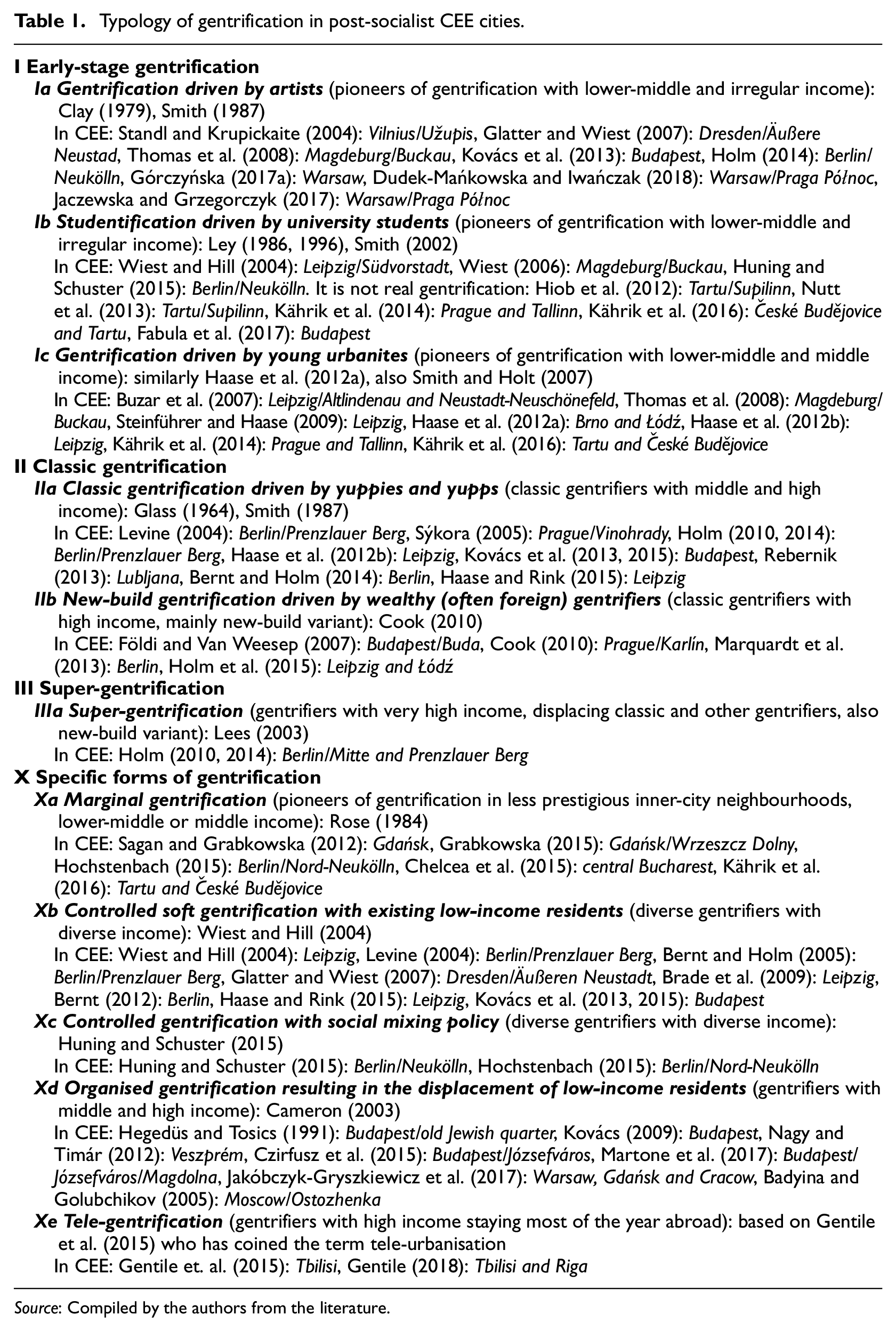
Source: Compiled by the authors from the literature.
Early-stage gentrification
Based on the published papers, three sub-types of early-stage gentrification can be identified in post-socialist cities. Gentrification driven by artists and other alternative lifestyle groups is less widespread in the region. An ideal type for this is the bohemian neighbourhood of Užupis in Vilnius (Lithuania), which was transformed by artists in the 1990s (Standl and Krupickaite, 2004). Similar processes were described in Berlin’s Neukölln by Huning and Schuster (2015), in Tartu by Nutt et al. (2013) and in Warsaw’s Praga Północ by Dudek-Mańkowska and Iwańczak (2018). Artists seek special architectural and historical milieus in cities with distinct ‘genius loci’ and affordable housing. They often contribute to a symbolic upgrading and increasing appreciation of inner-city neighbourhoods. Another branch of studies documented early-stage gentrification in the form of studentification driven by university students. The process is especially prevalent in East German cities (Huning and Schuster, 2015; Wiest, 2006; Wiest and Hill, 2004). In other CEE countries, university students have usually less influence on urban development and their moving into (mostly non-renovated) dwellings or sub-lettings in inner-city neighbourhoods does not necessarily result in displacement; however, they contribute to the rejuvenation of local society and a growing diversity of lifestyles and housing arrangements (Fabula et al., 2017; Grabkowska and Frankowski, 2016). Hence, students can serve as ‘gate-openers’ for the next wave of in-migrants, resulting in socio-economic upgrading and new housing developments.
Abundant evidence has been reported for the arrival of young, well-educated and childless people with lower-middle and middle incomes to East German, Czech, Polish and Estonian inner cities (e.g. Buzar et al., 2007; Haase et al., 2012a; Kabisch et al., 2010; Kährik et al., 2014, 2016). They are at the beginning of their professional careers, often without children, and they have no clear orientation towards places of work and residence in later stages of their lives. They originate from rural areas, small towns or suburban localities (Karsten, 2014; in Czechia, Kubeš, 2017), very often they occupy rental housing in slightly refurbished blocks, sometimes in the form of flat-sharing communities (Steinführer and Haase, 2009). For this group, Haase et al. (2012a) coined the term ‘transitory urbanites’. We classify the arrival of these people in inner-city neighbourhoods as early-stage gentrification driven by transitory urbanites, even though Haase et al. (2012a) hesitate to call this process gentrification, mainly because of their lower income level and uncertain housing career in the inner city. Yet, this transitory group of inner-city dwellers can cause the attention of investors to turn to existing rent gaps and they may pave the way for future in-migrants with higher socio-economic status.
Classic gentrification and super-gentrification
As Haase and Rink (2015) noted, ‘now, one can observe “ordinary” or “typical” gentrification in parts of the inner-city of Leipzig’. At the same time, Kovács et al. (2013) came to the conclusion that ‘gentrification in the traditional sense can be identified in the inner city of Budapest geographically only in smaller areas’. From the collection of papers, the conclusion can be drawn that classical forms of gentrification are also present in CEE, although this is not a dominant phenomenon and is concentrated mainly in cities in the fast-track transition countries in the north-western part of the region. Sýkora (1999a, 2005) identified high-income ‘foreign-oriented gentrification’ in inner Prague, which is a subtype of classic gentrification. Holm et al. (2015) recorded the same process in Łódź; Földi and Van Weesep (2007) or Kovács and Hegedűs (2014) in Budapest. Foreigners and also people returning home from long-term stays in Western Europe enlarge the group of gentrifiers (Holm et al., 2015). Another phenomenon closely related to classic gentrification is the development of new infills, upmarket condos and gated communities in central parts of CEE cities (Prague: Cook, 2010; Budapest: Kovács and Hegedűs, 2014; Warsaw: Górczyńska, 2017b; Kiev: Mezentsev et al., 2019). These new-build forms of gentrification often adjoin core areas of classic gentrification occupying vacant plots or brownfield sites. According to Ilík and Ouředníček (2007) and Cook (2010), after the devastating flood in 2002, Prague’s Karlín was quickly transformed into a modern, poly-functional neighbourhood with new luxury-housing enclaves. Cook (2010) classified this as ‘post-socialist creative destruction and the production of luxury’. The process was organised by foreign developers with the support of the district municipality and it was intended for wealthy (mostly Western) managers. On the basis of the literature, it can be noted that newbuilds are the most frequently described form of gentrification in post-socialist cities.
The housing shortage in Berlin, the re-establishment of the city’s position in the national and global urban network as well as the gradual rent deregulation resulted in various forms of classic gentrification, and even super-gentrification driven by super-gentrifiers in two inner-city neighbourhoods: Mitte and Prenzlauer Berg (Holm, 2010, 2014). In both neighbourhoods luxury housing became prevalent after 2005 mainly because of the abolition of administrative restrictions on new housing construction that resulted in the burgeoning of up-market housing enclaves. These new building projects attracted high-income super-gentrifiers (i.e. top-managers of larger companies, prominent stars from the art and film scenes) to the areas, pushing out pioneers and less-affluent gentrifiers who had moved in in the 1990s.
Specific forms of gentrification
The proliferation of renewal activities and the increasing interest of middle-class people towards inner-city housing have produced a diverse set of population changes in CEE cities. The term ‘marginal gentrification’ was originally coined to describe the increasing concentration of lower-middle- and middle-income inner-city-oriented people in less prestigious neighbourhoods affected by minor renovations (Rose, 1984). Marginal gentrifiers bring a limited socio-spatial shift but significant cultural changes. The process was described for central Bucharest (Chelcea et al., 2015) and second-tier Polish cities (see, e.g. Grabkowska, 2015; Sagan and Grabkowska, 2012), but it seems to be widespread in other cities as well (see Kovács et al., 2013, for Budapest; Hochstenbach, 2015, for Berlin’s Nord-Neukölln; or Kährik et al., 2016, for Estonian and Czech second-tier cities).
The considerable oversupply of apartments in East German cities as a result of the exodus of people to West Germany and to the suburbs in the 1990s, coupled with large central-state subsidies for regeneration, resulted in the process of controlled soft gentrification, where low-income residents were also enabled to stay in their neighbourhood after renovations (Wiest and Hill, 2004). In the case of Berlin, where there was no oversupply of apartments, a specific controlled gentrification with social mixing policy prevailed (Hochstenbach, 2015; Huning and Schuster, 2015). Both of these processes have been embedded in place-specific contexts, including local government arrangements and abundant central-state subsidies, therefore they can be considered uniquely German within the region.
Some socially marginalised and physically deprived inner-city neighbourhoods in Budapest, Łódź and other Polish cities became the targets of early regeneration projects organised by local governments (Földi and Van Weesep, 2007; Holm et al., 2015; Kovács, 2009). These interventions aimed primarily at the physical renovation of the built environment, including the demolition of poor-quality housing and the construction of new. The upgrading process was coupled with long-term low-income residents being replaced by younger and better-off people. The first signs of organised gentrification with the displacement of low-income residents were described by Hegedüs and Tosics (1991) in one of the inner-city quarters of Budapest, where the city administration started the rehabilitation even before 1990. Later, as Kovács et al. (2013) noted, state-led gentrification projects organised by district governments became widespread in Budapest.
Gentile et al. (2015) described tele-urbanisation as a remote-controlled urban transformation process when affluent Georgians residing in Russia, Germany or the USA invest in inner-city apartments in Georgian Tbilisi but use these apartments only occasionally. In this case diaspora capital produces urban growth with new buildings on vacant or under-used plots in inner-city locations, signalling to domestic and global capital the possible exploitation of a rent gap. A similar process has been described by Gentile (2018) for the Latvian capital Riga, where rich Russians acquire inner-city apartments as a form of investment, also safeguarding their free travel within the Schengen area. Consequently, the process was labelled as ‘Schengtrification’ and it shares some similarities with tele-urbanisation because it involves real estate transactions where the ‘gentrifier’ does not always show up. Both tele-urbanisation and ‘Schengtrification’ can be labelled as tele-gentrification. Given the income gap between East and West, the extension of the EU after 2004 inevitably contributed to the process of inner-city renewal and gentrification in CEE cities as citizens of the EU core-countries obtained unlimited rights to property. Kovács et al. (2013) highlighted the role of Spanish, British and Irish citizens as investors in the housing market of Budapest in the 2000s. Expats and foreigners invest their money mainly in new-build projects for the sake of long-term profit rather than exploiting rent gaps and they barely cause displacement; nevertheless, they contribute to the upgrading and subsequent gentrification of neighbourhoods.
Discussion
Even though theories that apply to Western cities have obvious limitations in CEE (Ferenčuhová, 2016; Ouředníček, 2016; Ouředníček and Pospišilová, 2016), the concept of gentrification can provide a good starting point for studying post-socialist urban transformation (Lees, 2000). After the fall of the Iron Curtain, researchers in CEE expected a rapid convergence of urban development patterns toward a Western model, assuming that the introduction of a market economy and liberalisation would inevitably lead to the appearance of urban spatial phenomena (e.g. gentrification) similar to the West (Enyedi, 1998; Szelényi, 1996). However, in the 2000s a growing number of papers reported a diverse set of gentrification-like processes (Bernt et al., 2015) and hybrid spatialities in the region (Golubchikov et al., 2014; Marcińczak and Sagan, 2011) challenging the convergence hypothesis. The variegated forms of urban change described above are the result of historical legacies, path dependencies and a set of factors embedded in local contexts.
Preconditions
The causal factors outlined in the section ‘Preconditions and driving forces of gentrification in post-socialist CEE cities’ played a different role in the unfolding of gentrification in these countries. The long-term neglect and concomitant physical decline produced vast dilapidated areas in inner cities that offered an exploitable rent gap and good ‘opportunities’ for gentrification. However, privately financed renovation activities became possible only after the re-establishment of land markets. Regarding property transfer, privatisation to the sitting tenants prevailed in the region, with the exception of East Germany and partly Czechia (see Sýkora 1996, 1999a, 1999b). This resulted in a housing tenure dominated by owner occupation in most of the countries; a Western-style rental market, except for East Germany, remained absent. As illustrated by Kovács et al. (2013) the predominance of owner occupation in the housing market, accompanied by the levelling-out policies of local governments, could prevent mass displacement of long-term residents in the inner city of Budapest. Low levels of residential mobility and the limited access of real-estate developers to the existing housing stock also slowed down the process of reinvestment and the invasion of middle-class households to inner-city neighbourhoods. The re-establishment of mortgage markets was also an important prerequisite for renovation, which took place overnight in East Germany, progressed with some delay in the fast-track transforming countries (Visegrad Countries and the Baltic States) and remained underdeveloped in countries in the Balkans or the former Soviet Union. Thus, the conditions for gentrification were fairly dissimilar and uneven within the region, which also had an impact on the dynamics of gentrification.
Actors
Before 2000 the unfolding of gentrification in CEE was hindered by the lack of classic gentrifiers, that is, inner-city-oriented, rich middle-class people whose residential preferences and investment decisions could have facilitated gentrification. The slow pace of class remaking, and the relatively low level of income differences, significantly narrowed the pool of potential gentrifiers. Instead, less affluent groups such as ‘transitory urbanites’ (Haase et al., 2012a, 2012b; Kabisch et al., 2010) or students became relevant actors at inner-city locations, enabling marginal forms of gentrification. Other groups associated with gentrification in the West, such as bohemian pioneers, young professionals employed in FIRE (finance, insurance and real estate) and other business services, super-rich financiers or ethnic minority gentrifiers, were, by and large, missing.
Local governments have also been important actors of urban renewal and gentrification in post-socialist cities. Many local governments were inspired by Western urban strategies and tried to transform physically neglected and socially problematic inner-city neighbourhoods through regeneration projects. The result was very often the involuntary relocation or displacement of local residents in the form of state-led, organised gentrification (e.g. Czirfusz et al., 2015; Jakóbczyk-Gryszkiewicz et al., 2017; Kovács, 2009; Martone et al., 2017; Nagy and Timár, 2012). Important actors of gentrification – especially after EU Accession – were foreign people. They are typically well-paid Western managers and members of the creative class who possess higher incomes than the local residents and are able to pay much higher rents. They also tend to seek new living forms and increase the demand for luxury housing (see Cook, 2010; Földi and Van Weesep, 2007; Sýkora, 1999a, 2005). As a result of the growing presence of expats living in the West, the process of tele-gentrification has also been documented (Gentile, 2018). Capital investments by the diaspora, for example for second-home or Airbnb purposes, resulted in rapidly rising apartment prices in the inner parts of CEE cities. The price of 1 m2 of a new apartment in the centre of Ljubljana, Prague and Tallinn, is three-quarters of the level of Brussels, and it is about half in Warsaw and Budapest (Deloitte, 2017). The increasing income and wealth differences have even brought about the formation of upmarket residential areas with ‘elegant’ and ‘expensive’ residences after 2000: examples are Mitte and Prenzlauer Berg in Berlin (Holm, 2010, 2014), Vinohrady, Dejvice and Karlín in Prague (Sýkora, 2005), the Buda Hills in Budapest, or Powiśle in Warsaw (Jakóbczyk-Gryszkiewicz et al., 2017).
Types
On the basis of the literature, a proliferation of the marginal forms of gentrification can be identified in post-socialist cities (Haase and Rink, 2015; Holm et al., 2015; Kovács et al., 2013). In the early 1990s Sýkora (1993) reported on an ‘embryonic stage of gentrification’ in central Prague, when only some houses in a neighbourhood were renovated and occupied by (mainly foreign) gentrifiers, and somewhat later about ‘selective gentrification’ (Sýkora, 2005) when only a few blocks owned by real estate companies went through regeneration and subsequent population change. Marcińczak (2007) and Galuszka (2017) detected ‘façade gentrification’ along the main streets of Łódź. Kovács et al. (2013) and Jakóbczyk-Gryszkiewicz et al. (2017) described ‘pocket gentrification’ in Budapest and in some Polish cities, respectively, while Chelcea et al. (2015) wrote about ‘patchy gentrification’ in Bucharest. However, since 2010, as a result of economic consolidation, an intensifying class division and capital accumulation, the classic form of gentrification has become more dominant in the inner-city neighbourhoods of post-socialist cities. As gentrification has spread outwards from the inner city, several authors have found evidence of the operation of Smith’s (1979) rent gap in the peripheral parts of these cities, for instance in the apartment blocks of Warsaw erected during state-socialism (Jakóbczyk-Gryszkiewicz et al., 2017) or in the renovated prefab blocks of inner-city housing estates built during socialism in Tartu or České Budějovice (Kährik et al., 2016; Kubeš, 2017). Even the peculiar ‘villa gentrification’ was found in the pre-war prestigious villa neighbourhoods of inner Prague (Dejvice: Sýkora, 1999a) and Budapest (Buda: Brade et al., 2009; Földi and Van Weesep, 2007).
Among the various forms of gentrification in post-socialist cities, new-build gentrification deserves particular attention because of its frequency. It has been identified in all CEE inner cities – in Berlin (Holm, 2010), Warsaw (Górczyńska, 2012; Jaczewska and Grzegorczyk, 2017), Prague (e.g. Cook, 2010), Budapest (e.g. Kovács et al., 2013), Ljubljana (Rebernik, 2013), Vilnius (Brade et al., 2009), Moscow and St Petersburg (Axenov, 2014; Badyina and Golubchikov, 2005) or Kiev (Gentile, 2018; Mezentsev et al., 2019). Generally, this type of gentrification appears as a consequence of long-term neglect and subsequent demolition. Prestige projects of new office or shopping malls realised in inner cities can serve as magnets for new housing investments in their surroundings (Loftman and Nevin, 1995; Temelová, 2007).
Conclusions
The rapidly changing social and power relations in post-socialist cities gradually manifested themselves in transformations of the built environment after 1990. One of the main processes of post-socialist urbanism was urban renewal and gentrification. The bulk of the literature reviewed in this paper associates the process of inner-city upgrading and population change with similar processes of North American and West-European cities (e.g. Brade et al., 2009; Földi and Van Weesep, 2007; Glatter and Wiest, 2007; Kovács, 2009; Kovács et al. 2013, 2015; Murzyn, 2006; Standl and Krupickaite, 2004; Sýkora, 2005). However, the very diverse processes described by these papers as ‘gentrification’ only partially resemble the classic examples of London or Lower East Side/New York. This is due to the specific ‘post-socialist conditions’, including the long-lasting neglect of inner cities under socialism, the post-socialist way of restitution and privatisation of housing, the limited amount of capital both in the hand of potential gentrifiers and domestic real estate developers.
CEE countries and their cities have started the post-socialist transition with different conditions, and the speed and direction of changes have also exhibited notable differences. These circumstances led to an uneven development of gentrification within the region. Cities of the former East Germany transformed faster than other cities in the region thanks to the mass capital transfer from West Germany and to the rapid involvement in European and global flows of capital (Holm et al., 2015). The proximity to the core regions of Western and Northern Europe has favourably affected the regeneration and upgrading of Czech, Polish and Hungarian cities and also the transformation of cities of the Baltic States. Most of the studies describing physical regeneration and gentrification in post-socialist cities come from these countries, whereas papers on Southern and Eastern European cities are not so frequent. This also applies to studies on second- and third-tier provincial cities, which means that gentrification on lower levels of the urban hierarchy remains largely unexplored. Analysis of research results also shows that the classic stage model of gentrification (Hackworth and Smith, 2001) related to global economic and political restructuring in the 1970s and 1980s cannot be used in the assessment of gentrification in CEE cities. This is partly because the process is still in its early phase in some of the countries, and partly because several hybrid forms (Bernt, 2016; Golubchikov et al., 2014) of gentrification-like processes hide the spatial effects of market-based renewal. The numerous modifications of gentrification are not so much a sign of backwardness but they call for the contextualisation of the process. Regarding the temporal dynamics of gentrification, we can say that even though the financial crisis of 2008 slowed down capital reinvestment in the inner cities of CEE, narrowing the room for gentrification, the recent economic upswing in the region suggests that the tempo of gentrification will speed up considerably in the coming years. On the basis of ongoing globalisation, growing income disparities and increasing polarisation within these societies we can also assume that marginal forms of gentrification will be replaced by more mature versions of classic gentrification, and even super-gentrification in the future (e.g. Marcińczak et al., 2015; Tammaru et al., 2016).
The works reviewed in this paper have contributed to a better understanding of post-socialist urban transformations, yet, more research is needed to scrutinise the essence of gentrification in this region. At least three avenues for future research on gentrification in post-socialist cities seem to be relevant on the basis of the literature. First, the impacts of gentrification on contemporary segregation patterns of post-socialist cities need to be clarified. Gentrification in its initial phases often results in greater diversity and mixing among various social groups as higher social groups start to move into formerly working-class neighbourhoods. This has already been reported in some of the literature (Fabula et al., 2017; Tammaru et al., 2016). But desegregation effects soon disappear once gentrification reaches a more mature phase, and this aspect deserves more attention in the future. Second, although several studies mentioned the process of displacement in, for example, Berlin (Bernt and Holm, 2009; Helbrecht, 2018), Prague (Kostelecký et al., 2012) or Budapest (Czirfusz et al., 2015; Kovács et al., 2015) little has been said about its extent, the underlying mechanisms, the role of local governments and the destiny of displaced people. In this respect the discriminatory effects of urban renewal policies on marginalised groups (e.g. Roma) deserve particular attention. Finally, future research should also shed light on the role of political activism and possible resistance to gentrification in CEE. The current state of the research calls for more empirical analyses with a comparative perspective. Only then can the kaleidoscope of gentrification in post-socialist cities be better understood.
Footnotes
Declaration of conflicting interests
The author(s) declared no potential conflicts of interest with respect to the research, authorship, and/or publication of this article.
Funding
The author(s) disclosed receipt of the following financial support for the research, authorship, and/or publication of this article: This research was supported by the Hungarian Scientific Research Fund (OTKA) grant agreement K119710, the Ministry of Human Capacities, Hungary grant agreement 20391-3/2018/FEKUSTRAT, and the Ministry for Innovation and Technology, Hungary grant agreement TUDFO/47138-1/2019-ITM.
