



Abstract
China’s Mid-Yangtze River city region (MYR) has been designated as a national strategic growth region intended to reverse the slow-down in economic transition. However, there has been a lack of attention to the internal spatial organisation of the region’s growth capacity associated with its inter-city relations. This article combines an urban network approach and a spatial econometric framework to not only examine the local contribution to growth of MYR cities’ indigenous factors, cross-territorial flows and positions in the regional capital network, but also to estimate their spatial spillovers. The analysis sheds light on the interplay between spatial proximity and network capital in the regional growth process. Recent growth is found to be significantly influenced by indigenous capital stock, labour cost and technological advances, by commodity and self-investment flows, and by ‘authority’ and ‘hub’ network capital, associated with coexisting endogenous and exogenous spillovers. The findings infer that institutional capacity in organising endowment mobilities will be important for policy to promote coordinated development.
Introduction
Chinese urbanisation is currently characterised by three ‘mega-city regions’ of a population size, physical extent and economic weight that makes them some of the largest in the world: the Pearl River Delta (PRD), Yangtze River Delta (YRD) and Beijing-Bohai Rim ‘Jing-Jin-Ji’ (JJJ) (Derudder et al., 2013). Recognised for their increasing integration in the world economy and emergent internal functional interlinkages, as Scott (2001) articulated, such densely urbanised regions have become ‘strategically crucial geographical arenas’ in the global economy (Brenner and Theodore, 2002: 349).
With rising labour costs and competition from other emerging economies, China’s overall growth has been slowing down, making transition from a capital-driven to an advanced, more resilient, economy through the expansion of added-value activities critically important (Zhang and Kloosterman, 2016). However, the current concentration of these activities in the three coastal mega-city urban constellations is increasing regional disparity (Meng et al., 2005). Consequently, policy articulated in China’s recent 12th Five Year Plan focused on the development of inland regions to stabilise the transition process and recharge the slowing economy (China State Council, 2011).
In this context, the central China Mid-Yangtze River city region (MYR), comprising the Hubei, Hunan and Jiangxi Provinces (see Figure 1), has been designated China’s ‘strategic growth region’. This decision reflected the region’s established industrial base, well-developed infrastructure, higher education and well-qualified labour, coupled with its advantageous location proximate to the YRD and PRD regions (Wang et al., 2013). Since the 2008 financial crisis, MYR has maintained a double-digit growth rate in contrast to overall national decline (National Bureau of Statistics of China (NBS), 2014). The strategic significance of MYR in China’s economic transition has been reinforced institutionally by several national policies that highlight inter-city synergies as key goals to promote its economy, reflecting European research emphasising the need to build institutional ‘organising capacity’ to counter regional territorial fragmentation (Meijers and Romein, 2003).
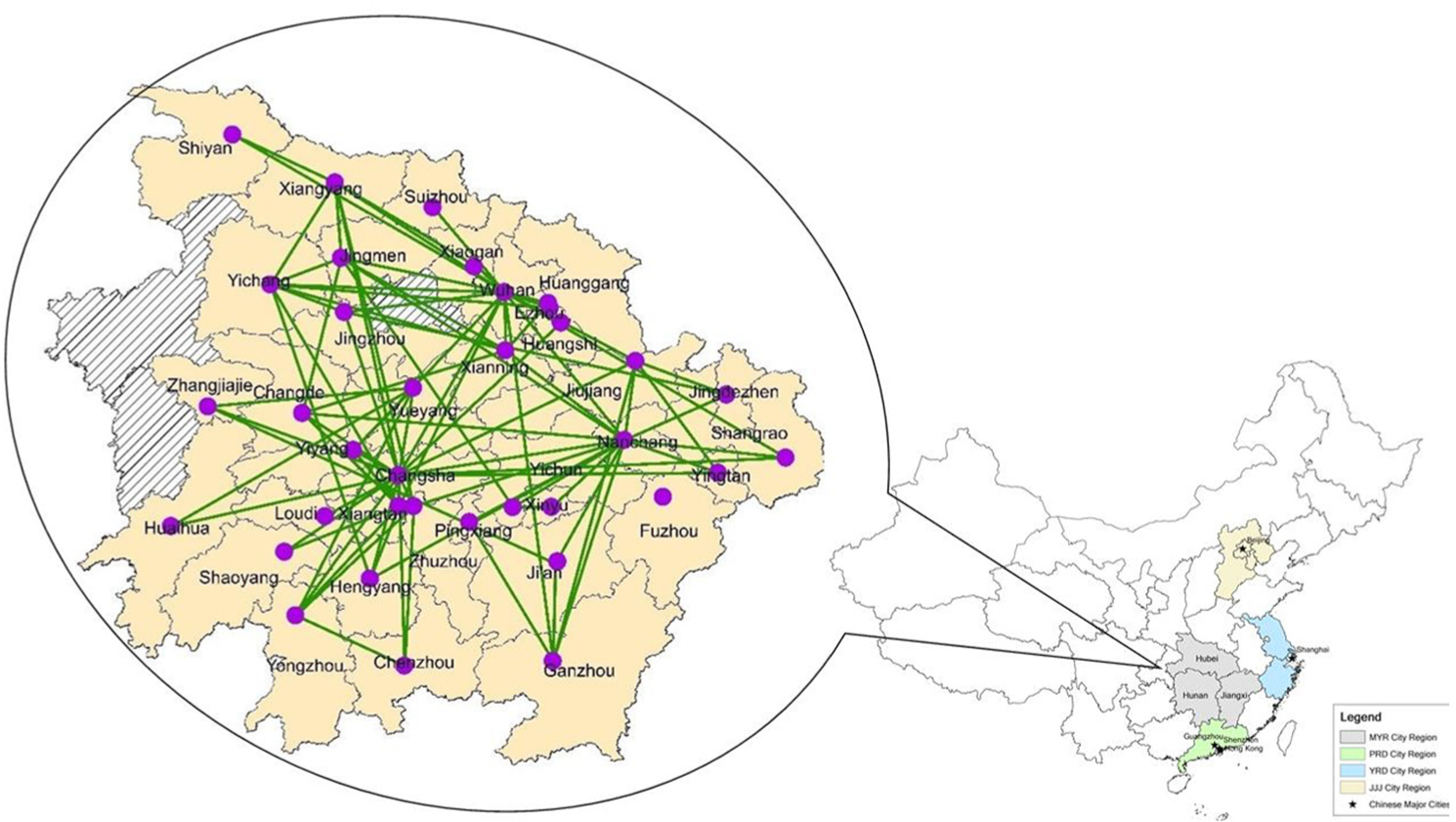
Inter-city capital network overlaid on the MYR region Geo-map.
However, in contrast to the coastal regions, empirical studies investigating the underlying spatial economic configuration of MYR have been limited, leaving a research void to be filled. As Zhang and Peck (2016) demonstrated, China’s developmental path is characterised by heterogeneous regional models (see Wen, 2014). Consequently, more in-depth studies of specific regions are needed to disentangle the heterogeneity in China’s growth. Analysing the MYR growth configuration can shed new light on an inland city region development model that has relevance for policy to facilitate economic transition and spatial rebalancing. Furthermore, most studies of Chinese urban growth have used the ‘Ha-Howitt’ model which highlights the effects of labour pool, capital stock, natural resources and technology (Ha and Howitt, 2007) but overlooks the spatial configuration of inter-city relations associated with flows of labour, goods, capital, etc. in the urban network paradigm (Pain et al., 2016; Van Oort et al., 2010).
A large literature has emphasised the critical importance of such flows in interconnecting and creating synergies between cities in the contemporary networked economy and also the contribution of network embeddedness to growth (Batten, 1995; Boschma, 2004; Castells, 1996; Coe and Yeung, 2015; Huggins and Johnston, 2010; Huggins and Thompson, 2017; Scott, 2001; Taylor et al., 2002). Moreover, some studies have suggested that cities’ network embeddedness associated with local agglomeration could give rise to a networked agglomeration economy (Capello, 2000; Meijers et al., 2016), leaving a complex underexplored area for further regional analysis. Changes in the Chinese economy associated with the rise of its city-focused knowledge economy, make the spatial configuration of city region network relations an important consideration to inform development policy as already demonstrated by Chinese national urban network analysis (see Shi et al., 2019). However, regardless of increasing inter-city network analysis studies in China, most of these studies solely utilised inter-city flows to investigate dynamic inter-city connectivity and hierarchical urban networks, while neglecting the effect of established networks and their spatial association with regional growth.
The overarching question addressed in this article is thus: What is the interplay between spatial proximity effects and flow network effects in the MYR space economy? This question will be informed by the investigation of two specific empirical research questions:
(1) Is MYR regional growth characterised by spatially coordinated or fragmented city interrelations?
(2) Do MYR inter-city flows and city network positions play a role in the region’s economic growth?
To investigate these questions, we adopt a two-stage approach: first, the network performance of MYR cities is measured using Mergers & Acquisitions (M&A) deals as a proxy for regional capital flows for reasons to be elaborated in the following review of relevant literature; second, the subsequent effects of city network embeddedness and spatial associations are examined in a regional growth model.
The analytical contribution of this article hinges on complementing the classic urban growth model through novel investigation of the spatial organisation of inter-city capital network flows significant for regional growth, using a spatial econometric framework and a network analysis approach. Theoretically, it informs discourse in the urban network literature on the conceptualisation of spatial network capital interlinking agglomeration and network economies by a two-way mechanism. The results are anticipated to inform policy evaluation of the MYR ‘growth region’ designation and to also contribute to comparison with city regions in China and internationally, and policy innovation.
The article first reviews theoretical contributions to existing literature relevant for our empirical framework for the investigation of spatial proximity effects and flow network effects, and their relevance for city region growth. Second, the data, variables and a Spatial Network Growth (SNG) model to be used in analysis, are specified. Third, the results from the inter-city network analysis and the SNG model are presented. Fourth, the results are discussed with theoretical observations. Finally, policy implications for MYR regional development are considered.
Review of relevant literature
The relevance of spatial proximity effects for city region growth
The conventional urban growth model assumes the independence of spatial units and highlights the importance of indigenous input factors for local growth (see Ha and Howitt, 2007). However, with deepening globalisation and technological advances, intensifying multi-directional heterogeneous flows and their dynamic re-organisation have contributed to the change from the global ‘space of places’ to a ‘space of flows’ (Alderson et al., 2010; Castells, 1996). Therefore, in order to unravel the spatial configuration of MYR growth, two empirical trajectories are required: a spatial econometric framework to allow analysis of the extent to which city region growth remains proximity-dependent and a network capital framework to investigate the extent to which the city region is characterised by distance-free flows.
The ongoing 21st century relevance of proximity for space economy conceptualisation has been much explored in social, organisational, business, cognitive, temporal, etc. contexts and applied in economic geography by various authors (notably Boschma, 2005). However, given the empirical focus of the present article on specific network capital flows between MYR cities as opposed to its position in the wider ‘world city network’, geographical proximity specifically is relevant for our analysis as illustrated in European comparative intra-regional studies (see Pain and Hall, 2006).
Despite predictions of the ‘death of distance’ (Cairncross, 2001) associated with the internet and telecommunication advances, a wealth of research has pointed to the continuing relevance of a geo-spatial rationale in which the intensity of inter-city relations is proportional to geographical distance for diverse economic activities where market participants require proximity as rational utility maximisers (Miller, 2004). Research informing the city network literature has demonstrated that, in the contemporary knowledge-based economy, spatial proximity is significant for business value-added activities and that associated spatial clustering is an important way in which firms attain valuable knowledge (Cook et al., 2007; Pain et al., 2016; Sassen, 1991). Agglomeration allows economic actors access to privileged information flows, knowledge transfer and interactive learning (Autant-Bernard and LeSage, 2011; Bathelt et al., 2004; Boschma, 2005). This principle not only has relevance for cities but also for city regions, since cities that are physically proximate to each other may be characterised by interactions that are advantaged by time–cost reductions and which, in turn, shape the pattern of development as an outcome (Pain and Hall, 2006).
Associated with advances in GIS techniques and computational technology, the use of spatial econometric modelling has become prevalent in studies of spatial interactions in standard economic models. The spatial econometric model argues that economic growth not only depends on cities’ indigenous factors but also on their neighbouring cities’ performance via spatial interactions. Numerous studies have provided empirical evidence on the significance of spatial proximity in facilitating regional development (e.g. Autant-Bernard and LeSage, 2011; Fingleton and López-Bazo, 2006; Parent and LeSage, 2012; Van Oort, 2007). Associated with China’s policy aims to promote inter-city coordinated development, spatial dependence has been investigated and found significant in Chinese empirical studies at province level (LeSage and Sheng, 2014; Ying, 2003), at city level (Tian et al., 2010; Wen, 2014) and within a specific radius (Ke, 2010). Furthermore, Tian et al. (2010) found that in contrast to the east and the west, cities in the centre of China, including MYR cities, showed faster economic convergence.
However, the investigation of inter-city spatial dependence at a city region scale in China has been restricted to the three developed coastal regions (Wen, 2014). In the context of existing literature above, investigation of spatial dependence across inland MYR cities has thus far been limited. Consequently, this article employs spatial econometric modelling to shed light on the MYR growth regime and also contribute to the development of Chinese heterogeneous regional model analysis (Zhang and Peck, 2016).
The relevance of flow network effects for city region growth
Technological breakthroughs have greatly reduced the costs of overcoming spatial constraints, vividly reflected by virtualised business services and capital financialisation. The circulation of these virtual services and financialised capital is generating a complex network space full of multi-directional heterogeneous flows connecting separate markets with fewer spatial constraints. Intertwined with deepening globalisation and worldwide competition, city regions are rising as dynamic local networks of economic interactions (Scott, 2001), making network thinking necessary to understand evolving regional development patterns (Alderson et al., 2010; Capello and Camagni, 2000; Johansson and Quigley, 2004; Van Oort et al., 2010).
The rationale for the network framework reflects a vast literature exploring inter-city network relations based on diverse kinds of flows at different spatial scales, for example, people, maritime and air traffic, information, finance, production, trade, etc. (e.g. Meijers et al., 2016; Neal, 2010). Network analysis has included measurement of flow volumes and morphological co-location patterns (Bathelt et al., 2004; Crevoisier and Jeannerat, 2009) and city global positionality in advanced producer services (APS) (Derudder et al., 2010; Taylor et al., 2002). Significant for the present analysis, network thinking allows constraints and opportunities associated with how cities are positioned in a regional city network spatial structure constructed by flows that are less distance-dependent to be explored. However, while city global network connectivity may generate valuable insights for leading global city regions, this is not the case for ‘less obvious’ city regions with a lower representation of global APS firms (Brown et al., 2010) such as MYR. Furthermore, the effect on urban growth of city network positionality that is conferred by the multi-directionality and interlocking effects of cross-territorial flows has received little attention (Huggins and Thompson, 2017).
Accordingly, the notion of ‘calculative’ network capital (see Huggins and Johnston, 2010; Huggins and Thompson, 2017; Smith et al., 2012) can contribute to understanding of the role of network positionality in regional development. The discourse articulates that a network is not just one kind of structure but is also a strategic resource generating ‘actual profit’ for connected participants. In contrast to conventional network capital analysis based on social capital, for example, social interactions, temporal events and informal contacts (see Inkpen and Tsang, 2005; Storper and Venables, 2004), this kind of network capital is calculated according to the embedded positions held by participants interlinked by formal long-term partnerships in flow networks. Undoubtedly, cities are the crucial spaces where flows associated with network linkages are circulating actively and translating into city network capital. Huggins and Thompson (2017) emphasised the spatial implications of inter-organisational knowledge flows conferred on city region development and discovered the significant contribution of network capital conferred by such flows to city region growth. Thus, after aggregating these cross-territorial flows, cities can be regarded as network nodes constructing an inter-city network imbued with cities’ network capital.
Chinese cities’ network capital has been calculated by analysing formal partnerships at an organisational level (Luo and Shen, 2009), APS office network connectivity (Derudder et al., 2013; Taylor et al., 2014), and social contacts (Tung and Worm, 2001). However, these studies did not estimate the effect of city network positions on regional growth by referring to the network capital discourse. Following network capital thinking, Shi et al.’s (2019) investigation of the association between the domestic investment network and urban attractiveness to foreign direct investment for the whole of China found that city network positions in the domestic investment network could enhance urban attractiveness to foreign investors. Therefore, in line with Huggins and Thompson (2017) and Shi et al. (2019), this article, focusing on intra-regional analysis, not only identifies city positions in flow networks but also tests the effects of these network positions on MYR growth.
Spatial network capital: The link between proximity and network effects
As discussed in the previous two sections, a rich literature has revealed the significance of spatial proximity and network flows in explaining urban dynamics. Undoubtedly, recognising the juxtaposition of city proximity agglomeration effects together with inter-city network flow effects in regional analysis can assist attempts to disentangle the ‘multiplexity’ of the contemporary networked agglomeration economy, regardless of potential trade-off effects (Meijers et al., 2016; Van Meeteren et al., 2016). Although Huggins and Thompson (2017) and Shi et al. (2019) examined the spatial implications of network capital, investigation of the relationship between proximity agglomeration and network capital is limited to a one-way linkage from urban network embeddedness to local growth, which neglects the potential two-way interaction between the two mechanisms. The present analysis combines urban network analysis and a spatial econometric model to test the potential regional spatial spillovers of city network capital, extending the conceptualisation of ‘network capital’ to ‘spatial network capital’ at a regional level. In other words, the MYR economy may be affected not only by its component cities’ network embeddedness indicated by their network positions but also by spatial spillovers from their neighbouring cities.
Additionally, as Burger and Meijers (2016) pinpointed, the effect of network positionality on urban growth depends on heterogenous economic, institutional and spatial contexts, demanding ‘a place-based’ research perspective. The city region scale provides a geographical arena to examine the interplay of the spatial proximity and network capital effects in regional growth. First, city regions are normally comprised of a group of proximate cities that are coordinated by functional linkages and benefit from agglomeration economies (see Pain and Hall, 2006; Huggins and Thompson, 2017; Wen, 2014). Second, in contrast to analysing individual cities or metropolitan areas, the city region scale provides a larger space to accommodate less distance-dependent flows. Third, city regions, especially those under the same institutional planning scheme, require less heterogeneity to be controlled for in quantitative analysis.
In conclusion, this article speculates that proximity and network effects are interactive, creating a functionally networked MYR economy. However, studies investigating the two-way link of proximity agglomeration and network capital in city region development are deficient. The present analysis fills this gap by illustrating both spatial and functional integration processes and potential MYR urban complementarities which could allow the spread of agglomeration economies constituting regional network economies (Meijers et al., 2016).
Recognised as a source of virtualised and financialised capital flows, M&A deals are selected as the flow metric used in analysis for the following reasons. First, in network space, compared with greenfield investments that create an intra-firm corporate hierarchy, M&A deals more explicitly reflect underlying long-term interactions with external entities, for example, elite, information, technology exchange and management mode learning, etc., and thereby spread innovation (Lee and Lieberman, 2010; Shultz, 2007). Second, M&A deals could change the pattern of business networks since they have interlocking effects on third parties and distant actors, such as the involvement of local business services, transcending solely acquirer–target bilateral relationships (Havila and Salmi, 2000). Third, regardless of deepening capital financialisation, spatial proximity plays a significant role in distributing M&A capital flows especially in relation to corporate asset diversification (Ellwanger and Boschma, 2015), mostly resonating with city region boundaries (Rodríguez-Pose and Zademach, 2003). By using M&A data as a metric, the analysis can estimate the role of network capital in city region growth and the potential for the emergence of network economies at a regional scale.
Method and data
Calculation of network variables
To address the overarching research question, the analysis employs a two-stage approach to unveil the underlying MYR spatial network economy. First, the network capital variables are measured by reference to authority, hub and closeness network attributes. These network measures are then specified in an SNG model developed in the research, in order to examine their effects on MYR growth and their subsequent spatial spillovers.
The Hyperlink-Induced Topic Search algorithm (HITS) (Kleinberg, 1999) is used to estimate cities’ authority and hub positions in the network. In contrast to conventional calculations, for example, betweenness and eigenvalue, HITS assigns extra weight to linkages that connect to authority or hub cities. Therefore, city nodes with few linkages may also be authoritative if their linkages are with important hubs, and vice versa. In the inter-city capital network, a high hub score indicates the cities’ advantages in interlinking other cities, while a high authority score indicates a city’s attractiveness to its counterparts. Authority and hub values are computed through iterative mutual recursion to the convergence between hub and authority weights (the stopping criterion used is 0.0001). Formally, the authority score


Iterations are updated as:

where A is the adjacency matrix of focused subgraph G;
Closeness

where d(y, x) is the shortest functional distance between city x and all other cities y.
Model specification
The baseline growth model is based on linear Cobb-Douglas production function, specified as:

where
However, cities’ development has become interdependent because of the increasing intensity of cross-territorial interactions. According to the extent of dependence on distance, cross-territorial interactions are classified into two forms: proximate interactions from neighbouring entities and distant flows
1
from non-neighbouring entities. The form of proximate interactions is technically estimated by spatial econometric modelling. Following LeSage (2014)’s advice on selecting spatial model specifications, the Spatial Durbin Model (SDM) is favoured as a departure to improve model flexibility and secure unbiased estimates. Post-testing
2
also justified the selection of SDM in specifying the present SNG model to capture unobserved spatial effects omitted in non-spatial models. The form of distant interactions is represented by human, commodity and capital flows. Additionally, as the network capital discourse highlighted, network positionality generated by capital flows is a strategically advanced resource, so the SNG model also incorporates network position variables

where
As a result of the feedback effects that arise as a result of impacts passing through neighbouring cities and back to the cities themselves, the coefficient β in SDM specification cannot be interpreted as direct effects that X makes on Y (Elhorst, 2014). Thus, direct and indirect effects are reported by transforming the matrix of partial derivatives of Y (see Appendix B).
In this analysis, the spatial contiguity matrix W is a binary matrix defined by rook contiguity criterion, 5 formally written as:

where
Data
The data are drawn from the NBS, 6 Zephyr database and the State Intellectual Property Office of China (SIPO). The sample includes 36 prefecture cities in the Hubei, Hunan and Jiangxi provinces between 2004 and 2014, forming a balanced panel sample. Cities’ GDP is used as a proxy for output, while investments in fixed assets, wages and authorised patents are used to indicate capital stock, labour cost and technological advances, respectively. Additionally, human and commodity flows are measured by the volume of passengers and freight, respectively. Cross-territorial M&A deals 7 are sourced from Zephyr to proxy inter-city capital flows and calculate network capital variables. The key criterion for inclusion of deals is that they involve the transfer of a business in the M&A process. Consequently, 1327 M&A deals during the period within the MYR are geographically coordinated to identify both source city nodes and destination city nodes, organised into 1-mode network matrices 8 (see Figure 1). Thus, Capital Inflows, Capital Outflows and Capital Self-flows are represented by the total number of investments a city receives from other cities, the total number of outward investments of a city to other cities, and the total number of investments occurring within a city’s boundaries, respectively (i.e. the diagonal of the 1-mode network), while the Hub, Authority and Closeness variables are measured as specified in the last section (the descriptions of variables are listed in Appendix Table A1).
Results
The results are presented here according to the sequence of the two-stage analytical approach. First, the MYR cities’ variation in economic output and their performances in the regional capital flow network are illustrated to inform the general pattern of the MYR spatial network economy and to also specify network capital variables incorporated in the second stage of the analysis. Second, the SNG model results are presented by examining the effects of the network variables specified, in order to answer the two empirical research questions.
Spatial distribution
The results on the spatial surface of regional economic performance are illustrated in Figure 2 by means of a Triangulated Irregular Network (TIN) technique. 9 It can be seen that the GDP variation across neighbouring cities is more pronounced than expected, reflected by terrain plateaus, valleys and plains. The economic output is spatially concentrated in Wuhan city in the north, Changsha city in the centre, Nanchang city in the east and Yichang city in the north-west. In conclusion, an uneven TIN surface indicates apparent disparity across territories and a multi-centric MYR regional development pattern.
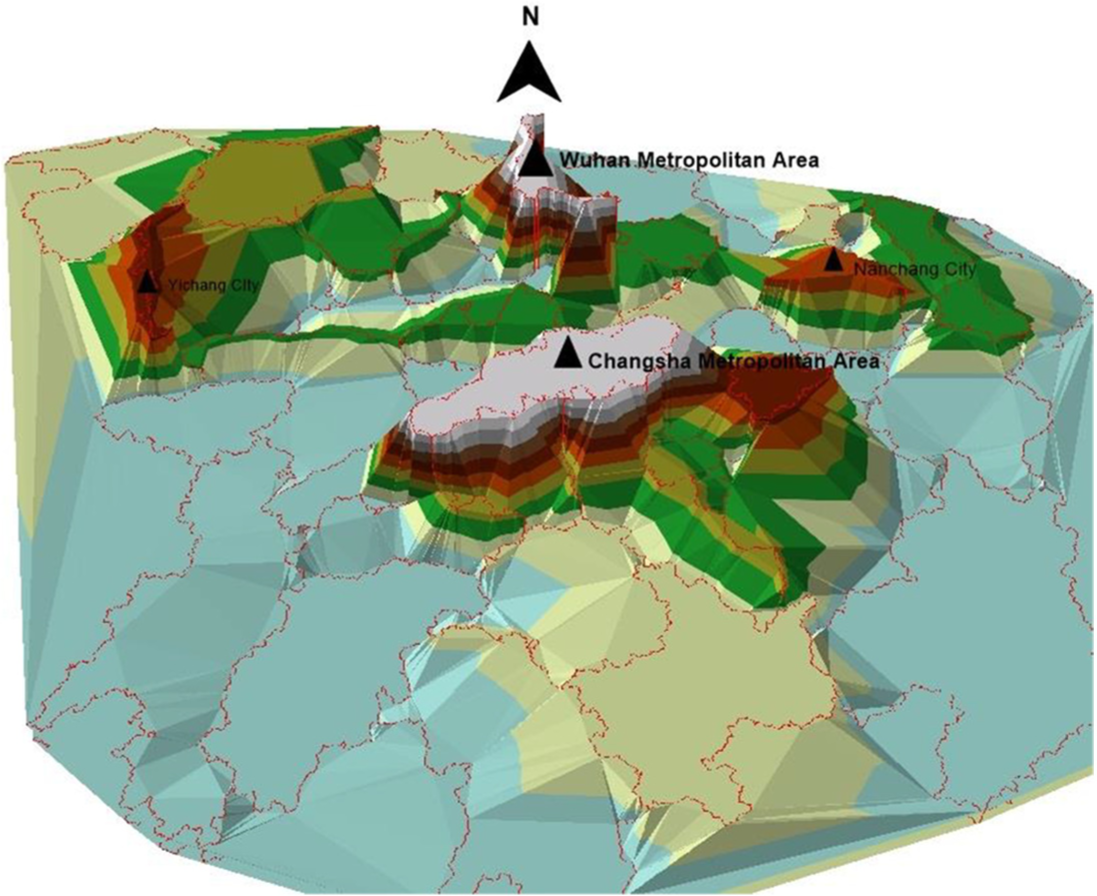
TIN surface of the MYR regional economy.
Network performance
The results presented in Table 1 show that the MYR inter-city capital network is characterised by high density and low clustering. This indicates that despite most cities in the network being directly interconnected, cities that are not directly interconnected would have difficulty in approaching each other, showing the deficiency of hub functions in the network. In addition, the high modularity 10 indicates that cohesive subgroups exist in the MYR network where linkages within subgroups significantly exceed the expected number.
City performance in network estimators (for clarity, the first half of cities given degree ranking is presented).
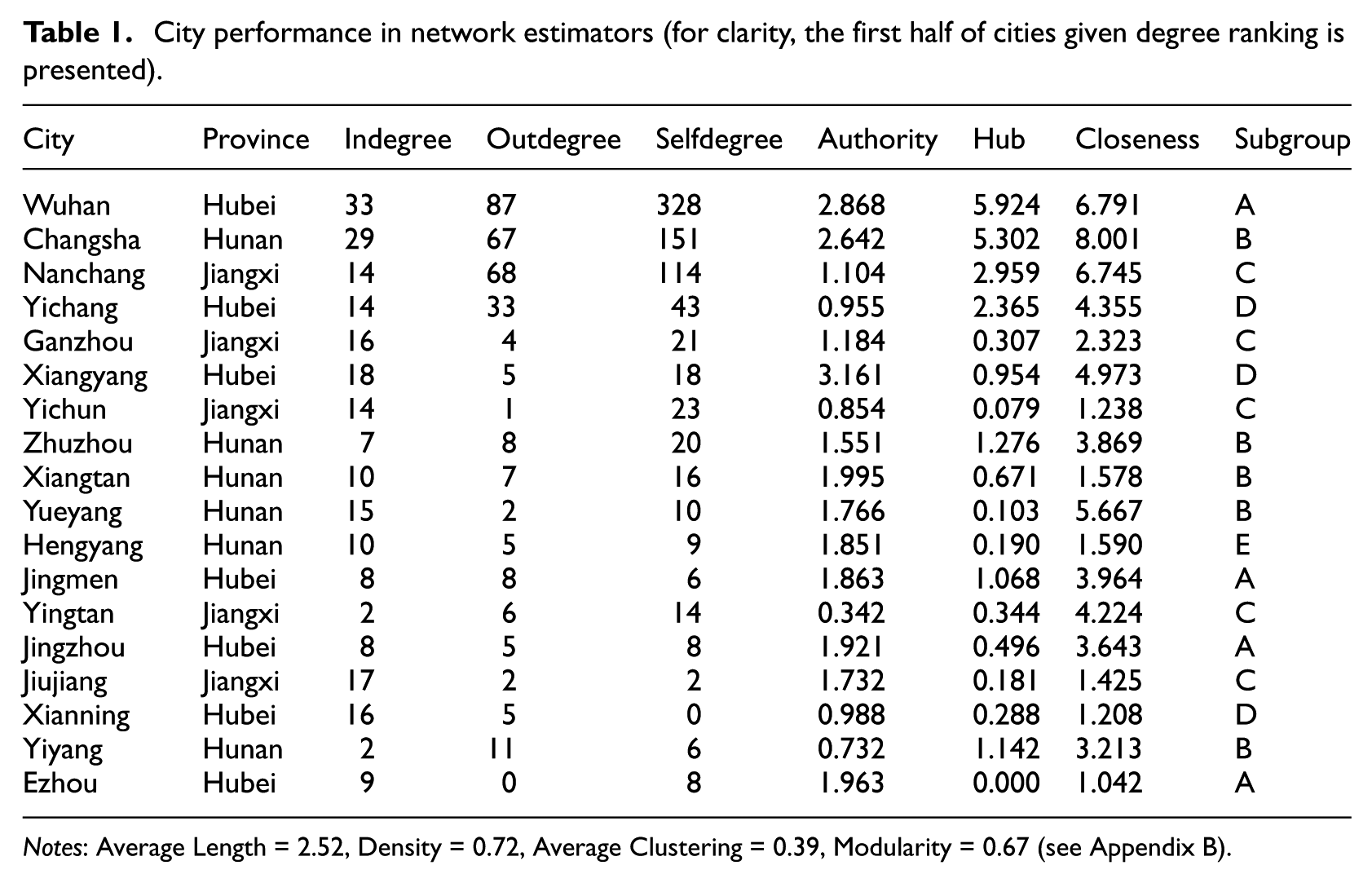
Notes: Average Length = 2.52, Density = 0.72, Average Clustering = 0.39, Modularity = 0.67 (see Appendix B).
Given the degree-related network measures, it is found that the majority of capital flows concentrate in Wuhan, Changsha, Nanchang and Yichang, and the outward ties of these outperforming cities outweigh those of counterparts. In addition, most cities focus on self-investments which are bounded by city boundaries. Given authority and hub measures, the four outperforming cities are dominant hub cities, leaving other cities far behind. However, surprisingly given its relatively low degrees, Xiangyang is the most authoritative city, reflecting its disproportional attractiveness to hub cities. Given the closeness measure, Changsha is the most functionally centred city in the network, followed by Wuhan and Nanchang. Given the subgroup divisions, the individual subgroups of the four outperforming cities resonate with geographical proximity and province division.
It can be seen that the MYR inter-city capital network is a multi-centric network characterised by well-connected factions but also by disparity, since most capital flows and advantageous positions are concentrated in Wuhan, Changsha, Nanchang and Yichang and each leading city organises its own subgroups.
Economic growth
As illustrated in Table 2, the direct effects of the independent variables (indigenous factors, flow factors and network factors) show distinctive prediction power and signals.
Estimated results of direct and indirect effects of the SNG model.
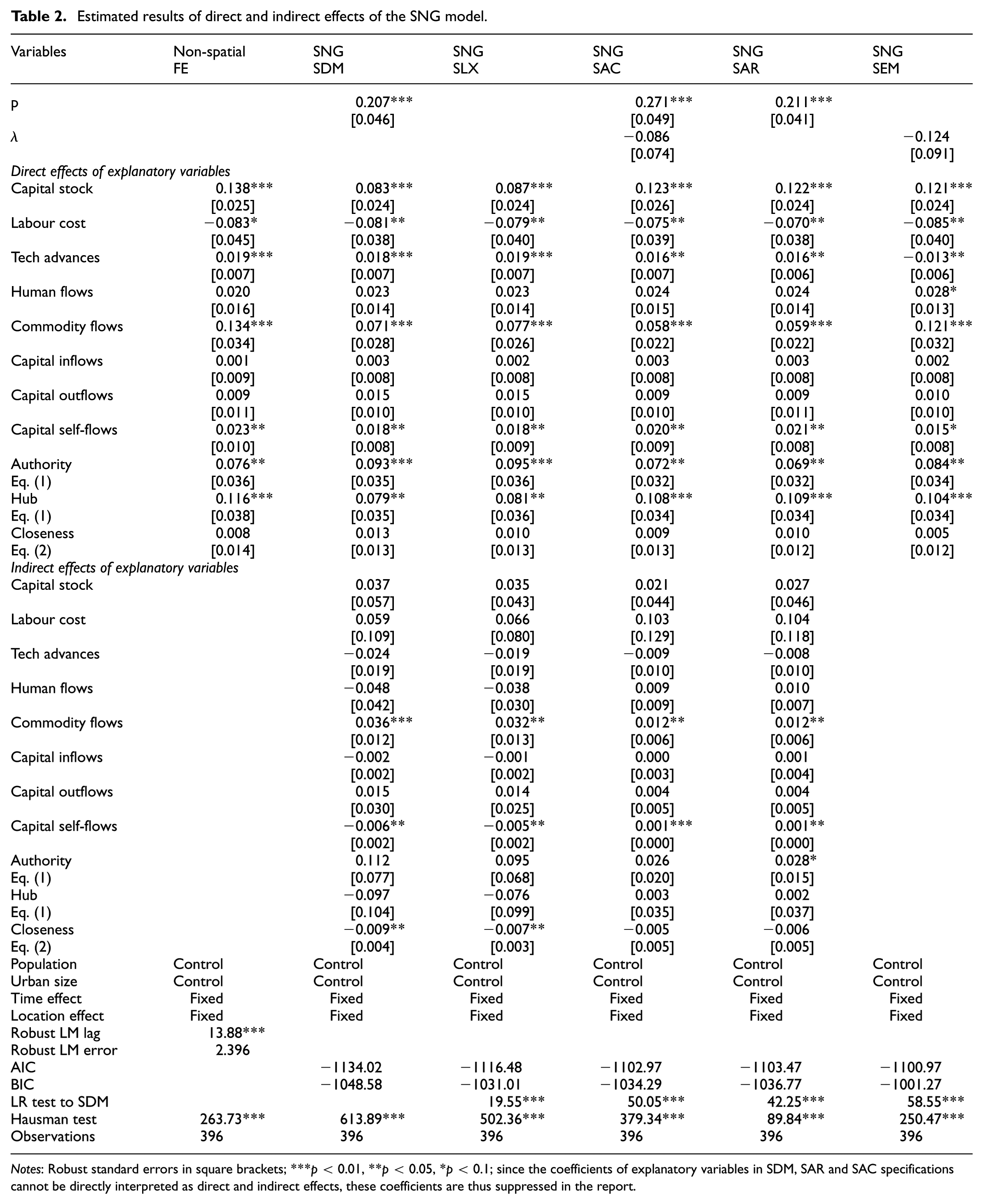
Notes: Robust standard errors in square brackets; ***p < 0.01, **p < 0.05, *p < 0.1; since the coefficients of explanatory variables in SDM, SAR and SAC specifications cannot be directly interpreted as direct and indirect effects, these coefficients are thus suppressed in the report.
First, among the indigenous factors, capital stock contributes most to MYR regional growth consistently across all specifications. Technological advances contribute to growth significantly, while the regional economy is negatively associated with the rise of labour costs. Second, the regional economy tends to grow with the volume of commodity flows, which corroborates the relevance of the space of flows theory for informing the regional growth model. Moreover, the self-investment variable is found to be significant rather than outflows and inflows, reflecting that the directions of capital flows matter in influencing cities’ economies. Third, both the authority and the hub network measures are found to be significant, which indicates that the MYR cities’ network capital is assigned to ‘power’ and ‘brokerage’ structural positions, 11 while functional proximity denoted by the closeness variable is not identified.
Given endogenous interaction effects, the results suggest that GDP in a particular city is associated positively with its contiguous cities’ GDP. Given exogenous interaction effects, commodity flows are found to be positively significant, which indicates that the growth of freight volume in a particular city influences its neighbours’ GDP. However, self-investment flows and closeness are found to be negatively significant, which means that an increase in self-investment and closeness in a particular city is associated with a decrease in its neighbouring cities’ GDP.
In conclusion, in relation to empirical research question (1), the MYR regional economy is generally characterised by a spatially coordinated market configuration rather than a fragmented market configuration. In relation to empirical research question (2), city capital flows and network positions play a role in the MYR’s growth. However, network positions are associated with both positive and negative spatial spillovers. The main results are discussed further next.
Discussion
The analysis addresses the overarching research question ‘What is the interplay between spatial proximity effects and flow network effects in the MYR space economy?’
First, the contribution of commodity and capital flows is verified in line with Huggins and Thompson (2017), reflecting the importance of endowment mobilities for urban growth in a networked economy (Bathelt et al., 2004; Crevoisier and Jeannerat, 2009). In addition, the ‘power’ and ‘brokerage’ network positions are verified as strategic network resources to facilitate city region growth, which is in line with Shi et al. (2019) and Burt’s (2009) proposition that a hub position is advantageous in creating synergies improving urban competitiveness as an outcome. Nonetheless, it should be noted that inter-urban flow networks are scale-sensitive and hinge on particular spatial economic settings, begging further empirical studies to test the interplay between geo-space and network space mechanisms in other city regions at different developmental levels and/or using alternative flow metrics (Burger and Meijers, 2016; Pain and Hall, 2006).
Second, it is found that commodity flows can generate positive spillovers, while self-investment flows and functional proximities are associated with negative spillovers to neighbouring cities. This finding indicates that cities may ‘borrow’ both positive and negative network capital from neighbouring cities, instead of the consistently positive borrowing found by Meijers et al. (2016), reflecting the multiplexity of spatial network capital in MYR regional growth. Future analysis could explore in-depth, negative effects of closeness on proximate cities, bearing in mind the need emphasised in recent literature to develop a better understanding of the complex relationship between city agglomeration externalities and network economies (Van Meeteren et al., 2016) and the potential for city network ‘borrowed size’ to counter ‘agglomeration shadows’ (Meijers et al., 2016).
Last, given its strategic importance in China’s economic transition, the spatial relationship between the MYR cities is of fundamental importance for assessing the region’s viability as a functionally interconnected regional economy complementing the PRD, YRD and JJJ global city regions. Similar to Tian et al. (2010)’s finding that cities in central China (including MYR cities) have a faster convergence rate than those in the east and the west, it can be speculated that the economic growth of MYR cities could be enhanced by coordinated inter-city relationships in an institutional territorial sense, facilitating market integration and regional synergies in future.
The results indicate that agglomeration economies and network capital are two-way interactive mechanisms at a regional scale, driving emergent network economies. They demonstrate the potential to disentangle the heterogeneity that presently characterises Chinese city regions (Zhang and Peck, 2016) by examining the interplay between network and agglomeration economies. Given that MYR economic development lags behind that of the coastal regions it can be speculated that YRD, PRD and JJJ are likely to exhibit more prominent reciprocal inter-city relations in network and agglomeration economies while less developed western regions are likely to exhibit trade-off relations (see Tian et al., 2010).
Conclusions: Implications for policy
The evidence on MYR spatial network capital has policy implications to promote regional growth and contribute to spatial rebalancing in China’s economic transition.
The positive spatial dependence across MYR cities lends support for China’s institutional plans to upgrade MYR as a new growth region during economic transition. It suggests that policy should encourage cross-territorial institutional cooperation to promote capital network organising capacity. For example, establishing an authorised public organisation to provide planning oversight across sub-regional administrative boundaries and to fund cooperative projects related to factors identified in the analysis and informed by business actors, could help to promote synergies between MYR cities and support future regional network capital, economic growth and spatial rebalancing.
However, MYR regional network developments presently exhibit both positive and negative spatial spillovers, reflecting the variability of network capital across the regional space. Therefore, given the significance of inter-city flows in the network paradigm, upgrading modern transportation and telecommunication systems should be consistent with spatial arrangements required for the accommodation of heterogeneous flows, and for enhancing the MYR role in connecting the developed coast and the underdeveloped west of China. Meanwhile, building a well-regulated financial market and a friendly business context is the key to facilitate financial capital flows, especially for large MYR cities; while policymaking should be cautious about potential MYR network diseconomies that might ‘borrow’ negative spillovers. The findings further suggest that public-sector policy should be informed by the identification of the network positions of cities and analysis of the regional network structure based on an up-to-date flow-tracking system, requiring the establishment of urban metadata centres.
Regardless of intensifying MYR inter-city flows, encouraging investments in the industrial base remains critical for supporting regional development at present. However, dependence on labour-intensive production is not a sustainable growth path. Policy focusing on technological innovations and the stimulation of business services that generate global as well as regional inter-city relations and add value to other production activities, can therefore be expected to be important for the promotion of resilient regional growth. Furthermore, other city regions in China could benefit from recognising the potential for both institutional organising capacity and physical arrangements supporting inter-city flows over administrative boundaries to enhance regional spatial network capital.
Footnotes
Appendix A
Variables description.
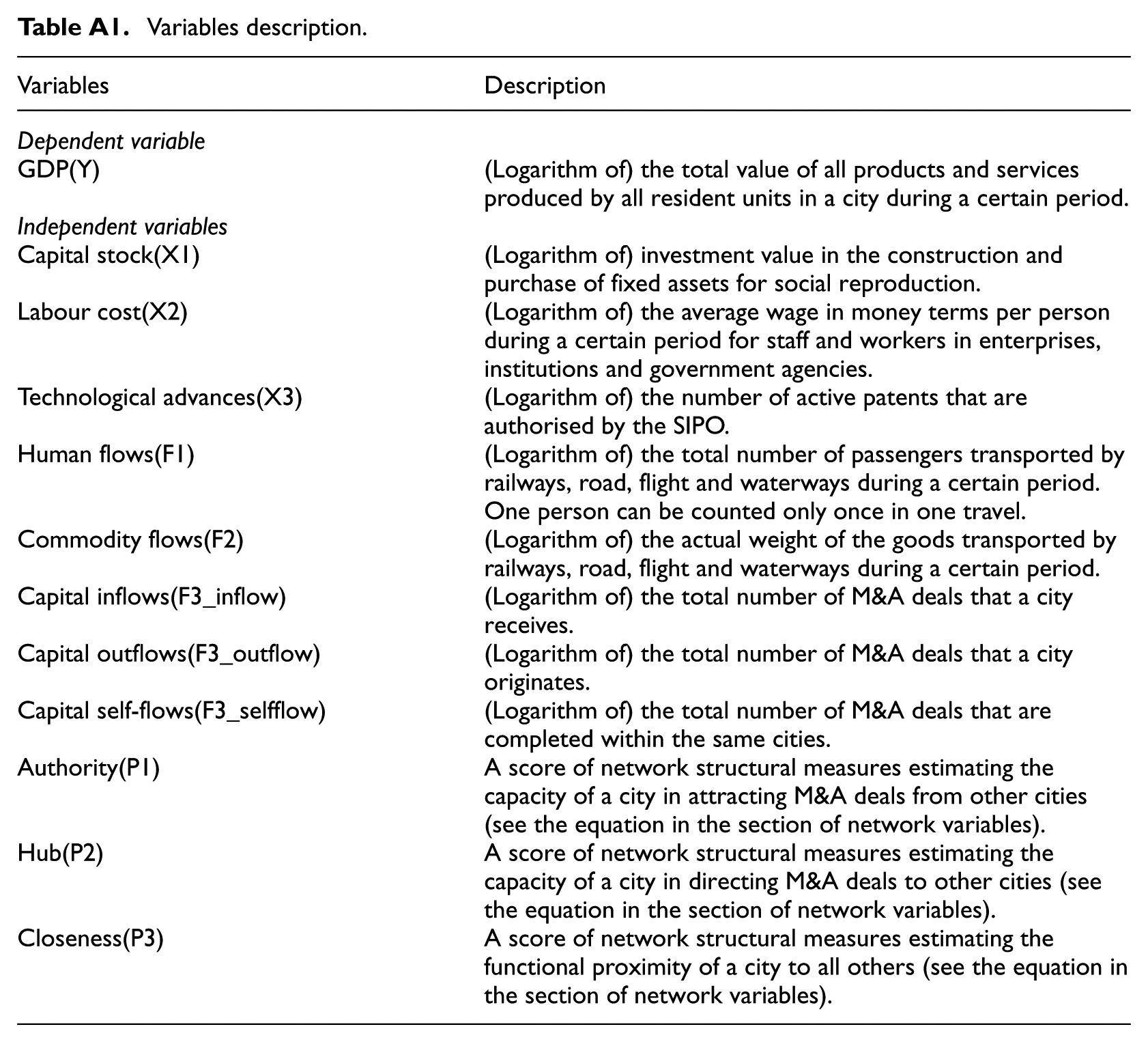
| Variables | Description |
|---|---|
| Dependent variable | |
| GDP(Y) | (Logarithm of) the total value of all products and services produced by all resident units in a city during a certain period. |
| Independent variables | |
| Capital stock(X1) | (Logarithm of) investment value in the construction and purchase of fixed assets for social reproduction. |
| Labour cost(X2) | (Logarithm of) the average wage in money terms per person during a certain period for staff and workers in enterprises, institutions and government agencies. |
| Technological advances(X3) | (Logarithm of) the number of active patents that are authorised by the SIPO. |
| Human flows(F1) | (Logarithm of) the total number of passengers transported by railways, road, flight and waterways during a certain period. One person can be counted only once in one travel. |
| Commodity flows(F2) | (Logarithm of) the actual weight of the goods transported by railways, road, flight and waterways during a certain period. |
| Capital inflows(F3_inflow) | (Logarithm of) the total number of M&A deals that a city receives. |
| Capital outflows(F3_outflow) | (Logarithm of) the total number of M&A deals that a city originates. |
| Capital self-flows(F3_selfflow) | (Logarithm of) the total number of M&A deals that are completed within the same cities. |
| Authority(P1) | A score of network structural measures estimating the capacity of a city in attracting M&A deals from other cities (see the equation in the section of network variables). |
| Hub(P2) | A score of network structural measures estimating the capacity of a city in directing M&A deals to other cities (see the equation in the section of network variables). |
| Closeness(P3) | A score of network structural measures estimating the functional proximity of a city to all others (see the equation in the section of network variables). |
Appendix B
Direct effects are estimated by the average of the diagonal elements of the matrix, and indirect effects are estimated by the average of the row sums of the non-diagonal element of the matrix. Therefore, the model equation (4) can be rewritten as:
Then the matrix of partial derivatives of Y is transformed as:
As we see the right-hand of equation (A2), indirect effects are interpreted as local spillovers under SDM and SLX specifications, while indirect effects are interpreted as global spillovers under SAR and SAC specifications (LeSage, 2014).
Network structural characteristics are estimated in order to illustrate the global pattern of the inter-city capital network by means of global centrality algorithms, including average distance, density and modularity, as formally specified below.
Average distance C(D) is the total distance of geodesic paths D divided by the sum of all pairs of cities, formally written as:
where n is the number of cities;
Density S indicates a ratio of all actual ties E to all possible ties T in a network. Complete network is the term that describes the statement that all logically possible ties are present in a network (density equals one). The density equation is written as:
Modularity is the fraction of the edges that fall within the given groups minus the expected fraction if edges were distributed randomly (see Newman, 2006). More formally, in a network of L edges and N city nodes, the modularity M is formulated as:
where
The clustering coefficient
where
Funding
The author(s) received no financial support for the research, authorship, and/or publication of this article.
