



Abstract
The urban night has traditionally been a regimented space characterised by strict policing and surveillance. Early research on the night-time economy documented the expansion of nightlife from a centrepiece of culture-led redevelopment strategies in post-industrial cities, to the introduction of a broad governance apparatus to manage the agglomeration of night-time activity. Over the past two decades, a new actor has emerged: more than 40 cities have appointed night mayors or individuals responsible for maintaining nocturnal vibrancy, while mediating between those who wish to work, party or sleep. This article summarises the results of a qualitative study that gathered information on the origins, propagation and geographic variations in the role to provide a first comprehensive look at this position. Data from 35 night mayors and night-time advocacy organisations from around the world revealed that, though cities differ greatly in their approach towards night-time infrastructure and regulation, there seems to be growing consensus on the need for permanent nocturnal governance structures. By encouraging greater dialogue and experimentation, these structures are challenging traditional approaches to urban governance and paving the way for a new wave of studies on the urban night.
Introduction
In recent years, globalisation and the introduction of new forms of political participation have led to significant changes in the cast of actors involved in managing urban areas. The contemporary notion of urban governance refers to the process through which public and private resources are coordinated by a wide range of actors – situated inside and outside local government – in the pursuit of collective interests (Pierre, 2011). Though local governments are still a central player, city planning involves a continuous process of negotiation in which non-elected urban actors are attaining growing significance. Many frameworks and taxonomies have been proposed to compare urban governance cross-nationally (e.g. DiGaetano and Strom, 2003; Pierre, 2011). In light of Pierre’s (2011) typology of urban governance regimes – managerial, corporatist, pro-growth and welfare – this article will analyse the origins and implications of a new actor whose rapid propagation is influencing the way cities manage life after dark.
Night-time planning is an emerging field, and one that has been addressed insufficiently in urban studies (Van Liempt et al., 2015). Its origins can be traced back to the early 1990s, when a small number of cultural and urban theorists began using a temporal approach to think about the physical and social dimensions of city planning (Bonfiglioli, 1997). By doing so, these scholars identified unique qualities present in European town centres after dark and raised a new set of issues that lay outside of the scope of urban governance and city management during the day. Subsequently, ‘temps de villes’ policies and research became concerned with the socio-economic implications of the expansion of working hours and the availability of services for people throughout the 24-hour cycle (Boulin and Mückenberger, 1999).
A useful framework to understand the evolution of studies on the urban night was provided by Hadfield (2015) and recognises three waves of research in this emerging field. For Hadfield, a ‘first wave’ of studies corresponds to culture-led redevelopment strategies aimed at extending the vitality of post-industrial city centres beyond the 9-to-5 time frame, which saw the night-time economy (NTE) as a key platform to transform abandoned warehouses and buildings into bars, clubs and creative spaces, to bring people back to the city (Bianchini, 1995; Comedia Consultancy, 1991; Hadfield, 2015; Roberts, 2004; Shaw, 2014). In a context of intensified competition between cities, the goal of these strategies was to deregulate ‘restrictive’ urban planning and licensing regimes and foster a growing culture around the notion of the ‘24-hour city’.
By leaving market forces ‘off the leash’, these strategies led to a rapid expansion of drinking-based leisure and its agglomeration in city centres, contributing to a rise in urban noise, crime and antisocial behaviour and triggering a backlash from residents and NGOs (Hobbs et al., 2003; Roberts and Eldridge, 2012). For Hadfield (2015), these unanticipated negative outcomes were the central concern of the ‘second wave’ of studies on the urban night, which focused on assessing the ability of existing governance structures to manage the negative consequences of a growing and ‘problematic’ night-time economy (Hobbs et al., 2005). These studies often focused on the ‘negative externalities’ associated with activity after dark and tried to quantify the operational costs of managing it efficiently (TBR, 2015). Powered by media reports of these negative consequences, this period demonised certain night-time practices and behaviours – particularly those related to alcohol consumption – while overshadowing residents’ genuine claims for active but more diverse late-night experiences (Eldridge and Roberts, 2008). As a result, new forms of video surveillance such as CCTV proliferated in this period, along with the emergence of new zoning laws and regulations that provided a broader range of enforcement options to local police and city governments (Hadfield et al., 2009).
Urban systems of nocturnal governance operate on different levels and range from laws and state actors like the police, to informal agreements and non-state actors like neighbourhood watches. Aside from having a common mission to oversee what happens in an area after dark, most of these systems share a limitation: they often assume the need to mirror or exacerbate the mechanisms of order and control that exist during the day, while disregarding the unique features of urban life after dark. The night has traditionally been used as a pretext for strict policing and for maintaining structures of social exclusion (Straw, 2018). Bianchini (1995) refers to these structures as ‘regulators of behaviour’ that range from licensing authorities to bouncers in a night club. For Hadfield (2015), the ‘third wave’ of studies on the urban night is concerned with studying the exclusionary outcomes that result from these structures, which are based on race and ethnicity, social class, gender, age and sexual preferences among other factors. This wave incorporates new voices and case studies from Western Europe, North America and South-East Asia that come to diversify a field that previously relied heavily on the British and Australian experience.
Moving away from the pessimistic ethos of previous studies, this ‘third wave’ of research on the urban night encouraged more proactive discussions about how to integrate data and planning mechanisms to tackle issues such as the saturation of licensed premises and an alcohol-centric definition of the night-time economy. In 2012 Roberts and Eldridge published their seminal book titled Planning the Night-Time City, and in 2015 Urban Studies devoted an entire volume to explore the ‘geographies of the urban night’ (Van Liempt et al., 2015). These publications coincided with the rise of multi-sectoral efforts to reduce binge drinking and initiatives to encourage nightlife operators to improve their safety and quality standards. Examples include the Purple Flag and Best Bar None accreditation schemes in the UK, which called for greater dialogue and cooperation between city governments and the nightlife industry.
These partnerships and collaborations – along with the rise of third-party policing in the night-time economy – paved the way for greater consensus around the notion of nocturnal governance as a complex responsibility that involves a mix of agencies including the police, licensing authorities, resident groups and public health institutions, among others. Rather than focusing on restrictive mechanisms to handle night-time crime and antisocial behaviour, this broader notion advocates a networked response that allows cities to tackle a wider range of social, economic and environmental factors of life after dark. This new ethos was supported by calls for the creation of partnerships and allegiances to exercise order and surveillance and to facilitate night-time planning (Roberts, 2004; Van Liempt, 2013) and set the stage for the rise of a new role and key actor within cities’ nocturnal governance system: the night mayor.
Night mayors – also called ‘managers’ and ‘czars’, among other designations – are individuals selected by cities to act as a liaison between nightlife establishments, citizens and local governments. Though their backgrounds and the process by which they are selected vary significantly, night mayors’ responsibilities can be categorised into three basic types. The first refers to enhancing nocturnal ‘hardware’, or improving the built environment in a way that is conducive to greater vibrancy and quality of life after dark. For instance, some night mayors have been involved in efforts to expand night-time transportation services in their cities, or to enhance lighting and basic services such as public toilets that are open at night. The second refers to improving – and often updating – nocturnal ‘software’, or the laws and regulations that facilitate activity and minimise nuisance at night. This refers to curfews or policies that establish hours of operation for businesses as well as public spaces. Finally, the third responsibility refers to mediating and promoting consensus among the wide variety of actors involved in nocturnal governance.
These three responsibilities – improving hardware and software and promoting mediation – are at the heart of all private and public strategies to manage urban environments after dark. Though cities differ greatly in their approaches towards night-time infrastructure and regulation, there seems to be growing consensus around the need for permanent nocturnal governance structures responsible for crafting these strategies and overseeing their implementation. This convergence of ideas around nocturnal governance is the outcome of a process of policy transfer that began with the introduction of the role in the early 2000s by cities such as Amsterdam and Berlin and its rapid propagation around the world. By December 2018, more than 40 cities had incorporated the role of the night mayor or had an active night-time advocacy organisation.
The field of night-time planning and policy has grown over the past decade, but the rise of night mayors and their relevance from an urban governance perspective has not been analysed and documented in urban studies. Nonetheless, night mayors – and their high journalistic appeal – have been recognised as a key factor in the ascension of the night as a relevant field of study (Straw, 2018). They are also considered a noteworthy mechanism that, along with night charters and other solutions, promotes mediation rather than regulation to solve urban issues after dark (Gwiazdzinski, 2018).
Amid the rapid dissemination of night mayors around the world, this paper intends to provide a first comprehensive look at this new role to assess its relevance as a mechanism to facilitate proactive and collaborative responses to crime, antisocial behaviour and inequality after dark. In the light of survey data gathered from 35 night mayors and night-time advocacy organisations and testimonies from six experts who have been influential in the dissemination of the role, it will first review the background and origins of night mayors within the growing field of studies on the urban night. Second, it will discuss the variations in the nature and scope of the position, its propagation, preliminary achievements and future perspectives. Third, in light of Pierre’s (2011) four models of urban governance, it will analyse the way the transfer of this role has been influenced by local systems of governance. Finally, it will provide recommendations for future research within this new subfield of studies on the urban night.
Methods
To obtain information about the nature of the emerging role of night mayors, the authors of this paper developed a qualitative survey and a database of 45 individuals who have been appointed or hired for the position by city governments, nightlife associations or civil society organisations between 2004 and 2018. While some cities have not yet designated their first night mayor, several cities in the Netherlands have appointed more than one. In order to avoid selection bias, only current night mayors of seven Dutch cities – Amsterdam, Eindhoven, Groningen, Zwolle, Nijmegen and The Hague – have been considered as part of this analysis.
The qualitative survey was distributed in June 2018 through personalised emails that were sent to a total of 45 individuals who work as night mayors or representatives from night-time advocacy organisations in 20 different countries around the world. All emails included a link that led to a 35-question survey available in English and Spanish. The survey included multiple choice as well as open-ended questions that allowed individuals to share more details on the origins and nature of their roles. Between June and October 2018, the survey was responded to by 35 individuals from a total of 34 cities. 1
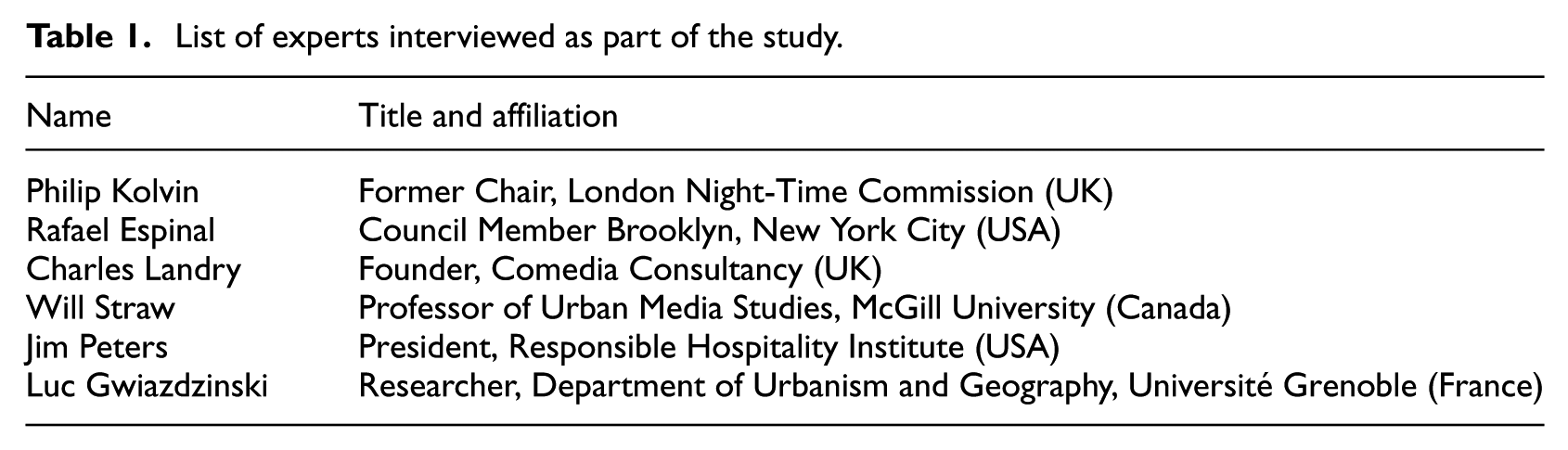
The first section of the survey included questions directed at understanding the demographics of the people in the role (their age, gender, education level), the characteristics of the position (how it was created, its duration, jurisdiction), the resources they have to support their work (salary, staff, operating budget, outreach mechanisms), and the types of issues they deal with (economic or social-cultural). Some of the questions also aimed at gathering information about cities’ nightlife regulations and infrastructure, by asking about the existence of 24-hour public transportation, alcohol curfews and noise regulations. To complement the results of the survey, between July and November 2018 the authors conducted additional interviews with six experts in night-time planning and policy whose work has been instrumental to the rise of the night mayor movement (see Table 1). Interview questions assessed the origins of the role, its current relevance and influence, and predictions of its future significance.
List of experts interviewed as part of the study.
Despite the global nature of this study, the selection of experts from North America and the UK should not be seen as a limitation but rather as a reflection of the reality of the field. While there is a growing number of contributions from scholars focused on the developing world, studies on the urban night continue to be highly focused on issues faced by cities in industrialised countries. The following section will discuss the findings from this qualitative study in light of the historical context and precedents to the appearance of night mayors as a new form of urban governance around the world.
Results
Background and origins of the role
Though Berlin was the first city to create an official night-time advocacy organisation – Clubcommission Berlin – the term ‘night mayor’ has its origins in the Netherlands. In the 1970s, Dutch poet Jules Deelder’s prominent role in the cultural life of Rotterdam earned him the nickname of nachtburgemeester or night mayor of the city. In a recent interview on the global rise of the role, Deelder commented: ‘I just learned that night mayors are popping up here and there (…). They sound like politicians, but that’s not how I imagined the role to be!’ (Van Dommelen, 2018). Though Deelder never expected night mayors to have a voice in city planning, the position preserves some of his disruptive character and wisdom: night mayors are individuals who are able to navigate the chaos and contradictions of darkness while working alongside city governments to make the night a safer and more inclusive space. By doing so, they become mediators or translators between two worlds – nightlife and city government – that until recently had few devices with which to communicate.
Over the past 10 years, Dutch cities have appointed more than 20 nachtburgemeesters. The most notable of these representatives is the nachtburgemeester Amsterdam, a position elected for the first time in 2003 and later institutionalised in 2014 through the creation of Stichting N8BM A’DAM– an independent non-profit organisation that provides guidance to the mayor and the city council on how to design policies to promote a culturally, socially and ethnically inclusive nightlife in the Dutch capital (Stichting N8BM A’DAM Amsterdam, 2018). The nachtburgemeester Amsterdam is funded both by the nightlife industry and the government and elected for two-year terms by a tripartite voting process: an online vote, a town hall vote and a jury vote. While candidates are expected to have a strong connection and knowledge of the city’s nightlife industry, they cannot be directly affiliated with a business or institution in this sector.
One of the most successful initiatives implemented by the nachtburgemeester Amsterdam is the creation of the 24-hour licence, an innovative five-year pilot scheme launched in 2013 that allows for the extension of opening hours for nightlife venues located on the outskirts of the city. Following its successful implementation, in 2017 it became a permanent policy (Van der Groep, 2017). A second initiative that has gained worldwide recognition is the Rembrandtplein Gastvrij (Hospitable Rembrandt Square) project. This three-year pilot was launched in 2015 with support from the late Mayor of Amsterdam, Eberhard van der Laan, to reduce alcohol-related violence, raise the quality of nightlife and make it safer for residents to move through Rembrandtplein, a major nightlife district where more than 200 violent incidents and reports of nuisance were reported every year. The outcome of a public–private partnership, the project involved hiring 20 hosts or stewards dressed in bright red jackets to patrol the district on Friday and Saturday nights as a means of creating a more relaxed atmosphere, similar to that found in a festival or public event. At the end of the three-year pilot, nuisance reports had decreased by 40% and violence reports had decreased by 20% (Broer et al., 2018).
Despite its Dutch origins, the night mayor concept had also resonated in France through the work of scholars such as Luc Gwiazdzinski, who proposed the election of a ‘maire de nuit’ as a means to recover the urban night and avoid the ‘banalization’ of this field (Aghina and Gwiazdzinski, 1999). For licensing specialist and former chair of London’s Night-Time Commission, Philip Kolvin, the idea had also been developing in British cities for a couple of decades. As the night-time economy expanded in the 1990s, town centre managers had to deal with a growing number of bars and restaurants, while also dealing with shops and offices (P Kolvin, personal communication, 2016). In 2016, Mayor of London, Sadiq Khan, appointed the city’s first ‘night czar’ to facilitate the interaction between citizens, local authorities and nightlife venues. Though this new role inherited some of the challenges faced by town centre managers, it was tasked with managing a dwindling rather than a thriving night scene. In only a decade, London had lost 58% of its LGBTQ+ venues, while nightclubs and other entertainment spaces were closing at an alarming rate (Campkin and Marshall, 2017). Among the most noteworthy, iconic nightclub Fabric lost its licence a few weeks before the night czar was appointed. Leading the talks that allowed this venue to stay open is considered one of the night czar’s main accomplishments during her first year in the position (Mayor of London, 2017).
In other cities, such as New York, the emergence of the night mayor figure is the outcome of years of pro-nightlife activism (Hae, 2012). Following a decade of zero tolerance policies and a severe crackdown on nightlife during Rudolph Giuliani’s administration, in the early 2000s New York City activists began to fight for the need to recognise the rights of those working the night shift, including nurses, taxi drivers and those in the hospitality and creative industries. In the summer of 2017, Brooklyn Council Member Rafael Espinal led the enactment of a bill to establish a Nightlife Advisory Board and an Office of Nightlife (The New York City Council, 2017). The Nightlife Advisory Board consists of 14 members responsible for evaluating the city’s laws and making recommendations to address common issues in the nightlife industry. Created in early 2018, the Office of Nightlife serves as a liaison between nightlife establishments, residents and the government. Though initially focused on handling complaints and violations, the office also provides policy recommendations to the mayor and various city agencies (City of New York, 2019). As opposed to the Amsterdam model, this position is fully funded by the administration and overseen by the mayor. For Espinal, its first major challenge is ‘convincing the public that the night mayor is not only there for the businesses, but also there for the community’ (Rafael Espinal, personal communication, 2018).
Nature and scope of the position
There are three questions that must be answered in order to lay out the role of the night mayor successfully (Kolvin, personal communication, 2016). The first question is where the role will be situated: inside or outside city hall. While those who work for local governments must align with political interests and voting cycles, those who are independent or appointed by community associations also encounter difficulties in carrying out and funding concrete actions, as well as in gaining recognition from city authorities. The second question is whether the night mayor will have an advocacy or a regulatory role, and the third is what the city is expecting this position to achieve. Of all participants, 75% mentioned safety as the primary concern on their agenda and all of them mentioned mediation and conflict resolution as part of their job description. However, none of these individuals have the authority to change local laws or regulations, making this an entirely advisory role.
For Will Straw, professor of urban media studies at McGill University and collaborator on several projects on night-time culture at the international level, the title of ‘night mayor’ suggests ‘an alternative city’ that is in need of representation (Straw, 2018). Its appeal lies greatly in its absurd and transgressive nature, which experts consider advantageous to raise awareness of the urban night as a relevant field for research and practice. Some cities, however, have been hesitant about using this designation as it is not always linked to an elected position and it sounds too much like ‘nightmare’ (City of Toronto, 2018; Straw, personal communication, 2018). Variations of the night mayor title include ‘night-time economy manager’, ‘nocturnal delegate’, ‘nightlife advocate’ and ‘night ambassador’. Differences in terminology also allude to a first geographic distinction in the position’s situation and scope. While European night mayors are independent advocates who help mediate between nightlife operators and citizens, their American counterparts – often called managers or directors – are government-appointed representatives responsible for overseeing how the night-time economy works (Kolvin, personal communication, 2016).
Creation of the role
The great majority of night mayors (73%) work at a city-wide level, while only 19% work at the neighbourhood or district level. Though many were inspired by Amsterdam’s independent model, almost half (40%) report directly and are fully funded from local government, while 23% report directly to a civil society organisation and only 3% report directly to the nightlife sector. However, the survey revealed that night mayors have very limited resources: 56% operate with a budget of 20,000 USD or less, and almost 40% work on their own or with support from volunteers. Almost half of participants reported that they only work part-time, which restricts the scope and impact of the role.
When asked about the way they attained the role, 42% of participants responded that they were appointed by the mayor or city council, 26% were appointed by a civil society organisation and 13% by the nightlife industry. Out of those endorsed by local government, 16% were hired full-time for the role. Answers to this question revealed a second important geographic difference: while most European night mayors have been appointed for temporary positions, their American counterparts were hired as full-time city employees. Two American cities – New York and Washington DC – have created their positions by introducing new legislation.
Survey results also revealed variations in the selection of the role. Night mayors situated within local government participated in a competitive process in which the role and its responsibilities were clearly defined, made public or included in new legislation. Those located outside local government followed a less rigorous selection process. More than half (53%) of participants are between 35 and 45 years of age, while 38% are 45 years or older. Almost half (45%) have a master’s degree, which revealed a group of middle-aged and highly educated individuals with a vocation for public service.
Propagation of the role
Given the vast coverage and support that night mayors have received from international media (e.g. Delgadillo, 2017; Henley, 2016; O’Sullivan, 2017), the role has quickly propagated around the world (see Figure 1). For Straw, night mayors are an element of a ‘new urbanism’ that has unfolded in three stages. The first stage refers to efforts to recognise the important contributions of this new role to the city, which began around 2012 when the term became popularised by the media. The second and current stage refers to global activism to save the remains of nightlife in a context of gentrification and massive closures of music venues that have turned the night mayor into an almost necessary figure. The third refers to efforts to raise awareness around group-specific issues such as women’s safety, particularly in places such as Latin America (Straw, personal communication, 2018).
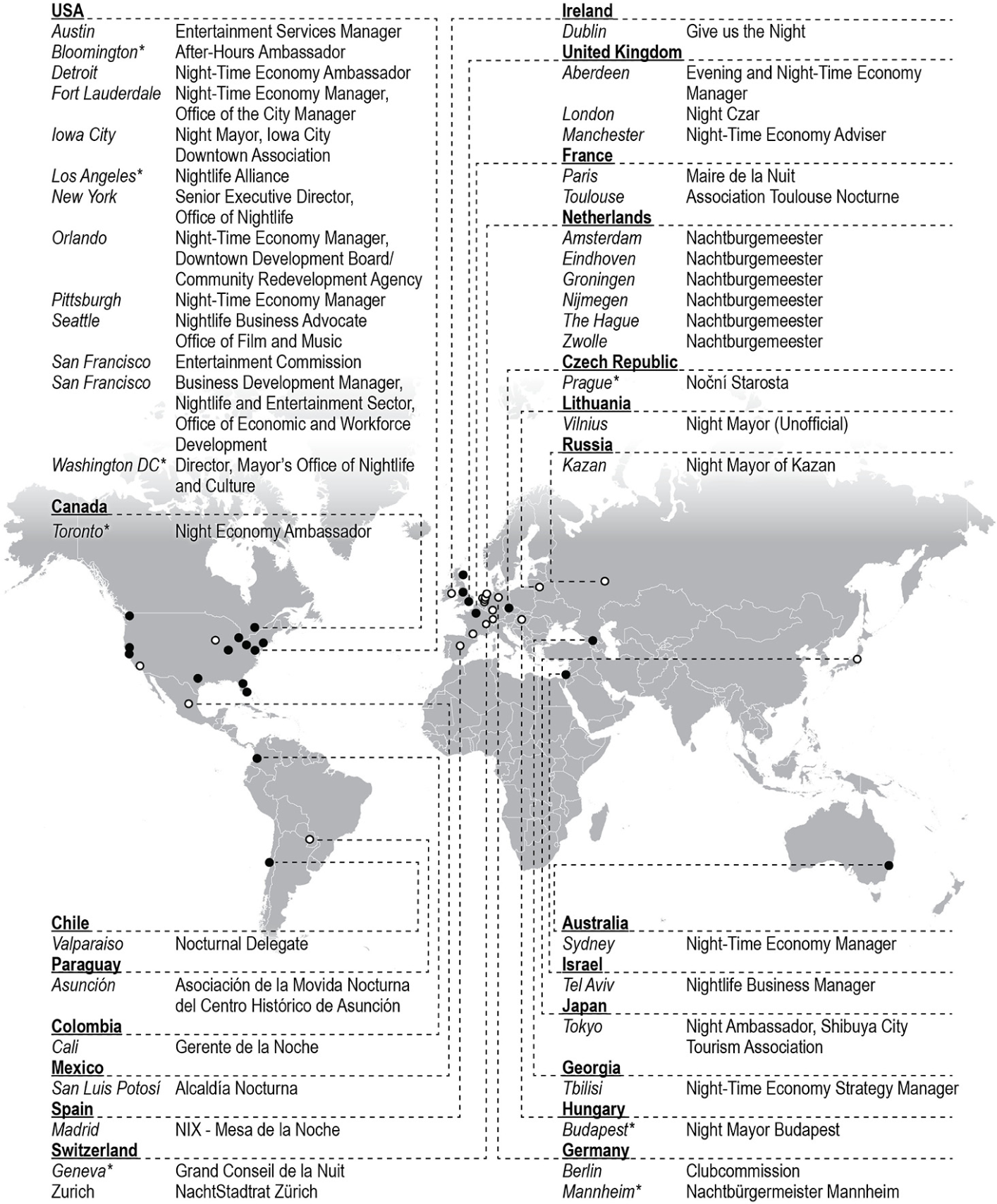
Global distribution of night mayors and night-time advocacy organisations.
The rise of night mayors is often described as a global movement that is tied to the growing economic and civic importance of cultural life in urban areas (Mount, 2015). Scholars led by Florida (2002) have long emphasised the relevance of a lively local night scene to enable people to meet and socialise, as well as the opportunities that nightlife brings for urban regeneration and to attract the ‘creative class’. Under this premise, urban development strategies have championed the night-time economy as a panacea for tourism and economic growth but failed to predict the long-term impact of regeneration over local identity and culture (Evans, 2009; Glaeser, 2004). Though expanding night-time activity can improve individuals’ perceptions of safety after dark, revitalisation efforts centred on strengthening the night-time economy can also facilitate waves of gentrification in which many nightlife venues are later closed or displaced, victims of their own success (Hae, 2012). For Jim Peters, director of the responsible hospitality institute (RHI), cities are seeking night mayors as a person who will come to rescue nightlife from all these pressures (Jim Peters, personal communication, 2018).
While the urban night has acquired a more positive significance in recent years, it continues to be a highly regulated space where restrictive policies such as curfews and drinking bans are implemented to ‘strike the right balance’ between a flourishing and diverse night-time economy and growing residential populations (Jones, 2018). However, these policies are also linked to the disappearance of traditional venues in cities such as London, which lost over half of its nightclubs between 2005 and 2015 (Wilson, 2019), and Sydney, where 176 establishments closed as a result of the implementation of the Lockout Laws in 2014 (Taylor, 2018). For Hae (2012), the suppression and disappearance of urban activities and their spaces must be taken seriously as ‘these are invaluable in establishing the normative ideal of cities’. This context has further encouraged more cities to appoint night mayors in an effort to protect their dwindling night scenes.
Aside from its cultural and economic contributions, the urban night is a key space for social interaction, as well as for trust and identity building. It is also a highly contested space, used historically by certain groups to reclaim their right to the city (May, 2014; Williams, 2008). The urban night has been of particular value to LGBTQ+ communities, which historically have been recognised for their contributions to the vibrancy and unique character of neighbourhoods and entire cities. It is therefore not surprising to find that night mayors have become key mouthpieces for the LGBTQ+ community, particularly in cities such as New York and London where they led WorldPride celebrations and awareness efforts in the summer of 2019 (Abadsidis, 2019; Broadgate, 2019). Despite women’s greater participation in nightlife, the study revealed that most night mayors are men (73%). However, some of the sample’s biggest cities – such as New York, Sydney and London – have selected female representatives. While some of these female night mayors are leading gender-sensitive initiatives that encourage nightlife venues and organisations to create safer environments for women, the impact of these contributions in reducing crimes against women still has to be assessed.
Data on the year that night mayor positions and night-time advocacy organisations were created illustrate the exponential growth of this movement (see Figure 2). Though only six night mayors had been appointed by 2013, ten new positions or organisations were created in both 2017 and 2018, making these the years with the highest growth in the movement. While this article was being published, six new cities joined the list – Bloomington, Mannheim, Prague, Los Angeles, Toronto and Washington DC – and other cities such as Edinburgh, Helsinki, Shanghai and Vienna have announced interest in creating the position. With the exception of Cali and Valparaiso, all the night mayors and night-time advocacy organisations that participated in the study remain active today.
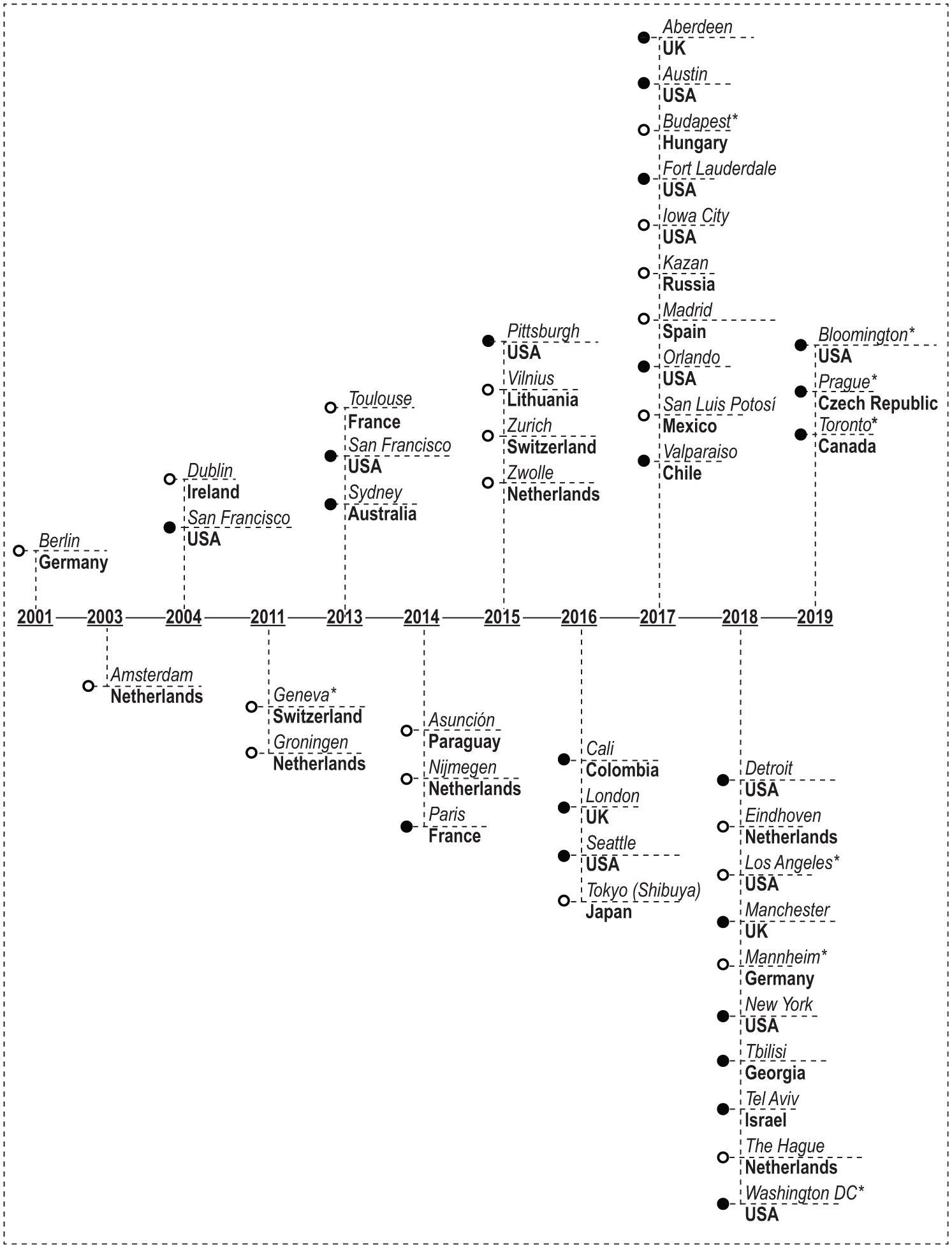
Night mayors and night-time advocacy organisations by year they were created.
Preliminary achievements
Survey results revealed that night mayors’ achievements can be categorised in four realms: awareness, policy, mediation and infrastructure. Of respondents, 15% stated they have been successful in placing nocturnal issues on local agendas (advocacy); 29% mentioned their positive involvement in updating local regulations to support nightlife (policy); 44% mentioned they were responsible for articulating nightlife operators and promoting greater cooperation with neighbours and local government (mediation); and 12% mentioned their achievements in raising public funds or encouraging private–public partnerships to improve soundproofing, night-time transportation and other infrastructure.
When asked about what makes their role relevant to their city, 50% of survey participants mentioned that they believe their role contributes towards creating a more positive image. Half of these responses included expressions such as ‘changing the negative perception of the night’ and the other half included expressions such as ‘making the city more vibrant’, ‘liveable’ and ‘more competitive’. This denotes a highly optimistic perspective on the impact this new role can have to support urban vibrancy and quality of life.
Expert opinions were equally optimistic. For urban planner and author Charles Landry, there are technical solutions to nocturnal issues such as noise and violence, but night mayors are important because the position encourages local actors to negotiate (Charles Landry, personal communication, 2018). In other words, it can be seen as a new platform through which cities can handle nocturnal activity in a participatory and more proactive way. For Straw, the relevance of the role stems from its ability to ‘cut through bureaucracies’ to tackle pressing urban issues (Straw, personal communication, 2018). By raising awareness of the advantages of having a vibrant, accessible and safe nightlife, the role exercises a new form of ‘temporalised governance’ that is helping move the focus of city management after dark from reactive solutions to handle safety concerns, to making more strategic decisions (Gwiazdzinski, personal communication, 2018; Peters, personal communication, 2018).
Future perspectives
Overall, experts agreed that the role will continue to expand – both geographically and in prominence – as more cities adopt the position, but its longevity in the cities where it already exists remains relatively uncertain. Though 78% of participants reported that they expect their role will continue beyond their term, 22% fear they might lose their night mayors in the context of leadership change. The prominent influence that local government has over the existence of this role calls for a greater involvement from the private sector, particularly, nightlife operators whose interests might not be represented if the role disappears.
When asked about their vision for their city’s nightlife in five years, 60% of night mayors stated they see the role as a tool to create a more inclusive city. They used terms such as ‘bottom up’, ‘diverse’, ‘affordable’ and ‘open’ to describe the initiatives they aspire to see in their cities in the future. These terms denote clear aspirations towards greater tolerance and collaboration, recognising that community building is a key feature of a healthy night-time economy.
Both survey participants and experts concurred that, rather than being defined as a one-person job, the night mayor role must be part of a broader functional structure that facilitates the coordination of different agencies (Kolvin, personal communication, 2016; Peters, personal communication, 2018). Several cities have made positive steps towards facilitating this coordination. London created a Night-Time Commission in 2017 and Manchester, Sydney and New York have created similar bodies (Greater Manchester Combined Authority, 2018; Joyce, 2018; Litvak, 2018). However, some of these bodies are temporary and most of their members are representatives of the nightlife and hospitality industries, while only 5% or less have a background in urban planning or policy.
Conclusions and recommendations for future research
The first three waves of studies on the urban night (Hadfield, 2015) have documented the expansion of nightlife from a centrepiece of redevelopment strategies in post-industrial cities to the introduction of a new governance apparatus that, while aimed at mitigating the rise in crime and antisocial behaviour that resulted from this expansion, also created a set of structures that foster social exclusion. Increased policing, strict licensing and reduced hours of operation have long been the formula to ensure social order after dark. However, the rise of night mayors has expanded the notion of nocturnal governance by revealing a new set of socio-economic and cultural issues that demand greater mediation and collaboration.
Over the past two decades, more than 40 cities have appointed night mayors. Powered by large media support and recognition from high-profile mayors such as those of London and New York, night mayors are quickly becoming local political actors and icons of a growing transnational network to discuss the issues affecting this long-overlooked part of the day. Aside from mapping the expansion of this movement, survey data revealed relevant geographic differences in the scope and situation – inside or outside local government – of the role. In light of Pierre’s (2011) four models of urban governance, it is possible to analyse some of these differences. For instance, following Amsterdam’s corporatist model, most European night mayors are independent champions who voluntarily – and in most cases only temporarily – lead civil society organisations that favour mediation and inclusion of a broad variety of groups and interests. In the USA – and in most places in Latin America – night mayors are hired as full-time civil servants and follow a managerial model, focused on efficiency and multi-agency coordination. Though urban governance models are static representations that only focus on a handful of cities – most of them in the developed world –Pierre’s (2011) and other taxonomies can be useful to explain some of the variations in scope that have emerged as the role is transferred into new contexts.
Study results also revealed an evolution in the scope of the role. While early night mayors and advocacy organisations followed Berlin and Amsterdam’s model focused on preserving nightlife and culture after dark, later additions to the movement are largely based within city hall: between 2017 and 2019, 23 new night mayor positions were created, out of which two-thirds are situated inside local government. The institutionalisation of the role has allowed night mayors to become increasingly involved in initiatives to enhance nocturnal ‘hardware’ or the built environment at night, as well as collaborate in processes to update nocturnal ‘software’ or laws that regulate urban life after dark. While broader institutional support and resources will allow them to venture further into policy and infrastructure, their capacity to advocate certain causes might be curtailed by changes in city leadership or political affiliation.
Given the novelty of the position, the purpose of this study was not to assess its impact but to understand its significance within a broader history of nocturnal governance and studies about the urban night. Further research is needed to measure the impact of night mayors’ contributions towards improving safety and reducing nuisance, while protecting the vibrancy and cultural identity of the urban areas they are responsible for overseeing. However, study results reveal four main contributions that can be attributed to this role.
Creating an institutional space to discuss the urban night: Though different forms of nightlife activism have existed in cities around the world, night mayors are helping place this topic on city agendas, leveraging additional resources – both human and material – to tackle the myriad of issues that affect urban life after dark. In the autumn of 2018, New York City’s recently created Office of Nightlife embarked on a five-borough listening tour ‘to pursue recommendations and long-term solutions to ensure a safe and vibrant nightlife scene that works for all New Yorkers’ (Office of Nightlife, 2019). Tour meetings took place in theatres and performance spaces and were led by the Office of Nightlife, along with representatives from city agencies such as the police and transportation departments. Aside from raising awareness of the new office and creating a space for citizens to voice their concerns, since early 2019 this initiative has encouraged regular inter-agency meetings to discuss the most pressing issues concerning nightlife in the city (Ariel Palitz, personal communication, 2019).
Promoting better night scenes through experimentation: The night presents unique opportunities for cities to experiment with new planning regimes, public transport provision and opening hours (Bianchini, 1995). By promoting pilot programmes to explore greater flexibility in licensing and innovative mechanisms to facilitate multi-stakeholder cooperation, night mayors are encouraging local governments to be more creative in the way they allocate resources to regulate night-time activity. This is the case of initiatives such as the 24-hour licence model and the Hospitable Rembrandt Square project that began as a pilot intervention led by the city of Amsterdam with the support of the nachtburgemeester and was later incorporated as a permanent programme.
Protecting nightlife as a form of culture: Cultural vibrancy and liveability are key features of a thriving city, but strategies to promote them can also drive processes of gentrification and displacement. By raising awareness of the need to protect night culture, night mayors are helping music and nightlife venues get recognised as relevant contributors to local tradition and identity. Amid increasing noise complaints in residential neighbourhoods, in 2017 the city of Berlin pledged 1 million Euros to fund soundproofing strategies for nightlife and music venues in an effort to protect them from disappearing (Hawthorn, 2017). This response follows almost two decades of advocacy work carried out by Clubcommission Berlin, an independent night-time advocacy organisation that has been raising awareness of the positive social, cultural and economic contributions of nightlife to the German capital since 2001 (Goldhammer, 2019; Wilson, 2019).
Creating inclusive spaces after dark: Night mayors are increasingly being acknowledged by city councils and community boards as key allies in garnering support from groups whose interests have long been overlooked. In recent years, they have become relevant champions of LGBTQ+ communities and supported efforts to promote women’s safety and night workers’ rights. As part of its Cultural Infrastructure Plan, London has committed to provide an annual audit of LGBTQ+ venues and has created a five-point pledge for operators, developers, property owners and others to support the city’s LGBTQ+ pubs, bars, clubs and other venues (Mayor of London, 2019).
Despite these contributions, some sectors remain hesitant to recognise a new form of bureaucracy that could potentially duplicate certain urban planning functions. Though the regulation of nightlife has long been a part of urban governance, the creation of night-time management offices within city administrations could be interpreted as greater civic control over private spaces of leisure and entertainment, potentially reinforcing rather than breaking existing structures of inequality and social exclusion. Some individuals in the role have begun to distance themselves from the ‘night mayor’ title in order to avoid making false promises of what their position can do from a law enforcement perspective (Poon, 2018). The study also revealed that not all cities have the same priorities or are at the same stage in managing life after dark, which complicates any predictions on the continuity of the position. In the absence of legal backing, charisma and recognition from the nightlife industry become relevant qualities to exercise the role, particularly for those located outside of city government.
The situation of the role – inside or outside local government – greatly determines the resources and legitimacy that are attributed to the position, though the impact of this condition on night mayors’ performance still needs to be assessed. While most of night mayors’ achievements are in the realm of mediation, their ability to make more permanent contributions to policy and city infrastructure greatly depends on the support they receive from other city agencies and multi-stakeholder institutions such as nightlife commissions and boards. By incorporating representatives not only from the culture and hospitality sectors but also from urban planning and policy, these boards will be better suited to assist night mayors in achieving significant long-term changes in the spatial configuration of cities at night.
As Hae (2012) suggested, understanding how pro-nightlife formations are evolving and responding to the conditions that threaten a city’s nightlife presents a unique opportunity for cities to embark on a more proactive agenda towards nocturnal governance and to explore new ways to tackle pressing issues, such as cultural displacement and gentrification. By becoming part of the decision-making process, night mayors have the potential to advocate a revision of licensing and zoning provisions that directly affect nightlife establishments and to work with communities to respond to their changing needs and preferences, a process that is key to building long-term trust and social cohesion. Making room for these new actors in the long-term will require not only achieving local recognition as a problem-solving mechanism, but also becoming a platform to promote a socially and environmentally conscious nightlife agenda. In Bianchini’s (1995) terms, this would entail linking the ‘green’ and the ‘dark’, or incorporating the notion of the 24-hour city into current debates on urban sustainability. To date, several cities such as London, Madrid, São Paulo and Bogotá have put together ‘manifestos’ to set local targets and guide night-time planning in this direction (Colaboratorio, 2014; Kolvin, 2016; NIX: Mesa de la Nocturnidad, 2017; Seijas, 2019).
The goal of this study was to provide a first comparative analysis on the role of the night mayor as a new mechanism for urban governance after dark. By encouraging greater dialogue and experimentation, the night mayor movement is challenging traditional approaches to nocturnal management focused on safety and control and creating a new form of representation that cities did not have before. The fast propagation of this role is paving the way for a new wave of studies concerned with assessing the implications – both positive and negative – of expanding the notion of nocturnal governance beyond licensing authorities and the police, to incorporate new actors with strong industry support and a focus on mediation. These studies should not only help contrast night mayors’ contributions among different cultures and political systems but should also make room for intra-national comparisons that shed light on differences based on gender, ethnicity, sexual orientation and other aspects of night mayors’ background and identity. These insights will hopefully guide new cities interested in joining this movement and encourage them to adopt a more participatory approach to planning urban life after dark.
Footnotes
Acknowledgements
The authors of this paper would like to thank all the individuals and organisations that voluntarily accepted to participate in this study and share information about their role. They would also like to thank Council Member Rafael Espinal, Luc Gwiazdzinski, Philip Kolvin, Charles Landry, Jim Peters and Will Straw for their valuable contributions to understanding the origins and implications of this emerging actor. Finally, they would like to thank Diane E Davis and Lynne Sachs for their support, and Richard Forster and Jack Waghorn for their editorial and creative assistance.
Funding
The author(s) received no financial support for the research, authorship, and/or publication of this article.
