



Abstract
Transnational gentrification has become a key element of urban and sociocultural transformations in several Latin American countries. New urban policies and transnational real estate markets adapt the city in order to respond to the expectations of transnational middle classes. This paper explores the case of San Miguel de Allende in Mexico. Methodologically, it adopts a qualitative approach and analyses two of the most important manifestations of transnational gentrification: lifestyle migration and luxury tourism. Historical files on protected buildings in San Miguel de Allende’s historic centre were used to observe functional alterations. This is supplemented with other statistical data (including the spatial pattern of Airbnb rentals) and direct observations of public spaces. I propose that transnational gentrification leads to a heritage-led transnationalisation of real estate, evidenced by luxury housing, boutique hotels, art galleries and other high culture spaces that cater to higher-income lifestyle migrants and tourists. As a result, the new class of owners and users changes the place’s identity, which has implications for lower-income groups’ right to the city. The process in San Miguel de Allende is analogous to processes in cities such as London, New York or Paris, where notions of heritage urbanism have also helped transnationalise local real estate markets. However, it also evinces other processes that are more difficult to appreciate in the Global North (growing rent gaps, real estate companies’ aggressive pursuit of gentrification and deep historical inequalities that are exacerbated by heritage-led gentrification).
Introduction
The concept of transnational gentrification (Sigler and Wachsmuth, 2015) reflects a new scale of urban processes that characterise both the main cities of the Global North and other large metropolises of the Global South – a scale, therefore, that is now global in scope. While scholars of planetary gentrification have argued that ‘neighbourhood upgrading’ and its associated displacement is increasingly a global phenomenon (cf. Smith, 2012), evidence from locations in Latin America suggest that, more than this, the priming of rent gaps and the turnover of residents in neighbourhoods deemed ‘desirable’ is increasingly global, entailing the transnational movement of people and investment from high-income countries in lower-income communities. Up until the end of the 20th century, gentrification was primarily defined by endogenous conditions of political, social and economic systems which materialised the socio-spatial order in each city. Even with the advent of neoliberal political regimes at a global level, urban transformations continued to be interpreted mainly as local adaptations to transnational capital’s interference (Sassen, 1996). It was not until the first decades of the 21st century that other global forces were recognised in urban studies, forces that acted transnationally on cities, transforming the urban areas of the Global North as well as those of the Global South (Brenner, 2013). These forces are not only economic, they also include the cultural practices and cosmopolitan ideals that motivate certain forms of privileged mobility.
This article offers a theoretical interpretation of the socio-spatial reality of San Miguel de Allende, Mexico. This particular case is of importance for urban studies in that it describes a series of urban transformations derived from transnational gentrification. Since the 1930s, the inhabitants of San Miguel – or Sanmiguelenses– have sought to enhance and conserve their urban heritage in order to advance the construction of a national identity and develop the city’s economy (Covert, 2017). The city was marginal to the economic development of the ‘Mexican miracle’ (1945–1980), allowing it to preserve an important part of its built heritage. These cultural and spatial qualities have attracted large numbers of artists and migrants from the USA, particularly since the beginning of the 1950s. The limited economic growth over this period has produced rent gaps (Smith, 2012) that, contrary to most studies of gentrification, were captured primarily by foreigners from higher-income countries, rather than by local elites or the national middle classes. Beginning in the neoliberal period of the 1980s and continuing into the present, the city has presided over a growing tourism sector (there were 1 million visitors in 2016), which has increasingly extracted value from its heritage urbanism. As a result, the city has been made over to cater to cosmopolitan-seeking foreigners and tourists, attracted by the aesthetic and environmental qualities of the city. Thus, San Miguel has become the cornerstone of a network of Latin American tourism cities which have emerged as important destinations for North American and European tourists and migrants over the last three decades – a network increasingly visible thanks to a growing body of literature on the subject (Covert, 2017; Gravari-Barbas and Guinand, 2017; Hiernaux, 2012; Lees, 2012; Reyes, 2014; Swanson, 2007; Torres and Momsen, 2005; Van Noorloos and Steel, 2015).
As other studies suggest, the sudden increase of higher-income foreign populations, either ‘expats’ or tourists, plays an important role in reshaping the identity and the social, spatial and cultural restructuring of cities (Gunce, 2003). However, the active role in these processes of an increasingly mobile group of middle classes from the Global North remains relatively under-studied. One of the reasons for this gap in the literature in the context of Latin America concerns continued resistance to acceptance of the concept of gentrification itself (Carrión, 2007; Vergara, 2013). Other experts have recognised this concept, adapting it to political and social conditions of capital and class struggle in Latin-American cities (Casgrain and Janoschka, 2013; Delgadillo et al., 2015; Vergara, 2013). Latin American conditions suggest important contrasts in the area of gentrification but also some common features. In particular, the same middle-class processes that re-imagined lower-income, working-class cities in the Global North, now turn to the apparent ‘grittiness’ and affordability of urban neighbourhoods in the Global South, rendered accessible through pliant neoliberal regimes of property investment and revanchist policing.
I argue in favour of applying the concept of gentrification to the case of San Miguel de Allende because the city demonstrates two of the concept’s defining characteristics: residential displacement and territorial exclusion. Residential appropriation by an upper class (non-national in this case) has been happening in the centre of San Miguel for at least four decades. This group has participated in and shaped the most important aspects of the city’s urbanisation process during that time. Over this period, people from the local lower, middle and even upper classes have been displaced by foreigners whose higher purchasing power has enabled them to buy properties with the greatest heritage significance in the most prestigious central neighbourhoods. This has produced territorial segregation of higher-income foreigners and tourists on the one hand and local residents on the other.
The main aim of this paper is to show the significant impact of transnational gentrification, particularly in medium-sized cities such as San Miguel de Allende, which have not been the main focus of studies of planetary gentrification in Latin America (but see Borsdorf et al., 2007). Moreover, many such cities that may have been marginal to national development agendas that sought to re-invent the city for modern, industrial capitalism, are increasingly prone to experiencing transnational gentrification because of the perceived value of their heritage urbanism (see also Hayes, 2019). Heritage urbanism has attracted various forms of leisure mobility. The heritage centres in medium-sized cities such as San Miguel de Allende are spaces where the material and cultural dynamics of global urbanisation are driven by transnational stakeholders who transfer processes, mentalities and manners from the Global North to the Global South.
This study draws on ethnographic observation and a descriptive statistical analysis of the presence of urban architectural heritage and its appropriation by middle-class foreigners. First, I discuss the conceptual linkages of heritage gentrification and touristification with processes of planetary urbanisation. Second, two of the most important groups driving transnational gentrification will be analysed: lifestyle migrants and luxury tourists. The paper identifies 15 heritage-designated buildings and surrounding houses in order to observe spatial uses, noting in particular how foreigners and local Mexican citizens interact and use space. It then goes on to document the amount of tourist accommodation (Airbnb), in those heritage buildings. Last, it presents a statistical study of the presence of non-nationals in the central neighbourhoods of San Miguel de Allende based on statistics from the most recent population census. The paper concludes with a discussion of the effects of transnational gentrification on San Miguel de Allende and its local population. The impact of new, primarily foreign and higher-income users of the heritage centre is felt in the real estate market (which is accessed now by mostly foreign capital) and in a series of segregated social and consumption practices. The over-gentrification of certain parts of the city’s historic centre even makes victims out of the first generation of gentrifiers, who are also sometimes displaced in the rapid pace of real estate extractivism characteristic of contemporary accumulation practices on a global scale.
Transnational gentrification, touristification and heritage
Studies of Latin American gentrification have often used conceptual postulates from the Global North and applied them to empirical conditions with which they did not always fit (Janoschka et al., 2014). Nevertheless, while most studies focus on the role of national middle and upper classes in the class segregation of Latin American cities, the role of foreigners in this process has not been totally ignored (see Casas et al., 2013; Hayes, 2018; Hiernaux, 2012; Sigler and Wachsmuth, 2015; Torres and Momsen, 2005).
The literature on gentrification in Latin America has pointed out two distinctive characteristics that shape the process in this region: incomplete displacement and commercial gentrification. First, gentrification occurs primarily without residential displacement or housing dispossession as is often the case in North America and Western Europe. The best-known empirical case studies (Mexico City, Buenos Aires, Quito, Santiago de Chile, Bogotà or La Habana) have not yet identified significant replacement of lower-income populations, although they have explored expulsions of destitute people, migrants and slum dwellers (Carrión, 2007; Casgrain and Janoschka, 2013; Delgadillo, 2016; Manrique, 2013; Sabatini et al., 2009; Vergara, 2013). López-Morales (2016) discusses the displacement of lower-income property owners who sell to real estate investors and who are not able to resettle in the new houses of the neighbourhood. These latter cases point to the general abandonment of Latin American heritage centres as a result of saturation, obsolescence or even natural factors such as earthquakes. The age of the properties, coupled with the decline of the neighbourhood, contribute to important rent gaps that private investors have more recently begun to exploit. These rent gaps have often been accentuated as a result of state-funded renovation programmes focused mainly on improving public spaces in contexts where there may have been fewer residents to displace.
Commercial gentrification (Carrión, 2007) is the second key characteristic of the Latin-American variety, as attested to by the literature on how heritage centres are ‘upgraded’ around the shift in commercial land uses from small-scale and local service sectors towards transnational service delivery in tourism, finance, IT and corporate services (Casellas et al., 2012; Delgadillo et al., 2015; Sigler and Wachsmuth, 2015). Commercial gentrification gives rise to particular types of displacement in the Latin American context, notably displacement of the informal workforce (Janoschka et al., 2014; Martí-Costa et al., 2016) and consumption activities involving street vendors, popular markets and indigenous populations (Bromley and Mackie, 2009; Delgadillo, 2016; Hayes, 2018; Swanson, 2007). In most metropolitan centres, the State has driven this commercial gentrification through the touristification of urban heritage (Carrión, 2007; Delgadillo, 2015; Manrique, 2013) in ways similar to cases in southern Europe, where tourism development was seen as an important driver of economic growth (Cócola-Gant, 2018; Mantecón, 2008; Mendes, 2018). To summarise, the renovation of heritage centres led by the State in cities such as Buenos Aires, Quito, Lima, Mexico City, Santiago and others includes the displacement of low-income services and populations. This displacement is ‘incomplete’ as long as it is mainly restricted to economic activities (touristification and commercial gentrification) and does not have important residential effects.
The case of San Miguel de Allende presents dynamics similar to those of larger metropolitan centres in the region. But because of its spatial scale, the presence of foreign populations in this town takes on greater importance and the relative size of foreign investments in tourism-related development makes it an advantageous site for exploring transnational forces in gentrification processes.
Architectural heritage is a key element in understanding Latin American gentrification (Delgadillo et al., 2015; Janoschka et al., 2014; Sigler and Wachsmuth, 2015), a trait shared with gentrifying cities in the Global North. Higher-income groups are attracted to heritage-style properties, such as the Victorian houses of London (Glass, 1964). The abandonment of the centres in Latin-American metropolises, especially by the higher-income groups who built them over generations, led to a significant degradation of properties that could be designated as heritage (Delgadillo, 2015; Ferro, 2003). The touristification of Latin American cities and the opening of a ‘heritage field’ (Burgos-Vigna, 2017), especially after 1978 (see also Lees et al., 2016), meant that there was ample opportunity to position historic neighbourhoods as desirable to the international middle classes for tourism consumption (Carrión and Erazo, 2016; see also Rojas, 1999).
Michaela Benson (2012) argues that the collective consciousness and cultural and biographical frameworks of lifestyle migrants help to structure their relocation decisions. Their relocations often reflect strong urban nostalgia, including for unequal social relations typical of a romanticised, colonial past (see Hayes, 2018; Urry, 1990; Walsh, 2012). Through lifestyle migration to Mexico, the consumption of cultural and heritage resources enables ‘expats’ to signal the success of their migrations, undertaken to improve their quality of life (Hiernaux, 2012). These cultural ideals are all the more attainable for citizens of Global North countries owing to the neoliberal economic measures that have rendered lower-income cities in countries such as Mexico more desperate for tourism dollars. Moreover, the continuous devaluation of the Mexican Peso makes migration to the Global South particularly attractive economically.
These ideals of accumulating certain forms of cultural capital through the consumption of Latin American heritage spaces has obvious effects on the built heritage of historic districts. As in other parts of the world, the new sharing economy, such as apartment-sharing platforms such as Airbnb, affects the residential character of neighbourhoods as much as it does the meanings and preservation of heritage monuments (Cócola-Gant, 2016). The expansion of short-term rentals has also stimulated longer-term migrations, since the advent of the Airbnb platform makes new business plans and lifestyles affordable for lifestyle migrants with sufficient capital to invest in housing (cf. Aguado, 2018). The most recent migrants in San Miguel – those who arrived after its recognition by UNESCO in 2008 – also became real estate investors, buying houses for use during the winter months and renting them out to tourists the rest of the year, similar to what European investors do in the historic cities of southern Europe, as Montezuma and McGarrigle (2018) document. At this point it is important to mention that, empirically, tourists and migrants impact heritage spaces with similar uses and consumption patterns. Migrants from the Global North who remain year-round participate in residential exclusion dynamics on a large scale in the historic centre. Also, national and foreign tourists have a similar impact in terms of consumption, since both profiles share international middle-class characteristics and use the historic centre in similar, leisure-oriented ways.
Thus, built heritage is buffeted by forces alternately known as gentrification and touristification, since both operate through transnational movement of higher-income consumers of urban spaces. However, gentrification literature has come to focus increasingly on the boundaries that separate it from ‘touristification’, as noted by contributors in this special issue (Sequera and Nofre, 2020; see also Cócola-Gant, 2018; Gravari-Barbas and Guinand, 2017). While in heritage contexts the gap between what these two concepts address appears minimal, they are, by definition, two different processes that feed into one another at some point (see Jover and Díaz Parra, 2020), even though in other contexts gentrification can occur without touristification. Dewailly (2005) defines touristification as the process and the result of planned and deliberate tourism development, in this case in a heritage urban area. It results in the gradual leisure-focused appropriation of the historic built environment of the city, leisure that is affordable primarily to transnational migrants from the USA and other higher-income groups – both national and international. In San Miguel de Allende, this touristification is evident from the rising rates of hotel occupancy, the growth of short-term rentals and tourism and leisure amenities in the historic centre, and the socio-economic effects of the rising short-term population, such as housing displacement, pollution, heritage transformation and increased living cost. In this context, gentrification emerges as a desirable result of touristification, or the realisation of official objectives for the urban rehabilitation of Latin-American heritage centres (Delgadillo, 2015).
In this analysis, gentrification and touristification will be seen as expressions of planetary urbanisation. This planetary urbanisation presents itself in the form of a creative destruction (Harvey, 2013) and of a negation of the right to the city of lower-income groups (Carrión and Erazo, 2016; Lefebvre, 1968). Put another way, this planetary urbanisation consists of the appropriation and/or expropriation of key spaces such as heritage centres for the purposes of capital accumulation and the re-spatialisation of inequalities within the local scale, reflecting the increased transnational mobility of higher-income groups from Global North countries. I focus, therefore, on the linkages between foreign migration, tourism and built heritage. I argue that the expansion of the global tourism industry has created spaces which, until recently, were excluded from international capital flows aimed at secondary circuits of accumulation, such as medium-sized cities that have received UNESCO heritage designations. In these geographies, as Sigler and Wachsmuth point out, ‘[l]ocalised disinvestment presents an opportunity for reinvestment capital not because of the neighbourhood’s changing relationship with metropolitan growth dynamics, but because of neighbourhood’s changing relationship with a transnational middle class, for whom globalisation has rendered a physically distant locale increasingly accessible both logistically and imaginatively as a lifestyle destination’ (Sigler and Wachsmuth, 2015: 708). Thus, rent gaps are created through tourism expansion and the accessibility of urban spaces to transnational middle classes, especially those whose desires to maintain or expand consumption in the ‘Third Age’ are made possible by transnational relocation (Hayes, 2018). The lifestyles of transnational middle-class residents, particularly their touristic and cultural consumption practices, help support the patrimonialisation of architectural heritage but also sharply erode lower-income residents’ right to the city. In this context, the case of San Miguel contributes three new elements to the Latin American gentrification literature. First, is the role of higher-income, foreign residents in the transnational gentrification of heritage centres (compared with that of local middle classes in metropolitan areas). Second, San Miguel de Allende’s historical significance made it a cultural hub early on, such that it differs in character from state-led gentrification, which originated touristification and gentrification in the historic districts of bigger cities. Third, San Miguel evinces mass population substitution in housing, even if this mostly concerns Mexican upper-class owners who sold to richer middle-class purchasers from the Global North.
Methodology
This mixed-qualitative research relies on ethnography and urban-architectural observation to analyse two of the most important manifestations of transnational gentrification: lifestyle migration and luxury tourism in a UNESCO heritage site. Fifteen heritage buildings were identified to observe the transformations of land use in their immediate vicinity. The sample was identified by consulting the National Directory of Economic Units (Directorio Nacional de Unidades Económicas, DNUE). The UNESCO-designated area was used to identify relevant buildings. In addition, urban ethnography in the historic centre of San Miguel de Allende enabled the identification of new businesses that may have been too recent to be included in the official register. Data from the historical monuments catalogue of the National Institute of Anthropology and History (Instituto Nacional de Antropología e Historia, INAH) were also consulted to identify protected buildings that now house high-class hotels. Observations were also made in public spaces (sidewalks, gates, squares and gardens) in order to detect areas where commerce was directed towards Mexican national and transnational middle classes.
For indicators of lifestyle migration and ‘expat’ uses of heritage space, the home addresses of non-nationals were identified using data from the General Population Censuses of 2010 and 2015 on the platform SCINCE (2010). Finally, sharing platforms such as Airbnb, available up to January 2018, were consulted. Through these data it was possible to identify the geographical distribution of short-stay rentals in the heritage centre, which are mainly used by foreign visitors but also by a number of short-term national visitors. The convergence of these two indicators, the concentration of foreign residents and short-stay rentals, delimited the residential areas where transnational gentrification appears to occur. The study also mapped the progression of the foreign population’s appropriation of spaces surrounding luxury hotels, high-class services and neighbourhoods and streets offering the highest quality architecture and heritage.
Discussion of the case
San Miguel de Allende: Urban and tourism history
San Miguel is located in Mexico’s mid-western Bajío region, about 200 km from Mexico City. Its urban structure is typical of a medium-sized city in Mexico: a core consisting of neighbourhoods dating from the foundation of the Spanish colony, then extensions – mainly from the 20th century – housing the lower classes and, most recently, middle-class neighbourhoods located on the periphery. Important deposits of precious metals are at the origin of the Bajío’s integration into a global division of labour, centred on Europe and North America (Covert, 2017; Ferro, 2003). They are also at the origin of its heritage architecture, as silver extraction influenced urban development. The existence of the most important silver deposits of the Americas in Guanajuato and Zacatecas enabled local forms of accumulation that were expressed in the urban landscape of the region’s cities (Arango, 2012). These urban centres reflected the economic and cultural zenith of humanist, liberal and progressive New Spain during the 18th century (González, 1980). This wealth also spawned greater demands for regional autonomy from the long reach of the Spanish empire. Mexico’s Independence movement was initiated in the Bajío and the first free City Council in Latin America was established in 1810 in San Miguel de Allende. During the early republican period, the city stagnated because of the decline of commercial activity, mining and agriculture that followed the wars and political instability that Mexico suffered during the 19th century. The class structure of San Miguel was strongly hierarchical and there was great social inequality. This class structure was reflected in the duality of a rich city of Spaniards and their descendants and a poor one of indigenous and multi-racial inhabitants. The concentration of political and economic dominance in the hands of a few families of Spanish lineage lasted until the 1950s (Ferro, 2003).
San Miguel and the development of a World Heritage Site (WHS)
San Miguel was first ‘discovered’ as a ‘charming’ colonial town by visitors from the USA in the 1940s and, from the 1950s, its foreign population began to grow on the basis of its reputation as a centre of ‘expatriate’ artistic production (Covert, 2017). The presence of high-income North Americans and the arts community, which promised to attract other higher-income foreign visitors, created new investment incentives. By the end of the 20th century and the early decades of the 21st century, San Miguel de Allende had become a major tourism and lifestyle destination for North Americans and wealthier Mexicans (Croucher, 2009; Gárriz, 2011).
The number of visitors to the city in 2010 was recorded at 203,052, rising to 500,000 in 2015 (SECTUR, 2016), with official statistics stating that up to 1,000,000 people visited in 2016 (day visitors and one-night hotel stays), 15% of which were non-nationals, mainly from North America (SECTUR, 2016). This sudden influx of tourists has helped consolidate service and retail clusters around the Plaza Principal (the main square) and its adjacent streets. This area comprises 294 hotels, 53 art galleries and 45 restaurants (DNUE, 2015). Foreign tourist and lifestyle migrants are not the only transforming influx, the role of Mexican tourists is also important in the gentrification of San Miguel, as they represent 85% of the tourism market, with some 460,000 visitors in 2015 (SECTUR, 2016).
In the 1940s, the seed of transnational gentrification was planted with the ‘Bauhaus Hispanoamericana’ cultural project, a group of artists and intellectuals of different nationalities, led by the Peruvian Felipe Cossío del Pomar (1974). This attracted hundreds of American war veterans and young students who arrived in San Miguel to learn arts and languages. These transnational pioneer gentrifiers helped promote the reputation of the city’s quality of life in the USA and fostered cultural exchanges (Covert, 2017). From there on, the urban rehabilitation of the city has been a collaboration of foreign lifestyle migrants on the one hand and local Mexican landowning elites on the other. Towards the 1990s, the presence of the transnational middle class in the city was substantial, as foreigners acquired second homes in San Miguel de Allende, many for their retirement. According to 2015 data, out of a total population of 69,811 residents, 26,318 lived in the historic centre. However, 1526 of these were foreign residents (SCINCE, 2010). While accounting for only a small percentage of the total, as Croucher points out, they punch well above their weight (Croucher, 2009). Moreover, they are joined by thousands of other foreign residents who live outside the historic centre but who use it on a regular basis, as well as by national and foreign tourists and short-term visitors who regularly dominate parts of its public spaces and business district.
Transnational gentrification in a Mexican heritage centre
According to information from the municipality, between 10,000 and 16,000 non-nationals live full-time in San Miguel (Covert, 2017; Gárriz, 2011). The foreign population is made up mainly of North Americans (from the USA 40% and Canada 3.5%), and South Americans (18%), followed by Europeans (14%) and Asians (11%), with the remainder coming from other regions (INM, 2009). The dominant age range is 60 years and older with 36.5% of foreign nationals, followed by those aged 50 to 60 years with 15%. In total, more than half of the foreign population is 50 years old or older (INM, 2009). The majority (58%) of foreign residents are women. The dominant profile is that of retired American women in the Third Age. Based on the last census, North Americans are the main foreign group, visible in public spaces and with respect to real estate sales.
The extended foreign appropriation of built heritage, both monumental and contextual, and specifically of housing, is evident throughout the historic centre of San Miguel de Allende. The study identified 11 luxury hotels in heritage-protected buildings as well as four other hotels in non-protected buildings near the UNESCO designated perimeter (Figure 1). In the vicinity of these 15 hotels, there are specialised services (restaurants, concept-houses, boutiques, art galleries) aimed at national and international visitors, as well as a strong foreign presence in public spaces. These foreign visitors and residents contribute to an emerging transnational urban economic fabric, consisting of complementary businesses such as bars and bistros, coffee shops, art and design galleries, as well as other, non-luxury hotels. This new urban economic fabric is especially evident in the main historic areas such as Plaza Principal and along streets such as Mesones, San Francisco, Umarán, De la Canal, Aldama and the Parque Juárez (Figure 1). This has produced an almost monothematic, Disneyfied urbanism oriented towards higher-income activities, mostly servicing higher-income lifestyle migrants and short-term visitors. The area’s grand colonial houses are now occupied by mixed commercial uses but there is hardly any residential space in the most important protected buildings and the high concentration of bars, restaurants, cafés and souvenir shops makes it a dead neighbourhood for every day, local residential uses (Figure 1).
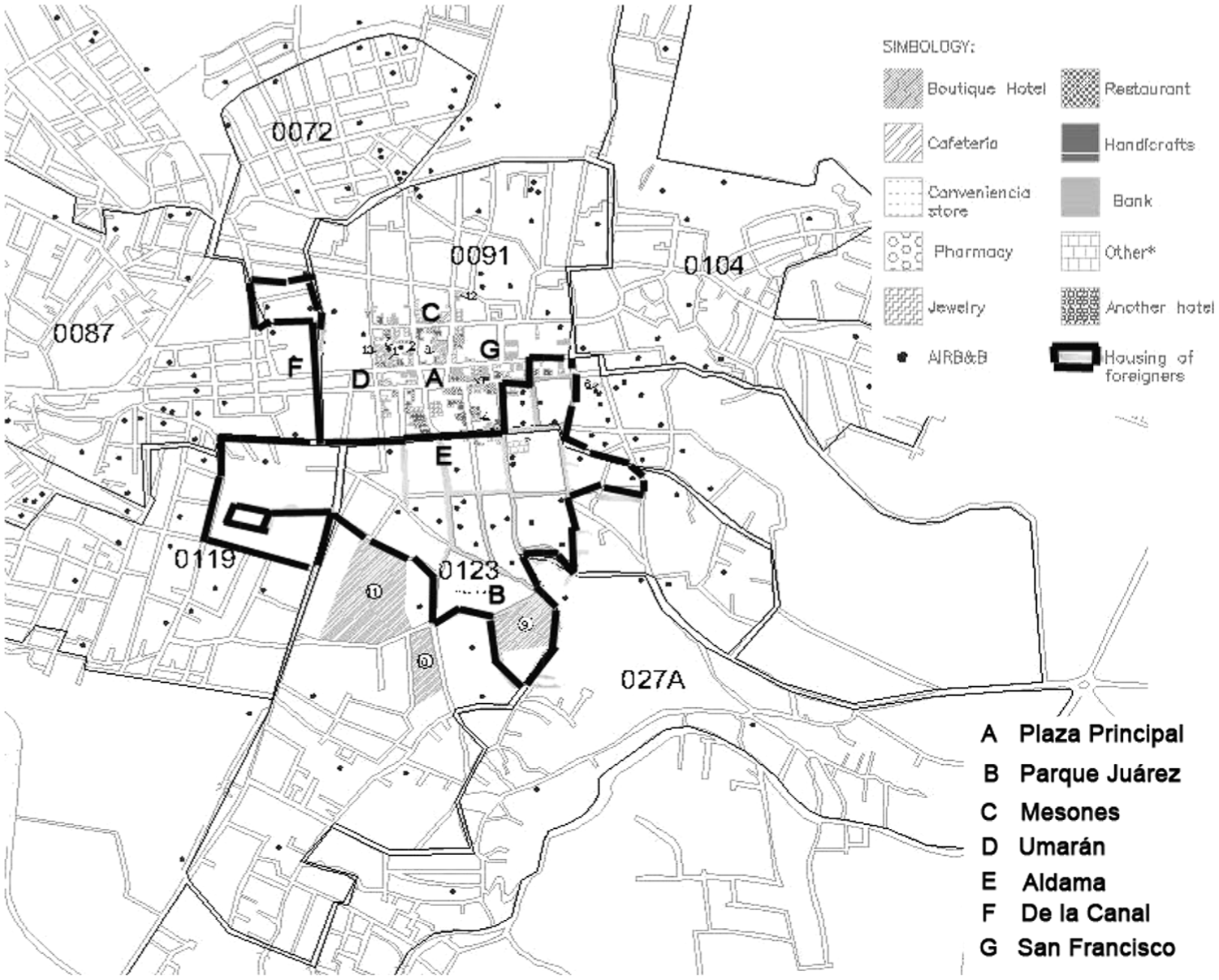
Airbnb’s accommodation and foreign housing distribution in the heritage centre of San Miguel de Allende. Author’s own elaboration.
Housing itself has also undergone a shift towards short-term uses aimed at the international middle classes, temporary residents and tourists both Mexican and foreign. This is especially evident in the growth of units advertised on peer-to-peer rental platforms such as Airbnb. Short-term rentals are clustered around the aforementioned Disneyfied historic centre, spilling out to the buffer neighbourhoods around the UNESCO designated zone. Figure 1 shows the concentration of foreign residents towards the north of the heritage centre, more specifically in the neighbourhoods of Guadalupe, Azteca and Tecolote. According to the database available in January 2018, a total of 306 units were advertised to tourists, of which 273 were entire houses. That number represents 3.5% of the housing stock of the heritage centre of San Miguel de Allende and it is estimated that it consists of up to 1000 tourist rooms, as each of the city’s houses has an average of four rooms (Aguado, 2018). According to the Airbnb website (www.airbnb.mx), 30% of the owners are in the Third Age, retired and mostly women (in line with the profile described above) while 70% of the short-term rentals were owned by Mexicans. Based on owners’ profiles verified at Airbnb’s website, foreigners appear to rent out their houses less frequently, since they live in them for most of the year, while Mexican owners rent frequently since they consider their houses as tourist businesses. These data suggest complementarity between transnational gentrification and touristification, where even Mexican homeowners participate in neighbourhood transformation in favour of higher-income, foreign middle classes.
Foreign residents in San Miguel de Allende live and spend much of their time in the UNESCO World Heritage Site polygon and in the areas surrounding the heritage centre. Fieldwork confirmed the spatial concentration of tourism uses in key central neighbourhoods. In this respect, the urban spaces of the city are appropriated for new types of transnational, touristic uses tied to leisure and lifestyles quite different from those that initially fostered the mining capital of Bajío. These territorial uses of the city spatialise global inequality and demonstrate the globalisation of urban space oriented towards the transnationally mobile global middle classes.
Transnational gentrification: From cultural hub gentrification to a public–private partnership
Transnational gentrification may be a global process, but it also requires endogenous conditions – government legislation, business interests and cultural heritage – that enable urban heritage renovation and processes of real and symbolic displacement. In San Miguel, the impact of the ‘expat’ population on real estate and urbanism is because local families and entrepreneurs, allied with local governments, have benefited economically from their presence and from their higher purchasing power. In the 1990s, the municipality and the government of the State of Guanajuato used the state tourism board, SECTUR-GTO, to finance San Miguel’s tourism promotion. From 2002 to 2008, the federal programme ‘Pueblos Mágicos’ (Magical Towns) was the main destination for investment and tourism promotion. Pueblos Mágicos was created in 2001 as an economic policy for heritage towns with tourist potential (see Velázquez, 2012). Finally, municipal, state and federal programmes from ministries of tourism and culture have been subsidising the economic development of San Miguel since 2008.
Although this analysis focuses on the role of gentrifiers (residents and visitors), it is also worth considering the influence of international institutions such as UNESCO, which can often induce transnational gentrification (Hayes, 2020). Since WHS status was conferred in 2008, the push towards luxury tourism and residential development has grown. In the city, municipal, state and federal governments have shown favouritism towards businesses even when these have flouted rules on heritage preservation. Various projects have drawn criticism over conflicts of interest, in which local patronage networks prevailed over regulatory compliance for heritage protection, official urban planning and the collective interest of the public (Herrera, 2018). For example, in 2015 authorisation was given to build the new Capilla de Piedra neighbourhood despite the height and density restrictions in place to protect the heritage character of the historic centre. The project went ahead, even after local newspapers and local radio voiced opposition to the project because of the threat it posed to the UNESCO protected urban landscape (Ochoa, 2016). The construction of the luxury hotel Aqua Live in 2016 not only required the destruction of an 18th century dyke and the felling of heritage trees, it also compromised the water supply to a low-income neighbouring community. Mexican developers undertook these projects. By catering to foreign demand they can increase profits, with apartments at US$160,000 and hotel rooms at US$500 per night 1 – prices that local workers and most Mexican tourists would be unable to pay.
These changes are occurring in the absence of mechanisms for citizen consultation and democratic urban planning programmes in Mexican heritage centres. The social groups opposed to the urban transformation of San Miguel’s heritage centre do not learn about new urban projects until the work has begun. Groups representing popular interests, such as shopkeepers’ and neighbourhood associations, feel threatened by ‘tourism’ and blame the municipal administration for not addressing their urban problems (Castillo, 2016). By contrast, civil society organisations such as SOMOS San Miguel and La Biblioteca A.C., which are comprised mainly of foreigners, talk about containing ‘tourism and gentrification’ (Aguado, 2018), as though these two processes were separate from one another, and that they themselves are not also part of the problem. In the context of weak civic participation in the urban planning process, the most common form of resistance is, therefore, through protests and media pressure. When protesting, people occupy plazas and streets for short periods of time and call on others to participate in marches, through social networks. Newspapers (Atención, El sol de Bajío, Correo and A.M.), along with the local radio station, publicise the protests. These events reflect the severe stratification in Mexican society and disputes over relations of power. Municipal actors associated with entrepreneurial elites participate in tourism development of the WHS. But not all Sanmiguelenses think alike and some civic associations and neighbourhoods from the middle and lower classes oppose what they see as a loss of their heritage and quality of life.
Transnational gentrification: Built heritage and displacement
Latin American gentrifications have often been linked to historic urbanism and built-heritage (Chang, 2016; Delgadillo, 2015; Inzulza-Contardo, 2012). Its appropriation by higher-income investors, owners and renters from higher-income countries is now an important element of urbanisation in San Miguel de Allende, perhaps even its most important contemporary urban dynamic. The difference in monthly income between the average Mexican citizen of San Miguel de Allende (US$608) and the average middle-class retiree from Texas (even if the latter has only the average social security pension of around US$1500) is significant. The value that higher-income foreigners place on Mexican urban heritage – at one time not especially valued even by local elites – has taken house prices out of reach of most Mexican buyers in San Miguel, where most homes currently sell for somewhere between US$200,000 and US$500,000. Urban heritage is, thereby, valued at higher levels of the global division of labour (Hayes, 2018), to the detriment of longer-term residents on lower incomes. For instance, I have observed that in the areas surrounding tourist boutique hotels, owners of the adjacent properties prefer to change the land use of buildings from housing to tourist-oriented businesses in order to be able to obtain higher returns. Housing that previously was rented out to students or working-class families and individuals is now sold or renovated and transformed for cultural or tourist purposes. In this respect, transnational gentrification does not just participate in the preservation of heritage, it also modifies it. Foreign appropriation of heritage buildings often breaks with the cultural and architectural values of local Sanmiguelenses, as seen in other processes of transnational gentrification around the world (Cócola-Gant, 2016; Zaban, 2017).
Transnational gentrification in San Miguel amounts to an advanced residential substitution. Until the 1990s, the downtown area was mostly inhabited by local families, although there were already some non-nationals among them and the WHS was essentially for the local middle and upper classes. However, these families sold their properties and settled on the periphery of the town in new middle-class gated communities or in suburban developments. The mechanism of replacement was real estate sales, and although this was a decision made of their own free will, it still amounts to a residential substitution. This phenomenon is now spreading to the Colonias Populares (informal neighbourhoods) surrounding the heritage centre. Here, low-income families also see the possibility of selling their houses in exchange for prices they perceive as astronomical. Francisco (57 years old), Alondra (35 years old) and Miguel (21 years old) were born in San Miguel and used to live in la Colonia Guadalupe, next to the heritage designated area. Their families sold their houses to foreigners and bought less expensive houses in the suburbs. In Miguel’s case, the sale of the family home financed his university studies. These forms of asset-based welfare for lower-income groups may legitimise some aspects of the gentrification process but they present diminishing returns over the longer term, as lower-income groups face permanent territorial exclusion from areas zoned for high-income leisure uses. The high value of property in the WHS is reflected in the average price of US$520,000 for the city’s properties compared with US$40,200 for the Bajío region as a whole according to the Federal Mortgage Society. 2
In sum, displacement occurs simultaneously in residential and commercial sectors and affects the value of real estate as much as access to the public spaces of the city. In the former, foreign migrants displace the local middle class, while in the latter, consumption practices and uses displace the low-income uses of public space (i.e. mainly affecting the use value of public space of informal workers, students, single mothers and indigenous populations). The heritage area is continually the object of municipal operations designed to ‘cleanse’ (limpiar) it of informal vending, 3 which disproportionately affects indigenous populations and low-income groups. Meanwhile, monthly rents have risen to an average of US$1850, 4 prices which exclude students and single-parent families from the WHS area.
Transnational gentrification, planetary urbanisation and exclusions
The urban spatial structure is sensitive to the process of transnational gentrification but so too are the social relations that play out in the urban environment of San Miguel de Allende. In the transformation of built heritage, social and cultural disputes emerge around the surge of socio-spatial exclusions typical of planetary urbanisation (Brenner, 2013). Up until the 1950s, the city was contained within its central area, and was similar in size to what it was in the 19th century. From the 1960s to 1990s, rural migrants began to gravitate to the city’s outskirts, setting up irregular settlements, partly as a result of the state’s inability to provide public housing for the growing urban population. Since then, a period of neoliberal urbanism coincided with the ejido land release in 1992 (the ejidos are farm cooperatives, a form of land ownership created as a result of the revolution of 1910), whereby land privatisation enabled private owners to sell their parcels of land on the urban property market (Olivera, 2015). This privatised land has been developed for urban housing, most of it oriented towards middle-class Mexican families and, most recently (2010s), rural areas on the outskirts of the city have become residential clusters oriented towards foreign buyers.
Housing has become a scarce resource in the heritage area, as pioneer gentrifiers already acquired most of the properties several decades ago; 70% of the real estate transactions in the heritage area were only between foreigners in 2017 (Notimex, 2017). The prices are so high that even some new migrants cannot afford them. In 2017, the average house price was US$520,000 in the WHS polygon (Notimex, 2017). Since there was not enough demand at these prices, property developers appropriated adjacent zones connected to the heritage centre. Social displacement caused by transnational gentrification is associated with highly profitable tourism and cultural consumption practices, which generate strong competition for space, especially in the historic centre. Part of the urban economy of San Miguel is dollarised for real estate transactions as well as for services. Consumption at restaurants, bars, art galleries and boutique hotels, bakeries, cafes and gourmet markets is beyond the purchasing power of the popular classes and most Sanmiguelenses. For instance, a slice of pie can cost up to US$4–5 in these places, similar to the cost of a local craft beer or the equivalent of the daily minimum wage established for a Mexican person (88.36 MXN). Even the pioneer gentrifiers of the 1950s–1980s experience social displacement as a result of the expansion in tourism. They also suffer from a loss in quality of life because of the overcrowding of roads (an average of 11,000 cars per weekend in 2017), overload on the garbage collection service, traffic jams, noise pollution and the massive influx of visitors (an average of 40,000 every weekend during 2017). A downtown that used to cater to residential needs and may once have appeared quaint is now arrayed with bars, restaurants and galleries that cater to shorter-term visitors, whose consumption practices now dominate the historic centre.
Conclusion
Gentrification in Latin-American heritage cities differs from ‘social upgrading’ in the metropolises of the Global North. The agents of urban transformation are partly urban landowners, but the ‘gentrifying’ classes in cities such as San Miguel de Allende are transnational lifestyle migrants and tourists. In the case studied here, transnational lifestyle migration and tourism lead to residential displacement and urban segregation. The inequalities at play in this process are not the same as those in national contexts. In this instance of transnational gentrification, the global differences in accumulated wealth and appropriated global labour power are expressed spatially as more and more North American and European migrants desire to consume the spaces of Latin American heritage cities (see also Hayes, 2020). The higher incomes of ‘higher latitudes’ of the global division of labour (Hayes, 2018) constitute demand for tourism entrepreneurs and real estate speculators. San Miguel de Allende is on the rent gap frontier of a new era of globalisation, where gentrification and urban planning are intricately linked (Brenner, 2013; Lees, 2012).
Since 2008, the reputation of San Miguel de Allende as a cosmopolitan heritage destination, especially for North American retirees, has been stoked by media and international lifestyle marketers. 5 But the growing crowds and the pressure they have put on local prices have also begun to be felt by many of the lifestyle migrants themselves. Finally, transnational gentrification in San Miguel draws attention to the overlap of the right to the city and global social justice, since in the light of global real estate interests, the most vulnerable local populations in Latin America are doubly affected by local and transnational inequalities of class and accumulated wealth. Particularly in this case, where transnational processes are promoted by governmental intervention, attempts to pursue economic development and the private profitability of space lead to the exclusion of most Mexican citizens. This spatialisation of the territory for higher-income tourists appropriates this space from longer-term Mexican residents who are less adapted to governmental objectives of international competitiveness. The local government currently lacks any strategy for greater citizen inclusiveness or for protecting the traditional spatial practices of lower-income residents. The transnational gentrification of this Mexican heritage centre erodes the poorest Mexicans’ right to the city. Thereby, it exacerbates the social exclusion and marginalisation of an important part of the population, who may use the city for different types of labour, consumption and cultural activity.
Footnotes
Acknowledgements
I would like to thank Matthew Hayes, University of St. Thomas, Canada, for his critical reading and translation improvement.
Funding
This research was supported by the DAIP (Dirección de Apoyo a la Investigación y al Posgrado) of the University of Guanajuato. Project number: 189/2019.
