



Abstract
In this paper we focus on LGBTQ+ travel guides and the creation of a North American LGBTQ+ urban imaginary as forms and facilitators of activism. Specifically, we consider one of the few continuously published sources detailing such an imaginary in the mid-20th century and its construction of an ‘epistemological grid’ onto which entries were placed. We briefly situate the guides in the context of an emerging (and frequently politicised) mid-20th-century LGBTQ+ media ecosystem, then proceed to a detailed analysis of the imaginary they evoke. Cities are the guides’ assumed building-blocks, along with certain other ontologies, most notably bars, sex establishments and other meeting places (though these change over time). As aggregators of information at a national scale, the guides standardised and communicated particular notions of what LGBTQ+ space was (and is). At the same time, as way-finding tools they helped readers navigate actual communities at the local scale. In so doing, we argue, Damron guides helped shape early forms of LGBTQ+ identity and community in North America – including the establishment of ‘gaybourhoods’. We therefore interpret the guides as both activist and facilitators of activism. They claimed space at an abstract level while simultaneously facilitating place-making, territorialisation and simple survival strategies by actual people on the ground. Our analysis contributes to understandings of the relationship, over time and at multiple scales, between travel guides, an urban-based North American spatial imaginary and LGBTQ+ activism. It also highlights Damron guides’ potential as a rich source of data.
Introduction
As part of a special issue on LGBTQ+ urban activisms, this paper analyses the content of two longstanding guidebooks for lesbians and gay men (Bob Damron’s Address Book– later known as The Damron Men’s Travel Guide – and its companion, The Damron Women’s Traveler) and the urban spatial imaginary they produced. We focus particularly on how the guides’ content and associated spatial imaginary functioned – and continue to function – as forms and facilitators of activism. We do this by conducting a textual analysis of the guidebooks themselves and by considering the political possibilities (and limitations) of the ‘epistemological grid’ they produced.
Since 1964 for the men’s guides and 1990 for the women’s guides, these books catalogued locations across an ever-increasing range of urban and rural areas in North America (and later selectively globally). Over nearly the same time period there has emerged a broad literature on LGBTQ+ activisms. Most recently reviewed by Johnston (2017), this scholarship has explored a wide range of bodies, sites, places and spaces. With some notable exceptions (e.g. Shuttleton et al., 2000) these sites have been urban-focused. We build on and broaden this literature by theorising the extent to which Damron guides and the urban spatial imaginary created by them might be conceptualised as nodes of LGBTQ+ activism that challenged heteronormativity and homophobia. Thus, we seek to extend scholars’ thinking about how this particular form of knowledge production and dissemination was (and is) also an important dimension of LGBTQ+ activism.
Our textual analysis shows that, as social artefacts, the guides challenged the particular power formation of the mid-20th-century closet, which alienated LGBTQ+ individuals from each other and from the broader community. Damron guides framed practical information for LGBTQ+ people about where to find resources, opportunities (including sexual opportunities) and other LGBTQ+ people in terms of a particularly urban spatial imagination. Following Magnusson (2013), we note the importance of proximate diversity that the guides and their internal organisation presumed and propagated. Cities and locations within them were the consistent building blocks of this knowledge-producing activism.
We have structured the paper to reflect these points. First, we review the literature on LGBTQ+ urban activism to show how the guides can be thought of as a different form of spatial activism rather different from the intra- and inter-urban foci in the literature. By creating an epistemological grid of possible meaning – inevitable in any form of representation, especially geographic – Damron guides built a spatial imaginary that offered isolated folks survival strategies and a less closeted spatial imagination of how their lives could be different. Second, we discuss the guides’ specific origins in the life of their namesake/creator and situate them within an emerging mid-century LGBTQ+ media-scape. Third, we offer a reading of the guides as texts that highlights the particularly urban imagination created by them, one that shaped the ability of LGBTQ+ individuals to locate themselves, break down the isolation of the closet and better live their lives. The guides’ qualitative discussion of cities and states, and their detailed coding of particular listings, allowed a singular, systematic grid through which places could be compared, contrasted and generally made legible. In particular, we read a great deal of activism around the evolution of codes for types of locations in a city, and the shifting identity politics around race and gender, but also age, sexuality and (dis)ability. We also ponder the activism around how the systematised coding of venues formed the building blocks of the late 20th-century ‘gaybourhood’. The paper concludes with a discussion of the implications of our reading for contemporary LGBTQ+ activisms, including how Damron guides might be further utilised by scholars and activists.
LGBTQ+ activisms and urban space
From a variety of theoretical perspectives, cities have long been viewed as conducive to political activism (e.g. Castells, 1977; Harvey, 1989; Miller and Nicholls, 2013; Wilson, 1992; Wirth, 1938; Young, 1990). While scholars’ particular logics vary widely, almost all locate this conduciveness in the material conditions of urban life, including issues of size, density, diversity and modes of production and consumption. The contemporary political theorist Warren Magnusson (2013) in fact argues that urban life is politics, because of the imperative of dealing with the ‘proximate diversity’ – economic, cultural and social – that is inevitable in cities.
The centrality of urban space to studies of LGBTQ+ activisms is not, therefore, surprising. It is manifest in numerous historical monographs about particular cases of LGBTQ+ activism (e.g. Atkins, 2003; Beachy, 2014; Boyd, 2003; Chauncey 1994; Faderman and Timmons, 2009; Houlbrook, 2005; Stewart-Winter, 2016) as well as in more social scientific attempts to make sense of sexual politics and the politics of sexuality. George Chauncey’s (1994) famous account of the emergence of a gay subculture in early 20th-century New York, for instance, demonstrated the importance of certain features of urban life to the formation of gay male as well as lesbian identities and communities in that city. These include a diverse array of bars, bathhouses and neighbourhoods, including particularly those catering to or associated with New York’s industrial working class. Many of the dynamics he described entailed either the exile of segments of LGBTQ+ populations to these urban spaces (see also Atkins, 2003; and Weston, 1995), affirmative claims to them by segments of the LGBTQ+ population, or some combination thereof. Either way, the result was a series of spaces whose existences were seen as inextricably linked to the urban contexts in which they were found and that were legible, by virtue of their relatively counterhegemonic norms and relative safety, as places to various LGBTQ+ people. Variants of these processes are documented and replicated in the LGBTQ+ histories of other cities. These include interactions with state authorities (for example, police, liquor control boards, planning boards), market actors (for example, land and housing developers, employers, unions, legal and illegal syndicates) and various social and political groups and movements (for example, workers, immigrants, unions, religious groups and eventually the women’s and gay rights movements).
A range of social scientific theories and models aimed at generalising from and building on these histories have also emphasised exile, territorialisation and place-making in cities as foundational to LGBTQ+ activism. These include structuralist accounts that emphasise the role of class dynamics, usually in combination with the forces of patriarchy, heterosexism and race, in the creation of LGBTQ+ commercial and residential areas in cities (Browne and Bakshi, 2013; Castells, 1983; Knopp, 1990; Lauria and Knopp, 1985; Murphy, 2010; Nash, 2006; Nash and Gorman-Murray, 2015; Podmore, 2006; Schroeder, 2013). This type of analysis is perhaps best exemplified by Castells’ (1983) study of San Francisco’s Castro district, which he interpreted as a form of activism expressed through place-based development of economic and political power, and a spate of studies of ‘gay gentrification’ inspired by his work. These emphasised neighbourhood-based economic and political empowerment in cities but often with an eye that was critical of Castells’ essentialisation of gender differences and his relative silence around issues of racial and ethnic stratification and exclusions within these spaces. Poststructuralist analyses, meanwhile, have focused on identitarian, anti-identitarian and other forms of cultural politics in the creation of more complex and contradictory urban spaces. These include a range of studies, from Valentine’s (1993) examination of lesbian homemaking strategies through Nash and Bain’s (2007) study of a lesbian night at a men’s bathhouse in Toronto, to Podmore’s (2001, 2006) studies of lesbian (in)visibility and place-making in Montreal, Binnie and Skeggs’ (2004) and Nash’s (2006) critiques of the creation of Manchester’s and Toronto’s ‘gay villages’ and Brown’s (2007) and Browne and Bakshi’s (2013) place-sensitive explorations of complex and contradictory forms of LGBTQ+ activisms aimed at producing non-normative forms of ‘ordinariness’ in ‘ordinary cities’. Brown’s (2000) multi-scalar examination of the spatiality of the closet, meanwhile, details the ways in which the closet’s particular epistemology of ‘knowing by not knowing’ (Sedgwick, 1990) is manifest in (among other things) the production of urban space. His textual analysis of the inner-city landscape of Christchurch, New Zealand, shows how an urban landscape’s subtle coding – including, ironically, attempts at the erasure of LGBTQ+ visibility by governmental authorities – actually facilitated LGBTQ+ people’s navigation of that landscape, as well as their strategies for empowerment and community-building.
Both strands of literature often stress the territoriality of urban place-making through processes of resignification as well as physical occupation and control of space (Misgav, 2015). A variety of spaces within the city have been considered, including the local state (Andrucki and Elder, 2007; Forest, 1995), streets (Podmore and Chamberland, 2015), parks and recreational space (Muller, 2007; McCann and Catungal, 2010; Patrick, 2013), parades and festivals (Browne, 2007; Currans, 2017; Johnston, 2007), housing (Brown, 2007) and community centres (Hartal, 2018; Misgav, 2016), as well as private spaces such as the home (Valentine, 1993), religious organisations (Schroeder, 2013; Seitz, 2017), non-profits (McLean, 2018) and commercial establishments (Brown et al., 2014; Nash and Bain, 2007; Weightman, 1980). Additional work has stressed the importance of embodiment and emotion in this territorialisation (Doan, 2017; de Jong, 2017; Johnston and Waitt, 2015). A sensitivity to scales of activism beyond the urban is an emerging but still underdeveloped characteristic of this literature (compare DiFeliciantonio, 2014; Doan, 2016; Johnston, 2017; Oswin, 2015).
A consistent theme across this literature is the partiality and complexity of ‘activism’ (de Jong, 2017). In recent years a consensus has emerged – at least within more critical circles – that battles over signification and meaning (e.g. ‘ordinariness’), along with everyday survival strategies and even explicit failures, can rightfully be seen as ‘activist’ (Browne and Bakshi, 2013; Knopp and Brown, 2003). The creation, content and contestation of ‘spatial imaginaries’ (Gregory, 1995; Watkins, 2015) constitute particularly fertile ground for discussions of these more broadly defined forms of LGBTQ+ activism (Binnie and Klesse, 2016). As representational discourses, spatial imaginaries frame debates and delimit material practices, including activisms. Yet, except in the context of cosmopolitan/transnational/global LGBTQ+ activisms (Bacchetta et al., 2015; Binnie and Klesse, 2011; DasGupta, 2019) and anti-racist activisms (Bates et al., 2018), most discussions of spatial imaginaries have focused on hegemonic practices rather than resistances (for example, Jessop and Oosterlynck, 2008; Massey, 2005; Puar, 2006). In addition, activisms are quite intersectionally problematic for a truly progressive politics (Doan, 2007; Johnston, 2017). They are always partial/incomplete and often even contradictory, in that a form of activism that may be empowering in one dimension or for one constituency may be disempowering or even perpetuate oppression for another (Currans, 2017).
Our intervention here is about activisms at the scale of individual North American cities and of North American cities as an expanding, networked whole. We focus particularly on the creation, through the Damron guides, of a specific, urban-focused spatial imaginary and certain of its activist dimensions and effects. In this case, the spatial imaginary takes the form of an ‘epistemological grid’ onto which LGBTQ+ people could place themselves and recognise each other across space. In the context of a much broader philosophical discussion of approaches to social science, Dixon and Jones (1998: 215) describe such a grid, abstractly, as follows: [It] is at once a procedure for locating and segmenting a complex, relational, and dynamic social reality … The grid segments social life so that it may be captured, measured and interrogated … [I]t should also be regarded … as a way of knowing that imposes itself upon and eventually becomes inseparable from the processes it helps to understand. (Dixon and Jones, 1998: 251)
This description calls attention to two important points that inform our reading of the guides: the impossibility of accessing reality without representation, and the fact that all acts of representation have selective meaning-making effects. In the case of Damron guides, a grid of some sort was inevitable if the social world they sought to capture was to be represented. Yet the grid also inevitably foregrounded a particular imagination about that social world and, in so doing, had both direct and indirect meaning-making (and activist) effects.
We are keenly aware, of course, that any discussion of spatial imaginaries is its own form of representation and thus risks universalising its own situated truths. In the context of activisms associated with Damron guides, the obvious danger is the perpetuation of the guides’ own racist, sexist, classist, ableist and ‘Western’ homonormative imagination. But, as we argue below, the guides also created liberatory possibilities for many LGBTQ+ people in North America during the mid-20th century and into the 21st century. Moreover, the activisms associated with the guides shifted over time, certainly in response to changes in national-scale (and some local-scale) LGBTQ+ activisms and perhaps also as activist innovations themselves.
Damron guides in context
The first Damron guide was published in 1964 by Bob Damron, a San Francisco gay bar owner, and Hal Call, then President of the Mattachine Society, 1 in San Francisco (Meeker, 2006; Sears, 2006). It was oriented overwhelmingly, but not exclusively, towards gay men. Though not the first lesbian or gay travel guide published commercially in the USA, it was one of the earliest and for decades was the most commercially successful. 2 Moreover it is the only such guide to have survived in print form to the present day.
Of course, travel guides were neither the first nor the only kind of publication of, by and for LGBTQ+ people in the USA. Historian Martin Meeker traces the emergence of such publications to privately distributed circulars published by US military personnel during the Second World War, and heavily coded directories ostensibly aimed at connecting men who shared interests in hobbies such as stamp collecting in the immediate post-war era (Meeker, 2006: 22–26). By the 1950s, national organisations such as the Mattachine Society and Daughters of Bilitis had emerged and were producing their own national publications. ONE magazine, published in Los Angeles by individuals associated with the Mattachine Society, circulated nationally by mail between 1953 and 1969. The Mattachine Society itself published The Mattachine Review between 1955 and 1967. And the Daughters of Bilitis published The Ladder magazine from 1956 to 1972. These publications typically featured a mix of literary, informational and educational content about LGBTQ+ people and experiences and were infused with an ethic of reducing prejudice and discrimination against LGBTQ+ people (albeit from quite diverse ideological perspectives). In 1969 the more explicitly political magazine The Advocate began national publication. The Advocate emerged in early 1967 as a local Los Angeles newsletter, in response to police brutality and raids on gay bars in the city (Faderman and Timmons, 2009). Numerous local newsletters and, eventually, gay and lesbian newspapers (and even occasional radio shows) also emerged during this period, and increased rapidly after the Stonewall rebellion in New York City in 1969. Combined with travel guides such as The Address Book, they constituted a nascent LGBTQ+ media ecosystem that connected LGBTQ+ people in disparate locales, helped them overcome (or at least evade) prejudice and discrimination and, perhaps most important, helped popularise and standardise what it meant to be gay or lesbian in the USA (see below).
In The Address Book’s early years, Bob Damron personally gathered content by travelling across the USA, visiting gay bars and developing contacts with as many gay men and lesbians as he could. As the guides grew in size and popularity, these individuals – disproportionately bar owners, managers, patrons and people who shared Damron’s particular sexual interests – were then relied on to provide updates and new information. The guides’ readership was also encouraged to contribute information and updates, in an early, low-tech example of crowd-sourcing that is consistent with the more democratic and activist side of Damron’s project. The eventual consequence of this method, and of the guides’ publication in general, was to create a standardised, nationalised and to a considerable extent commercialised imagination about what it meant to be gay or lesbian in the USA. This imagination was also profoundly spatial and multi-scalar. As Meeker (2006: 214) explains, Damron and others imagined the gay world to be expansive, established, and spatially anchored … [T]hey knew there were gay sites in small towns and large cities and that the commonalities they shared were far more important than their differences – that at the base these were places where men could meet men and women could meet women for friendship, companionship, and sex … [T]hey believed a sort of gay nationality existed but was waiting to be discovered by its members; by cataloging and mapping this nation, the publishers of these guidebooks not only told gay men and, to a lesser extent, lesbians where they could find others like themselves, but they provided them with evidence of the larger world, indeed the quasi-nation, in which they lived.
The publication of the Damron Women’s Traveler in 1990 extended this imaginary to recognise explicitly women and women’s experiences as different from those of men. 3 Along with shifts over time in the ways both guides dealt with issues of gender and race, the emergence of the Women’s Traveler highlights the important role of identity politics in shaping the spatial imaginary evoked by the guides. It also draws attention to their imbrication with various forms of activism. We turn next, then, to a detailed discussion of the specific architecture and content of the Damron guides, the spatial imaginary they produced, and how both functioned as forms and facilitators of activism.
Damron guides, their urban spatial imaginary and activism
The Damron guides began as a project that was simultaneously commercial and activist (Meeker, 2006: 212). Damron and Call sought to create a successful business by helping LGBTQ+ people (initially mostly gay men) find sex, friendship and community (see below). Their strategy for doing so involved the cataloguing of detailed information about specific places and the creation of a spatial imaginary – in this case a detailed epistemological grid – that connected those places and the people in them.
A US-based urban imagination animated the grid from the beginning. 4 Cities and towns were the grid’s basic building blocks, with individual venues typically associated with LGBTQ+ life assigned to them, most notably gay bars. Listings by city were then grouped by US state (and, eventually, Canadian province), with important information about particular cities and states also often provided (see Figure 1). Note the detailed, qualitative nature of this information and the implicit assumptions made about how the information might be used. Listings for the state of Georgia, for instance, are introduced with a lengthy explanation of what to expect based on that state’s liquor laws and, crucially, how they might be skirted. Idaho’s listings, meanwhile, are preceded by a fairly damning commentary to the effect that the entire state may not be worth an LGBTQ+ traveller’s time. And the listings for Cincinnati and New York City caution readers about ‘local pressure’ putting a damper on potential ‘offerings’ as well as ‘trouble’ at ‘private clubs’ – including the now famous resistances at New York’s Stonewall Inn in 1969, 5 while also providing a positive overall assessment of the ‘bar scene’ in New York. Thus the guides’ organisation of information by city (and state), the particular kinds of information provided about these jurisdictions and the guides’ privileging of the kinds of venues and opportunities found in urban areas, led readers to expect (or not!) a particularly urban form of LGBTQ+ life at a listed venue, regardless of where it was actually located.
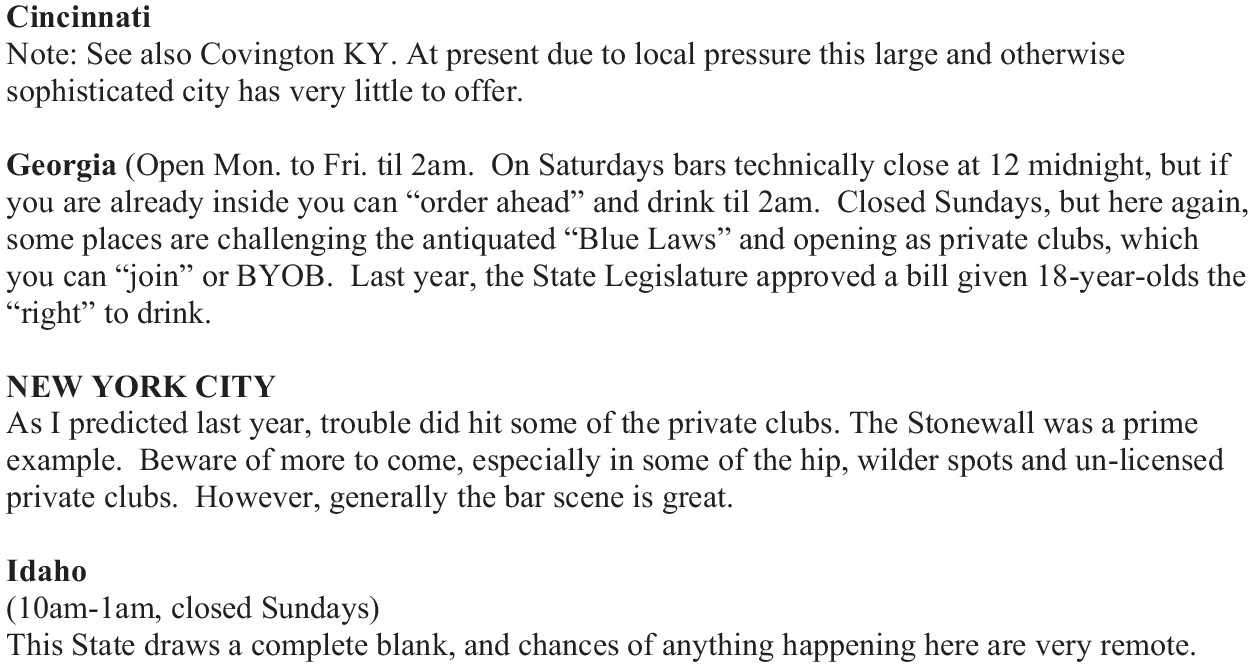
Examples of entries in Damron Guide (Men's) 1971.
This universalising of an urban imagination about LGBTQ+ life, via the creation of a national-scale epistemological grid, can be seen as an innovative form of activism. Prior to the guides’ publication, individuals such as Damron and Call (and the publishers of their less-successful predecessors) may have had their own national-scale imaginations about LGBTQ+ life but The Address Book and its successors universalised and extended that imagination in ways that were both practical and idealistic. They created a set of ideals about what LGBTQ+ life was and could be and put those ideals into practice, by helping diverse LGBTQ+ travellers and others find each other, live their lives and imagine themselves as part of something larger.
The guides’ epistemological grid was not the sole product of their editors and publishers, however. Diverse LGBTQ+ individuals in cities and towns across North America contributed information and content from the very beginning and only became more important over time. While the crowd-sourcing was initially built on Bob Damron’s own personal networks, it was also explicitly encouraged in the early years of the guides’ publication: Compiler Bob Damron … personally visited some 200 cities in 37 states and toured Canada to obtain data presented here. In addition many letters and telephone calls were utilized to expand information and attain highest possible accuracy … Still, there are bound to be some mistakes and omissions, for which we solicit accurate information so that correct listings can be printed in the next edition. (The Address Book, 1965: 2) As in the past, the publishers are grateful to readers for their information on new places to go and other appropriate changes for future editions of this book. (Bob Damron’s Address Book, 1968: 3)
This crowd-sourcing clearly contributed to the guides’ increasingly rich, complex and diverse content over time. Moreover, it suggests a dialogue between editors, publishers and readers that was relatively democratic and activist in its effects. Contributors were empowered to help inform and shape the guides’ content and spatial imaginary, which they obviously did. This agency on the part of the crowd-sourcers, in cooperation with the guides’ publishers, democratically contributed to breaking down the closet and helped reduce isolation.
The creation of the grid helped diverse LGBTQ+ individuals live their lives in other ways as well. By drawing affinities between diverse locales and creating a network of seemingly similar venues across space, Damron guides enabled LGBTQ+ people to see themselves and each other through various nodes on the guides’ epistemological grid, while at the same time helping them navigate the marginalised and at times dangerous world(s) they encountered.
Figure 2 shows a series of codes used in the early men’s guides to draw these affinities. Note that these codes cover a lot of useful ground, from descriptions of venues’ clienteles, to the types of services or entertainment provided, to evaluations of a venue’s popularity, to information about possible barriers to entry and how one might overcome them. In the early years of the guide, the codes themselves were often coded, in that they drew on subcultural understandings that conveyed more sensitive, nuanced and sometimes compromising or inculpating information about particular venues. This is a classic form of ‘knowing by not knowing’, a key epistemological feature of the closet. The coded codes had the dual effect of protecting readers from the potentially prying eyes of public authorities, family and others while also enabling engagement in taboo activities (including forms of sex-radicalism). ‘S-M’, for example, was formally defined as ‘SOME MOTORCYCLE’ but almost surely was meant to convey that the venue in question drew a clientele interested in sadomasochistic role-play (at a time when openly acknowledging such could have been used against both the venue and its clients by local authorities). Similarly, ‘RT’ (defined in the guide as ‘Rugged, often commercial’) was almost surely an allusion to the then common term ‘rough trade’, which referred to male street hustlers willing to engage in sex with men in exchange for money. A few years later the code ‘FFA’ appeared, and was defined as ‘Final Faith of America, or ask your friendly SM serviceman’ – an almost certain allusion to ‘Fist Fuckers of America’, a group associated with the BDSM subculture of the time that allegedly met at the famous Mineshaft, a gay club in New York City. 6 A rather different subcultural understanding is alluded to via the codes ‘M’ and ‘PE’, defined as ‘Mixed, and/or tourists’ and ‘Pretty elegant – usually jacket and tie required’, respectively. The former indicated predominantly non-LGBTQ+ venues where LGBTQ+ people were nonetheless likely to be found but where knowledge of subcultural cues was necessary to do so (and to avoid detection by others). The latter was most likely a sanitised version of the term ‘piss elegant’, used at the time to refer to a subtle, sometimes campy, upper-class (or aspirationally upper-class) subculture of homosexual men, legible as such only to each other, often in otherwise heterosexual spaces. These codes were very often applied to the bars of older, elegant (or once-elegant) downtown hotels. The coding of the Oak Room bar in New York City’s Plaza Hotel as ‘M-PE’, in the 1965 guide, is a particularly clear example.
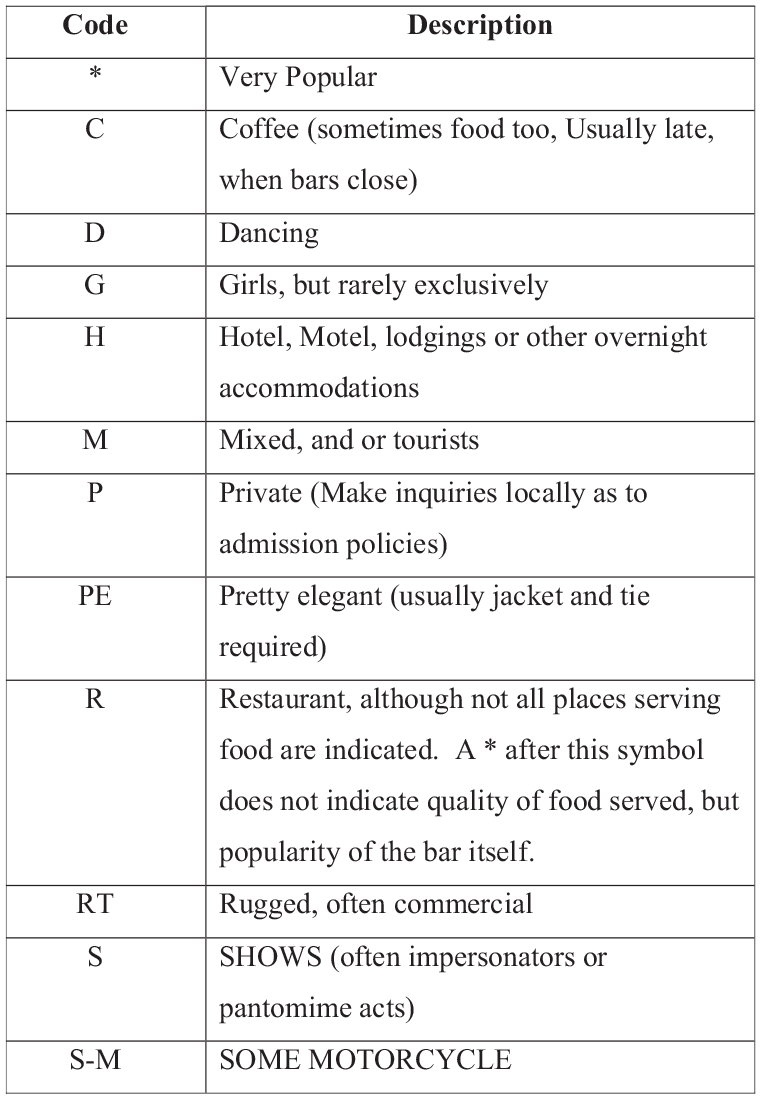
Codes and their descriptions from an early edition of The Address Book.
By the late 1970s the guides had become a much larger commercial operation and the codes describing venues expanded substantially. The evolution in coding bespeaks an imbrication with yet another kind of activism: identity politics. For example, the guides first called out race explicitly in 1970, through the code ‘B’, which was described as ‘Blacks Predominate’ (by 1975 this had become ‘Blacks Frequent’). By 1991, in what was now the Damron Men’s Travel Guide, the same code was described as ‘Multi-Racial Clientele’, signalling a partial shift towards a language of multiracialism, even if the code itself had not shifted. By 1994 the code had changed to ‘MRC’ (for ‘Multiracial Clientele’) and included the sub-codes ‘MRC-A’, ‘MRC-AF’ and ‘MRC-L’, which meant ‘mostly Asian-American’, ‘mostly African-American’ and ‘mostly Latino-American’, respectively. These codes have continued to the present day in the men’s guides. By contrast, the Women’s Traveler (which from the start eschewed the complex coding of the men’s guides in favour of fewer and more descriptive word-codes), 7 recognised race through a single word-code ‘Multi-racial Clientele’, further defined as ‘Our favourite category – We love a variety of colours’. This word-code has changed relatively little over time, with the most recent one being simply ‘Multiracial’, now described as ‘A good mix of women of colour and their friends’. The Damron guides’ spatial imaginaries have thus been racialised in ways that suggest an ongoing effort on the parts of their editors and publishers to grapple with a broader racial politics, albeit in ways that continue to assume whiteness as the norm. They have struggled to acknowledge racial diversity while reproducing particular racial formations and recentring whiteness. The activism around this particular form of identity politics is thus liberal and reactive, rather than radical and proactive. But it is nonetheless real. Moreover, the guides’ crowd-sourcing dimension suggests a potentially powerful role for readers in this activist process.
A similar process plays out with respect to an activist identity politics around gender. Both guides frequently coded venues for whether women or men predominated, though neither coded for the presence of gender non-conforming people (except in the context of drag shows) until 1997. The Women’s Traveler focused its gender descriptions primarily on the relative proportions of women and men found in a venue and later on whether or not gender non-conforming people were likely to be welcome (e.g. ‘Mostly Women – 80–90% lesbian crowd’, ‘Mostly Gay Men – Women welcome’, ‘Lesbians/Gay Men – Roughly 50/50 mix of lesbians and gay men’ and ‘Transgender-Friendly – Transsexuals, cross-dressers, and other transgendered people welcome’ in the 2014 guide). The men’s guides, by contrast, initially assumed and reproduced male spatial dominance and only coded for gender in cases where women or, later, gender non-conforming people might be present. This began with the code ‘G’ in 1965, described as ‘Girls, but rarely exclusively’, which lasted through 1979. It was replaced in 1980 by the code ‘L’, whose meaning was initially ‘Ladies/Ms’ but then was described simply as ‘Lesbians’. In 1989 the code switched to ‘W’ (meaning ‘Mostly Women’) and has been unchanged since. Beginning in 1989, and continuing to the present, the code ‘MW’ has been defined as ‘Men and Women’ or a close variant thereof, indicating venues serving women and men more or less equally. Then, in 1995 (and continuing to the present), the men’s guides added the code ‘MO’, described as ‘Men Only’. This code’s emergence is potentially important. It represents an acknowledgement that male-only spaces now needed to be recognised as such, rather than male spatial dominance simply being assumed. Finally, as noted above, in 1997 both guides added the code ‘TG’, described as meaning ‘Transgender Friendly’ (or something similar). Like the evolving racial codings, then, these gender codes and their transformations suggest an activist ethos around gender issues that has been largely liberal and reactive, though perhaps a bit more proactive on the parts of the Women’s Traveler’s editors than those of the men’s guide. And, again, as a result of the crowd-sourcing, these changes suggest a potentially important role for readers in this activism as well.
The coding of venues around other identities have similarly morphed over time, suggesting other ways in which the guides’ epistemological grid has facilitated engagements with identity politics. These include issues of age, sexual orientation (including of venues’ ownership and management) and to a limited extent (dis)ability. Generally speaking, both guides have long coded for the ages and sexual orientations of venues’ clienteles and, beginning in the early 1990s, for wheelchair access as well. However, the issue of age has been more complexly coded in the men’s guides while those of sexual orientation and (dis)ability have been more complexly coded in the women’s guides. These sensitivities and differences can be seen as having activist effects in at least four senses: first, they facilitate different segments of the LGBTQ+ population finding and interacting with one another. Second, they facilitate interactions between sub-groups (including, potentially, cross-generational sexual interactions). Third, they identify businesses and venues one might wish to patronise (or not) based on their management’s/ownership’s relationship to an emerging and diversifying LGBTQ+ community. And fourth, they facilitate an intersectional approach to identity politics generally.
Finally, the guides’ spatial imaginary had the effect of helping build place-based LGBTQ+ communities, including ‘gaybourhoods’ (see Ghaziani, 2014: 2–3, for a discussion of this term). From the very beginning the largest metropolitan areas were broken down by sub-area that, some of which would later become anchors for gaybourhoods (for example, West Hollywood, CA). Other sub-areas that appeared as gaybourhoods began to develop in them (for example, Polk Street and the Tenderloin in San Francisco). As the guides became more commercial, advertisers made note of and capitalised on these geographical understandings. A full-page advertisement for the Church Street Station restaurant, in the middle of several pages of listings for San Francisco in the 1978 guide, highlights this, by describing it as ‘Midway Between the Polk and The Castro’ (Bob Damron’s Address Book, 1978: 62). Similarly, recent years of the men’s guides include a subdivision of Chicago called ‘Boystown/Lakeview’ (Damron’s 50th Anniversary Men's Travel Guide, 2000: 156), a recognition of that area’s emergence as a gaybourhood. And the women’s guides have routinely included an inset page for major cities that includes a section titled ‘Where the Girls Are’. The 2012 section for Atlanta, for example, explains that: Many lesbians live in DeKalb County, in the northeast part of the city of Decatur. For fun, women head to Midtown or Buckhead if they’re professionals, Virginia-Highland if they’re funky or 30-ish, Little Five Points if they’re young and wild, and Castleberry Hill if they’re artistic. (Damron Women’s Traveler, 2012: 141)
Thus, by calling attention to areas with concentrations of LGBTQ+ people and venues, the guides have facilitated the association of these areas with LGBTQ+ communities, as well as their growth. Indeed, they may potentially have contributed to an imagination that made the building of those communities possible in the first place. This holds even for some areas outside of major metropolitan areas, such as Fire Island and Easthampton, NY (some 65 and 95 miles from Manhattan, respectively). As early as 1965, these communities were listed separately from New York City but were nonetheless called out in the overview for that city as among several ‘nearby communities … listed separately’ (The Address Book, 1965: 33). 8
Overall, then, the Damron guides’ content, and the grid produced by them, have constituted both a practical tool and an abstract spatial imaginary through which LGBTQ+ readers could see themselves, find each other and live their lives. In these ways they can be seen as both forms of activism themselves and facilitators of activism by everyday LGBTQ+ people. The grid in particular helped LGBTQ+ people see themselves as part of a networked whole – something approximating Meeker’s ‘quasi-nation’ – while the guides’ content gave them lots of practical information. The codes and other descriptions (of jurisdictions as well as venues) were particularly important in this regard, as they provided place-specific and generic information that enabled readers to navigate their worlds, resist heterosexism and homophobia, and build community. The evolution of the codes, the crowd-sourcing of content and the eventual recognition by the editors and advertisers of incipient ‘gaybourhoods’, meanwhile, indicate an activist role for readers in the guides’ production. This role includes complex engagements with identity politics as well as a democratising of the process of breaking down the closet.
Conclusion
Our reading of the Damron guides and their production of a spatial imaginary, as forms and facilitators of activism, is important for at least two reasons: first, it highlights the importance to activist politics of cataloguing, systematising, synthesising and disseminating mundane information, particularly for a politics aimed at empowering marginalised people. Damron guides represented a lot of hard, collaborative work. And while they certainly benefited some segments of the LGBTQ+ population more than others, they nonetheless productively contributed to the dismantling of the closet for many, many people. Second, our reading illustrates the central role spatial imaginaries can play in cultural politics. Creating a new spatial imaginary can be seen as not just a way of controlling or contesting a narrative, or of framing a debate, but as a strategy for claiming space at an abstract level. Damron guides thus gave LGBTQ+ people the ability to locate themselves in an abstract, affirming, space, and to imagine themselves as part of a larger, networked whole. This in turn helped make national-scale LGBTQ+ activism imaginable.
Our analysis raises numerous additional questions, though. How else might these guides be associated with LGBTQ+ activism (especially beyond urban areas)? How might they facilitate (or work against) the creation of a less urban-centred imagination about LGBTQ+ life? How might they preclude, rather than facilitate, activism(s)? What about possible connections to anti-LGBTQ+ activism? On a different note, how might they function in ways similar to – or different from – other resources and imaginations produced for other marginalised populations in the USA, such as The Negro Motorist Green Book (Kennedy, 2013)? And as a data source, how might Damron guides be used to address altogether different kinds of research questions? While we cannot hope to answer all of these questions here, we close this paper with a few thoughts about how each might be framed.
Thinking about Damron guides and activisms beyond the urban requires grappling with the question of whether or not an alternative spatial imagination was even possible at the time they began or might have become feasible since then. We share the scepticism of many about the coherence of the urban as a social or spatial category, and so find nothing fundamentally or inevitably urban about an imagination informing or enabling LGBTQ+ activism(s). Still, we find useful Magnusson’s (2013) notion of ‘proximate diversity’ as a spatial condition – particularly apposite in cities – that leads to the foregrounding of certain kinds of politics, including LGBTQ+ activism. Proximate diversity was certainly part of the context in which Bob Damron and his collaborators first developed the guides. So was a certain privileged position within that diversity, which clearly shaped not just the execution of their project but its conceptualisation in the first place. At the same time, the closet’s particular epistemology of ‘knowing by not knowing’ arguably functioned (and continues to function) similarly in urban and non-urban environments, suggesting certain commonalities in the experiences of LGBTQ+ people in both contexts. Thus, non-urban LGBTQ+ activisms, and the spatial imaginations associated with them, would likely be informed by conditions of life that are different in some respects and similar in others. They would also depend heavily on the positionalities of those executing them. In addition, it is important to consider the extent to which the closet remains (or does not remain) central to LGBTQ+ lives and experiences of LGBTQ+ people today, and its contemporary geographies.
With respect to constraints on activism, and the potential facilitation of anti-LGBTQ+ activisms, there is no question but that Damron guides and their associated spatial imagination have had numerous potential downsides. Most obviously, they were not designed to facilitate activism on the parts of particularly marginal segments of the LGBTQ+ population. They were designed first and foremost by and for LGBTQ+ folks with the means to travel and consume, primarily white gay men. They also risked making the contours of the closet visible not just to LGBTQ+ people but to determined opponents. This clearly has the potential to facilitate anti-LGBTQ+ activisms, which could take many forms, including exposing particular people and places, infiltrating and disrupting LGBTQ+ spaces and perpetrating campaigns of harassment and violence. A recently initiated transnational project on heteroactivism (Browne and Nash, 2017; Browne et al., 2018) constitutes a promising context in which these sorts of anti-LGBTQ+ activist strategies might fruitfully be explored in detail.
The issue of constraints on activism is complex in other ways. It entails a deep engagement with a wide range of activist practices. As we have argued here, these range from very material ones, such as way-finding and community-building, to symbolic and semiotic ones, such as creating a standard notion and set of expectations around what LGBTQ+ life looks like. Such practices – indeed all activisms – always have a duality to them. In developing their theories of what needs to be changed and how to change it, activists privilege some realities and imaginations over others. In the process they necessarily foreclose opportunities for some activisms while opening up opportunities for others. This is perhaps most easily seen in the ways in which the Damron guides’ efforts to manage the complex demands of certain kinds of identity politics were necessarily, in the end, liberal and reactive rather than radical and proactive. Deeper explorations of this issue might look beyond identity politics to issues of commercialism and class (barely touched on in our analysis, yet central to the guides’ purpose) as well as the slow disappearance of sex-radicalism as an animating feature of the guides.
Exploring ways in which the Damron guides and their associated spatial imaginary functioned similarly or differently from other guides and their imaginaries, such as The Negro Motorist Green Book, requires careful examinations of different forms of oppression and their associated epistemologies, as well as their intersections and geographic specificities. The epistemology of the closet produces a particular kind of alienation that is different from that of many other oppressed groups but that nonetheless overlaps and intersects with them. Moreover, its empirical manifestations vary across space, as the differences between urban, rural and multiple ‘Western’ and ‘non-Western’ LGBTQ+ lives and cultures make clear. Thus drawing comparisons between Damron guides and something like The Negro Motorist Green Book requires a detailed analysis of how the closet, its logics, its place-specific historical lineages and its empirical manifestations intersect with those of white supremacy and, in turn, white supremacy’s intersections with class and various other aspects of culture.
The above agendas are all tremendously important, but daunting. We end this paper, then, with a modest plea for Damron guides also to be recognised as a fertile data source for research, including historical/activist research. Here we have only scratched the surface of what might be possible using these guides. Other possibilities abound. Among some of the most exciting (and manageable!) are: mapping venues’ locations to explore changing spatial patterns over time; using maps and other visualisations of Damron guide data to correct exclusions (by presenting them to locally knowledgeable individuals for feedback, especially folks from marginalised segments of the LGBTQ+ population); using new digital techniques and technologies, in combination with data from the guides and other sources, to visualise LGBTQ+ life and its intersectionalities in more complex and subtle ways (e.g. ‘heat maps’ – see Zhao et al., 2017); tracking institutional, organisational and commercial histories; verifying, validating and honouring particular institutions’ and organisations’ places in local, regional and national histories; building LGBTQ+ archives; and building communities of LGBTQ+ scholars, activists and archivists.
With a lot of leg-work and an appropriate investment of resources, any one of these could be accomplished, given that the guides themselves are already archived in at least two libraries (the Gerber/Hart Library in Chicago and the New York City Public Library) and many are available online (via Alexander Street, an online academic press and publisher). The impacts of such work would be profound, as LGBTQ+ histories and geographies – and particularly intersectional histories and geographies – are notoriously difficult to excavate and preserve, because of the erasures of both the closet and creeping homonormativity.
Footnotes
Acknowledgements
We are deeply grateful to Ayanda Masilela and Miller Spitler for their assistance with data collection, management and analysis, and to Greggor Mattson for his inspiration, encouragement and insights regarding the larger project from which this paper is drawn. We are also grateful to three anonymous referees as well as the editors of this special issue for their extremely detailed and helpful comments on an earlier draft of this paper.
Funding
The author(s) disclosed receipt of the following financial support for the research, authorship, and/or publication of this article: The research was made possible, in part, by a grant from the Royalty Research Fund at the University of Washington.
