




Abstract
We bring together research on social networks and neighbourhood disadvantage to examine how they jointly affect unemployed individuals’ probability of re-entering employment. Data from the UK Household Longitudinal Study ‘Understanding Society’ provide information on the proportion of friends who live in the same neighbourhood, and are linked with small-scale administrative information on neighborhood employment deprivation. Results indicate that neighbourhood employment deprivation prolongs unemployment, but only for individuals who report that all of their friends live in the same neighbourhood. Living in an advantaged neighbourhood with all of one’s friends in the neighbourhood increases the chances of exiting unemployment. In contrast, neighbourhood location is not associated with unemployment exit if one’s friends do not live in the same neighbourhood. We conclude that neighbourhood effects on exiting unemployment critically depend on individuals’ social embeddedness in the neighbourhood. Not just residing in a disadvantaged neighbourhood, but actually living there with all one’s friends, prevents individuals from re-entering employment. This opens new avenues for theorising neighbourhood effects as social rather than geographic phenomena, and highlights that the effects of neighbourhood socio-economic characteristics are conditional on the level of interaction residents have within their neighbourhood.
Introduction
Neighbourhoods are an important context of social stratification. Living in a neighbourhood with concentrated poverty reduces well-being and educational attainment, increases problem behaviours and crime and limits employment chances (Sampson et al., 2002; Wodtke et al., 2011). It has been convincingly demonstrated that neighbourhood disadvantage prolongs unemployment (Buck, 2001; Dawkins et al., 2005; Miltenburg and van de Werfhorst, 2017; Musterd et al., 2003). The reasons why, and the conditions under which neighbourhoods influence unemployment duration, remain less clear. Residents of disadvantaged neighbourhoods may be more likely to be unemployed for several reasons: employer discrimination based on neighbourhood, a spatial mismatch resulting from a lack of local jobs coupled with poor transportation connections, a lack of local institutional and social services that may help in the job search, lack of access to resourceful networks that hold information about job opportunities or neighbourhood peer influences that undermine an effective job search. Theoretical mechanisms that connect neighbourhood disadvantage and resident’s life chances have been difficult to disentangle in empirical population-level research.
In this article, we examine how social ties in the neighbourhood and neighbourhood deprivation jointly affect the probability of exiting unemployment. We address two research questions. First, we follow the conventional approach to neighbourhood effects and ask whether neighbourhood deprivation per se decreases the probability of exiting unemployment. Second, we bring together neighbourhoods and networks to examine, in a population-wide longitudinal study, how social network location measured as the proportion of friends in the neighbourhood moderates the association between neighbourhood disadvantage and the probability of re-employment. Social relations are important cornerstones for understanding how context-level determinants affect individual outcomes (Erbring and Young, 1979). Neighbourhood socio-economic status matters if neighbours provide practical help or access to information about job opportunities, or act as role models in the job search process. Hence, unemployment could be prolonged in neighbourhoods with concentrated disadvantage that lack these resources.
Until recently, the literatures on neighbourhood and network effects developed largely separately (see Desmond and An, 2015). On the one hand, the neighbourhood literature has documented how residential neighbourhoods affect the life chances and choices of their inhabitants, but it has rarely incorporated detailed measures of social networks and social interaction (Galster, 2012; Sampson et al., 2002; Topa and Zenou, 2015). On the other hand, the social networks literature has focused on the types and structure of social ties and how these affect socio-economic outcomes, largely without concern for their geographical location (Burt, 2004; Granovetter, 1973; Portes, 1998). Integrated studies of social networks and neighbourhoods are often called for, but empirical work is rare (Desmond and An, 2015; Fernandez and Su, 2004; Papachristos et al., 2013; Topa and Zenou, 2015), and empirical population-wide survey evidence is non-existent to our knowledge. Existing studies are either cross-sectional (Desmond and An, 2015; Miltenburg, 2015) or based on administrative records of specific groups (Papachristos et al., 2013), but do not rely on population-wide longitudinal survey data with information on network and neighbourhood characteristics.
We use the UK Household Longitudinal Study ‘Understanding Society’ to test whether the impact of neighbourhood disadvantage on the probability of re-employment is moderated by the location of residents’ social networks, measured as the proportion of friends in the neighbourhood. The data uniquely combine geographically localised measurements of respondents’ friendship networks and small-scale neighbourhood information specifically on the employment deprivation of neighbourhoods with the possibility to examine unemployment longitudinally.
Our study contributes to the literature on neighbourhood effect heterogeneity (Wodtke et al., 2016), and is the first to find clear evidence with population-wide data that neighbourhood effects on employment depend on the co-location of social networks. Specifically, we find that locally concentrated networks moderate the effect of neighbourhood disadvantage: they act as multipliers of the beneficial effects of resourceful neighbourhoods and of the detrimental effects of disadvantaged neighbourhoods on the probability of exiting unemployment. This finding extends previous work that theoretically elaborates the downsides of locally concentrated social ties, and highlights that the benefits of locally concentrated social ties are confined to resourceful environments (Fasang et al., 2014; Portes, 1998). At the same time, individuals who have a larger share of friends outside of the neighbourhood are largely immune to the effects of neighbourhood disadvantage. We argue that it is not simply where individuals reside, but where they live, that is, where they spend time and with whom they interact, that matters for the impact of neighbourhood characteristics on socio-economic outcomes. This opens new avenues for theorising neighbourhood effects as social rather than geographic phenomena, and highlights that the effects of neighbourhood socio-economic characteristics are conditional on the level of interaction residents have within their neighbourhood.
Background: Neighbourhoods, networks and unemployment
We first review theory and evidence on neighbourhood effects on employment, followed by a discussion of theoretical mechanisms and empirical findings that link networks in neighbourhoods to employment outcomes, before summarising our main hypotheses.
Neighbourhoods and employment
Previous research has suggested several mechanisms through which neighbourhood disadvantage can affect life chances (Galster, 2012; Jencks and Mayer, 1989; Sampson et al., 2002; Sharkey and Faber, 2014). For employment, four main mechanisms have been distinguished: spatial mismatch, neighbourhood discrimination, local institutional services and social interaction.
First, the spatial mismatch hypothesis (Kain, 1968) attributes lower employment chances for residents of neighbourhoods that are geographically distant from suitable jobs to three reasons: information, commuting and moving (Ihlanfeldt and Sjoquist, 1998). The further away the job opportunities are, the less likely a jobseeker is to know about them. Many low-level jobs are advertised locally or require local knowledge for successfully obtaining them. While more distant jobs come with higher commuting costs in terms of money and time, poorer areas are often less well-served by public transport and have lower rates of car ownership. Additionally, high housing costs and housing discrimination can impede relocation to neighbourhoods with job opportunities. Consequently, the rise in inner-city poverty in the United States is believed to be related to a spatial mismatch resulting from jobs shifting to the suburbs (Wilson, 1987). The spatial mismatch has also been argued to play a role outside of the United States. In the United Kingdom, lower-paid employees have been found to work closer to home while social housing residents and manual workers are less likely to move (Houston, 2005).
Second, job applicants may be discriminated against based on living in a neighbourhood with a bad reputation. The neighbourhood thereby serves as a signal for an applicant’s unobservable future productivity. Field experiments have shown that employers prefer and are more likely to interview applicants from certain neighbourhoods (Bunel et al., 2016; Tunstall et al., 2014).
Third, the institutional mechanism focuses on a lack of local services that foster individuals’ opportunities to find and maintain employment (Galster, 2012), including private, non-profit and public organisations. While job centres and welfare organisations can directly aid job searches, medical services and childcare centres are important to ensure employees’ physical health and care for children while their parents are at work.
Fourth and most importantly for our study, the social interaction mechanism refers to the influence of social connections in the neighbourhood. 1 Neighbourhoods may facilitate getting a job if resources and information are successfully shared between residents, and if neighbours act as positive role models. One important mechanism of neighbourhood stratification is selection into neighbourhoods or residential sorting. If individuals with similar characteristics tend to live in the same neighbourhood, then inequalities between neighbourhoods boil down to inequalities between individuals. In fact, studies have argued that much of the neighbourhood effect is attributable to selection (Dietz, 2002; Ginther et al., 2000). Others have argued that inequalities between social groups in residential re-location patterns are in themselves an important aspect of spatial stratification. It has been shown that a large part of residential sorting across the life course is captured by variables such as race, ethnicity and socio-economic position (Sampson, 2008). While our study empirically accounts for the most plausible confounders in a longitudinal set-up, selection on unobservable characteristics that relate to both neighbourhood location and networks usage is still a possibility.
Extensive theoretical accounts of the detrimental impact of neighbourhood disadvantage on employment have proven more difficult to disentangle in empirical population-level research. Studies on spatial mismatch have used indicators measuring distance to jobs, controlling for other neighbourhood disadvantage characteristics (Ihlanfeldt and Sjoquist, 1998; Mouw, 2000). Neighbourhood discrimination and stigma have been examined in field experiments sending out job applications from different localities (Bunel et al., 2016; Tunstall et al., 2014). The social interaction mechanism, however, is often assumed to be at play without being explicitly modelled. Qualitative research provides hints about the reasons behind neighbourhood disadvantage, but quantitative studies usually show that neighbourhoods matter without including explicit indicators to address why that is the case. Because the social interaction mechanism is the focus of our study, we subsequently bring together insights from the neighbourhood and social networks literatures to hypothesise how social interactions and neighbourhoods jointly affect the probability of re-employment.
Neighbourhood social ties and employment outcomes
In both the neighbourhood effects and social networks literatures, there are two main ways through which neighbours potentially affect employment outcomes, which we summarise as: resource-sharing and norm-setting. Resource-sharing refers to instrumental support in finding employment by exchanging information and resources in networks (Granovetter, 1973, 1995; Lin, 1999). Research in four large urban areas in the United States, for instance, showed that 40–50% of jobs are obtained through social networks (Mouw, 2002). Neighbours potentially provide information about job opportunities, psychological support or practical help, or directly recommend a candidate for a job.
Norm-setting goes beyond tangible support through resource-sharing and refers to how social interaction can set behavioural standards. Through social learning from peers and role models, individuals adjust their aspirations and behaviour. This mechanism is known under different names and sub-dimensions in the neighbourhoods literature, including contagion theories, collective socialisation (Jencks and Mayer, 1989) or social cohesion and social control (Galster, 2012; Sampson et al., 2002). While interacting with professionally successful neighbours can motivate job searches, a lack of local positive role models could foster a ‘culture of unemployment’ (Wilson, 1987), for example by reducing the social stigma attached to welfare use (Moffitt, 1983). In line with the norm-setting function of social interaction, network scholars, prominently Portes (2014), have drawn attention to potential downsides of dense and concentrated social networks: they could bring about downward-levelling norms, excessive claims on group members and impaired judgment due to excessive trust in group members (Morgan and Sorensen, 1999; Portes, 2014).
Whether neighbourhoods prove useful for getting a job crucially depends on the resources and role models available in their social networks, as well as the type of social ties an individual establishes with co-residents. Distinguishing between a mediating and moderating relationship between local networks and neighbourhood effects is important to illuminate the theoretical mechanisms through which neighbourhoods affect socio-economic outcomes.
Social networks are mediators of neighbourhood disadvantage if they are variables on the causal pathway from neighbourhood deprivation to employment; for example, if residence in a deprived versus affluent neighbourhood affects the size, composition or geographical location of residents’ social networks, and these social network characteristics affect employment. In this study, we focus on the local concentration of friendship ties in the neighbourhood as proxies for neighbourhood social interaction. A mediating role of neighbourhood social networks implies that individuals in disadvantaged neighbourhoods have more locally concentrated friends. Social isolation theories of neighbourhood effects argue that residents of deprived neighbourhoods are cut off from outside social networks and institutions that provide access to job information (Jencks and Mayer, 1990; Wilson, 1987, 1996). For instance, Tigges et al. (1998) report that neighbourhood poverty reduces the size of the social network of their residents as well as their overall level of social contact. Most prior work on neighbourhood effects similarly treats social isolation as a neighbourhood characteristic.
In contrast, a moderating role of social networks implies a differential effect of neighbourhood disadvantage depending on whether people have social ties in their neighbourhood or not. The mechanisms of resource-sharing and norm-setting crucially depend on social interaction in the neighbourhood. Local friends in disadvantaged neighbourhoods may be less able to support the job search process due to their limited resources, for example in terms of the type of job they hold or the extent and quality of connections to individuals in powerful positions. Similarly, a lack of employed role models, downward-levelling norms and oppositional cultures are likely powerful barriers to exiting unemployment for people with their social ties primarily in areas of concentrated disadvantage. At the same time, residents who do not interact within their immediate surroundings but whose social networks extend beyond the neighbourhood will be less exposed to, and less dependent on, the resources and norms shared in disadvantaged neighbourhoods. Desmond and An (2015) examined the relationship between neighbourhood disadvantage and social network disadvantage and reported individual heterogeneity. Many residents of poor neighbourhoods were embedded in more advantaged networks. In the subsequent analyses, we therefore examine whether neighbourhood deprivation has less detrimental consequences for residents who have social networks outside of their neighbourhood.
Previous research
Previous research supports that residents of high-poverty neighbourhoods rely more heavily on less-educated and poorer informal contacts compared to residents of affluent neighbourhoods (Elliott, 1999). A study evaluating job networks among Moving to Opportunity participants found that the job networks of residents who remained in concentrated poverty neighbourhoods are less diverse than those of individuals who moved to more mixed neighbourhoods (Kleit, 2002). Oesch and von Ow (2017) combined survey and administrative data in Switzerland to show that middle-aged job seekers with high prior earnings primarily find a new job through work-related ties, whereas job seekers with poor employability rely more heavily on communal contacts. Cingano and Rosolia (2012) found that a one standard deviation increase in the employment rate of the network of an unemployed person reduces unemployment duration by about 8%. The closed homogeneous networks in high-poverty neighbourhoods may not only limit access to job information but also shape perceptions of opportunities (Galster and Killen, 1995).
While these and other studies suggest that neighbourhood effects on employment could be related to social networks, quantitative studies usually show that neighbourhoods matter without including indicators to address why that is the case. Indicators of neighbourhood composition, such as the employment or poverty rate, are used as distant proxies of social interactions (Cutler and Glaeser, 1997; Dawkins et al., 2005; Oregan and Quigley, 1996; Weinberg et al., 2004).
Existing empirical evidence that locally concentrated social ties act as multipliers of local resources often uses distant proxies for social interaction, is confined to specific sites and urban areas and is cross-sectional. Importantly, most studies only test a mediating role of social networks in neighbourhood effects but disregard potential moderating effects. This is surprising because, as outlined above, the theoretical rationales of resource-sharing and norm-setting through social interaction in neighbourhoods suggest moderating rather than mediating effects. An exception is Miltenburg (2015), who examined, in a cross-sectional study, the moderating role of neighbourhood social integration on the relationship between neighbourhood’s socio-economic position and resident’s income and found no moderating effect. Miltenburg and van de Werfhorst (2017) demonstrate effect heterogeneity of neighbourhood disadvantage on the transition to employment for individuals in different household constellations, using household constellation as a proxy for social ties in the neighbourhood. Specifically, they deduce that parents spend more time in the neighbourhood and likely have a denser, more locally concentrated social network than childless individuals, especially when children are young. Findings indeed show that neighbourhood disadvantage particularly depresses job opportunities for single parents and parents of young children.
In this article, we present a large population-wide longitudinal study to isolate how network location measured as the proportion of friends in the neighbourhood moderates the association between neighbourhood disadvantage and the probability of exiting unemployment.
Summary of hypotheses
Based on the considerations above, we hypothesise that residence in a disadvantaged neighbourhood compared to an advantaged neighbourhood is associated with a lower probability of exiting unemployment (H1). Further, we expect that the association between neighbourhood disadvantage and the probability of re-employment is more negative among residents who have exclusively local friendship networks compared to residents who also have friends outside of their own neighbourhood (H2). We thus hypothesise neighbourhood effect heterogeneity by the location of residents’ social networks. Note that if effect heterogeneity exists, evaluating only the main effects of both neighbourhood disadvantage and a local concentration of friends would be misleading. In particular, averages might suggest null effects, when in reality neighbourhood disadvantage and a local concentration of friends facilitate unemployment exits under some conditions but hamper them under others.
Data and methods
We use nationally representative longitudinal data from the United Kingdom Household Longitudinal Study ‘Understanding Society’ (University of Essex, 2014). Understanding Society started to collect data annually in 2009 for a stratified and clustered random sample of 39,802 households, which corresponds to about 100,000 individuals. All household members aged 16 and above are eligible for interview, and original sample members and their children are followed when they move to new households. During our observation window (2010–2012), the UK experienced a surge in unemployment from around 5.5 percent to around 8 percent following the international financial crisis (Gregg and Wadsworth, 2010). The extent to which individuals have been able to exit unemployment, and which local factors proved beneficial or detrimental in this process, provides insights that may extend to other countries affected by the crisis.
Study design and analysis sample
Our analysis sample comprises original sample members who participated in the first four waves of the survey (2009–2012) and were personally interviewed, aged 17–55 and unemployed in the 2011 wave, when we measure network location and neighbourhood deprivation. We follow these individuals if they received personal or proxy interviews in 2012, where we measure the outcome variable, i.e. whether an unemployment exit occurred or not. Out of n = 1327 cases, we lose 230 cases (17 percent) to attrition in wave 4 and an additional 63 cases (5.7 percent) to item-specific nonresponse in waves 2–4, which we excluded through listwise deletion. The final sample size amounts to 1034 cases, and the analysis is weighted with the longitudinal weight. Overall, Understanding Societies has been found to be highly representative of the population covered in census data. Compared to other large-scale panel studies, attrition is moderate and only slightly selective, with somewhat higher drop-out probabilities for younger age groups, men, black people, people on lower incomes and those in the West Midlands (Lynn and Borkowska, 2018). Since these groups are also disproportionately affected by unemployment, we account for their higher attrition probability with the longitudinal weight. Due to the availability of the neighbourhood variable, our analysis is confined to England.
Our research design uses three observation points, Supplemental Table S.1 shows the core variables assessed at each of the three time points. We select all unemployed individuals at the 2011 wave and measure our central variables – neighbourhood deprivation and network location – in the same wave. We measure a number of social background characteristics in 2010 known to affect the selection into neighbourhoods, and assess re-employment at wave 2012. Our design thereby accounts for the temporal ordering of confounders (t – 1) before treatment (t) and before outcome (t + 1). Note that the selection of years and our longitudinal approach were limited by the fact that network location was only available in waves 1 and 3.
Variables and measurement
We estimate to what extent neighbourhood effects on unemployment exit are mediated and moderated by network location. The outcome is an indicator variable of whether respondents have entered paid employment at wave 2012 or not.
Neighbourhoods are defined on the basis of Middle Layer Super Output Areas (MSOA) delineated by the UK Office for National Statistics for the collection and publication of small area statistics. They were designed to have similar population sizes and to be socially homogenous (ONS, 2018). There are 6791 MSOAs in England, with a minimum population of 5000 and a maximum of 15,000. The average population of MSOAs in England and Wales was 7878, with 95% of MSOAs having a population between 5443 and 11,579 (ONS, 2012).
The key independent variable, percentage of employment-deprived people in the neighbourhood, is a sub-dimension of the English Index of Multiple Deprivation
The combined count of employment-deprived individuals of working age (women aged 18–59 and men aged 18–64) per Lower Layer Super Output Area (LSOA) forms the numerator of an employment deprivation rate, expressed as a proportion of the full working age population in the LSOA. We aggregated the employment deprivation rate to the MSOA level using the method recommended by the Department of Communities and Local Government (DCLG) at the Office for National Statistics. Averages of LSOA-level scores have been population weighted using adjusted 2008 mid-year estimates, provided by DCLG. We linked this census-based employment deprivation rate to the MSOA areas in wave 2011 of our dataset. Note that employment deprivation does correlate with other dimensions of deprivation, but each of the dimensions are distinct and have shown different relationships with outcomes (for details, see McLennan et al., 2011).
The mediating and moderating variable, network location, was measured using a self-report of the proportion of the respondent’s friends that live in the local area. This indicator was measured in 2011, the third wave of our temporal sequencing. We distinguish three categories: whether ‘less than half’, ‘more than half’ or ‘all friends’ live in the same neighbourhood.
We measure an extensive set of covariates at the 2010 wave to control for confounding of neighbourhood residence and unemployment exits (Supplemental Table S.1), including the self-reported employment status (‘in paid employment’, ‘unemployed’, ‘inactive’), age and gender of the respondent. Educational level was measured as ‘university degree’, ‘other higher qualification’, ‘A level & equivalent’, ‘GCSE & equivalent’, ‘other qualification’ and ‘no qualification’. Race is included as ‘White’, ‘Asian’, ‘Black’, ‘Other’ and ‘don’t know or missing’. Marital status of the respondent covers the categories ‘single, never married’, ‘married or cohabiting’ and ‘separated, divorced or widowed’. Further, we control for household income and composition, including the number of employed individuals and the number of adults and children under age 16 in the household.
In addition to the central independent variables measured in 2011, neighbourhood deprivation and proportion of friends in the neighbourhood, we control for several other characteristics of friendship networks and residential area at 2011: the total number of close friends, 3 urban versus rural area and duration of residence at the current home in years. We performed a supplementary analysis including conscientiousness as a personality trait that potentially affects both which neighbourhood individuals reside in and their likelihood of being unemployed. Unfortunately, conscientiousness was only measured in 2011, the same time point when neighbourhood deprivation and network location were measured, and it is therefore potentially affected by neighbourhood deprivation, our ‘treatment’ variable. Controlling for conscientiousness does not affect our results and was therefore omitted from the final analyses.
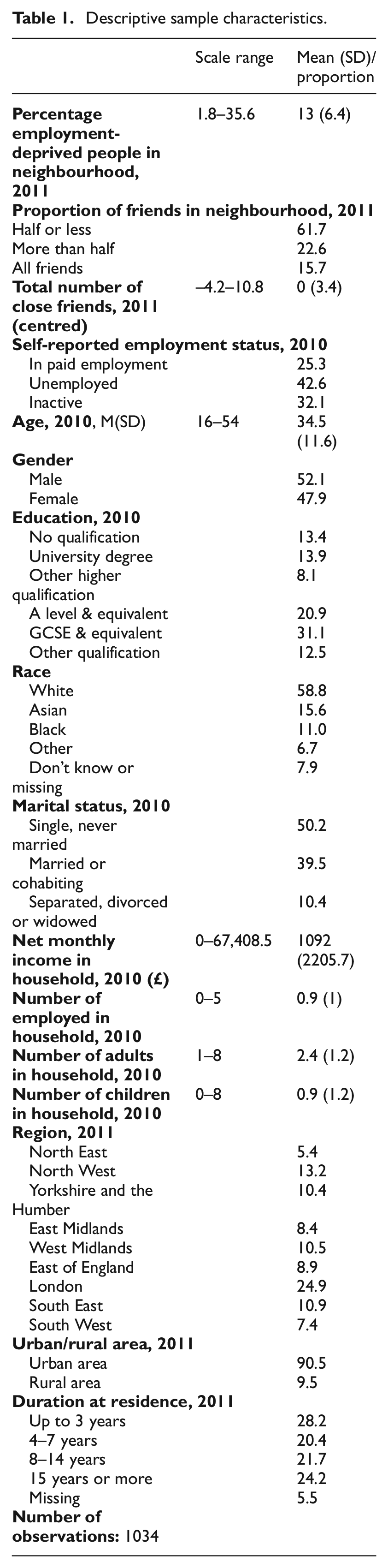
Table 1 and Supplemental Tables S.2 and S.3 show descriptive sample statistics of all variables included in the analyses. About 38% of the unemployed in our study had more than half of their friends in the neighbourhood, indicating that social networks are partly geographically based, but there is substantial heterogeneity in network location across residents. This is true for residents of both the deprived and less deprived neighbourhoods and calls for a conditional analysis of neighbourhood effects across network location.
Descriptive sample characteristics.
Methods
Logistic regression models were conducted on the probability of exiting unemployment between wave 2011 and wave 2012. The moderating impact of network location on the effect of neighbourhood deprivation on exiting unemployment is included via an interaction term between employment deprivation of the neighbourhood n and the proportion of an individual’s friends located in the neighbourhood of residence n. The model is specified as follows:

We did not estimate multilevel models since most (81.5%) MSOAs contain only a single observation, and few (5%) contain more than two. 4
We report odds ratios and average marginal effects. Standard errors are clustered at the neighbourhood level (2011 wave). Odds ratios cannot be straightforwardly compared across nested models and between groups of an interaction (Mood, 2010). Therefore, we calculated average marginal effects (AME) of neighbourhood IMD across the three groups of neighbourhood integration. 5 The average marginal effect produces the average change in probability of unemployment exit with a one percent increase in employment-deprived residents in the neighbourhood. This change is calculated for all sample members and then averaged. We report the AMEs as well as the AME contrast scores compared to the reference category of ‘half or less than half of my friends reside in the neighbourhood’, along with the significance of the associated Chi-square test (Mize, 2019). The AMEs of the control variables refer to average effects. Furthermore, we graph predicted probabilities of unemployment exit by neighbourhood deprivation and network location, and at the mean of the other covariates. This allows us to visualise how the estimated effect of changing neighbourhood location changes with the relative location of one’s friends. 6
Results
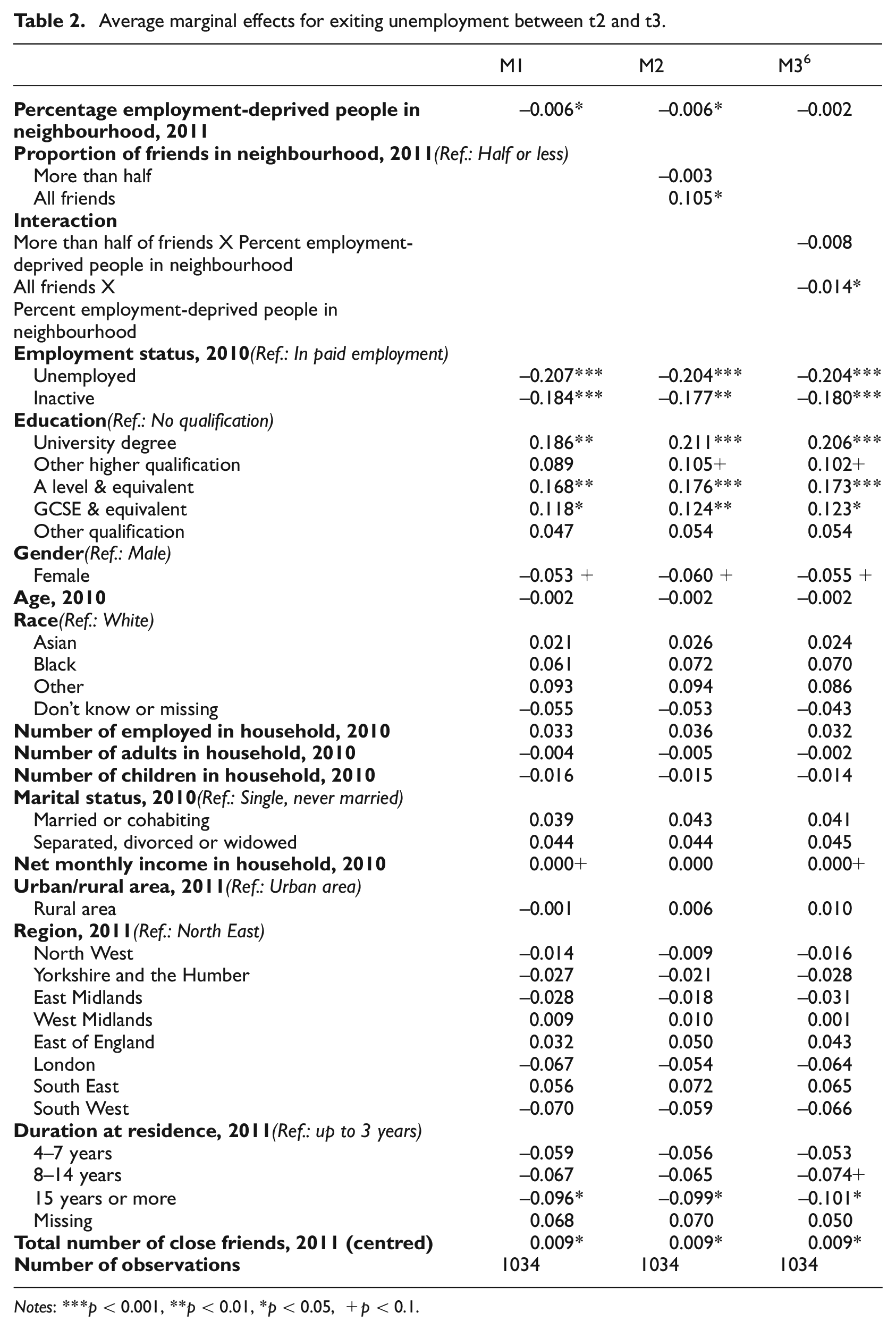
Table 2 reports the average marginal effects for the probability of exiting unemployment between waves 2011 and 2012. The models proceed in several steps. First, in Model 1, we only include the percentage of employment-deprived people in the neighbourhood adjusted for temporally precedent controls to test our main hypotheses – that the probability of exiting unemployment is lower in more deprived neighbourhoods. Model 2 adds the proportion of friends in the neighbourhood, and Model 3 additionally takes into account the interaction between network location and employment deprivation in the neighbourhood.
Average marginal effects for exiting unemployment between t2 and t3.
Notes: ***p < 0.001, **p < 0.01, *p < 0.05, +p < 0.1.
The AMEs in Model 1 show that an increase of one percent employment-deprived residents in the neighbourhood is on average associated with a 0.6% reduction in the probability of exiting employment in 2012. When proportion of friends in the neighbourhood is added in Model 2, the effect of neighbourhood deprivation does not change quantitatively and remains significant. Consequently, the effect of neighbourhood deprivation is not mediated by the location of close social ties. In other words, the lower employment uptake for individuals in disadvantaged neighbourhoods is not explained by having more locally concentrated friends. Instead, in Model 3, the significant and negative interaction term between neighbourhood deprivation and having all friends in the same neighbourhood suggests a moderating effect of a strong local concentration of friends in the neighbourhood for the association between neighbourhood deprivation and re-employment. Local networks as moderators index effect heterogeneity in neighbourhood effects across individuals with different types of personal networks.
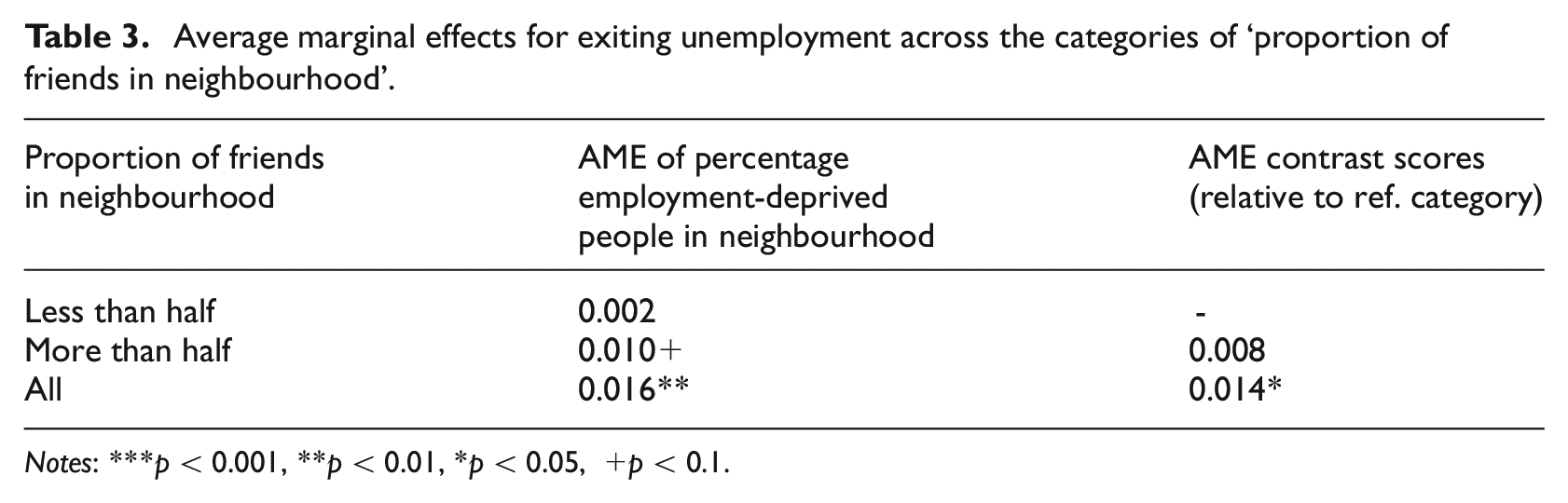
Table 3 shows the AMEs calculated for the subgroups of network location. For people with less than half of their friends in the neighbourhood, a one percent increase in employment-deprived individuals in the neighbourhood does not significantly reduce their likelihood of re-employment (AME = −0.002; p = 0.620). In contrast, for residents with all their friends in the neighbourhood, the decrease in the re-employment probability amounts to 1.6%, with a one percent increase of employment-deprived co-residents in neighbourhood deprivation (AME = −0.016; p = 0.004). For residents with more than half of their friends in the neighbourhood, the average reduction in re-employment amounts to 1% (AME = −0.001; p = 0.095). Hence, having many friends in the neighbourhood is particularly detrimental for individuals who have no friends outside of their own disadvantaged neighbourhood. Living in a deprived neighbourhood and having all of one’s friends in the same neighbourhood considerably reduces the chance of re-employment compared to living in an advantaged neighbourhood and having all of one’s friends there. That is, even if residents of disadvantaged neighbourhoods have the same level of locally concentrated networks as residents of advantaged neighbourhoods, these networks do not increase their chances of exiting unemployment in the same way. By contrast, living in a disadvantaged compared to living in an advantaged neighbourhood is not associated with a change in the probability of re-employment for individuals who have locally dispersed friendship networks.
Average marginal effects for exiting unemployment across the categories of ‘proportion of friends in neighbourhood’.
Notes: ***p < 0.001, **p < 0.01, *p < 0.05, +p < 0.1.
Figure 1 shows the predicted probabilities for exiting unemployment by percentage of employment-deprived individuals in the neighbourhood and proportion of friends in the neighbourhood. Neighbourhood employment deprivation much more strongly reduces the probability of unemployment exit for people with all their friends in the neighbourhood than for the other two groups (Figure 1). For individuals with half or less of their friends in the neighbourhood, neighbourhood deprivation does not change the probability of exiting unemployment. Residents of neighbourhoods with low employment deprivation have a higher probability of exiting unemployment if they have all their friends in the neighbourhood. In contrast, residents of employment-deprived neighbourhoods with strong locally concentrated social networks in these neighbourhoods have a lower chance of exiting unemployment compared to residents of these neighbourhoods with less locally concentrated social networks.

Predicted probabilities for exiting unemployment between waves 2011 and 2012 by neighbourhood deprivation and proportion of friends in the neighbourhood (less than half, versus all). 7
Discussion
We brought together the literatures on social networks and neighbourhood disadvantage to address two research questions: 1) Does neighbourhood deprivation lower the probability of exiting unemployment? 2) Does a local concentration of friends in the neighbourhood moderate the effect of neighbourhood deprivation on the probability of exiting unemployment?
Findings based on the UK Household Longitudinal Study substantiate previous research that neighbourhood deprivation is associated with prolonged unemployment. In addition to what was possible in previous research, our findings based on population-wide longitudinal data suggest that neighbourhood-level employment deprivation reduces the probability of finding a job only for individuals who have no friends outside of the neighbourhood (controlling for total number of friends). Living in an advantaged neighbourhood and having all of one’s friends locally speeds up re-employment, whereas living in a deprived neighbourhood and having all of one’s friends in that deprived neighbourhood delays re-employment. By contrast, we find no evidence that neighbourhood-level employment deprivation is associated with re-employment for individuals who have at least some friends outside their own neighbourhood.
Our study thereby highlights the moderating role of networks that is in line with both the resource-sharing and norm-setting functions of social interaction in neighbourhoods. Indeed, the mechanisms of resource-sharing and norm-setting crucially depend on social interaction in the neighbourhood. If residents do not interact within their immediate surroundings but have social ties that spread outside of the neighbourhood, they are less exposed to the resources and norms shared in the neighbourhood.
Our findings add locational specificity to the more general sociological argument that bridging or horizon-expanding ties outside of the immediate network of a respondent are particularly valuable for socio-economic attainment (Morgan and Sorensen, 1999). Bridging ties might not be a necessary condition but rather a proxy for resource access in deprived environments; indeed, if an individual is located in a resource-rich environment, locally dense networks are potentially more helpful.
Our findings point to social interaction as an important mechanism in explaining why neighbourhood deprivation affects employment chances. Indeed, the unemployed with less than half of their friends in the neighbourhood experience no effect of neighbourhood disadvantage on their employment uptake, even though they are equally distant to jobs (spatial mismatch), with an equally stigmatising postcode (neighbourhood discrimination) and the same access to local institutional resources. One challenge for further research is to explore how neighbourhood mechanisms may interact with each other.
Our results hint at two possible policy directions. Firstly, the beneficial effects of local friends are found in mixed and advantaged neighbourhoods, so any policies aiming at neighbourhood desegregation and social mixing might provide employment benefits for residents. Furthermore, for the most deprived neighbourhoods, initiatives that help less locally concentrated networks to develop (e.g. sport teams or other interest groups with membership across neighbourhoods) could be helpful.
The findings of our study need to be interpreted in the context of several limitations. Despite the longitudinal design and the unusually rich information available in Understanding Society, we cannot rule out that our findings are biased by unobserved heterogeneity due to unaccounted selection into neighbourhoods. Unemployed people located in deprived neighbourhoods may be different from the unemployed in affluent neighbourhoods on unobserved characteristics (e.g. personality traits) that make them interact less successfully with – and benefit less from – their local friends. Placed in affluent neighbourhoods, these same individuals would similarly interact less successfully with local friends and hence not experience positive employment effects from having a high proportion of friends in an affluent neighbourhood. In addition, future research should examine whether the reinforcing impact of social interactions on neighbourhood advantage and disadvantage extends to individuals who are not unemployed and spend less time in their neighbourhood. Importantly, the relative importance of resource-sharing and norm-setting in the moderating effect of network location for neighbourhood disadvantage should be further disentangled in future research.
To inform the theoretical mechanisms at work behind the moderating effect of a local concentration of friends for neighbourhood disadvantage, future research requires more information on employment outcomes and social networks in conjunction with detailed neighbourhood characteristics. Our study goes beyond previous research with the localised measure of friendship networks, but the central network indicator remains rather crude. Future studies should include information on the types of ties (strong or weak; Granovetter, 1973), the overall network structure (i.e. how friends are connected to each other and create closed or open social structures; Burt, 2001; Coleman, 1988; Morgan and Sorensen, 1999), as well as the specific resources and exchange relationships of network members. Furthermore, re-employment remains a crude outcome and information on type of employment, wage and occupational status upon re-employment could deepen our insight in the role of neighbourhoods and networks.
Our analysis concentrates on a specific historical period, 2010–2012, in which unemployment was high following the 2008 recession. Findings could be similar in other liberal restrictive welfare states, for example the United States, with relatively strong residential segregation in times of high unemployment following economic recessions. Future research should investigate to what extent these relationships hold in times of lower unemployment in the United Kingdom, and expand comparisons with other structural and policy contexts. The extent and duration of unemployment assistance, active labour market policies and overall levels of residential segregation likely affect the strength of the associations. Arguably, a local concentration of friends in disadvantaged neighbourhoods will have weaker effects on re-employment in more egalitarian contexts with more extensive state policies to compensate for unemployment and activate re-employment.
To conclude, beyond what was possible in previous studies, the detailed measurement of network location via the proportion of friends in the neighbourhood combined with the specific dimension of employment deprivation in neighbourhoods enabled us to contribute to the literature in two ways. First, previous studies have theoretically argued that locally concentrated social ties act as multipliers of the beneficial effects of resourceful environments and the detrimental effects of disadvantaged environments on socio-economic outcomes. This has been empirically shown for parental networks in school environments for educational outcomes (Fasang et al., 2014). Our study shows that a similar moderating and multiplying effect of locally concentrated social ties also exists in the context of neighbourhood disadvantage and unemployment. Secondly, our findings underline an important role of locally concentrated social ties in explaining the mechanisms through which neighbourhood disadvantage affects individuals’ life chances. It is not simply where individuals reside, but where they live, i.e. where they spend time and with whom they interact, that matters for the impact of neighbourhood characteristics on socio-economic outcomes. It is therefore promising to theorise neighbourhood effects as social rather than geographic phenomena.
Supplemental Material
USJ925374_Supplemental_material – Supplemental material for Neighbourhoods, networks and unemployment: The role of neighbourhood disadvantage and local networks in taking up work
Supplemental material, USJ925374_Supplemental_material for Neighbourhoods, networks and unemployment: The role of neighbourhood disadvantage and local networks in taking up work by Leen Vandecasteele and Anette Eva Fasang in Urban Studies
Footnotes
Acknowledgements
We gratefully acknowledge input on the research design by Felix Elwert in the early stages of the research project, as well as student assistance by Kerstin Stockmayer and Sophia Degen. The data we used, Understanding Society is an initiative funded by the Economic and Social Research Council and various Government Departments, with scientific leadership by the Institute for Social and Economic Research, University of Essex, and survey delivery by the National Centre for Social Research and TNS BMRB. The research data are distributed by the UK Data Service.
Declaration of conflicting interests
The authors declared no potential conflicts of interest with respect to the research, authorship, and/or publication of this article.
Funding
The authors disclosed receipt of the following financial support for the research, authorship, and/or publication of this article: This publication benefited from the support of the Swiss National Centre of Competence in Research LIVES - Overcoming vulnerability: Life course perspectives, which is financed by the Swiss National Science Foundation (grant number: 51NF40-160590). The authors are grateful to the Swiss National Science Foundation for its financial support. Anette Eva Fasang gratefully acknowledges funding from the Swedish Research Council for Health, Working Life and Welfare (FORTE, grant no 2018-01612) for supporting a research visit at the Stockholm Demography Unit (SUDA) in Spring 2019.
Supplemental material
Supplemental material for this article is available online.

Notes
References
Supplementary Material
Please find the following supplemental material available below.
For Open Access articles published under a Creative Commons License, all supplemental material carries the same license as the article it is associated with.
For non-Open Access articles published, all supplemental material carries a non-exclusive license, and permission requests for re-use of supplemental material or any part of supplemental material shall be sent directly to the copyright owner as specified in the copyright notice associated with the article.
