



Abstract
This article examines the cultural geography of fashion cities, focusing on independent fashion designers’ relationships with their city. Through discussing the Australian city of Brisbane and its place within the hierarchy of fashion cities, we examine the position of modern yet peripheral locations that have what we term an ‘elusive’ fashion identity. The discussion highlights the complexities that make a city a fashion city, specifically the interplay between industry, culture, retail and design, commonly identified as fundamental elements in the construction or transformation of fashion cities. The paper unravels the dynamics and discourses that have contributed to the contemporary conceptualisation of the fashion city; it evaluates the way in which local independent fashion designers (IFDs) can contribute to a reorientation of thinking about cities and their fashion; and it gauges how IFDs sustain a local fashion identity within cities that do not present the commonly recognised characteristics of a fashion city such as infrastructures. We argue that IFDs in peripheral cities have a very different relationship with their city than do IFDs in so-called fashion cities. By examining this relationship, and Brisbane’s modestly placed position on fashion cities’ hierarchy, we propose that, except for the traditional fashion centres, other cities are in a constant state of flux, arguing that the concept of the fashion city itself is elusive. We propose that as cities experience fashion narratives that ebb and flow, they may present multiple characteristics that make them unique at a particular moment, thus they are ‘elusive’ fashion cities.
Introduction
The nexus fashion–city has long been recognised as providing fertile ground for the investigation of cultural, social and industrial relationships. The concept of the city as the physical location of industry and cultural production is based on the paradigm of creative industries and creative clusters, with an emphasis on creative networks and a critical mass of workers in the creative industries (Castells, 2011; Sassen, 2013; Scott, 2000, 2008). The factors that identify a city as creative include the interplay between global centres and cultural production. In the last 30 years, this interplay has also been transferred to the identification of a ‘fashion city’ (Breward and Gilbert, 2006; Currid, 2006; Jansson and Power, 2010; Skov, 2011; Weller, 2008). Bovone (2005: 359) states that ‘Fashion, fashionable goods and services, and the social actors that produce and consume them constitute a complex, organic circuit that is transforming the post-industrial city.’Bovone’s (2005) definition is emblematic of a common understanding of the fashion city as a complex interaction of people, production, marketplace, organisations and even images, from concept to consumption (see also Bellini and Pasquinelli, 2016; Rantisi and Leslie, 2006). However, does this interplay necessarily transform every city into a fashion city? Does every fashion city present the same characteristics and, do they need to be present at the same time for a city to be called a fashion city? Within a contested terrain, this study unravels dynamics and discourses that have contributed to the contemporary conceptualisation of the fashion city; it evaluates the way in which local independent fashion designers (IFDs) can contribute to a reorientation of thinking about the relationship between fashion and the city; it gauges how IFDs sustain a local fashion identity within cities that do not present the commonly recognised characteristics, or only some of the characteristics of fashion cities; and we propose a new way to think about cities that go in and out of fashion narratives as ‘elusive’ fashion cities.
As one of the fastest growing cities in Australia, Brisbane was chosen for this study to demonstrate the fluid dynamics that can alter currently accepted perceptions of the peripheral city and its relationship to fashion. Brisbane’s rapid economic growth has propelled it to a global city in recent years (Brisbane City Council (BCC), 2016), outstripping all other state capital cities in its rate of population growth (ABS, 2012). However, Brisbane is considered an outlying city because it has never been on the Australian fashion map in the same way as Sydney and Melbourne, which claim their prime position as fashion cities (GLM, 2017). Given these contradictions, and based on the perspectives of IFDs, we propose that the categorising of fashion cities is no longer relevant in a time of extreme industry disruption.
The case study of Brisbane breaks the fixed concept of a fashion city as a centre of production or inspirational designer hub. To undertake this analysis of Brisbane’s fashion status, we drew upon industry reports, government and city policy, local fashion media and fashion brand communication through websites, blogs, social media and magazine articles, and environmental observations of retail and creative spaces. Additionally, we conducted semi-structured interviews with industry participants, following the university’s procedure for research involving human participants. Eighteen local fashion industry stakeholders participated in the study, comprising ten Brisbane-based IFDs, four fashion experts including fashion academics, journalists and suppliers, and four industry mentors. Interviews lasted between 20 minutes and one hour, they were transcribed and thematically analysed according to the themes: independent design entrepreneurs’ production processes and their workspaces, their aesthetics and philosophies, their education and training, their use of marketing technology, their communication with industry networks, their interaction with clientele and their various approaches to enterprise. These interviews contextualised and built Brisbane as a case study (Yin, 2013). The study also covered how long designers had been in business, the challenges they face and the support they seek. In analysing these data, we grouped them thematically according to fashion design, production and production networks, as well as the culture of consumption. These themes guide the analysis of Brisbane discussed in the sections below.
In determining the relationship between IFDs and Brisbane as a city, our findings suggest that there is no stable causality between creative labour and locality but, rather, both city and designers benefit from the part that small independent fashion entrepreneurs play in what we call an ‘elusive fashion city’. This means that, in a more sparse fashion field (Bourdieu, 1993), local independent designers can rapidly move to the centre, as they are supported by local press, funding and retail opportunities, as well as targeted mentoring, devoted consumers and local and federal government aid.
This article begins with an examination of the definitions and characteristics of the fashion city and introduces the concept of the elusive fashion city. We then explore the case of Brisbane, its recent past and the development of creative output as a reaction to some of its particular features, referring to the literature where pertinent. We examine the factors of design, production networks, fashion promotion and consumption which embolden local IFDs, and demonstrate how their relationship with the city shapes the image of the city, in turn reflecting on perceptions of local fashion productivity. The paper closes with our proposed application of the term ‘elusive city’ to explain the more nuanced and complex understanding of fashion identity and place within a peripheral global city.
What makes a fashion city?
Fashion has played a vital role in the cultural economies of cities around the world, and in particular in the cultural geographies of select cities. Cultural historians, fashion scholars and cultural geographers have provided definitions and categories aimed at understanding the city as a place embracing fashion, culture and economy, focusing on the Big Four fashion capitals: Paris, London, New York and Milan (Benjamin, 2002; Breward and Gilbert, 2006; O’Neill, 2007; Steele, 2017). These cities have established their privileged positions as global or ‘tier-one’ fashion cities because of long-standing traditions of fashion expertise, industry and culture (Rantisi and Leslie, 2006; Skov, 2011). They have emerged for different reasons, but they all relate to the establishment of a high-brow fashion concept, the ‘culture of design’, connected to a luxury market of fashion connoisseurs. Paris’s position in the global geography of fashion cities is the result of a long historical process, closely connected to court life and consumption, and royal support of the textile industry in Lyon. London established its position partly in opposition to Paris, but specifically because of the role played by the ‘Square Mile’, a quarter characterised by the rising economic power of London during the British Empire, and quality masculine sartorial production within its boundaries (Breward, 1999: 241). Unlike Paris and London, fashion ‘traditions’ have been established relatively recently in some world cities – for example, New York and Milan only became fashion cities in the 20th century, proposing high-end ready-to-wear fashion as an alternative to Paris’s high-brow couture. New York came to prominence thanks to an urban renewal plan, including that of the Garment District in the 1930s (Gilbert, 2000: 19); Milan increased its influence for existing know-how and technical infrastructures based on a tradition of furniture and interior design, along with advertising agencies and the publishing industry in the 1970s (Ferrero-Regis, 2008). The fashion city concept therefore has various dimensions: ‘as centres of a culture of design, as central points in production networks, as examples of distinctive consumption cultures, or as the subjects of representation in film or the fashion press’ (Breward and Gilbert, 2006: ix).
The current geography of fashion is a ‘construction’ that is ‘absorbed and understood without reflection’ (Gilbert, 2000: 14). This perceived unproblematic approach to the understanding of fashion and place has seen numerous attempts to re-write the symbolic geography of world fashion cities, with Skov (2011) identifying the continued emergence of more fashion centres worldwide in the formation of a ‘polycentric’ system. Newly identified fashion cities with alternative offerings have become known as ‘second-tier’ fashion cities which compete for global market prominence (Rantisi and Leslie, 2006; Skov, 2011). Notably, factors other than culture, tradition and identity as singled out by Sassen (2013), Castells (2011) and Scott (2008) are prompting second-tier cities to jostle for geographical redistribution on the 21st century fashion map. Rantisi (2011) contends that fashion cities have strong production, marketing, distribution networks, local networks and designers supporting one another, adding that the local aesthetic and sensitivity to place, intermediaries such as boutiques and fashion weeks, and designer markets are critically important in establishing a sense of fashion identity and place in a second-tier fashion city (2011: 262). Furthermore, fashion education is increasing globally (Wang, 2013) and plays an important part in the development of a fashion city and rising number of independent fashion designers.
Martínez (2007) identifies further characteristics that have given Antwerp the status as a new fashion city. Here the fashion interconnections are seen as ‘mediatory forms and sites of consumption, fashion designers, manufacturers, fashion institutions and local regional governments, the institutions of civil society’ (Martínez, 2007: 2451). The Global Language Monitor (GLM, 2017: 1) has ranked global fashion capitals since 2007, identifying 63 ‘established and emerging centres of fashion’ across the globe by tracking citations in worldwide media, academic research and reports. Breward and Gilbert (2006) also add consumption and consumers to the definitions that typify a fashion city, while Lazzeretti et al. (2017: 207) identify two forms of fashion cities with: ‘a supply-side perspective, which defines a fashion city as a “manufacturing fashion city” based on its physical image and presence of a garment industry and a demand-side perspective, which deploys the term “symbolic fashion city” in line with its virtual image and new information and communication technologies’. While many authors have defined fashion cities (Benjamin, 2002; Breward and Gilbert, 2006; O’Neill, 2007; Steele, 2017), Casadei and Gilbert (2018) argue that there is not a single model of the fashion city. Instead of underplaying fashion’s complexity and treating it simply as a cultural and creative industry, Casadei and Gilbert (2018) propose an analytical framework that highlights fashion’s association with manufacturing, design and symbolic production. Brydges and Hracs (2017) argue further that new forms of independent production, digital technologies and mobilities are reshaping this landscape. However, the effect of, and role played by, the independent fashion designer on these movements are not captured in these scholarly classifications. Ultimately, categories reviewed here still prove insufficient in the analysis of a city in flux, prompting the need for a reconsideration of its identity, which we propose as the elusive fashion city.
The elusive fashion city
From this discussion of fashion cities and their discursive construction as elite world centres within fashion history, fashion studies and the fashion system, it emerges that a fashion centre is considered a place where production and design, fashion retail and events such as fashion weeks, as well as awards and trade fairs, increase a city’s economic productivity and cultural activity. Fashion credibility is achieved through originality of design, the endorsement of fashion authorities such as magazines and the presence of international buyers at fashion weeks (Skov, 2011). Ideas about fashion cities seem chiefly based on a highbrow understanding of fashion, the presence of elite or high-profile fashion brands and an affluent local base of consumers, influential individuals and businesses high in fashion capital. This excludes the many local, lesser known designer firms creating alternative fashion discourses in places that do not qualify as a fashion city. Indeed, Molloy and Larner argue that the success of the niche New Zealand designer fashion industry is underpinned by the designers’ approach to remaining small and locally based specialist players, while situated at the forefront of international fashion trends (Molloy and Larner, 2013). The designers are conscious of the minimal fashion status of their ‘not-so-global cities’ (Larner et al., 2007: 281) but believe their output is not hindered as a result. To be clear, Weller (2007) sees that success in this instance is not based on the micro networks of individual actors but the macro trade policies of New Zealand and the common market with neighbouring Australia. Nonetheless, remaining small has worked well for New Zealand designers, such as Karen Walker, Trelise Cooper and Zambesi, some of whom have survived since their debut on the world stage in the late 1990s and now record sales in the tens of millions.
Our discussion of Brisbane as an elusive fashion city reaches beyond current definitions of world fashion cities to embrace a more nuanced understanding of the interplay between place, fashion, culture and economics. This is because peripheral cities display characteristics which differentiate them from the bigger players, for example the greater importance of social networks and the more intimate role of intermediaries and significant community formation (Luckman, 2012), while lacking the commonly recognised elements of fashion cities. Local ‘scenes’ and the advantage of collaborating with other arts/creative/activist communities in order to sustain ‘independent’ identities typifies smaller population areas (Gibson, 2010). The navigation of smaller markets, and the creative freedom that comes from being distant from metropolitan/core trends and principal gatekeepers, add to the conditions found in peripheral cities (Collis et al., 2010; Gibson, 2010). Supplementing the mapping of small-scale fashion activity by Felton (2012) and Luckman (2012), the idea of elusive fashion cities is offered as a way of describing all cities beyond the ‘Big Four’, even those without customary fashion industry attributes.
In proposing that the definition of fashion city for all of the cities identifying as such can be misleading and selective, the concept of the ‘elusive fashion city’, inspired by Colin McArthur’s (1997) elusive cinematic city, is brought into discussion. Shedding light on the relationship between cinema and the city through filmic representation of the city, as well as through local and national policies that facilitate filming in a specific location, in his discussion of Glasgow as an elusive cinematic city McArthur (1997) shows that hegemonic narratives of cities are always fragile and contested. According to McArthur (1997), elements that create the discursive presence of a city are to do with travellers’ accounts, images, popular stories, presence in paintings, poetry, literature, tabloids, newspapers, magazines and so on. These accounts and representations shift constantly, have no absolute and dominant meaning as they reinvent and reshape the city according to changes in popular attitudes, while accommodating alternative narratives, histories of traditions and also affecting institutional policies as they promote specific locations to increase local economies of tourism and labour.
Similarly, the elusive fashion city is that which is considered outside dominant narratives and beyond prevailing national accounts of what constitutes a fashion city. The consideration of a fashion city as ‘elusive’ opens up the existing analytical framework. Skov’s (2011) tiered framework of fashion cities assumes that their position remains fixed but it is well documented that single designers may do well in the global industry while their city may suffer from a decline, economic downturn or decreased press coverage. All cities are in constant flux, with rise and decline phenomena.
In Australia, Sydney and Melbourne have established their position globally as fashion cities. Brisbane’s representational narratives in popular media, art, global cultural discourses have been fragile and have shaped it as a non-fashion city. As discussed, the status of a fashion city is slippery because cities reinvent themselves continuously; different meanings are constantly mobilised. The traditional status of a fashion city as having creatives, manufacture, retail, fashion shows, fashion schools and media is today replaced by systems with unique strengths that confer unique fashion status to a city. This leads to the acknowledgement that local fashion systems, attuned to the city’s aesthetic, industrial, cultural and economic activities, must be validated. A more useful approach to fashion cities’ scholarship is to recognise the power of the Big Four in terms of fashion centres, and that all other cities are elusive fashion cities with their own fashion narratives that are legitimised and validated through a variety of shifting cultural practices and business structures. A systematic definition of the fashion city requires a configuration of all of the agreed organising principles, while the omission or the scarcity of one of these principles or criteria makes the condition of the city all the more interesting and worthy of analysis. According to Lampert (2001), Hegel excluded the city from aesthetic judgement because the city is nomadic and the result of infinite interactions, and thus it is difficult to define the aesthetic city based on any one set of terms. For Hegel, the city is constructed one piece at a time, it is its disunity built in the tradition of the city that makes the beauty of the city (Lampert, 2001: 316). Likewise, we propose that the understanding of the elusive fashion city is stimulating because of what it lacks, rather than what it comprehensively presents. The following discussion presents the case of Brisbane as an elusive fashion city based on its fluidity rather than the presence of established ‘fashion city’ criteria.
Brisbane as an elusive fashion city
Brisbane’s place within the national cultural discourse has historically been that of an inconsequential city. However, this derisive view of Brisbane is changing through a blend of policy that highlights cultural festivals, fashion incubators supporting enterprise, the opening of fashion schools and an increasing population of affluent young professionals seeking an enjoyable lifestyle. These elements underpin the evolving narrative that the city is today becoming one of the world’s sophisticated cities (Gross, 2019).
As the subtropical state capital of Queensland, Brisbane was settled in 1823, but not considered a city until 1924. In its short history, several socio-economic ebbs and flows have occurred and continue to emerge. While immigrants manned the city’s clothing factories in the second half of the 20th century in Fortitude Valley (Ferrero-Regis, 2014), 2 km west of the city centre, drapers lined the main (Queen) street offering mixed textile services. Distant from other capitals and functioning rather as a large regional centre for the state’s rural economy, Brisbane bore a reputation for fashion dullness (Buick and King, 2015). Known as the ‘country cousin’ to larger state capitals Sydney and Melbourne, Brisbane was considered insignificant as far back as the Second World War when the alleged ‘Brisbane Line’ was drawn to protect the southern cities, leaving Brisbane undefended in the case of invasion (Hasluck, 1970).
The region came of age after the Second World War, when international service personnel and tourism promoted the state’s features of sun and lifestyle. Beach culture took hold, and South East Queensland designers started producing some of the most venturesome swimwear fashions in the country (Schmidt, 2013). But apart from seasonal consumption by vacationers, the region’s fashions and fashion businesses did not move beyond serving the local community.
From the late 1970s through to the mid-1990s, Brisbane had a vibrant, political and sometimes underground arts and theatre scene, largely driven by a response to an autocratic and extremely conservative State government which dominated for 17 years. During this time, authorities forcibly suppressed independent music, activists, students, LGBTQI and other diverse communities. This is the setting in which Brisbane’s independent music scene flourished (Bennett and Rogers, 2014) and, not unlike grunge and punk fashion elsewhere, set the stage within which ‘poor’ dress culture emerged as an anti-establishment response, and can be seen as a surge in the ebbs and flows of the elusive fashion city. This anti-elitist position influenced the lively arts/cultural position that Brisbane draws on today. The market dynamic is also slowly changing and, as more high-profile designers originating from the area such as Sass and Bide, Lorna Jane and Easton Pearson (see Figure 1) have gained national and international prominence during the last 30 years, the city is aspiring to replace its fashion dullness with a reputation for young designers producing colourful and creative outputs (Trinh and Taylor, 2017).
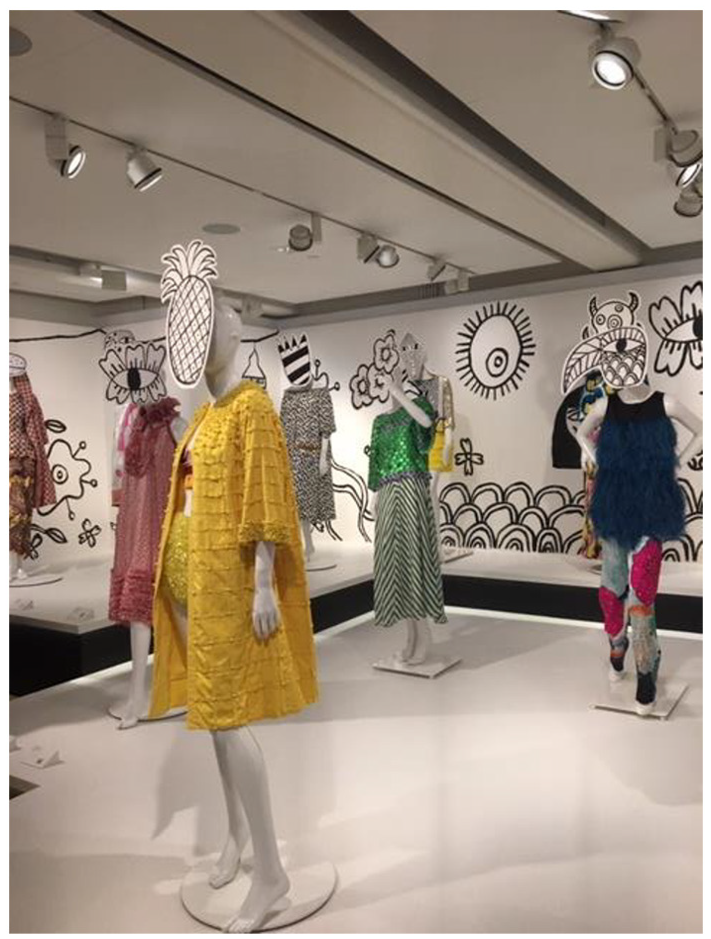
Easton Pearson’s exhibition EP held at the Museum of Brisbane, 2018–2019.
Brisbane’s fashion elusiveness is aptly exemplified in the city fringe quarter Fortitude Valley, also known as The Valley, which was home to department stores, medium-enterprise men’s wear manufacturing such as Freedman & Co, and a small hub for tailoring and bespoke production, based on networks of post-war migrants (Ferrero-Regis, 2014). The progressive de-localisation of fashion manufacturing of the 1980s dismantled the already fragile fashion manufacturing structure and saw the transformation of The Valley into a hub for illegal gambling and prostitution, which contributed to the formation of a narrative of corruption nationally. The quarter went through several recovery plans, including the opening of Chinatown and its mall in 1987, that re-positioned The Valley as the centre for entertainment and retail. In its current post-industrial urban and cultural regeneration, fashion has re-emerged as a vital activity integrated with furnishing, digital marketing agencies, architect and design offices.
The progressive gentrification of The Valley area over the last two decades has led to the upscale development of the James Street precinct, a former industrial site and home to a Coca-Cola factory. A large-scale urban renewal initiative established in the early 1990s, which culminated in the Brisbane City Plan 2000, operated along three tiers of government: the Brisbane City Council, the State government and the Federal government’s Better Cities Program input. This driver has seen the complete transformation of the area (Neilson, 2008). The neighbourhood is now brimming with luxury retail and apartments, restaurants and niche urban amenities which are unaffordable to many. In an effort to avoid the redeveloped city fringe costs, Felton et al. (2010) observe that individual designers of every ilk have scattered across the peripheral suburbs. Some such as Rant Clothing and George Wu are working in larger home studios, others such as CCC Manufacturing and Black Milk have settled into industrial parks. Some, such as The New Garde, a consultancy hosting independent designers, congregate in the few networks of shared spaces still available in un-refurbished or trust-managed buildings of the city fringe, taking advantage of the cheaper rents. Others such as Alice Nightingale have moved to locations such as laneways, 1 thus embracing the social aspect of peer-to-peer exchanges.
Today, as the largest local government in Australia, this ‘New World City’ (Brisbane City Council (BCC), 2015: iv) is experiencing policy and population growth that are changing both its architectural landscape and cultural activity. Indeed, Stead (2015) discusses the ‘GOMA’ effect, describing the converging discourses created by the cultural edifice which is the state Gallery of Modern Art (GOMA). Stead (2015) sees such public buildings as symbolically underscoring local art and architecture, state policy and identity. Alongside initiatives with Queensland State Government planning agencies, the Brisbane City Council (BCC) has played a major role in shaping Brisbane’s urban renewal processes. This process links its built environment and urban planning to its cultural expansion (Felton and Collis, 2012). 2 The BCC Creative Brisbane Creative Economy 2013–22 policy aims to strengthen the city’s ‘livability as a vibrant creative hub, and to ensure Brisbane will be the premier location for talented people to live, work and play’ (Brisbane City Council (BCC), 2013). This strategy has manifested in extra funding, stipends, incubators and shared spaces such as the River City Labs and the Innovation and Creative Sparks Awards. The BCC and its various arms claim to connect, support and promote Brisbane’s creative practitioners and enterprises, improve access to the Council’s facilities for creative-sector use and promote creative and cultural events, such as the popular fashion exhibition ‘EP’ held at the Museum of Brisbane in 2019.
However, according to former local fashion business owner and Brisbane Fashion Month founder Carly Vidal Wallace (2018) leadership and interest in supporting IFDs in Brisbane is not strong enough. The Council encourages fashion retail marketing through local fashion festivals, but these tend to uphold the larger brands rather than independent designers. Some entrepreneurs that stage fashion events promoting major retailers with the aid of local government funds put little back into the independent fashion community (Vidal-Wallace, 2018). Therefore, although some effort is made on the part of the council to support creative industries, it is a blanket policy leaving the independent fashion community to fend for itself. Within a constantly shifting cultural narrative, recent initiatives, such as luxury hotels linking fashion and lifestyle, new maker spaces and the opening of Double Double, a megastore of international independent brands, point to a fresh injection of private capital investment in the city. This trend may propel Brisbane to an updated status as a ‘style centre’ similarly to Copenhagen in the 1980s (Beard, 2011) instead of a fashion city as commonly understood, thus shifting its narrative again and signifying the characteristics of the elusive fashion city.
Brisbane’s fashion production and retail networks
Production networks include the physical manufacturing capabilities to produce clothing, as well as the networks of cultural intermediaries who translate the fashion idea to consumers. This section begins by addressing the location and physical manufacturing capabilities of Brisbane, then discusses the local networks of agents, retailers and fashion press that are essential to the symbolic production of fashion.
Although small in comparison with other Australian capitals (around 700 businesses in Queensland compared with around 1000 and 1300 in the southern states (IBSA, 2017)), the proportion of textile, clothing and footwear (TCF) manufacturing companies in Queensland has grown over the past five years (Johnson, 2017). This increase is largely due to population growth following the resources boom and increased migration to the state. However, local fashion infrastructure is overwhelmingly oriented towards uniform and stretch wear production. Pockets of manufacturing subsist in the outer southern suburbs, where there is a strong presence of immigrant homeworkers (Nossar et al., 2015; Sydney Morning Herald (SMH), 2007). Figure 2 locates the main TCF manufacturing sites in the city. Some fabric wholesale agents and cut-make-trim (CMT) businesses endure, but they are either slowly moving to lower rents in suburban industrial areas or moving away from Brisbane altogether.

Map of Textile Clothing and Footwear manufacturing industry in Brisbane suburbs.
The increasing spread to outer areas or small quarters in distinct neighbourhoods has left no central manufacturing hubs for designers near suppliers. Some practitioners in Brisbane, such as designer/maker Alice Veivers of the label Alice Nightingale, have found alternative solutions by changing their business model to incorporate agile supply chains, networking, thrifting and sharing (Veivers, 2016). Veivers recounts, ‘Sometimes I don’t have the equipment that I need, so I learn how to make it. Like working with wood, I make all my own clothes racks. I’m learning to make stuff out of wood. Making all of my own things is one of my life’s philosophies.’
In contrast, local conceptual designer Gail Reid of the label Gail Sorronda relies on the conventional supply chain, often procuring materials from known fashion industry sources such as agents, trade fairs and factories, both nationally and internationally (Reid, 2016).
Factors such as lifestyle, local media and support networks add value to the endeavours of the local designers. Much like the designers studied by Wenting et al. (2011) in Amsterdam and Heebels and van Aalst (2010) as well as McRobbie (2013) in Berlin, conceptual designers such as Gail Sorronda who have decided to settle locally benefit from interaction with likeminded peers. Sorronda circulates in the local fashion design community but admits that she is most comfortable participating in arts-based activities. This preference aligns with the links McRobbie has drawn between fashion and wider underground networks and creative ecologies, including music (McRobbie, 2015). It also echoes the evidence found by D’Ovidio (2016) amongst fashion practitioners in London, who prefer to mix with artists and designers from various disciplines.
That designers choose to remain local regardless of the odds is a significant point in reviewing the fashion identity of peripheral locations such as Brisbane. Felton (2012) cites lifestyle and, in particular, a slower pace as another reason for creative workers to escape inner-city precincts. Chapain and Comunian’s (2009) study of Newcastle in the UK also found that people valued a slower pace, while Gibson et al. (2010) echoed related themes in their study of the distant city of Darwin. In interviews, Brisbane’s designers prioritised the balance provided by the city’s reasonable cost of living (compared with unaffordable rents in fashion capitals such as London or even second-tier fashion centres such as Sydney), pleasant lifestyles or being surrounded by family and friends and experiencing a less frenetic pace. The designers accept the absence of high-level professional organisations and substitute with networked groups to assist one another.
Intermediaries such as fashion agents are fundamental to establishing fashion city status. In Brisbane, the demise of the independent fashion boutique has resulted in a reduction of local agents (Tuite, 2019). The c. 50 agents left in Brisbane, of which only around ten have a profile amongst local designers (Hilton, 2017), tend to function as wholesalers for imported goods instead of distributers for local designers. This means that designers are left to seek alternative means of reaching their markets. Our findings show that the local reduction in intermediaries such as agents has been of benefit to some IFDs by lowering the number of gatekeepers and consequent barriers to entry. Few local designers use the agent/wholesaling arrangement today, first because this avenue is continuing to diminish and second because the designers prefer not to work with a ‘middle man’ [sic]. Indeed, Alice Veivers believes that designers can make a place for themselves locally, especially in Brisbane because its population is smaller than that of Sydney or Melbourne. ‘There is so much competition in Melbourne. Everyone wants to go there because they think it is a fashion city’ (participant interview, 2016). Veivers reports a modest 3 but sustainable income from her business but adds that other factors accompanying her work add value.
Sales channels for Brisbane’s IFDs are both similar and diverse among the designers. Depending on market level, some sell directly to overseas customers through aggregating online platforms such as Etsy. In contrast, high-end labels such as Gail Sorronda have a greater ‘fashion reach’ through high fashion media exposure. In the case of Gail Sorronda, this is not only a result of the press her label enjoys but partly also because she has been physically present at international events. Featured in glamorous fashion shows such as the Mercedes Benz Fashion Festival and prestige international magazines (Vogue Australia, Vogue Italia, Harper’s Bazaar), Gail does not advertise in magazines but several high-fashion publications and blogs have featured the label in editorial articles. Gail’s originality and creativity have attracted journalists keen to present unique and original ‘local’ work (Barker, 2015). Gail is beloved of the Brisbane cultural press and institutions, is a mentor for the Australian Fashion Council’s (AFC) Curated programme and is regularly invited to public talks. Gail is the typical small independent designer whose movement to the centre of the local fashion field, following Bourdieu, has earned her national and international reputation. Almost to reflect physically and geographically this symbolic position, Gail’s boutique is located in the James Street precinct, now one of the city’s luxury retail and independent designer quarters. Sorronda notes that the local media also reach many people: It’s not dressed up and as glossy, but people can just relate to it, which helps us. You’ve got your aspirational element but you’ve also got something else. You would think it would be the opposite but what is perceived as successful isn’t necessarily so. (Participant interview, 2016)
The designer believes people like the idea of supporting a local designer or even just local business: ‘It’s as simple as that’ (Reid, 2016). As also experienced by Alice Nightingale with Frankie magazine, local publications boost the label’s visibility. And yet, Gail does not mention Brisbane or Queensland anywhere on her website. Location is not necessary in the promotion of her work although the support from networks within her city has brought much value for the label (Heim, 2019).
Working within tightly knit communities also reduces the effects of long-distance logistics and regenerates the local economy (Gonzalez-Feliu et al., 2014). As urban researchers Florida (2006) and Scott (2006) note, concentrations of creative practitioners represent a dynamic element in a region’s economic development and growth. In contrast, Wenting et al. (2011) found that fashion designers in Amsterdam did not necessarily benefit from the business aspect of agglomeration but were more interested in the superior networking possibilities that this arrangement afforded. Similarly, Heebels and van Aalst (2010: 361) discovered that creative entrepreneurs in Berlin used their environment to ‘reproduce and strengthen their creative reputations’ rather than rely on production resources. Differences between cities and designers in their approach to fashion production and networking clearly outline that no one framework fits all. This observation supports our approach to elusiveness, where the elusive fashion city does not only indicate ups and downs in its visibility but also lack of elements that are regarded as essential to a definite categorisation. Recalling Hegel’s reluctance to define the aesthetic city, we argue that categorising fashion cities is no longer relevant in a time of extreme industry disruption, where economic models will be re-invented and local retail and re-shoring, amongst many other changes, will see a growth (Amed et al., 2020: 20).
Brisbane’s culture of consumption
Brisbane’s historic reputation for poor dress culture points to the demand-side perspective of the ‘symbolic fashion city’ discussed by Lazzeretti et al. (2017). Brisbane’s retail backdrop for local designers has been ruptured by the exit of many independent boutiques (Tuite, 2019). A few designer shops cling to inner suburbs such as Fortitude Valley, New Farm and Paddington. Luxury brands such as Chanel, Gucci and Louis Vuitton are present, but few independent boutiques exist in the city centre. Local designers located in the city include Tengdahl, Pia du Pradal, Dogstar, Maiocchi and Sacha Drake 4 (see Figure 2). Beside the advance of high-street and fast fashion such as H&M, Zara and Uniqlo and the continuing progress of e-commerce, many boutique owners cite normative tastes and undervaluing the original as factors in the departure of local boutiques. A decade ago, Thea Basilou’s eponymous store, formerly known as Blonde Venus, had introduced new international designers to Brisbane including Mary Katrantzou and Jacquemus, while fostering the local arts community, thus building a connection between culture and fashion (Tuite, 2018). Yet local dress practice, although strongly influenced by the subtropical climate, is still maligned as it tends to casual, street and active wear. Nicky Charman, owner of Calexico, an independent boutique located in the James St precinct, which also stocks international brands, finds that she is constantly ‘educating’ her customer in the art of making good fashion choices. In contrast, Phoebe Paradise’s laneway-located boutique embraces Brisbane’s reputation for low-culture dress and takes a light-hearted approach by offering ironic statement pieces to its customers.
Brisbane’s so-called ‘low fashion consciousness’ is sustained through examination of retail trends in the city. Fashion consumer data from Brisbane city in 2015–2016 show there was a 114% jump in the consumption of fast fashion compared with 2% growth in designer fashion consumption (IBISWorld, 2019). This compares with a 10% growth in designer fashion consumption in Melbourne for the same period. Fashion accessories dominated the fashion consumption in Brisbane, which also suggests a lower ‘bag price’. Surf and sportswear consumption ranked second on the list, which points directly at local lifestyle preferences. This means that on the one hand, IFDs remain constrained to marketing their goods to the niche customer, which itself gnaws at the viability of their ventures and keeps them out of sight of fashion observers and consumers at large; on the other, lifestyle goods such as sport, active, swim and street wear have strong potential in the local market (Britt, 2018; IBISWorld, 2018). Conversely, the recent opening of boutiques of international luxury brands Tiffany, Louis Vuitton, Chanel, Ferragamo and Gucci in the city centre creates a new narrative of Brisbane whereby the city is experienced as a retail fashion city, especially catering to a new, younger and more sophisticated international tourist (BDO, 2019; TEQ, 2019).
The shortfall of independent boutiques that stock local labels has left the designers to find new and unique ways of bringing their product to market. Some designers, such as Rant, located in a western suburb, and George Wu, south-east of the city, use their homes as both studios and sales outlets (see Figure 2); this is not ideal, as the designers cannot rely on passing trade or attracting visitors generated by the concentration of other nearby boutiques. Only a handful of designers, such as Gail Sorronda and House of Ezis, occupy their own boutiques in the inner-city retail precinct (see Figure 3). Many instead opt to exhibit side-by-side at designer markets and pop-up shops; many more pin their hopes on e-commerce.
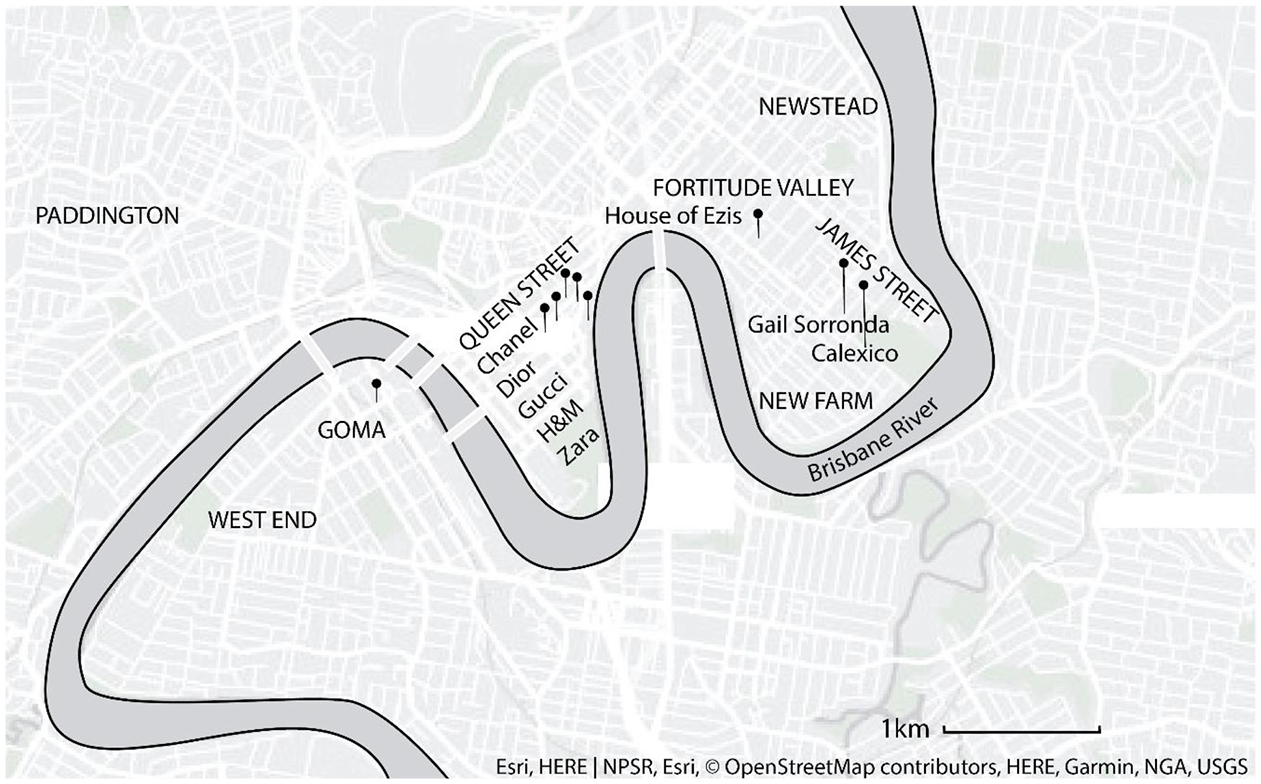
Retail map of Brisbane inner city, Author 1.
Although Brisbane designers rely heavily on national and international online sales, some also count on alternative retail opportunities. However, these are mostly in unconventional forms, once again fostered by local government policy that sees the advantage in conspicuous cultural activity. Open-air markets such as Finders Keepers and designer markets in Brisbane’s cultural precinct, the Gallery of Modern Art (GOMA), the Queensland Art Gallery and State Library of Queensland, present just such opportunities that are growing. In 2015, two Finders Keepers markets, two Bris Style markets and one Designer Market at GOMA took place during the year. In 2017, this grew to 20 ‘designer’ markets in November alone. Markets not only provide an affordable platform for local designers, they have traditionally functioned as a testing ground and go-between phase for designers on their trajectory to expansion. The proliferation of markets and their lively patronage also points to a shifting landscape in the preferences of local fashion consumers for alternative styles.
Brisbane designers are not pressured by the fashion schedule as neither national nor international fashion buyers come to the city for trade fairs. On the surface, this can be seen as a handicap in the building of a sustainable business. On the contrary, this relative isolation is conducive to heightened creativity. Also, Brisbane IFDs enjoy a relatively affordable lifestyle in a relaxed climate. These are all factors that lead the designers to finding their own niches and markets, and different approaches to what is normally considered success in the industry. The lack of professional infrastructure inhibits connections with intermediaries at national level but they do have potential to make a viable long-term living. The affordances of ICT reinforce their potential for success and so they stay. Despite the fact that a unique Brisbane fashion style and culture is still emerging, the city’s fashion identity remains marginal, incomplete and thus elusive.
Concluding remarks
Independent fashion designers play a pivotal role in the constitution of a fashion place and, in turn, benefit from the cultural and production networks afforded by the city. Particular locations are factors that add value to creatives’ outputs because they offer the opportunity to share knowledge, aesthetics values and inspiration and, in turn, enhance their creativity, ultimately bolstering their city’s reputation (Currid, 2006; Florida, 2006; Heebels and van Aalst, 2010; Hracs et al., 2013; Scott, 2006). This has been seen to a limited extent in Brisbane, with the promotion of IFDs such as Gail Sorronda and Easton Pearson in the local press and in cultural institutions.
In his work on fashion and the spatial metaphor of field in relation to designers and consumption, Bourdieu (1993) proposed the way in which designers move between the periphery and the centre of the fashion field. The fashion field can refer to fashion in a local place (e.g. Brisbane) or to the global system of fashion. Designers occupy an interesting position within the creative city as they act as both cultural producers and intermediaries that disseminate fashion, bridging material production with cultural production (Tuite, 2018). Regardless of the lack of manufacturing infrastructure, IFDs in Brisbane have carved out their own niche without the cachet of a large fashion centre by relying on local networks and pertinent support from local institutions. A dense local fashion place is likely to position the city within tier one or two of the global fashion system and therefore shift it from a perceived peripheral position to a central one. The spatial metaphor of the fashion field is used in this article to explain a double movement within a fashion place or centre: an internal movement and an outward movement. The internal movement is referring to the drive of designers within the city of Brisbane, their struggle to have a voice within Brisbane’s fashion culture which is currently overwhelmed by large global fast-fashion companies. The way in which local independent designers can find a dominant position within the city is to have ‘subversive strategies’ (Bourdieu, 1993: 133), which clearly influence the outward movement, as their creative work aids in the construction of a city’s narrative. The outward movement explains how a global peripheral city such as Brisbane may be able to move outside local and national boundaries towards greater exposure within global fashion or, at least, be recognised within the global cacophony of fashion cities and aesthetics. Critically, a city’s standing as a fashion city is therefore not static but continually in motion and therefore elusive. In this respect, we use ‘elusive fashion city’ as a critical tool to unravel dynamics and discourses that have contributed to the contemporary conceptualisation of the fashion city.
The implications of place are demonstrated with a deeper discussion of the changes taking place in Brisbane, exploring design ethos, production networks, consumption culture and the representation of the city. We propose that Brisbane, and other similar cities such as Vancouver, Accra, Bristol and Antwerp in the 1990s, must be seen as an elusive fashion city because it displays approaches to fashion with an intense local flavour and a real presence of local independent designers, despite its unfashionable past and the recent strong incursion of global fast-fashion companies. The discursive assessment of Brisbane is similar to that of many other marginal fashion cities. It is neither a fashion industry city with a manufacturing-side perspective, intended as the centre of mainstream fashion production, nor a hub for small-scale designers, as are the second-tier cities of Barcelona, Antwerp or Seoul. Yet, despite its current lack of fashion significance, influence and identity, the city is revealed in this study as a factor in the success and resilience of its local small-scale independent designers. The influence wrought by IFDs on the city is therefore the convergence of several dynamics. These include the synergic effects that enhance reputation, inspiration that enriches creativity, infrastructure that facilitates production, proximity of related services that reduces costs and niche demographics that increase markets. However, these attributes are not all present simultaneously in a small-scale city such as Brisbane. Indeed, other factors may be at play that dilute the perception of the cultural output of a city, even when community policy supports cultural development. Further research could expand on these findings through investigating a wider circle of actors within the city’s fashion production and consumption networks, for example, fashion educators, other intermediaries, policy makers and city marketers.
From our examination of Brisbane IFDs and their production networks and consumption cultures, it appears that the interaction of the individual designer with their city’s relative fashion reputation is a dichotomous interchange. Neither being a global city with fashion clout nor a regional area with valued traditions determines whether a city is a good place for creative birth or rebirth. Therefore, we offer ‘elusive fashion city’ as a critical tool to demonstrate the ways in which the city presents moments of local surge, for example with underground cultural movements contributing to a homegrown fashion aesthetic, or with the growth of local designers, such as Easton Pearson in the 2000s, who are able to forge an international profile. Local designers are continuously developing their own and the city’s identity, in the same way the city develops following internal and external dynamics. The city’s low fashion status may even benefit their creative work. In this paper, the elusive fashion city is considered as part of a discursive presence that is influential in determining popular attitudes about the city and helps shape subsequent narratives.
