




Abstract
Scholarly understandings of LGBTQ2S activist geographies are largely informed by a metronormative analytical lens that inadequately captures the shifting landscapes of sexual diversity in Canadian city-regions. The gap between the available services in peripheral municipalities and the rising demand from their growing LGBTQ2S populations has mobilised fractured groups of activists to lobby for policy, programming and service changes. This paper examines sexual politics in suburban civil society, focusing on the grassroots organising of not-for-profit activist groups as they interact with local government outside of the electoral process. It compares LGBTQ2S activist practices in two neighbouring, although differently sized and demographically divergent, peripheral municipalities in the Vancouver city-region: Surrey and New Westminster. A comparative case study approach reveals how LGBTQ2S activists work through variations in suburban political opportunity structures, resource landscapes and inter-organisational relations resulting in differential practices of mobilisation and collective action. In contrast with an urban legacy of insurgent practices of LGBTQ2S resistance, suburban LGBTQ2S activisms primarily centre on enactments of local resourcefulness, community resilience and institutional reworking within more dispersed resource landscapes.
Introduction
Canada’s largest city-regions are home to many Lesbian, Gay, Bisexual, Transgender, Queer and Two-Spirit (LGBTQ2S) citizens who reside outside of city centres for a range of different reasons – choice, kinship and cultural networks, psycho-social necessity (because of triggers caused by proximity to drugs, alcohol and sex in commercial urban gay scenes) and exclusionary economic forces (such as high rents, gentrification and lack of job opportunities). In the Vancouver region in particular, a combination of outward displacement brought by housing policy and market financialisation (Peck et al., 2014) and the regional impact of LGBTQ2S ‘equalities’ legislation (Browne and Bakshi, 2013b), means that suburban areas are home to many sexuality and gender minorities and their community organising and activisms. Such peripheral municipalities, therefore, shape political outcomes for their LGBTQ2S citizens but their significance for queer urban studies scholarship remains under-examined because of an emphasis on the more visible and historic activisms associated with the sexual liberation and progressive politics of the central city (Podmore and Bain, 2019). This paper contributes to critical urban scholarship on sexuality activisms by exploring the geographical difference that a peripheral location within a city-region can make to LGBTQ2S activist practices. The paper adopts the geographically specific acronym LGBTQ2S to signal the long-standing presence of the Two-Spirit communities (a term used by some Indigenous peoples to refer to the intersection of a masculine and feminine spirit in their sexual, gender and spiritual identities) in this city-region.
LGBTQ2S activisms, like the exclusions and inclusions they respond to, vary temporally, by jurisdiction and by local culture, perceived needs and political perspectives (see Binnie, 2014; Hartal, 2015; Misgav, 2015; Podmore, 2015; Rouhani, 2012). While activists draw on a diffuse set of globally circulating LGTQ2S activist practices (Knopp and Brown, 2003) and territorialise them relationally (Binnie, 2014), they are embedded in specific contexts that shape priorities, strategies and outcomes. Such geographical differences necessitate attention to the horizontal mobilisations of LGBTQ2S organisations and individuals in particular places as they strive to influence political systems between elections, assert their priorities amongst competing claims and design programmes to meet their service needs (Murray, 2015; Tremblay, 2015; Warner, 2002). In line with Hartal’s (2015) efforts to disrupt discourses that frame the Israeli periphery as offering ‘nothing but homophobia’, this paper examines and compares the everyday practices of suburban LGBTQ2S activisms within two of metropolitan Vancouver’s peripheral municipalities, Surrey and New Westminster. It demonstrates the persistence of uneven queer suburban topographies within an era of LGBTQ2S equalities legislation and considers how the varying political opportunity structures, resource landscapes and inter-organisational relations of places afford differential means of mobilising social groups and translating grievances, desires and resistances into collective forms of political action (Tarrow, 1998).
This paper provides a comparative case-study analysis of two Vancouver area suburbs, bringing them into a wider conversation about LGBTQ2S activisms on the periphery of the urban Global North. As Binnie (2014: 591) has argued, urban studies of sexualities should benefit from a more explicit and relational comparison because it can ‘reveal the contingent nature of theories generated in one context and challenge their applicability elsewhere’. To compare everyday peripheral activisms with the insurgent urban, the paper begins by situating the suburban within urban historical legacies of sexual minority activisms. To facilitate comparison across suburbs, it then builds an analytical typology by outlining different forms of LGBTQ2S activisms and collective action frames (Minkoff, 1999). The paper’s conceptual framework draws on Katz’s (2004) countertopographies of youth activist practices –resilience, reworking and resistance– and expands her discussion of resilience to include resourcefulness (MacKinnon and Derickson, 2013). It argues that even in the relatively wealthy and sexually progressive metropolitan Global North, the dispersed landscapes of its metropolitan periphery require that LGBTQ2S activists primarily focus on mobilising resources, building resilience and reworking existing institutions, rarely adopting a more insurgent resistance politics historically associated with the central city. The empirical sections detail the contexts and practices of peripheral LGBTQ2S activists in the two case study municipalities. Drawing on these examples, the conclusion reflects on the uneven geographies of suburban LGBTQ2S activisms and highlights their implications for understanding LGBTQ2S activisms in the suburban Global North.
Situating suburbia in an urban legacy of LGBTQ2S activisms
Within contemporary deliberative democracies in the Global North, activism is usually understood as a confrontational and oppositional mode of expression deployed by marginalised social groups and social movements to question norms, seek greater justice, oppose silencing and exclusion, command attention and inspire action (Tilly, 1994; Young, 2001). Such challenges are primarily advanced by collectives who, rooted in common purposes and social solidarity, come together in large urban centres where political and economic power is consolidated and marginalised groups can develop a ‘critical mass’ (Tarrow, 1998). While the contemporary LGBTQ2S movement is global and diffuse, its roots lie in this ‘urban social movement’ model (Castells, 1983; Tremblay and Paternotte, 2015). It was launched in the late 1960s when US activists took to the streets to demand ‘liberation’ from the sexual and gender repressions of a heteronormative society (Valocchi, 1999). Over the ensuing decades, this urban-based movement drew in the ‘critical mass’ of sexual and gender minorities found in central cities and organised collectively to advance rights demands, build community and political constituencies, support service needs and claim urban identitarian spaces (Ghaziani, 2014; Marche, 2017; Stein, 2012). The movement may, therefore, be interpreted as ‘urban’ in that its constituencies, organisational structures and political practices reflect and depend upon a certain ‘fixity’ in a central urban location (see Nicholls and Beaumont, 2003).
While attentive to the diverse ‘spatialities’ of LGBTQ2S contemporary activisms (Johnston, 2017), the major themes of geographies and urban studies of sexualities reflect the spatial fixity of this urban legacy. Gay village studies demonstrate their role in community building, visibility, identity and safety (M Brown, 2014; Ghaziani, 2014) with some researchers further arguing that such enclaves have served as vehicles for gaining political legitimacy and building political constituencies (Lewis, 2013; Nash, 2006; Stone, 2012). The visibility politics of urban ‘pride’ has been extensively examined, specifically the spatial and identity politics involved in the transformation of erstwhile pride marches into municipally sanctioned, corporately sponsored parades and festivals (Blidon, 2009; Browne, 2007; Johnston, 2007; Waitt and Stapel, 2011). Sociologists have studied how movement cycles and internal conflict shape LGBTQ2S activist spatial practices (Brown-Saracino and Ghaziani, 2009; Ghaziani, 2008; Ghaziani and Baldassarri, 2011). Geographers detail the more micro-level activisms shaping urban LGBTQ2S community-based spatial resources such as community centres (Hartal and Sasson-Levy, 2017; Misgav, 2015, 2016), religious organisations (Seitz, 2017), youth groups (Schroeder, 2012) and health services (M Brown and Knopp, 2014; Catungal, 2013). Alternative urban LGBTQ2S activist ideals are analysed in qualitative studies of ‘queer’ (G Brown, 2007) and ‘safe’ spaces (Goh, 2018; Hartal, 2018).
In response to the metronormativity critique (Halberstam, 2005), a growing literature on ‘non-metropolitan’ LGBTQ2S place-making has, however, begun to reveal that many of the movement’s more ‘urbane’ activist ideals and practices are not easily translated into peripheral areas such as rural small towns (Gorman-Murray et al., 2013), smaller more ‘ordinary’ cities (G Brown, 2008; Brown-Saracino, 2018; Muller Myrdahl, 2013, 2016) or suburban areas (Bain and Podmore, 2020a). As Gray (2009) argues, an emphasis on ‘coming out’ and being visible in public space – tenets used to mobilise the collective capacity of the early American gay liberation movement (Kissack, 1995) – cannot be directly adapted to non-urban contexts where civic space is more limited, the public–private dichotomy more porous and public anonymity less viable. Geographers have extended this argument, maintaining that a focus on LGBTQ2S visibility activisms reinforces metronormativity because it equates peripheral ‘invisibility’ with queer impossibility (Binnie, 2014; Hartal, 2015). For these reasons, Muller Myrdahl (2016: 37) proposes abandoning core–periphery comparison so that outlying LGBTQ2S visibility practices may be understood ‘on their own terms’. While the expansion of research into rural and small city sexualities makes the cross-periphery comparison necessary for such generalisation increasingly possible, the dearth of research into suburban locations inhibits understandings of LGBTQ2S activism on the edges of metropolitan areas (see Tongson, 2011).
Since the metronormativity critique primarily operates through an urban–rural binary, it is perhaps unsurprising that suburbia has been almost completely neglected (Gorman-Murray and Nash, 2018; Podmore and Bain, 2020). Moreover, of a handful of specifically suburban studies, only two discuss anything resembling activism: both Retzloff’s (2015) historical study of a gay suburban organisation in late-1970s Detroit and Kirkey and Forsyth’s (2001) study of gay men on the suburban–rural fringe describe their ‘home-centred’ organising practices. However, set in late 20th-century America and focusing exclusively on white, middle-class gay men, these studies provide little basis for conceptualising contemporary LGBTQ2S activisms in the increasingly contested and diversifying terrain of North American suburbs (Keil, 2017). Furthermore, their discrete privatised activist practices contrast with the more public and politicised practices currently observed in North American suburbs, especially the micro-public practices of immigrant activists (Basu and Fiedler, 2017; Carpio et al., 2011; Parlette and Cowen, 2011). Contemporary LGBTQ2S activisms in suburbia – a peripheral metropolitan location built for the reproduction of heteronormativity – remains crucially under-examined, leaving significant scope to unpack the ‘integrative multiplicities’ across intersections of difference that play out within suburban activist movements (Basu and Fiedler, 2017).
Conceptualising suburban LGBTQ2S activisms
To depart from established urban models of LGBTQ2S activisms, a conceptual framework was built by layering typologies of activism onto those linked to the politics of local place (Figure 1). Levtisky’s (2007) adaptation of Minkoff’s (1999) typology of American women’s and racial minority social movement organisations provided a framework for organisational practices: service or cultural provision; institutional advocacy; and social protest. Service organisations provide (in)tangible resources and/or services (e.g. health care, counselling, legal aid, crisis telephone lines, support groups, consciousness raising) while cultural organisations run activities and events (e.g. Gay Straight Alliances, pride parades, dances). Advocacy organisations use the routine mechanisms of lobbying and litigation to wield political influence in different institutional settings (e.g. media, religious, political-electoral). Protest organisations use disruptive tactics (e.g. demonstrations, marches, sit-ins) to influence politics, public officials and public opinion.
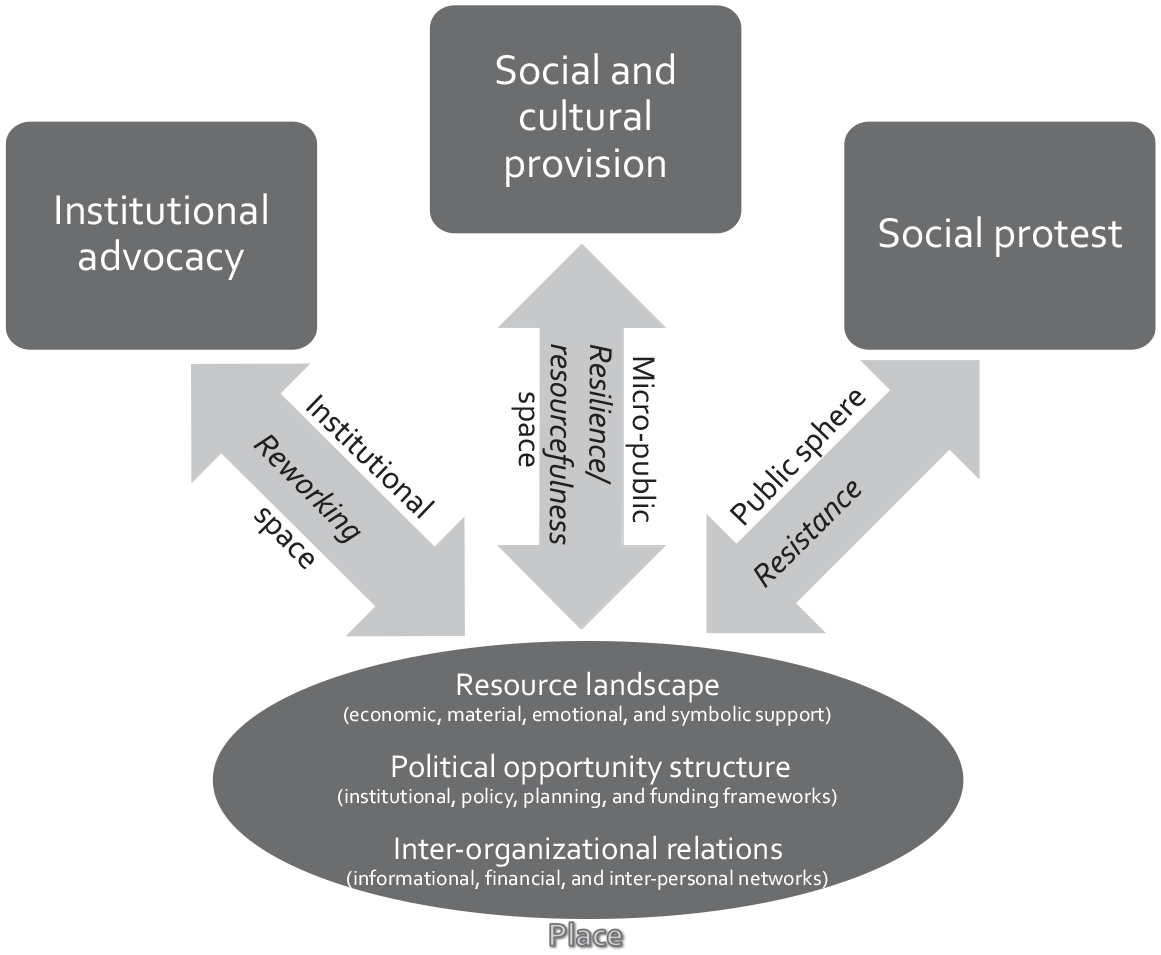
A place-based typology of LGBTQ2S activisms.
Katz’s (2004) countertopography of youth activisms offers a framework for the analysis of everyday activist practices: enactments of resilience; projects of reworking; and acts of resistance. Resilience refers to small acts of struggle in adverse situations as a coping mechanism to sustain individuals and communities. Operating on the same plane as the problem and within hegemonic social relations to undermine structural constraints, reworking offers pragmatic alterations to ‘the conditions of people’s existence to enable more workable lives and create more viable terrains of practice’ (Katz, 2004: 247). Finally, resistance involves a more oppositional consciousness that confronts conditions of oppression. While this typology seems to suggest a hierarchy with resistance idealised as its apex, Katz (2004) asserts that the three components are not mutually exclusive: practices of resilience, reworking and resistance may inform one another, and activists may strategically employ them in various instances and spaces. Recent debates about the co-opting of the discourse of resilience by neoliberal urban policies have led to questions about its use within the typology. While De Verteuil and Golubchikov (2016) argue that Katz’s (2004) original critical use of the term renders it redeemable, MacKinnon and Derickson (2013) propose its replacement with a politics of resourcefulness that can more effectively ‘redress issues of recognition and redistribution and work towards cultivating conditions in which communities can develop alternative visions of social relations’ (MacKinnon and Derickson, 2013: 255). This paper augments Katz’s resiliency by hyphenating it with resourcefulness in order to signify the complementarity of these concepts.
Local variations in LGBTQ2S activist practices are further shaped by the political opportunity structures, resources landscapes and inter-organisational relations embedded in places. A political opportunity structure is the ‘consistent – but not necessarily formal, permanent, or national – dimensions’ of the external political context that can encourage or discourage collective action (Tarrow, 1998: 8). As Smith (2005: 78) explains, ‘the political opportunity structure shapes social movement activism by creating institutional and policy incentives’ and planning and funding frameworks that support certain types of organising and not others. The resource landscape describes the resources (economic, material, emotional and symbolic) that may support LGBTQ2S lives and activisms (Nicholls, 2009) that are often produced and accessed through locally constituted social networks (Routledge, 2003). Local interpersonal and inter-organisational relations determine the cohesiveness and durability of political organising. Information, financing and political support all flow relationally as do the attributes of ‘trust, loyalty and duty that facilitate the mobilisation of resources and tighten solidarities’ (Nicholls, 2009: 79). While organisations invariably have different goals, tactics, ideologies and deliberative logics, the cooperative dynamics between organisations holds the potential to contribute to a solidarity of purpose (Levitsky, 2007).
The following analysis of suburban LGBTQ2S activism on Vancouver’s periphery integrates these activist typologies and place-based attributes (Figure 1). The specificities of place (the resource landscape, political opportunity structure and interorganisational structure) provide the foundations for a comparative analysis. Levitsky’s (2007) typology of organisational practices has them layered onto Katz’s (2004) countertopographies with the integration of MacKinnon and Derickson’s (2013)resourcefulness as follows. First, institutional advocacy organisations focus on the equitable redistribution of resources enacted through the reworking of institutional spaces. Service and cultural organisations practise resilience and resourcefulness in the provision of services in micro-public spaces that enhance social participation. Groups seeking social change through resistance engage the public realm to assert a collective politics of recognition. While all politics might be construed as ‘resistance’, for the present analysis it is defined in collective terms, as a common struggle for recognition in the public sphere.
Research design and methods
The following analysis draws from a larger research project studying the everyday lives, activisms and place-making practices of suburban LGBTQ2S Canadians in Montreal, Toronto and Vancouver. This paper is based on field research conducted in suburban Vancouver between 2017 and 2019. Its primary source materials include field observations at events (e.g. pride festivities, pub nights and city council meetings) documented using field notes, photographs and video recordings in combination with digitally recorded semi-structured information interviews (n = 98) with social agents impacting LGBTQ2S lives in suburban environments: (1) civic leaders (municipal politicians, planners, policy makers, programme administrators); (2) Gay Straight Alliance (GSA) teacher sponsors; (3) community service providers; and (4) LGBTQ2S community organisers and activists. Interviews with civic leaders focused on municipal ‘inclusion’ policies, governance priorities and LGBTQ2S initiatives. Interviews with GSA teacher sponsors addressed programme mandates, outreach strategies, student needs and the role of LGBTQ2S allies. Service providers discussed addressing the needs of LGBTQ2S clienteles. Community organisers described their organisation’s mandate, membership, political priorities and local inter-organisational relations. Such activists also described the history of LGBTQ2S activisms in their municipality and their current resource landscapes. All of these interviews were selectively transcribed based on topic and issue markers documented in detailed hand-written notes. The transcribed content coded for activism is the analytical focus of this paper. The case study municipalities were chosen for the density of their activisms relative to other suburban municipalities in the region.
The paper adopts a comparative case study approach (Bartlett and Vavrus, 2017) which provides in-depth examination of a social phenomenon through a comparison of the uniqueness and particularities of multiple cases (Simons, 2009). Such richness is particularly useful for exploratory research on under-examined phenomena (Yin, 2003). Since they are not generalisable, ‘cross-case’ comparison is used to develop more nomothetic theories (Babbie, 2010). Comparisons may be scalar (vertical), spatial (horizontal) or temporal (transversal) (Bartlett and Vavrus, 2017). A homologous, horizontal, single-scale comparison juxtaposes similar but categorically distinct places (Bartlett and Vavrus, 2017). The present study provides a homologous horizontal comparison of LGBTQ2S case-study activisms within two Vancouver-region suburbs. This comparison begins by considering demographic differences as detailed in national census data. It then attends to differential patterns of municipal governance with respect to social inclusion plans and policies, the distribution of LGBTQ2S community spaces and services, and localised histories of LGBTQ2S activism, fundraising and micro-public placemaking. The application of our typology of LGBTQ2S activisms (Figure 1) to peripheral municipalities, reveals through comparison the variability and unevenness of resource landscapes, political opportunity structures and inter-organisational relations. The narrative analytical overviews accentuate the unique textures of each case study and highlight selected exemplary LGBTQ2S activist groups.
Case studies of suburban LGBTQ2S activisms in the Vancouver city-region
The Vancouver city-region has a long history of LGBTQ2S activisms, dating back to the founding of Canada’s first homophile organisation, the Association for Social Knowledge, in 1964 (Warner, 2002). In 1971, Vancouver activists founded Canadians’ first gay liberation group, Gay Alliance Toward Equality (GATE), which launched the first Canadian legal challenge to discrimination based on sexual orientation, organised the first gay pride event in 1973 (Warner, 2002) and developed a ‘metropolitan infrastructure’ coordinating many projects and service programmes (Brochu-Ingram, 2015: 230). Since 1984, Vancouver’s downtown gay village has provided an electoral base for ‘gay candidates and allies of the LGBTQ community’ at all scales of government (Murray, 2015: 76). Its historic lesbian enclave in the eastern Commercial Drive neighbourhood also has a history of lesbian and feminist activisms (Brochu-Ingram, 2015). LGBTQ2S activisms stemming from these neighbourhoods resulted in the founding of one of Canada’s only two (along with Toronto) LGBTQ2S municipal advisory boards in 2009 (Murray, 2015).
Vancouver’s suburbs have also been part of this activist history, especially the historic working-class suburbs extending along the south-eastern corridor (Figure 2). Burnaby (Burnaby-Douglas) elected Svend Robinson (1979–2004), Canada’s first openly gay Member of Parliament. Robinson’s replacement, Bill Siksay (2004–2011), also openly gay, introduced the bill to amend the Canadian Human Rights Act to include gender identity or expression as prohibited grounds for discrimination (Bill C-16). Surrey came to national attention in the late 1990s when a kindergarten teacher challenged a schoolboard ban of three books dealing with same-sex families from the curriculum, a fight that went all the way to Canada’s Supreme Court. New Westminster is not a site of historic activisms but it has been touted as the region’s new ‘gay village’ (Chow, 2010). The paper builds a comparison between two of these suburbs, New Westminster and Surrey.

Map of suburban case study municipalities within the Vancouver city-region.
New Westminster: LGBTQ2S activisms in a ‘progressive’ suburb
With a population of 70,996 (Statistics Canada, 2017a), New Westminster is a small inner suburb located in the south-west of Vancouver’s Census Metropolitan Area (CMA), founded as the provincial capital in 1859. Its urban infrastructure is among the oldest in the city-region. It has an historic riverfront downtown core that expands along Columbia Street, a main street lined by office buildings, department stores, pubs and hotels dating to the early 20th century. Its uptown neighbourhoods are composed of high-rise apartments and heritage homes. A former working-class city, it has been a stalwart of the labour movement, and its ‘progressive’ municipal government has been a regional leader in the development of social inclusion policies. Demographically, New Westminster has a slightly older population (17.3% are over 65) (Statistics Canada, 2017a), its uptown apartments having served as a retirement centre for the region since the 1970s. Regionally, it is less ethnically diverse: upwards of 60% are of European origin and only 35% declare a mother tongue other than English or French (Statistics Canada, 2017a). Its historic infrastructure has attracted middle-class migrants from the core, leading to significant gentrification of its older homes and riverfront apartment complexes. With 13.5% of all suburban same-sex households in the Vancouver CMA, the LGBTQ2S population is notable, leading to its designation as the region’s ‘second gay village’.
LGBTQ2S activism in New Westminster began in 2010 when the Royal City Pride Society was formed by long-term LGBTQ2S residents stimulated by an influx of gay migrants leaving Vancouver in search of lower housing costs. Activists linked the demand for a local pride event to no longer wanting to go downtown for Pride (it was too far away, there was no parking and it was too big and impersonal) and a desire for a smaller, more family-oriented and less commercial event. Others noted that civic leaders were also receptive to pride activism, inaugurating the first Pride with a proclamation and a flag-raising at City Hall and offering the adjacent park for the event. As one organiser explained, ‘They were so welcoming, and they were so supportive. They made a Proclamation Day. They gave us a grant to put on activities.’ In addition, a social infrastructure was emerging through the allied support of churches and unions. Although New Westminster was predominantly described by informants as queer-friendly, two events in its early years underscored the need for continued pride activism: the 2010 expulsion of a lesbian teen from a local Presbyterian church for public involvement in New West Pride; and the 2012 murder of a well-known transgender activist in New Westminster.
Within a year of these events, the municipal political opportunity structure for LGBTQ2S activists began to widen, especially at the City’s daytime activity seniors’ centre, Century House. In 2011, two municipal initiatives created new openings for LGBTQ2S advocacy: a mandatory, city-wide ‘Safe Harbour’ diversity and inclusion training programme; and an inclusion enhancement working group at the seniors’ centre. As a recreation programmer at Century House explained, ‘We always felt that we’re pretty inclusive here, but that we could always do better,’ particularly with respect to ethno-cultural and sexual diversity. As part of this project, a screening of the documentary film Gen Silent (Maddox et al., 2010) – profiling six Boston LGBTQ2S seniors navigating the long-term-care system – was organised, attracting a 200-plus audience. Stimulated by this reception, some attendees decided to form the Senior Gay Straight Alliance (SGSA). The first of its kind in Canada, it functions as a Century House working group of about 15 members (half LGBTQ2S and half allies). It holds monthly meetings and hosts LGBTQ2S events such as the Pride Hoedown at the Centre. The SGSA focuses on creating a safe and inclusive space for LGBTQ2S seniors that provides peer support and enhances social opportunities. It is also an important forum for initiating activist research and lobbying for change (e.g. partnering with a local health agency to develop inclusive seniors’ centres and long-term care facilities). Along with New West Pride, the SGSA is one of the key consultation groups for city planners regarding LGBTQ2S diversity enhancement in the municipality.
Although the only ‘gay-owned’ establishment in New Westminster is a cafe in the uptown area, LGBTQ2S visibility is strongest along Columbia Street, the main street of its lower downtown core. In 2015, the City inaugurated a rainbow crosswalk on this street in front of The Heritage Grill, the first commercial establishment to host gay events and drag shows in 2008. It sits beside The Met Hotel, which also attracts an LGBTQ2S clientele for themed events. Directly across the street is a long-established gay bathhouse and a few doors down stands The Columbia Theatre featuring drag balls and LGBTQ2S fundraisers. One block away is a pub that holds weekly ‘rainbow’ trivia nights and monthly ‘beer busts’ to raise funds for Pride. Since 2014, this retail strip has hosted the street festival that completes the city’s pride week, an event that attracts upwards of 20,000 people. The kiosks at this street party reveal the multi-scalarity and diversity of New Westminster’s LGBTQ2S activist networks: local activist groups and ally institutions (including churches, schools, unions, social service agencies, political parties); LGBTQ2S organisations from other suburban municipalities; and Vancouver-region LGBTQ2S organisations doing outreach for specific populations. For example, the kiosk of Health Initiative for Men (HIM), a Vancouver-based health service that provides STI testing and organises condom packing socials, is highly visible. It opened a satellite clinic in New Westminster in 2013 because, within the region, ‘New West is the second hub.’
In addition to a municipal government that sees LGBTQ2S inclusion as an important component of its ‘compassionate city’ image, New Westminster LGBTQ2S activists benefit from a very particular resource landscape – a commercial infrastructure that resembles a downtown gay village – that can be used to organise social activities. Since, in the words of one business owner, Columbia Street was once ‘one of the worst streets in the Lower Mainland in terms of drugs, prostitution, homelessness’, many businesses have welcomed the opportunity to host LGBTQ2S-themed events. The Rainbow Event Network (REN) is an umbrella organisation of New Westminster LGBTQ2S event organisers that provides a web-based guide. Founded in 2016, it is the culmination of sustained efforts to hold LGBTQ2S social activities locally and communicate them via social media that began in 2005 when a local lesbian activist started a monthly events email newsletter so that she would not have to go downtown to feel a sense of community. Later, an event organiser moved to New Westminster, bringing Rainbow Night Karaoke and initiating ‘Dining Under the Rainbow’, a monthly event in local restaurants. Once the organisers of the beer bashes and trivia nights joined, REN could advertise a full monthly calendar of activities spanning Columbia Street.
While fostering opportunities for LGBTQ2S socialising is the core objective, a secondary effect is to temporarily queer existing heterosexual spaces, rendering the strip queer-friendly at any time. The organiser of the Rainbow Night Karaoke described how queering the local sports bars leads to a broader awareness of the local LGBTQ2S community locally: I take the rainbow flags with me and stick them on the table so that people know that this is where we are. This one guy came over and he says, ‘You know, we’re trying to figure out what country that flag is.’ So, one of the group says, ‘You know what, this is the pride flag. It’s in every country around the world.’
These practices are more akin to the types of practices noted in queer-friendly neighbourhoods (Gorman-Murray and Waitt, 2009) where the LGBTQ2S identities are but a component of a more ‘cosmopolitan’ and ‘progressive’ neighbourhood identity and subtle practices are used to ‘render a neighbourhood queer’ by imagining it otherwise (Bain et al., 2015). Rather than producing the region’s ‘second gay village’, activists involved in REN envision the entire municipality as a queer-friendly suburb. As one optimistically asserted, ‘That’s what’s unique about New Westminster. We don’t have a village. The whole community is our inclusive village.’
Reworking institutions and a resourceful creation of LGBTQ2S social spaces are central practices to LGBTQ2S activisms in New Westminster, but activists have also practised public resistance through demonstrations to increase local movement visibility, to directly combat local prejudice or demand justice. For example, the first pride events in 2010 began with a ‘Hills n’ Heels’ fundraising march when activists symbolically marched from The Heritage Grill downtown up a steep hill to City Hall wearing high heels. The 2012 murder of a transgender activist brought demonstrators out for a vigil and a march from City Hall to the local courthouse for the bail hearing of the accused, calling for the recognition of societal violence experienced by transgender people. More recently, there have been demonstrations in front of churches that have adopted an transgender stance to Canada’s Bill C-16 or have held meetings to oppose British Columbia’s mandated Sexual Orientation and Gender Identity (SOGI) policy. These more resistant demonstrations have attracted a wider group of activists – young, queer and trans-identified – who are not necessarily part of the strong organisational networks developed through pride activism, REN and the SGSA.
Such demonstrations underscore the specificity of the interorganisational relations surrounding LGBTQ2S activisms in New Westminster. There is a core group that, using overlapping networks and social capital, build the ‘structural interdependencies’ necessary to ‘sustain a sense of movement identity locally’ (Levitsky, 2007: 282). Older, middle-class, primarily white gay men participate and volunteer in the same groups and sit on the boards of institutions that give them access to spaces and political power. They have robust connections to city managers and local business leaders, creating a strong sense of organisational collaboration and a great range of cooperative ties. They attempt to build ‘a community of empowered people’ by cooperating with the municipality and integrating themselves into its project for revitalisation, which can potentially open space for other forms of LGBTQ2S activisms (Misgav, 2016: 1529). However, their models (gay village place-making strategies, pride activisms and GSA formation) potentially continue other sets of power relations, rendering LGBTQ2S ‘others’ less central to this suburb’s activist spaces and leadership.
Surrey: LGBTQ2S activisms in a former ‘hotbed of homophobia’
On the eastern edge of the Vancouver city-region, Surrey extends from the Fraser River to the USA border. With a population of 517,887, it is second only to the City of Vancouver in population size and has the largest portion of suburban same-sex households (18.2%) in the Vancouver CMA (Statistics Canada, 2017b). To accommodate its rapid annual population growth rate (10.6%), Whalley, one of its original seven town centres, has been designated as its ‘downtown’ core ushering in intensive densification and redevelopment. With the only expanding school district in the province, its youth cohort is large: 31% of residents are between the ages of 0 and 24 years (Statistics Canada, 2017b). Surrey is also very ethno-culturally diverse with 47% of residents having a mother tongue other than the official English or French (after English, Punjabi (20%), Mandarin (5%), Tagalog (3%), Hindi (3%) and Korean (2%) are the most common mother-tongue languages) (Statistics Canada, 2017b). Furthermore, it is in the ‘Bible Belt’ of the Lower Mainland where there is a high concentration of white, socially conservative, church-attending evangelical Christians. The pivotal book-ban case in the 1990s was fuelled primarily by religious opposition from these quarters (Collins, 2006), leading journalists to characterise Surrey as a ‘hotbed of homophobia’ (Sullivan, 1999), a descriptor that has lingered long after.
Opposition to the book-ban launched LGBTQ2S activism in Surrey beginning with a fund-raising dance to support the legal challenge in 1999. Those who came together for this event later formed the Out in Surrey Rainbow Coalition Society (becoming Surrey Pride Society in 2011), one of the longest-running suburban pride societies in Canada. These annual events were historically held in various parks but, in 2010, Holland Park (located near the city centre) became the main location. By 2016, Surrey Pride was a day-long festival primarily oriented towards outreach through tables and booths set up by LGBTQ2S organisations – from Surrey, downtown Vancouver and other suburban municipalities – and supportive institutional services ranging from those that are Surrey-based (such as libraries and schools) to those operating at other scales (local branches of the Royal Canadian Mounted Police and national and provincial labour unions). From 2016 to 2018, Pride also began with a small, unsanctioned half-kilometre march of under 30 people from City Hall to the park, leading marchers to its outdoor stage where Indigenous performers and political dignitaries launched the day’s festivities.
This unsanctioned march is a reminder of the tenuous political opportunity structure offered to LGBTQ2S activists by the Surrey municipality. While the Surrey Pride event is an important expression of LGBTQ2S solidarity and social inclusion, it has never been officially sanctioned by the municipality. Every year, organisers ask for a Pride Week proclamation and a rainbow flag raising. Annual proclamations are made in Council, but the flag has yet to be raised. The City also refuses to issue a permit for the pride march, arguing that it cannot be granted without costly insurance. Access to the plaza in front of City Hall, often used for identity-specific festivals, has never been granted for pride celebrations. While activists did succeed in getting the municipality to install a rainbow crosswalk in 2018, LGBTQ2S activists have turned elsewhere for support. In 2019, a nearby shopping mall housing a satellite university campus hosted the Pride festival and the local Royal Canadian Mounted Police detachment held a flag-raising ceremony. These substantial gains in LGBTQ2S visibility in Surrey have not directly involved the municipal government. On the contrary, along with the unsanctioned pride march, they are examples of resistance, practices that contest the lack of municipal support by staging events without sanction or in places that are beyond the purview of the municipality.
Beyond Pride, LGBTQ2S activism in Surrey revolves around disparate practices of advocacy, support and cultural organisations that are distinct within the region. Several Pride Society founding members established the Empire of the Peace Arch Monarchist Association (EPAMA), a philanthropic branch of the Imperial Court System, in 2008. Formed to build community through the ritual spaces of ‘royal’ pageants, they raise funds for local charities and youth scholarships. EPAMA members also founded a drop-in space for LGBTQ2S youth, led the Red Ribbons 4 Life campaign (against a travel ban imposed by the USA on HIV+ Canadian citizens) and fundraised for the Surrey HIV/AIDS Food Bank. More informally, Surrey activists have worked to create LGBTQ2S-themed events in local bars and restaurants, the most prominent was the monthly Amanda Luv drag show in a local restaurant. Continuing the activism that led to the book-ban, ‘insider-activists’ rework schools, libraries and recreation centres by creating spaces of support for LGBTQ2S youth. For example, in 2016, high school GSA-teacher sponsors organised the region’s first district-wide ‘Pride Prom’ and municipal librarians organised a summer teen GSA (Bain and Podmore, 2019, 2020b). Indeed, the most sustained LGBTQ2S activisms in Surrey involve empowering youth through service and cultural community organisations established by LGBTQ2S and ally adults (Bain and Podmore, 2020a).
SHER Vancouver is an example of an adult-created, locally specific supportive space for LGBTQ2S youth. It is a non-profit, youth-led peer support group for LGBTQ2S South Asians aged 16 to 25 years. It was established in 2009 by a Sikh social worker who specialises in combating the sense of alienation, depression and isolation experienced by queer youth of colour. As is often the case when adults create spaces for LGBTQ2S youth (Schroeder, 2012), he drew on his own experience of being gay in his specific Surrey community: I didn’t feel accepted in my community where it is all about marriage. In my culture, you stay at home until you’re dead and the grandparents raise the kids. It’s a different world. It’s hard to be flamboyant and gay.
To create SHER, he began by establishing an online social media presence and then a website (http://www.shervancouver.com) offering peer support, advocacy and outreach. Next, he decided to create ‘a safe space to be gay and brown’ for young people ‘who are vulnerable to intersectional discrimination … and feel marginalised in groups in the Lower Mainland’. He understood that privacy rather than visibility was essential in creating a safe space for this population. Therefore, he organised monthly meetings in the common areas of his condominium building. This private space affords participants ‘privacy and confidentiality – they don’t want a sign saying “gay” because people aren’t out in the brown community. A safe space means not being outed by walking through the door.’
In contrast, Youth 4 A Change (Y4AC), another out-of-school Surrey LGBTQ2S youth group, promotes resilience in a normative environment through public engagement and activism. Created in 2012 by a married lesbian couple for youth between 13 and 21 years in a youth drop-in centre in a strip mall storefront, Y4AC holds weekly after-school meetings where the youth co-create a resourceful place for sexual and gender minorities to rest, relax, socialise and organise. However, beyond creating safe space, Y4AC stresses education and outreach. Much like London’s Queeruptors group (Brown, 2007: 2687), they deploy their ‘power-to-do’–‘a social process of doing with others’. They variously: run workshops with GSAs on homophobia and transphobia; research and discuss LGBTQ2S history; monitor schoolboard social inclusion policies; lobby city councillors and schoolboard trustees about LGBTQ2S youth issues; participate in local campaigns (e.g. for gender-neutral facilities or for a flag raising at City Hall); collaborate inter-generationally with elders; help train community youth workers; consult on public safety; attend Pride and other festivals; and organise community events. The youth of Y4AC empower themselves by engaging multiple arenas to ‘create alternative forms of sociality and mutual support in the here and now’ (Brown, 2007: 2697).
Despite their successes in advocacy, fundraising and support for LGBTQ2S youth, activists in Surrey continue to characterise this peripheral municipality as exclusionary. According to Pride Lounge organisers, it remains ‘a rough and red-neck city that doesn’t like change’. The limits of its political opportunity structures were especially frustrating. Although Surrey had an ‘out’ lesbian city councillor, not all LGBTQ2S activists perceived her as an ‘insider activist’ who advocated for their policy and service needs (Browne and Bakshi, 2013a). While she persuaded the city council to commemorate the lives lost in the Orlando gay nightclub shooting in 2016 and participated openly in two of the Surrey Pride celebrations, she did not advocate for other forms of recognition. For her, ‘LGBTQ issues are on the backburner because of other competing priorities’– namely high poverty, homelessness and addiction rates, and Indigenous youth exclusions. She also contended with conservative politicians who flattened diversity, prioritising ethno-racialised differences over sexual differences.
Constraints in Surrey’s political opportunity structure are compounded by a limited resource landscape. Surrey has few dedicated LGBTQ2S spaces and redevelopment is displacing the older hotels, restaurants and bars near the city centre that activists once attempted to temporarily queer. As the organiser of SHER pointed out, ‘there are no gathering places for LGBTQ in Surrey – we are a community with no infrastructure’. Activists have, therefore, focused on resourcefully creating micro-public spaces for LGBTQ2S youth (c.f., Bain and Podmore, 2019, 2020b). This sustained investment in ‘generationing’ (Vanderbeck, 2007) by adults focuses on transferring knowledge of LGBTQ2S activist practices as a way to build resilience for LGBTQ2S youth living in a suburb that was once known as a ‘hotbed of homophobia’. Both the school and library GSAs and the out-of-school support groups generate a sense of connection and shared identification through ‘space[s] of encounter that involve and invoke recognition, trust-building, and affectivity’ (Chesters and Welsh, 2005: 203). Such ‘safe spaces’ are seen as protecting youth from suburban homo- and cis-phobia and, at Y4AC, providing the space to build the necessary activist toolkits to change that environment.
The lack of resources and political support for LGBTQ2S activisms in Surrey further determined its fragmented inter-organisational relations. As one city councillor in interview asserted: Surrey does not yet have a critical mass of LGBTQ2S activists. It takes a group of passionate consistent people. In Surrey, we go through people, we’re not building capacity, and we’re constantly playing catch-up. A couple of people do a lot of the work.
In Surrey, a fragmented and sporadic solidarity among its small groups of long-term LGBTQ2S activists and their inter-personal conflicts are magnified by its extensive geography. Activists often view their work through the lens of their own organisational mission, resulting in ‘external connectivity’ rather than local solidarity (VanHoose and Savini, 2017: 294). Internal racialisation and gender, age and other ‘differences’, further boundary-making. Such divisions may explain why an unresponsive municipality has yet to be addressed through militant confrontation – what for Katz is resistance. While Surrey’s LGBTQ2S activisms may be more recognisable as a ‘politics of respectability’ (characterised by limited demands for greater social inclusion and acceptance) (Gould, 2009: 305), its resistances emerge through resourceful practices of reworking and resilience.
Conclusion
By relocating queer to Canadian suburbs, the broad objective of this paper has been to widen the scholarly conversation about LGBTQ2S activisms in the Global North to include the metropolitan periphery (Binnie, 2014). While recognising that some practices historically established in an urban context are diffused to other locations (Knopp and Brown, 2003), the aim has been to decouple contemporary peripheral LGBTQ2S activist practices from those established through the historic urban, including: ‘safe’ enclave formation, territorial constituency building, visible central-city demonstrations, and dense networks of community-based cultural and service provision in inner-city spaces. Given the increased mobility of LGBTQ2S populations in urban areas in the Global North (Gorman-Murray and Nash, 2014), such a model can no longer encapsulate the plethora of LGBTQ2S activist practices currently being expressed in inner-city, inner-suburban and peripheral locations across Canadian metropolitan areas. As the case studies of New Westminster and Surrey show, Vancouver’s metropolitan peripheries are not encapsulated in a totalising hetero- and cis-normativity resulting in LGBTQ2S invisibility (Hartal, 2015). The centrality of visibility to their politics renders them unlike existing examples of ‘non-metropolitan’ LGBTQ2S activisms (Gray, 2009). The public character of their sustained place-making, institutional advocacy and sporadic protests, is not reminiscent of the existing ‘home-centred’ accounts of suburban LGBTQ2S activisms (Retzloff, 2015).
Beyond enriching the portrait of LGBTQ2S activisms by relocating to the suburbs (see Tongson, 2011), the objective of this paper has been to compare two examples from the Vancouver city-region. Distinctions between their respective political opportunity structures, resource landscapes and inter-organisational relations highlight the unevenness of the LGBTQ2S activist terrain in these two adjacent municipalities. Strong differences in the political opportunity structures and resource landscapes of each resulted in divergent activist practices and inter-organisation relations. In New Westminster, LGBTQ2S activist demands for recognition and a resourceful use of the commercial landscape merged with the interests of the municipality and business community. LGBQT2S activists, therefore, focused on reworking institutional spaces, the temporary creation of LGBTQ2S cultural spaces, and increasing LGBTQ2S visibility through pride festivialisation. With strong inter-organisational relationships in the core group, there was little need for ‘protest’ except to contest particular forms of violence and exclusion. In contrast, Surrey activists had a more tenuous and ambiguous relationship with the municipality, resulting in an alternate focus on cultural and service provision, especially the ‘protection’ of LGBTQ2S youth. Since grassroots activists in Surrey had little access to institutions to advocate for LGBTQ2S recognition, much of the ‘reworking’ was done by ‘insider activists’ such as teachers, librarians and recreation programmers. A more dispersed landscape with a centre undergoing dramatic urban redevelopment provided few and fleeting opportunities to appropriate commercial spaces for LGBTQ2S place-making. But Surrey activists, although more fragmented in their inter-organisational relations, came together in solidarity to resist municipal exclusion by seeking out other political opportunities and networks and alternative places to stage demonstrations.
These two case studies from one city-region suggest that suburban LGBTQ2S activisms may be qualitatively different from the urban legacy with which they are implicitly compared. Suburban LGBTQ2S activisms emerged later, are less territorial in their place-making, lack the critical mass to leverage large demonstrations and rework institutions with few allies. The case study comparison also highlights considerations that warrant further study. First, that suburban municipalities can significantly determine access to political opportunity structures, a reminder that national LGBTQ2S ‘equalities’ legislation does not directly filter down to the municipal scale, resulting in an uneven distribution of rights, recognition and funding (Hubbard, 2013). Second, intergenerational dynamics (that privilege either end of the age spectrum, both youth and seniors) are an important component of suburban LGBTQ2S activisms. Offering the first investigation into suburban LGBTQ2S activisms, this paper highlights the continued importance of relocating queer urban scholarly inquiry to metropolitan peripheries.
Footnotes
Acknowledgements
We are grateful to Alan, Alex, Gary, Jennifer and Martin in Surrey, and Don, Guy, John, Keith, Nancy, Robert and Shelly in New Westminster for their interview insights and long-time LGBTQ2S activism. Without their involvement, and the funding of the Social Sciences and Humanities Research Council of Canada, this paper would not be possible.
Funding
The author(s) disclosed receipt of the following financial support for the research, authorship, and/or publication of this article: This work was supported by Social Sciences and Humanities Research Council of Canada [grant number 435-2016-1142].
