




Abstract
Although the cities in the Pearl River Delta (PRD) in China are amongst the world’s cities most exposed to flooding due to climate change, surprisingly little is done to address this problem. This article explores the barriers to the emergence of policies adapting to the growing flood risk in two PRD cities, Guangzhou and Shenzhen, underlining the importance of the Chinese territorial governance system for adaptive capacity at the local level. Focusing on institutions, ideas and interests as a heuristic device, the article contributes to the literature on urban climate adaptation and the nexus of spatial planning and flood risk management by exploring why and how the development of the adaptive capacity of cities is hampered, despite an urgent need for it.
Introduction
Extreme weather events are becoming the ‘new normal’ in the cities of the Pearl River Delta (PRD), illustrating the broader challenges that cities across the world, especially in fast-growing economies, currently face in the context of climate change (UN-HABITAT, 2011). Consequently, climate adaptation has emerged as a new priority on the global urban policy agenda (Revi and Satterthwaite, 2014), and its success depends on coordinated action at multiple scales (e.g. Keskitalo et al., 2016) and on the presence of adaptive capacity. The latter can be understood as ‘the ability of systems, institutions, humans and other organisms to adjust to potential damage, to take advantage of opportunities, or to respond to consequences’ (IPCC, 2014: 118). The strength of adaptive capacity depends on a complex interplay between local and wider socio-economic and political factors (Smit and Wandel, 2006). For instance, national-level decisions and policies shape the local arenas where new urban solutions for tackling climate change are implemented (Van der Heijden, 2016; Westerhoff et al., 2011), while the characteristics of (multi-level) governance regimes shape the scope for learning amongst the policy actors needed to adapt to climate change (Pahl-Wostl, 2009).
The relationship between the governance of adaptation policies in cities and the national institutional, political and economic contexts may be an emerging research topic (e.g. Chu, 2018; Hughes et al., 2017), but there is a need to explore how contextual factors matter for the capacity of cities to adapt to climate change. The literature identifies multiple barriers for implementation of urban climate change policies; for example, related to mismatch between priorities at different scales (Adger et al., 2009) or to lack of templates for cross-level cooperation (Corfee-Morlot et al., 2009; Leck and Simon, 2012). However, we know much less about (1) how they emerge; (2) how they are interrelated with each other; (3) why they persist (Eisenack et al., 2014); and (4) how to overcome them. Moreover, most studies tend to explain deficiencies in adaptation policies by examining the role of formal institutions, paying little attention to factors related to the policy actors’ ideas or interests (Purdon and Thornton, 2019).
Thus, the research question addressed here is: how do prevailing characteristics of multi-level governance and spatial planning systems affect the adaptive capacity of cities in the face of the growing flood risk? Given that patterns of urban development critically influence cities’ exposure to flood risk exacerbated by climate change, and that spatial adaptation measures are needed to complement the already insufficient civil engineering solutions to mitigate flood risk (Chan et al., 2018), the article answers the above question by focusing on the nexus between spatial planning and flood risk management. It also puts emphasis on the ability to learn (from innovations and in response to new challenges and uncertainties), which is one of the major components of adaptive capacity (see Gupta et al., 2010; Pahl-Wostl, 2009). Learning is crucial for the latter because of the uncertainty inherent in climate change, which constrains decision-making on the novel, often costly and controversial, adaptation measures. Municipal decision-makers thus need to profoundly rethink the current approaches to planning and designing cities. This, in turn, calls for an ability to innovate and learn from experiments in order to upscale those innovations and produce wider policy change.
The article builds on a case study of two cities located in the Chinese Pearl River Delta: Guangzhou and Shenzhen. They are some of the most exposed cities to future climate change-induced flooding (Hallegatte et al., 2013). The article, first, aims to take stock of adaptation policies at different territorial levels and of urban innovations at the boundary between spatial planning and flood risk management. The innovations shift away from the traditional civil engineering measures, which still predominate in Chinese cities and elsewhere (Chan et al., 2018). The innovations that coastal cities need today include (1) hybrid solutions reducing the chance of flooding or mitigating its impacts while at the same time providing other urban functions, and (2) non-structural measures, for instance preventing urban development in flood-vulnerable areas (spatial adaptation). Second, the article aims to examine the contextual barriers for the development of adaptive capacity in both cities, with an emphasis on the potential for learning from and for mainstreaming boundary-spanning innovations as part of spatial adaptation strategies.
The next section introduces the analytical framework for the study, based on the notion of the ‘three Is’ (institutions, interests and ideas). Subsequently, the case study design and main research methods are outlined. Then, the two empirical sections offer a state of play in urban adaptation policies and spatial adaptation innovations in China and the cities studied, followed by an analysis of the barriers to learning from, and mainstreaming, these innovations in order to develop adaptive capacity. The last section summarises the key findings, discusses them and outlines avenues for future research.
The three Is
The distinction between interests, institutions and ideas (the so-called ‘three Is’) (Hall, 1997; Hall and Taylor, 1996) is used as a basis for the analytical framework for this study. The three Is framework is relatively well established and has featured in various studies of changes in decision-making related to issues ranging from employment, healthcare, welfare, pension and migration, to environmental, agricultural, transport and property rights reforms and climate adaptation (see e.g. Dudley and Richardson, 2000; Gallez et al., 2013; Humpage, 2010; Kern, 2011; Pojani and Stead, 2014; Purdon and Thornton, 2019; Reitan, 1998; Varshney, 1989; Williams, 2005). However, it has not yet been much applied to the study of urban climate adaptation (with the exception of Dąbrowski, 2018). The approach adopted in this article is to explore how the features of Chinese multi-level governance and of the spatial planning system shape the capacity of cities to mitigate the growing flood risk through spatial adaptation policies (Figure 1). The multi-level governance perspective underscores that decision-making on policies involves multiple interdependent actors operating at different levels of government, from national to local (e.g. Hooghe and Marks, 2003; Keskitalo, 2010; Keskitalo et al., 2016; Westerhoff et al., 2011). Multi-level governance, thus, provides the canvas for the operation of a spatial planning system, which is ‘the ensemble of institutions that are used to mediate competition over the use of land and property, to allocate rights of development, to regulate change and to promote preferred spatial and urban form’ (ESPON, 2018).
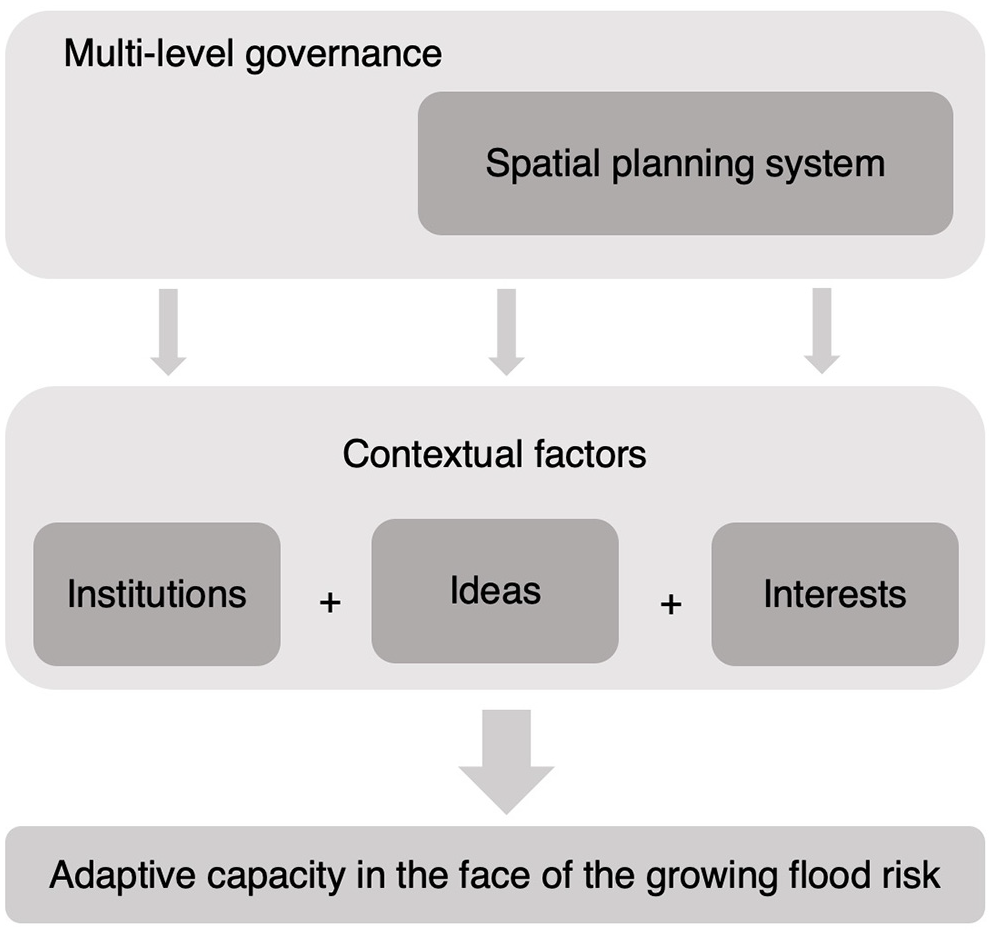
Analytical framework.
The Chinese governance context is characterised by paradoxes. It is based on hierarchical relations and the leading role of the Chinese Communist Party (CCP), but is also characterised by a growing degree of decentralisation (Landry, 2003) and complex negotiations across vertically and horizontally fragmented bureaucracies (Lieberthal and Lampton, 2018). The central government has a strong influence on planning, especially in large cities, but at the same time the financial clout of the city governments is increasing (Lu et al., 2018). In this context, policy-making and strategies at the city level cannot be understood purely as a local-level activity but should also be seen as a multi-level process (see Lu et al., 2017). In order to clarify how the features of the national spatial planning system and the wider multi-level governance system shape the conditions for development of adaptive capacity at the municipal level, we use the three Is as a heuristic device to explain why new policy initiatives remain piecemeal and fail to disturb the current status quo in which the authorities in Guangzhou and Shenzhen hardly take climate change-related flood risk into account in their spatial planning and water management policies, despite the urgent need for it.
While being distinct from each other and stemming from different schools of thought in social science (see Hall and Taylor, 1996), each of these three notions affects the conception, formulation and implementation of public policy, as well as each other. The combinations of the three Is in specific national contexts work together to shape policy actors’ behaviour, which makes this heuristic tool particularly helpful in developing a nuanced understanding of climate adaptation action or lack thereof (Purdon and Thornton, 2019) and exploring the interrelations between the barriers for adaptive capacity development (see Eisenack et al., 2014).
Institutions can be defined as both formal and informal rules and structures that provide a framework in which actors interact (North, 1990). In this article, however, we consider institutions as organisations, regulations and platforms for interaction which create (or hinder) the conditions for cooperation and learning across sectoral boundaries, and which are necessary for developing the adaptive capacity of cities. Our focus here is not only on the local level, but also on how institutions associated with the national territorial governance system affect the ability of the local actors to engage in cross-boundary interactions and learning.
By contrast, interests and ideas are the less readily observable drivers behind the behaviour and choices made by the actors involved. The interests dimension relates to the rational choice institutionalist theory (since there is no space in this article for elaborating on this extensive body of literature, for an overview see Shepsle, 1989, 2006), considering actors as utility-maximising creatures that strategically pursue their own goals. Interests are thus the ‘real, material interests of the principal actors, whether conceived as individuals or groups’ (Hall, 1997: 176). Public policy results from an interplay of the interests of the different actors involved (e.g. different departments of government, lobbies or societal groups), who compete for resources, power and influence on the policy. The notion of power, whether stemming from material or relational resources, is central here, as the most powerful actors are able to pull a policy agenda towards their priorities. In a multi-level governance perspective, the local actors’ interests are influenced by the opportunities and constraints created by processes at the national or regional level and by relations across levels of government.
Finally, in the sociological institutionalist perspective (for a primer on this, see March and Olsen, 2008), ideas refer to social norms, worldviews, culture, cognitive frameworks or values that emerge in a given society and dictate appropriate and acceptable behaviour. Ideas are taken-for-granted values, perceptions and identities, which are stable, deeply embedded and provide a framework for understanding the way in which society, the state and policies work (and change). Considering them can help explain, for instance, the ways in which the actors seek out and share knowledge to address the new challenge of adaptation to the increasing flood risk in the urban setting. The said norms, cultural frames or values are shaped by the local history, traditions and culture, but are also influenced by the wider regional or national socio-cultural conditions, calling for a multi-level perspective to understand them.
Thus, the ‘three Is’ influence the formulation of public policy, but also the processes of institutional learning, which are a crucial factor in policy change and for the development of adaptive capacity. Importantly, while each of the Is matters individually, they also affect each other: national, regional and local institutions provide a structure of opportunities and constraints for the actors to pursue their interests and provide a canvas on which processes of learning between policy actors can unfold. At the same time, institutions have a bearing on the shared understandings of common problems and the ways to deal with them. In turn, the interests of the dominant actors can also influence formal and informal decision-making rules, frameworks and processes and promote or hinder learning, embracing new ideas and innovations.
In sum, this study explores how the norms and formal structures (institutions) defined at different levels of government, as well as the less tangible shared understandings and values rooted in the political culture and history (ideas) and the actors’ strategies (interests) shape and constrain local capacity to adapt to the growing flood risk (see Purdon and Thornton, 2019). This allows for (1) a more nuanced understanding of how the features of the national (multi-level) governance and of the spatial planning system condition the ways in which cities are able to learn, foster cross-sectoral cooperation and embrace innovation to adapt to climate change. This also allows for (2) a structured scrutiny of the barriers to the development of adaptive capacity in cities and identification of opportunities to overcome them.
Research design
Case study cities
Two case study cities operating within the same national and provincial governance context are examined here: Guangzhou and Shenzhen. The rapid expansion of these cities since the opening of the Chinese economy in the late 1970s happened at the expense of their resilience to flood risk, since new urban districts mushroomed in agricultural or wetland areas which had provided a natural buffer against flooding. What is more, as land available for development shrinks, both cities have started expanding onto land reclaimed from the sea, which remains highly exposed to coastal flooding. It is estimated that in the case of a one-metre sea level rise, a storm surge of five metres would result in the flooding of several major cities of the PRD. For Guangzhou, the financial losses of such an event would amount to about 37% of the city’s GDP (Yao-Dong et al., 2013). Moreover, the entrepreneurial approach of the municipalities to land development (Wu, 2015) was not matched by a commensurate effort to develop drainage and flood defence infrastructures. Like elsewhere in China, in Guangzhou and Shenzhen the construction of new buildings and infrastructure soared but the development of flood safety solutions lagged behind, leaving the new urban areas vulnerable to the increasingly frequent flooding.
Methodology
The study employs a critical case study approach. In general, critical cases represent the ‘most likely’ or ‘least likely’ cases which can either clearly confirm or else irrefutably falsify the research propositions and hypotheses (Flyvbjerg, 2006). Guangzhou and Shenzhen are considered to be examples of ‘most likely’ critical cases in the sense that governance responses to the new threat of growing flood risk can be expected in these Chinese cities, if anywhere, since they face some of the most severe potential impacts of flooding and financial losses. The two cities are comparable in many ways. Both are rapidly expanding megacities (with new expansions on flood-prone land reclaimed from the sea). Both are economic engines of the PRD and vice-provincial municipalities operating under the supervision of the central and Guangdong provincial governments. The main difference from a flood risk perspective is that Guangzhou’s core is located more inland and hence coastal flooding is not (yet) affecting it as directly as in Shenzhen, which is on the coast and has already been experiencing coastal flooding. Guangzhou is the historical capital of the region and the province, with an old urban core. Shenzhen, meanwhile, is a new town which has been developing extremely quickly since 1980 thanks to the Special Economic Zone on the border with Hong Kong; it has a track record of policy experimentation and innovation. The purpose of having two cases, however, is not to conduct comparative analysis, but rather to gather complementary insights from two cities in a context where access to interviews and policy documents remains extremely difficult.
This article draws on document analyses and 24 semi-structured interviews with key stakeholders in the fields of spatial planning, urban design, civil engineering and flood risk management. The interviewees represented the relevant authorities operating at various levels, from provincial to local, but also private sector and academic experts (see Table 1). Snowballing was used to broaden the sample, and helped to overcome the difficulty in reaching out to public officials in China. The interview data were coded and triangulated with secondary data from the literature and from policy and planning documents. Insights from the literature were also used to interpret insights from the interviews and to bridge some information gaps in the interview material. The three Is are used as an analytical framework.
Interviews.

Note: * Informal conversation.
Source: Authors.
Coping with flood risk in the PRD cities: State of play across levels of government
To set the scene for the analysis, this section provides a brief overview of adaptation policies in place at various levels of government, from central to provincial to municipal.
Adaptation at the national and provincial levels
China’s 2007 national climate change programme (National Development and Reform Commission, 2007) was the first national policy document stressing the need for adaptation to climate change. While vague on the urban dimension, the document paved the way for further action. In 2008, a dedicated Department of Climate Change was set up under the Ministry of National Development and Reform Commission (NDRC), while two years later specialised climate change offices to coordinate work across policy sectors were established in each ministry of the central government (Li, 2013).
In 2010, every province was required to set up Climate Change Adaptation Plans and create a network of special offices for coordinating work on climate change across their sectoral bureaus (Li, 2013). Also in 2010, pilot projects were set up to facilitate bottom-up experimentation to mitigate climate change impacts in five provinces and eight cities, albeit without being framed as part of urban adaptation policies (Li, 2013). As was evident from the study of the documents and stakeholders’ accounts (Interviews 1, 17, 21), the development of provincial adaptation plans did not result in planning or actions for adaptation at the municipal level. Thus, in the climate adaptation field, the ‘policy conveyor belt’ in China, typically ensuring that national policies trickle down across all lower layers of government, stalled at the provincial level.
Since then, however, the Chinese government has further developed its climate change adaptation policy. In 2013, the National Strategy for Climate Change Adaptation provided a macro framework for adaptation, yet without clarifying how the measures suggested would actually be implemented and enforced at the local level (Wang and Hills, 2014). Further details were then specified in the National Plan for Tackling Climate Change 2014–2020, but little information is available about the implementation of the plan.
In 2014, the ‘Sponge City’ policy was introduced in response to the growing recognition of the urgency of addressing the increasing waterlogging problems in Chinese cities. While not framed as an urban adaptation policy, the Sponge City policy represents a key innovation as it explicitly recognises waterlogging as an urban planning issue rather than a water management issue, leading to changes in discourse and planning practice (for more details, see Meng et al., 2018, 2020). The policy provides guidelines and funding for projects across several cities to introduce ‘blue’ and ‘green’ solutions (i.e. water- and plant-based structures respectively) into urban space to increase the capacity to absorb excess rainwater. It also forces urban planners, responsible for the local implementation of the policy, to consider flood risk in their work and collaborate with water management officials more closely on this problem (MOHURD, 2014: 120). The policy, however, does not respond to the rising sea levels, and the impact of this on the ground remains unclear (Meng et al., 2018).
Adaptation at the local level in Guangzhou and Shenzhen
There is a tendency for the national adaptation policy to be watered down as it trickles down from the central to the urban level, generating little more than scattered local initiatives, as can be observed in Guangzhou and Shenzhen. Neither of the two cities has a policy that specifically addresses climate adaptation. The growing flood risk resulting from climate change is not recognised as a major issue by planners and urban designers in Guangzhou and Shenzhen (Interviews 5, 8, 9, 10, 13, 17).
Even the municipal water management authority, which acknowledges climate risks in principle, does not put forward any measures to adapt to them. For instance, a senior official at Guangzhou Water Affairs Bureau whom we interviewed questioned the validity of the World Bank/OECD study putting Guangzhou at the top of the list of coastal cities exposed to climate change-induced flooding (Hallegatte et al., 2013): ‘From our research, we conclude that this is not true. The increase in sea level is not as dramatic […] We are building on 2000 years of experience in dealing with water’ (Interview 3).
This is corroborated by the Guangzhou Water White Paper from 2013, which maintains that the city boasts sufficient flood defence infrastructures and an efficient emergency system to cope with the flood risk, deemed much less dramatic than estimated by foreign experts (Water Affairs Bureau, 2013).
Yet, the white paper also indicated 24 black spots in the city that were particularly prone to waterlogging, and flagged up the problem of increasing pressure on green areas from the expanding city, reducing the capacity to store water. It also pointed to deficiencies in urban planning as an issue that needed to be solved.
Despite the limited consideration for the impacts of climate change, in both cities one can observe the emergence of innovative local projects aimed at reducing flood risk while at the same time fulfilling other functions. These include improvement of the spatial quality of particular districts, redevelopment of post-industrial areas and ‘beautification’ through green urban landscapes. Interestingly, these projects resemble the kind of adaptive solutions put forward in many Western cities, which are well covered in the literature (e.g. Aerts, 2013) but are not framed as part of an adaptation policy. The data on climate change were not considered in their design and implementation, and the initiatives also remain scattered and piecemeal at present. Nonetheless, they have created opportunities for rare collaborations and learning between the municipal departments for planning, urban construction and water management, by bringing together the spatial and flood risk considerations in joint projects.
In Guangzhou, at least three examples of such multi-functional flood risk management projects requiring a new degree of coordination across municipal policy sectors were identified. First, in Lychee Bay, Liwan District, one of the old districts of Guangzhou, the Asian Games in 2010 provided an impetus for redevelopment of this historical area. The area used to boast a network of canals, but these were considered insalubrious and were covered over during the 1990s as the city expanded to provide more space for roads. Without the canals, the area became more prone to waterlogging, which occurred up to four times per year (Interview 4). Redevelopment of the area was carried out in 2010 in collaboration between the Urban Construction Bureau of Liwan District and the Water Affairs Bureau. The aim was to recreate the canals as part of the efforts to rehabilitate the historic urban fabric. While the main objective of this was to make the area more pleasant and attractive, the restored canals also contributed to the efforts to reduce the flood risk. They include sluices, underground drainage pipes and flood barriers that were put in place by the Water Affairs Bureau.
Another example, also in Liwan District, was the recent redevelopment of the Pearl River banks. The project entailed building a leafy promenade on the Southern bank, in place of the pre-existing natural bank and fisher houses on stilts. This was combined with the installation of a flood barrier on the Huadi River, and the redevelopment of a disused industrial compound into a space for creative industries and restaurants. The project was co-financed by the Urban Construction Bureau of Liwan, Water Resources Bureau and Urban Planning Bureau of Guangzhou, with involvement from private investors in a public–private partnership. Again, climate change was not considered in this project. However, like the redevelopment of Lychee Bay, the project entailed innovative cross-sectoral collaboration.
Finally, Haizhu Lake represents another example of a multi-functional project involving infrastructural and governance innovation. Haizhu Lake was conceived as a water management project, with the artificial lake located in the middle of a park area. It was implemented in a broad collaboration between the Guangzhou Bureaus for Urban Planning, Forestry and Landscaping, Water Affairs and Land Resources and the Haizhu Wetland Park office. The lake was supposed to drain, store and purify the water from the surrounding branches of the Pearl River. However, as the project attracted the attention of urban planners and developers, it became part of the plans to expand the North–South ‘axis’ of new developments in Guangzhou, including Zhujiang New Town business and cultural district (Interview 16). The lake serves the purpose of improving flood safety through water storage, while at the same time providing a much in-demand recreational space for a massive urban expansion project. As in previous cases, though, climate change was not a factor considered in its design (Interview 16).
Similar developments were also observed in Shenzhen. The most striking example is the development of Qianhai new town, built on reclaimed land in the former port area of the city. The project is implemented by a special agency of the Shenzhen municipal government, coordinating the development of this special urban zone and dealing with developers. The project benefits from the highest level of financial and political support from Beijing, as it seeks to establish a new Central Business District. The plans for the district include an impressive array of urban design features including green and blue facilities in both private and public spaces to store excess water while providing an attractive living environment. Examples include waterways with recreated wetland, green roofs, permeable pavements and underground stormwater tanks. Like in the Guangzhou projects, however, the design of Qianhai was neither based on any consideration of the projected sea level rise, nor on the predictions for the effects of extreme rain events (Interview 18). The rationale for them was rather to make the area ‘greener’ and hence more attractive to investors, with improved adaptive capacity being an accidental side-benefit.
Finally, Shenzhen has been piloting the Sponge City policy since Autumn 2014, with a pilot project in Guangming new town. This redevelopment project is located in the Northern Bao district and hosts a mixture of agriculture, often under-used industrial land and urban villages. It was conceived in collaboration between the municipality of Shenzhen and the International New Town Institute. Unlike other districts of Shenzhen that have their own sectoral bureaus, Guangming is developed by the Guangming New District Committee, focusing on economic development, urban construction and social affairs, while relying on the Municipality of Shenzhen sectoral departments for provision of funding, expertise and other services.
These examples illustrate that in China spatial interventions that contribute to resilience against flooding are not framed as climate adaptation and are not part of any overarching municipal strategy to tackle urban flood risk or adapt to climate change. Where this happens, new kinds of collaborations tend to emerge, typically between the different bureaus of the municipal administration, but also with private-sector and research institutions. Considering the continuing urban expansion and the growing flood risk, there is a strong argument for a more explicit and strategically planned adaptation policy in Guangzhou and Shenzhen. Achieving this would require overcoming a number of obstacles, as discussed in the next session.
Barriers for building adaptive capacity
This section considers how the features of Chinese multi-level governance and spatial planning systems create barriers for the development of adaptive capacity in Guangzhou and Shenzhen, using the heuristic of the three Is.
Institutions
From the institutions perspective, at least three of the characteristics of the Chinese administrative system explain why innovations in urban adaptation observed remain ‘accidental’. The first one concerns the peculiarity of vertical coordination in the Chinese territorial governance and spatial planning system in which the central government plays a predominant strategic role (Wang and Yeh, 2020; Wu, 2015; Xu and Yeh, 2009; Yu, 2014). In theory, this system is highly centralised, with the leading role played by the CCP and the central government, defining policies to be replicated across levels of government both in terms of institutional setup and content. In practice, however, as previous research on governance in China has showed (e.g. Landry, 2008; Lieberthal and Lampton, 2018), and as our analysis confirmed in the case of climate adaptation, the Chinese governance system remains complex and fragmented, making the central government not always able to enforce the local implementation of national policy priorities. Municipal governments in China enjoy greater formal institutional weight and resources despite the control of the CCP and the formal oversight by higher levels of government (Landry, 2003; Lu et al., 2017). Thus, adaptation policy is rarely adopted by municipalities, despite having a high priority on the national agenda. In Guangzhou and Shenzhen, the difficulty of the central government in enforcing its climate adaptation goals allows municipal leaders to avoid putting in place local adaptation policies.
This can be explained further by the pragmatism characterising Chinese policy-making, which allows flexible solutions to be adopted in a highly fragmented yet authoritarian and hierarchical system. In this ‘guerrilla style’ policy-making, based on experimentation and adaptability to changing circumstances (Heilmann and Perry, 2011), the central government de facto leaves the provincial and municipal governments latitude in the implementation and operationalisation of national policies to fit the local specificities. This creates scope for negotiation, informal arrangements and experimentation, even if these are conducted under the strict supervision of the central state, which has the ‘paramount power of intervention and final decision-making’ (Schoon, 2014: 198). In theory, this ‘experimental governance’ could thus create scope for learning from the local experimentation on climate adaptation (see e.g. Bulkeley and Broto, 2013) and leave room for informal networks of actors to take initiative, which is also central for adaptive capacity (Pahl-Wostl, 2009). However, in practice the process of drawing lessons from local experiments is hindered by the narrow focus on success stories. These can be proudly reported as achievements to the higher levels of government, and the reluctance to acknowledge failure prevents learning from trial and error (Li, 2013; see also Schoon, 2014).
The second aspect of ‘institutions’ which hinders adaptive capacity development is the lack of long-termism in decision-making. While land use planning is critical for reducing exposure to flooding, ‘its effects mostly occur on a longer (decadal) time scale’ (Kreibich et al., 2017: 963). The innovative urban projects mentioned above generally do not form part of any long-term spatial strategies to adapt to climate change. Meanwhile, the typical timescale of city mayors is only short (or medium) term. This derives from the way in which mayors of cities are not elected or appointed from amongst the local leaders, but rather are ‘parachuted in’ from other locations via appointments made by the provincial branch of the CCP. The post of mayor is considered to be one stage in an administrative career – a springboard for higher level offices, either at the provincial or at the national level. The CCP continues to exert political control over municipal leaders (Landry, 2003, 2008). While the exact criteria for performance and promotion remain unclear, there is a ‘slight positive bias in favour of cadres who oversee quantitative growth’ (Landry, 2003: 52). Thus, to be promoted to higher levels of government, mayors are incentivised to focus on achieving tangible successes during their time in office. This results in a strong preference for short-term and measurable performance in terms of boosting GDP (see Li, 2013), and for highly visible ‘prestige’ investments such as urban megaprojects, landmarks or major infrastructures. Thus, local leaders’ promotion appears to be correlated with the economic performance of their cities (Tingjin, 2012). Hence, investing in adaptation solutions – which may not offer immediate and ‘marketable’ payoffs – is not attractive to municipal leaders. This also helps to explain why, in cases such as that of Qianhai, adaptation solutions are implemented not to improve resilience to flooding but to make the area more attractive to investors. The same applies to Lychee Bay in Guangzhou, a project supposed to restore the historic charm of this part of town for the 2010 Asian Games which ‘accidentally’ had the side-benefit of managing excess rainwater.
The third aspect of institutions that hinders adaptive capacity development is the extremely segregated policy-making style in China (OECD, 2010, 2015), preventing horizontal (cross-sectoral) coordination and dialogue. There are neither regulations nor platforms for engagement in dialogue across sectoral and disciplinary boundaries on the city scale that would enable collaboration and learning between the relevant policy sectors. The different municipal bureaus are supposed to coordinate actions to ensure that flood safety and funding streams from different bureaus can be combined to implement innovative green-blue infrastructures. In practice, however, this cooperation often remains limited to rubber-stamping, which can lead to counterproductive results. A good illustration of this is the case of Haizhu Lake, supposed to collect excess rainwater from the entire Haizhu District (located on an island) through the various water streams flowing into it, whereas the North–South motorway cutting across the island was implemented without involving the Water Affairs Bureaus in charge of the management of water streams and reservoirs. The motorway created a barrier for the water flowing into the lake from the western part of the island, crippling the lake’s water storage effectiveness (Interview 16).
Ideas
To date, relatively little attention has been paid by the authorities of Guangzhou and Shenzhen to climate change-related flood risk and the need to adapt to it. This can be better understood when considered through the lens of ‘ideas’.
The first ideational contextual feature that explains this is the predominance of short-term thinking about the built environment amongst planning and urban development stakeholders (Interview 23), echoing the Chinese model of local officials’ promotion mentioned above. In fact, the lifecycles of buildings and infrastructures, built to last for 20–30 years, appear to be much shorter than for instance in Western Europe. Cities in the PRD have expanded at an unprecedented pace, and new buildings are designed to produce rapid gains and deliver ‘basic functionality’ in the medium term. In this context, the long-term perspective – which is needed to address climate change – is very much at odds with the prevailing planning culture orientated towards maximising profits from land development (Wu, 2015; Yu, 2014).
The second contextual factor related to ‘ideas’ is that the centuries-old traditions of managing floodwaters in PRD cities (e.g. building houses on stilts in a way that makes them resilient to increased river discharges) have been largely forgotten, as many of our interviewees argued. Modernity has replaced this local knowledge with the engineering-based approach to control of water, which, however, does not suffice in the face of ultra-rapid urbanisation. This neglect of the local knowledge and traditions of living and building with water is clearly a wasted opportunity to learn from past experience and supplement insights from climate change science (see Lebel, 2013).
The third contextual factor under the heading of ‘ideas’ that matters here is the perception of flood mitigation as a low-priority issue by the actors involved in urban planning and design, let alone real estate developers. Our interviews showed that awareness of the risks associated with climate change remained very limited both in Guangzhou and Shenzhen, or that these risks were being downplayed. Considering the increasing scarcity of rural land that can be urbanised, urban planners roll out plans for new towns to be located in areas that are very vulnerable to coastal flooding without taking into consideration the future climate change impact scenarios (Interview 22). The sea level rise tends to be ignored in planning and design work, for instance in the new massive urban expansions of Nansha in Guangzhou (Interview 6) and Qianhai in Shenzhen (Interview 18). The same goes for other multi-functional solutions described above, such as the Lychee Bay canals or Haizhu Lake: their core purpose was to create a beautiful city landscape, reflecting the idea that ‘every mayor wants a lake in their district’ (Interview 8). With such an orientation, learning for adaptation can hardly take place. The lack of a sense of urgency about future climate risks amongst the urban decision-makers in Guangzhou undermines the incentives for searching for new solutions for this great challenge.
Interests
A rational choice perspective focusing on ‘interests’ complements the insights from the perspective of ‘ideas’. The shared perceptions and beliefs amongst local policy actors are reinforced by the incentives stemming from the features of the multi-level governance and planning system in China (for an overview of the Chinese planning system and its actors in a multi-level perspective, see Lu et al., 2017; Meng et al., 2020). First, adaptation goals clash with the political priority given to economic growth and urbanisation, forging a close alliance between local authorities and developers. Finding solutions to decrease the flood risk in the medium to long term is a priority neither for municipal leaders, nor for developers targeting quick returns on investment. This explains why urban planners have little incentive to expend time and effort exchanging knowledge with hydraulic engineers, and why the corresponding development of drainage and flood defence infrastructure lags behind the speedy physical expansion of Guangzhou and Shenzhen (Interviews 20, 23). Although the increasingly frequent flooding events capture the attention of the media and have spurred the establishment of the Sponge City Programme, it remains to be seen whether this will actually translate into more resources allocated and coordination efforts deployed on the ground (Meng et al., 2020). The Sponge City Programme is unlikely to deeply change the local practices unless the incentives for local leaders to pursue economic growth are removed (Interview 24).
In fact, the entrepreneurial approach of the municipalities following a ‘planning for growth’ paradigm (see e.g. Wu, 2015) continues to drive rapid urbanisation in the PRD. This has already resulted in a shortage of rural land that could be developed into urban areas. Urban redevelopment has started to take place in the PRD, although Guangzhou and Shenzhen have continued to locate large new urban projects on land reclaimed from the sea. This expansion into the sea is driven by short-term profits and ignores the risks stemming from sea level rise. This in turn further increases the exposure of the built environment and its inhabitants to coastal flooding.
Paradoxically, the dominant interest in boosting the value of real estate on land developed by the municipalities also drives the use of green-blue urban design features and other multi-functional solutions to storing water. For example, in Qianhai district such features are used to brand the new town as ecological and investment-worthy. In the context of extreme air pollution and environmental degradation in Chinese cities, there is a strong demand for greener urban environments, particularly amongst those who can afford to pay a premium for them.
Discussion and conclusions
This article endeavoured to explore how the features of multi-level governance and the spatial planning system in China shape the capacity of cities to tackle the growing flood risk by learning from local adaptation innovations and deploying spatial adaptation strategies. As a point of departure, we highlighted a number of emerging innovations in Guangzhou and Shenzhen both in terms of technical solutions to combine flood risk management with urban (re)development, and in terms of governance practices that span policy sectors (see Bressers and Lulofs, 2010; Dąbrowski, 2018). These create potential for learning and improving these cities’ capacity to deal with extreme weather. However, this potential remains underused. The said innovations remain piecemeal and do not lead to wider-reaching change in the established policy routines and planning practices. To explain this, the article used the analytical lens of the three Is, shedding light on the contextual factors that create barriers for developing adaptive capacity.
From the ‘institutions’ perspective, we demonstrated how the Chinese multi-level governance structures and practices – from the system of promotion of local officials to the deeply embedded segregation between policy sectors preventing sectoral boundary spanning – cripple the capacity of cities to upscale urban experiments and learn from the new interactions they entail. Exploration of the role of ‘ideas’ underscored how institutional features result in low awareness of climate change urgency amongst local policy actors. It also showed how established perceptions nurture short-termism in urban planning and prevent planners from considering urban flood risk as part of their remit. Finally, the ‘interests’ perspective helped to explain how the Chinese governance and ‘planning for growth’ model (Wu, 2015) incentivises municipal leaders to focus on economic development and urban expansion. This restricts the scope for learning that could lead to wider policy change (see Pahl-Wostl, 2009) and a shift towards more climate-proof urban development.
Echoing the theoretical arguments by Purdon and Thornton (2019), this study contributes to the literature on urban climate adaptation inter alia by illustrating how the three Is – institutions, ideas and interests – are indeed intertwined and interdependent factors hindering the development of adaptive capacity in cities. The study also contributes to the literature by shedding more light on the importance of good relations across levels of government (see e.g. Keskitalo et al., 2016; Westerhoff et al., 2011) and of local contextual factors such as planning practices (see Chu et al., 2017), urban political economic contexts and state–society interactions (Chu, 2018). It brings new insights from Chinese megacities which are rarely covered in this literature and yet which are severely affected by climate change and do surprisingly little to mitigate it. Our findings also underscore that interdependencies across levels of government are critical for understanding why urban climate adaptation policies fail to progress, despite the urgent need for them, and why climate change risks are not taken seriously in urban planning. While some of the institutional factors highlighted here are specific to China, others are likely to manifest in any cities operating in a hierarchical administrative system, a context of rapid urban expansion and with high vulnerability to climate change impacts.
Finally, the three Is perspective has allowed for bridging another knowledge gap by explaining how and why barriers for developing adaptive capacity in cities emerge and by pointing to ways to mitigate or remove them. The ‘interests’ perspective, in particular, points towards the potential to pragmatically build on the existing demand for green-blue features in new urban developments to promote more healthy and attractive urban environments. In particular, ‘greening’, liveability and climate resilience could be promoted in city branding strategies. These remain a powerful strategic tool in the Chinese context (Lu et al., 2017), while relatively wealthy cities like Guangzhou or Shenzhen could potentially afford to compensate developers for the additional costs of adaptive infrastructural, urban and architectural solutions (see Lu et al., 2018). Working with or alongside existing policy frameworks (such as those for promoting eco-cities or sponge cities), incentives and/or more prescriptive measures could be used to steer Chinese municipalities towards solutions for storing water in public space (particularly nature-based ones that can deliver ecosystem services such as water purification, carbon storage, heat island mitigation or space for recreation). This could make urban areas more attractive (also for investors), while stimulating engagement and learning across sectoral divisions between the municipal bureaus.
Importantly, the interest calculus amongst actors can be redefined by adequate incentives, unlike other barriers identified which stem from deeply rooted institutional or normative features of Chinese governance. This could be the case, for instance, if the Sponge City policy turns out to be successful and its experimental approach is mainstreamed across the country (see Schoon, 2014), forcing urban planners to put adaptation higher on their agenda. One could also consider expanding the requirements for climate adaptive solutions in the design of new or redeveloped neighbourhoods, beyond the prescriptions already included in Sponge City plans (see Meng et al., 2018). Such requirements would not necessarily clash with the prevailing profit maximisation focus, because of the said growing demand for ‘greener’ urbanism, creating a win-win situation.
This discussion, however, raises thorny ethical and political questions about who benefits from such urban adaptation measures, particularly from the new (often expensive) developments that they may end up promoting. These may benefit only the well-off while neglecting more socially vulnerable citizens (see e.g. Broto, 2017), echoing the debate on the negative effects of climate adaptation deepening socio-spatial inequality (see Juhola et al., 2016; Sovacool et al., 2015). The issue thus demands further investigation from the perspective of the uneven distribution of costs and the benefits of climate adaptation in cities in China and elsewhere.
Lastly, the said measures would need to be combined with efforts to raise awareness of climate change amongst planners and urban designers. Climate change needs to be seen by them not only as a risk factor, but also as an opportunity to bridge various policy agendas. To support this, awareness-building campaigns should also target not only municipal officials and real estate developers but also citizens, who could then exert social pressure on both developers and city authorities to take flood resilience more seriously.
Footnotes
Acknowledgements
The authors would like to thank in particular the Urban Studies Foundation for making this research possible. The fieldwork for this study would not have been possible without the exceptionally kind support, hospitality and guidance offered by the scholars at SCUT, including Prof. Yimin Sun, Prof. Jianyun Zhou, Dr Dongji Qi and many others who collaborated with the authors as part of the SCUT-TU Delft Joint Research Centre Urban Systems and Environment. Many thanks to Wang Pan (SCUT and TU Delft), Yuting Tai and Meng Meng (both TU Delft) for their assistance, and to the anonymous reviewers for their helpful comments.
Declaration of conflicting interests
The authors declared no potential conflicts of interest with respect to the research, authorship and/or publication of this article.
Funding
The authors disclosed receipt of the following financial support for the research, authorship and/or publication of this article: The research has benefited from financial support from the Urban Studies Foundation (Marcin Dąbrowski’s Postdoctoral Research Fellowship), the State Key Laboratory of Sub-Tropical Building Science at the South China University of Technology (SCUT) and Urban Knowledge Network Asia (Marie Curie Actions of the European Union).
