



Abstract
Iskandar Malaysia (IM) is a 4749 km2 urban conurbation and development region located at the Malaysia–Singapore border. State-led development of this regional economic corridor has attracted inflows of foreign investments and spurred the rise of mid- to high-end urban developments by foreign developers. This has resulted in the emergence of an interurban migration industry consisting of intermediary entities that are co-developing and co-marketing ‘migration products’ (real estate, education and lifestyle migration) as an integrated package to middle-class, aspiring transnational investor/lifestyle migrants from the region. This article argues that this middlemen industry is crucial to the materialisation of urban speculation, for state actors and investor/lifestyle migrants alike. Through interurban alliances that capitalise on the broader state-led speculative urbanism landscape, the industry co-creates an imagined urban future that is grounded in transnational lifestyle mobilities. This article highlights the need to analyse speculative urbanism and transnational investment/lifestyle migration as intertwined processes.
Introduction
‘I’m interested in emigrating. But I’ve never done this before, and I’m worried about relying on information on the Internet.’ If you are interested in migration, real estate purchase, your children’s education, or entering a business in Johor Bahru but are unsure about what to do, why not pay a visit? … What is more important when considering migration is your own sensitivities. … It is important to check with your own eyes first. Our Johor Bahru Inspection Tour will guide you through the city with an expert local guide who can answer all aspects about migrating here. We hope to assist you in making a decision.
The quotation above (my translation) appears on a company webpage featuring pre-migration tours for Japanese potential migrants who are considering transnational migration to Johor Bahru, Malaysia’s second largest city, located at the Malaysia–Singapore border. Long functioning as the hinterland of Singapore, the city is also part of the 4749 km2 Iskandar Malaysia (IM) urban conurbation that was designated as an economic corridor (i.e. special economic zone) by the federal government in 2006 (see Rizzo and Glasson, 2012). Spearheaded by the Iskandar Regional Development Authority (IRDA), a federal state entity, IM has recorded RM285.3 billion (US$69.7 billion) in committed investments (of which 38% were from foreign investors) from 2006 to 2018 (The Star Online, 2019). Indeed, the urban conurbation has been attracting migrant resident and transient populations as a result of the broader economic development plans and its strategic locational proximity to Singapore. 1
One of the attractors for labour and lifestyle migrants to IM is the development of new integrated urban projects undertaken by ‘super developers’ (Hamzah, 2019: 10), which has reshaped IM’s cityscape. A notable project is Forest City, a US$100 billion, 20- to 30-year development planned for a target population of 700,000 on four reclaimed islands spanning 1386 ha in the Straits of Johor. This 60/40 joint venture project between a mainland Chinese developer (Country Garden Holdings) and local entities has, arguably, become the symbol of IM. Urban studies and political economy scholars have commented on the politics and consequences of this mega-project from the macro perspective (Moser, 2018; Ng and Lim, 2017; Rahman, 2017; Williams, 2016). However, little attention has been given to micro-processes on the ground: who are the intermediaries, how do they market the development and how do they co-shape (speculative) migration and capital mobilities to IM?
Based on ongoing ethnographic and qualitative research conducted at IM since 2016, I have observed the emergence of innovative marketing strategies employed by property developers and their collaborating partners in non-real estate sectors (especially education and lifestyle migration) to entice potential ‘migrant’ clientele from certain Asian countries to partake in real estate investments and transnational sojourns in the urban conurbation. At first glance, these marketing efforts appear to be focused on selling residential real estate. However, upon further examination, and as the opening quote suggests, real estate constitutes only one part of the story. Instead, what is on offer is an integrated product which includes real estate, children’s education and lifestyle migration for middle-class, aspiring transnational investor/lifestyle migrants. I refer to this integrated product as ‘migration products’ because what is on sale is fundamentally an option for migration or transnational mobility, to be flexibly used and exercised in the future should one choose to do so.
Theoretically, this article uses the migration industry (Gammeltoft-Hansen and Sørensen, 2013; Hernández-León, 2008; Lindquist et al., 2012) as a conceptual lens to understand the materialisation of urban speculation. In shifting the gaze from speculative to speculation, the article seeks to make visible the translation of speculative discourse (encapsulated in state-led urban regional development plans) into speculative practices (that are being actualised in the present) by the urban middlemen economy. It conceptualises the assemblage of intermediaries at IM as an interurban migration industry, that is, a migration industry that operates collaboratively within and across the urban conurbation. The prefix ‘inter’ is used here as it captures the two salient characteristics of this migration industry: first, its interdependent nature (i.e. working in partnership across product sectors and urban scales for mutual benefit); and second, its inter-referencing nature (i.e. the mobile agility for cross-border, cross-urban and cross-sector transfers of ideas, practices and strategies).
This article argues that the interurban migration industry is crucial to the materialisation of urban speculation, for state actors and investor/lifestyle migrants alike. It illustrates this by analysing how the industry forges interurban alliances that capitalise on the broader state-led speculative urbanism landscape. By co-creating an imagined urban future that is grounded in transnational lifestyle mobilities, the industry assists in realising state-led urban regional development plans and individual investor/lifestyle migrants’ transnational mobility projects. In turn, the success of such interurban alliances for urban speculation necessitates the continued reliance on the industry’s interurban expertise, resources and connections.
Using a migration industry lens to understand the materialisation of urban speculation is productive as it highlights the equal significance of the urban middlemen economy (beyond an exclusive focus on the finance industry, e.g. Moreno, 2014), in addition to state actors (Shin and Kim, 2016) and political economy (Goldman, 2011). Moreover, this approach affirms and extends emergent insights on the development of real estate as a globalised industry that feeds (on) the transnational mobile lifestyles of relatively privileged groups (e.g. Hayes and Zaban, 2020; Rogers and Koh, 2017). In other words, this urban middlemen economy thrives on the intersections of speculative urbanism and transnational lifestyle mobilities.
Following this introduction, the next section outlines the theoretical underpinnings of the article. Specifically, it discusses how the migration industry lens can enrich existing understanding of speculative urbanism. After a brief methodological section, the fourth section explains the emergence of the interurban migration industry at IM. The fifth section details the co-development and co-marketing of migration products by mainland Chinese and Japanese entities, respectively. The article concludes by discussing the broader implications of the urban middlemen economy.
Understanding speculative urbanisation through a migration industry lens
Speculative urbanism
The concept of ‘speculative urbanism’ can be traced to Goldman’s (2011) article on the processes of world city-making at Bangalore, India. In a later article, Goldman (2020: 2) highlights that speculative urbanism is associated with the development and consolidation of (1) new/alternative forms of finance capital; (2) state reforms that encourage and facilitate foreign investments into real estate; (3) transnational networks of policy experts; (4) global inter-referencing of cities; and (5) the financialisation of public goods and services through state-led urban speculation. In sum, speculative urbanism entails the institutionalisation of mechanisms that seek to fix free-floating global capital in place (what Harvey, 1982, referred to as ‘spatial fix’). In this process, the built environment becomes a ‘safe deposit box’ (Fernandez et al., 2016) for the temporary parking of footloose investment capital. The built environment that is produced in this process does not really matter; what matters is that the idea of the urban product is attractive enough to secure investment capital. Indeed, Steel et al. (2017: 138) highlighted that speculative urbanism ‘prioritises image over actual needs and growth; … us[ing] world city image building as a short-term and speculative growth strategy.’
In many Asian cities, speculative urbanism is predominantly state-led/facilitated. Extant urban studies literature has thus far focused on the roles of state actors (e.g. the developmental state, parastatal agencies), global elites and global financial capital in charting speculative urbanism (Goldman, 2011; Moreno, 2014; Shin and Kim, 2016). By contrast, less attention has been given to the middlemen actors who play equally important roles in materialising urban speculation on the ground. Two notable exceptions include Raman (2016), though exclusively on how developers mobilise land and financial resources; and Halbert and Rouanet (2014), though exclusively on the ‘transcalar territorial networks’ (i.e. geographically dispersed yet transnationally connected intermediaries) in the business/commercial property market. While these two works are helpful in shifting the focus onto the middlemen economy, there remains scope to examine underexplored areas such as the residential property market, collaborations with non-real estate/financial intermediaries and the mobilisation of non-real estate resources that are related to speculative urbanism.
In a special issue on the globalisation of residential real estate (and not on speculative urbanism per se), Rogers and Koh (2017: 7) noted the dialectical relationship between the state and ‘the global real estate industry’ (e.g. real estate agents and lawyers, migration professionals, wealth managers). They wrote: ‘Without the nation-states there would be no foreign investment laws and immigration policies, and therefore, no loopholes for the global wealth and real estate industries to seek out and manipulate’ (Rogers and Koh, 2017
The (interurban) migration industry
It is here that the migration industry literature can lend insights into the roles and workings of the urban middlemen economy. The migration industry can be defined as an ensemble of private and informal actors offering for-profit or in-kind services (often specialised) that facilitate and sustain international mobility (Hernández-León, 2008). Given the increasingly complex ‘spatial, juridical, economic and social barriers’ (Cranston et al., 2018: 545) to international migration, potential migrants are turning to the migration industry to actualise or smooth the path of their migration projects. This has led to the commercialisation of the industry and the expansion of its services (Gammeltoft-Hansen and Sørensen, 2013). Importantly, the industry’s existence depends on ‘the continuation of migration’ (Castles, 2004: 859). As the industry expands and matures, this leads to an inevitable ‘intermediary trap’ (Xiang, 2013), that is, a situation where agents in the migration industry ‘made themselves indispensable’ (Collins, 2012: 159) to their clients and migration stakeholders.
Hernández-León’s (2008) insights on the three characteristics of the migration industry is particularly useful for theorising the urban middlemen economy. First, he suggested conceptualising the industry as ‘a matrix of interrelated services and activities in which providers simultaneously compete, cooperate and articulate their activities with other actors’ (p. 25). Moreover, the services ‘are not organised in a chainlike form, where the consumption of one leads to another’ (Hernández-León, 2008: 25). This conceptualisation highlights the dynamic and mutual interdependence amongst the industry’s cross-sector members. As we shall see later, this is applicable to the interurban migration industry, which thrives on the co-development and co-marketing of cross-sector migration products that can be flexibly packaged, sold and consumed.
Second, Hernández-León (2008: 155) highlighted that the migration industry is present and plays an active role throughout the migration process (before, during and after), and across different migration trajectories (e.g. temporary, return and cyclical). This perspective is productive for viewing migration (and the related capital) mobilities beyond existing migrant categories. In the context of speculative urbanism, this enables us to see that the interurban migration industry works flexibly within and across existing migrant categories, as long as urban speculation can be realised. This perspective is also useful for considering how the interurban migration industry can switch its service offerings across migration phases to match client needs. For example, during the pre-migration phase, the industry could offer ‘property tourism’ (Koh, 2017) for potential migrant-buyers to ‘“try on” local life’ (Montezuma and McGarrigle, 2019: 3) before they commit to investment/lifestyle migration; while after migration, the industry could offer services ‘for settling in at destinations’ (Cranston et al., 2018: 544) or advice for further (corporeal and capital) mobilities.
Finally, Hernández-León (2008: 28) noted that the migration industry ‘has a multidimensional and fluid relationship with states … and the immigrants themselves, articulated by their profit-seeking motivation and their interest in the continuation and expansion of cross-border flows.’ Positioning this insight in the context of speculative urbanism, we can see that the interurban migration industry thrives on the sustained cross-border flows of migration-linked investment capital, which materialises urban speculation for the state, the investor/lifestyle migrants and the industry itself. Importantly, the industry’s entrepreneurial activities in creating new cross-sector products and markets are made possible through its deep commercial understanding of the capital accumulation and urban speculation needs of the ‘speculative state’ (Goldman, 2011: 571) and investor/lifestyle migrants.
Real estate, education and migration
Thus far, the migration industry literature has tended to focus on migration brokers and mobility facilitators/producers within specific migration streams (e.g. Beech, 2018, on international student mobilities; Lindquist, 2010, on gendered labour recruitment). Although Castles (2004: 859, my emphasis) noted that ‘[t]he migration industry includes …housing agents’, there has been little done to explore the real estate dimension of the migration industry (but see Koh and Wissink, 2018). Meanwhile, tourism and second homes studies have noted the important roles of property and tourism agents in facilitating residential tourism and lifestyle migration (Åkerlund, 2012). Housing studies scholarship has also examined how translocal property agents facilitated relatively wealthy migrants’ purchase of overseas investment properties (Rogers et al., 2015). While not writing specifically about speculative urbanism nor the migration industry, Rogers (2017: 102) highlighted that ‘real estate purchases have become a way to obtain educational security for children, a way to “purchase citizenship” and a way to attract [investment] capital to global cities.’ This points to the interconnectedness of real estate, education and migration for urban speculation: it is this interconnection that constructs an imaginable urban future, attracting investor/lifestyle migrants and their capital to the speculative city (see Badaró, 2020).
It was only in recent years that some scholars began to explore the interconnectedness of education, real estate and migration from an intermediary perspective. Robertson and Rogers (2017) used the concept of ‘brokerage assemblage’ to analyse how actors in the migration industry co-produce and co-circulate a ‘real estate–education–migration nexus’ through digital and lived spaces. However, their contribution focused on the discursive and performative co-production of new knowledge in the brokerage of such mobilities without linking the analysis to speculative urbanism. Nevertheless, the idea of brokers as assemblers, ‘connective agents who actively bring together the different elements of the … assemblages they operate in and are targeted by’ (Koster and van Leynseele, 2018: 6), is helpful to analyse how the interurban migration industry operates within a speculative urbanism landscape. This focus on the urban intermediary economy can shed light on how urban speculation is realised through the industry’s entrepreneurial pursuits in the interconnected sectors of real estate, education and migration.
Methodology
This article is based on an ongoing project on transnational and cross-border investment-lifestyle mobilities which I started in 2016. The project utilises qualitative and ethnographic methods, including document analysis (e.g. marketing collateral, official websites), participant observations (at property sales galleries, property launches and real estate seminars), guided and unguided site visits, as well as semi-structured interviews and informal conversations with a range of stakeholders (e.g. representatives of IRDA, representatives of local and foreign developers, sales gallery visitors).
As the project focused on specific organisations and development projects, I used purposive sampling to recruit interview participants and to request guided site visits. Participants were informed that their responses and individual identity were to be kept anonymous and confidential, although their organisational identity may be revealed in publications. Each interview lasted between 50 and 90 minutes. The interviews were audio recorded with participants’ consent and transcribed verbatim. After each interview, site visit or participant observation session, I wrote fieldnotes recording my observations and insights. As Laurier (2010: 122, original emphasis) noted, recording fieldnotes ‘after the event’ was helpful as this allowed me to describe, analyse and reflect on the encounter. Writing fieldnotes also helped me prepare for the next encounter and to make sense of the collated data in relation to the broader research question(s).
In this article, I focus on interviews with two Japanese intermediary entities (Company A and Company B) conducted in 2016, as well as my ethnographic fieldnotes and brochures collected from four fieldwork visits during 2016–2017. I supplemented these fieldwork data with information from the official company and development websites. I used NVivo for data reduction, to record coding memos and to generate empirical and conceptual codes.
The emergence of the interurban migration industry at Iskandar Malaysia
Iskandar Malaysia
Iskandar Malaysia (IM) is a 4749 km2 urban conurbation and economic corridor located at the southern tip of Peninsular Malaysia (Figure 1). IRDA is the principal coordinator performing the tri-functions of planning, promotion and facilitation in relation to the development of nine economic focus sectors, including education. 2
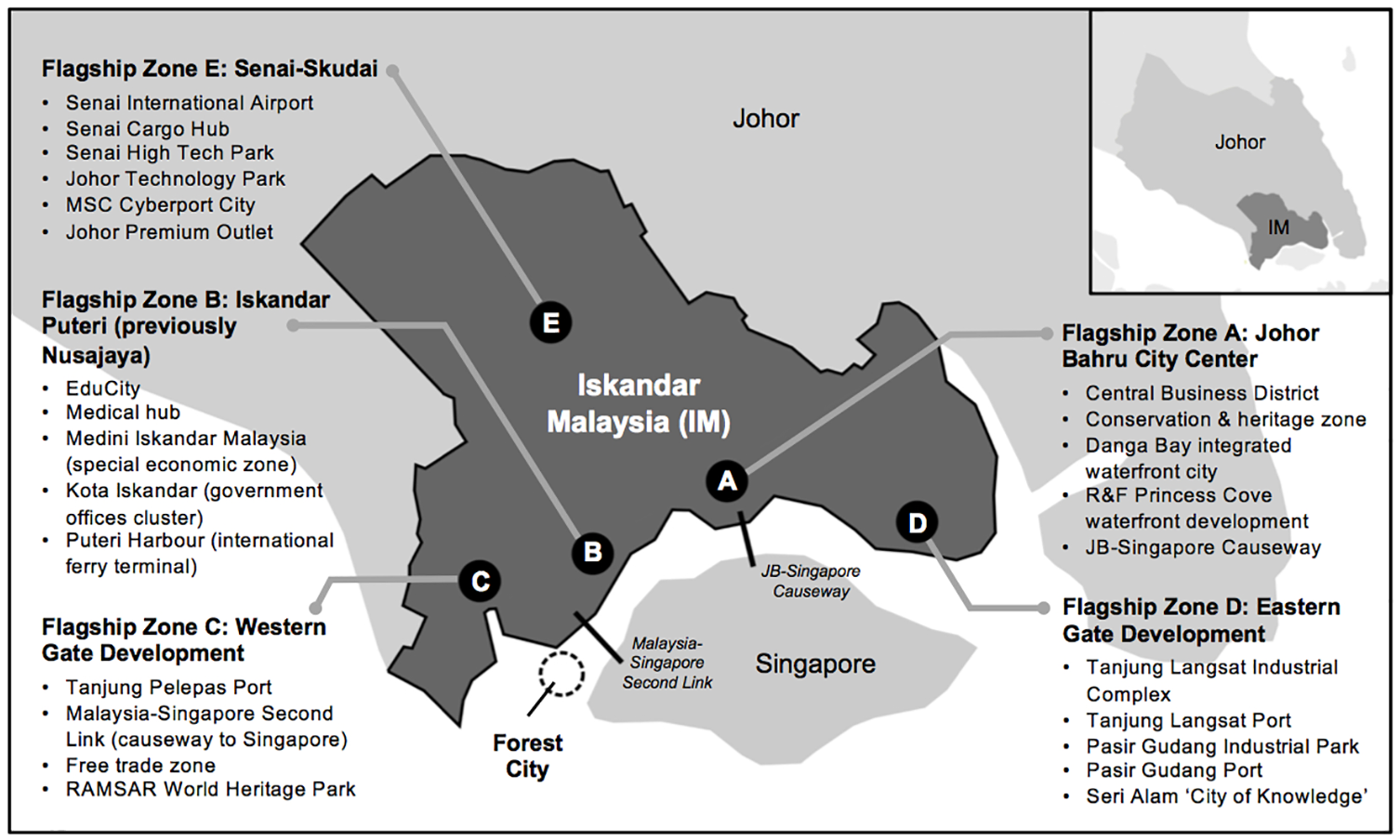
Iskandar Malaysia (IM) and the five flagship zones.
The long-term economic and urban development of IM is of federal and local state interests, as seen in its institutional set up. IRDA’s Chief Executive reports to the Members of the Authority (MoA), a board consisting of key federal and Johor state officers holding finance, economic planning and executive portfolios. The MoA in turn reports to IRDA’s two Co-Chairmen: Malaysia’s Prime Minister, and the Chief Minister of Johor. As a federal state authority, IRDA works with federal and local state entities in attracting foreign investments and facilitating the entry/operations of foreign investors at IM. This includes coordinating the provision of incentives (e.g. tax reliefs) and fast-tracking of development proposals.
With regard to urban development, Iskandar Investment Berhad is the strategic developer, with Khazanah Nasional Berhad (the federal state investment arm), the Employees Provident Fund (the federal state fund) and Kumpulan Prasana Rakyat Johor (the Johor state fund) as its shareholders. Another key actor, the Sultan of Johor, 3 plays a significant role in high profile development projects. Many academic and public commentators have highlighted his direct and entrepreneurial involvement in land sales, sand extraction, land reclamation and joint ventures with foreign developers (read: urban speculation), most notably in the Forest City project mentioned earlier (Aw, 2014, 2015; Rahman, 2017; Williams, 2016).
In short, there are vested national, local and private commercial interests in the successful materialisation of the IM regional economic and urban development plans (see Ng, 2020, on land politics at IM). These vested interests translate into conditions of speculative urbanisation that are attractive and conducive to transnational investors and profit seekers, be they organisations or individuals. As we shall see below, the ‘speculative (‘plug-n-play’) climate’ (Goldman, 2011: 571) at IM has led to the emergence and growth of the interurban migration industry.
EduCity
As mentioned earlier, education is one of the nine focus economic sectors in IM, with EduCity being a catalytic development. Located in Flagship Zone B, EduCity is a 350-acre education cluster consisting of four foreign and one local university branch campuses, two private tertiary institutions and two international schools. Interestingly, the two international schools (Marlborough College Malaysia, Raffles American School) are not actually located within the physical boundaries of EduCity. Nevertheless, they are included in the education cluster because of their prestigious brand names, 4 which assists in the branding of the cluster. Indeed, as we shall see below, some members of the interurban migration industry at IM work directly with these two schools in co-developing and co-marketing migration products for their clients from specific source countries.
Malaysia My Second Home and lifestyle migration
The regional economic and urban development plans at IM cannot be analysed independently from Malaysia My Second Home (MM2H), a lifestyle and retirement migration visa programme. Successful applicants enjoy a 10-year renewable residential and multiple-entry visa for themselves and their family members (including student pass for their school-going children).
From 2002 to 2018, China and Japan topped the list of source countries for MM2H migrants (41.8% share). 5 Japanese migrants are attracted to the warm weather, lower cost of living (especially for recreational golf and retirement healthcare), the presence of existing Japanese communities and ease of communication (since English is widely spoken) in Malaysia. With regards to property purchase and investment, Japanese investor/lifestyle migrants find Malaysia attractive because of the less volatile property market and rule of law safeguarding foreign property ownership compared with other South-east Asian countries such as Thailand, Vietnam and the Philippines (interview, Company A, July 2016).
As for mainland Chinese migrants, it was reported that although only 15% of MM2H migrants had purchased properties in Malaysia, the majority of the purchasers were Chinese nationals (The Malaysian Reserve, 2019). Touted as part of the ‘“third wave” of Chinese migration’ to Malaysia (Sukumaran and Liu, 2017), this new migration trend saw the influx of lifestyle migrants who spend their time between China and Malaysia. Like Japanese migrants, they are also attracted to the cheaper cost of living in Malaysia – although in their case this relates to real estate and children’s education.
While individuals can apply directly to the MM2H programme, most applicants rely on licensed agents to help them navigate the application process. As will be evident below, this opens up opportunities for MM2H agents to partner with intermediaries in other sectors (especially in education and real estate) to co-develop and co-market migration products for a growing clientele of middle-class, aspiring transnational migrants in the region.
The interurban migration industry at IM
As a result of the overlapping regional development plans and lifestyle migration programme described above, an interurban migration industry has emerged at IM. This cross-sector industry consists of intermediary entities that have co-developed ‘migration products’ in real estate, education and lifestyle migration for a target clientele. Regardless of their specific sectors, actors in this industry are united by the commercial desire to market IM as an attractive and strategically located urban destination for lifestyle migration-tied speculative investment.
Nonetheless, the emergence and growth of this interurban migration industry has been to a large extent spurred by the real estate sector. Like other state-led mega-urban developments, IM has become ‘the site of real estate speculation’ (Shin, 2017: 92), especially for transnational capital. This has been most obvious in the case of large-scale integrated developments led by mainland Chinese developers such as Forest City, mentioned above. The scale and speed of these developments hugely contrasted with the practice of local developers (interview, local developer, July 2016): ‘In Malaysia, one developer would … launch a few hundred units in one go. But when Country Garden came in they were launching about 30,000 units. It really threw all the developers in Malaysia off.’ Furthermore, these foreign-developer-led projects are not designed for the local market. Priced at RM700,000 (US$170,000) and above, these properties are beyond the local residents’ reach. Indeed, a Country Garden official admitted that ‘the price of the property is too high for Malaysians, and [we have] specifically marketed toward the Chinese’ (Mahtani, 2018).
Since the local population cannot be expected to absorb the surplus supply of residential units produced, the obvious solution was to turn to foreign buyers. This is where actors in the interurban migration industry at IM come into the picture: they capitalise on the broader urban regional development plans and lifestyle migration programme to co-develop and co-market migration products that are attractive to potential investor/lifestyle migrants. They therefore materialise state-led speculative urbanisation by orchestrating the transnational circulations and landings of potential owner/occupiers from target source countries who are lured by ‘promises of “the [urban] good life”… [and packaged] “landscapes of privilege”’ (Pow and Kong, 2007: 131). In doing so, not only do they co-create imagined urban futures (with state agencies, investors and end users), they also assist in the multiscalar mitigation of urban speculation risks (see Halbert and Rouanet, 2014, ‘transcalar filtering of risks’) for all involved investors, including themselves. To demonstrate this argument, I now turn to the workings of the interurban migration industry at IM.
Co-developing and co-marketing migration products
Mainland Chinese entities: Forest City by Country Garden
With the rise of Chinese tourism spurring overseas property shopping (Juwai, 2016), there is emerging attention to ‘property tourism’, which Koh (2017: 35) defined as ‘short trips purposively organised by property developers and their agents … to educate, inform, cajole, influence and, ultimately, convince potential clients to commit to a purchase.’ Indeed, during my visit to the Forest City sales gallery, a sales agent revealed that, ‘Everyday we have a lot of China tour groups coming in, 20–30 groups. Most of [them] … are our homeowners … from Country Garden projects [in China]’ (interview, July 2016). This illustrates the developer’s interurban marketing strategy: capitalising on their existing customer base in China and transferring the same marketing practice they have successfully used in Chinese cities to IM. This interurban strategy illustrates ‘the concomitant movement of techniques, discourses, models and actors-facilitators across interurban space’ in the context of neoliberal urbanisation (Peck et al., 2013: 1096).
Purchasing a second home in an unfamiliar international location usually involves non-real estate, lifestyle considerations. To help potential investor/lifestyle migrants allay their concerns and figure out how to actualise their mobility projects, there is an ‘Education and Migration Consultation Centre’ 6 in the sales gallery. This helpdesk is flanked by two vertical displays written in Mandarin only – clearly targeting the mainland Chinese clientele. The first display introduces the MM2H programme, while the second details information on ‘Comparative Advantages of Educational Resources in Singapore and Malaysia’ and ‘Introduction to Country Garden Malaysia Overseas Chinese University Entrance Examinations Course.’
The table comparing Singapore–Malaysia educational resources highlighted that both countries accept foreign students from the kindergarten stage, which is crucial for ‘an early start to an elite life’ and ‘letting your child win at the starting line.’ Moreover, while ‘English is the main teaching medium’ in both countries, Mandarin is ‘widely used in everyday life.’ This ensures that children will not ‘lose Mandarin as a result of learning English.’ Additionally, early entry into an English-based education allows children to ‘seize the best window for language learning’ without having to ‘worry about communication problems during the early stage of studying overseas.’
Regarding immigration, the table highlighted that mothers can reside in Singapore with their school-going children under the ‘unique study accompaniment visa’, 7 while in Malaysia ‘parents can easily realise study accompaniment’ through the ‘more valuable’ MM2H programme. Importantly, the table highlighted the close proximity between China and Singapore/Malaysia (‘arrival in less than half a day’) and the ‘numerous internationally reputable universities’ within 15–35 km of Forest City (which is ‘only one bridge away from Singapore’) – all for the potential migrating family to ‘enjoy the highest level of international education from a close distance.’ This illustrates how the developer has translated the strategic location of the Forest City project into a long-term educational advantage, a key consideration for the prospective investor-buyer who is seriously considering children’s education as part of the familial mobility project. Here, a real estate product has been turned into a migration product that encompasses real estate, education and transnational migration.
For families who are planning well ahead for their children’s eventual re-insertion into the education system in China at the university stage, the developer has teamed up with educational partners in Shanghai and IM to offer the 3-year ‘Overseas Chinese University Entrance Examinations Course.’ Under this transnational programme (first year in Shanghai, subsequent 2 years in IM), the children of Forest City homeowners can sit for China’s notably competitive Gaokao (‘University Entrance Exams’) as overseas Chinese candidates – which means that they will be subject to relatively less competitive quotas compared with local candidates in China. 8 The potential advantages of this innovative programme are many, including a higher success rate for entry into preferred universities and a wider selection of universities should the candidate choose to study in China. The programme brochure suggests, tantalisingly, ‘Going out for a better future return.’
The Forest City case demonstrates the innovative co-creation of an integrated migration product that caters specifically for the mainland Chinese clientele. Real estate is obviously the foundation of the package – property ownership is the first criterion for the potential investor/lifestyle migrant to gain entry to a longer-term familial mobility project, facilitated by the developer and its strategic partners. Indeed, as Badaró (2020: 20) notes, investment in real estate is often presented ‘as an investment in individual and family life.’ Education is also a key but supplementary product in the package, in the sense that there are many options and (transnational) educational routes to choose from. Finally, the MM2H programme constitutes the facilitative factor that enables these migrating Chinese families to partake in relatively hassle-free investment/lifestyle migration that stems from the broader speculative urbanism landscape at IM.
Here, the developer embodies ‘the entrepreneur [who] … ensure[s] profitable capital recombination’ (Pereyra, 2019: 2) by amalgamating real estate, education and migration into a migration product that addresses the specific needs and aspirations of the target clientele. In doing so, the developer and its cross-sector partners are co-creating an imagined urban future that is grounded in transnational investment/lifestyle mobilities for their target clientele. Importantly, it is the mass subscription to the imagined urban future, made imaginable and practically possible/actionable by the interurban migration industry, that turns speculative discourse at the urban regional scale into actual urban speculation activities at the local scale. Through the successful sale of the migration products, urban speculation is being realised for the state, the industry and the investor/lifestyle migrants.
Japanese entities
In addition to the case above, I have also chanced upon Japanese entities where the lead agent has co-developed migration products in a more organic and less time-compressed manner. A lead from a respondent led me to two Japanese intermediary companies that target and deliver ‘long stay’ (i.e. lifestyle migration) services to Japanese clients in Johor Bahru. 9
Company A runs two businesses: a licensed MM2H company (established in the late-1990s) offering ‘long stay support’ (interview, July 2016), and a brokerage company (established in the early 2010s) offering property-related services and overseas business consulting services for individuals and corporations. Company A has three branches in Malaysia and one in Tokyo. Company B was established in Johor Bahru in the early 2010s and has since evolved from a real estate brokerage company into a MM2H licensed company that also offers other services (real estate investment and management, education migration consultation, settling-in support). In addition to a branch in Kuala Lumpur, Company B has an affiliated company in Macau providing overseas investment and asset management consulting services to Japanese clients.
Company B’s evolution into an intermediary company offering a comprehensive package of migration products to the Japanese market is worthy of further elaboration. In 2012, it partnered an established Malaysian developer to develop an RM500 million (US$123 million) Little Japan in Permas Jaya. 10 Company B provided input on the design and layout of the condominium units to cater to Japanese buyers/occupiers, and successfully sold half of the units to Japanese investor-buyers. As most of these buyers were absentee investor-owners, Company B started brokering interior design, furnishing, rental and property management services for them. For owner-occupiers, the company coordinated arrangements for ‘their cars, their children’s education and what not’ (interview, July 2016).
Through these service demands Company B saw a market gap and began selling the idea of education migration to their clients. With the emergence of prestigious yet relatively affordable international schools in IM (especially Marlborough College and the Raffles American School mentioned above), Japanese parents started ‘buy[ing] that idea’ of familial education migration to IM. Families who could not afford to purchase properties in IM resorted to the transnational split-household migration model where ‘the father would work in Japan and earn salary; the children and the mother would stay in Malaysia’ in a rental unit through Company B. To help clients figure out the nature and extent of their migration project, both Companies A and B have developed experiential tour packages to suit different needs: ‘It depends on what they want: if they are looking for property it will be a property tour; if they are looking for education it will be an education tour’ (interview, Company B, July 2016).
In addition to ad hoc, individual tours, Company B has also teamed up with international schools in EduCity in offering 1- or 2-week Spring/Summer schools where the child and parents can experience what it is like to study/board at the school and live in IM. The Spring/Summer school package costs RM7500–17,000 (US$1850–4200), including tuition, accommodation, meals, extracurricular activities, airport transfers 11 and property inspection tours for parents. In collaboration with its branches in Japan, Company B offers free webinars (‘Education Migration to Johor’) and paid information sessions (‘Johor’s Educational Environment and International Schools’) in Tokyo and Osaka prior to the experiential programmes in IM.
While the lifestyle migration and second homes literature has noted the importance of tourism as part of the process of foreign residential property acquisition (Illés and Michalkó, 2008; Montezuma and McGarrigle, 2019), there has been relatively little research in the realm of education. Company B’s collaborative international school experiential programme addresses parents’ desire to check out potential schools before enrolling their children. This experiential tour allows parents to shop for education in a foreign location before they decide to invest their time (in terms of schooling years), effort (in terms of complete/partial family migration or long-distance parenting) and financial capital (to rent or purchase property) in a lifestyle migration destination.
The migration products co-developed by Company B and its partners therefore facilitate the materialisation of urban speculation by providing a menu of services that can flexibly meet the specific needs and circumstances of the potential investor/lifestyle migrants. In ‘internali[sing and filtering away] risks that would otherwise prevent [lifestyle migration-led] investment’ (Halbert and Rouanet, 2014: 474), Company B has made it easier and less risky for its clients to undertake their transnational capital and migration projects. By locking clients into such projects, the company is also ensuring its downstream businesses in the future – for example, when clients complete, alter or prematurely terminate their investment/lifestyle mobility projects.
Discussion and conclusion
The functions of the interurban migration industry
The findings presented above point to three interrelated functions that the interurban migration industry performs for realising urban speculation. First, the industry functions as the expert facilitator that renders investment/lifestyle migration projects to unfamiliar (speculative) urban destinations more effortless, less risky and less costly in terms of time and opportunity costs than if individual investor/lifestyle migrants attempt to navigate the processes themselves. Given their sector-specific knowledge and up-to-date information on policies and business trends in interurban locations, members of the industry are well equipped to offer targeted and tailored advice to assist (and enhance) their clients’ urban speculation-tied investment/lifestyle mobility.
Second, the industry functions as the well-connected matchmaker that forges collaborative, interurban alliances for the mutual benefit of all the stakeholders. By offering a full range of cross-sector services that covers the entire ‘migration’ lifecycle, this middlemen industry ‘provide[s] value … [and solves] a particular problem’ (Krakovsky, 2015: 6) that sits at the intersections of urban speculation and transnational mobility. In doing so, the industry delivers commercial profit to its assemblage partners and assists in materialising urban speculation by turning clients’ aspirations into actual transactions and mobility projects. Instead of merely matching supply with demand, the industry is also actively creating new demand in new markets that it then fulfils (see Koh and Wissink, 2018). This, in turn, necessitates the continued reliance on the industry’s interurban expertise, resources and connections.
Finally, the industry functions as the mobility producer that enables middle-class, aspiring transnational migrants to actualise their investment/lifestyle migration projects. This includes, but extends beyond, cross-border human mobilities – in fact, a crucial element of such migration projects is the transnational accumulation and circulation of capital (including but not limited to education, real estate and mobility). Once transnational capital is accumulated, it can then be converted into other forms of capital that can be used for future mobilities. In this process, urban speculation is effectively materialised for the investor/lifestyle migrant, as real estate capital (which is capitalised upon the broader speculative urbanism landscape) is being converted into social, educational and mobility capital.
In both cases presented, the interurban migration industry has assisted in the creation of new transnational investment/lifestyle migration corridors for middle-class Asian families who are turning to children’s (early-stage) international education as part of their (speculative) mobility projects. The innovative educational solutions co-developed by actors in the industry offer the flexibility to pick and choose the educational pathway that best suits clients’ needs, aspirations and affordability. Unforeseen changes to familial circumstances may not necessarily jeopardise children’s educational pursuits, as there are many possibilities to switch tracks (and even countries) since the educational credentials have transnational utility. In rendering future uncertainties less risky (cf. Halbert and Rouanet, 2014, ‘filter[ing] away the risks’), the industry actively encourages and enables the transnational sojourns and capital acquisition of their clientele who otherwise may not have pursued such mobility projects. The interurban migration industry therefore (re)shapes and (re)directs migration and capital flows to the speculative city, facilitating the ‘spatio-temporal fix’ (Harvey, 2003) of capital before its eventual circulation to neighbouring areas in the region and further afield.
Crucially, the interurban migration industry is able to perform all of the functions above because of the existence of conditions of speculative urbanism, which has been to a large extent enabled by the state. Indeed, transnational capital ‘did not arrive unannounced, nor indeed uninvited’ (Ley, 2017: 16). At IM, the industry relies on the presence of ‘conscious and centralised’ (Rizzo and Glasson, 2012: 424) states, both federal and local, to provide the broader socio-economic, political and infrastructural frameworks necessary for its members’ entrepreneurial pursuits. These broader frameworks set the stage for the industry to capitalise on and ‘adapt to new profit opportunities’ (Pereyra, 2019: 6), drawing upon its assemblage of situated knowledge and in-depth cultural understanding of the target clientele.
Contributions
This article shows that a migration industry lens is useful in enriching existing understandings of speculative urbanism. Specifically, this perspective highlights the significant roles of the urban middlemen economy in translating speculative discourse into speculative activities. Through its entrepreneurial cross-sector brokerage activities, the interurban migration industry assists in realising urban speculation for the state, the investors/lifestyle migrants and the industry itself. In doing so, this article complements existing speculative urbanism literature that has examined the roles of state actors and political economy (Goldman, 2011; Moreno, 2014; Shin and Kim, 2016), and some intermediary agents (Halbert and Rouanet, 2014; Raman, 2016). It also contributes to the migration industry literature by highlighting the pertinence of examining the interconnectedness of education, real estate and migration as a commercialised migration product.
This article highlights the need to analyse speculative urbanism and transnational investment/lifestyle migration as intertwined processes. The findings suggest that the interurban migration industry relies on transnational migration and urban speculation as its business model. Indeed, real estate is an increasingly global industry connected to emergent cultures of transnational mobility (Hayes and Zaban, 2020; Koh, 2017; Rogers and Koh, 2017). Capitalising on an imagined urban future that it co-creates and co-promotes to middle-class, aspiring investment/lifestyle migrants, the interurban migration industry plays a crucial role in transforming transnational mobilities in/through the speculative city into commodities of transnational consumption.
Focusing on the analytical and empirical intersections between transnational migration mobilities and speculative urbanism is especially important, given the rise of speculative urbanisation processes in many ‘worlding cities’ (Ong, 2011) that are seeking to attract potential migrants and their capital – even if actual human mobilities are not necessary nor mandatory. Indeed, speculative urbanism and worlding desires ‘provide the canvas for entrepreneurial activities [by the interurban migration industry] to continue profiting from and changing the city’ (Pereyra, 2019: 8). More needs to be done to fully understand the transnational operations, cross-sector reach and broader implications of the urban middlemen economy for transnational migration mobilities and speculative urbanism.
Footnotes
Acknowledgements
I thank the special issue editors and the three anonymous reviewers for their comments, which have sharpened this paper. A draft version of this paper was delivered as an online lecture for the Transient Spaces and Societies research group, University of Innsbruck, in June 2020 – I am grateful to Tabea Bork-Hüffer for her kind invitation.
Declaration of conflicting interests
The author declared no potential conflicts of interest with respect to the research, authorship, and/or publication of this article.
Funding
The author disclosed receipt of the following financial support for the research, authorship, and/or publication of this article: The work was supported by Universiti Brunei Darussalam University Research Grant (UBD/ORI/URC/RG(337)/U01).
