



Abstract
This paper uses a novel, globally harmonised city-level data set – with cities defined at the Functional Urban Area (FUA) level – to revisit the link between urban concentration and country-level economic dynamics. The empirical analysis, involving 108 low- and high-income countries, examines how differences in urban concentration impinge on changes in employment, Gross Domestic Product (GDP) per capita and labour productivity at country level over the period 2000–2016. The results indicate that urban concentration reduces employment growth but increases GDP per capita and labour productivity growth. The returns of urban concentration are higher for high- than for low-income countries and are mainly driven by the ‘core’ of FUAs, rather than by suburban areas.
Introduction
Today about 55% of the world’s population lives in urban areas. The concentration of population in cities is the consequence of rapid urbanisation: between 1950 and 2018 the population living in cities rose from 0.75 billion to 4.22 billion. Rapid urbanisation has been particularly rife in developing countries. In 1950, 59.4% of the world’s urban population lived in developed world cities. This share had declined to a mere 23.6% by 2018. Urban growth has also been more intense in large cities. The population living in cities of more than 5 million rose from 162 million to 855 million between 1970 and 2018. Once again, this rise was far more pronounced in low- than in high-income countries. During this period, the rate of population growth in large cities was 4.7 times higher in the former than in the latter (United Nations (UN), 2019).
This global and rapid move towards cities and the corresponding increase in urban concentration have attracted considerable attention. Urban economists and economic geographers have investigated extensively the economic impact of cross-country differences and changes in urban concentration and hierarchy. The dominant view is that economic dynamism is greater in countries with highly concentrated urban structures, with a limited number of very large cities (e.g. Melo et al., 2009; Rosenthal and Strange, 2004). However, this view has been challenged by more recent scholarly work. This research suggests that there is simply not enough evidence to assert that urban concentration drives growth in all countries. It is increasingly posited that the link between urban concentration and economic performance is highly context-specific and related to variations in economic development levels across countries (e.g. Berdegué et al., 2015; Brülhart and Sbergami, 2009; Castells-Quintana, 2017; Frick and Rodríguez-Pose, 2018a; Henderson, 2003).
This paper revisits this debate, addressing the question of whether greater urban concentration leads to improvements in overall economic dynamism. It provides new empirical insights on the long-run effects of urban concentration on employment, wealth and productivity growth at country level. To do so, it uses a novel, globally harmonised city-level data set covering 108 high- and low-income countries over the period 2000–2016. The degree of urban concentration – operationalised by means of a Herfindahl-Hirschman Index (HHI) – is defined at the beginning of the growth period. Different measures of urban concentration are regressed on different types of economic performance, controlling for a large set of country-specific economic, demographic and geographic characteristics known to affect employment, Gross Domestic Product (GDP) per capita and productivity growth. We also test for causality and endogeneity issues by means of an instrumental variable (IV) approach, which exploits cross-country variations in terms of land area equipped for irrigation in the year 1900.
The results of the analysis suggest the existence of a negative effect of urban concentration on employment growth. In contrast, urban concentration positively affects GDP per capita and labour productivity growth. These general findings depend, however, on the level of development of the countries considered and the threshold values of the population size of Functional Urban Areas (FUAs). Urban concentration propels growth to a greater extent in high-income countries than in low-income ones. Economic performance is also higher in countries with high-density ‘cores’ than in those with more low-density urban zones.
The paper presents three key novel approaches with respect to previous research. First, it is among the first to exploit city population data from the new Global Human Settlement Layer (GHSL) database, recently developed by the Joint Research Centre and the Directorate-General for Regional and Urban Policy of the European Commission. This new database allows for a considerably more granular approach than previous city-level databases dealing with ‘urban concentration’. The logic behind this database is that the traditional concept of ‘city’ has changed significantly. Cities have augmented their sphere of influence, becoming broader ‘functional’– rather than purely administrative – urban areas (Dijkstra et al., 2018). The use of a functional definition allows for a more adequate measurement of cities, going beyond traditional administrative boundaries that follow diverse national definitions and which, frequently, do not coincide with the physical space where social and economic activities take place within cities (Ahrend et al., 2017). The GHSL database has the great advantage of employing a globally harmonised definition of FUAs, which allows for a direct comparison of the degree of urban concentration among countries worldwide.
Second, we complement previous evidence on the relationship between urban concentration and economic dynamics at country level – which was commonly based on short-run analyses – by explicitly focusing on the long term. In doing this, we provide novel insights into the urban concentration–economic growth nexus, by accounting for the heterogeneity between low- versus high-income countries, and between high-density (core) and low-density (peripheral) urban zones within FUAs. On the one hand, we assess the interplay between the national concentration-dispersion pattern and the monocentric-polycentric internal spatial structure of urban agglomerations. On the other, we also examine if there is an ‘optimal’ size of FUAs for agglomeration economies to materialise.
Finally, we provide a comparative analysis involving three different economic dimensions: employment, GDP per capita – used as a proxy for wealth – and labour productivity growth. This implies going beyond the traditional focus on GDP per capita (e.g. Bertinelli and Strobl, 2007; Castells-Quintana, 2017; Frick and Rodríguez-Pose, 2016, 2018a) to evaluate whether and how the economic returns of urban concentration vary with respect to different economic dimensions.
The aim is to push the boundaries of existing knowledge, while providing policymakers with a more comprehensive picture for evaluating how country-level variation in urban concentration may affect the returns of development and growth policies.
The paper is organised as follows. The following section discusses the theoretical and empirical literature on the relationship between urban concentration and economic growth. The third section presents the empirical model. The fourth section presents the results, which are discussed in the fifth section. The sixth section concludes and draws some policy implications.
Urban concentration and national economic performance: A view from the literature
Starting with Marshall (1890), many scholars have emphasised the growth-enhancing powers of the geographic concentration of economic activities. In the Marshallian tradition, the agglomeration of firms and their workers creates a fertile ecosystem for the circulation of ideas and knowledge – thanks to labour market pooling, proximity to (specialised) suppliers and inter-sector linkages – which, in turn, enhances overall firm-level efficiency (Ciccone and Hall, 1996; Duranton and Puga, 2004; Rosenthal and Strange, 2004). This basic idea was later formalised by the New Economic Geography (NEG) literature (Krugman, 1991) that pointed to increasing returns to scale, reduction of transport costs and market access as additional drivers of urban growth. All these factors led to the formation of a dominant view: the concentration of more dynamic firms in cities creates economic dynamism in urban environments and, especially, in large metropolises (Glaeser et al., 1992; Henderson et al., 1995; Puga, 2010).
From this perspective, the city represents the space where positive agglomeration externalities emerge and intensify, as (traditional) manufacturing activities meet tangible and intangible assets linked to both business services and a creative atmosphere typical of a diversified urban structure (Florida, 2002; Jacobs, 1969). The presence of individuals from different backgrounds and with different skill levels, together with the availability of physical infrastructures and of public and private services concentrated in well-defined urban agglomerates, turn cities into the motors of modern economic dynamism and growth (Duranton, 2015; World Bank, 2009).
Drawing on these theoretical insights, urban economists have focused on the micro-foundations of agglomeration economies at city level, providing evidence of a productivity premium for large and high-agglomerated cities relative to smaller cities, towns and rural areas in low-density environments (Ciccone and Hall, 1996; Duranton and Puga, 2004; Melo et al., 2009; Rosenthal and Strange, 2004). The NEG literature, however, has also highlighted how productivity follows an inverted U-shape function with respect to city size. From this perspective, an excessive concentration of economic agents (population, workers, firms) in cities can result in agglomeration diseconomies – for example, congestion, pollution and high land rents (Duranton and Puga, 2004).
Agglomeration diseconomies can be addressed through migration processes connecting cities of different sizes. The interplay between centripetal and centrifugal agglomeration forces determines the location of economic activities within a country (Fujita et al., 1999; Krugman, 1991). Centripetal forces – through positive agglomeration externalities – further incentivise the concentration in large (and growing) cities. Centrifugal forces – driven by negative agglomeration externalities – push for dispersion, such that migration processes occur until an ‘optimal’ spatial distribution of agents is reached (Bertinelli and Black, 2004). In particular, migration processes occur at two spatial levels. They happen across cities, leading to national polycentric structures dominated by (almost) equal-sized cities, and within large cities, favouring the formation of sub-centres functionally connected with urban ‘cores’. These sub-centres borrow agglomeration benefits arising from a large and functionally integrated urban area, but without suffering the productivity slowdowns associated with agglomeration diseconomies (Li and Liu, 2018; Shen et al., 2019).
Overall, from a theoretical viewpoint, the adjustment process should lead to a national spatial structure where agents are distributed efficiently over space, such that productivity is maximised both at micro and country level (Duranton and Puga, 2004). However, this theoretical mechanism is far from being empirically validated. Political interests of primary cities, weak infrastructure endowments in more remote and/or less dense locations, and the motivations of individuals may limit or prevent migration processes from congested large cities towards less dense locations. Indeed, not only have metropolises in developed countries become larger and more concentrated over the last decades, but also new ones have emerged mostly in developing countries (Frick and Rodríguez-Pose, 2016, 2018a; UN, 2019).
The city-level evaluation of agglomeration economies and diseconomies needs, however, to be complemented by research accounting for the ‘overall’ spatial structure of a country. There are considerable risks involved in linking a country’s economic performance to the productivity of a single or a few high-agglomerated cities. The way economic activity is spatially distributed within a country and, consequently, the national degree of concentration of population and economic activity, can have important implications for overall economic development (Frick and Rodríguez-Pose, 2016).
Building on this rationale, many past contributions have analysed the relationship between urban concentration and economic growth at country level (e.g. Ahrend et al., 2017; Atienza and Aroca, 2013; Berdegué et al., 2015; Bertinelli and Strobl, 2007; Bloom et al., 2008; Brülhart and Sbergami, 2009; Castells-Quintana, 2017; Frick and Rodríguez-Pose, 2018a; Henderson, 2003; Lewis, 2014). Most research has underlined the existence of a positive link between urban concentration and economic performance, especially when considering developed and high-income countries (e.g. Melo et al., 2009; Rosenthal and Strange, 2004).
However, there is no complete agreement on the subject. While some contributions underline how urban concentration significantly boosts economic growth up to certain thresholds of economic development (e.g. Brülhart and Sbergami, 2009; Henderson, 2003) or find no evidence of urbanisation-related benefits for economic growth (e.g. Bloom et al., 2008), some more recent scholarly work concludes that the urban concentration–economic growth relationship is highly context-specific, especially when confronting developed versus developing countries. This is because, although there has been a global tendency towards urban concentration, the paths towards urbanisation have differed greatly between high- and low-income countries. Developed and high-income countries have experienced a process of relative decentralisation of the urban population, driven mostly by a physical and functional expansion of the ‘traditional’ city towards enlarged FUAs. This process has entailed a movement of individuals and economic activities from urban cores to suburban areas within FUAs (Veneri, 2018). Developing and low-income countries, by contrast, have witnessed hefty migration processes from rural to urban areas. The result has been a rapid acceleration of urbanisation with a greater concentration of population within high-monocentric ‘megacities’ (UN, 2019). These processes stand out in the work of Castells-Quintana (2017), who finds that urban concentration pushes short-run GDP per capita growth in developed countries, while this relationship depends on access to basic infrastructures in developing countries. Similarly, Frick and Rodríguez-Pose (2018a) uncover that urban concentration is at the root of short-run GDP per capita growth in developed countries only.
The growing number of empirical studies focusing on the economic returns of urban concentration and the recent trends in urban dynamics in the developed and developing worlds are casting increasing doubts on the hitherto dominant notion of a positive link between urban concentration and economic growth. There are also other factors stoking interest in the topic. First, most previous research has focused on the short-term relationship between urban concentration and GDP per capita growth. Second, limited evidence exists on both the returns of urban concentration on other economic dimensions (e.g. employment and labour productivity) and its long-run effects. Third, the different urbanisation paths followed by high- and low-income countries demand a more detailed analysis on the potential economic growth returns of urban concentration in these two types of economies. Different agglomeration-related economic returns for high- versus low-income countries can be the result of their diverse – and structural – ability to manage the potential negative externalities arising from urban concentration, such as crowding, environmental degradation, pollution and over-priced housing markets (Bloom et al., 2008; Rodríguez-Pose and Storper, 2020).
Hence, novel empirical analyses on the link between urban concentration and economic performance are required, especially in light of the attention policymakers are paying to urban-oriented development and growth strategies. The urban concentration–growth nexus has relevant economic policy implications, as long as a ‘growth-inequality’ trade-off exists, and may force policymakers to choose between pushing overall economic growth and promoting socio-economic cohesion (Brülhart and Sbergami, 2009; Martin, 1999, 2008). We contribute to this debate by analysing the short- and long-run effects of urban concentration on employment, wealth and labour productivity growth, distinguishing explicitly between low- and high-income countries. We provide a more comprehensive picture of the growth returns of urban concentration by evaluating also the interplay between the national concentration-dispersion pattern and the monocentric-polycentric internal spatial structure of urban agglomerates. We also examine whether an ‘optimal’ city size exists for agglomeration economies and diseconomies to materialise.
Empirical framework
Empirical model
The relationship between urban concentration and long-run change – over the period 2000–2016 – of employment, GDP per capita and labour productivity at country level is assessed using the following cross-sectional empirical growth equation:
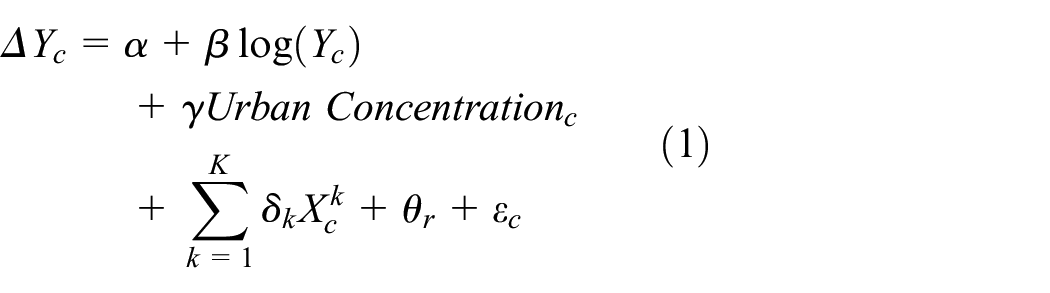
where the dependent variable is defined as
The key explanatory variable depicts the degree of concentration of urban population in a country. The variable is defined using urban population data derived from the GHSL database. This database provides detailed information at FUA level for the population residing in high-density urban areas (i.e. the ‘core’ of FUAs), low-density urban areas (i.e. the suburbs) and the rural outskirts of each FUA in a country. Following Frick and Rodríguez-Pose (2018a), the national concentration of urban population is operationalised through an HHI, which is defined as follows:
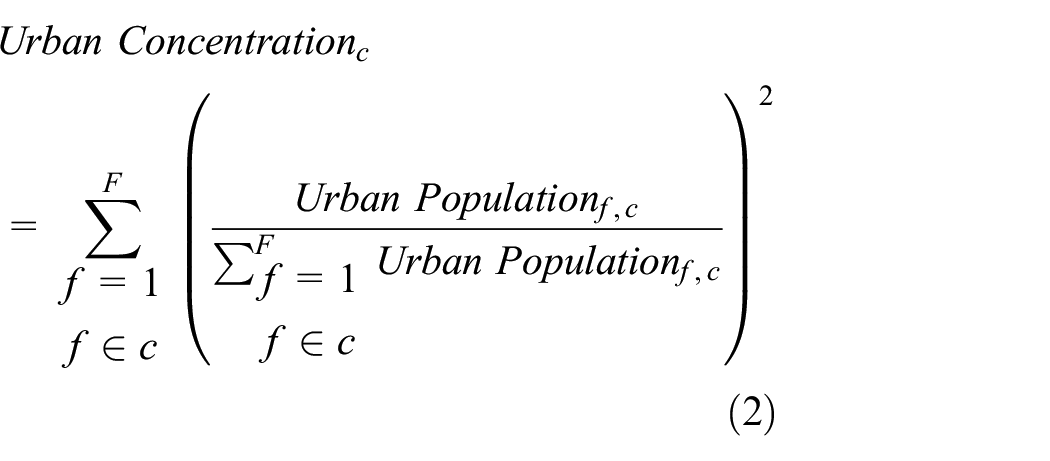
where
The vector
Estimation approach
Following Barro (1991) we adopt an Ordinary Least Squares (OLS) estimation approach. However, the potential endogeneity of the urban concentration variable can bias the OLS estimates. Endogeneity may emerge for several reasons, including reverse causality (the urban structure of a country can be the result of its economic performance and dynamism, rather than the other way round) and measurement errors (related to difficulties in identifying the proper geographic unit capturing the ‘urban space’) (e.g. Brülhart and Sbergami, 2009; Castells-Quintana, 2017; Frick and Rodríguez-Pose, 2018a; Henderson, 2003). We address potential endogeneity problems by means of a Two-Stage Least Squares (TSLS) estimator.
The proposed identification strategy exploits cross-country variations in the irrigated land area in 1900 to instrument for the current degree of urban concentration at country level. The rationale behind the chosen IV is that improvements in agricultural productivity could have contributed to shape the ‘modern’ process of urbanisation and, consequently, the current urban structure of a country. As discussed by Motamed et al. (2014), among others, first-nature geographic factors, such as soil fertility, represented key forces that favoured the establishment of cities in the past. Historically, cities have been set up in accessible locations that could act as markets for the agricultural production of neighbouring areas. Being surrounded by fertile land was also essential to satisfy the nutrition needs of large urban populations. The availability of fertile land would therefore have favoured the concentration of rural population and the formation of cities. Subsequent improvements in agricultural productivity and an increased availability of agricultural products, together with improvements in transportation, would have freed part of the agricultural workforce to be used in non-agricultural production activities, inducing migration processes from rural areas to nearby cities (Michaels et al., 2012; Motamed et al., 2014). Hence, interventions aimed at increasing agricultural production – such as, for example, improvements in irrigation infrastructures – could have, first, led to an increase in the density of rural population in response to rises in agricultural productivity, followed by a push towards urban centres. In such a scenario, improvements in agricultural activities could be at the root of the emergence of cities and of the concentration of population in certain cities (Frick and Rodríguez-Pose, 2018a). The IV capturing a country’s irrigated land area in 1900 can therefore be considered a good predictor of current urban concentration. The validity of the identification strategy is guaranteed by the fact that the IV is likely to be exogenous to national growth rates in employment, GDP per capita and labour productivity taking place more than a century later.
The data on irrigated land area are drawn from the global Historical Irrigation Dataset, which provides estimates – based on sub-national irrigation statistics collected from various sources – of the time development of the irrigated land between 1900 and 2005 at a five arcmin resolution – see Siebert et al. (2015) for details.
Results
Urban concentration propels wealth and productivity but harms employment growth
Table 1 reports the results of the OLS – see columns (1), (3) and (5) – and TSLS – see columns (2), (4) and (6) – estimation of equation (1). 4
The economic returns of urban concentration – all countries.

Notes: Robust standard errors are reported in parentheses. All specifications include a constant term. Table A2 (Supplemental Appendix A, available online) reports the definition of the variables. Tables B1 and B2 (Supplemental Appendix B, available online) report the full set of OLS and TSLS results, respectively.
p < 0.1. **p < 0.05. ***p < 0.01. ****p < 0.001.
The OLS results suggest that urban concentration is negatively but negligibly associated with employment growth. By contrast, a positive and statistically significant association is found with both GDP per capita and labour productivity growth. They also indicate that convergence in all three economic dimensions considered has been the norm in recent years.
However, as previously discussed, the OLS estimation of the urban concentration parameter can be biased by endogeneity. The TSLS estimation highlights that the IV capturing irrigated land area in 1900 has a good predictive power, as the first-stage F statistic on the excluded IV is higher than the conservative cut-off value of 10 in all the estimated specifications. Particularly, the TSLS results indicate that urban concentration increased both GDP per capita and labour productivity growth. This effect is strongly statistically significant. In contrast, urban concentration reduced employment growth. Hence, in the long run, higher urban concentration leads to higher economic growth and productivity but weakens the labour market by reducing the capacity to create new jobs.
At first glance these results may seem puzzling as the expectation, based on the dominating urban economics and NEG theories, is that urban concentration – depending on the prevalence of agglomeration economies or diseconomies – would either positively or negatively affect all three economic dimensions. However, this may not always be the case. 5 Agglomeration externalities can positively affect productivity and wealth while, simultaneously, destroying jobs. For example, positive agglomeration economies can trigger higher innovation which, in turn, can push firms to shed employment while improving production processes. New production methods based on efficiency-enhancing technologies (e.g. robotisation) tend to be more capital than labour intensive, leading to productivity increases and, potentially, to labour substitution. Moreover, positive agglomeration economies drive inward migration, allowing firms to choose from a pool of high-quality and highly productive workers (Francis, 2009; Zenou, 2009). The concentration of high-productivity workers in the city will further increase overall productivity but also make prices and living costs soar in core cities. This may drive away and/or prevent lower-skilled workers from living in large city centres, pushing them to the urban fringes or preventing them from joining the large city worker pool altogether (Rodríguez-Pose and Storper, 2020). 6
The returns on urban concentration are greater in high- than in low-income countries
The most recent empirical literature has emphasised how the short-run returns of urban concentration on economic performance are not homogeneous across different types of countries and, in particular, between high- and low-income countries. Following this rationale, the TSLS estimation of equation (1) is replicated by splitting the sample into low- and high-income countries to evaluate the extent to which the economic returns from urban concentration depend on a country’s development level.
Table 2 reports the TSLS estimates of equation (1). The results reveal that the negative long-run returns from urban concentration on employment are only statistically significant for high-income countries. The agglomeration effects linked to urban concentration, therefore, do not work in the same way in both groups of countries. By contrast, positive and statistically significant effects of urban concentration on GDP per capita and labour productivity growth are in place in both low- and high-income countries. However, the estimated coefficients show that the positive economic returns from urban concentration are considerably higher for high- than for low-income countries in the long run. That the returns from urban concentration on wealth and labour productivity are higher in high- than low-income countries and that labour-market diseconomies are more prevalent in high-income countries may be due to different life-cycle processes in cities depending on their level of development (Shen et al., 2019). It may be the case that large urban agglomerations in high-income countries have already reached a turning point, with centrifugal forces playing a stronger role and undermining centripetal ones. By contrast, the ‘newer’ megacities in low-income countries can benefit from increasing agglomeration economies, with agglomeration diseconomies still playing a limited role (Brülhart and Sbergami, 2009). In this respect, the positive wealth and productivity returns associated with agglomeration economies may have not yet peaked, while the negative employment returns can still emerge. A further explanation could be related to differences in technological development between low- and high-income countries. Agglomeration-related technological progress drives up productivity and wealth but depresses employment to a greater extent in high- than in low-income countries. This may be related to the prevalence in high-income country urban agglomerations of service- and information-based activities – characterised by capital-intensive, high value-added sectors – triggering a greater concentration of highly productive but also higher-wage workers in large developed cities. This concentration builds up, once again, productivity and wealth without necessarily requiring a larger labour force. In contrast, labour-intensive activities remain dominant in most low-income country megalopolises, meaning that the productivity and wealth returns are lower while those of employment are higher.
The economic returns of urban concentration in low- versus high-income countries.

Notes: TSLS estimates. Robust standard errors are reported in parentheses. All specifications include a constant term. The test of equal urban concentration coefficients for low- versus high-income countries is obtained through bootstrapping (1000 replications). Table A2 (Supplemental Appendix A, available online) reports the definition of the variables. Table B3 (Supplemental Appendix B, available online) reports the full set of results.
p < 0.1. **p < 0.05. ***p < 0.01. ****p < 0.001.
To understand better whether and how time matters in evaluating the economic returns from urban concentration, the TSLS estimation of equation (1) for low- and high-income countries is replicated considering two shorter time horizons of 5 and 8 years, respectively. This exercise aims to provide a comparison with the results of Frick and Rodríguez-Pose (2018a), who analyse the short-run, 5-year relationship between urban concentration and GDP per capita growth in developed versus developing countries.
Table 3 reports the TSLS results. Two interesting insights emerge. First, the time horizon considered in analysing the growth returns from urban concentration matters. The short- and mid-term results differ significantly with respect to the long-run estimates of Table 2. Second, it takes time for urban concentration to produce its effects on the economy of a country. The 5-year results (upper panel of Table 3) suggest that urban concentration has a positive and statistically significant impact – albeit weaker than in the long run – on the short-run growth of GDP per capita and labour productivity in high-income countries only. In this time horizon, urban concentration remains completely irrelevant for low-income countries. However, as the time dimension increases to 8 years (lower panel of Table 3), the productive efficiency of low-income countries marginally benefits from urban concentration. The economic returns of urban concentration are, thus, weak and affect economic trajectories more in the long- than in the short-run. This is particularly the case for low-income countries.
The short- and mid-run economic returns of urban concentration in low- versus high-income countries.
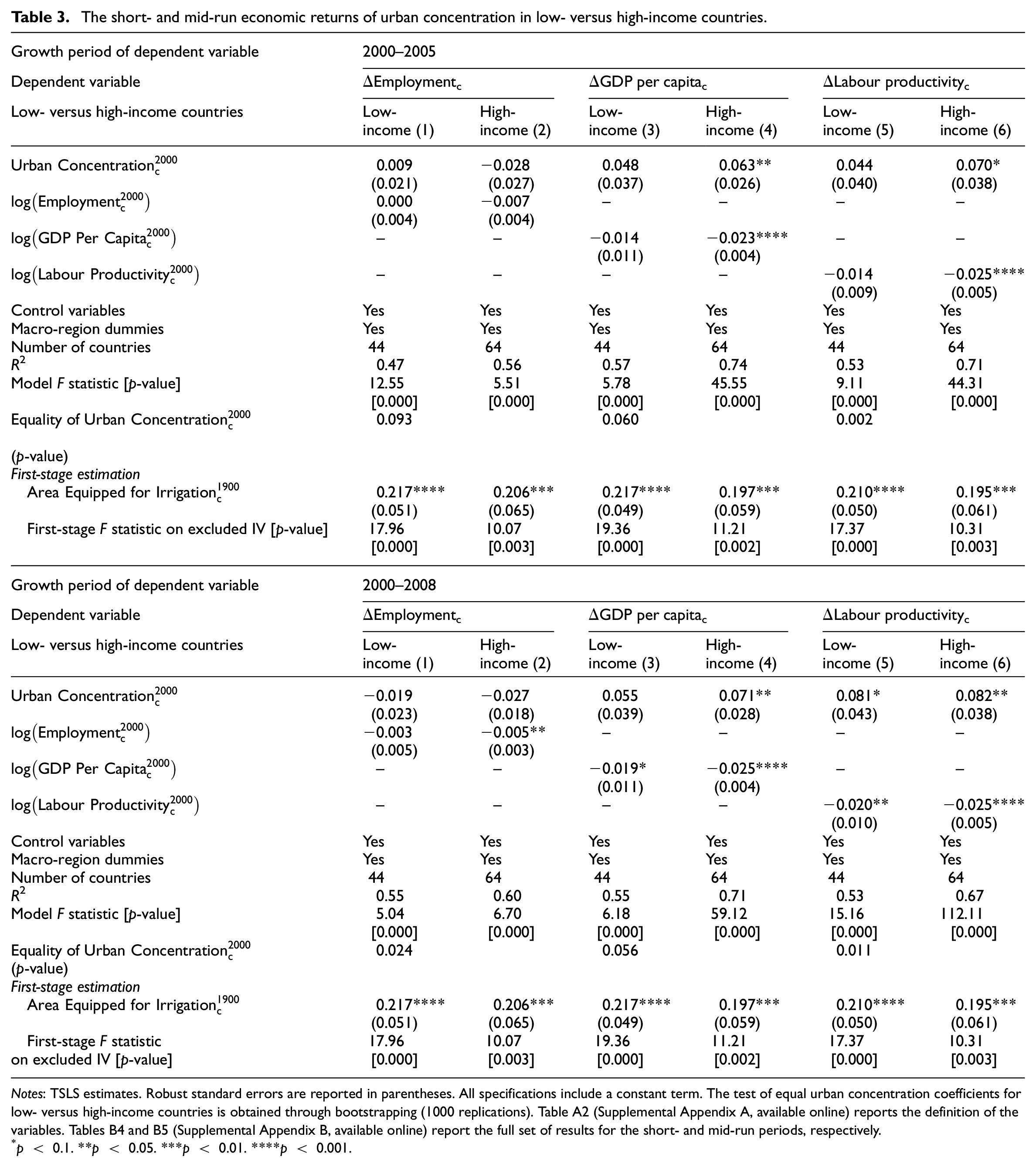
Notes: TSLS estimates. Robust standard errors are reported in parentheses. All specifications include a constant term. The test of equal urban concentration coefficients for low- versus high-income countries is obtained through bootstrapping (1000 replications). Table A2 (Supplemental Appendix A, available online) reports the definition of the variables. Tables B4 and B5 (Supplemental Appendix B, available online) report the full set of results for the short- and mid-run periods, respectively.
p < 0.1. **p < 0.05. ***p < 0.01. ****p < 0.001.
The growth returns on urban concentration are driven by the urban ‘core’ of FUAs
One important new dimension of the analysis is the focus on whether urban concentration produces different economic effects when distinguishing between the low- and high-density parts of FUAs, that is, between the core of cities and their suburbs. The GHSL database contains disaggregated data on the population residing within both the high-density centre (i.e. the ‘core’) and the low-density urban area (i.e. the ‘suburb’) of FUAs. This allows us to calculate the HHI to capture urban concentration considering the urban population residing in these two urban zones separately. This exercise accounts for intra-FUA heterogeneity, evaluating the interplay between the national concentration-dispersion pattern and the monocentric-polycentric internal spatial structure of urban agglomerates (Li and Liu, 2018).
Table 4 reports the TSLS estimates of equation (1) considering the two variables for urban concentration in low- and high-density urban areas separately. The negative long-run returns from urban concentration on employment growth and the positive returns on GDP per capita and labour productivity growth are higher for high-density than for low-density urban zones. This evidence suggests that agglomeration-related advantages and congestion effects arise from ‘true’ urban cores, while the prevalence of suburbs diminishes the economic returns from urban concentration. The concentration of (self-selected) highly productive, high-wage workers in high-density urban cores appears as a key growth-enhancing factor for overall productivity and wealth. Simultaneously, greater suburbanisation does not reduce the negative employment growth returns from excessive urban concentration. The presence of large, low-density suburbs also contributes – albeit to a lesser extent than high-density cores – to overall productivity and wealth growth through the generation of additional positive agglomeration externalities. In any case, the negative employment growth effects remain. This may be because the spatial evolution of FUAs from a monocentric to a polycentric internal structure is far from complete. The ongoing re-allocation processes of low-wage workers and unemployed individuals from city centres to suburbs could go a long way in explaining negative employment effects in the urban ‘core’. It may also be the case that suburbs with still limited infrastructure endowment and weaker services than ‘cores’ may have not yet fully maximised their economic potential – for example, in terms of their capacity to attract firms fleeing the high prices of urban centres or of generating start-ups. Hence, their job creation capacity is not strong enough to counter-balance the arrival of individuals fleeing expensive urban centres. The overall picture suggests that positive agglomeration economies related to urban concentration at country level can be maximised through a spatial re-configuration process of economic activities within individual FUAs.
The economic returns of urban concentration for low- versus high-density urban areas within FUAs.
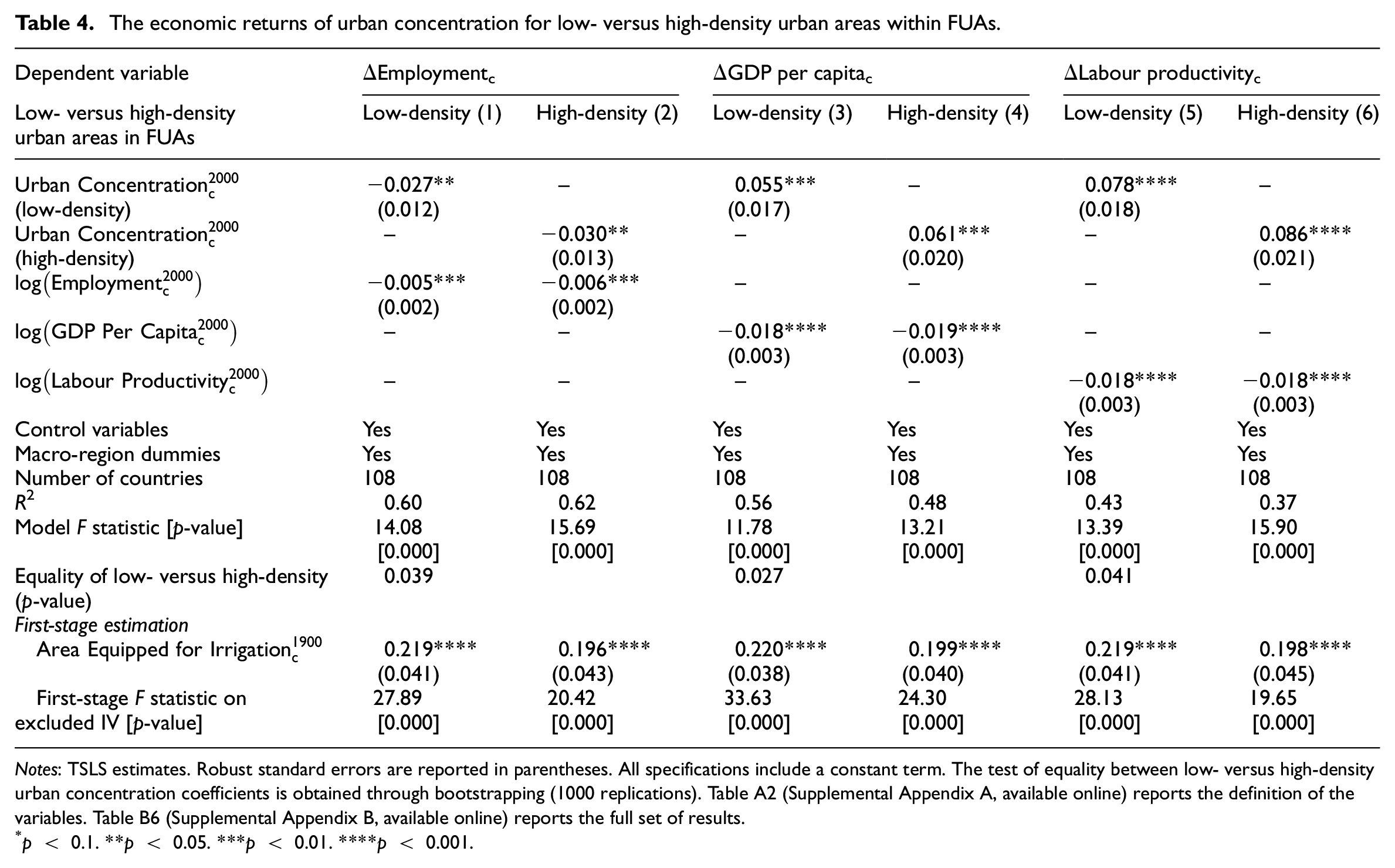
Notes: TSLS estimates. Robust standard errors are reported in parentheses. All specifications include a constant term. The test of equality between low- versus high-density urban concentration coefficients is obtained through bootstrapping (1000 replications). Table A2 (Supplemental Appendix A, available online) reports the definition of the variables. Table B6 (Supplemental Appendix B, available online) reports the full set of results.
p < 0.1. **p < 0.05. ***p < 0.01. ****p < 0.001.
Detecting the size-related effects of FUAs
Finally, the TSLS estimation of equation (1) is replicated considering a series of urban concentration variables defined over subsets of FUAs identified with respect to population threshold values. This exercise considers the size-related effects of FUAs, testing for possible aggregation biases (Rosen and Resnick, 1980). Specifically, the HHI is calculated including FUAs with population greater than or equal to 50,000, 100,000, 150,000, 200,000 and 250,000 inhabitants.
Table 5 reports the TSLS results. They suggest two interesting insights. First, the magnitude of the estimated coefficients of the urban concentration variables decreases as the population size of the FUAs increases. The positive and negative urban concentration effects on long-run growth are consequently lower in the presence of highly concentrated urban structures dominated by large urban areas. Second, the negative effect of urban concentration on long-run employment growth becomes negligible above a threshold value of 150,000 inhabitants. This implies that job market-related congestion effects are almost absent in contexts where the urban population is concentrated in relatively large urban areas. In contrast, the estimated positive effects of urban concentration on both GDP per capita and labour productivity growth remain highly statistically significant with respect to all the cut-off values of population size – although decreasing in magnitude. Furthermore, the difference in estimated coefficients between cut-off values becomes statistically negligible at a threshold value of 150,000 inhabitants. These results complement those reported in Table 4. They also add new insights into the ‘optimal’ size of FUAs at which agglomeration economies arising from a highly concentrated national urban structure push overall productivity and wealth growth, before agglomeration diseconomies become detrimental for employment growth. The picture emerging from Table 5 suggests that labour market-related diseconomies are active in smaller FUAs but affect larger ones less. Drawing on the previous arguments, a possible explanation could be related to the fact that larger FUAs – those above 200,000 inhabitants – have largely developed polycentric internal spatial structures with well-functioning – and functionally integrated – suburbs, resulting in a greater within-city spatial equilibrium. Smaller FUAs, instead, are behind in the city lifecycle process. Thus, the combination of ongoing adjustment processes in terms of migration into and out of the urban ‘core’, together with less efficient services and infrastructure endowments in still-evolving suburbs, could help explain the presence of labour market-related diseconomies.
The economic returns of urban concentration by FUAs’ population threshold values.

Notes: TSLS estimates. Robust standard errors are reported in parentheses. All specifications include a constant term. Threshold values are defined in terms of (urban and rural) population residing within a FUA. The test of equality between pairs of urban concentration coefficients is obtained through bootstrapping (1000 replications). Table A2 (Supplemental Appendix A, available online) reports the definition of the variables. Table B7 (Supplemental Appendix B, available online) reports the full set of results.
p < 0.1. **p < 0.05. ***p < 0.01. ****p < 0.001.
Discussion
The empirical results presented in the previous section corroborate some existing knowledge on the economic returns of urban concentration while simultaneously providing novel insights into the casual effect of urban concentration on employment, wealth and labour productivity growth.
The analysis offers a comprehensive assessment of whether having highly concentrated national urban structures is a driver of economic performance across four main dimensions. First, we provide a comparative analysis of the long-run growth returns from urban concentration on employment, wealth and labour productivity. This analysis complements previous research that focused almost exclusively on the short-run effects of urban concentration on GDP per capita growth (e.g. Bertinelli and Strobl, 2007). Second, and following recent investigations (e.g. Castells-Quintana, 2017; Frick and Rodríguez-Pose, 2018a), we distinguish between low- and high-income countries to account for both heterogeneity in development levels (e.g. Henderson, 2003) and variations in urbanisation paths between developed and developing countries (e.g. UN, 2019) in the short- and long-run. Third, we evaluate the interplay between the national concentration-dispersion pattern and the monocentric-polycentric internal spatial structure of urban agglomerations, expecting to find differences in the spatial adjustment processes of economic activities both across cities and between the urban ‘core’ and the suburbs of a city (e.g. Bertinelli and Black, 2004; Li and Liu, 2018; Shen et al., 2019). Finally, we analyse population threshold values to evaluate whether an ‘optimal’ city size exists for the emergence and interplay of agglomeration economies and diseconomies (e.g. Frick and Rodríguez-Pose, 2018b).
Considering the first two dimensions, we find that high levels of urban concentration have opposing growth returns on employment versus wealth and labour productivity. Urban concentration has a negative impact on employment growth in high-income countries only. However, this negative impact is only in evidence in the long run. By contrast, urban concentration has a positive effect on both wealth and labour productivity growth, both in low- and high-income countries. These positive growth returns from urban concentration, however, take some time to materialise, especially in low-income countries. Our results corroborate previous evidence according to which urban concentration has positive short-run effects on GDP per capita growth in high-income countries only (e.g. Castells-Quintana, 2017; Frick and Rodríguez-Pose, 2018a). But we also find that low-income countries also benefit from urban concentration in terms of wealth growth, although this only happens in the long run. In addition, the positive urban concentration returns on labour productivity growth in low-income countries take time to materialise (i.e. an 8-year period). By contrast, they are observable already over a short-run (i.e. 5-year) period in high-income countries.
Overall, the growth returns on urban concentration are greater for high- than for low-income countries and the impact of urban concentration on economic performance varies depending on the time horizon and the type of economic output considered. We shed further light on the negligible (Frick and Rodríguez-Pose, 2018a) or negative (Castells-Quintana, 2017) returns from urban concentration on wealth and productivity in low-income countries, which seem to be predominantly a short-run phenomenon, and we add new evidence on how urban concentration shapes employment trends.
Concerning the third and fourth dimensions, we provide new evidence suggesting that the growth returns from urban concentration are primarily driven by the urban ‘core’ of FUAs. The negative long-run returns from urban concentration on employment growth, and the positive returns on GDP per capita and labour productivity growth, are higher for high-density than for low-density areas within FUAs. We also uncover that the growth returns on urban concentration diminish as the population size of FUAs increases. These results corroborate previous evidence indicating that the positive urban concentration effects on wealth growth are lower in countries with highly concentrated urban structures dominated by large urban areas (e.g. Frick and Rodríguez-Pose, 2016, 2018b). They also confirm this pattern with respect to labour productivity growth and provide new evidence suggesting that the negative urban concentration effects on employment growth become negligible above a threshold value of 150,000 inhabitants. Altogether, these findings indicate that the positive and negative country-level growth returns from highly concentrated national urban structures can be balanced only if adjustment processes occur both across cities of different size and between well-developed urban ‘cores’ and suburbs within FUAs.
Conclusions
This paper has investigated the relationship between urban concentration and growth of employment, GDP per capita and labour productivity over the period 2000–2016, using a sample of 108 low- and high-income countries. It has exploited novel information on urban population residing in FUAs using a new, globally harmonised database. The aim was to revisit previous research on the short-run returns from urban concentration on GDP per capita growth by focusing on the long-run returns from urban concentration on three different economic dimensions (employment, GDP per capita, labour productivity), accounting for the heterogeneity between low- and high-income countries, as well as for differences in the spatial structure of FUAs.
Overall, the empirical analysis suggests a negative effect of urban concentration on employment growth and a positive one on GDP per capita and labour productivity growth. However, these results are highly dependent on the level of development of the country considered. The returns from urban concentration are greater for high- than for low-income countries and become stronger over the long run. In addition, the growth returns from urban concentration are higher for countries with a prevalence of high-density urban cores than for those dominated by low-density suburbs. They also become stronger in highly concentrated national urban structures made up by relatively small urban areas.
Our results in part confirm previous research but also provide novel insights. In particular, they suggest that the dimension and direction of urban concentration returns vary according to the economic dimension evaluated, the type of country considered, the time horizon analysed and the urban thresholds applied in the analysis.
Can policy implications be derived from these results? While prescribing more investment in education or innovation is relatively straightforward, recommending that countries should alter urban structures that have been built over long historical periods is far more difficult and could be counterproductive. However, it is important to recognise that different national forms and degrees of urban structure and concentration contribute to shaping country-level economic trajectories and may thus affect the impact of other policies. Our results show how any growth strategy needs to consider that variations in urban structures may result in potentially opposing effects on different economic dimensions. They also suggest that the level of development of a country matters in the role cities play in national economic performance. Hence, it may be the case that labour market-related measures are more needed in urban areas in high-income countries, and especially in those with highly agglomerated urban areas at the top of the urban hierarchy, if we are to counterbalance agglomeration diseconomies limiting job creation and increasing inequality. By contrast, in developing countries measures aimed at reinforcing the labour market in primary cities – for example, by providing better urban infrastructure and services to accommodate high rural–urban migration (e.g. Castells-Quintana, 2017) – may be more effective.
Supplemental Material
sj-pdf-1-usj-10.1177_0042098021998927 – Supplemental material for Does urban concentration matter for changes in country economic performance?
Supplemental material, sj-pdf-1-usj-10.1177_0042098021998927 for Does urban concentration matter for changes in country economic performance? by Roberto Ganau and Andrés Rodríguez-Pose in Urban Studies
Footnotes
Acknowledgements
We are grateful to the Editor in charge, Markus Moos, and to four anonymous reviewers for their insightful comments and suggestions on our paper. We are also grateful to Lewis Dijkstra (Directorate-General for Regional and Urban Policy of the European Commission) and to participants of the 59th Congress of the European Regional Science Association (Lyon, 2019) for valuable comments and feedback.
Declaration of conflicting interests
The author(s) declared no potential conflicts of interest with respect to the research, authorship and/or publication of this article.
Funding
The author(s) disclosed receipt of the following financial support for the research, authorship and/or publication of this article: This research has benefited from the financial support of the Directorate-General for Regional and Urban Policy of the European Commission. All errors and omissions are our own.

Supplemental material
Supplemental material for this article is available online.
Notes
References
Supplementary Material
Please find the following supplemental material available below.
For Open Access articles published under a Creative Commons License, all supplemental material carries the same license as the article it is associated with.
For non-Open Access articles published, all supplemental material carries a non-exclusive license, and permission requests for re-use of supplemental material or any part of supplemental material shall be sent directly to the copyright owner as specified in the copyright notice associated with the article.
