



Abstract
Business improvement districts (BIDs) are understood as a proactive response by locally dependent property owners and businesses aimed at attracting capital investment and consumers back to the central city at a time of increasingly gutted public sector resources. BIDs have yet to be explicitly examined as a form of rent-seeking, even though the primary motivation for property owners to self-impose additional taxes for implementing ‘clean and safe’ programmes is rent. In this context, the self-imposed tax is treated as a speculative investment that will hopefully yield a return in the form of enhanced profit for businesses and rents for landowners. As such, we conceptualise BIDs as not only a form of rent-seeking, but an alliance of private-sector actors engaged in the collaborative and strategic mobilisation of class monopoly rent as a weapon against all perceived barriers to profitability. Based on evidence from Seattle, Washington, the paper deepens our understanding of BIDs by linking this phenomenon to the spatial dynamics of rent within the contemporary neoliberal city and concludes by discussing the implications for what BIDs reveal about class monopoly rent in particular, the kind of class conflict this form of rent configures and its role within wider processes of neoliberal urbanisation.
Introduction
The formation of business improvement districts (BIDs) is now a global phenomenon, emanating from their place of origin in North America (Cook and Ward, 2012; Hoyt and Gopal-Agge, 2007; Valli and Hammami, 2021; Ward, 2007a; Ward and Cook, 2017). Coinciding with the neoliberalisation of urban governance (Brenner and Theodore, 2002), BIDs have thus far developed most prominently across most metropolitan regions in the USA over the past three decades (Ward and Cook, 2017). BIDs are defined as public-private partnerships whereby ‘privately directed and publicly sanctioned organizations […] supplement public services within geographically defined boundaries by generating multiyear revenue through a compulsory assessment on local property owners and/or businesses’ (Hoyt and Gopal-Agge, 2007: 946).
The conditions that led to their proliferation stem from the deindustrialisation and suburbanisation that marked the 1970s and 1980s which left many central city spaces mired in cycles of disinvestment (Ward, 2007a). With city governments consequently decimated of their revenue streams and increasingly cut-off from federal funding, BIDs are considered a proactive response from locally dependent property owners and businesses to resuscitate flows of capital investment and consumers back to the central city at a time of gutted public sector resources (Cook, 2009). It is in this context that BIDs have been identified as core features of ‘urban growth machines’ (Logan and Molotch, 1987) and key attributes of neoliberal urbanisation (Cook, 2009; Ward, 2007a), effectively blurring the line between the state and civil society in the realm of urban governance (Glyman and Rankin, 2016; Lippert, 2012).
The scholarly literature on BIDs is now voluminous and spans multiple disciplinary boundaries (for substantive reviews, see Ward and Cook, 2017). In critical urban studies, BIDs have been criticised for over-regulating and (quasi)-privatising public space (Glyman and Rankin, 2016; Hoyt and Gopal-Agge, 2007), as well as enhancing security infrastructure as a disciplinary mechanism of removing perceived obstacles (i.e., panhandlers) to consumer traffic (Bookman and Woolford, 2013; D’Souza, 2020; Lippert, 2012; Walby and Hier, 2013). Emphasis has also been placed on the striking geographic mobility of BIDs as a ‘transferable’ model of territorial governance that can be uprooted from one socio-spatial context and micro-fitted to another (Peyroux et al., 2012; Valli and Hammami, 2021; Ward, 2006, 2007a; Ward and Cook, 2017). Yet, BIDs are constituted in a wide variety of ways between and within nation-state contexts. For instance, it is only property owners that are taxed in the USA, as opposed to property occupiers in the UK (Ward and Cook, 2017).
BIDs have more recently been examined as ‘assemblages’ of myriad ‘actors, agendas, and interests [that] territorialize differently and with varying degrees of ideological coherence in articulation with specific socio-spatial histories’ (Rankin and Delaney, 2011: 1364; also see Kudla, 2021; Kudla and Courey, 2019; Lippert, 2012). This approach understands neoliberal urbanism as a contingently manifest and incomplete process ‘through which political economic restructurings are mediated [by] local political and social histories’ (Rankin and Delaney, 2011: 1367). In this understanding, BIDs are viewed as comprised of ‘related but distinctive and even contradictory projects’ (Rankin and Delaney, 2011: 1367).
However, the explicit examination of BIDs as a form of rent-seeking is lacking, which is the topic of this intervention. Despite the variegated and necessarily malleable character of BIDs, three core commonalities are almost always present in terms of the inter-related services that BIDs provide (though not always in the same proportions): (1) physical infrastructure improvement, (2) consumer/promotional marketing and (3) surveillance infrastructure (e.g. security personnel, CCTV cameras) (Ward, 2007a). We argue that the primary, though, not the only, motivation for property owners to self-impose added taxes for implementing these services, despite their otherwise diverging interests, is rent.
Indeed, BIDs are not always dominated by commercial landowners: they often include representatives of resident associations, commercial tenants and even artists, activists and city planners ‘who may harbor critical views and progressive commitments’ (Rankin and Delaney, 2011: 1377). BIDs can be mobilised by a variety of economic motives as well, such as increasing local tax bases, global capital and attracting tourists. Yet, while rent may not be the only motivation underpinning BID practices, we argue that it is the primary theme that ties these myriad actors and agendas together. For example, enhancing rent is a means of enhancing property tax revenue (Anderson, 2019), and it is also the main reason for attracting global capital and tourists. Even where commercial tenants (i.e., businesses that lease the property) are taxed, the widened profit margins that result nonetheless influence property values and, thus, the rents that can be commanded by property owners (Cook, 2009). ‘Certainly’, as Rankin and Delaney (2011: 1371) note, ‘these constituents share an interest in increasing property values’, although they might not necessarily agree on how best to meet this shared objective (Ranasinghe, 2013).
Moreover, because the perception of safety is integral to attracting the consumer traffic necessary for securing acceptable returns, it is no surprise that ‘cleansing’ the image of the district among potential consumers, including the street itself of any real or perceived barriers (e.g., homelessness, crime, rubbish) to profitability, is among the BIDs’ primary means of rent-seeking. In this context, this self-imposed tax is more than just a tax. As Ward and Cook (2017) make clear, it is a tax that commercial landowners/businesses collaboratively treat as a speculative investment that will hopefully yield a return in the form of enhanced profit for businesses and rent for landowners. As such, we conceptualise BIDs as not only a form of rent-seeking, but an alliance of public and private-sector actors engaged in the strategic cultivation of class monopoly rent in particular. When property owners/producers collaborate (rather than compete) to manipulate supply/demand conditions as a means of maximising their individual rates of return, the proportion of rent attributable to this collaboration can be termed class monopoly rent (Harvey, 1974; Ward and Aalbers, 2016).
The paper expands the analysis of both BIDs and class monopoly rent via a critical engagement with land rent theory, bringing these two bodies of literature into closer dialogue. In what follows, the next section reviews the relevant literature on land rent theory and class monopoly rent in relation to urban growth machines. Grounded in existing scholarship on BIDs, the third section describes how this institutional practice represents the mobilisation of class monopoly rent as a mode of territoriality to filter out all perceived threats to profitability. Building on this conceptualisation, the fourth section draws on empirical evidence from Seattle, Washington, USA to argue that the pursuit of class monopoly rent via BIDs functions as a weapon within the broader restoration of class power and revanchist recapture of central city space by capital that characterises the neoliberal city (Harvey, 2005).
Following Ward’s (2010) call for broadening the empirical referent upon which theory is constructed, we also mobilise this evidence to highlight the military-like imagery invoked via BID practices to displace (forcibly if necessary) the visible presence of houseless bodies from their boundaries. We argue that the neoliberalisation of urban governance effectively disciplines rent-seekers into forming (public-private) coalitions engaged in the strategic weaponisation of class monopoly rent against all perceived ‘enemies’ to their collective revenue-maximising mission. BIDs represent one formally institutionalised manifestation of this class-based mission.
Ward (2007a: 657) notes that BIDs ‘are both interesting in their own right, for what they reveal about contemporary trans-national trends in urban governance, and for what they have to say about wider processes of neoliberal urbanization’. Building on this insight, the study deepens our understanding of BIDs by linking this phenomenon to the spatial dynamics of rent within the contemporary neoliberal city and concludes by discussing the implications for what BIDs reveal about class monopoly rent in particular, the kind of class conflict this form of rent configures and its role within the wider processes of neoliberal urbanisation more generally.
Urban land rent theory
Land rent theory has its roots in classical political economy and was initially focused on explaining how land could have value without being the product of human labour (Ward and Aalbers, 2016). The answer, for Marx (1981/1894), is the private property institution which effectively chops land into discrete parcels, thereby rendering them exchangeable like any other commodity: it is a spatially fixed conduit through which landowners can stake a legal claim on existing (surplus) value in circulation (Haila, 2016). Yet, land is a different kind of commodity in that its exchange value does not represent socially necessary labour time. Rather, its exchange value is determined by the capitalisation of socially necessary labour time (captured through rent), the result of the ‘fetishized fiction’ of its normalised treatment as a commodity in capitalist society (Swyngedouw and Ward, 2022). This allows land to be treated as a financial asset as well, a form of ‘fictitious’ capital investment in a tradeable claim to future revenue.
Another primary concern in land rent theory is the myriad conditions that differentially impact how much rent can be realised in certain situations (Park, 2014; Ward and Aalbers, 2016). It is in this context that the three primary categories were formulated: differential rent (DR), monopoly rent (MR) and absolute rent (AR). Substantive reviews of these categories are provided elsewhere (e.g., see Haila, 2016; Ward and Aalbers, 2016). In the urban context, DR refers to the proportion of rent attributable to relative locational advantages (e.g. proximity to employment centres, parks, public transportation), or capital investments made upon the land (or structures thereon), that is, renovating outmoded buildings, a common feature of gentrification (Bryson, 1997).
Following Marx (1981/1894), MR represents the portion of rent attributable to an entirely unique, or non-substitutable, feature of the land (or commodity produced by the land) that cannot be found anywhere else (e.g., wine from a vineyard endowed with unique attributes). Landowners then have exclusive property rights over the resource in question, thereby granting them the power to set rents as high as effective demand will yield. However, because the private property institution (enforced by the state) grants landowners the power to command rent in the first place, landowners can collectively act to ensure the least amount of rent ‘socially acceptable’ in a given spatio-temporal context. For example, that landowners frequently opt to keep land out of circulation that would otherwise command rents below this socially acceptable minimum amounts to a barrier to capital investment by landowners doing this collectively (though not necessarily in collusion). The aggregate effect is that supply is reduced to the point where rents rise to whatever levels are deemed socially acceptable in a given context. Marx identified this minimum tribute as AR insofar as it could not be explained by DR and represented a distinctly different socio-material condition than MR.
Class monopoly rent
Interest in land rent theory, however, eroded in the 20th century for reasons that extend beyond the scope of this paper (see Manning, 2021; Ward and Aalbers, 2016). Interest was then revived in Anglo academic circles via Harvey’s (1974; Harvey and Chatterjee, 1974) application of the theory to the urban context. In his analysis of Baltimore’s inner-city housing (sub)market dynamics, Harvey (1974) introduced the notion of ‘class monopoly rent’ (CMR) to better characterise the role of both class and monopoly in the form of rent Marx termed AR. In the Baltimore context, inner-city slumlords were observed to remove units from circulation that would have cost too much to maintain, yielding rents beneath the acceptable minimum, essentially the same dynamic theorised by Marx in the otherwise disparate agricultural context of early capitalism. Thus, CMR represents the proportion of rent attributable to each landowner by virtue of the ‘artificial’ scarcity produced through their collective imperative to secure, at the very least, the socially acceptable minimum.
Yet, this artificial scarcity can be produced in myriad ways. Harvey also points out that there is no such thing as supply and demand across an entire metropolitan landscape, contrary to neoclassical economic understandings (also see Beitel, 2016). Rather, property owners/producers in conjunction with financial institutions are observed to structurally differentiate such landscapes into an ‘island-like’ kaleidoscope of territorially bounded submarkets that are segregated by myriad socio-economic divisions of consumers (Aalbers, 2007; Harvey, 1974; Harvey and Chatterjee, 1974; Revington, 2021). As such, supply and demand only make sense within each submarket: consumers catered to by one submarket are often priced-out of another, or only consider housing in neighbourhoods with certain mixes of amenities or perceptions of exclusivity, etc.
Harvey suggests that a landscape spatially structured in this way raises the potential for CMR insofar as supply/demand conditions can be actively manipulated by landowner collectives in each submarket. Low-income population groups are trapped directly by price, but the ‘trapping’ of higher-income groups is based on what Harvey (1974) notes as the production of new social wants and needs in relation to housing. This is most clearly observed in the discursive branding practices propagated by rent-seekers as a means of cultivating the perception of a monopoly where substitutes might otherwise exist, for example, a neighbourhood branded as ‘exclusive’, ‘unique’ or ‘distinctive’ (Ward and Aalbers, 2016). Insofar as this branding succeeds in shaping people’s consumption habits, then such neighbourhoods become effective monopolies marked by a finite supply of properties within their socially-constructed boundaries (which act as the necessary means of enclosure upon which CMR is based) (Aalbers, 2007).
Growth machines in pursuit of CMR
Marxian rent theory flourished in the 1970s and 1980s, which featured intense theoretical debates over the role of CMR in the urban context (for substantive reviews of this literature, see Park, 2014; Ward and Aalbers, 2016). These debates, however, consequently led to notable confusion in terms of varying distinctions proposed between CMR, AR and MR. For the sake of clarity, we follow Ward and Aalbers’ (2016) understanding that AR and CMR are essentially the same, although we prefer the CMR label as it better describes this form of rent in terms of highlighting the key roles played by both class and monopoly (e.g., see Anderson, 2019).
The emergence of ‘institutional approaches’ in the 1980s questioned the value and utility of the rent categories, favouring empirical-driven studies on the actions of local actors and institutions (Strauss, 2021; Ward and Aalbers, 2016). Coupled with shifting intellectual agendas and the methodological challenges related to empirical examination, Marxian rent theory diminished in the 1990s (with the exception of Smith’s (1986)‘rent gap’ thesis) (Park, 2014). At this point CMR was generally considered to be an exceptional circumstance, not as prevalent of a mechanism as DR with respect to the distribution of land uses to their ‘highest and best use’ (Ward and Aalbers, 2016).
Marxian rent theory is now experiencing another revival, triggered by a growing interest in the transforming roles of land, property and rent in contemporary processes of neoliberal urbanisation (Anderson, 2014, 2019; Butcher, 2020; Park, 2014; Swyngedouw and Ward, 2022; Ward and Aalbers, 2016; Wyly et al., 2012). Harvey (2012) implicates the pursuit of CMR as fundamental to the formation and functioning of urban growth machines. Due to the withdrawal of federal funding from city governments in the 1980s, municipal budgets had to be balanced through new sources of tax revenue. The result was a forced structural alignment of city governments with private developers, prominent landowners and financial institutions in the shared bourgeois mission of resuscitating central city spaces as sites for capital accumulation (Brenner and Theodore, 2002).
A key feature of such public-private coalitions is the embrace of discursive-branding campaigns that work to cultivate perceptions of a city’s ‘cultural amenities’ (e.g., museums, historic landmarks) as unique (see Tretter, 2009), an inter-urban manifestation of what Harvey (2012) calls ‘monopolistic competition’ (also see Emmanuel, 1985). Similar discursive-branding tactics also underpin processes of gentrification, in addition to myriad other institutional practices, that is, tax-increment financing (TIF), historical preservation, elaborate land-banking practices and cartelistic behaviour among developers – all of which implicates the pursuit of CMR (as much as DR) by growth machines as a structural outcome of neoliberal governmentality (enacted by the removal of federal funding to cities in the 1980s) (see Anderson, 2019).
Citing the ‘thirst for profit maximisation’ as the motive for private sector involvement in growth machine formations, Logan and Molotch (1987) go as far as to explicitly identify ‘rentiers’ as the leading faction of capital within these formations. As Cook (2009: 931) asserts, following Stone (1989), no one group is able to monopolise power and resources within these formations without actively working together ‘to fully realise their ambitions’. It is in this context that BIDs have proliferated across North America and beyond, as a collective strategy among locally dependent rent-seekers and businesses working in conjunction with the local state and investors ‘to realize their common interests in a particular area’ (Cook, 2009: 931), interests that are rooted in rent and are, consequently, antagonistic to similar coalitions operating elsewhere, an intra-urban manifestation of the same monopolistic competition identified by Harvey (2012).
Indeed, this current revival of interest in rent theory has coincided with an emergent understanding of CMR as structurally built into the architecture of neoliberal capitalism and just as prevalent and important in terms of directing land uses in ways that enable (rather than inhibit) the progressive accumulation of capital (see Purcell et al., 2020; Swyngedouw and Ward, 2022). Moreover, there is now a general acceptance that the categories of rent are crucial heuristic concepts for linking the actions of local actors and institutions, via the rent mechanism, to the broader dynamics of capital circulation and accumulation in the built-environment (Ward and Aalbers, 2016). This study builds on this emergent literature in the context of BIDs as a concrete form of CMR that is mobilised in distinct ways.
BIDs and CMR
BIDs clearly implicate DR as well. We are not disputing this. What we hypothesise is that they also, and inseparably, represent the speculative pursuit of CMR insofar as BIDs effectively ‘[break] up the urban sphere into competing … [and] discrete, governable spaces’ (Ward, 2007a: 667), and where each ‘district’ contains an inherently limited supply of properties produced by the cartographically imposed boundaries that act as barriers to entry by capital. BIDs, however, do not necessarily entail the collective removal of properties from circulation. The manipulation of supply/demand conditions comes not by actively limiting supply in the way described by Harvey (1974), rather, it comes by enhancing demand within a geographically-bounded (and, thus, property limited) commercial space among potential consumers. This essentially produces the same effect on property values, not too dissimilar from TIFs, historical preservation and other similar ‘district’ designations and ‘discursive branding campaigns’ mobilised by growth machine coalitions.
It also follows that, insofar as BIDs are increasingly implemented in variegated ways across the globe, it is a form of CMR that, far from rare and exceptional, is now global, a constitutive feature of neoliberal globalisation. Moreover, it is a (growth-machine) strategy of pursuing CMR whereby the class alliance primarily consists of commercial property owners (working in partnership with local government, investors, neighbourhood organisations, etc.), a type of property market that has received comparatively little attention (i.e., in relation to residential property) in the broader rent literature (for notable exceptions, see Bryson, 1997; Ward and Swyngedouw, 2018).
In their pursuit of CMR, BIDs work to both (re)produce and spatially regulate one of the primary reasons for their creation: visible houseless bodies (see Anderson et al., 2021 for a broader discussion of this in the context of developer cartels). BIDs contribute to the generation of houseless bodies insofar as they work to increase property values in prime central city spaces of development, gentrification, etc. (Blomley, 2009). Yet, BIDs are also threatened by this very houselessness which, ironically, gravitates towards social services which tend to be located in close proximity to the very commercial corridors that BIDs represent (also see Langegger and Koester, 2017). In short, the pursuit of CMR by BIDs contributes to the perpetuation of the very ‘threats’ upon which BIDs are mobilised to displace from their boundaries.
Evidence of BIDs functioning as regimes of CMR abounds in the BID literature (for noteworthy studies, see Cook, 2009; Lippert, 2012; Ward, 2006, 2007b; Ward and Cook, 2017). While a substantive review of this empirical material is beyond the scope of this paper, Cook’s (2009) study on BIDs in three UK cities is perhaps most instructive. Cook (2009: 936) notes that one of the major reasons for participating is ‘the perception that the services and partnerships are effective catalysts at increasing consumer spending, profits and property values’. The primacy of rent in the BID calculus is perhaps most explicitly articulated in the following quote: We wanted to get involved to improve the city centre because if the city centre improves, hopefully the value of our holdings will increase. [It is] a purely selfish point of … view that hopefully a better Plymouth city centre means better returns on our properties, our rents and better capital values if we come to sell them. (Representative for a UK property company, quoted in Cook, 2009: 936).
Following Cook (2009: 936) further, BID participants revealed that their participation ‘could build up trust with competitors and facilitators and potentially lead to joint-ventures and the selective sharing of information and “good practices”’. In short, where participating businesses/landowners would have once been viewed as competitors, they are now collaborators who view their individual participation as working to the benefit of all participants in the BID.
In the context of enhancing security infrastructure in three BIDs in Canadian cities, Lippert (2012) provides additional ethnographic data in support of BIDs as the strategic mobilisation of CMR. A BID coordinator in Toronto noted the following in the context of how surveillance infrastructure moves out ‘inappropriate’, and therefore profit threatening, behaviour: It’s very clear and you also get the urban economics. The rents go up and . . . now you have business more appropriate coming in and the landlord is able to raise rent. Then these other businesses move out, so there’s really a whole – from a crime prevention standpoint – a real cause and effect here from bringing people downtown, appropriate behaviour, people living down here. (Quoted in Lippert, 2012: 173).
The ‘clean and safe’ programs (i.e., security infrastructure working in tandem with ‘street ambassadors’) that comprise most BID operations are also fundamental to cultivating perceptions of safety among not only potential consumers, but the right kind of consumers. Businesses perceived as catering to ‘inappropriate’ consumers (e.g., panhandlers and houseless individuals) are subsequently displaced due to the rising rents that result from BID investments, rents that can be conceptualised as CMR. In the process, as Ward (2007a: 657) notes, ‘clean and safe’ programs function to ‘securitize consumption’ in this way, with CMR simultaneously acting as both the means to do so and end goal.
It is in this context that Lippert (2012) interprets BIDs as a particular mode of governmentality where not only would-be criminals and houseless bodies are disciplined to stay out of the district, but perhaps more importantly, where the perception among potential affluent consumers is that the district is cleansed and, thus, safe to enjoy the delights of shopping that ultimately enhance profits for businesses and rent for landowners. Insofar as this continues to be an ‘enduring dream of urban governance’ (Lippert, 2012: 167), it is accomplished by a mode of governmentality that is enacted by coalitions of rent-seekers and profit maximisers that find that collaborating works to the benefit of each individually.
This collaboration also entails active engagement with public agencies and outside investors, and it is the job of BID coordinators to ‘build bridges’ between ‘preferred businesses and … public police and other public officials’ (Lippert, 2012: 174). The self-imposed tax is also not the only source of funding, as ‘BIDs are innovative fund-raisers’ (Hoyt and Gopal-Agge, 2007: 949) that use these bridges and close ties to investors, neighbourhood organisations, and civic elites to supplement their investment reserves, effectively plugging the BID into the broader scale ‘monopoly cultivating’ growth machines discussed by Harvey (2012).
Based on this literature, we identify a tendency among BID actors to discursively deploy militarised terminology in their ‘mission’ to buttress their speculative rent-seeking interests by obliterating all perceived ‘enemies’ to their objectives. Terms like ‘security’ and battle/war-like metaphors are often used to characterise the struggle in which BIDs are enmeshed, a struggle against all perceived ‘threats’ to BID shared interests. The role of the police in this struggle is made explicit in the following comment from a Los Angeles police officer: Many times police officers are made to be the tip of the spear for systemic failures, like homelessness, like mental illness … when the system fails, guess who they call to deal with [it]? The police … we are actually responding to system failures, and we get blamed because we are the tangible form of government that people can say, ‘bad government, look at what you’re doing!’… I think these systemic failures give society the perception that we failed. No, we are responding to failure … (Deon Joseph, Los Angeles Police Department, quoted in CBS News, 2021, emphasis added).
This comment is quite perceptive. Without explicitly identifying what ‘system’ exactly has failed, insofar as the police are the ‘tip of the spear’ when dealing with the consequences of this failure, then, in the context of BIDs, the pursuit of CMR represents the spear itself, strategically mobilised and wielded by commercial real estate capital against a long-standing foe: visible houseless bodies in public spaces. In short, BIDs function as a means of cultivating and mobilising CMR to enhance and sharpen the tip of this spear towards the spatial dislocation of this foe from visibility within their respective boundaries. The enhanced police and private security forces enlisted by BIDs are essentially the foot soldiers on the ‘front lines’ of this class-driven battle for territorial control of prime central city real estate.
It is against this backdrop that we now draw on empirical evidence from Seattle, WA to further build on this imagery of CMR as a strategically wielded (and metaphorical) weapon targeted at removing all perceived threats to the rent-seeking interests of BIDs. Indeed, more humanising approaches to houseless management have been noted in recent years (Glyman and Rankin, 2016; Przybylinski, 2020), for example, the private security enlisted by many BIDs (D’Souza, 2020; Lippert, 2012), a form of ‘compassionate revanchism’ (Hennigan and Speer, 2019; Margier, 2021) where the tip of the spear does not come in the form of armed and hostile police, but often as clean-cut youths with smiles on their faces (Lippert, 2012). We suggest, however, that this emergent compassionate approach has unfolded in parallel with an even more punitive revanchism that we reveal in the next section.
Evidence is drawn from a broader project that investigates the spatial practices of BIDs as a form of rent-seeking in the context of the ongoing affordable housing crisis in Seattle, WA (Arms, 2021). This material is organised and presented in the form of a constructive narrative based on a content analysis (Denzin and Lincoln, 1994; Fairclough, 2003) of 70 textual documents (e.g., policy documents, BID websites and news media) related to the primary actors, institutions and discursive and material practices of Seattle’s community of BIDs. The value of this analysis is that it enables a deeper (and darker) understanding of BIDs by foregrounding the class struggle which strikes at the core of what BIDs are all about: they represent turf wars being waged over the same urban spaces by opposing classes of actors. This is a turf war that also highlights the role of rent in structuring the ‘social strife of land’ that Swyngedouw and Ward (2022) identify as emblematic of ongoing neoliberal processes of financialisation, assetisation and monopolisation, and which needs to be better understood.
BIDs versus the houseless in Seattle
Discursive portrayals of uniqueness
There are ten BIDs, or what are termed ‘business improvement areas’ (BIA’s), in Seattle (see Figure 1), with many designating their boundaries to include spaces with supposedly unique and interesting history and culture.
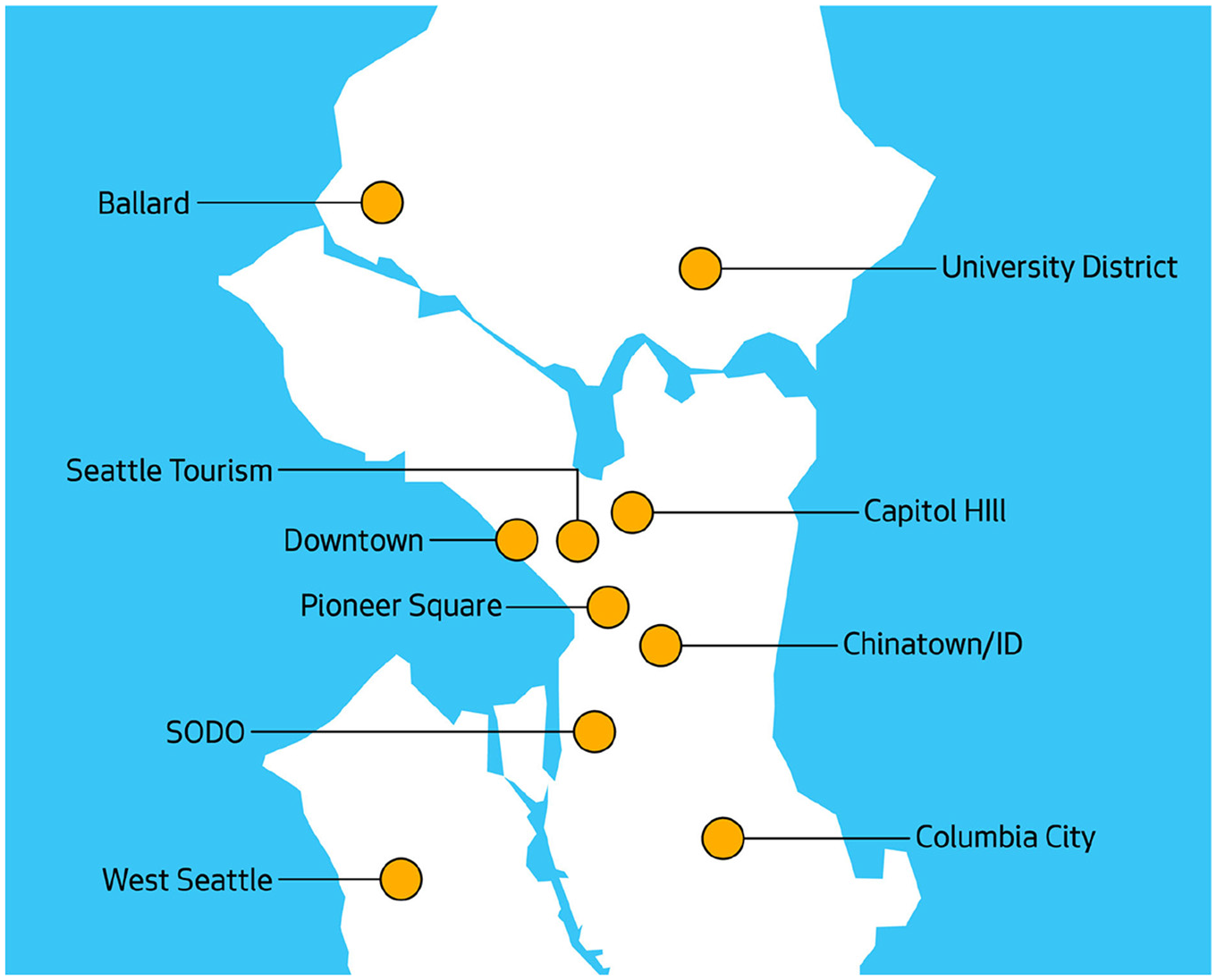
Map of Seattle’s ten BIAs.
For example, the mission of the Ballard BIA ‘is to ensure the Seattle neighborhood of Ballard remains a unique and economically vital community for its visitors, residents, business and property owners’ (Ballard Alliance, 2021, emphasis added). The maritime and Nordic heritage of the Ballard neighbourhood is the basis of this claim to non-substitutability. The Pioneer Square BIA also relies on the historical importance of its geographic boundaries, for nowhere else in Seattle is ‘the historic birthplace of Seattle and Seattle’s first historic district’ (Alliance for Pioneer Square, 2021). Moreover, the Chinatown and International District BIA plays up the strong cultural ties that many Asian countries and communities share, as is stated on their webpage: ‘the CIDBIA coordinates several of the neighborhood’s major events including the Night Markets and Lunar New Year Celebration, in addition to Dragon-fest’ (CIDBIA, 2021).
In short, claims to uniqueness mark the discursive portrayal of each BIA (Arms, 2021). And while this might reflect BIDs as urban assemblages rooted in local context, it also feeds into the kind of monopolistic competition indicative of the pursuit of CMR whereby each district represents an alliance of property owners (and partners) in competition with other alliances elsewhere in the city. Yet, marketing tactics such as these are only one feature of Seattle’s BIAs. Enhanced surveillance, security, fundraising, urban beautification and cooperation with city government (i.e., the Seattle Police Department, Office of Health and Human Services, Waste Management, Seattle Public Utilities and Parks Department) are others, all of which are mobilised towards realising each BIA’s rent-seeking objective: to enhance demand among consumers within a supply-limited ‘district’ of properties by producing and safeguarding the built-environment for ideal consumers.
Sting-operations and the criminalisation of houselessness
Enhanced security and police presence is a common feature in many BIDs. We highlight these practices here for the punitive, military-like tactics that are often employed. Force is often applied, if necessary, in clearing encampments or moving along visible houseless bodies deemed threatening to BIDs, which is what usually happens when the more ‘compassionate’ street ambassadors are resisted. In 2017–2018, homeless encampment clearances increased significantly in Seattle, as reported by Davila (2018): … almost 200 unauthorized encampments of varying sizes were removed in Seattle, according to data the city provided … the biggest increase has been in the number of encampments that have been cleared immediately and without notice. The city removed 89 encampments since the beginning of 2018 without having to provide 72-hour notice.
Consistent with the punitive, criminalisation of houselessness across the USA in recent decades (Mitchell, 2011), we argue that such targeted and draconian operations have increased in conjunction with the more compassionate approaches noted elsewhere (see Langegger and Koester, 2017). For example, the Goodwill store in the South of Downtown (SODO) BIA has been a ‘regular gathering place of the homeless and the near-homeless’, which led to a ‘sting operation’ by police in intentionally placing an ‘unlocked bicycle leaning against a tree … as bait’ with the purpose of luring houseless people into taking the bike (Westneat, 2019). The woman who did sought to return the bike to its rightful owner, only to be taken into custody. In response, defence attorney Brandon Davis argued that the ‘SPD placed this [unlocked] bicycle near a Goodwill, a store that serves people with low incomes … Prosecution of such a person is befitting of Dickensian London, not 21st century Seattle’ (quoted in Westneat, 2019).
Moreover, roughly ‘2,000 people in King County live in vehicles – some of them dilapidated RV’s that are hazardous and even inoperable’ (Greenstone and Brownstone, 2019). In response to this illegal RV camping, the City of Seattle has introduced legislature that would derail the potency of this last-resort refuge by marginalised people who would otherwise be living on the streets. In short, to appease commercial landowners and business owners in some of Seattle’s more notable BIAs, the City issued a decree that illegal parking of RVs be deemed a public health hazard (due to rubbish, human waste and drugs) and be destroyed: Businesses in areas like SODO and Ballard, where many people are living in RVs have been vocal critics of city politics that allow RVs to continue to pop up. Erin Goodman executive director of the SODO BIA, said the legislation is a good first step. (Greenstone and Brownstone, 2019).
Another feature of this class turf-war has been the production of disciplinary spaces designed to discourage congregations of houseless individuals in certain targeted spaces. These ‘hostile-to-homeless installations’ are often included in conjunction with BIA sponsored urban beautification projects and can even take the form of otherwise innocuous services. For example, as Greenstone (2018) reports, ‘the Seattle Department of Transportation [SDOT] installed bike racks in Belltown last year [an upscale Seattle neighbourhood]’, but rather than encouraging bicycling, they ‘were explicitly designed to keep people from camping there’. SDOT also invested over $1 million towards the installation of fencing (particularly in the Ballard BIA) in order to keep houseless people from using particular spaces, fencing that is deemed by SDOT as ‘important for safety’ (Greenstone, 2018). These practices combine to constitute what is nothing short of a hostile, draconian and class-driven ‘corralling’ (Tsikalas and Jones, 2018) of houseless bodies, by prominent Seattle landowners operating through BIAs, into spaces of otherwise invisible neglect, further removed from the services the houseless rely on for survival.
The prolific offenders and the limits toanti-homeless revanchism
In terms of the biggest threats to the BID mission, only 100 individuals are explicitly cited as having ‘the greatest impact on Seattle’s business neighborhoods’ (Lindsay, 2019: 6). These are the ‘prolific offenders’ with four or more bookings in King County, WA within a year, individuals responsible for a relatively large portion of reoccurring ‘criminal activity’. According to a report titled ‘System Failure’, commissioned by Seattle’s community of BIAs (see Lindsay, 2019), 100% of these prolific offenders suffered from both substance abuse disorders and houselessness, with 38% showing signs of mental health issues. Thus, it is not just visible houselessness that is acknowledged as the ultimate threat to the commercial landowners that comprise Seattle’s BIAs, but the reoccurring problems generated from the same 100 visibly houseless individuals that are deemed particularly problematic.
Reflecting Officer Joseph’s comments quoted in the previous section, the report indicts the criminal justice system as the system that has failed, and ultimately (though unwittingly) the neoliberal state for not sufficiently acting as the tip of the spear in thoroughly and permanently neutralising the threat posed by this particularly problematic population to Seattle’s BIAs. The report cites ‘substance abuse disorders, mental health conditions, and homelessness’ as the ‘predominant underlying issues’ (Lindsay, 2019: 5), a skin-deep assessment that implies neoliberal-informed explanations of these ‘underlying issues’ as rooted in the pathologic or deficient individual. The analysis does not dig any deeper towards the factors that underpin these supposed ‘individual deficiencies’, factors that are poorly understood and presumably not worth addressing (Lippert, 2012). Thus, the solution, according to Seattle’s BIA community, is the further sharpening of the tip of the spear.
In reality, since BIDs are contributing factors (within the broader systemic failure alluded to by Officer Joseph) to the (re)production of these very prolific offenders, limiting reform to the criminal justice system can only fall short of hitting the deeper roots of the ‘system failure’ discussed by Officer Joseph. Despite the increasingly revanchist (compassionate or otherwise) attitude taken by capital to combating houselessness, the number of houseless individuals has only continued to increase to crisis levels today (Giles, 2017). With local governments increasingly fiscally starved of their capacity to respond to BIA demands, torn between their conflicting goals of serving local business and real estate capital and funding social welfare programmes, the ‘System Failure’ report represents a tacit acknowledgement that three decades of anti-homeless policies and practices have failed, and that a governing shift is needed (see Anderson, et al., 2021). Whether this governing shift moves in a more substantively compassionate direction or continues to tilt back to the draconian awaits to be seen.
In short, it is in prime spaces of development where houseless bodies are threatening to capitalist interests most, and whereby CMR is strategically weaponised as a means of cleansing these spaces of this threat. Consequently, houseless populations are displaced from the spaces that tend to be in close proximity to where services are located, pushed to other more marginalised urban spaces where their presence is less visible (and thus threatening) to retail capital and higher-income consumers (Anderson, et al., 2021). They are alienated from, and cast into the margins of, the very neoliberal society that created them (Mitchell, 2011), rendering their everyday lives even more precarious as they are forced to navigate a more expansive and difficult geography merely to survive (Langegger and Koester, 2017).
Conclusion
This study deepens and expands our understanding of CMR as a strategic response by landowners acting cooperatively to ‘secure’ their capitalist investment (and acceptable rates of return) in the built environment. In the context of BIDs, the pursuit of CMR is mobilised in the service of performing this securitisation, with its realisation dependent on the success of the collaborative partnerships that bind rent-seeking actors and institutions (including the local state) together (Stein, 2019). In short, BIDs are all about the strategic control of space to ensure land uses that are consistent with their shared rent-seeking interests.
What does this analysis of BIDs reveal about CMR? We argue that it reveals BIDs as a variegated manifestation of a broader pattern of rent-seeking, similar to TIFs, historical preservation districts, cartelistic formations of developers, urban growth boundaries, etc. Each of these otherwise seemingly disparate practices represent specific ‘concrete’ manifestations of the same ‘abstract’ form of CMR: the enhancement of demand for land within a territorially bounded space where supply is relatively inelastic. Building on the existing literature on CMR, we argue that this broader, abstract form of CMR has emerged as a key, structural ingredient to the operation of neoliberalised housing markets over the past four decades. And insofar as BIDs have become a global phenomenon, this means that the pursuit of CMR is global as well.
This study also conceptualises BIDs as embedded within a ‘war-like’ struggle with anything that poses a threat to their rent-seeking interests. The value of this conceptualisation, we argue, is that it foregrounds the role of rent (and CMR in particular) in structuring the landscape of class conflict that marks the contemporary neoliberal city today (although it is also simultaneously a race war seen as non-white minorities constitute disproportionate numbers of displaced low-income and houseless populations). The cultivation of CMR by commercial landowners/businesses, operating collaboratively as a ‘class’ through BIDs, is performed via a variety of measures, as described above. Yet, many of these measures are geared towards the erasure of visible houselessness from BID boundaries as a means of ensuring the realisation of CMR. As such, in the context of the symbolic and structural violence this strategic mobilisation of CMR unleashes on houseless populations in particular, we suggest that it is a CMR that is also ‘weaponised’ against a visible houseless population portrayed by commercial landowners and businesses as akin to a mortal enemy within the broader class warfare that strikes at the heart of neoliberal capitalism.
In this context we can view the public realm in which houseless populations must navigate to survive as an active battlefield. This is a battlefield whereby conflicting actors are constantly waging war over the production of space as a means of achieving diverging goals. Is space to be mobilised towards ensuring everyone is sheltered in a respectable, dignified manner? Or is it to serve the progressive accumulation and circulation of capital in and through the built environment? The pursuit of CMR by BIDs represents an example of the latter which is contingent on negating the former (see Desmond, 2017). In the process, the pursuit of CMR is strategically mobilised as the metaphorical spear in this long-standing war by capital against the most marginalised members of the contemporary industrial reserve army. The end goal is the realisation of this form of CMR, the raison d’etre of BIDs functioning as ‘homeless exclusion districts’ (Western Regional Advocacy Project, 2019).
In a neoliberalising world where the local state’s revenue streams are held hostage by local real estate capital (Anderson, et al., 2021), this is a battlefield already tilted to the advantage of capital. While these ‘warzones’ may not be littered with bombed out vehicles and smouldering craters, they are instead blotted with refuse, human waste, graffiti, worn-out tents and bedraggled RVs amid commercial zones of affluent consumerism. The number of houseless individuals continues to climb in Seattle. However, the lack of affordable housing is increasingly identified as a serious component to the violent interruption of normal life that the houseless individual is forced to endure (Giles, 2017; Langegger and Koester, 2017). In this context, and lastly, the study represents a springboard for further investigations into CMR as a potentially fruitful object of resistance insofar as it could further link otherwise disconnected grass-roots movements (e.g., anti-gentrification activism, housing affordability advocacy) against a common target: the forces of CMR in the restoration of class power under neoliberal capitalism which continues to render the city increasingly unaffordable, contributing to rising levels of houselessness, exacerbating existing inequalities and further subjugating the most victimised members of contemporary neoliberal society.
Footnotes
Acknowledgements
We thank Kassahun Kebede and Jason Scully for their comments and suggestions on previous versions of this manuscript. We also thank the anonymous reviewers for their constructive criticisms and insights. The usual disclaimers apply.
Declaration of conflicting interests
The author(s) declared no potential conflicts of interest with respect to the research, authorship, and/or publication of this article.
Funding
The author(s) received no financial support for the research, authorship, and/or publication of this article.
