



Abstract
In this paper, I illustrate how sewage is managed beyond the networked city to create infrastructure mosaics – patchworks of interconnected infrastructures across the city characterised by variegation, fluidity and non-linearity. The purpose of this work is to develop the concept of infrastructure mosaics as a way to understand urban sewage flows in Southern cities based on the lived experience of residents, rather than on concepts developed to describe Northern cities. I begin with a brief review of how the concept of networked cities has been applied to the Global South. I then explore how sewage operates within the networked city and beyond. I finish by contextualising these ideas through the case of sewage in Agra, India. The findings from this work can help planners and policy makers across the North/South divide better understand how urban sewage operates in reality, giving decision makers insights into opportunities for improvement outside the modern infrastructural ideal.
Introduction
Like many Indian cities, Agra struggles to manage its waste. Approximately half of the city’s residents live without sewage services, making open defecation and sewage dumping common practices (Centre for Urban and Regional Excellence, 2012). Although the municipal government is charged with providing sewage services, it is under-resourced and lacks the capacity to do so in the immediate future. Further, Agra has been the target of several domestic and international programmes tasked with improving the state of its sewage management due to the high visibility of the city as a tourist destination. The result is a mosaic of sewage infrastructures – patchworks of interconnected infrastructures across the city characterised by variegation, fluidity and non-linearity. The mosaics of sewage infrastructure in Agra exist in stark contrast to the visions of fully-networked sewage services laid out in municipal planning documents (MDP Consultants, 2006). The purpose of this work is to develop the concept of infrastructure mosaics as a way to understand urban sewage flows in Southern cities based on the lived experience of residents, rather than concepts developed to describe Northern cities. I begin with a brief review of how the concept of networked cities has been applied to the Global South. I then explore how sewage operates within the networked city and beyond. I finish by contextualising these ideas through the case of sewage in Agra, India. The findings from this work can help planners and policy makers across the North/South divide better understand how urban sewage operates in reality, giving decision makers insights into opportunities for improvement outside the modern infrastructural ideal.
Networked cities, splintering urbanism and beyond
Urbanisation in the Global North during the last half of the 19th century ushered in an era of modern city-making marked by the development of networked service infrastructures. Study of the technologies, relations and materials undergirding ‘networked cities’ has been a major focus of urban scholarship over the last three decades. Tarr and Dupuy (1988) describe the rise of homogenous, monopolistic, universal service provisions in the networked cities of Europe and America, which gave all urban residents equal access to the same provisions of basic services. A decade later, Graham and Marvin (2001) explain how admiration of these integrated, unitary networks produced the ‘modern infrastructural ideal’, which they define as ‘the ideal of rolling out monopolistic, standardised and integrated infrastructure networks to cover a city, region or country’ (p. 426). They go on to explain how the ‘splintering’ of these networks is leading to an urban crisis of fragmentation, whereby urban elites are able to procure access to superior services. More recently, Coutard (2008), and then Coutard and Rutherford (2016), question the transferability of these concepts to the Southern context and consider infrastructures ‘beyond the networked city’.
In particular, Coutard (2008) questions the applicability of ‘unbundling’ and ‘bypass’ to cities in lower-income countries. He points out that these processes are central to Graham and Marvin’s (2001) claim of fragmenting, or splintering, service networks; however, they operate differently outside of networked cities. For Graham and Marvin (2001: 141), splintering occurs when integrated infrastructure networks are ‘unbundled’ into discrete elements or service packages, which allows elites to ‘bypass’ less powerful people and space in favour of ‘premium networked spaces’. Coutard (2008: 1818) explains that: … the notion of unbundling is deceptive when it comes to studying the cities (especially in lower-income countries) where recent evolution does not involve a passage from an integrated system to an unbundled one, but rather a passage from one more or less unbundled system to another.
He observes that ‘bypass’ in cities of lower-income countries does not indicate access to elite spaces, but exclusion from services altogether. Further, the terms ‘splintering’, ‘fragmenting’, and ‘unbundling’ only make sense within the context of Northern cities because the terms reference a whole, whether previously existing or simply longed for. There is some singular thing that has been splintered, fragmented, or unbundled. I offer the concept of mosaics as a way to acknowledge how the everyday practices of myriad actors continuously make and remake urban infrastructures in Southern cities. By introducing this idea, I aim to de-centre our conceptualisations and provide a way to understand urban infrastructures in the Global South that does not look to ideals generated in Northern cities for reference. With these concepts and debates in mind, I discuss how sewage operates with the context of the networked city and beyond in the next two sections.
Sewage in the networked city
Sewage is created by using water to convey human waste. Laporte (2002) traces the origins of sewage production in Paris to a 16th-century edict calling for the use of large amounts of water to wash refuse away from the front of one’s house. Ogle (1996: 136) explains that American sanitarians in the 1870s believed that the solution to the problems of unscientific domestic plumbing was to use copious amounts of water to carry waste away from the toilet and home.
A century and a half later, residents of the networked city have constant access to complete sewage services, which include the sequestration, removal and treatment of household sewage. As illustrated in Figure 1, these services are usually rendered through household toilets (sequestration) connected to pipes that convey that waste to a geographically distant (removal) sewage treatment plant (treatment).
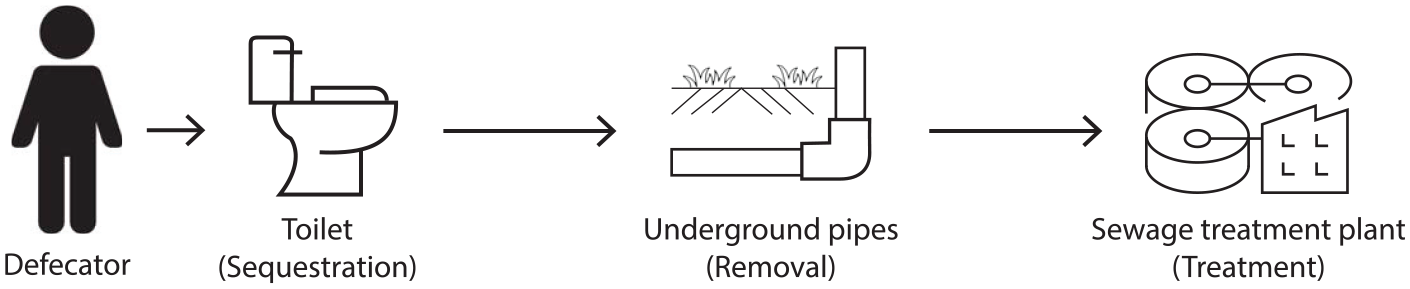
Sewage flows in the modern infrastructural ideal.
Within the modern infrastructural ideal, the modern toilet is the only socially acceptable site of sequestration. There are technologies that allow for the management of human waste without the production of sewage such as composting toilets. Although these options have been adopted in very specific contexts (see, e.g., Esrey et al., 2001; Jewitt, 2011a, 2011b), they have not been widely incorporated into mainstream sewage management. Morales et al. (2014) find that residents of poor urban communities in Argentina prefer flush toilets connected to sewers over composting toilets. To accept anything less than this would make them feel like second-class citizens.
Consequently, production of sewage, or the use of water to move human excreta away from the body, has become taken-for-granted as the only way to manage human faeces. Human waste has become synonymous with sewage. Conflation of human waste with sewage forecloses widespread implementation of any practice that does not use large volumes of water to carry human waste ‘away’. Additionally, assuming production of sewage prioritises particular kinds of physical sewage infrastructure construction. If it is assumed the only way to manage human excreta is to move it with large amounts of water, then physical systems must be in place to support that process.
Urban sewage beyond the network
Characterisations of sewage originating in the Global North often fail to adequately transfer to the Southern context. For example, in cities that have an integrated sewage network, sewage is only generated by flushing a toilet. In these cases, sewage is sequestered within a network of toilets, pipes, and treatment systems. However, in un-networked cities, sewage is generated in several other ways. For example, human waste left in a field from open defecation becomes sewage when it is washed away by rainfall. Sewage is also created when a person defecates directly into a river or lake. In both cases, the sewage is not contained within a closed, managed system as with networked sewage services, but flows freely.
A concern in cities without fully networked sewage services is that there is too much focus on building toilets. As Wankhade (2015) explains, national policy on sanitation in India has been too focused on toilet construction and has neglected the ‘whole wastewater cycle’. She points out that, based on the 2011 Census of India, only 33% of household toilets are connected to a piped sewer system and 38% are connected to a septic tank (Wankhade, 2015: 557). The remaining toilets do not have means to treat the waste collected. Development NGOs and investors often create new environmental and health problems when they ‘pay for conventional water closets without considering sewage disposal’ (Arby, 2008: 10). In India for example, untreated sewage is being used for crop irrigation in many places, posing serious environmental and health concerns, particularly in growing peri-urban areas (Amerasinghe et al., 2013).
Notable works that address sewage beyond the networked city include the highly-lauded Orangi Pilot Project in Pakistan (see, e.g., Hasan, 2006; Riaz, 2016), the Society for the Promotion of Area Resource Centres (SPARC) and Mahila Milan in Mumbai (Appadurai, 2001). These organisations use ‘bottom-up’ approaches to address sewage management at the community level. Other studies have explored the co-production of sewage infrastructure as an alternative to conventional production modes (see, e.g., Monstadt and Schramm, 2016; Moretto et al., 2018). Despite the excellent work described here, urban sewage studies of un-networked cities have little concept of how these stand-alone infrastructures constitute a whole. This is what this study aims to provide. Following the recent call for more situated urban political ecology (see, e.g., Doshi, 2019; Heynen, 2014; Lawhon et al., 2014; Loftus, 2009, 2019; Silver, 2015; Truelove, 2019), this work considers the interplay of infrastructure, materiality of sewage and the rhythm of everyday practices in Agra, India.
Sewage in the Indian context
Materiality of human waste
The materiality of human waste in the Indian context significantly impacts the Agra sewagescape and as such deserves attention at the outset of this case study. Purity and caste are two important themes found in research on human waste in India. Coffey and Spears (2017) argue that, in rural India, the persistence of open defecation can be attributed to issues arising from the traditional caste system. They show that high-caste people reject household toilets to maintain the purity of their homes and lower-caste people refuse latrines in order to align themselves with the value systems of high-caste people in the hopes of social mobility.
Alok (2010) follows the connection between religion and sanitation back to the Vedic period of Hinduism dating back to around 2500 BCE. He finds that sanitation and hygiene were very important during this time with Vedic hymns giving instructions on where and how to defecate and urinate. One particular Vedic hymn warns that excrement is so harmful even looking at it is prohibited (Alok, 2010: 20). Today, for Hindus, all bodily wastes are impure, but faeces are the most polluting. This belief has been a major barrier to acceptance of indoor household toilets in India, where people are particularly concerned with maintaining the purity of their domestic interiors (see, e.g., Chakrabarty, 1992; Coffey et al., 2014; Doron and Jeffrey, 2014; Jewitt, 2011a; Srinivas, 2002). An important counterpoint to this theme is the growing body of work that demonstrates a high and unmet demand for toilets in urban India (see, e.g., Desai et al., 2015; Oberg, 2019).
Many scholars explore the role of caste and manual scavenging in India, where both have played an important role in the management of human faeces. Scavenging is the practice of cleaning and carrying night-soil, or human excrement, often in buckets atop one’s head. Manual scavengers often use a broom and tin plate to clean toilets and nalas, or open drains, common throughout urban India. In India this task is performed by Bhangis, a hereditary sub-caste of Dalits at the lowest level, who ‘are hated and shunned for [performing] this dirty job’ (Pathak, 2000: 1). In his research, Pathak (2000) shows that Bhangis who work as scavengers are isolated by other castes and not allowed to participate in community gatherings such as festivals, an important part of Indian culture. The traditional view of Dalits is that they are polluting as a condition of their caste and cannot ever be pure. However, Pathak (2000: 173) argues that today, people are often viewed as polluting as a function of the work that they do. Once they find other work and cease contact with human excrement, they are no longer dirty and do not need to be isolated. Not only does this show a shift in the way caste is being viewed in a modernising India, it demonstrates the importance of sewage services that do not require manual scavenging. In sum, purity and caste have deeply influenced Indian attitudes towards human waste and its management. However, the forces of urbanisation and modernising norms begin to call into question the centrality of these ideas for some Indians, particularly in cities.
Gender
Gender is another important consideration in the study of human waste management in India. These discussions can be broadly divided into two kinds of concerns – (1) recognition that defecatory practices impact women differently, and (2) acknowledgement that it is far more difficult for women to effect change within Indian society than it is for men.
First, much of the literature on defecatory practices in India focuses on how women experience the practice of defecation differently. Women disproportionately bear the consequences of incomplete sewage services because of their biological differences, their domestic duties, and violence by men (see, e.g., Desai et al., 2015; Doron and Jeffrey, 2014; Doron and Raja, 2015; McFarlane, 2008; Sharma et al., 2015).
Because of biological differences, women are not able to easily urinate standing up or without significantly adjusting their clothing. When women must urinate, they require accommodations similar to those needed for defecation. Men are not subject to the same constraints and are therefore less frequently burdened by insufficient toilet facilities. Further, women require accommodations while they are menstruating. They need a place to dispose of sanitary pads and require a longer time in the toilet facilities to attend to their needs when menstruating. Consequently, the same number of toilets for men and women may be equal, but is not equitable.
In addition to biological differences, women are responsible for the majority of the domestic work in Indian society, including tending to sanitation for children and the elderly. Women not only have to accommodate their own bodily needs, but must also tend to the needs of other family members. Additionally, the concentration of domestic duties in the morning means women have very little time to relieve themselves upon waking. Oberg (2019) finds that the inconvenience of travelling to defecating grounds, particularly for women in the morning, is driving demand for household toilets in urban India. An interviewee tells Bapat and Agarwal (2003: 80): In the morning, I have to send the children to school and husband to the office. I have to cook. There is very little time and there is a long queue at the toilet. Even if you go at 5:30 in the morning, there are at least four people ahead of you.
The final way that women experience lack of sewage services differently is in the threat of sexual violence. Many researchers have documented this problem (see, e.g., Bapat and Agarwal, 2003; Burra, 2005; Sharma et al., 2015). ‘A few of us generally go together for the toilet. Men hide behind the bushes and watch women when they are squatting. If they see a woman alone, they creep in and molest her’ (Bapat and Agarwal, 2003: 74).
Secondly, social and political forces in India give women less power over decisions which impact human waste management. In his study of sanitation infrastructure in Mumbai slums, McFarlane (2008) found that existing male-dominated community structures were maintained during new development projects and ‘resulted in extra provisions for men over women, including individual taps in male toilets and extra seats’ (p. 102). Pushing back against this kind of patriarchal control over how women defecate, there has been a growing movement where eligible women refuse to marry men who do not have household toilets. This grassroots campaign has been called ‘No Toilet, No Bride’ and ‘No Loo, No I Do’ in different parts of India. In their discussion of the gendered power dynamics of defecation in India, Doron and Raja (2015) point out that, although there are obvious benefits from this campaign, it may also unintentionally isolate women. Phadke et al. (2011) highlight the disproportionate number of public toilets for men versus women in India as a physical symbol of male privilege, giving men the ability to move freely about public spaces but not women. Doron and Raja (2015) postulate that the push for household toilets without a similar demand for women’s public toilets will incentivise women to stay home, further making public spaces the domain of men.
Sewage in Agra, India
Agra is a medium-sized city, situated on the edge of the Indo-Gangetic plain in the northern state of Uttar Pradesh. Located just 200 km from the capital city of New Delhi, Agra is home to the Taj Mahal, a World Heritage Site and the most visited monument in India (Prasad and Gavsker, 2016). In addition to a thriving tourist industry, the population of Agra continues to expand apace with the rapid growth and urbanisation seen throughout India. The steady flow of people into Agra, through tourism and migration, has put tremendous pressure on municipal services such as water, electricity and sewage management.
The lack of sufficient sewage services in Agra greatly impacts the Yamuna river, which flows through the heart of the city. The Yamuna is commonly referred to as a sewage canal or a dying river (see, e.g., Babu and Lal Seth, 2007; Menon, 2018). Misra (2010) calls it a ‘pale and stinking drain’ (p. 491). The Central Pollution Control Board, the federal agency charged with protection of the environment, has deemed the waters of the Yamuna to be Class E, the most polluted class, meaning that the water is only suitable for ‘irrigation, industrial cooling, and controlled waste disposal’ (Central Pollution Control Board, 2013). The full length of the Yamuna has been divided into five segments, with the city of Agra located in the middle segment called the ‘Eutrophicated Segment’ (Central Water Commission, 2015). Much of this eutrophication is a result of runoff teeming with agricultural fertilisers and faeces – human and animal. This means Agra is on the most polluted stretch of a river in the most polluted class of rivers.
In this study, I focus on sewage in Agra slums, which house approximately half of Agra’s 1.5 million residents. As shown in Figure 2, the 400+ slums designated by the municipal government are distributed fairly evenly throughout the city. In Agra, the municipal government designates slums as residential neighbourhoods lacking basic services (Cities Alliance, 2012). However, once the designation is applied to a neighbourhood, it is rarely re-evaluated (personal communication with municipal employee, 16 December 2014). Over the last several years, there have been many slum upgrading initiatives aimed at increasing access to basic services. The outcome is a city where the term ‘slum’ is applied to neighbourhoods that fall along a continuum of service access, ranging from no services to almost fully serviced. It is important to note that even in those neighbourhoods with access to many services, those services are often obtained outside of standard municipal networks and function differently as a result.
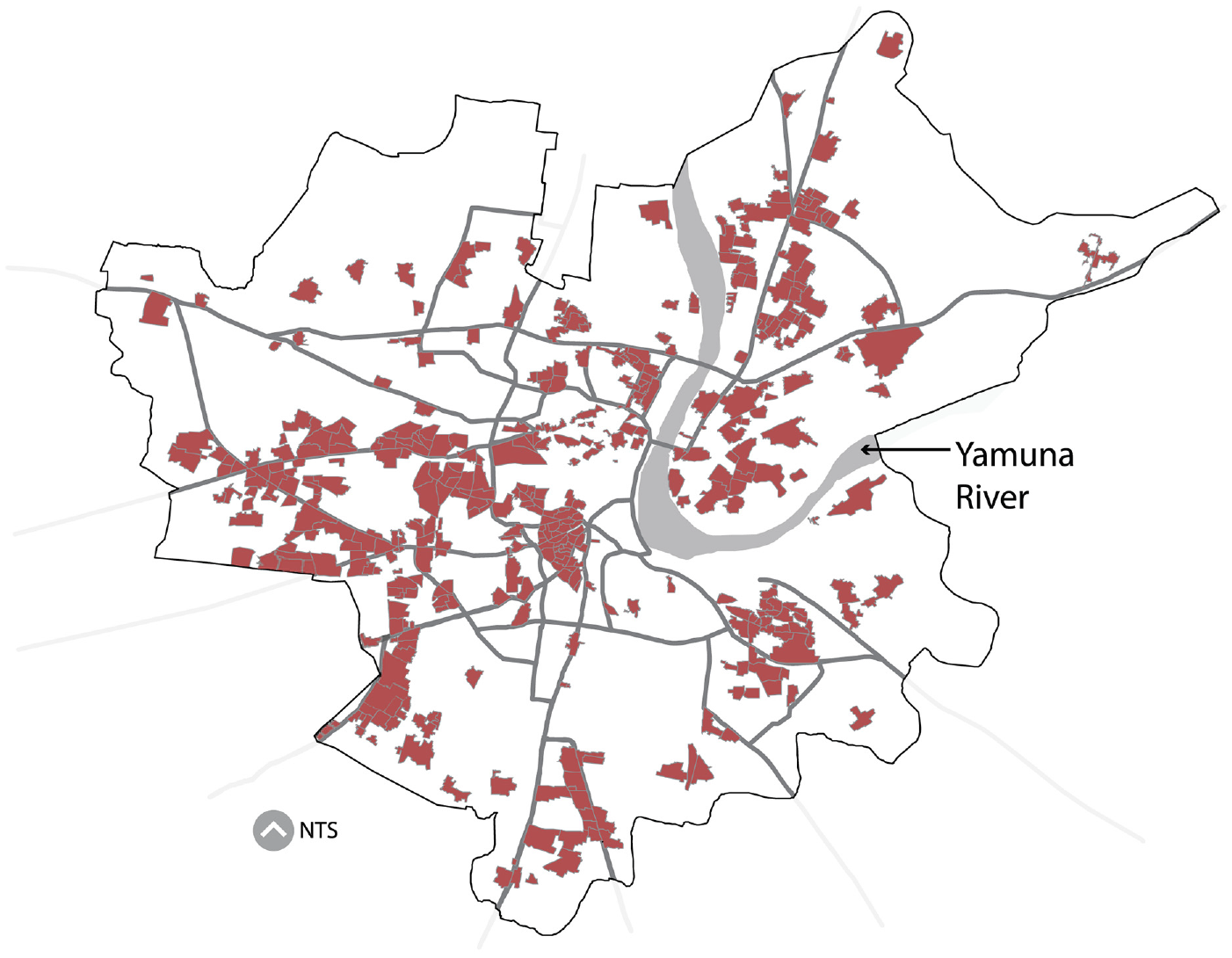
Location of slums in Agra, India.
To understand how human waste is managed beyond networked services, I draw on data collected during 13 months of fieldwork in Agra between 2012 and 2015. Data were collected through ethnographic and structured interviews. In-depth, ethnographic interviews were conducted with 75 households in two neighbourhoods, including over 230 residents. One neighbourhood, Taj Ganj, is located in a heavily touristed area very close to the Taj Mahal. The other neighbourhood, Kachpura, is directly across the Yamuna from the Taj Mahal adjacent to Mehta Bagh. These interviews focused on practices and preferences with regard to defecation and waste management. They were conducted with the help of two translators who were also residents of the neighbourhoods. Additional ethnographic interviews focusing on the process and outcomes of slum-upgrading projects were conducted with five workers at a Delhi-based NGO doing work in Agra. I also conducted structured interviews with two municipal employees in the Agra engineering department, a contractor who builds sewage infrastructure in Agra, and an architect working on pro-poor planning projects in Agra. Each of these interviews was conducted to gain a greater sense of existing sewage infrastructure conditions in the city. All interviews were coded to identify emerging themes.
Figure 3 illustrates the flows of human waste described in the data from Agra. In the following sections, I use themes of defecation, human waste removal, and sewage treatment to organise the data. These themes approximate the three stages of sewage management imagined in the modern infrastructural ideal (sequestration, removal and treatment), but differ in important ways which are described below. While presenting the data from Agra, I am careful to differentiate human waste from sewage. As previously discussed, sewage is created when large volumes of water are added to human waste as a means of conveyance. Unlike the modern infrastructural ideal, the case of Agra includes human waste that has not been converted to sewage. I highlight these instances as they are presented.
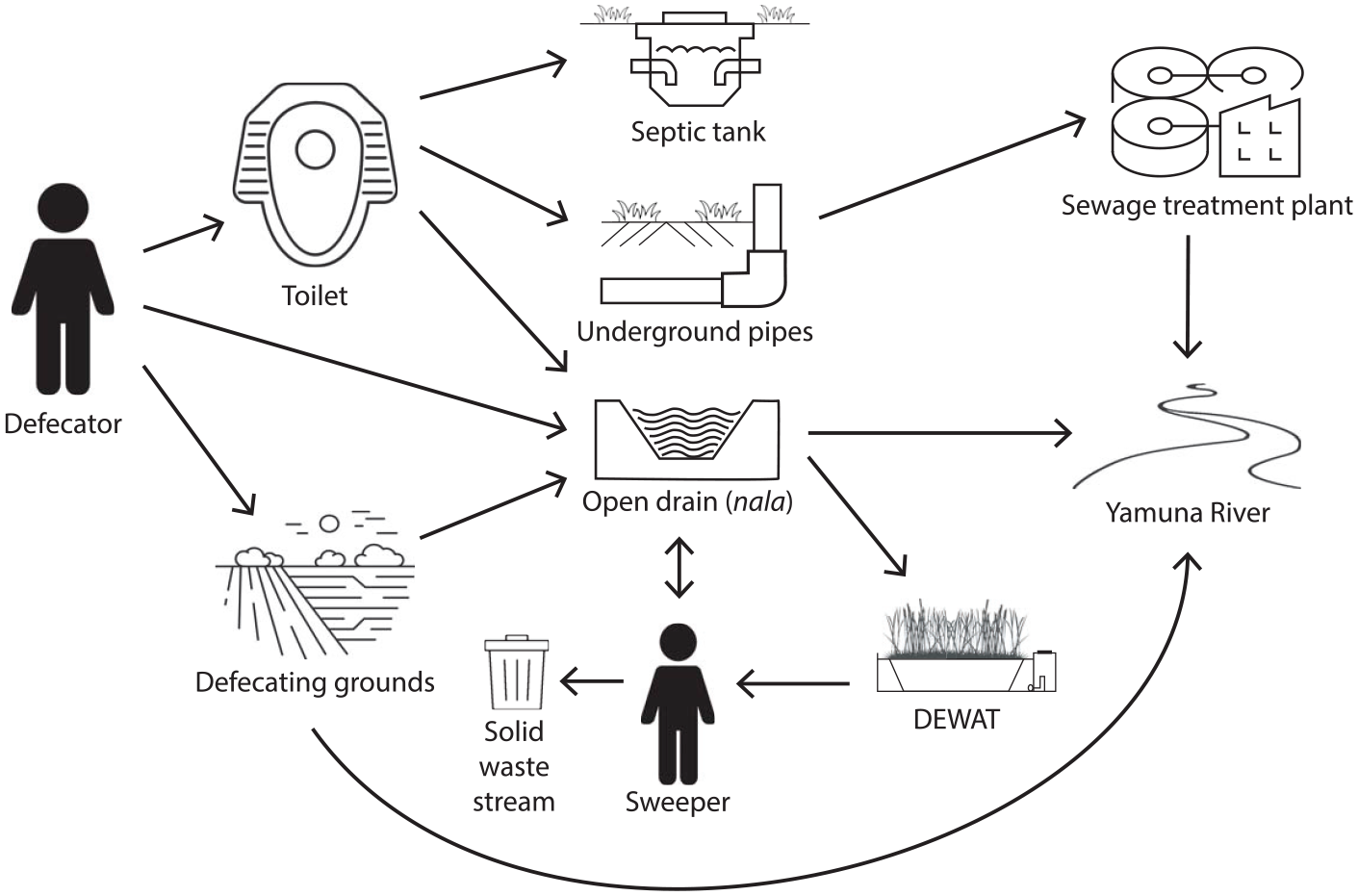
Human waste flows in Agra, India.
Defecation
Interviewees in Agra described three primary modes of defecation – into a toilet, in the open and into a nala (open drains that run throughout the city). Defecation into a nala is reserved for only the youngest children, who are not allowed to travel to defecating grounds alone and routinely defecate directly into the nalas in front of their homes so their caretakers can watch them while continuing to perform their household duties. Older children and adults either use a toilet or practise open defecation. The mode used depends on availability of services and varies depending on changing circumstances. There are many residents who never have access to a toilet and practise open defecation as a matter of course. There are others who have inconsistent access to a toilet and will use a toilet when available but will otherwise practise open defecation. For example, in three large households interviewed, each had a toilet in their home but found that during high use times, such as the morning, the wait for the toilet was too long. In both homes, some family members would opt for open defecation rather than waiting for the toilet to be available when wait times were long (personal communication with resident, 4 November 2014). This mirrors decisions observed in other research where community members opt for open defecation when queues are long at community toilets (see, e.g., Desai et al., 2015; McFarlane, 2008). In another instance, I observed someone who did not have a household toilet using her friend’s toilet when she visited her house, but who would otherwise go to the field to relieve herself (observation, 28 October 2014).
When residents practise open defecation in a field, sewage is not created until water from rain or agricultural irrigation flows over the defecating grounds. Further, the sewage created is not sequestered and flows freely into the public domain at many geographically distributed, and often hidden, locations. Likewise, defecation into a nala only results in sewage when there is water flowing through it. Although waste and sewage in a nala are sequestered, in the sense that they are away from casual human contact, they are not hidden visually or olfactorily.
A common theme among all respondents was the banality of defecation, whether practising open defecation or using a toilet. Although residents described their strategies for navigating incomplete services, they did not speak of these practices as extraordinary or particularly noteworthy. This does not mean that all modes of defecation are viewed as equal by all residents. Residents did report obstacles with respect to open defecation. However, the concerns that residents expressed were not inherent to open defecation, but in terms of other factors. The primary factor that influences open defecation is fear of assault or harassment by fellow residents. This fear was expressed in two ways. First, the practice of open defecation as gendered is well documented in the literature (see, e.g., Bapat and Agarwal, 2003; Oberg, 2019; O’Reilly, 2010). The data from this research support findings that women and girls are subject to harassment and sexual violence when practising open defecation, including harassment while walking to defecating grounds. A teenage girl who lives in a one-room home with her father and older brothers says that this is a particular problem when she is menstruating because there is no place to change her pad in the house and ‘the men are always watching and laughing when [she] goes to the field’ (personal communication, 18 November 2014). To avoid this, women and girls do not ‘go to the field’ at night, but wait until early morning. Second, local farmers police their agricultural fields, attractive places for children to defecate, often physically assaulting the children they catch defecating in their fields during the growing season. The father of a young child explains, ‘the field used to be open, but now it is closed. The farmer does not allow it. He abuses the small, small children’ (personal communication, 18 November 2014). Other obstacles to open defecation included having to travel long distances to defecating grounds, dealing with muddy fields during the monsoon season, and fear of animal attacks such as snake bites. A female resident explains that her situation has improved since getting a toilet in her home because ‘the field is very dirty and smelly. There is no space [to defecate] in the rainy season’ (personal communication, 4 November 2014).
Finally, despite the practice being illegal, none of the residents expressed concern about being cited by law enforcement officials. When asked directly about this, several residents brushed it off as inconsequential. The difficulties described above were their main concerns.
Human waste removal
In Agra, there are several practices that remove human waste from the location where it was deposited – a toilet, a field or a nala. Some toilets in Agra are connected to subterranean municipal sewer pipes leading to a sewage treatment plant. However, very few slums have such connections and they must use other modes. A community targeted by aid organisations for upgrading relies heavily on household septic tanks that were installed when toilets were constructed. In another community, nearly all residents have household toilets, but approximately half of the toilets are not connected to any form of treatment. A common practice in this community is for households to empty the contents of their toilets into the nalas that run in front of their homes, via outlets designed for this purpose (personal communication with NGO worker, 5 June 2015). This is often done at night, under the cover of darkness.
Children defecating directly into the nalas and households draining toilets into them mean that nalas are constant receptacles for human waste. When there is sufficient water to keep nalas flowing, most of the sewage ultimately flows into the Yamuna River. During times of low rainfall, human waste can accumulate in the nalas. To decrease the odour this causes, families who can afford to do so hire a sweeper to manually clean out the drain in front of their house. In one neighbourhood, a local NGO created what they call a Swatcch Gali, or Clean Street. Part of this initiative included hiring a sweeper to clean the drains along both sides of the street twice a week (personal communication with NGO worker, 28 October 2014). Once sweepers remove waste from the drain, they carry it to another location for disposal. This generally means dumping the waste in a waterway or in a garbage receptacle depending on what is available to the sweeper at the time.
Sewage treatment
There are three modes of sewage treatment in Agra – septic tanks, sewage treatment plants (STPs) and decentralised sewage treatment systems (DEWATs). As previously mentioned, some household toilets in Agra slums are connected to septic tanks. These septic tanks were designed to last the average household 25 years before requiring emptying (personal communication with contractor, 13 November 2014). Because these tanks are not yet 25 years old, it is difficult to assess maintenance processes. However, none of the residents that I interviewed mentioned any problems thus far.
There are currently three STPs operating within the Agra municipal boundary. Data on the total production of sewage in Agra vary so greatly that the Centre for Science and Environment claims ‘the city has no clear idea how much waste it generates’ (Narain, 2012: 54). The Central Pollution Control Board estimates that the capacity of Agra’s STPs can only treat 27% of the total sewage produced by the city (Narain, 2012: 55). Even this number can be deceiving. One of the STPs is only operating at 64% capacity, while the other two are over-burdened and divert 90% of the sewage coming to them through a bypass system, leaving it untreated and flowing into the Yamuna River (Narain, 2012: 56).
One of the NGOs working in Agra advocates increased use of DEWATs throughout the city based on the success of the DEWAT in Kachpura. Untreated sewage from upstream slums flows in nalas and is collected and treated in the DEWAT. The community that houses and maintains the DEWAT is treating sewage that they did not produce. They are re-capturing sewage from others and treating it. This is a phenomenon that does not exist with the paradigm of the modern infrastructural ideal. When functioning as planned, the treated water and sludge are used on nearby agricultural fields (personal communication with NGO worker, 3 November 2014). However, during a site visit, I witnessed a sweeper transferring sludge from the DEWAT into the adjacent nala, negating the sewage treatment benefit of the system.
Discussion: Infrastructure mosaics
The data from Agra describe what I conceptualise as infrastructure mosaics – patchworks of interconnected infrastructures across the city characterised by variegation, fluidity and non-linearity. Following McFarlane and Silver (2017), as cited in Lawhon et al. (2018: 725), I understand infrastructure to be ‘a practice of connecting people and things in socio-material relations that sustain urban life. It is not just a context or a noun, but a verb: social infrastructure is made and held stable through work and changing ways of connecting.’ My choice of the term ‘mosaic’ draws on its use in the fields of biology, art, and cartography. In the field of biology, mosaicism refers to an organism that contains cells of different genetic types. Similar to Truelove’s (2019) description of how the ‘Grey Zones’ of Delhi’s water governance defy dualistic framing, I argue that conceptualising infrastructures as mosaics allows them to exist in multiple paradigms at once. From the fields of art and cartography, the concept of a mosaic refers to the process of arranging discrete elements into patterns, which make a whole. Unlike the concepts of ‘fragmenting’ or ‘splintering’, which describe failures created by pieces detaching from a whole, the idea of mosaics builds coherence from the relationship between many separate pieces.
Agra’s sewage infrastructures exhibit mosaicism insofar as they inhabit multiple infrastructure paradigms simultaneously. They are both centralised, with centralised sewage treatment plants and the subterranean pipes feeding those plants, and decentralised, utilising septic tanks and decentralised sewage treatment systems. They embrace modernity through technologies such as toilets and nutrient recycling, while maintaining traditional practices such as open defecation and manual scavenging. The sewage services of Agra’s sewage mosaics disarticulate the rigid chain of service provision seen in modern networked systems, transforming the provision of sewage services from a singular, linear process (sequestration, removal, treatment) to an array of processes that resist easy categorisation. However, these processes do not operate in insolation, rather they are continuously responding to one another. Together, they constitute an infrastructure mosaic and exhibit the characteristics of variegation, fluidity, and non-linearity. Further, the expression of each of these characteristics is influenced by deeply embedded power relations.
First, the variegation, or variety, demonstrated in Agra’s sewage mosaics arises from the many different infrastructure elements at work and the variety of work that particular elements do. Comparing Figures 1 and 3, there are approximately three times as many infrastructure elements working in Agra than in the modern ideal. In particular, there are several elements at play in Agra that may not immediately be associated with human waste flows, such as open fields, a river and nalas. A closer look at the work performed by the nalas and, to a lesser extent, the Yamuna River shows a multitude of roles. Nalas function as sites of defecation for very small children, they operate as open pipes collecting sewage from toilets and fields, they feed sewage to the DEWAT, and they carry sewage to the Yamuna River where it will flow downstream to another town. Similarly, the Yamuna collects sewage from fields, nalas, and overburdened STPs and carries it away from Agra. These two infrastructure elements, which are not explicitly identified as sewage infrastructure by most decision makers, provide many of the sewage services in Agra.
Second, Agra’s sewage mosaics are in a constant state of flux; mosaics are continuously being made and remade. There are both human and non-human factors that contribute to this fluidity. The data from Agra show that time of day greatly influences sewage services. For those who have access to a household toilet, mornings are particularly busy and may render that toilet temporarily unavailable. For women and girls who do not have access to a household toilet, the defecating grounds are not an option at night when the risk of sexual violence is greatest. Additionally, travelling to the defecating grounds during broad daylight subjects women and girls to harassment from onlookers, leaving only the very early morning as a time when the defecating grounds are an option for women and girls. In addition to time of day, seasons also influence sewage services. The growing season makes agricultural fields unavailable for defecation and the rainy season makes some fields too muddy. The dry season prevents the removal of waste from the defecating grounds and the nalas. There are also less predictable occurrences that impact sewage services. For example, the ability to use a friend’s toilet during daylight hours or the availability of a sweeper to clean out a nala or DEWAT.
Third, the flows of human waste in Agra’s sewage mosaics are non-linear. Figure 3 shows a multitude of possibilities at each step. Not only do sewage flows in Agra not follow a straight line, but they can also be circular. For example, sewage flowing from a nala may enter the DEWAT. A sweeper may remove the sludge from the DEWAT and put it back into a nala. A sweeper may clean out a nala in one location and dump the contents into a nala in another location.
Finally, deeply embedded power relations underlie the expression of all these characteristics. The most privileged position is held by the urban resident who does not have to think about their sewage services; they have consistent access to complete, reliable and safe services. Extensive scholarship on Southern cities shows that several axes of difference, including gender, caste, income and age, shape how an individual experiences incomplete sewage services. Many of those themes are evident in the data from Agra. In addition to those themes, I consider ways that marginalised residents may be able to take back some control within the context of sewage management.
Returning to Coutard’s (2008) discussion of ‘unbundling’ and ‘bypass’ in cities in lower-income countries, I apply these ideas to the case of Agra. First, I prefer the term ‘never-bundled’ as it is more reflective of Agra’s sewage history. Never-bundled sewage services present a different kind of bypass to residents. Graham and Marvin (2001) speak of bypassing less powerful people and spaces. Coutard (2008) talks about bypass in the Southern context to indicate that certain residents can be bypassed from service altogether. In Agra, rather than bypassing an existing integrated network in favour of premium networked spaces, the never-bundled context of sewage mosaics allows residents to bypass some stages of sewage management. For example, those who empty the contents of their toilets into open drains are able to bypass the treatment phase of sewage management. This form of bypass allows residents who are not provided services by the municipal government, a way to dispose of their household waste at little cost and with no oversight. The practice of open defecation is another form of bypass controlled by the resident. Both practices are ways to subvert government control over their experience with sewage services.
In the absence of complete sewage services, the state (or other authority) has very little control over how residents transfer their waste to public spaces. Open defecation is illegal in India, but enforcement of this law is often difficult. For example, penalties for open defecation in Mumbai exist and are well documented via public signage. However, they are nearly impossible to enforce and therefore are rarely adhered to; many instances of defecation occur directly under signage (McFarlane, 2008). With many disbursed defecators who choose conditions that prevent accidental onlookers, such as darkness, enforcement would require vast numbers of officials working around the clock. This is also true for those who empty their toilets into drains. It can be done quickly and easily, making monitoring by officials nearly impossible. The relative comfort with which residents can transfer their waste to the public sphere shapes their everyday practices, rather than concern about retribution for law-breaking. This indicates that study of everyday practices is essential because it is through those practices that waste is transferred from private households to become a public problem. The lack of state power in policing open defecation does not mean that the everyday practice is not policed. Farmers control who can use their fields through threats of violence and harassment. Men control under what conditions women and girls feel safe practising open defecation, which is another form of policing this practice.
Conclusion
In many cities of the Global South, residents experience incomplete sewage services. Despite a high demand for these services, insufficient resources exist to provide them. Analysis of sewage mosaics in Agra shows the complicated reality of social inequality tied up with incomplete services. There is not a tidy narrative that directly correlates incomplete services with increased inequality. Rather the mosaicism of sewage infrastructure in Agra shows the myriad ways that residents are subjugated (e.g. women being harassed) and subvert authority (e.g. draining sewage into nalas at night). Mitigating these inequities will require nuanced understanding of what is actually happening.
Using the concept of sewage mosaics as a way to understand processes of urban sewage, we can better respond to how urban sewage operates in reality, giving decision makers insights into opportunities for improvement outside the modern infrastructural ideal. To achieve this, we need more investigations of how urban sewage operates in context as well as studies of how physical sewage infrastructure engages with the processes of urbanisation.
Further, the concept of infrastructure mosaics provides an analytic to understand situations of infrastructure across the Global North/South divide. The modern infrastructural ideal is just that – an ideal. One that has not truly been achieved anywhere. All infrastructure services have elements of mosaicism. This is particularly true in the face of increasingly dramatic climate shocks, which have laid bare the precarity of many infrastructure services in Northern cities. For example, many cities in the United States and Europe use combined sewer overflows (CSOs), which discharge untreated sewage into nearby waterbodies during wet weather events.
In sum, the concept of infrastructure mosaics is a useful analytic in both Northern and Southern cities because it describes how sewage actually flows through a city and illustrates the relationship between all infrastructure elements.
