



Abstract
The article contributes to understanding public transport as a public space by exploring diversity and the city through mobility. It investigates the compressed and mobile space of the 90/91 trolleybus in Milan. Due to its itinerary and extended schedule, this bus is intensively used by citizens with different ethnic, economic, social and cultural backgrounds. Literature on planning and transport has recently started exploring qualitative issues through individual ethnographic research on transport means. Research on everyday multiculturalism, despite recognising the role of public transport as a promising space to study the negotiation of difference, rarely adopts this specific focus and does it mainly from a socio-anthropological point of view. Against this background, the work investigates the compressed space of a bus through an ethnographic exploration of people, spaces and practices onboard. Notably, the article is is grounded on direct observation carried out by three classes of students in the Urban Ethnography course offered in the MSc in Urban Planning and Architecture at Politecnico di Milano, and presents a post-hoc reflection on the outcomes of the teaching project. Grounding on this experience, the article argues that the compressed and mobile space of public transport is an excellent observation point to investigate everyday negotiation of difference and a privileged observatory of broader city dynamics. Additionally, the multiplication of points of view embedded in the observations and experiences of students has proved how, in the face of increasingly diverse cities, pluralisation may be a key methodological approach.
Introduction
The article aims to expand the understanding of public transport as a public space by exploring through mobility the city and its diversity. In particular, the 90/91 trolleybus in Milan, as a ‘compressed’ (Fink, 2012) public space of everyday multiculturalism, is the focus of attention. As we will further explain, this specific transit space was chosen because it is the only public transport means offering a 24-hour service, riding in a circle around the core of the city (Figure 1). Due to its itinerary and extended schedule, the 90/91 is intensively used by a wide variety of citizens who have very different ethnic, economic, social and cultural backgrounds.
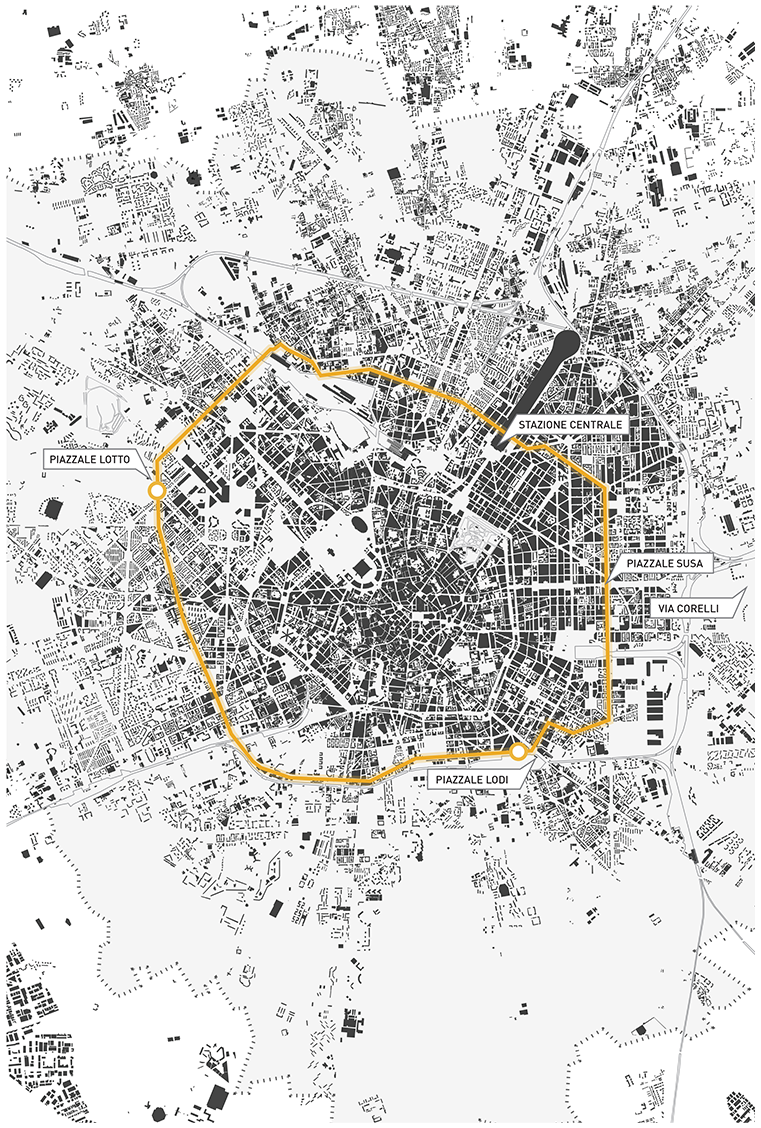
The 90/91 circle line. Elaboration by the authors, 2018.
Innovative points of view are developed in at least three main directions. The first point relates to the embryonic stream of studies on mobility spaces as public spaces using qualitative approaches. The second point is more related to the contribution to the literature on everyday multiculturalism: public transport means have been recognised as promising spaces to explore the negotiation of difference in the everyday (Amin, 2002; Noble, 2009; Wessendorf, 2014), but few studies adopted this specific focus of attention. During our work, only a few references could be found. Literature on public transport and everyday encounters often focuses on its divisive effects in cities (Rokem and Vaughan, 2018) – the separations it creates between different communities. Instead, this article reveals a more nuanced role of public transport. Finally, a third point refers to our specific background as architects and planners: studies on everyday multiculturalism have been mainly developed by sociologists and anthropologists (Colombo and Semi, 2009; Wise and Velayutham, 2009), who have given a relevant contribution to understanding social relations among people with different backgrounds in ‘micro-publics of encounter’ (Amin, 2002; Valentine, 2008). In these studies, the intertwining between social and spatial aspects, and in some way the material space where relations occur, remains in the background without being a real focus of attention (Briata, 2019). On the contrary, this work assumes ‘spatial practices’ (Cranz, 2016) and the role of the – public – space in everyday multiculturalism as specific focuses.
Three main research questions guided the research. One broader question relates to how everyday negotiation of difference occurs in a trolleybus boarding a wide range of different populations. Secondly, we question how much ethnographical observation in the fine grain of life along the transit space might be helpful in observing micro-publics of encounter, and broader city dynamics. Finally, a third question is mainly methodological and concerns the added value of using an ethnographical approach to study a bus as a public space.
The article’s main argument is that compressed public transport spaces are an excellent point of observation to understand how everyday negotiation of difference occurs: adaptations, ephemeral solidarities, frictions, attitudes and subtle forms of racism appear more evident precisely because the space is limited. We will show how the study of this bus has also been helpful to broaden/deepen an understanding of Milan, the most internationalised among Italian cities. Moreover, ethnographies have been an excellent tool to explore the fine grain of socio-spatial relationships and to expand the view on broader urban dynamics.
In line with the approaches suggested by everyday multiculturalism, ethnography has been the primary methodology adopted in this work, but direct participant observation was not carried out directly by the authors of this article. This is a post-hoc reflection made by looking retrospectively at the outcomes of a teaching project led by the authors for three academic years with classes of students in Urban Ethnography in the MSc in Urban Planning and Policy Design and in the MSc in Architecture at Politecnico di Milano (Italy). 1
Addressing overall 85 students from different countries – a minority of Italians, and students from 14 national origins across the different continents – the Urban Ethnography course featured a vibrant terrain for exchange between a wide range of educational and cultural backgrounds. The course aimed at stimulating a critical reflection on the most common analytical tools used in planning and design studies. A core point was thus supporting the students in practising ethnographic fieldwork, with particular attention to the interplay between people, spaces and practices in the everyday that, in methodological terms, still appears an underexplored field (Cranz, 2016; Henderson, 2016; Pink et al., 2017; Rishbeth et al., 2018). The challenge was thus to engage the participants in giving value to their own direct experience as a legitimate and relevant source of knowledge while performing a direct observation of spaces and people. Our primary reference in planning research was the work of Patrick Geddes (1948) and his contribution to the education of urban planners and designers. Geddes argued for a sight on the city that is articulated in a ‘view from above’ and in a ‘view through’ (Ferraro, 1998). Walking is a core tool for the ‘Geddesian planner’ (Ferraro, 1998: 106). Wandering through the city, observing while walking: this is an invitation to an ethnographic orientation in which direct, if not participant, observation of places is a relevant tool of knowledge (Goffman, 2008; Hannerz, 1980; Wacquant, 2007). Students were introduced to social and spatial analysis approaches which can support the understanding of how urban space is organised and results as the combined product of human and non-human actors. A core part of the course was dedicated to individual fieldwork, with the common guideline of focusing on the role of public spaces in supporting the coexistence of strangers and their negotiation of difference. The fieldwork was based on direct participant observation on the trolleybus and the use of photography. The definition of the field that has been proposed was a very wide one and left each student free to select his/her own space of observation: focusing on the vehicle and on the practices that take place on it, or broadening the observation and exploring areas along the line or the bus stops. Each student had to produce a report made up of a short piece of text and a selection of images.
The article is organised as follows: the first section outlines possible intersections between qualitative studies in the mobility field and issues related to the coexistence of diversity and everyday multiculturalism; the second section introduces the context of the 90/91 bus in Milan; in the third section, some reflections drawing from the research outcomes on the bus are described; then concluding remarks are drawn. 2
Mobility, space and society
Different strands of literature have been used to build up the theoretical background for this work. Qualitative studies in the mobility field have been helpful to define the state of the art of current literature. At the same time, the thematic focus on the coexistence of different populations in public space has been supported by studies on everyday multiculturalism, as well as by looking for those aspects recalled by Anderson (2011), describing the characters of cosmopolitan canopies – places where written and unwritten social and spatial rules are ‘loose enough’ to render the coexistence of strangers possible and where acceptance by everyone of everyone else is especially high.
Literature on planning and transport is still characterised by the prevalence of quantitative studies focused on the passengers’ profiles in terms of income, race, ethnicity, sex and age. In recent years, research has also started to explore qualitative issues to understand in more depth passengers’ behaviour and the social dimensions of movement. The so-called ‘mobility turn’ characterises studies trying to go beyond the dichotomy between transport and social research, focusing on social dynamics in the mobility field and exploring the relationships between transport and travellers’ travel patterns and experiences (Grieco and Urry, 2011; Sheller and Urry, 2006; Urry, 2007). Despite this, qualitative studies regarding mobility and transport remain few (Bourdin, 2005; Büscher et al., 2016; Merriman, 2014; Vecchio, 2017, 2020). The deployment of an ethnographic methodology challenges the over-reliance of policymakers – and some academics – on quantitative analysis sets to map transport use.
Ethnographic insights provide evidence of the meanings and practices of the use of public spaces by diverse citizens and communities and their multi-faceted character. In this direction, some existing studies were considered: Wilson’s (2011) work on intercultural relations, differentiation and exclusion on buses in Birmingham; Koefoed et al.’s (2017) work on cross-cultural encounters on a bus in Copenhagen, and on the tension between familiarity and difference, inclusion and exclusion where encounter is also a bodily experience; and Bacqué ’s (2018) and Poiatti’s (2019) work on how more experienced passengers develop tricks to pass the time, avoiding crowds, or territorialise some seats to feel at home in their routine on the RER B train line in Paris. The ethnographic study on the social life of rapid and local transit networks in Los Angeles realised by Fink (2012) has also been a relevant reference point in this work. Fink puts under observation transit spaces as a particular type of public space where passengers are exposed to contact with very different individuals and groups. Her references have also provided some inspiring images from previous works, such as the ‘communities on wheels’ studied by Nash (1975), who described what kind of subversions may occur in daily routines on a means of transport; the ‘people pipelines’ introduced by Zurcher (1979) in his studies on social relationships occurring in a ‘compressed’ and highly regulated space such as an aeroplane; and Vannini’s (2010) view of daily practices of movement not as ‘dead times’ or culturally neutral experiences, as passengers actually create and transform travel spaces through their activities and the technologies they use while travelling. Our idea was to go into more depth with Fink’s and other authors’ proposal to look at life on buses, adopting a perspective where mobility represents a core issue to understand the transformation of the connections between space and society.
The 90/91 trolleybus is a compressed public space where very diverse social, economic and cultural groups coexist, and various forms of negotiating differences are performed. In this direction, concepts mobilised by the literature on everyday multiculturalism have also been helpful references. The everyday multiculturalism perspective calls for observing the daily experience of difference in some specific places (Colombo and Semi, 2009; Valentine and Sadgrove, 2012; Wessendorf, 2014; Wise and Velayutham, 2009). Without denying the relevance of general norms and contexts – including national policies on migration – this strand of literature explores how diversity is lived in everyday situations, focusing on how social relations and identities may constantly be reformulated, producing tensions and conflicts, but also transformation and cultural hybridisation. Hence, urban coexistence does not result only in tensions and conflicts, and much of the negotiation of difference occurs at the ‘very local’ level through everyday experiences and encounters (Amin, 2002). Amin’s work emphasises the relevance of space liveability in the local dimension, observing sites where ‘prosaic negotiations’ of difference are compulsory in micro-publics such as the workplace, schools, public gardens and community places. In a more recent contribution, Amin (2012) underlines how people can get in contact and cooperate on a common objective, producing a ‘material culture of living together’, even in the absence of a total acceptance of ‘the other’ as well as without the presence of highly intense social bonds. The city has thus been framed in this work as a place where even extreme physical proximity – for example, the bodies’ compression in public transport, but also in crowded shopping centres – does not necessarily correspond to a form of sharing beyond that of space. Amin (2012) calls this condition ‘coexistence among strangers’.
The 90/91: A cosmopolitan canopy on the move?
The 90/91 trolleybus represents a unique point of observation of the recent processes of social and demographic change in Milan. The foreign population has been rapidly increasing in Milan, and the public debate and rhetoric related to immigration has become visible in the urban scene. The city is one of the primary destinations for immigrants in Italy, with a foreign population that, in the 2000s, rose to 19%. The regular foreign residents are around 260,000, over 1.3 million inhabitants. Milan is also a place where, in the face of a significant number of initiatives and policies aimed at guaranteeing the economic stability of the city (Pasqui, 2017), social polarisation is particularly intense (Cucca and Ranci, 2017). From 1993 to 2011, the city was governed by centre-right coalitions that dealt with immigration issues through safety policies (Briata, 2014). From 2011, a new centre-left government was established. The change in the political context also resulted in a shift in the public debate on immigration. Theoretically, a broad idea of safety emerged, reflecting the regeneration and liveability of places where the newcomers have settled. Despite this, the lack of a shared framework to integrate very fragmented initiatives is still evident in the city’s policy agenda. At the same time, the change in the public debate was not coupled with innovative policy actions, marking significant differences from the past xenophobic attitude (Barberis et al., 2017; Marzorati and Quassoli, 2015). The only exception in this sense was related to a series of initiatives activated to face the arrival of refugees at Milan’s central station since 2014 (Bovo and Lippi, 2017).
Concerning our research, a relevant aspect to be underlined from an international and multicultural perspective is that, in contrast to other parts of the world, in Italy – and in Milan particularly – public transport is usually not stigmatised and is used by a wide range of people. This happens also for the 90/91, two trolleybuses travelling on the same line in opposite directions along one of the city ring roads. This circle line plays a strategic role within Milan; it links most suburban areas and radial transport lines, and it reaches very different districts, along with the central station and some of the most important underground stations. It represents the longest city line (40 km and 65 bus stops), and it crosses eight of the nine urban districts (the most central is excluded). It provides a 24-hour service and, thanks to its route, serves a diverse range of passengers: young people going home late at night, early morning workers, street flower-sellers, tourists going to the train station, students, homeless people spending the night onboard to stay warm. They coexist in the large space of the bus (see Figure 2), made up of two connected parts with a capacity of 135 standing people and 31 seated.
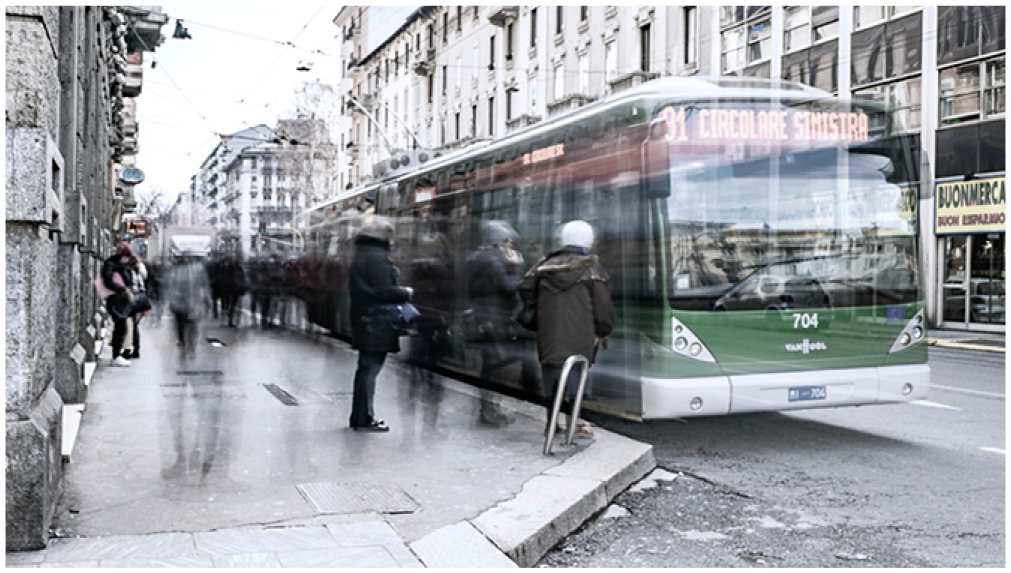
The 90/91 trolleybus. Photo by Sara Elthoky, 2018.
While such a wide variety of people crowds the bus every day, the immigrant passengers and late-night users are what draw public attention. Searching online for ‘travel on the 90/91’ brings up a narrative primarily based on terms such as ‘fear’, ‘hell’ and ‘violence’, evoking a ‘war’ and ‘horrific’ environment populated by scary people. 3 In most cases, the circle line enters the public discourse through reports of its bad condition and on the theme of foreign immigration and social alarm. However, there are also articles ironically describing experiences on the bus, and photographic and art exhibitions and blogs 4 aimed at ridding it of its negative image. 5
Within a public discourse characterised by stigmatisation, the city government has reacted by addressing this issue mainly in terms of public safety, with different tones within the right- and left-wing parties. The centre-right administration guided by Letizia Moratti (2006–2011) established strong repressive solutions, the so-called ‘patrols’ on the bus; from 2011, a centre-left government and its Welfare Department tried to soften such a security-based approach, substituting the patrols with ‘mobile social units’ and introducing social worker interventions on the bus. The current centre-left city administration, guided from 2016 by Giuseppe Sala, is still addressing the issue of the 90/91 in terms of safety, proposing a permanent security service on board. Despite the mainstream debate and consequent public action, a closer look via a press review showcases a more complex reality. During daytime hours, the bus is represented in very different ways, ranging from complaints about the strong presence of immigrants and reports of pickpocketing to cases in which value is given to the wide variety of passengers. On the other hand, all narratives tend to merge in the night description of the line’s users: during the night, diversity decreases and the presence of homeless people and those in desperate conditions increases feelings of insecurity. Hence, it seems that the night vision is so powerful as to be a sort of synecdoche taking over all the other imaginaries and becoming the only character of the 90/91 line.
Crossing perspectives and interpretations: The 90/91 as a mirror and lens of the metropolis
Each student addressed the observation individually, thus starting from his/her point of view and developing a personal research project. Here, references are limited to some of the students’ works, especially to those that, more than others, have raised relevant issues related to this article. In all works, the spatial compression of the bus has played a crucial role in ‘making visible’ different issues in an amplified way. In particular, looking through the compressed space and time of the bus, students have been able to address how the coexistence of strangers is negotiated, to detect spatial and social relationships between users and ultimately to obtain an overview of broader urban dynamics. 6
Bodies in the compressed space
The first group of essays used the bus’s compressed space to deepen the relationships between users in this ‘extreme’ environment. The observations focused on passengers’ spatial practices, words and sounds, touch and social behaviours. Spatial relationships were deeply analysed by Eugenia Iarlori and Irem Okandan, respectively from Italy and Turkey, who focused on the passengers’ behaviours, attitudes and profiles. Starting from Amin’s (2012) image of ‘urban animals’ living in the city, the research identified some recurrent profiles, choosing categories not coinciding with the most conventional ones such as ethnicity, age or sex. The research drew back to the metaphor of the food chain, identifying hierarchies of prey and predators, and through them, the most common expressions of territoriality were mapped. Some passengers tend to isolate themselves and limit their personal space (defenders and isolators), others are rather careless and indifferent. There are groups of people moving together in a more invasive manner (with company); in contrast, others have explicitly dominant attitudes, which turns them into invaders and predators. This work questioned how the coexistence of different behaviours makes the 90/91 a more or less public space. On the bus, feelings, placements, frictions and negotiations are regularly experienced by the passengers, who can thus be classified within different roles. Where does my freedom (of use) end in relation to how I limit others’ freedom of use? This is already a crucial question in the coexistence of strangers.
Nina Pfeil, from Hamburg, who based her observations on the differences between German and Italian buses and passengers, focused on a specific space of the bus: the entrance/exit area. Within the doors’ area, passengers on Italian buses seem to be drawn by a compelling magnetism, the door appeal. The higher the number of people within this area, the stronger the need to ensure personal space at any cost. Given this recurrent behaviour, a deeper look revealed specific features of this space compared with the rest of the bus: the presence of a thin borderline between a generically polite behaviour and a survival instinct, a fight for personal space near the doors. In her conclusion, Pfeil argued that, to her surprise, despite evident differences between passengers, on the 90/91 the power of the door appeal is so strong that it makes a common ‘bus culture’ emerge, shared between people of very diverse cultural and social backgrounds. Within the compressed space of the bus, the research spotted an even more compressed space, where passengers are somehow forced to experience micro-interactions, and by doing so, end up sharing a cultural behaviour.
The bus compression led to further interesting observation, focusing on social behaviour, in the work of Sara Elthoky, from Cairo. In her research, personal experience played a crucial role, and from the start she questioned the notion applied to the bus of the cosmopolitan canopy. In her view:
riding the bus number 90/91 in the city of Milan for the first time, you feel like it is not Italy anymore. People with different ethnicities, races and social classes hail from across the globe, all here in the public setting of the bus, forming this remarkable mixture.
At first sight, the circle line is perceived as a rich space of coexistence and light civil interaction. As the research further developed, a second level of complexity was revealed, where networks of individuals overlap and intersect each other. Egyptian men often offer her their seat on the bus, following the Egyptian habit, but they don’t do the same for women of other nationalities. One woman aggressively pushes her for having accidentally invaded her space: ‘Would she have reacted differently if I hadn’t been wearing a headscarf?’ A mosaic of ephemeral ‘micro-communities’ was thus outlined, quickly emerging and dissolving in the space of the bus, not only on an ethnic basis but also on a cultural, linguistic, national and social one.
A lens on socio-spatial practices
In the second group of essays, the bus’s spatial compression worked as a lens on the coexistence of strangers, and how people negotiate their differences (Figure 3). This perspective introduces the question of whether the 90/91 is a cosmopolitan canopy, a place where the public acceptance by everyone of everyone else is especially high (Anderson, 2011). At first sight, the intensive use of this means of public transport by such diverse populations – including the privileged groups of the city – leads to an affirmative answer. However, in-depth works, as that by Elthoky, tell us about a place of tolerance and intolerance that includes intrusive curiosity towards difference, and ethnic and not-only-ethnic solidarity. Thus, the 90/91 is still not the cosmopolitan canopy described by Anderson, but is certainly a good ‘gym’ in which to train for coexistence in a ‘city of difference’ (Fincher and Jacobs, 1998). Indeed, the negotiation of difference in this compressed space starts with the physical proximity to strangers; and coexistence in the bus becomes, in the first place, bodily training. Many observations gave an account of a pretty tricky exercise. Vinita Wagh, an Indian student, had never even imagined getting on a public bus in her home city of Pune: ‘I wouldn’t have lasted a day.’ In Milan, she happened to have the 90/91 bus stop near her home. Unbelievable: bus stops looked all the same, standardised and comfortable, while broad and empty spaces would wait for her inside the bus. The bus stop areas, described in the Indian context as a compressed mass of waiting people, in Milan are places where travellers have space and time to wait and observe each other, noticing details, traces on the ground, the clothing and looks of future travel companions. Based on a highly ironic narrative, which contextualised the stigma developed by the media on the 90/91 line, Wagh underlined the ordinary nature of the bus, and soon after, some recurring intrusions into the personal sphere. Often, she drew the attention of other passengers and was exposed to embarrassing situations, including quite direct questions: ‘where do you come from?’, ‘how long have you been in Milan?’, ‘where do you live?’ This would rarely occur in her home country. In her own words: ‘Life in the public sphere is highly anonymous, but avoiding other people takes a lot of effort … It’s never the locals and never the students. The only interested parties are the middle-aged non-natives.’ The questions get more and more intrusive until the day she is asked: ‘to which religion do you belong?’ Whereas in Milan, this might be considered a mild issue, in India this is the object of violent and open conflicts and would never be raised as a question during a casual conversation. Here, Wagh’s personal experience of the bus introduced work on proxemics, and when arguing that ‘avoiding other people takes a lot of effort’, she affirmed how much coexisting in a shared space is also a matter of physical training involving all the senses. Coexisting with strangers means getting used – and indifferent – to others’ sounds, smells and skin colours.
The matter of regulation introduced a final consideration on the coexistence of strangers, namely what could be considered normal and ‘subversion’. In this sense, the work of Bilal El Ghoul from Lebanon provided an interesting example. El Ghoul started from a comparison with his home country and, by doing so, he reframed the meaning of a bus. In the face of the headlines of some Italian newspapers arguing that using the 90/91 bus is ‘like going to war’, El Ghoul underlined that the Lebanese Civil War in 1976 started with the assault on a bus in Beirut and that this transport means is still its symbol. Given these premises, El Ghoul focused on the notion of regularities and irregularities in the two contexts of Milan and Beirut. In some ways, the Lebanese drivers follow specific routes, but every journey can vary, according to the driver’s need to choose a shorter way to drop off or pick up passengers. Thus, the transport system in Beirut includes a ‘visible irregularity’, and the human component broadly determines timetables and routes. Instead, in Milan, El Ghoul investigated the ‘invisible irregularities’ of a more structured transport system: the driver’s choice to open the doors for late passengers, delays due to requests for information at the entrance or pedestrians suddenly crossing the street. The 90/91 is described as an ordinary reality, and the focus shifts to a series of micro-variations, which enrich the travel experience and represent a precious space of personal expression. Through his work, El Ghoul highlighted how important it is to define normalcy always and only in context.
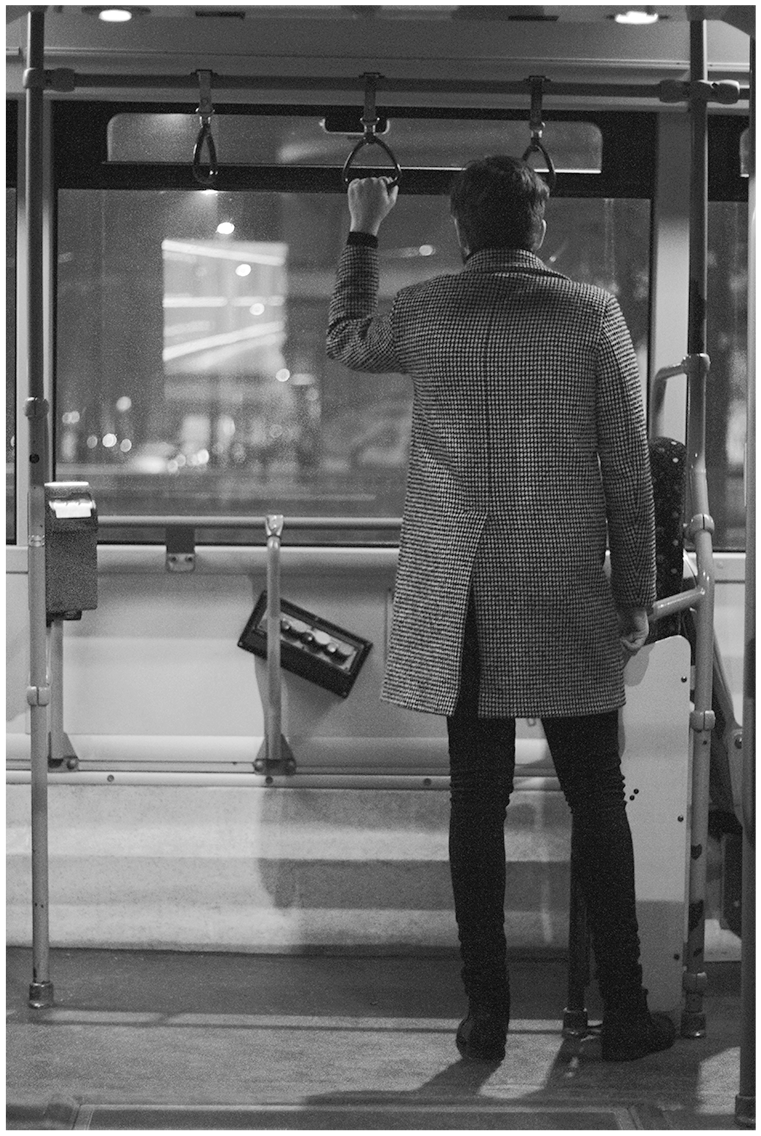
Inside the 90/91. Photo by Mehdi Lazarus, 2018.
A mirror of the metropolis
The third group of explorations of the 90/91 looked at the whole city and showed how the bus’s mobile and compressed space might be a good field for developing broader reflections on public spaces and the contemporary city (Figure 4). In these cases, the bus is a mirror where even tiny details are helpful to see broader city dynamics and challenge views of Milan as an international, open and polycentric city.
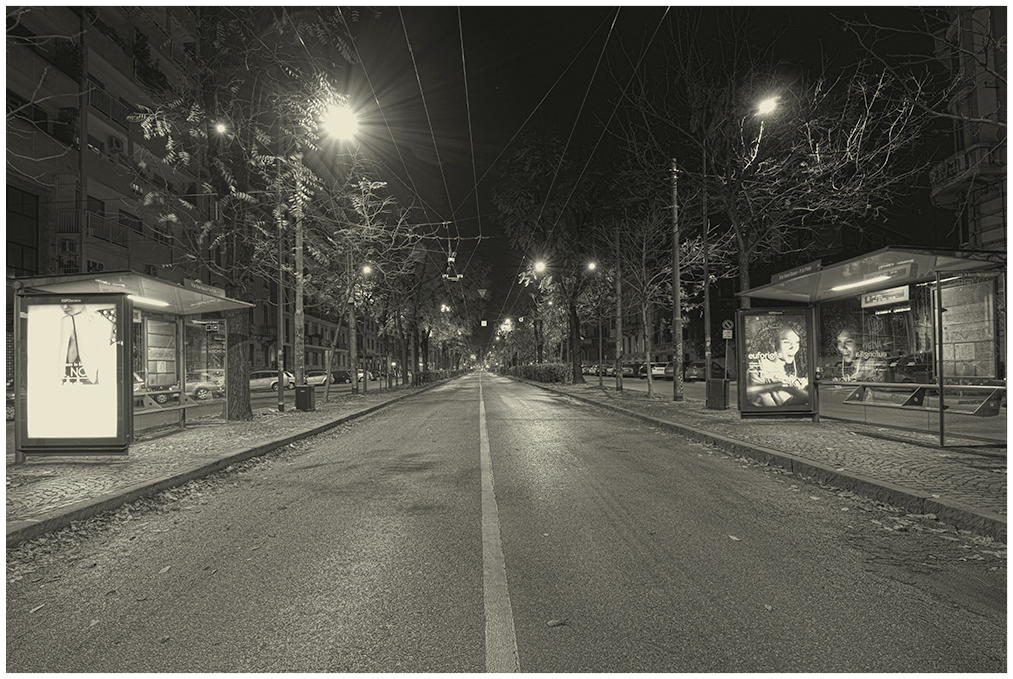
Bus stops of the 90/91. Photo by Victor Gardin, 2018.
This is the case in the work of Mesfin Alemu, an Ethiopian student who focused on the stretch of the 90/91 line between Milan Central Station and Piazzale Susa (Figure 1). The two stops here are important nodes connecting the city’s central station to reception centres for newly arrived refugees and asylum seekers; many migrants from the Horn of Africa move between them. Within this stretch of the line, Alemu chose to observe, interview, sometimes follow – with their agreement – passengers coming from Ethiopia and Eritrea. Alemu’s personal experience and his language skills on the bus unveiled informal resources and mutual help developed by the immigrant groups. His observation also revealed widespread stigmatisation practices occurring in one of the most international of Italian cities; he reported that Italian passengers usually change their seats when a black person sits nearby. Additionally, Alemu had a series of exchanges with a specific group of passengers speaking Tigrinya, discovering how the vast space of Piazzale Susa constitutes an established meeting point for many immigrants. Here, people sharing a common language look for information to orientate themselves in the complex bureaucracies for newcomers landing in Milan.
The bus is a mirror of different dynamics and practices also in the work of Szymon Michalski, from Poland, who described it as a peculiar temporal and spatial extension of the city nightlife. Intensive observation of the passengers on the 90/91 line and a minor accident that occurred during the night led Michalski to fine-tune his observation on a specific group of users: the youngsters who move late in the night between the different pubs and clubs in the city. During a journey, Michalski and a group of friends stepped on the bus with some party leftovers while heading to a club. The glasses and cocktails drew the attention of a Muslim man who condemned the lack of respect for Ramadan rules, under the eyes of his young children. This led to a lively discussion within the group of friends, already a bit tipsy. This situation brought Michalski to reflect on how often, during the night, people drink and eat on the 90/91 bus, a practice that is generally forbidden on all urban public transport in Milan. Together with a photo reportage documenting the frequency and variety of these practices, the research outcome consisted of a map documenting – through the support offered by TripAdvisor – that many of the most attractive trendy clubs and party locations for young crowds are located along the external ring line. Moving from one club to another is a common practice, and the 90/91 line is a resource available all night long, enabling club-goers to safely get home. Atmospheres, practices and groups of friends transfer from the clubs’ space to the bus’s space, which lives as a sort of bridge between the clubs themselves.
The essay of Gieles Kinget from Belgium mirrored broader city dynamics, starting from ‘details’. Keen on very detailed observation, Kinget detected and documented flyers, leaflets, tiny paper advertisements and post-its hanging on posts, bus shelters and boards near the bus stops. Extensive use of a very traditional form of communication – paper! – appeared as a sort of subversion in the face of the digital information flow that permeates the city. This is a communication channel that conveys and makes visible practices related to a very vivid underground informal market serving poorer groups of inhabitants. Kinget developed a close-up analysis of two different market areas: the demand for and supply of unskilled jobs – mainly in services – and of affordable and cheap accommodation – flats, rooms and beds. Transferring the collected information onto a city map showed how the informal housing and job markets are systematically located out of the 90/91 ring, confirmation of the very mono-centric aspect of Milan where real estate values and housing costs are distributed along a series of decreasing rings from the centre to the periphery. In the face of the current rhetoric of Milan as a polycentric city resisting the economic crisis, this essay called for a debate on a deep territorial distinction between the centre and the outskirts, where the so-called ‘external ring road’ still represents a boundary between values, practices and populations.
Hence, the compressed nature of public space aboard the bus outlined an amplified view of the inner spatial and social practices of the coexistence of strangers and the outer city. In this way, the students’ works suggested that the notion of compressed public space might be an essential aspect that public transport offers to everyday multiculturalism studies.
Conclusions
The article explored dynamics occurring in and around a public transport means in an increasingly diverse urban environment. The main points of reference have been qualitative studies in the mobility field, intersecting with studies on everyday multiculturalism. The first stream of literature is still embryonic; the second relies on relevant findings from sociologists and anthropologists that unpacked social relationships between strangers in micro-publics of encounter. Our specific contribution relates to the attention to the interplay between people, space and practices in the everyday.
These final remarks will underline some relevant conceptual and methodological findings, arguing that public transport means represent insightful places to observe and understand the transformation of space and society. Our study confirmed that the compressed space of public transport is an excellent lens of observation to understand how everyday negotiation of difference occurs, precisely because the space is limited and ‘on the move’. Explorations in the fine grain of socio-spatial relationships have been helpful to understand micro-publics of encounter, negotiations of difference, ephemeral solidarities and everyday forms of racism. Despite this specific gaze at the micro-scale, observations were also helpful for obtaining an overview of the dynamics occurring in the whole city. This is the case of Kinget’s work on the location of the informal job and housing markets serving the poorest groups of the city. Similarly, Michalski challenges the stereotypical night vision of the 90/91; in his work, the bus is not just a place for the homeless to sleep but also a mobile space connecting clubs, where young people meet and coexist with other ‘people of the night’. Micro-dynamics and broader city issues merged in Alemu’s work, which unveiled both forms of solidarities and mutual help occurring in spaces connected by the trolleybus line and forms of everyday racism towards black people. Similar issues, but more focused on micro-dynamics, arose in Elthoky’s work, which described acts of kindness of an ephemeral ‘Egyptian community’ and everyday acts of unkindness as a reaction to her visible difference represented by the Islamic veil. These two works explicitly showed that the body is a marker for other people to label ‘diversity’, and a powerful means to detect which visible diversity is still not widely accepted in Milan, the most international among the Italian cities. As seen, most of the students’ works revolved around the coexistence of strangers as a central character of the bus space, often starting from a bodily and spatial shared experience. Beyond some relevant ‘incidents’ that cannot be ignored, the 90/91 is used by very different people who, in most cases, seem to practise daily the fragile art of ‘civic inattention’, as Goffman (2008) called it: a set of minor and unwritten conventions that allow crowds of strangers to cohabit peacefully. Small courtesy gestures make up how strangers are seen, measuring themselves without staring at each other, remaining sceptical while giving themselves minimal confidence. Therefore, in most cases, the delicate balance between strangers in bus spaces relies on forms of mutual inattention.
These findings would not have been discovered without a qualitative and ethnographical approach. In this direction, an unexpected methodological point emerged in our post-hoc reflection on this research experience. In the face of increasingly diverse cities, pluralisation may be a key methodological approach. Over time, we realised that this research experience’s strength also lays in a methodology that emerged during the work: a multiplication of viewpoints and corporeal experiences that was made possible by the heterogeneity of biographies, educational paths and ethnocultural backgrounds of the students attending our classes. This was a methodology that we associated with the work of Bourdieu when he underlined that the so-called ‘difficult places’ are, first of all, difficult to be described and thought. Against simplistic and unilateral representations such as those of the media, the research group, led by Bourdieu’s ideas, carried out an inquiry that worked in two directions. On the one hand, they let talk the plurality of coexistent and rival viewpoints of the residents in the French suburbs; on the other hand – we add here – they managed a multiplication of viewpoints through the multi-ethnic and multicultural background of those who conducted the interviews. Over three years, the students’ multiplied gaze on the 90/91 produced a profound understanding of this plural space and its meanings; an understanding that was grounded on their perspectives, built on their everyday-life experiences and their cultural backgrounds. Their gazes taught us how much normality should always be defined as context-based: if the newspapers describe a ride on the 90/91 as ‘going to war’, Bilal El Ghoul reminds us that buses on the streets of Beirut are the symbol of a real and prolonged war, and Vinita Wagh ironically builds up comparisons with the everyday ‘war’ to gain some vital space in the human mass of Pune.
The work has investigated public transport as a key space for engagement and encounter in the multicultural city, showing processes of both togetherness and separation. Within this framework, we also discovered that the pluralisation of viewpoints seems to be a promising – and not yet fully explored – path in our research fields. On the one hand, such a pluralisation would enrich qualitative research on public transport that often relies on a single point of view; on the other hand, it would serve as an effective tool to dig into – without flattening – the growing diversity and plurality of – public – spaces in contemporary cities.
Footnotes
Declaration of conflicting interests
The author(s) declared no potential conflicts of interest with respect to the research, authorship, and/or publication of this article.
Funding
The author(s) received no financial support for the research, authorship, and/or publication of this article.
