



Abstract
Significant research has shown that gentrification often follows the implementation of greening initiatives (e.g. new parks) in cities worldwide, in what scholars have called ‘green gentrification’. A few other studies in the Global North suggest that greening initiatives might be disproportionately located in disadvantaged neighbourhoods that are gentrifying as opposed to disadvantaged areas experiencing continuous disinvestment. Building on these findings, in this critical commentary we present the green gentrification cycle, which sheds light on the complex spatiotemporal relationships between greening and gentrification. The cycle posits that gentrification can precede greening, gentrification can follow greening and, in some cases, gentrification can both precede and then follow greening. We present the actors and processes involved in intentionally steering greening to already gentrifying communities and discuss them through an environmental justice lens. Specifically, we propose three complementary explanations for why gentrification precedes greening, including demand from gentrifiers, push from the green growth machine and increased resource availability in gentrifying communities. We then present a research agenda on the green gentrification cycle, including the need for a better understanding of how the cycle might materialise in places with varying political economies, such as the Global South.
Introduction
Several studies have recently examined whether and how gentrification follows the implementation of greening initiatives, that is, whether greening causes gentrification in disadvantaged communities (Anguelovski et al., 2018; Chen et al., 2021; Gould and Lewis, 2017; Rigolon and Németh, 2020; Wu and Rowe, 2022). These studies have focused on greening initiatives such as new or improved parks, greenways, community gardens, urban trees, green infrastructure for climate adaptation or mitigation, bike lanes and trails and brownfield regeneration (Anguelovski et al., 2018; Chen et al., 2021; Donovan et al., 2021; Gould and Lewis, 2017; Kwon et al., 2017; Maantay and Maroko, 2018; Rigolon and Németh, 2020; Wu and Rowe, 2022). This work has mostly focused on the Global North, but researchers have also recently examined the connections between greening and gentrification in the Global South (Anguelovski et al., 2019a, 2019b; Chen et al., 2021; de Souza and Torres, 2021; Yazar et al., 2020).
The findings of this literature show that, in some circumstances, neighbourhoods have gentrified after greening initiatives were implemented in Global North and South contexts (Anguelovski et al., 2018, 2019a; Chen et al., 2021; Gould and Lewis, 2017; Kim and Wu, 2022; Kwon et al., 2017; Rigolon and Németh, 2020; Wu and Rowe, 2022). Scholars have called this phenomenon green gentrification or environmental gentrification, and they have conceptualised this form of gentrification as a response to greening initiatives (Checker, 2011; Gould and Lewis, 2017). Although other research has focused on gentrification processes linked to climate vulnerability (e.g. wealthier people relocating to low-income neighbourhoods sitting on higher ground to avoid flooding) (Keenan et al., 2018), in this article we focus on green gentrification as defined above.
Green gentrification is a pernicious issue for planners and policymakers. Greening initiatives that foster gentrification in nearby communities might end up displacing disadvantaged groups from their neighbourhoods (Gould and Lewis, 2017; Pearsall and Eller, 2020). And disadvantaged groups, who tend to experience worse health outcomes than other people, stand to gain health benefits from improved access to green space (Rigolon et al., 2021). Such benefits cannot be realised if those populations are displaced in the process. Also, gentrification has been linked with negative health outcomes for disadvantaged people (Anguelovski et al., 2021).
A few recent studies in the Global North have shown that some greening initiatives have occurred disproportionately in low-income areas that are already gentrifying, as opposed to disadvantaged areas that have experienced continued disinvestment (Ferenchak and Marshall, 2021; Reibel et al., 2021; Rigolon et al., 2020; Sharifi et al., 2021). This evidence indicates that gentrification might precede greening, a phenomenon that some have called ‘gentrified greening’ (Sharifi et al., 2021). Such studies suggest that we should conceive of green gentrification as a potentially cyclical process rather than a sequence in which social change linearly follows greening.
The extent to which gentrification might both follow and precede greening has not been deliberately conceptualised, and the mechanisms through which gentrification might attract greening initiatives have not been discussed in depth. Given these literature gaps, in this critical commentary we first conceptualise the green gentrification cycle, which describes how gentrification might precede and follow greening. Our conceptualisation includes a focus on environmental justice implications. Second, we explore explanations for why gentrification might precede greening, and third, we propose a research agenda on the green gentrification cycle. Through this commentary, we also answer calls to better understand the actors and processes involved in green gentrification, and the spatiotemporal factors associated with this phenomenon (Anguelovski et al., 2019b).
Conceptualising the green gentrification cycle
We argue that green gentrification might act in a cycle: gentrification can follow greening, gentrification can precede greening and, in some circumstances, gentrification can both precede and follow greening in a given neighbourhood (see Figure 1). We conceptualise the complex spatiotemporal processes linking greening and gentrification as ‘the green gentrification cycle’. Figure 1 encompasses cases wherein both processes happen in the same neighbourhoods, as well as cases in which greening only precedes or only follows gentrification.
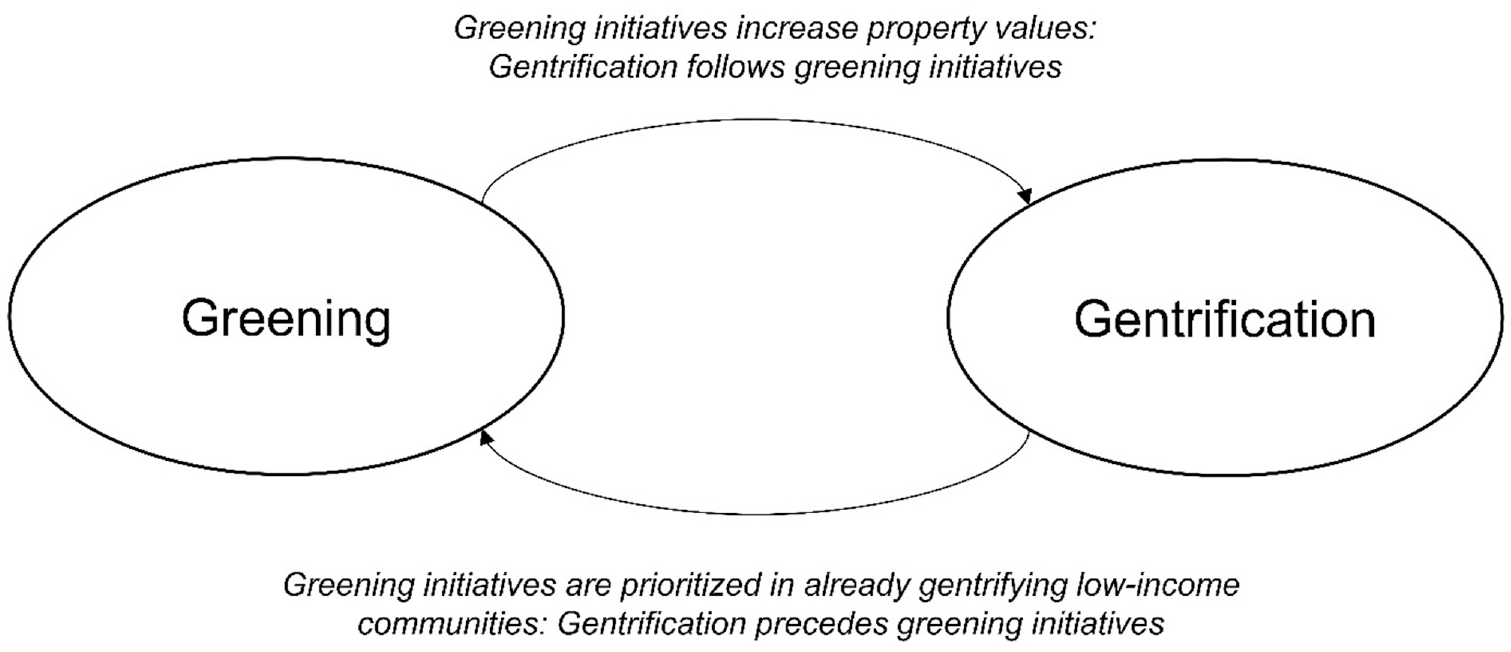
The green gentrification cycle.
The green gentrification cycle was acknowledged in previous research either implicitly (Gould and Lewis, 2017) or explicitly (Reibel et al., 2021; Rigolon et al., 2020), but the cycle has not been clearly conceptualised or explored quantitatively in both directions in the same study. Specifically, Gould and Lewis (2017: 24) wrote that green gentrification can involve an ‘iterative process’ wherein it may be difficult to discern whether greening or gentrification came first. Others have suggested that green gentrification might work as a cycle, based on findings that showed that gentrification preceded greening but that did not test whether gentrification also followed greening (Reibel et al., 2021; Rigolon et al., 2020). A recent review paper acknowledged that while gentrification may precede greening (Anguelovski et al., 2019b), this sequence has been under-theorised. As noted above, an empirical paper proposed the term ‘gentrified greening’ to describe this process (Sharifi et al., 2021).
Evidence for the green gentrification cycle
Research that has examined gentrification in temporal relation to greening helps us highlight important features of the green gentrification cycle. First, studies of a wide variety of environmental initiatives have found gentrification to follow greening, and fewer studies have found gentrification to precede greening. Quantitative studies documenting gentrification after greening have focused on initiatives such as new or renovated parks, greenways, urban trees, community gardens and brownfield regeneration (Anguelovski et al., 2018; Chen et al., 2021; Donovan et al., 2021; Gould and Lewis, 2017; Immergluck and Balan, 2018; Kim and Wu, 2022; Kwon et al., 2017; Maantay and Maroko, 2018; Pearsall and Eller, 2020; Rigolon and Németh, 2020; Wu and Rowe, 2022). Quantitative studies documenting gentrification before greening have focused on initiatives such as new parks and park improvements, demand for greened vacant lots, bike lanes, brownfield regeneration and green land cover (Ferenchak and Marshall, 2021; Flanagan et al., 2016; Gould and Lewis, 2017; Reibel et al., 2021; Rigolon et al., 2020; Sharifi et al., 2021).
Second, evidence for both sides of the green gentrification cycle (gentrification preceding greening and vice versa) is much stronger in the Global North than in the Global South. Most of the quantitative studies showing that gentrification follows greening were conducted in the Global North, but at least two were carried out in China (Chen et al., 2021; Wu and Rowe, 2022). Also, each of the quantitative studies we identified finding that gentrification precedes greening focused on the Global North (Ferenchak and Marshall, 2021; Flanagan et al., 2016; Gould and Lewis, 2017; Reibel et al., 2021; Rigolon et al., 2020; Sharifi et al., 2021). There may be quantitative studies of Global South contexts with similar findings that our literature search failed to identify, but it is unlikely that numerous such studies exist.
Some qualitative studies in the Global South have provided accounts of gentrification possibly preceding greening, yet they offered undetailed discussion of this process (Baviskar, 2003; He, 2007; Jou et al., 2016). Similar accounts have also been reported in qualitative studies across numerous Global North countries (Blok, 2020; Goossens et al., 2020; Krivý, 2021). Thus, the part of the cycle wherein gentrification precedes greening might apply more to the Global North than to the Global South, but this is possibly due in part to the limited number of studies on green gentrification in the Global South (de Souza and Torres, 2021).
Third, the literature suggests that the green gentrification cycle does not apply to all new greening initiatives in disadvantaged communities. Just as not all new greening initiatives lead to gentrification in their surroundings (Anguelovski et al., 2018; Kim and Wu, 2022; Rigolon and Németh, 2020), so are not all established in disadvantaged gentrifying areas, as some are built in disinvested neighbourhoods and others in affluent areas (Pearsall and Eller, 2020; Reibel et al., 2021). Studies on whether gentrification follows greening have shown strong associations with gentrification for greenway parks, nature parks and parks close to city centres (Anguelovski et al., 2018; Chen et al., 2021; Kim and Wu, 2022; Rigolon and Németh, 2020; Wu and Rowe, 2022).
Fourth, the extent to which a single greening initiative and surrounding neighbourhoods can experience both sides of the green gentrification cycle is under-researched. There is evidence that, for some neighbourhoods, gentrification might both precede greening and then follow greening. For example, the case of Park Slope near Brooklyn’s Prospect Park (New York, USA) in the 1980s is one where it is hard to disentangle which came first, as gentrification had started when the city government and a non-profit organisation began to pour resources into the park (Gould and Lewis, 2017). Studies on Chicago’s 606 Trail and the Atlanta BeltLine in the USA (Immergluck and Balan, 2018; Rigolon and Németh, 2018) show that some parks built in gentrifying communities accelerated gentrification. One study in Shanghai, China, reported the example of a neighbourhood where both sides of the green gentrification cycle might have occurred (He, 2007). Further, reports from interviewees in Philadelphia, USA, show that new parks in gentrifying neighbourhoods exacerbated gentrification by contributing to further increases in property values (Pearsall and Eller, 2020).
Environmental justice and the green gentrification cycle
The green gentrification cycle builds on environmental justice research examining the temporal processes through which environmental amenities and demographic groups co-locate in given neighbourhoods (Boone et al., 2009; Rigolon and Németh, 2021). Here, we conceptualise environmental justice in relation to greening initiatives as consisting of four interrelated dimensions: distributional, procedural, recognitional and interactional justice (Low, 2013; Schlosberg, 2004, 2007). Distributional justice describes equitable access to environmental amenities and exposure to environmental hazards between social groups (Low, 2013; Schlosberg, 2004, 2007). Procedural justice describes inclusive decision-making processes about environmental amenities and hazards, where the interests of disadvantaged people are well-represented (Low, 2013; Schlosberg, 2004, 2007). Recognitional justice involves accounting for the experiences of oppression of disadvantaged groups (e.g. racism) and for the cultures of such groups when crafting policies or plans about environmental amenities or hazards (Schlosberg, 2004, 2007). Interactional justice, as defined by Low (2013) in the context of public spaces, involves designing and managing green spaces to help disadvantaged people (e.g. racial/ethnic minority people, immigrants) feel welcome and represented.
The green gentrification cycle is linked to these four dimensions of environmental justice. Specifically, significant environmental justice issues have been reported when greening precedes gentrification (Gould and Lewis, 2017; Mullenbach and Baker, 2020; Rigolon and Németh, 2018). This process can lead to distributional injustices, as disadvantaged people might be displaced to areas with worse environmental conditions and less social support (Gould and Lewis, 2017; Mullenbach and Baker, 2020; Rigolon and Németh, 2018). When greening precedes gentrification, procedural injustices often arise due to a lack of in-depth community engagement with disadvantaged residents (Gould and Lewis, 2017; Mullenbach and Baker, 2020; Rigolon and Németh, 2018). Further, greening initiatives that precede gentrification can involve recognitional injustices, as the planning processes for such initiatives often portray greening as universally beneficial without accounting for racial/ethnic minority people’s cultural needs or experiences of oppression – for example, among Black Americans who have been profiled and harassed by police in parks (Checker, 2011). Finally, interactional injustices can also arise, as disadvantaged people might feel unwelcome in new green spaces that appear to foster gentrification by design (Rigolon and Németh, 2018).
We argue that similar environmental injustices also occur when gentrification precedes greening. When greening initiatives are implemented in gentrifying neighbourhoods, wealthier people gain privileged access to environmental amenities (Gould and Lewis, 2017). The processes that lead to greening in gentrifying neighbourhoods empower gentrifiers and developers, neglect long-time disadvantaged residents and often disregard the culture and experiences of such disadvantaged residents, which constitutes both procedural and recognitional injustice (Checker, 2011; Miller and Lubitow, 2015). And the new green spaces built in gentrifying neighbourhoods might be perceived as white spaces, unwelcoming for disadvantaged residents, especially racial/ethnic minority people who are disproportionately targeted by policing (Harris et al., 2020).
A consideration of procedural and recognitional injustices pertaining to the green gentrification cycle must engage questions of intentionality. Two types of intentional actions are integral to the green gentrification cycle. The first is what we call the intention to appropriate greening, which involves deliberately steering greening to gentrifying communities (as opposed to low-income disinvested communities) and pertains to gentrification preceding greening. As we describe below, there is evidence that gentrifiers, politicians and real estate developers seek to attract greening to gentrifying neighbourhoods (Gould and Lewis, 2017; Hamilton and Curran, 2013). The second type of intentional action involves what we call the intention to displace via greening, which describes using greening initiatives to deliberately displace disadvantaged residents and pertains to gentrification following greening. Examples of this process include clearing informal settlements to make room for greening in the Global South (Anguelovski et al., 2019a; Jou et al., 2016; Yazar et al., 2020), using environmental discourses to remove homeless encampments from parks (Dooling, 2009) and financing greening initiatives to promote land valorisation, which depends on expropriation of property, residential displacement and gentrification (Argüelles et al., 2022). These examples refute the logic held by some scholars that gentrification and related displacement might be an unintended consequence of greening (Chen et al., 2021; Donovan et al., 2021; Kim and Wu, 2022; Kwon et al., 2017).
From a distributional justice perspective, it matters less whether actors involved in the green gentrification cycle intend to displace disadvantaged populations and whether they intend to appropriate greening. Outcomes such as the displacement of disadvantaged residents and the disproportionate greening of gentrifying neighbourhoods represent distributional injustices regardless of intent (Gould and Lewis, 2017; Rigolon and Németh, 2018). Yet these two types of intentionality matter for procedural and recognitional justice, as they involve power differentials, disregard for the needs and experiences of disadvantaged groups and the exclusion of those groups from decision-making processes. Moreover, while considering intentionality is important for addressing questions of environmental justice, it may also help clarify specific processes perpetuating and pathways for destabilising the green gentrification cycle. In the next section, we elaborate on why gentrification may precede greening, shedding further light on how various actors might intend to appropriate greening.
Why gentrification might precede greening
Based on our examination of the green gentrification literature and of the broader gentrification literature, we offer three potential complementary explanations for why gentrification might precede greening in some circumstances. Two of the three explanations align with the demand-side and supply-side explanations of green gentrification (Hamilton and Curran, 2013). These three explanations primarily apply to Global North countries where political-economic conditions include relatively unregulated real estate markets and some degree of civic participation in planning processes; those conditions contrast with some Global South countries wherein land is state-owned and planning is a top-down, government-led endeavour (e.g. China; see Chen et al., 2021). Nevertheless, we also highlight cases in which these three explanations might apply to Global South contexts.
Pressure from gentrifiers (demand side)
This explanation holds that middle- and upper-class newcomers to gentrifying neighbourhoods have the will and political power to advocate for greening initiatives in their new neighbourhoods. In other words, gentrifiers bring a demand for greening to neighbourhoods. In democratic societies where planning is a pluralistic process, demand for greening can manifest in advocacy to public agencies (Gould and Lewis, 2017; Grier and Perry, 2018; Hamilton and Curran, 2013; Miller and Lubitow, 2015) and privately-led greening initiatives (McClintock, 2018; Rigolon et al., 2020; Sharifi et al., 2021). This explanation aligns with what Hamilton and Curran (2013: 1560) framed as ‘demand-side (gentrifier-led) environmental gentrification’, that is, greening initiatives that are created due to gentrifiers’ demands.
Gentrifiers’ demographics, values and consumption patterns
The sociodemographic characteristics of gentrifiers in many Global North countries—being politically progressive, younger and environmental-minded—help explain their heightened demand for greening (Gould and Lewis, 2017; Hamilton and Curran, 2013; McClintock, 2018). In cultural terms, gentrifiers’ affinity for greening aligns with their consumption patterns, lifestyle and values (Hamilton and Curran, 2013), including strong environmental consciousness (Gould and Lewis, 2017). These attributes suggest that gentrifiers represent a ‘constituency’ predisposed to advocating for greening in gentrifying neighbourhoods (Gould and Lewis, 2017: 23), particularly greening initiatives that serve their needs. For example, gentrifiers might advocate for dog parks (Grier and Perry, 2018) or engage in urban agriculture (McClintock, 2018). In response, long-time residents of gentrifying neighbourhoods burdened by persistent environmental injustices in both the Global North and South may reasonably conclude that new green spaces are not for them but for gentrifiers, which is an interactional injustice (Checker, 2011; Chen et al., 2021; Harris et al., 2020).
Advocacy: Power differentials and technical knowledge
In the USA, gentrifiers tend to get more attention from elected officials and city departments than long-time residents (Checker, 2011; Grier and Perry, 2018). White newcomers tend to be vocal and well-organised, which helps them achieve their goals through advocacy. In Global North contexts where planning includes civic participation, engagement processes for greening initiatives in gentrifying communities are places where white gentrifiers are over-represented because they tend to be more knowledgeable about city planning processes and technology than disadvantaged groups (Hamilton and Curran, 2013; Miller and Lubitow, 2015).
Even when long-time disadvantaged residents are highly vocal, they express frustration with their power deficit in advocating for greening initiatives. Several reports in the USA show that long-time residents have demanded greening initiatives only to see them materialise when white newcomers move to the neighbourhood and advocate for those same improvements (Checker, 2011; Flanagan et al., 2016; Miller and Lubitow, 2015). A similar phenomenon in the Global South was described in India, where an ‘environmental bourgeoisie’ advocated for environmental improvements that involved removing informal settlements and displacing their residents (Baviskar, 2003, cited in Anguelovski et al., 2019b). These differences in residents organising and voicing concerns, and in public agencies listening, reflect power differentials between more privileged newcomers and long-time disadvantaged residents, and they represent procedural and recognitional injustices associated with the intent to appropriate greening.
Demand from disadvantaged communities
In the last two decades, environmental justice advocates in the USA have sought to bring greening initiatives to disadvantaged areas (Anguelovski, 2013; Boone et al., 2009; Fernandez, 2018; Rigolon and Németh, 2021). In gentrifying communities, such advocates tend to find allies among gentrifiers, who may help bring greening projects to fruition. An example of a successful alliance between gentrifiers and long-time residents is found in New York, USA, in what has been framed as ‘gentrified-enhanced environmental activism’ (Hamilton and Curran, 2013: 1561). Nevertheless, such alliances can also result in white gentrifiers co-opting the equity-oriented efforts of long-time residents of colour, as was seen in the case of the 606 greenway in Chicago, USA (Rigolon and Németh, 2018). Thus, advocacy by disadvantaged communities may also inadvertently contribute to instances of gentrification preceding greening and perhaps the initiation of a green gentrification cycle, which highlights complex issues of procedural and recognitional injustice.
Push from the green growth machine (supply side)
Extending from the work of Molotch (1976) and Logan and Molotch (1987), the ‘green growth machine’ describes a coalition of developers and elected officials who seek to leverage greening initiatives to increase profit from real estate development and property tax revenue (Gould and Lewis, 2017). Several authors have shown how the green growth machine can implement greening initiatives that contribute to gentrification in the Global North (DuPuis and Greenberg, 2019; Gould and Lewis, 2017; Mullenbach et al., 2021), and some studies have outlined similar processes in Global South contexts with lightly regulated land markets (Anguelovski et al., 2019a; Yazar et al., 2020).
Here, we argue that, at least in many Global North countries, the green growth machine might steer greening initiatives to areas that are already experiencing gentrification, as opposed to disinvested areas (see Reibel et al., 2021). A recent study in 15 cities in the Global North lends support to this argument by showing that real estate developers have pushed greening initiatives to gentrifying neighbourhoods to maximise profit, meet local demand and promote sustainable lifestyles (García-Lamarca et al., 2022). Greening initiatives in gentrifying neighbourhoods can help attract the creative class and displace the working class (Gould and Lewis, 2017; Hamilton and Curran, 2013). The push from the green growth machine aligns with supply-side explanations derived from cases wherein greening initiatives have been established in already-gentrifying neighbourhoods due to efforts by developers and/or elected officials (Hamilton and Curran, 2013). Yet in countries like China characterised by state ownership of land and top-down planning (Chen et al., 2021), developers might not be able to steer greening initiatives to gentrifying areas because the government controls the planning process.
Why the green growth machine may steer greening initiatives to gentrifying communities rather than to low-income disinvested areas
In many Global North contexts, growth machine interests likely view gentrifying low-income neighbourhoods as those where prospects for successfully closing a large rent gap – defined by the disparity between the potential ground rent level and the actual ground rent capitalised under the present land use (Smith, 1979) – are the greatest. This is because gentrifiers, investors and developers are already making private investments to improve such neighbourhoods. Thus, to reinforce and accelerate the process, the green growth machine may strategically steer greening initiatives to those gentrifying neighbourhoods (López-Morales et al., 2019). Greening initiatives may immediately increase both the actual and potential ground rents in gentrifying neighbourhoods, and eventually facilitate closure of the rent gap. In other words, greening initiatives in such neighbourhoods may appear to those within the green growth machine to hold the greatest promise for fuelling substantial growth over the near term (via increased property tax assessments and profits in the rental market) and the longer term (via the highly profitable sale of properties).
Importantly, we distinguish gentrifying, low-income neighbourhoods as providing the ideal milieu for pursuing a ‘green growth’ strategy to help close large rent gaps. This perspective differs from prior treatments of the ‘green rent gap’ premised on the notion that greening increases potential ground rents as a precursor to gentrification (Anguelovski et al., 2019b; Garcia-Lamarca et al., 2021). While the rent gap may be large in disinvested, stigmatised neighbourhoods, such contexts do not exhibit preconditions for closure of the rent gap, which is difficult to achieve (Christophers, 2022). On the other end of the spectrum, the rent gap is already narrow in affluent neighbourhoods, such that additional greening initiatives in such areas have limited potential to stimulate substantial green growth.
This perspective aligns with McClintock’s (2018) work on urban agriculture and green gentrification, in which he argues that there must be a degree of gentrification in place for urban farming to provide a basis for green growth. Other potential gentrifiers interested in local food and prospective investors may view the urban agriculture practised by white, upwardly mobile residents as a basis for growing ‘sustainability capital’ and spurring further gentrification through additional greening initiatives (McClintock, 2018). And it is only in gentrifying neighbourhoods home to ‘foodies’, as opposed to disinvested low-income neighbourhoods, where urban agriculture is likely to be capitalised on as a pillar of a green growth strategy (McClintock, 2018). This reflects complex issues of recognitional, procedural and distributional injustice with respect to greening, gentrification and potential displacement.
Both sides of the cycle could occur in the same neighbourhood
The green growth machine’s efforts to attract the creative class through greening initiatives (Gould and Lewis, 2017; Hamilton and Curran, 2013) could provide conceptual support for the existence of both sides of the green gentrification cycle in the same neighbourhood. The green growth machine does not just steer greening initiatives to gentrifying places because of demand for improvements from existing gentrifiers. Rather, they want to do so to promote further gentrification and attract new waves of wealthy residents (García-Lamarca et al., 2022; Gould and Lewis, 2017).
Members of the green growth machine
Traditionally, members of the growth machine have mostly included real estate developers and elected officials (Gould and Lewis, 2017; Molotch, 1976). Research on the green growth machine in the USA suggests that gentrifiers and environmental non-profit organisations may also form part of this coalition, as their goals in some instances align with those of developers and elected officials (Dilworth and Stokes, 2013; Gould and Lewis, 2017). Specifically, non-profit organisations such as the Prospect Park Alliance can form part of the green growth machine when they enter into public–private partnerships to invest in greening initiatives in places at risk of gentrification (Gould and Lewis, 2017). Non-profit organisations do so by funnelling private money from foundations and corporations to improve and manage green spaces. Private money contributes to increasing property values nearby, which benefits already established gentrifiers and attracts new gentrifiers. Gould and Lewis (2017) suggest that early gentrifiers might be part of the green growth machine by providing political support to these changes and making neighbourhoods marketable for further gentrification.
Advocacy, political pressure and the media
As part of the green growth machine, politicians and private developers in Global North countries might exert pressure on governmental agencies that make decisions about budgets for greening initiatives (Reibel et al., 2021). Additionally, members of the green growth machine engage in obvious advocacy efforts for greening initiatives, such as testifying at public meetings (Dilworth and Stokes, 2013). News media can also support the green growth machine in pushing for new greening initiatives in disadvantaged areas (Mullenbach et al., 2021). The media does so by using apolitical arguments that amplify the voices of developers and ignore equity concerns associated with such greening initiatives (Mullenbach et al., 2021). This, of course, exacerbates the recognitional injustices experienced by long-time disadvantaged residents.
Increased resource availability in gentrifying communities (resource side)
The third explanation focuses on the higher availability of public and private resources in gentrifying neighbourhoods than in low-income disinvested neighbourhoods. Specifically, we argue that higher tax revenue and more resources in gentrifying neighbourhoods could provide the support needed for local greening. Sharifi et al. (2021) made a similar argument, suggesting that greening might ‘depend’ on gentrification because greening initiatives require resources, especially money. The additional resources brought by gentrification can include public funding (e.g. increased property tax revenues, park fees) and private funding from property owners, who might decide to green their properties (e.g. by planting trees) after purchasing them (Rigolon et al., 2020; Sharifi et al., 2021). As for the demand-side and supply-side explanations, these mechanisms related to public resources are more likely to apply to countries where decisions about resource allocation involve some civic participation – such as most Global North countries – and are less likely to apply to countries like China where the state makes such decisions in a top-down fashion (see Chen et al., 2021).
Some Global North cities charge developers of residential or commercial properties fees that will be used to fund green space (CABE Space, 2006; Reibel et al., 2021). These fees generally have to be spent in proximity to the development where they were generated (Reibel et al., 2021). If early gentrification brings real estate development, gentrifying areas might generate substantial park fees that must be spent within their boundaries or in their proximity. The green growth machine might advocate for those increased public resources to be spent within the neighbourhoods experiencing gentrification (Reibel et al., 2021).
Gentrification also brings more resources for greening when environmental non-profit organisations like park conservancies get involved in green space management. For example, the Prospect Park Alliance in New York City, USA, raised significant private funds to improve and operate the park (Gould and Lewis, 2017). Those resources would probably not have been available without the presence of the park conservancy, which was established after the surrounding areas started to gentrify (Gould and Lewis, 2017).
Comparing the three explanations
We argue that these three explanations are complementary. First, some scholars have included gentrifiers as members of the green growth machine (Gould and Lewis, 2017). Gentrifiers and traditional actors in the green growth machine (developers, elected officials) appear aligned in most circumstances. Second, gentrifiers, developers and elected officials tend to pursue the same apolitical arguments (e.g. that greening is universally good) and to push for projects that feed the green gentrification cycle without regard for the environmental justice implications (Checker, 2011; Lubitow and Miller, 2013; Mullenbach et al., 2021). Third, the green growth machine and gentrifiers may be instrumental in bringing more resources to gentrifying neighbourhoods. As noted, developers and elected officials could exert political pressure on government agencies when decisions about the distribution of park impact fees are made (Reibel et al., 2021). And developers contribute to generating these fees in gentrifying neighbourhoods by locating residential or commercial projects within their boundaries. Fourth, these various explanations might apply to different points in a given place-based green gentrification cycle. For example, gentrifiers might advocate for greening in a neighbourhood (demand); then a new greenway might be built, followed by new residential investments from developers (supply); then further greening might happen thanks to increased tax allocations (resource) – see Zapatka and Beck (2021) for a discussion of dynamics between the demand side and supply side.
The green gentrification literature shows limited evidence about which mechanism might be the strongest to explain why gentrifying neighbourhoods attract disproportionate greening. One example is the brownfield regeneration and greening of the Gowanus Canal in Brooklyn, New York, USA (Gould and Lewis, 2017). Here, Gould and Lewis (2017) argue that the developers and elected officials – the elite members of the green growth machine – had a much stronger role in fostering gentrification than early gentrifiers. In this project, significant actions were needed to spur green gentrification, such as governmental money to clean up brownfields and significant land use changes (Gould and Lewis, 2017).
Additionally, the brownfield regeneration and greening of Greenpoint (Brooklyn, New York, USA) demonstrates that an imbalanced alliance between gentrifiers and long-time residents made greening possible (Hamilton and Curran, 2013). Here, the increasingly powerful presence of white gentrifiers brought this greening project to the attention of public agencies (Hamilton and Curran, 2013). And despite their experiences of recognitional injustice, long-time residents provided significant local knowledge about environmental hazards to gentrifiers.
A research agenda on the green gentrification cycle
Based on our conceptualisation of the green gentrification cycle and the gaps that emerged in our analysis of the literature, we propose several avenues for future research.
Which came first between greening and gentrification? Future research could disentangle whether gentrification most often precedes gentrification, most often follows gentrification or both, and clarify explanations of processes underlying green gentrification. Some studies have used difference-in-differences analyses to examine whether greening is a precursor to gentrification (Kim and Wu, 2022), and similar methods could be used to study whether gentrification precedes greening. This research would build on ‘which-came-first’ environmental justice literature that sought to understand the causes of distributional injustices in green space provision (Boone et al., 2009; Rigolon and Németh, 2021).
What are the dynamics of displacement in neighbourhoods experiencing different parts of the green gentrification cycle? To our knowledge, no quantitative research on green gentrification has modelled whether residential displacement occurred as a result of greening initiatives, even though qualitative research in the Global South has reported the displacement of informal settlement dwellers to make space for greening initiatives (Anguelovski et al., 2019a; Yazar et al., 2020). Although measuring gentrification-induced displacement has numerous challenges (Easton et al., 2020), future work could use individual-level data to avoid the problem of ecological inference that limits aggregated data analyses. Such work will be critical to specifying and addressing environmental injustices that underpin the green gentrification cycle.
Under which conditions are new greening initiatives disproportionately located in gentrifying neighbourhoods, as opposed to low-income non-gentrifying areas? Similar to work on gentrification following greening (Chen et al., 2021; Rigolon and Németh, 2020), future research could analyse whether certain types of greening initiatives (e.g. greenways) are disproportionately established in gentrifying neighbourhoods. Another related question would be whether particular characteristics of gentrifying neighbourhoods (e.g. historic housing stock) help attract greening initiatives.
To what extent do greening initiatives in gentrifying communities foster additional gentrification? We noted instances wherein new or renovated parks in gentrifying neighbourhoods contributed to accelerating gentrification (Gould and Lewis, 2017; He, 2007; Rigolon and Németh, 2018), but more robust research could test under which conditions this phenomenon occurs. This work could also examine whether neighbourhoods can experience the green gentrification cycle multiple times. This research could seek to understand whether the green growth machine may exploit the ‘green rent gap’ through multiple gentrification waves (Anguelovski et al., 2019b).
What is the strongest explanation for why gentrification might precede greening? In-depth case studies of neighbourhoods experiencing the green gentrification cycle could shed light on the relationships between gentrifiers and the green growth machine. As we noted, there is evidence of collaborations that reveal shared interests between the two parties (Gould and Lewis, 2017). Nevertheless, more work could analyse tensions between the three explanations and the actors involved; for example, some gentrifiers may raise ‘not in my back yard’ (NIMBY) concerns about developments pushed by the green growth machine.
How and to what extent does the green gentrification cycle vary across global contexts? As we noted, green gentrification research in the Global South is relatively scant. Future quantitative studies in Global South contexts could examine whether gentrification precedes greening initiatives, and whether gentrification both precedes and follows greening in the same place. Further, qualitative studies could examine how demand-side, supply-side and resource-side explanations for gentrification preceding greening play out in Global South countries with varying political economies (de Souza and Torres, 2021). Similar studies could also compare these mechanisms between Global South and Global North cases.
Conclusion
In this critical commentary, we argued that green gentrification should be viewed as a potentially cyclical process. Evidence shows that gentrification can follow greening, gentrification can precede greening and gentrification can both precede and follow greening in some neighbourhoods. We called the spatiotemporal processes connecting greening and gentrification ‘the green gentrification cycle’. Most of the evidence for gentrification preceding greening has emerged from Global North contexts, probably due to the limited research on green gentrification in the Global South (de Souza and Torres, 2021) and different political–economic conditions affecting greening initiatives in such contexts (Chen et al., 2021). Thus, with the evidence to date, the green gentrification cycle might be more applicable to Global North than Global South contexts, but more work on green gentrification is needed in the Global South in particular.
Conceptualising green gentrification as a cycle, including understanding that gentrification might precede greening, can broaden scholars’ and practitioners’ perspectives on the complex relationships between urban greening and gentrification, opening new directions for research and equity-oriented policymaking. Armed with a deeper understanding of the green gentrification cycle, including its underlying mechanisms and environmental justice implications, policymakers and planners could seek to green cities equitably by co-developing parks and affordable housing, conducting deep community engagement to empower disadvantaged communities and using risk assessment tools to evaluate how greening might foster gentrification in different low-income areas.
In summary, this commentary contributes to the scholarly discourse on green gentrification in several ways. First, we deliberately define green gentrification not as linear, but as a potentially cyclical process wherein the relationships between gentrification and greening are complex and multidirectional. Second, we summarise the evidence to date showing that gentrification may precede greening. Third, we offer three potentially complementary mechanisms as reasons for why gentrification may precede greening, including pressure from gentrifiers (demand side), push from the green growth machine (supply side) and increased resource availability in gentrifying communities (resource side). Fourth, we frame the green gentrification cycle in relation to different dimensions of environmental justice to tie the cycle to broader debates about the justice implications of urban sustainability initiatives. Fifth, we highlight two different types of intentionality related to the green gentrification cycle. Specifically, the intent to appropriate greening constitutes procedural and recognitional injustices and contributes to distributional injustice in the provision of urban environmental amenities. Ultimately, developing a cyclical understanding of green space provision and gentrification will be necessary to inform environmentally just urban greening initiatives.
Footnotes
Declaration of conflicting interests
The author(s) declared no potential conflicts of interest with respect to the research, authorship, and/or publication of this article.
Funding
The author(s) received no financial support for the research, authorship, and/or publication of this article.
