



Abstract
The role of hospitals has significantly changed over the past decades and the ‘medical city’ has emerged as a new urban phenomenon in China. However, research on the significance of the medical city to China’s urbanism is limited. This paper situates China’s medical city in the theory of state entrepreneurialism and rethinks consumerism in healthcare. Particularly focussing on the state–market and production–consumption dyads, the paper argues that the state has engineered the institutional and market legitimacy for the rise of consumerism in healthcare and allows the medical city to capitalise on the provision and consumption of high-end healthcare services to advance the healthcare reform and capture economic opportunities. This argument is substantiated by a case study on the Shanghai New Hongqiao International Medical Center, which focusses on the public–private partnerships in the medical city. It is found that while the production of the medical city is based on private sector participation, the state’s presence is diffused in the governance of the medical city through public–private partnerships, which reflect the characteristics of state entrepreneurialism. The findings add to the theory of China’s urbanism with new sets of materials and render important implications for the urban future in China.
Introduction
The role of hospitals has significantly changed over the past decades. In countries such as the United States, due to the privatisation and commercialisation of healthcare, hospitals have become regional purchasers and providers beyond just the providers of social benefits (Erickson et al., 1986), and have transformed the urban landscape in American cities with ‘medical cities’. Famous examples include the Texas Medical Center in Houston, the Longwood Medical Area in Boston and the University of Pittsburgh Medical Center in Pittsburgh. In these dense urban areas where hospitals and medical professionals are concentrated, cutting-edge biomedical and clinical research is conducted, advanced medical education is delivered and innovative health business practice is offered (Simpson, 2019). Influenced by these precedents, the concept of the medical city is also being applied to urban development practices in China. However, theoretical studies on medical cities are limited. Current studies have not attempted to blend the literature on urban spatial production and healthcare.
Responding to the gap in the literature, this paper aims to study China’s medical city through the theoretical lenses of urban entrepreneurialism and consumerism in healthcare. In the urban studies literature, scholarly work has focussed on the emergence of urban typologies other than the medical city in China, and hospitals have not been included as a key element in the discussion on the production and consumption of urban spaces in Chinese cities (He and Wu, 2009; Hsing, 2010; Wu, 2015a, 2016). In the healthcare literature, against the backdrop of the socialist ideology of providing affordable and universal healthcare (Yip et al., 2019; Yip and Hsiao, 2015), the 2013 healthcare reform allows for the privatisation and commodification of healthcare to stimulate reforms in China’s inefficient public hospital system. This triggered rising consumerism in healthcare and provides opportunities for local and even regional economic development.
The theoretical framework of this research is based on the literature on state entrepreneurialism to delineate the dynamics of state–market relations while giving specific attention to the state’s promotion of consumerism in contemporary urban society (Hsing, 2010; Liu and Yau, 2020). Urban transformation in China is usually associated with the global trend of neoliberal urbanisation, in which the institutional spaces are ‘re-territorialised’ (Brenner, 1998; Swyngedouw, 1997) and the state responsibilities are ‘rescaled’ to local state authorities who pursue growth-oriented agendas with entrepreneurial market instruments (Harvey, 1989; Lauermann, 2018). Therefore, the urban space has been politically used to trigger economic growth, and cities have become arenas for ‘urban entrepreneurialism’ experiments (Brenner and Theodore, 2002; Smith, 2002; Taylor, 1995).
While marketisation and decentralisation have substantively changed the institutional space in China (Harvey, 1989; Wei, 2012), the interventionist state still penetrates through the state–market and production–consumption dyads. The Chinese state closely engages with market activities and uses market instruments to defend its dominance and fulfil its vested interests (Buckingham, 2017; Wu, 2015b, 2018; Zhou et al., 2019). This characterised a ‘state entrepreneurialism’ that has boosted local economic development through the promotion of consumerism in urban spaces that essentially depends on land commodification and the real estate market (Lin and Zhang, 2015). The state’s role also exists in the healthcare sector where the state has used various governance tools to restructure the healthcare system in China during the past decades (Yip and Hsiao, 2015), including the 2013 reform that encourages the privatisation of healthcare to achieve the political and economic interests of the state. State entrepreneurialism and the rising consumerism in healthcare together have paved the theoretical foundation for the emergence of the medical city in China. Instead of assuming the medical city is simply a tool to brand ‘creative property developments’ based on land strategies (He and Wu, 2005; Lauermann, 2018), the medical city should also be viewed as an instrument to capitalise on the rising consumerism in healthcare to achieve the state’s aspiration of reforming the healthcare system and capturing economic development opportunities.
Therefore, the medical city has theoretical values in advancing the current literature on China’s urbanism. The research question of this paper concerns the processes in which the medical city in China is established and governed under state entrepreneurialism. This paper uses the New Hongqiao International Medical Center in Shanghai as the case study. The research objectives are to empirically investigate the public–private partnerships with which the state legitimises private sector participation and diffuses its power in market operations. Open company data is collected to articulate the stakeholder structure and interactions of various stakeholders in the public–private partnerships. The study also draws on expert interviews, as well as multiple secondary sources, including policy documents, media interviews and reports to substantiate the analyses. The rest of the paper is organised as follows: the second section offers the theoretical rationale that situates the medical city in the discourse of state entrepreneurialism and its capitalisation on China’s rising consumerism in healthcare; the third section articulates the case study of New Hongqiao International Medical Center and offers discussion; the fourth section concludes the research with findings that render important implications for urban futures in China.
State entrepreneurialism, consumerism in healthcare and the medical city in China
The entrepreneurial states in China
The influential notion of ‘urban entrepreneurialism’ came to the fore in the late 1980s reflecting certain trends in neoliberalism from the preceding decade. As a political–economic ideology, neoliberalism has contributed to the rationalisation of globalisation, offered institutional frameworks for marketisation and commodification, restructured state–market relations (Peck, 2004; Smith, 2002) and ‘diffused state power’ (Peck and Tickell, 2002: 400). As a response to the post-1970 round of global economic restructuring, the neoliberal movements pushed states to reconfigure their capacity territorially and functionally across all levels of governance in which they can exercise power most effectively (Brenner, 1998; Lauermann, 2018). The rescaling of the state (Brenner and Theodore, 2002; Swyngedouw, 1997) shifted the decision-making downward to local state authorities. Meanwhile, market forces have replaced the state in effectively allocating investments and resources (Harvey, 2005), which leads to the processes of ‘denationalisation’ of the state and the ‘destatisation’ of the political system (Jessop, 2000). The ‘retreat of the state’ from the social provision and the dominance of market exchange, together with the triple transitions of decentralisation, marketisation and globalisation, have created a growth-oriented environment and empowered local governments in pursuit of growth (Harvey, 1989).
Local states hence became ‘entrepreneurial agents’ to fill the political–economic void hollowed by neoliberalisation (Brenner, 2004; Jessop, 2002; Macleod and Goodwin, 1999). Urban entrepreneurship, according to Harvey (1989: 8), rests on a public–private partnership focussing on investment and economic development with the speculative construction of place. In this, the entrepreneurial local states reassign the responsibility of social welfare and infrastructure provision to the market and make innovative decisions to foster local economic development. They adopt pro-growth approaches to stimulate local economic growth and increase their competitiveness. Precisely as part of this entrepreneurial strategy, the local governments produce and sell urban spaces (Harvey, 1989) and compete by producing city brands and selling places to industrial and property investors (Jessop, 1998). Cities thereby become ‘labs’ for various neoliberal experiments including place-making, public–private partnerships, new forms of local boosterism and property-led redevelopment (Brenner and Theodore, 2002; Smith, 2002; Taylor, 1995).
These entrepreneurial strategies have also been adopted by the Chinese state. Scholarly work on China’s urbanism is associated with market-oriented reforms since the late 1970s (Unger and McCormick, 1996). From 1949 to 1978, the Chinese Communist Party adopted a centrally planned economy framework based on Marxist ideology. The centrally planned economy and state power soon developed inherent problems despite impressive achievements in industrialisation (Stavis, 1983: 184). The state changed its perception of the market and launched the ‘open door’ reform in 1978, which shifted the accumulation regime from state-led industrialisation to marketisation and decentralisation (Wei, 2012). Through commodification, the state creates a market-like environment and uses market instruments to fulfil its strategic objectives such as promoting economic growth to legitimise its power (Wu, 2015b), and the development pressure confronted by the central state is transferred to the lower levels of the state apparatus (Wu, 2002).
There are several defining characteristics of entrepreneurial governance in China, including the 1994 tax-sharing system reform (Zhang, 1999), cadre appointment system (Li and Zhou, 2005) and land property and market reform (Hsing, 2010). Each of these characteristics encourages local governments to adopt pro-growth urban development strategies to increase extra-budgetary revenue and enhance local economic and political performance. The tax-sharing system introduced a central–local fiscal contract in which the central government recentralised its control over fiscal allocation and limited tax revenue at the local level significantly. The fiscal responsibility of local government was strengthened with greater local decision-making autonomy and growth-oriented targets (Walder, 1995; Wu, 2018). Similar to their Western counterparts, this decentralisation of state power resulted in competitive sub-national spaces through which expanded capital accumulation could be generated (Brenner, 1998; Macleod and Goodwin, 1999). The local state in China is hence no longer a social welfare provider (He and Wu, 2005), and it often competes in initiating or testing new reform policies. Furthermore, since the market reform, the economic performance of cities became a key criterion for evaluating the suitability of local leaders for positions in upper-tier governments (Li and Zhou, 2005). This is accompanied by land and housing reforms, which allow local governments to lease land-use rights to property developers, who seek to accumulate large-scale capital and profit by developing residential properties (He and Wu, 2009). Local governments have, since the late 1990s, devoted themselves to developing residential properties by extracting revenue from land leasing (He and Wu, 2005; Lin and Zhang, 2015).
Consequently, the state is transformed into an entrepreneurial market agency known as ‘state entrepreneurialism’ (Wu, 2018). The officials of these entrepreneurial states behave similarly to managers of large business corporations in seeking profit and revenue opportunities for their own jurisdictions (Duckett, 2001; Walder, 1995). These reforms have led to the increasing role of local government in spatial development during the political and economic decentralisation (Wang et al., 2014), which has pushed the local governments to compete in a system characterised as ‘Chinese-style federalism’ (Montinola et al., 1995), or ‘local state corporatism’ (Oi, 1992, 1995). Inter-local competition has driven local states to pay more attention to land development as they sell ‘places’ to investors (Jessop, 1998), and city building has become a competitive enterprise for local governments who seek to outdo each other in ‘place-making’, both to attract investments and to conjure up highly visible trophy projects (Wang et al., 2014).
At the same time, ‘state entrepreneurialism’ should be differentiated from ‘urban entrepreneurialism’ because of China’s interventionist state. The state dominates market operations through sponsorship and supervision, therefore, market forces exist in a parasitical relationship with the local state apparatus (Liu and Yau, 2020). Instead of the ‘retreat of the state’ seen in Western literature, the Chinese state proactively uses market instruments for more strategic and developmental objectives (Wu, 2020). State entrepreneurialism does not aim to create a self-disciplined market driven by individualisation and consumer choice (Wu, 2018, 2020). Instead, it denotes an active process of acting through the market to reinforce state power and maximise state interests (He and Wu, 2009), justifying the legitimacy and interests of the state and solving the crisis created during urbanisation and urban transformation (Wu, 2018). Therefore, state entrepreneurialism can be comprehended as a new set of power relations negotiated and contested by the state and market (Lin et al., 2015).
The rise of consumerism in healthcare
Consumerism has been a key instrument for China’s state to sustain state entrepreneurialism. Historically, there had been tensions between consumerism and non-materialistic values in China because since 1949 the country claimed it could ‘build socialism’ without ‘bourgeois’ consumerism (Gerth, 2020). However, the massive privatisation, deregulation and decentralisation since the 1980s have assisted the state-engineered development of a ‘socialist market economy’ (Zhang, 2013). Consumerism arose in China’s emergent market as a dominant mode of social integration and state redistribution, and the state–market dyad has become an influential force of production for accumulation (Liu and Yau, 2020). The state has reduced its control over the flow of commodities, which led to immense changes in the social order from egalitarian redistribution to market-oriented consumerism (Davis, 2000: 3). The state has thereby transformed Chinese society into a set of heterogeneous consumption demands.
Consumerism has manifested in this transformation in China’s urban society through the property industry and the proliferation of urban (re)development projects (Wu, 2016; Zhang, 2013). The entrepreneurial local state relies on non-public investors and forms coalitions because it is not financially feasible to undertake large projects alone (Wu, 1999, 2002; Zhu, 2004). Driven by its aspiration for economic growth, the state actively mobilises and deregulates the market (He and Wu, 2009) to invite the market to interact in the processes of producing and consuming urban spaces (He and Lin, 2015). This state-led market legitimacy allows the collaboration with other private-sector agencies to promote proactive real estate development of new urban districts and large-scale real estate projects (He and Wu, 2005, 2009; Lauermann, 2018; Lichtenberg and Ding, 2009; Wu, 2015a), which are based on consumption activities such as housing, shopping, tourism (Hsing, 2010; Wu, 2015a) and mega-events (Zhao et al., 2017).
Consumerism in China’s healthcare sector has brought profound social changes (Tang and Guan, 2018). The history of consumerism in China’s healthcare exhibits a rather nonlinear trajectory. In the state-dominant era, the centrally planned economy created a public medical system fully funded by the government (Luk, 2017: 29). However, driven by the neoliberal reforms since the 1980s, healthcare became rapidly commodified to occupy a much bigger proportion of personal expenditure, more in line with consumption patterns in developed countries (Zhan, 2013). The Chinese state has radically cut back its role in funding health services (Duckett, 2011), and hospitals were encouraged to operate income-earning services based on selling medicines for kickbacks (Yip et al., 2010) and ordering fee-for-service charges without strict government regulation (Yip and Hsiao, 2015). Healthcare in this period was seen as a consumption activity rather than a fundamental right. As a result, social issues appeared. Since the mid-1990s the development of China’s health system has largely fallen behind that of its economy (Eggleston et al., 2008) and Chinese people increasingly experienced difficulty in accessing or affording reasonable quality healthcare (Yip and Hsiao, 2015).
In response, President Hu and Premier Wen’s regime gave higher priority to addressing the social issues in healthcare. Between 2008 and 2012, the new multi-layered health insurance system covered over 95% of China’s population (Dou et al., 2018). However, issues remain in the current system, which relies heavily on baseline insurance under government programmes and co-insurance by individuals out of their savings. Inflating health expenditure emerged because there is little private insurance coverage and providers operate with low margins (Yip et al., 2019). China thereby launched its new cycle of reform in 2013, which encourages private health insurance to cover private hospital services and supplement the basic social health insurance. Privatisation and marketisation are encouraged to stimulate changes and reform the otherwise stymied public hospital system characterised by the for-profit nature and delivery of wasteful, inefficient and low-quality medical services (Yip and Hsiao, 2015).
State entrepreneurialism is reflected by the Chinese state’s political interests in the rise of consumerism in healthcare. The state legitimises consumption-driven behaviours in healthcare to promote healthcare reform, which denotes using governance techniques that encourage private-sector competition to stimulate changes in the stymied public hospital system. The responsibility of advancing the healthcare reform was transferred to the local states, which encouraged the construction of private hospitals through favourable policies including land policy, tax abatement and government subsidy that benefits hospital-building (Feng et al., 2020). Furthermore, private sector healthcare is also driven by the new policy priority of the ‘Healthy China 2030’ planning outline which promotes the integration of health care, tourism and real estate development (State Council of China, 2019). These state initiatives restructured the healthcare market in China, providing the private sector with incentives to shift their business to healthcare.
Capitalising on the consumption-driven medical city
Much of the consumerism in healthcare happens in the private sector expansion of urban private hospitals that deliver high-end services, such as cosmetic surgery, VIP services and ‘check-ups’ that are not integrated with chronic disease case management (Yip and Hsiao, 2014). This is because of China’s public hospital-centric healthcare system. Most healthcare resources are concentrated in public hospitals (Yip et al., 2019: 1198). They are the point of entry into the healthcare system for most Chinese seeking care (World Bank and World Health Organization, 2019: 162–163; Zhang et al., 2020). While they deliver wasteful, inefficient and low-quality medical services, they also provide over 90% of the country’s inpatient services and more than 50% of outpatient services (Yip and Hsiao, 2015). Furthermore, public hospitals are relatively large facilities, averaging 416 beds while private facilities are much smaller, averaging 89 beds. Although public hospitals make up only 36.1% of all hospitals, they account for 72.4% of the beds (World Bank and World Health Organization, 2019: 163). Despite the growth in the number of private hospitals, public hospitals have maintained their dominance in hospital beds, admissions and patient visits (Deng et al., 2018).
As a result, private hospitals are vulnerable when responding to market competition – they tend to reduce expenditure, whereas public hospitals raise healthcare service quality (Yi et al., 2019). Furthermore, they tend to lose the market share of permanent urban residents with urban hukou because they value private healthcare less (Tang et al., 2016). Therefore, high-end private hospitals and specialty hospitals target the patients who are willing to pay for private insurance and higher out-of-pocket costs, which reflects the private sector’s competitive differentiation to secure the niche market where public hospitals’ dominance is weaker. 1 This is because wealthier patients are willing to enjoy a better experience of high-quality facilities and minimal wait times (Daemmrich, 2013), and higher margins for advanced technologies could produce huge profits (Hou and Coyne, 2008; Tang et al., 2014). This leads to the proliferation of private specialty hospitals in certain industries that generate a high margin of profits, including cosmetic medicine, ophthalmic care and traditional Chinese medicine. Furthermore, since private hospitals have higher out-of-pocket costs for patients, they usually cater to citizens with private insurance, including foreign expatriates, medical tourists and affluent Chinese individuals (Tang et al., 2016). Even after the outbreak of COVID-19 when international travel was compromised, the domestic healthcare market afforded tremendous business opportunities for the private sector (Hu et al., 2020).
As a result, state entrepreneurialism is also reflected by the Chinese state’s economic interests in capitalising on consumerism in healthcare. The state used governance techniques to boost the local economy with the provision and consumption of high-end healthcare services. Similar to the exploitation of the dual forces of production–consumption orders in urban (re)developments to boost economic development (Liu and Yau, 2020), the entrepreneurial states advertise the concentration of premium healthcare resources and healthcare consumers in specific locations as the ‘new centres’ of regional spatial reconfiguration to trigger economic growth (Vogel et al., 2010). Examples of consumption-driven ‘medical cities’ pervade across Asian countries including Singapore, Japan, Korea and India (Hunter, 2007; Jo and Lee, 2019), and consumption activities in these urban spaces have a positive effect on the economies’ output growth (Beladi et al., 2019).
Another known case in the United States is the Texas Medical Center in Houston. It delivers advanced medical practices in specialty care. The city successfully branded it to transform its economy from oil and mining-based to one that is life-science driven (Nie, 2019; Simpson, 2019). China’s entrepreneurial local states have also made similar attempts in advancing the ‘medical city’ that capitalises on consumerism in healthcare. An exemplary case is the Shanghai New Hongqiao International Medical Center (HIMC). It is a medical city consisting of a cluster of private specialty hospitals that target the niche healthcare market. The Shanghai local government has adopted various entrepreneurial governance strategies to establish, brand and regulate this medical city. This medical city is a place where public and private interests are negotiated with a strong presence of the state. The next section provides the context for this case study and conducts an empirical investigation to reflect upon state entrepreneurialism in the medical city.
The Shanghai New Hongqiao International Medical Center (HIMC): Public–private partnerships under state entrepreneurialism
The study area and method
Compared to the medical cities in other countries, the HIMC is a valuable case study for the discussion of state entrepreneurialism because it is not only an economically driven urban complex but also a state-led project imbued with the state’s political aspirations. Politically, the HIMC is expected to advance healthcare reform with private sector participation (Shanghai Minhang District People’s Government, 2019b). The medical city was led by the Shanghai local government in a collaboration with the National Development and Reform Commission, the National Health Commission and the Ministry of Human Resources and Social Security (Ding, 2019). Guoying Huang, the president of Children’s Hospital affiliated with Fudan University, noted that the government supports the development of specialty hospitals in the HIMC because one of the healthcare reforms is to ‘extract specialized care services from the public hospital system’ (Chen, 2013). The HIMC thus enjoys preferential policies such as permitting the practice of foreign healthcare organisations and professionals and the multi-site practice of domestic doctors, as well as the low-tax import of medical devices and pharmaceutical products (Foresight Industrial Research Institute, 2018).
Furthermore, the HIMC was also expected to enhance healthcare provision in west Shanghai. On the one hand, it is located in west Shanghai because most of the land in Shanghai City Center had been built by 2005, hence development after 2010 happened around the peripheral areas of Shanghai (see Figure 1). On the other hand, in the ‘Layout Planning of Medical and Health Facilities in Shanghai (2008–2020)’, the Shanghai Municipal Government designates the HIMC as a ‘medical extension centre’ in Minhang District to supplement the weak healthcare provision in west Shanghai which is reliant on community health centres or small private facilities (Shanghai Hongqiao, 2017). According to Chen Yujian, the Deputy Secretary of the Minhang District Committee, the HIMC was envisioned strategically as a ‘health zone’ among other creative cultures, game competition and business zones to enhance the economic vitality of the Minhang District (China Business News, 2020).
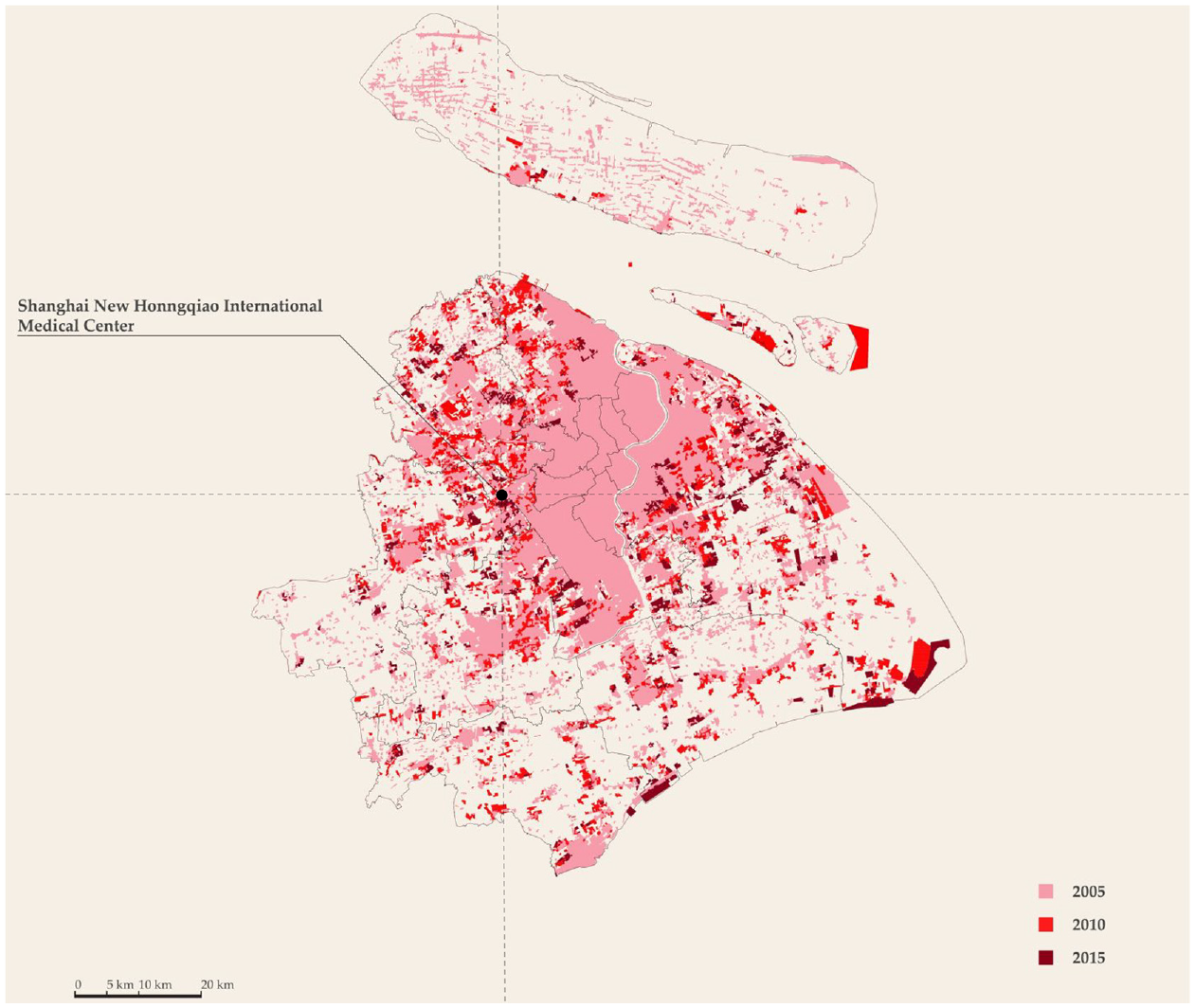
The built area of shanghai metropolitan region (2005, 2010 and 2015) and the location of the HIMC.
Economically, the HIMC is an instrument to capture growth opportunities since the Minhang District government aspires to transform the local economy from an industrial one to a service-driven one through regional healthcare tourism. Similar to the medical cities in other countries, the HIMC acts as a regional pole that boosts the local economy through the provision and consumption of high-end healthcare services in China’s niche healthcare market. Furthermore, according to the interview with Jie Yang, the chairman of the HIMC, the conception of the HIMC was based on the experiences of the Texas Medical Center which celebrates the privatisation of healthcare services and the agglomeration economy of the healthcare industry. 2 As a result, the HIMC was planned as an aggregate of specialty hospitals that captures economic growth through the provision of high-end services.
Among the eight hospitals at the HIMC (see Figure 2), six are private specialty hospitals: the Luye Ellium Cosmetic Hospital, the Fudan StarKids Children’s Hospital, the Ci Hong OBB/GYN Hospital, the Concord Cancer Hospital (in collaboration with the MD Anderson Cancer Center) and the Lanhai Rehab and Orthopedic Hospitals. The Huashan Hospital West Campus is a branch of a public general hospital, and the Parkway Hospital is a private general hospital. The HIMC’s proximity to the Hongqiao Railway Station and Hongqiao International Airport transport hubs also enhances its accessibility as a ‘medical hub’, allowing it to benefit from the healthcare market and hence patients in the Yangtze River Delta. Although the current medical city (phase one development) is only based on the provision and consumption of healthcare resources, phase two development will include pharmaceutical headquarters and biotech research institutions.

The medical institutions inside the HIMC (some still under construction).
Based on these characteristics, state entrepreneurialism is elaborated in the governance of the HIMC. The empirical investigation focusses on the public–private partnerships with which the state legitimises and leverages the private sector to operate through the market. The investigation has two objectives. The first objective is to discuss the privately-developed publicly-operated model (PDPO) through which the state legitimises the private sector. The second objective is to unfold the stakeholding structure in the HIMC, in which the state diffuses its power to the private hospitals through quasi-governmental agencies since stakeholding is an important instrument for the state to manage urban governance (Feng et al., 2022). Responding to the objectives, this research employs a mixed-method study. First-hand empirical evidence includes open company data and expert interviews with key personnel in the HIMC. The data is collected from Baidu Ai Qi Cha, or Baidu Enterprise Credit, which is a big data platform established by Baidu to profile companies in China for investors. The data is analysed to articulate the developers and operators in the PDPO and profile the stakeholding structure. The research also draws evidence from secondary materials, including policy documents and media reports to substantiate the deductive analyses.
Legitimising private hospitals with public operation
Table 1 captures the essential information about the hospitals in the HIMC. Among the eight hospitals, the Huashan Hospital West Campus is a public tertiary hospital directly administered and operated by the National Health and Family Planning Commission. It is affiliated with the Shanghai Medical College of Fudan University. It was designed as a hospital with a ‘strong capacity as a specialty hospital and a minimum capacity as a general hospital’ (Shanghai Hongqiao, 2017), serving as the clinical medical centre (teaching hospital) for the neurosurgical department of Huashan Hospital’s main campus. The reputation of this ‘public’ general hospital helps to attract patients. Since its opening in June 2018, the hospital has received more than 150,000 patients, of which more than half are non-Shanghai medical tourists (Shanghai Minhang District People’s Government, 2020). The other general hospital is Parkway Hospital owned by the IHH healthcare group, which has the second-largest market value in the world. The Parkway Hospital mainly serves foreign expatriates in Shanghai who seek high-quality healthcare services and are willing to pay through private insurance or out-of-pocket. 3
The developers and spatial characteristics of the hospitals in the HIMC.

The remaining six institutions are private specialty hospitals managed under public–private partnerships (see Figure 3 for architectural renderings of these hospitals). An important finding on the public–private partnerships is the PDPO (privately-developed publicly-operated model), or min jian gong ying. In PDPO the private sector develops the hospital, but the public sector (public hospitals) operates the hospital. In the HIMC, except for the two general hospitals, three of the six private specialty hospitals are self-developed and self-operated. They are the Luye Ellium Cosmetic Hospital, the Concord Cancer Hospital and the Lanhai Rehab Hospital. The others three hospitals are operated by the public sector. The Lanhai Orthopedic Hospital is operated by the sixth hospital affiliated with Shanghai Jiao Tong University, which is a public tertiary hospital specialising in orthopaedics. The Fudan StarKids Children’s Hospital is operated by the Children’s Hospital affiliated with Fudan University. The Ci Hong OB/GYN Hospital is operated by the Obstetrics and Gynecology Hospital Affiliated with Fudan University.

Architectural renderings of the specialty hospitals in the HIMC.
The PDPO is essentially different from other public–private partnerships such as BOT (build–operate–transfer), in which the state allows the private sector to build and operate the property before returning it to the public sector. The PDPO instead highlights the uniqueness of China’s public hospital-dominant healthcare system. Because healthcare resources including branding, professionals, patients and technology are concentrated in public hospitals, they dominate the healthcare market. The PDPO mobilises the public sector’s healthcare resources for the private sector. From the public sector’s perspective, operating a privately developed hospital is an asset-light strategy to expand its services to more patients, thus generating more revenues. From the private sector’s perspective, having its assets operated by the public sector is equivalent to buying the brand of the public hospitals. This ensures the quality of services, builds the hospital’s reputation and attracts more patients. This is a win–win strategy between the public and private sectors. However, tension exists on two levels. Firstly, public hospitals in China are usually not-for-profit but private hospitals need to generate substantial returns for the investors. While public hospitals could sustain income by providing services to more patients at fixed prices, private investors need to figure out alternative income-generating strategies. Secondly, due to the dominance in healthcare resources and businesses, public hospitals have stronger leverage against the private sector during contract negotiations.
The PDPO reflects certain characteristics of state entrepreneurialism, and thus should be differentiated from Harvey’s (1989) notion of public–private partnership under urban entrepreneurialism (p. 8). Under state entrepreneurialism, the Chinese state defends its dominance through holding critical resources, including land and other administrative powers, to maximise the state-led interests through optimising and legitimising market operations (Wu, 2018). The PDPO reflects the state’s dominance in the provision of healthcare through state-funded and state-governed public hospitals. The state legitimises the private sector in the healthcare business by offering the state’s healthcare resources including doctors, physicians, equipment and technology to operate the privately developed specialty hospitals. Through this entrepreneurial governance, the state manages to promote and capitalise on consumerism in healthcare with the assistance of the private sector. Precisely reflecting state entrepreneurialism (Wu, 2018), the market instruments are invented not purely for the market interests of the private sector participants that constructed these hospitals, but rather for defending the state’s interests in advancing healthcare reform and promoting the local economy with the healthcare industry.
Diffusing the state power through stakeholding
State entrepreneurialism is also reflected by the stakeholding structure of HIMC (see Figure 4). The central pieces are the Shanghai New Hongqiao International Medical Center Construction Development Company (HIMC Company) and the Shanghai Hongxin Medical Investment Holding Company (Hongxin Company). According to Wei Liu, the general manager of the HIMC Company, the company is in charge of the master planning, project investment, provision of infrastructural services, operation and logistics of the HIMC (Zhu, 2021). The HIMC Company is 100% owned by the Shanghai Minhang District State-owned Assets Supervision and Administration Commission (Shanghai Minhang District People’s Government, 2019a). The Commission used the land as ‘state-owned assets’ to invest in the developments of the HIMC (Yang, 2020). The state thereby holds stakes in the private hospitals, so the hospitals become not entirely privately owned and will have to negotiate with the state’s interests.
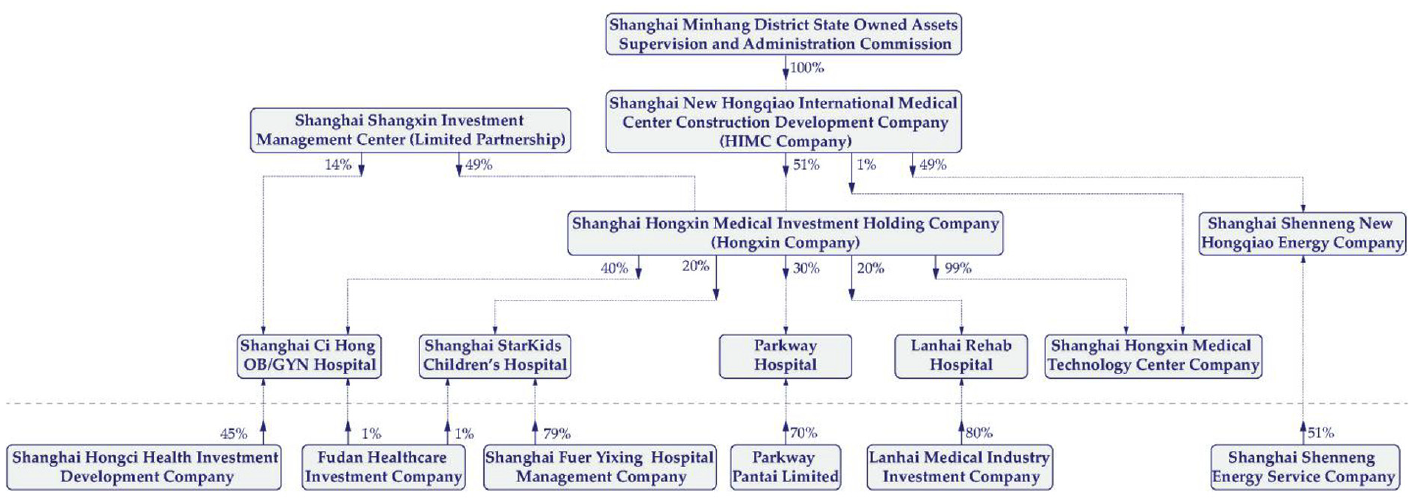
The stakeholding structure of the public and private sector participants in the HIMC.
Specifically, the HIMC Company holds a 51% stake in the Hongxin Company, which holds various stakes in Parkway Hospital (30%), Lanhai Rehab Hospital (20%), Ci Hong OB/GYN Hospital (40%) and Fudan StarKids Hospital (20%). The HIMC company is the majority stakeholder of the Hongxin Company (51%), and therefore is able to substantially influence the business decisions of the Hongxin Company. The Hongxin Company, based on its stakeholding in the hospitals, has substantial influence over the decisions of Parkway Hospital, Lanhai Rehab Hospital, Fudan StarKids Hospital and Ci Hong OB/GYN Hospital. At the same time, these four private hospitals also seek financial partnerships with outside investment companies including the Shanghai Shangxin Investment Management Center, the Fuer Yixing Hospital Management Company and Fudan Healthcare Investment Company to finance their development. With this stakeholding structure, the Minhang District government controls the HIMC company and Hongxin Company, which act as quasi-governmental agencies. The state’s power and control are diffused through the quasi-governmental agencies to the private hospitals. This technique is similar to the findings by Feng et al. (2022) on financialised urban governance in Shanghai. The shareholding of the state-owned Asset Supervision and Administration Commission of Shanghai legitimises the state’s power over the Shanghai Municipal Investment Corporation, which manages urban development. The stakeholding structure of HIMC enables the state to exert influence on the private sector, strengthen the governance of the medical city and operate through the healthcare market.
Figure 5 further maps the stakeholding structure on top of the spatial organisation. The Minhang District Government, through the establishment of the Shanghai Minhang District State-owned Assets Supervision and Administration Commission, diffuses its power to four hospitals: the Parkway Hospital, Ci Hong OB/GYN Hospital, Fudan StarKids Children’s Hospital and Lanhai Rehab Hospital. The state, by holding stakes in the private hospitals through the quasi-governmental agencies (the IMC Company and Hongxin Company), is able to influence, interfere, counter or even make decisions for the private hospitals. Therefore, these hospitals could be conceptualised as places where the public and private interests are negotiated, while the state’s interests remain dominant. Meanwhile, the HIMC Company is a fully owned subsidiary company of the Commission. It develops and manages the infrastructure of the HIMC campus, 4 while the developers of the hospitals also seek private sector partners for investment. The HIMC is, therefore, a publicly controlled but privately financed development, which reflects the dynamics of state–market dyads of state entrepreneurialism. As Wu (2020: 326) noted, the state is ‘proactively using market instruments for more strategic and developmental objectives in China’ and acts through the market rather than just being market-friendly. The Minhang District Government, which is a ‘constituent of the state apparatus’ (Wu, 2018: 1395), orchestrated the institutional and market legitimacy for the private sectors to engage in the development of the private specialty hospitals, which is further situated in the backdrop of the national goals of the healthcare reform.

The stakeholding and corporate structure represented in the spatial organisation of HIMC.
Therefore, the public–private partnerships presented in the HIMC reflect the principles of state entrepreneurialism, which does not aim to create a self-disciplined market driven by individualisation and consumer choice (Wu, 2018, 2020). Instead, state entrepreneurialism demonstrates an active process of acting through the market with quasi-government agencies such as the HIMC Company and Hongxin Company. The case study of HIMC thereby advances the existing discourse of state entrepreneurialism on China’s urbanism and development. Responding to the criticism expressed by Buckingham (2017), the assumption of a ‘retreat of the state’ in the Western literature may contradict China’s situation. The presence of an interventionist state ought to be characterised by a ‘rescaling’ process rather than a ‘retreat’ momentum, and the various financial instruments are adopted not solely for the market, but also for strengthening the state’s intentions and initiatives that transcend pure market consideration and profit accumulation (Zhou et al., 2019). The state does not ‘serve’ consumer choice in the healthcare industry. Instead, it stimulates the emergence of consumerism in healthcare with various governance strategies and actively capitalises on the consumer society. Therefore, the HIMC suggests a new direction of urbanism in China that should be interpreted as a strategy for the state and the market to negotiate and contest the new power relations (Lin et al., 2015).
Conclusion: Producing and governing future urbanism through the medical city
This research uses the literature on state entrepreneurialism to situate the medical city in China’s urbanism. State entrepreneurialism is a respondence to the global neoliberal movements that brought decentralisation and marketisation which fundamentally reshuffled the state–market relations. However, it is to be differentiated from urban entrepreneurialism in Western literature which emphasises the hollowing out of the state (Jessop, 2000). Instead, it highlights the process of state ‘rescaling’ through various market-orchestrated market instruments to closely engages in the production–consumption dyads in the contemporary Chinese urban society (Brenner, 2004; Wu, 2018). The rising consumer society in China is enabled by market-oriented reforms and the restructured central–local relations that push local governments to capitalise on consumption activities in the urban society (He and Lin, 2015; Hsing, 2010). Particularly the rising consumerism in healthcare is a mixed result of the socialist legacies and market-driven reforms. At the same time, the state has been using governance tools to create the institutional and market legitimacy for the private sector to engage in the commodification of healthcare, which is intended to achieve the state’s interests in advancing healthcare reform.
Focussing on the state–market dyads in the theory of state entrepreneurialism, this paper argues that the medical city consisting of private specialty hospitals is a state-orchestrated space that, on the one hand, reconciles the state–market interests, and on the other hand, capitalises on the consumption of high-end private care. Specifically, the state promotes privatisation and commodification of healthcare to reform the stymied public hospital system and at the same time promotes local economic development with healthcare businesses. This offers valuable insights into the current literature on China’s urban development. Instead of assuming that the production of a medical city is simply fulfilling the state’s interests in branding and selling urban spaces based on the financialisation and commodification of land (Wu, 1999, 2002; Zhu, 2004), the medical city is a contested space that symbolises the new state–market interests and regional spatial reconfiguration (Vogel et al., 2010).
The case study on the HIMC offers insights to substantiate this argument. As a state-led project, it was conceived to advance healthcare reform and capture economic opportunities. But the implementation requires multiple spatial governance strategies that involve both the public and private participants. Firstly, in the PDPO, the state legitimises the private sector practice by offering its state-owned healthcare resources in public hospitals to operate the privately developed hospitals. Secondly, in the stakeholding structure, the state holds stakes in the private specialty hospitals through quasi-governmental agencies, so these hospitals are not entirely privately owned and the state diffuses its power over them. Therefore, the public–private partnerships in the HIMC are different from Harvey’s (1989) notion of urban entrepreneurialism. The strong presence of the state in the market operation promotes consumerism in healthcare, conceives the HIMC, encourages private sector participation and orchestrates the public–private partnerships, reflecting the characteristics of state entrepreneurialism. However, there are limitations to this research. The stakeholding information cannot fully describe firm-level interactions between the public and private institutions. Further research could focus on the specific negotiation techniques between private hospitals and quasi-governmental agencies.
In conclusion, the research findings suggest that the medical city in China is a result of the entrepreneurial state capitalising on consumerism in healthcare to secure the state’s aspirations. In this process, the state collaborates with the private sector through various innovative market instruments. Adding to the existing discourses on China’s urbanism and entrepreneurial state that revolve around urban (re)development strategies with land, housing and gentrification, the medical city extends the discussion to the health sector and makes an association between urbanism and the consumption of healthcare. It implies an urban future in China while also highlighting several fundamental debates in governing China’s urbanism – state–market interests, production–consumption dyads and public–private participation.
Footnotes
Acknowledgements
The paper is developed from a chapter of my doctoral dissertation ‘The Civic Value and Economic Promise of Medical Cities in the United States and China’, completed at the Harvard Graduate School of Design. I am grateful for my committee members’ encouragement, guidance and feedback along the way. I especially thank Camille Hao from HSBC China for sharing her connections and making the interviews possible, and share my thanks to the interviewees who offered critical information and insights. All errors are my own.
Declaration of conflicting interests
The author declared no potential conflicts of interest with respect to the research, authorship, and/or publication of this article.
Funding
The author disclosed receipt of the following financial support for the research, authorship, and/or publication of this article: This study is supported by the Harvard Graduate School of Design DDes Research Grant, the Harvard Fairbank Center Summer Research Grant and the Harvard Fairbank Center Harvard China Fund.
