




Abstract
This article proposes the use of photojournalism to understand women’s urban mobility practices in contemporary Mexico City. Throughout the analysis, a variety of issues such as economic violence, time poverty and sexual harassment emerge. In general, the article argues that, by analysing the cultural representations that circulate within different media in a specific social and historical context, particular experiences of urban mobilities are made visible, thereby enriching current urban mobility scholarship. Specifically, the article explores how the analysis of material makes visible the various and distinct encounters that women experience when using public transport in Mexico City. The article makes the case that there is already plenty of scholarship within the humanities and cultural studies that could be integrated into existing research on urban mobility practices, enhancing our understanding of how such practices are distinct in particular locations and time periods, and ultimately helping to achieve a more complex and nuanced understanding of them.
Introduction
If ‘travel behaviour is [indeed] gendered’ (Olivieri and Fageda, 2021: 1), it is essential for transport and mobility scholars to find and use adequate tools to understand how these differences shape and impact mobility practices, infrastructures and resources. Sánchez de Madariga and Zucchini (2019) remind us that, even though there is over 50 years’ worth of research within transportation that has focused on gender, time poverty, the needs of women, household structure, etc., these studies have predominantly analysed structures and practices from the USA and UK, leaving the rest of the world in urgent need of situated research.
Some of the research that aims to address this gap is original not only for the geographical context but also for the methodological choices of analysis. Two notable examples are Thornbury’s (2014) and Singh’s (2017) explorations of gendered violence in Tokyo’s and Buenos Aires’ public transport. Through the analysis of cultural representations such as literature, cinema and drawings, both scholars review a well-known issue from an innovative perspective that adds cultural context and complexity to the issue. While Thornbury ultimately demonstrates how the short stories she analyses ‘contain hints of newly emerging interventions and choices, along with the possibility of a counter-hegemonic discourse in which women resolutely assert their agency on a rail system built by and mostly for men’ (Thornbury, 2014: 43), Singh concludes that: what we see here is a normalization of a form of abuse … Films show the lack of an immediate social condemnation and how harassment can be legitimated by laugh. Cultural history helps to understand how experiences of mobility were represented. (Singh, 2017: 95)
In a similar line, this article analyses women’s mobility practices through cultural representations. By exploring the use of public transport by women in Mexico City through the lens of Mexican photojournalism, this article answers two questions: why should urban mobility scholars consider the analysis of cultural representations as a form of exploration and understanding urban mobility practices; and which are the inputs that gendered perspectives scholarship provide when integrated to the analysis of these representations? Throughout the article, it is argued that current scholarship in mobility studies allows the incorporation of creative perspectives that enrich our understanding of mobility practices and transportation issues.
This article is divided in four sections. The first section explains why cultural representations can and should be used as a lens to analyse and understand urban mobility practices. The second section elucidates why photojournalism, among many different types of cultural representations, was chosen to analyse mobility practices within public transportation in Mexico City. The third section analyses the photographic material, discussing its selection criteria and meaning within the context of contemporary Mexico City. This section is in turn divided into three subsections that explore the various issues found throughout the analysis: mobilities of care and time poverty, different manifestations of social violence and responses to gendered violence. Finally, the fourth section concludes the article by making the case for the integration of the analysis of cultural representations into mobilities and public transport research.
Thinking urban mobility through cultural representations
According to Jones (2016), there have been three stages in the evolution of the study of modern urban transport planning and policy. The first one, developed during the post-Second World War years, was dominated by urban motorway-building rhetoric in which private motorisation was a priority. In the second one, the focus of study changed from vehicle flows to the movement of people. Discourses on sustainability and the quality of public transport emerged as a trend. The last one, ‘itself evolving’, is encouraging ‘a nexus approach to address urban transport issues … acknowledging the “place” as well as the “movement” functions of urban streets’ (Jones, 2016). A ‘nexus approach’, as Jones suggests, would therefore need new tools that had not been considered before to explore and understand urban transport planning and policy. Mobilities research has produced many of those necessary tools that have boosted new insights around urban mobility services (Bissell, 2018; Cresswell, 2006; Merriman, 2012; Sheller, 2018). By combining methods and epistemologies from the arts, the humanities and particularly the social sciences, mobility scholars have underlined aspects around urban mobilities that had long been neglected within transport research and practice, particularly for public transportation. Mobilities research is, hence, ‘about figuring out what fills that [imaginary] line, what makes it significant, what makes it socially important, rather than just something that you can measure’ (Cresswell, in Forum Vies Mobiles/Mobile Lives Forum, 2014).
One of the most important contributions of mobilities research to modern urban transport planning and policy has arguably been the creation of interdisciplinary arenas where different disciplines can converse about the social and cultural complexities of public transport use. In order to provide some more nuanced takes on what makes transportation in cities effective and desirable, mobility scholars have proposed a series of methodologies that seek to understand the journeys of individuals: ethnography (Tomic et al., 2015), ethnographic shadowing (Jirón, 2009), focus groups (Watts and Lyons, 2011), photovoice (Guell and Ogilvie, 2015) and history (Divall et al., 2016), among many others (Merriman, 2014). The lessons have been valuable: when everyday mobility practices are examined under a different light, new meanings and perspectives on uses of transport emerge.
Photojournalism as a lens to understand mobility practices in contemporary Mexico City’s public transport
With that in mind, I carried out a doctoral research project between 2015 and 2018 that aimed to study urban mobility practices in contemporary Mexico City through the lens of different cultural representations. The research argues that an informed and thorough analysis of the narratives produced by cultural products accentuates the understanding of human dimensions of urban mobility; emphasises cultural specificities and idiosyncrasies; and illuminates the perspective that different groups of people hold towards different modes of transportation. In the project, I analysed a corpus of different cultural products 1 that depict mobility practices and decided to use one type of representation per type of mobility. At the end, the research project observed automobilities and the use of the taxi as represented in cinema; walking practices as narrated in literature; and the use of public transport services as portrayed in photojournalism. The selection of the type of cultural representations, as well as the materials that were analysed, was informed entirely by the role that cinema, literature and photojournalism have played in Mexico’s cultural identity makeover throughout the last quarter of the 20th century. Given the different nature of each of the cultural products, I decided to analyse them all through a narrative approach with a special focus on voice and focalisation (Genette, 1988). In the case of the analysis of the photographic material, Gillian Rose’s observations on discourse analysis of visual materials (Rose, 2001) were also important during the analysis process. The result was a localised and contextualised reading of how mobility practices in Mexico City have changed in the last four decades.
For the case of the uses of public transport, the material produced within Mexico’s photojournalistic context was by far the most complex and nuanced. By ‘focusing on the unexceptional and quotidian’ (Mraz, 2009: 171), contemporary Mexican photojournalism has provided some of the most acute observations on different issues in the country since its consolidation as a way of news reporting.
It is generally agreed that contemporary photojournalism in Mexico emerged after 1976, when editor Julio Scherer along with 200 journalists were forced to leave the newspaper Excelsior. Among the national newspapers, Excelsior had been one that was most critical of the government, particularly since the 1968 student massacre (Sherman, 2015). Following his departure, Scherer founded Proceso, a weekly magazine that still circulates today in high demand, while journalist Manuel Becerra Acosta founded newspaper Unomásuno. It was in both of these news outlets that photography gained a new weight in Mexican journalism; it secured ‘a space, an opinion, a mobility of its own’ (Cuellar, in Mraz, 1996: 26; translation mine). Photographs of ordinary people in ordinary circumstances started to appear in said outlets too. More than ‘illustrations’ of any topic, these photographs accounted for the social conditions in which a large number of Mexicans lived. Take for example Elsa Medina’s Metro (Figure 1), which was featured on newspaper La Jornada’s back cover in 1988.
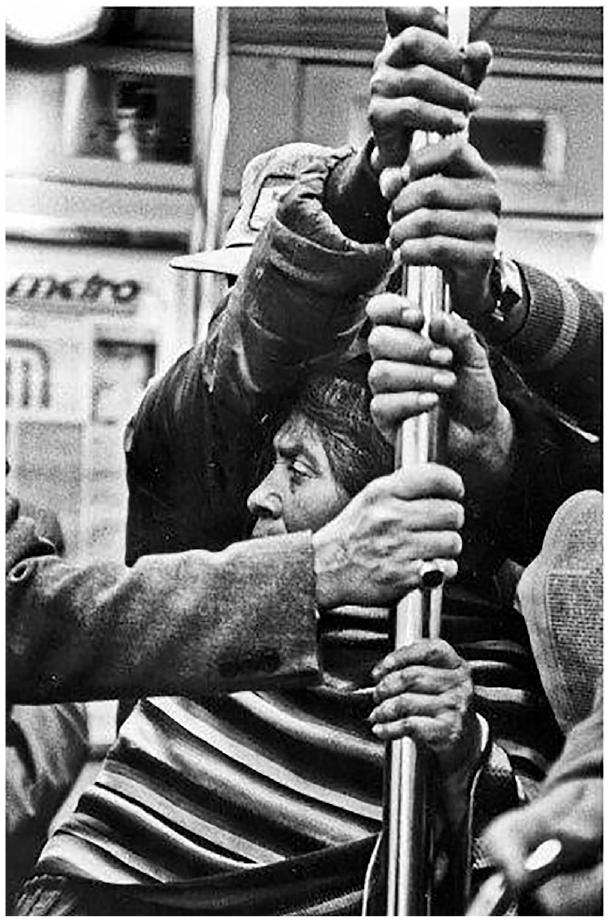
Metro, Elsa Medina, Elsa Medina Collection, © 1988.
The photograph shows an indigenous woman at the bottom centre who is holding tight to the pole of a visibly crowded metro train. Surrounded by hands which are also clinging to the pole, the hard gaze of the woman speaks volumes about how she has to navigate in such spaces. Unrelated to any particular breaking news, the featuring of this photograph in a prominent space of a newspaper accounts for the change that Mexican photojournalism went through after Scherer’s government-forced departure from Excelsior.
Women’s mobility practices in contemporary Mexico City
Understanding the uses of public transport in such contexts provides scholars of urban transport and mobility studies with a glance at a public service in a wide variety of its possible social and local-specific dimensions. It reflects the role that public transport plays in everyday urban life as an integral part of the city. In the case of Mexico City’s public transport, the analysis demonstrated that the different uses that citizens make of public transport underline the social importance of the service in the everyday life of the city. For a variety of different reasons, such as long travelling distances or lack of time to complete some activities at home, people in Mexico City use public transport as much more than just a system to move from point A to point B. The ways in which these spaces are used may be shared with other cities around the world, but the ever-changing nature of these practices, that respond to a series of political and social realities, shapes the commuting and travelling experiences of millions of people in Mexico City.
Mobilities of care and time poverty
As I presented my findings in different fora, 2 the photographs prompted a series of analysis, questions and observations that allowed me to deepen into themes that I had not yet considered. One of the most frequent observations was the number of photographs that showed women and the different activities they performed during their commute. Indeed, most photographs that had made the final selection for the thesis showed women in a variety of circumstances that determined the actions they could engage with or not. Many of these activities were directly or indirectly related to the notion of ‘care’, as intended by Inés Sánchez de Madariga, which is ‘mostly unpaid work carried out by adults having responsibility for children and other non-physically autonomous individuals, as well as those activities needed for the upkeep of the home’ (Sánchez de Madariga and Zucchini, 2019: 147).
In the last 10 years, Sánchez de Madariga has developed the concept of mobilities of care and, by collecting data using the concept of mobility of care – i.e. by acknowledging that the reasons for many journeys in people’s everyday lives are directly related to caregiving activities – has ‘roughly estimated that such trips might account for a volume, measured in the number of trips, close to that of trips linked to employment’ (Sánchez de Madariga and Zucchini, 2019: 148). In short, what scholars like Sánchez de Madariaga, Zucchini (2015) and Jirón (2010) are suggesting is to bring ‘the notion of care to the forefront of transport research and policy [to …] allow us to challenge existing gender biases in both the construction of knowledge and the policy decisions that derive from it’ (Sánchez de Madariga and Zucchini, 2019: 150). The inclusion of the notion of care in transport research would have a significant social impact on everyday life. As Turner and Grieco (2000: 119) explain, ‘[w]omen are time poor as a consequence of the disproportionate level of household tasks they are required to perform within present social structures’.
Take, for example, Francisco Mata Rosas’ photograph of a woman putting on mascara (Figure 2). By her clothes, her watch and the man sleeping in a coat sitting next to her, the viewer deduces that she is heading to work.

Woman Putting on Make-up, from ‘A Journey’ series, Francisco Mata Rosas, © 2011.
During the investigation for my doctoral project, I noticed that the most common type of photograph of women on public transport is of them putting on make-up. This practice is a clear example of how women in Mexico City tend to use their travelling time to carry on with activities they could not finish at home. Of all the images available, Mata Rosas’ photograph was the best example of this.
In the photograph, a woman and a man perform domestic-like activities. On the one hand, she is putting on make-up and even feels comfortable enough in this space to have a large hair roller hanging from her fringe. On the other hand, he is having a nap, taking advantage of the seat he could grab that morning. What Mata Rosas’ photograph seems to be suggesting is that no one on the Metro commute will judge the performance of such domestic practices; it is likely that the person sitting next to you is also enacting their own. However, reconsidering the photograph from the perspective of mobilities of care, it gains a new dimension.
As in many other countries (Casas et al., 2019; Jirón, 2010), in Mexico it is women who make sure the children are ready to go to school. They are also the ones who make sure that everything is ready for everyone in the family to leave early. They alone tend to take care of the breakfast, dressing and in many cases transportation for children. That leaves them little or no time to get ready themselves for their own activities.
The time dedicated to care work deserves greater attention (Sánchez de Madariaga, 2009, 2016; Hernández and Rossel, 2015; Jirón, 2017; Segovia, 2016), because it has severe implications for people’s mobility and interdependence. Traditionally, the tasks associated with caring for others are invisible in their contribution to economic and social development (Segovia, 2016). Who takes care of the care work? And how do they do it? What implications does this have? These are relevant questions for urban studies to advance in a gender perspective on the city, which contributes to advancing towards gender equality. (Jirón and Gómez, 2018: 59; translation is mine)
Whilst both people in the photograph are getting the best out of their travelling time, she is the one doing the extra activities she did not have time to perform at home. There is one element that allows this interpretation: the hair roller hanging from her fringe. The roller clearly implies that the woman is not ‘retouching’ her make-up, nor performing an act of morning self-care. While the roller suggests that she had no time to do her hair at home, the assuredness with which she is holding her mascara and mirror implies that she has mastered the application of make-up while using public transport. But not only that; the same activity – women putting on make-up on public transport – is the most common activity performed by women caught on camera. This suggests that women in Mexico City are compensating for the time they use for other activities by getting the best out of their travelling time.
From this perspective, the meaning behind one of Sonia Madrigal’s photos from her series ‘Dead Times’ is particularly upsetting. Originally posted on Instagram, a common tool among both well-established and young photojournalists in Mexico, Sonia Madrigal’s photograph of a window of a combi in Mexico City’s periphery reads as follows: ‘This is not a dorm, nor a phone booth, nor a beauty parlour’ (Figure 3).
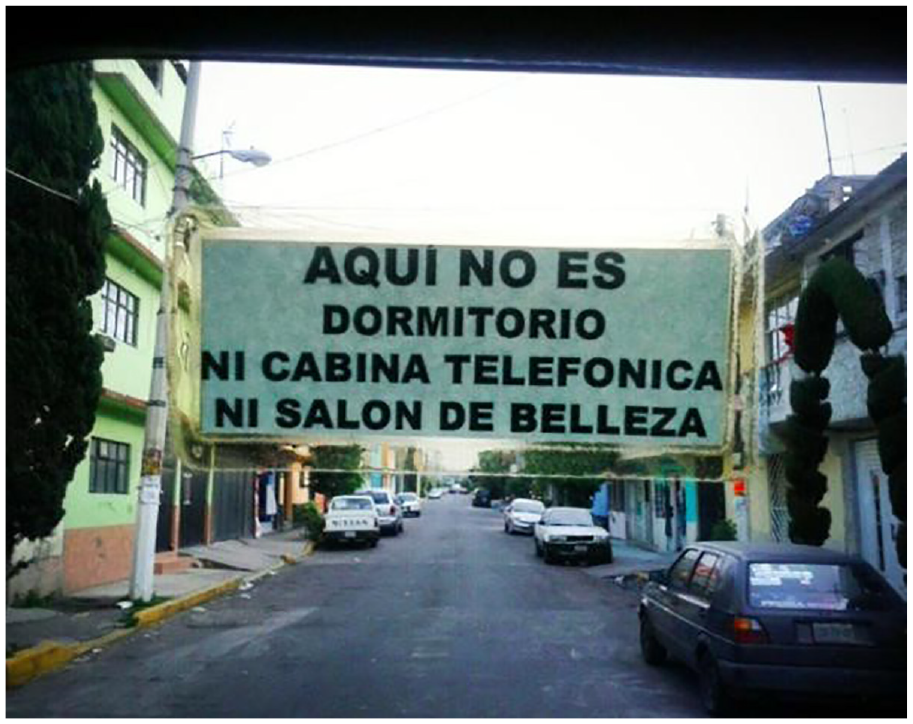
This Is Not a Dorm, from ‘Dead Times’ series, Sonia Madrigal, © 2015.
The series ‘Dead Times’, a photo essay that explores the long travelling journeys of Mexico City’s metropolitan inhabitants, depicts exhausted bodies taking time from their travel to take a break: young people laying down on a Metro station floor, couples holding hands around bus terminals, people staring out from the windows of combis and peseros. In this context, the ‘This is not a dorm’ sign is both a sympathetic gesture from Madrigal towards the users of jitney services and a criticism towards a government that has been unable to offer its population a reliable, affordable and safe transport system.
Jitney services such as microbuses and combis are problematic not only because their business model forces drivers not to prioritise investing in and maintaining efficient units, but also because they have served as vehicles for petty crime and even kidnapping and murder (Vilalta, 2011). But in many parts of the city, and particularly in the metropolitan area, these are the only services available to move around. As shown in INEGI’s (2017: 10) origin–destination poll, over 83% of journeys by public transport in the whole metropolitan area are made using a type of bus service, which is likely to be a jitney service.
Exposed to and safe from violence by design
Citizens have developed different strategies to overcome the difficulties that jitney services entail. While this is true for all of the population, it is particularly unavoidable for women in Mexico (Dunckel-Graglia, 2015), as demonstrated by a black-and-white photograph of two women taken by photographer and filmmaker Ernesto Méndez (Figure 4).
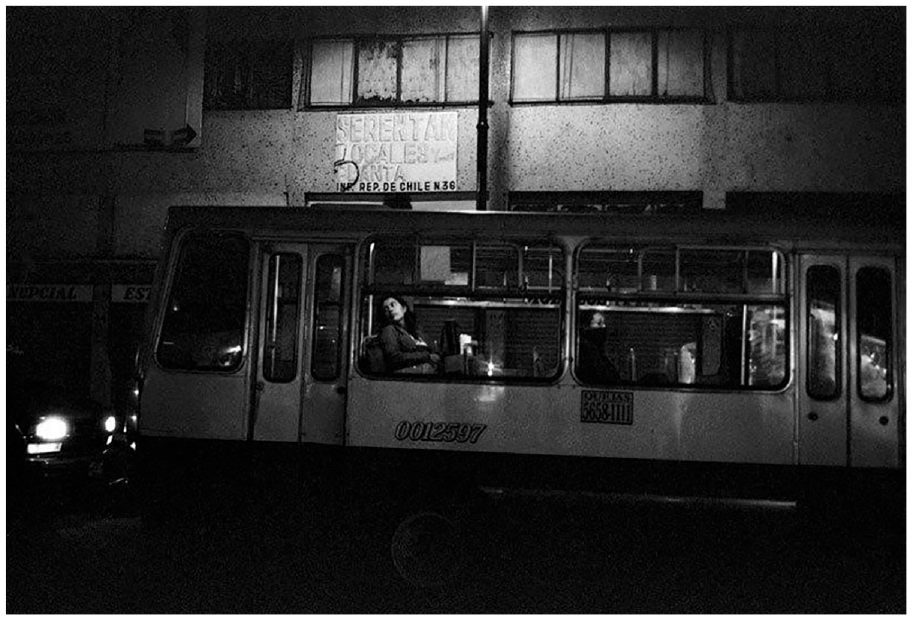
Two Women Inside a Pesero, from ‘Bus’ series, Ernesto Méndez, © 2014.
In the photograph, one of the women stands rigidly with her gaze focused on what is ahead on the road. The other one, instead, seated just two places behind the first, is looking anxiously behind her. The reason for her curious gaze is unknown, but in the context of the photograph it is highly relevant: whatever made her turn her head back triggered in her a state of alert that will not allow her to ‘relax’, let alone ‘enjoy’, the rest of her commute. Méndez’s photograph is a particularly good example of what Mexican photojournalism stands for: the non-‘picturesque, condemning or sensationalist’ (Mraz, 1996: 16; translation mine) glance that aims to tell a social story. In the photograph of the two women riding a pesero, there is a story of gendered violence in the form of stress and the fright of having to be in a constant state of alert.
Gendered violence is unquestionably one of the most pressing issues in Mexico. Between January and June 2020 alone, 489 femicides were officially recorded (Juárez Piña, 2020: 2). By not acknowledging how these encounters continually modify the mobility practices of millions of women in Mexico City, government entities are not only not addressing issues that directly affect half the population of the city; they are failing to understand the extent to which this issue is a global problem. As Col·lectiu Punt 6 (2019: 179) has observed with regards to gender-based violence: … [it] is another element that conditions our mobility. Harassment, sexual assaults, and the perception of security affect how we feel when we go through different places at different times of the day. Our mobility is more sustainable during daylight hours, but at night it is substantially modified, conditioned and even paralyzed by the fear of being sexually assaulted. (Translation and emphasis mine)
Gendered violence is clearly a problem that exceeds any mobility agency. However, the ways in which it affects the mobility preferences of half the population in a community should always be considered during transport and infrastructure planning (Levin and Faith-Ell, 2019).
The precarious conditions of jitney services, which have gained territory since 1995 when the city government terminated Ruta-100– an efficient and subsidised bus service that operated all over the city – explain the popularity of Metrobús, a Bus Rapid Transit service that was launched in 2005 under Andrés Manuel López Obrador’s term as mayor of Mexico City. The first Metrobús line ran across Avenida de los Insurgentes, the largest and one of the most important roads of the city. In its first year, it spanned over 19 km across 37 stations and reduced ‘travel times … by 40 percent’ (Flores Dewey, 2018: 16). Clean, spacious, with clear stops and routes, Metrobús was a game-changer in the everyday life of the city. It has also been one of the most successful implementations against environmental pollution. By improving traffic movement in the avenues in which it operates, it has re-shaped the commercial and social life of such streets (Flores Miranda et al., 2015: 39).
In 2015, to commemorate its 10th anniversary, the government of the city exhibited on fences in Chapultepec Park a series of photographs celebrating the Metrobús service; the exhibition was turned into an art book, the printing of which was limited for the consumption of key stakeholders. Some of the photos were taken by well-known documentary photographers such as Yvonne Venegas (Figure 5).

Metrobús Window, from ‘Metrobús 10’ series, Yvonne Venegas, © 2015.
One of the things that Venegas’ photograph captures well is the way in which the city is seen from the window of a Metrobús. As symbolic as this might seem, the power of this action should not be underestimated. For millions of people around the world, the relationship they create with their urban spaces is constructed through the daily interactions they have with the city whilst commuting on public transport. For the residents of Mexico City, this is an undeniable reality as the average commuter spends up to two hours a day commuting (Ciudadanos con visión, 2012: 15). If these hours are filled with fear, uneasiness and discomfort, there can be no surprise that the attention given to the city perceived from the window will be relegated to second or even third place. What Metrobús achieved with better spaces for the daily commute and a faster and more reliable service was the possibility to see the city anew, and, on top of that, the possibility of seeing how the city was effectively changing.
Yvonne Venegas’ photograph suggests just that. The photograph does not pay attention to the conditions inside the Metrobús, although this is vaguely suggested on the right edge of the photograph (available spaces to sit, and large, clear and clean windows to look out of). The photograph shows instead how the city centre – always busy with the movement of hundreds of thousands of people – is seen through the window of the Metrobús, from the inside, as it moves along. The city outside looks clean, with enough space to take a stroll and enough services to move around.
There have been different governmental efforts to address the needs of women while travelling on public transport, but so far most of these have been insufficient (Dunckel-Graglia, 2013b). In that sense, Venegas’ photo, presented in a beautifully edited book for the same planners and public servants who introduced women-only sections on public transport as a solution, 3 is also a pat on the back and a superficial recognition of the problem. On the other hand, the existence of these sections, and the images that circulate in the news and on social media about them, have encouraged public debate on their existence and have prompted a serious call for action (ONU Mujeres, 2017).
Responses to gendered violence on public transport
In this context, and thanks to new image-sharing platforms such as Instagram and Flickr, many young photographers have taken on the task of documenting with their mobile phone cameras the everyday around them, thus creating groups under single accounts or hashtags that have produced thousands of very interesting photographs. Such is the case of #vagondemujeres (women-only passenger car). Popularised by Instagram account @Metrochilango, a fan account dedicated to Mexico City’s Metro, the gallery that has formed in the last four years under this hashtag presents valuable material for investigation. The motifs are recurrent and many of them mirror what has already been discussed here.
However, since 2019, a new theme has emerged among the photographs that portray the mobility journeys of women in Mexico City; the interventions of feminist collectives into the spaces of public transportation. In tune with the feminist movements in Argentina and Chile, various Mexican feminist groups have taken over the streets to protest femicides, violence against women and in general the systematic subjugation of women under Mexican patriarchal society. The tone of the protests has changed in response to the reactions of some of the most conservative groups in the country. This has been manifested mainly through pintas (graffiti-like interventions on walls, monuments and shops) and material damage of some street furniture such as public transport stops and stations. An example of these interventions can be seen in Yaz Rivera’s photograph (Figure 6) taken in February 2020 during Ingrid Escamilla’s protests. 4
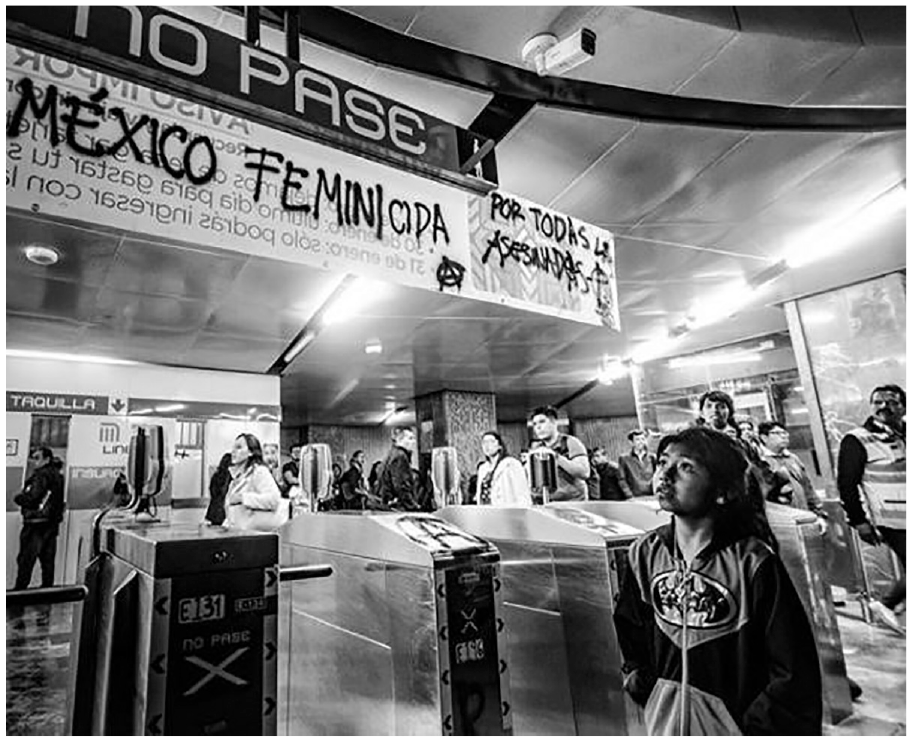
Mexico Femicide, from #vagondemujeres, Yaz Rivera, © 2020.
The photograph shows the inside of a Metro station featuring an intervention by one of the feminist collectives. On the sign that warns people not to enter (because turnstiles are only for the way out), someone has written ‘Mexico Femicide. For all those who have been murdered’, thereby creating the message ‘Do not Enter. Mexico Femicide’. Grouped in the right side of the photo, a dozen people are staring at something that is not portrayed in the photograph. A girl is standing at the forefront, in awe, trying to make sense of what is going on. If it were not for the interventions (pintas) on the premises, the service would carry on as usual. The photograph works as a painful reminder that changes in favour of women in society have been achieved primarily after women’s intervention in the public sphere.
The condition of many Mexican women as care takers, however, does not allow them to disengage from the activities without which a Mexican household would not operate. Children still need to be taken to the school; errands still need to be run. Hence, many women have opted for practices that are safer but less environmentally sound.
Rivera’s photograph is a testimony of how, tired of not being heard, women in Mexico, and in Latin America in general, are the ones taking action in different ways. As shown by the number of women actively engaged in mobility roles in politics and academia, either through activism or policy implementation, it is expected that the mobility experiences of women will come to define the future of urban transport planning. The role of mobilities research will be, as always, to propose the critical tools and the methodologies with which such changes can be assessed and implemented. Here, I have presented how materials that already circulate within established media can be used as a lens to understand the many layers of social complexity that public transport use entails.
Conclusions
As with several other megalopolises (Canitez, 2019; Williams and Arkaraprasertkul, 2017), Mexico City poses a series of challenges that affect the mobility practices of its inhabitants: insecurity, violence and deficient infrastructure are all too common issues that affect public transport users, particularly women. While these issues are well-known, their consequences for the everyday lives of citizens are often not properly envisaged. In order to improve our understanding, therefore, social issues require to be treated with approaches that do justice to their complexity.
This article made the case for the consideration of interdisciplinary approaches within urban mobilities research. In particular, it has argued for the exploration of urban mobility practices in contemporary Mexico City as experienced by women through photojournalism. Photojournalism was chosen amongst various forms of cultural representation for two main reasons: in the Mexican context, for historical reasons, photojournalist materials are always deliberately charged with political interpretations. The investigation around the production and circulation of these photographs proved to be relevant for understanding different observations of the role of public transport in the everyday lives of women in the city. In general, this article argues that integrating the analysis of cultural representations into current mobilities research provides unique insights and encourages critical debate around urban mobility practices and infrastructure.
The observations from the analysis raise a series of questions that should be addressed during transport planning and research processes. Why do passengers need to perform activities more common to intimate arenas such as dwelling places? Why do passengers need to use their time ‘smartly’ by, for example, putting on make-up or having a nap? Why must passengers commute long distances at early hours of the day? Why is there a need for a ‘women-only’ section? This does not mean that planners must answer these questions, or that they have to go against the ‘specificity’ of their job – creating efficient, affordable, reliable, environmentally responsible modes of urban transportation. It means that just thinking of the specificities of the job blurs the social use of public transport: it is not the same to plan a metro line for Copenhagen as it is for Mexico City; it is not the same to design pedestrian-only areas for Mexico City as it is for London.
It is important to underline that these questions emerged only after careful examination of a large corpus of photographs that had been compiled, studied and analysed. The reading of these photographs is not a mere personal interpretation of visual materials; it is an interpretation informed by the politics and social conditions of the city in question; it is an analysis informed by the history of the transport service and the history of the city itself. It is important to underline that photojournalism was one option among many other possible forms of cultural representations. If photojournalism was chosen it was only because Mexico City’s particular history has benefited this kind of representation when it comes to public transportation. Evidently, other cities might benefit from the analysis of cultural representations as found in different media.
One of the questions raised in the exploration of public transport services through photographs made by professional photojournalists is the risk of romanticising public transport through the selection of appealing photographs. My intention to explore public transport through photojournalism responds to the need to observe this service in all its possible social and local-specific extents. In the Mexican case, photojournalism does so quite adequately. Conversations around and presentations of this research have proved one thing: the analysis of cultural representations – in the form of photographs, cinema or any other medium – proposes a sincere conversation about public transport: its values, its perks and its contradictions. The exchange of experiences hence avoids any kind of romanticisation, as it encourages a nuanced approach to the services.
Footnotes
Declaration of conflicting interests
The author declared no potential conflicts of interest with respect to the research, authorship, and/or publication of this article.
Funding
The author disclosed receipt of the following financial support for the research, authorship, and/or publication of this article: This work was supported by Consejo Nacional de Ciencia y Tecnología, grant no. 400261.
