




Abstract
The sharp increase in and volatility of fossil fuel prices, due in particular to the Russian–Ukrainian conflict, is a powerful incentive for cities to accelerate their energy transition. Yet urban authorities have limited power over the construction of energy policies and the management of networks, and they remain dependent on remote and mainly carbon-intensive imported sources of energy. The recovery of waste heat from waste incineration or industrial emissions and its use in heating networks represents a solution for cities to control part of their energy supply, to develop their own capacities for action and to implement local transition strategies, in addition to the development of renewable energies. Based on the analysis of four case studies in France between 2019 and 2022, in the context preceding the current energy crisis, this article examines how cities are trying to develop waste heat recovery and the role this energy resource plays in the decarbonisation of urban energy systems. The analysis highlights that the emergence of these projects is more broadly part of the renegotiation dynamics of energy, ecological and economic relationships between cities and industries, and that their implementation results in the construction of new urban energy nexuses. The use of waste heat makes it possible to improve the energy efficiency of industrial and urban energy systems, sometimes significantly, but it must be seen as a transitional solution because it can temporarily increase cities’ dependency on high-carbon and energy-inefficient industrial activities.
Introduction
The economic recovery following the COVID-19 lockdowns and the Russian–Ukrainian conflict have led to a sharp increase in and volatility of fossil fuel prices. While in the medium term this situation may be an opportunity to accelerate the transition to low-carbon energy systems, particularly in Europe (Kuzemko et al., 2022; Osička and Černoch, 2022), in the shorter term it threatens the energy security of the territories most dependent on these fossil fuel imports, at the forefront of which are cities. Most cities lack the means and space to ensure their energy autonomy through the development of renewable energies (solar, wind, geothermal) and remain heavily dependent on external resources and highly centralised energy distribution systems (electricity, gas, etc.), over which they have little power (Lopez et al., 2019). In the face of the energy crisis, local authorities must develop new ways to extend their scope of action and energy production capacities and experiment with new technical, economic and political solutions in order to design and build post-carbon cities (Bulkeley and Castán Broto, 2013; Bulkeley et al., 2011, 2015; Hodson and Marvin, 2010).
One of the main energy challenges for cities is the production and supply of heat. In Europe, where half of the energy consumed is used for heating or cooling purposes (European Commission, 2016; Heat Roadmap Europe, 2017), heating represents a significant percentage of carbon emissions and energy consumption in urban areas. The development of heat distribution through district heating systems is therefore an important catalyst for action for urban communities in several ways (Hawkey et al., 2015; Webb et al., 2016). These solutions allow cities to act on the decarbonisation of their heating solutions, to develop their energy autonomy by reducing their dependency on external energy resources and, as a result, to provide price-controlled energy to their inhabitants that is less dependent on volatile international energy markets. Recent advances in the district heating industry are facilitating the inclusion of renewable and recovered energy, improving the energy efficiency of district energy systems and reducing the use of fossil fuels (Johansen and Werner, 2022; Lund et al., 2014).
While the possibility of producing renewable energy is limited in urban areas, cities generate significant amounts of energy ‘to be recovered’, particularly waste heat, which is attracting an increasing amount of attention. So far, the most developed form of waste heat recovery comes from waste incineration, in order to fuel district heating networks, to produce electricity, or both (combined heat and power, hereafter CHP). These practices, usually termed as ‘waste-to-energy’, as they result in intertwining waste and energy issues, have been studied through the lens of urban nexuses. While waste-to-energy nexuses have definite advantages, they also carry the risk of locking in obdurate infrastructural systems (Monstadt and Coutard, 2019) fed by continuous waste streams (Behrsin and De Rosa, 2020; Corvellec et al., 2013; Florentin, 2017). Yet refuse is not the only waste heat source available in urban areas. We can observe a diversification of recovery practices across urban services and facilities – data centres, the underground, wastewater treatment systems (Lygnerud and Langer, 2022; Sandvall et al., 2021) – as well as an interest in energy generated by industrial activities. Attempts to capture industrial waste heat as a local urban resource renew analyses of industrial symbiosis (Södergren and Palm, 2021), as well as responding to the need for ‘a more resource-sensitive metabolic turn in [urban] infrastructure studies’ (Coutard and Florentin, 2022: 50).
New infrastructures and organisational solutions are required to connect industrial waste heat sources to district heating networks, calling for new alliances between different players, especially between urban authorities and industries. This dynamic could foreshadow the emergence of new kinds of energy nexuses, between cities and industries, which would displace, redefine or even reconfigure those established around waste-to-energy. To test the question of the reconfiguration of urban nexuses around waste heat, this article studies and compares four French metropolises that are turning to their industries to power their district heating network and to contribute to their energy transition policy. The analysis is based on data collected as part of a research project carried out between 2019 and 2022. Fifty-one semi-structured interviews were conducted at the national level with government representatives, energy operators and various experts, and at the local level with industrialists, technical and elected officials from local authorities, and heat network managers. The analysis also includes documents relating to heat recovery projects (planning schemes, technical and economic studies, contracts).
The first section grounds the question of industrial waste heat as an energy resource capable of reconfiguring urban nexuses. In the second section, we explain how the feeding of urban heat networks by industrial waste heat is encouraged by public policies at the European level as well as by some local authorities. The third section is devoted to the analysis of projects and policies implemented in four cities (Dunkirk, Grenoble, Lille, Lyon). In the fourth section, the results from the case studies are discussed with regard to the emergence of links of (in)dependence between actors involved in waste heat recovery, and the possible shift from waste-to-energy to waste-energy-industry urban nexuses. Given its temporality, the research sheds light on a situation prior to the current energy crisis. However, in the conclusion, we highlight the implications of our results in the context of an energy crisis that is likely to last for some time.
Decarbonising heating systems and recovering industrial waste heat: A key issue in the transformation of cities
Within the European energy market, cities seem to have little capacity to act on energy policies and energy networks. Nevertheless, in parallel with the construction of this energy market, local authorities have developed expertise on climate and energy issues thanks to the dissemination of good practices by large, well-established international networks such as Energy Cities or the Covenant of Mayors (Emelianoff, 2014), as well as reforms of central–local governance (Poupeau, 2014). Although local authorities have very limited control over the production, distribution, pricing and use of energy, heat networks remain privileged instruments for acting locally. Heating and cooling are essential sectors in which local authorities have a real capacity for action and for which they can rely on specific networks for sharing knowledge and experience (e.g., the Celsius City programme). Despite their uneven development at the European level, many communities are expanding, renovating or creating district heating networks from an environmental and social perspective (Rocher, 2014; Tingey and Webb, 2020; Webb et al., 2016). The renewed interest in these infrastructures is accompanied by the desire to mobilise locally available resources, in particular recovered energy. District heating systems, whose infrastructure characteristics form part of debates about the post-networked city (Coutard and Rutherford, 2011, 2015), are also interesting in terms of the resources that service provision relies on.
Metabolic attention to resources, which is relatively neglected in the literature on urban infrastructure (Coutard and Florentin, 2022), has been taken into account in industrial ecology approaches. The development of these approaches from the 1970s onwards laid the foundation for what is now known as the circular economy. Models for regulating the flow of energy and matter were established in order to better control the environmental externalities of industrial societies (Erkman, 1997; Kneese et al., 1970). Like the emblematic case of Kalundborg in Denmark, symbiosis practices have been initiated by industrial players who find an economic and ecological interest in collectively exchanging and regulating their flows of resources and waste, and specifically of industrial waste heat (Jacobsen, 2008). These symbiotic exchanges have remained largely confined to industrial sites, although local governments are becoming more involved in regulating industrial symbioses (Södergren and Palm, 2021).
Territorial industrial ecology (Barles, 2010) focuses on the flows of matter and energy at the territorial level, drawing inspiration from the urban metabolism, itself built around a plurality of methodologies and complementary research questions (Newell and Cousins, 2015). These approaches invite us to think of cities’ spatial changes as processes that are simultaneously political, economic, socio-technical and socio-ecological, as well as processes of flow reorganisation (Bahers et al., 2022). These contributions to the field of territorial industrial ecology highlight the fact that the current development of the circular economy calls for a rethinking of the spatial footprint of certain practices, in particular those relating to energy, which result from the linear economy and the widespread use of fossil fuels. In a system characterised by the intensive use of fossil fuels and the internationalisation of energy markets, cities’ energy supply distances have greatly increased (Kim and Barles, 2012), consolidating relationships of dependency on increasingly distant hinterlands (Bahers et al., 2020). Cities’ interest in heat recovery is part of a desire for, if not complete autonomy, at least the relocation of energy flows (Lopez et al., 2019). Links between heat producers, distributors and users are creating new relationships between sectors of activity and stakeholders who were previously unaware of each other.
Increasing references are being made to the concept of the urban nexus to account for symbiotic operations and the interface between various flows and activities. The combinations of waste/energy, (waste) water/energy and water–energy–food are the most common and widely studied forms (Artioli et al., 2017). According to Monstadt and Coutard, ‘the study of the interconnectivities, interdependencies and multiple interfaces and hybrids between infrastructure domains is of critical interest to urban studies’ (Monstadt and Coutard, 2019: 2192). The need for a political and critical approach to nexuses is also emphasised, in order to avoid focusing solely on the aspects of synergies that are considered to be virtuous insofar as they contribute to circular metabolisms. Waste energy recovery, which has been practised for a long time and is encouraged by European and national policies (Rocher, 2020), is particularly concerned by the risk of destabilising local recycling economies (de Bercegol and Gowda, 2019) and of infrastructure lock-in, which would lead to long-haul waste transfers. Such situations have been documented in relation to the importation of waste for incinerators supplying local heating networks in several European cities (Behrsin and De Rosa, 2020; Corvellec et al., 2013; Florentin, 2017).
By focusing our attention on the use – or attempted use – of industrial waste heat sources, we seek to identify to what extent the emergence of industries as providers of heat is likely to reconfigure established nexuses. Industries, as well as cities, have long relied on national providers to fill their own energy needs. Therefore, whereas local authorities and industries have built long-lasting relationships (and tensions) on economic and employment issues, as well as on various environmental concerns such as air quality, energy is not a usual matter of interaction between them. Despite a consensus about the common interest in recovering waste energy, its capture and distribution through urban infrastructure encounters a series of difficulties and raises unresolved questions. Before examining how such issues are addressed in specific urban situations, the following section focuses on the contextual elements drawn from the European and national levels that frame how recovered resources can be mobilised at the local level.
Waste heat recovery in the European and French context: A matter of changing public policies on energy and cities
The pace at which industrial heat recovery and the development of concrete operations are being put on the agenda in France is essentially the result of three factors: the gradual adoption of a European framework for action, the implementation of national incentives for recovery, and the development of urban authorities’ expertise on these issues.
In Europe, the recycling of industrial heat has long been seen as a promising energy solution. However, although technical solutions have been available thanks to experimental projects since the beginning of the 20th century, low energy costs have hampered their development (Bergmeier, 2003) and the adoption of larger-scale public policies (Commission of the European Communities, 1982). Within the framework of the adoption of the third legislative package on energy efficiency in 2012, Europe is committed to the development of industrial waste heat recovery (Fontaine and Rocher, 2021a). This commitment takes three forms. Firstly, all new industrial installations of more than 20 MW are required to carry out cost–benefit analyses about the opportunity to recover waste heat. Secondly, the European Commission urges Member States to establish heat demand and availability maps to facilitate the identification of suitable recovery operations. Finally, the Horizon 2020 programme provides funding for research, technological development and demonstration programmes around these issues. Regulatory texts now often add a reference to waste heat when renewable energy is mentioned, and the development of industrial heat recovery is now an important focus of the European strategy to decarbonise heating and cooling (European Commission, 2016).
In conformity with this European framework, France has put a series of measures in place to develop knowledge about waste heat and to encourage people to take action. ADEME and CEREMA, public expertise agencies respectively attached to the Ministry of Ecological Transition and the Ministry of Industry, have published national and regional maps and inventories of industrial heat since 2012 (ADEME, 2012, 2017). The governmental priority is to work on the efficiency of the processes to reduce thermal losses, then to recycle this heat on site, before supporting its recycling for district heating once the other options have been exhausted. For the latter option, three incentive schemes are available to support project promoters. The central element of this policy is the Heat Fund (Fonds Chaleur). Initially created in 2009, it has enabled the subsidisation of the construction of infrastructure for the recovery of waste heat since 2015. Operations for the recovery of industrial waste heat are also eligible for the incentive scheme of energy saving certificates (i.e., white certificates). Finally, district heating networks that consume more than 50% renewable and recovered energy benefit from reduced VAT, which gives them a competitive advantage over heating offers based on fossil fuels. Since 2020, France has increased the budget for these schemes and their incentivising nature by making them more easily cumulative (Ministry of Ecological Transition, 2019) and announced new budgets as part of its industry’s decarbonisation and economic recovery in the wake of the COVID-19 crisis. Next to that, a modification of the national CHP policy acts as an indirect source of increased attention for waste heat. Waste incineration plants have long benefitted from a highly remunerative guaranteed feed-in tariff for electricity production with 15-year purchase obligation contracts. In 2016, a new European rule on renewable energy put an end to CHP feed-in tariff contracts. These renewed conditions of access to energy markets completely changed the economic organisation of waste-to-energy. Incineration plants, which had previously favoured the production of electricity, started to turn more systematically to the recovery of heat, then available for heating networks.
The development of the recycling of industrial heat in France is also taking place in the context of a national decentralisation policy and urban agglomerations’ increased expertise and jurisdiction on energy issues (Dégremont, 2019). Following the adoption of two reforms (MAPTAM from 2014 and TECV from 2016), the management of heat networks, which had hitherto been the responsibility of municipalities, is now entrusted to metropolitan urban communities. The metropolitan – rather than municipal – scale appears to be better suited to the management of these infrastructures and to dialogue with industrialists, with a view to the recovery of their waste heat (Fontaine and Rocher, 2021b). In this respect, the development of waste heat is an important catalyst for action for urban communities to decarbonise their heating solutions, by quickly accessing significant heat deposits.
Energy and industry nexuses in the making: Four case studies in French metropolitan areas
The case studies on which the following analysis is based are located in two French administrative regions – Hauts-de-France and Auvergne-Rhône-Alpes – where the potential for industrial waste heat recovery is considered to be the most significant (ADEME, 2017). The selection of cases reflects emerging projects of industrial waste heat capture for the purpose of district heating in contrasting metropolitan and industrial contexts. Through chronological analysis of the decision-making processes, attention is paid to the local actors at the origin of the projects, and especially to the interests and motivations of public (local authorities) and private (industrial) actors. The analysis of the interplay between stakeholders highlights the differences in negotiation dynamics and the conditions for the alignment of interests between local authorities and industrial players of various sizes and from different sectors of activity, given that the investment needed to capture and distribute waste heat is most often unevenly shared amongst stakeholders. The evolution of the local energy mix (at the metropolitan scale) associated with these projects is another criterion of analysis. Each project is described with regard to its own temporality and its stage of completion. In fact, some of them have been abandoned, as no agreement regarding infrastructural and organisational solutions could be reached, while others are still in development. 1 All in all, they reveal an unprecedented dynamic regarding industrial waste heat recovery for urban purposes. They demonstrate tangible – albeit fragile and questionable – energy–industry nexus practices and policies in the making.
A balanced waste, industry and district heating synergy in Grenoble
The Grenoble–Alpes Métropole is an urban area of 450,000 inhabitants, in the heart of a mountain region. The agglomeration of Grenoble has the second-largest heat network in France, created in 1960, which is now 180 km long and heats 100,000 housing unit equivalents. This network has long operated on coal, mined in nearby mines until the 1990s, as well as on the incineration of household waste since the 1970s. The facilities are managed by a mixed economy company in which the local public authorities are the majority shareholders. During the 2010s, as part of their energy-climate policy, the urban authorities sought to accelerate the decarbonisation of the heat network, 50% of which was still being fuelled by fossil fuels in 2009. In addition, with the planned end of the feed-in tariffs for electric cogeneration, the local authority is looking for new outlets for heat from waste incineration, especially in the summer when heating needs are low. Studies are being carried out with local industrialists to make an inventory of the quantities of waste heat available and to identify opportunities for synergy with the district heating network.
The main opportunity for synergy lies in the proximity of the heat network to a chemical industrial area in the south of the city. The three chemical manufacturers on this site are willing to supply heat to the grid during periods of high demand, by reducing the flaring of gaseous residues, and to consume excess heat from the grid during the summer. Such a partnership had already been discussed several times since the 1980s without ever being consolidated in the form of a trade agreement. The industrialists and the local authority were never able to agree on a price for the sale of the heat and on who would pay for the investment in the heat transport infrastructure. Following an industrial crisis on the site in 2013, the discussions were revived by the local authority. On the verge of bankruptcy, one of the three industrialists attempted to reorientate its activity to become the site’s energy operator. It therefore became a key partner for the local authority, making it possible to carry out the project to recycle industrial waste heat.
The negotiations around the organisation of the project were consensual and led to the signing of a tripartite contract in 2017 between the industrialist, the manager of the heat network and the local authority. This contract covered the minimum quantities that each stakeholder undertook to purchase and the prices of the heat in the first years of operation. The connection of the chemical platform required a 2.6 km extension of the existing network, necessitating an investment of €7 million, which was shared between the public and the private sectors, with the project benefitting from a Heat Fund national state grant of €4 million. The work began in 2017, and the facility was inaugurated in 2019. From the first year of operation, heat exchanges were much more significant than had been foreseen in the contracts, in both directions, generating a profit for each stakeholder. The manufacturer sold 47 GWh instead of the 20 GWh forecast and bought 12 GWh instead of the 8 GWh forecast. The gain allowed the industrialist to sustain its activity and the local authority to lower the price of the heat delivered to heat network subscribers. The recovery of industrial heat combined with the development of renewable energies allowed players to put an end to the consumption of coal and fuel oil on the network and to optimise the seasonal recovery of urban waste. The three partners in the project have already agreed to significantly increase the heat exchange and to decarbonise further still.
Industrial heat in Dunkirk: New nexuses in the making
The Urban Community of Dunkirk is one of the main energy nodes in France. A substantial percentage of the fossil fuels consumed in France is imported via its port, where the largest nuclear power plant in Europe is located. Because of this strategic position, this area with 196,000 inhabitants is also an important industrial centre. Despite its current 17,500 industrial jobs – accounting for 24% of local jobs – the territory has been weakened by recent crises. It is now heavily dependent on a multinational metallurgy firm, the main employer in the area, whose long-term presence is not guaranteed. In partnership with this industrialist, the city of Dunkirk has become a pioneer territory in France for the recycling of industrial waste heat, which is the main source of energy for a district heating network built in 1985. This initial recovery, originally motivated by a desire to reduce the flaring of certain gases in order to improve air quality, made it possible to guarantee low heat prices for network subscribers. A new heat capture operation at the same site was commissioned in 2008. However, these captures represent only very small percentages of the available deposit.
In 2016, the Urban Community of Dunkirk decided to build a new heat network in a neighbouring town, connected to the original network. The project involved a 40-km-long network and a consumption of 140 GWh/year ensured at 90% by waste heat recovery on the metallurgical site. The industrialist agreed to deliver its heat at cost price but refused to contractually commit to sustaining this delivery. In order to make the project a success, the local authority and the chosen heat network manager agreed to bear the increased risk of the investment between them, the profitability of which would not be guaranteed if the industrialist left. The industrialist did not make a profit from this operation but maintained good relations with the local authority at a lower cost. Once this political choice was validated, the network’s construction work began in 2019 and was completed in 2020. The budget for the operation was €15 million, including €8 million in grants from the Heat Fund and €7 million in investment from the network manager. In the first months of the new network, an accident at the metallurgical site caused the delivery of waste heat to stop. In order to continue its operation, the manager of the new heat network had to quickly mobilise boilers from the neighbouring network at a much higher price. This put the network operator in economic difficulty, since it could not contractually pass on this additional cost to its subscribers. Thanks to its status as a leading national heat network operator, this company has been able to write off its losses, but it is likely to take fewer risks in the future when recovery projects are based on very unbalanced partnership relationships.
At the same time, the manager of the original network in Dunkirk conducted studies to diversify heat sources and reduce its dependency on the metallurgical site. Its main project was to create a synergy with a small family-owned agro-food industry group and an urban waste incinerator. Due to the end of the guaranteed electricity feed-in tariffs, the latter was looking for new markets for its production in the summer. The neighbouring industrialist then agreed to buy this heat in the summer and to contribute through a two-way exchange system to sell its excess heat in the winter. This agreement fell within the framework of this industrialist’s desire to develop a new energy production activity to sustain its economic model. Firmly anchored in the territory, it agreed to permanently and contractually commit to minimum quantities of heat for sale and consumption. The network development and the construction of a heat exchanger, supported by the three stakeholders and funded by the Heat Fund, were completed in 2019. This operation allowed for optimised energy recovery from waste and for the diversification of the network’s sources of heat, even though its functioning remains largely dependent on the metallurgy company, which in 2022 is not bound by any binding heat supply agreement.
Lyon, unattainable industrial waste heat
With 1.4 million inhabitants, the Metropolis of Lyon is the third-largest urban area in France. Legally responsible for the creation and management of heat networks since 2015, the Metropolis has set out to connect its four existing heat networks. These networks have a combined length of 185 km and deliver more than 700 GWh/year of heat to 70,000 housing unit equivalents. They are powered by two household waste incinerators and wood-fired boilers (more than half of the energy distributed), as well as natural gas. As part of its policy of developing and greening heating networks, the Metropolis is seeking to exploit the abundance of industrial waste heat in the ‘Vallée de la Chimie’ (Valley of Chemistry) in the south of the city, where an oil refinery and chemical manufacturers are located.
Since 2012, several studies have been funded by the urban authorities to measure the industrial waste heat deposit with the ambition of making the Vallée de la Chimie a ‘Metropolitan Energy Plant’. The identified deposit is 500 GWh/year, of which more than 200 GWh/year could be recycled under attractive economic conditions. After several exchanges between the Metropolis and the site’s industrialists – some of whom joined the process late in the day – the project as envisaged in 2021 consisted of creating an industrial synergy through a heat exchange network between the industrial players in the area, which would then be connected to the district heating system to distribute excess heat. Negotiations on this project, relaunched several times at the initiative of public actors, have stalled, with the exception of a new waste energy recovery unit, the first source of heat that would lead to further connections from neighbouring industries. Despite a commitment by the public authorities to cover most of the investments, notably thanks to grants from the Heat Fund, industrialists seemed reluctant to engage in contractual commitments. In a context of low gas prices, energy efficiency actions were not a priority for industrialists. In a more uncertain context of rising gas prices and carbon quotas, some of them prefer to consider individual solutions to reduce their energy bills.
From coal to waste: A heat highway to feed an extended network in Lille
The European Metropolis of Lille is an urban area of 1.1 million inhabitants. The agglomeration has seven distinct heat networks. These networks have a cumulative length of more than 100 km, provide heating for 50,000 housing unit equivalents and distribute about 480 GWh/year. Until 2017, these networks consumed 80% fossil fuels, including coal. In 2015, the Metropolis decided both to interconnect these networks and to put an end to the use of coal, using renewable and recovered energy instead. Thanks to its refurbishment, the town’s waste incinerator, located 25 km north of the city centre, which previously produced electricity, can now supply up to 350 GWh/year to the heat network.
In order to transport the heat from the incinerator to the heating network of the centre-agglomeration, the Metropolis decided to build a ‘heat highway’. The project was designed within the energy and waste departments, and its implementation and management were delegated to a project company comprising two private energy groups. The €80 m investment was covered to the tune of €52 m by the private group, and the rest was covered by public grants from the Heat Fund and the European Regional Development Fund. The agreements were signed in 2018, and the new facilities were gradually brought into operation in 2020 and 2021. The connection to the heat of the waste incinerator enabled the closure of the last coal-fired power plant in the agglomeration in 2021, and a 65% rate of renewable and recovered energy was achieved across the networks. This operation has reduced customers’ heat bills by nearly 30%.
According to the initial plans, the design of the heat transport infrastructure had to allow not only for the recovery of the waste heat available at the waste incinerator, but also for the recovery of heat from other industrial facilities along the network route. In this, the Metropolis wanted to facilitate the emergence of recovery projects without being limited by the capacity of the network. Negotiations had been initiated with an agro-food industrialist and a data centre manager with a view to capturing more waste heat. However, when the heat highway was put into service in 2021, local public authorities realised that heat deliveries were already limited by the capacity of the network, meaning that the connection of new heat suppliers and heat users would not be as fast as had been announced as well as being more costly.
Results and discussion
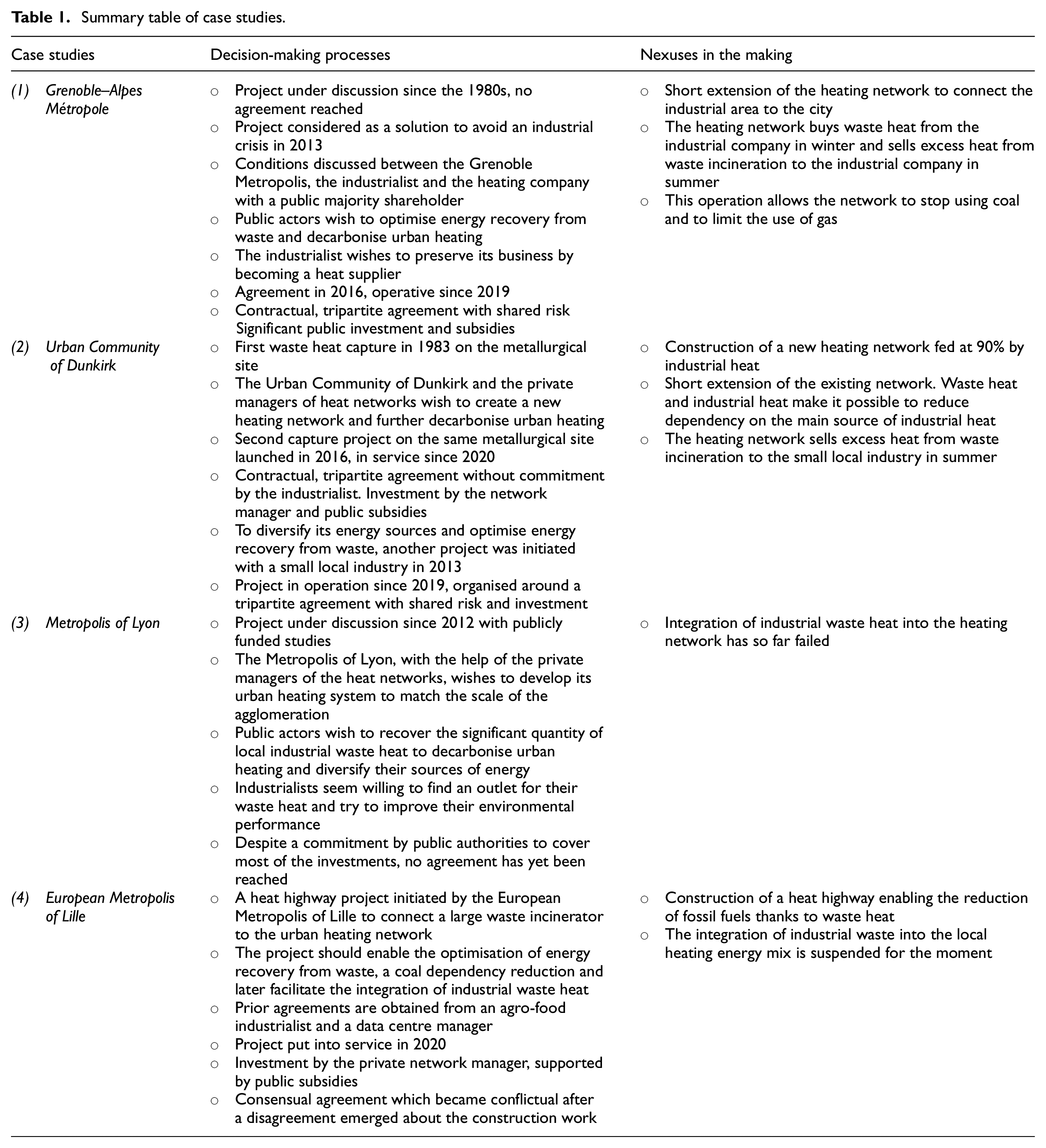
Cities try to seize waste heat recovery as an opportunity to accelerate their energy transition, more specifically greening their heating supply. As summarised in Table 1, the implementation of different forms of recovery has led to the construction of new kinds of energy nexuses between cities and industries. This research contributes to the understanding of the transformation of urban energy nexuses in a context of both evolving infrastructures (Coutard and Florentin, 2022) and more pronounced urban governance of climate-energy issues (Bulkeley and Castán Broto, 2013) resulting in redesigned urban metabolism patterns (Newell and Cousins, 2015).
Summary table of case studies.
From waste-to-energy to waste–industry–energy nexuses
In many cities, district heating systems are historically supplied by waste incineration units, forming what have been referred to as waste-to-energy nexuses. Energy recovery from waste goes back to the establishment of urban services constituting the ‘sanitary city’ (Melosi, 2004). These historical choices have laid out paths of infrastructural but also organisational and institutional dependency, insofar as urban authorities, in charge of heating systems and of the removal of waste, have been able to pilot jointly these services and related policies. But since the mid-2010s, the combined adoption of European and national measures to support the recovery of waste heat and the cessation of feed-in tariffs for the production of electricity from waste has initiated a transformation of these historical nexuses. However, depending on local contexts, these transformations take different forms and rhythms.
In Grenoble, the recent connection of the industrial site to the heating network makes it possible, in addition to waste incineration, to decarbonise the response to winter heat peaks while providing an outlet for the heat from waste incineration in the summer. In Dunkirk, the connection of the waste incinerator to the urban heating network allows for a diversification – and a better security – of the heat sources, provided so far by the main industrial plant. In Lyon, projects to recover industrial waste heat have so far failed. As a consequence, waste incinerators remain the main source for the district’s heating network. In Lille, industrial waste heat recovery is envisioned as a possible source once the available heat from the waste incinerator has been recovered through the heat highway.
These cases show forms of complementarity between the recovery of heat from the incineration of waste and the recovery of industrial waste heat. In most of the cases, previous experience in waste-to-energy schemes makes it possible to secure, optimise or simply facilitate the recovery of industrial waste heat. The connection of waste incineration units provides a security that counteracts the dependency on uncertain industrial sources subject to supply disruptions. In Grenoble and Dunkirk, energy nexuses between industries, incineration units and heating networks make it possible for each of the entities to provide or use heat, depending on their seasonal and daily activities, with this new complementarity making it possible to improve the energy efficiency of both activities. Finally, city–industry heat synergies almost always involve waste, to the extent that it is more appropriate to refer to these new dynamics as waste–industry–energy nexuses rather than industry–energy nexuses alone.
Cities-industries: Looking for (in)dependence
The waste heat released by industrial sites is a significant energy resource. At the scale of the cases analysed in this study, the available deposit is often greater than the annual quantities of heat distributed in the existing district heating networks, which theoretically could be fuelled solely by industrial heat. For urban actors, industrial waste heat recovery represents an opportunity to reduce dependency on fossil fuels, to improve air quality, to expand district heating networks, to offer a low-cost, low-carbon heating solution to new users and last but not least to maintain industrial jobs. For industrialists, the capture of waste heat is often a secondary issue, which must on no account interfere with their production activity. However, it might be a source of additional revenues, and a way to maintain good relations with urban actors. Moving to action and aligning these interests is, however, anything but neutral, as it requires joint action by public and private actors and, according to local contextual elements, is part of shifting power relations.
These observations establish a key link between the way in which industrial waste heat recovery projects are initiated, supported and negotiated and the strength of the new energy partnerships forged between cities and industries. The more urban and industrial actors can agree on common interests, initiate the project together and share the risks, the stronger the nexus. In these cases, the actors agree, on the basis of their shared interests, to build a balanced relationship of co-dependence, based on trust, which is likely to last a long time. For instance, in Grenoble the sale of waste heat allowed an industrial company in difficulty to save jobs and gain support from the public authorities. This led to the signing of binding agreements based on a shared investment reflecting a balanced distribution of risks. By contrast, the more the project is carried out by a single actor, the less the interests of the partners are aligned, and the more fragile the nexus. The result is a one-sided and unbalanced situation likely to become conflictual or to stall. In Lyon, even though the urban authorities took on all the studies themselves and were prepared to bear most of the investment and risks, the difficulty in obtaining commitment from industrialists caused the project to fail. In Lille, the urban actors chose to rely on waste incineration and intend to initiate negotiations with industrialists only once they are in a position of strength with a functional infrastructure and established energy autonomy. In Dunkirk, the large metallurgy company, which is subject to strong international competition and at risk of relocation, is the main source of energy for the district heating network and agrees to supply very cheap energy, but it refuses to make any binding commitments. In that case, the successful outcome relied on the decision of the city to invest alone in infrastructure, despite the risk that the industrialist could leave or stop heat supply without warning. This situation led the urban authorities to find a local manufacturer willing to sign commitments to secure part of the heat supply.
These different situations show that the mobilisation of industrial waste heat as an urban resource challenges and sometimes redefines the relationship between cities and their industries established on the basis of power relations built up over time. When the industrialist is both the main employer in a territory and the main source of recovered heat, it finds itself in a position of strength to negotiate a non-binding agreement and to call for full public funding of investments. In reverse situations, urban authorities may be in a position to demand more environmental, economic and contractual commitments from industrialists. What happens over the course of the negotiations and agreements relating to the urban use of industrial heat is the reconfiguration of the forms of dependencies, which involve not only energy flows but also the full economic, social and environmental implications of local industrial activity.
Waste heat: A limited source of urban energy autonomy and decarbonisation
Following recent reforms to decentralise energy issues in France, urban authorities have been tasked with developing their own local energy transition strategies. By enhancing their use of renewable and recovered energy, most cities have developed a discourse on the construction of their energy autonomy. Through the recovery of large quantities of industrial heat generated on the territory, they expect greater control over their energy supply. But while urban actors are at the forefront of waste heat recovery projects, the success of these projects depends to a very large extent on a national subsidy scheme. At the government’s initiative, the combined action of the Heat Fund and the policy of decarbonisation of industry promotes the strengthening of the links, particularly in terms of energy, between cities and industries. In this sense, there is still a long way to go for energy decentralisation and the autonomous construction of local urban energy planning strategies (Lopez et al., 2019; Poupeau, 2014).
This leads to a discussion about the status of this resource in the energy transition, which has an ambiguous character. In the name of the energy transition policy, industrial waste heat recovery benefits from an incentive policy, in the same way as renewable energy. Nevertheless, a substantial part of this waste heat is generated by processes responsible for significant carbon emissions. Waste heat represents an energy resource that allows urban authorities to meet their political objectives of changing the energy mix but does not fully engage them on a path towards decarbonisation. Although it reduces the direct use of fossil fuels, the use of industrial heat maintains the dependency on carbon-intensive and energy-inefficient industrial systems (Unruh, 2000, 2002). Beyond matters of decarbonisation, urban actors see waste heat as an asset for controlling their energy bills. In contrast to local sources of energy, which are not always synonymous with lower, more stable prices – nor with low-carbon energy – waste heat as a by-product of industrial activities is often sold at prices well below those on the international energy markets. Finally, waste heat is seen as a pathway for the construction of local urban autonomy. On this matter, although the waste heat generated by industrialists is produced locally, this often involves processes that use fossil fuels imported from abroad (coal, heavy fuel oil, natural gas). In this respect, the recovery of industrial heat does not address the issue of cities’ dependence on primary energy sources that are often very remote (Bahers et al., 2020; Kim and Barles, 2012). In light of this, discourses on decarbonisation and energy autonomy ought to be nuanced.
Finally, this study prompts a reflection on the role of waste heat as an energy resource in the energy transition. The challenge seems to be to mobilise recovered energy as a transitory source of energy, temporarily recycled to avoid waste, before actions of energy efficiency and structural transition dry up the source. The same applies to urban waste, where energy recovery is presented as a temporary step that must not prevent the reduction of waste production. Waste heat must be mobilised as a short-term resource, as part of a diversified energy mix that is gradually evolving and allows urban actors to plan for the often-slower development of renewable energies, industrial decarbonisation and waste reduction. But in the cases studied, long-term considerations seem to be overshadowed by short-term issues, in particular concerning employment and energy prices.
Conclusion
Through the development and decarbonisation of district heating networks, French metropolises are strengthening their role in the fight against climate change and the implementation of the energy transition. In addition to their actions for the development of renewable energies and their commitment to the recovery of energy from waste incineration, they are now turning to the recovery of industrial waste heat present in their territory. Based on the comparative analysis of four case studies, the article highlights three key challenges associated with the development of this new energy resource for cities. The reorganisation of urban energy systems induced by the recovery of industrial heat is more broadly part of a renewed dynamic of cooperation between industrial players and local authorities, based on the (sometimes unilateral) will to strengthen forms of economic and metabolic dependency. This reorganisation has led to the emergence of new energy nexuses and synergies between industrial activities, waste incineration and energy production, which have hitherto been conceived of separately (Artioli et al., 2017; Monstadt and Coutard, 2019). The use of industrial waste heat makes it possible to improve the efficiency of industrial and urban energy systems but does not solve cities’ dependency on imported primary energy sources. These results highlight the need to approach the transformation of urban metabolic systems in a comprehensive way by emphasising the ways in which the reorganisation of energy and material flows in cities results from dynamic relationships between stakeholders, local negotiations and national and European regulatory developments (Barles, 2010).
The results presented in this article must be considered in light of a major limitation specific to this research. The fieldwork for the analysis of the case studies was carried out partly in the context of an increase in the price of gas in 2021, uncertainty about the increase in the price of European carbon quotas and, above all, prior to the energy crisis caused by the Russian–Ukrainian conflict. After a long period marked by very low gas prices, these new factors have made energy efficiency and waste heat recovery operations much more economically attractive for industrialists and local authorities. This new context is likely to accelerate the recovery of waste heat. But it is not certain that this acceleration will take the form of mutual support between cities and industries and facilitate the alignment of previously irreconcilable interests. In fact, in a context of uncertainty, industrialists may well be willing to quickly adopt their own solutions to reduce energy bills, without taking the time to cooperate with local actors. It will therefore be necessary to continue this study to analyse how, in the midst of an energy crisis, urban and industrial players succeed or fail to build and jointly implement new heat policies in the context of sustainable, long-term decarbonisation strategies.
Footnotes
Declaration of conflicting interests
The author(s) declared no potential conflicts of interest with respect to the research, authorship, and/or publication of this article.
Funding
The author(s) disclosed receipt of the following financial support for the research, authorship, and/or publication of this article: This research was carried out with financial support from the French National Research Agency – Agence Nationale de la Recherche (ANR-18-CE05-0009 project RECUPERTE). This paper benefitted from language assistance by Cadenza Academic Translations.
