




Abstract
This paper casts the foundations for the development of an urban political ecology of the commons, drawing on the case of a guerrilla gardening initiative in Thessaloniki, Greece. In doing so, it draws on the literature of urban political ecology and its ontological and epistemological underpinnings and argues for a reconceptualisation of urban commoning as a socio-natural, productive process. Understanding commoning as inherently socio-natural, the product of discursive and material practices, opens new horizons for both academic research and activist engagement in efforts to imagine and build alternative urban futures. The commoning practices of the Peri-Urban Gardening Group of Karatassou, in Thessaloniki, serve as a heuristic case study for the development of a holistic methodological framework that uncovers the equal significance of discursive and material commoning practices and processes.
Introduction
This paper casts the foundations for the development of an urban political ecology of the commons. During the past decade, critical scholars increasingly focus on commoning practices, and not on the commons as naturalised resources, to study grassroots urban initiatives. These range from initiatives for climate justice in Copenhagen (Chatterton et al., 2013), to collective spaces in Dublin (Bresnihan and Byrne, 2015); housing cooperatives and Community Land Trusts (Bunce, 2016; Huron, 2015; Noterman, 2016; Thompson, 2015); urban agriculture and food justice (Eizenberg, 2012, 2016; Tornaghi, 2017); private yards (Lang, 2014); neighbourhood committees (Feliciantonio, 2017); and urban occupations (Morado Nascimento, 2016). Regarding green common spaces, scholars stress their role for socio-environmental transformation (Eizenberg, 2012, 2016; Tornaghi, 2017), which has also been the focus of a substantial part of the urban political ecology (UPE) literature.
In a nutshell, (urban) political ecology brings a critical lens to the study of urbanisation processes by underlining their simultaneously structural, political and socio-environmental dimensions (Angelo and Wachsmuth, 2015; Keil, 2003; Swyngedouw and Heynen, 2003) and analysing the socio-material flows that (re)produce unjust (urban) environments. More recently, there has been a shift of interest within it towards everyday practices of grassroots initiatives and movements. For instance, Velicu and Kaika (2017) propose focusing on practices that produce alternative collective spatialities, founded on dissensus (Kaika, 2017). Loftus (2012), like Kaika (2017) and García-López (2016), uncovers the everyday experiences of urban dwellers. He demonstrates how this is the foundation of any and all radical urban environmental politics and contends that ‘[t]he struggle for revolutionary change is a socio-natural project rooted in the experience of producing everyday environments’ (Loftus, 2009: 327). Since liberation comes, as Keil and Boudreau (2006: 41), argue through the ‘natural physical and symbolic metabolisms that we equally … belong to…the “materiality” of nature [is] a central concern of UPE’. Despite their major contributions, few UPE studies have attempted to adequately theorise and empirically study alternatives to hegemonic urban environmental politics, as well as the role of radical, grassroots initiatives in the production of more democratic, emancipatory, and just urban spaces. As Ernstson and Swyngedouw (2018: 5) advocate, [w]e have less to offer in terms of what to do, in terms of thinking with radical political activists about new political imaginaries, forms of political organising, and practices of emancipatory socio-ecological change.
I propose to address this gap through the in-depth study of transformative, everyday initiatives and experimentations that produce the urban commons. These initiatives could indeed present the geographic materialisation of an emancipatory urban future in the here and now (Swyngedouw, 2014; see also Kakogianni and Rancière, 2013).
Several scholars have insisted on employing a holistic approach in our analyses of urban commoning practices (Harvey, 2012; Linebaugh, 2008; Stavrides, 2016; Swyngedouw and Wilson, 2014). Notwithstanding the significant advances made by them in conceptualising the urban commons, it is also important to investigate how and which intertwined material and discursive processes feed into their production. Having this as a point of departure, this paper draws on the (urban) political ecology literature (Swyngedouw, 1996) to argue for an understanding of commoning as a socio-natural metabolic and productive process, formed through interweaving material, discursive and affective practices and power relations. This enables us to understand the commons as nodes in networks of flows, without over-focusing on their isolated components (i.e., resources, communities, etc.).
In examining the potential of such an approach, the paper mobilises the case of the Peri-Urban Gardening Initiative of Karatassou Park (henceforth PERKA), in Thessaloniki, Greece. PERKA created its gardens in an occupied former military camp in Western Thessaloniki in 2012. Since then, it has quickly grown to approximately 140 members and seven gardens within the camp, becoming one of the most well-known guerrilla gardening initiatives in Greece.
The structure of the paper is as follows. It commences with a brief discussion on the literature on the urban commons. It then moves on to the delineation of the need for an urban political ecology of the commons and the presentation of the basic tenets of such an approach. The presentation of the case of PERKA in the following section demonstrates how the conceptualisation of commoning as a socio-natural process can contribute to the advancement of our understanding of alternatives to hegemonic urbanisation processes. The paper concludes by summarising the argument and sketching a research agenda on the UPE of the commons.
Commoning as a socio-natural process
Urban gardening initiatives (henceforth UGI) have been discussed through different perspectives. In the literature on mainstream urban environmental policies, they are praised for their contribution in the sustainability and resilience building of cities (McClintock, 2014). In critical urban studies, UGI are presented as spaces of commoning and prefigurative territories (Asara and Kallis, 2023); spaces of contestation of hegemonic urban development processes (Eizenberg, 2016; Milbourne, 2012; Staeheli et al., 2002); spaces of citizen control (Pudup, 2008); or even spaces of neoliberalisation through gentrification (Quastel, 2009). Thus, UG is not necessarily a radical emancipatory practice. Unpacking this controversy, Classens (2015) focuses on the conceptualisation of nature within such initiatives. According to him, the failure to fully appreciate the intertwined socio-natural processes that produce urban gardens is what leads to either over appreciating their potential, or dismissing it completely (see also Gibas and Boumová, 2020). Hence, it is important to consider the ‘ecological, social and individual’ dimensions of UG (McClintock, 2010: 191).
Similarly, regarding UG, the discussion on the commons is anything but new. It commences in the 1950s and gains ground in the 1970s (Barrett, 1990). In the 2000s, renewed interest with a focus on (urban) commons emerged in academic and activist circles (De Angelis, 2007; Gibson-Graham, 2008; Hardt and Negri, 2009). Concisely, this literature focuses on collectively produced spaces in cities and beyond. However, the term ‘commons’ is highly contested. Essentially, approaches can be split into two broad categories: (1) resource-oriented, economic or naturalising approaches, drawing on Ostrom’s (1990) framework; and (2) socio-political approaches in the field of critical (urban) theory (De Angelis, 2007; Hardt and Negri, 2009; Stavrides, 2016).
The former approach, founded on the Ostromian analysis framework, outlines the urban commons as static objects, as ‘things’, that are part of the planet’s portfolio of finite resources/assets. As a result, the major focus in these studies is the management of common-use/access spaces and resources. Ostrom (1990, 2005) has convincingly argued for the possibility of localised collective management schemes for common-pool resources and suggested a model that could be upscaled and generalised. However, Ostrom assumes resources ‘to be non-problematic, objective and given’ (Kornberger and Borch, 2015: 8), running the risk of downplaying the significance of all socio-political and cultural factors that affect the production of socio-natures in any given context by categorising them as exogenous variables (García-Lamarca, 2015).
Taking a significantly different stand, socio-political approaches conceptualise the commons as spaces of coexistence. They can, however, disregard the very material, socio-environmental metabolic processes that produce the urban, and, consequently, the urban commons (for an exception see Stavrides, 2016). Here, commoning processes/practices, as they are shaped in and through urban space, are emphasised over the commons as resources/assets. The focus, then, is on social relationships, forms of organisation, and the socio-spatial transformations and production processes they entail (Chatterton, 2010: 626). Indicatively, Jeffrey et al. (2012) describe the commons as ‘generative spacing’ (p. 1249). Through this framing, the commons obtain a series of distinct characteristics: (1) they are produced through commoning and, thus, are not only a resource/asset; (2) they present a set of livelihood and material dimensions and practices (Eizenberg, 2012: 766); (3) they are non-commodified, post-capitalist forms of societal organisation and space production; (4) they necessitate communities – the commoners (De Angelis, 2003); (5) they are shaped by and in turn shape institutions of commoning (Stavrides, 2014); and (6) they are always open to newcomers (Stavrides, 2014).
Aligning with the socio-political theoretical approaches, as summarised above, this paper argues against a fragmented understanding of the commons. Compartmentalised frameworks that favour some of the dimensions of the commons (physical/environmental, social, and/or political) at the expense of others limit our analyses. The UPE framework on urbanisation can assist in unpacking commoning processes in cities by bringing together their socio-natural characteristics. What follows, then, is an attempt to provide the foundations for a UPE of the commons, through the reconceptualisation of commoning as a socio-natural, generative process.
Two reasons render this endeavour particularly relevant and timely. First, as discussed in the first section, UPE needs to expand its research into urban transformative alternatives through the investigation of the material and discursive urbanisation processes that produce them and by using this understanding to describe how more egalitarian urban imaginaries and forms of urban living could be materialised. This opens new research pathways, allowing for the examination of both mainstream environmentalism and initiatives promoting urban emancipation and justice in more plural ways. Second, it facilitates moving beyond dualistic accounts of the commons, as either natural/physical assets or radical spaces of coexistence.
Despite their major contribution, both frameworks on the commons fail to account for the ways in which material and discursive processes that intertwine in cities feed into their production. This approach here is derived from UPE’s understanding of urban settings as socio-natural hybrids, as the product of intertwined, representational, and material, socio-political, and cultural, processes, and practices (Swyngedouw, 1996). Establishing an ontological understanding of ‘things’ as socio-natural from the very beginning, Swyngedouw (1996: 70) defines the ‘world’ and everything in it as: an historical–geographical process of perpetual metabolism in which ‘social’ and ‘natural’ processes combine in an historical–geographical ‘production process of socio-nature’, whose outcome (historical nature) embodies chemical, physical, social, economic, political and cultural processes in highly contradictory but inseparable manners. Every body and thing is a cyborg, a mediator, part social and part natural, but without discrete boundaries, continually internalizing the multiple contradictory relations that re-define and re-work every body and thing.
Similarly, Keil and Boudreau (2006: 41) argue that ‘[t]he biophysical reality of most urban metabolic processes makes them subject not just to symbolic, discursive deliberations of all sorts but also of quite physical engineering practice (and discourse)’. Or, as Latour (1993: 122) writes, ‘these assemblages [socio-natural, hybrid “objects”], like commodities, are simultaneously real, like nature; narrated, like discourse; and collective, like society’ (Swyngedouw, 2006: 24). This translates in the case of urban commons into a need to study the relations between the discursive and material practices and socio-natural processes, that shape commoning processes. Or, as Swyngedouw and Heynen (2003) advocate, how the ‘interwoven knots of social process, material metabolism and spatial form’ shape ‘urban socionatural landscapes’ (Swyngedouw and Heynen, 2003: 906).
Just like the urban is the product of networks of intertwined socio-natural processes (Swyngedouw, 1996, 2006), the urban commons are too. The materiality of the urban commons is equally significant to the dialectical practices involved in their production. Underlining the spatial character of commoning, Stavrides (2016) writes that commoning not only produces it, but it actually takes place through space and is context-specific, entangled with the historical–geographical materiality of space. Equally important is the fact that commoning entails the transformation of natural resources and spaces through collective labour (Harvey, 2011), or, in other words, the production of nature. The material practices and processes of commoning render it a productive process, whereby all matter of things and spaces can be shaped, produced, and reproduced through sharing and collaboration. In a nutshell, commoning is a form of metabolising nature.
Simultaneously, commoning takes place through dialectical, discursive, social, political, and cultural practices and processes. First, commons are produced by a community of commoners. This community is ‘always in the making’ (Stavrides, 2015: 12) and should not be one-dimensionally conceived as a group of people brought together by their common interest in managing a common-pool resource, as a community built on ‘commonness’ (Nancy, 2010: 152). Rather, the community of commoners is a ‘quality of relation’ (Federici, 2010; cited in Bunce, 2016: 140), built on cooperation, sharing and mutual responsibility, on being-in-common. Accordingly, participation in commoning processes is a process of becoming, of subjectification, rather than a state (for a detailed account on subjectification, see Karaliotas and Kapsali, 2021).
In turn, the emerging subject is simultaneously singular and collective. The collective subject is produced and reproduced through dissensual, democratic, socio-political processes (Karaliotas, 2017; Rancière, 2000; Velicu and Kaika, 2017). Second, being-in-common is organised through institutions of commoning. Commoning presupposes that ‘everyone (and not just the state, its technocratic managers, or propertied and moneyed elites) [can] govern and decide the principles of appropriation and distribution of wealth and revenue’ (Swyngedouw and Wilson, 2014: 305–306). Institutions of commoning employ a horizontal organisation and operate beyond public and private forms of management (Bresnihan and Byrne, 2015: 37; Susser and Tonnelat, 2013).
When taken together, the material and discursive practices of commoning render it a socio-natural process. This observation is not absent from the literature. Swyngedouw and Wilson (2014: 306) explain that: The very name of communism not only invokes an egalitarian ‘being-in-common’ of all qua multiple and multitude, but also refers to the commons that is the earth, the world and, therefore, life itself. This latter sense of the commons refers fundamentally to the collectively transformed socio-ecological conditions and their associated socio-physical relations, such as water, air, […] resources, urban space, and the like.
In the same line of argument, Linebaugh (2008: 279) advocates that the commons ‘expresses relationships in society that are inseparable from relations to nature’. Finally, drawing our attention to the socio-natural ‘nature’ of commoning practices, Harvey (2012: 73) writes: [t]he common is not to be construed […] as a particular kind of thing, asset, or even social process, but as an unstable and malleable social relation between a self-defined social group and those aspects of its actually existing or yet-to-be-created social and/or physical environment deemed crucial to its life and livelihood. There is, in effect, a social practice of commoning.
Building on the work of the above scholars, Swyngedouw and Wilson’s call to examine ‘the collectively transformed socio-ecological conditions’ (Swyngedouw and Wilson, 2014: 376) of commoning is addressed though its conceptualisation as a socio-natural process. Commoners produce the common not only through socio-political processes of being-in-common, but also through metabolic processes of socio-natural transformation in and through space. The concept of metabolism can prove useful here if it is considered for the analysis not only of capitalist urbanisation processes but for post-capitalist commoning processes. In doing so, and building on Cook and Swyngedouw’s (2014: 14) definition of metabolism we can consider articulating an adapted definition that can be mobilised for the study of commoning practices. Commoning, then, is: the process whereby bio-physical matters are transformed through the mobilisation of [resources]
The definition of metabolism is adapted here by replacing the original statement ‘a circulatory process organised under distinct capitalist relations of production and exploitation’ (Cook and Swyngedouw, 2014: 14), with the statement ‘a circulatory process organised through being-in-common under the principles of self-organisation, equality and solidarity’. During these processes, the social networks of commoners and movements are the ‘metabolic vehicles’ that organise the process of metabolic circulation and the de-territorialisation and re-territorialisation of its flows, like in broader urbanisation processes (Cook and Swyngedouw, 2014; Virilio, 1986). Other agents, apart from the commoners, may form part of these networks and act in support or opposition to commoning practices. It is the interaction between those flows and networks that produces the nodes that are the urban commons.
The application of the concept of metabolism for the study of urban commons compels us to move beyond romanticising framings that view them either as resources/assets in danger of depletion, or isolated enclaves of freedom, and towards more relational approaches. This framework allows us to capture the complexities of urban environments and the specificities of each context as well as the joint effect of glocal flows that intertwine to produce each and every urban setting.
Unpacking socio-natural commoning processes
A UPE view of commoning as a socio-natural process, a form of metabolising and producing Nature, renders it necessary to consider not only the specific space and/or community, but also the networks of relevant agents and scale(s), the historic, legal and institutional frameworks in which they come into being, their socio-political, historical and economic geographies. Building on UPE’s theoretical and methodological tools, the analysis of the production of the urban commons was organised to include the dialectical study of both material and discursive practices that compose such processes (Swyngedouw, 1996). 1 Furthermore, the examination of how different actors frame Nature and its relationship to cities plays a pivotal role in uncovering the links between practices and broader political projects, in line with UPE’s approach on the social construction and production of Nature.
PERKA was selected as a case study for three reasons: (1) its large number of participants (approximately 140 members in 2018); (2) its being a grassroots initiative with a continuous presence and practice since 2012; and (3) its choice to create their gardens at the former military camp Karatassou, in order to strengthen the local community with its transformation into a public green space through its concession by the Greek military – its present owner – to the Municipality. Its endurance over time, the very practice of gardening that can be analysed as production of Nature, and PERKA’s connections with several different actors on all scales, combined with its actions on multiple issues beyond gardening, make it an excellent case study for the examination of commoning as a socio-natural process.
Data collection methods included: (1) 19 semi-structured interviews – seven PERKA members, three elected representatives of the municipality and the central government, five NGOs and other civil society organisations, two academics/planners, one environmental educator, and one senior staff member of the Municipality; (2) internet and social media research (Facebook, mailing list, website, blogs of PERKA sub-groups); (3) participant observation in the gardens and assemblies for the triangulation of data and data collection on everyday life in the park and for the study of power dynamics and conflicts; and (4) document analysis (PERKA General Assembly proceedings, Municipal council proceedings and press releases, urban plans of the municipality, PERKA’s brochures and press releases among others). The collected data was subsequently coded and discourse analysis was used as a method to unpack discursive practices of production of the urban commons. Access to data was granted after participation in PERKA activities and assemblies and official approval of the General Assembly. Interviewees were approached during general assemblies, everyday gardening activities, and events in the park and an effort was made to include people from all PERKA sub-groups, ages, sexes, educational backgrounds, and place of residence. Interviews took place in two sets during spring–summer of 2016 and winter–spring of 2018. Interview themes evolved around the following axes, all referring to PERKA: personal stories, motives for joining, and experiences; decision-making, community building, conflicts; relationships with actors outside PERKA; and issues pertaining to green public spaces, the environment, and the city in general.
Providing an in-depth discussion of the codification process goes beyond the purposes of this paper. It should be noted, however, that the codification of PERKA’s commoning practices proved particularly challenging, largely due to the effort to avoid the imposition of predefined categories and, instead, to uncover the categories that emerge from the close examination of the data itself. This was addressed through the simultaneous analysis and cross-examination of the existing literature and empirical findings that resulted in an innovative coding framework based on three key aspects of everyday commoning (see Figure 1):
everyday life,
networking, and
learning.
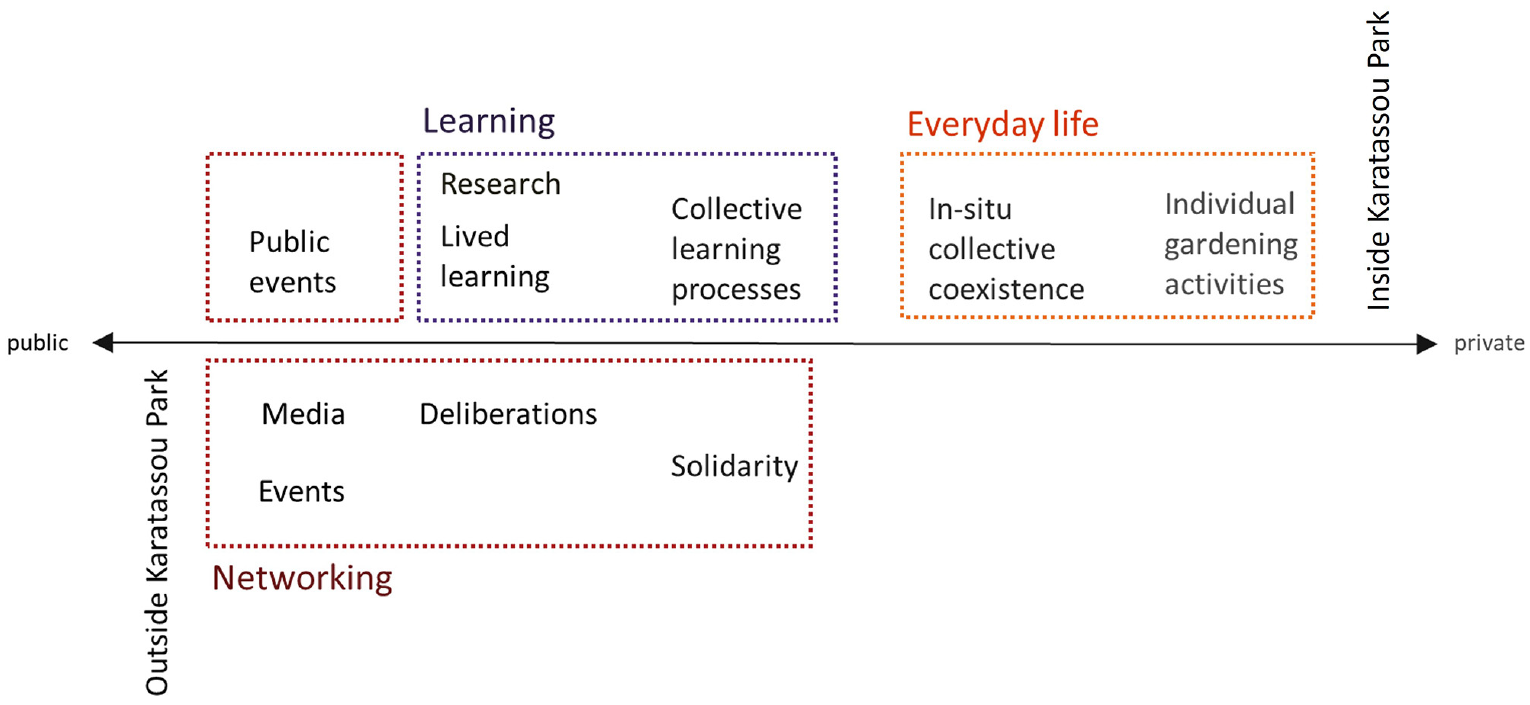
Diagrammatic representation of PERKA’s practices based on their distribution in the public – private spectrum (Karagianni, 2019: 354).
In turn, these were also analysed based on their scale, actors involved, and the issues/themes they addressed.
Finally, it should be noted that research into grassroots initiatives whose activity is outside the legal spectrum presents two ethical challenges. The first relates to interviewing, since a sizeable number of members refused to participate because they were reluctant to sign a consent form. Second, the analysis and publication of data can be challenging since the activities of such an initiative can be construed as illegal (they take place in an occupied space). To address this, the findings of this research are published without the accompanying data tables, where all activities and actions henceforth presented are documented in detail.
The Peri-Urban Gardening initiative at Karatassou Park, Thessaloniki
PERKA’s gardens were created at the Karatassou ex-military camp in Western Thessaloniki, in the densely populated, primarily working-class area of the Municipality of Pavlos Melas (MoPM) (Hatziprokopiou, 2004). Karatassou covers an area of 126 Ha, was created in 1926 (MoPM, 2018) and was decommissioned in 2003. The camp’s ownership status remains contested until today and is still the cause of a long-lasting legal conflict between MoPM, the National Defence Fund, and the Ministry of Finance, which claims it as part of the portfolio of the Hellenic Corporation of Assets and Participations.
In its efforts to secure the use as a public space, MoPM has refurbished a small area, created a playground, a cafeteria, and two football courts, and designated it as a metropolitan park in its urban plan, embarking on several campaigns and partnerships with civil society organisations to promote this. Also, almost half of the camp (∼60 Ha) hosts two large hospitals and is separated from the rest of the area by the city’s ring road. The remaining area remains officially ‘undeveloped’ but not unused, since it is partially occupied by PERKA (Figure 2).

The Karatassou ex-military camp and existing facilities and uses in and around the camp (Karagianni, 2019: 341).
PERKA was formed in 2011 with the purpose of creating the first grassroots-led urban garden in Thessaloniki, Greece, and counted 30 members who met at the Ecological Movement of Thessaloniki, a local NGO. Thus, the group was formed one year after the enactment of the first memorandum between the Greek government and the troika, with the effects of the recent crisis already starting to settle in. By 2013, PERKA had grown to 120 members and seven different gardens in the camp, produced by an equal number of PERKA subgroups (PERKAs, see Figure 2). A representative of PERKA argued during a MoPM municipal council in MoPM (Theodosiadis in MoPM, 2013b: 41–42), PERKA acquired in a brief time a human form, team spirit and…optimism that we can indeed cooperate and rejoice in our coexistence against the pessimism the apathy of our times.
Alongside its ecological interests, PERKA lists among its principles those of ‘collectivity, self-management [and] egalitarianism’ (PERKA, 2015a: 1), and poses itself against any act of ‘privatisation, subdivision [and] sale of [the camp’s] land’ (Enallaktikos, 2012: 1). Similarly to other examples of commoning initiatives (see for instance Varvarousis et al., 2021), and as the following analysis reveals, PERKA too appears to broaden its spectrum of claims beyond urban gardening, to include justice, inequality, counter-austerity politics and the city.
Soon after its establishment, PERKA began forming strong relationships with the local community, the municipality, and several other bottom-up initiatives (Figure 3). The aims of its networking practices were to communicate its existence, principles, and practices to non-members, and to build connections with other actors. PERKA’s relationship with the municipality is supportive, as both share the same objective: to transform Karatassou into a park. Notwithstanding the importance of the former’s material support, through the encouragement of the use of the land and the provision of electricity and water, another particularly important aspect of their relationship was their joint opposition to the military plans for the redevelopment of the area and the eviction of PERKA. This contributed to the election of a PERKA member in the MoPM municipal council, who was later promoted to Vice-Mayor. Finally, perhaps the most representative factor of the symbiotic relationship between PERKA and the local authorities is their collaboration in an extensive environmental education programme that resulted in the creation of 15 school gardens. Therefore, PERKA’s networking practices are formative of its commoning practices. To understand the latter, we need to extensively study the former as well, since they are not exogenous variables, as an Ostromian framework would describe them, but an intricate part of socio-natural commoning practices.

Sum of PERKA’s networking actions per year by category. The majority of PERKA’s actions belong in the events category (Karagianni, 2019: 359).
In PERKA, coexistence in the park, labour relations, the organisation of labour and the community itself are shaped and sustained through an intricate system of institutions of commoning. Coexistence in Karatassou and in PERKA in general is based on two documents, which were developed through participatory, democratic processes by the first 30 members. The first is a smaller list of member obligations and rights, while the second is a detailed text on articles of association. Decision-making is based on direct democracy principles and takes place through general assemblies and separate assemblies of PERKA subgroups. As Kostas mentioned in a personal interview, ‘PERKA hasn’t got leaders’ (interview, 27 May 2016). According to PERKA’s operation principles, this is to be achieved by the ‘pursuit of consensus, freedom for the expression of dissensus, recallable representatives and assemblies’ (PERKA, 2011: 5). This system, which could be described as PERKA’s institutions of commoning, includes the following:
general assembly,
main coordination committee,
assemblies of subgroups, and
coordination committees of subgroups.
Issues affecting all members and/or referring relations with other actors and networking, are discussed in the general assembly, while issues of everyday coexistence in the sub-groups’ assemblies. According to the principles of PERKA, a decision can be made only when consensus is achieved through disagreement and lengthy discussions. As Dimitris told me, ‘we try for our decisions to be collective …, when there are disagreements we discuss them, if we manage to soften the disagreement of some people, we make a decision’ (interview, 16 June 2016). In 2012–2018 there were approximately seven assemblies per year. Although assemblies are to be organised monthly, they do not take place during the summer or holidays, barring exceptional or time-sensitive cases. Issues under discussion refer mostly to networking and learning activities and finances, resource-sharing, and relationships and conflicts with other actors (Figure 4).
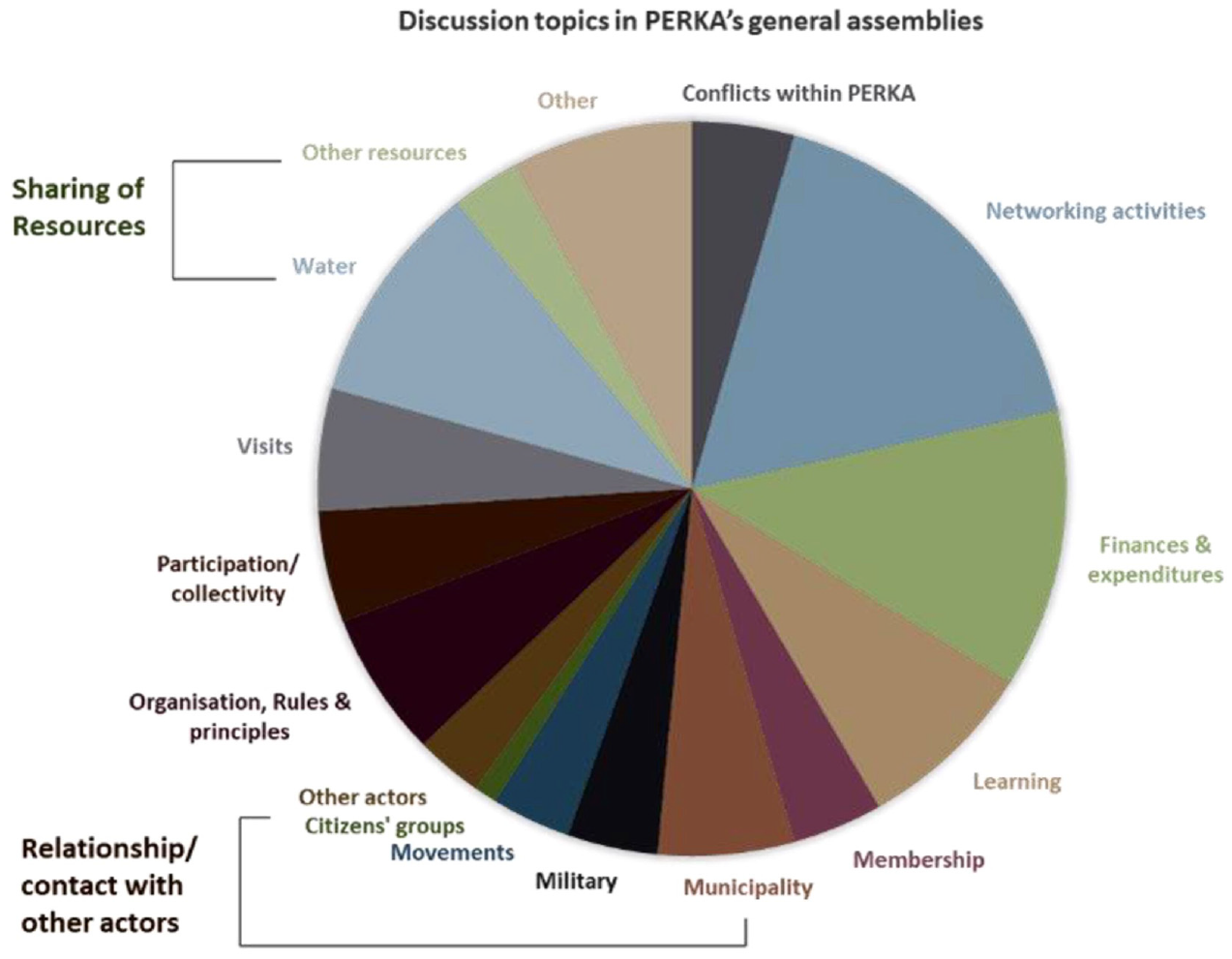
Distribution of discussion topics in PERKA’s General Assemblies during the period 2012–2018 (Oct.) (Karagianni, 2019: 378).
New members usually contact PERKA through its website and are then informed of the group’s principles. Their membership is completed after the approval of a general assembly. As Kostas mentioned, although PERKA is not an ‘official’, but an ‘informal’ organisation, ‘it still has principles. We have a questionnaire that all new farmers must answer, so that they understand they are entering a small community’. Despite efforts to the contrary, attendance to assemblies has proven challenging for PERKA. Sofia said that ‘[they] have not managed to convince people that participation in assemblies and activities is necessary’ (interview, 20 July 2016). Katerina attributes the continued existence to efforts by PERKA’s oldest members of PERKA. As she told me, ‘the cohesion of the team is based on [the efforts of] its initial members … not everyone participates … they go to farm and then leave’ (interview, 21 April 2016). Indeed, despite the requirement for the attendance of 2/3 of members, most assemblies take place with an average of 26, that is, only 1/5 of members. According to Dimitris, the low participation in assemblies can be attributed to their long duration and the lack of members’ prior experience in similar initiatives (interview, 16 June 2016), both of which were also confirmed through participant observation and interview findings.
PERKA began collectively discussing the low participation of members in 2013. The PERKA assembly on 15 April 2013 (PERKA, 2013c) concluded that the organised events were a remarkable success but ‘they are carried out by the initiative and effort of a small part of PERKA members . . . [and] present a serious lack of organisation, participation, and communication’ (PERKA, 2013c: 2). To these issues, another assembly, two months later, added those of lack of representation and common ‘spirit’ of the collective, especially among newer members. While PERKA maintained its openness to new members who are always welcomed, this difference between older and newer members arose on several occasions, with the former appearing to be more politicised and more concerned with issues that move beyond gardening, and the latter focusing more on their individual gardening plots.
The most intense conflict between PERKA members occurred in 2017. In December 2017, four of the founding and most active members of PERKA left the group in the face of a ‘revolt’ led by 18 people in PERKA 1, who disregarded the principles that prohibit the creation of any large or permanent structure in the gardens and rejected their obligation to comply with the rules in general, forming their own collective (PERKA, 2017). Despite efforts made by the general assembly to convince them otherwise, the new group decided to maintain its gardening plots in PERKA 1 after leaving PERKA (PERKA, 2017). PERKA’s inability to effectively address this conflict highlights a limitation of large-scale commoning practices. The group’s rapid growth in membership weakened its institutions of commoning. The new members did not consider themselves part of a community of commoners, and, as a result, did not agree to be held accountable for their actions by the general assembly. In turn, the assembly, facing a decrease in participation, was unable to persuade them to respect PERKA’s institutions of commoning. In this sense and at that moment, PERKA’s being-in-common processes and practices proved weaker than the group intended.
Overall, the community of commoners was weakened due to three factors: (1) the decreasing interest in time-consuming decision-making processes; (2) the unequal distribution of labour for the organisation of collective activities; and (3) the inability of PERKA to infuse its principles in newer members. In all cases, older members appeared to be more engaged and committed to the collective than newer ones, which created a rift in the community. However, here it is not large numbers per se, in Ostromian terms the size of the community, or the increasing heterogeneity of the group that comes with it (Ostrom, 2000), that obscured commoning processes and community building. It appears that the speed of the politicisation process did not match the speed of the group’s growth, resulting in different paces of politicisation for different members that proved challenging. Confirming Nancy’s (2010: 152) argument as discussed in the first part of this paper, ‘commonness’ alone proved inadequate to secure the community’s continued existence when social processes (Swyngedouw, 2009) were weakened.
The construction and production of nature in Karatassou park
PERKA’s spatial interventions as commoning practices
Each PERKA subgroup has its own designated area in the park, with separate plots for its members. People usually visit their plots every 2–3 days, and daily during the summer. Multiple flows of resources such as water, seeds, soil and financial capital are metabolised through collective human labour to produce the gardens and Karatassou park. The tasks performed include planting, watering, weeding, composting, and collecting vegetables, but also caring for the common-use buildings and open spaces of the park. Larger vegetables are kept for seeding, while the rest are consumed. If the quantity suffices, part of the crop is given to friends and/or social groceries. While in the beginning PERKA discussed the collective cultivation of a larger plot and the donation of that produce to social groceries in a consistent manner, this effort never flourished due to a lack of participation and interest.
PERKA has also turned the old barrack into a community space, naming it Sporeio,
2
Social Space for the freedom of people, ideas, and seeds. This space is described in the PERKA statute (PERKA, 2011: 5) as a: public, social meeting place for people who wish to organise and participate in alternative, free forms of social life and political action. … a space of … creation of a different everyday life in our city.
Participation in the maintenance and repairs needed for the preservation of the park, including reused buildings, common-use spaces, and gardens, is an important aspect of being-in-common. Representatives of PERKA stated during Municipal Council conventions of MoPM that: we … have invested effort and labour in this space. We repaired a toilet… [and] a building so that we can gather during the winter, … change and go about our works. (Chiltidis in MoPM, 2013c: 489)
And: we have been protecting the camp for 4 years… When we went there half [of the facilities] were destroyed. It’s a shelter for people now … it is safe because we are there. (Theodosiadis in MoPM, 2015: 465)
Indeed, the park has changed a lot for the better through PERKA’s interventions. All small PERKAs include the gardens and an area where people meet and spend time together, to provide infrastructure for being-in-common. This communal area can be anything from a picnic table with or without a shed (PERKAs 1 and 7) to a renovated building (PERKA 3). Some PERKAs have a hen coop, compost bins, tool sheds, rainwater collection tanks and flowerbeds. In PERKA 1 there is also a greenhouse, a stone oven, the only drinking water tap in the camp, and a children’s garden, for educational purposes during school visits. 3 All PERKAs are fenced, but not locked. Fences are short and only protect the gardens from animals (Karagiorgas in Gritzas et al., 2016) and, as such, they do not create exclusionary spaces. PERKA members produced the entire infrastructure by themselves, investing their personal labour, time, and resources, looking to build the group’s autonomy.
Besides gardening space, members share resources, such as land, water, and seeds. Furthermore, according to data collected from the group’s mailing list, participants choose to place bulk orders collectively. This secures lower costs for all, while members share access to everyone’s social networks. Thus, participants without any prior knowledge on gardening learn by being part of a collective.
Although farming appears to focus on the individual, it involves a high degree of sharing and requires that each member is always aware of the collective. Water sharing in PERKA can prove illuminating at this point. In fact, water is possibly the most valuable shared resource in PERKA and a highly important aspect of everyday life routines in the park, as shown by the number of related discussions in assemblies and email correspondence, combined with the group’s actions related to irrigation. Indicatively, water scarcity and damage to PERKA’s irrigation system were discussed in 21 out of 49 general assemblies during 2012–18. Access to water for irrigation is secured through a tank which is filled by a drill hole. The infrastructure was installed by the municipality for the irrigation of the football court and is now shared by PERKA and Lykoi F.C. with the consent and support of the municipality. The water from the utility network is only used for drinking, cooking, and washing utensils for water saving purposes (PERKA, 2015b). During discussions on saving water in general assemblies, one of the most common arguments was to secure equality for all by employing ‘justice and consciousness in each gardener’s water consumption’ (PERKA, 2014: 6, 2016). Finally, the PERKA general assembly has also decided that ‘for us to have water and continue to exist and create, both on the farming and the social level, we need… solidarity and mutual help’ (PERKA, 2015c: 2). Thus, for PERKA water became a reason and a motive to discuss the organisation of everyday life in a collective.
What these arguments share is an emphasis on the impact that the actions of each member have on the collective, especially when it comes to the sharing of common resources, such as water. In the end, water consumption raised broader issues than the mere sharing of resources such as collectivity, solidarity, and collective responsibility. At the same time, PERKA members did not act as consumers of resources, but as commoners who embrace their socio-natural production, employing methods for water collection and distribution based on equality (Stavrides, 2011).
PERKA’s grassroots discourse and the construction of Nature
PERKA has articulated a grassroots discourse on nature, sharing practices and public space, which while presenting some similarities to mainstream sustainability discourses, simultaneously manages to move beyond their limitations and understand Nature as a socio-ecological construct. Against a univocal conceptualisation of Nature based on technocratic knowledge and concepts such as ‘natural’ resources or ‘man-made’ assets, PERKA employs a socio-natural approach that unfolds in two ways: first, through its cultivation methods, and second, through its conceptualisation of Karatassou as a primarily green space, a public park.
The use of ‘natural’ cultivation methods and ‘natural’ (meaning autochthonous) seeds is pivotal for PERKA. Half of the principles adopted by the group in its statute refer to ‘the biological, biodynamic or natural cultivation … [with] … seeds coming from open pollination (no hybrids or [genetically] modified)’ (PERKA, 2011: 1). This is for PERKA simultaneously ‘a tangible action of resistance against … business interests’ (PERKA, 2011: 1), and a way of ensuring the quality of the produce. Nature, a nodal point in PERKA’s grassroots discourse, is, not unlike the hegemonic discourse on Nature, constructed as a divine entity, from which people have been alienated and have now managed to reconnect with, through Karatassou. At the same time, however, it is not proximity to ‘green’ spaces that marks their reconnection with Nature but sharing practices. The group characterises its presence and practices in Karatassou as aiming to ‘cultivate vegetables and human relationships’ (the group’s motto). Indicatively, one of PERKA’s founding members stated during one of MoPM’s municipal council meetings that: through collectivity, self-management, equity, … PERKA has become a laboratory of people who are trying to understand the natural cycles, learn from them and find a cooperative way out of the current crisis, both social and political. (Theodosiadis in MoPM, 2013a: 42)
PERKA members mention the financial crisis usually while discussing their commoning and solidarity practices, such as their participation in the ‘Thessaloniki Open Network for the Direct Supply of Products’ (Calvário et al., 2017). A PERKA member argued during an interview that ‘the earth has a magical way of bringing people together, … [a big part of PERKA] is solidarity, … otherwise it wouldn’t have been able to live for five years now’ (K., interview, 27 May 2016). He went on to support that ‘eating together, cooking for someone who visits the gardens’ are part of ‘a common life with others’ (K., interview, 27 May 2016). Overall, PERKA has built its practices on a grassroots environmentalism that is anchored to the everyday (Loftus, 2012). The city becomes the locus where it organises new urban metabolisms based on being-in-common. PERKA has managed to demonstrate that, as Loftus (2009: 327) suggests, ‘[t]he struggle for revolutionary change is a socio-natural project rooted in the experience of producing everyday environments’. This also becomes evident if we consider that issues of access to land and resources cannot be resolved by the community alone and necessitate extensive discussions in decision-making processes and collaborations or conflicts with other actors, as shown in previous sections.
While PERKA’s cultivation methods may not significantly differ from those of other grassroots gardening initiatives, its approach to public and green space is more interesting. In a brochure published in 2015, PERKA states that ‘farming becomes a research laboratory that tends to bridge the . . . chasm between people living in cities and farmers and brings [people] closer to nature’ (PERKA, 2015a: 1). Building on this relational understanding of the role of public space, PERKA (MoPM, 2013a: 42; PERKA, 2015) insists on maintaining its public character, stating that it ‘sets itself against the privatisation, the division, sale of land [and] construction’ in Karatassou.
PERKA aspires that the group’s social life and sharing practices will spark top-down institutional political decisions towards maintaining the public character of the park and its concession to the local community. The group envisions Karatassou as a social space with uses and activities that are based on ‘citizen participation, have a strictly social objective, improve health [of people] and are governed by the principles of the social and solidarity economy’ (PERKA, 2013a: 1). In carrying out these principles here and now, the group strives to build its practices on the ideals of solidarity, equality, and collaboration. In an announcement issued after an attack by strangers on Sporeio, the building in Karatassou that PERKA refurbished and uses for its meetings, events, and general assemblies, it wrote: ‘Sporeio’ will be cleaned, … our laughter and our children’s laughter will fill the area once again. … Karatassou Park belongs to society … and will remain green, free and open to everyone. (PERKA, 2013b: 1)
Karatassou park is ‘green’ due to its being a physical space, but also due to PERKA’s productive practices. At the same time, it is a ‘free’ space, and, thus, a political space that is founded on equality. Finally, Karatassou is a space that is ‘open to everyone’, a threshold with boundaries that obtain a liminal quality (Stavrides, 2010), a social space where everyone is welcome.
PERKA’s grassroots discourse on the three-dimensional conceptualisation of public space as physical, social, and political materialises through its practices. The group’s material and discursive practices have spatial, social, and political aspects. The seven PERKA subgroups have created their gardens and an irrigation system, and renovated buildings to house their meetings and events. All these ‘livelihood qualities’ become PERKA’s arena over which ‘rights are [constantly] negotiated’ (Eizenberg, 2012: 766). At the same time, PERKA members perform their everyday lives collectively in the park, they have created ‘new networks of encounter’ (Solnit, 2009; cited in Stavrides, 2016: 65), and learning practices. Collective activities unfold on various scales and create connections between PERKA and other actors and grassroots organisations, asserting Stavrides’ (2011) declaration that the radical reclaiming of the commons emerges through multiple scales and actions.
Undoubtedly, material, and discursive practices intertwine and have blurred boundaries, aiming at fulfilling PERKA’s aims and materialising its vision for Karatassou park. The sharing of resources, and water particularly, raises organisational and political issues and its discussion in assemblies quickly moves beyond distribution, to arguments about equality and justice. The scheduling of lived learning activities for children drives the organisation of physical space, and discussions about food and urban gardening quickly raise issues related to alternative forms of societal organisation, based on co-existence and collective effort. The mere act of eating together becomes a political action of collectivity, where everyone brings what they have prepared, to create a large collective kitchen. PERKA’s discursive and material commoning practices manifest in the best of ways so that the production of the commons is a continuous metabolic socio-natural process.
PERKA’s praxis turns it into a platform for raising much bigger and broader issues, which leave behind them resource distribution to talk about environmental justice, equality and inclusion in cities, democratic public spaces, and the urban commons. Sharing practices pervade each and all levels of everyday life at the park, from simply tending to one’s garden to organising the annual celebration. Overall, being part of PERKA could be described as being-in-common.
Of course, since being-in-common is, above all, a process of becoming, it cannot be complete. It is, rather, always in the making, just like the common itself (Stavrides, 2016). PERKA tried to build a community that is, as Federici (2010; cited in Bunce, 2016: 140) would write, not a ‘gated reality’, but a ‘quality of relation, a principle of cooperation and responsibility to each other’. Sharing resources in PERKA is not a techno-managerial but a political issue. Moving beyond naturalising approaches to the commons, the group built its sharing practices not on individual responsibility, but on being-in-common (Bresnihan and Byrne, 2015; Swyngedouw and Wilson, 2014). Notwithstanding these efforts, PERKA has not always succeeded in carrying out its everyday activities in a collective manner. In some cases, several members complained about the lack of participation of many others while some conflicts within the group have yet to be resolved. However, this lack of complete participation and success does not necessarily diminish the value of PERKA’s efforts. Besides, commoners are not a homogeneous groups of like-minded people and political subjectification processes always have their own ‘internal dynamics, tensions and even conflicts’ (Karaliotas, 2017: 58). Since being-in-common is a process, rather than a state, what is important is to keep on trying. Even if PERKA does not manage to transcend its own limitations and move forward, it has still left us with a lot to learn.
Concluding remarks
This article set out to critically examine grassroots initiatives and the spaces they produce to provide a systematic account of commoning practices through their reconceptualisation as socio-natural. To this end, this first part of this paper laid out the foundations for such an approach by demonstrating the limitations of existing theoretical frameworks on the commons and mobilising the literature on (urban) political ecology to bridge the social and natural dimensions of commoning. In doing so, it suggested that commoning is ‘the process whereby bio-physical matters are transformed through the mobilisation of [resources] … and labour in a circulatory process’ (Cook and Swyngedouw, 2014: 14) organised through being-in-common under the principles of self-organisation, equality and solidarity.
The case of PERKA, the UG initiative at the Karatassou ex-military camp in Thessaloniki, Greece, acted as a case study to pinpoint the complex net of socio-natural commoning processes that produce the gardens. The findings suggest that PERKA’s sharing practices and processes for the production of the common are inherently socio-natural, unfold in multiple scales simultaneously, involve the broad mobilisation of resources and labour, and are shaped through the group’s multiple interactions with other actors. In turn, the community of commoners itself is not a black box. Instead, power relations, internal conflicts and contradictions are always there and are also formative of the common space that is Karatassou park, rendering the community, like the common, always in-the-making. Overall, and despite its weaknesses, PERKA has developed over the years a coherent alternative to neoliberal urbanisation processes.
Having demonstrated the need for the study of the multiple, interconnected processes that produce the common as a socio-natural construct, this paper contributes to the discussion on commoning by demonstrating the ways in which this understanding can provide novel insights for the production of counter-hegemonic, emancipatory urban spaces. More research is needed to both further our understanding of the underlining causes of community conflicts and contradictions that limit the possibilities for upscaling commoning practices, and to overcome them. To this end, comparative studies of various commoning initiatives as socio-natural commoning practices could prove illuminating.
Footnotes
Acknowledgements
I thank the editor and the three anonymous reviewers for their generous feedback that helped clarify and sharpen my arguments. A warm thank you goes to Matina Kapsali, Evie Athanassiou, Stavros Stavrides and Maria Kaika for their support and comments on earlier drafts.
Declaration of conflicting interests
The author declared no potential conflicts of interest with respect to the research, authorship, and/or publication of this article.
Funding
The author disclosed receipt of the following financial support for the research, authorship, and/or publication of this article: I would like to acknowledge funding from the State Scholarships Foundation (IKY) through the Operational Program ‘Human Resources Development, Education and Life-long Learning’ in the context of the project ‘Scholarships program for post-graduate studies – 2nd Study Cycle’.
