




Abstract
The smart city literature mostly focusses on digital initiatives from above. However, digitalisation also reshapes the city from below. Residents use digital means and platforms to empower their agency in the city. This paper aims to explore how residents utilise digital tools to activate their agency and influence local politics. The paper focusses on one neighbourhood in the city of Tel Aviv where different groups of residents struggle to promote their desired political-spatial vision. The main question is whether digitalisation produces new forms of agency on the neighbourhood scale. The paper argues that: (1) digitalisation provides residents with new forms of connective action, creating digital networks at different scales, using representational practices and forming new spaces for political negotiation; (2) through these practices, they manage to influence the symbolic and political status of the neighbourhood and reframe the struggle over its character and future; (3) groups with higher digital agency gain wider visibility of their claims and needs with politicians, the media and public officials. Importantly, this does not only serve middle-class groups. (4) Ultimately, residents become predominant political actors through digital agency. Methodologically, this paper includes two methods: (i) interviews with residents and municipal workers and (ii) social media analysis and online ethnography. The conclusion elaborates the concept of place-oriented digital agency as a particular type of agency aimed at determining change in a specific locale.
Introduction
Three decades into the digital revolution, it can be said that digital technology has transformed our cities, societies and lives. Digitalisation has made the urban experience multifaceted, combining virtual and spatial dimensions in almost every aspect of life: shopping, commuting, navigating, interacting and participating civically. The smart city literature is mostly focussed on government efforts to harness technology to make cities more efficient, connected and sustainable (Ahvenniemi et al., 2017; Angelidou, 2014; Hatuka et al., 2018; Kitchin, 2015). Although some research emphasises citizens’ perspectives and experiences in smart cities (Hatuka et al., 2021; Hatuka and Zur, 2020; Molinillo et al., 2019), the agency of individuals and groups in the digital city remains undertheorised. This paper aims to explore how residents use digital means to activate and empower their agency in their city and how they utilise digital tools to influence local politics. The paper focusses on one neighbourhood in the city of Tel Aviv where different groups of residents struggle to promote their desired political–spatial vision. The main question is whether digitalisation produces new forms of agency on the neighbourhood scale. This is followed by a sub question: how does digitalisation change the tools and strategies of residents in pursuing neighbourhood change?
Digitalisation offers new tools and platforms that are generative and recursive; they are open to various uses and practices that are constantly evolving. Although digital platforms are developed by digital companies with certain aims, the users determine the social meaning of the technology through the practices and contestations evolving around them (Lupton, 2014). Digitalisation builds the social realm in a nondeterministic way, as claimed by Schwarz (2021); therefore, it is necessary to explore the ways in which digitalisation shapes social dynamics, place and politics in cities. The concept of agency itself gained new meaning in the digital age due to the interactive relations between humans and machines in the digital sphere. Each digital action involves a hybrid mix of agents, humans and machines who are intelligent and equipped with belief, desire and intention algorithms (Rammert, 2008: 63). Hence, a new concept of ‘distributed agency’ was elaborated to reflect a more balanced approach to the relations between humans and machines that emerge through digitalisation. Using this concept, this paper highlights the ways in which digitalisation transforms and empowers residents’ agency. This paper argues the following: (1) digitalisation provides residents with new forms of connective action, creating digital networks at different scales, using representational practices and forming new space for political negotiation to promote their agenda in place; (2) through these practices, residents manage to influence the symbolic and political status of the neighbourhood and reframe the struggle over its character and future; (3) groups that succeed in mastering their digital agency achieve higher visibility of their claims and needs with politicians, the media and public officials. Importantly, this does not only serve middle-class groups. Hence, digital agency becomes a significant force in shaping local politics and neighbourhood change. (4) Ultimately, through digital agency, residents become predominant political actors in urban politics.
Methodologically, the study uses a two-pronged method: (i) interviews with residents and municipal workers and (ii) social media analysis and online ethnography of the dominant groups in the neighbourhood conducted between 2018 and 2021.
The conclusion elaborates the concept of place-oriented digital agency to describe this type of agency intended to influence the politics of place. It includes a multitude of practices that are rooted in space and aim to shape and struggle over a certain territory. It uses digital means to materialise change in a concrete environment and determine its representation, character and future. Place-oriented digital agency marks a change in the position of residents in urban politics and the forms of civic engagement.
Digitalisation and agency at the neighbourhood scale
Physical space and digital space are intertwined. In the digital age, place is configured in and through mobile social media platforms at multiple levels of media engagement (Wilken and Humphreys, 2021). The users, as consumers and agents in the digital sphere, participate in the construction of place. Hence, today, understanding place as a process that is continually enacted, negotiated and renegotiated (Massey, 2005) involves exploring multiple sites, both physical and virtual. Daily digital practices such as rating, uploading pictures and sharing information, data, emotions and experiences on social media produce and commodify space (Wilken and Humphreys, 2021). Thus, users become agents in the production of places that they are not necessarily aware of. For example, research shows how young users ‘amplify gentrification’ in certain neighbourhoods by uploading images of new ‘hipster’ businesses, mainly restaurants. These warped representations of space on digital platforms produce narratives and images that have material consequences on the ground (Bronsvoort and Uitermark 2022). Users of location-based media in general configure places materially and symbolically by creating representations, images, reviews, maps and information. Hence, they are digital agents of change in the physical and digital space.
However, what is agency in the digital age, and are there different levels of agency? The concept of agency stimulated renewed discussion in ANT theories and science and technology studies (Rammert, 2008). Human and machine relations, which were previously imagined as instrumental actions between active people and passive objects, have become, due to digitalisation, interactive relations among multiple agents. In the digital world, each action activates thousands of agents delivering, transmitting and transforming the action behind the scenes. Indeed, ‘These software or hardware agents equipped with belief, desire and intention algorithms are able to take part in manifold actions and even change them based on machine learning’ (Rammert, 2008: 63). Therefore, a new concept of ‘distributed agency’ between humans and machines has been elaborated to offer a more symmetrical and sophisticated concept of agency. Moreover, in terms of social media and digital platforms, people participate in a collective network shaped not only by the design of the network (or the device) but also by the agencies of other users and the meanings they give to the technologies (Lupton, 2014: 128). Thus, the effects, consequences and transformations driven by digital technologies are outlets of individual and collective agency and meaning making.
However, Rammert (2008), following Giddens, suggests differentiating among three levels of agency: ‘causality’, ‘contingency’ and ‘intentionality’; the first refers to an efficient behaviour that exerts influence or has an effect. The second refers to an act that includes a choice between options when a routine action is disrupted and requires change or adaptation (by people or programme). The third is ‘the domain of meaningful action that is oriented to the supposed meaningful action of other actors’ (Rammert, 2008: 76–77). As he explains, this concept of agency provides a wide range of possibilities to identify and classify various forms of agency, which might be useful in exploring residents’ digital agency in the urban arena.
In the urban context, researchers explore the ways in which digital means are used by people to influence places and achieve emotional, social and political goals. For example, digital placemaking practices create a sense of place and belonging in different locals (Halegoua and Polson, 2021) including minorities in marginalised areas who use it to empower their human agency (Nemer, 2016); digitalisation is used for community building (Katz and Hampton, 2016); and it has opened new prospects for political participation. Residents participate digitally in planning processes and local governance initiatives, making it more accessible to wider publics (Thoneick, 2021). Moreover, residents participate in the construction of the image of places, promoting economic change by using social media (Bronsvoort and Uitermark 2022).
Considering the levels of agency, some of these practices have a direct and intentional impact on changing places through digital agency, while others have an indirect effect. Some forms of digital use manifest themselves as people making conscious and sophisticated use of digital tools to create an advantage for themselves (or their group) and to promote their interests in a particular place. In these forms of use, residents activate and empower their agency through digital means. As Giddens (1984) describes, higher levels of agency are present when actors can explain their action if asked. This means that their use is conscious and intentional. This paper presents a case study in which residents strategically and deliberately use digital tools to push their political–spatial agenda and promote the neighbourhood change they desire. This paper contributes to understanding residents’ digital agency as a spectrum that ranges from actions that have an indirect effect on place to intentional actions through which residents consciously mobilise their digital superiority to influence the future of the place. We conceptualise this as place-oriented digital agency.
Empirical context and methodology
This paper focusses on a neighbourhood located in South Tel Aviv called Neve Sha’anan, which has been defined as disadvantaged throughout the history of the city (Hatuka, 2010; Marom, 2014). Neve Sha’anan has been known as a centre for asylum seekers and migrant workers in the city since the 1990s (Kemp and Raijman, 2008), and it has a reputation as a centre for drug trafficking, prostitution and homelessness (Weisburd and Amram, 2014; Zur, 2021, 2023). In the past five years, accelerated urban regeneration has brought a new middle-class population to the neighbourhood (Kaddar, 2020; Zur, 2023). These processes created a highly heterogeneous environment where veteran residents mostly from low socio-economic backgrounds, newcomers who are young middle-class, asylum seekers, refugees and foreign workers from various states and populations in distress are living side by side. This encounter provokes contestation over the future and character of the neighbourhood. Different groups of residents strive to promote competing political–spatial visions for the place (Peršak and Di Ronco, 2018). Veteran residents, who oppose the presence of asylum seekers and migrant communities, wish to turn the neighbourhood into a Jewish environment. The gentrifiers aspire to transform it to a neoliberal environment that is free of anti-social behaviours and has better law enforcement, while the pro-migrant and migrant residents wish to strengthen its multiculturalism and inclusiveness. Each political–moral worldview carries a spatial implication concerning the demographic mix, aesthetics, norms, values and order. We generalise these as political–spatial visions.
In this paper, we refer to three dominant groups of residents operating in Neve Sha’anan who were dominant actors in the digital public sphere during the years of research (2018–2021). (1) The gentrifiers formed a Facebook group (FG) called ‘South Tel Aviv Needs a Fix’(STA needs a fix from here on) 1 in 2019 to conduct an aggressive campaign against drug trafficking, homelessness and prostitution in Neve Sha’anan. They demanded law enforcement, policing and urban investment to improve their quality of life. (2) The long-term residents who oppose the presence of asylum seekers and refugees conducted a forceful campaign to displace them by spreading narratives and representations of violence (Zur and Hatuka, 2023). They influenced public discourse against asylum seekers and gained high visibility and political power. (3) The pro-migrant residents were less prominent on social media but significant and influential in other arenas (mainly large-scale demonstrations, legal activity and lobbying). This group is more complicated to define as residents since some of them, besides being residents, also work in human rights organisations. Although there are residents who share this worldview, politically or civilly, they operate mainly through human rights organisations. Asylum seekers and refugees also use digital tools for self-representation and political activism (Dubinsky, 2020). However, during the time of research, we did not find an active group that systematically used digital means to activate their agency to influence the character and future of the neighbourhood. Four asylum seekers who address the Israeli public through social media were interviewed. They explained they mainly work to build their community internally and fight for their legal status and representation in the Israeli public sphere.
Methodologically, this paper is based on information gathered from two sources. The first is in-depth interviews (N = 20) with residents (18) and municipal workers (2) who work with the neighbourhood: the community relations coordinator and head of addiction and homelessness department in Tel Aviv Municipality. The residents’ interviews took place in Neve Sha’anan; they lasted approximately an hour and a half and dealt with questions related to the neighbourhood, conflicts within it, violence and protest. The residents interviewed were reached mainly through social media based on their prominence in neighbourhood activism and some through snowball sampling. They were asked about their activism, tools and goals. The second source involved social media analysis and online ethnography (Airoldi, 2018; Caliandro, 2018) of the various groups, ‘STA needs a fix’ 2 FG, the pages ‘South Tel Aviv against deportation’, ‘Otef Tahana Merkazit’, ‘The Headquarters for the Rescue of South Tel Aviv’, ‘South Tel Aviv is under disaster’ and the public profile of ‘Sheffi Paz’, the leader of the fight against immigrants. The posts (230 posts and 72 videos) were gathered manually from 2018 to 2021 based on their relevance to the topics of violence, spatial struggles, the ordering of space and intergroup relations. Their analysis included categorisation to themes, content analysis of the posts and comments and visual analysis of the videos and images.
Results: Promoting neighbourhood change with digital tools
The residents in Neve Sha’anan compete over dominance in the neighbourhood public spaces and over its regulation and future. Some groups turned to the digital sphere to become visible and prominent as opposed to the physical space where other communities are more dominant, mainly the asylum seekers and foreign communities and the populations in distress (i.e. the homeless people and people with substance abuse disorders). The gentrifiers and veteran residents who felt excluded and/or alienated from the public space in the neighborhood found each other in the digital public spaces. Digitalisation enabled those who seek to promote an alternative spatial order to gain dominance and impose their political–spatial vision by operating in digital spaces. They became significant agents of change in the neighbourhood by mobilising the qualities offered by digitalisation. As detailed below, digitalisation enabled new forms of connectivity and political action: to preform new publics, to interfere in the representation of place and to form new space for political negotiations.
Preforming new publics
The moment our Facebook page reached 1000 people, now it’s 5500, Tel Aviv municipality contacted me. They opened a communication channel, and we met every week until we blew up the conversations. (‘South Tel Aviv needs a fix’ group’s leader)
Social networks enable residents to perform as public (Papacharissi, 2014). Before starting the page, which later became a Facebook group (FG from here on), they were scattered individuals with some informal ties and similar sorrows. Forming a FG made them a public with shared claims and demands (Iveson, 2007). Social network sites do not simply reflect a preexisting community or visualise metaphorical social networks but constitute and transform them. They constitute them thoroughly different entities with different ontological statutes (Schatzki 2019 in Schwarz, 2021: 64). As the group leader explained in an interview, he wanted to anticipate the growth of the gentry community that is no longer limited to a few individuals who have moved to the neighbourhood. The digital network enabled him to gather people and perform as public with clear demands for change and personal safety. Moreover, the digital platform also provided him and others with the emotional support they needed, as he described: When we left the meeting of the 70 residents, at the corner of Lewinsky street stood a junky in her seventh- or eighth-month of pregnancy, rocking with her eyes closed. I got back home and wrote about it in our FG. The fact that I could write about it and 5000 people were with me at that moment … it was powerful.
The gentrifiers are not the only group who use social networks to become an affective public (Papacharissi, 2014), although the scale and scope of the various networks differ. For example, the pro-migrant residents formed an international network, while the anti-migrant residents worked to create a national network to frame their struggle as a national issue connected to the Jewish nationality of the state. Each group established a new digital network to act digitally for their political goals. A human rights activist against deportation, who is also a member of the neighbourhood committee, formed an ad hoc global network to stop a deportation plan of asylum seekers to Rwanda or Uganda in 2018. In an interview, he explained his motivation; he thought that only international pressure could make these countries withdraw from the plan. He turned to social media to organise protests in major cities worldwide: ‘I just started it, I opened a FG called “UGANDA SAY NO”. I also wrote an article in Haaretz that was translated into English with a link to the FG’. He mobilised a network of Israeli academics who live abroad, refugees in Europe and Canada and Jewish liberals in the US. In days, demonstrations occurred in central cities worldwide (e.g. London, Berlin, Paris, Stockholm) (Alon, 2018; Yaron, 2018). He remarked, ‘my part was very small, opening the FG, preparing materials and graphics. In every city someone took it on him to organize the event’.
His description of his role in mobilising this action highlights the unique nature of political actions in the digital age. Individuals become central nodes in driving or initiating the network, but the action is realised through the accumulation of actions of other individuals or small groups. All of them are connected to a network that enables them to create meaningful joint action. These cooperative actions are what scholars conceptualise as connective action, which represents a different logic of social coordination (Schwarz, 2021). It stems from the ease of organising, recruiting and mobilising publics for small and large actions through digital means. The low cost and accessibility of digital tools diversify the possibilities of protest and struggle (Jost et al., 2018; Joyce, 2010; Zur and Hatuka, 2023). In each group of residents, there are a few individuals (1–3) who become central nodes in the network, or ‘microcelebrity activists’ (Tufeci 2013 in Schwarz, 2021: 64). They serve as the FG administrators or central initiators of actions, memes and digital campaigns. They also become junctions for collecting and disseminating information and visual materials in the network. Moreover, they play an important role in defining the group’s claims and boundaries and in expressing its moral and emotional stand. In this sense, it is not only the ability to appear as a public on social media and gain visibility but also the ability to conduct an internal and external dialogue that constantly constructs the boundaries and identity of each public. For example, see two posts of central activists in Neve Sha’anan in Figure 1.
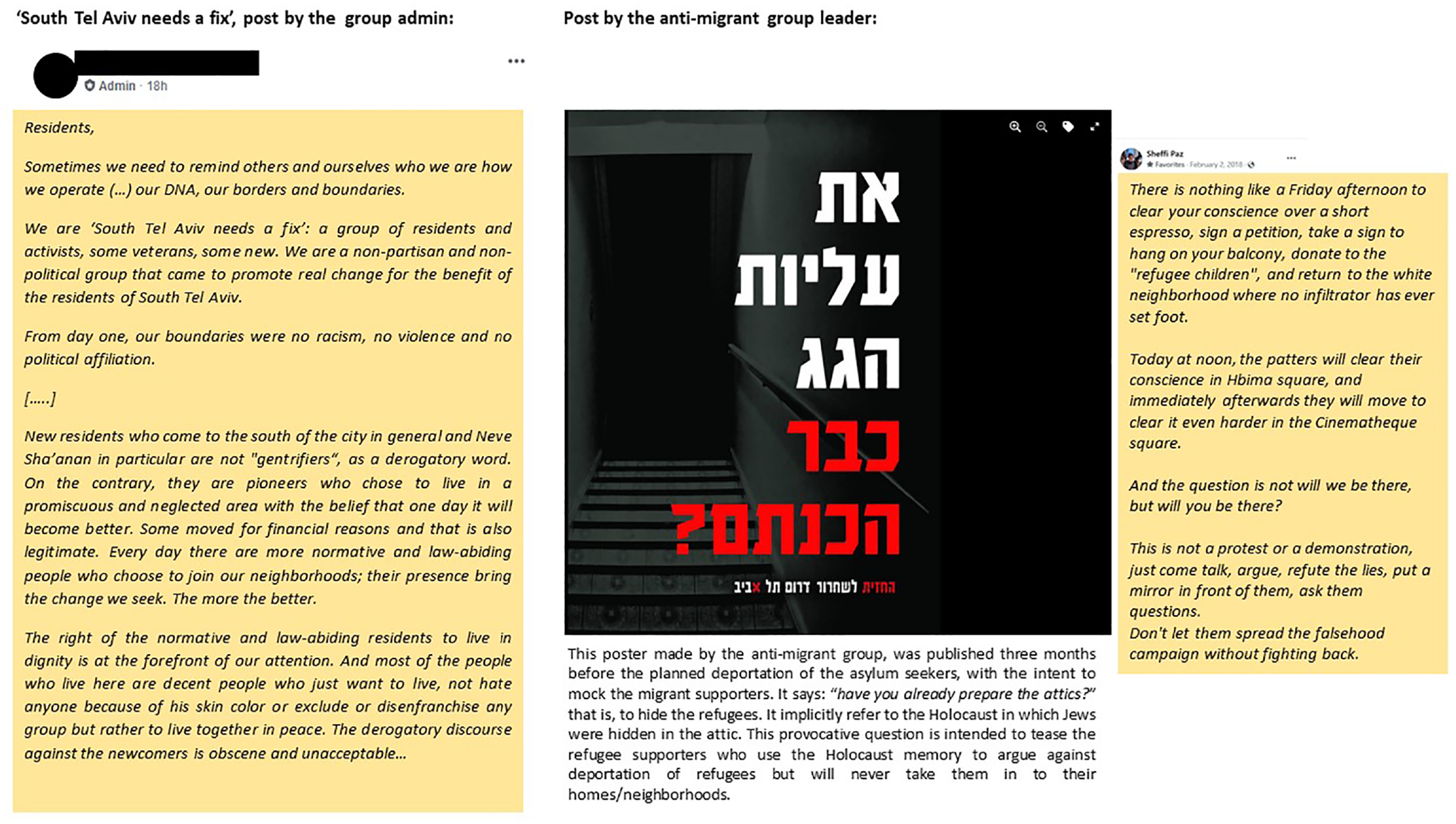
Posts of central group leaders constructing the moral identity of their public.
These new publics or, more correctly, digital networks conduct connective action to pursue neighbourhood change. Two dominant forms of connective action are used in the neighbourhood to promote change: representing and disseminating new imageries of the neighbourhood; and enhancing political power through direct digital communication and creating new spheres of political negotiations.
Representation and new imageries of the neighbourhood
The residents use social media and digital means to produce and promote negative representations of the neighbourhood to influence the regulation of space and promote political action by the authorities. Each group produces different representations of the neighbourhood to promote their desired regulation. The gentrifiers represent the disorder in the streets, the concentration of unwanted phenomena and incivilities to urge the authorities to displace them. Therefore, they share daily images of homelessness, drug use, drug trafficking, women in prostitution, garbage in the streets, dirt and nonnormative uses of public space. Their mission, as they explained in an interview, is to represent the ‘forgotten reality of Neve Sha’anan which has been normalised’, as it serves as the city’s ‘backyard’ (Cohen and Margalit, 2015). These representations aim to provoke the authorities on social media and poke fun at the city’s image and branding. They share negative representations on tourist pages and groups, as well as on official government pages to illuminate the ‘dark side of the city’ as they phrase it (Figure 2). The residents use the municipality’s branding graphic language to mock it. In one campaign, they present a comparison between one image from their neighbourhood and the other from more affluent area to visualise urban inequality. One of the activists in this group explained the use of images: People who don’t live here have no idea what’s going on. I think it’s convenient for the authorities that it’s all concentrated here; I believe the images speak for themselves. Photos and videos have power.
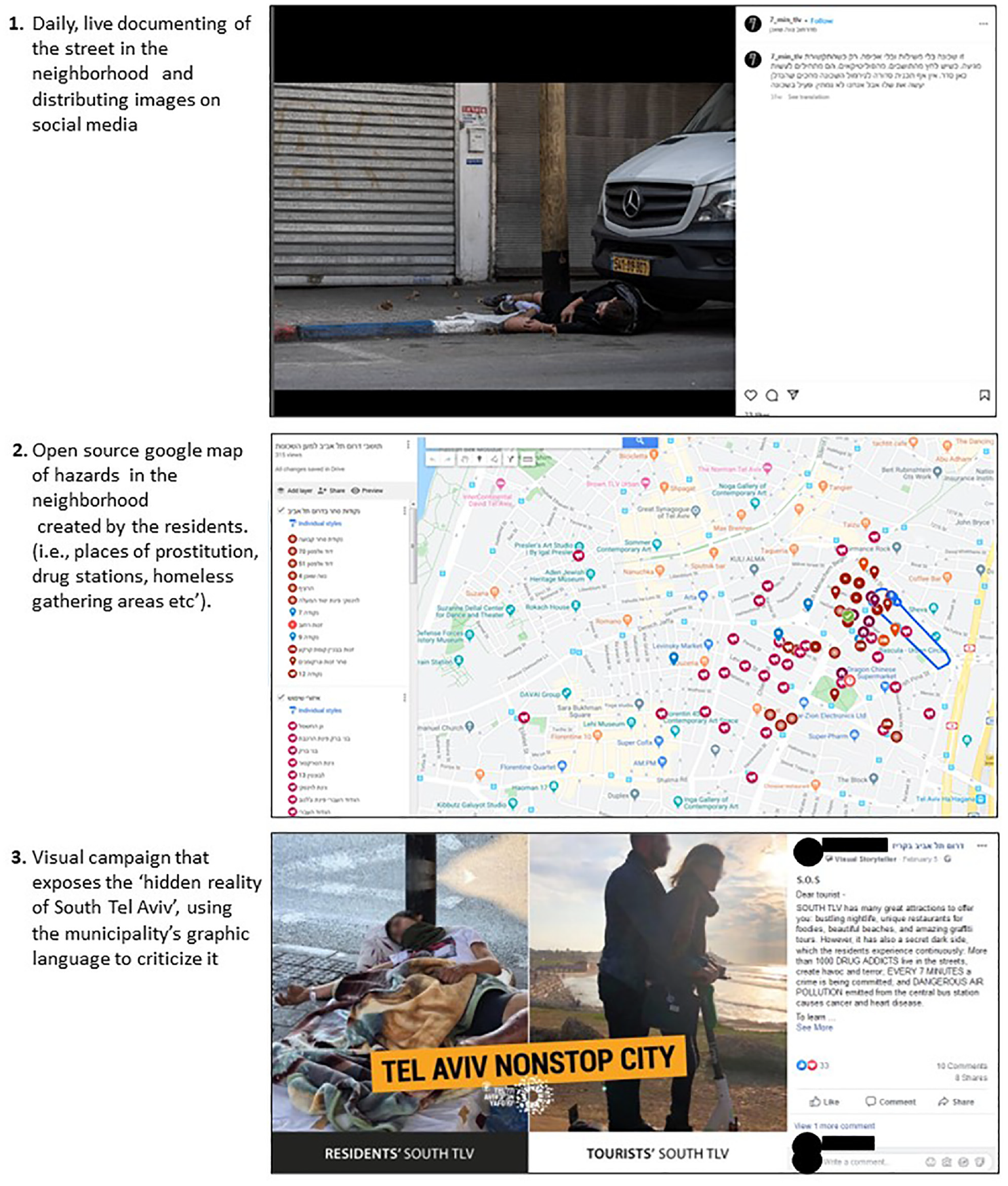
Negative representations of the neighbourhood produced by the residents.
Alternatively, residents who oppose the presence of asylum seekers disseminate different types of representations on social media. In particular, they share images of black people gathering in public spaces and images related to violent encounters involving asylum seekers. They frame the violence and disorder in the neighbourhood as related to immigration and race (Zur and Hatuka, 2023).
Digital tools enable self-representation, giving residents the opportunity to represent the neighbourhood from their perspective and daily experiences. They become independent from the traditional media who dominated the public sphere and now use visual content and representations produced by the residents (Zur and Hatuka, 2023). An anti-migrant resident explains the reversal of roles between them and the media: The media doesn’t like us; if we won’t do the work, no one will. … I send them [the journalists] all the materials, if they are interested they are taking it. … 80% of the videos and images from STA are coming from my phone … I also tell people if something is happening, make a video and send it directly to me.
The democratisation of representational power in the digital age (Andén-Papadopoulos, 2014; Frosh, 2001) enables residents to overcome traditional gatekeepers such as journalists, editors and publishers and thereby reshapes the relationship between residents and the media from being represented to becoming content producers who feed the media. This challenges the dominance of the media and the authorities in creating the image and territorial stigma of places (Avraham, 2000; Body-Gendrot, 1995). The residents are free to use the channels of social media to distribute alternative narratives (Neumayer and Rossi, 2018). Although subjected to the new algorithmic gatekeepers of social media (Daniels, 2018; Poell and van Dijck, 2015), they still enjoy higher levels of freedom, visibility and scalability that were not available to residents prior to digitalisation.
The residents, who struggle among themselves over the future of the place, produce competing representations of the neighbourhood according to their political view and goals. Moreover, they convey complex messages about the place and are sophisticated actors on social media. For example, the gentrifiers produce negative representations to criticise and pressure the authorities and at the same time post positive representations of renewed architecture building and new businesses to encourage potential residents to move to the neighbourhood or support events and business that promote gentrification.
The residents’representational practices include taking pictures and videos and uploading them to Facebook, Instagram, X (previously known as Twitter) or Google Maps. They use a car that drives the streets while filming and broadcasting on FacebookLive, mapping hot spots of crime and hazards in the neighbourhood and placing surveillance cameras that broadcast on FacebookLive. They upload daily visual reports that include pictures taken in the streets to various social media platforms. ‘It’s a very creative struggle’ says one of the leaders of ‘STA needs a Fix’. The other group produces edited videos of violent encounters between anti-migrant activists and asylum seekers or human rights activists (Zur and Hatuka, 2023). Their main goal is to ‘show the invisible reality of immigration’ and its consequences on their daily life, as one woman explains in an interview: The media presented the residents as a bunch of rowdy and racists who don’t know what they are talking about … (and not the) peeing in stairwells, the mess, the shits in the streets, the drunks, the smoke in buildings … when the media and human-rights organizations are not in the area they [the immigrants] are walking around like peacocks, laugh and act like the masters of the land.
The intense digital representation on digital networks creates an additional effect. It establishes a new form of countersurveillance by the residents and a public archive that documents street life in the neighbourhood and the residents’ struggle and negotiation with the authorities.
The residents use practices of countersurveillance and documentation of the local authorities to monitor and publish their ‘inaction in space’ (Figure 3). The representation of the disorder and incivilities in the streets highlights the authorities’ lack of enforcement and control. By using alternative surveillance, they challenge the authorities’ control over the surveilled space and criticise their lack of transparency. The area of Neve Sha’anan is the most policed area in the city and has the highest concentration of surveillance cameras (Zur, 2023). At the same time, it remains the main cluster of drug use, homelessness and street prostitution in the city. Therefore, the residents aim to expose the incompatibility between surveillance and enforcement. By creating an alternative means of surveillance, they turn the surveilled gaze towards the authorities. Some of the actions are symbolic. As one of the leaders explained, they created a Google map (see Figure 2) where residents uploaded pictures and marked points of crime and hazards in the neighbourhood: ‘It doesn’t matter if the interactive map was practical, it was more symbolic’, to indicate that it is well known and transparent.
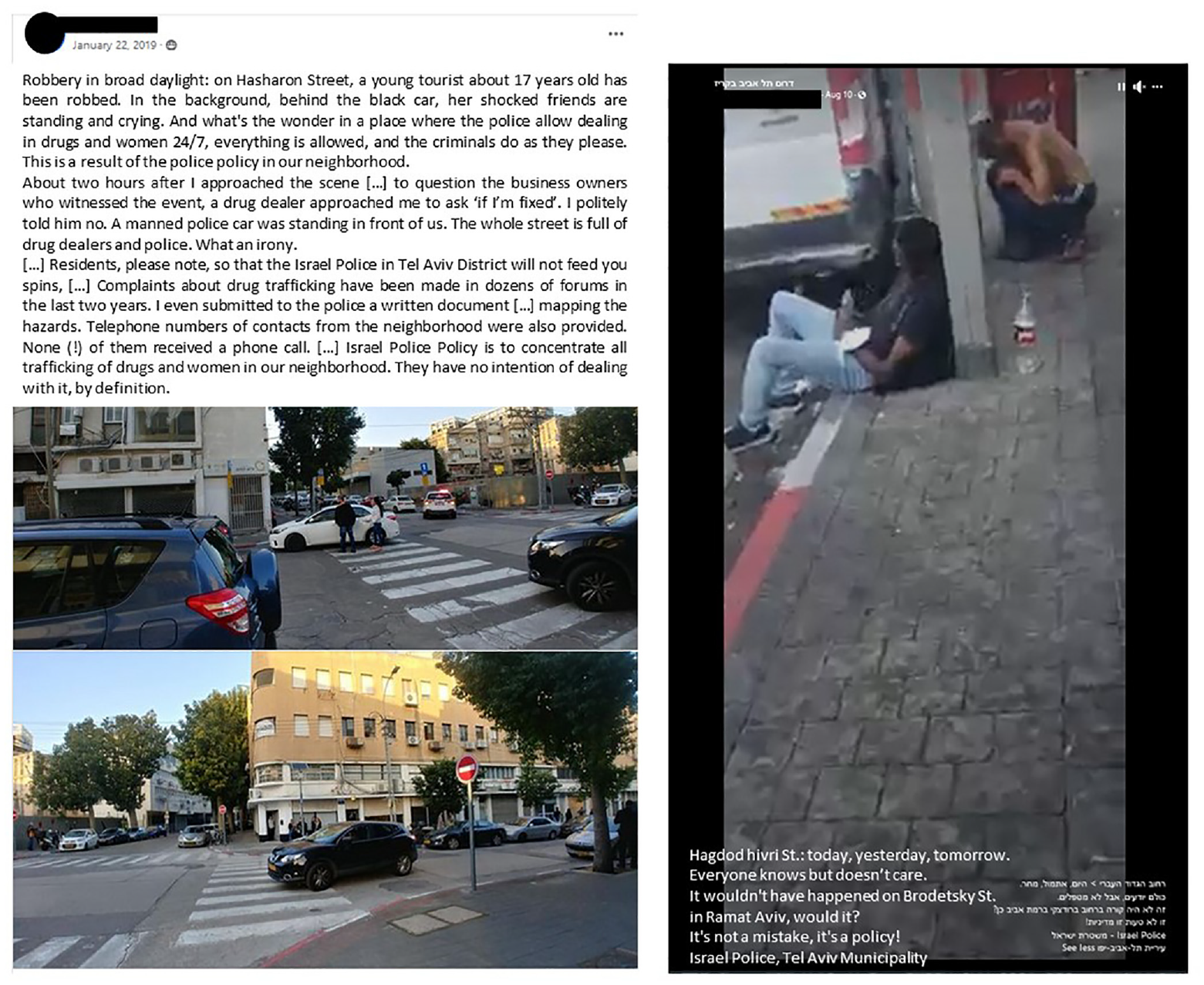
Documentation and countersurveillance of the local authorities’‘inaction in space’.
Digital tools and platforms allow residents to collect and display data, information, visual materials, documents and conversations and archive them publicly. Turning their claims into data, displaying them, and storing them creates an archive that tracks street life in the neighbourhood and the negotiation with the authorities over the regulation of space. The residents document events, give updates on meetings and share images on the social media timeline that can be reviewed, returned to and discarded if necessary. This becomes the group’s public archive, which is created by all the people who contribute to it. Unlike the authorities’ surveillance, which has one source of control, this is an open archive and surveillance mechanism made by the connective action of the people in the network. Materialising their claims into data, serves as evidence that supports their demand and criticism against the authorities. This was initially one of the motivations to open the FG: How did we start the page? We uploaded a video of a friend talking to a SALA officer [urban police], and he said what we already know, that basically the police and the municipality convey or explain to the homeless and drug addicts that they must go to this area.
They wanted to make this information public and document evidence regarding the informal spatial policy of concentrating unwanted phenomena in Neva Sha’anan (Zur, 2021).
Enhancing political power through direct digital communication and new spheres of negotiation
Digitalisation transforms the political relations between residents and policy makers, authority officials and politicians. The residents manage a complicated network of communication with the authorities in various digital platforms; some are open and public, while others are closed and direct. Digital networks facilitate new spaces for political negotiation, claim making and dialogue with politicians and in-between political groups.
Many of these spaces are formed and administered by the residents; therefore, they can set the agenda, lead the discussions and navigate the moral boundaries and membership of the group. The admins, who approve every post, have vast control in directing the content. Instead of being limited to participating in the digital ‘invited space’ created by the municipality (Legard and Hovik, 2022), they forge alternative negotiation spaces. As explained by the admin of the FG, ‘STA needs a fix’: I know that there are people of Ardan [The Minister of Defense] and people from the municipality who follow the FG. They want to be on it; this is the best channel for us. Even in the large WhatsApp group there are people from the municipality who are there to know what is going on.
Journalists, activists, police officers and residents from around the city are also members of the FG. Other active groups in the neighbourhood manage social media pages and profiles. Moreover, the ability to comment on politicians, institutions and other users’ posts constitutes a political arena where residents enjoy great freedom for political interaction and negotiation.
Additionally, digital media generates a personalisation of political actions; since each politician has a social media profile, they become accessible and targetable. Many digital campaigns are focussed on specific figures, such as the mayor, the minister of internal security and the police station commander. Moreover, residents conduct direct actions of mass-messaging decision-makers in an orchestrated manner to flood them with messages on a certain topic and demonstrate the group’s growth and persistence. ‘We have a guy who is an expert in getting to people’s personal WhatsApps’ explains one of the residents and gives a list of high-rank urban and state politicians they approached. This strategy is also based on a connective action, initiated by few but executed by a collective of individuals who operate together. In a Facebook post inviting people to participate in what they call ‘WhatsApp patrol’, a young man is depicted lying on a sofa with his phone in his hand, along with the slogan ‘Changing South Tel Aviv from the sofa!’ and the following text: The more people we have, the more decision makers will receive direct requests on WhatsApp, and we pressure them to act in our favour. The messages are pre-formulated so that you don’t have to spend more than 10 seconds a day.
The connective action creates a new path for civic agency for other residents, inviting them to become digital activists with minimal effort and without even leaving their homes. Digital activism offers different levels of participation (George and Leidner, 2019). The ability to reach politicians’ private WhatsApp or to poke them on social media shortens distances, bypasses gatekeepers and gives ordinary people the opportunity to interact with them digitally and be heard. It changes the relationship among residents, politicians and people in high-rank positions from being hierarchical, formal and inaccessible to being horizontal and accessible. Politicians, residents and institutions are all playing on the same field, feeding and responding to one another. As described by an active resident: Recently, I entered Twitter, yesterday Ayelet Shaked [The Minister of Justice] started following me and then from that moment I started getting followers, about fifty just yesterday because of Ayelet Shaked.
The fact that politicians and ministers follow private people on social media demonstrates the significance of the horizontal and nonhierarchical network, where politicians and residents are interdependent in their race to gain followers, visibility and power. ‘There is no distance’ says another resident from the gentry group, ‘it’s amazing! People don’t understand what power citizens have today’. During our interview, he received videos from national politicians for one of their campaigns. He listed the ministers and parliament members with whom they met. The anti-migrant group also made significant connections with politicians from the right and was even invited to meet the prime minister at a crucial decision point. 3 Notably, prior to the struggle, these were anonymous citizens who became political leaders through their social media activity and their leading role in the networks that operate the connective actions.
Another form of direct digital communication with influential figures is the WhatsApp groups of police and residents established by the police to meet residents’ demands. The residents use the app to transfer pictures and videos of hazards, nuisances and complaints. Through direct and daily digital communication with the police, the residents impact the priorities of police work in the neighbourhood. The constant images and demands shared by the residents with public officials create greater exposure to their agenda, perception of space and nuisances. This new form of communication (i.e. direct, instant, informal, accessible and free) with the ‘digitally connected’ residents raises questions regarding inequality in police services in the neighbourhood (Zur, 2023).
Acting simultaneously in public spaces of negotiation (i.e. social media and media), in addition to conducting behind-the-scenes politics in closed digital networks (i.e. WhatsApp), allows residents to maneuver and speak in multiple voices. The public negotiation serves as leverage point to pressure the authorities as a gentry activist explained: Tel Aviv municipality really doesn’t like us using the media, they told us: ‘it doesn’t serve you … we work without the media’ … but that’s not true, without the media it wouldn’t work.
An anti-migrant activist described the group’s leader strategy: She realised that you can’t win the struggle with demonstrations, you always need connections with politicians . . . You play poker, you have a lot of cards, you need to control the game . . . I always tell her that if people knew what is happening behind the scenes, they wouldn’t believe.
Of course, not everything is done via digital means, but the organisation of the networks, the action on different fronts and especially the accumulation of power and visibility by the residents lies in the opportunities and capabilities offered by digitalisation. In the area of Neve Sha’anan, there are dozens of WhatsApp groups and subgroups of residents that are used for organising and acting collectively. This multitude of digital communication groups creates a complex web of digital coalitions in space, negotiating in multiple arenas at the same time, with various actors, different scales and levels of transparency. It can be imagined as a tangled and dense network of relations that is highly dynamic, which hovers over the neighbourhood’s present and future.
The effect of digitalisation on residents’ agency in the neighbourhood
Digitalisation accelerates and decentralises citizen-government relations. It opens the political sphere to new actors, participants, possibilities, arenas and paths for action. Moreover, it transforms political relations to be more direct, daily and recursive. Digitalisation has caused the collapse of some human gatekeepers, transforming political relations to become less formal and hierarchical. Many of the emerging digital coalitions in the neighbourhood are necessarily a consequence of digitalisation. These social associations are a product of the ease of connecting and communicating through digital platforms: the resident-police digital groups, the international network of activists against deportation, the gentry group and the anti-migrant group are different forms of digital networks that conduct connective action.
The various practices developed by the residents demonstrate how digitalisation opens new avenues for influencing and shaping the neighbourhood and its position in the political realm. Their digital agency affects different aspects of the neighbourhood, as follows: in terms of social dynamic, the residents assembled new digital coalitions of power and compete against other groups in space. Their struggle for visibility and dominance on social media to promote conflicting political–spatial visions, inflame the social relations in the neighbourhood. Symbolically, they changed the image of the place and interfered in its representation and stigmatisation. By producing competing narratives and framings, they reconstruct the symbolic space, framing it as a failure of the authorities and making it a symbol for wider struggles (i.e. urban inequality, nationalism and racism). The digital tools of representation and the ability to form different digital networks allow them to influence the scale and framing of the struggle, from local to urban, to national and even international. Moreover, they alter the political status of the neighbourhood, from being weak and neglected, the ‘backyard’ of the city, to being in the forefront and having political claims and power. Through their digital agency, residents become significant political actors in the local and national arenas.
Conclusion: Place-oriented digital agency
Residents in the digital age have greater tools and spheres to express themselves, represent their narratives, directly address politicians and policy makers, organise collectively and operate as publics. They are not waiting for or limited to the government ‘invited spaces’ (Legard and Hovik, 2022) but instead create their own channels of negotiation and claim making (Tilly, 2008). Residents are sophisticated digital users who know how to empower their agency through digital means. They use diverse digital strategies to promote change in different directions. They invert the tools used by the authorities, such as surveillance, to conduct countersurveillance that monitors the police and municipal actions in place. Through digital representation, they influence public discourse and traditional media, submitting visual materials that are consistent with their point of view and values. Therefore, digitalisation does produce new forms of agency at the neighbourhood scale.
Digitalisation essentially changes agency itself; it creates ‘distributed agency’ (Rammert, 2008), which describes the emerging force that stems from the combination of the creativity of people and the capabilities and qualities offered by digitalisation (i.e. speed, scale, connectivity, distribution, horizontality and recursiveness). Digital agency allows people to conduct connective actions at an unprecedented speed and scale. This involves an interactive relation between humans and machines, a dual process in which the digital restrictions and abilities shape the modes of activism and protest and vice versa. The concept of distributed agency can also describe the multiplicity of users and agents constituting connective action. Each action gains meaning and volume from the accumulation of actions and hence from the participation of other agents in the network. Therefore, agency is not individual but distributed between the users in the network. In summary, digitalisation offers residents new possibilities: (1) to conduct connective action and form networks at various scales; (2) to form new spaces for political action and negotiation; (3) to participate and become agents in the network with different degrees of involvement; (4) to pursue self-representation, documentation, archiving and public dissemination; and (5) to conduct horizontal communication with politicians and the police. Hence, digital agency gives residents significant power to act in the urban political arena.
The paper indicates that in contemporary urban struggles, digitalisation becomes central capital for groups who know how to utilise it. They gain overrepresentation in the virtual arena, in front of the police, politicians, traditional and social media. They employ their digital capital to leverage a position of power in the neighbourhood. However, this comes at the expense of other groups who are not digitally connected (Hatuka and Zur, 2020; Zur, 2023). Therefore, we witness an interesting process of growing discrepancy between the physical and digital spaces as arenas of action of different communities in the city. There is a split between those who are more active and visible in physical spaces (e.g. populations in distress) and those who try to shape the physical space through the digital spheres. Importantly, digital agency is not limited only to middle-class groups but is open to the wider public who uses it differently (including the gentrifiers, the veteran right-wing residents and the human rights activists). It opens the political game to small groups with limited resources who are not necessarily organised (Zur and Hatuka, 2023). The variation in use (i.e. intensity, creativity, visuality, scale, sophistication and strategy) is related to each group’s political goals, moral perception and digital capabilities. Thus, further research is needed regarding the evolving different profiles of digital agencies.
Although many daily digital uses influence the production of space in the city (Bronsvoort and Uitermark, 2022; de Souza e Silva, 2006; Wilken and Humphreys, 2021), we can identify a spectrum of digital agency related to place; lower levels of agency have a cumulative impact on place but are more indirect and not necessarily intentional, while higher levels of agency are characterised by a vocabulary of intentionality (Rammert, 2008). When digitalisation is used strategically and intentionally to interfere in the politics of place, we suggest the concept of place-oriented digital agency. As shown here, the connective action and digital practices advanced by the residents are all place related, aimed at shaping and struggling over a certain territory. All practices are rooted in place and are directed to reconfigure space and impose certain order, values and aesthetics. The place-oriented digital agency influences place on multiple levels: the social space, the symbolic space, the political and the normative. It uses digital means to materialise change in a concrete environment, its character and its future. The practices of struggle themselves involve the use of physical and digital spaces (Zur and Hatuka, 2023). Place-oriented digital agency is not limited to neighbourhoods; it can be used on larger scales and struggles over the identity of place (such as nation-state) due to the scalability of digital networks. Similar digital practices are used in struggles on larger scales to empower citizen agency. Therefore, this paper, on the one hand, reveals an emerging dynamic in neighbourhoods in the digital age and, on the other hand, allows us to see and understand macro processes on a small scale.
To conclude, neighbourhoods in the digital age have become a complex, multifaceted web of connections, spaces and coalitions. The multiplicity of digital platforms creates multiple digital arenas of negotiation, representation and interaction. In conflicted, heterogeneous neighbourhoods, social struggles now extend to multiple physical and digital spaces. Therefore, the study of neighbourhood change must engage both the digital and the material spheres to assess how digitalisation, in multiple ways, materialises change on the ground and vice versa.
Footnotes
Acknowledgements
I wish to thank George Galster and Jan Üblacker, the editors of this special issue, for their ideas and thoughts during ‘Digitalization, Neighborhood Change, and Social Integration’ workshop held on May 2–3, 2022, in Cologne, Germany, under the support of the Fritz Thyssen Foundation. More specifically, I wish to thank George Galster, for his insightful suggestions to this paper, to Tali Hatuka and to three anonymous reviewers for their invaluable comments.
Declaration of conflicting interests
The author(s) declared no potential conflicts of interest with respect to the research, authorship, and/or publication of this article.
Funding
The author(s) received no financial support for the research, authorship, and/or publication of this article.
