



Abstract
This paper investigates the impact of homeowners’ condominium self-governance on neighbourhood governance in urban China. The self-governance campaign, which advocates for the direct employment of property management personnel, signifies condominium owners’ endeavours to reassert control over their private living space against the intervention of the state and the exploitation of property management agents. Whilst self-governance is practised within specific walled neighbourhoods, homeowners’ efforts to amplify the influence of this campaign have brought it beyond the mere selection of a property management model. Employing the strategic action field approach, this paper identifies the key actors and specific forces that shape China’s condominium and neighbourhood governance. It also explores the potential political risks associated with the self-governance campaign and how it changes the power dynamics within the neighbourhood governance structure. The research findings not only illustrate the versatility of the strategic action field approach in analysing the various aspects of condominiums and private neighbourhood governance in urban China but also extend current understanding of the interplay among homeowners’ organisations, market agents and state actors and reveal relevant implications for neighbourhood governance in urban China.
Introduction
Condo-isation is an accelerated trend in cities across the world (Lippert and Treffers, 2021; Rosen and Walks, 2013). As a relatively new legal and social framework for housing ownership and shared built environment, it profoundly impacts the governance of private urban neighbourhoods (Easthope, 2019; Lippert, 2019) and carries significant implications across multiple dimensions. For example, condominiums are legally defined as mixed property regimes and spatially gated living spaces, making property-related laws, space-bounded social actions and locational benefits the key factors for its governance (Fu, 2019; Logan and Molotch, 1987).
The political dimension of condo-isation, which concerns both the internal governance structure of condominiums and their broad external environment, is another important issue (Lippert and Treffers, 2021). Whilst this dimension is observed globally (Blandy et al., 2010), it is especially relevant in authoritarian states like China where the state maintains tight control over society (Mittelstaedt, 2022; Thornton, 2013). Notwithstanding large-scale housing privatisation reform and the introduction of condominiums, a strong state presence still persists in this ostensibly self-regulated form of neighbourhood governance. A political surveillance mechanism better known as the social management system, which symbolises a vestige of the socialist past and combining private autonomy with party-state leadership, has been established to exert control over the condominium system in urban China (Zhang and Ong, 2015; Zhou, 2014).
In this context, the self-governance campaign, which has gained popularity among homeowners’ associations (HOAs hereafter) in China over recent years, emerges as a potential form of resistance to state intervention in condominium governance. Presented as a mode of direct employment of property management staff by HOAs (bypassing an external property management company), self-governance is also known as partnership management (Wekerle et al., 1980) or direct labour management mode (Yip et al., 2007). In urban China, this mode transcends the mere promotion of an alternative approach of property management. It signifies homeowners’ explicit quest to reclaim power in governing their condominium, which poses a challenge to both political intervention by the local state and economic exploitation by property management agents (PMAs hereafter). More importantly, the campaign has been actively promoted by a group of dedicated advocates as a cross-city movement in which homeowners’‘right-defending’ actions have been actively involved. This further complicates the political dimension of condo-isation in China.
This paper explores how the campaign of condominium self-governance impacts the interaction among various actors in China’s private neighbourhood governance. Utilising a strategic action field perspective, it provides an in-depth analysis of how homeowners’ organisations, market agents and state actors shape condo-isation in China and aims to achieve two specific objectives. First, it seeks to identify the strategic action fields that are involved in condominium governance in urban China. Second, it attempts to analyse the impacts of condominium self-governance on the dynamic interaction within and between these fields.
The paper is structured as follows. The second section reviews the literature on different dimensions of condominiums systems with a focus on the political dimension and its relevance to China. The third section three outlines the core components of the strategic action field framework, which provides a basis for the analysis of the actors and interacting forces involved in private urban neighbourhood governance in China. The fourth section details the methodology for data collection, followed by an elaboration of the interplay among key actors in the self-governance campaign in the following section. The sixth section discusses the findings, and the final section provides the conclusion.
Condominium system and its political dimensions
A condominium is not just a physical edifice but ‘an invented legal and social relationship among property owners and other key constituents centered on a defined space’ (Lippert and Steckle, 2016: 133). It embraces a complex array of interconnected elements in legal, spatial and political dimensions.
As a legal framework for a mixed property regime, condominiums encompass a bundle of private ownership rights that demarcate between the individual and common property ownership as well as the obligations of owners in daily management (Van der Merwe, 1994). HOAs serve as crucial legal mechanisms to provide collective service, foster civil participation and solve the problem of collective action in the co-governance of communal properties (Cséfalvay and Webster, 2012; McCabe, 2011).
Spatially, condominiums often manifest as gated communities (Pow, 2009). These gated neighbourhoods, which create a club economy within defined territorial boundaries, ‘reflect the ideological shift toward privatism that is characteristic of the neo-liberal consensus’ (McKenzie, 2005: 189). They cater to the need of the middle classes for a privatised utopia that offers shared identity, enhanced security and exclusive service (Foldvary, 1994; Glasze, 2013).
Politics is another important dimension of the condominium system. Existing research on private neighbourhood governance has recognised inner micro-politics as a foremost concern in the smooth implementation of condominiums (Lippert and Steckle, 2016; Treffers and Lippert, 2020). Basically, a private neighbourhood with a HOA as its governing body is considered a small-scale form of democratic governance as it provides citizens with opportunities to use their own skills and knowledge to solve the problems in their living space (Cooper, 2005; McCabe, 2011). The macro-political context is also highly relevant (Pow, 2009). The distinct social, political, and legal environments do influence the power relationship between different actors in condominium schemes (Lippert and Steckle, 2016). For instance, the dominance of property interests in the political system has put condominium owners in a disadvantaged position in condominium projects (Easthope, 2019; Yip and Forrest, 2002), and condominium law often fails to offer adequate protection to condominium owners (Blandy et al., 2006). Meanwhile, participation in HOAs has been found to be positively correlated with local governing (Chaskin and Greenberg, 2015) because HOAs are instrumental in the development of associative democracy that enables social groups ‘[to] build their own social worlds in civil society’ (Hirst, 1994: 13).
The legal, spatial, and political issues associated with the condominium system are evident in China. The market-oriented economic reform of the 1980s not only introduced private ownership of housing but also accompanied legislation, including the Regulations of Property Management (in 2003), the Real Rights Law (in 2007) and the Civil Code (in 2020). Similar to their Western counterparts, most private neighbourhoods in China are designed as gated ‘club realms’ with PMAs as the key service providers (Hendrikx and Wissink, 2017). Meanwhile, HOAs have emerged as the organisational entities for private neighbourhood governance in China. These associations are often associated with ‘bottom-up’ democratic participation and homeowners’ pursuit of higher-level citizenship (Wang et al., 2017; Xia and Guan, 2017).
Yet, there are several noticeable differences in China’s condominium system. Large-scale housing privatisation reform does not imply a retreat of the state from neighbourhood governance. Instead, since the 1980s, a ‘community building’ initiative has been in place to address the power vacuum left by the collapse of the work unit system (Bray, 2009). Against the background of a general relaxation of political control after the market reform, this new initiative may reflect the desire of the party-state ‘in incorporating democratic elements in neighbourhood governance, especially at the local level’ (Zeng et al., 2023: 638). However, HOAs have been identified as potential agents of mass mobilisation and democracy, prompting the state to assign a Street Office (SO) and Residents’ Committees (RCs) as political gatekeepers to monitor owners’ activism (Yip, 2019). For example, the Regulations on Property Management of China mandates that ‘the homeowners’ assembly and the HOA shall cooperate with the RC to perform their duties, provide support for RC, and accept the RC’s guidance and supervision’ (Regulations on Property Management of the People’s Republic of China, 2018, clause 20). Thus, a vestige of their political influence, which is absent or far less prevalent in Western contexts, remains in private condominiums in China. Recently, RCs have extended supervisory roles to vetoing collective decisions made at condominium owners’ meetings or overturning HOA election results under the guise of exercising supervising and guiding power (Cai and He, 2022; Yip, 2019). Consequently, the pervasive presence of administrative power in condominium governance has transformed the neighbourhood into areas where residents’ everyday lives are governed ‘at a distance’ by the government (Tomba, 2014).
The impact of political intervention is also evident in the relationship between HOAs and PMAs. Condominium owners often mistrust PMAs due to their poor service quality (Shin, 2013; Wang, 2014). Meanwhile, PMAs and RCs have formed a symbiotic relationship, creating a ‘local growth coalition’ where RCs benefit from PMAs’ staffing and financial support (Sun and Huang, 2016). In exchange, PMAs gain administrative convenience and political protection from RCs when necessary. This alignment makes it challenging for condominium owners to assert their property rights. For example, although it is a legitimate practice elsewhere to mobilise support to dismiss an underperforming PMA, such action in China might be perceived by RCs as a threat to social stability. Organisers of such campaigns may be cautioned by RCs about the potential legal consequences of disturbing social order.
The penetration of the state in condominiums and the complex triangular interplay among the state, market and society have placed homeowners and their HOAs in an unpleasant position. Current research indicates that HOAs in China have limited power in self-administration and fall short of the private neighbourhood governance models in the West (He, 2015; Gao, 2021). HOAs are not the ‘power centre’ of the condominium system as the essential legal, social, and political support for their development is lacking (Wang, 2016). It is against this backdrop that self-governance becomes a campaign to reclaim the economic and social rights that the law empowers on paper but are not realised in practice (Yip et al., 2021).
The strategic action field framework and neighbourhood governance in China
The SAF approach
The strategic action field approach seeks to streamline the relationship between structure and agency while connecting macro-social processes with micro-interactions. It examines how actors navigate within the constructed social order by successfully launching collective strategic action, particularly with the presence of the state (Fligstein and McAdam, 2012). The strategic action field is conceived as a ‘meso-level social order and the basic structural building blocks of modern political/organisational life in the economy, civil society and the state’ (Fligstein and McAdam, 2012: 3). In the field like this, ‘actors (who can be individual or collective) interact with the knowledge of one another under a set of common understandings about the purposes of the field, the relationships in the field (including who has power and why), and the rules of this field’ (Fligstein and McAdam, 2012: 9).
The SAF approach primarily focuses on the interaction between two fundamental actors, that is, incumbents and challengers. Incumbents wield disproportionate influence within a field and can shape it to their advantage by setting general rules. Challengers are less advantaged members of the field with their own vision of how the field should be and tend to participate in collective actions to reshape the structure of the field when opportunities arise (Fligstein and McAdam, 2012; Goldstone and Useem, 2012). In addition, central to one SAF is the internal governing unit that is ‘charged with the duty of overseeing compliance with field rules and facilitating the overall smooth functioning of the systems of the field’ (Fligstein and McAdam, 2011: 6).
SAFs are dynamic and complex entities with fluid boundaries where actors’ understanding of the field is not necessarily consensual. The ongoing contestation between incumbents and challengers can result in the adjustment of field rules, field crises or even the creation of new fields. Meanwhile, SAFs do not exist in isolation, they are embedded within the complex webs of other fields, which can introduce turbulence and external shocks. Changes in a field can have a ripple effect, directly or indirectly, on proximate fields. This is particularly evident when incumbents fail to withstand external impact or when challengers effectively seize the opportunity to reframe contentious actions (Fligstein and McAdam, 2012: 59).
SAFs related to China’s neighbourhood governance
Private neighbourhood governance in urban China is influenced by four SAFs. The first is the grassroots state field, which represents the political terrain where the party-state exerts direct control over grassroots society. This field was established when China introduced the household registration system in cities in the mid-1950s. Initially dominated by work units under the central planning economy system, this field was restructured with the revitalisation of RCs to fill the social and political control void in the neighbourhoods following China’s market-oriented reform (Wong and Poon, 2005; Sun and Yip, 2018). With substantial financial and human resources injected by the party-state, RCs have become the administrative arm and nerve tips of the lowest level of local government (Bray, 2009; Yip, 2014), making them incumbents of the grassroots state field. Local party branches act as the internal governance units in this field, ensuring that the Communist party’s policies on political mobilisation, social control and service delivery are properly implemented.
The condominium field is the second field of focus. This field was established when China introduced private housing ownership in the late 1990s, which created private property rights for individual units and a collective ownership of common structures and amenities. Such a field encompasses not only the physical living space but also a bundle of housing rights and governance practices. In condominiums, homeowners, who were institutionally granted the right to govern their neighbourhood, become the incumbents. The local Housing Management Bureaus, which are empowered by China’s condominium laws to be responsible for implementing regulations regarding condominium management and HOA operations, are the internal governing units of this field.
In our conceptualisation of the grassroots state and condominium as SAFs, an intriguing dynamic emerges. The incumbents in each field serve as challengers in the other field. Given that all city dwellers must be affiliated with one RC, condominium fields are inherently nested within the spatial boundary of a specific RC or supervised by several RCs if the scale of the condominium project is large. This spatial overlapping may not pose an issue if the two fields are functionally distinct. However, as RCs are legally mandated to oversee HOAs within their jurisdiction, the grassroots state field has gained significant influence over the condominium field. Considering that the value of the condominium system is largely predicated on homeowners’ property rights, external control and limitations on the free enjoyment of property rights inevitably diminish the value of condominium ownership (Chen and Kielsgard, 2014). This explains why RCs’ intervention in the condominium field would easily be perceived by the condominium owners as an intrusion into their private realm. In fact, RCs’ political manipulation has triggered a further escalation of condominium owners’ actions, including appealing to a higher authority or organising more confrontational actions (Shi and Cai, 2006; Yip, 2019). Conversely, the legal mandate of HOAs in collective decision-making within condominium governance positions them as challengers to RC’s monopoly in social mobilisation. The occurrence of ‘right-defending’ actions, which are not uncommon in large cities in China (Chen, 2020), further exacerbates RCs’ anxieties and reinforces the role of HOAs as challengers in the grassroots state field.
The market field, a field that encompasses the real estate developers and PMAs as the neighbourhood builders and relevant property management service providers, also directly impacts the condominium field. In principle, the market field should be subordinate to the condominium field with the management agents hired by the HOA. It should be a straightforward process to dismiss PMAs that fail to meet contractual obligations. However, in China, such dismissals are often complex and may even be impossible due to PMA’s de facto dominant position in neighbourhood management. When a condominium operates to provide services as a club good, market entrepreneurs typically possess more resources than individual homeowners (Chen and Webster, 2005: 205), making it challenging to organise actions against underperforming PMAs. Furthermore, the symbiotic connection of a PMA with an RC further complicates owners’ collective action. Consequently, PMAs in China exist as challengers in the condominium field. It is common for them to overpower the condominium owners’ autonomy, maximise their influence and ultimately secure business profits.
In addition, the civil field, defined as a social space where civil organisations and civil forces engage in communications, experience sharing, and claims articulation, is the last important field to mention here. Despite tight political and social control, China recognises the need for voluntary social organisations to alleviate the state’s burden in addressing urgent social problems such as poverty alleviation, environmental conservation and disaster relief (Peng and Wu, 2018; Teets, 2014). That is how a weak civil field gets developed. Although heavily patrolled and controlled by the state, this field still provides room for the operation of some challenging social groups. One case in point is homeowners’ networked organisations. Identified as cross-neighbourhood HOA coalitions (Huang and Gui, 2016) or lateral networks of HOAs and housing activists (Yip, 2020), this kind of organisation provides homeowners with sophisticated skills and social capital, which are valuable external supporting resources for homeowners who want to initiate rights-defending activity. That is how the civil field is relevant to the condominium field and homeowners’ self-governance campaign in urban China.
Methodology
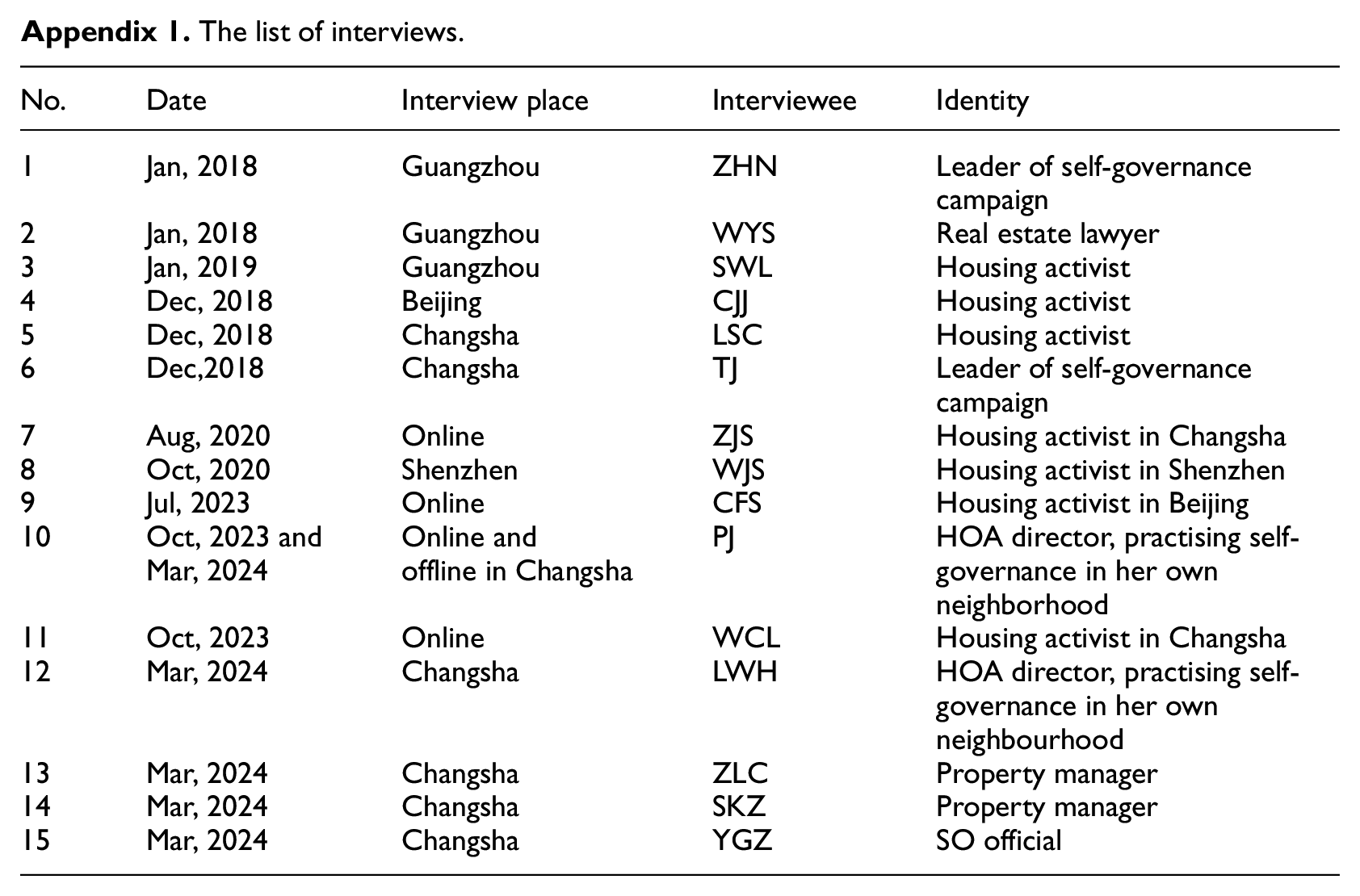
The paper draws on a range of data sources including semi-structured interviews, conference proceedings and online information. From December 2018 to March 2024, interviews were conducted with 11 local HOA leaders who practised self-governance in their neighbourhoods, one real estate lawyer, two property managers and one SO official. All interviews were recorded, transcribed and analysed with NVivo12 or manually. Based on the crucial concerns of the condominium system and the key tenets of SAF theory, the authors used an inductive approach to extract themes from the empirical data. After several rounds of data mining, several key themes such as owners’ claims, strategies in networking activities, PMAs’ reaction to self-governance and interactions among market agents, local government and housing leaders, were identified. To preserve privacy, direct quotes from the interviewees were anonymised. Detailed information on the interviews is available in Appendix 1.
Another significant source of data came from the proceedings of four national self-governance conferences held in Changsha in 2017, 2018, 2020 and 2022. These conferences, which provide homeowners with venues to share experiences on self-governance and engage in networking activities, were attended by 100–150 housing activists from multiple cities in China. One of the authors personally attended the 2018 and 2020 conferences and directly observed participants’ interactions and accessed the reports presented by housing activists.
Additional data was gathered from four online WeChat (the Chinese equivalent of WhatsApp) groups focused on self-governance, with a total membership exceeding 1400 from multiple Chinese cities. These group communications provide insights into important issues and relevant internal official documents that might have otherwise been overlooked. However, no direct quotes from these online platforms are used due to the impracticality of obtaining consent from all participants. Social media reports on self-governance in cities such as Xian, Ningbo, Hangzhou, Changsha and Guangzhou were also collected. The following sections will adopt the SAF perspective to examine the private neighbourhood governance in China and illustrate how the campaign of self-governance facilitates homeowners’ pursuit of full housing ownership and management rights.
Self-governance campaign and changing field interplay
The self-governance campaign has significantly influenced private neighbourhood governance in China by altering the interplay among the aforementioned several SAFs. This shift has further complicated the political dimension of the condominium system in urban China.
Consolidating owner’s incumbent position in the condominium field
The most noticeable impact of the self-governance campaign is the strengthening of HOAs’ incumbent position by counteracting the influence of the market field. Condominium owners often perceive PMAs as the root cause of management issues. Consequently, replacing PMAs with staff directly hired by the HOA is viewed as a straightforward solution to these problems. This approach is particularly appealing to condominium owners as their grievances are primarily targeted at PMA. One keynote speaker at the 2018 national conference on self-governance in Changsha claimed, Infringement of homeowners’ rights by property management companies is usually unbearable, this compels homeowners to act, to get rid of the “nanny” (property management agent), to take over the neighborhood, and motivate fellow condominium owners [to participate] [Xia, 2018; Changsha conference].
Likewise, reclaiming control over neighbourhood affairs is one significant accomplishment of self-governance. As contended by a HOA director in Guangzhou, It[self-governance] helps clarify owners’ status as the master [of their neighborhood], it lets the owners know that they can realize their housing rights by managing the property themselves. [Interview with ZHN, December 2018, Guangzhou]
The self-governance campaign’s most effective strategy in gaining support of condominium owners is the immediate financial benefit it offers. In Changsha, a notable example demonstrates this impact. One neighbourhood allocates 680,000 RMB in 2023 to homeowners as a year-end bonus after practising self-governance for four years. Mr TJ, the key organiser of the 2018 national self-governance conference and a staunch advocate of self-governance campaign, proudly declared, No condominium managed by a property management agent will offer a rebate to condominium owners, only self-governed condominiums can. [Interview with Mr TJ, December 2018]
Even if the financial benefits of self-governance are not substantial enough to prompt a successful dismissal of the PMA, the mere possibility of such benefits serves as a significant deterrent. This threat puts PMA on alert, compelling them to improve their performance. It also encourages ordinary homeowners to scrutinise the financial performance of PMA more closely. This weakens the PMA’s dominant position in the condominium field. A property manager in Changsha remarked, When will homeowners conduct self-governance? They do it when they are not satisfied with PMAs. This fast development of self-governance in recent years means PMAs must change our ways of doing business. PMAs must respect owners, make their budget transparent and provide better service, this a challenge. But PMAs must take action to respond. [Interview with ZLC, March 2024]
Resisting the interference from the grassroots state field
Homeowners’ consolidated incumbent position in the condominium field aligns with their resistance against the intervention from the grassroots state field. As previously discussed, the alignment of organisational interests between RCs and PMAs often undermines HOAs’ autonomy. When self-governance is implemented and the PMA is directly controlled by HOA, the RC’s ability to intervene in condominium governance is significantly diminished. A housing activist from Shenzhen described this interplay as follows, The grassroots government [SO and RC] does not like self-governance, property management companies can offer a lot of help to RC. When HOA controls all property management activities, it would be inconvenient for the RC [to monitor private neighborhood]. [Interview with WJS, October 2020]
Control over property management information serves as a powerful instrument for HOAs to counter the intervention from the grassroots state field. It should be noted that the highly technical information on finance, building maintenance and facility management of condominium system is crucial for the RC in its role in overseeing the neighbourhood. When this kind of information was controlled by HOAs via self-governance, RCs’ influence was weakened and HOAs were entitled with greater bargaining power in their interactions with RCs. As commented by a housing activist in Beijing, Self-governance means HOAs or some activists of this neighborhood make final decisions on financial budget, facilities maintenance and personnel cost. In this process, owners or their self-governance organization will have a better understanding of how their neighborhood is managed. This is what the RC cannot do, this is why self-governance enables HOAs to resist the RC if they think the RC’s supervision is unreasonable. [Interview with CFS, July 2023]
It is important to note that the resistance against intervention from the grassroots state is often subtle and non-confrontational. A strategy of ‘rightful resistance’ which O’ Brien (1996) used to characterise peasants’ resistance in rural China, can also be adapted to the campaign of self-governance in private condominiums. In this context, activists’ strategically frame their actions ‘with reference to protections implied in ideologies or conferred by policymakers’ (O’ Brien, 1996: 33). This approach makes it difficult for the state to dismiss these legally valid claims outright. Consequently, advocates for self-governance accentuate their claims of self-governance in the rhetoric of legal justifications. For instance, a participant of the Changsha conference in 2018 explained: I singled out Article 70 of the Real Right Law to illuminate a key point, the point is only the condominium owners, not the government, not any organizations, have the right to their dedicated areas and the right of collective management of the common areas [of their neighborhood]. [Wu, 2018, Changsha Conference]
The homeowners’‘rightful resistance’ approach has placed grassroots government in a difficult position. One official in Changsha describes their attitude towards self-governance as follows, We think self-governance is risky, it cannot be supervised, who knows what will happen in the self-governance neighborhood? We will not encourage this management model. But no laws say self-governance is illegal or not reasonable. So, there is nothing we can do to stop it, we just hope it can operate well, do not make trouble for us. [Interview with the SO official YGZ, March 2024]
Building connections with the civil field
The last change brought about by the self-governance campaign is the connection between the condominium field and the civil field. Such connections were established primarily through the personal interactions between advocates of the self-governance campaign and activists in the network organisations of the condominium system. Cross-neighbourhood network organisations have been active in supporting homeowners’ right-defending actions and have been prominent advocates for the reform of condominium management laws in urban China (Yip, 2020). To realise their organisational aims, the activists of network organisations have established or joined multiple instant messaging platforms (e.g. WeChat). These platforms offer communicative affordances for homeowners to share experiences, garner support and sustain their movement (Kow et al., 2016; Treré, 2020), and thus have become powerful organisational devices for disseminating self-governance ideas nationwide.
These cross-city conferences on self-governance represent another proactive move that further aligns and connects the condominium and civil fields; they also serve as a crucial strategic action to elevate the visibility of the self-governance campaign. The inaugural conference in 2017 can be regarded as a field-configuring event (FCEs), providing a platform to ‘announce new products, construct social networks, share information and recognise accomplishments’ (Lampel and Meyer, 2008: 1026). The organiser of this ground-breaking event holds a prominent position. Not only is he a housing activist who has implemented self-governance in his own neighbourhood as early as 2003, but also is a prominent figure in a networked organisation in South China. This dual role lends credibility and expertise to the event and enhances its impact. While the primary organisers of the subsequent conferences in 2018 and 2020 were not directly involved in any networked organisations, many seasoned members of the networked organisations attended to show their support. One organiser of the Changsha conference in 2018 mentioned the purpose of these large-scale conferences, One key objective of holding conference is to make self-governance more visible, and to promote it to more condominiums, I want more officials to know that we [homeowners] can manage our property very well. [Interview with conference organizer Mr TJ, December 2018]
Similarly, the attendance of networked organisation leaders is instrumental as their high status and popularity among HOAs in China would help to boost the ‘branding’ of self-governance, Doing this thing [self-governance] needs more support. Inviting these famous leaders [housing activists] from different cities is to have such support. They [the housing activists] help establish the brand of self-governance, expose it to more people and more social media, and expand its influence. [Interview with ZJS, August 2020]
A summary of how self-governance changes the interplay among the condominium field, market field, grassroots state field and civil field in China’s private urban neighbourhoods is illustrated in Figure 1.
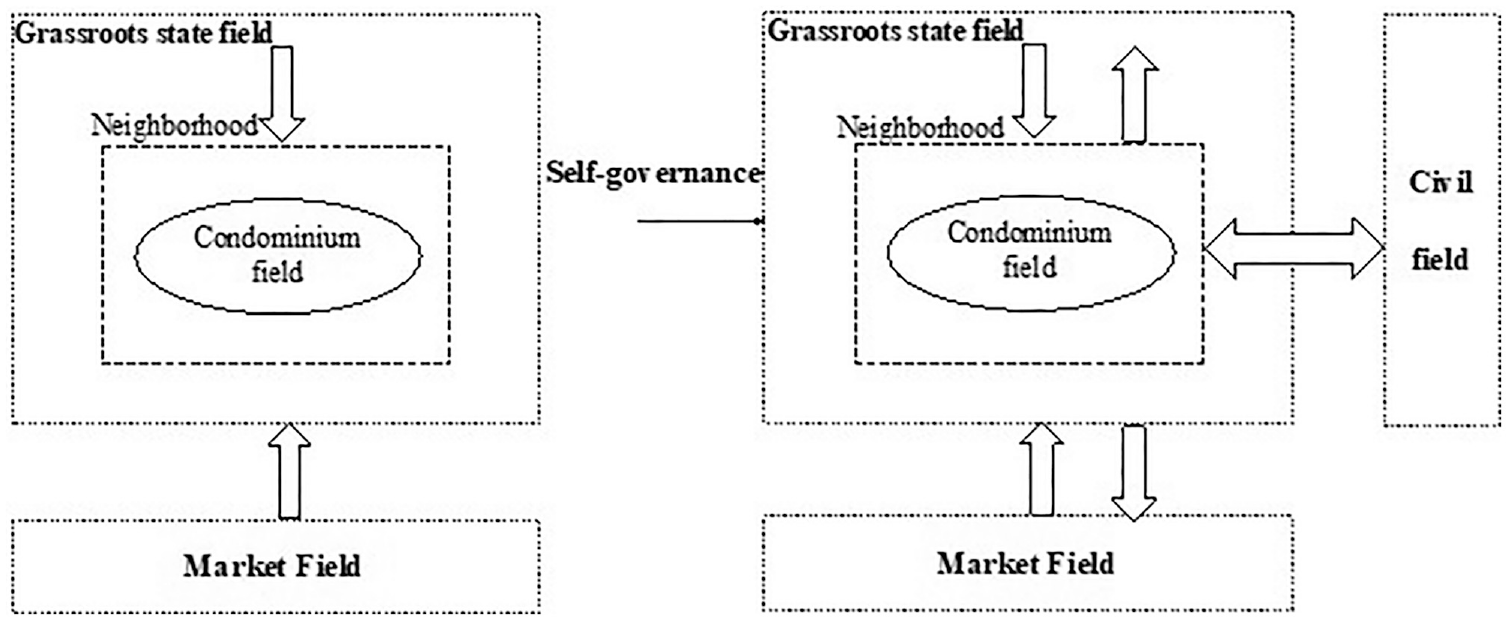
Self-governance and changed field interplay regarding neighbourhood governance in urban China Note: the arrows denote influence on the other fields.
Discussion
Private governance in condominiums in China has aroused heated discussion since its introduction after the economic reform. Vestiges of the state in upholding power in citizens’ private realms have a deep influence on the daily lives of neighbourhood residents. Concurrently, a condominium field has been established to regulate the behaviours of residents as owners of properties and users of the common areas and facilitates within the private neighbourhood.
This paper employs the strategic action field approach to examine the self-governance in condominium governance. Such an approach offers an analytically robust framework for linking the interaction and collective actions of agency at the micro level with the constructed social order at the meso level. In urban China, a distinct feature of private neighbourhood governance is the complex interplay between multiple fields. The condominium field is developed as a semi-autonomous meso-level structure in realising collective ownership and discharging the management responsibility of the neighbourhood common space that operates under the political monitoring of the grassroots-state field. Meanwhile, running property management services as club goods has granted PMAs considerable authority over the daily management of the neighbourhood. This enables the market field to have a heavy influence on the condominium field.
Interestingly, the dynamic interplay between the grassroots state field and the condominium field presents a complex interaction between actors in the two fields. Incumbents (playing a leading role and influence in the field) in the condominium and grassroots state field are also the challengers (less advantaged members who attempt tend to reshape the structure of the field) in the other field. As the incumbent of the grassroots state field, the RC performs crucial functions of social and political control over the neighbourhood. However, from the owners’ perspective, the RC is perceived as a challenger who interferes with the autonomous rule of the neighbourhood where they have the full right to manage. The tension is further complicated by the alliance between the PMAs and RCs.
The recent campaign of self-governance brings more changes to the interplay among different fields. Such a campaign can be seen as a proactive measure in establishing a new narrative aiming at dismissing property management agents. This can be perceived as an effort to reclaim the legally supported autonomy to govern their private neighbourhood by directly hiring their own management staff. This initiative resonates with the aspiration of the majority of condominium owners. As indicated by a nationwide survey in 2021, 90% of condominium owners expressed a desire to change their property management agent in urban China (Tencent Real Estate, 2021). Furthermore, in Shanghai alone, over 190,000 complaints regarding property management services were reported to a government hotline in the first half of 2020 (Shanghai Observer, 2021).
While turning to a direct labour management mode in other countries is an internal process in the condominium field, such a change in urban China would alert the grassroots state agency. Given that the dismissal of the PMA would bolster the incumbent role of HOA in the condominium field, it would at the same time strengthen the challenger role of the HOA in the grassroots state field and pose a threat to the incumbent role of the RC. That is why self-governance is not a mere struggle between PMA and HOA but a ‘politicised’ action that gets the state power involved.
One point that is worth further discussion is that promoting self-governance as a campaign and aligning it with homeowners’ right-defending activism is a double-edged sword. On the one hand, organising national conferences as field-configuring events and establishing regular communication networks (e.g. WeChat groups) with their supporters help to maintain a strong support base. Furthermore, close connections with networked organisations of condominium owner right-defending activists enhance the campaign’s access to social and technical resources within the civil field. On the other hand, such an approach also carries political risks. As homeowners’ networked organisations are already on the surveillance radar of high-level social control agents (Yip, 2020), their association with the self-governance campaign would further alert the RC of the political implications of this property management mode. This may generate a more tense and even conflicting relationship between RCs and HOAs that advocate for self-governance. As a HOA director from Changsha who began to implement self-governance in her neighbourhood in 2016 remarked, If one single neighborhood decides to adopt self-governance, the RC will not oppose, nor will they support. But if you encourage other neighborhoods to adopt self-governance with some ‘big action’ [e.g., organizing a national conference], the government will see you as a threat, they think your actions will make the neighborhood unstable, this will bring more trouble to them in maintaining social stability. [Interview with PJ, Oct 2023]
In addition, while the advocates of self-governance champion the benefits of such a model, they may undermine the potential long-term challenges. Research in property management has highlighted the inevitable agency cost associated with self-governed condominium management. Factors such as property ownership types (sole owners or collective ownership like the condominium) and agents’ compensation play crucial roles in the smooth daily operations (Klingenberg and Brown, 2006; Rosenberg and Corgel, 1990). In this sense, the apparent advantages of self-governance, particularly the cost savings from direct personnel employment, may be misleading. In fact, the new model generates new agency costs between HOA leaders and ordinary condominium owners (Yip et al., 2007). Hence, the seemingly cheaper property fee in self-governance may mask additional hidden agency. Internal conflict between leaders in a self-managed condominium and other owners may be more difficult to handle.
Conclusion
Our empirical analysis shows that the promotion of self-governance in urban China represents more than a mere shift in modes of condominium management. On the surface, self-governance resembles homeowners’ rights defence action once highlighted by previous studies. But such a campaign carries richer implications. It not only upholds homeowners’ private housing interest as other rights defence activities do but also signifies a new arena where private homeowners strive to reclaim autonomy in neighbourhood management and counteract excessive local state intervention and market exploitation. The campaign’s alignment with homeowners’ right-defending networks is particularly symbolic, especially given the sharp decline in social protests by homeowners in recent years 1 (Chen, 2020). In this case, self-governance may be a more politically neutral and acceptable venue for homeowners to pursue autonomy in their private realm while minimising the potential confrontation with the grassroots local state. Also, the advocates’ continuous efforts in promoting self-governance have made it more influential than other case-by-case rights defence actions in China.
With the SAF approach and its conceptually inspiring framework for identifying active actors within the meso-social structure and the forces influencing behaviours and interactions, this paper reveals that the self-governance campaign has the potential to alter the power dynamic in the grassroots state field and the condominium field. At the same time, the civil field, which has been subject to heightened control nationwide, has become a more visible factor that exerts a significant impact on the condominium field. It may prompt the grassroots state to escalate its efforts in curtailing its growth. Consequently, the condominium self-governance campaign adds a layer of complexity to the political dimension of neighbourhood governance in urban China.
The application of the strategic field approach offers valuable insights into the dynamics of neighbourhood governance. It illuminates the interactions and influences among different forces and key actors in the condominium, market, local state and civil fields and reveals how these interactions shape the basic contour of the condominium system as well as neighbourhood governance in urban China. It also probes how the state and its grassroots administrative agencies in the neighbourhood respond to housing activism and the bottom-up self-governance campaign, thereby highlighting homeowners’ activism within an increasingly restrictive political dimension in private neighbourhoods.
While this paper offers valuable insight, its limitations should be acknowledged. Owing to the challenge in interviewing government officials, the official stance regarding self-governance of condominiums is under-represented. Likewise, the assertion of successful claims of self-governance put forward by advocates requires further scrutiny of its long-term impacts and potential problems. Further research can be conducted to compare neighbourhoods with different management modes, which would provide a comprehensive understanding of neighbourhood governance dynamic. In addition, the strategic action field framework could serve as a pivotal tool in examining the social and political forces at play in neighbourhoods involved in right-defending actions. The interactions between actors in respective fields (grassroots state, condominium, and civil field) also require further investigation to observe whether they can bring more profound changes to the condominium system in China. A prolonged follow-up study in this area is expected to yield more insightful academic contributions.
Footnotes
Appendix
The list of interviews.
| No. | Date | Interview place | Interviewee | Identity |
|---|---|---|---|---|
| 1 | Jan, 2018 | Guangzhou | ZHN | Leader of self-governance campaign |
| 2 | Jan, 2018 | Guangzhou | WYS | Real estate lawyer |
| 3 | Jan, 2019 | Guangzhou | SWL | Housing activist |
| 4 | Dec, 2018 | Beijing | CJJ | Housing activist |
| 5 | Dec, 2018 | Changsha | LSC | Housing activist |
| 6 | Dec,2018 | Changsha | TJ | Leader of self-governance campaign |
| 7 | Aug, 2020 | Online | ZJS | Housing activist in Changsha |
| 8 | Oct, 2020 | Shenzhen | WJS | Housing activist in Shenzhen |
| 9 | Jul, 2023 | Online | CFS | Housing activist in Beijing |
| 10 | Oct, 2023 and Mar, 2024 | Online and offline in Changsha | PJ | HOA director, practising self-governance in her own neighborhood |
| 11 | Oct, 2023 | Online | WCL | Housing activist in Changsha |
| 12 | Mar, 2024 | Changsha | LWH | HOA director, practising self-governance in her own neighbourhood |
| 13 | Mar, 2024 | Changsha | ZLC | Property manager |
| 14 | Mar, 2024 | Changsha | SKZ | Property manager |
| 15 | Mar, 2024 | Changsha | YGZ | SO official |
Acknowledgements
The authors thanks for the support provided by research institute of ‘Baisheshinian’ in the School of Public Administration, Central China Normal University.
Declaration of conflicting interests
The author(s) declared the following potential conflicts of interest with respect to the research, authorship, and/or publication of this article: Notes
Funding
The author(s) received no financial support for the research, authorship, and/or publication of this article.
