




Abstract
This article contributes to urban regime theory by analysing the conditions enabling the electoral consolidation of social movement-led left coalitions in Spanish cities after 2015. It uses fuzzy-set qualitative comparative analysis to investigate combinations of economic and political factors influencing regime change across 18 cases. The analysis identifies civic capacity as a necessary condition and finds that no single factor is sufficient. Instead, consolidation results from particular combinations: in smaller cities, high representation in local councils and fiscal capacity compensate for hostile upper-tier governments; in larger cities, intergovernmental allies are more critical. Contrary to expectations, capital mobility plays only a small explanatory role, likely due to Spain’s intergovernmental fiscal transfers. These findings underscore the importance of political-institutional factors – especially civic mobilisation and multi-level alliances – for progressive urban governance.
Introduction
Urban regime theory (URT) originally focussed on explaining the formation of durable political coalitions with the capacity to implement durable policy agendas in US cities (Stone, 1989, 1993). At the turn of the 21st century, Marxian scholars sought to complement URT with higher order theories of capitalist political economy (Davies, 2002; Jessop, 1997) and comparativists to explain variation in regimes across national contexts (Di Gaetano and Klemanski, 1993; Di Gaetano and Strom, 2003; Dowding, 2001; Kantor et al., 1997). The research agenda faded somewhat in the face of broader approaches to urban governance which were deemed superior for capturing changes associated with neoliberal globalisation and for being applicable beyond the USA (Pierre, 2011). However, following the 2008 global financial crisis, European scholars found the focus of URT on coalitions, agendas and resources useful to analyse how urban social movements arising from anti-austerity convulsions were affecting urban governance (Bertolin and Salone, 2025; Bua and Davies, 2023; Davies, 2021; Davies and Blanco, 2017).
This article contributes to this strand of the literature through a comparative analysis of the politics of urban regime contention in Spain, following the ascendancy of social movement-led left coalitions (SMLLCs) – composed of alliances between a broad range of grassroots movements arising in response to austerity and left-wing parties – that won control of many major urban administrations in 2015 (Roth, 2019). Methodologically, it draws on qualitative comparative analysis (QCA) to analyse an 18-case sample: including major international centres, like Madrid and Barcelona, regional capitals like Valencia and Zaragoza as well as medium and small cities like Santiago and Siero. It builds on Kilburn’s (2004) QCA of the influence of city context upon the development of progressive urban regimes in the USA by adding variables that capture the political and strategic positions of governing actors and the influence of upper tiers of government upon regimes, deemed important in the European context (e.g. Sellers, 2002). The article thus contributes to the question of the conditions for progressive regime change by analysing multiple cases of urban regime contention in Spain.
A brief first section explains the evolution of URT and outlines the contribution of the article. A contextual section provides an overview of Spanish urban governance following the global financial crisis and during the rise of SMLLCs. The methodology and comparative framework are then explained, including hypotheses derived from a review of the urban regime literature, before analysing results and concluding.
Urban regime theory
URT originated in a political-economic critique of pluralist accounts of power developed in the USA. Pluralists understood power in cities to be fragmented and (roughly) equally dispersed (Dahl, 1961). However, the persistence of deep social inequalities in the 1960s led pluralists to grant to Marxian critics that the importance of private investment in capitalist societies gave business interests a structurally advantageous position (Manley, 1983). URT developed this neo-pluralist (Lindblom, 1980) political economy, incorporating the structural importance of private investment, in the context of urban politics. Importantly, structural advantage does not mean that business interests directly govern cities, but that they possess resources that are necessary for implementing policy agendas (Stone, 1989: 2). As in pluralist accounts, power remains fragmented and much of the work of urban regimes is to unify coalitions of actors across business, state and civil society to provide the resources necessary for the implementation of a policy agenda. The focus of URT is to explain how such coalitions come together and persist in time. Mossberger and Stoker (2001: 830) argue that the focus of URT on coalition building and maintenance makes it a ‘valuable and plausible’ political economy perspective by leaving space for political agency.
A central tenet of URT is that governing capacity increases in line with progressive agendas. In the context of the USA, Stone (1993) develops a typological continuum based on the level of progressive ambition, distinguishing between caretaker, developmental, progressive and opportunity expansion regimes. He posits that progressive and, especially, opportunity expansion regimes are harder to achieve and sustain because they require greater regulation of and resource extraction from the private sector, which is not as likely to be cooperative with the egalitarian or environmentalist goals characterising progressive regimes.
The conditions for progressive regime change is the problem addressed by this article. This question has since been tackled in one way or another by various researchers. Marxian scholars sought to relate URT to capitalist dynamics (Jessop, 1997), and to better explain the difficulties and prospects for egalitarian urban regimes in capitalist societies (Davies, 2002; Imbroscio, 1998). Kilburn (2004) explains the contextual conditions favourable to progressive regimes in the USA, characterised by the pursuit of egalitarian and environmentally friendly outcomes, and also uses QCA. Other comparativists sought to expand URT beyond the USA by developing analytical frameworks that encompass a broader range of actors applicable beyond the US context (Di Gaetano and Klemanski, 1993; Di Gaetano and Strom, 2003; Kantor et al., 1997). The literature led to a proliferation of typologies relating urban regimes to variation in institutional, political and economic conditions (Mossberger and Stoker, 2001), the results of which inform the comparative framework below.
In the 2000s, URT would lose pride of place to accounts of urban governance that incorporate a broader range of processes, actors and institutions than the focus of URT on local business and city hall and could thus travel to other contexts (Pierre, 2011). Adaptations to URT would be made especially in its application to Europe where stronger central governments and intergovernmental transfers made actors from higher state tiers important for regimes (Mossberger and Stoker, 2001; Sellers, 2002). Retaining a URT focus, Stone (2015: 103) developed the concept of ‘urban political orders’, characterised by a more multi-tiered approach which retained the inner-core insight that resources must be commensurate with agendas.
Following the onset of austerity politics, this expanded version of URT became attractive to European scholars, especially in the Spanish context (Bua and Davies, 2023; Davies and Blanco, 2017) where the question of the conditions for progressive regimes forcefully reappeared with SMLLCs winning the 2015 municipal elections in multiple Spanish cities on progressive policy agendas (Vazquez-Varela and Martinez-Navarro, 2023). This wave of research has so far been limited to single case studies of Madrid (Medina-García et al., 2021) and Barcelona (Russo and Scarnato, 2018) and small-n comparisons of smaller cities (Bua and Davies, 2023). Vazquez-Varela and Martinez-Navarro (2023: 680) note a paucity of larger-n comparative work which can more adequately explain outcome variation. This article contributes to filling this gap.
The policy agendas followed by SMLLCs are best described as hybrids of Imbroscios’ (1998) ‘community-based’ and Stones’ (1993) ‘progressive’ regimes, characterised by egalitarian and environmentalist agendas pursued through participatory and community-led means. I depart from Stones’ (1993) basic premise that resources and governing capacity increase in line with the progressive ambition of policy agendas, which is high in the case of SMLLCs. An important reference point for this study is Kilburns’ (2004) QCA of the contextual conditions favourable to progressive regimes in 14 US cities. I build on this study and test its findings, whilst also correcting for two important limitations of his approach. Kilburn uses capital mobility, fiscal resource base, civic participation, ward style representation and city size. However, these variables do not take into account alliances across state tiers nor do they measure agential factors related to local politics such as civic capacity (Stone, 2001) and the political strength of regime actors within local councils and governments (Mossberger and Stoker, 2001). I correct for these limitations in the comparative framework, where I also develop hypotheses regarding how the variables I focus on are expected to influence prospects for progressive regime change.
Finally, wary of the danger of reducing the regime concept to that of a governing coalition with an agenda (Dowding, 2001; Mossberger and Stoker, 2001), I do not aim to establish whether regimes have been formed. The in-depth historical work this requires is too unwieldy for a multiple case comparison, and the case study literature is too sparse in the Spanish context to establish this. There is, however, good reason to believe that macro-economic and political conditions from the late 20th century in Spain were conducive to developmental urban regimes, focussed on instigating economic development and agglutinating coalitions though land use policy and construction (Martí-Costa and Tomàs, 2017). The global financial crisis represented a punctuation of this model and led to a period of heightened political contention giving rise to SMLLCs. My ambition is to explain different degrees of success in beginning to consolidate their alternative regime projects.
Urban politics in contemporary Spain
A detailed history of Spanish urban governance is impossible due to space constraints. However, the most important context for the present study is that land liberalisation in the 1990s accelerated an already considerable real estate boom beginning in the late Francoist era (Moreno, 2020), which incentivised local elites to build coalitions around urban redevelopment projects and provided ground that was fertile for neoliberal developmental regimes (Martí-Costa and Tomàs, 2017; Vazquez-Varela and Martinez-Navarro, 2023). Within the sample under study (Table 2), case study literature confirms the existence of neoliberal-developmental urban regimes in Barcelona, Madrid and Valencia (Blanco et al., 2020; Davies and Blanco, 2017; Díaz Orueta, 2010; Janoschka and Mota, 2021), and considerable evidence exists for A Coruña, Santiago de Compostela, Cadiz, Valladolid, Palma de Mallorca and Zaragoza (Bua and Davies, 2023; Escolano-Utrilla et al., 2018; Maroto, 2023; Maroto, 2023; Martínez and Wissink, 2022; Miro, 2011; Ortega, 2005).
This urban growth model entered a severe crisis with the 2008 global financial crisis and ensuing austerity policies, dictated by the European Union, initially implemented by the centre-left Partido Socialista Obrero Espanol (PSOE) and sharpened by the subsequent conservative Partido Popular (PP) administration. In conjunction with severe corruption scandals affecting the PP (Moreno, 2020), the economic crisis fuelled a political crisis, marked by the emergence of the ‘Indignados’, a diverse movement opposing austere neoliberalism and calling for more genuine democracy (Gonick, 2016). One political current emerging from the Indignados which was especially close to urban social movements came to view the local state as a ‘strategic entry point’ (Russell, 2019: 3) for broader social change. In quite an astonishing development, the SMLLCs which arose from these were able to take city hall in many urban centres following the 2015 elections, including in key cities like Madrid, Barcelona and Valencia. 1 SMLLCs pursued progressive agendas, seeking to challenge austerity and neoliberalism by expanding social rights, the social and solidarity economy and participatory democracy (Roth, 2019). The extent to which they began to form alternative urban regimes is the question with which this article engages.
Supporting the URT hypothesis that progressive regimes face higher barriers to implementing their agendas (Stone, 1993, 2015), research has documented severe structural, institutional and political constraints faced by these administrations. Their political rhetoric called for changes which were beyond the scope of municipal jurisdiction, which had been further hamstrung by austerity legislation’s limits on municipal fiscal policy and personnel hiring (Martí-Costa and Tomàs, 2017). Regional state tiers, a crucial governance unit in Spanish democracy, were mostly controlled by traditional political parties deeply hostile to them (Blanca and Ganuza, 2018; Bua and Davies, 2023; Janoschka and Mota, 2021). These hostilities were compounded by an inability for the broader political movement ignited by the Indignados to mirror municipal electoral success in regional and national levels. Whilst significant inroads were made in national politics by the new political party Podemos, closer alliances were impeded by tensions between the radically democratic, decentralised political strategy of municipal SMLLCs (Russell, 2019) and the neo-vanguardist left-populism of Podemos, which limited ‘democracy’ to a contested signifier in its largely discursive political strategy while instituting a vertical organisational culture (Cancela and Rey-Araújo, 2022).
In terms of municipal politics, Bua and Davies (2023) show how municipal administrators, traditional civil society intermediaries such as neighbourhood associations and business networks retained policy obstruction capacity. SMLLCs began to get bogged down by nominally ‘technical’ resistances, requiring high levels of political creativity and sustained effort to achieve even modest aims. Reflecting on interviews in five cities, Blanca and Ganuza (2018) argue that clientelism and rent seeking had acculturated urban administrators, who used discourses around competition and free enterprise to hold back reforms to public procurement. In Barcelona, Blanco et al. (2020) report a vicious political counterattack by a ‘pro-status quo coalition’, with heavy influence over media, which developed political campaigns against policies in areas that are especially important for urban capital accumulation in Spain, such as housing, re-municipalisation of public services and touristification (see also March et al., 2019; Russo and Scarnato, 2018).
SMLLCs had a series of internal weaknesses. They incorporated a range of actors from often quite different political traditions, with a strong presence of assembly-based movements, but also traditional left, new left and populist left parties (Gonick, 2016). Whilst this was formatively conducive to innovative forms of organising and operating in relation to established institutions, it would later result in the aforementioned tensions with the more vertical strategy of Podemos (Roth, 2019) as well as with the urban social movements that were critical for their formation (Bua and Davies, 2023; Martínez and Wissink, 2022). Moreover, the administrative inexperience of activists turned politicians (Blanco et al., 2020) was a source of electoral attraction in the context of corruption scandals, but when it came to governing, the lack of politico-administrative know-how made SMLLCs easy prey to bureaucratic obstructions from agents tied to status-quo interests (Bua and Davies, 2023).
It is therefore unsurprising that SMLLCs fell short of implementing rhetorical ambitions for significant political transformations, which was likely setting the bar too high to avoid disillusionment (Welp, 2025). Initial evaluations of their successes suggest that they placed residents’ needs higher on the agenda of urban planning, especially vis-à-vis urban mobility, the tourism industry and real estate speculation, and experimented with new forms of participatory governance (Bua and Bussu, 2023; Vazquez-Varela and Martinez-Navarro, 2023). However, by 2019 most SMLLCs had lost city hall, within my sample achieving electoral continuity in 2019 in Barcelona, Valencia, Cadiz and Torrelodones, and returning to city hall in 2023 in Iruñea (in Basque, or ‘Pamplona’ in Castilian). This article seeks to explain the conditions underpinning the relative success of SMLLCs in these municipalities in re-entering city hall.
Methodology
QCA is a method for the systematic comparison of cases, which seeks to identify necessary and sufficient conditions for an outcome, and is often applied to medium-N research designs. Whilst conventional quantitative analysis breaks up cases into isolated variables to establish generalisable patterns, QCA treats cases as whole units, thus retaining their context and complexity (Ragin, 1998), giving leverage for identifying diverse pathways towards outcomes (Emmenegger, 2011). This is especially useful for URT because urban regimes are explained by context-specific combinations of socio-economic, political and institutional factors (Di Gaetano and Strom, 2003; Kantor et al., 1997).
QCA includes two primary variations: crisp set and fuzzy set. In crisp-set QCA, as used by Kilburn (2004), conditions and outcomes are dichotomised as present or absent. This binary approach can disregard nuanced variations in set membership. The approach used here, fuzzy-set QCA (fsQCA), allows for conditions to be calibrated on a spectrum. By allowing for the calibration of degrees of membership in sets representing relevant conditions and outcomes, fsQCA can provide deeper insights into the interplay of conditions that support or hinder the consolidation of progressive coalitions.
The QCA process consists of several steps. First, cases must be relevant to the research question, and variation on the outcome to be explained needs to be ensured. The sample for this research is composed of 18 SMLLCs that entered city hall in 2015 in Spanish municipalities with more than 20,000 inhabitants, four of which achieved electoral continuity in 2019 or 2023 and 14 of which did not. Theoretical work identifies relevant conditions that hypothetically influence the outcome. These ‘directional expectations’ are important in developing a model which the QCA software uses to develop hypotheses for configurations for which data is not available. These hypotheses are developed in the forthcoming comparative framework, and their interpretation is explained in the findings section. A second step involves using data (which can be quantitative or qualitative) to calibrate the degree to which particular cases demonstrate membership within each condition. This study uses quantitative data taken from a variety of European and Spanish statistical datasets. It is important to note that this represents a limitation. URT concepts such as the dispersal of power and the ability to govern are difficult to measure, explaining the reliance of most of the literature on in-depth case studies. The need to use quantified data means that I often rely on proxies, which are explained in depth in a methodological appendix to this article.
Third, the calibrated cases are analysed on a ‘truth table’ listing each possible configuration of conditions across the cases and the observed outcome. Boolean algebra is then applied to eliminate conditions that are insignificant for the outcome, resulting in a logically minimised set of causal configurations that are sufficient for an outcome. Results of sufficient conditions come in three potential forms: ‘complex’, ‘intermediate’ and ‘parsimonious’. 2 The ‘complex’ solution involves logically minimising only those combinations that are empirically present in the truth table; it therefore usually leads to longer causal combinations. The intermediate solution incorporates only those logical remainders that align with theoretical expectations. The parsimonious solution maximises simplicity by using all logical remainders, and is guided by the Quine McCluskey algorithm to make the judgement on reduction on mathematical grounds. Following Emmenegger (2011), who uses six conditions to analyse 19 cases, I rely on the intermediate solution, which eliminates only counterfactuals that comply with theoretical expectations.
These fourth and fifth steps were carried out using the fsQCA software package. 3 Finally, results are interpreted (see Schneider and Wagemann, 2012 for a textbook account).
Comparative framework
This section inspects the URT literature to derive a comparative framework and associated hypotheses informing the QCA model, summarised in Table 1. The process for calibrating measures is fundamental in QCA research, because it is here that important qualitative decisions are made regarding set membership (Schneider and Wagemann, 2012). For this reason, it is good practice to be transparent regarding the calibration process (Emmenegger, 2011; Ryan, 2014). A methodological appendix is provided for a detailed justification of measures and the approach to calibrating conditions. This section discusses these at a conceptual level.
QCA model: Conditions, measures and hypotheses.

Outcome: Electoral consolidation
Kilburn’s (2004) QCA uses case study material to identify the nature of different regimes in 14 US cases. I use a different approach because detailed case studies of Spanish cities are too sparse to determine this. The outcome, electoral consolidation of SMLLCs, is measured through electoral results in 2019 and 2023, including electoral results, vote share and government position, and acts as a proxy for regime change. The 18 cases under study included SMLLCs which embarked on an agenda pursuing outcomes associated with Stones’ (1993) progressive and Imbroscios’ (1998) community-led regimes. This article seeks to explain the conditions leading to success. Electoral consolidation is admittedly an imperfect proxy for this because it is not necessarily sufficient for regime consolidation. However, being in government is a necessary, and perhaps most important, part of an urban regime (Dowding, 2001; Mossberger and Stoker, 2001). The concept used therefore captures an important element of urban regime formation.
Economic conditions
The embeddedness of urban regimes within capitalist economies is foundational to the political economy orientation of regime theory (Stone, 1989), and economic conditions are more broadly understood to be fundamental to urban politics and policy making (Di Gaetano and Strom, 2003: 357–359). Kilburn (2004) assesses economic context through capital mobility and tax base. The former is taken to be a constraint upon regime viability, as capital flight depletes the resources available for policy agendas. Kilburn finds that low capital mobility facilitates progressive regimes in two of his three configurations (Baltimore, Tampa; Seattle, Portland, San Francisco), whereas high capital mobility coexists with a progressive regime just in Minneapolis. Kilburn also finds support for his hypothesis that the wealth of a city’s tax base enables progressive regimes in two out of his three configurations.
Both hypotheses find wide support in the regime theory literature (Di Gaetano and Klemanski, 1993; Di Gaetano and Strom, 2003; Kantor et al., 1997; Mossberger, 2009). Regarding capital mobility, it was widely accepted at the turn of the century that European local administrations tend to be less sensitive to investor preferences due to the greater presence of intergovernmental transfers (Mossberger and Stoker, 2001: 819–821). However, Bua et al. (2018) find that austerity contributed to increasing the importance of private investment for European cities. I therefore follow the literatures’ lead in hypothesising that both capital mobility and fiscal capacity facilitate progressive regime formation.
Kilburn measures capital mobility using the number of Fortune 500 companies headquartered in his cases. However, this is mainly a US list and many, if not most, of my cases are too small to headquarter transnational firms. I have therefore opted for the percentage of workers employed in professional and financial services. 4 Regarding fiscal capacity (FC), Kilburn’s (2004: 638) use of municipal tax base by median family income is not an appropriate measure in the Spanish context. As in Europe generally, inter-governmental transfers constitute an important source of municipal revenue, complemented by property and land taxes which are relatively unsensitive to earned income. Thus, instead, I measure FC through actual spending. This offers a clear picture of the resources that a city commits to policy initiatives. Spain’s fiscal equalisation mechanisms can be expected to even out, but not eliminate, inequalities and thus important variation is still expected. This measure potentially underestimates fiscal capacity in conservative administrations, which are more prone to prioritise surpluses. To mitigate, averages are calculated using 2015–2019 data, a period when SMLLCs were present in urban governments in all cases, reducing variation on governing ideology.
Political conditions
Kilburn (2004) uses two measures of ‘democratic conditions’: civic participation and ward-style representation. However, because I am interested in both contextual and agential factors, a more general account of political conditions is appropriate. Political conditions are made up of three dimensions. First, Stone (1993) views ‘informed and mobilised citizen support’ as key to sustaining progressive regimes. This hypothesis is contradicted by Kilburns’ (2004: 645) finding that civic participation did not play an important role in the 14 cities he examined. However, his measure of citizen participation is limited to municipal electoral turnout, which fails to capture other important ways in which citizens can mobilise in support of agendas, as well as the possibility that abstention is a rational choice by citizens preferring more direct engagement – which is especially important given the disaffection with traditional political institutions in Spain following austerity and corruption scandals, and the ambitions for more direct democracy that such protests carried (Gonick, 2016). Therefore, I use ‘civic capacity’ (CC) measured by electoral (municipal and general election turnouts) and non-electoral forms of participation (measured by yearly protests per capita). 5 I follow Di Gaetano and Strom (2003), Stone (1993, 2001), Kantor et al. (1997) and Mossberger and Stoker (2001: 827–828) in hypothesising that high civic capacity is conducive to progressive regimes. Given the ‘community-led’ (Imbroscio, 1998) orientation of SMLLCs, it especially stands to reason that high civic capacity will be necessary for success.
Second, recent research into Spanish SMLLCs strongly suggests that (a) the strength of representation of SMLLCs in local councils and (b) the relationship of SMLLCs to higher state tiers strongly conditioned governance. Bua and Davies (2023) find that the capacity of SMLLCs to implement agendas was severely hamstrung by minority governments with relatively small proportions of council seats as well as hostility from (conservative-led) regional administrations, who control key policy levers in the Spanish state (see also Blanca and Ganuza, 2018; Blanco et al., 2020; Janoschka and Mota, 2021). Whereas it stands to reason that strong representation in local councils is universally important for regimes (Mossberger and Stoker, 2001), it is broadly accepted that intergovernmental allies are especially important in the European context, where stronger state traditions make coalitions across different tiers of the state important for regime viability, as actors from different state tiers can form part of urban regimes (Mossberger and Stoker, 2001; Sellers, 2002). I therefore hypothesise that SMLLCs with a higher number of council seats and those with allies in higher state tiers are more likely to succeed in consolidating their regime projects.
SMLLC council position (CP) is measured by the number of council seats held and intergovernmental allies (IA) is measured by coding for the ideological affinity of parties leading relevant regional administrations, which, as explained in the appendix, are a critical governance tier for urban administrations in Spain.
City size
Finally, there is a wide range of municipal population in my sample, from 20,000 to over 3 million residents. I therefore also account for City Size (CS), measured by municipal population in 2015. Whilst it is well established in democratic theory (e.g. Dahl, 1989) that participatory democracy of the kinds pursued by SMLLCs (Bua and Bussu, 2023) is easier to achieve at lower scales, city size does not appear in any of the three causal configurations that explain progressive regimes in Kilburns’ (2004) analysis. My theoretical model is therefore ambivalent about the influence of city size.
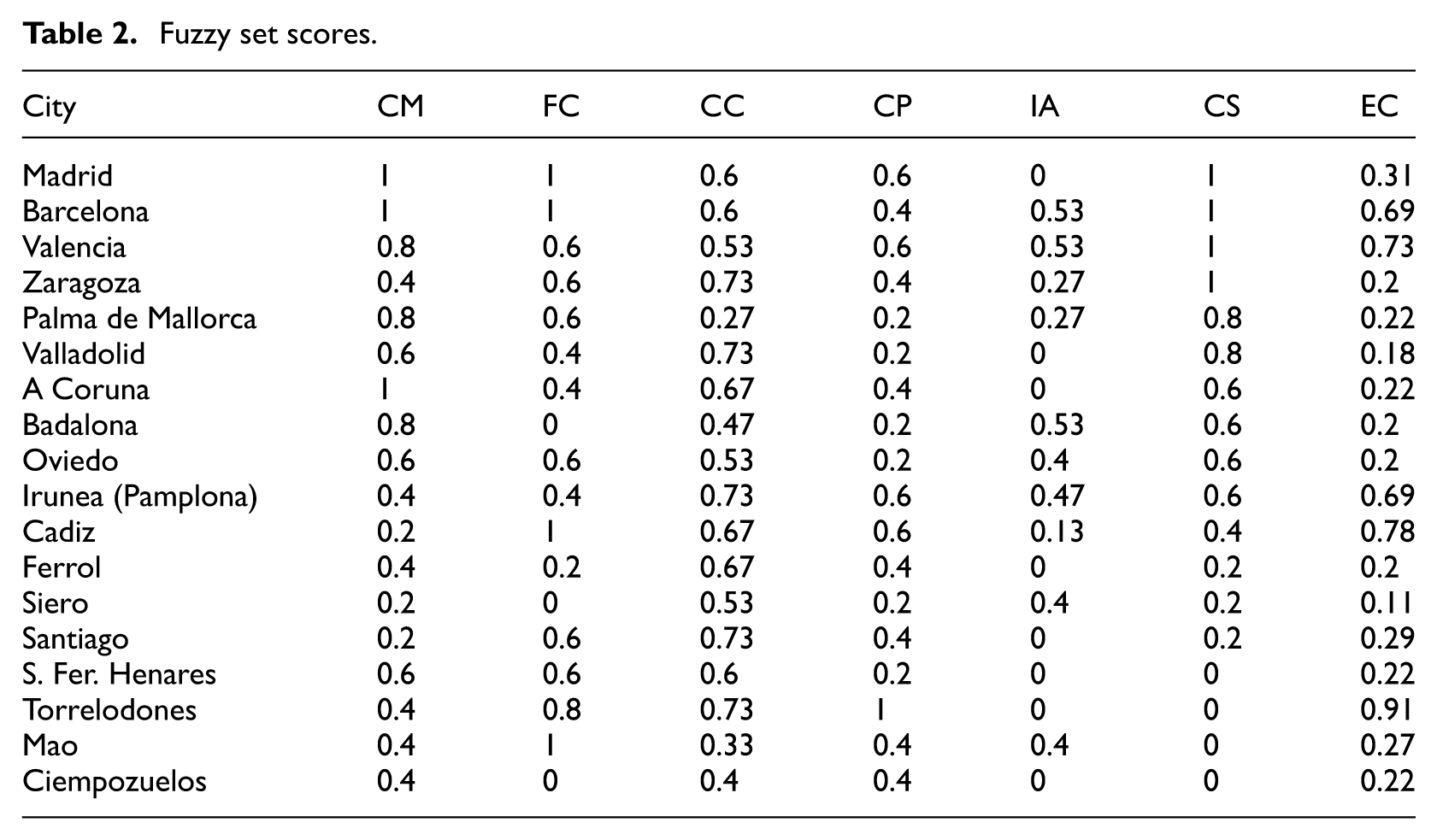
Table 2 presents the fuzzy-set scores across the municipalities, ordered by city size. For details as to how these calibrations were developed, refer to the Supplemental Appendix.
Fuzzy set scores.
Findings
QCA analyses typically begin by identifying necessary conditions for the outcome, then move onto analysis of sufficient conditions (Emmenegger, 2011; Ryan, 2014). In the tables that follow, capital letters denote the presence of the condition or outcome, and lowercase their absence.
Necessary conditions
In the analysis of necessary conditions, consistency measures the degree to which cases with the outcome also share the condition being analysed. Coverage measures how much of the outcome can be explained by the condition, that is, its empirical relevance. The consistency threshold to make claims regarding necessity is usually set at 0.9 (Ryan, 2014: 73). Table 3 highlights those conditions meeting the consistency threshold, or close enough to it to merit mentioning.
Necessary conditions for electoral (non)consolidation.
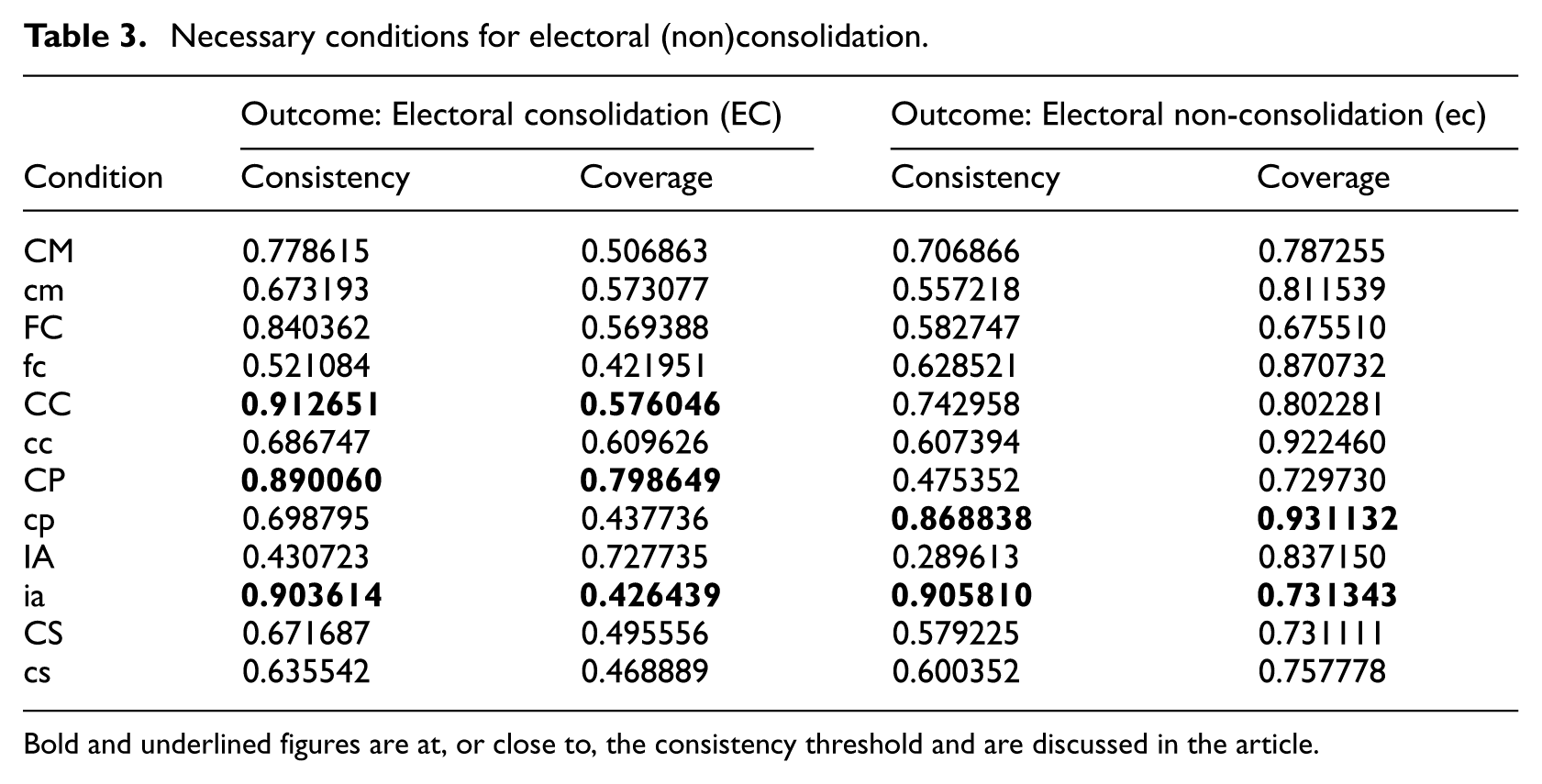
Bold and underlined figures are at, or close to, the consistency threshold and are discussed in the article.
First, civic capacity (CC), a compound measure of voter turnout at municipal and general elections and average protests per capita, appears as a necessary condition for electoral consolidation (EC), with a consistency of 0.91. This provides support for Stones’ (1993) hypothesis that a mobilised citizenry is important for progressive regimes, and contravenes Kilburns’ (2004: 645) finding that ‘citizen participation’ is relatively unimportant for progressive regimes. However, this is tempered by a medium coverage score of 0.58. Inspecting the dataset, all cases of EC score > 52 on CC (Valencia 0.53; Barcelona 0.6; Cadiz 0.67; Torrelodones and Iruñea 0.73). Moreover, cases without the outcome also score high on CC (e.g. Valladolid, Ferrol, Zaragoza, A Coruna, Santiago, Madrid: all >59). In fact, 14 cases out of 18 have scores above the 0.5 threshold. This suggests that civic capacity is important for the development of SMLLC-type projects but needs to work in conjunction with other factors to be sufficient for their consolidation, as considered later.
Second, council position (CP), measured by the average proportion of council seats won by SMLLCs in the 2015, 2019 and 2023 elections, scores 0.89 consistency. This almost meets the necessity consistency threshold (0.9), with a high coverage of 0.80. Four out of five cases of EC score > 5.9 on CP (Iruñea, Valencia, Cadiz 0.6, Torrelodones 1), excepting Barcelona at 0.4. Inspecting the lack of electoral consolidation (ec) shows that low council position (cp) is almost necessary, with a consistency of 0.87 and a coverage of 0.93. Assuming that electorates hold incumbents accountable for delivering on their policy agendas, that CP is (almost) necessary for EC and that cp almost necessary for ec makes intuitive sense on the basis that a higher proportion of council seats enables governing parties to implement their agendas.
Third, the QCA suggests that the lack of intergovernmental allies (ia) is necessary for electoral consolidation (EC), with a consistency of 0.90 and a coverage of 0.43. This seems counterintuitive. How can it be, given the aforementioned importance of the regional tier of the Spanish state, that low intergovernmental allies are necessary for electoral consolidation? Upon inspecting the cases, it is noteworthy that intergovernmental allies are low across the whole sample, reflecting the fact that traditional political parties hostile to SMLLCs retained power at the regional level across all regions studied. 6 In cases of electoral consolidation, Barcelona and Valencia have the highest intergovernmental allies score: 0.53. In Catalunya (covering Barcelona and Badalona), this reflects that the Spanish unitary right (Vox, PP, Cs) has a very poor political record here. Independentist and/or left parties governed the Generalitat de Catalunya from 2010 to 2024 (using my coding scheme: right independentist 2010–2020, and independentist-left 2020–2024), whereupon the centre-left PSOE took the presidency. In the Generalitat Valenciana, the Spanish-nationalist right has a much stronger historical record, with the PP governing from 1995 to 2015. However, the political right in this region was especially implicated in the corruption scandals of the 2010s (Moreno, 2020: 1359). Perhaps for this reason, it is the only case where the SMLLC-linked party Compromis was in regional government: as second partner in coalition with the PSOE between 2015 and 2023, whereupon the Conservative PP was re-elected.
That ia (low intergovernmental allies) appears as a necessary condition for electoral non-consolidation (ec; consistency 0.91, coverage 0.73) also reflects the low score in general across all cases in the sample. That this variable is almost a constant speaks to an important fragility of Spanish radical municipalism: that these administrations were, at best, lacking allies in higher state tiers (Blanco et al., 2020), and at worst operated in a context of direct hostility by regional governments, as in Galician (A Coruna, Santiago, Ferrol) and Madridian (Madrid, San Fernando de Henares, Ciempouzuelos, Torrelodones) cases, both regional PP strongholds. Analysing these cases, Bua and Davies (2023) and Janoschka and Mota (2021) coincide on politicised obstructions to urban policy such as withholding regional funding for important infrastructure projects. It is safe to say that troublesome relations with regional governments were a problem in general for SMLLCs (Blanca and Ganuza, 2018).
Fourth, it is worth discussing the low scores for some conditions which were included in the comparative model because they were theoretically expected to be conducive to electoral consolidation (EC) and its negation, ec. Based on Kilburn (2004), capital mobility (CM) was expected to present difficulties for EC. The logic is that mobile capital constrains policy options because it increases the ability of firms to disinvest for political reasons. That CM bears no noteworthy necessary significance for EC (consistency 0.78, coverage 0.51) might reflect the aforementioned greater importance of intergovernmental transfers vis-à-vis business taxes in Spanish municipalities relative to US cities (Kilburn, 2004), reducing the need for Spanish urban governments to anticipate business preferences when devising policy. 7 It stands to reason that fiscal equalisation measures facilitate progressive agendas (Sellers, 2002) because they reduce the reliance of urban governments on private investment and thus the political power of capital holders.
Whilst it stands to reason that high capital mobility constrains progressive regimes because it increases capitals’ exit option (Kilburn, 2004), an inverse hypothesis is also plausible. Businesses that are more rooted in place, because they are dependent on public contracts, on the reclassification of land for construction or on features of the local geography, such as in the case of tourism capital, might be more likely to mobilise politically against municipal policy change due to their relative immobility and dependence on local policy (Bua and Davies, 2023). However, on my analysis the configuration ‘cm ⊆ ec’, that low capital mobility is necessary for electoral non-consolidation, delivered just 0.55 consistency and 0.81 coverage. Thus, my results suggest that capital mobility is not necessary for the consolidation or non-consolidation of progressive regimes in Spain. As explained below, analysis of sufficient conditions also underlines the unimportance of capital mobility. More research is merited on the relationship between private investment, intergovernmental finance and progressive urban regime change.
Kilburn (2004: 641) finds no relationship between city size and progressive regimes. It could be argued that ‘cs ⊆ EC’ (low city size is necessary for electoral consolidation) is logical because in smaller cities’ coalitions are easier to assemble and manage, and democratic theory suggests that participatory democracy is facilitated at lower scales (Dahl, 1989). However, my data suggest that city size is not necessary for the electoral (non-)consolidation of SMLLCs.
Expectations regarding fiscal capacity (FC) were inverse. Higher FC was expected to increase capacity to develop and implement policy, and it stands to reason it could offset negative influences from other variables such as low civic capacity. ‘FC ⊆ EC’ (high fiscal capacity necessary for electoral consolidation) did indeed deliver a higher consistency of 0.84, with a coverage of 0.57. The inverse, fc ⊆ ec, delivered just 0.63 consistency and 0.87 coverage, suggesting that fiscal capacity is important for electoral consolidation, although low capacity does not directly lead to its negation.
These results suggest that capital mobility, city size and fiscal capacity are, by themselves, not necessary for the consolidation or non-consolidation of progressive regimes. However, this does not mean that they do not operate in conjunction with other conditions to establish causal routes that are sufficient.
Sufficient conditions
The central analytical device employed in QCA to analyse sufficient conditions for an outcome is a truth table, which systemically organises the cases according to the combinations of conditions and outcomes they demonstrate. The truth table for this analysis is presented in Table 4, covering the causal recipes (combinations of conditions and outcomes) that are empirically present.
Truth table.

The crisp codes (0, 1) reflect the use of formal logic to assign cases to configurations that they most closely belong to, that is, which have greater than 0.5 membership in the set of cases portraying the causal configuration. Attribution of the outcome, electoral consolidation (EC), is set to a 0.85 consistency threshold. 8 In what follows, Boolean operators are * and; + or; ⊆ necessary for; → sufficient for. Table 5 presents the sufficiency analysis of intermediate solutions leading to EC.
Sufficiency analysis for electoral consolidation (EC).
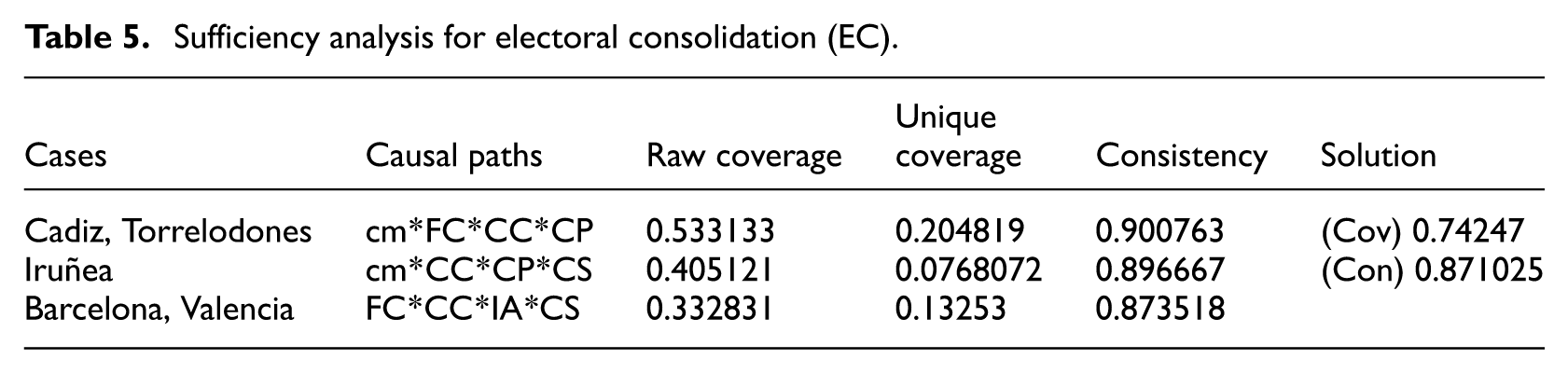
I can further simplify the statements by combining those applying to large city size (CS) with high civic capacity (CC) (Iruñea, Barcelona, Valencia) (i), and those applying to cities with low capital mobility (cm), high civic capacity (CP) and high council position (CP (Iruñea, Cadiz, Torrelodones) (ii):
i. CS*CC*
a. cm*CP→EC (Iruñea)
+
b. FC*IA→EC (Barcelona, Valencia)
ii. cm*CC*CP*
a. CS→EC (Iruñea)
+
b. FC→EC (Cadiz, Torrelodones)
Solution (i) states that large city size combines with high civic capacity AND (ia) low capital mobility and high council position, OR (ib) fiscal capacity and intergovernmental allies to produce electoral consolidation. Solution (ii) states that low capital mobility, high civic capacity and high council position combines with (iia) high city size OR (iib) high fiscal capacity to produce electoral consolidation.
A first thing to note is that civic capacity (CC) features in all causal combinations for electoral consolidation (EC), underlining its status as a necessary condition, and providing further evidence against Kilburn’s (2004: 685) finding that civic participation is unimportant for regime change. In the Spanish context, CC forms part of all causal routes to electoral consolidation. Beyond this, in the three cases of EC with smallest populations (Torrelodones, Cadiz and Iruñea), both civic capacity and council position appear as part of the causal recipes. The larger cities (Barcelona and Valencia) stand out as cases where intergovernmental allies (IAs) feature as part of the causal recipe for electoral consolidation. Unlike Cadiz, Iruñea or Torrelodones, Barcelona and Valencia are international urban centres, where higher political stakes perhaps increase the importance of allies at higher administrative tiers. In the smaller cities, council position (CP) appears as part of both causal recipes, and is notable for its absence in the larger city of Barcelona and moderately high score in Valencia. In the case of Barcelona, the CP score was 0.4, in Valencia 0.6. In Barcelona the existence of allies in higher administrative tiers may have placated a weaker municipal council position.
Overall, in all causal configurations political and agentic factors (CP, IA, CC) interact with economic and structural factors (FC, cm) in ways that are broadly coherent with the theoretical expectations of the model. All factors deemed theoretically important for progressive regime change (CP, IA, CC, FC, cm) are present in one or more solution. In order to consider the possibility that such findings are generated by counterfactuals filled by theoretical expectations, it is worth briefly considering the complex solutions:
i. CM*FC*CC*IA*CS→EC (Barcelona, Valencia);
ii. cm*FC*CC*CP*ia*cs→EC (Cadiz, Torrelodones);
iii. cm*fc*CC*CP*ia*CS→EC (Iruñea).
The main thing that stands out in terms of divergence from theoretical expectations is that in both Barcelona and Valencia, high capital mobility (CM) forms part of the complex solution for electoral consolidation (EC). At the very least, this suggests that capital mobility is not an absolute constraint on progressive regime change. This might be because fiscal equalisation measures and the structure of the Spanish tax system mean that urban fiscal capacity remains relatively independent of investor confidence in cities. Indeed, both Barcelona and Valencia are cases of high fiscal capacity. Compounded by civic capacity and intergovernmental allies, this generated a sufficient causal route for electoral consolidation of SMLLCs in both cases.
Cadiz and Torrelodones contravene theoretical expectations: low intergovernmental allies (ia) is part of the sufficient recipe for electoral consolidation (EC). Here, the presence of high fiscal capacity, civic capacity and council position clearly compensated for this. Iruñea shares many of these features but is classed as a large city with low fiscal capacity. The importance of political factors such as civic capacity and council position is underscored.
In QCA it is also important to analyse separately what explains the absence of the outcome (Ryan, 2014: 89–91). This is because causality in QCA is asymmetric: the conditions leading to the negation of the outcome are not necessarily inverse to those leading to the outcome. Thus, a separate sufficiency analysis for outcome negation adds depth to the analysis, and might identify logical contradictions in the data by testing whether they also appear within causal recipes without the outcome. This can be considered a stress test for the explanatory power of the model. Table 6 presents the sufficiency analysis for ec, using the intermediate solutions.
Sufficiency analysis for electoral non-consolidation (ec).

Cases included in this configuration S.F. Henares, Valladolid, Palma, Santiago, Maó, Ciempozuelos, A Coruña, Zaragoza, Ferrol, Oviedo, Siero.
A Coruña, Valladolid, Iruñea.
Palma, A Coruña, Madrid, Oviedo, Valladolid.
Badalona.
These combinations are further reduced into the following expressions:
i. ia*
a. fc*CS→ec
+
b. CM*CS→ec
ii. CM*CS*
a. ia→ec
+
b. fc*cc*cp→ec
The first thing to point out is that Iruñea appears in both sets of cases displaying the outcome and negating the outcome. This is possible in fuzzy-set analysis where cases display partial membership in sets, as supposed to crisp sets where cases are necessarily in or out. Iruñea has an electoral consolidation score of 0.69; it is therefore in the set of cases of non-consolidation by 0.31.
Second, low scores on variables measuring political strength (council position and intergovernmental allies) stand out in explaining non-consolidation. The solution cp*ia→ec (low council position and low intergovernmental allies is sufficient for electoral non-consolidation) covers 12 cases out of 14 of electoral non-consolidation (ec). The absence of these political goods (cp, ia) is sufficient in explaining non-consolidation in most cases under study. This underlines the importance of political factors again, and mirrors findings that the kinds of governments in my sample were severely hamstrung by a lack of allies at higher administrative tiers (Bua and Davies, 2023; Janoschka and Mota, 2021).
Third, economic factors of high capital mobility and low fiscal capacity (CM and fc) seem less important. CM appears in two solutions for electoral non-consolidation (ec; covering Madrid, Palma, A Coruña, Oviedo, Valladolid and Badalona) and fc is included in just two solutions, with relatively little coverage (limited to A Coruña, Valladolid, Iruñea and Badalona), challenging accounts of urban governance empahsizing the importance of economic structure (Stone, 2004).
Fourth, the presence of city size (CS) explaining non-consolidation (ec) in three out of four solutions is notable and distinct to the relative absence of this factor in explaining electoral consolidation (EC). Coverage is modest but important, with seven cities (A Coruña, Madrid, Palma, Oviedo, Iruñea, Valladolid and Badalona) featuring CS in causal combinations for ec. Two out of three solutions featuring CS also include low intergovernmental allies (ia), suggesting that larger cities without strong vertical support are especially prone to the hostilities identified in the literature (Bua and Davies, 2023), which makes sense due to their political importance. More broadly, it seems that city size might pose a challenge to consolidation in the absence of political countervailers. Cases of electoral consolidation and high city size (Barcelona, Valencia) sustain this, since they included high intergovernmental allies and civic capacity.
Finally, low civic capacity (cc) is notable for its absence in explaining electoral non-consolidation (ec), especially given the importance of high civic capacity for electoral consolidation (EC). This is not a case of low data differentiation, since four cases of ec portray cc and seven portray CC (see Table 4). Thus, I can infer that whilst the presence of civic capacity plays an important enabling role, its absence does not necessarily play a blocking role. Moreover, high levels of civic capacity are also consistent with ec, underlining that it is not by itself a sufficient condition for EC.
Conclusion
This article has used QCA to analyse 18 cases of urban governance by Spanish SMLLCs seeking to instigate major changes in urban governance conducive to the formation of progressive urban regimes. To this end, it has drawn on urban governance literature to specify a comparative framework composed of political and economic factors which are expected to be (non-)conducive to progressive regime change: capital mobility, fiscal capacity, civic capacity, council position, intergovernmental allies and city size. This framework formed the backbone of a QCA of the 18 cases.
The findings suggest that civic capacity is a necessary condition for the electoral consolidation of SMLLCs, supporting Stones’ (1993) initial hypothesis and contravening Kilburns’ (2004) later analysis. No single factor is sufficient for the electoral consolidation of progressive regimes. In smaller cities such as Iruñea, Cadiz and Torrelodones, strong council position and fiscal capacity compensated for low levels of intergovernmental allies. In larger cities like Valencia and Barcelona the presence of intergovernmental allies played a more prominent role, even where council position was weaker, as in the case of Barcelona. In terms of explaining non-consolidation, the findings were quite symmetrical in so far as the absence of parliamentary support and intergovernmental allies was sufficient to explain non-consolidation in a majority (12/14) of cases.
Importantly, my evidence suggests that economic factors such as capital mobility and fiscal capacity were not consistently decisive. In particular, capital mobility was expected to play an important role, but this was not borne out. Its failure to emerge as a major constraint could be because of the structure of the Spanish intergovernmental tax transfer system which assures a degree of fiscal capacity independently of investor confidence to a greater degree than in the USA. It is also possible that the high degree of tourism capital in many Spanish cities ties investors to the urban public goods that their business depends upon, thus limiting their exit option and empowering municipal governments. As discussed, it is also plausible that the lack of an exit option incentivises political opposition. However, low capital mobility played no significant role in electoral non-consolidation. Thus, this research suggests that capital mobility is unimportant. It needs, however, to be considered that this finding could reflect a methodological limitation. As explained in the appendix, due to the paucity of urban data, this research operationalised capital mobility through the percentage of finance and professional service workers in the city region, using Eurostat data. This is an indirect and imprecise measure of capital mobility, which taps the infrastructure needed to handle international investment but misses actual flows of capital in cities, and the propensity for investors to disinvest or withhold investment in response to local politics. Other measures (e.g. FDI as a percentage of GDP) were explored, but this data was only available at the regional level and thus did not enable me to differentiate sufficiently between cases. Results might change with more granular measures accounting for capital mobility and distinguishing the weight of sheltered and exposed sectors. Given the lack of data, I can offer no more than some informed speculation that capital mobility seems unimportant for Spanish urban political economy.
Finally, regarding the method used, QCA is useful for identifying necessary and sufficient conditions but its application is not without limitations. The approach is sensitive to calibration choices and the availability of comparable data. Moreover, QCA privileges cross-case patterns, meaning that it can miss the micro-political dynamics through which regimes evolve. Future research could combine QCA with process tracing capable of capturing the temporal contingencies of urban governance.
To conclude, I provide new comparative insights into the conditions under which coalitions can consolidate progressive urban regimes. Citizen mobilisation and institutional-political strength emerge as central factors, especially multi-scalar alliances. Finally, I am limited by the time scope to focussing on the electoral consolidation of coalitions aspiring to form an alternative regime, rather than regime formation properly speaking, which can take decades. Electoral consolidation is an imperfect proxy, but it nonetheless represents an important step towards regime change (Mossberger and Stoker, 2001). Future URT can build on these insights using more granular quantitative data than that available to me, or through in-depth case studies testing some of these findings.
Supplemental Material
sj-docx-1-usj-10.1177_00420980251405755 – Supplemental material for The politics of urban regime contention: A qualitative comparative analysis of 18 Spanish cases
Supplemental material, sj-docx-1-usj-10.1177_00420980251405755 for The politics of urban regime contention: A qualitative comparative analysis of 18 Spanish cases by Adrian Bua in Urban Studies
Footnotes
Acknowledgements
I would like to thank Matthew Ryan for generous methodological advice, Yanina Welp for insightful comments on previous drafts and Jonathan Davies for his intellectual generosity and past guidance as I became interested in urban political economy.

Funding
The author disclosed receipt of the following financial support for the research, authorship, and/or publication of this article: This article is supported by the Horizon Europe Marie Sklodowska-Curie Postdoctoral Fellowship (grant no. 10110670).
Declaration of conflicting interests
The authors declared no potential conflicts of interest with respect to the research, authorship, and/or publication of this article.
Supplemental material
Supplemental material for this article is available online.
Notes
References
Supplementary Material
Please find the following supplemental material available below.
For Open Access articles published under a Creative Commons License, all supplemental material carries the same license as the article it is associated with.
For non-Open Access articles published, all supplemental material carries a non-exclusive license, and permission requests for re-use of supplemental material or any part of supplemental material shall be sent directly to the copyright owner as specified in the copyright notice associated with the article.
