




Abstract
Research in some agrarian regions of India points to new forms of urbanization involving demographic densification led by natural population growth and employment shifts out of agriculture in the absence of standard drivers of structural transformation. Research into the local economic dynamics of this “urbanization from within” remains nascent, but scholarship offers two contrasting frameworks for interpretation—one emphasizing the agency of actors in emerging towns and another highlighting dependence on larger cities via translocal migration and remittances. Against this backdrop, this article investigates places urbanizing from within through qualitative interviews with non-farm firms in small towns of Bihar, India. Translocality in these sites not only increases local consumption of non-farm goods and services, but it also mitigates the risks of non-farm entrepreneurship and furnishes soft skills helpful to starting and running non-farm firms. The interviews also highlight the importance of other mechanisms: inter-firm credit, flowing from larger to smaller settlements, and low social barriers to entry in growing tertiary activities. These findings support a complex reading of economic dependence and agency. Even as the interviews highlight the hierarchical economic relations between small towns and larger cities, they also illuminate the ways in which local agents act inside structures of uneven development to carve narrow opportunity pathways in the burgeoning non-farm economy.
Introduction
A growing body of research argues that new forms of urbanization are unfolding in once-rural regions of India. This “urbanization from within” (Randolph, 2023) is novel in that it involves the demographic densification of settlements through natural population growth rather than in-migration, as well as an employment shift away from agriculture despite an absence of the typical drivers of structural transformation: large-scale industrialization, agricultural productivity growth, or other forms of economic modernization (Gollin et al., 2016; Randolph, 2023; Van Duijne et al., 2023; Venables, 2017). While it has been documented most extensively in India’s Gangetic Plain, emerging research points to similar trends in other regions of the Global South, notably in parts of sub-Saharan Africa (Fox, 2017; Moriconi-Ebrard et al., 2016; Randolph, 2026).
The causes and consequences of this phenomenon merit careful study by urban and development scholars. Existing theory offers two contrasting interpretations of such places. “Subaltern urbanization,” proposed as an encompassing framework to describe India’s diffuse urban transition, argues that small and emerging towns are “places imbued with agency” where actors like firms engage with the space-economy on their own terms (Mukhopadhyay et al., 2020: 586). Other scholarship argues that economic transition in places urbanizing from within is fundamentally linked to their underdevelopment: agrarian poverty drives circular out-migration, which furnishes demand for non-farm goods and services via remittances (Randolph and Dutta, 2025; Van Duijne et al., 2023). Deeper investigation into the micro-foundations of the non-farm economy in these settlements—that is, the local processes, informal institutions, and firm behaviors that govern and shape it—offers scope to reconcile these perspectives while reflecting more broadly on the evolving relationship between urbanization and socio-economic development.
This article asks: What are the firm-level norms and practices that shape the non-farm economy in places witnessing urbanization from within? We address this question using qualitative data from semi-structured interviews with 33 micro-enterprises across three settlements in the Indian state of Bihar, where much research on new urbanization patterns is anchored. Interviews focused on the social background and employment experiences of firm owners; sources of firm capital; and dynamics within and between firms. Two of the field sites are best described as market towns, with economic functions organized around retail, hospitality, and other non-tradable services, while one is a local economy that combines these tertiary activities with informal production activities, mostly in textiles. All are small urban settlements that have seen significant expansion in their population and non-farm employment share since the early 1990s.
Our findings confirm the importance of out-migration in sustaining non-farm economies in these urbanizing settlements. We find that, in addition to remittances creating aggregate demand for non-farm goods and services, there are other channels linking migration to the local non-farm economy. Translocal householding—where families remain in place but send migrants to work in higher-wage labor markets—also helps to mitigate the risks associated with entrepreneurship and supplies valuable labor market and life experience that enables return migrants to start and run non-farm enterprises. In addition, our findings point to two other mechanisms that facilitate the emerging non-farm economy. One is a system of non-institutional credit, most importantly inter-firm lending, that enables those with very little capital to become firm owners; this credit flows down the settlement hierarchy, from larger to smaller settlements. The other mechanism is the low social barriers to entry for activities that are expanding and bear a relatively weak association with caste and religion. Our qualitative data suggest that these mechanisms operate differently in the secondary and tertiary sectors, with the latter offering more agency to firm owners, even as activities like retail face the threat of saturation.
These findings support a complex reading of questions surrounding economic dependence and agency in settlements urbanizing from within, both strengthening claims that urbanity in such locations is “injected” from elsewhere (Van Duijne et al., 2023), while also highlighting specific ways in which local entrepreneurs exercise agency. By investigating a region urbanizing with low levels of industrialization, and highlighting the social dynamics of emerging tertiary activities, our analysis also speaks to a wider set of debates around urbanization without industrialization (Rodrik, 2016; Venables, 2017) and the welfare consequences of consumption-oriented urban growth (Gollin et al., 2016; Jedwab et al., 2022).
The paper is structured as follows. The next section reviews the literature on India’s diffuse urban transition and the socio-economic characteristics of small and emerging towns. We then describe our methods of data collection and analysis. In section “Findings,” we outline our core findings in terms of three mechanisms: translocal householding, non-institutional credit, and low social barriers to entry. In our discussion, we interpret how these mechanisms operate in mutually reinforcing ways, explore their relation to questions of economic agency in small towns, and examine their implications for long-term processes of social change and economic development. Our conclusion proposes future directions for research on the local dynamics of urbanization from within in the Global South.
Literature review: The economies of India’s small and emerging towns
India’s urban and economic transition involves two parallel processes. Its large metropolitan centers have expanded and prospered following the economic reforms of the 1990s; yet their growth has been “exclusionary” (Kundu, 2014), in the sense that rural-urban migrants without high levels of skill and education struggle to access jobs in the service sectors that offer stable employment (Chamarbagwala, 2006; Dutta, 2005; Kijima, 2006; Randolph and Dutta, 2025). At the same time, the country hosts a large and growing number of towns at the bottom of the settlement hierarchy (Pradhan, 2017; Swerts, 2017), as population persists and grows in small towns and villages “morph” into new urban settlements. While megacities have long driven urban research agendas in the country, this latter phenomenon is generating increasing interest among scholars (Choithani et al., 2021; Guin, 2018, 2019; Guin and Das, 2015; Mukhopadhyay et al., 2016; Mukhopadhyay et al., 2020; Nijman et al., 2025; Randolph, 2023, 2024, 2026; Sircar, 2017; Van Duijne, 2019; Van Duijne et al., 2023).
The emergence, persistence, and growth of small towns reflects a spatially diffuse transition out of agriculture, with non-farm employment rising rapidly across agrarian regions of India (Binswanger-Mkhize, 2013). By 2009–2010, non-agricultural income formed 65% of the total rural net product in India (Gupta, 2015). In many small towns, even those reported as farmers in official statistics are likely to earn a major portion of their income from non-farm sources (Mukhopadhyay et al., 2020), as households pursue strategies of livelihood diversification (Dhar and Singh, 2025; Munjal and Swaminathan, 2025; Singh et al., 2025). Economists attribute the growth of the rural non-farm economy to various factors, such as a shift of production activities to rural areas (Ghani et al., 2012), social welfare schemes (Jatav and Sen, 2013), demographic growth (Jha, 2006), and increasing road connectivity (Asher and Novosad, 2020).
A significant body of literature investigates the social, economic and political dynamics of India’s small towns. Mukhopadhyay et al. (2020) propose “subaltern urbanization” as an encompassing framework to describe small towns that exist independently and outside the shadow of major metropolitan areas. They argue that India’s small towns are “places imbued with agency, where inhabitants can be directly connected to the world, where an entrepreneur can innovate and/or trade” (Mukhopadhyay et al., 2020: 586). They also develop a typology of small towns, which includes industrial clusters, market towns, and emerging small towns.
Ethnographic and case study research across some parts of India lends support for the idea that small towns are places of “autonomous external engagement” with the broader economy (Mukhopadhyay et al., 2020: 582). In regions of India that benefited from the Green Revolution—the state-led program in the 1960s–1970s that boosted food grain output by promoting high-yield seeds, irrigation, and chemical inputs—landholding middle- and upper-caste groups have transformed their agricultural surpluses into industrial, commercial, and real estate capital (Balakrishnan, 2019; Chari, 2004; Harriss-White 2016; Kalaiyarasan and Vijayabaskar, 2021; Upadhya, 1988). This work highlights social mechanisms that have translated agrarian wealth into thriving non-farm sectors, including frugal innovation, family labor, and informal credit, as well as institutions like caste that act as regulators (Balakrishnan, 2019; Harriss-White, 2010; Raman, 2017; Tastevin, 2017). Such studies add texture to general theories of how agricultural productivity growth drives the development of urban settlements, as surplus generates investment and consumption in the local non-farm economy (Hazell and Haggblade, 1991; Satterthwaite and Tacoli, 2003).
Yet Green Revolution regions are not the only places witnessing growth and proliferation of small towns. So is the eastern Gangetic Plain—a region marginalized in India’s broader patterns of uneven development, bypassed by both the Green Revolution and the export services growth enjoyed in metropolitan India (Chakravorty, 2000; Lolayekar and Mukhopadhyay, 2017). There, natural population increase is swifter than in other parts of India, leading to demographic densification of settlements (Randolph, 2023). Low productivity growth, low wages, and income volatility in farming lead people to abandon agriculture (Himanshu and Stern, 2016). And scholars find a link between the growth of non-farm economic activity and “translocal householding” (Deshingkar and Akter, 2009; Mazumdar et al., 2013), which they attribute to remittances fueling increased consumption of non-farm goods and services (Iyer, 2017; Randolph and Dutta, 2025; Tumbe, 2015; Van Duijne et al., 2023). As Van Duijne et al. (2023: 185) note, these observations about the economic dynamics underpinning small towns in the Gangetic Plain “run counter to suggestions of the relative autonomy or self-reliance of small and emergent Indian towns inherent in the subaltern urbanism argument”.
Meanwhile, the micro-foundations of urban economies in small and emerging towns in this region—the norms, practices, and informal institutions that sustain them—have yet to be thoroughly investigated. A closer investigation into the dynamics shaping non-farm economic activity in peripheral regions is necessary to better understand how such towns relate to other parts of the urban system and to the wider space-economy.
Urbanization in regions like the eastern Gangetic Plain also speaks to other research agendas in urban and development studies. Acknowledging that many 21st-century urban transitions are not propelled by conventional modes of structural transformation (Fox and Goodfellow, 2022; Randolph and Storper, 2022; Schindler, 2017), scholars are interested in “urbanization without industrialization” (Gollin et al., 2016; Rodrik, 2016) and the struggle of some regions (like Bihar) to “break into tradables” (Venables, 2017: 88). In addition, other scholarship asks how translocality—in addition to being a livelihood strategy across the Global South (Djurfeldt, 2021; Islam and Herbeck, 2013; Lohnert and Steinbrink, 2005)—might “shape and structure the nature and spatiality of development processes” (Randolph and Dutta, 2025: 247). Analyzing the local practices that organize economic activity in towns of Bihar can advance these research agendas.
Data and methods
This article explores these micro-foundations through qualitative firm interviews conducted in Bihar, a large and populous state of India that has spawned significant research around alternative modes of urbanization.
Site selection
To select a district for data collection, we began with a previously published list of Indian districts “urbanizing from within” (Randolph, 2023), identified based on high growth rates in shares of population living in dense population agglomerations and working in non-farm activities, alongside negative or near-zero rates of net migration. On this list of 29 districts, four are in Bihar: Begusarai, Bhagalpur, Muzaffarpur, and Siwan. We aimed to select multiple field sites in the same district that were spatially independent of the district headquarters and meaningfully distinct from one another in terms of their size and stage of economic transition.
Bhagalpur District was well suited to this strategy. Within the district, we selected three field sites corresponding to the three non-metropolitan town types identified in the “subaltern urbanization” framework (Mukhopadhyay et al. 2020): an emerging small town, a town with significant production activities, and an established market town. The first, Pirpainti, is a town recently reclassified as urban—one of 103 new nagar panchayats that were established in 2020 by the state government of Bihar (Randolph, 2026). 1 The town hosts about 10,000 people and remains more closely tethered to agriculture than our other field sites. Between 1991 and 2011, its share of workers engaged in non-farm occupations grew from 27% to 53%, mostly in trade-related activities. 2 The second, Puraini, is a town of approximately 30,000 people. In contrast to our other field sites, it has a cluster of workers engaged in production activities, particularly textiles. Its non-farm employment share grew from 39% to 90% between 1991 and 2011. Despite its more urbanized condition, it is still administratively rural, governed by a gram panchayat. The final, Kahalgaon, is a nagar panchayat with over 33,000 people. While more established than Puraini or Pirpainti, Kahalgaon has also witnessed population growth and non-farm economic transition in recent decades. Between 1991 and 2011, its population nearly doubled while its non-farm employment share increased from 67% to 90% (Table 1).
Non-farm economy in field sites.
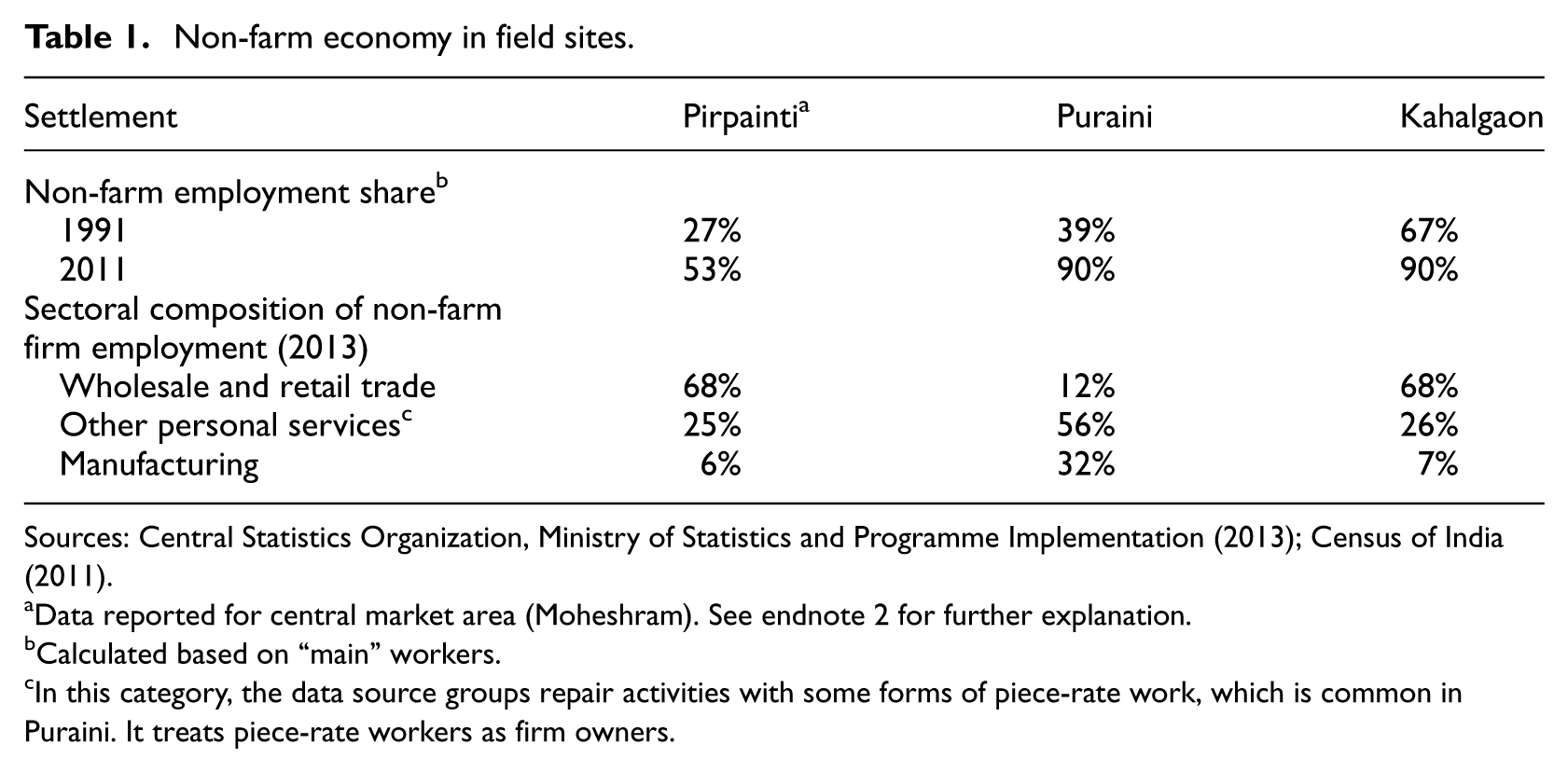
Sources: Central Statistics Organization, Ministry of Statistics and Programme Implementation (2013); Census of India (2011).
Data reported for central market area (Moheshram). See endnote 2 for further explanation.
Calculated based on “main” workers.
In this category, the data source groups repair activities with some forms of piece-rate work, which is common in Puraini. It treats piece-rate workers as firm owners.
Our sites thus share the basic characteristics of places urbanizing from within—namely, population increase and a non-farm economic transition despite little in-migration or concentrated capital investment (Randolph, 2023). Yet they reflect the diversity of small towns in Bihar and India more generally, varying in size, administrative status, and the stage and nature of economic transition.
Data collection and analysis
Data were collected in the summer of 2024. Participants were selected through convenience and snowball sampling. All interviewees were either the owners of the establishment or an adult family member who helps to operate the business. In total, 33 firms were interviewed across the three settlements. Interviews were conducted using a semi-structured format. The interview protocol contained questions related to the firm owner’s social and family background, employment history, and migration experiences, as well as questions related to the firm’s origin, products or services, sources of capital, employees, and relationships to other firms (see interview guide in Appendix A). Interviews were conducted in Hindi with two-member teams on the business premises.
Following data collection, interviews were transcribed and translated into English. An online qualitative tool (Taguette) was used to analyze the transcripts. Analysis involved an open coding strategy. Data were broken into smaller segments and various codes were given—as examples, “caste,” “capital and assets,” “past employment,” “skills,” and “supply chain.” These codes were later aggregated into three main themes: previous migration and employment history; firm operations; and market dynamics.
Limitations
As a qualitative study, our methods are not designed to produce a statistically representative cross-section of the non-farm economy in our field sites. Rather, the primary goal of this study is to investigate behaviors, norms, and practices that speak to underlying mechanisms supporting urban economic transition in places urbanizing from within. The value and purpose of this type of qualitative research is well established in the social sciences (Small, 2009). The insights gleaned from our interviews can also serve as a basis for future quantitative or mixed-methods research designed with representativeness in mind.
A key limitation of our data collection was that we interviewed firms with operations visible to the public, thus excluding those operating exclusively in domestic spaces. Puraini contains many of these “invisible” businesses, given that much of the production activity takes the form of piece-rate work from home. While our sample contains fewer manufacturing enterprises than is ideal, these interviews nevertheless supply important contrast to the tertiary sector in Bihar’s towns. In addition, businesses operating exclusively from domestic spaces are more likely to be owned by women, who are poorly represented among firm owners in the public and marketplace settings where we conducted interviews (Chakraborty and Chatterjee, 2021; Tripathi, 2023). The same may be true for those of Scheduled Caste backgrounds, who are similarly underrepresented in our sample. While our interviewees include many firm owners from non-elite backgrounds, the research cannot claim to have a comprehensive view of how all marginalized groups fit into the non-farm economy. Another limitation is that, given the nature of our interview guide, the research protocol required interviewing firm owners. This imposed difficulties in interviewing some types of firms, such as coaching centers and health diagnostic centers, in which owners are less likely to be physically present. Nevertheless, our sample does reflect the dominant economic activities in the three settlements (Table 1).
Findings
Overview of firms interviewed
Table 2 presents summary statistics of firms and firm owners in our sample. In terms of sectoral distribution, retail constitutes more than half the firms we interviewed, reflecting its dominance in Kahalgaon and Pirpainti and its substantial presence in Puraini (especially among public firms). Traders across the field sites sell a range of goods—from relatively expensive items like household appliances and mobile phones, to inexpensive discretionary goods like small cosmetics, to basic needs like medicines and rations. A smaller number of firms are engaged in other kinds of non-tradable services. These include restaurants, barbers and salons, repair activities, and some more specialized service providers, such as a firm that rents tents for celebrations and another that produces bespoke modifications for motorbikes. The data contain a small number of manufacturers, all sourced from Puraini, which contains the only production cluster. 3
Characteristics of interviewed firms and firm owners.

Note: Figures reflect the number of interviewed firms or firm owners with the identified attribute.
Castes are categorized based on the 2022–2023 caste list released by the Bihar state government. The central government divides caste into General, Other Backward Classes (OBC), Scheduled Castes (SC), and Scheduled Tribes (ST). The Bihar government further disaggregates OBC into BC (Backward Classes), and EBC (Extremely Backward Classes).
About one-third of our interviewees had previously out-migrated, in nearly all cases for work. In addition, many interviewees without personal migration experience had migrant or return migrant family members. The most common caste group among entrepreneurs in our sample is “Other Backward Classes.”
Reflecting the very small scale of firm operations, nearly two-thirds of the interviewed firms were sole-proprietorships, though many of these are family-run operations where unpaid labor is contributed by household members. This pattern is consistent with broader trends in the Indian economy, where half of the workforce remains engaged in self-employment within traditional informal own-account enterprises that operate without hired labor and depend exclusively on family labor (Kesar, 2023).
Based on the qualitative interviews, the following sections draw out key findings related to the mechanisms shaping the non-farm economy in these settlements: translocal householding; non-institutional credit; and low social barriers to entry in tertiary occupations.
Translocality for skill building, risk mitigation, and emergency capital
Bihar has very high rates of employment-driven out-migration. As noted, this migration typically involves the practice of translocal householding: most family members remain in place while one or multiple male members work in a distant location, send remittances, return frequently, and plan to eventually resettle with the rest of the household. Our interviews shed light on underexplored mechanisms linking translocality and non-farm economic activity. The first of these links is the role of labor market and life experience. Nearly all the firm owners who are return migrants claim that the experience of leaving home and working elsewhere afforded them skills important for running their business. In some cases, firm owners glean specific vocational skills from migration that they now utilize. Harsh 4 out-migrated and worked as a tailor making coats in Mumbai; having returned to Puraini, he now runs his own tailoring business. Vatsal, who runs a barber shop, previously worked in salons in Delhi, Mumbai, and Kolkata, and credits these experiences with helping him hone his “sharp wit,” skill at cutting hair, and capacity to ask the right questions about the style a customer wants.
However, for most, migration is more important for acquisition of transferable soft skills. Return migrants, especially those who run retail and hospitality businesses, highlight self-confidence, interpersonal communication skills, and a general facility with managing money and accounts. “Such situations force you to understand the world at a young age … The migration experience sparked my talent,” said Aamir, an apparel shop owner. “I understood a lot after my time in Delhi: how the world works, how businesses run, what strategies work,” said Kabir, a cosmetics shop owner. Sushant worked for a plastics company during his migration to Gujarat and sees little correspondence between the specific skills he learned in that work and his current business, a restaurant; yet he believes he never would have started the business if not for his six-month work experience elsewhere. He claims this experience gave him the confidence to interact with different kinds of people, including those with higher social status, which is now crucial to the success of his restaurant. Soft skills and comfort with business operations are also transferred to non-migrant firm owners from migrant family members. For example, building materials shop owner Shyaam explained that, initially, when digital payment options became available in India, “I had trouble learning it, but my brother taught me. He has stayed away from home, so he is more aware of such newer technology.”
The notoriously poor working conditions that Biharis experience in other parts of India are also linked to many return migrants becoming business owners. They want to avoid working for someone else. As Aamir said: As migrant workers in another state, we are often treated as inferior … if you live outside the state, a poor man (like us) is treated like an ant … Like you crush ants, laborers are crushed like that there … During that time, I realized what the outside world was like. So, I moved back to Bihar … It is better to just start your own business (in Bihar).
Feelings of pride, resilience, and a resolve not to work under anyone else were echoed in several other interviews.
Besides migration influencing firm formation and survival through skills and labor market experience, earnings from migration also matter. While it is difficult for a firm owner to use remittances or savings from migration to capitalize a new business, given the low-wage work in which labor migrants typically find themselves, wages from work performed elsewhere do allow households to minimize the risks associated with starting a business or access bridge financing during difficult times. For example, Shyaam explained that remittances from his brother, combined with his own side job, enabled him to keep his business afloat until it became profitable: [My] brother used to earn around ₹20,000–25,000 every month.
5
He was a diamond shiner … in Surat. He used to send me money little by little. After opening the shop, he stayed there for two to two-and-a-half more years. I also kept doing a newspaper [delivery] job which gave ₹300–400 [per day]. The shop was not that profitable earlier, therefore … [the] income helped to meet daily requirements. But now it’s not required.
Similarly, earnings from migration provide financing during economic downturns or other slow periods when fledgling businesses are at risk of failure. Dev migrated to Pune, a city in Maharashtra, to gather enough capital to rescue his apparel shop that risked failure due to damaged goods and declining sales. Sushant explained that he saved some of his earnings from working in Gujarat to recapitalize a confectionary that his father had closed due to his ailing health. These stories illustrate that, for households seeking to start or sustain a firm, translocality mitigates the financial risks associated with small-scale entrepreneurship by maintaining a diversified income.
Non-institutional credit
Our interviews also underscored the role of non-institutional credit in supporting the non-farm economy by enabling the formation of new businesses by those with little experience or collateral. New firm owners in Bihar identify access to credit as among the biggest challenges in starting and sustaining a business. Many complain that the loan-making process in traditional banks is too cumbersome, corrupt, 6 or requires a track record that favors established enterprises, while others claim that loan amounts in government programs are too small for meaningful investments. While 10 out of 33 interviewed firms accessed a formal loan at some point, the financing they received was insufficient to obviate the need for non-institutional credit.
Inter-firm lending is by far the most common source of non-institutional credit for interviewed enterprises. This entails a larger and better capitalized business offering credit to a smaller and capital-constrained supply chain partner. Here, there are important differences between retailers and manufacturers. Among retail firms, inter-firm credit involves upstream wholesalers offering downstream firms a system of deferred payments. Some of these arrangements are highly informal. Shaheed, who owns a ration shop, explained how he built credit with his wholesaler: I started my egg business by purchasing two cartons of eggs, which I transported myself on my bike. I would sell the eggs and return to buy more. Over time, the seller … offered me a deal where I could buy a larger quantity of eggs by paying 50% upfront and the remaining 50% later. This opportunity allowed me to significantly increase my profits. The seller appreciated my loyalty and subsequently let me buy a truckload of ration goods on credit. Now, I can obtain inputs worth over ₹1 lakh on credit.
Other deferred payment arrangements between wholesalers and retailers are more formalized, with clear, pre-established guidelines for repayment in installments using digital platforms. These are more common in the case of standardized products, such as construction materials, which typically have a shorter supply chain between manufacturer and consumer. In most cases, these credit systems between wholesaler and retailer come with zero interest for at least an initial period, which may be as short as a few days or as long as a few months.
Among manufacturers, inter-firm lending takes the form of raw material advances. Production units receive orders from a merchant based in the district capital, who also acts as a wholesaler. This merchant commissions the work, supplies the necessary raw materials up front, and pays the producers upon delivery of the finished goods. The weavers interviewed in Puraini cannot afford their own working capital outside of these arrangements. As Shakil explained: “They give us the material and ask us to make it and bring it back … I don’t have capital, so how can I invest?” The final product is then exported out of Bihar. Whereas retailers often reported having multiple different wholesale partners, all the producers had a relationship with a single merchant who supplied materials and controlled their access to the market of buyers. As Shakil said: If we take work from two places, both will demand it on time. That would be a problem, right? If it were our business, we could make and stock different kinds of goods. We could show them what we have as per their requirements.
His comments reflect that producers in Puraini do not even view themselves as firm owners.
Two other forms of non-institutional credit were also reported in interviews. Businesses sometimes approached informal moneylenders (saahukar) for capital, though this was less common than inter-firm lending. And many retailers reported that they extend credit to their customers.
Overall, a common feature of non-institutional credit in these small towns is that it typically flows down the settlement hierarchy, from larger to smaller places. In wholesaler-retailer relationships, creditors are usually in Bhagalpur (the district headquarters) or larger cities, such as Delhi and Kolkata. Retailers even reported lending small amounts of product to their workers, who then set up a shop in their nearby village, running it with family labor whenever they are in town working for the main retailer. In wholesaler-producer relationships, the merchants are similarly located in Bhagalpur. Even in the case of consumer credit, shop owners often allow deferred payment from a customer who lives in a nearby village. Another common feature is that these systems depend heavily on interpersonal trust. Such relationships are established through track records of repayment, and lines of credit are expanded in proportion to the amount of trust established. They are also easier to build in settings where all parties involved have deep roots in the social ecosystem, which is true of our field sites. Some return migrant respondents specifically drew a contrast between credit availability at home versus in their destinations. As Aamir said: “We mostly get things on credit. Outside, in other states, you don’t get anything on rent or credit.”
Low social barriers to entry in services
Interviews across the three settlements also highlighted another important dynamic of the non-farm economy: low social barriers to entry in growing service sector occupations. Rather than requiring specific technical or vocational skills, many businesses in retail and hospitality require general skills tied to labor market and life experience, in addition to literacy and numeracy. Many of the skills interviewees highlighted are those that migrants carry back with them, such as “learning how to behave with a woman” (Suresh, cosmetics shop owner); “controlling your tone … how you speak” (Yash, apparel store owner); and street smarts, such as avoiding scams when purchasing from wholesalers (Dev, fruit vendor). The transferability of these general skills is reflected in how frequently firm owners change their business models. Virat currently runs a “gift house,” which sells toys, frames, artifacts and some bespoke items. But this is only the latest of the shop’s four different lives. Its first iteration was “Shoe Palace,” before it became an internet café, before it became “a gadget house.”
These minimal requirements for technical knowledge reflect an important contrast between the informal tertiary sector and agriculture or manufacturing. In the cluster of weavers in Puraini, occupation and skills are transferred intergenerationally, and the work is strongly tied to Ansaris, a Muslim caste group, while also carrying a social stigma for other groups. The textile buyers who supply raw materials are also classified by their caste-based identity, Marwari, known for their commercial wealth and for operating in closed merchant networks (Parashar, 2025). This rigid social structure relates to how Ansari weavers see their position in the economy, as subservient. Despite owning their own looms, they referred to themselves as “bonded labor,” entirely beholden to the merchants who supply their raw materials and buy their product.
By contrast, retailers repeatedly insisted that caste plays a minimal role in determining who sells what. Shyaam, a Hindu who runs a building materials shop, explained: “People from all different religions and castes engage in business here. For example, we got this glass from a man named Abdul [a Muslim] because Guddu [a Hindu] was too far away.” In other words, he purchases supplies based on economic logic (proximity) rather than social logic (shared religious identity). Apparel store owner Yash, who is a Brahmin, asserted: “This business was traditionally handled by the Baniya caste, but now everyone is educated. Religion or caste doesn’t matter here; only knowing how to work does.” Even though these retailers depend on wholesalers for credit, they perceive themselves as autonomous entrepreneurs, in contrast to how those in caste-based occupations articulate their position. These relatively flexible social attitudes mean that, even for those who do not build the general and transferable skills of the retail economy through migration, there are opportunities to glean them via local experience on the job. Workers in the market town who live in nearby villages even manage to start their own firms while still employed at a shop in town. Yash, an apparel retailer, described this: They buy items from you, work here, but have a shop in the village. We are based in the city, and they have their setup in the village … His wife runs the shop [in the village], while he works in the city. This way, his behavior is good, the boss is happy, he is happy—everyone’s happy.
Inherited identities are by no means irrelevant in services like retail and hospitality. Land, which has strong ties to caste, is sometimes sold to finance businesses. Most importantly, the caste heterogeneity among firm owners does not extend to Scheduled Caste groups, which are still very underrepresented among retailers and service providers. Our data cannot tell us whether this results from overt discrimination or more systemic inequalities, but it does indicate that the lower social barriers to entry in retail are still not low enough for the most marginalized groups. Caste and religion operate in other ways too. Those from the same social group are more likely to hire one another or share spaces for running businesses. Those from production-oriented caste groups sometimes open retail shops corresponding to what their ancestors once made; for example, Anuj, from the Sonar caste that historically fashioned products from gold and other metals, now sells aluminum and steel utensils. And skills continue to pass down through generations, especially in personal service occupations like barbering. Nevertheless, these are not rigid social boundaries that deny access to new entrants, nor do most service-sector enterprises carry strong enough social stigma to deter participation by a range of caste and religious groups. Sociologically, this produces a local economy that is relatively open and fluid compared to both agrarian relations and other parts of the non-farm economy, such as the production activities in Puraini.
Yet interviewees in the retail sector also underscored a natural downside to its relatively open social and economic structure: small and micro-enterprises in such places have little insulation from competition. New market towns are forming in the villages of former customers, further enhancing competition, and online retailers are perceived as an existential threat, especially among retailers who sell standardized products like medicine. These fears were mainly expressed in Kahalgaon, the most established of the three settlements. “Now there are shops everywhere, so people don’t come here anymore. They can simply go to their local nearby stores,” mentioned a firm owner in Kahalgaon selling shoes and medicines. This highlights, unsurprisingly, that at this later stage of urban economic transition, market saturation and competition from new market towns lead to stagnation in the consumption-dominated local economy.
Discussion and conclusion
This study helps to describe how urban economic transitions unfold in contexts where natural population increase and livelihood diversification, rather than structural transformation, are the primary drivers of urbanization. While not exclusive to these settings, the three features we highlight—translocal householding, non-institutional credit, and low barriers to entry in the tertiary sector—come together and act in self-reinforcing ways in places urbanizing from within, enabling and organizing the non-farm economy. Through translocality, households diversify their income, giving them time to build a business through the small, incremental financing available in non-institutional networks. The labor market and life experience that come with migration align well with the requirements of running a business in retail or hospitality, where much of the growth of non-farm firms is concentrated and where caste-based skills transfer is relatively less important.
These findings build on prior work on both translocality and informal economies. Translocal householding has been described as a livelihood system for risk mitigation (Steinbrink and Niedenführ, 2020); our interviews show that, in managing risk, such livelihood strategies act as grease for non-farm entrepreneurship. Migration not only fuels demand for non-farm goods and services via remittances, but also shapes firm formation and operations. This work also builds on prior work identifying informal credit as a key feature of India’s rural non-farm economy (Basumatary et al., 2024; Polzin, 2016; Tripuraneni and Robbins, 2024; Tsai, 2004). Our findings suggest that, because this credit flows down the settlement hierarchy, it helps to support a spatially diffuse urbanization process.
These mechanisms appear to operate to varying degrees and in different ways depending on sector. The producers we interviewed are involved in traditional activities closely linked to caste, religion, and the intergenerational transfer of skills; they did not emphasize the importance of migration for soft skill-building. And while the role of trust-based inter-firm credit is evident across sectors, these credit systems leave producers feeling like “bonded labor” while retailers generally view themselves as autonomous agents shopping among wholesalers for the best deal. A town’s stage of economic transition also seems to matter. More so than in other field sites, firm owners in Kahalgaon perceive that their opportunities are narrowing amid growing saturation, perhaps due to its more advanced economic transition. This reflects the long-run challenge of economic resilience in such towns.
These findings speak to contrasting theoretical perspectives in the broader literature on small towns in India. While “subaltern urbanization” emphasizes the agency and autonomy of small and emerging towns, prior studies of urbanization dynamics in Bihar and similar regions have highlighted their dependence on larger cities. The mechanisms we identify affirm these latter claims, showing that Bihar’s small and emerging towns exist in hierarchical relation to other settlements. This is reflected, for example, in firm owners depending on migration to larger cities for emergency capital to keep their enterprises afloat, or through their reliance on credit from merchants and wholesalers living in bigger towns and cities.
At the same time, our interviews do suggest some important forms of local agency in these small and emerging towns. Some return migrants view their homecoming to Bihar and establishment of an enterprise as a form of resistance to the exploitation they faced in the metropolitan labor markets outside the state. The fact that translocal householding not only furnishes remittances, but also presents some opportunities for soft skill acquisition—allowing some entrepreneurs to cease their migration—suggests that its effects are more complex than simply locking Bihar’s towns into a “migrant syndrome” (Reichert, 1981) of dependency. These observations extend Ramamurthy’s (2020) arguments about translocality as a contradictory practice in which rural–urban mobility simultaneously reproduces subordination and creates new possibilities for agency. Meanwhile, the burgeoning service economy—while it may be supported through wages from distant labor markets—nonetheless creates opportunities for residents to establish non-farm livelihoods outside of some of the traditional restrictions in a caste-based society, including those in producer occupations. This aligns with prior research that finds retail less associated with caste than other occupations (Srinivasan, 2016).
In addition, this study complements an economics literature on “urbanization without industrialization” that raises important questions for macroeconomic development but contains few field-level insights. This work compares “consumption cities” and “production cities” in urbanizing countries, finding that the latter fare better on a range of development indicators (Gollin et al., 2016), linked to higher productivity in tradable sectors (Jedwab et al., 2022). Our findings suggest that, in regions like Bihar, the tradeoffs between these two forms of economic transition might be more complicated. On the one hand, adding to concerns about consumption cities is the issue of market saturation—illustrated by the anxieties expressed in Kahalgaon—suggesting not only a distributional problem, but also a basic issue of economic sustainability. On the other hand, in transitioning regions where poorly capitalized producers are likely to end up exploited within supply chains, and where inherited identities like caste and religion remain salient, non-tradable services may enable more social mobility and economic agency than production activities. These observations do not support, on their own, a broader argument about production versus consumption cities and their implications for development, but they do suggest that the progressive potential of “breaking into tradables” (Venables, 2017) depends critically on local context. It is far from evident that the towns in our study could tackle their long-term development challenges by expanding the types of manufacturing found in Puraini.
As a qualitative study, this article does not seek to quantify the relative influence of the three mechanisms identified, nor was data collection designed to capture home-based non-farm work. Our observations about producers versus traders in the context of places urbanizing from within also require further validation, given our limited number of interviews with manufacturers. We hope future research will seek to fill these gaps. In general, more case studies and inductive research approaches are needed to understand the micro-foundations of diverse processes of urbanization and economic change in the contemporary Global South, including in other regions urbanizing from within. Identifying these processes can play a key role in understanding the policy challenge of linking urbanization to inclusive economic development in transitioning regions.
Footnotes
Appendix A: Firm interview guide
Acknowledgements
We thank all interviewees for their participation in the study. Our work received crucial intellectual and logistical support from Niladri Dhar of the Bihar Institute of Public Finance and Policy. Local field assistants Chris Bastian, Aman Kumar, and Ankit Kumar supported data collection in Bhagalpur district. We are also grateful for constructive feedback from three anonymous reviewers and the handling editor, Professor Alison Bain.

Funding
The authors disclosed receipt of the following financial support for the research, authorship, and/or publication of this article: JustJobs Network, an India-based research institute focused on labor and employment, provided funding to support data collection for the study.
Declaration of conflicting interests
The authors declared no potential conflicts of interest with respect to the research, authorship, and/or publication of this article.