



Abstract
While several studies on the issue have shown that traditional beliefs affect people's political behavior and preferences, very little attention has been paid to how traditional beliefs influence electoral behavior. The only study that has attempted to link traditional beliefs and electoral behavior has done so by analyzing the case of Togo where the party system has been traditionally fairly stable and unfragmented. The case of Indonesia, on the other hand, has undergone significant changes since the end of the Orde Baru, and what was once a fairly unfragmented party system now displays high levels of fragmentation. Hence, it is particularly interesting to explore how the presence/diffusion of traditional beliefs shapes the voters’ choices in a changing, increasingly fragmented, democratizing political system. Moreover, in reviewing the literature on Indonesian elections, we find that, first, the study of electoral behavior in Indonesia has made little effort to employ existing theoretical frameworks; second, quantitative studies are scarce; and third, there are practically no micro-level quantitative studies on electoral behavior. In this article, we assess whether and to what extent the electoral choice of a voter is affected by whether and to what extent they hold on to traditional beliefs by performing statistical analyses of original survey data. We find that voters with a traditional mindset are more likely to vote for the secular parties in the ruling coalition than voters who do not hold traditional beliefs.
Even the most cursory glance at analyses of the Indonesian elections reveals that the study of Indonesia's elections and electoral behavior is dominated by country specialists, that little to no effort is made to link the findings of these studies to more general debates of the electoral behavior literature, and that, methodologically speaking, most of the analyses of Indonesian elections are chiefly descriptive/qualitative and make little to no use of quantitative data (Aspinall et al. 2021; Savirani and Aspinall 2017; Savirani et al. 2021).
The recent literature on Indonesian electoral behavior has discussed a wide range of issues such as religious polarization in the 2017 Jakarta elections; the fact that parties are poorly institutionalized; that the parties of the Left never managed to make a successful comeback; that clientelistic politics in post-Suharto Indonesia is fairly widespread; and that the political system, or one should say the party system, is rather fragmented (Savirani and Aspinall 2017). Other studies have been devoted to women in politics and studies produced in this line of inquiry focus on gender quotas (Hillman 2018), political dynasties (Wardani and Subekti 2021), the political meaning of hijab style (Ni’mah 2021), and wives’ electoral victories (Ichsan Kabullah and Fajri 2021).
These studies have greatly advanced the scholarly understanding of Indonesian elections or elections in an Indonesian context, but these studies were vitiated by three basic problems. First, the study of electoral behavior in Indonesia made little to no effort to employ any of the theoretical frameworks that the literature has developed over the years. Second, the study of elections and electoral behavior in Indonesia makes a limited use of quantitative information. Most of the studies that present some figures and numbers generally report electoral results. The data are often used for descriptive purposes, not for analytic ones. Third, the few studies that perform some statistical analyses or display statistical graphics—such as the scatterplots used by Aspinall et al. (2021) to show the relationship between the size of the Muslim population in a province and the representation of women in the DPD and DPRD—use aggregate data. This is somewhat problematic because, in order to understand why voters vote and/or why they vote the way they do, it is essential to perform data analyses at the micro-level in addition to the macro-level. The present article is an effort to look at the Indonesian voters’ electoral behavior by linking their electoral behavior with some of the theories/frameworks that were devised to analyze electoral behavior in other settings, by employing a focus and an approach that country specialists have so far not employed, and by performing statistical analyses of micro-level data.
From Weber (2002) to the new modernization theorists, social scientists have long had a fascination with religion. Religion (and/or religious denomination) was believed to be the single most important reason why capitalism had developed in Protestant countries (Weber 2002), why democracy had consolidated and survived in some settings but not in others (Lipset 1959), or why the quality of democracy was higher in some countries than in others (Inglehart and Baker 2000; Inglehart and Welzel 2010). In spite of the obvious differences between the work of Weber, Lipset, and Inglehart and Welzel, all these scholars agreed on the fact that religion is an important aspect of a (political) culture as it shapes the values and the attitudes of individuals. The literature has in recent years advanced two complementary claims, namely, that highly religious individuals (and societies) are less likely to have post-modern, emancipative values (see Kuzenbayev and Pelizzo 2023) and that “modernization tends to make religion less influential” (Inglehart and Welzel 2010, 555). In spite of the claims advanced by the secularization literature in the 1960s (Berger 1967), the world has not become fully secular. Berger, who was one of the leading secularization theorists claimed in recent years that secularism was in retreat (Berger 1996) and that secularization (theory) had been falsified (Berger 2008). Religion remained a prominent feature in the life of those who had failed to achieve existential security (Norris and Inglehart 2011), and in several settings, from Indonesia to Kazakhstan, it gained even greater prominence.
The case of Indonesia is rather emblematic because with the fall of Suharto's Orde Baru (New Order)—a secular authoritarian regime—the Indonesian political system became simultaneously more democratic and more religious. In the wake of its democratic transition and with the reinstatement of competitive multi-party competition, religious parties—the National Awakening Party (PKB) and Justice Prosperous Party (PKS)—were created and took part in the country's political life. The literature has paid some attention to the electoral fortunes of religious parties in Indonesia. In this respect, it was noted that the electoral fortunes of the PKB differed from those of the PKS, that these differences were to a large extent ascribed to the different organizational characteristics of these two parties (Hamayotsu 2011), but that they also reflected the fact that Islam “has penetrated the nationalist political parties” (Tanuwidjaja 2010, 31).
While political scientists, especially those working in the political culture paradigm, have long been interested in religion and its political consequences, less attention has been paid to the fact that the (political) culture of a given polity is also affected or shaped by factors other than religion. Mbiti (1970, 21), in his classic work, noted that the concept of time should be regarded “as the key to our understanding of the basic religious and philosophical concepts. The concept of time may help to explain beliefs, attitudes, practices, and general way of life of African peoples not only in traditional set up but also in modern situation.”
The importance of time orientation was acknowledged not only by philosophers of religion, such as Mbiti, but also by psychologists and social scientists more generally from Kluckhohn and Strodtbeck (1961) to Hofstede and Bond (1988) who detected a relationship between value orientation and level of socio-economic development. This literature on what culture is and how it is, or could be, operationalized and measured also went on to note that while culture does not change quickly, it does change over time (Beugelsdijk and Welzel 2018).
Yet, as one of the articles (Pelizzo et al. 2023) included in this special issue reveals, some cultural aspects are more resilient to change even in the face of socioeconomic transformation, development, and modernization. There are some traditional beliefs, such as, for example, the belief in magic and or superstition, that manage to survive. More importantly, these beliefs, as the analyses presented in the other articles included in this issue indicate, display greater cross-national variation than across various religious groups in a single country (Pelizzo et al., 2023, in this special issue) and also display some considerable variation even among the followers of the same religion (Pelizzo and Kuzenbayev 2023a, 2023b in this special issue).
Important as these traditional beliefs may be in shaping individuals’ attitudes and values and in shaping a country's political culture, they have generally been overlooked by political culture theorists as (politically) significant facets of political culture. We believe instead that precisely because they signal considerable within-religion and cross-national variation, traditional beliefs represent an important, however underappreciated, cultural element. And, insofar as political phenomena are shaped, among other things, by cultural factors, then it is fairly reasonable to assume that these traditional beliefs may also have political consequences. That is, we post that if political culture matters and if traditional beliefs are a determinant of such culture, then traditional beliefs should have a clear and detectable impact on political phenomena, political preferences, and political behavior.
While Pelizzo and Kuzenbayev (2023a, 2023b in this special issue) explore the attitudes toward democracy of traditionally minded/superstitious voters, the general question that we aim to address is whether the persistence, the pervasiveness and/or the rise in traditional values and beliefs, rather than the religious polarization/radicalization to which the literature has alluded, has had any electoral consequences in the Indonesian case. Specifically, we wish to assess whether and to what extent the electoral choice of a voter is affected by whether and to what extent they hold on to traditional values. In order to do so, we will analyze the responses of 110 Muslim men (50 percent) and women (50 percent) from different cities and regions of Indonesia. 1 We do so for three reasons. The first is that, as Pasquino and Pelizzo (2022) recently noted, the functioning of any political system is affected by what can loosely be defined as cultural factors and that some aspects of culture are just as important as others—and occasionally even more so—in making political system work.
The second reason is that some cultural factors have received greater attention than others. For instance, while considerable attention has been paid to the political consequences of religion (that is to the role that religion played in the consolidation of democracy (Lipset 1959), to its role in the third wave of democratization (Huntington 1991), and to its impact on the quality of democracy) much less attention, if any, has been paid to whether, how, and to what extent traditional beliefs (other than religion) affect political preferences, attitudes, and behavior. While Pelizzo and Kuzenbayev (2023a, 2023b in this special issue) have shown that individuals with a (more) traditional mindset are more likely to favor the rule of a strongman to democratic rule, very little attention has been paid to how traditional beliefs, such as a belief in witchcraft or superstition, influence electoral behavior. Given this gap in the electoral behavior literature, we believe that this is a question worth exploring.
The third reason is that the only study, to the best of our knowledge, that has attempted to link traditional beliefs and electoral behavior (Pelizzo et al. 2023 in this special issue) has done so by analyzing the case of Togo where the party system has been traditionally fairly stable and unfragmented. The case of Indonesia, on the other hand, has undergone significant changes since the end of the Orde Baru, and what was once a fairly unfragmented party system now displays high levels of fragmentation—or hyperfragmentation. Hence, it is particularly interesting to explore how the presence/diffusion of traditional beliefs shapes the voters’ choices in a changing, increasingly fragmented, democratizing political system.
The analysis of the survey data reveals that traditional values and beliefs are very common among the respondents, that traditional beliefs form a coherent whole, and that the traditional mindset shapes voters’ electoral choices. In fact, regardless of how we operationalize the traditional mindset, we find that voters with a traditional mindset are more likely to vote for the secular parties in the ruling coalition than voters who do not hold traditional beliefs.
The article is organized in the following way. In the next section, we discuss the literature on electoral behavior, noting that voters’ electoral choices in industrially advanced economies have been explained on the basis of sociological, sociopsychological, economic, and cultural characteristics. Less attention has been paid to whether and to what extent these frameworks for analysis provide much insight into the electoral behavior of voters in non-Western, developing settings. In the following section, we focus our attention on the Indonesian case because, while in recent years scholars have extensively studied a wide range of aspects pertaining to the Indonesian elections, little to no attention was devoted to providing some empirical evidence as to why Indonesian voters vote the way they do. We contend that the Indonesia case is worth exploring because Indonesia has (more or less) successfully undergone a democratization process, elections have become competitive and multi-party, the country has made remarkable progress along the developmental path, the Islamization of the Indonesian electorate has not occurred, but Indonesian society has become considerably more traditional than it once was. Hence, the Indonesian case provides a perfect setting to explore whether and in what ways voters’ electoral behavior and choices reflect or are affected by voters’ attachment to traditional beliefs.
The results of this type of analysis are relevant for various streams of scholarly inquiry. They are expected to make a contribution to the literature on democracy and elections in Indonesia because it will show that the electoral behavior of Indonesian voters is not simply a function of whether and how religious they are but also of whether they hold traditional beliefs or not. The results of our analyses will also be of interest to scholars working within political culture and modernization paradigms. Modernization theorists will appreciate the fact that traditional beliefs survive even in countries that make significant progress along the developmental path, while political culture scholars will appreciate the fact that when speaking of traditional values we may have to go beyond religion, religiosity, and patriotism to include other traditional beliefs. Finally, the results of the analyses performed in this contribution to the World Affairs special issue represent a meaningful contribution to this special issue because they show that the traditional belief-electoral behavior nexus that Pelizzo et al. (2023 in this special issue) had detected in other, non-democratic settings, also exists in democratic ones.
In the subsequent section, we discuss our data and methods before presenting the results of our analyses. Our analyses show that tradition matters—or, to be more precise, that voters who hold on to traditional beliefs (e.g., to magic or the evil eye) and practices (such as the use of traditional healers) are more likely to vote for secular parties (in the sense of not being Islamic parties) and in government coalition. In the final section, as is customary, we draw some tentative conclusions.
Literature Review
In the electoral behavior literature, it is possible to identify four main streams. The first and oldest stream of inquiry explained electoral choices on the basis of the social characteristics of the electorate. Society is divided by social divisions which are known as cleavages, some of these cleavages are politically salient as they segment the electorate and create/shape voter loyalties. These cleavages are responsible for the format of the party system—that is, the number of parties—which reflects the number of cleavages that were still salient when universal suffrage was granted (Lipset and Rokkan 1967). In this respect, speaking of issues rather than cleavages, Taagepera and Grofman (1985, 344) noted that the number of parties in a given party system equals the number of issues/cleavages plus one or:

The work of Lipset and Rokkan (1967) came to represent, along with Sartori's classic work (Sartori 1976), one of the main frameworks for the analysis of party systems. Sartori's framework inaugurated the functional approach to the study of party systems as his work investigated how fragmentation and ideological polarization influenced the functioning of party systems and provided useful criteria for their classification. Lipset and Rokkan's work instead inaugurated the genetic approach to the study of party systems as it focused on the historical development of party systems, that is, on how party systems acquired and retained the characteristics that they displayed. Lipset and Rokkan (1967) in fact noted that party systems in the 1960s closely resembled the party systems of the 1920s and argued that the reason why party systems had not changed was that the cleavage structure on which they had been built had not changed.
With the fall of the Berlin Wall, the end of the Cold War, the rise of populist (and/or) right-wing parties, the emergence (and the electoral success) of regionalist parties, the previously frozen (Western and, more specifically, Western European) party systems started to change. Bartolini and Mair (2007) developed a new approach for assessing the resilience of cleavages, Karvonen and Kuhnle (2003) attempted to assess the merits of Lipset and Rokkan's framework for analysis, Katz (2001) explored the extent to which cleavages were frozen in English-speaking democracies, Veugelers (1999) argued that the rise of the new extreme right parties represented a challenge for the political sociology practiced by scholars working in the tradition inaugurated by Lipset and Rokkan (1967). In addition to these studies wondering whether party systems were changing, how (and how much) they were changing, and whether such changes could be reconciled with the genetic and the functional approach championed, respectively, by Lipset and Rokkan (1967) and Sartori (1976), other studies noted that cleavages were still responsible for the segmentation of the electorate but that some of the old cleavages had lost their salience and some new cleavages had become salient. In this respect, one could recall that while Inglehart (1971) spoke of a silent revolution, of a generational value change, the emergence of post-materialist values and of a materialism-post-materialism cleavage that manifested itself in the creation of Green parties, Ignazi (1992) explained the rise of new extreme right parties as a reaction to the rise of post-materialist values. In each of these studies, party loyalty, electoral choices, electoral competition, format, and mechanics of the party system were the result of social divisions.
Political behavior was explained along the very same lines. Voting for a Christian party, for an Agrarian party, or for working class parties are all examples of social/sociological voting—the best known of which was, of course, class voting according to which a voter casts votes for a party that defends/protects the interests of her class. While several studies in the past two decades have attempted to underline the continued significance of class voting (Evans 2000; Nieuwbeerta and De Graaf 1999; Van der Waal et al. 2007), more recent studies have noted that with the declining importance of equality and redistributive policies (Kitschelt 1994; Przeworski 1986), class voting has finally lost some significance (Evans and Tilley 2012).
Yet, well before the recently discovered crisis of class voting, the merits of the theories of class voting and social/sociological explanations of electoral choice had long been called into question. One critical remark was that it was not clear how the class voting should be operationalized (Korpi 1972); that is, whether a party represents a class because the majority of that party's voters belong to a given class or whether a party represents a class because the majority of the voters belonging to a specific class vote for a given party. A second critical remark concerned the way in which the class of an individual could be ascertained in the sense that it was not always clear which social/demographic characteristic represented the defining feature of a class allegiance (Evans 2017). A third set of problems of class voting and other sociological explanations of the electoral choice was that they were too deterministic (Rose 1982), that they left little room for agency and for other characteristics (Lewis-Beck 1990), and that, methodologically, they were often making inferences about electoral behavior from aggregate electoral data.
The publication of The American Voter (Campbell et al. 1960) was a turning point in the study of electoral behavior in understanding why people vote (or not) and why they vote the way they do. The authors of this seminal work argued that voters are socialized in the early years of their lives; they develop an attachment to a specific political party, known as party identification; and that party identification provides both cognitive and behavioral guidance. With the rise of pressing issues, the importance of party identification in shaping electoral choices declined, while the importance of issue voting increased (see Nie et al. 2013).
The third approach to the study of electoral behavior is represented by the spatial/economic theories of voting, the best known of which are proximity theory (Downs 1957) and the directional theory of issue voting (Rabinowitz and MacDonald 1989). This approach posited that voters cast their ballot depending on their personal positions and parties’ positions on what has alternatively been defined as the political spectrum, the policy spectrum, or policy issues. The difference between the approaches consists in the way in which voters are believed to decide how to vote. According to proximity theory, a voter casts her ballot for the party that is closest to her own position, while for directionality theory, a voter casts her ballot by checking whether a party stands on the same of a given issue and by how strongly a party feels about that issue (see also, e.g., Macdonald et al. 1991; Macdonald et al. 2007; Rabinowitz and Macdonald 1989).
A fourth stream of electoral behavior studies has attempted to explain voters’ electoral choices on the basis of their attitudes and their values; that is, of what is generally defined as culture. There are several examples of this “cultural” explanation of the electoral behavior: the rise of, and the vote for, post-materialist parties was viewed as the result of voters’ value change (Inglehart 1971); the success of the (new) extreme right-wing parties was regarded as a reaction to the value change that had created an electoral market for the parties of the so-called New Left (Ignazi 1992; Kitschelt and McGann 1997); the fact that voters vote against their class-belonging was dictated by their cultural participation (how much they read) and by their cultural conservatism (Achterberg and Houtman 2006).
While the merits of the approaches discussed so far have greatly expanded the scholarly understanding of electoral behavior in advanced industrial societies, less attention has been paid to whether (and to what extent) these approaches provide scholars with the proper frameworks to explore electoral behavior in non-Western, developing nations. There are several reasons why approaches and/or frameworks designed to make sense of electoral behavior in industrially advanced democracies have not been used to shed light on electoral behavior in developing nations. One of these reasons, as we mentioned above, is that in several developing nations national election surveys, similar to the ones that are administered in the United States, the United Kingdom, Germany, and other Western countries, are not administered. Hence, while it is possible to analyze the electoral returns, in the absence of survey data it is more difficult, not to say impossible, to explore by statistical means whether a voter voted the way they did because they identify with the party they voted for, because they belong to a social group that a party is believed to represent, because of her and the party's policy stance(s), or because of all of the above. A second reason is that in many developing polities, even when data are collected, they are not always of terribly high quality as the literature has extensively discussed (see, for example, Baris and Pelizzo 2020; Kinyondo and Pelizzo 2018; Kinyondo et al. 2019).
A third reason is, as Sartori (1970) had understood, concepts are culture-bound: they do not travel well and do so by losing their precision. Concepts that in a given tradition have, precisely because of that tradition, a specific meaning may have a rather different meaning in a different cultural setting. The point made by Sartori has two implications. On the one hand, it implies that the way, for example, a political party is understood in Western settings may be different from the way it is understood in non-Western settings—and it is precisely because of the differences in the understanding of what a (political) party is and/or is supposed to do, which Sartori (1976) distinguished party systems proper, where political parties are instrumental in stabilizing the pattern of inter-party competition, from “fluid polities” where the pattern of inter-party competition is unstable or fluid. On the other hand, Sartori's remark implicitly pointed out that different cultures have different characteristics or markers—which means, concretely, that some survey questions that properly capture the values and the attitudes of Western respondents may not work equally well in non-Western settings where respondents, with their cultural characteristics, need to be allowed to speak in their own voices and to be understood in their own terms.
We can illustrate this problem with a simple example. Inglehart and Baker (2000) identified God's importance in one's life as one of the indicators/sub-dimensions of traditionalism and went on to identify church attendance, the reported importance of religion in a respondent's life, and the reported confidence in the country's churches as the correlates of traditionalism. But little to no attention was paid to the fact that religion is only one and not necessarily the most traditional of the traditional beliefs. As the data collected by the Pew Research Institute and all the articles included in this special issue reveal (see Pelizzo and Kuzenbayev 2023a, 2023b; Pelizzo et al. 2023; Pelizzo, Turganov, and Kuzanbayev 2023), people, citizens, and voters may have a much wider range of remarkably more traditional beliefs and practices, for example, the belief in (the existence) of witchcraft, the evil eye, spirits, or the use of traditional healers. These traditional beliefs are important for several reasons. First of all, they are important because they reveal the extent to which some aspects of local traditions, which in many cases pre-dated the emergence of monotheistic religions, have managed to survive in spite of the rise of monotheism, socio-economic development, and modernization. The second reason why they are important is that they allow scholars to appreciate how much cross-national variation there is among individuals and communities who belong to the same faith and, by doing so, they provide a good indication of the character of a country's culture. The third reason is that, as some of the other studies included in this special issue make clear, the traditional mindset and/or the presence of traditional beliefs in a given society have clearly detectable political consequences. Individuals who hold traditional beliefs or engage in traditional practices tend to prefer ruling parties over opposition parties (Pelizzo et al. 2023), and they are more inclined to support strongman's rule over democratic rule (Pelizzo and Kuzenbayev 2023a, 2023b). In the remainder of this article, we explore whether and to what extent respondents’ traditional mindset has any impact on their electoral behavior.
The Indonesian Case
The classic “Modernization” theorists from Marx (1972) to Weber (2002) argued that, thanks to socio-economic progress, people would abandon their pre-modern beliefs and belief systems, would transition from a belief in magic to a belief in religion, and would eventually secularize.
While in the 1960s secularization was believed to be pervasive and inevitable, scholarly findings have forced secularization theories to qualify or correct some of their previous views. Secularization is not occurring universally, as it was once believed, but it is occurring among the richer segments of the most affluent societies, while religion and religiosity remain very popular in settings in which the people lack a sense of existential security (Norris and Inglehart 2011). In this respect, we should note that existential security was first associated with low GDP per capita and, later on, with the experience of lived poverty, though more recent studies have shown that the sense of existential security reflects both material as well as non-material conditions (Kuzenbayev and Pelizzo 2023). 2
The case of Indonesia represents a sort of exception to the classic version of modernization theory proposed by Marx or Weber. At the end of Suharto's rule, known in Indonesian Bahasa as Orde Baru (New Order), Indonesia democratized. The Indonesian Orde Baru was praised by some observers and commentators as a remarkable developmental success (Schwarz 1997) and criticized by others not only for the human rights violations of the Suharto regime but also for the fact that in spite of three decades of development, the country remained rather poor (Kurniawan and Managi 2018). The 1999 elections were the first multi-party elections. More than 100 parties participated in the elections, 21 of them won at least one seat in parliament, and the parliamentary party system became rather fragmented and dramatically more so than it had been in the wake of the 1997 elections. In fact, while Golkar, the United Development Party, and the Indonesian Democratic Party had won all the parliamentary seats and the Golkar alone had won 325 of the 425 seats, in the 1999 elections, no party won more than one-third of the seats. Actually, the Indonesian Democratic Party of Struggle, which emerged as the country's largest party, won only 153 of the 426 seats. The 2004 elections produced an even more fragmented parliamentary party system since the largest party, Golkar, won only 128 of the 550 parliamentary seats amidst allegations that vote counting had been rigged (ACVR 2005).
The 2009 elections also produced a highly fragmented party system because, despite the fact that the number of parties that had won at least one seat in the elections had decreased, the size of the largest party had not increased much—from 23.3 percent in the 2004 elections to 26.4 percent in the 2009 elections (Ufen 2010). In the 2014 elections the number of parties winning at least one parliamentary seat and the size of the largest party in parliament dropped to 19.5 percent and bounced back to a meager 22.2 percent in the 2019 elections (Toha et al. 2021).
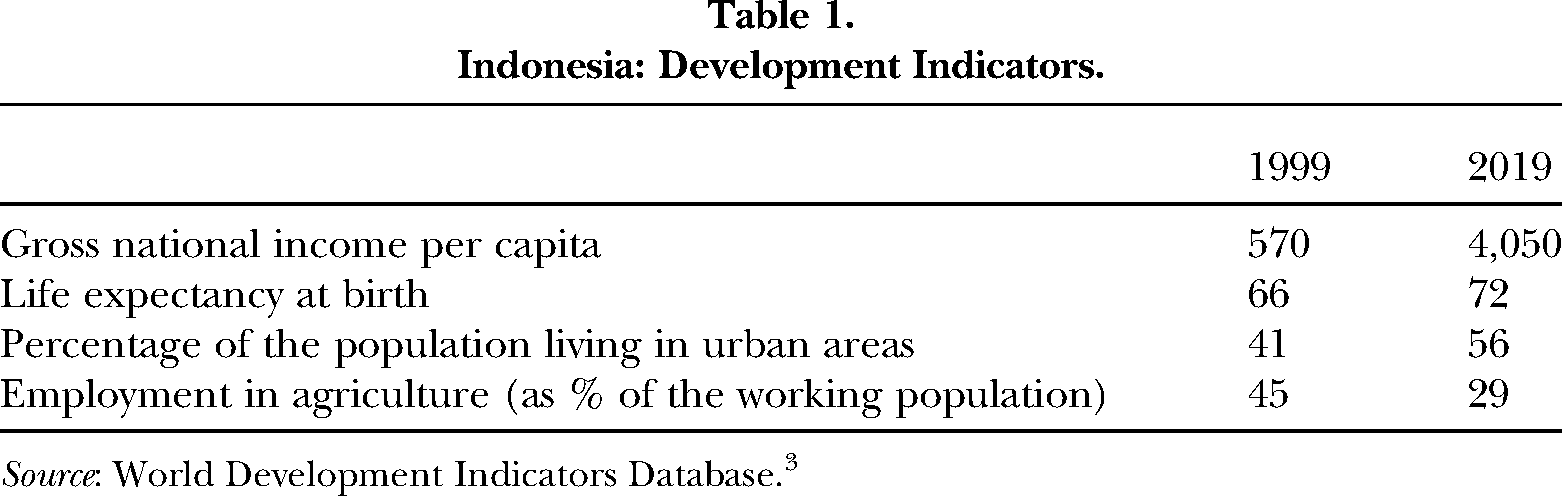
In the same period, Indonesia made considerable progress along the developmental path: life expectancy at birth increased, the percentage of the population living in urban areas rose, and the percentage of the population working in agriculture dropped (World Bank 2023). More importantly in the period under consideration, the wealth of Indonesian society increased considerably. The Gross National Income grew from 570 dollars in 1999 to 4,050 dollars in 2019 (see Table 1).
Indonesia: Development Indicators.
Source: World Development Indicators Database. 3
The data in Table 1 make it quite clear that Indonesia urbanized, industrialized, secured longer and healthier lives for its citizens, and grew richer. Indonesia developed. Interestingly, though, and this is the reason why we noted above that Indonesia is a somewhat exceptional case, the percentage of Indonesian citizens who believe that religion is important remained unchanged. In the course of the 4th, 5th, and 7th wave of the World Values Survey, Indonesian respondents were asked to indicate how important religion is in their lives. As we can see from the data presented in Table 2, the percentage of respondents who felt that religion is very important was the same in the 4th and in the 7th wave and stood at an impressive 98.1 percent. Improvements in health, wealth, and living conditions had—contrary to secularization theory—no impact on the religiosity of the Indonesian population.
Percentage of Indonesian Respondents Stating That Religion Is Very Important.

Source: World Values Survey. 4
The data presented in Table 2 suggest that, in the period under consideration, there was no increase in religiosity overall. The value recorded in the 7th wave is identical to the value recorded in the 4th wave because, after a modest decrease from the 4th to the 5th wave, the percentage of respondents for whom religion is very important bounced back in the course of the 7th wave. More interestingly, for the purposes of the present article, is the fact that traditional beliefs and practices—such as believing in the evil eye, believing in sorcery/witchcraft, witnessing an exorcism, or making use of traditional religious healers—have become more common.
In 2012, the Pew Research Institute conducted a survey among Muslim communities in South Asia, South-East Asia, sub-Saharan Africa, the Middle East and North Africa, Southern-Eastern Europe, and Central Asia. The responses provided by Indonesian respondents, all Muslim, suggested that traditional practices and beliefs were not always terribly common (Pew Research Center 2012). Only 20 percent of the respondents reported having witnessed an exorcism, 29 percent of the respondents believed in the evil eye that is in some people's ability to cast curses, 38 percent of the respondents reportedly made use of religious traditional healers, while 69 percent of the respondents believed in sorcery/witchcraft. The data that we collected in the course of our research reveal that traditional beliefs and practices have become remarkably more common among Indonesian Muslims. The analysis of our survey data, collected in 2022, reveals that 58.2 percent of the respondents have witnessed an exorcism, that 50 percent of the respondents believe in the evil eye, that 70.9 percent of the respondents make use of traditional healers, and that 56.4 percent of the respondents believe (in the existence of) witchcraft. Respondents were also asked whether they knew someone who believes in traditional religions, and 48.2 percent of the respondents reported that they do indeed know someone who believes in traditional religion(s). See Table 3.
Traditional Beliefs and Practices in Indonesia.
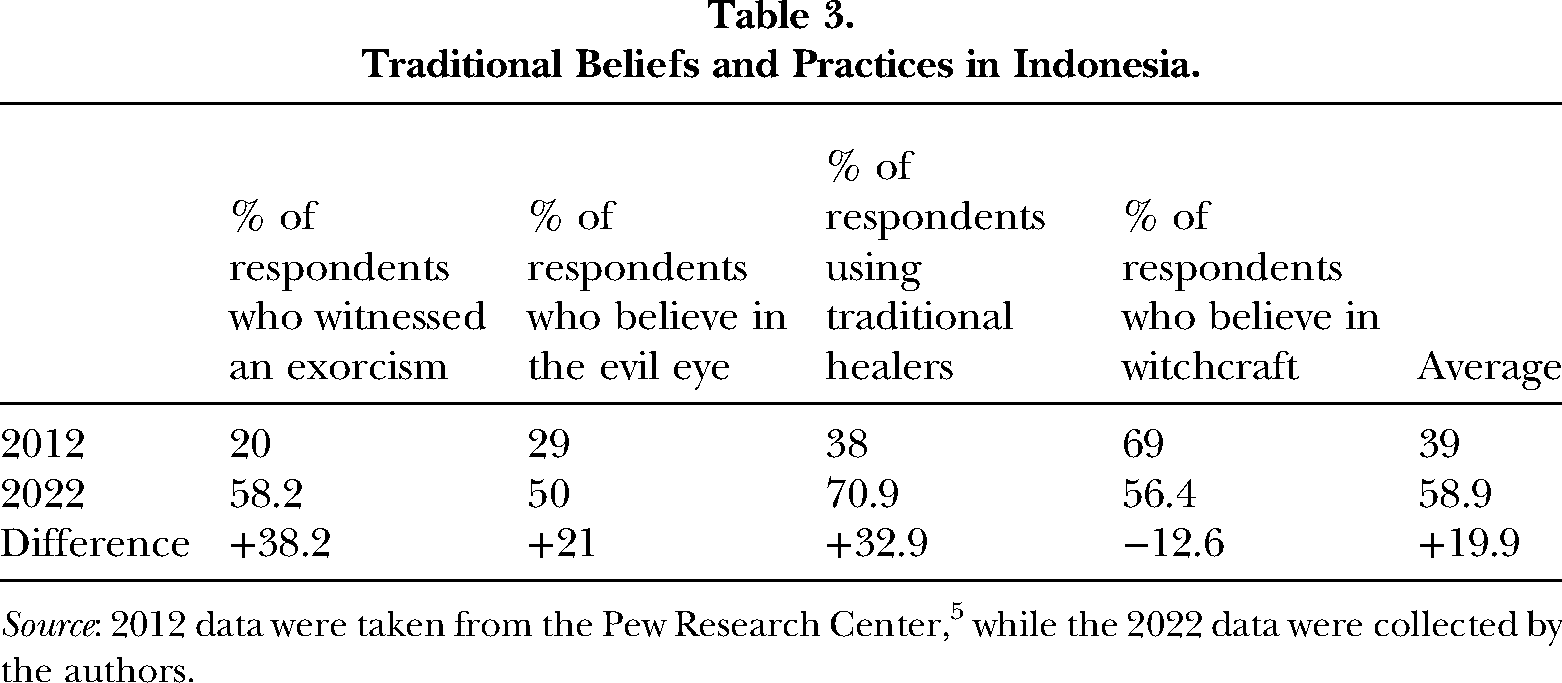
Source: 2012 data were taken from the Pew Research Center, 5 while the 2022 data were collected by the authors.
These findings sustain the claim that, as Indonesia democratized and made significant progress along the developmental path, it remained a very religious society and it became increasingly more traditional. The fact that Indonesia became richer and more developed did not affect the religiosity of the Indonesian population, in contrast to what secularization theory would lead one to believe. The fact that the mindset of Indonesians became more traditional is inconsistent with the postulates of modernization theory that has long assumed that as a country develops—becomes richer, more literate, more urbanized, and more industrialized—it experiences a cultural transformation: its values change and become more modern. In the case of Indonesia, a simple comparison of our findings with those presented by the Pew Research Center reveals that the values of Indonesian society have changed as the country made progress along the developmental path as Indonesian society has become more traditional. Traditional values are more common now in a country that is materially better off than it once was.
Given this extraordinary, and in a way unexpected, value change in Indonesian society it is worth exploring whether the recent, and in many ways unexpected, rise of traditional values in what is supposed to be a rapidly modernizing society has affected the electoral behavior of the Indonesian electorate. In other words, we explore in the remainder of this article whether the presence/absence of traditional values or the fact that some individuals/voters have a more traditional mindset than others affects their electoral choices.
Data and Methodology
Our survey was administered to a sample of 110 respondents. All the respondents were Muslim, as had been the case for the survey earlier administered by the Pew Research Center (2012). Respondents came from different parts of Indonesia and were generally fairly young—the average age of the respondents was 31.6 years, the minimum age was 19 years, and the maximum age was 66 years—and they were evenly split along gender lines. In fact, 55 of the respondents were females, the other 55 were males.
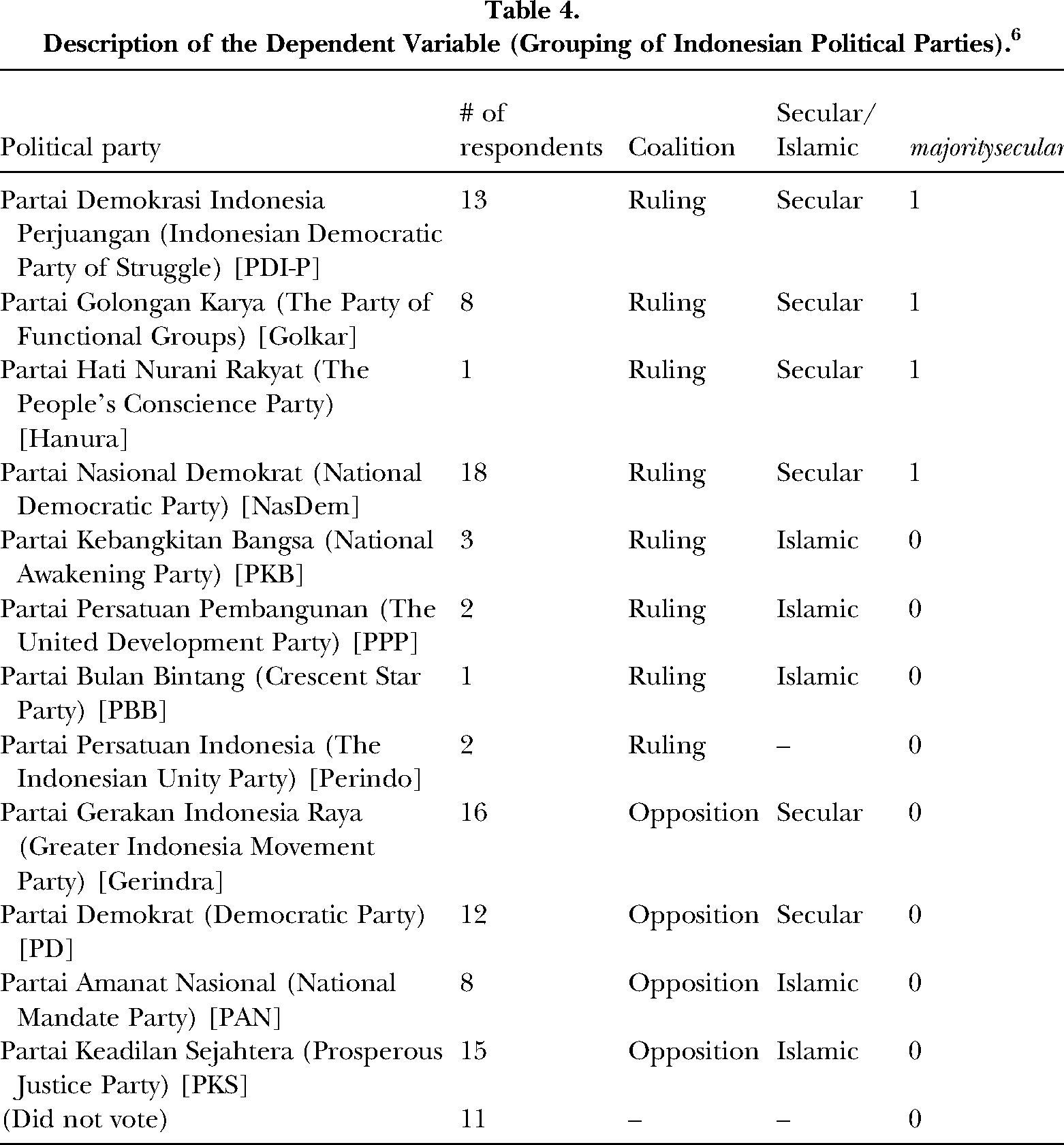
The survey included three sets of questions. One set concerned the personal characteristics of the respondents such as age, gender, religion, and place of residence. A second set of questions concerned voters’ participation in the electoral process, for which party they voted, and whether they believed that the country needed some change. In the first respect, 90 percent of the respondents claimed to have voted in the elections. In the second respect, respondents were asked to indicate which party they had voted for in the 2019 general election. In total, the respondents mentioned 12 political parties (see Table 4). From these responses, we construct the dependent variable of our model—majoritysecular, which is an indicator variable: 1 if the political party is both secular (Bulkin 2013) and from the ruling/majority coalition (Lontoh 2019) and 0 otherwise. In the third respect, 106 (or 97 percent) of our respondents stated that they believe that the country needs change—a value that is fairly similar, albeit slightly lower, than what Pelizzo et al. (2023) report in their analysis of Togolese data in this issue of World Affairs.
Description of the Dependent Variable (Grouping of Indonesian Political Parties). 6
A third set of questions was employed to assess whether and to what extent the respondents hold traditional views. In order to do so, we asked them to answer a series of yes or no questions: (1) “Have you ever experienced or witnessed the devil or evil spirits being driven out of a person?” (2) “Do you or your family ever use traditional healers when someone is sick?” (3) “Do you believe that certain people can cast curses or spells that cause bad things to happen to someone?” (4) “Do you believe in witchcraft or sorcery?” (5) “Do you know anybody who believes in traditional religion?” From the responses to these questions, we construct two measures of traditional beliefs (Cronbach's alpha for these five survey items is 0.66). First, traditional_dummy is an indicator variable that is equal to 1 if the respondent answered “yes” to all five questions and 0 otherwise. Second, traditional is derived from the factor analysis of the same five variables (Table 5). Principal component factor analysis (PCFA) using a polychoric correlation matrix (Holgado-Tello et al. 2010) yields one factor that loads highly on all five items. This single factor explains 55 percent of the total variation.
PCFA of Five Survey Items for Traditional Beliefs.
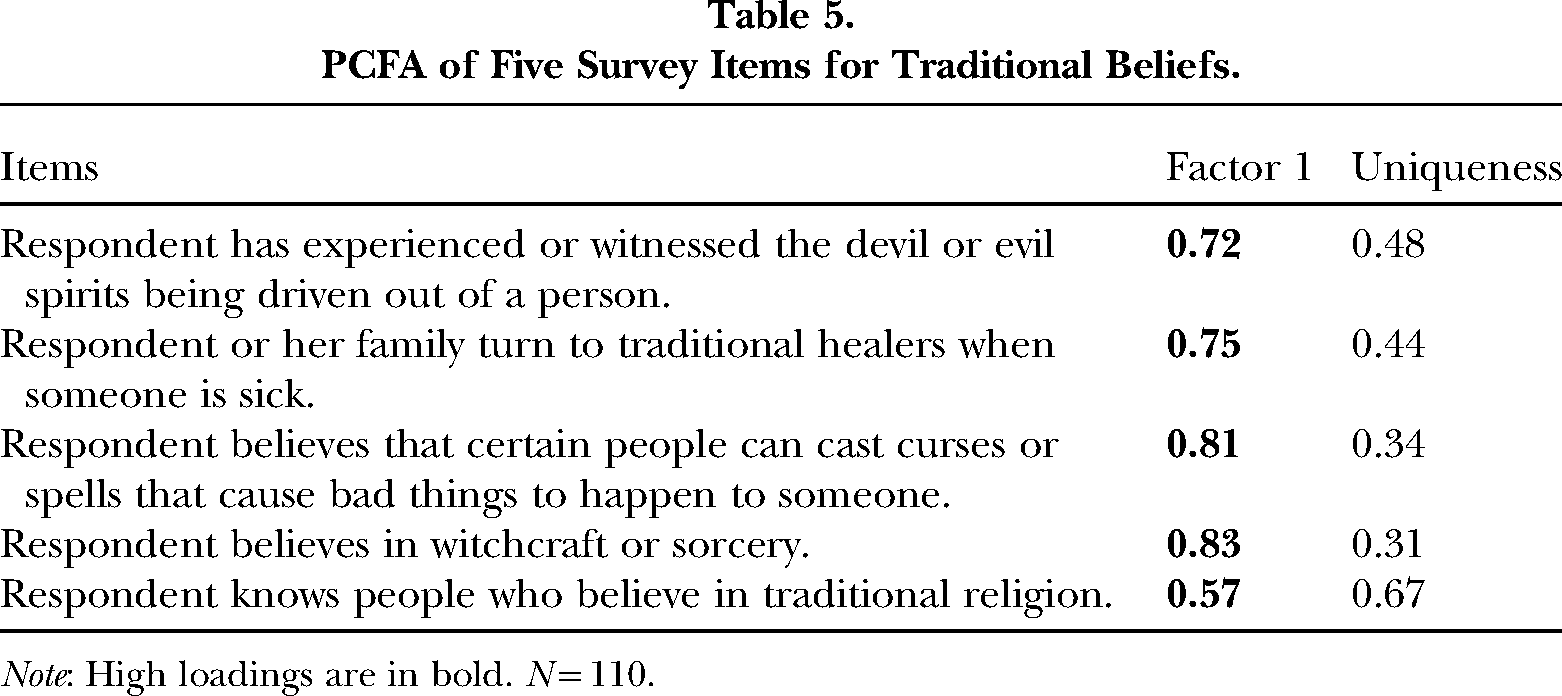
Note: High loadings are in bold. N = 110.
To understand whether and to what extent the electoral behavior of our respondents is affected by their characteristics (age, gender) and by traditional beliefs, we estimate two logit regression models. In addition to the explanatory variables of interest (traditional_dummy and traditional), we control for age and gender. The estimation results are discussed in the next section.
Results
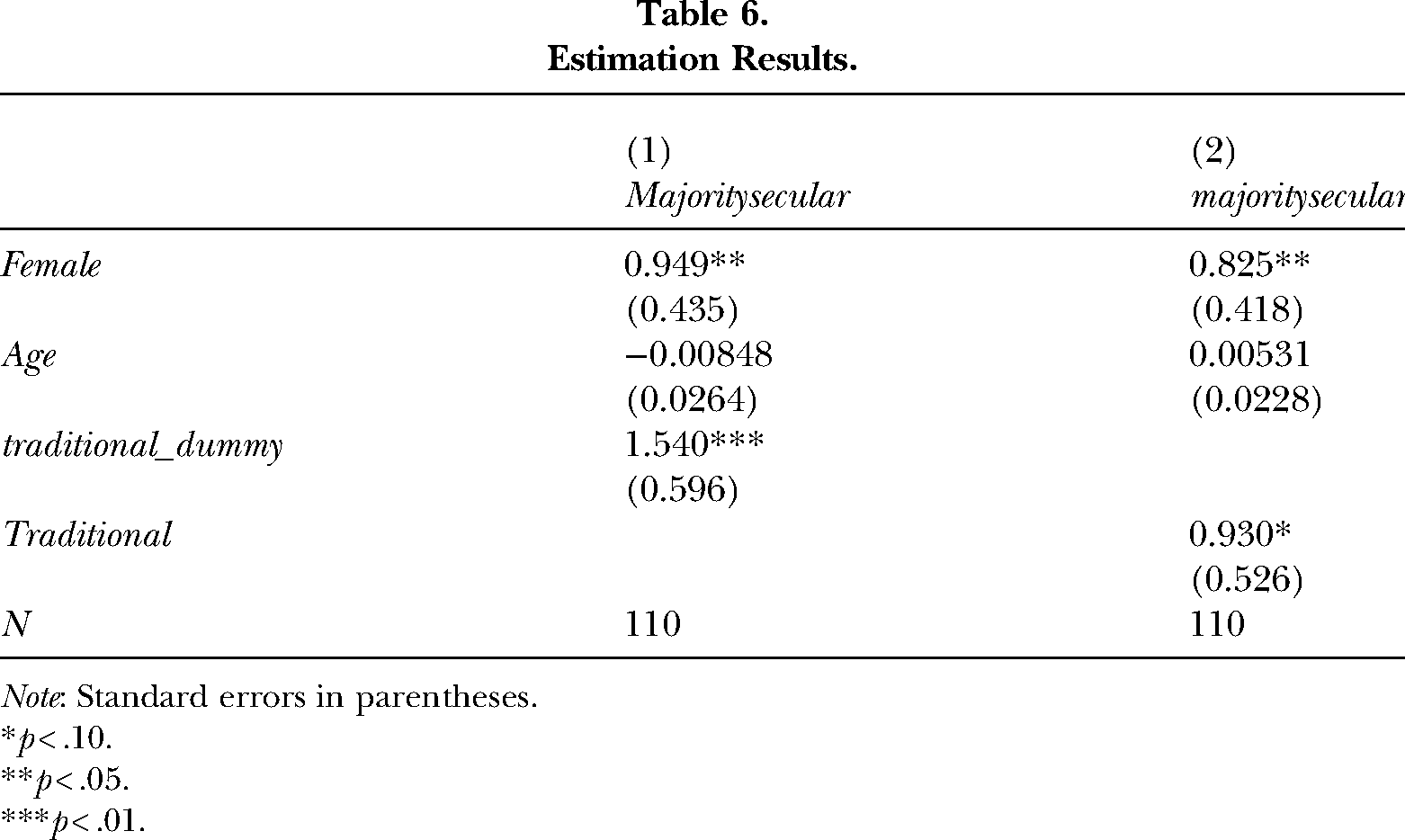
The results of logit estimations are presented in Table 6. The results suggest that women are more likely to vote for political parties that are not Islamic and not from opposition. The effect of age is not statistically significant. The effects of both traditional_dummy and traditional are positive and significant. Hence, respondents who believe in traditional superstitions are more likely to vote for political parties that are both secular and from the ruling coalition.
Estimation Results.
Note: Standard errors in parentheses.
*p < .10.
**p < .05.
***p < .01.
Conclusion
The electoral behavior literature has attempted to explain voters’ choices on the basis of social/sociological characteristics, their social-psychological traits, economic models, and cultural preferences. One of the common features of all these approaches was that they all relied upon extensive data analysis. Yet, despite the fact that, in recent years—that is after the collapse of the Orde Baru—several studies have discussed Indonesian elections, little empirical/statistical/quantitative evidence has been used or presented to explain why Indonesian voters vote the way they do.
The literature on Indonesian elections has, for instance, claimed that the political landscape in Indonesia has witnessed a religious polarization (Savirani and Aspinall 2017). Many studies have discussed whether Indonesia is in the middle of a process of Islamization (Cammack 1997), what forms Islamization is actually taking (Kuipers and Askuri 2017), the co-trending of democratization and Islamization (Hefner and Horvatich 1997), changing religiosity, and the political dividends/costs of religious radicalization.
The analysis of the survey data collected by the World Value Survey project does not provide much evidence for the claim that the religious demography or the religiosity of Indonesia is changing. As we have shown before, the percentage of respondents who believe religion to be very important in their life was identical in the 4th and the 7th wave of the World Value Survey which were conducted nearly 20 years apart—the 4th wave of the World Value Survey collected data from 1999 to 2004, while the 7th wave administered the survey in the 2017–2022 period.
A comparison, however, of the data collected by the Pew Research Center in 2012 and the data that we collected reveals however that one change has in fact occurred: the pervasiveness of traditional beliefs and practices among Indonesian Muslims is much greater than it once was. Pelizzo et al. (2023) report that the stability of a party system is greater in countries in which traditional beliefs and practices are more widespread. They suggested that a possible explanation is represented by the fact that voters with a more traditional mindset are more likely to vote for the ruling party. In Togo where the party system has been remarkably stable and a large portion of the electorate has a traditional mindset, the link between traditional values and the support for the ruling party holds at the macro- and possibly at the micro-level.
In Indonesia, by contrast, the party system changed (and became less stable) in spite of the fact that society became more traditional. So, the link between tradition and the support for the ruling party does not seem to hold at the macro-level. At the micro-level, however, which is actually the correct level of analyses, the results of our analyses reveal that more traditionally oriented voters are more likely to vote for secular parties/parties in government.
This evidence does not simply sustain the claim that culture matters or that some aspects of culture are in some respects more important than others (Pasquino and Pelizzo 2022) but also that as the traditional mindset gains a wider currency it will erode the appeal of opposition/Islamic parties that had led scholars and observers to fear Islamization (Choi 1996; Gadzhiev 2020; Hefner and Horvatich 1997; Schneier 2015; Stauth 2015) and religious radicalization of the electoral competition (Tanuwidjaja 2010). The interest in the role that religion can play in electoral competition and politics is understandable. The existence of religious parties is symptomatic of the state-church cleavage that Lipset and Rokkan (1967) had theorized; from Weber (2002) to proponents of the new modernization theory religion is regarded as one of the most important, if not the most important, facets of (political) culture; the progressive, though not complete, Islamization of Indonesian society was one of the best-understood correlates of Indonesia's democratization. Each of these factors obviously makes one understand why so much attention was paid to religion, Islam, Islamization in the Indonesian context. Yet, as important as religion may be for Indonesia and, for that matter, in other developing countries, religion is not the only (and possibly not the most important) aspect/manifestation of a traditional mindset. Religion does coexist and in some instances is at odds with other traditional beliefs. In the Indonesian context, superstitious voters, just like the voters in Benin, Togo, and Tanzania (Pelizzo et al. 2023 in this special issue), are more likely to support ruling/government parties than opposition parties. In Germany, while religious voters are less inclined to appreciate Hitler, National Socialism, or to be anti-Semitic, superstitious voters are more likely to think of Hitler as a stateman to recognize that National Socialism had some positive aspects and to hold anti-Semitic views (Pelizzo and Kuzenbayev 2023a, 2023b in this special issue). Superstition and religion may be both features of a traditional mindset, but they are, as the examples recalled here illustrate, at odds with one another. This is why we believe that scholars working on (political) culture may have to find new, other, ways to capture how traditional a culture actually is. By operationalizing traditional beliefs and practices in terms of belief in witchcraft and the evil eye or as the use of traditional healer, we hope that we may have provided an indication of how a traditional mindset can be more properly captured.
Footnotes
About the Authors

Notes
Appendix
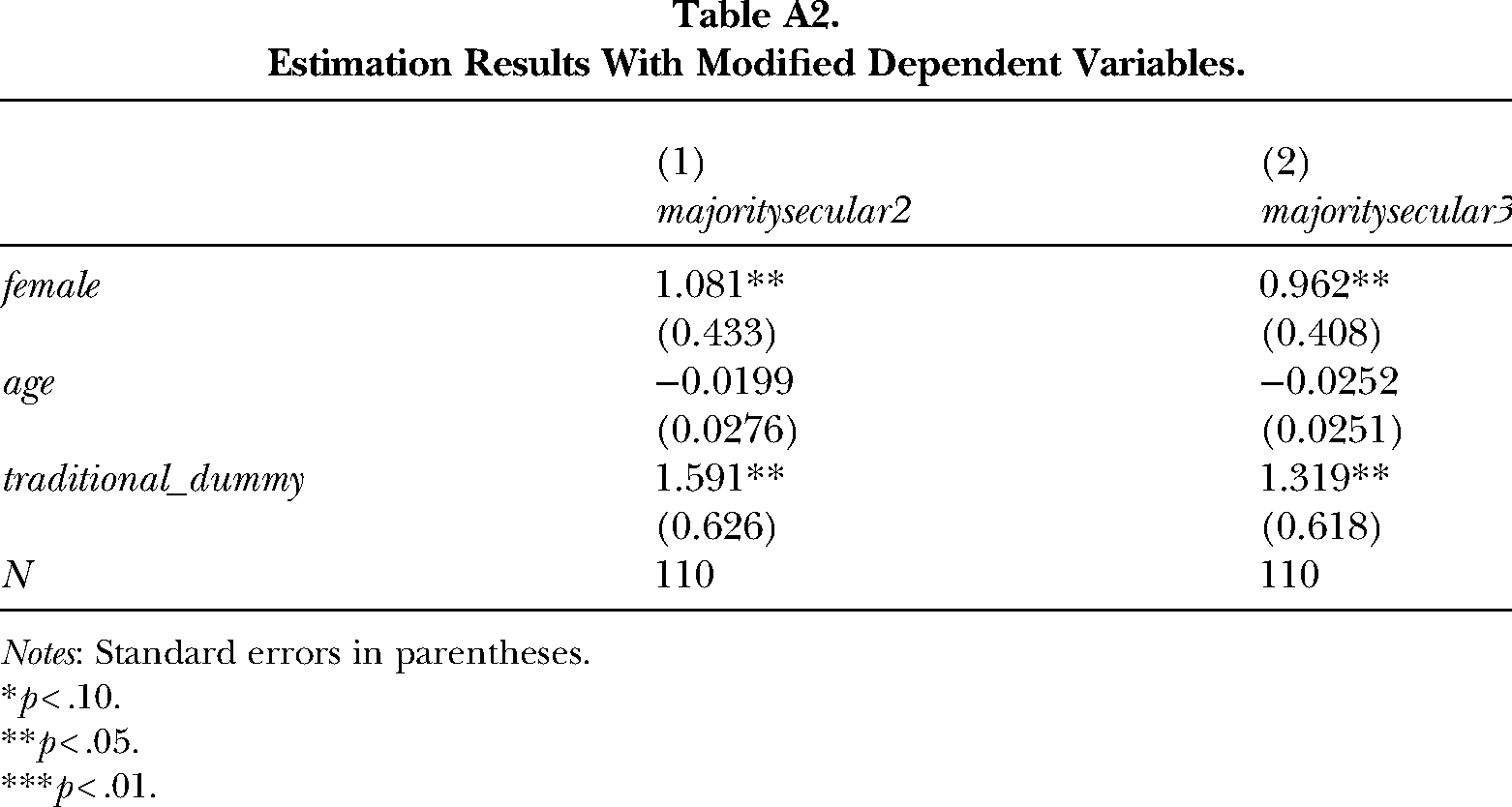
Estimation Results With Modified Dependent Variables.
| (1) | (2) | |
|---|---|---|
| majoritysecular2 | majoritysecular3 | |
| female | 1.081** | 0.962** |
| (0.433) | (0.408) | |
| age | −0.0199 | −0.0252 |
| (0.0276) | (0.0251) | |
| traditional_dummy | 1.591** | 1.319** |
| (0.626) | (0.618) | |
| N | 110 | 110 |
Notes: Standard errors in parentheses.
*p < .10.
**p < .05.
***p < .01.