



Abstract
This study examines stressors, general stress levels, coping strategies, and subjective well-being in a sample of 144 ethnically diverse, urban adolescents (mean age of 13). The most frequently reported stressors include the death of a family member, feeling socially isolated, family financial problems, injury of a family member, and parents arguing. The most common coping strategies are seeking support, acceptance, active coping, using distraction, and venting. Positive and negative affect are related to many coping strategies, but only humor buffered the relationship between stress and negative affect. Venting exacerbates the negative relationship between stress and life satisfaction. Implications for helping ethnically diverse, urban adolescents cope with stressors and maintain well-being are discussed.
Keywords
Understanding the impact of stress and coping on a variety of developmental outcomes for urban adolescents of color has been a growing interest of researchers over the past decade (Schaefer-McDaniel, 2007). Adolescents in general are confronted with unique psychological stressors because of pubertal changes and identity development demands. However, urban adolescents of color, especially those who live in low-income families, may be exposed to additional stressors by living in risky environments.
The majority of extant research on this population has focused on establishing the relationship between stress and psychopathology such as depression and conduct disorders (Grant et al., 2006). Yet exploring the extent to which subjective perceptions of well-being are related to stress and coping is equally important in clarifying the impact of stress on mental health in this population. Furthermore, identifying coping strategies that may maximize well-being by moderating the effect of stress has many important implications for practitioners who work with urban adolescents. The goals of the current investigation were to examine the relationships between perceived stress, coping, and subjective well-being (SWB) in a sample of ethnically diverse, urban adolescents and specifically, to examine whether specific coping strategies would moderate the relationship between stress and SWB.
Subjective Well-being
Since exposure to stressors and coping strategies are established predictors of negative outcomes in urban adolescents (Tolan, Gorman-Smith, Henry, Chung, & Hunt, 2002), these same constructs could be relevant to predicting positive outcomes such as SWB. SWB is defined as an appraisal of one’s quality of life, both cognitively and affectively (Diener, Suh, Lucas, & Smith, 1999). The construct is measured by assessing positive affect, negative affect, and life satisfaction. Positive and negative affect refer to the frequency of either positive or negative feelings experienced by an individual. Life satisfaction is a global assessment that reflects a cognitive aspect of well-being (Diener et al., 1999). Although research has demonstrated that life satisfaction tends to be empirically related to positive and negative affect, the three constructs are conceptually distinct. Lent (2004) argued that researchers should examine these variables separately rather than using composite scores of SWB in their methodologies.
There are several existing theoretical models that explain how SWB is derived. One is a temperament model (Costa & McCrae, 1980), which prioritizes the role of personality and its effect on dispositions (e.g., friendliness) and perceptions about life events. The model posits that people with positive temperaments are more likely to have positive dispositions and interpretations of life events that lead to greater SWB. A second model, the process-participation model (Cantor & Sanderson, 1999), emphasizes the independent contributions of both social resources and personality in predicting SWB. In this model, high social resources and positive personality characteristics lead to more “active participation” in one’s life, which results in higher SWB. No existing models of SWB, however, specify how stress might affect SWB.
The majority of extant SWB studies have been based on the temperament model and have focused on identifying which personality variables best predict SWB (Diener et al., 1999). Several other studies have been based on the process-participation model (Edwards & Lopez, 2006), and results from those studies have revealed the importance of social support, above and beyond the contributions of personality factors. Other research has examined the relative impact of demographic factors (i.e., income level, education) but has found that these variables explain the least amount of variance in SWB (Lent, 2004). Yet though studies have determined that overall levels of SWB do not reliably vary by demographics, the criteria on which life satisfaction is assessed may be culturally dependent (Edwards & Lopez, 2006).
Adolescent Stress
Definitions of stressors, or events that cause distress to individuals, found in the literature typically include events that would be considered “everyday hassles” such as missing a bus as well as significant life events that would be considered more life altering, such as the death of a parent (Ruffin, 1993). Grant et al. (2003) argued that an objective conceptualization of stress, as opposed to one that is based on cognitive appraisals, should be used in conducting research with minors. Thus, for the purpose of this research, Grant et al.’s definition of stress will be used: environmental events or chronic conditions that objectively threaten the physical and/or psychological health or well-being of individuals of a particular age in a particular society.
Research on the impact of stressors on adolescents, similar to the adult literature, has determined that not all individuals respond in similar ways to stressful life events (Grant et al., 2003). For individuals who have established effective coping strategies, exposure to a particular stressor may have relatively less influence on mental health and well-being. For those who do not cope effectively, this relationship may be much more significant. As a result, adolescents may vary in terms of how “stressful” or taxing they view a particular event. Thus, research examining the impact of stressors on psychological outcomes must include measures that tap into subjective evaluations of the impact of stressors.
In addition, in order to understand population-specific stressors and coping strategies in urban adolescents, it is important to elucidate what types of stressors and strategies are most frequently reported by adolescent research participants. Allison et al. (1999) found that there was a wide range of stressors experienced by urban, African American adolescents (i.e., more than 500 stressors) but that the stressors that had the broadest negative impact on participants were a combination of experiences that may be urban context related (e.g., seeing crime in your neighborhood, not having enough money) and others that would be considered stressful by most adolescents, regardless of context (e.g., doing poorly in school, not getting along with your parents, having chores at home).
Dise-Lewis (1988) conducted a similar study in an attempt to create a stress and coping measure that would reflect the actual reported experiences of adolescents living in a large metropolitan area. Data from focus groups revealed that stressors fell into four categories: crisis events (e.g., death of a parent, being arrested by the police); routine, frequently occurring events (e.g., school-related challenges); changes affecting family/peer/academic roles (e.g., being suspended from school); and internally generated worries (e.g., concerns about competence).
This literature has been very valuable in determining the most relevant types of stressors experienced by urban adolescents. However, given that the consequences of exposure to stressors are affected by how one reacts to these situations, it is also important to use subjective measures of stress severity.
Adolescent Coping
Coping is defined as the ways in which individuals attempt to manage internal and external demands that are appraised as taxing (Folkman & Lazarus, 1988). Effective management strategies are thought to protect individuals from the negative impact of such demands. Rasmussen, Aber, and Bhana (2004) argued that adolescents may cope with stressors differently than adults due to the cognitive changes they experience. In addition, what constitutes “effective” coping in adolescents is a complicated task. A strategy that works in one situation may be ineffective in another. Hence, helping adolescents to learn and use a battery of strategies may be necessary since no single coping strategy will be effective in every situation. This information may also be critical in designing interventions aimed at reducing the impact of stress or interventions that might aim to enhance well-being.
Only one study to date has examined the relationship among coping and SWB in urban adolescents (Steward et al., 1998). In this study, data collected from African American participants indicated that the use of humor, relaxing, and utilizing social support were the most significant predictors of well-being. Although this study was very useful in identifying which types of coping behaviors might serve a protective function for an urban adolescent sample, the authors failed to measure stress levels and, as such, could not test for moderation or the ability of such coping strategies to buffer the impact of stress on SWB.
Research Questions
In order to determine how SWB can best be promoted in urban adolescents, it is important to establish a database on coping strategies that might “buffer” urban adolescents from the potential impact of stress on well-being. This overall goal was the focus of the current investigation. The current study examined three research questions:
Research Question 1: What are the most frequently reported stressors and coping mechanisms reported by a sample of urban adolescents?
Research Question 2: What are the relationships among perceived stress, coping styles, and SWB (i.e., life satisfaction, positive affect, and negative affect) in this sample?
Research Question 3: Do specific coping strategies moderate the relationship between stress levels and SWB criteria (i.e., life satisfaction, positive affect, negative affect) in a sample of urban adolescents?
Method
Participants
The current study included 144 ethnically diverse (65% Latino, 10% African American, 10% Asian American, 10% Biracial, 5% White), early adolescents, 52% of which were female (48% male). The study participants were enrolled in a public, urban school in a large Midwestern city and ranged in age from 12 to 15 years (M = 13.26, SD = 0.75). According to the data available from public state records, the study’s sample roughly reflects the demographic profile of the school as a whole. The ethnic breakdown of the school is 68.4% Latino, 10.5% Black, 9.7% White, 11.3% Asian American, and less than 1% Native American. Eighty-seven percent of the students enrolled in the school are categorized as low income (i.e., students who come from families whose incomes qualified for free breakfast and lunch programs in school, based on family incomes below the national poverty level).
Procedure
The entire student body enrolled in seventh and eighth grade was eligible to participate in this study (a total of 178 students). Of these students, 144 completed the survey that was administered in their homerooms during the school day. Students who did not complete surveys were absent on the day of administration or did not have signed permission slips. Research assistants read each item aloud to the students as a group to control for differences in reading levels. Assistants were also available to answer questions during the administration of the survey. Participants obtained informed consent from their parents and signed assent forms prior to completing the survey. IRB approval was obtained for this study.
Measures
The survey contained a set of demographic questions (gender, race, ethnicity, grade in school, typical grades earned in school) and the following instruments: Perceived Stress Scale (Cohen, Kamarck, & Mermelstein, 1983), Brief COPE Scale (Carver, 1997), Positive and Negative Affect Scale (Watson, Clark, & Tellegen, 1988), Satisfaction With Life Scale (Diener, Emmons, Larsen, & Griffin, 1985), and the Life Events and Coping Inventory (Dise-Lewis, 1988).
Perceived Stress Scale
The Perceived Stress Scale (PSS) was used to measure perceived stress among the adolescents in this study. The PSS is a global measure of perceived stress that measures the extent to which respondents find their lives to be unpredictable, uncontrollable, and overwhelming due to stress within the past month (Cohen et al., 1983). A sample item is, “How often do you feel nervous and “stressed?” The 14 items of the PSS measure perceived stress using a 5-point rating scale. Scores can range from 0 to 56, with higher scores indicating higher degrees of perceived stress. Cohen et al. established content validity on PSS scores as well as concurrent and predictive validity. Reliability indices of .84 to .88 have been reported along with adequate test–retest reliability (.85) among samples of early adolescents in past studies (Yarcheski & Mahon, 1999). In the current sample, the reliability alpha was .72.
Life Events and Coping Inventory
The life events subscale from the Life Events and Coping Inventory (Dise-Lewis, 1988) was used to assess the experiences of specific stressors in the sample. The original scale was developed for use with 12- to 14-year-old adolescents, at which time 125 stressor items were created based on interviews and focus groups held with adolescents in Denver, Colorado. The instrument has been used with ethnically and racially diverse samples of adolescents in the United States (Dinsmore & Stormshak, 2003) as well as international samples where scores have demonstrated acceptable psychometric properties. Test–retest reliability and construct validity of the items has been supported in studies by the author of the instrument (Dise-Lewis, 1988). Participants in this study were presented a list of the top 20 life stressors endorsed by adolescents in previous research (Dise-Lewis, 1988) and were asked to indicate whether they have experienced the events (i.e., yes/no) and how stressful they found the events to be on a scale of 1 to 4. Because the majority of the 125 stressors in the initial draft of the instrument were found to be rated “not stressful” to only “somewhat stressful,” the decision to use only the items rated as “stressful” to “extremely stressful” for the current study was made. This yielded a set of 20 items. The coping subscale of this measure was not utilized in the current study because of the limited number of coping strategies represented in the scale (i.e., five strategies). Because the scale was not intended to measure a unified construct of stress, alpha coefficients were not calculated on this measure.
Brief COPE Scale
The Brief COPE Scale (Carver, 1997) is a 28-item measure of coping strategies. The coping strategies measured include self-distraction, active coping, denial, substance use, use of emotional support, use of instrumental support, venting, reframing, planning, humor, acceptance, religion, and self-blame. For the purposes of the current study, a final coping strategy, violence, was added based on the findings of previous research with adolescent samples (Dise-Lewis, 1988). Subscores are obtained for each of the coping strategies in the measure that indicate the frequency with which each is used in general (the range of scores is 2-8). No overall score is produced on this scale. Carver examined the factor structure and psychometric properties of the Brief COPE Scale with a sample of survivors from Hurricane Andrew. In this study, all of the scales produced scores that had adequate reliability (above .60), and the factor structure of the scale resembled the same factor structure of the original COPE scale. Because each type of coping style was measured with two items, alpha coefficients were not calculated on the subscales.
Positive and Negative Affect Schedule (PANAS)
The PANAS (Watson et al., 1988) is a 20-item brief scale intended to examine predominant affective states that was used to measure two elements of SWB, positive and negative affect (10 items each). Scores range from 10 to 50 for each subscale, with higher scores reflecting more frequent emotions in each category. Participants are asked how frequently they feel a variety of emotions such as excitement, anger, sadness, and happiness. Past research has shown that the PANAS has adequate construct validity (Watson et al., 1988) and acceptable reliability. This scale has been used with ethnically diverse adolescents in previous research (Author citation, 2008) where it has been shown to produce reliable scores. The internal consistency reliability for scores this sample was estimated to be .82 for positive affect and .79 for negative affect.
Satisfaction With Life Scale (SWLS)
SWLS (Diener et al., 1985) is a 5-item general measure of satisfaction with the quality of one’s life used to represent the cognitive component of SWB. Scores range from 5 to 35, with higher scores indicating greater satisfaction. Past research has provided support for the validity and reliability of this instrument with ethnically diverse adolescent samples (Author citation, 2008). Internal consistency reliability for this sample was estimated to be .78.
Results
To answer the first research question, frequencies of common stressors and mean scores of coping mechanisms were examined. Table 1 displays the means and standard deviations on the study instruments. The top five stressful events were endorsed by more than 30% of the sample participants. These events were death of a family member (37.9%), felt like nobody liked you (34.5%), family had money problems (32.2%), family member was injured (31.6%), and parents argued or fought (30.5%). As can be seen in Table 1, the coping styles that were used most frequently in the sample, on average, were acceptance, distraction, seeking emotional and instrumental support, active coping, venting, and planning.
Descriptive Statistics on Main Variables

Important gender differences existed in the use of coping strategies, however, as indicated by one-way ANOVAs. Girls scored significantly higher on the following coping strategies: denial, F(1, 131) = 5.546, p < .01; venting, F(1, 131) = 22.726, p < .001; instrumental support, F(1, 128) = 6.98, p < .01; self-blaming, F(1, 125) = 9.634, p < .001; violence, F(1, 131) = 12.637, p < .001; and acceptance, F(1, 125) = 22.442, p < .001. Boys reported significantly higher life satisfaction scores than did girls, F(1, 128) = 8.58, p < .01. No ethnic differences were found in responses to stressors or coping strategies, though the small number of participants in ethnic groups other than Latinos precluded the ability to fully explore this issue.
To address the second research question, Pearson correlations were used to examine the interrelationships among perceived stress, coping styles, and the SWB criteria. Table 2 contains a correlation matrix that highlights the relationships between coping strategies, stress, and SWB. In this table, it can be seen that positive affect was significantly related to active coping, planning, venting, acceptance, reframing, self-blame, emotional and instrumental support, humor, and distraction coping styles. All of the significant correlations between coping styles and positive affect were in a positive direction. Negative affect was significantly related to stress, active coping, distraction, emotional and instrumental support, religion, venting, self-blaming, and violent coping styles. All of the significant correlations between coping styles and negative affect were also in a positive direction, suggesting that the more frequently participants utilized strategies such as seeking support or turning to religion, their levels of negative affect were higher. Life satisfaction was significantly related only to stress and a self-blaming coping style. Both these significant correlations were in a negative direction, suggesting that life satisfaction was highest for participants who had lower perceived stress levels and a lower tendency to blame oneself as a coping strategy.
Intercorrelations between Coping Scales, Stress, and Subjective Well-Being
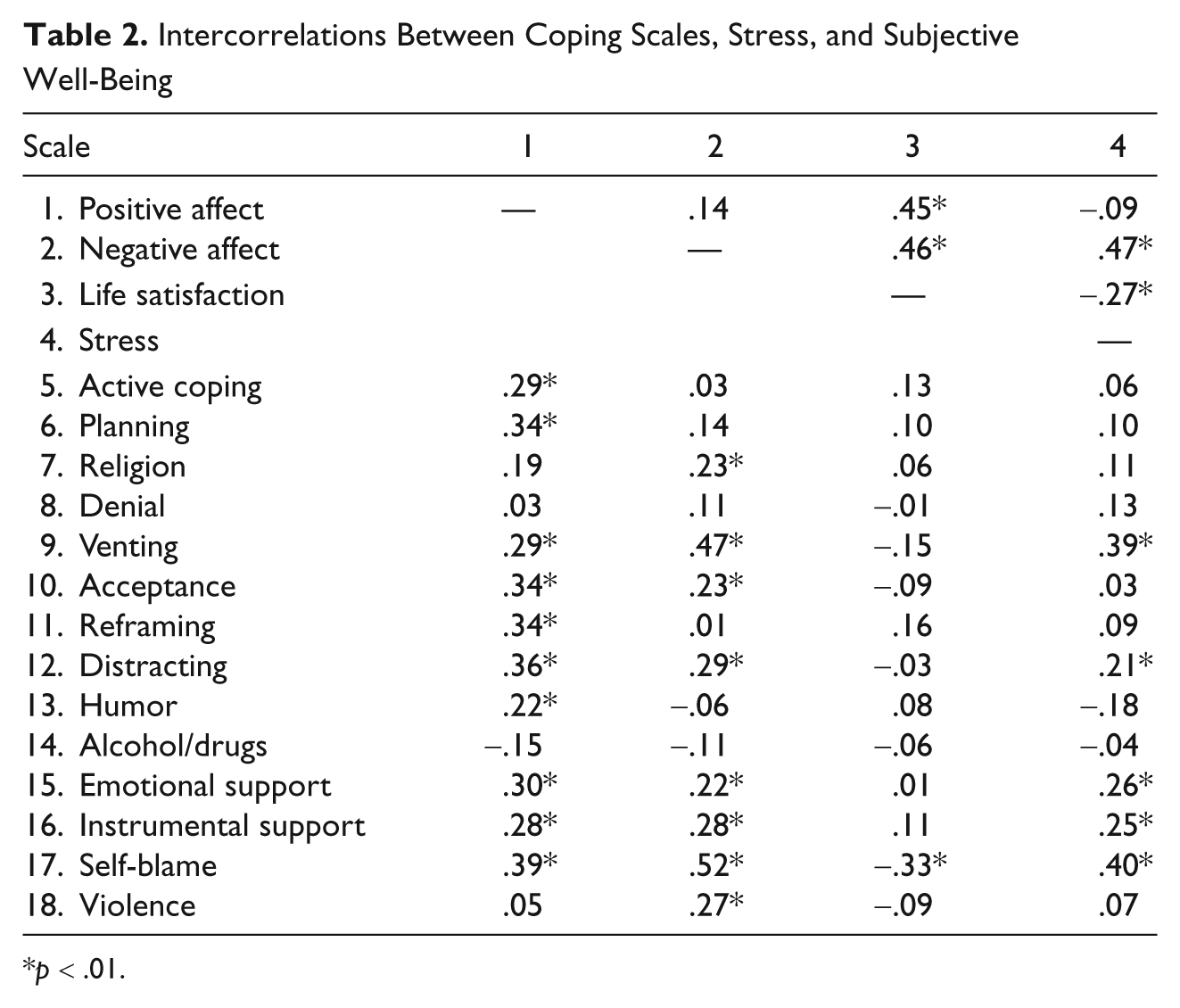
p < .01.
To address the final research question that examined the ability of certain coping strategies to buffer the impact of perceived stress on SWB, moderated multiple regression analyses were conducted. To determine which specific coping styles might serve as moderators of the relationship between stress and each of the three SWB variables, we conducted three sets of moderated multiple regression analyses (one for each SWB outcome), looking at each of six coping style’s potential to independently moderate the relationship between stress and life satisfaction, positive affect, or negative affect. The selection of these six coping styles was based on existing literature (Steward et al., 1998) that determined three strategies: social support, distraction, and humor as being positively related to psychological well-being. We also added acceptance, active coping, and venting due to their status on the list of the five most frequently used coping styles in this sample.
For each equation, stress scores were entered on the first step, the specific coping style was entered on the second step, and the interaction term was entered on the third step. Because we needed to conduct a high number of regression analyses (18 total), we utilized .01 as our alpha level to reduce incidents of spuriously significant results. To avoid multicollinearity between the main effect and interaction terms, all predictor variables (i.e., stress and the coping styles) and interaction variables (i.e., Stress × Coping Style) were centered before analysis (Frazier, Tix, & Barron, 2004). Thus, all stress and coping scores had a mean of zero after centering.
In the large majority of the cases, coping strategies did not serve as moderators of the relationship between perceived stress and SWB outcomes. This was determined by examining the significance level of the interaction term. However, there were two instances where evidence of moderation was detected. Humor was a significant moderator of the relationship between stress and negative affect. The overall model accounted for 27.6% of the variance, with 3.6% of the variance being uniquely predicted by the interaction term. Correlations were computed on the relationship between perceived stress and negative affect for participants who reported using humor above the mean (3.8) and those below the mean. These analyses revealed that for participants who used humor less frequently the relationship between stress and negative affect was .570 (p < .001) and for participants who used humor more frequently, the relationship was reduced to .454 (p < .001). Thus, participants who used humor to cope more frequently had less of a significant relationship between stress and negative affect.
Venting also significantly moderated the relationship between stress and life satisfaction. The overall model accounted for 16.0% of the variance, with the interaction term explaining 5.2% of the variance. Correlations were computed for participants in the sample who reported using venting at levels above and below the mean point of 4.8. For participants who vented less frequently, the relationship between stress and life satisfaction was not significant (r = −.026, p > .01) and for those who used venting more frequently the relationship was found to be significant in a negative direction (r = −.476, p < .001). Thus, for participants who vented more frequently, the relationship between stress and life satisfaction was discernibly stronger. Results of the significant equations are reported in Tables 3 and 4.
Multiple Regression Analysis for Moderation of Stress and Negative Affect
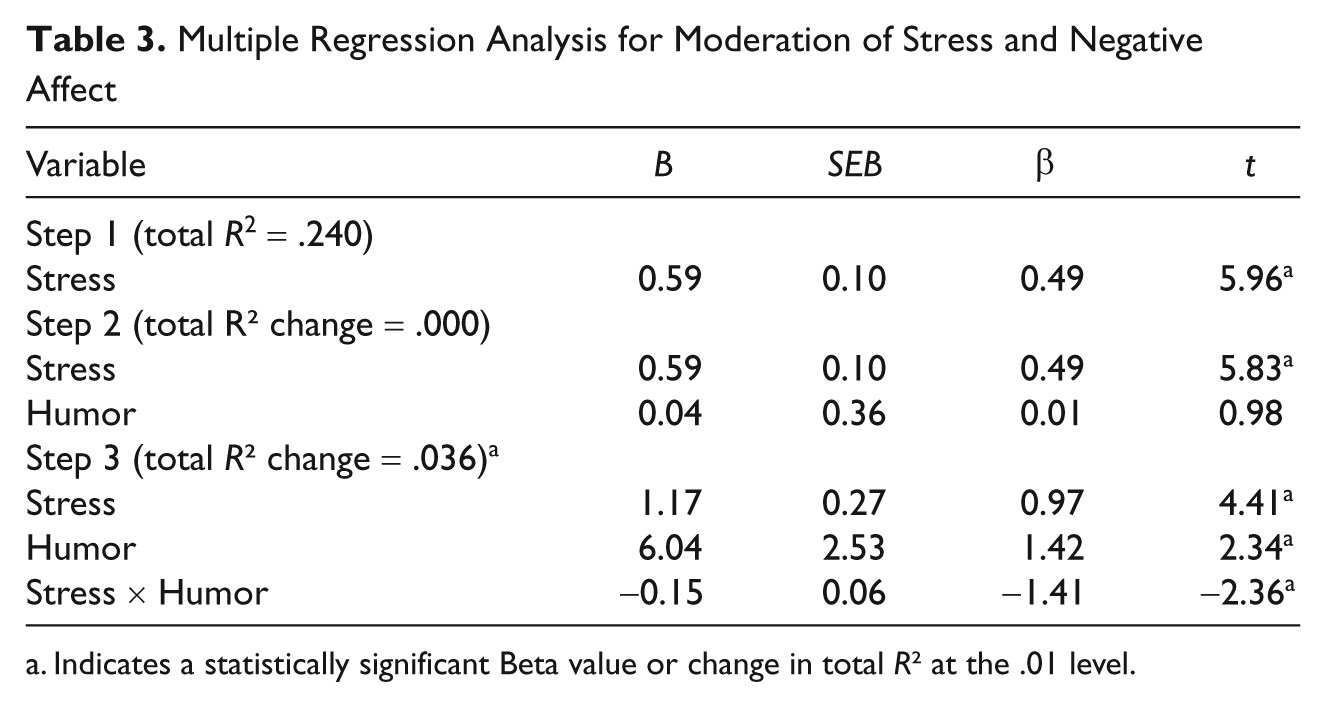
Indicates a statistically significant Beta value or change in total R2 at the .01 level.
Multiple Regression Analysis for Moderation of Stress and Life Satisfaction
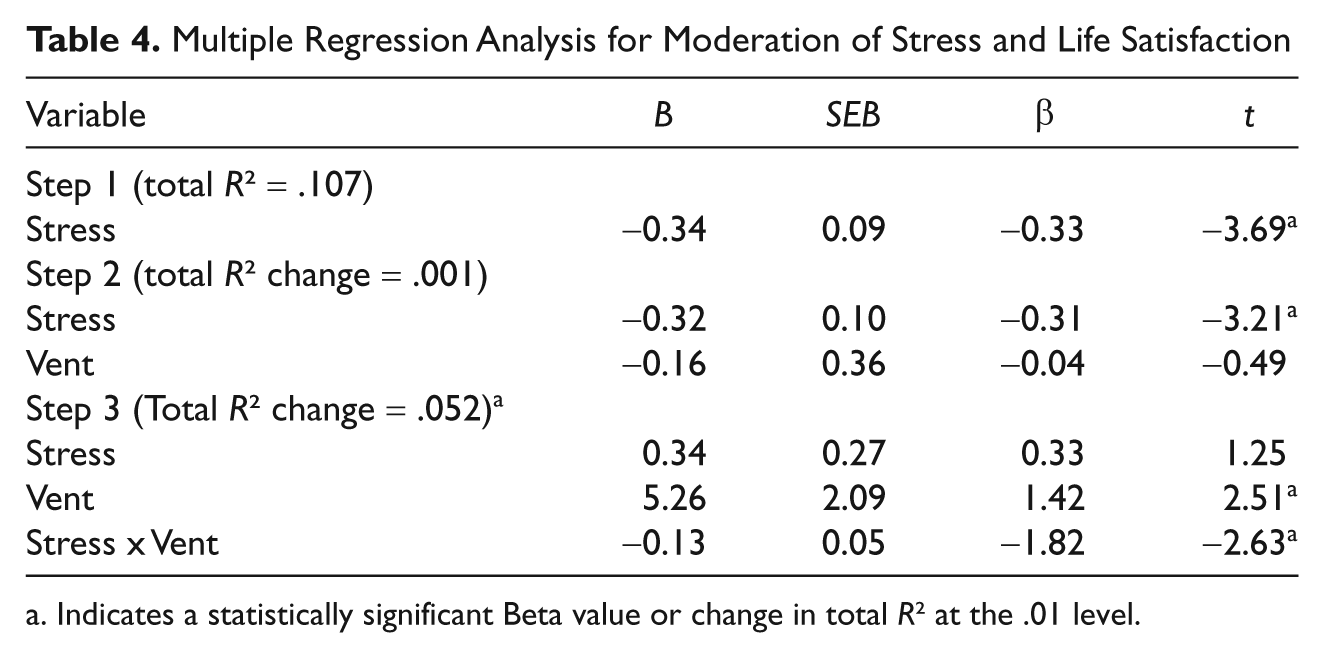
Indicates a statistically significant Beta value or change in total R2 at the .01 level.
Discussion
The results of this study reveal an interesting portrait of stress, coping, and SWB in urban adolescents. Descriptively speaking, it would appear that a significant proportion of participants had experience with stressors that Dise-Lewis (1988) would categorize as crisis related (e.g., death or injury of a family member) and at least one that Allison et al. (1999) would classify as urban context related (i.e., financial problems). This latter result makes sense, given the socioeconomic status of the families of the participants.
The correlational analyses revealed some unexpected patterns between coping styles, well-being, and overall perceived stress. For example, many of the coping strategies were positively related to levels of positive and negative affect, which may at first appear counterintuitive. Self-blame is one illustration of this finding. One interpretation of this seemingly paradoxical result is that adolescents who blame themselves for their problems might be more likely to do something about their problems, which may lead to problem resolution and a positive outcome, than would those who blame others for their problems. However, adolescents who overuse self-blame as a coping strategy, especially for problems that are not under their control, may experience greater negative affect when it is ineffective. Since Lent (2004) has found that positive and negative affect are not typically correlated in most SWB research, then perhaps these counterintuitive findings are not truly paradoxical.
One difficulty in interpreting the correlational findings is that the scores from the perceived stress measure used in this analysis asked participants to rate their perceptions of overall stress, not in reaction to a specific stressor or event. Thus, it is unknown whether the use of these coping strategies were being applied to controllable stressors or uncontrollable ones. If the participants were basing their responses on an accumulation of their experiences of coping with uncontrollable situations, then use of any coping strategies might bring about frustration and, ultimately, fail to resolve the problem. According to researchers such as Clarke (2006), if adolescents attempt to use specific coping styles to alter unchangeable stressors, they would in fact experience negative affect. However, it is important to consider the possibility that having frequent negative affect also may impact the decisions adolescents make about which coping styles to utilize. It is important to note that no causation can be inferred from correlational results.
The final analyses that were conducted for this study revealed whether any coping strategies had the potential to minimize the impact of stress on well-being for this urban adolescent sample. The failure of most coping strategies to serve as moderators of stress, with the exception of humor and venting, suggests that conventional coping strategies, such as seeking social support, may not for buffer adolescents from the effects of stress on SWB, despite their potential to affect more negative developmental outcomes (Tolan et al., 2002). However, the fact that humor significantly moderated the relationship between stress and negative affect is not altogether unexpected. The benefits of humor to maintaining mental health has been documented in previous research conducted on adult participants (Nezu, Nezu, & Blissett, 1988) and with adolescents of color (Steward et al., 1998). Venting appeared to be more maladaptive to the participants in this study in that higher levels of venting were associated with a more significant, negative relationship between stress and life satisfaction. Although venting is one way of releasing affect, it may not be a coping style that brings about change in stressful situations.
The biggest result from the moderation analyses is that the large majority of coping styles did not seem to act as moderators for sample participants. Although a majority of the coping literature would indicate that “productive” coping styles that involve actively solving problems and seeking support from others should be beneficial to the minimization of stress’s impact on developmental outcomes, the same types of coping did not seem to buffer the participants in this study from the impact of stress on well-being. However, this may be a function of the minimal ability that children have to actually control their environments, including exposure to stressors.
It may also be the important to reiterate that there are developmental differences in coping (Skinner & Zimmer-Gembeck, 2007). The active ways that adults try to cope with and respond to controllable stressors may be something that is not yet effectively learned and practiced by early adolescents. Proponents of this school of thought have suggested that mental health professionals may best serve adolescents by helping them to learn alternatives to active coping such as healthy distractions in the face of uncontrollable stressors (Clarke, 2006). When one considers the type of stressors many of the participants endorsed (e.g., death or injury of family member, family financial problems), it seems reasonable that an early adolescent would perceive these stressors as uncontrollable and, thus, may rely on coping styles that are neither effective nor problem solving in nature.
Limitations and Future Research
There are a number of limitations with this study that affect the generalizability of the findings. First, though we had a sufficiently sized sample of participants for the analyses conducted, they all came from one geographical area, one school, and as such, findings cannot generalize to a general population of urban adolescents. However, the demographics of the sample in terms of ethnicity and socioeconomic status mirror those of other urban adolescents; thus, one might anticipate similar findings in other urban samples. Second, the study relied on self-report measures, some of whose scores had only acceptable reliability estimates, and included no collateral data from teachers or parents who might verify the accuracy of the participants’ self-reports. There were also no observational data included in this study. Thus, our data reflect what participants told us they have experienced in terms of stressors and how they generally cope with stress. Self-report data are used in the majority of studies of this type, however, but it would be interesting to see whether observational or collateral data collected would reveal similar trends. This study was also cross-sectional in design, which prevents cause-and-effect conclusions, yet is a common methodology in similar types of studies. We also did not examine the extent to which coping styles that rely on others, such as accessing social support, was available to the participants in this study, which may have affected their reported use of instrumental and emotional support as coping styles. However, based on similar studies (e.g., Edwards & Lopez, 2006), one might assume that social support is typically available to ethnically diverse adolescents.
Future research should examine the extent to which various types of coping options, such as social support, are actually available to urban youth and whether the source of the support might moderate its effectiveness (e.g., family support vs. peer support). Furthermore, it would be very valuable to see when and how participants decide to use one specific coping style (e.g., humor) versus another (e.g., instrumental support) and whether certain styles might be more effective with specific stressors. Finally, it would be very valuable to determine whether the controllability of the stressor influences the extent to which it impacts SWB and whether the effectiveness of any coping style is influenced by whether urban adolescents perceive the stressor to be malleable.
Conclusion
It is noteworthy that within the past several years, adolescent researchers have slowly begun to shift their focus away from examining specific problem behaviors and toward identifying competencies and resources that both foster healthy developmental outcomes and prevent a host of mental health problems in urban youths (Larson, 2000). This shift reflects an acknowledgment that even adolescents who do not exhibit diagnosable problems may not necessarily grow up to become happy, adjusted, or productive adults. Proponents of a strengths-based perspective highlight the need for practitioners to focus on enhancing quality of life and promoting mental health in their clients rather than solely treating pathology. This has implications for practitioners who work with urban adolescents in community and school settings. These findings also suggest that it may be beneficial to teach such adolescents about specific coping styles (i.e., use of humor) in psychoeducational efforts aimed at promoting SWB. To determine the mechanisms for enhancing the well-being of any specific population, a database must exist that clarifies the constructs most related to SWB for such populations. This study serves as one contribution to such a database.
Footnotes
Declaration of Conflicting Interests
The author(s) declared no conflicts of interest with respect to the authorship and/or publication of this article.
Funding
The author(s) received no financial support for the research and/or authorship of this article.