




Abstract
The major social science theories on adolescent risk-taking—strain, social control, and differential association theories—have received substantial empirical support. The relationships between variables central to these theories and individual differences in temperament related to risk-taking, however, have not been adequately studied. In a sample of adolescents, this study examines how behavioral inhibition and activation relate to variables central to social control, strain, and differential association theories and how interactions between behavioral inhibition and activation and these theories predict aggressive and nonaggressive forms of risk-taking. The results of this study suggest that (a) BIS (behavioral inhibition system) and BAS (behavioral approach system) are related to strain, social control, and differential associations; (b) the effects of these social science and personality variables are, at least partially, additive; and (c) significant interactions exist between BIS/BAS and social control and differential association. Combining social science and personality concepts therefore could advance the understanding of differences in risk-taking.
Despite compelling and repeated calls for interdisciplinary research (Lopreato & Crippen, 1999), the social and psychological sciences have generally studied adolescent risk-taking separately, resulting in a diverse body of literature with few instances of integration. Existing social science theories, such as control (Hirschi, 1969), strain (Agnew, 1992; Agnew, Brezina, Wright, & Cullen, 2002), and differential association theories (Sutherland & Cressey, 1974), have received substantial empirical support with respect to adolescent risk-taking and related concepts. Psychological criminology has focused on the relevance of personality traits to different forms of adolescent risk-taking (Campbell, 2006; Gullone & Moore, 2000).
Although there are some exceptions(Agnew et al., 2002), few researchers have studied if and how personality variables are related to or interact with the concepts central to major social science theories. The aim of this article is to study if and how two broadband motivational systems (Johnson, Turner, & Iwata, 2003) rooted in Gray’s neurobiological theory (1972)—behavioral inhibition and behavioral activation, which regulate the individual’s sensitivity to, respectively, punishment and reward—relate to existing social science theories on adolescent risk-taking.
Adolescent Risk-Taking
Irwin (1993) defined adolescent risk-taking as a behavior that may be intrinsically rewarding but has an unpredictable outcome, given the possibility of an identifiable negative health outcome or social sanction.
In this article, we use adolescent risk-taking as a general term for related concepts such as antisocial behavior, problem behavior, deviance, delinquency, or criminal behavior for several reasons. First, most of these concepts correlate strongly with each other or are measured using similar indicators (Gottfredson & Hirschi, 1990; Jessor & Jessor, 1977). Second, not all forms of risk-taking are considered criminal, delinquent, or antisocial in the strict sense. For example, in the United States, alcoholic consumption by a minor may be considered delinquent behavior, subject to formal sanction; in many European countries, this is not the case. Despite these differences, informal sanctions or health risks may be similar across countries. Third, a more broadly defined concept—one that includes minor forms of risk-taking—may be desirable as it allows for the study of a phenomenon that in younger age groups is unlikely to be expressed in more severe forms of delinquency or antisocial behavior. The present study is limited to the more antisocial behavior–oriented forms of adolescent risk-taking.
Gender is an important correlate of adolescent risk-taking, with boys/men scoring higher than girls/women do on most forms of risk-taking (Byrnes, Miller, & Schaffer, 1999), especially on more aggressive forms of risk-taking (Maughan et al., 2000). While gender is not our focus, we acknowledge that social and/or psychological variables may be differently related to risk-taking in boys versus girls. Therefore, we will analyze the relationships between social science and psychological variables in boys and girls separately.
We acknowledge that the concept of adolescent risk-taking is not without its complexities and paradoxes (Nakkula & Toshalis, 2007; Sharland, 2006). Sharland (2006), for example argues that risk-taking is, to some degree, a normal and even a necessary part of adolescent development. However, strong individual differences in risk-taking exist, and finding the specific traits and contexts that may help to explain these differences remains important from a perspective of prevention and/or intervention.
Social Science Theories and Adolescent Risk-Taking
The three most influential groups of sociological/criminological theories on adolescent risk-taking are without doubt control theory, strain theory, and differential association theory. This study will not offer a comprehensive discussion of these theories, which are classic theory and discussed in depth elsewhere (Agnew, 1992; Hirschi, 1969; Sutherland & Cressey, 1974); our focus is on how control, strain, and differential association theorists could benefit from the study of personality traits.
Control theory is one of the most influential branches of sociological/criminological theory with respect to adolescent risk-taking. Several versions of control theory exist (Seydlitz, 1993); however, the most influential has undoubtedly been Hirschi’s social control theory (1969), which stresses the importance of a social bond between the individual and society. Social control theory has received substantial support (Costello & Vowell, 1999; Huebner & Betts, 2002; Stewart, 2003), along with a fair degree of criticism (Kempf, 1993). Although it asserts that the bond is social and not deeply internalized by socialization, social control theory does not explain how a social bond between the individual and society develops and is silent on whether the development of the bond depends on an individual’s personality characteristics. Like other control theorists, Hirschi assumes that individuals do not differ in their motivations for risk-taking, despite evidence from personality research (Carver & White, 1994) that challenges this assumption. Moreover, Hirschi has not seriously considered the fact that a strong social bond may not be a deterrent for everyone to the same degree. Research on individual differences in personality traits suggests that these assumptions may, at best, be overgeneralizations, and few researchers have studied the relevance of these traits to understanding the influence (and development) of social bonds.
Agnew’s general strain theory (GST; Agnew, 1992) has showed how negative relationships and life events may evoke a negative emotional state such as anger, which may lead to risk-taking. GST has received strong empirical support (Agnew et al., 2002; Piquero & Sealock, 2000; Van Houtte & Stevens, 2008). However, studies have found that most forms of strain have only small to moderate effects on risk-taking, and research on the moderating role of factors such as social support, coping, social control, or differential association has offered disappointing results (Agnew et al., 2002). Most researchers, however, have failed to acknowledge the importance of individual differences in how the experience of stress is translated in risk-taking. Individuals can contribute to the creation of strain in their environment (Rudolph & Hammen, 1999) and they may do so in very different ways, according to personality or temperamental traits. Differences in the emotional reaction to strain and the ability to respond to strain in a noncriminal manner may also depend partially on individual differences in personality. Agnew et al. (2002) have recently begun to study personality traits as potentially modulating factors and have found evidence that juveniles with high negative emotionality and low constraint are more likely to react to strain with delinquency.
Social learning theories comprise the third group of theories on the etiology of risk-taking. One influential social learning theory is Sutherland and Cressey’s differential association theory (1974), which suggests that peers are an important, although not an exclusive, learning group in which adolescents may learn definitions, motives, and attitudes favorable to risk-taking. Association with peers who are highly involved in risk-taking is associated with aggression (Capaldi, Dishion, Stoolmiller, & Yoerger, 2001), self-reported delinquency (Vitaro, Brendgen, & Tremblay, 2000), and drug abuse (Dishion, Capaldi, Spracklen, & Li, 1995). Although exposure to differential associations may be explained by social structural variables (Akers, 1998), less attention has been given to the possibility that personality variables are relevant to the characteristics on which group affiliation or selection of friends is based—birds of a feather flock together (Gottfredson & Hirschi, 1990). Moreover, research has paid less attention to the hypothesis that the probability of having friends with high levels of risk-taking increases or decreases depending on existing personality-related predispositions toward risk-taking.
In summary, there are compelling reasons to study how personality variables relate to variables central to the leading sociological theories on adolescent risk-taking. The effects of personality traits may be merely additive; however, it is more likely that personality variables may be associated with or interact with sociological variables.
Self-Control as a Mediating Variable
Some researchers have studied how Gottfredson and Hirschi’s concept of self-control (1990) acts as a stepping-stone toward the integration of the more sociologically and psychologically oriented criminology. This approach has been fruitful to some degree. Longshore, Chang, Hsieh, and Messina (2004) found that social control variables at least partially mediated the relationship between self-control and substance use, whereas Peter, LaGrange, and Silverman (2003) found that the effects of strain and social control were additive but not interactive. However, Gottfredson and Hirschi’s concept of self-control has been criticized as being tautological. This potential for tautology is apparent in statements made by Gottfredson and Hirschi (1990), such as their description of self-control as “the differential tendency of people to avoid criminal acts whatever the circumstances in which they find themselves” (p. 87). Although they argue that one can measure self-control as a personality construct independent of crimes or analogous acts, doing so does not solve the problem. When measured as a personality concept (Grasmick et al., 1993), for example, the concept of self-control lumps together temperamental, emotional, and cognitive states that are typical for offenders or risk takers; however, it is not rooted in or consistent with existing theories of personality and temperament within psychology. As such, the risk of tautology remains. More specific temperamental variables grounded in theory (like Gray’s neurobiological theory [1972]) rather than the catchall concept of self-control may reduce the concern about tautology.
Behavioral Inhibition and Activation
Although a variety of conceptions about temperamental master traits exist, Gray’s neurobiological theory (Gray, 1972, 1994; Gray & McNaughton, 2000) has influenced how they are understood by providing the groundwork for two concepts—the behavioral approach system or behavioral activation system (BAS) and the behavioral inhibition system (BIS)—each describing a “broadband motivational system” (Johnson et al., 2003). Gray’s original theory (1972) finds that BIS may influence behavior by regulating the sensitivity to conditioned signals of punishment and frustrative nonreward that form the basis of differences in anxiety proneness, specifically, and in negative affect and state anxiety, generally. BAS is relevant to behavior because it influences sensitivity to conditioned signals of reward and relief from punishment, regulates appetitive motivation, and forms the basis of impulsivity (Gray, 1994); it is conceptually related to Zuckerman’s sensation seeking (Zuckerman, 1979).
It is assumed that that BIS and BAS are rooted in distinct structures in the nervous system (Carver & White, 1994; Gray, 1972). More recently, Gray and McNaughton (2000) have revised several aspects of the theory. While debate continues on certain aspects—for example, the independence of BIS and BAS, the status of the fight or flight system (for an overview, see Corr, 2004)—a relative consensus exists that reward and punishment sensitivity are related to various forms of behavior, mood, and cognition (Johnson et al., 2003).
Individual differences in BIS and BAS have been found to be related to variations in behavior, including depression, anxiety, substance use/abuse, attention deficit hyperactivity disorder, and conduct disorder (Franken, Muris, & Rassin, 2005; Gray, 1994; Johnson et al., 2003). It may be argued, therefore, that high reward-seeking and low inhibition may be factors that contribute to adolescent risk-taking.
Although there is always a danger of tautology when explaining risk-taking behavior using psychological tendencies toward risk-taking as mentioned earlier, the use of BIS and BAS (instead of self-control) as separate constructs mitigates this concern. Research indicates that BIS and BAS are distinct systems and that measures of BIS and BAS are poorly correlated (Carver & White, 1994). BIS and BAS may contribute independently to risk-taking or one or the other may be more important. In addition, although some studies find associations between BIS and/or BAS and forms of risk-taking, these associations are often modest; this suggests that research should be careful not to exaggerate concerns about tautology. For example, with respect to substance abuse, Knyazev et al. (2004) found a modest effect of BAS and only a small effect of BIS. Moreover, there is nothing in Gray’s theory to suggest that people who are highly sensitive to rewards are inherently inclined to pursue illegal or more antisocial activities (Carver & White, 1994).
Some studies (Knyazev et al., 2004) have argued that personality-related variables contribute more to risk-taking in some social environments than in others, or vice versa that social environments contribute more to risk-taking in some individuals than in others, depending on personality-related factors. With respect to social control theory, one may hypothesize, on one hand, that individuals with low levels of inhibition and high levels of behavioral activation may be less inclined to develop strong bonds with individuals or a social order that promotes conformism and restricts the individual’s search for gratification. On the other hand, one may hypothesize that differences may exist in the effectiveness of social bonds depending on the individual’s BIS or BAS. For example, strong social bonds may deter risk-taking in individuals high in BIS, because they may be more concerned about losing the respect of others or about their reputation. Alternatively, one could hypothesize that social bonds are a protective factor, particularly in individuals that are psychologically more inclined toward risk-taking.
With respect to strain theory, BIS and BAS are empirically and conceptually related to Tellegen’s (1985) master traits of negative emotionality and constraint, which are relevant to understanding the experience of strain and the reaction to strain as they may affect emotional reactions to strain and the ability to control the expression of anger (Agnew et al., 2002). Therefore, one may assume that BIS and BAS may be related to and/or interact with strain with respect to adolescent risk-taking. On one hand, individuals low in BIS and high in BAS may seek environments that are more stressful in nature (due to conflict, danger, etc.) and may therefore experience more stress. On the other hand, they may be differently vulnerable to the stress created by these environments.
With respect to social learning theory, one can argue that, due to their influence on interests that peer-group development is based on, BIS and BAS relate to differential associations. Moreover, one may hypothesize that friends that are highly involved in risk-taking may affect risk-taking more strongly in individuals with high levels of BAS and low levels of BIS.
In summary, BIS and BAS may be relevant to the experience of and/or the reaction to environmental variables such as social control, differential association, and strain on one hand, and, more directly, to adolescent risk-taking on the other.
The Present Study
In this article, we analyze the relationships between BIS and BAS and variables central to social control theory, strain theory, and social learning theory with respect to antisocial forms of adolescent risk-taking. We differentiate between aggressive and less aggressive forms of risk-taking, or forms of risk-taking that are intended to satisfy adolescents’ lust for acknowledgment and privilege (like theft and substance abuse), as they may have different etiologies, as suggested by the more pronounced sex difference and the relative stability throughout the life course of aggressive forms of risk-taking. To allow for the possibility that aggressive (ART) and nonaggressive (NART) forms of risk-taking are differently related to our variables of interest, analyses of ART and NART will be done separately. Analyses will be done separately for boys and girls, taking into account (a) that sex differences exist in risk-taking (Byrnes et al., 1999), especially in aggressive risk-taking (Maughan et al., 2000), and (b) that sex differences may exist in most independent variables and that independent variables especially may be relate differently to ART and NART for boys versus girls.
Method
Participants
Data presented in this article are part of ADORISK, a larger study on the social and biological determinants of the sex gap in adolescent risk-taking. The target group of this study was a population of third-grade students (14-15-year-old age group) selected within an educational setting. After an oral presentation on the goals of the study, informed consent letters were distributed to both students and their parents. In exchange for their participation, students were given an incentive. The Ethical Committee of the University Hospital of Ghent approved informed consent letters and privacy guarantees. Seventy-one percent of the eligible students participated, making up a total sample of 599 third-grade adolescents, 301 boys and 298 girls. The distribution of the girls in our sample across the different tracks of the Flemish educational system was relatively well balanced compared with the distribution of the general third-grade population. More information on the sample is available in Vermeersch, T’Sjoen, Kaufman, and Vincke (2008).
Data
Independent Variables
Social control
For the variable social control, one single score was calculated as the result of a factor analysis of four aspects: belief, commitment, involvement, and attachment.
Belief: To measure belief, we asked our respondents to rate their agreement with six items, similar to those originally formulated by Hirschi (1969), using a 5-point scale. Items included “You may disobey rules and laws as long as nobody knows it,” “Suckers should be taken advantage of,” and “A teacher that has no authority may be bullied.” Cronbach’s alpha for belief was .75, and corrected item–total correlations varied between .47 and .57. The sum of the items was taken.
Commitment: To measure commitment, we asked our respondents to rate their agreement with six items, similar to those originally formulated by Hirschi (1969), using a 5-point scale. Items included “Studying hard is for me the best way to a good future,” “I’m not interested in getting good grades,” and “Working and behaving well is the best chance for a good future.” Cronbach’s alpha for commitment was .78, and corrected item–total correlations varied between .42 and .63. The sum of the items was taken.
Involvement: To measure involvement, we asked our respondents to rate their agreement with six items, similar to those originally formulated by Hirschi (1969), using a 5-point scale. Items included “In my spare time, I like to help my parents” and “Hanging around with friends without doing something useful is my idea of having a good time.” Cronbach’s alpha for involvement was .65, and corrected item–total correlations varied between .19 and .52. The sum of the items was taken.
Attachment: To measure attachment, we asked our respondents to rate their agreement with six items—similar to those originally formulated by Hirschi (1969)—about their relationship with their father and their mother separately, using a 5-point scale. Items included “I can talk to my father/mother about my thoughts and feelings” and “If I have plans for the future, I talk them through with my father/mother.” Cronbach’s alpha for the paternal attachment scale was .91 with corrected item–total correlations between .71 and .80. Cronbach’s alpha for the maternal attachment scale was .90 with corrected item–total correlations between .68 and .81. A single attachment variable was created by a factor analysis of the paternal and maternal attachment scales. The factor explained 65% of the variance and factor loadings were 0.81.
A single social bond variable based on a factor analysis on attachment, commitment, involvement, and belief explained 43% of the variance, with component loadings that varied between 0.59 and 0.70, indicating that there were few substantial differences in the contribution of attachment, commitment, involvement, and belief to the single social bond variable.
Although the creation of a single social bond factor has the potential to blur differences in the importance of attachment, commitment, involvement, and belief, we chose this strategy because (a) the various aspects of the social bond are thought to reinforce each other (Hirschi, 1969) in such a way that their effects are not purely additive and (b) our interest is not in the effects of attachment, commitment, involvement, and belief specifically but in how personality variables are related to social control variables. Using the factors separately would lead to complications in interpreting the results of the multivariate analyses, which include interaction effects—interactions between BIS, BAS, and each component of the social bond would result in eight interaction effects, each of which should be interpreted independently from the others—without contributing much to the theoretical goals of this article.
Strain
We followed Agnew’s (1992) conceptualization of strain as (a) the loss of positive stimuli, (b) the presentation of negative stimuli, and (c) the failure to achieve positively valued goals, and, based on existing tools and interviews with adolescents (see Vermeersch et al., 2008), we developed an index of stressors. This index measured the presence of 39 daily, chronic, or enduring stressors related to four domains that suggest the most important social roles that adolescents have: school (e.g., “My results at school were worse than those of my friends”), family (e.g., “My parents treated me as if I was a child”), peer group (e.g., “I felt that my peers looked down on me”), and romantic relationships (e.g., “I felt misunderstood in love”).
We created a strain index based on the number of stressors experienced rather than on the subjective feeling of stress for two reasons. First, accounting (subjective) weights to stressors has not proven to be superior to a simple account of events (Johnson & Bradlyn, 1988; Luthar, 1991). Second, considering the subjective feeling of stress or the perceived severity of the stressor results in “stressor outcome contamination” (Kohn & Milrose, 1993). No indices of internal validity were calculated as these are generally low and not meaningful (De Coster, 2005; Hoffman & Cerbone, 1999).
Differential association
To measure differential association, we asked our respondents to rate on a 4-point scale how many of their friends were involved in seven forms of risk-taking behavior. Answers varied between none to almost all. Items included “had problems at school,” “played truancy for a full day,” “were smoking,” “were smoking a joint,” “was involved in a fight,” “got in trouble with the police,” and “have stolen something.” Cronbach’s alpha was .86, and corrected item–total correlations varied between .55 and .69.
Behavioral inhibition and activation
Even though research has developed a variety of instruments to assess BIS and BAS, the scales developed by Carver and White (1994) are the most frequently employed tools. Carver and White’s instruments consist of one inhibitory factor (measured by seven items such as, for example, “If I think something unpleasant is going to happen, I usually get pretty ‘worked up,’” “I have very few fears compared to my friends”) and three activational factors. The activation factors include (a) fun seeking (BAS-FUN), with four items reflecting a desire for new rewards and a willingness to approach a potentially rewarding event on the spur of the moment (e.g., “I crave excitement and new sensations”); (b) reward responsiveness (BAS-REWARD), with five items that focus on positive responses to the occurrence or anticipation of reward (e.g., “When I get something I want, I feel excited and energized”); and (c) drive (BAS-DRIVE), consisting of four items pertaining to the persistent pursuit of desired goals (e.g., “When I want something, I usually go all-out to get it”). Exploratory and confirmatory factor analyses (Carver & White, 1994; Ross, Millis, Bonebright, & Bailley, 2002) support this four-factor model of BIS/BAS, and adequate internal consistency scores for these scales have been found, with Cronbach’s alpha varying between .65 and .83. We used Franken et al.’s (2005) Dutch translation of these scales. Franken and associates have shown that these scales have a factor structure similar to the English version, with modest to good indices of internal consistency from .59 to .79. Although the original scales presented only four possible answers, without the possibility of opting for “undecided,” a pretest of our questionnaire showed unacceptably high rates of missings. For this reason, we provided five answer options. To avoid unnecessary complications in interpreting the results of the multivariate analyses, which include interaction effects, this study used the total BAS scale—rather than the BAS subscales—and the total BIS scale. In our sample, Cronbach’s alpha for the BIS scale was .72 (with corrected item–total correlations varying between .22 and .52); Cronbach’s alpha for the BAS scale was .81 (with corrected item–total correlations varying between .27 and .56).
Dependent Variables
As part of the ADORISK project, a self-report instrument was developed to measure levels of ART and NART in a nonclinical population. Initially, we selected items from a variety of sources and included Alexander, Kim, and Ensminger’s (1990) six-item measure of risk-taking for young adolescents. This is, to our knowledge, the only scale that has been validated by asking if items reflected behavior that adolescents themselves considered risk-taking. We added items—stealing, damaging property, substance abuse—that are generally used in scales of risk-taking, delinquency, or antisocial behavior. Items were presented to the sample (N = 599) with five possible answers, ranging from I have participated in that behavior often to I have never participated in this behavior. Answers referred to a time frame of the past year.
A Lisrel confirmatory factor analysis was referred to in order to test whether a two-dimensional measure of risk-taking—with ART and NART as latent variables—would fit the data for boys as well as for girls. Items labeled before administration as ART or NART were allowed to load on their latent variable. Items were excluded if the Lambda value, an indication of the strength of this load, was less than .3. Twenty-one items on the NART scale and six items on the ART scale complied with the criteria.
As for the final model, (a) NART and ART were allowed to correlate, (b) items were not allowed to load on NART and ART, (c) error covariances were allowed to correlate, and (d) these error covariances were allowed to correlate differently for boys and for girls. This final model fitted the data with reasonable indices of fit—RMSEA = 0.063; CFI = 0.95. Although awaiting further validation of the final model, the model distinguishing between an ART scale and a NART scale was supposed to be a proper tool for measuring ART and NART for boys as well as for girls. Both scales are presented in the appendix.
Control Variables
The present study included three control variables: age, family type, and socioeconomic status (SES). Age was measured as “years completed at the time of the research.” Family type differentiates between families in which parents are or are not separated and was scored as follows: 0 if the family is intact and 1 if the parents are separated. Finally, SES was measured by Erikson et al.’s (1979) occupational prestige classification, which is often used as a measure of SES (Van Houtte, 2006). Maternal and paternal occupational prestige scores were rated and the highest prestige score was assumed to reflect the social class position of the adolescent’s family.
Appendix
NART
I bike-raced in the city when there was a lot of traffic (*).
I did something risky or dangerous on a dare (*).
I drank alcohol.
I took train, tram or bus without paying for it.
I had sex.
I stole something with a value of less than 5 euro in a shop or at school (*).
I got punished at school.
I smoked.
I copied the homework of my classmates.
I went to concerts where the music was too noisy.
I stayed away from school by pretending I was sick.
I cheated at exams.
I slipped out at night while my parents believed that I was asleep (*).
I willingly sat in a car with someone I knew was a dangerous driver (*).
I did things on the Internet that are not allowed.
I drove on a motorcycle on the public road although I was not allowed to because I was too young.
I visited porn sites.
I smoked a joint.
I drank more than 5 glasses of alcohol in one evening.
I stole money at home.
I broke a rule that my parents set for me just for the thrill of seeing if I could get away with it (*).
ART
I destroyed something that did not belong to me on purpose.
I was involved in a fight at school.
I insulted a teacher in front of the class.
I beat someone up because he/she annoyed me.
I threatened someone with violence.
I wounded someone in a fight.
Analyses
The internal consistency of the scales was assessed by means of Cronbach’s alpha and Lisrel confirmatory factor analyses. Data were analyzed by using ANOVA and OLS. Product terms for analyzing interactions were calculated based on standardized variables to avoid high multicollinearity.
In the first multivariate analysis, the emphasis was on how variables related to each separate theory mediate or interact with BIS and BAS. First, we assessed how BIS and BAS are related to ART and NART and, subsequently, how variables central to social control, strain, and differential association theories mediate and/or moderate that relationship.
The second multivariate analysis aimed at studying how BIS and BAS interact with each of the social science variables, controlling for the other variables. We inserted all variables in a first step; we followed this step by inserting the interaction effects using the forward method, which allowed their effects to be established.
Although linear regression is considered a robust technique, it is assumed that the data in linear regression are normally distributed. The ART (but not the NART) scale was skewed in girls (and, to a lesser extent, in boys and in the general sample). To address this issue, the data were transformed by taking the square root of the ART values—a procedure that is particularly suitable when data are skewed on the right side. A reanalysis of the data using these transformed values did not show substantial changes in the results presented in the following section. For this reason, they are not shown in the tables.
To clarify the nature of the interaction-effects, they were visualized by Figures 1 and 2. The effects of social bonds (Figure 1) and differential association (Figure 2) were shown for individuals with low BIS (≤33rd percentile), medium BIS (>33rd percentile and ≤66th percentile), and high BIS (>66th percentile).
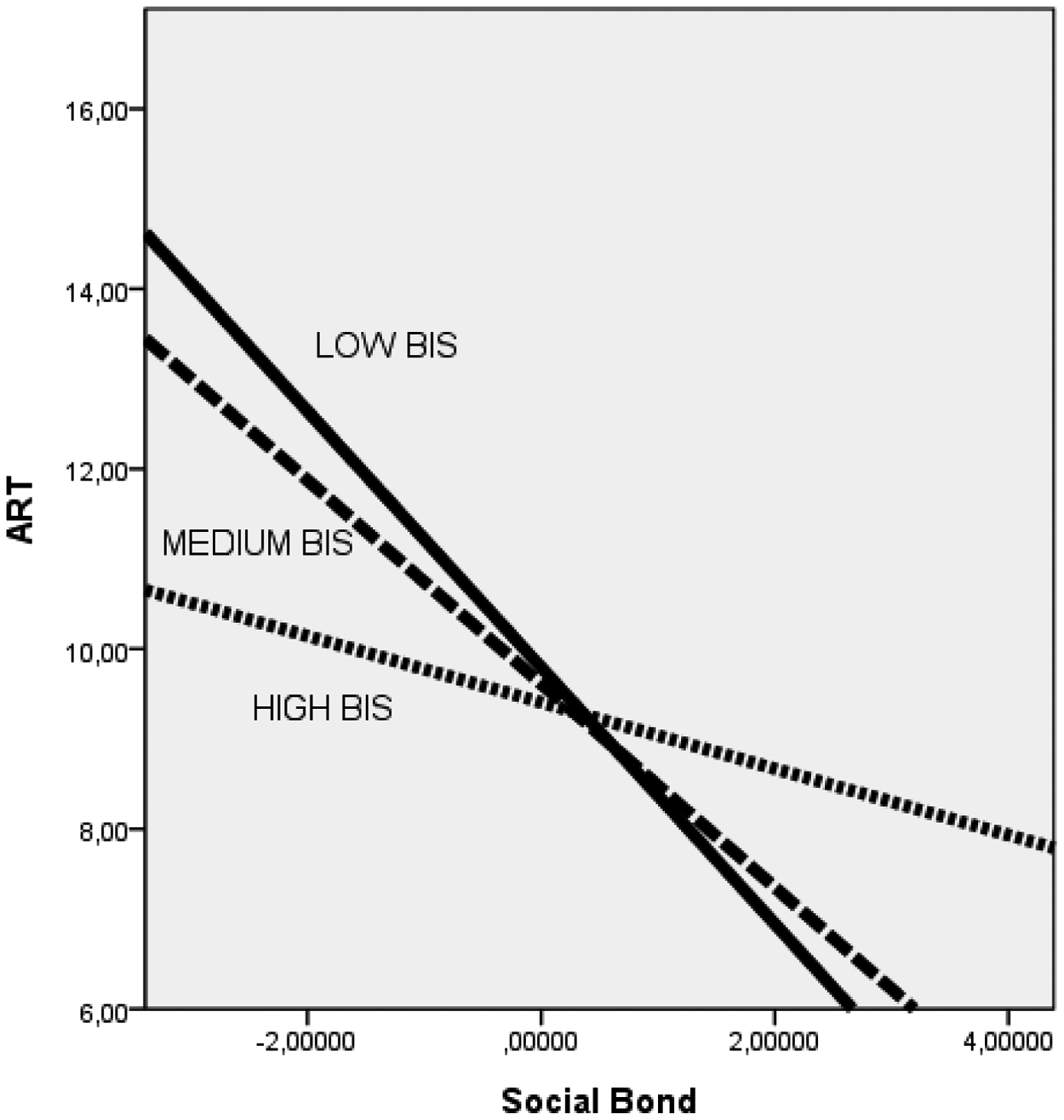
The association between social bonds and ART in boys with low, medium, and high BIS
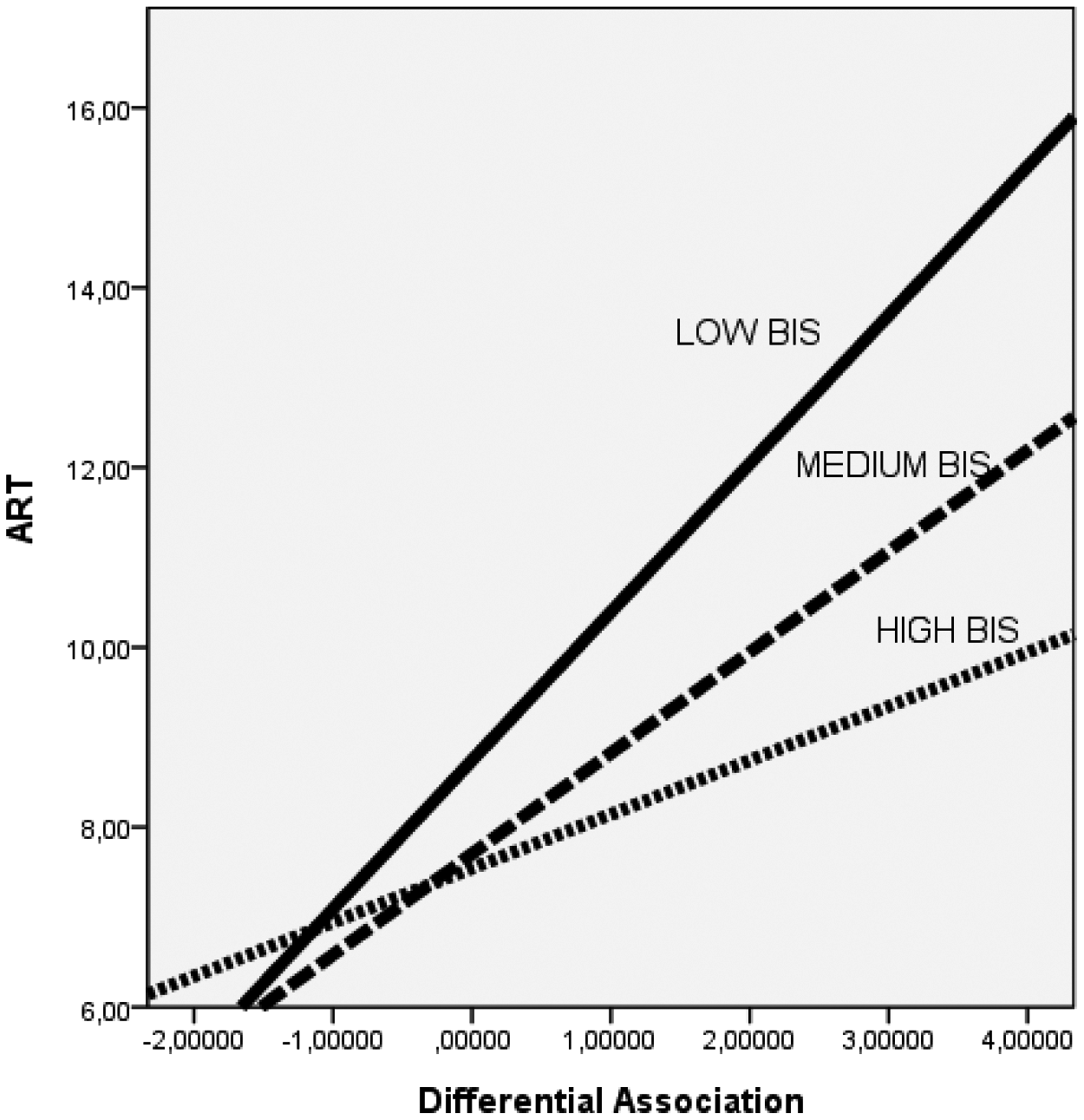
The association between differential association and ART in girls with low, medium, and high BIS
Results
Differences in Boys’ and Girls’ Profiles
Table 1 summarizes and compares the profile of boys and girls. Boys have higher levels of NART, ART, BAS, differential association, and paternal attachment and have lower levels of BIS, strain, belief, and maternal attachment.
Characteristics of the Sample (Boys, N = 301; Girls, N = 298)

Note: SES = socioeconomic status; BIS = behavioral inhibition; BAS = behavioral activation; DA = differential association; NART = nonaggressive risk-taking; ART = aggressive risk-taking.
Bivariate Associations in Boys and Girls
In boys (not in Tables), BAS was negatively associated with social bond (r = −.27; p < .001) and positively associated with differential association (r = .24; p < .01). BIS was associated positively with social bond (r = .26; p < .001) and negatively with differential association (r = −.16; p < .001); in addition, there was a positive association with strain (r = .13; p < .05). In girls (not in Tables), BAS was associated negatively with social bond (r = −19; p < .01) and positively with strain (r = .21; p < .001) and differential association (r = .22; p < .001. BIS was positively associated with social bond (r = .27; p < .001). Consistent with the literature (Carver & White, 1994), BIS and BAS were found to be unrelated in both boys and girls. BIS, BAS, and the core sociological variables (social bond, differential association, and strain) were related to NART and ART, in boys as well as in girls.
Multivariate Relationships
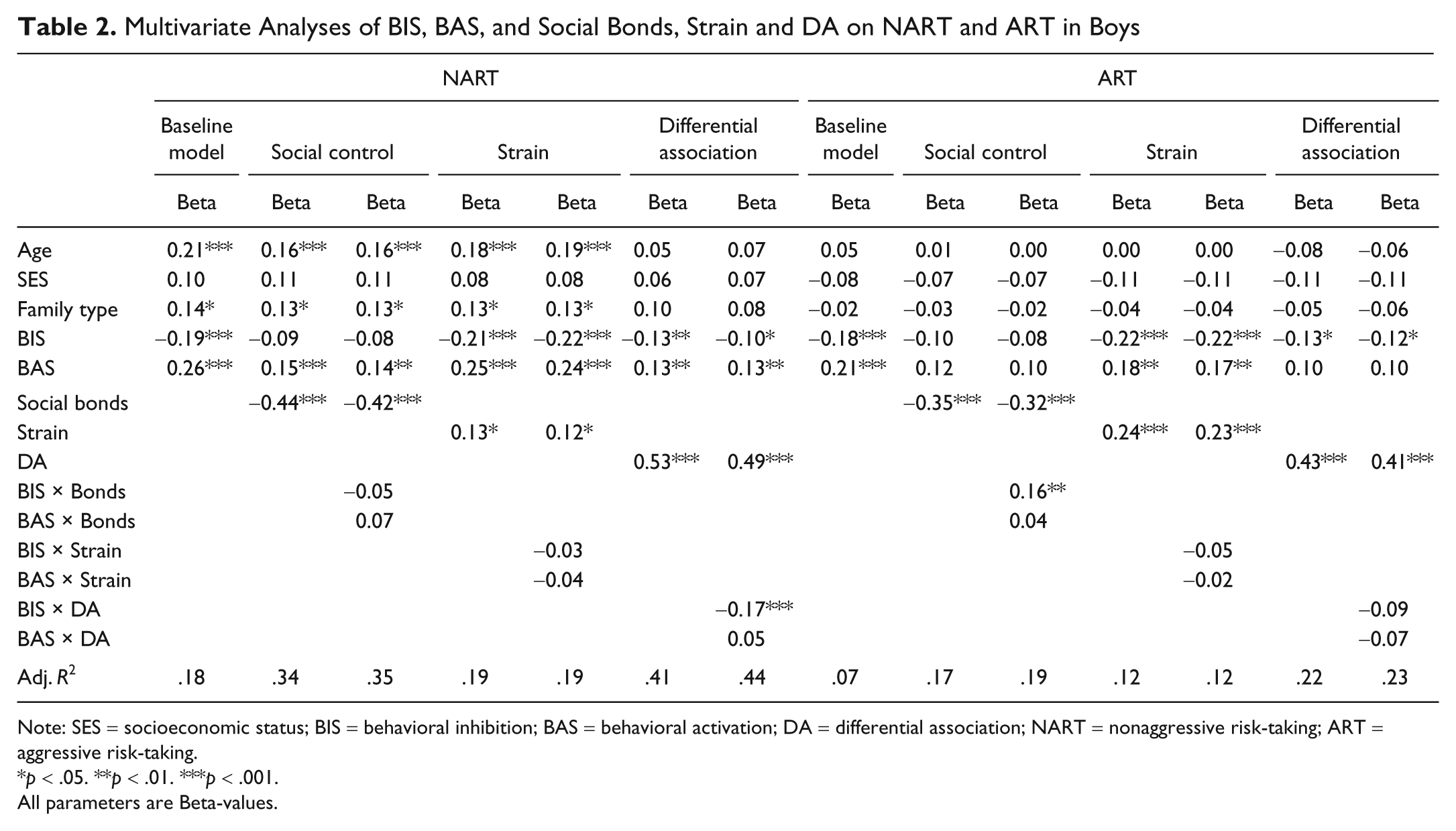
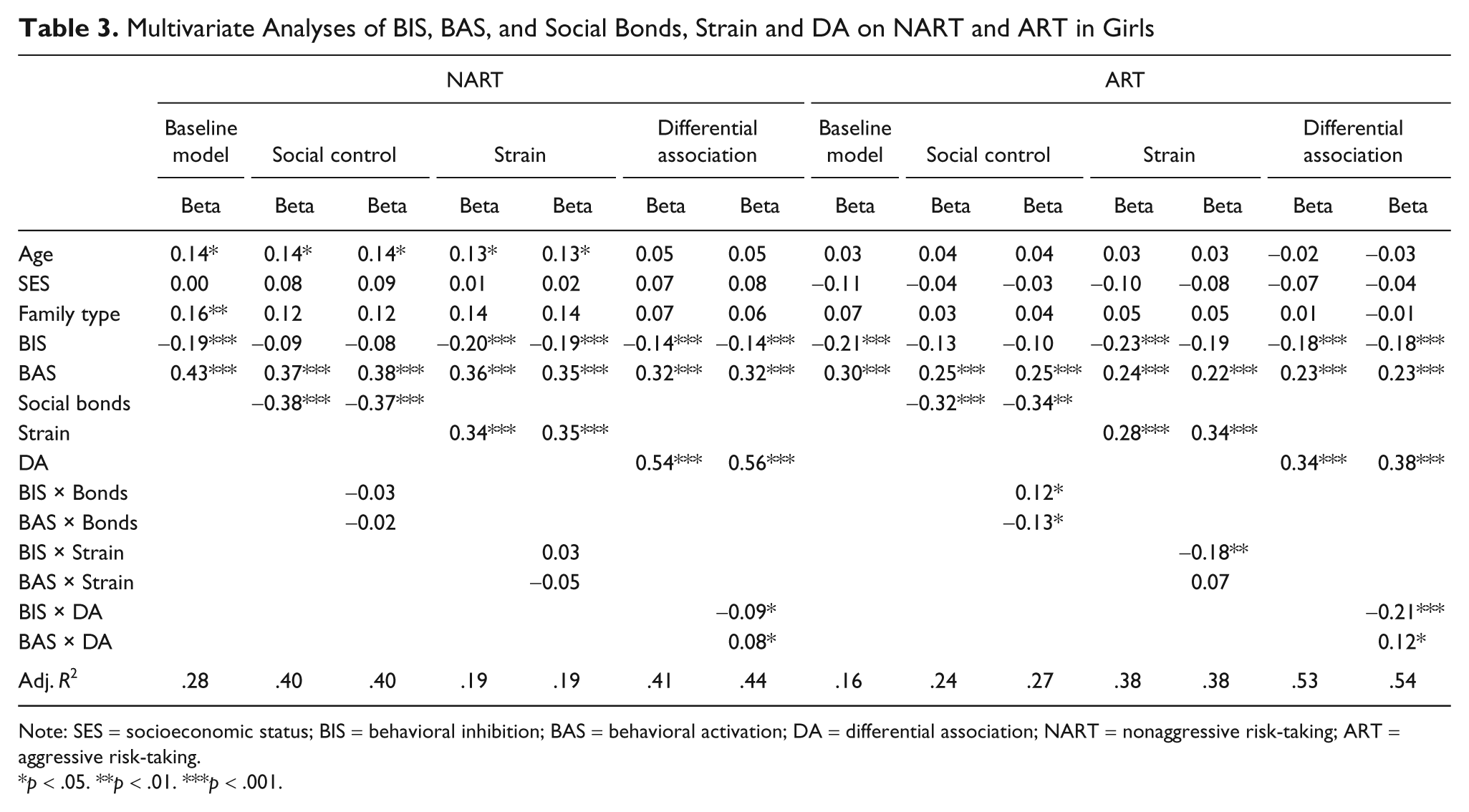
Table 2 (boys) and Table 3 (girls) show the results of a baseline model including BIS, BAS, and the control variables and the results of three models that include the social bond, strain, and differential association variables, including interactions with BIS and BAS.
Multivariate Analyses of BIS, BAS, and Social Bonds, Strain and DA on NART and ART in Boys
Note: SES = socioeconomic status; BIS = behavioral inhibition; BAS = behavioral activation; DA = differential association; NART = nonaggressive risk-taking; ART = aggressive risk-taking.
p < .05. **p < .01. ***p < .001.
All parameters are Beta-values.
Multivariate Analyses of BIS, BAS, and Social Bonds, Strain and DA on NART and ART in Girls
Note: SES = socioeconomic status; BIS = behavioral inhibition; BAS = behavioral activation; DA = differential association; NART = nonaggressive risk-taking; ART = aggressive risk-taking.
p < .05. **p < .01. ***p < .001.
The baseline model shows that in boys, BIS was negatively and BAS was positively related to both NART and ART. In girls, the results were similar.
With respect to boys’ NART, no interactions were found between the social bond and BIS or BAS. With respect to ART, the presence of an interaction effect between social bond and BIS was found, indicating that the effect of social bond was stronger in individuals with low levels of BIS.
In girls’ NART, no interactions between BIS/BAS and social bond were found. In girls’ ART, significant interaction between BIS and social bond and between BAS and social bond was found, indicating that the effect of social bonds was stronger in girls with low levels of BIS and high levels of BAS.
These interactions found in boys and girls suggest a protective effect of social bonds, particularly in individuals who have a temperament that is more inclined toward risk-taking.
Strain theory
With respect to boys’ NART and ART, an effect of strain was found; however, no interactions were found between strain and BIS/BAS. In girls, strain was related to both NART and ART. Whereas no interactions were found between strain and BIS or BAS with respect to NART, a significant interaction effect between strain and BIS was found with respect to ART, indicating that the effect of strain was less pronounced in girls with high levels of BIS.
Differential association
With respect to boys, inserting differential association partially decreased the Beta parameters for BIS and BAS with respect to both NART and ART. With respect to NART, we found a significant interaction effect between differential association and BIS, indicating that the effect of differential association was less expressed in boys with high levels of BIS. With respect to boys’ ART, no significant interaction effects were found.
With respect to girls’ NART, a significant interaction effect was found between differential association and BAS and a significant interaction effect between differential association and BIS, indicating that the effect of differential association was somewhat stronger in girls with high levels of BAS and less expressed in girls with high levels of BIS. Similar interactions between differential association and BAS and between differential association and BIS were found with respect to girls’ ART.
In both boys and girls, these interactions indicate that personality variables moderate the effects of having risk-taking peers: being sensitive toward rewards increases the effects of risk-taking peers; being sensitive toward punishment decreases the effects of risk-taking peers.
Integrated analysis
Table 4 shows the results of the analysis in which the interactions between BIS/BAS and the other core variables are included simultaneously. With respect to boys, the final model shows no direct effects of BIS and BAS. However, in addition to strong effects of social control and differential association, an interaction effect between differential association and BIS remained significant, indicating that the effect of differential association is less expressed in boys with high levels of BIS.
Multivariate Analyses of BIS, BAS, and Social Bonds, Strain and DA, Including Interactions on NART and ART in Boys and Girls
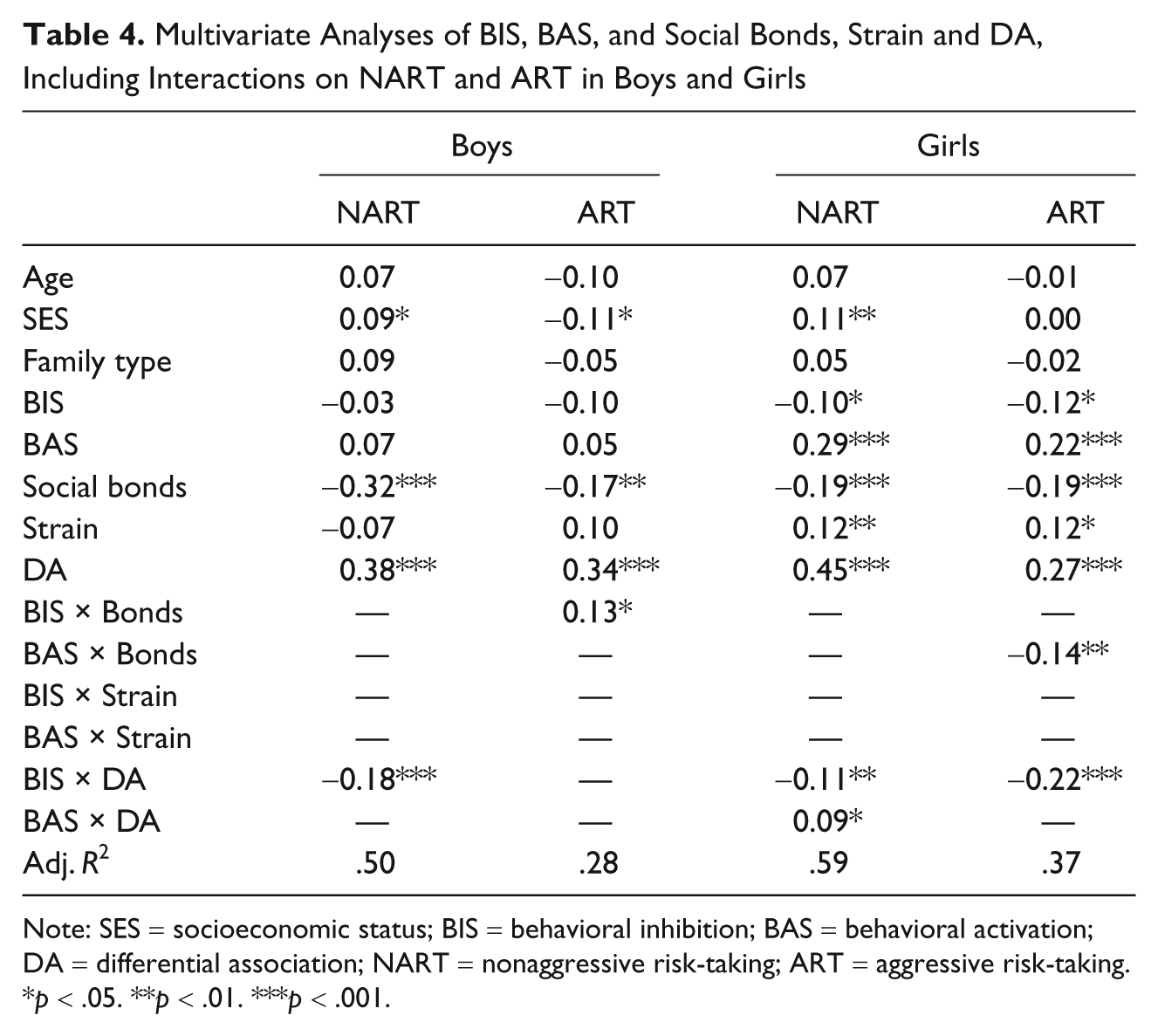
Note: SES = socioeconomic status; BIS = behavioral inhibition; BAS = behavioral activation; DA = differential association; NART = nonaggressive risk-taking; ART = aggressive risk-taking.
p < .05. **p < .01. ***p < .001.
The results with respect to boys’ ART are similar. No direct effects of BIS and BAS were found, although differential association and social bond remained strongly related to ART. In addition, a significant interaction between social bond and BIS was found, indicating that the effect of social bonds was more expressed in boys with low levels of BIS (Figure 1).
With respect to girls’ NART, the final model shows that, in contrast to boys, the effects of BIS and BAS remain significant. Social bond, stress, and differential association were related to NART. In addition, two interaction effects were found indicating that the effect of differential association on NART was less expressed in girls with high levels of BIS and more expressed in girls with high levels of BAS.
With respect to girls’ ART, the final model showed significant effects of BIS, BAS, social bond, strain, and differential association. In addition, two interaction effects were found. The first interaction effect (Figure 2) indicated that the effect of differential association was less expressed in girls with high levels of BIS. The second interaction effect indicated that the effect of social bond was less expressed in girls with high levels of BAS: Social bond may be seen as a protective factor against ART, in particular in girls who may be more inclined to risk taking because of having high levels of BAS.
Conclusion and Discussion
In a sample of adolescent boys and girls, we studied how two broad temperamental variables—behavioral inhibition and activation—derived from Gray’s biopsychological theory on motivation (1972) are related to and interact with variables central to major social science theories with respect to adolescent risk-taking.
Our findings confirm the relevance of both personality and social science variables to adolescent risk-taking. While Knyazev et al. (2004) found relationships between BAS and substance use in adolescents, our analyses showed relationships between BIS/BAS and adolescent risk-taking. Like other studies (Agnew & White, 1992; Capaldi et al., 2001; Costello & Vowell, 1999; Dishion et al., 1995; Stewart, 2003), our study found strong evidence for relationships between social control, strain, and differential association and risk-taking.
Our findings expand the current body of knowledge by showing that relationships that exist between personality and social science variables, including processes of mediation and interaction, are more complex than previously thought. Bivariate analyses show that boys with high levels of BAS had a weaker social bond and higher levels of differential association, whereas boys with high levels of BIS had a stronger social bond, lower levels of differential association, and higher levels of strain. Girls with high levels of BAS had a weaker social bond, higher levels of strain and differential association, whereas girls with high levels of BIS had a stronger social bond and lower levels of differential association.
Multivariate analyses show that the effects of social science variables largely mediated the effects of BIS and BAS in boys. In girls, the effects of BIS and BAS remained significant after controlling for social science variables.
The associations between BAS/BIS and social control, strain, and differential association show that sociological and psychological variables cannot be seen as independent from each other; however, our findings also suggest that reductionism is unwarranted. The contribution of sociological and psychological theories with respect to adolescent risk-taking should be evaluated in relation to each other. The study of reciprocal effects between personality traits and environmental variables like the experience of strain, the development of social bonds, and the selection of peers deserves a more prominent place on the research agenda and is important for the development of more integrated theories on adolescent risk-taking (Agnew et al., 2002).
Our analyses also suggest that at least with respect to each theory—control theory, strain theory, and social learning theory—separately, interactions with the psychological level may be important. In a final model that included all variables related to all theories, there was some evidence with respect to control theory that indicated that the effects of social bonds on to risk-taking were stronger for individuals with low levels of BIS and high levels of BAS. With respect to differential association theory, we expanded on Knyazev et al.’s (2004) finding that adolescents with high levels of BAS were more vulnerable to the influence of deviant peers. We found that individuals with high levels of BAS and lower levels of BIS were more vulnerable to differential association. In summary, these results suggest that high-level social control may partially override a personality-based predisposition for risk-taking, whereas having peers that are involved in risk-taking may increase a predisposition for risk-taking.
While Gottfredson and Hirschi’s theory on self-control (1990) may be seen as an important stepping-stone toward an integration of sociological and psychological criminology, it reduces the explanation for crime and related behaviors to the psychological level. In addition, the concept of self-control may be an oversimplification as it lumps together different personality dimensions that may be independent from each other. Our data confirm earlier findings that two broadband motivational factors are independent from each other and may interact with control theory, strain theory, and differential association theory in ways that go unnoticed when using the self-control concept as a way to integrate more sociological and psychological levels of analysis.
From a policy point of view, our results suggest that next to personality-related predispositions—which are potentially more resistant to change—environmental variables such as social control, stress, and differential association may offer a focus for social interventions. The good news is that strong social bonds and involvement with peers with high levels of risk-taking make a difference with respect to risk-taking, particularly in adolescents who have higher levels of risk-taking predispositions.
Several factors may hinder the interpretation of our results. First, the data are cross-sectional, enabling us to draw conclusions only about association and not about causation. Although we found that BIS and BAS are associated with the variables central to social control, strain, and social learning theories, it is not possible to make strong inferences on the direction of these relationships. Although Gray’s theory (1972) is neurobiological in nature and there is evidence of the neurobiological origins of BIS and BAS (Blair, Peters, & Granger, 2004; Coan & Allen, 2003), this does not imply that strain, social control, or differential association—or environmental variables associated with these concepts—are irrelevant with respect to the development of BIS and BAS. Future research should study the possibly reciprocal relationships between children’s and adolescents’ social environment and the development of their personality within a longitudinal design. Second, we based our measurements of key variables exclusively on participants’ reports and thus reflected adolescents’ perceptions of parental control. Further research should include indicators of processes of control and risk-taking that are more independent of individuals’ perception and/or reporting. Third, we used a general index of stressors. Although no direct effect of strain was found in boys, it may be that gender differences exist in types of stressors—for example, agency- versus community-related stressors (De Coster, 2005)—that are related to risk-taking and that a distinction should be made between them.
In conclusion, we found evidence of the relevance of two broad temperamental variables—behavioral inhibition and behavioral activation—for current social science theories on adolescent risk-taking. Inclusion of these personality variables and interactions between personality and social variables helped to explain partially differences in NART and ART. However, further research is necessary to develop a more integrated understanding of adolescent risk-taking.
Footnotes
Declaration of Conflicting Interests
The authors disclosed receipt of the following financial support for the research, authorship, and/or publication of this article:
Funding
The authors disclosed receipt of the following financial support for the research, authorship, and/or publication of this article:
This work was supported by the FWO (Foundation for Scientific Research, Flanders), grant number 31514609