



Abstract
Despite an overall increase in college attendance, low-income youth and particularly those in the foster care system are less likely to attend college (Wolanin, 2005). Although youth in foster care report high educational aspirations, as little as 4% obtain a 4-year college degree (Nixon & Jones, 2007). The purpose of this study is to explore differences in educational aspirations and expectations among foster care and nonfoster care youth and to explore key predictors of these differences. Using baseline data generated from Kansas Kids @ GEAR UP (Gaining Early Awareness and Readiness for Undergraduate Programs), 1,377 youth were surveyed in regard to their future educational goals, academic self-perception, and level of social support. Results demonstrated that youth from the foster care system report lower educational aspirations and expectations, of which academic self-perception and parental support for education were the best predictors. Limitations and implications for future research will be discussed.
Postsecondary education has been demonstrated to present a number of benefits to both individual degree recipients and society at large. Compared to those with only a high school diploma, college degree holders earn twice the lifetime income, smoke less (Perna, 2005), have lower risk of heart failure, vote more often, and are more likely to hold leadership positions in civic organizations (NCES, 2003). Yet, despite a great deal of effort on the part of government, educational, and private institutions to create equal access and opportunity, the well-documented benefits of postsecondary education remain inequitably distributed among certain segments of the population. Although gains have been made over the past 30 years (NCES, 2003), African American and Hispanic youth still attend college at disproportionate rates (Children’s Defense Fund, 2005) as do youth from rural areas (Cowley, 2000).
One of the greatest disparities in educational attainment can be found among youth emerging from the foster care system. Only as many as 10% of former foster care youth enroll in college (Wolanin, 2005) with as little as 4% obtaining a bachelor’s degree (Nixon & Jones, 2007). “Foster care” is a broad term, which refers to youth who have been removed from their home by the court system. Children in foster care may be placed in foster homes (46% nationally), with relatives (23% nationally), or in a group home. The typical goal of foster care is reunification, which occurs in just over half of the cases (55% nationally). Other options include adoption of the child by a family member, adoption by a nonrelative, or allowing the child to “age-out” of the system (Wolanin, 2005).
Each year, up to 25,000 youth are “aged out” of foster care. They have endured, on average, 28 months in three different placement settings (AFCARS, 2008) and are often left with irreparable mental, social, and academic deficits, which increase according to the amount of time spent in foster care and the number of placements experienced (Courtney, Piliavin, Grogan-Kaylor, & Nesmith, 2001). These emerging adults often find themselves extremely vulnerable to mental health needs, homelessness, unemployment, and other maladies (Nixon & Jones, 2007).
Despite these concerns in adulthood, youth in foster care report high levels of educational aspirations. Courtney, Terao, and Bost (2004) found that more than 80% of foster care youth in their Midwestern sample expressed the aspiration to obtain postsecondary education, compared to more than 70% in other national studies (Nixon & Jones, 2007). This gap between educational aspirations and attainment raises key questions for the long-term quality of life for former foster care youth. McCarron and Inkelas (2006) explored this gap with students for whom college attendance would be a first in their family. They found that despite high aspirations to obtain a bachelor’s degree, more than 62% of these students failed to reach the level of education they had aspired to as sophomores in high school (McCarron & Inkelas, 2006).
Educational Aspirations and Expectations
Education aspirations have been defined as the ideal amount of education which a person would like to achieve (Reynolds & Pemberton, 2001). In contrast, educational expectations form a more realistic, concrete assessment of future possibility. Expectations may serve as a “cognitive link” between idealized aspirations educational attainment (Reynolds & Pemberton, 2001) and have been demonstrated to predict future educational attainment (Beal & Crockett, 2010; Ou & Reynolds, 2008). Several studies have discussed differences between educational aspirations and expectations, reporting that expectations are often lower than aspirations, a difference which is more prevalent among marginalized groups (Chang, Chen, Greenberger, Dooley, & Heckhausen, 2006; Lloyd, Leicht, & Sullivan, 2008).
Both educational aspirations and educational expectations may be considered examples of academic-focused possible selves. Defined as “individually significant hopes, fears, and fantasies” (Markus & Nurius, 1986), possible selves have been linked to better grades and increased persistence in school (Anderman, Anderman, & Griesinger, 1999; Oyserman, Brickman, & Rhodes, 2007). Educational aspirations represent “hoped-for” possible selves, whereas expectations form “probable” possible selves (Perry, Przybysz, & Al-Sheikh, 2009). Although youth tend to overestimate their own abilities (Chevalier, Gibbons, Thorpe, Snell, & Hoskins, 2009), educational expectations are particularly susceptible to environmental influences including perceptions of college cost (Beal & Crockett, 2010; Destin & Oyserman, 2009). Students of low socioeconomic status are more likely to report a gap between their “hoped-for” aspirations and their probable expectations (Boxer, Goldstein, DeLorenzo, Savoy, & Mercado, 2010; Perry et al., 2009).
The development of educational aspirations and expectations occurs within a variety of interrelated contexts (Bronfenbrenner, 1977). Parental behaviors have been shown to influence adolescent aspirations. Key parental factors include the parent’s level of education (Boxer et al., 2010; Englund, Lucker, Whaley, & Egeland, 2004), parental expectations for their children (Benner & Mistry, 2007; Kirk, Lewis-Moss, Nilsen, & Colvin, 2011), and parental involvement in their child’s education (Davis-Kean, 2005; Lecroy & Krysik, 2008). Teacher’s expectations also play a role in developing future orientation in students (Benner & Mistry, 2007) as does student connectedness to school (Boxer et al., 2010). These proximal contexts combine with more distal influences, such as public policy, funding availability, college access programming, to influence present conceptions which may influence the trajectory of the child’s educational path (Taylor et al., 2002). Youth in the foster care system often experience multiple disruptions across familial, academic, and social environments, which may further disrupt their future goals.
Although any number of variables could be included in an exploration of the factors that predict aspirations and expectations, this study focuses on demographic factors, academic factors, and social support for education. Academic factors include grade-point average and academic self-perception. Related to the concepts of self-efficacy and self-concept, academic self-perception has been connected to academic achievement in a reciprocal relationship with previous academic success predicting improved academic self-perception which in turn predicts future academic achievement (Garg, Melanson, & Levin, 2007; Uwah, McMahon, & Furlow, 2008). Social support variables included in this analysis were parental and school staff involvement in academic assistance and discussions about college.
Context and Background
This study used data obtained from Kansas Kids @ GEAR UP (Gaining Early Awareness and Readiness for Undergraduate Programs). The statewide GEAR UP Program hosted by Wichita State University was funded in the state of Kansas in 2002, receiving a grant valued at 25 million dollars for 6 years. KKGU worked in six regions throughout the 105 counties of Kansas, taking student referrals from schools or other agencies. The mission of KKGU was to increase the educational aspirations and college preparedness of limited income and particularly foster care youth from across the state of Kansas (Kansas Kids @ GEAR UP, 2008). Two thirds of KKGU participants were youth in foster care.
Research Questions
The purpose of this study is to examine the gap between educational aspirations and attainment in youth in foster care. Three research questions were considered for this analysis. First, did foster care youth report lower educational aspirations and educational expectations than the nonfoster care youth? Second, which of a variety of academic (self-perception, grade point average), social (parent and school support), and demographic variables (zip code population density, race/ethnicity, foster care status, age, and gender) were important in predicting aspirations and expectations? Finally, how did youth in and out of foster care differ on key predictive factors? These research questions were designed to promote understanding of the unique plight of foster care youth and inform future interventions designed to create equitable access to postsecondary education for marginalized groups.
Method
Participants
A total of 1,377 students from the Kansas Kids @ GEAR UP Program were included in this study. These students lived throughout the state of Kansas from rural Western regions to the larger metropolitan areas with zip code population densities ranging from two to more than 4,000. To participate in the Kansas Kids @ GEAR UP Program, the participants had to qualify as limited income according to the criteria for the Federal Free and Reduced Lunch Program (e.g., less than US $37,000 annual income for a family of four). Youth from the foster care system were granted priority access to the program and comprised of nearly two thirds (N = 895) of the sample.
Measures
Data was collected from the KKGU Student Survey and school transcripts as part of standard reporting procedures to the Department of Education. The KKGU Student Survey asked students about their future educational goals, current academic performance, and level of social support for education. Six items from the survey concerned future educational goals. These six items were factor analyzed to determine underlying dimensions. Parallel and scree plot analysis revealed two distinctive factors: educational aspirations, consisting of four items (e.g., “How much education would you like to obtain?”) and educational expectations, consisting of two items (e.g. “Do you think you will be able to afford attending college after high school?”). The total items for each variable were summed to form scales ranging from 0 to 12 for aspirations (Mean = 10.75, SD =2.18, Cronbach’s α = .83) and expectations (Mean = 7.06, SD = 1.93, α =. 79).
Additional survey items were used to assess academic self-perception and parental and school support for education. Academic self-perception was a single, dichotomous measure which asked “what type of student you consider yourself to be?” The majority of students (58.4%) reported a perception of being a “good student” (SD = .49). Parental support for education was assessed from the sum of two dichotomous items which asked students whether their parents were (a) involved with their school work and (b) discussed college with their child. The summed variable ranged from 0 to 2 with a mean score of .88 (SD = .82, α = .56). School support was derived from the same questions as the parents, but applied to school staff (Mean = .49, SD = .48, α = .46).
In addition, demographic data was gathered from the KKGU database and grade-point averages were calculated from transcripts obtained as part of the program evaluation. Prior to conducting the analyses, multiple imputation was conducted using NORM to estimate missing values on the measure of grade-point average (Rubin, 1996). Thirty-nine percent of the participants had grade-point averages collected, and the absent values were determined to be missing at random (MAR). Multiple imputation was chosen over other techniques to maintain the variance of the sample without overfitting the data. These imputed values were included as an estimation of grade-point average and should be interpreted with caution. Finally, information from the 2000 U.S. Census was used to determine degree of urbanization within the participant’s zip code by calculating population densities.
Procedure
Student participants of Kansas Kids @ GEAR UP (KKGU) completed a survey questionnaire with the measures described previously prior to participating in the program. Parent/guardian permission was obtained via the program application form. Although surveys were collected for all participants, some surveys were unable to be matched to demographic data and thus were excluded from the present analysis. The unmatchable surveys were equally distributed across KKGU regions and major demographic groups, indicating that they were not significantly different from the overall population of KKGU participants. Survey questionnaires were administered at the GEAR UP office and/or at each participant’s school using the mrInterview online survey tool. Some students were given paper surveys which were later entered online by KKGU staff. Data were downloaded from mrInterview and imported into SPSS Windows 18 for analysis. Copies of student transcripts were sent yearly to the program evaluator and entered into a separate Excel database before being imported to SPSS for analysis.
Plan for Analysis
First, two independent samples t-tests were used to explore differences in educational aspirations and expectations between foster care and nonfoster care youth. Next, two sequential multiple regression analyses were planned to predict educational aspirations and expectations from parental, school, academic, and demographic factors. Finally, comparisons of key predictors of educational aspirations and expectations were conducted using independent samples t-tests with Bonferoni corrections.
Results
Comparison Between Foster Care And Nonfoster Care Youth
Youth in foster care reported significantly lower educational aspirations, t(1123) = −8.96, p < .001, d = −.50 and expectations, t(1104) = −5.78, p < .001, d = −.32 than the nonfoster care youth in this sample of exclusively low-income students. Only 43% of the foster care youth aspired to obtain a 4-year college degree compared to 67% of the nonfoster care youth. Educational expectations were lower than aspirations for all demographic groups as displayed in Table 1.
Means and Standard Deviations for Educational Variables by Demographic Group.
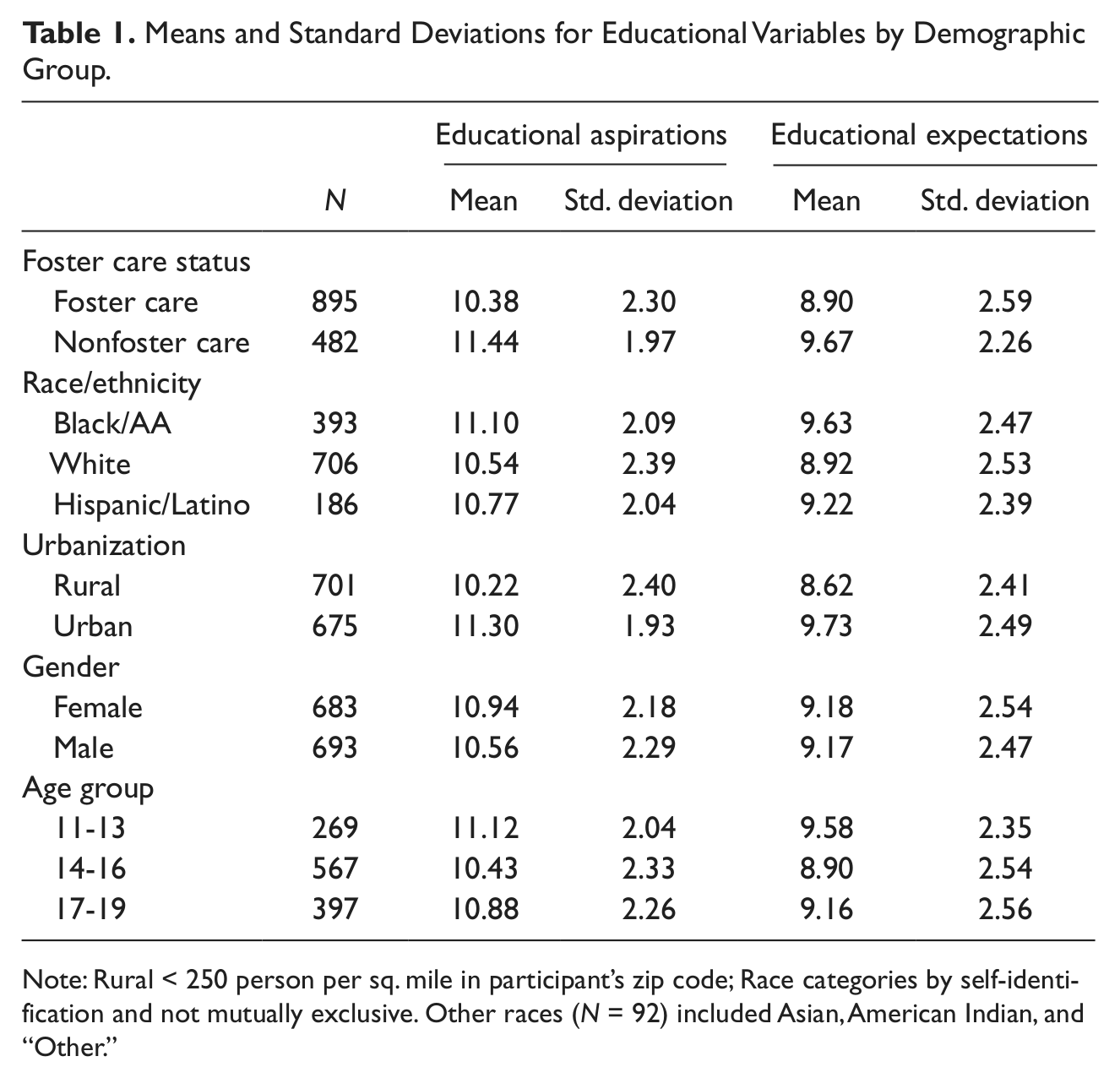
Note: Rural < 250 person per sq. mile in participant’s zip code; Race categories by self-identification and not mutually exclusive. Other races (N = 92) included Asian, American Indian, and “Other.”
To further explore this discrepancy, a pair of sequential regression analyses was used to determine which factors predicted higher aspirations and expectations. These two criteria were evaluated separately to discuss differences in the linear equations between the two constructs. Each analysis explored academic, parental, and school factors, as well as determining whether the criterion could be predicted based on the participant’s foster care status, gender, race/ethnicity, and urbanization of residence.
Educational Aspirations
Sequential regression was used to predict educational aspirations from a variety of factors. Two measures of academic ability were entered first into the equation. Academic self-perception was a measure of what type of student the participant considered themselves to be, whereas grade-point average was an estimation of the cumulative GPA for the students in KKGU. These two factors significantly predicted educational aspirations (R2 = .196, adjusted R2 = .194 F(2,1374) = 167.67, p < .001.) Further exploration of these variables revealed that only academic self-perception was a significant predictor, t(1377) = 14.95, p < .01. The bivariate correlation between the student’s perceived ability and their estimated GPA was low, r(1377) = .05, suggesting that a sense of academic self-perception may be more salient in considering educational aspirations than the actual grades which a student obtains.
After controlling for academic ability, the remaining variables were added. These factors significantly predicted educational aspirations over and above academic predictors (R2change = .09, F(9,1365) = 18.22, p < .001). Together with the academic predictors, the regression equation significantly predicted 28% of the variance in educational aspirations (R2 = .282, adjusted R2 = .277, F (11,1365) = 48.83, p < .001). Among the remaining factors, all were significant predictors of educational aspirations with the exception of the race/ethnicity variables. The strongest predictors overall were academic self-perception, parental support for education, foster care status, and urbanization. Table 2 displays the regression coefficients and standard errors for the educational aspirations regression.
Coefficients of Regression for Educational Aspirations for Complete Model.
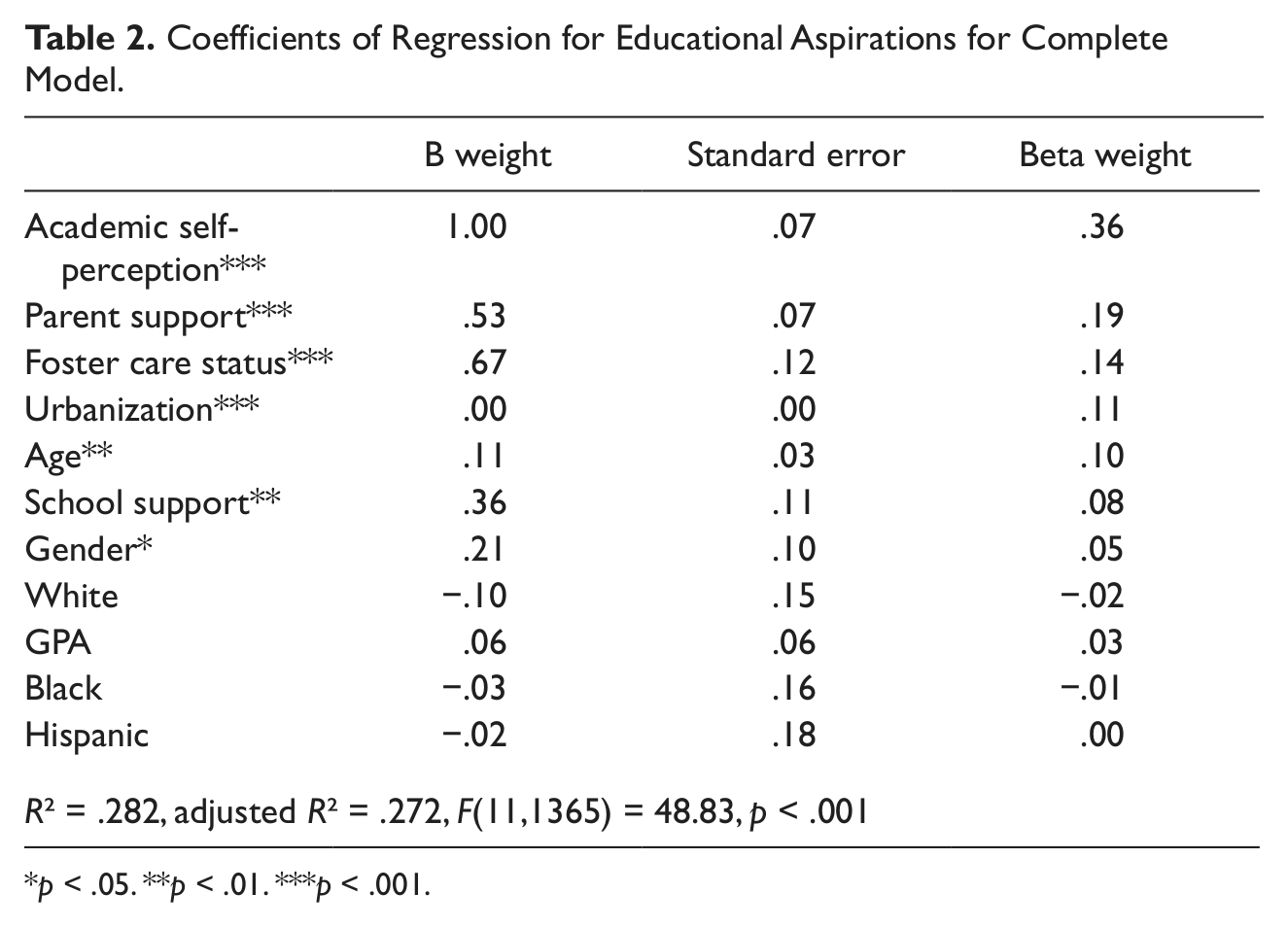
p < .05. **p < .01. ***p < .001.
Educational Expectations
To explore the differences between educational aspirations and educational expectations, a second sequential regression analysis was conducted. Educational expectations were hypothesized to be a more concrete extension of educational aspirations. Thus, educational aspirations were entered first into the equation to control for this shared variance. The correlation between the two criterion was high, r(1377) = .58 and one third of the variance in educational expectations was predicted from aspirations (R2 = .338, adjusted R2 = .338, F(1, 1375) = 702.98, p < .001).
After controlling for the educational aspirations score, the other factors were entered into the equation to determine if these criteria could predict expectations after controlling for the aspirations. These factors did indeed predict educational expectations over and above reported aspirations (R2 change = .03 F(10,1365) = 5.52, p < .001). Of these factors, academic self-perception, t(1377) = 4.67, p < .001, parental support for education, t(1377) = 2.83, p < .01, gender, t(1377) = −2.396, p < .05, and urbanization, t(1377) =2.12. p < .05, were significant predictors. Thus, after adjusting for level of educational aspirations, foster care status was not a significant predictor of educational expectations. Table 3 displays the regression coefficients and standard errors for each of the predictor variables in the equation for educational expectations.
Coefficients of Regression for Educational Expectations.
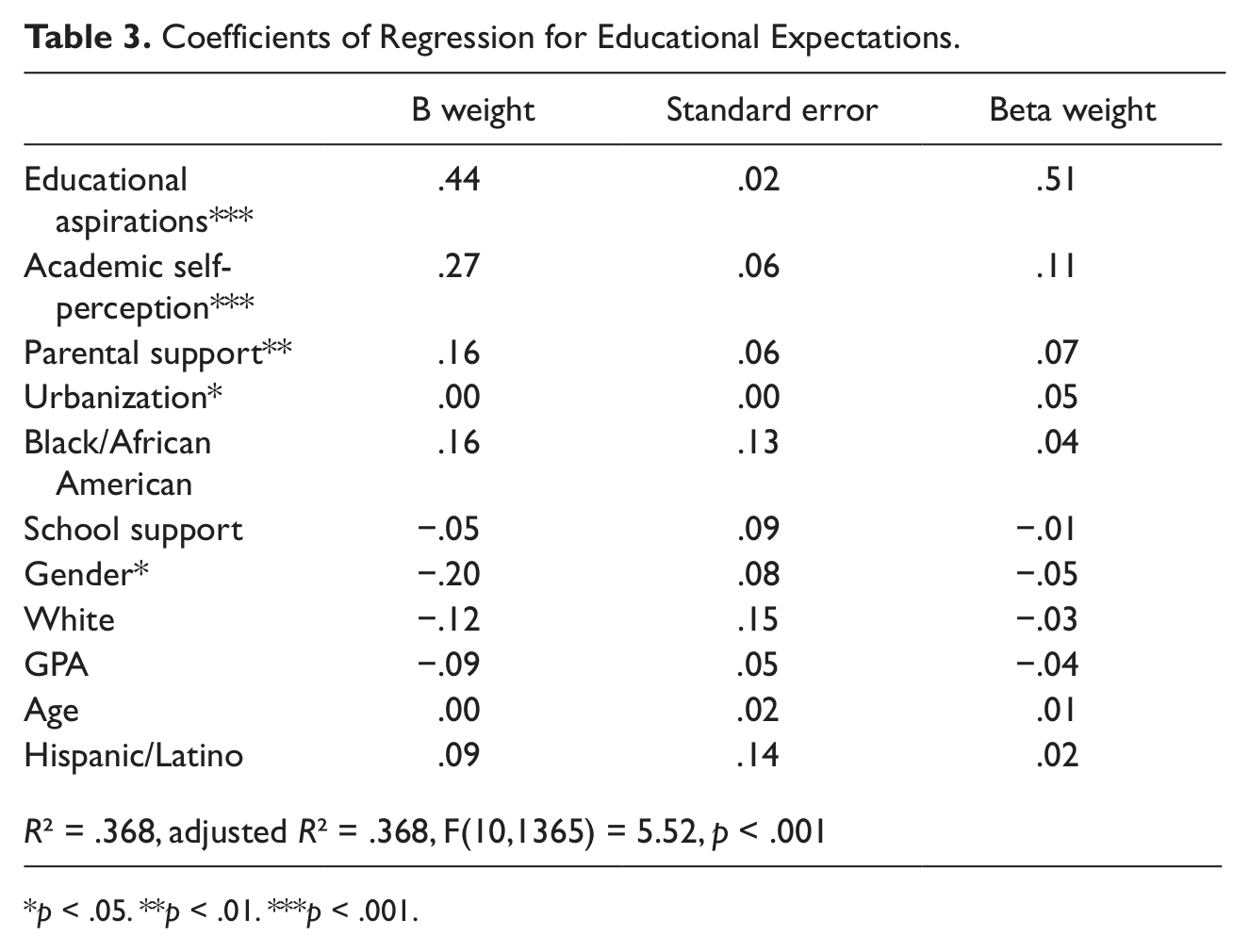
p < .05. **p < .01. ***p < .001.
Finally, to better understand these factors, a further exploration of two of the predictors was conducted. Given the highly predictive nature of academic self-perception and level of parental support, it was determined that these would be explored in connection to the foster care and nonfoster care youth to examine possible differences. Figure 1 displays these results alongside the aspirations and expectations variables. Youth in foster care reported lower academic self-perception, t(996.31) = −5.69, p < .00, and parental support for education, t(957.17) = −7.35, p < .001, than other youth. However, there was a great deal of variance among the foster care youth in their degree of parental separation and level of parental (biological or foster parent) connection (SD = .79). Although 46% (N = 413) of the youth in foster care reported no parental support on homework and college information, 22% (N = 198) reported a high level of parental involvement, indicating that parental involvement among foster care youth varies a great deal, despite being significantly lower on average from nonfoster care youth.
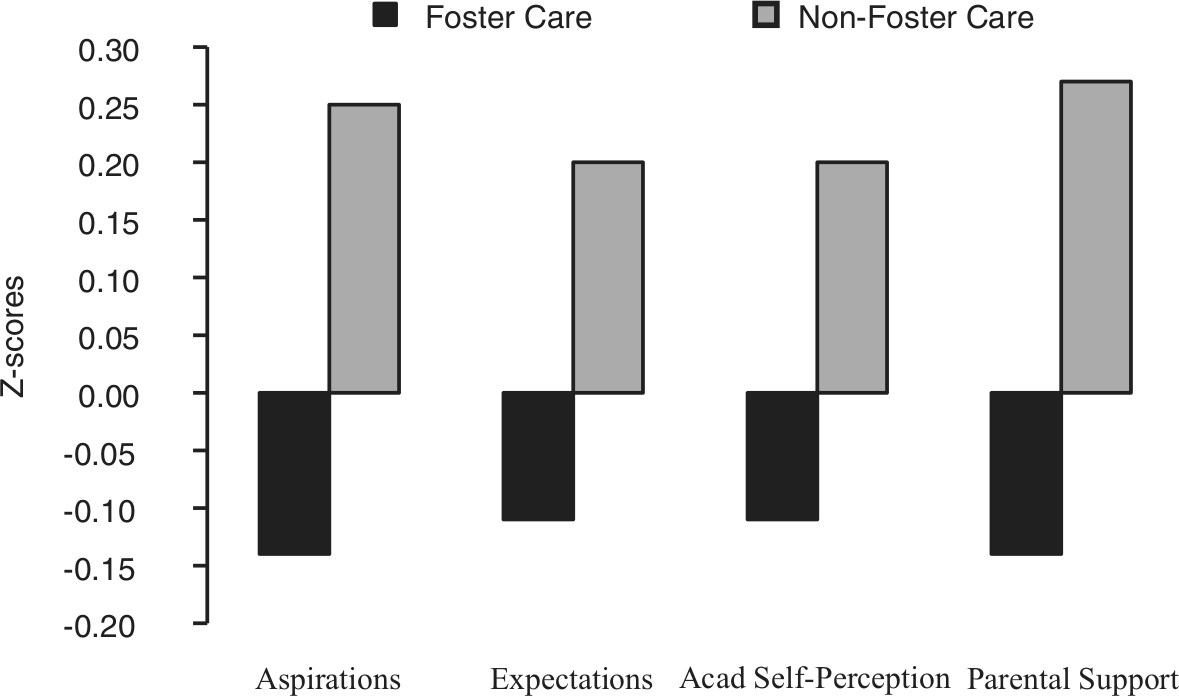
Z-scores on key variables for youth in and out of foster care.
Discussion
The purpose of this study was to provide baseline data on the educational aspirations and expectations of youth in foster care and explore key predictors of the two constructs. The results suggest youth in foster care report significantly lower aspirations and expectations in comparison to low-income youth who were not in the foster care system. This stands in contrast to other studies of solely foster care youth which found higher levels of aspirations (Wolanin, 2005). One explanation may be the inclusion of many youth from rural areas, who reported lower aspirations and expectations than their urban peers. Although foster care status was not the most important factor in this analysis, it accounted for a large portion of the variance in educational aspirations.
Regression analyses revealed that academic self-perception and parental support were two key factors in predicting both educational aspirations and expectations. On both of these factors, foster care youth scored significantly lower than other participants. Given the multiple academic disruptions which characterize the foster care experience (Conger & Rebeck, 2001), in addition to the increased mental and behavioral issues which arise from the trauma associated with foster care, one can easily see why foster care youth report lower levels of academic self-perception than other low-income youth. As expected, youth in foster care reported lower levels of parental support, consistent with their varying degrees of parental involvement and contact. Not surprisingly, youth in foster care may lack support from their biological parents to succeed academically. Thus, foster care youth who experience multiple placements and extended stays in the foster care system may be at increased risk for lower educational aspirations in addition to other difficulties (Courtney, et al. 2001; Nixon & Jones, 2007). It is important to note, that although these findings are significant, the factors used here could only predict 28% of the variance in educational aspirations, suggesting that a number of other demographic (e.g., time in foster care, type of foster care placement, socioeconomic status), social (e.g. connection to biological parent and/or foster parent, and academic, for example, early academic success, participation in college preparatory programs) factors could be included to improve the ability to predict these constructs.
The exploration of educational aspirations and expectations revealed that, as expected, aspirations were higher than expectations for all demographic groups. Furthermore, aspirations predicted more than one third of the variance in educational expectations. This indicates that the two constructs are highly related, yet markedly different. One key component to this difference may be the perception of college affordability. Among those students in the KKGU sample who indicated that they may not go to college, 40% (N = 556) reported that they would not attend because of financial issues. Perception of inability to afford college did correlate significantly with lower educational expectations, r(1377) = −.11, p < .01, but not with aspirations, r(1377) = −.03. As hypothesized, educational expectations may be more susceptible to adjustment based on external circumstances (i.e., lack of wealth and/or income). Only 51% of students reported having received information about financial aid from their schools prior to KKGU involvement. Thus, it seems that college cost remains a prohibitive factor in the minds of low-income youth and may be responsible for lowering expectations despite larger aspirational goals.
Limitations
A number of limitations exist within this study. The results are based almost exclusively on self-report data and may not reflect the most accurate opinion for the participants. Assessments of future possibility may be likely to change over time and could be susceptible to subtle variations in the school environment at the time of the survey. As all participants were limited income, a restriction of range in regard to educational aspirations and expectations may limit generalizability.
Because of the transient nature of the foster care population and the large geographical scope of the program, data collection was sometimes inconsistent resulting in an inability to match approximately 30% of KKGU participants to their baseline survey. Although the missing surveys were equally distributed across the different regions and demographic groups, they may not be entirely missing at random. This missing data may limit the generalizability of the study to all KKGU participants or to all youth in foster care. Finally, although grade-point averages were not a significant portion of the analysis, many of these values were imputed and must be interpreted with caution.
Suggestions for Future Intervention and Research
These findings suggest that future intervention should focus on building academic self-perception, providing increased support, and increasing both access to and information about college funding opportunities. Intervention at younger ages may be needed as college expectations are often set by eighth grade (Swail & Perna, 2002; Trusty, 2002). This is particularly important with youth in foster care, whose academic disruptions put them at risk for lower levels of achievement. Another factor not considered here is academic disruption due to in-school behavior. Future interventions with foster care youth should explore how behavior affects academic disruption (Yampolskya & Massey, 2006).
The nature of support structures for foster care youth is an area for future research. Although parental support remains a strong factor in educational attainment, supplements to this support via peer and professional involvement should be explored in research and practice. In addition, the availability of information about financial aid should be researched to a greater degree to explore who gets this information, how they get it, and how it is utilized.
Future research should focus on exploring, in greater depth, the construct of educational expectations, including longitudinal measures on how this construct changes over time. Despite a persistent gap between aspirations and attainment, many studies have used singular, aspirational expressions as indicators, ignoring the role of expectations on both an individual and systems level. A deeper exploration of educational expectations is required to erase the educational disparities which put former foster care youth at risk. Intervention programs may want to place increased focus on building expectations, in addition to “pumping kids up” about college.
Conclusion
Although the experience of foster care presents a number of challenges to youth, the hope of obtaining a college education presents a way to move beyond those challenges and into a stable adulthood. The fact that only as few 10% of former foster care youth are enrolling in college poses a serious problem. This research suggests that early intervention to build academic self-perception and increase knowledge about college funding is needed to reduce this disparity. By taking this long-term, sustainable approach, interventions may have increased success in helping youth from the foster care system enroll and graduate from college.
Footnotes
Declaration of Conflicting Interests
The author(s) declared no potential conflicts of interest with respect to the research, authorship, and/or publication of this article.
Funding
The author(s) received no financial support for the research, authorship, and/or publication of this article.