



Abstract
Substance use and delinquency in Thai adolescents are growing public health concerns. Research has linked neighborhood characteristics to these outcomes, with explanations focused on neighborhood disorganization, social cohesion, and social control. This study examines the independent associations of these neighborhood constructs with Thai adolescents’ substance use and delinquency, through peer deviance, to determine which neighborhood aspects are particularly important. Families (N = 420) with adolescents aged 13 to 14 were randomly selected from 7 districts in Bangkok, Thailand. Structural equation modeling showed that adolescents’, but not parents’, perceptions of greater disorganization were related to increased rates of both minor and serious delinquency. Surprisingly, greater neighborhood cohesion was related to greater minor delinquency. Peer deviance was unrelated to neighborhood variables. Findings can inform prevention strategies for Thai adolescents, as results suggest that neighborhoods are important for adolescent behaviors regardless of culture. Further work should help communities make use of social cohesion to benefit residents.
Adolescent substance use and delinquency in Thailand are growing concerns (Assanangkornchai, Pattanasattayawong, Samangsri, & Mukthong, 2007; Miller et al., in press). Lifetime rates of alcohol and cigarette use among Thai adolescents are 37.3% and 15.4%, respectively (Ruangkanchanasetr, Plitponkarnpim, Hetrakul, & Kongsakon, 2005). Delinquency rates are also a concern, as Ruangkanchanasetr and colleagues (2005) reported that 8.5% of adolescents had carried a weapon, 31.5% had been involved in fighting, and 12.1% had reported driving after drinking alcohol. These concerns highlight a need for effective prevention strategies for Thai adolescent problem behavior (Assanangkornchai et al., 2007).
Research has linked neighborhood characteristics to adolescent substance use and delinquency in the United States, attempting to pinpoint the specific characteristics of neighborhoods that influence adolescent problem behavior to discern appropriate targets of social policy (Cantillon, 2006; Leventhal & Brooks-Gunn, 2000). However, few neighborhood studies have been conducted in Asian countries (Chuang, Li, Wu, & Chao, 2007). Whether relationships are similar to the United States is not yet clear. Determining which neighborhood characteristics are important in these regions will allow for the development of more successful prevention strategies that focus on contextual risk and protective factors. Furthermore, finding neighborhood effects in Thailand would suggest that the neighborhood context may be important in many populations and regions, despite cultural differences, and thus may also be informative to researchers adapting prevention strategies to different cultures within the United States. The present study examines the independent associations of neighborhood disorganization and two aspects of social capital, cohesion and control, with Bangkok, Thailand adolescents’ substance use and delinquency through peer deviance, to determine which neighborhood characteristics are particularly important.
Neighborhoods andAdolescent Problem Behavior
Evidence from U.S. and international neighborhood studies demonstrate the link between two key theoretical constructs, disorganization and social capital, and youth behaviors (e.g., Drukker, Kaplan, Feron, & van Os, 2003; Leventhal & Brooks-Gunn, 2000). Neighborhood assessments have been made with both “objective” and subjective (e.g., resident perceptions) measurements. However, relationships between neighborhood characteristics and youth behaviors may differ depending on which type of assessment studies use (Bamaca, Umana-Taylor, Shin, & Alfaro, 2005). So-called “objective” measurements, often defined by using census data, do not always match neighborhoods as defined by residents (O’Neil, Parke, & McDowell, 2001), and it has been argued that residents’ perceptions are more influential for their outcomes (Bowen, Bowen, & Cook, 2000; Burton & Jarrett, 2000). This approach is in accordance with perspectives that view context as a social construction and focus on the interpretations of the residents (Bronfenbrenner, 1992; Furstenberg & Hughes, 1997). Surprisingly, most neighborhood studies overlook residents’ own perceptions of their neighborhood environment (Dahl, Ceballo, & Huerta, 2010).
Neighborhood disorganization
Social disorganization is a characteristic of neighborhoods that can disturb residents’ health and behavior and refers to characteristics that can make it difficult for residents to preserve control over their environment (Shaw & McKay, 1942). In contrast, neighborhoods with social organization tend to have high social cohesion and informal social control that assist parents in achieving healthy outcomes for their children (Sampson, Morenoff, & Earls, 1999; Sampson, Raudenbush, & Earls, 1997). Intergenerational closure, a resource gained through parents’ making acquaintance and sharing information with parents of their child’s friends, is a foundation for developing close social ties among residents (Coleman, 1988; Sampson et al., 1999). These characteristics of social organization are thought to be means by which structural characteristics of the neighborhood (e.g., poverty) are related to the health and behaviors of residents (Kubrin & Weitzer, 2003).
Neighborhood disorganization is linked to adolescent problem behaviors. For example, characteristics such as low neighborhood socioeconomic status (SES), often used to indicate disorganization, are consistently related to adolescent problem behaviors in general (Leventhal & Brooks-Gunn, 2000). In a nationally representative sample of Canadian adolescents, those with preexisting psychological tendencies were more likely to join a gang when they lived in neighborhoods with more residential instability (Dupéré, Lacourse, Willms, Vitaro, & Tremblay, 2007). Other studies have found that youth in high-poverty neighborhoods are more likely to be involved in property offenses (Kingston, Huizinga, & Elliott, 2009). Furthermore, there is evidence that neighborhood disorganization is linked to substance use. A study of urban African Americans showed that adolescents who perceived greater disorganization in seventh grade used more tobacco, alcohol, and marijuana in ninth grade (Lambert, Brown, Phillips, & Ialongo, 2004). However, studies are inconsistent, as other work has found that greater disorganization is related to less alcohol use (Duncan, Duncan, & Strycker, 2000; Ennett, Flewelling, Lindrooth, & Norton, 1997).
The role of neighborhood disorganization for Thai adolescents’ problem behaviors is not well documented but may be related to Thai youth behaviors as well. A previous study found that rates of Thai adolescent delinquency and sexual behaviors vary depending on which Bangkok district the adolescents reside in (Chamratrithirong et al., 2009). Studies in other Asian countries also support a link between neighborhood characteristics and youth behaviors. In Japan, lower neighborhood safety was related to greater teen deviant behavior (Laser, Luster, & Oshio, 2007). In Taiwan, greater neighborhood disorganization was related to higher rates of drinking but for low SES individuals only (Chuang et al., 2007).
Neighborhood social capital
Although neighborhood social capital is a multifaceted concept, definitions share common aspects. Although social capital can be conceptualized at the individual, neighborhood, city, national, and international levels (Halpern, 2005), we focus on the neighborhood level. Most definitions describe how the social organization of the neighborhood creates resources through ties and networks among neighbors, allowing for reciprocal obligations and enforcement of shared norms and values (Coleman, 1988; Putnam, 1993). Sampson and colleagues (Sampson et al., 1999) extended the concept of social capital to include collective efficacy, an aspect of social capital that encompasses the expectations of residents in the active engagement of supporting and controlling neighborhood youth.
Social capital is often measured through assessing two aspects of social capital, social cohesion and social control, which reflect social ties and residents’ willingness to intervene, respectively (Drukker, Buka, Kaplan, McKenzie, & Van Os, 2005; Drukker et al., 2003). Although social capital includes many aspects, the concepts of cohesion and control are often used because they encompass several aspects of social capital and are related to youth problem behaviors. For example, social cohesion reflects social networks and ties, whereas social control reflects the informal imposition of shared norms and sanctions (Sampson et al., 1997, 1999).
Few studies have examined the relationship between neighborhood social capital and youth outcomes (Caughy, O’Campo, & Muntaner, 2003), and to our knowledge, studies have not examined this relationship in Thailand. Adolescent health and behavior are related to neighborhood social capital. For instance, higher neighborhood social capital is related to less school dropout (Coleman, 1988), greater health, life satisfaction (Drukker et al., 2005; Drukker & van Os, 2003), and lower delinquency (Cantillon, 2006). Another study found that social control and social cohesion are related to adolescents’ greater perceived health in the Netherlands and Chicago Hispanic youth but not among Chicago non-Hispanic youth (Drukker et al., 2005). This may indicate ethnic and/or cultural differences in the ways social capital affects adolescents.
Aspects of social capital are not inherently positive or negative in and of themselves. However, they are most often framed in terms of their benefits. Although most studies have found positive effects of social capital, networks that create social capital can promote either social good or social disorder (Kreuter & Lezin, 2002; Putnam, 1996). Elements of social capital, such as the exclusion of outsiders, expectations that group members conform to group norms, and keeping members from rising out of negative conditions due to a common opposition to mainstream society, could all lead to negative outcomes (Portes, 1998; Portes & Landolt, 1996). For example, gangs are based on strong social networks and trust that provide resources to members and impose shared norms, but these resources are related to unhealthy behavior (Portes & Landolt, 1996; Takahashi & Magalong, 2008).
Peer deviance
Neighborhood characteristics may also be related to adolescent problem behavior through relationships with deviant peer affiliations. Consistent with the norms and collective efficacy model (Leventhal & Brooks-Gunn, 2004), based on social organization theory, the relationship between neighborhood characteristics and adolescent problem behavior may be mostly mediated by the norms and behaviors of the peer group. Studies have found that neighborhood characteristics are related to peer deviance (e.g., Brody et al., 2001; Rankin & Quane, 2002), and, in turn, peer deviance is related to adolescent problem behaviors, such as delinquency and substance use (Barnow, Lucht, & Freyberger, 2005; Fallu et al., 2010; Rankin & Quane, 2002).
The Present Study
Evidence of the importance of neighborhoods for adolescent development, and concerns over adolescent problem behaviors in Thailand, suggest that an examination of this relationship may allow for the development of new prevention strategies for this population. We hypothesize as follows:
Hypothesis 1: Greater neighborhood disorganization is related to greater levels of problem behaviors.
Hypothesis 2: Higher neighborhood social cohesion and control are protective against these behaviors.
Further we hypothesize as follows:
Hypothesis 3: These neighborhood characteristics will be related to adolescent problem behaviors indirectly through peer deviance.
The independent associations of these measures are warranted for the development of effective prevention strategies. Our fourth hypothesis is as follows:
Hypothesis 4: Individual demographic characteristics are expected to be indirectly related to adolescent behaviors, through associations with neighborhood perceptions.
As individual demographic characteristics may influence the experiences a person has and the way individuals interpret those experiences, these characteristics may also be important in determining neighborhood perceptions (Sampson & Raudenbush, 2004).
Method
Sampling and Procedures
Data were obtained as part of a larger study designed to identify risk and protective factors for Thai adolescent problem behavior and subsequently adapt a U.S. family-based prevention program for use in Thailand. Using the probability proportional to size (PPS) sampling method (with case multiplication technique), 420 families were randomly and proportionally sampled from Bangkok, Thailand. Families were sampled from seven districts, which are located in three zones (inner, middle, and outer) of the former Bangkok Metropolitan Administration. Each district’s population as of the end of 2006 was obtained from the Central Registration Bureau of the Department of Provincial Administration, Ministry of Interior. Based on the PPS method, one district was sampled from the inner zone, four from the middle zone, and two from the outer zone. Using PPS method, the National Statistical Office (NSO), in collaboration with Mahidol University researchers, sampled 35 blocks from each district, which led to a total of 245 blocks (35 blocks × 7 districts), reflective of a wide range of community conditions, including the four general types of communities (i.e., slum communities, urban communities, community housing buildings, and housing developments). This step determined the target households, which were about 4,000 households in each district, or 30,471 households total across all seven districts. Households with adolescents 13 to 14 years old were identified (N = 957) by CSN data-collection teams who conducted household census and enumerations in each block using maps provided by NSO. Of these households, 762 (79.6%) indicated that they would be willing to participate. In the final step, 60 households per district (420 total) were randomly selected to be interviewed.
One adolescent and one parent per family completed separate and private interviews. Adolescents completed interviews using an audio computer-assisted questionnaire (ACASI) on a laptop computer. Parents could choose to complete the interview in one of three ways: (a) self-administered using paper and pencil, (b) to record answers with paper and pencil while listening to a tape recording of the questions, or (c) administered by a trained interviewer. Study procedures were approved by the Institutional Review Board at the Pacific Institute for Research and Evaluation (PIRE).
Sample Characteristics
The sample included 420 families with an adolescent aged 13 or 14 (M = 13.45, SD = .50). Half (50.5%) of the adolescents were female and were mostly ethnic Thais (91.2%), although 5.9% reported their ethnicity as Thai Chinese, and 2.9% reported Other ethnicity. Parents were on average 41.47 years of age (SD = 6.35), were mostly female (83.1%), with 82.6% married. Few (6%) parents had graduated from college. A range of family incomes were included in the sample and reflected national and regional average household incomes, as average monthly incomes are 18,660 baht per month in Thailand and 35,007 baht per month in the greater Bangkok area (Thailand, 2007), which is currently equivalent to approximately US$466 and US$875, respectively. Monthly family incomes in our sample ranged from less than 10,000 baht to more than 40,000 baht per month. Reflecting lower income families, 15.5% earned less than 10,000 baht and 36.7% earned 10,001 to 20,000 baht. Reflecting middle-income families, 15.2% earned 20,001 to 30,000 baht and 6.5% earned 30,001 to 40,000 baht. Reflecting upper income families, 26.1% of families earned more than 40,000 baht.
Measures
U.S. and Thai researchers developed measures in collaboration to make certain that measures were culturally appropriate for the Thai culture (Tragesser, Beauvais, Swaim, Edwards, & Oetting, 2007). This began with a review of the U.S. measures by the Thai members of our team to provide their interpretations of the meaning of items. The Thai researchers suggested modifications if necessary to make sure items had the same meaning in both cultures. Items that were not relevant for the Thai culture were deleted. The next step included translating the instruments into Thai and then back-translating into English. Two different people provided the translation and back-translation to avoid bias. Then the back-translated version was compared with the original English version to ensure that the intent of the questions remained. If the intent was not comparable with the original version, further modifications were made. The final step was piloting the instruments with Thai parents and adolescents not involved in the study to obtain feedback, followed by in-depth qualitative interviews with a subsample of families. Based on our vetting of the instruments with Thai experts and Thai families, several changes to existing instruments were made to more appropriately reflect the Thai culture. The following describes the measures used in the interview instruments. All measures are based on adolescent reports unless indicated otherwise.
Substance use
Adolescents reported their use of alcohol and cigarettes over the past 6 months. Adolescents provided the number of drinks they usually had each day on days that they drank during the time period. Adolescents also reported their smoking over the past 6 months, using a 4-point scale (1 = didn’t smoke, not even a puff, 4 = 6 or more cigarettes per day). The item was recoded for analyses to more closely reflect the number of cigarettes smoked per day. Specifically, 1 (no smoking) was recoded to 0, 2 (one or two puffs) was recoded to 0.5, 3 (1-5 cigarettes per day) was recoded to the midpoint of 3, and 4 (6 or more cigarettes per day) was recoded to 6.
Delinquency
Self-report data for 11 behaviors, using items adapted from Elliott, Ageton, Huizinga, Knowles, and Canter (1983), provided two indices: “serious” delinquent behaviors (participated in gang fights, gave drugs to friends, joined a gang, stopped by police and told to go home, taken to a police station and arrested, ran away from home) and “minor” delinquent behaviors (skipping school, shoplifting, joyriding, vandalized property, disorderly conduct). Each index was log transformed due to data skew.
Peer deviance
Five items adapted from the Child Affiliation with Antisocial Peers scale (Institute for Social and Behavioral Research, 2000) were used to assess peer deviance. Adolescents reported the extent to which they agreed with questions regarding behaviors of their friends, such as getting into trouble with the police. Response options ranged from 1 = strongly agree to 4 = strongly disagree but were reverse recoded for analyses so that higher scores indicated greater peer deviance. Items were averaged to create a peer deviance scale (α = .82).
Neighborhood disorganization
Adolescents and parents responded to 21 questions adapted from Elliott et al. (1983; one item, “high unemployment, many people out of work,” was dropped in analyses due to low factor loading). The items reflect the following elements of the neighborhood: (a) social disorder (eight items, e.g., little respect for rules, laws, and authority), (b) structural or system problems (four items, e.g., police not caring about our problems), (c) physical disorder (two items, e.g., abandoned buildings), and (d) crime/victimization (eight items, e.g., burglaries and thefts). Relevant items were summed to create scales corresponding to each element. The scales had good internal reliability (Cronbach’s α for parents: .90 for social disorganization, .81 for structural problems, .79 for physical disorganization, and .92 for crime; Cronbach’s α for adolescents: .95 for social disorganization, .88 for structural problems, .88 for physical disorganization, and .95 for crime). Separate latent variables were created for mothers’ and adolescents’ perceptions of neighborhood disorganization with each scale as an indicator.
Neighborhood social cohesion
Parents’ responses to a scale adapted from Sampson et al. (1997), reflects social ties and trust among neighbors, and included three items asking how strongly parents agreed with items such as “people around here are willing to help their neighbors,” and “this is a close-knit neighborhood.” Possible responses ranged from “strongly disagree” to “strongly agree” on a 4-point scale), and Cronbach’s α was .86. A latent variable was created for analysis.
Neighborhood social control
To assess informal social control, parents responded to four items also adapted from Sampson et al. (1997) regarding the likelihood that their neighbors would intervene in situations such as children writing graffiti on public places/a wall or children showing disrespect to an adult. Responses ranged from “very unlikely” to “very likely” on a 4-point scale (Cronbach’s α = .87). The four items were used as indicators in the creation of a latent variable for analysis.
Background variables
Background variables included parents’ reports of family income, the number of people residing in the household, and marital status (married = 1, other = 0), and adolescents’ reports of age and sex (male = 1, female = 2).
Data Analysis
Rates of missing data were low (generally less than 4% of cases) and were imputed using EM estimation. Latent structures of measures of parents’ and adolescents’ perceived neighborhood disorganization and parents’ perceptions of neighborhood cohesion and control were examined using maximum likelihood (ML) confirmatory factor analysis (CFA) implemented with EQS (Bentler, 1985-2004). ML latent variable structural equations modeling was used to examine the relationships between neighborhood disorganization, cohesion, and control with adolescent substance use, serious and minor delinquency through relationships with peer deviance, taking into account background variables reported by parents and adolescents (e.g., family income). We used Lagrange multiplier (LM) and Wald tests to help modify the models. As recommended by Hu and Bentler (1999), the ML-based comparative fit index (CFI) and root mean squared error of approximation (RMSEA) were used to evaluate model fit. A CFI value above .90 and a RMSEA value less than .06 were considered indicators of good model fit. Robust estimates of the standard errors were obtained because the data were nonnormally distributed.
Results
Descriptive Analyses
Adolescent substance use and delinquency
Among adolescents who drank during the past 6 months, 1.83 drinks per drinking day were consumed on average (SD = 1.67). Among those that had smoked in the past 6 months, the average number of cigarettes per day was 1.25 (SD = 1.64). Serious types of delinquency were reported by 28.2% of the adolescents, whereas 28.4% reported minor types of delinquency. For a more detailed description, see Miller et al. (in press).
Peer deviance
Adolescents reported low levels of peer deviance on average. The mean was 1.63 (SD = .57), which indicated that adolescents were in between strongly disagree and disagree in response to items indicating deviance among their friends.
Neighborhood disorganization
Table 1 presents means and standard deviations for the neighborhood measures. For each scale, adolescents tended to rate problems as more serious than did parents. For example, parents rated social disorder as moderate, whereas adolescents rated it moderately high in their neighborhood. Ratings of disorganization varied by type of disorganization, with structural problems being considered the least problematic by both parents and adolescents and crime/victimization the most problematic.
Means and Standard Deviations for Neighborhood Measures.

Reversed-coded.
Neighborhood social cohesion and control
Parents reported high levels of social cohesion in their neighborhood and, regarding social control, felt that it was “likely” overall that their neighbors would intervene in different situations to maintain order in the neighborhood.
Structural Equation Modeling
Using CFA, we examined the measures to determine if the latent structures of the measures followed expectations. Table 2 shows the standardized and unstandardized factor loadings. The final measurement model fit the data well (CFI = .971; RMSEA = .047; 90% CI [.039, .056]) and was used as the basis for the latent variable structural model.
Measurement Model.

Note: All factor loadings are statistically significant (p < .05).
Unstandardized factor loading was fixed at 1.0.
An initial structural model was then specified wherein adolescents’ substance use and serious and minor delinquency were associated with neighborhood disorganization, cohesion, and control through peer deviance. The model also specified that neighborhood perceptions were related to background variables. Results indicate that delinquency measures, but not substance use or peer deviance, were affected by neighborhood variables. Specifically, adolescents’ perceptions of neighborhood disorganization were positively related to both serious and minor delinquency. However, parents’ perceptions of disorganization were unrelated to outcomes. Surprisingly, parent perceptions of neighborhood cohesion were related to higher rates of minor delinquency. Parent perceptions of neighborhood control were not related to outcomes.
Background variables were associated with neighborhood context variables. Specifically, older adolescent age was related to greater perceived neighborhood disorganization by adolescents, whereas greater neighborhood cohesion was significantly predicted by a higher number of people residing in the household. Greater neighborhood control was significantly predicted by more people living in the household and being unmarried. Both parents’ and adolescents’ perceptions of greater neighborhood disorganization were predicted by lower family income, whereas adolescents’ perceptions of disorganization were also greater for female adolescents than males.
All background variables were allowed to covary with each other, as were the disturbance terms for the latent variables (i.e., cohesion, control, and parents’ and adolescents’ perceptions of neighborhood disorganization). In addition, the residuals for the outcome variables were allowed to covary. Nonsignificant paths were dropped from the model. Based on conceptual relevance and LM tests, the following paths were added to the model: relationships between the number of people living in the house with neighborhood cohesion and control, marital status with neighborhood control, family income with parent and adolescent report of neighborhood disorganization, adolescent age with adolescents’ perceived neighborhood disorganization, adolescent gender with adolescents’ perceived neighborhood disorganization, and the likelihood of neighbors intervening regarding youth skipping school/hanging out on corner with intervening regarding youth engaged in graffiti: Figure 1 presents the final structural model, which fit the data well (CFI = .960; RMSEA = .045; 90% CI [.037, .052]). R-squared values, standardized and unstandardized coefficients, Robust SE, and Robust t are presented in Table 3.
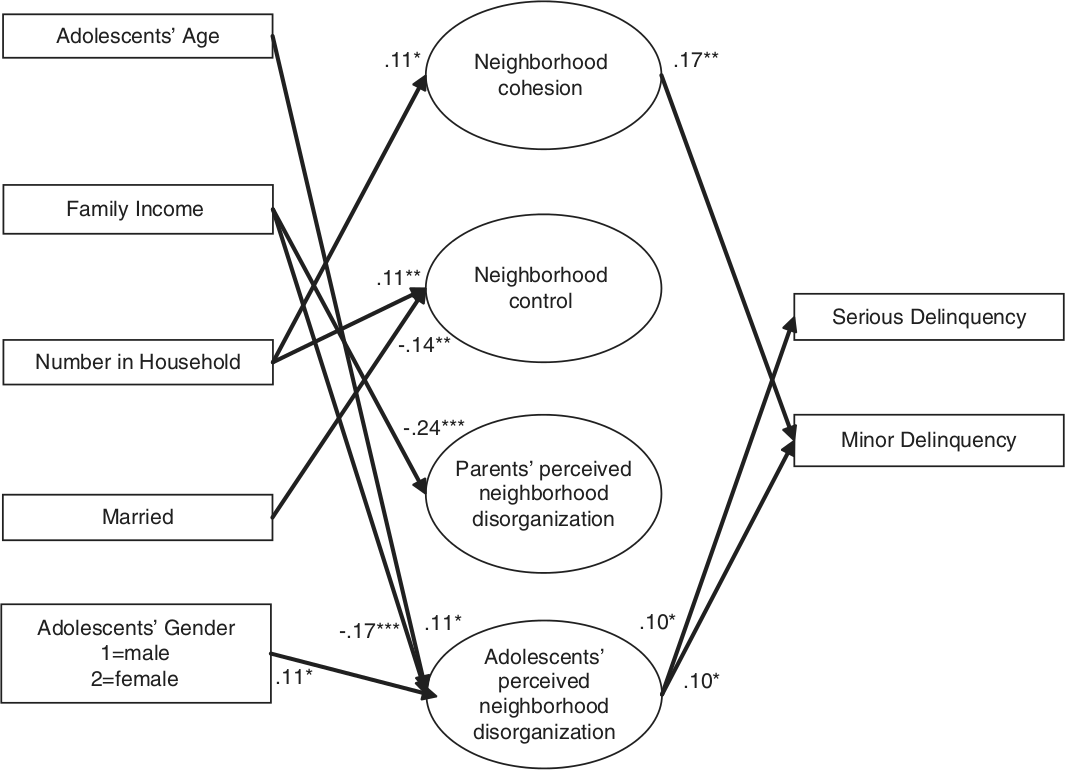
Final structural model of perceived neighborhood social cohesion, social control, disorganization, and adolescent behaviors.
Final Structural Model.

Discussion
Findings suggest that both neighborhood disorganization and social cohesion are related to adolescent delinquency for Thai youth. Adolescent, but not parent, perceptions of greater neighborhood disorganization were associated with increased rates of both minor and serious delinquency, consistent with prior research (Dupéré et al., 2007; Lambert et al., 2004; Leventhal & Brooks-Gunn, 2000). These findings are consistent with a recent study in the United States (Byrnes, Chen, Miller, & Maguin, 2007) showing the importance of adolescent neighborhood perceptions, as compared with parents’, in predicting delinquency. Adolescents’ own perceptions of neighborhood problems may be more important for their problem behavior as reflective of their exposure or even involvement in these neighborhood elements. In addition, as teens age, parental supervision declines (Patterson & Stouthamer-Loeber, 1984) and parents may be unaware of the neighborhood influences on their teens. Alternatively, parents and adolescents might interpret the same neighborhood characteristics differently. Even if parents perceive their neighborhood as low in disorganization, adolescents might still perceive high disorganization, which could lead to problem behavior.
Surprisingly, higher neighborhood cohesion was related to increased levels of minor delinquency. However, this study only assessed social cohesion through parental reports, and adolescents’ perceptions of social cohesion may have been different. Findings are in contrast to theoretical conceptualizations of social capital (Coleman, 1988) and to prior U.S. studies showing community cohesion to be protective of problem behaviors (Feinberg, Chilenski, Greenberg, Spoth, & Redmond, 2007). However, findings are similar to a study showing that adolescents in “disconnecting” neighborhoods, which include low cohesion as a characteristic, have less antisocial behavior (Seidman et al., 1998). There are a few possible explanations for this. Adults in neighborhoods with high cohesion may provide less active monitoring, as they may feel the neighborhood is safer and that their neighbors are watching out for each other. Alternatively, the reverse may be true, in that cohesion may be a proxy for greater monitoring by community members, and so youth may be more likely to get caught engaging in delinquent behaviors. Findings are also consistent with explanations that the resource developed through cohesion can be used toward producing social disorder as well as social good (Portes, 1998; Portes & Landolt, 1996). As an example, researchers have noted that in gangs, members exchange resources and are expected to follow group norms, while maintaining tight social bonds but unhealthy and/or criminal behavior result (Portes & Landolt, 1996; Takahashi & Magalong, 2008).
Neighborhood social control was unrelated to outcomes. This differs from findings in the United States that indicate adolescents in neighborhoods with higher levels of social control have more prosocial competence and conventional friends and less problem behavior (Elliott et al., 1996) or affiliation with deviant peers (Brody et al., 2001). Again, the social cohesion and control variables were assessed through parental report, yet perhaps the adolescents’ own perceptions of social control matter more than those of parents’, as found in some studies (Brody et al., 2001). Findings may also be explained due to differences in neighborhood structure and composition in Bangkok than in the United States.
None of the neighborhood variables were related to adolescent substance use, in contrast to prior studies (Duncan, Duncan, & Strycker, 2002; Lambert et al., 2004). Possibly, neighborhood influences are not important to Thai adolescent substance use. However, neighborhood characteristics may also indirectly affect substance use by first affecting delinquency, as overall problem behavior is often related to later substance use (Taylor, Malone, Iacono, & McGue, 2002; van den Bree & Pickworth, 2005). Longitudinal studies of Thai adolescents may shed light on this progression.
Neighborhood variables were also unrelated to peer deviance. This finding is inconsistent with past research showing that collective efficacy and neighborhood disorganization are related to peer deviance (Chung & Steinberg, 2006; Rankin & Quane, 2002). Peer deviance rates were low, however, and this may explain the lack of relationships. In addition, in Thailand peer deviance may be related to different neighborhood variables than measured in the United States. Alternatively, peer deviance in Thailand may mostly take place outside of neighborhood areas.
Background variables were also related to neighborhood perceptions. Consistent with prior research, higher family income was related to less perceived neighborhood disorganization (Chuang et al., 2007). In contrast to prior research (Sampson & Raudenbush, 2004), being married was related to lower perceived neighborhood control. Findings also showed that a greater number of residents in the household was related to greater perceptions of neighborhood control and cohesion. It is possible that families from larger households know more of their neighbors through other household members, which may lead to the development of close ties and sharing of expectations for behavior in the neighborhood. Older adolescent age was also related to greater perceived disorganization. As teens get older, parental supervision decreases (Patterson & Stouthamer-Loeber, 1984) so these teens’ exposure to disorganization may increase as they explore the neighborhood more on their own. Female adolescents also perceived more disorganization. This may be because they feel more vulnerable and so interpret neighborhood characteristics as more of a risk than males do.
There are limitations to these findings. Specifically, the cross-sectional nature of the data currently limits conclusions regarding causality. However, longitudinal data collection underway on this project will help shed light on the directionality of findings. In addition, the present study used U.S.-based constructs to measure social capital, and a more intensive, qualitative study might be able to identify more specific cultural contextualized measures of social capital important to the Thai culture. Another limitation is the collection of social cohesion and social control data from parents only. Parents may be able to more accurately report about the social cohesion and control of the neighborhood as it affects teens. However, future studies should collect these data from adolescents as well, as their perceptions may also be important. Nevertheless, findings from this study are important, as to our knowledge no studies have examined effects of neighborhood social capital in Thailand. This study represents an initial step in showing the importance of considering the neighborhood context in prevention programming for Thai adolescents.
Findings contribute to the literature by demonstrating the importance of both neighborhood disorganization and social cohesion for adolescent delinquency. Prevention strategies should target disorganization, such as neighborhood clean-up efforts and improving safety. Programs should also focus on helping adolescents manage risks and help parents find ways to increase protective strategies in such areas. However, since adolescents’ perceptions of disorganization, but not parents’, were related to youth risks, programs should help parents become aware of how their teen views their environment and what stressors they are exposed to in their neighborhood. Increased parental awareness of neighborhood stressors for youth might increase their protective behaviors (Hartos & Power, 1997). Findings also suggest that preventive strategies focus on helping communities determine how to make use of existing neighborhood social cohesion in a manner that benefits residents. For example, social ties could be used to form neighborhood watch associations or to help supervise neighborhood youth.
In addition, this is the first study of which we are aware that examines relationships between specific neighborhood characteristics and Thai adolescents’ problem behaviors. Results show that similar to findings in the United States, risk factors in the neighborhood context are related to Thai adolescents’ problem behaviors. Effect sizes are also similar to those found in U.S. studies (Leventhal & Brooks-Gunn, 2000). Specifically, in this study, neighborhood variables account for about 2% to 3% of the variability in adolescent behaviors. Findings have importance for informing prevention strategies for Thai youth and suggest that the importance of the neighborhood context remains across different cultures and populations. In implementing prevention strategies in Thailand, community members would need to be involved in adapting strategies that take into account the cultural norms and infrastructure that might facilitate or create barriers to implementing such strategies.
Footnotes
Acknowledgements
The authors extend their thanks to Michael Todd for statistical advice.
Authors’ Note
The content is solely the responsibility of the authors and does not necessarily represent the official views of the National Institute on Alcohol Abuse and Alcoholism or the National Institutes of Health.
Declaration of Conflicting Interests
The author(s) declared no potential conflicts of interest with respect to the research, authorship, and/or publication of this article.
Funding
The author(s) disclosed receipt of the following financial support for the research, authorship, and/or publication of this article: Research for and preparation of this manuscript was supported by NIAAA 1R01AA015672-01A1 “Youth Alcohol Use and Risky Sexual Behavior in Bangkok.