




Abstract
Erikson (1950) contends that the physical changes associated with puberty serve as a catalyst for adolescents to question childhood identifications and to consolidate these with current self-conceptions, personal ideologies, interpersonal values, and future aspirations. Erikson describes the adolescent identity crisis as the developmental period when identity development becomes salient. For males, pubertal changes have implications for sexual identity development and self-perceptions of masculinity, which are aspects of the identity exploration and integration process that occurs during adolescence. This study is an examination of the impact of age, grade, and physical development on male identity development. A purposive sample of 173 Anglo-American male participants in Grades 6 through 12 completed the Petersen Development Scale and The Extended Objective Measure of Ego Identity Status (EOM-EIS) in their homes. Statistical analyses revealed that physical development shared more variability (20% explained) with the identity measure than either age (8.3%) or grade (4.2%). Advanced physical development correlates with lower Foreclosure scores and higher Moratorium and Achievement scores. These findings are consistent with Erikson’s life span theory of psychosocial development.
Erikson (1950) outlined eight developmental stages that summarize psychosocial development from birth to death. Beginning with the first stage (trust vs. mistrust) and progressing sequentially through the eighth (ego integrity vs. despair), personality is shaped and reshaped in accordance with the resolution of each stage-specific crisis. Successful resolution of a given stage is evidenced by a favorable ratio (adaptive) of inner (psychological) and outer (social) influence. Erikson’s fifth stage (identity vs. role confusion) is largely a result of an individuals’ concern “with what they appear to be in the eyes of others as compared to what they feel they are” (p. 261). For Erikson, the identity crisis is facilitated/exacerbated by the physiological changes that occur during puberty.
Clinicians and researchers have struggled to understand the complexities of identity development as outlined by Erikson (1950, 1968). Researchers have developed several operational procedures for assessing identity (Berzonsky, 1989; Grotevant & Adams, 1984; Marcia, 1966), and identity specific paradigms that claim kinship to Erikson’s fifth stage (Berzonsky, 1988; Marcia, 1966) have precipitated lively debates (Cote & Levine, 1988a, 1988b; Waterman, 1988).
To date, Marcia’s (1966) interpretation of Erikson’s fifth stage, which emphasizes the importance of exploration and commitment to identity development, has been the most popular. Indeed, Marcia’s conceptual model and method of measurement has attained paradigm status. Marcia operationalized four identity statuses to characterize identity resolution. Statuses are derived by examining levels of exploration and commitment in the areas of dating, friendship, recreation, sex roles, occupation, politics, religion, and life philosophy. Accordingly, (strong) commitment following a period of active (high) exploration is designated as Identity Achievement; (strong) commitment and little or no exploration is characteristic of Foreclosure; weak commitment combined with little or no exploration denotes Identity Diffusion; and, a period of active (high) exploration combined with weak commitment defines Moratorium.
Although Marcia’s paradigm has been criticized for failing to mirror Erikson’s description of identity formation (Cote & Levine, 1988b), real and imagined discrepancies have done little to damage the popularity of this paradigm. In fact, a great majority of identity studies conducted over the past 40 years have assessed Marcia’s identity statuses, and, in general, findings from these studies tend to support Erikson’s description of identity formation.
Waterman (1993), a proponent of the identity status perspective, contends that identity develops through a series of “progressive developmental shifts” (p. 44), as evidenced by movement from a lower level identity status such as diffusion or foreclosure to a higher level identity status (moratorium and achievement). Transitions from diffusion or foreclosure to moratorium or from moratorium to achievement, for example, represent progressive developmental shifts. Longitudinal data tend to support the existence of these progressive developmental shifts in identity development (Berzonsky & Adams, 1999; Meeus, Iedema, Helson, & Vollerbergh, 1999).
According to Berzonsky and Adams (1999) “people are born diffused. . . . Foreclosure occurs when children become attached and identify with primary caregivers, prompting the internalization of expectations, restrictions, values, and the like—a parentally determined self-structure is formed” (p. 11). Thus one would assume that the dominant identity status among children and early adolescents—just prior to the onset of puberty, which, according to Erikson, may necessitate a change in identity—would be Foreclosure. Several studies provide partial support for this assumption. For example, Archer (1982) interviewed 6th, 8th, 10th, and 12th graders and reported that “diffusion and premature foreclosure were the principal identity statuses expressed among the early adolescents” (p. 1555). Other studies, too, have found that diffusion and foreclosure is common among early adolescent and adolescent samples (Jones & Hartmann, 1988; Jones & Streitmatter, 1987; Streitmatter, 1993).
Both Erikson and proponents of the identity status paradigm share the conviction that pre- and early adolescent identity is primarily a reflection of commitments formed through identification with significant adults. Erikson’s (1968) description of school-age children (e.g., Stage 4—Industry vs. Inferiority) is remarkably similar to descriptions of the foreclosed identity status.
Individuals in the foreclosure status have not actively questioned alternatives, but they have made a commitment which they will strongly defend. This commitment is typically an extension of the values or expectation of significant others which are accepted without consideration of alternatives. (Archer, 1982, p. 1551)
What is the catalyst for questioning these early identifications and prompting movement from Stage 4 (Industry vs. Inferiority) to Stage 5 (Identity vs. Role Confusion)? According to Erikson (1950), it is the physical changes associated with the onset of puberty: “In puberty and adolescence all sameness and continuities relied on earlier are questioned again, because of the rapidity of body growth which equals that of early childhood and because of the entirely new addition of physical genital maturity” (p. 227). Thus, the somatic changes associated with pubertal development correspond with a change in social expectations, opportunities, relationships, and responsibilities. These psychosocial changes reduce the utility of parental identification as a means for self-definition, thus forcing one to reconstruct a meaningful sense of self (the essence of identity development). For proponents of the identity status paradigm, relinquishing identifications with parents and significant adults would be evident in lower levels of foreclosure (i.e., unquestioned commitments are reexamined and/or relinquished) and higher levels of moratorium (active and purposeful identity exploration) and achievement (commitment following purposeful identity exploration).
Pubertal change also affects self-perception and interpersonal relationships. Adolescent males who physically mature early tend to experience added expectations for more mature behavior from adults (Savin-Williams, 1995). Increased athletic ability or enhanced physical features associated with pubertal change may facilitate male adolescents’ acceptance or status among peers. In contrast, late maturing male adolescents tend to be more psychologically immature and often show lower ego development (Lindfors et al., 2007). Other studies have shown that boys who experience delayed puberty feel more negatively about their sexual identity compared with boys who experience average (or on time) pubertal maturation (Flannery, Rowe, & Gulley, 1993; Miller, Norton, Fan, & Christopherson, 1998). Pubertal change also has implications for sexual identity development and self-perceptions of masculinity (Frankel, 2004), which are aspects of the identity exploration and integration process. Puberty may provoke adolescent males to actively explore their changing identity.
Identity Development
Much literature has documented relationships between the development of identity and age/grade. In fact, Kroger, Martinusses, and Marcia (2010) identified 565 studies (published from 1966 to 2005) that provide data relevant to developmental patterns associated with Marcia’s ego identity statuses. From these, Kroger et al. selected 71 studies to include in a meta-analysis with the goal of documenting developmental trajectories. Regardless of measurement (viz.: identity status interview, Marcia, 1966; EIS, Adams, Shea, & Fitch, 1979; EOM-EIS, Grotevant & Adams, 1984; EOM-EIS-II, Adams, Bennion, & Huh, 1989; DISIO-O, Dellas & Jernigan, 1981; DISI-O.R.P., Dellas & Jernigan, 1987) or research design (longitudinal designs with categorical assessments; cross-sectional designs with categorical assessments; or cross-sectional designs with continuous assessments), findings generally showed that foreclosure and diffusion decreased over time while achievement tended to increase over time, as one would expect given Erikson’s description of identity formation.
Notably, of the 71 studies included in the meta-analysis (Kroger et al., 2010), a great majority (n = 53) were conducted using high school (n = 16) and/or university-aged participants (n = 37) only; few of the studies included participants who were likely to be in the beginning and early stages of pubertal development. The youngest participants involved in these 71 studies were 11 years old (represented in only two studies), and in three additional studies the youngest participants were aged 12. All of the studies used age and/or grade as a proxy for maturity, and none of the studies measured physical maturation. Given the wide range of variation in the onset and completion of the pubertal process (Tanner, 1962), age is likely to be an inferior measure of physical maturation, especially among adolescents who are 10 to 20 years of age.
Interestingly, researchers have not examined the impact of pubertal change on identity status development. Instead, they have opted to employ age and/or grade as a proxy for maturity despite (a) Erikson’s beliefs regarding the importance of physical change to the process of identity development and (b) the extent of interindividual variability in terms of onset, duration, and extent of pubertal change (Tanner, 1962). In accord with Erikson’s writings, we expected that pubertal development would be relevant to identity development, more so than either age or grade. In addition, in line with beliefs shared by both Erikson and proponents of the identity statuses, we anticipated that advanced pubertal development would correspond with lower levels of foreclosure (i.e., a loosening of unquestioned commitments/identifications), higher levels of moratorium (exploration of options to replace relinquished identifications), and an increase in achievement (strengthening commitments following examination of alternatives).
Method
Sample and Procedures
This study employed a purposive sample; we recruited participants based on their sex (male) and presumed levels of pubertal development (viz., pre, transitional, and post puberty). Initially, adolescent males from two public middle schools and four public high schools (including one alternative or continuation high school) were invited to participate in the study. Thirty-five of the 95 middle school students who expressed interest actually participated (36.8%), and 89 of the 240 high school students who volunteered actually participated (37.1%). Given the intent of our research, and the low number of early adolescent participants (n = 35), we actively recruited additional participants from six local Boy Scout troops. This effort resulted in an additional 49 participants, all attending Grades 6 through 9 (n = 49), from a total 103 eligible participants (47.6%).
Adolescent males (n = 438) who expressed interest to their teachers, principals, and scout leaders were given a packet of materials (which included an informed consent form, a participant version of the questionnaire, and two candy bars as an incentive). Participants were instructed by their teachers and leaders to take the packet home and then, with their guardian (preferably male), to read and sign the informed consent form if they agreed to the conditions and were willing to participate. The packet also included a brief description of the study and instructions for participation.
Participants were instructed to complete the survey and to place the completed survey back in the packet. Each guardian, too, completed the Peterson Development Scale (PDS) to rate his son’s level of development. These assessments were also placed in the packet. Each adolescent participant then returned the packet (containing the adolescent’s completed questionnaire and the guardian’s completed PDS) to his teacher or scout leader. A total of 438 packets were distributed, and 173 were completed and returned. The final participation rate was 39.5%.
Grades 6 through 12 were represented within the sample, with about half of the participants (48.6%) enrolled in Grades 6 through 9 and remaining participants enrolled in Grades 10 through 12. The median age was 15.54. A majority (70.6%) of these predominantly Anglo-American adolescent males reported that their families were intact (i.e., living with both biological parents); 11.4% resided in step-families, and 10.2% resided with a single parent.
Measurement
We used a questionnaire to obtain information regarding each participant’s age, grade, pubertal development, and identity status level.
Peterson Pubertal Development Scale (PDS)
The PDS (Petersen, Crockett, Richards, & Boxer, 1988) provides a brief assessment of pubertal development. Five statements access specific physical changes: body hair, voice change, growth spurt, facial hair, and skin changes. In past research, alpha coefficients for this measure have ranged from .68 to .83, with a median of .77. Petersen and colleagues (1988) compared the PDS with physician ratings of physical development and reported correlations ranging between r = .61 and r = .67. Similarly, the Sexual Maturation Scale (SMS), a self-report measure in which adolescents rate their own physical development based on drawings or pictures they view, also correlates well with the PDS (r = .72 to r = .80). These findings support the construct validity of the PDS.
The Extended Objective Measure of Ego Identity Status (EOM-EIS)
Grotevant and Adams (1984) developed the EOM-EIS, a paper-pencil instrument that measures Marcia’s (1966) four identity statuses according to four ideological and four interpersonal subscales. This measure yields a score for each status across ideological and interpersonal domains (4 statuses × 2 domains = 8 scores) and a score for each status across eight content areas (viz., Dating, Friendship, Recreation, Sex Roles, Occupation, Politics, Religion, and Life Philosophy; 4 statuses × 8 content areas = 32 scores).
The self-report questionnaire is easily administered and responses are scored with a Likert-type response format. The EOM-EIS has been used with college (Grotevant & Adams, 1984), high school (Jones & Hartmann, 1988), and junior high school (Jones & Streitmatter, 1987) samples. Adams et al. (1989) summarized 13 studies whose authors estimated internal consistency using Cronbach’s alphas. The median alpha for all of the studies for each of the four subscales was .66. Studies assessing test-retest reliability had a median correlation of .76. Previous estimates of reliability for the EOM-EIS are adequate.
Results
We computed Cronbach’s alpha coefficients to examine the internal consistency of the PDS. The five-item measure yielded a Cronbach’s alpha coefficient of .85 (N = 165). This estimate compares favorably with estimates reported by Petersen and colleagues (1988). The alpha of .85 indicates that the participants who responded to the PDS items were consistent in their responses to pubertal change associated with the physical characteristics of body hair, voice change, skin change, growth spurt, and facial hair. Guardians, too, rated the physical development of their sons by completing the PDS (α = .91). The correlation between guardian’s and son’s PDS scores was r = .68, which is comparable with findings reported in the original Petersen et al. (1988) study in which the PDS was correlated with other measures of physical development (such as physician ratings; r = .61).
Using data obtained for this study, we generated the following alpha coefficients for the four EOM-EIS scales: (a) Diffusion, .76 (N = 140); (b) Foreclosure, .82 (N = 143); (c) Moratorium, .80 (N = 146); and (d) Achievement, .82 (N = 152). These reliability estimates are comparable with those reported by Jones and Streitmatter (1987), who also used the EOM-EIS to assess identity among early adolescents and reported the following Cronbach alpha coefficients: (a) Diffusion, .52; (b) Foreclosure, .80; (c) Moratorium, .74; and (d) Achievement, .77.
To examine construct validity, we also generated correlations between the EOM-EIS subscales. The achievement and moratorium scales were more strongly related (r = .53) than were the achievement and foreclosure scales (r = .32). The strongest relationship occurred between the two “uncommitted” scales, Moratorium and Diffusion (r = .78). An examination of coefficients of determination demonstrates that the values generated by Jones and Streitmatter (1988) are similar to the values obtained in this study. For example, when comparing the scales of Achievement and Diffusion, Jones and Streitmatter (1988) reported an r2 = .19 (19%); the shared variance in this study between the same two subscales yielded r2 = .16 (16%). The Achievement and Diffusion scales measure different constructs, and correlation coefficients in this study reflect that phenomenon. However, evidence also exists to support the convergence for constructs that are theoretically related. For example, the scales of Achievement and Moratorium, both reflecting exploration of alternatives, yielded coefficients that evidence some overlap. Jones and Streitmatter (1988) reported r2 = .27 for these two scales; in this study, the two scales generated a shared variance of r2 = .28. Therefore, we observe that these correlation coefficients and coefficients of determination provide evidence of construct validity and compare favorably with findings that have been reported previously.
The primary purpose for conducting this study was based on the assertion that age and grade are only loosely related to pubertal development, and thus, given Erikson’s emphasis on pubertal development as a catalyst for identity development, age and grade are not necessarily sufficient for provoking a change in identity. As a result, by conducting this study, we sought to establish a balance in our understanding of the factors that precipitate identity change. Certainly, as suggested earlier, this balance has not yet been established; until now, relations between identity development and pubertal development have not been investigated.
In this study, age and grade correlated at r(166) = .92 (84.3% common variance). Pubertal development correlated with age, r(159) = .68 (46.2% common variance), and with grade, r(159) = .65 (42.3% common variance). Hence, the rationale for examining relationships between pubertal development and identity development appears valid.
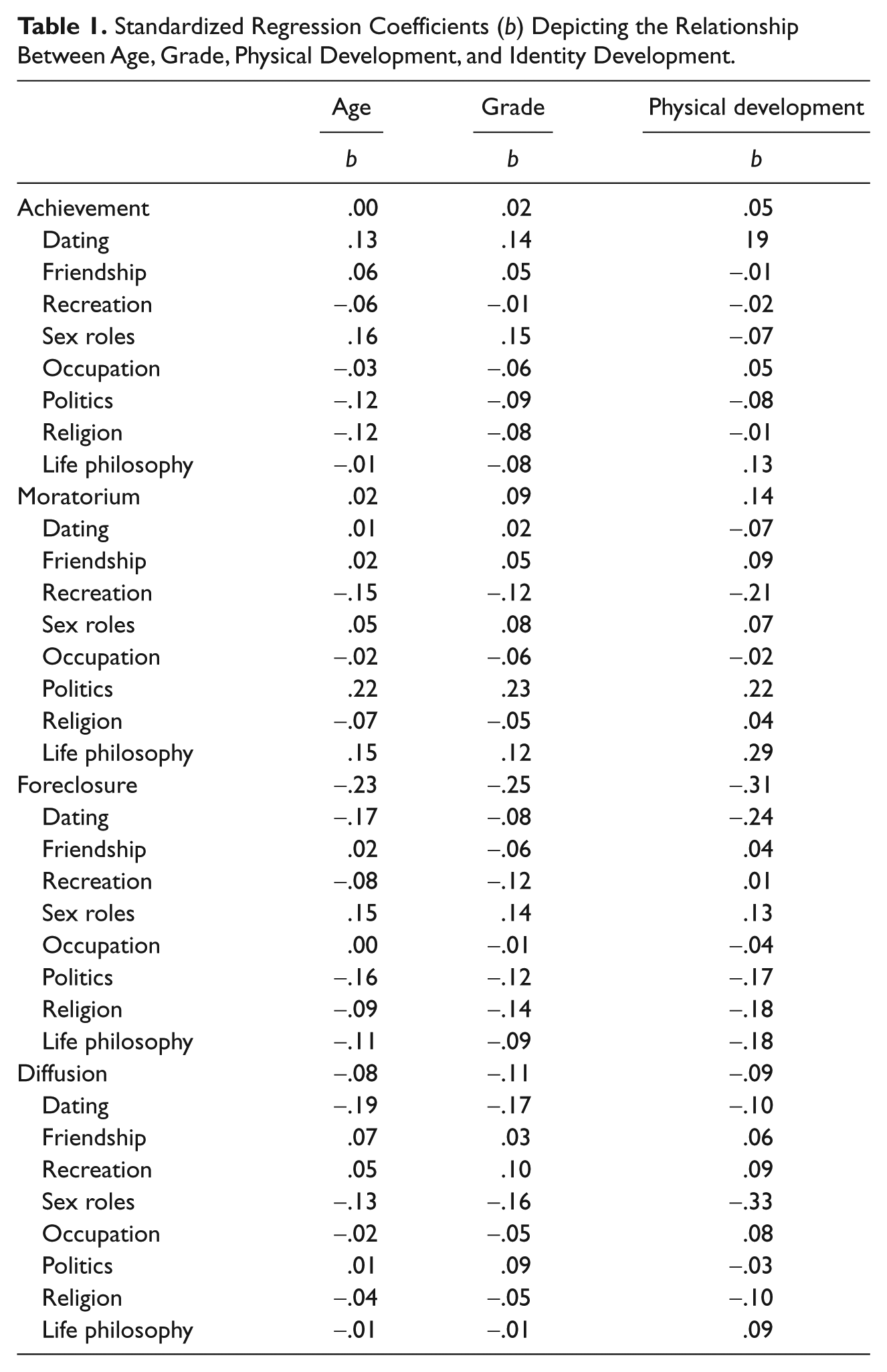
Table 1 summarizes standardized regression coefficients from six analyses. Three of the analyses used all 32 content-area status scores to summarize relationships between age, grade, and physical development; and three of the analyses used the four total identity status scores to summarize relationships between age, grade, and physical development. For all six analyses, we entered identity variables simultaneously (one step) to obtain profiles of identity development for age, grade, and physical development. The analyses that used total identity status scores produced the following findings.
Standardized Regression Coefficients (b) Depicting the Relationship Between Age, Grade, Physical Development, and Identity Development.
Age
The relationship between the four total identity status scores and age was statistically significant, F(4, 158) = 2.85, p = .026, R2 = .067. As shown in Table 1, the negative relationships between foreclosure and diffusion with age (b = −.23 and b = −.08, respectively) summarize this relationship fairly well. Hence, foreclosure and diffusion scores decrease with advancing age.
Grade Level
The analysis of grade level produced findings that mirrored those found for age. These findings are not surprising given that grade and age correlated at r = .91. The resulting variance ratio, F(4,158) = 2.78, p = .028, and R2 = .066 between grade and the total identity status scores were similar to the findings reported above for age. The pattern of relationships was also similar, with lower levels of foreclosure and diffusion corresponding with advancing grade level (b = −.25 and b = −.11, respectively). Unlike the analysis that used age, grade level was also associated with a small increase in moratorium scores (b = .09).
Physical Development
Physical development was related to lower levels of foreclosure and diffusion (b = −.31 and b = −.09, respectively) and higher levels of moratorium and achievement (b = .14 and b = .05, respectively). Physical development and identity development yielded an R2 = .086, F(4,151) = 3.56, p = .008.
Collectively, of the three analyses summarized above, physical development produced the most theoretically compatible solution. Physical development, more so than either age or grade, is associated with movement away from less sophisticated forms of identity development and movement toward more advanced forms of identity development. Clearly, physical development is an important, if not vital, factor in explaining ego identity development. Compared with the age and grade analyses, physical development shared more variability with the identity measures, and it was also associated with larger decreases in foreclosure and larger increases in both moratorium and achievement.
Regression coefficients for identity status by content comparisons (also reported in Table 1) show that age is most related to political moratorium (b = .22), dating diffusion (b = −.19), dating foreclosure (b = −.17), political foreclosure (b = −.16), and sex role achievement (b = .16). Increments in grade level are associated with increases in political moratorium (b = .23) and sex role achievement (b = .15) and decreases in dating diffusion (b = −.17) and sex role diffusion (b = −.16). Physical development is related to increases in life philosophy moratorium (b = .29), political moratorium (b = .22), and dating achievement (b = .19), and decreases in sex role diffusion (b = −.33) and dating foreclosure (b = −.24). These findings indicate that advancing age, grade, and physical development translate to more sophisticated ideologies and movement away from more elementary values and beliefs.
The identity status content analyses reported above were replicated using stepwise entry criteria to identify content areas that best predicted each of the three measures of maturity (age, grade, and physical development). As shown in Table 2, when the identity status content areas were correlated with respondent age using a stepwise selection criterion, only two of the identity measures were included, F(2, 160) = 7.25, p < .001. Advancing age was associated with decreases in foreclosure in both the dating (b = −.19) and political (b = −.16) content areas. Combined, these two variables share 8% of the variability with age. When we entered grade level as the dependent variable, only religious foreclosure (b = −21) emerged as a statistically significant correlate, F(1, 161) = 7.09, p < .01, R2 = .04. Finally, the analysis that examined identity status content areas in relation to physical development revealed that 20% of the variability was shared with four of the identity content area scales, F(4, 151) = 9.59, p < .001. Physical development was associated with lower levels of foreclosure in both the dating (b = −.26) and religious (b = −.21) content areas, lower levels of diffusion with regard to sex roles (b = −.33), and higher levels of exploration (moratorium) in the life philosophy content area (b = .39).
Regression Results (Stepwise) Summarizing Relationships Between Age, Grade, Physical Development, and Identity Status Content Area Scales.
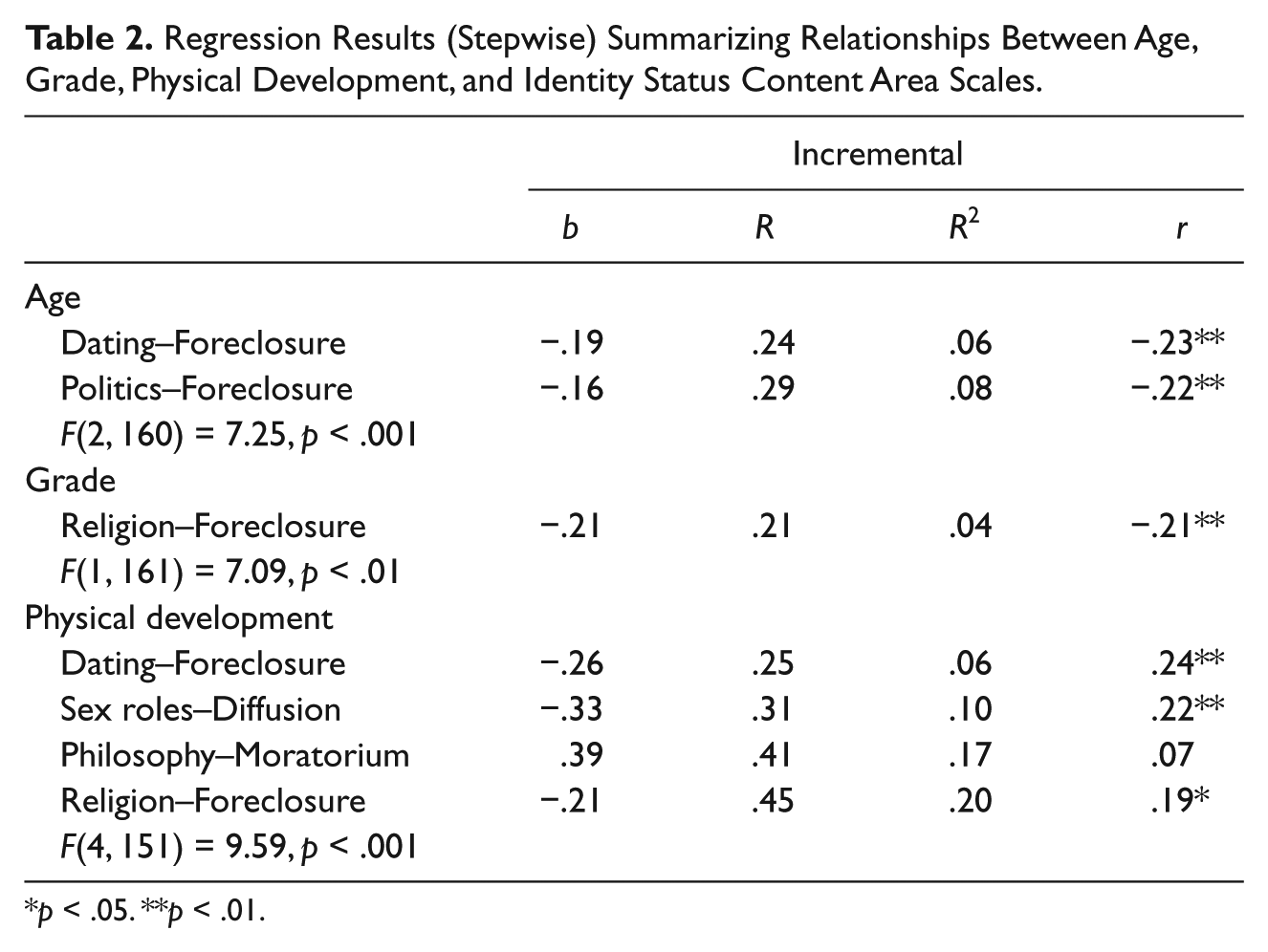
p < .05. **p < .01.
The results of these analyses are instructive: Physical development and identity development share 20.3% common variance, compared with 8.3% and 4.2% for the age and grade comparisons, respectively. Maturity (including physical development, age, and grade) was related to advanced identity development as measured by the EOM-EIS. Maturation was associated with lower levels of foreclosure (overall, and in the specific content areas of dating, political ideologies, and religious beliefs) and lower levels of diffusion (overall, and in the specific content area of sex roles), and in some instances, higher levels of moratorium (specifically in the content area of life philosophy).
Summary and Discussion
This study demonstrates that among male adolescents, advancing physical maturity corresponds with a loosening of commitments and identification with parental expectations and values. All three measures of maturity (physical development, age, and grade) were related to lower levels of identity foreclosure and diffusion. However, physical development was most consistent with identity development as evidenced by lower scores for the less sophisticated identity statuses (foreclosure and diffusion) and higher scores for moratorium (a more sophisticated identity status). These findings are consistent with Erikson’s (1968) writings and others (Berzonsky & Adams, 1999) who suggest that (a) earlier stages of psychosocial development (viz., Stage 4—Industry vs. Inferiority) are characterized by identification with parents (descriptions that are similar to Marcia’s profile of foreclosed identity status) and (b) puberty is an important catalyst for identity development.
Of particular interest are relationships between physical development and specific content domains assessed within the four identity statuses (see Table 1). The largest content domain negative relationships within lower level statuses (foreclosure and diffusion) emerged for sex roles (diffusion), dating (foreclosure), religion (foreclosure), life philosophy (foreclosure), and politics (foreclosure). Positive relationships observed within the more advanced identity statuses were fairly consistent within the same content domains, including life philosophy (moratorium), politics (moratorium), and dating (achievement). These same patterns were expressed in total identity status scores, according to which physical development was associated with lower levels of diffusion and foreclosure and higher levels of moratorium and achievement. In other words, each of these findings provides support for Erikson’s contention that the physiological changes associated with puberty provoke change—possibly change in one’s social milieu (social opportunities, relationships, and responsibilities) thus rendering parental identification less useful as a means of self-definition.
In addition, support for Waterman’s (1993) assertion that identity develops through “progressive developmental shifts” (p. 44) from low-level identity statuses (i.e., foreclosure and diffusion) to higher level identity statuses (i.e., moratorium and achievement) was found to be mediated by physical development. Although continuous scores, rather than categorical data, were used in our analyses, our findings are consistent with previous studies that have reported a developmental progression (Kroger et al., 2010) as well as studies showing (Cote & Levine, 1988b) diffusion and foreclosure as the dominant statuses for early adolescents and adolescents still in high school (Archer, 1982; Jones & Hartmann, 1988; Jones & Streitmatter, 1987; Streitmatter, 1993).
These findings are somewhat limited by the ethnic homogeneity of the sample and the cross-sectional design which was used to infer developmental change in identity but did not actually assess change within individuals over time. Nevertheless, researchers seeking to examine identity development and/or to validate Erikson’s writings in the future should assess physical development instead of, or in addition to, age and/or grade. Findings from this study confirm theoretical assertions made by Erikson and contemporary identity researchers regarding the salience of male physical development as a catalyst for identity development. The purposive sample included an appropriate age range of participants that spans the time period in which pubertal changes are likely to occur within males. Longitudinal studies that follow children through this developmental phase may more clearly illustrate this relationship in males as they actually experience pubertal change. Although this study sample was predominately Anglo-American, it may be useful to compare results of similar or future studies of male identity development in ethnically diverse samples. This would allow for an examination of ethnicity as a potential additional influence on male identity development. Finally, although we designed this study to examine male identity development in relation to age, grade level, and physical development, studies that include both males and females would allow for gender comparisons.
This study uniquely contributes to the identity literature by documenting a direct link between physical development and identity development. As Kroger et al. (2010) found, few studies have included samples with participants young enough to capture ongoing pubertal change, and none specifically involved a comparison of physical development to identity development. This study shows that associations between identity development and physical development are much stronger than are relationships found between identity development and age or grade. It may be useful for parents, educators, and other professionals who work with male youth to be aware that pubertal change is associated with changes in interaction patterns with adults (e.g., less time spent with adults, less disclosure, decreased perceptions of acceptance, increased conflict). These normative developmental processes may put youth at risk for greater peer conformity and weaken their acceptance of adult perspectives and expectations. Furthermore, evolving patterns within family structures indicate that more males are growing up without a permanent father or father figure; pubertal change may signal the need for increased male adult support or role models in the lives of male youth, as they not only negotiate physical changes associated with puberty but also sense who they are, which includes their emerging male identity.
Footnotes
Declaration of Conflicting Interests
The author(s) declared no potential conflicts of interest with respect to the research, authorship, and/or publication of this article.
Funding
The author(s) received no financial support for the research, authorship, and/or publication of this article.