



Abstract
The transition to adulthood has received the attention of scholars, practitioners, and policy makers in recent years. For some, the transition is an extended period during which commitments to adulthood institutions are delayed, termed emerging adulthood. For others, the transition is brief and commitments to adulthood institutions begin without delay, termed accelerated adulthood. Institutions play an important role in accumulating advantages or disadvantages for individuals, influencing the likelihood of an emerging or accelerated adulthood. This article introduces an institutional framework that explores the link between institutional forces and individual outcomes. This article proposes the concept, institutional constellation, which is the specific set of institutions operating in an individual’s life, and their lived experience of/within that institutional constellation. The degree of integration within the institutional constellation and the degree to which the institutional constellation is aligned to dominant social norms influence the resources that will accumulate advantages or disadvantages for an individual.
Introduction
The transition between adolescence and adulthood has become the focus of researchers across disciplines (Arnett, 1998, 2000; Côté, 2000; Furstenberg, Rumbaut, & Settersten, 2005), and has received attention from program designers and policy makers (Altshuler, Stangler, Berkley, & Burton, 2009; Wald & Martinez, 2003; The William T. Grant Foundation Commission on Work, 1988). The transition to adulthood, termed emerging adulthood by Arnett (1998, 2000), is often an extended transition period characterized by detachment from social institutions of childhood (e.g., school and family of origin) and tentative attachments to institutions of adulthood (e.g., work and family formation). Some youth, however, lack the resources and supports necessary to experience an extended transition period and instead must immediately commit to adulthood institutions, a process referred to in this article as accelerated adulthood. In today’s social and economic context, emerging adulthood allows individuals time to acquire additional and necessary capital before making deliberate choices about adulthood commitments. Therefore, those youth who do not experience an extended transition period are at a disadvantage, and in this way are marginalized as they take on adult roles.
Examining the lives of those who experience accelerated adulthood through an institutional perspective can draw attention to structural processes that result in their marginalization. Although the body of work on marginalized youth during the transition to adulthood typically refers to “vulnerable” youth, this article uses the term “marginalized” to emphasize the role that structural forces play in contributing to their condition as vulnerable. This article focuses on two primary, but not necessarily exhaustive, groups of individuals who reside at the margins although there is overlap between the two. One group includes those reared in environments with limited resources, which may foreclose their opportunity to engage in an emerging adulthood. A second group includes youth who are of minority status, such as ethnic or sexual minorities. Normative institutions often do not provide the same support to minority youth that their peers from the dominant groups experience. While some marginalized individuals are able to navigate a transition period with weakened institutional attachments, they must overcome challenges to do so while others struggle in an accelerated adulthood without sufficient guidance and resources. Understanding the experiences of marginalized individuals can provide important information about how to design institutional structures that can better serve everyone, thus creating more socially just institutions.
This article consists of two main sections. The first section presents a review of the literature on the transition to adulthood. The second section begins with a brief primer on institutional theory. Although there are numerous institutions that operate within our lives, this article focuses on the institutions that socialize young people through childhood, adolescence, and the transition to adulthood. These institutions include, but are not limited to, the institutions of family, education, and the State embodied in public institutions such as the child welfare or juvenile justice system during childhood and adolescence; postsecondary education and the market economy during the transition period; and marriage, parenthood, and the market economy in adulthood. Following the primer, this article introduces an institutional framework consisting of five propositions that explore the link between institutional forces and individual outcomes. Suggestions for measuring proposed concepts are also discussed throughout the article to guide future work testing this framework. This article ends by discussing the potential of this institutional framework to inform future policy and research.
The Transition to Adulthood: A Review of Literature
A rich body of work has developed around the transition to adulthood period consisting of three major perspectives: (a) a developmental perspective, focused on experiences of the individual and establishing this period as a distinct developmental stage termed emerging adulthood (Arnett, 1998, 2000); (b) a structural perspective, focused on documenting altered demographic trends and the structural factors that have led to these shifts (Côté, 2000; Fussell & Furstenberg, 2005; Stanger-Ross, Collins, & Stern, 2005); and (c) a focus on the transition to adulthood experiences of marginalized youth (Collins, 2001; Osgood, Foster, & Courtney, 2010; Osgood, Foster, Flanagan, & Ruth, 2005). Individuals are completing education and beginning a career, establishing an independent household, getting married, and having children at a later age as compared to individuals coming of age midcentury (Bynner, 2005; Settersten, Furstenberg, & Rumbaut, 2005). Researchers have identified two parallel processes that contribute to these demographic trends: individualization and destructuralization (Côté, 2000; Fussell & Furstenberg, 2005; Shanahan, 2000).
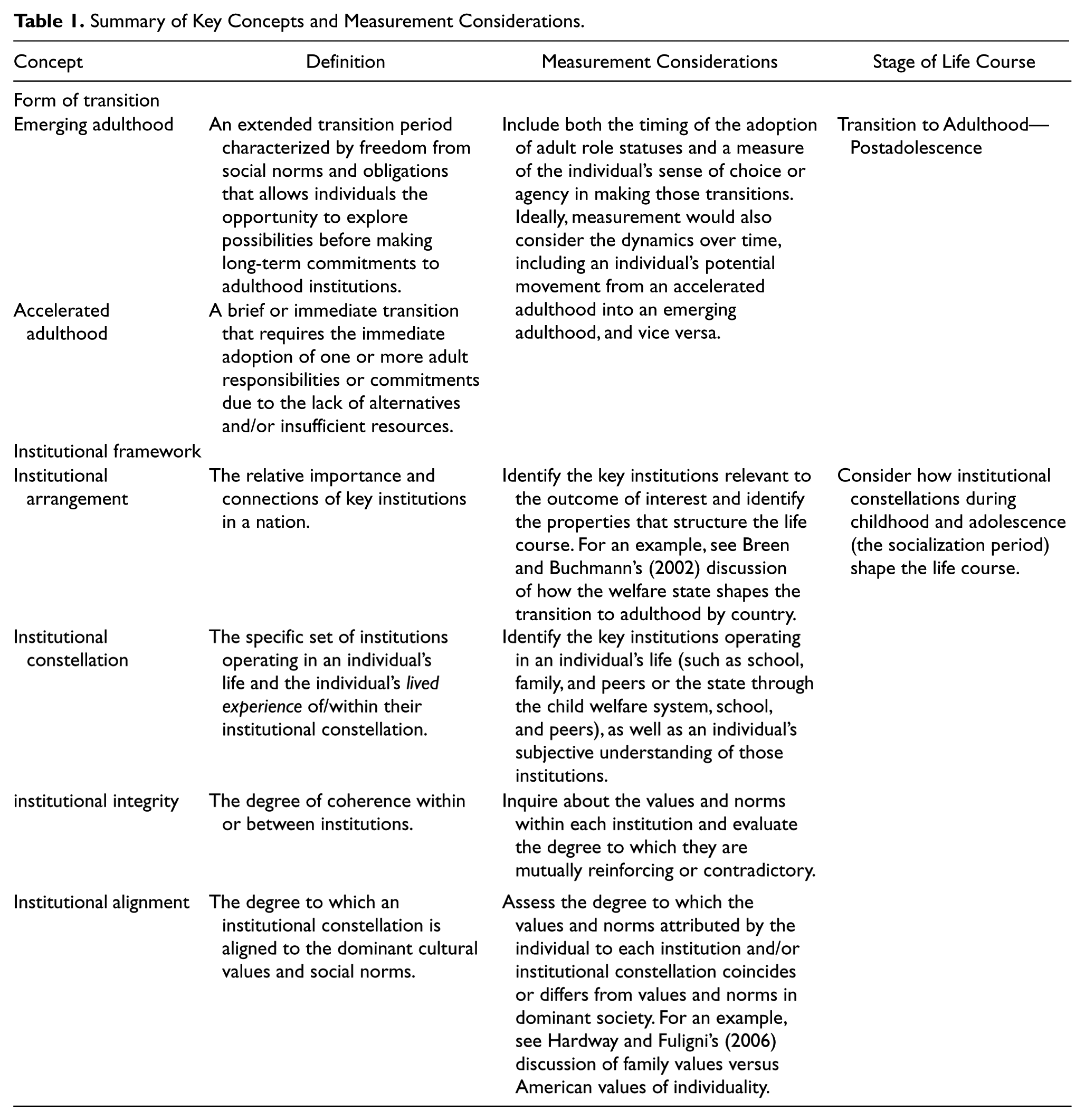
The developmental perspective focuses on individualization, which refers to the ability of each individual to travel on unique pathways through the transition to adulthood (Côté, 2000). Arnett (2000, 2006) distinguishes emerging adulthood from other periods by five main features: identity exploration, possibility, self-focus, feeling in-between (i.e., neither adolescents nor adults) and instability. Thus, the delay of adult commitments allows young people time to experiment with their identities, which may be reflected in seemingly backward motion such as moving from work back to school or from independent living back to living with families (Fussell & Furstenberg, 2005). Individuals in the transition period are also able to focus on themselves to a greater degree than in other developmental periods, such as when they delay commitments to adult roles to spend time abroad. They also experience instability as they switch jobs, romantic partners, and residences more often than in other developmental periods (Arnett, 2006). This article uses the term emerging adulthood to refer to an extended transition period characterized by freedom from social norms and obligations that allows individuals the opportunity to explore possibilities before making long-term commitments to adulthood. Here, the characterization of emerging adulthood is applied to understanding the transition to adulthood as a process. See Table 1 for a summary of key concepts.
Summary of Key Concepts and Measurement Considerations.
The structural perspective focuses on destructuralization, which refers to weakened social patterns and diminished uniformity of the transition to adulthood (Côté, 2000). While individualization refers to micro-level processes, destructuralization refers to macro-level processes (Côté, 2000). Current institutional patterns result in weakened social control and norms during the transition to adulthood period in comparison to other periods (e.g., adolescence or adulthood), contributing to tremendous heterogeneity during this period (Arnett, 2006). Previously paired institutional transitions, such as the transition from education into work, leaving the family of origin to marriage, and marriage to parenthood, are now decoupled resulting in increased options and possibilities (Côté, 2000).
Researchers from a structural perspective have contextualized the extended transition period by linking demographic trends to larger economic and social forces. The recent shift from a manufacturing to service-oriented base in the United States has resulted in jobs that pay less, are less stable, and provide less potential for growth for high school graduates than within a manufacturing economy (Fussell & Furstenberg, 2005). Meanwhile, the real costs of housing have risen as home loans have become more difficult to obtain (Stanger-Ross et al., 2005). A typical starting salary for a high school graduate cannot cover housing and medical insurance alone, making the transition into adult roles after high school difficult (Furstenberg et al., 2005). The inability for young people leaving adolescence and high school to become financially independent is a common explanation for emerging adulthood.
A Second Form of Transition: Accelerated Adulthood
Although the joint processes of individualization and destructuralization allow many individuals to benefit from an extended transition period, empirical evidence indicates that emerging adulthood is not a universal experience. For example, studies based on samples from Michigan, Minnesota, and Washington state report that emerging adulthood is experienced by about 42% to 58% of their respective samples (Mortimer, Staff, & Lee, 2005; Oesterle, Hawkins, Hill, & Bailey, 2010; Osgood, Ruth, Eccles, Jacobs, & Barber, 2005). This suggests that conceptualizing the transition to adulthood solely in terms of emerging adulthood provides a limited understanding of the contemporary transition to adulthood. This article takes a broader perspective by conceptualizing two forms of transition: an extended or accelerated version. Accelerated adulthood requires the immediate adoption of one or more adult roles due to limited alternatives and/or insufficient resources. It is important to note that some individuals in emerging adulthood may choose to adopt early adult roles rather than choosing an extended transition, and this reflects a healthy process of individuation (Cohen, Kasen, Chen, Hartmark, & Gordon, 2003; Tanner, 2006). However, those in accelerated adulthood do not have a choice; they are constrained to adopting at least one, though not necessarily all, early adult roles. Although there is heterogeneity in both emerging adulthood and accelerated adulthood, the key distinction between these two forms of transition is the ability of the individual to make choices about when and how they will make the long-term commitments of adulthood (Hendry & Kloep, 2007).
Although emerging adulthood and accelerated adulthood may look similar at a point in time, individual experiences can differ substantially. In a qualitative study, Blustein and his colleagues (2002) compared the experiences of individuals in upper and lower socioeconomic statuses who had made early transitions to full-time work. They found that individuals in the upper SES reported an increased sense of self-concept crystallization through their work and active career exploration, while individuals from the lower SES described work in terms of survival, reporting fewer resources and increased difficulties (Blustein et al., 2002). These substantive differences continue to play out over time (Macmillan & Copher, 2005). Thus the timing of adoption of role statuses may be an observable but incomplete means of measuring emerging or accelerated adulthood. As noted in Table 1, including a measure of whether an individual is constrained to or has chosen the immediate adoption of various adult social roles, as well as including a time dimension will provide a more accurate measurement of these two forms of the transition to adulthood.
Extant studies examining the relationship between marginalized social statuses (e.g., race or socioeconomic status) and pathways to adulthood indicate that such factors are related to an increased likelihood of accelerated adulthood in comparison to their peers (Berzin & De Marco, 2010; Bynner, 2005; Cohen et al., 2003; Macmillan & Copher, 2005; Mahaffy, 2004; Oesterle et al., 2010; Schoen, Landale, Daniels, & Cheng, 2009). For example, Berzin and DeMarco (2010) find that poor youth are more likely to leave home before age 18 and more likely to become parents before age 25. Similarly, higher parental income and educational attainment are related to higher educational attainment and a lower likelihood of childbearing by age 30 (Guldi, Page, & Stevens, 2007). Additionally, Black women are more likely to become single parents by age 24 than White women, controlling for their mother’s education level (Schoen et al., 2009).
This may raise the question as to whether an extended transition period is critical for positive adult outcomes. There are some individuals who experience an extended transition period but are struggling during this period (Hendry & Kloep, 2007; Mortimer et al., 2005). At the same time, there are some individuals who have no choice but to adopt adult roles early and do so successfully, such as 36.3% of the former foster youth who transitioned into adult roles by age 23 or 24 in spite of reported economic and housing hardships (Courtney, Hook, & Lee, 2010). However, the evidence suggests that an accelerated adulthood poses more challenges than an emerging adulthood and continues the process of accumulated disadvantage not only for individuals, but for their children as well. For example, leaving the parental home between the ages of 18 and 22 increases the likelihood of poverty (Bell, Burtless, Gornick, & Smeeding, 2007), and early labor force participation and parenthood limit gains to human capital (Berzin & De Marco, 2010; Guldi et al., 2007; Macmillan & Copher, 2005; Mortimer et al., 2005). Early parenthood also increases the risks for negative child outcomes (Berzin & De Marco, 2010; Guldi et al., 2007). Limited gains to human capital is also related to lowered acquisition of other capital, such as social, cultural, and identity capital (Furstenberg, 2006), limiting the overall potential for those who experience an accelerated adulthood. Although developing institutional structures that can support an emerging adulthood for everyone may be ideal, providing structures to support those who experience accelerated adulthood, such as the transition into early parenthood, can make an important difference for many young people and their children who currently receive little or no support.
Although the concept of emerging adulthood accounts for individual variation during the transition period, conceptualizing emerging adulthood as the sole form of transition obscures the role that institutional structures play in constraining individual choice in how the transition to adulthood is lived (Macmillan & Copher, 2005). The sociological life course perspective suggests that factors external to the individual explain more of the individual variation in who would experience an emerging versus accelerated adulthood than individual factors (Mayer, 2004; Mayer & Schoepflin, 1989). For example, in a comparative study between Germany and the United States, Mortimer, Oesterle, and Krüger (2004) find that the transition to adulthood is more uniform in Germany, where institutional structures provide clear guidance for the school-to-work transition, and more variable in the United States, where those with little or no access to postsecondary education receive little institutional support for the transition to work. Additionally, these institutional structures also create incentives for timing in family formation. While individual factors play an important role in shaping the transition to adulthood, focusing on institutions can help highlight structural mechanisms that may be operating to constrain or encourage individual development during the transition period.
The transition to adulthood period is a prime window of opportunity since individuals have the opportunity to take on new roles in new contexts throughout multiple domains (Masten et al., 2004; Schulenberg, Sameroff, & Cicchetti, 2004; Tanner, 2006). The complete set of role and context transitions may be stressful and challenging for some, but for others it may be an escape from previous dysfunctional contexts (Schulenberg, Bryant, & O’Malley, 2004). Although improved institutional structures during the transition period cannot guarantee that accumulated disadvantage during childhood and adolescence can be overcome, the potential rewards for intervention are significant. Just as criminologists have documented that employment, marriage, and parenthood can positively alter individual trajectories (Crutchfield & Pitchford, 1997; Kreager, Matsueda, & Erosheva, 2010; Laub & Sampson, 2003; Sampson & Laub, 1990), the successful establishment of an individual within a set of adult institutions can help individuals overcome earlier disadvantages or deviate from prior dysfunctional developmental trajectories, thus increasing the likelihood of a positive pathway through adulthood.
A Primer on Institutional Theory
From an institutional perspective, the transition to adulthood is characterized by a period of “freedom from institutional guidance” (Arnett, 2006, p. 308). The fluidity in institutional attachments occurs between the individual’s graduation from institutions of childhood and their long-term commitment to institutions of adulthood. In the case of emerging adulthood, this institutional fluidity is extended, empowering individuals to define their own transition into adulthood, while in the case of accelerated adulthood, the fluidity is brief or may not occur at all. The critical task for the transition to adulthood is to make attachments to institutions of adulthood such as the labor market and family formation (e.g., marriage and parenthood) without requiring the intervention of public institutions such as the criminal justice or child welfare systems. The transition to adulthood is significant since it is the first opportunity for most individuals to exercise choice about their attachments to social institutions.
According to institutional theory, institutions provide the structures that allow individuals to interact and thus, enable society to function as a whole (North, 1990). The definition for institution used in this article is anchored in North’s (1990) definition: “[i]nstitutions are the rules of the game in a society or, more formally, are the humanly devised constraints that shape human interaction” (p. 3). Not only do rules forbid behaviors, but they also permit or require behaviors (Ostrom, 1990). Institutions are the evident social structures that embody the values and norms of society (Portes, 2006) and are responsible for imparting those values and norms to each new generation, functioning as a primary mechanism of socialization (Messner & Rosenfeld, 2007). Some childhood institutions approach socialization by providing scripts for interaction (e.g., public education and foster care system), while others attempt to eliminate behaviors by limiting interaction, thus serving as mechanisms of social control (e.g., juvenile and criminal justice systems; Clemens & Cook, 1999).
To gain a more comprehensive picture of the ways in which institutions shape the transition to adulthood, it is crucial to consider experiences of populations at the margins. In his early work, Arnett (1998) noted that his focus was on those he believed “[set] most of the norms and standards and [hold] most of the positions of political, economic, and intellectual power” (p. 296). However, such an exclusive focus contributes to existing power structures by continuing to privilege one set of experiences while obscuring the institutional forces that guide these individuals into emerging adulthood. Institutions are shaped by those who are able to influence the design of those institutions, and thus advantages for themselves become incorporated in those structures (North, 1990). For example, cultural capital specific to the dominant class, such as linguistic patterns and knowledge dispositions, are infused in the educational system, and conformity to these norms is rewarded (Mahaffy, 2004). Over time, these advantages are reinforced to become an integral part of key institutions while power inequalities continue to accumulate (Pierson, 2004; Portes, 2006). These power differentials become invisible as advantages become more firmly entrenched in institutions (Pierson, 2004). Studying marginalized populations and adopting an institutional perspective can help direct attention toward the power differentials embedded within social structures while enabling marginalized youth to define their own experiences of the transition to adulthood.
The next section presents an institutional framework to explain who is more likely to experience emerging adulthood and who is more likely to experience accelerated adulthood, culminating in a proposed probabilistic matrix for predicting outcomes for the involvement of public institutions. This framework is an application of an ecological systems model in the conceptualization of individuals as embedded within nested contexts (Garbarino, 1992), and the life course perspective due to the shared emphasis on social context and attention to processes that occur over time (Elder, 1995, 1998), combined with concepts drawn from institutional theory.
An Institutional Framework: Five Propositions
To illustrate the five propositions, examples will be drawn from hypothetical experiences of one marginalized group, immigrant families. Hardway and Fuligni (2006) identify cultural differences between immigrant populations from Asian and Latin American backgrounds, where family responsibility and interconnectedness are valued, and traditional American society, where independence and autonomy are valued. Such a contrast in values will help elucidate each of the following propositions.
Proposition 1: Individuals experience institutional arrangements in unique ways, which is referred to as the institutional constellation.
Institutional arrangement is a macro-level term that refers to the relative importance and connections of key institutions in a nation (see Table 1). The set of institutions depends on the outcome of interest. Analyses of the welfare state take into account the relationship between the economic markets, family, and state, while a discussion of socializing institutions considers education, family, and the market economy (Côté, 2000; Mayer, 2004; Messner & Rosenfeld, 2007). The influence of institutional arrangements is rarely uniform across the population, and thus does not have the same effect on each individual. This article introduces the concept, institutional constellation, a micro-level concept that refers to the specific set of institutions operating in an individual’s life, and also emphasizes the importance of their lived experience of/within an institutional constellation. An individual’s lived experience shapes their subjective map of their institutional constellation. The distinction between institutional arrangement and institutional constellation is depicted in Figure 1 by the large arrow labeled institutional arrangements pointing across the vertical macro-micro line to the representative arrow for one individual’s institutional constellation. Although many people experience the same institutional arrangement (macro) on the left side of the vertical line, the institutional constellation and the rest of the figure on the right side of the line are unique to each individual (micro).

The Relationship Between Institutional Arrangements and Individual Transitions Into Adulthood.
From a micro-level perspective, the concept of institution may be easy to conflate with organization. Individuals are part of a subset of organization(s) that operate within and represents the larger institutional structure. Most individuals do not experience the full extent of any one institution, but rather, experience only a subset of that institution. Thus the family can be considered an institution as the social norms and formal rules that define families, such as what constitutes a family, the purpose of family, and how they operate. However, most individuals are raised within one or a limited number of familial organization(s). An individual’s understanding of the institution of family will be largely defined by their experiences within their own familial organization. However, the concept institutional constellation, rather than an organizational constellation, is important because it provides the conceptual link between the macro-structural factor (i.e., institutional arrangement) and the individual.
In addition to variation in exposure to an institutional arrangement, individual differences arise through the individual’s lived experience of their institutional constellation. While institutions shape the incentives, constraints, and alternatives for individuals (Breen & Buchmann, 2002; Hernes, 1976), each individual develops a subjective map of the world (North, 1990). For example, one sibling in an immigrant family from a family-oriented culture may perceive family obligation as unfair, instead embracing the dominant values of independence and autonomy, whereas another sibling may embrace the norms of family obligation. This has ramifications for the choices they will make during the transition to adulthood, such as whether they will attend school close or far from home, if they will live at home while they attend postsecondary education, and whether they will make a financial contribution to their family as they begin working. Measurement of the institutional constellation involves identifying the key institutions operating in an individual’s life as well as measuring the individual’s subjective experience of those institutions (Table 1).
Proposition 2: As the primary mechanism of socialization, institutions exert a slow, ongoing force on the individual, up to and through the transition to adulthood, and the rest of their lives.
Institutions socialize children and youth through the structures they create for human interaction and the constraints on behavior that they put in place. As a socializing force, institutions exert a slow-moving and constant force on the lives of individuals (Pierson, 2004). These forces accumulate over time, creating a positive feedback process. A positive feedback process is one that supports the status quo; as time elapses, the relative cost of changing courses increases as the benefits to the status quo increase (Pierson, 2004). In the presence of positive feedback, path dependency occurs, where minor differences in initial costs to change paths become large, potentially insurmountable differences over time. In Figure 1, the slow influence of institutions over time is depicted by the six thin arrows emanating from above and below the institutional constellation of childhood arrow. Moving from left to right, the arrows become longer signifying a positive feedback process. The arrows pointing diagonally toward either the top right or bottom right corners indicate path dependency: the distance between the two arrows is smaller on the left side of the figure and larger on the right side of the figure. Thus small socialization differences between two infants, such as socializing a young immigrant child into a heteronormative versus an accepting environment become larger over time. If the immigrant family is involved in a religious group that condemns homosexuality, combined with a sense of obligation to the family, a lesbian, gay, or bisexual child may never fully come to terms with their sexual orientation since doing so means facing the disapproval of the religious group and simultaneously shaming their family. As the individual ages, it may become more difficult for them to come to terms with their sexual orientation, especially if their lived experiences of their childhood institutional constellation lead them to choose similar institutional contexts as they transition into adulthood. Thus the transition to adulthood is significant since it provides individuals with their first legitimate opportunity to exercise agency in constructing their institutional constellations although the ongoing nature of this agency results in dynamic and changing institutional constellations throughout their lives.
Proposition 3: The degree of institutional integrity, alignment to dominant social norms and values, and resources available in the institutional constellation contributes to the level of accumulated advantages for the individual.
Institutional constellations are described through two key characteristics: integrity and alignment (Table 1). Since institutional constellations include multiple institutions, there may be inconsistencies, both within a single institution and between institutions. Institutional integrity refers to coherence within an institution or set of institutions (Clemens & Cook, 1999). An institutional constellation with high integrity reflects coherent and reinforcing support for a child’s socialization process throughout the multiple institutions in the institutional constellation. Institutional alignment refers to the degree to which an institutional constellation is aligned to dominant values and norms.
Children reared in institutional constellations with high integrity will accrue greater levels of advantage and are more likely to experience an emerging adulthood. Each institution in the child’s life works to socialize the child to the same set of cultural values and social norms so that a clear and unified message is delivered by the family, their schools, their religious groups, mass media, and national values. An institutional constellation with high integrity is depicted in Figure 2a, where all the institutions, including marriage, family, labor market, and State are neatly lined up. With a clear and unified set of socializing influences, energy is focused on developing the individual. In contrast, an institutional constellation with low integrity is depicted in Figure 2b, where the institutions are scattered across the figure. In this case, the socializing influence of each institution contradicts and/or works against each other. Institutional integrity may be measured by asking the individual to identify the values and norms associated with each institution in their institutional constellation and evaluating the degree to which the set of institutions are mutually reinforcing or contradictory (see Table 1).
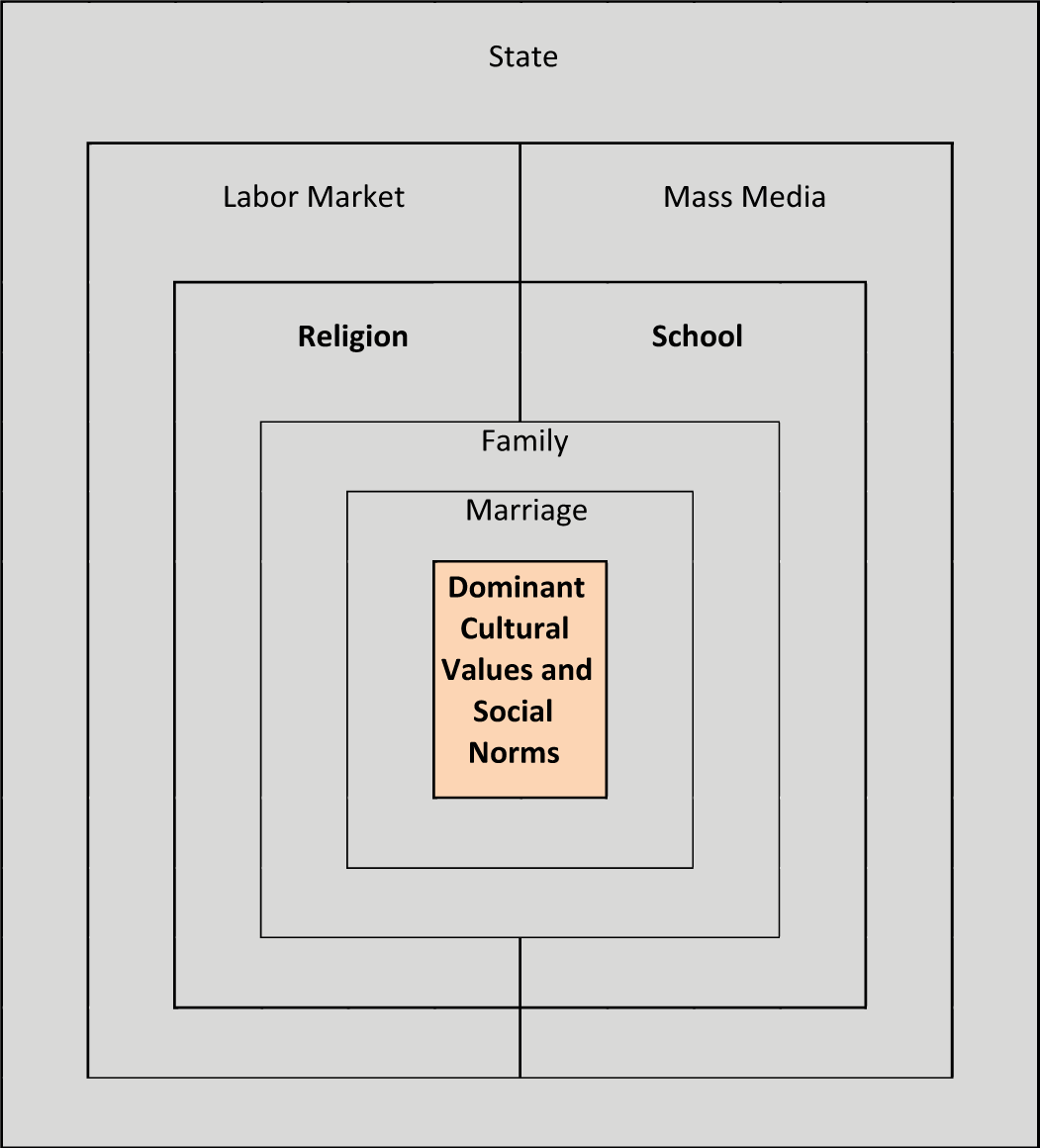
A Highly Integrated Institutional Constellation.
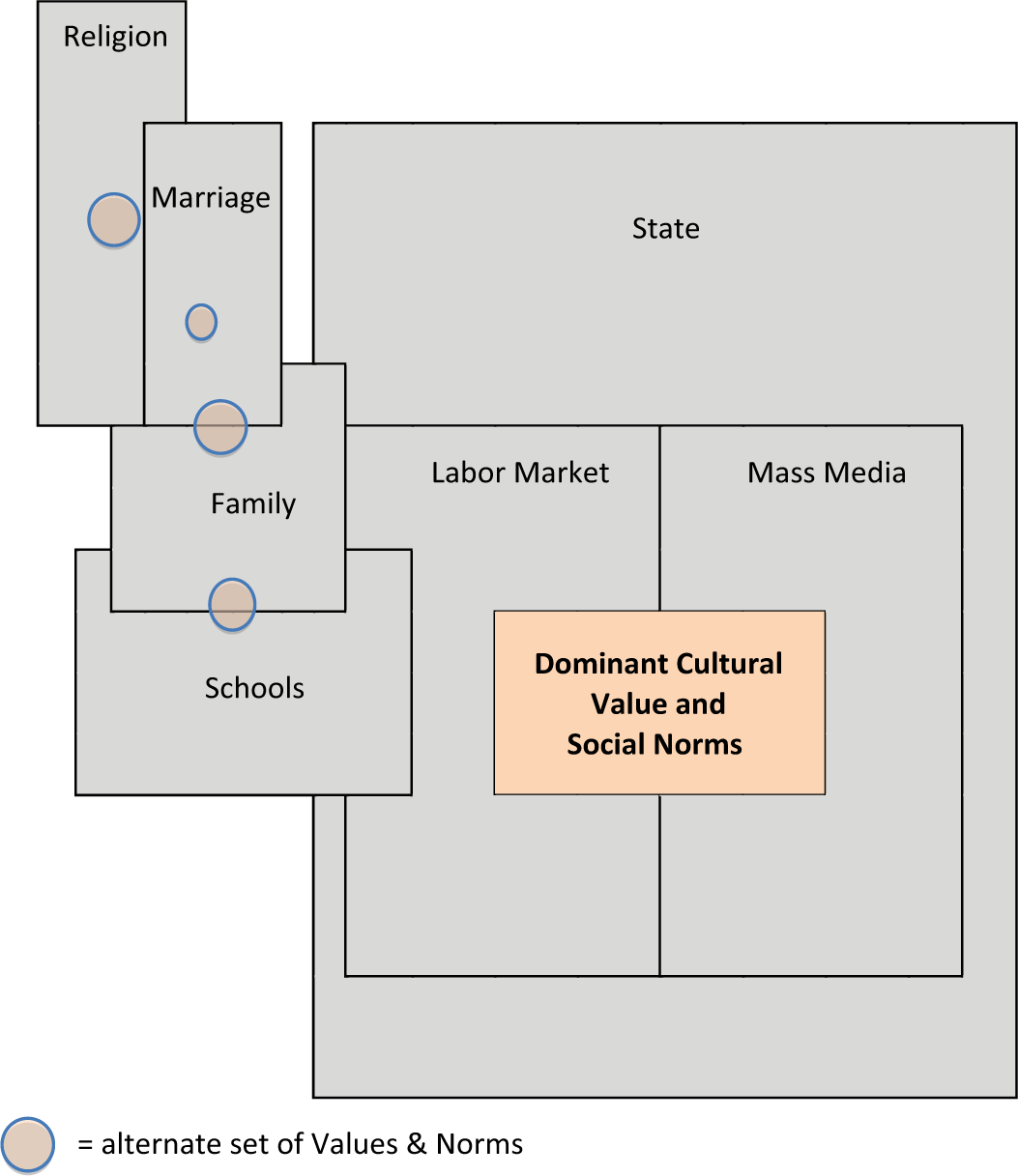
A Minimally Integrated Institutional Constellation.
High institutional alignment will also accrue greater levels of advantage: institutional structure influences individual choice through incentives (Hernes, 1976), so individuals who reside in institutional constellations that socialize them according to dominant social norms will be rewarded. An institutional constellation with high alignment is also depicted in Figure 2a, where each institution is centered on the same set of values and norms. An institutional constellation with low alignment is depicted in Figure 2b, where the schools, family, religion, and marriage are not centered on dominant values and norms, but rather, each are centered on unique values and norms, as represented by the circles in the center of each institution in the figure. An institutional constellation with high integrity but low alignment is possible, such as that of an immigrant child who resides with their family in an ethnic-specific neighborhood and attends the local bilingual school and religious institution. This institutional constellation may demonstrate high integrity since each institution shares the same set of cultural values and social norms. The child may have limited exposure to the institutions of state and labor market, and since their institutional constellation is aligned to nondominant values and norms, demonstrates low alignment. Institutional alignment can be measured by considering the degree to which the values and norms attributed by the individual to each institution and/or institutional constellation coincides or differs from dominant values and norms.
Institutional constellations with high integrity and alignment to dominant values and norms will have higher levels of resources available for their children. For example, a child reared by immigrant parents from family-oriented cultures may forego a scholarship at a prestigious university to remain close to home during the transition to adulthood to take care of their parents (Fuligni, 2007; Rumbaut & Komaie, 2010). Or, using an example drawn from the author’s experiences working at an alternative to juvenile justice program, a 15-year-old Mexican immigrant was expected to work to send money home to his family in Mexico. The youth’s parents did not want him attending school since lower, but immediate, wages were more important for the family than higher but delayed wages. In both cases, these individuals experience disadvantages that are reflected in their work experiences and future job opportunities (human capital), their ability to acquire a diverse social network (social capital), their exposure to important cultural experiences within the dominant culture (cultural capital), and their ability to individuate and thus develop an autonomous identity distinct from their family (identity capital) (Côté, 2002; Furstenberg, 2006; Hardaway & McLoyd, 2009; Mahaffy, 2004).
Proposition 4: The family is at risk for intervention by the state when the institutional constellation is minimally integrated and poorly aligned to dominant values and norms.
Nested institutions refers to the hierarchical relationships between multiple levels of institutions, or rules, where some rules govern other rules (Ostrom, 1990). Deeper rules, such as constitutions, are more difficult to modify while shallower rules are more mutable, such as individual contracts (North, 1990; Ostrom, 1990). Deeper rules are not apparent in everyday life and thus less tangible to the individual, but “underlie, and are inferred from, aspects of everyday behavior” (Portes, 2006, p. 237). The layer that governs all other rules is considered the deepest and most difficult to change, typically the State. In Figures 2a and 2b, the layer of institution is represented by the size of the institution, where the State is the largest and deepest institution, and family and marriage are the smallest and most shallow institutions.
Shallower institutions, such as the family, are at risk for intervention by deeper institutions. The successful functioning of shallower institutions is partially affected by the rules within which they are nested. Shallower institutions will allow for more variability and flexibility in the organizations that arise within those institutional structures, and thus are more reflective of the individual’s values and norms. Deeper institutions are less flexible and less likely to be modified, instead challenging the more shallow levels of institution.
In many instances, the State will intervene in an attempt to redirect the socialization of a young person. An individual reared within a family that is not aligned to the dominant values and norms of the state may be perceived as failing to properly socialize the youth in the eyes of the State. For example, if an immigrant family with strong religious involvement has a child who is lesbian, gay, bisexual, or transgender, the family may not approve of their child’s sexual orientation. If the family also carries cultural norms of corporal punishment and applies these norms to address their child’s perceived disobedience, the parents will find themselves in direct conflict with State child abuse laws. The State is the deeper institution and may remove the child from the family and/or succeed in assimilating the family to a new, no corporal punishment, norm. The resources of the family and individual are diverted toward learning the new norm, and in a sense, the deeper institution works to socialize the individual by resocializing the family.
Proposition 5: The impact of state intervention into the institutional constellation can be predicted by understanding the intervening public institution’s approach to socialization, whether positive or negative, and the individual’s subjective response to the intervention, whether perceived as punishment or opportunity.
The outcome of government system intervention can be predicted using the heuristic of the 2 × 2 matrix, which takes into account the public institution’s approach and the individual’s experiences in their institutional constellation (see Table 2). The public institution may attempt to provide new scripts for behavior, or may attempt to eliminate behavior through punitive means. The individual may interpret the intervention as either an opportunity or a punishment, depending on their lived experiences within their institutional constellation. An individual with an institutional constellation with high integrity and alignment (Figure 2a) is hypothesized to be more likely to interpret public institution intervention as opportunity, whereas an individual with a less integrated and aligned institutional constellation (Figure 2b) is hypothesized to be more likely to interpret public institution intervention as punishment.
Predicted Outcome of Public Institution Intervention.

Thus, in the case of a welfare/supportive intervention by the State, such as the scenario where the LGBT youth is removed from their immigrant family due to corporal punishment and placed in the foster care system, if the youth interprets the intervention as an opportunity, they may move on a positive path toward full social inclusion. However, if that youth interprets the intervention as punishment, they may choose to reject the socialization attempts of the foster care system. Instead, they may run away, and due to their negative experiences in both their family and the State intervention, become silenced in conventional terms and experience alienation.
On the other hand, in the case of a coercive intervention by the state, such as the scenario where the 15-year-old Mexican immigrant youth is picked up due to truancy since he is working rather than attending school, he may interpret his involvement in the juvenile justice system as an opportunity if he is resentful of his obligation to his family. He would experience a turning point toward a more positive path (Inderbitzin, 2009). However, if he interprets the intervention as punishment, especially if he adheres to his immigrant values of family obligation, he is hypothesized to resent the State intervention and continue on a path toward social exclusion as an adult.
These five propositions comprise the proposed institutional framework that seeks to explain how institutions influence individual lives by contributing to accumulated advantages or disadvantages. This accumulation of advantage or disadvantage plays a role in determining who experiences accelerated adulthood or emerging adulthood, and contributes to the individual’s lived experience of their institutional constellation, which in turn shapes their likely reaction to the intervention of public system in their lives.
Conclusion and Implications
The dual processes of individualization and destructuralization during the transition to adulthood presents the opportunity for youths who experience an emerging adulthood to reach for their full potential, but those who face an accelerated adulthood may not experience such benefits. This institutional framework seeks to understand how institutional dynamics influence the form of an individual’s transition to adulthood. This framework provides a perspective that situates an individual’s development within a structural context, and the concepts of institutional constellation and the individual’s lived experience places an individual at the center of a constellation of power structures designed to shape individuals as they develop into adults. Power differentials are incorporated into institutional design (Portes, 2006), so that examining institutional contexts can reveal the ways social structures contribute to the marginalization of certain groups and may reveal implications for policy. The concept of power has been more fully explored and debated elsewhere, but is beyond the scope of this article. For a succinct summary of the literature about power as pertaining to institutional theory, see Pierson (2004) or Portes (2006).
This framework suggests that when designing programs and policies to address potential difficulties during the transition to adulthood, attention should be paid to the long-term forces that have been operating through institutions to advantage or disadvantage young people. Attention to the subtle dynamics of power structures within the lives of youth transitioning to adulthood can help inform effective policies. For example, in considering how postsecondary educational institutions can be modified to address the needs of nontraditional students as discussed by Brock (2010), understanding whether and how institutional constellations operate in the lives of young adults to encourage or discourage their matriculation in higher education can help inform policy design. For postsecondary institutions that matriculate immigrant youths, supporting the values of family obligation that students may carry can be accomplished by providing evening or weekend classes, or reducing commuting through fewer but longer class sessions so that individuals can work and/or care for their families.
This institutional framework also provides implications for future empirical endeavors. Such a research agenda includes operationalizing the concepts of emerging and accelerated adulthood, developing measures of institutional integrity and alignment within an institutional constellation, and examining whether and how institutional integrity and alignment contribute to an individual’s transition to adulthood as well as linking these to later adult outcomes. Conducting research with this framework may help elucidate potential institutional modifications that can help encourage positive pathways into adulthood and thus may help provide young people with the socialization experiences they need to become productive and participatory adults.
Footnotes
Declaration of Conflicting Interests
The author(s) declared no potential conflicts of interest with respect to the research, authorship, and/or publication of this article.
Funding
The author(s) received no financial support for the research, authorship, and/or publication of this article.