




Abstract
This article reports on a qualitative study of youth interviews representing different types of other-oriented purpose. In order to better understand youth contribution, differences in the directness of responses to community needs were examined in youth who demonstrated other-oriented purpose. Implicit theories about the world and other people were investigated as potential determinants of these different types. First, results supported a relation between incremental world theories and indirect-response other-oriented purposes. Second, results showed that participants with direct-response other-oriented purposes displayed evidence of either entity or incremental theories. Agency and compassion are suggested as explanations for why implicit theories functioned differently between the identified types of other-oriented purpose.
Within the field of positive youth development, contribution is considered a sign of adolescent thriving (Lerner, Dowling, & Anderson, 2003). Contribution is motivated by a concern for others and commitment to the social good (Sherrod & Spiewak, 2008). This requires understanding the self as, in part, responsible for the well-being of others. Youth who recognize this act out of concern for others. They may become purposeful about life goals that contribute in some positive way, and, eventually, develop purposes that are other-oriented. In order to understand how young people develop towards the type of positive contribution exemplified in other-oriented purpose, I examined young people’s theories about others and the world, and the development of other-oriented purpose.
Young people exhibit purpose when they develop and act upon stabilized goals that are personally meaningful and contribute to the world beyond the self (Damon, 2008, p. 33; Damon, Menon, & Bronk, 2003). Here, I focused on youth with other-oriented purposes. These types of purposeharness the individual’s own interests and talents to increase the well-being of others through responding to community or world needs. My claim is that variation in types of other-oriented purpose may relate to individuals’ thoughts about change and growth in the world and people. Youth actions in the community may depend on the degree to which they believe their actions will be efficacious. Implicit theories refer to individual’s beliefs about whether people and the world are changeable (Chiu, Dweck, Tong, & Fu, 1997; Dweck, Chiu, & Hong, 1995). Here, I explore the dynamics of implicit theories in young people with purpose in two other-oriented purpose categories: those directly addressing community needs (direct-response), and those indirectly addressing community needs (indirect-response).
Young people bring implicit theories into each of their experiences (Chiu et al., 1997; Dweck et al., 1995). An implicit theory is a belief taken for granted about something (e.g. intelligence, personality) before any other evaluations are made. Implicit theory research is well developed in areas related to intelligence. It has been shown that the degree to which a young person thinks his or her intelligence is fixed (an “entity”) or malleable (“incremental”) influences academic choices, effort and achievement. Those endorsing incremental theories of intelligence experience a wide range of positive benefits, from upward trajectories in math grades (Blackwell, Trzesniewski, & Dweck, 2007) to a greater likelihood of choosing more challenging tasks (Dweck, 1999). In these cases, children and youth are not explicitly thinking about the nature of their intelligence. Instead, theories of intelligence are implicit—always right under the surface—influencing choices and actions in a variety of domains.
Relevant to this study were implicit theories about the world and other people. Like in the domain of intelligence, young people may evaluate the world and other people using entity or incremental theories (Chiu et al., 1997; Dweck et al., 1995). Entity theorists hold fixed views of the world and other people, whereas incremental theorists hold growth-oriented and malleable views. These theories potentially influence other-oriented purpose in the following way; the young person may form a purpose that reflects the level of efficacy for changing others and the world suggested by his or her implicit theories. Who or what the young person thinks he or she can influence might impact the locus of his or her other-oriented purposeful intentions.
Purpose
I investigated other-oriented purpose as a focused form of youth contribution, which, again, may require an identity that sees the self as responsible for others. Purposeful young people act to accomplish something that is both meaningful to the self and influential to the world beyond to self (Damon, 2008, p. 33). Purpose is related to identity, but distinct from it (Damon et al., 2003); Identity answers the question of, “Who am I,” whereas purpose answers the question of “Why am I” (Yeager & Bundick, 2009, p. 6). The young person who develops an other-oriented purpose recognizes that he or she is—the answer to the “why” question—because she finds purpose in responding to the needs of the other. Analyzing case exemplars of purposeful youth, Bronk (2011) found that pursuing purpose helped young people better define themselves and find their place in a broader social context (an identity task). Here, I investigated the degree to which that process of finding one’s place (and influence) in the broader social context is related to implicit theories concerning the world and other people.
Forms of Purpose
The analysis reported here grew out of the work of the Stanford Youth Purpose Project (SYPP). The SYPP interviewed 249 youth between the ages of 11 and 22 concerning their most important hopes and goals in life. The description of the forms and categories of purpose presented here grew out of that work, and is measured across three dimensions: intention, engagement, and beyond-the-self reasoning (Moran, 2009). The form is the primary designation of the degree to which the young person engages his or her purpose, based on those three dimensions (Moran, 2009). Forms include those who are purposeful, pursue self-oriented life goals, dreamers, dabblers, and drifters. Two forms are characterized by beyond-the-self intentions—the dreamers and the purposeful. These were the only two forms utilized in this study. The purposeful individual exhibits all of the elements in the aforementioned purpose definition. Dreamers are like purposeful individuals in the beyond-the-self component of their goals, without stable and long-term engagement. Importantly, both youth who are purposeful and dreamers have already identified a specific content to their purpose—a specific “something” toward which they move.
Categories of Purpose
Each individual in the initial SYPP research was also coded for a category of purpose. The 17 SYPP categories of purpose describe the aforementioned content of an individual’s purpose. I used categories of purpose to determine which participants (from the dreamers and purposeful) qualified as other-oriented. The SYPP categories of “help others,” “change the way people think” and “make the world a better place” were selected as other-oriented forms of purpose. As is addressed in detail in the methodology, these were transformed into two new categories: direct-response and indirect-response.
Direct-response and indirect-response categories of purpose
The differences between direct-response and indirect-response other-oriented purposes were rooted in Westheimer and Kahne’s (2004) descriptions of participatory and justice-oriented citizens. Their participatory citizens, whose characteristics inspired the direct-response category of other-oriented purpose, address community needs through activities like book drives and volunteering in shelters. I utilized the term direct response instead of “participatory” in order to highlight how participants in this category were proximally involved with those in need. In contrast, Westheimer and Kahne’s justice-oriented citizens examine the underlying causes of needs in their communities, and focus on social movements and structural change. Their efforts are often less proximal to the people they are serving. Likewise, individuals in the indirect-response category responded to needs in less proximal ways (e.g., changing people’s minds, educating others), though they did not always qualify as “justice-oriented,” in Kahne and Westheimer’s sense of the term.
Implicit Theories
Implicit theories were a key construct in considering variation between direct-response and indirect-response other-oriented purposes. Dweck et al. (1995) outline an implicit theory as one that may be poorly articulated or inexplicitly identified by the individual, but that influences thoughts and actions in life. These theories may vary across domains (e.g. self, others, world), and can be divided into two categories. An entity theorist in a particular domain believes that the target domain is generally fixed and unchangeable. An incremental theorist tends to believe that the target domain is malleable.
Beliefs about changeability have been shown to effect how people interact with others and understand their moral responsibilities. Implicit theories about other people influence how children evaluate other children, and how likely they are to volunteer and associate with people in need (Erdley & Dweck, 1993; Heyman & Dweck, 1998; Karafantis & Levy, 2004). Additionally, implicit theories about the world are associated with the way individuals understand their moral obligations (Chiu et al., 1997). Taken together, these results laid the foundation for this study’s area of inquiry.
Recall that the differentiation between direct-response and indirect-response other-oriented purposes is largely found in the proximity of the analysis and response to the identified need. The aforementioned research on implicit theories suggests that beliefs about changeability influence how one analyzes a problem and the target of one’s response. Therefore, I thought beliefs about the changeability of other people and the world would be an important construct in differentiating the types of other-oriented purposes. Entering the period of analysis, I remained agnostic concerning the specific nature of the relations.
Method
To investigate the possible relations between implicit theories and other-oriented purposes, I was granted permission by the SYPP primary investigator to examine interviews from the previously referenced SYPP study. I obtained IRB approval for continued analysis of the SYPP interview data through an extension of the time frame of the SYPP protocol. I was already included as a researcher on the protocol, and collected no new data.
The SYPP data included transcripts of semistructured interviews of 270 youth between the ages of 11 and 22, 147 of whom were interviewed twice (2006 and 2008, approximately 18 months apart). SYPP researchers randomly selected interview participants from participating schools. The interview asked questions about important goals, values and supports in life (Andrews et al., 2006). In the SYPP work, youth were classified by a minimum of two coders into forms, which denote the degree to which one is purposeful, and categories, which are broad descriptions of types of goals (Malin et al., 2008). There were three total coders, including the author. All three coders reached agreement (Cohen’s Kappa = .70) on 10% of the interview sample.
Sampling
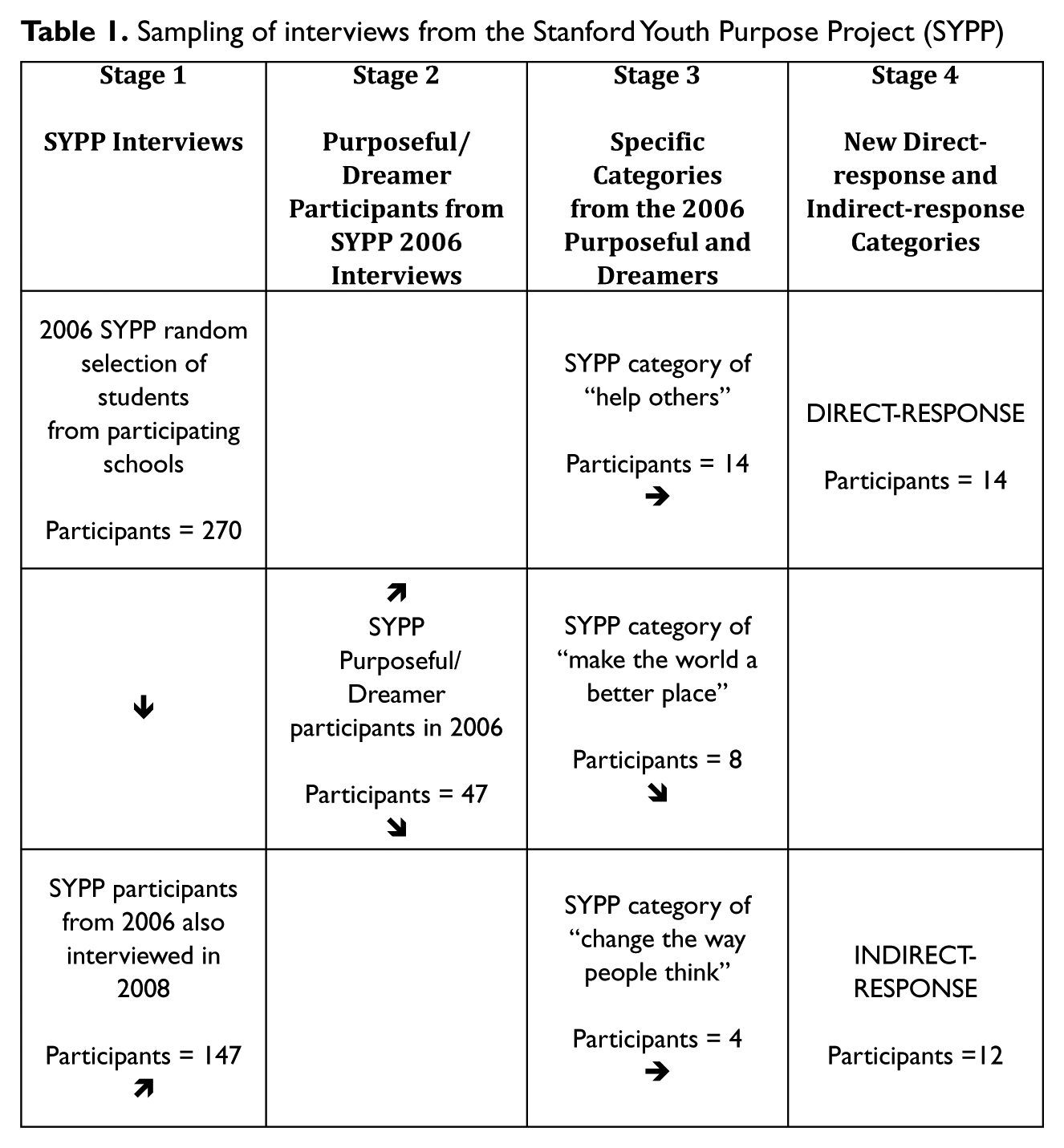
The theoretical sampling procedure (Eisenhardt, 1989) relied on the coding and forms of the SYPP work (see Table 1).
Sampling of interviews from the Stanford Youth Purpose Project (SYPP)
Forms of Purpose Sampled From the SYPP
I sampled those participants in the SYPP who were dreamers or purposeful in the 2006 interview, because those were the forms with a stable beyond-the-self component (constitutive of other-oriented purpose). This resulted in 47 SYPP participants.
Categories of Purpose Sampled From the SYPP
From the dreamers and the purposeful, I sampled interviews from the “help others,” “make the world a better place,” and “change the way people think,” categories (see Table 1). These were believed to be the categories that best contained other-oriented intentions. Descriptions of each of these categories follow.
Help others
SYPP researchers assigned participants to the “help others” category if they described their primary goal as a direct way of alleviating suffering or offering assistance to other people or animals. Participants in this category often aimed to be teachers, nurses, counselors, etc. Overall, they involved themselves in planned or active direct service to those in need.
Change the way people think
SYPP researchers assigned participants to the “change the way people think” category if the individual’s purpose addressed needs by increasing knowledge or changing opinions about something.
Make the world a better place
SYPP researchers assigned participants to this category if they had broader intentions of changing something in the world, rather than more localized intentions of addressing the specific needs of individuals.
Results of Sampling
The parameters described above yielded 14 “help others” participants, 8 “make the world a better place” participants, and 4 “change the way people think” participants for a total of 26.
Participants
Of the final 26 individuals from the SYPP data set, 62% were female and 31% self-identified as White. They were distributed across grade levels as follows: 6th grade (n = 6), 9th grade (n = 4), 12th grade (n = 3) and college (n = 13). Participants were from a variety of socioeconomic backgrounds and areas of the United States. Twelve of the 26 participants also met the sample criteria in their 2008 SYPP interviews. Part of the analysis described here focuses on those twelve participants, using both of their interviews. This subsample was 58% female, 40% White, and distributed across the grade levels at the time of their first interview: 6th grade (n = 2), 9th grade (n = 2), 12th grade (n = 1) and college (n = 7).
Transformation of SYPP Categories Into Direct-Response and Indirect-Response Categories
After reviewing the notes about category assignments from the coding that took place during the SYPP study, I reassigned participants in the “help others,” “change the way people think,” and “make the world a better place” categories into direct-response and indirect-response categories. Identifying details have been changed in the following descriptions and later analyses.
Direct-Response Other-Oriented Purpose
I transformed the SYPP category of “help others” into direct-response in order to highlight the attention individuals in this group gave to directly meeting the needs of other people. For example, Rose, a 9th grade female, described wanting to help out in a variety of ways.
I want to get into a club. If there isn’t one I want to try to create one where they do something for the community, like help giving back. Whether it’s reading books to kids, cleaning, doing food drives, anything. As long as it’s helping.
Rose committed to addressing the concrete needs of others in direct ways (e.g. reading, giving food, cleaning). All participants in this category desired to address needs in this way—through direct, person-to-person responses.
The direct-response category of other-oriented purpose included 14 participants. This group was 71% female and 50% White, distributed across grade levels: 6th grade (n = 2), 9th grade (n = 2), 12th grade (n = 3), and college (n = 7).
Indirect-Response Other-Oriented Purpose
I combined those who were in the “make the world a better place” and “change the way people think” categories into one category—indirect-response. Throughout the SYPP coding, those who responded to need in less proximal ways were classified into the “make the world a better place” or “change the way people think” categories. John, a white male studying engineering in college at the time of his interview, exemplified this less proximal focus:
I’d like to see more of a balance between the rich and poor. That’s another reason I like technology so much is I think it can create that balance. I think that more advanced technologies will help close the gap in some ways . . . Right now, people who are financially well off have better odds of getting their kid into a college, and that kid’s better off or more likely to get a good job . . . And I think if we can get technology to be at a level where it’s affordable . . . I firmly expect that we’re going to start getting more books online, so we’ll be at a point where people can—in terms of school, everyone will have a computer. They’ll all have access to the books, and the only thing they won’t have is parents with a vocabulary the same size as the other kids they’re up against.
John recognized the needs of economically poor members of society. He showed this in his attention to the connections between socioeconomic status, technology, and education as pathways to close the gap between the rich and the poor. However, there was no evidence in his interview that he felt a desire to directly interact with the poor. This is not to say that he never did this, but instead, he framed his purpose in a way that required a less direct response to this identified need. Contrast his decision to focus on technology to increase access to books with Rose’s focus on directly giving books to the children. Both recognized a similar need, but chose responses that differed in the level of directness, or proximity, to those in need.
The indirect-response category of other-oriented purpose included 12 participants. This group was 50% female and 17% white, with the following grade level distribution: 6th grade (n = 4), 9th grade (n = 2), and college (n = 6).
Analysis Procedure
I treated each interview as a case of either direct-response or indirect-response other-oriented purpose, and engaged in theory-generating analysis. Following from Eisenhardt (1989), I cautiously brought the implicit theory construct into my initial analysis of the interviews. I believed there were logical reasons to examine this construct, but conducted my analysis to avoid presuppositions about what, if any, relation would be found between implicit theories and other-oriented purpose.
The primary way I avoided these presuppositions was to blind myself to the direct-response/indirect-response classification of each interview during this stage of analysis. I focused first on answers to questions in the interview about the “ideal world”—with wider exploration done where there was insufficient information. This more narrow focus allowed me to analyze the interview for person and world language, without reviewing enough of the interview to know exactly what type of other-oriented purpose the young person was pursuing.
I specifically looked for language indicating beliefs about the changeability of other people and the larger realities of the world. There is support in the implicit theory research that entity (fixed) person and world theories result in helpless feelings and behaviors (Dweck, 1996). Therefore, statements of efficacy or inefficacy and hope or hopelessness in changing other people or the world were taken as indicators of the participant’s implicit theories. Ideally, I classified each participant as displaying an incremental or entity world theory, and as displaying an incremental or entity person theory. Examples of phrases that led interviews to be classified in each of the two implicit theory domains follow, with emphases added to the most relevant words.
Incremental World Theory
I classified a participant as displaying an incremental world theory if the primary way in which the person discussed the ideal world indicated some possibility of achieving this ideal. Examples from the cases of “incremental world theory” phrases follow.
I’d like to see a balance between the rich and the poor. That’s the reason I like technology so much is that I think it can create that balance.
You just have to chase what you’re passionate about or what you feel like is gonna change something in the world.
I think the more people that try to see the problems, like the younger generation tries to see the problems of the world, maybe when they go into power they can fix it.
Entity World Theory
I classified a participant as displaying an entity world theory if the primary way in which the person discussed the ideal world indicated either that the world was not capable of change, or that the individual’s efficacy in making that change was so low as to render it impossible. Participants also classified as entity world theorists if the language surrounding the “ideal world” discussion was more wishful thinking, than efficacious planning. Case examples of “entity world theory” phrases follow.
I wish the world were different, but it probably won’t be.
Well, it’s hard. I think it’d be really similar to ours now. I just wish there’d be no crime. There’d be no hatred towards other people.
Realistically speaking, there’s always gonna be the lucky ones and the not so lucky ones.
Incremental Person Theory
I classified a participant as displaying an incremental person theory if their interview included language to talk about others or themselves that suggested people can change, or that how people behave or appear is dependent on factors in the context of their lives. Examples of “incremental person theory” phrases follow.
Teaching is a way of helping people change themselves.
Because I don’t think people stay the same, and you’re going to change constantly over your life.
But you just genuinely, when you talk to them, you generally find out that it’s really the situation that they happen to be in that puts them in the position that they’re at.
Entity Person Theory
I would have classified participants as indicating entity person theories if there was evidence that participants primarily thought of people as incapable of change or as uninfluenced by their contexts. However, I classified no interviews as having an “entity person theory.” Generic examples (from implicit theory research) of “entity person theory” phrases follow.
People pretty much stay the same throughout their lives.
Where you live or how you grew up doesn’t really influence the kind of person you are.
Evidence of More Than One Theory or No Evidence
Some participants showed evidence of more than one theory in one domain (world or people). In these cases, I examined the entire interview and made a best effort to classify based on the theory phrases most relevant to the way the participant discussed his or her purpose. Contrasting theory phrases were noted in data collection. Additionally, some interviews contained insufficient information to identify a theory. When this happened, I retained the participant if there was evidence of a theory in at least one of the domains. Insufficient data cases are noted in the results.
Results
I present results organized in two ways. First, I describe the results from the analysis of the 2006 interviews of all 26 participants. Second, I discuss the results of the analysis of 2006 and 2008 interviews for those 12 individuals who were other-oriented at both points in time.
Analysis of 2006 Interviews
Analysis of the 2006 interviews unearthed a potential relation between incremental world theories and indirect-response purposes (see Table 2). Eleven out of 12 indirect-response participants, as compared to 6 out of 14 direct-response participants, displayed evidence of incremental world theories. No indirect-response participants displayed entity world theories (one had insufficient information), whereas 6 of 14 direct-response participants displayed evidence of entity world theories (two had insufficient information). In addition, all showed evidence of incremental person theories, with three indirect-response participants containing insufficient person theory information. No differences in evidence of theories about the world for gender or race were found.
Other-Oriented Purpose and Implicit World Theories in 2006 Interviews

Note: N = 26 observations. Three observations (indirect-response = 1, direct-response = 2) contained insufficient data to code for world theories and thus are not included in these results.
Case Examples of Incremental World Theories
Six of 14 direct-response participants and 11 of 12 indirect-response participants displayed incremental world theories. Overall, individuals in this category understood the world as changeable. Participants differed by the target of their other-oriented actions, rather than by their world theories.
Indirect-response and incremental world theory
David, an 11th-grade male originally from the eastern part of Africa, exemplified the thinking demonstrated by the young people in this group. His description of “what the world is like” showed his belief in the malleability of the world: “The world around me is—coming out with better solutions for like gas prices, the expense of living, to make it more affordable, pretty much to help out communities that are really in need.” His description showed a belief in the capability of the world to become a better place. This supported his reasons for addressing community needs in a systematic, yet less direct way:
There’s always a community in need, in some place in the world. If we help them to help themselves, to get started with cleaning up the area and making that city a better place, that will somehow prevent-[create] less crime in the areas. It would give the place a better name, and attract more people in to more business, giving them more opportunities there. (David)
David’s belief in possible systemic change led to his more complex articulation of what helping a particular community would do—getting the work started would prevent crime in the area. He fused belief that the world can change with conviction that he should take part in that change. He also demonstrated a desire to change conditions to inspire self-sufficiency, stating that it would be necessary to “keep doing it until they have a strong foundation, so that they can take it on their own.” Notice that he still uses some direct-response methods (cleaning up a community), but he has a more complex vision for what these actions will accomplish.
Direct-response and incremental world theory
Emily, a White, 21-year-old female, tutored and wanted to be a nurse at her first interview. Her goals centered on helping people through these activities. When asked about a perfect world, she displayed an incremental world theory: “I want to change it, or I want to see someone else do it actively . . . I think we need to work through it together . . . People need to work together to make it work.” Emily saw the ways in which the world could change, and saw that people could collectively make that happen. However, her actions focused on direct, local work with students:
I really love my students. They seem to really be able to learn. They come [to me]. They ask me questions and they always say it helps. And that keeps me going . . . I really love teaching them . . . They want to keep going, and that makes me really happy. (Emily)
In the above explanation of her work with students, she described the happiness and interpersonal connection that this direct work provided. This joy in the interpersonal connection, coupled with uncertainty in her singular ability to change the world, resulted in a goal typical of direct-response participants:
I don’t know that I could change the world at this point, but I would like to start in my own backyard and make a difference to people around me. So in my nursing career it could be as simple as just being able to make a difference for my patients. (Emily)
Emily, like others in the direct-response category with incremental worldviews, focused on direct service, but did not entirely reject the idea that larger structural change was possible.
Case Example of an Entity World Theory
Those participants that indicated entity worldviews formed another category. In these cases participants demonstrated lack of confidence and/or belief in the ability of the world to change. Six of 14 direct-response participants populated the entity world theory category. No participants showed evidence of an entity world theory and an indirect-response other-oriented purpose.
Direct response and entity world theory
Teresa, a Hispanic college student majoring in child development, exhibited some of the subtle ways in which participants in this study indicated that they held entity world theories. In her discussion of the ideal world, she was concerned with globalism and capitalism, and explained,
Lots of little things [are] never going to change. I went to Spain when I was in high school. And I thought it was really sad, but there was this nice antique façade, all these old buildings with a McDonald’s smack in the middle in a brand new building. It was really sad . . . Companies like that are capitalistic and they want to draw money, and the way to do that is most people want things that are new and exciting . . . And it’s just what people want. People want whatever is new and popular (Teresa).
This belief that the problems of the world are somewhat inevitable given the wants of most people leads her to name interpersonal efforts as the most appropriate target for her actions. When asked whether things can change, she replied:
Not necessarily on a global scale but definitely on a personal scale. I know I don’t talk to people in my classes . . . I think people communicating with each other more is possible. I don’t know how likely it is, but it’s definitely possible.
This combination of seeing probabilities for change as low on the global scale and high on the personal scale connected to a very specific purpose for Teresa:
I think I have something to contribute on the interpersonal level with my relationships and being a good friend to my friends. Through education and career, I think I have something to contribute to the generations of children I’m going to be educating.
Teresa was representative of other direct-response entity world theorists. She thought there were things in the world that should change, but her parameters for change were located at the person, rather than the global level.
Analysis of Participants Who Were Other-Oriented in 2006 and 2008
Twelve participants were other-oriented in both 2006 and 2008. My analysis of these participants looked for consistency of the patterns established in the 2006 interviews. Recall that the 2006 analysis showed that direct-response participants held either entity or incremental world theories, that indirect-response participants held incremental world theories, and that all participants demonstrated incremental person theories.
Overall Patterns
All twelve participants in the 2006/2008 analyses followed the pattern established by the 2006 results (see Table 3). Three 2006/2008 participants exhibited an indirect-response purpose at both time points. All three also exhibited incremental worldviews at both time points. Two individuals displayed a direct-response type of purpose at both time points, one a consistent entity theorist and the other moving from an incremental to an entity world theory. Five other-oriented individuals displayed a direct-response purpose in 2006, and then an indirect-response purpose in 2008; three showed evidence of incremental world theories at both time points and two moved from entity world theories in 2006 to incremental world theories in 2008. Finally, two individuals displayed an indirect-response type of purpose in 2006 and a direct-response type of purpose in 2008. Both showed evidence of incremental world theories in 2006 and in 2008. I found no combinations that would be unexpected given the 2006 results.
Patterns of World Theory and Other-Oriented Purpose Change (2006 to 2008 Interviews)
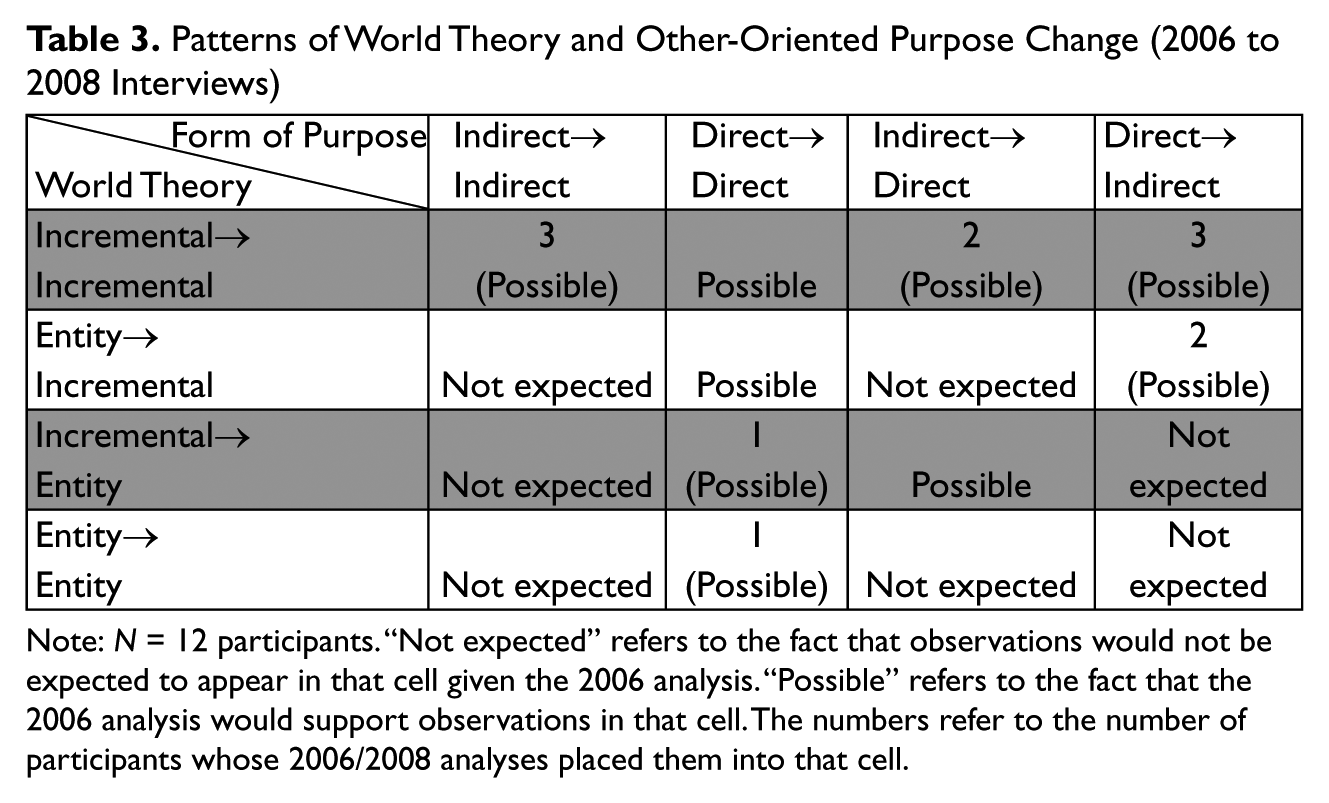
Note: N = 12 participants. “Not expected” refers to the fact that observations would not be expected to appear in that cell given the 2006 analysis. “Possible” refers to the fact that the 2006 analysis would support observations in that cell. The numbers refer to the number of participants whose 2006/2008 analyses placed them into that cell.
Dynamics of Change
Seven of the 12 2006/2008 participants changed types (direct or indirect) of other-oriented purpose. Five moved from direct response to indirect response, and two moved in the reverse direction. Of these seven individuals who changed other-oriented purpose types, only two displayed evidence of a different world theory in 2008 than they had shown in 2006. These individuals, who both moved from direct response to indirect response, shifted from showing evidence of entity world theories to showing evidence of incremental world theories. The other five individuals all displayed evidence of incremental world theories in both interviews.
Summary of Results
An emerging relation was found between incremental world theories and indirect-response other-oriented purposes, between participants and within individuals over time. Second, both incremental and entity theories about the world may be related to direct-response other-oriented purposes. This was also consistent among participants and within individuals over time.
Discussion
If concerned adults wish to foster the kind of positive, contribution-oriented identity found in youth with other-oriented purpose, they need to attend to the way young people negotiate their developing thoughts about other people and the world. In order to understand why young people engage their communities in differing ways, I examined the relations between other-oriented purpose (both direct- and indirect-response types) and beliefs about the changeability of the world and other people. From this analysis, I suggest that there is a relation between incremental world theories and indirect-response other-oriented purpose. Additionally, while a connection surfaced between beliefs that the world can change and indirect-response other-oriented purposes, no similar relation emerged between beliefs that the world will not change and direct-response other-oriented purposes. Instead, something other than theories about the changeability of the world may influence some of those with a direct-response other-oriented purpose.
Civic Identity
Given the established relation between purpose and identity (Bronk, 2011; Burrow & Hill, 2011) and the role of contribution in civic identity (Sherrod & Spiewak, 2008), work in civic identity may help to explain how and why implicit world theories influence other-oriented purpose for some and not for others. Civic identity has been defined as “the establishment of individual and collective senses of social agency, responsibility for society, and political-moral awareness” (Youniss, McLellan, & Yates, 1997, p. 620, but also see Nasir & Kirshner, 2003; Youniss & Yates, 1997). In other words, civic identity develops when the individual comes to define him or herself as part of, responsible for, and capable of positive community change. Other-oriented purposeful youth, in some way, already define themselves as responsible for and capable of contribution in their communities.
One of the variations, however, in civic identity, is found in exactly who counts as “the community.” When the community is one’s actual neighbor, determining needs and solving problems is relatively straightforward. The proximity of the people involved makes direct service efficacious contribution. Casseroles, hand-me-downs, and companionship go a long way. This is something those youth with direct-response other-oriented purposes were good at—seeing individual needs and responding (although, they certainly addressed needs beyond their residential neighbors). But how does one respond when one grows to understand that one’s “neighbor” is one of many facing similar problems? What about when one’s “neighbor” is the child of a different ethnic background on the other side of town? The family practicing a different religion in another country? The wildlife put at risk by an oil spill?
Thinking about the dynamics that allow a young person to widen their circle of community (Templeton & Eccles, 1998) offers insight. Recall Teresa, the young woman majoring in child development who showed a direct-response other-oriented purpose and an entity world theory. She struggled with her response to those who were truly her neighbors. She lamented that she barely knew her neighbors or the people in her classes, and also recognized that there were larger problems in the world (she hinted at globalism and capitalism). However, when she thought about where she could actually change things, she was committed to getting to know people better in her neighborhood and in her classes—it was in these more proximal circles that she felt a sense of agency.
Contrast Teresa to David (also discussed earlier), the young man of east African heritage who desired to be a community leader to effect change both in the United States and in his country of origin. His interview indicated an indirect-response other-oriented purpose with an incremental world theory. He connected cleaning up a community with less crime in a community—and he was talking about communities different from the one in which he lived. He also had a realistic sense that the kind of work he was thinking about would be difficult, but recognized that several small changes over time could make a difference. In other words, David felt a sense of agency towards a wider circle of community.
Agency
The contrast between these Teresa and David is an important element to consider here because agency—one’s sense that one’s actions have effects—is a key component of civic identity (Youniss & Yates, 1997). It is logically connected to whether or not one sees other people and the world as capable of change. It may be that the relation between incremental world theories and indirect-response other-oriented purposes heard in the voices of the young people in this work is connected to a sense of agency towards larger scale change. This may grow out of the belief that the world itself is malleable. It is not so much that the young person with an entity world theory is unable to develop a sense of civic agency; instead, implicit world theories may influence the target of youth contribution (person, community, structural, etc.), because they influence youth agency towards increasingly wider circles of community.
Compassion
But is thinking the world can change the only influence in determining whether a young person takes a more direct or indirect approach to community need? That would not appear to be the case for the six participants in this work who demonstrated an incremental world theory and a direct-response other-oriented purpose. Something else must be at work for this group of youth. In addition to agency, Youniss and Yates (1997) discuss compassion as a component of civic identity. Some of the young people in the direct-response category of other-oriented purpose spoke with compassionate words about the people they encountered. Recall Emily, who demonstrated a direct-response other-oriented purpose with an incremental world theory. She effusively spoke of her “love” for the children she taught. Or think again of Teresa, who demonstrated a direct-response other-oriented purpose with an entity world theory and wanted to improve things, really, by being a better friend. David, the future community leader, and John, who wanted to change educational opportunity through technology (both of whom demonstrated indirect-response other-oriented purpose and incremental world theories), turned to the language of efficacy, rather than compassion. It may be that some young people pursue direct-response other-oriented purposes because they prioritize compassion for other people, over a sense of agency, in thinking about how to respond to need. When compassion is prioritized in this way, the individual’s theory about the changeability of the world may be less important.
The analysis presented here indicated that incremental world theories are typical of participants with indirect-response other-oriented purposes. The degree to which one has a sense of agency towards wider circles of community helps to explain that finding. However, participants with direct-response intentions were almost equally split between incremental and entity world theories. These participants were just as likely to display a direct-response other-oriented purpose with the belief that the world could change as they were with the belief that change at the world level was next to impossible. Variation in the prioritization of compassion may help to explain why direct-response intentions were less clearly connected to a particular world theory.
Limitations
There are limitations to this study. First, the semistructured interview utilized for the present work was designed to elicit information about purpose, not implicit theories. Therefore, future work would need to more specifically draw out implicit theories in the world and person domains in order to test the theory suggested by these results. Additionally, much implicit theory research focuses on very specific domains, like intelligence. People, and certainly theories of the entire world, are likely much more complex and may not fit as neatly into the implicit theory framework. So it may be more accurate to think of implicit theories as a heuristic for thinking about one dimension of how individuals view others and the world, rather than to think that the evidence drawn out of these interviews conclusively suggests a coherently defined theory of either.
Second, while this work resulted in emerging theories about how beliefs about the world and other people may influence types of other-oriented purpose, future work needs to move towards hypothesis testing research (Eisenhardt, 1989). At the theory generating stage, the constant, transparent conversation between theory and data was beneficial in considering relations among constructs. However, while this method allowed a theory to be suggested, the move to hypothesis testing would require a coding system inclusive of trained coders, a coding process blind to the hypothesis, and acceptable agreement. At present though, the analysis described here presents emerging evidence of a theory to be tested concerning the influence of world and person theories on other-oriented purpose.
Conclusion
I began by examining the relations between implicit theories and other-oriented purposes. As a starting point, I identified direct-response and indirect-response other-oriented purposes. Because these types of purpose differ in the directness of their response and analysis, I thought they would offer insight into how beliefs about the world and other people influence the type of other-oriented purpose that takes shape. The first finding was not surprising—incremental person theories were found in all of the other-oriented participants. The second finding made some logical sense—almost all of the indirect-response other-oriented participants displayed evidence of incremental world theories. This may develop from a wider sense of efficacy supported by an incremental world theory. However, the third finding added complexity to this story—those participants who had direct-response other-oriented purposes were equally likely to categorize as entity or incremental theorists about the world. My claim concerning these participants is that they may prioritize compassion over agency in forming other-oriented purpose. Thus the kind of action that grows out of an incremental world theory in the direct-response individual may be less about “I can” and more about “I care.” The work described here suggests that beliefs about the world and other people are important factors as young people explore identity through other-oriented purpose. In the end, both types of other-oriented purposes offer young people paths to contribution and thriving.
Footnotes
Declaration of Conflicting Interests
The author(s) declared no potential conflicts of interest with respect to the research, authorship, and/or publication of this article.
Funding
The author(s) disclosed receipt of the following financial support for the research, authorship, and/or publication of this article: Some of the research described in this article was funded, in part, by grants made to the Stanford Center of Adolescence by the John Templeton Foundation and the Thrive Foundation for Youth.