



Abstract
This article presents findings from an interpretive study that sought to understand how organized sport at the community level influences sibling relationships and interactions. The meanings of the participants’ sport involvement, in relation to their siblings’, was also examined using a constructivist approach to grounded theory. Nineteen youth (9 boys and 10 girls) from 7 different families living in a rural community in Canada participated in the study. The findings call attention to the significance of organized youth sport to enhance opportunities to spend time together, to shape perceptions of fairness and equality, and the implications that occur when living with a star athlete. Emphasis is placed on the contradictory nature of organized youth sport to strengthen and challenge sibling relationships as well as the potential of sibling dynamics to alter the nature of the participation experiences.
Research examining sibling relationships and organized sport participation remains limited, yet the potential significance in understanding this phenomena is salient for our full understanding of youth in sport. As Côté and Hay (2002, pp. 513-514) argue,
Siblings have a major impact on one another’s behavior and development. This impact is influenced by mutual socialization, especially in childhood and adolescence. Sibling relationships, therefore, may have an important influence on a child’s participation and achievement in sport. Sibling relationships constitute a major subsystem of the family that can affect the entire climate of a family. Without examining sibling relationships, we will never be able to fully comprehend the influence of the family on a child in sport.
Furthermore, the limited research, to date, has examined sport and siblings at an elite level with minimal attention paid to the community sport level (e.g., Côté, 1999; Davis & Meyer, 2008; Fraser-Thomas, Côté, & Deakin, 2008). This oversight is unfortunate, as the majority of youth will participate in sport within their community and not at the elite level. The investigation of sport and sibling relationships may be distinct in the community context. An enhanced understanding of the potential positive and negative implications that the sibling relationship has on participation experiences may provide important insights. Moreover, research that examines organized youth sport and sibling dynamics may help shed light on the development and nature of the sibling relationship itself.
Therefore, the purpose of the present interpretive interview study was to understand how organized youth sport, at the community level (i.e., houseleague—within a community, and “rep” or select teams—where local communities compete against each other), influenced siblings relationships and interactions. In addition, the study sought to explore how siblings construct meanings and experiences of their own youth sport involvement in relation to their siblings’.
Sibling Relationships and Organized Youth Sport
Although there is limited research on sibling relationships and youth sport participation, we can garner a sense of its potential significance. For example, older siblings may have a positive influence on the sport work ethic of younger siblings. Côté (1999) and Stevenson (1990) found that older siblings often act as role models by introducing their younger siblings to sport and that this can encourage a closer relationship. Younger siblings also seek to emulate older siblings of the opposite sex (Stevenson, 1990). Kay (2006) also points to the influence of older sibling support, and particularly brothers, that serve to increase Muslim young women’s participation in sport. As Kay noted, “Although the authority lay with the parents, there were examples of views being mediated by older siblings” (p. 369).
The emotional support between siblings may also be an important attribute that shapes their relationship and sport experiences. Davis and Meyer (2008), in their study of elite athletes who compete against each other, found that siblings provided emotional support in many different ways. For example, siblings would often cheer, display pride, and offer words of encouragement for their sister/brother’s achievements. Sibling athletes were also found to provide “instructional support to one another through such means as assisting with strategies, facilitating focus, and offering sport-specific advice” (p. 232).
Despite these positive effects, research also suggests that there are negative functions and outcomes related to sibling athlete relationships. In Davis and Meyer’s (2008) study, sibling athletes described aspects of closeness (e.g., increased emotional involvement) and positive regard (e.g., respect) as well as rivalry (e.g., motivation to beat sibling) and disregard (e.g., gloating, trash-talking). Siblings who competed against each other also expressed negative feelings such as anger, disappointment, increased anxiety, and frustration as they mentally prepared for the competition. Côté (1999) echoed these findings and argued that siblings are influential in an athlete’s development and can act as role models at the same time as they foster rivalries.
Sibling relationships may also be important to help us understand why some youth remain in sport while others drop out. For example, in an exploratory study that compared dropout versus prolonged engagement in adolescent competitive sport, athletes who spoke of rivalries, competition, and jealousy were often the ones who dropped out of sport (Fraser-Thomas et al., 2008). In contrast, “Only engaged athletes spoke of a general positive influence that their sibling(s) had on them” (p. 656).
Côté (1999) and Davis and Meyer (2008) revealed that younger siblings expressed bitterness and jealousy toward their talented older sibling or felt the pressure to perform and measure up to their achievements. At the same time, older siblings and/or more experienced siblings sought to maintain their superior athletic status (Davis & Meyer, 2008). Rivalries, according to Davis and Meyer (2008), are “fostered by sibling athletes who strive to maintain or acquire favorable athletic status within the sibling dyad” (p. 227). Consequently, the sibling (commonly the younger sibling) may drop out of competitive sport and/or seek out activities to create a special “niche” to establish their own sport identity (Côté, 1999; Davis & Meyer, 2008).
There are few studies, to date, that have examined the sibling relationship and how siblings’ participation in sport may affect their interactions and dynamics within family life more broadly. A notable exception includes Kay’s (2000) study on elite child athletes and the impact of their sport participation on the family unit. Kay reported that parents were aware of the potential impact that a child’s sport involvement may have on the other siblings, and consequently, many parents made a conscious effort to ensure that all children were treated equally. Some nonathlete siblings who were interviewed in Kay’s study indicated that they were very supportive of their brother’s or sister’s sporting involvement. However, feelings of resentment were also seen to be significant and difficulties were expressed living with “the emotional ups and downs that accompany the lives of the talented” (p. 160). For one family in particular, a sibling voiced feelings of hurt and jealousy as he lived in the shadows of his older sister. Côté’s (1999) research also points to sibling dissention due to an uneven distribution of resources directed to the elite child athlete.
In sum, research examining sibling influence in youth sport participation remains limited (Côté & Hay, 2002; Fraser-Thomas et al., 2008). The literature that exists on sibling relationships and sport participation indicates the significance of siblings in the socialization process as well as the contradictory experiences when siblings compete against one another. These insights also point to the potential impact that it has on not only the meanings of their own sport participation but on the sibling relationship itself. Furthermore, the majority of research that has examined sibling relationships has primarily focused on competitive or elite athletes with little attention given to community sport participation. Research that examines organized youth sport and sibling dynamics, at the community level, may contribute to a more complete understanding of the youth sport experience as well as its potential impact on the overall development of the sibling relationship.
Method
Theoretical Framework
With the discovery nature of the sibling relationship and youth sport, and the focus on the subjective experiences of youth, an interpretive qualitative approach was used. As Denzin and Lincoln (2005) suggest, “Qualitative researchers study things in their natural settings, attempting to make sense of, or interpret, phenomena in terms of the meanings people bring to them” (p. 3). Yet within this generic definition there are many research perspectives and approaches. I have embraced an interpretive understanding of the human experience that is actively constructed and co-constructed through everyday lived experiences. In that, truth and knowledge are constructs of the human mind that are a socially situated phenomenon (Guba & Lincoln, 2005). I see value and worth in understanding the rich descriptions of the everyday social world through individual experiences and stories that are “against a backdrop of shared understandings, practices, language, and so forth” (Schwandt, 2007, p. 38). Central to this belief is to understand the meaning-making activities of individuals and groups, and in turn, how these activities may enrich and/or constrain individual and collective lives (Guba & Lincoln, 2005).
Strategies of inquiry, such as grounded theory, are useful in understanding context-based and socially constructed phenomena. Specifically, I was guided by Charmaz’s (2005, 2006) constructivist approach to grounded theory, with an emphasis on a systematic gathering and analyzing of the data, while allowing for creativity and openness to emerging concepts and themes. This approach “places priority on the phenomena of study and sees both data and analysis as created from shared experiences and relationships with participants and other sources of data” (Charmaz, 2006, p. 130). Moreover, with a constructivist grounded theory approach, the research process is not linear; rather it consists of “simultaneous data collection and analysis, with each informing and focusing the other throughout the research process” (Charmaz, 2005, p. 508).
There are three main levels of involving youth in the research process. Alderson (2005) defines the different levels as (a) unknowing objects of research where adults are interpreters of the youth’s experiences, (b) aware subjects with the use of fairly rigid adult-designed projects, and (c) active participants who willingly take part in research that is reflective and flexible to their individual needs. The approach I embraced conceptualized youth as active participants in the research process, capable of speaking for themselves on the construction of meaning of their own lives (Christensen, 2004).
Participants
Participants for this study were youth residing in a Canadian rural community. Consistent with an interpretive qualitative framework, this study confined itself to a small number of participants, in order to develop an in-depth level of detail about their relationships, interactions, and sport participation experiences. Purposive sampling strategies were used to find participants who were information rich, illuminative, and were the best participants to begin to understand the problem and the research questions (Charmaz, 2006; Cresswell, 2007). Initial participants were recruited through contacting several volunteer organizations within the community. Members of the organizations were asked to assist in the identification of potential families who might be interested in the study. Snowball or chain sampling strategies were then used to find additional information rich participants (Cresswell, 2003).
Nineteen youth (9 boys and 10 girls) from 7 different families participated in this study. All of the youth in the study were currently participating in one to three organized sport activities a year. Furthermore, the range of competition level varied from house league (competition within the community) to “rep” or select teams (competition between local or regional communities). The average age of the participants was 12.8 years with the youngest being 9 years old while the oldest was 17 years old, and all of the participants were white. See Table 1 for a description of the participants’ demographic information and current sport participation.
Profile of Study Participants
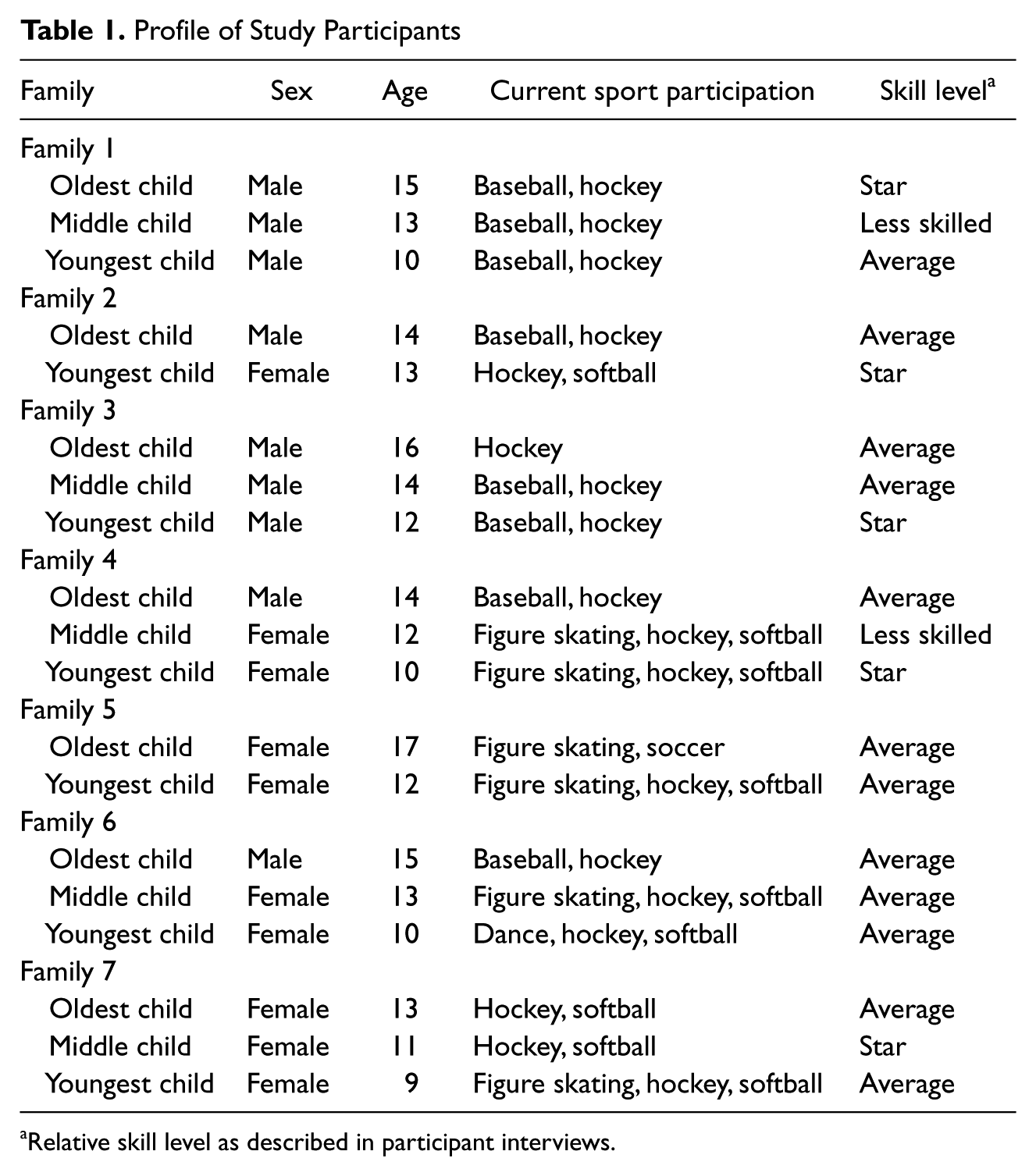
Relative skill level as described in participant interviews.
Family selection was based on insights from the related literature. For example, to ensure an element of homogeneity, each family had at least one child in the family unit in the 12- to 15-year-old age group who currently participated in organized sport as this is the age where sport participation rates decline. Data indicate that sports participation patterns in nonschool sports teams as well as “free-play” sport activities peaks at 10 to 11 years of age and is then followed by a steady decline throughout the teenage years (Ewing & Seefeldt, 1996).
Data Collection and Analysis
The data were gathered by semistructured interviews that took place in the participants’ homes, participant journaling (10 days duration), informal observation, and a researcher journal. Consistent with the grounded theory approach, the semi-structured interviews were the primary source of data collection with the other sources of data collection providing complementary sources (Charmaz, 2006; Cresswell, 2007).
As the nature of the research was exploratory, to begin the project, I used insights and sensitizing concepts from the relevant literature that was reviewed earlier. While the discussions were wide-ranging, the youth were asked questions about their typical day, the nature and context of their sport activities and that of their siblings, and their interactions with their siblings in connection to organized youth sport. As a result of the openness of the interview process, our conversations were somewhat unstructured and ranged from 15 min to 45 min.
Although parental consent was attained, I also sought out the youth’s assent to participate in the study with specially designed forms for their developmental level. Moreover, the participants were interviewed separately, without a parent in attendance, as joint interviews with a parent and/or multiple siblings may shape the nature of the data collected. For example, Hertz (1995) argued that although interviewing a couple together may elicit the advantage of a shared and collective story, it is often difficult to detect differences and discrepancies in individual experiences with most family members wanting to show a unified front and/or avoid confrontation. Extending this concept, I believed that separate interviews would provide a more composite story of sibling relationships, which would be richer than joint interviews that may privilege one dominant voice over another.
All interviews were audio-recorded and later transcribed. The strategies of memo-writing, coding (initial, focused, and theoretical), and comparative method procedures as outlined by Charmaz (2006) provided the guiding principles for analysis. During the beginning stages of analysis, I read through all of the data to obtain a general sense of the information and made reflective notes on each transcript. After I gained a general familiarity with the data source, I began the initial stages of the coding process. Data were analyzed word by word, sentence by sentence, and section by section as I attempted to code with words that reflected action in each segment rather than apply preexisting categories. As Charmaz points out, invoking a language of action rather than topics “curbs our tendencies to make conceptual leaps and to adopt extant theories before we have done the necessary analytic work” (p. 48, emphasis in original). The second major phase was focused coding, which involves making decisions about which initial codes make the most analytic sense to categorize the data using the most significant or earlier codes to sift through the large amount of data. The final phase, theoretical coding, identified the possible relationships between categories that developed during focused coding. That is, as the early coding stages fractured and separated the data, this process brought it back together again in a coherent story and moved the analysis into a theoretical direction. The aim at this stage of analysis was to exhaust coding procedures until categories had reached a point of saturation. Theoretical saturation “occurs when added information does not reveal new understanding about relations or abstraction” (Kirby & McKenna, 1989, p. 138).
Throughout the data analysis, memo-writing became a larger part of the process as coding became more focused. Memo-writing provided an important tool in the constant comparison of codes and conceptual categories, and the understanding of their interconnectedness. In that, writing memos built, clarified, or removed codes/categories based on identifying variations within a code/category and between other codes/categories (Charmaz, 2006).
Whittemore, Chase, and Mandle (2001) identified several strategies or techniques that may be used to demonstrate the trustworthiness of an interpretative study. Specifically, I provided a rich and thick description in the presentation of the study’s written accounts so that the reader can share the construction of the themes as revealed in the study. Participants’ verbatim quotes are also intertwined with the constructed themes and interpretations and provide the reader with the opportunity to make their own judgments as to the trustworthiness of the research. Finally, as a trustworthiness/credibility technique, I included discrepant information that runs counter to the themes, as individual perspectives do not always coalesce (Cresswell, 2003).
Findings
The analysis of the data led to the development of three main themes that best reflected the youth’s meanings and experiences of organized youth sport in connection to their relationship with their sibling(s) and their sport involvement. The analysis revealed the significance of (a) enhancing opportunities to spend time together, (b) shaping perceptions of fairness and equality that were constructed around their siblings’ sport participation, and (c) the implications that occur when living with a star athlete. Embedded throughout all three of these themes was the contradictory nature of organized youth sport to both strengthen and challenge sibling relationships. In turn, the nature of these relationships was seen to alter the youth’s own participation experiences.
Enhancing Opportunities to Spend Time Together
The first main theme revealed the significance of the participants’ involvement in organized sport and how it shaped siblings’ relationships and interactions. The siblings’ common sport interests facilitated opportunities to spend time together and practice their skills, regardless of their age or sex. Organized youth sport provided opportunities for communication and an enhanced sense of connection. As one participant described,
You can relate and you can talk about it and you get like, you have one more thing in common with them. It’s just more fun because then you go out and have fun with your own family. Like shoot pucks or you can just have a game of shinny or like one on one or something. You don’t have to practice by yourself or call someone. (Oldest sibling, male, age 16, Family 3)
The notion of strengthening sibling relationships and a sense of unity and shared identity is perhaps best represented by one of the youngest participants in the study: “Because my brothers . . . we live for hockey! Like we love hockey!” (Youngest sibling, male, age 10, Family 1)
It was clear, too, that organized youth sport provided siblings with the opportunity to develop a mentor-type relationship, as they would teach each other new skills. Older siblings, in particular, would take a leadership role with younger ones in both formal experiences such as coaching their team and/or informal experiences such as practicing at home in the backyard. These leadership experiences also provided the older siblings with a sense of expertise that they could share with their younger siblings. As one older brother explained,
And like for my sisters—I kind of try teaching them stuff because I have more experience and stuff. [So when would you teach them stuff?] Well at practices and stuff [he was the assistant coach for his sister’s hockey team]. And sometimes we go out on the road with a net and hockey sticks. (Oldest sibling, male, age 15, Family 6)
This sentiment was reflected, also, in a statement by his younger sister:
They [her older brother and sister] take the same sports as I do so I know what they’re going through but their sports are obviously harder. It’s just knowing that they take the same sports and that I’ll be as good as them if I keep taking it. So it’s just they’re teaching me how to play good. (Youngest sibling, female, age 10, Family 6)
Yet at the same time it could create some negative feelings between siblings. The same participant also expressed mixed feelings about her older brother being the umpire at her softball games. When asked whether she liked her older brother at her games, she explained, “And sometimes I don’t like it because sometimes I hit it funny and he laughs at me when I run. So then I can’t focus on running, so then I’m out, and then he laughs at me again” (Youngest sibling, female, age 10, Family 6).
Thus, the significance of the youth’s involvement in organized sport was seen to shape sibling relationships through time spent together that created opportunities for communication and an enhanced sense of connection. Formal and informal mentoring opportunities between siblings also seemed to play a significant role to foster positive sibling relationships, although on occasion it could also create tension between siblings.
Shaping Perceptions of Fairness and Equality
When asked the open-ended question, “What do you think about your sibling(s)’ sport participation?,” a common initial response was to describe how often they participated. As the second theme highlights, underlying much of the youth’s discussion about their siblings’ sport participation was concepts centered on “fairness” and “equality.” In that some participants emphasized the number of teams each sibling participated on, and other participants qualified equal participation on the basis of number of evenings that they played. For example, as one participant explained, “I think we’re pretty even with what we do and stuff. She’s [her older sister] on two soccer teams and so it’s even that she also doesn’t play hockey” (Youngest sibling, female, age 12, Family 5). The very fact that the siblings participated in sports also provided validation for equality. As these three siblings explained,
She takes figure skating but I take dance. And there’s like, I have two classes of dance but she takes figure skating like four nights a week. So, we’re kind of like equal. So I’m not really jealous about her. (Youngest sibling, female, age 10, Family 6) I am the one in the family that does the most with hockey and figure skating. My brother only does hockey, my sister does both, she does a lot too I guess. She dances, hockey, step, and piano. Yeah, so they still get to do sports, so they’re not really missing out on anything. (Middle sibling, female, age 13, Family 6) I think it’s a tad over the top [in reference to the number of sports his sisters participated in], but if they can handle it then good for them. Like I used to feel like I was in a lot more than them, but it’s kind of teetered off now I guess. Like, I’m not mad that they’re in like a lot of summer sports. Like I kind of wish, when I see them do so many sports, maybe I should have asked mom more and I could have played some other sports or tried something else when I was younger. (Oldest sibling, male, age 15, Family 6)
Even in families who had one child that played at a more competitive level (i.e., rep or select) that required additional family time and money, there seemed to be little resentment expressed by their sibling(s). Once again, the concepts of fairness and equality, as defined by the quantity of sport opportunities provided, appeared to be an important factor for the youth. As one brother who played in the local house league explained, perceptions of fairness were related to the number of opportunities or teams provided to each sibling. That is, there was no concern or jealousy over his brother’s participation at a rep/select level that consumed more of the family’s resources. As he stated, “Hockey for me is two times a week. Just a weekend practice and then a weeknight game. [How do you feel about him playing Triple A hockey?] I go to watch him and support him. Equal opportunities and they can’t take that away” (Oldest sibling, male, age 16, Family 3).
Interestingly, throughout the interviews, none of the youth expressed concern for the family’s financial resources that were consumed by their siblings’ sport involvement. Instead, perceptions of fairness and equality in relation to their siblings’ sport participation were centered on the number of teams, opportunities, or evenings that they played.
Living With a Star Athlete
The third theme revealed the impact that living with a star athlete could have on the sibling relationship. In five of the seven families, there was one child who, to some extent, stood out as the athletically talented one. Furthermore, the youth appeared to recognize the siblings’ level of play, and consequently, this shaped and constructed the meanings of their own sport involvement. For example, in Family 2, there was clearly a star athlete who was competing at the select or rep level. Even though in the local league the brother was a skilled player himself, he judged his own performance relative to his sister’s accomplishments and downplayed his own abilities. There was also a pointed sense of recognition of their respective hierarchal levels of play:
I think she’s going to go places in sports. Yeah, she’s a good goalie. I’m extremely proud. I don’t really plan on going anywhere with hockey or baseball. I’m not a super-star. (Oldest sibling, male, age 14, Family 2) Well, he’s at a lower level than me. I like to go and watch him. He’s in a lot of sports at high school and I think that’s a good thing. And I think he’s good. (Youngest sibling, female, age 13, Family 2)
For other families, the youth’s perceived skill level and success in organized sport seemed to create tension between siblings, and this was particularly evident when the younger sibling, who was of the same sex, was thought to be the star athlete. For some of the older siblings it meant that they questioned their abilities and contemplated dropping out of the sport. As one sibling revealed,
I don’t really like [figure] skating that much. I think I might quit next year. [Why?] I don’t know. I just think I’m starting to lose interest in it. I’m starting to have the pressure of my [younger] sister’s catched up to me in skating and I don’t. I feel like I’m not moving forward so I can’t get ahead of her again. (Middle sibling, female, age 12, Family 4)
Further comments alluded to the significance of being able to create an identity of one’s own through an activity that was unique to other family members. The same sibling continued, “I just want to have something that’s my thing. I just . . . I want to have my thing. ‘Cause I played girls’ hockey and that was my thing until she wanted to play it too” (Middle sibling, female, age 12, Family 4).
Considerable tension between siblings could also develop when same-sex siblings were teammates, and once again, this was particularly evident when the younger sibling was deemed to be the star athlete in the family. For example, even though the older sister was the captain of her team, bitter feelings were revealed when her younger sister played on her team from time to time:
Well, it just bugs me. If she scores the goal and I’m the defenseman so I just stop part of the goals. [So it’s hard sometimes is it?] Yeah, and then when she goes and gets a goal, and everybody’s happy because it’s a winning goal, or she gets a whole bunch of them. She gets a bit of glory when she already has it on her own team. (Oldest sibling, female, age 13, Family 7)
Moreover, many of the positive comments made by siblings who were teammates, in the past or in the present, highlighted the importance of the star athlete’s ability to help their team win. The benefit of having a sibling who was the star teammate was seen to be instrumental in nature. For example, the brother who was cited at the start of this theme (oldest sibling, male, age 14, Family 2), expressed that he hoped that his sister would come back and play with his team so that they could win once again:
I’m kind of put out whenever she doesn’t want to come back to Puckville. Because well, we’ve been having some goal tending problems since she left. [So you two used to play together?] Yeah. [What was it like playing on the same team?] It was fun. We actually won the championship whenever she was with us. (Oldest sibling, male, age 14, Family 2)
Overall the ability to win provided a sense of enjoyment, even for one participant who had earlier in the interview described a strained relationship with her older sister who was the star of their team. When asked whether she liked playing with her sister, she replied, “Well, sometimes. She really helps us win and stuff. Yeah, she scored 60 or 70 goals in like 30 games” (Youngest sibling, female, age 9, Family 7).
Thus, living with the star athlete appeared to shape the participants’ meanings and experiences related to their own sport participation. That is, for some youth it seemed to devalue their own sense of skills and abilities, and some even wanted to seek out an identity of their own and/or niche in another activity that was unique to them. Moreover, siblings who were teammates seemed to value the instrumental nature of having a star athlete on their team, rather than the potential for an enhanced emotional or social connection.
Discussion
The findings of the present study suggest that siblings’ involvement in organized sport at the community level influences sibling relationships and interactions in their daily life as well as the meanings of their sport involvement. It was evident that participation in youth sport shaped their time spent together, the nature of their relationship in terms of both strengthening and challenging it, and their perceptions of their own sporting opportunities and achievements relative to that of their siblings. Moreover, it became evident, as the analysis progressed, that embedded within each of the three main themes was the significance of the contradictory nature of organized youth sport, and how it challenged and fostered sibling relationships and participation experiences.
For some siblings, organized youth sport may facilitate a sense of enhanced connection and shared identity as this study revealed how their participation in organized sport carried over into their home life. Informal (i.e., practicing in the backyard) and formal (i.e., assistant coach) mentorship roles were also seen to be significant in shaping their time spent together and creating a sense of connection with older and younger siblings. This finding echoes previous research that identified the older sibling as positively influencing the younger siblings’ participation and work ethic in sport (e.g., Côté, 1999; Côté & Hay, 2002; Stevenson, 1990). The findings from this study also point out how the quality of the younger siblings’ sport experience can be diminished, with sibling teasing during informal play and/or formal coaching relationships. Thus, although organized youth sport has the potential to enhance familial relationships, it does not always occur.
Participation in organized youth sport also has the potential to create heightened tension and strain between siblings, and consequently, alter the quality of their participation meanings and experiences. Côté (1999) and Davis and Meyer (2008) revealed that younger siblings experienced negative emotions toward their talented older sibling and felt that they lived in their shadow. In turn, they often dropped out of sport to find their own niche. In contrast, the findings in this study point to the tension and negative emotions experienced when the younger sibling was thought to be the star athlete—and this was particularly evident between same-sex siblings. Consequently, some older siblings, contemplated dropping out of the sport to seek an activity that would allow them to create their own identity. Even in one family, when the older sibling was clearly a talented athlete herself (she was the captain), she expressed unhappiness when her younger sibling played on her team and “stole the glory.”
Moreover, the findings from this study suggest that when siblings (both same and different sex) are on the same team together, the perceived benefits appear to be more instrumental in nature, as the emphasis is on their sibling’s ability to help them win. None of the comments made by any of the youth in this study identified the emotional and social gratification of being teammates. It seems that the siblings may value their opportunity to play together based on the win-loss outcome, yet they may be less aware (or vocal) of the other potential benefits. The absence of this concept in the interviews requires further research to more fully understand how being teammates might shape and alter the sibling relationship and participation experiences.
It was clear, too, that the perception of “fairness” and “equality” and the consumption of family resources might not be an issue for some siblings. Unlike Côté’s (1999) research with elite athletes, the siblings did not express feelings of tension or bitterness with the uneven distribution of family resources. Instead, fairness related to siblings’ participation was evaluated by the quantity of teams that they were involved with, not the family time or financial resources that were consumed when playing on the community’s “rep/select” team.
Concluding Thoughts and Limitations
This study served to emphasize the significance of organized youth sport and its potential impact on sibling relationships and interactions. The siblings in this study also revealed how organized youth sport meanings and experiences can alter based on their siblings’ sport involvement. This insight may have some significance as we seek to understand youth sport participation rates. That is, by more deeply understanding the impact organized sport has on shaping sibling relationships, it may be one more step toward more clearly understanding why some youth decide to remain in sport and others drop out.
The potential for the diversity and multiplicity of individual meanings from shared experiences and social interactions, between family members and different groups of siblings, was emphasized in this exploratory study and requires further attention. Moreover, the design of this study was limited to the experiences of selected siblings living in a rural community, and thus, decreases the generalizability of the findings. Large-scale survey designs would enhance our understanding of this phenomena and its generalizability to larger groups of siblings.
Clearly, it will be important in future research to capture the meanings and experiences of other groups of siblings in order to enhance our understanding of youth involvement in organized sport and how it affects sibling relationships. For example, in urban settings, what implications might exist toward sibling relationships if more types of sporting opportunities are available? Other research designs, such as a longitudinal or retrospective study, might also provide new understandings about the potential long-term impact of youth sport on sibling interactions and sport participation. In addition, parental narratives on sibling relationships might provide valuable insights and a composite perspective of family dynamics. Further examination of sibling relationships in connection to organized youth sport participation may contribute to a more holistic understanding of the youth sport experience as well as the development of siblings’ overall relationship dynamics.
Footnotes
Declaration of Conflicting Interests
The author(s) declared no potential conflicts of interest with respect to the research, authorship, and/or publication of this article.
Funding
The author(s) disclosed receipt of the following financial support for the research, authorship, and/or publication of this article: I gratefully acknowledge the support of a Social Sciences and Humanities Research Council Doctoral Fellowship and Sport Canada (the Sport Participation Research Initiative) for this project.