



Abstract
Despite existing research on the contribution of social context and religiosity to adolescent behavioral outcomes, few studies have attempted to explore this topic among Muslim adolescents in non-Western settings, looking at both positive and negative outcomes. In response to this gap, the current study explored the effects of three dimensions of developmental assets (positive parenting, community support, and religiosity) on risk, prosocial, and thriving behaviors among Muslim adolescents (N = 895) from Malaysia. Hierarchical regression results revealed positive parenting as the greatest protective factor against risk behavior, religiosity as the most significant promotive factor of prosocial behaviors, and community support as the greatest contributor to adolescent thriving. In the final model, unique effects varied by outcome. The findings support the importance and universality of multiple levels of developmental assets for youth development, and highlight the need to better understand their interaction in non-Western cultural contexts.
Recent research on youth and adolescents has outlined several critical elements in individual and social contexts important for positive youth development. Research on families, schools, communities and, increasingly, religion, has identified key elements and processes within these dimensions that, when present, increase the prevalence of healthy youth outcomes (Scales, Benson, Leffert, & Blyth, 2000; Theokas & Lerner, 2006). Achieving positive youth outcomes no longer means merely being free from engaging in problematic or risky behaviors, as the field of positive youth development has shown that young people’s healthy transition to adulthood not only goes beyond being problem-free but also includes being physically, psychologically, and socially competent.
A smaller but increasingly significant body of research has extended the competency model of positive youth development to include thriving as a broader, asset-based measure of youth well-being. Scales, Benson, and Roehlkepartain (2011) have defined thriving in relation to an adolescent’s “sparks,” or “a passion for a self-identified interest, skill, or capacity that metaphorically lights a fire in an adolescent’s life, providing energy, joy, purpose, and direction” (p. 264). Thriving emphasizes the development of a young person within the context of that development; the aligning of youth strengths and self-directed interests with the resources found in their ecology (Bowers et al., 2011; Scales et al., 2011). Research by Scales et al. (2000) and others has further shown that the existence of positive developmental assets or inputs is directly and indirectly linked to reductions in risk behaviors as well as higher engagement in thriving behaviors. This ongoing research has uncovered that multiple levels of developmental inputs, when synergized, increase the likelihood that adolescents will not only avoid negative outcomes but will also engage in positive, prosocial, and even thriving behavior (Theokas & Lerner, 2006).
The ecological systems perspective of Bronfenbrenner (1979), one of several theories from which positive youth development derives, proposes that the psychosocial development of an individual is influenced by the reciprocal interaction of the individual with these multiple social contexts (Camino, 2000; Christens & Peterson, 2012; Scales et al., 2000; Youngblade & Theokas, 2006). This framework suggests that development not only depends on social address (i.e., family SES, family structure) and personal attributes that may have favorable or unfavorable influences on the development of the individual but is also influenced by the processes through which changes in development occur (Baharudin, Krauss, Yacoob, & Pei, 2011).
In terms of specific ecological domains, the importance of family on adolescent health and well-being has been demonstrated over several decades. Multiple aspects of “positive” parenting including support, warmth, discipline, modeling of healthy behavior, monitoring, and supervision have been related to positive developmental outcomes (Youngblade et al., 2007), while a substantial body of literature also suggests that parents’ (negative) parenting behaviors directly affect their children’s engagement in risk behavior (Cleveland, Gibbons, Gerrard, & Pomery, 2005; Fulkerson et al., 2006). In addition to parents and family, other research has shown positive outcomes for youth positively connected to community institutions and networks, such as schools, community and youth organizations, and healthy peer networks (Snell, 2009). Community investments in youth such as youth development programs and organizations have also been related to lower levels of risk behavior and greater opportunity for health-promoting behavior and positive youth development (Youngblade et al., 2007).
For decades, religion was viewed solely as a control or prevention mechanism in reducing the odds of young people’s engagement in a variety of negative and high-risk behaviors (Benson, 2004). More recently, however, religious involvement in the lives of adolescence has gained attention as a source of support, resiliency, encouragement, coping, meaning, satisfaction, values, and behavioral prescriptives (Chamberlain & Zika, 1992; Gorsuch, 1988; Pargament & Park, 1995; Snell, 2009; Ventis, 1995; Wagener, Furrow, King, Leffert, & Benson, 2003). Several dimensions of religion have been shown to act as protective factors against adolescent problem behaviors and stress (Wagener et al., 2003), while more recent trends indicate that religion also enables young people to thrive by fostering positive developmental outcomes and prosocial behavior (Benson & Scales, 2009; Dowling, Gestsdottir, Anderson, von Eye, & Lerner, 2003; Snell, 2009; Wagener et al., 2003). Religion and spirituality have thus begun to be viewed as more than just protective factors but as positive developmental assets and contributors to youth thriving as well (Benson & Scales, 2009).
In light of these trends, researchers have begun to study the links between religion as a youth development input in the lives of youth, and the prevalence of positive and negative youth behavioral outcomes, in an attempt to demonstrate the protective and promotive influences of developmental assets on young people (Bowers et al., 2011; Bowers & Lerner, 2010; Lewin-Bizan, Bowers, & Lerner, 2010; Theokas & Lerner, 2006; Youngblade et al., 2007). Key themes in this literature include negotiating and exploring Western and Muslim aspects of youth identity (Bosma & Kunnen, 2008; Britto & Amer, 2007); the tension between these two aspects of identity caused by current historical circumstances and how this negotiation process affects their psychological well-being (Sirin & Balsano, 2007); negative behavioral outcomes such as smoking (Islam & Johnson, 2003); religiosity and character development (Ahmed, 2009; Regnerus, Smith, & Fritsch, 2003; Smith, Denton, Faris, & Regnerus, 2002); and several studies on mental health-related outcomes (Ahmed 2007; Frank, Plunkett, & Otten, 2010).
An important gap that still remains in this growing body of research, however, is the somewhat limited scope on which existing findings are based, in that the vast majority of studies to date have been carried out on predominantly secular, Western populations of youth from Judeo-Christian backgrounds (Stewart et al., 2000). A paucity of research exists, examining developmental outcomes among youth from non-Western, less secular countries such as predominantly Muslim nations, where religion plays a more pervasive role in everyday life (French, Eisenberg, Vaughan, Purwono, & Suryanti, 2008; Sirin & Balsano, 2007; Sirin & Fine, 2007). Exceptions include related research in Pakistan (Stewart et al., 2000) and Indonesia (French et al., 2008), where the former reported positive relationships between positive parenting and several psychosocial outcomes among a sample of late adolescents. In their study among 183 eighth- and ninth-grade students, French et al. (2008) found that involvement in Islam is associated with multiple aspects of social competence including behavioral and emotional control, academic success, helping others, and developing a positive view of self.
Religious Socialization Among Muslims in Malaysia
The Malaysian youth community is multicultural and reflects the larger population, comprised of about 57% Malay, 25% Chinese, 7% Indian, and 10% noncitizen and indigenous population (Imam et al., 2009). The nearly 60% of the population that is Malay are almost entirely Muslim, and Islam is the official religion of the country as stipulated in its federal constitution (2009). Although a pluralistic society, Islam is closely associated with the Malay people and is an integral part of Malay social life and culture, providing a framework that influences their daily lives, customs, and institutions (Abd Manaf, 2009; Stivens, 2006). On a daily basis, young people are exposed to religious values and practices in the context of the institutions and people with which they interact (Krauss et al., 2012). Public or “government” schools also play an important religious socialization role where students receive both secular and religious lessons along with cocurricular activities. A significant minority of Muslim youth also attends Islamic schools (sekolah agama) or “integrated” educational programs that combine a secular academic curriculum with Islamic religious studies.
Islam in Malaysia, like its neighbor Indonesia, focuses on the textual foundations of the Koran and the five pillars of Islam, which include testimony of faith, performing the five daily prayers, fasting during Ramadan, almsgiving, and the Hajj pilgrimage to Mecca (French et al., 2008). Although living within a pluralistic society, Malaysia’s majority Muslim population is considered socially conservative in terms of normative behaviors and social values and adheres to general Islamic precepts against premarital sex, drug and alcohol use, pornography, and other perceived negative social behaviors (Abd Manaf, 2009). In addition, central features of Islam and Malay culture involve helping and caring for others, sharing, filial piety, the importance of seeking knowledge, and a strong communal interdependence (Keshavarz & Baharudin, 2009; Krishnan, 2004). Given these core elements of Malay-Muslim culture along with the existing related literatures, we expected that religion, parents, and community would be salient as predictors of both positive and negative behavioral outcomes among the Muslim youth sampled.
The Current Study
Against this backdrop, we attempted to address three specific concerns in the current study. First is the need for this type of work among Muslim youth residing in predominantly Muslim countries; second is the need to explore the first issue in the context of both positive and negative developmental outcomes; and third, is the inclusion of multidimensional religiosity measures that are germane to the population under study. The use of such measures allowed us to tease out not only the general contribution of religiosity as a predictor but also the more specific subdimensions of religiosity that correlate with each of the different outcome measures. In this way, we attempted to paint a more complete picture of Muslim religiosity and its role in predicting youth outcomes among a Muslim youth sample (Wagener et al., 2003).
As outcome measures, we included three dimensions; two positive—prosocial behaviors and thriving behaviors—and one negative—risk behaviors. The prosocial behavior measure we employed was designed specifically for the population under study (i.e., Muslim adolescents), thus adding an element of relevance and proximity, while the thriving behavior measure was comprised of several items from a universal thriving behavior scale. Prosocial behavior differs from thriving in its focus on positive social interaction and competence, reflecting developmental adequacy. Thriving, however, goes beyond competence and implies young people being nurtured by their contexts, which include families, schools, peer groups, and communities, and then making positive contributions to those contexts. Thus thriving connotes a higher developmental trajectory than basic competence and prosocial behavior.
Drawing on ecological systems and positive youth development theoretical perspectives, we used hierarchical multiple regression to predict that (a) positive parenting (parental support and supervision) would act as a protective factor against risk behavior and as a promotive factor for both prosocial and thriving behavior; and (b) community support (peer support, school engagement, and youth organizational involvement) would act as a protective factor against involvement in risk behavior and as a promotive factor for prosocial and thriving behavior. Given the importance placed on religion in Muslim societies, we also predicted that (c) religiosity (religious worldview, spiritual striving, and religious attendance) would act as a protective factor against involvement in risk behavior and as a promotive factor for prosocial and thriving behavior. Lastly, we aimed to explore the direct effects of all of the individual measures to determine the unique predictors for each of the three behavioral outcome measures included in the study.
Method
Participants
Table 1 provides descriptive information about the study sample. The sample included 895 third year Muslim high school students (M Age = 16.06, SD = .25) from 16 public secondary schools: 11 national secondary schools and five religious secondary schools throughout the Klang Valley (greater Kuala Lumpur region). Malaysian national secondary schools are subdivided into several types: National Secondary Schools (Sekolah Menengah Kebangsaan), Religious Secondary Schools (Sekolah Menengah Agama), National-Type Secondary School (Sekolah Menengah Jenis Kebangsaan; also referred to as Mission Schools), Technical Schools (Sekolah Menengah Teknik), Residential Schools, and MARA Junior Science College (Maktab Rendah Sains MARA). Approximately 68.6% of the teens were living with both parents, 19% were living with either their mother or father only and 12.4% were living with someone other than their parents. Roughly 27% of the fathers and 23% of the mothers had at least a 4-year college degree. The mean family income for the sample was RM4,325 per month (approximately USD1,441), which is nearly equal to the national average monthly household income for urban families of RM4,356 (Department of Statistics, Malaysia, 2007). Overall, the sample was near evenly split between males and females, and was primarily an urban, Malay, middle-income socioeconomic sample of young people. However, being a predominantly urban sample, the percentage of respondents living in two-parent families (68.6%) was significantly lower than the national average of 87% (based on year 2000 data; Wilcox, Lippman, & Whitney, 2009).
Sample Descriptives.

Procedures
Prior to data collection a pilot test was conducted with 36 students from one secondary school to ensure clarity of the survey items and reliability of the scales. During the pilot test, respondents were encouraged to highlight any items that were not clear or difficult to understand. Unclear items were later reworded for greater clarity. For both the pilot test and field test all scales were translated into Malay language by the researchers and then reverse translated to ensure consistency and accuracy. Translated items were only used after full consensus of the 8-member research team was reached. On the survey booklet itself, all items were presented in both Malay and English.
Prior to full data collection, approval to carry out the study was first sought from the Malaysian Ministry of Education at both the Federal and State levels. As the lead university involved in the study did not require ethics approval for social science survey research at the time of the present study, ethics approval from the Ministry of Education and the individual schools was sufficient following their review of the survey questionnaire contents. The respondents were encouraged to answer all questions on the survey but were also reminded that their participation was voluntary and that they were free to decline to respond to any question that they were not comfortable answering.
On approval, the first 12 schools included in the sample were selected randomly from a master list of all public secondary schools in the Klang Valley. Random selection yielded a total of 12 schools, 11 government schools and 1 religious school. To balance out the sample by school type, another four religious schools were added to bring the total number of schools to 16, with an overall sample size of 895. Due to restrictions posed by the Education Ministry limiting the research team’s ability to randomly select students, a direct request was made to each school’s Headmaster/Headmistress to personally select 50 students comprising an equal mix according to gender and academic performance. The median self-report score for the students’ grades was 4.0 (half Bs and half Cs), on a scale of 1 (mostly Ds or lower) to 7 (mostly As).
Data were collected using survey method. At each school, the research team members administered the questionnaires in groups. Questionnaires were given to the respondents and collected as soon as they were completed. Respondents were given 45 minutes to 1 hour to complete the surveys. Scores for each scale were summed (negatively worded items were reverse scored). All measures used in the study were adolescents’ self-report.
Measures
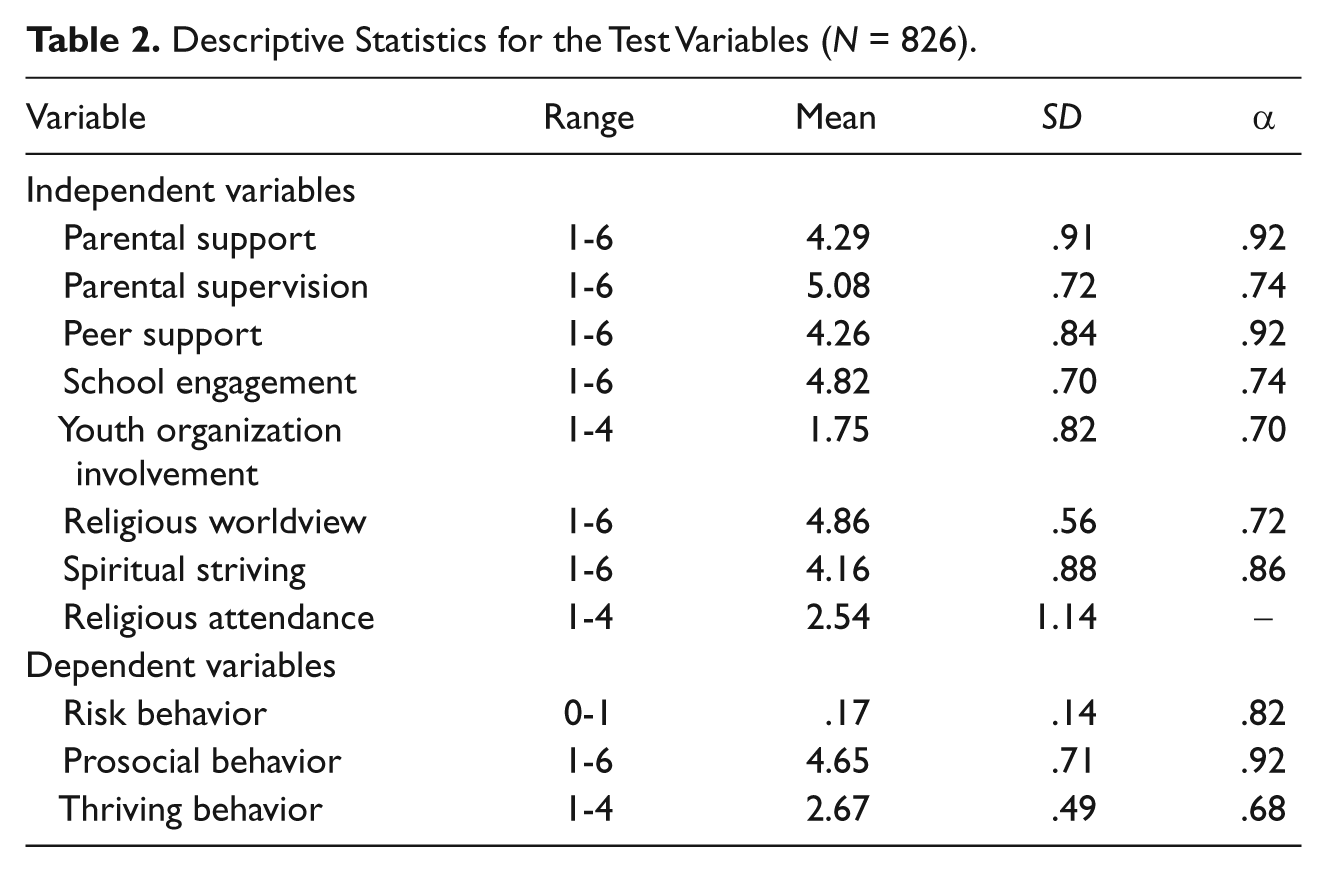
The survey questionnaire used to carry out the analysis included eight independent variables—parental support, parental supervision, peer support, school engagement, youth organization involvement, religious worldview, spiritual striving, and religious attendance—and three dependent variables—risk behavior, prosocial behavior, and thriving behavior—and five controls. Cronbach alphas for all measures are reported in Table 2.
Descriptive Statistics for the Test Variables (N = 826).
Risk behavior
A 9-item risk behavior scale (Krauss et al., 2006) was used to measure a range of at-risk behaviors. Two items were removed from the original version due to relevance concerns given the age of the study sample. Respondents were asked to indicate the frequency of engagement in the list of 9 risk behaviors, which included loitering, smoking, gambling, drinking alcohol, viewing pornographic movies and books, drug use, kissing and premarital sex. Responses ranged from 1 = almost never to 6 = almost always.
Prosocial behavior
The 14-item Mu’amalat scale (Krauss et al., 2006) was used to measure the respondents’ frequency of engagement in positive, prosocial behaviors. Prosocial behaviors on this scale refer to positive relations with family, friends, and society as well as the nonhuman environment. Example items include “I respect other people’s opinions,” “I feel worried when I hurt my parents,” and “I do not neglect my friends’ dignity.” One item (“I worry if I cannot pay debt on time”) was removed due to relevance with the study sample. Responses ranged from 1 = almost never to 6 = almost always.
Thriving behavior
Thriving behavior was measured using a composite of eight items from the Thriving Orientation Survey (Benson & Scales, 2008) that included sparks, valuing diversity, positive health perception, and academic achievement. All items were measured with 4-point scales. Five items pertained to “sparks,” which refer to those interests that give adolescents energy and purpose, (e.g., “I have a special talent, interest, or hobby that I really care about and spend time on at least once a week” and “This talent, interest, or hobby gives me joy and energy, and is an important part of who I am as a person”). Valuing diversity was measured with one item (“I should have friends who are of a different race”), as was positive health perception (“I take good care of my physical health [such as eating foods that are good for me, exercising regularly, and maintaining a balanced diet”]). For academic achievement, adolescents were asked their grades in school (one item), with responses ranging from 1 = mostly Cs or below, 2 = mostly Bs and Cs, 3 = mostly As and Bs, and 4 = mostly As.
Parental support
Parental support was measured with 16 items from the revised version of the Inventory of Parent and Peer Attachment (IPPA; Armsden & Greenberg, 1987). The IPPA assesses adolescents’ perceptions of the positive and negative affective/cognitive dimension of relationships with parents—particularly how well these figures serve as sources of psychological security. For the current study, 16 items were identified from the IPPA that refer specifically to psychological and emotional support. The validity of the items was confirmed through exploratory factor analysis, with all 16 items loading above .4 on a single construct. Example items include “When we discuss things, my parents consider my point of view,” “My parents trust my judgment” and “My parents help me to understand myself better.” Responses ranged from 1 = strongly disagree to 6 = strongly agree.
Parental monitoring
Parental supervision was measured using a 6-item version of the Parental Supervision Scale (PSS; Cochran, Wood, & Arneklev, 1994). The PSS was designed to measure the control effect of parental supervision. The original scale comprised three items: (a) When I was younger my parents kept a close eye on me; (b) When I was younger my parents recognized when I had done something wrong; and (c) When I was younger my parents punished me when they knew I had done something wrong. An additional three items were added to measure the respondents’ perceptions of current level of parental supervision. The additional three items are (d) My parents still keep a close eye on me; (e) My parents recognize when I do something wrong; and (f) My parents punish me when they know I have done something wrong. Responses ranged from 1 = strongly disagree to 6 = strongly agree.
Peer support
Peer support was measured with 15 items from the revised version of the Inventory of Parent and Peer Attachment (IPPA; Armsden & Greenberg, 1987). Similar to the parental support scale, items from the IPPA were identified that pertain to peer support. The validity of the items was also confirmed through exploratory factor analysis, with all 15 items loading above .4 on a single construct. Example items include “When we discuss things, my friends consider my point of view,” “My friends encourage me to talk about my difficulties,” and “My friends listen to what I have to say.” Responses ranged from 1 = strongly disagree to 6 = strongly agree.
School engagement
A 6-item scale was used to measure the respondents’ adherence to the educational goals and values of their school (Cochran et al., 1994). Sample items include, “Going to school has been an enjoyable experience for me,” “Doing well in school is important for getting a good job,” and “How important do you think the things you are learning in school are going to be for your later life?” All items were measured with 6-point scales.
Youth organization involvement
Youth organization involvement was measured with two items. Respondents were first asked, “How would you rate your level of involvement in a youth organization/youth club?” The first item was measured on a 4-point scale ranging from 1 = not involved/not very involved to 4 = highly involved. Then, they were asked, “If you are involved, how many hours per week are you involved?” The second item was measured on a 4-point scale ranging from 1 = 1 hour or less to 4 = more than 3 hours.
Religious worldview, spiritual striving, and religious attendance
Although the use of religious salience (e.g., ‘Religion is important in my life’) as a dependent measure of religiosity is ubiquitous in the literature, several authors have stressed the importance of using multidimensional measures relevant to the specifics of the Islamic faith to distill more information about its unique form of religiosity (Abu-Raiya & Pargament, 2011). In line with this thinking, the Islamic Worldview and a revised Spiritual Striving (formerly Ritual) scale from the Muslim Religiosity-Personality Inventory (MRPI; Krauss et al., 2006) were used, along with mosque attendance, as religious measures.
The Islamic Worldview scale is based on the aqidah (foundational/core beliefs) of traditional Sunni Islam and measures the level of agreement with item statements relating to the Islamic pillars of faith (arkan al-Iman; i.e., belief in God, Angels, Messengers and Prophets of God, Books of Revelation, The Day of Judgment, and Divine Decree). These pillars of faith, representing Islamic aqidah, form the basis of Islamic worldview or one’s personal vision and understanding of reality as defined by Islamic teachings, which in turn influence—in varying degrees—behaviors, values, and thoughts (Krauss, 2005). Example items on the Islamic Worldview scale include “To fully develop their nations, Muslims cannot completely follow Islamic teachings” (negative item), “Islamic values are applicable only in certain situations, places and times” (negative item), and “All human activities must be done for the sake of Allah.” For the current study, a shortened 20-item version of the Islamic Worldview scale was used as three items were removed from the original version of the scale (see Krauss et al., 2006) due to concerns of relevance to the younger sample included in the current study. Responses ranged from 1 = strongly disagree to 6 = strongly agree.
The revised Spiritual Striving scale is one of two Religious Personality subscales from the MRPI. Spiritual striving refers to individual ritualistic behaviors undertaken in an attempt to bring oneself closer God, reflective of Islamic teachings. Such striving includes making an effort to seek religious knowledge and learning the Qur’an, engaging in acts of worship such as prayer beyond what is considered compulsory, remembrance of God (zikr), praying in congregation, and Qur’an recitation. Example items include, “I make an ongoing effort to increase the frequency of my non-obligatory prayers,” “I try to understand the meaning of Qur’anic words/verses,” and “I feel at peace when I hear the Qur’an recited.” Seven items were removed from the original scale that, although reflective of spiritual or religious striving, were prosocial in nature (e.g., “I take advantage of opportunities to understand Islam with my family,” “I invite others to perform obligatory prayer”). Out of concern for multicollinearity with the prosocial behavior scale, those items were removed. One additional item was added “Whenever possible, I pray in congregation”. Exploratory factor analconfirmed the construct validity of the revised 8-item scale with all 8 items rotating on a single factor with loadings above .5. The revised Spiritual Striving scale was based on a 6-point scale ranging from 1 = almost never to 6 = almost always. Religious attendance was measured with a single item (“How often do you go to the mosque?”); responses ranged from 1 = never/a few times a year, 2 = a few times a month, 3 = a few times a week, to 4 = every day.
Controls
An eight-item short version of the Crowne-Marlowe Social Desirability scale was used to measure social desirability responding (Ray, 1984). Self-enhancement strivings, such as those typically found in the context of studies on religiosity, are prevalent, potent, and universal and should thus be accounted for (Sedikides & Gebauer, 2010). The original eight-item Crowne-Marlowe short scale used in the current study reported satisfactory reliabilities among samples of German and Australian respondents (Ray, 1984). In the current study, however, reliability of the scale was lower at α = .54. In addition to social desirability, to minimize the possibility that results might be due to spurious effects, gender (0 = female; 1 = male), residence (0 = urban; 1 = rural), income, and family structure (0 = one parent at home; 1 = two parents at home) were also included as control variables.
Data Analytic Strategy
Following descriptive and partial correlation analysis of the test variables, we performed separate multiple hierarchical regressions to examine positive parenting (parental support, parental supervision), community support (peer support, school engagement, youth organization involvement), and religiosity (religious worldview, spiritual striving, religious attendance) as predictors of risk, prosocial, and thriving behavior. For the multiple regressions, the predictors were entered in a hierarchical fashion to examine the contribution of positive parenting while controlling for sociodemographics and social desirability; the contribution of community support over and above parenting; and the contribution of religiosity above and beyond all of the preceding variables. Sociodemographic and social desirability controls were entered in Step 1, parental support and parental supervision in Step 2, peer support, school engagement, and youth organizational involvement in Step 3, and religious worldview, spiritual striving, and religious attendance in Step 4. Finally, the final model was examined for direct effects of the individual predictor measures.
Through hierarchical multiple regression, we entered the study variables in blocks relating to order of proximity to the adolescent respondents in line with the ecological approach discussed in the introduction. After entering several sociodemographic variables along with social desirability as controls, the parenting variables were entered together, followed by the community support constructs, and lastly the religious factors. Although religion is arguably a personal construct that could have been entered into the analysis before parenting and community support, we chose to enter it last to examine the presumed importance of religion in the lives of Muslims living in predominantly Muslim countries. Also, the three religious measures we included pertain to both individual and social context. For example, religious worldview, although personal, is influenced by many of the other social context factors included in the analysis, as parents, peers, and educational institutions will undoubtedly shape a young person’s worldview. We felt it most appropriate, therefore, to enter religiosity last in an attempt to glean out its unique contribution over and above the other variables included.
Results
Partial Correlations
Results of the partial correlation analysis are shown in Table 3. After controlling for gender, place of residence, income, family structure, and social desirability, risk behavior was inversely associated with religious worldview, parental support, school engagement, spiritual striving, and religious attendance, respectively. For prosocial behavior, all of the independent variables were positively associated, ranging from r = .15 (p < .01) for youth organization involvement to r = .52 (p < .001) for spiritual striving. For thriving behavior, all independent variables also correlated positively, with a range of r = .13 (p < .01) for parental supervision to r = .34 (p < .001) for school engagement.
Partial Correlation Coefficients of the Test Variables.

p < .05. **p < .01. ***p < .001.
Multiple Regressions
Risk behavior
Preliminary analyses for all regression analyses were conducted to ensure no violation of the assumptions of normality, linearity, multicollinearity, and homoscedasticity. The hierarchical regression results (Table 4) revealed that positive parenting, community support, and religiosity each uniquely contributed to the overall variance in risk behavior. In Step 2 of the hierarchical regression, parental support and supervision contributed 3% (p < .001) of the total variance explained by the model, after controlling for sociodemographics and social desirability. Peer support, school engagement, and youth organization involvement also contributed an additional 3% (p < .001), over and above parenting and sociodemographics, while religious worldview, spiritual striving, and religious attendance contributed an additional 2% (p < .01) over and above the other variables in the model. In the final model, parental support, school engagement, and religious worldview effects were found such that adolescents reporting higher in each of the three, reported less involvement in risk behavior. Youth organization involvement and peer support, however, were positively associated with risk behavior, meaning that adolescents reporting higher in each of the two reported higher risk behavior. The overall R2 for the tested model predicting risk behavior was .28 (p < .001).
Standardized Beta Coefficients From Hierarchical Regression Analysis for Risk, Prosocial and Thriving Behavior.

p < .05. **p < .01. ***p < .001.
Prosocial behavior
In Table 4, the results again indicated unique contributions for each of positive parenting, community support, and religiosity. Parental support and supervision contributed 14% (p < .001) of the overall variance, after controlling for sociodemographics and social desirability. Peer support, school engagement, and youth organization involvement contributed an additional 6% (p < .001), over and above parenting and sociodemographics, while religious worldview, spiritual striving, and religious attendance contributed an additional 13% (p < .001) to the overall model. In Step 4, adolescents who reported higher parental supervision, peer support, school engagement, religious worldview, and spiritual striving, reported higher prosocial behavior. The overall R2 for the tested model was highest for prosocial behavior at .39 (p < .001).
Thriving behavior
According to Table 4, the results again indicated unique significant contributions in the overall variance of thriving for each of the positive parenting, community support, and religious factors. Parental support and supervision contributed 5% (p < .001) of the overall variance, after controlling for sociodemographics and social desirability. Peer support, school engagement, and youth organization involvement contributed an additional 10% (p < .001), over and above parenting and sociodemographics, while religious worldview, spiritual striving, and religious attendance contributed an additional 3% (p < .001) over and above the other variables included in the study. In the final model, adolescents who reported higher school engagement, peer support, and spiritual striving reported higher thriving behavior. The overall R2 for the tested model predicting thriving behavior was .23 (p < .001).
Discussion
The positive youth development approach emphasizes the importance of a holistic, systemic approach to development, which translates into integral roles for parents, families, and communities to support adolescents. The youth development assets framework (Benson, 1997; Benson, Scales, Leffert, & Blyth, 1998; Leffert et al., 1998) has provided much of the intellectual and empirical capital for this work by illustrating that there are a number of “assets” or positive influences in adolescents’ everyday environment that, when present, facilitate healthy development. Drawing on this philosophy and related work, in this study we set out to expand on the existing research by examining the role of positive parenting, community support, and religiosity—three key developmental thrusts—on a sample of Muslim adolescents in a predominantly Muslim country. We asserted that previous research emphasizing the importance of positive experiences with parents, family, peers, school, youth, and community programs, and religious involvement and personal religiosity, would result in positive outcomes for Muslim youth in the form of lower involvement in risk behavior and increased involvement in positive outcomes such as prosocial behavior and thriving. In so doing, we tested the hypotheses that (a) positive parenting, (b) community support, and (c) religiosity, as developmental assets, would significantly contribute to both negative and positive behavioral outcomes by acting as protective factors against risk behavior and promotive factors of prosocial and thriving behavior. Each of the three hypotheses tested were partially supported, as each contributed significantly to the three behavioral outcomes tested; however, individual predictors within each block varied in their level—and in some cases direction—of contribution.
For risk behavior, each of the three sets of factors tested were significant in terms of their contribution to the overall model; however, much of the variance in risk was accounted for by the controls, in particular, gender and social desirability. The results further indicated a small, but substantive contribution of religiosity as a protective factor against involvement in such behavior, even after controlling for parental and community supports, indicating that religious worldview, in this case, was salient and not explained by the other study factors. Milot and Ludden (2009), in their study of rural Christian youth in the United States, found that even after accounting for parental social support and frequency of religious service attendance, adolescents’ beliefs that religion is important in their lives were associated with less cigarette, alcohol, and marijuana use. This protective role resonates with social control theory (Hirschi, 1969), which states that connections to conventional institutions with appropriate value systems, such as religion and its worldview, can control and inhibit deviant behaviors. In the current study, the religious worldview measure employed embodies the core beliefs of Islam, which appear to act as a protective factor against deviance among the study sample. Perhaps somewhat surprising was the lack of a similar direct effect from either of the other two religiosity measures, which are more representative of religious and spiritual practices. According to King and Benson (2006), however, religious worldviews often embody unique beliefs and values that can sustain a young person with a sense of identity, purpose, and belonging. This sense of belonging can strengthen a young person’s commitment to a broader collective who share similar beliefs; providing motivation for service and identity formation and leading young people away from negative, self-destructive behaviors. This may help explain the significance of religious worldview in the current study as not only a preventive factor but also a contributor to prosocial behavior as well.
In the final model predicting risk behavior, only parental support, school engagement, and religious worldview proved significant as individual protective factors, while peer support and youth organization involvement indicated positive relationships with risk. Although we cannot infer causality from regression analysis, the findings provide some indication that supportive peers and involvement in youth organizations are not—in and of themselves—sufficient as protective factors against negative behaviors. In fact, the positive association between peer support/youth organizations and risk behavior may imply learning from deviant peers and deviant youth subculture, reflecting a “negative” social learning process (Dworkin & Larson, 2006; Sutherland, 1947). This finding reflects a limitation in the current study design, that being the lack of a peer religiosity or related measure to gauge respondents’ perceptions on the extent to which peers act as positive or negative influences in their lives. Peer support and involvement in youth organizations alone do not imply any specific direction of influence. A young person could be highly supported by peers and involved in youth organizations where the influence on the young person, is in fact, negative. Previous studies have found that such negative experiences in youth programs can include experiencing stress, encountering inappropriate adult behavior, being subject to negative peer influence or pressure, experiencing social exclusion, and encountering negative peer group dynamics (Dworkin & Larson, 2006; Larson, Hansen, & Moneta, 2006). On the other hand, the findings show that peer support was also a positive contributor to prosocial behavior and thriving, indicating that peers can also play a significant positive role in the lives of adolescents.
For prosocial behavior, the results indicated more robust contributions from the test variables than for risk behavior, with parenting and religiosity contributing the most variance. The final model further showed that spiritual striving, religious worldview, parental supervision, peer support, and school engagement, respectively, were significant as unique predictors. The positive contribution of religious worldview on predicting prosocial behavior highlights the important role that religiosity can have as a simultaneous protective and promotive factor. The significant contribution of spiritual striving indicates that young people’s dedication to striving toward the divine has a strong association with other positive behaviors. Other studies have also shown positive relationships between religious and spiritual forms of striving and greater purpose in life, greater subjective well-being, greater coherence among personal goals, and less goal conflict (Mahoney et al., 2005; Pargament & Mahoney, 2002). Few studies to date, however, have attempted to link spiritual striving with prosociality.
The significant role of supportive parenting on prosocial behavior indicates that parents offer much in the way of both support and supervision to foster positive youth behavior, as do schools and potentially peers. However, much of the variance from parental support was accounted for by the religiosity factors in Step 4 (Table 4), spiritual striving in particular. A similar pattern resulted for thriving behavior as well. Parental support thus appeared to be mediated by spiritual striving; however, this was beyond the scope of the current study. More extensive analysis on the interaction of these variables would be useful in future studies.
For thriving, community support and parenting were most salient as predictors. The role of positive school experiences and involvement in youth programs, both in and outside of school, has been cited in several studies as having a promotive effect on thriving. Spiritual striving, in the final thriving behavior model, was also associated with thriving behavior, indicating that like prosocial behavior, the greater the devotion in the form of supererogatory acts of worship, knowledge seeking and spiritual practices can transfer over to—or be transferred by—striving in other aspects of life. In some cases, a young person’s thriving may be in the form of religious interests, which may have been captured in the current study by the “sparks” items included in the thriving behavior measure. This is not surprising among a sample of Muslim youth in the context of a predominantly Muslim country.
Study Limitations and Future Directions
Although the findings extend previous research, there were limitations to this study. Despite its extensive use in the religiosity literature, religious attendance as a valid measure for adolescent religiosity has been called into question as some adolescents may attend the mosque because their parents ask them to or it may simply be a routine family event. We tried to buffer this possibility by using multiple measures for religiosity along with a social desirability scale. It should be noted, however, that as a predictor, attending the mosque might result in benefits for the young person regardless as to the motivation for his or her attendance, as social learning can still occur once a young person is involved in the setting. Future studies could, however, include an additional item measuring the extent to which one’s attendance at the mosque is of his or her own choosing. Future research should also consider other modes of measuring religiosity, such as parental and peer reports (French et al., 2008).
The possibility of shared method variance and self-report bias cannot be ruled out as alternative explanations for the findings as well, due to the study’s sole reliance on self-report measures at one point in time. We feel that the inclusion of the Marlowe-Crowne social desirability scale was important given the sensitive nature of religiosity scales. Despite the potential for socially desirable responding in the context of sensitive research such as studies on religion and problem behaviors, few studies actually include such scales in their analysis. In the context of such research, however, the problem of socially desirable responding has been discussed (Eysenck, 1998; Lewis, 1999). The results here support the need to include social desirability scales in research on sensitive issues like religiosity and problem behaviors, especially among populations that may have a higher level of sensitivity to such issues, such as Muslims and other Asian populations, where stigmatization is often attached to self-disclosure of certain types of religious and other social behaviors (Inman, Ladany, Constantine, & Morano, 2001).
As literature in the West has shown that schools and peers become increasingly important to middle- and high school students, dimensions in adolescents’ social context should be extended in future studies to include school and peer experiences as independent social factors. Although the two factors, as measured by school engagement and peer support, were included in the current study analysis, they were treated as part of community support. Furthermore, although causality was not a major concern in the current study, longitudinal data should be preferred in future studies to show clear predictive directions between risk/protective factors and behavioral outcomes.
Conclusions and Implications
Despite the study limitations, the results have important implications for adolescent development, particularly on the universality of the role of parenting, community/school engagement, and religiosity in Muslim contexts. The above discussion of Islam in Malaysia provides some partial explanation of the findings. Within Muslim cultures such as that of the Malays, religion permeates all aspects of life and competence in religious involvement translates to other spheres of life. It further highlights the importance of understanding youth development within different faith communities and the roles that relationships and institutions can play (French et al., 2008).
The results also indicate that multidimensional measures of religiosity that are relevant to the target population are most effective in eliciting its importance in the lives of youth. Future studies that incorporate longitudinal designs will go further in examining the findings over time as well as establishing key causal relationships between the variables under study.
Footnotes
Declaration of Conflicting Interests
The author(s) declared no potential conflicts of interest with respect to the research, authorship, and/or publication of this article.
Funding
The author(s) disclosed receipt of the following financial support for the research, authorship, and/or publication of this article: The research was supported through the UPM Research University Grant Scheme, Vote No. 91772.