




Abstract
This exploratory study was designed to examine the beliefs of youth users of alcohol and marijuana about the connections between their substance use and dating violence perpetration. Eighteen youth (ages 14-20 years old), who were primarily of Black or Hispanic race/ethnicity, participated in in-depth interviews about times when they had perpetrated dating violence. They were asked to reflect on whether and how they felt that alcohol and/or marijuana may have contributed. Responses coalesced around four major themes, which were that users believed that (a) Alcohol escalates minor conflict; (b) Alcohol exacerbates feelings of irritation and anger; (c) Marijuana reduces feelings of irritation and anger; and (d) Substances are used to cope with conflict-related stress. We conclude that momentary event-level research that investigates the immediate influence of alcohol and marijuana use on dating violence perpetration is needed and that dating violence prevention interventions should consider addressing substance use and substance-aggression expectancies.
Adolescent dating violence is a serious public health problem. As many as 10% of high school-attending youth in the United States report having been hit, slapped, or hurt by a dating or sexual partner every year (U.S. Centers for Disease Control and Prevention, 2009). Youth living in urban areas appear to be at heightened risk for experiencing dating abuse (Hickman, Jaycox, & Aronoff, 2004), for example, 14% of youth in Boston, 16% of youth in Chicago, and 24% of youth in Detroit report victimization (U.S. Centers for Disease Control and Prevention, 2013). Youth who experience dating violence are at risk for a range of negative consequences, including death, injury, suicidal thoughts, substance use, disordered eating, and psychiatric disorders (Ackard & Neumark-Sztainer, 2002; Banyard & Cross, 2008; Brown et al., 2009; Kilpatrick, Acierno, Resnick, Saunders, & Best, 1997). For this reason, research delineating risk factors has been prioritized by federal funding agencies such as the U.S. Centers for Disease Control and the National Institute of Justice. Unfortunately, efforts to understand the etiology of dating violence are complicated by the fact that dating violence perpetration likely has multiple contributing risk factors including, for example, parent-to-child abuse, witnessing interparental violence, mental health disorder, and social norms encouraging the use of violence to resolve conflict and/or traditional sex role beliefs (Lewis & Fremouw, 2001; Vagi et al., 2013). However, research that illuminates why and how dating violence occurs is essential for the development of evidence-based prevention efforts.
One factor that is a suspected contributing cause to adolescent dating violence perpetration is substance use, specifically alcohol and/or marijuana use (Reingle, Staras, Jennings, Branchini, & Maldonado-Molina, 2012; Rothman, McNaughton Reyes, Johnson, & LaValley, 2012; Rothman, Stuart, et al., 2011). Historically, the study of the relationship between substance use and domestic violence has met with some concern from domestic violence activists who do not want substance use to become a viable “excuse” (i.e., justification) for perpetration (Zubretsky & Digirolamo, 1996). These concerns notwithstanding, a recent review of the literature on alcohol use and dating violence perpetration found that across 28 studies published between 1985 and 2010, 79% found a positive association between alcohol use and self-reported dating violence perpetration by youth (Rothman et al., 2012). However, these studies were either cross-sectional, or if longitudinal, did not assess whether alcohol consumption had an immediate (e.g., within 4 hours) impact on dating violence perpetration, and thus a causal link between alcohol use and dating violence perpetration could not be established by any of them. For this reason, additional data that provides insight into the potential for alcohol to influence youth dating violence perpetration is still urgently needed.
It is reasonable to suspect that youth alcohol consumption will indeed be found to have a pharmacological and acute effect on youth dating violence perpetration, as the larger body of research on adult partner violence perpetration and alcohol use is rich with data that are suggestive of such a causal relationship in adults (Fals-Stewart, Leonard, & Birchler, 2005; Leonard, 2005; Leonard, 2002). However, even the quantitative data collected from adults on alcohol use and partner violence perpetration does not explore how and why the statistical relationship may exist, which is germane for the development of effective prevention strategies (Langhinrichsen-Rohling & Capaldi, 2012). Researchers have proposed multiple theoretical explanations for why alcohol might influence partner violence perpetration, including (a) that alcohol has an acute, pharmacological effect on aggression, due to its disinhibiting or myopic effects, or because of users’ alcohol-aggression expectancies (McMurran, 2009); (b) that chronic drinking has a deleterious effect on neurophysiology, which increases risk for aggression; (c) that drinking may adversely effect relationship quality, which results in increased risk for violence; or (d) that alcohol and partner violence perpetration are both caused by a common underlying factor, and thus the association is spurious (Foran & O’Leary, 2008; Klosterman & Fals-Stewart, 2006; Lipsey, Wilson, Cohen, & Derzon, 1997; Rothman et al., 2012). Each of these may partially explain the observed associations between alcohol use and partner violence in adults. However, because youth are both developmentally and neurologically different than adults (Blakemore, 2012), and because their drinking styles can differ from those of adults (Steinhausen & Metzke, 2003; Windle, 1996), it is not a foregone conclusion that alcohol will influence their partner violence perpetration in the same manner that it does adults’.
The literature on marijuana use and youth dating violence perpetration is limited to a handful of studies; to our knowledge, eight peer-reviewed articles at this time (Champion, Wagoner, Song, Brown, & Wolfson, 2008; Coker et al., 2000; DuRant et al., 2007; Epstein-Ngo et al., 2013; Malik, Sorenson, & Aneshensel, 1997; Reingle et al., 2012; Rothman, Johnson, Azrael, Hall, & Weinberg, 2010; Testa, Hoffman, & Leonard, 2011). Though there is variation across these studies in how marijuana use was assessed, this small body of research has found consistently that self-reported marijuana use is associated with dating violence perpetration, with the exception of the Epstein-Ngo study. This is somewhat surprising, given that marijuana is reputed to have sedative and aggression-suppression effects (Myerscough & Taylor, 1985), and some research has found no link between marijuana exposure and aggression in humans (Cherek & Dougherty, 1995; Chermack et al., 2010; Epstein-Ngo et al., 2013; Thomas & Earleywine, 2008). There are two types of theoretical explanations for why marijuana could increase risk for dating violence perpetration. First, it’s possible that marijuana has pharmacological and acute, or immediate, effects on the user that make them behave aggressively. For example, Ostrowsky posits that marijuana use may result in increased heart rate and feelings of panic, which in turn may elevate risk for violence perpetration (Ostrowsky, 2011). Second, marijuana use may have no pharmacological impact on risk for aggression, but the use of the substance may nevertheless increase users’ risk for violence perpetration for situational reasons. For example, chronic users may experience a decrease in ability to cope with stress, solve problems, or communicate effectively with their partners. This in turn may elevate the risk for relationship conflict and violence perpetration. Finally, as others have pointed out (Thomas & Earleywine, 2008), marijuana use often co-occurs with other substance use (i.e., so it may be difficult to disentangle the effects of marijuana on aggression), and is also more common among those with a propensity for antisocial behavior. It is possible that observed relationships between marijuana use and violence perpetration could reflect unmeasured confounders.
This study was designed to examine what users’ beliefs are about the connections between their alcohol and marijuana use and their own dating violence perpetration. The study does not seek to evaluate whether alcohol and marijuana use elevate risk for dating violence perpetration. Rather, it seeks to provide rich detail about why users think that it does and to highlight possible situational and contextual mechanisms to inform theory and support quantitative investigations.
Method
Sample Selection
The 18 participants in this study were recruited from a pediatric emergency department (PED) in an urban area. The hospital in which the PED is located is the largest safety net hospital in New England. Approximately 50% of patients are uninsured or on Medicaid. The majority of the youth who seek services from the PED do so for nonurgent, nonacute medical problems (e.g., urinary tract infection, to get stitches removed, strep throat culture), and were therefore easy to approach and screen for eligibility.
Patients were eligible for this study if they were medically stable, between the ages of 14 and 20 years, could speak English, could recall at least one day in the past year when they drank or used marijuana and perpetrated dating violence, and were willing to be alone with the interviewer for the duration of the interview (i.e., any accompanying parents or friends had to wait outside the patient’s room). The age range of 14 to 20 years was selected for both scientific and practical reasons; we wished to include youth in various stages of development, and to facilitate recruitment. Youth aged 14 to 17 years old who presented to the emergency department unaccompanied by a parent or guardian were able to give assent for their own participation in this research study just as they are able to give permission for medical procedures. Both males and females were eligible for the study, as prior research has demonstrated that both male and female adolescents may use physical violence in dating relationships (Kernsmith & Tolman, 2011; Rothman, Johnson, et al., 2011; Rothman, Stuart, et al., 2011; U.S. Centers for Disease Control and Prevention, 2009). Although the dynamics and consequences of male-to-female and female-to-male dating violence may differ (Foshee, 1996), those differences were not germane to the present research question of interest, which focused on the participants’ perception of the role of alcohol in their own dating violence perpetration, regardless of the consequences for the victims. Therefore, we analyzed the responses from all participants combined, without stratifying by gender. All study protocols were reviewed and approved by the Boston University Medical Center Institutional Review Board (IRB).
Data Collection and Analysis
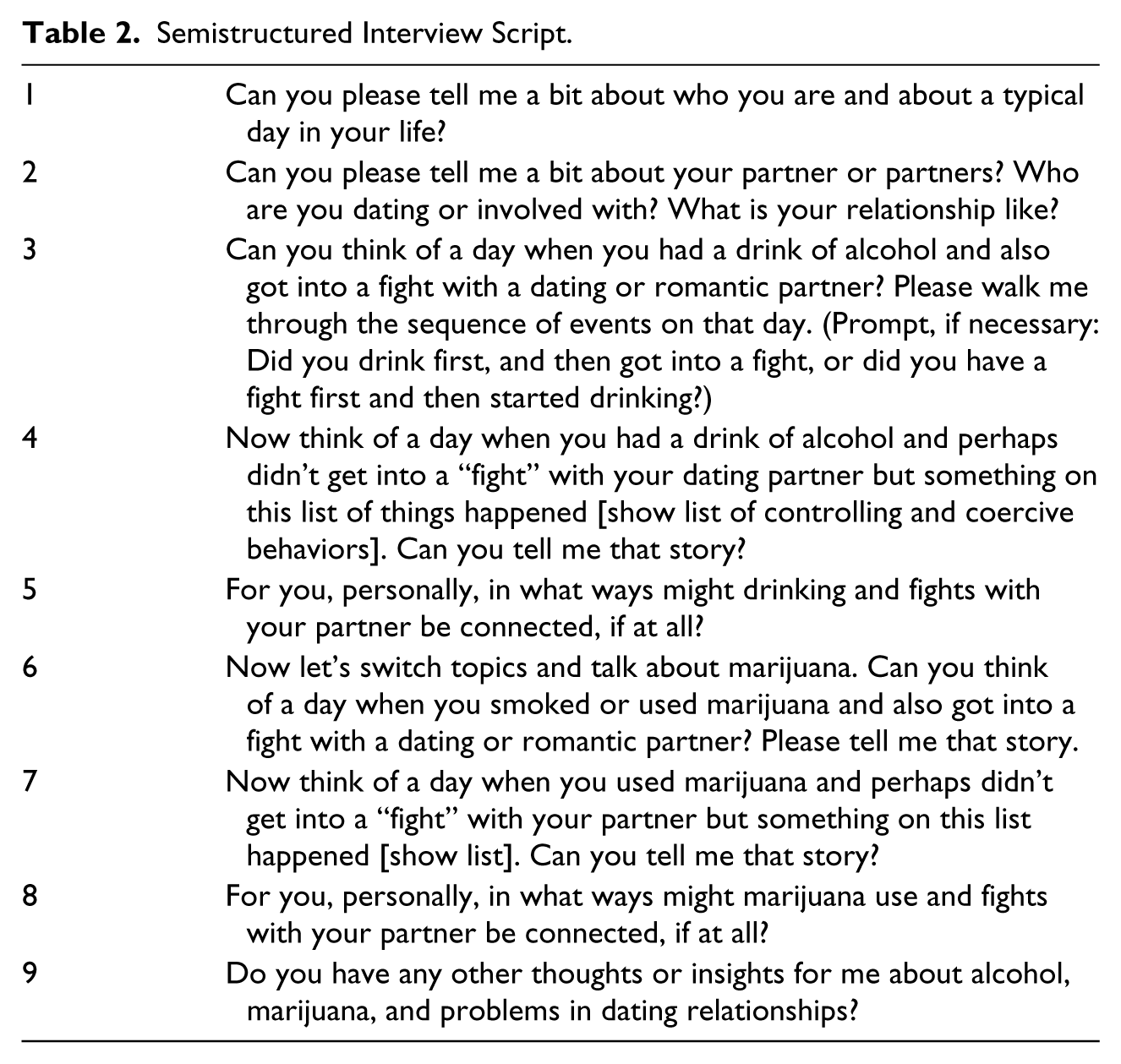
The semistructured interview script appears in Figure 1 The interview began with basic questions about the participant and his or her dating partner(s) to establish a rapport. Information about how alcohol and/or marijuana may be connected to dating violence perpetration was elicited by asking a series of questions about episodes when the participant may have used alcohol and/or marijuana and “had a fight” (i.e., a euphemism for perpetrating dating violence) with his or her partner. Each interview was coded for themes related to reasons why participants stated alcohol or marijuana may have influenced their behavior.
The coding process was as follows: (a) two individuals (authors MT and CK) read through each transcript to get “a sense of the whole,” (Sandelowski, 1995); (b) these two authors, in consultation with the study principal investigator (author ER), generated a coding list, where codes represented a theme that emerged from the interview data; and (c) codes were applied to sections of text by two independent coders. The coders then met to review their coding decisions and to record how many sections of text they had coded similarly (i.e., data used to calculate interrater reliability, as described below). Where discrepancies existed, the two coders discussed their decisions until consensus on a code was reached. To improve the chances that the two coders would make similar coding decisions on all 18 texts, at the outset of the process they used two interview texts to “practice” their coding and harmonize their decisions.
Once all interviews were coded, the data were explored in-depth using the qualitative software analysis program Atlas.ti (ATLAS.ti, 1999). First, members of the research team conducted searches by code, and looked at each section of text to which a particular code had been applied to get a sense of the thematic responses within that coding category. Second, all members of the research team met to discuss the themes that emerged from the text and to select illustrative quotations that represented each.
Results
Sample Characteristics
The 18 interviewees were 66% female (see Table 1). Age ranged from 14 to 20 years, with a mean average age of 18 years. Approximately 45% of the sample was between the ages of 14 and 18 years. The majority (89%) were youth of color, with 50% Black, 22% Hispanic, 11% White, and 17% Multiracial.
Characteristics of sample (N = 18).

Findings
The ways in which users believed that alcohol and marijuana were connected to dating violence perpetration in this sample fell into four main categories; (a) Alcohol escalates minor conflict; (b) Alcohol exacerbates feelings of irritation and anger; (c) Marijuana reduces feelings of irritation and anger; and (d) Substances are used to cope with conflict-related stress.
Alcohol escalates minor conflict
The descriptions of dating violence perpetration incidents that involved alcohol were commonly attributed to the disinhibiting effect of alcohol. A vast majority of the participants (15 out of 18, or 83%) gave descriptions of dating violence incidents that in their opinions would have been minor but for the presence of alcohol, or spoke in general terms about why they felt that alcohol escalated their conflicts from “petty arguments” to more severe episodes. Their comments coalesced around the ideas that alcohol heightens emotions and disinhibits aggressive behavior. One 18-year-old, White, gay, male reported that he had recently punched his boyfriend and felt that it was entirely attributable to alcohol consumption: If I was sober I would have never punched him. I know that for a fact. Like, I don’t believe in dating violence. I don’t like, I don’t believe in that at all. So I was even shocked.
A 19-year-old, Multiracial male commented that alcohol was the factor that influenced him to abuse his girlfriend rather than calmly discussing his dispute with her at a later time: [When drinking] I don’t hold my tongue. If I was sober, I probably would sit there like a little punk and let it go happen and like, oh god. And then probably bring it up to her after the fact. Like listen, I didn’t really appreciate what you did. The alcohol just pissed me off. Like, having the alcohol in me made me like, no, I’m going to control this situation right now.
Semistructured Interview Script.
This same participant continued to explain that in his experience, alcohol was the factor that determined whether he was going to react to a problem with his partner: Alcohol gives you that extra push to open your mouth. I’m the type of dude that likes to keep things to myself. I don’t really try to let the little things stress me until I drink.
Alcohol exacerbates feelings of irritation and anger
Twelve of the participants (66%) made comments about alcohol causing, or increasing, feelings of irritation and anger toward their partners. Some described specific incidents when they remembered feeling like alcohol had made them angry at a partner, while others described what they felt were general patterns related to their alcohol use and emotional reactions to their partners.
For example, one 18-year-old, White, male commented, When I drink, the littlest things upset me.
A 19-year-old, Black female used almost identical language (“littlest thing”) to describe how alcohol influenced her ability to keep things in perspective and remain calm and nonviolent: All of a sudden it feels like the alcohol just builds up and builds up and gets to a level where you just wanna like yell and scream at everyone. And be violent and take your anger out on everyone. And every little thing that happens, it could be the littlest thing ever, just makes you wanna like hit someone.
A 19-year-old Multiracial female talked about threatening her partner and the alcohol being the critical factor that made her follow through on her threat: My anger was already upset. I was already just past the point of upset. And the liquor gave me the actual boom, to stick to my word. I’m ready to fuck something up.
This same participant wondered aloud why and how alcohol made her feel more aggressive and described feeling more argumentative and primed to engage in physical fighting when drinking: I don’t know the biology and actually what in liquor, what reaction it has in your body. Does it slow your responses down, I don’t know. But I know when I drink, I’m a lot more, just easier to get into an argument. A lot more argumentative. A lot more physical. A lot more, I’ll fight you, I’ll punch you, I’ll beat you up.
Marijuana reduces feelings of irritation and anger
Six of the 18 participants (33%) talked about marijuana, and four of them talked about marijuana having a calming effect on them, particularly in relation to their feelings about their intimate partners. Of the remaining two, one participant spoke about marijuana making her feel paranoid, and increasing her fear of being raped by a male friend. Another attributed her own physical dating violence perpetration in one particular incident to marijuana use. In other words, 90% of those who spoke about marijuana reported that it made them feel happy, calm, and reflective.
An 18-year-old Black female talked about an incident that had happened the day before the interview, when she had beaten her boyfriend for being late for a date with her. She used marijuana to calm herself down afterward, and when she felt herself growing irritable again, she smoked more marijuana to avoid using more violence: So when I mad I smoke for me to just brush it off, to be like whatever, I don’t care. So when we get into an argument we smoke for me to not be mad. . . . Yesterday, me and him had plans and he was late. I was like “alright, I got him” and waited for him to come here and I beat him up. Then we smoked and I was fine. Then I got mad and smoked again but I don’t understand why it’s like that.
A 19-year-old Multiracial male talked about why marijuana allowed him to avoid being abusive toward his partner, and explained that his experience of using marijuana was that he became more reflective and introspective, and willing to consider his partner’s point of view. He contrasted this feeling to being drunk on alcohol, when—in his view—he was more likely to act instantaneously on a negative thought or impulse: With marijuana, it made me be calmer and look outside the box and things. So, example like, okay when I asked her, why did you feel like I was talking to another woman—this is the marijuana kicking in. I thought about it, I’m like, what took her to that point to think that? That the marijuana making you just think and think and think of like different things, versus alcohol where you think of one thing (snaps fingers) and you’re rolling with it. That’s it. Marijuana I stepped outside my box: why we did the actions we did, versus alcohol where it’s like . . . you cheated on me? Fuck you. Blah blah. You don’t have control of your thoughts.
As mentioned above, there was one participant (a 19-year-old, Hispanic female) who reported that she was physically violent toward her boyfriend and that she attributed that to marijuana:
So you had smoked a little marijuana?
Mm hmm. He went into the kitchen and he was like calling me a bitch . . . I ran into the kitchen and hit him again . . . and his friends grabbed me again and locked me in the bedroom and then I calmed down, and I went out again and he called me the b-word again and I flipped out again . . . I hit him with my fist . . . if I wasn’t smoking that night, I think I would have just talked to him about it rather than just walk up to him.
Finally, there was also one participant ( a 16-year-old, Black female) who said that marijuana made her feel paranoid and therefore more frightened of date rape than perhaps she needed to be: I really can’t smoke ’cause I start getting paranoid . . . Like one time I was smokin’ with my friend. He tried to talk to me once and I turned him down. So I finally end up chillin’ with him and then I smoked or whatever, and after that like every move he did I’m like whoa whoa whoa like whatchu tryin’ to do. He like I’m not tryin’ to do anythin’. I’m like are you bout to rape me, are you about to rape me? He’s like no, what are you talkin’ bout and he got up and I’m runnin’ out the house speedin’ for my life! I thought he was after me but he really wasn’t.
Substance use to cope with conflict-related stress
Relatively few participants mentioned that they drank or used marijuana in the aftermath of a dating violence perpetration incident although 2 out of 18 (11%) did. This is noteworthy because, theoretically, one of the reasons why research studies may have detected a correlation between alcohol and/or marijuana use and dating violence perpetration is because perpetrators use substances after, rather than before, such incidents. While this study did not seek, and is unable, to provide evidence about whether substance use following a dating violence incident is primarily or even partially responsible for any correlations that have been detected in prior quantitative studies, we were able to document that at least in some cases, youth do use alcohol or marijuana following dating violence incidents to cope with stress.
Conclusions
This exploratory, qualitative investigation of users’ perceived relationship between their alcohol and/or marijuana use and dating violence perpetration revealed that, in this sample (a) alcohol was perceived as escalating minor conflicts into more serious ones with the potential for physical violence; (b) alcohol was perceived as exacerbating feelings of irritation and anger that might otherwise be ignored; (c) marijuana was perceived as having a sedative or calming effect; and (d) there are instances when those who perpetrate dating violence subsequently use either alcohol or marijuana to cope with their own stress.
These results add to the existing literature on the relationship between alcohol and marijuana use and dating violence perpetration in three important ways. First, alcohol aggression expectancies—that is, beliefs that alcohol causes aggression, have been found to predict dating violence perpetration (Rothman, Stuart, et al., 2011). In this study, we found that users’ beliefs in the disinhibiting effects of alcohol (“Alcohol gives you that extra push . . .”), and beliefs that alcohol can cause angry feelings (“And it usually does make me mad. Hard alcohol for some reason”), specifically, were related directly to their own dating violence perpetration scripts. This has salience for prevention because if alcohol aggression expectancies can be addressed successfully, it is possible that alcohol-related dating violence might decrease. It is noteworthy that youths’ perceptions that alcohol escalates conflict or increases anger may or may not be accurate; it is possible that youth have the expectation that they will feel more vitriolic after consuming alcohol because they have witnessed parents or other people become violent after consuming alcohol, or they may consciously or unconsciously use alcohol as an excuse for aggressive behavior to avoid accountability. No matter how youth form their expectancies about how alcohol might influence them, addressing those expectancies through prevention programs may be important. Second, marijuana was almost universally perceived as having a sedative or calming effect, and several participants described conflict scenarios when, in their own perception, the use of marijuana decreased the severity and/or frequency of the abuse that they perpetrated. How can we make sense of this finding in light of the quantitative evidence that marijuana use is associated with increased risk of dating violence perpetration (Reingle et al., 2012)? The majority of prior quantitative research has assessed marijuana use in a gross manner (for example, the number of days of marijuana use in the past month) and also assessed dating violence perpetration at a substantially later time point (for example, a month or year later). The quantitative studies on this topic have detected a global statistical relationship between a form of substance use and a form of violence perpetration, but they have not established that THC (i.e., the psychoactive component of marijuana) causes immediate aggressive behavior. Moreover, a recent analysis of daily data from a sample of urban youth found that dating violence perpetration was no more likely on a day when a youth used marijuana than a day without (Epstein-Ngo et al., 2013), which supports the argument that marijuana may not increase dating aggression. A momentary analysis that assesses marijuana use and dating violence by hour of the day would help to establish the temporal order of marijauna use and dating violence events on days when both occur, which would substantially further the knowledge base about the possibility that marijuana is causal in dating violence. Third, this study is the first to demonstrate that in some instances, perpetrators of dating violence seek out and use substances (either alcohol or marijuana) in the aftermath of the event. This is a critically important finding because it raises a new limitation of cross-sectional studies that find associations between dating violence perpetration and substance use. These cross-sectional associations, where temporal order has not been established, cannot be assumed to suggest that the substance use elevated risk for the dating violence perpetration. It is possible that a portion of those who abuse partners use substances only after having perpetrated abuse, which underscores the need for careful empirical research that demonstrates that substance abuse precedes dating violence perpetration in the majority of cases if a causal inference is to be made. Otherwise, prevention efforts that seek to reduce substance use as a means to reducing dating violence perpetration may be misguided.
This study is subject to several limitations. First, qualitative investigations are by nature exploratory. The value in this work is that it relays the thoughts and feelings of the participants, but their own opinions about how alcohol and marijuana influence them may not be accurate. This is why it is important to bear in mind that it is users “expectancies” that we have investigated, and we have not uncovered truths about how either alcohol or marijuana operates neurochemically. Second, the sample was a small-to-medium-sized sample for a qualitative investigation of this nature. After completing 18 interviews, our research team felt that we had reached “saturation,”—that is—we were not hearing very many new opinions, new stories, or new ideas, and so terminating the sample recruitment was appropriate in our view. Third, we drew our sample from one particular department within a particular hospital in one city. How “representative” are poor, urban youth from Boston of other dating violence perpetrators in the nation? Unfortunately, we have no way to ascertain how similar or different from other dating violence perpetrators those in our sample may be, but we would urge the reader to keep in mind that qualitative research is intended to be theory-generating, and to enrich knowledge established through quantitative research. Therefore, the representativeness of this sample is, arguably, not a weakness insomuch as the results are not intended to be generalized. Finally, our sample contained two youth with same sex sexual experiences. It is possible that the role of alcohol and marijuana in the perpetration of dating violence by gay, lesbian, or bisexual (GLB) youth differs from those of heterosexual youth, as some GLB youth face additional challenges in unhealthy dating relationships due to their sexual orientation (Gillum & DiFulvio, 2012). Additional research that includes larger samples of GLB youth would be informative.
In conclusion, we found that in this population of urban young adults, expectancies surrounding alcohol and marijuana use were reported to influence the perpetration of dating violence. Whereas alcohol use was associated with participants’ perception of increased likelihood of dating violence perpetration, marijuana use was often described as a mitigating factor. Furthermore, we describe a subset of participants who reported using alcohol or marijuana after perpetration, underscoring the importance of establishing the temporal relationship between alcohol/drugs and dating violence in studies.
Footnotes
Acknowledgements
The authors wish to thank the numerous public health students who helped to collect and transcribe the data: Kelly Adams, Jess Alder, Nina Burke, Katelyn Flaherty, Carol Kopelman, Kelly Lamas, Casey Mulligan, Jacquelyn Murphy, Kristina Racek Pechulis, and Jessica Trudeau.
Declaration of Conflicting Interests
The author(s) declared no potential conflicts of interest with respect to the research, authorship, and/or publication of this article.
Funding
The author(s) received following financial support for the research, authorship, and/or publication of this article: This research was supported in part by National Institute on Alcohol Abuse and Alcoholism grant K01AA017630.