



Abstract
The present study sought to examine the relationship between Chinese high school students’ academic self-efficacy and their academic-related boredom. Another objective was to explore the moderating effects of mono-amine-oxidase type A (MAOA) gene polymorphism on this relationship. In a sample of 514 Chinese high school students, we measured their academic self-efficacy and academic-related boredom from Grades 10 to 12. In addition, we collected their DNA. Data were analyzed by using a linear mixture model. The results indicated that students’ academic self-efficacy negatively predicted their academic-related boredom. The relationship between academic self-efficacy and academic-related boredom was more reliable for students with the 3-repeat allele than for the students with the 4-repeat allele. The findings suggested that the functional polymorphism of MAOA gene moderated the relationship between academic self-efficacy and academic-related boredom.
Self-efficacy, a key component of Bandura’s (1977) social cognitive theory, is a concept that has been widely researched in recent decades (Bandura, Barbaranelli, Caprar, & Pastorelli, 1996; Carroll et al., 2009). Academic self-efficacy is conceptualized as “people’s judgments of their capabilities to organize and execute courses of action required to attain designated types of performances” (Bandura, 1986, p. 391). In previous research, academic self-efficacy has been linked to academic outcomes such as academic achievement and motivation (Carroll et al., 2009; Elias & Loomis, 2004; Greene, Miller, Crowson, Duke, & Akey, 2004; Pintrich & DeGroot, 1990). Although students experience several kinds of academic-related emotions in their school settings (Pekrun, 2006), the relationship between academic self-efficacy and academic-related emotions has been a less well studied area. In previous research, researchers reported that students felt boredom during 32% of their classroom time (Larson & Richards, 1991), which was more frequently felt among students than other academic-related emotions (Goetz, Pekrun, Hall, & Haag, 2006; Nett, Goetz, & Hall, 2011). Therefore, in the present study, we sought to examine the relationship between Chinese high school students’ academic self-efficacy and their academic-related boredom and the moderating effects of the mono-amine-oxidase type A (MAOA) gene polymorphism on this relationship.
The Relationship Between Academic Self-Efficacy and Academic-Related Boredom
Based on expectancy–value theory and attribution theory, Pekrun (2006) proposed a control–value model to describe the antecedents of students’ academic-related emotions. This model provides a framework to examine how academic self-efficacy influences academic-related emotions. According to this model, students’ academic-related emotions are determined by the appraisals of subjective control (perceived controllability of academic activities and outcomes) and values (the intrinsic or extrinsic values of academic activities and outcomes; Pekrun, 2006). Students’ academic-related boredom is suggested to be related to the appraisals of subjective control and values. A lack of subjective values leads to academic-related boredom (Pekrun, 2006). Furthermore, the model suggests that students experience academic-related boredom, when academic activities exceed their capabilities or provide inadequate difficulties (Pekrun, 2006). Recently, Pekrun, Goetz, Daniels, Stupnisky, and Perry (2010) have suggested that students usually experience low and moderate control in their classes, because their learning tasks require effort to achieve success and are not easy enough to induce a feeling of high control. Hence, perceived control is negatively related to academic-related boredom in common school settings (Pekrun et al., 2010).
Moreover, Pekrun et al. (2010) proposed that the self-appraisal of one’s competencies such as self-concepts of abilities and self-efficacy belongs to the appraisals of subjective control. Hence, academic self-efficacy should be significantly related to academic-related boredom (Putwain, Sander, & Larkin, 2013). In empirical research, Roseman (1975) found that middle school students with low IQ scores (less than 95) reported more boredom than their classmates, and students’ academic abilities rated by their teachers were negatively associated with boredom. Fogelman (1976) found that students with lower verbal and nonverbal cognitive abilities and poorer academic performance in reading and arithmetic were more bored than others. By using a sample of early adolescents, Dicintio and Gee (1999) found that subjective control over academic activities was negatively correlated with boredom. Goetz et al.’s (2006) study found that self-concepts of abilities were negatively associated with academic-related boredom. In summary, the limited evidence suggests that subjective control over academic activities was negatively correlated with boredom. Students’ academic self-efficacy represents the appraisals of subjective control (Pekrun & Stephens, 2010); however, there is no study that examines the relationship between academic self-efficacy and academic-related boredom.
In the present study, we first sought to examine the relationship between Chinese high school students’ academic self-efficacy and their academic-related boredom by using repeated measures over three high school years. It was expected that Chinese high school students’ academic self-efficacy was negatively related to their academic-related boredom.
The Moderating Effects of MAOA Gene
In the existing literature, no theory has addressed the effects of genetics on academic-related boredom. From biological perspectives, Ressler and Nemeroff (2000) proposed that serotonin, which is an important neurotransmitter in the central nervous system, was related to the development of mood and emotions. From Caspi et al.’s (2003) study, researchers have found that serotonergic gene moderates the effects of environmental variables on emotional outcomes (De Neve, 2011; Gillespie, Whitfield, Williams, Heath, & Martin, 2005; Karg, Burmeister, Shedden, & Sen, 2011). For example, stressful life events can increase serotonin concentrations in the brain (Amat et al., 2005). Serotonin transporter regulates the reuptake of serotonin at brain synapses, which plays a dominant role in the regulation of serotonergic neurotransmission (Lesch et al., 1994). Western studies found that there is a biallelic functional polymorphism of the 5-HT-transporter gene in its promoter region (5-HTTLPR; Lesch et al., 1996). The polymorphism is distinguished by a long (l) and a short (s) allele, according to a 44-base pair (bp) insertion or deletion (Heils et al., 1996). It has been found that the short allele reduces the transcriptional regulatory efficiency of the promoter (Hariri & Holmes, 2006). Prior studies found that the short allele carriers were more likely to experience negative emotions such as depression and anxiety in stressful conditions (e.g., threat, loss, and humiliation) and fearful stimuli than the long allele carriers (Nugent, Tyrka, Carpenter, & Price, 2011). It means that negative emotions were more likely to be induced by environmental variables, when serotonin concentrations are high in brain.
Similar to the function of the 5-HTT, the MAOA enzyme can metabolize serotonin by rendering serotonin inactive (Caspi et al., 2002). The previous studies have shown that there is a variable number of tandem repeat (VNTR) polymorphism of the MAOA gene. It consists of a 30-bp repeat sequence (Caspi et al., 2002). In previous studies, two to five copies (2-, 3-, 3.5-, 4-, and 5-repeat) have been found (Huang et al., 2004; Jonsson et al., 2000); however, the 2- and 5-repeat alleles are rare. As the MAOA gene is on the X chromosome, the previous research has shown that there are generally two genotypes (3 and 4) in males, and two homozygous (3/3 and 4/4) and one heterozygous (3/4) genotypes in females (Huang et al., 2004). In transfection experiments, researchers found that the allele with three copies was associated with lower MAOA activity than the 4-repeat (4 in males and 4/4 in females) sequence (Jonsson et al., 2000). In previous research, researchers proposed that lower academic self-efficacy can cause a feeling of threat because of the anticipation of failure, which may increase serotonin (Putwain et al., 2013). The 3-repeat allele of the MAOA gene has lower activity than the 4-repeat allele in metabolizing serotonin, and more serotonin is related to more negative emotions. Hence, we expected that the relationship between academic self-efficacy and academic-related boredom for students with the 3-repeat allele would be more reliable than that of students with the 4-repeat allele.
The Present Study
The present study sought to examine (a) the relationships between Chinese high school students’ academic self-efficacy and their academic-related boredom, and (b) the moderating effects of the MAOA gene polymorphism on this relationship. It was expected that (a) Chinese high school students’ academic self-efficacy would be negatively related to their academic-related boredom over time, and (b) the strength of the relationship between academic self-efficacy and academic-related boredom for students with the 3-repeat allele would be stronger than that of students with the 4-repeat allele.
Some prior studies have suggested that students’ academic-related emotions should be measured in domain-specific ways (Goetz, Frenzel, Pekrun, Hall, & Lüdtke, 2007). Hence, the present study focused on Chinese high school students’ academic self-efficacy and academic-related boredom in the subject of mathematics. We chose mathematics because mathematics is a core high school subject and is usually emotionally charged for many students.
Method
Participants and Procedure
Five hundred fourteen urban high school students (246 girls) participated in the present study. Their mean age was 16.62 years (SD = 0.58). The participants all resided in an urban city in the People’s Republic of China. They came from six high schools and are all Chinese. The participants completed a survey at the beginning of Grade 10 (Time 1), Grade 11 (Time 2), and Grade 12 (Time 3). The interval between Times 1 and 3 was nearly 25 months. In the present study, 86% provided data for three waves and 92% for at least two waves. Ethical approval for the study was granted by our institution, and informed consent was obtained from students and one of their parents.
Measures
Academic-related boredom
Academic-related boredom was assessed with a scale in Chinese (three items: for example, I am bored in my mathematical class). Students were asked to respond on a 5-point scale, ranging from 1 (strongly disagree) to 5 (strongly agree). An average score was computed, and the negative keyed items were reverse coded. The internal consistencies of the scale were acceptable at three time points (αs = .72-.76).
Academic self-efficacy
A four-item scale in Chinese measured students’ academic self-efficacy. The scale was adapted from Fast et al.’s (2010) scale on mathematical self-efficacy (e.g., I’m sure that I can do even the hardest work in my mathematical class). A 5-point scale ranging from 1 (strongly disagree) to 5 (strongly agree) was chosen. The psychometric properties of this scale have been well established (Fast et al., 2010). The internal consistencies of the scale were adequate in the present study (αs = .90-.92).
DNA Collection and Genotyping
Genomic DNA was extracted from cheek cells. A buccal cotton brush rolled the both sides of participants’ cheek nearly 20 times to collect their cheek cells. Next, the buccal swab was immediately put into a 1.5-milliliter centrifuge tube that had 0.9% physiological salt solution. The tubes were stored in a refrigerator at −20°C. Polymerase chain reaction (PCR) was performed to amplify the DNA fragment of each gene. The primer sequences were 5’–GAACGGACGCTCCATTCGGA–3’ (forward) and 5’–ACAGCCTGACCGTGGAGAAG–3’ (reverse). The following cycling conditions were used: initial denaturation at 95°C for 5 minutes, followed by 35 cycles at 94°C for 30 seconds, 58°C for 30 seconds, and 72°C for 40 seconds, and finally elongation at 72°C for 10 minutes. The length of PCR products was separated by using a 2% agarose gel electrophoresis© (Liu & Lu, 2013).
Analysis Plan
According to the suggestion of Otis, Grouzet, and Pelletier (2005), we used the expectation–maximization algorithm (Dempster, Laird, & Rubin, 1977) to impute the missing values for students’ academic self-efficacy and academic-related boredom. A linear mixed model was used to examine the moderating effects of the MAOA gene on the relationship between Chinese high school students’ academic self-efficacy and their academic-related boredom by using SPSS 16.0 (West, 2009). We first examined the relationship between students’ academic self-efficacy and their academic-related boredom during three high school years. Students’ academic self-efficacy was treated as a time-varying predictor of their academic-related boredom (Roskam & Meunier, 2012; Uebelacker, Weisberg, Strong, Smith, & Miller, 2009). The model was as follows: academic-related boredom = µ + r1 (academic self-efficacy) + r2 (time) + r3 (academic self-efficacy) × (time) + e. The time metric was 0 (Grade 10), 1 (Grade 11), and 2 (Grade 12).
Next, students’ genotypes were added into the model as a factor to test the moderating effects of the MAOA gene polymorphism on this relationship. The model was as follows: academic-related boredom = µ + r1 (academic self-efficacy) + r2 (time) + r3 (gene) + r4 (academic self-efficacy) × (gene) + r5 (academic self-efficacy) × (time) + r6 (academic self-efficacy) × (time) × (gene) + e.
As the MAOA gene is on the X chromosome, the phenomenon of gene suppression for females can happen. Hence, girls with heterogeneous genotype (3/4) were eliminated in the next analysis. The rest of the students were divided into two subgroups according to their genotypes (3-repeat allele and 4-repeat allele). The 4-repeat allele subgroup was selected as the reference subgroup. The linear mixed model outputted the predictions in the reference subgroup and values for the other subgroup. This showed whether the effects of independent variables on dependent variables in this subgroup were significantly different from the reference subgroup.
Results
Descriptive data and inter-correlations among the variables are shown in Table 1. Regarding the genotypes of the MAOA gene, the results indicated that among the 514 students, 234 students were 3-repeat genotype (3 or 3/3), 154 students were 4-repeat genotype (4 or 4/4), and 121 students were heterogeneous genotype (3/4). The 2-repeat (two participants) and the 5-repeat (three participants) were also found, which were not included in the next analysis due to the small number. ANOVAs indicated that there were no differences in academic self-efficacy across individuals with different genotypes at three time points, Time 1: F(1.386) = 1.46, ns; Time 2: F(1.386) = 1.15, ns; and Time 3: F(1.386) = 2.28, ns. Furthermore, the students with the 4-repeat allele had higher scores on academic-related boredom than the students with the 3-repeat allele, Time 1: F(1.386) = 7.72, p < .01; Time 2: F(1.386) = 7.83, p < .01; and Time 3: F(1.386) = 8.15, p < .01.
Descriptive Data and Inter-Correlations Between Academic Self-Efficacy and Academic-Related Boredom (N = 514).
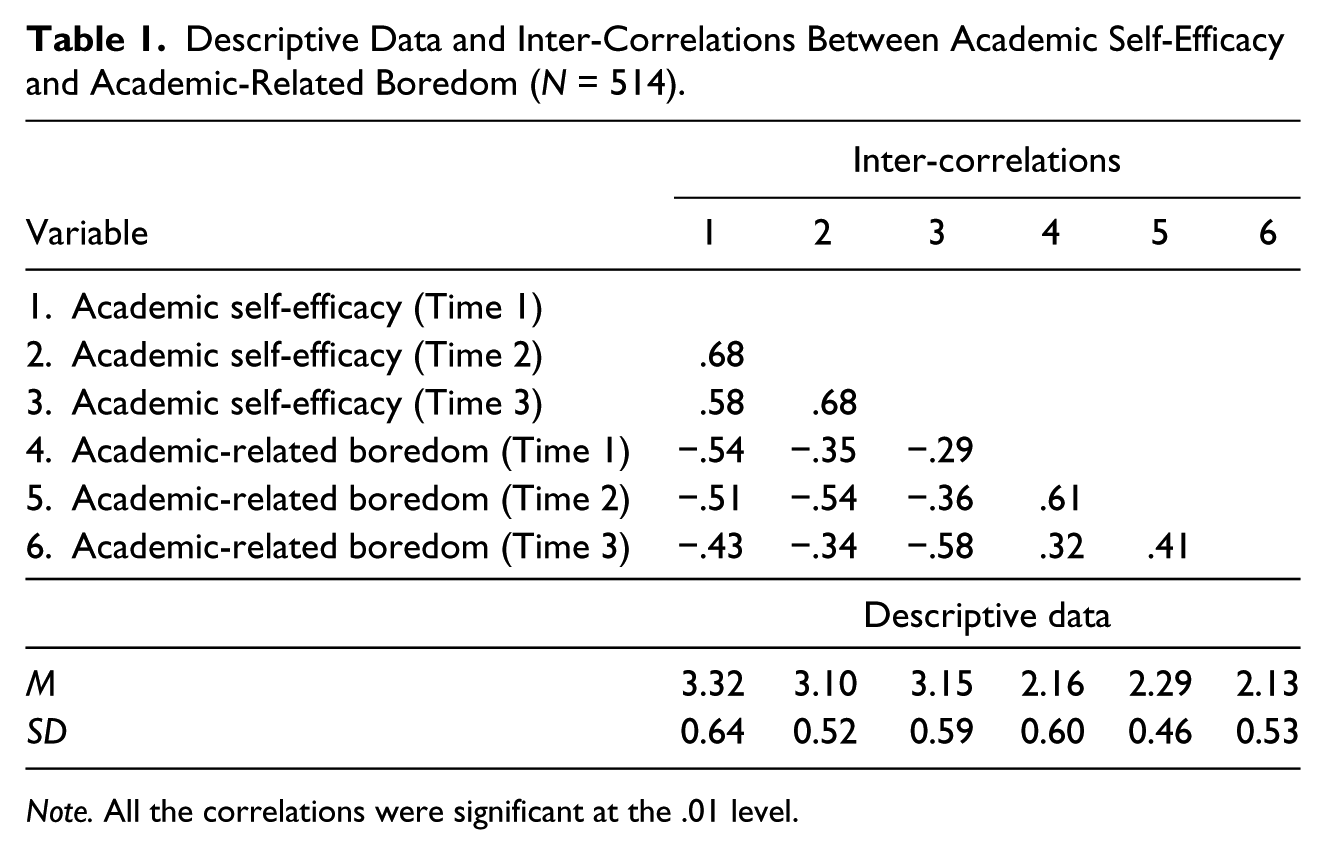
Note. All the correlations were significant at the .01 level.
As shown in Table 2, a linear mixed model first indicated that students’ academic self-efficacy negatively predicted their academic-related boredom. The interaction of academic self-efficacy and time was not significant, which indicated that the negative relationship between academic self-efficacy and academic-related boredom was constant over time. Furthermore, students’ academic-related boredom did not significantly change over time. Next, we added the students’ genotypes into the model as a predictor. The relationship between academic self-efficacy and academic-related boredom for students with the 4-repeat allele is shown in Table 3. The results also indicated that the interaction of academic self-efficacy and gene was significant (value = −0.11, standard error [SE] = 0.04, p < .05), which suggested that the strength of the negative prediction of students’ academic self-efficacy on academic-related boredom was significantly stronger for students with the 3-repeat allele than those students who carry of the 4-repeat allele. Furthermore, the results showed that the intercept of the 3-repeat allele model was not significantly different from the intercept of the 4-repeat allele model (value = −0.25, SE = 0.14, ns), and the Gene × Academic self-efficacy × Time interaction term was not significant either (value = 0.00, SE = 0.01, ns). The model for the 4-repeat allele subgroup was as follows: academic-related boredom = 3.63 − 0.42 (academic self-efficacy) + 0.01 (time) − 0.01 (academic self-efficacy) × (time). The model for the 3-repeat allele subgroup was as follows: academic-related boredom = 3.88 − 0.53 (academic self-efficacy) + 0.01 (time) − 0.01 (academic self-efficacy) × (time). Figure 1 illustrates the moderating effects of MAOA gene on the relationship between academic self-efficacy and academic-related boredom. The figures were generated by comparing the strength of the relationship between academic self-efficacy and academic-related boredom across the 3-repeat allele model and the 4-repeat allele model in each grade. The time in the two models was coded 0 in Grade 10, 1 in Grade 11, and 2 in Grade 12, respectively.
The Relationship Between Academic Self-Efficacy, Time, and Academic-Related Boredom.
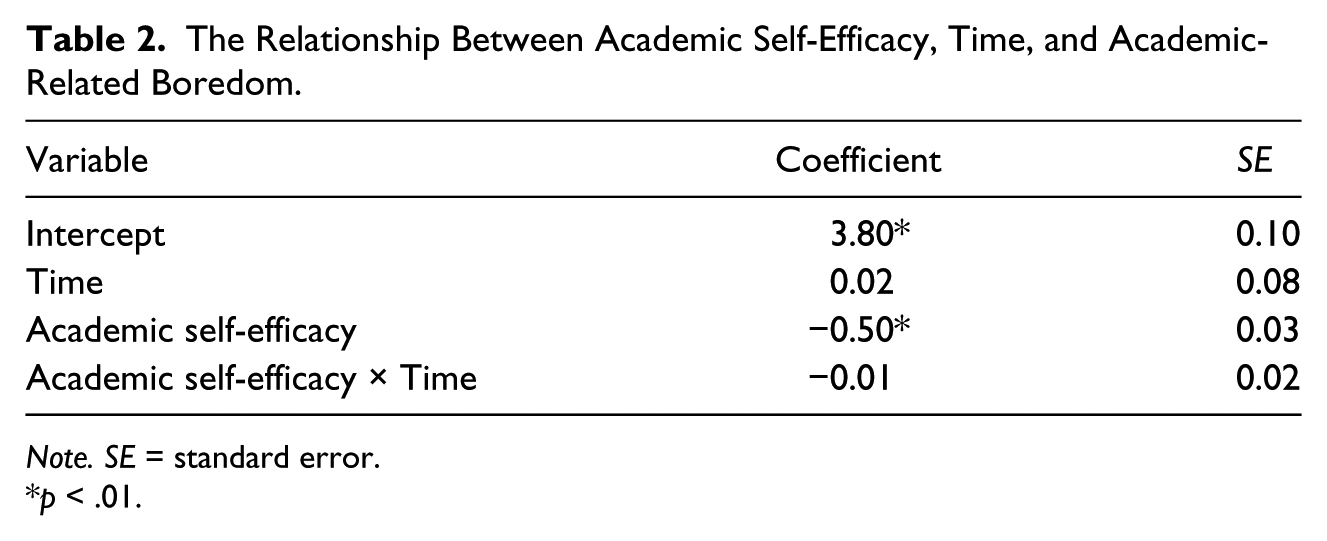
Note. SE = standard error.
p < .01.
The Relationship Between Academic Self-Efficacy and Academic-Related Boredom for Students With the 4-Repeat Allele.
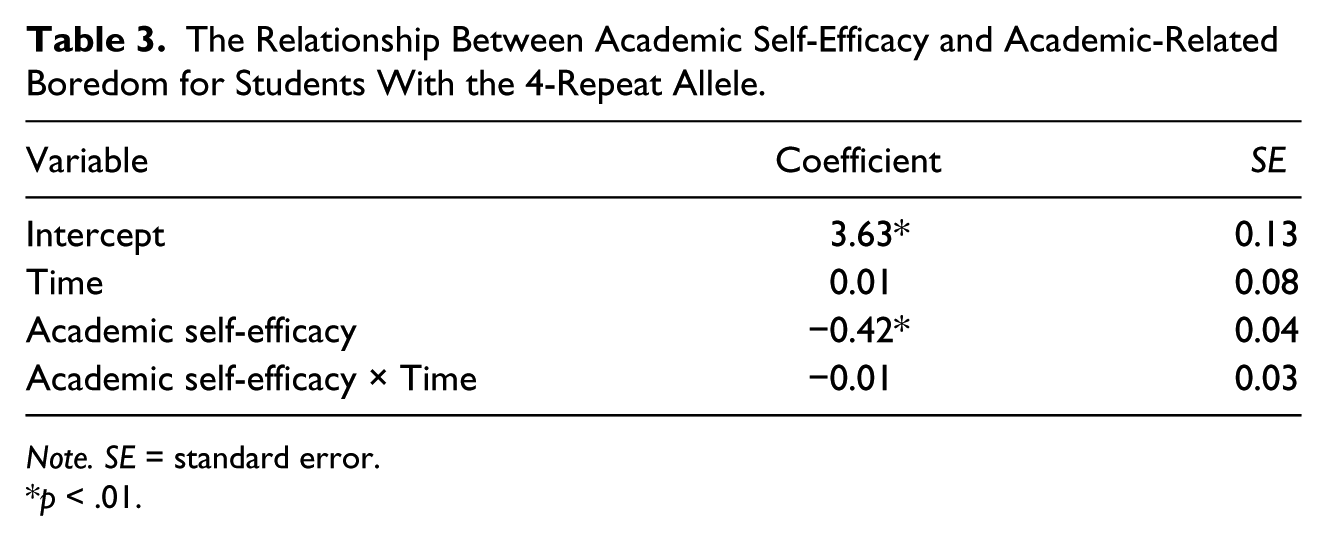
Note. SE = standard error.
p < .01.
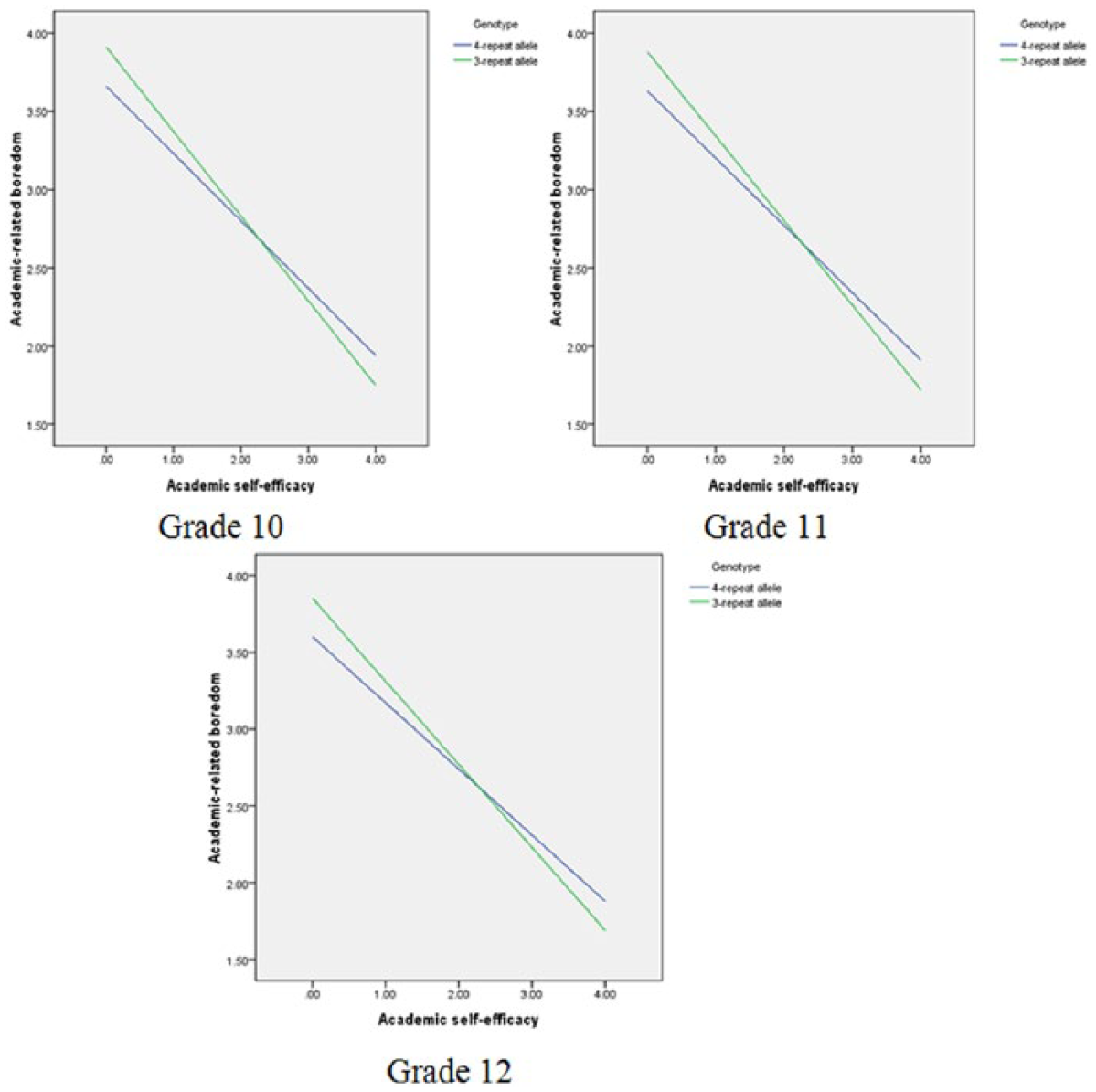
The moderating effects of MAOA gene on the relationship between academic self-efficacy and academic-related boredom.
Discussion
The present study contributes to theory and practices in several important ways. First, to our knowledge, no study has examined the relationship between students’ academic self-efficacy and academic-related boredom. The present study contributes to the theory by examining the relationship between Chinese high school students’ academic self-efficacy and their academic-related boredom during three high school years. Our data support our first hypothesis. By using repeated measures over time, the result indicated that Chinese high school students’ academic self-efficacy negatively predicted their academic-related boredom. In line with other studies that examine the relationship between the self-appraisal of one’s competencies and academic-related boredom (Fogelman, 1976; Goetz et al., 2006; Roseman, 1975), our findings support the control–value model that suggests that subjective controllability is related to academic-related boredom. In addition, our findings imply that increasing students’ academic self-efficacy is a useful way to reduce their academic-related boredom.
This study next investigated the moderating effects of the MAOA gene polymorphism on the relationships between academic self-efficacy and academic-related boredom. To our knowledge, the present study is the first that explores such moderating effects. Consistent with our second expectation, the results indicated that the functional polymorphism of the MAOA gene moderated the relationship between academic self-efficacy and academic-related boredom. This relationship was more reliable for students with the 3-repeat allele than for the students with the 4-repeat allele. The present findings suggest that academic self-efficacy and human gene can interactively contribute to students’ academic-related boredom. In addition, the current findings imply that increasing students’ academic self-efficacy is more efficient in reducing academic-related boredom for students with the 3-repeat allele in their MAOA gene than for students with the 4-repeat allele.
Limitations and Future Directions
Although this study adds to the literature in several important ways, it is important to recognize its limitations. First, students’ academic self-efficacy and academic-related boredom were both self-reported. More information sources could be used in further research. Second, the participants only came from high schools, so further research may use samples from younger students. Third, the present study focused on the subject of mathematics. Further research may investigate whether the present findings can be applied to other academic domains. Fourth, the present study only focused on academic-related boredom. Further research may examine the relationships between academic self-efficacy and other academic-related emotions such as hopelessness, joy, and, enjoyment and the moderating effects of the MAOA gene on these relationships. It is helpful in comprehensively understanding the relationships between academic self-efficacy and academic-related emotions and the moderating effects of the MAOA gene polymorphism on these relationships. Fifth, the present study controlled the effects of time when examining the relationship between academic self-efficacy and academic-related boredom. We did not control gender effects because the prior studies showed that gender did not contribute to students’ academic-related boredom (Pekrun et al., 2010). However, further research may control the effects of some other variables such as math ability. Sixth, a longitudinal design was used in the present study; however, it is still impossible to examine the cause–effect relationship between academic self-efficacy and academic-related boredom because of the correlational nature of this study.
By using longitudinal data, the present study provides empirical evidence to the significant relationship between adolescents’ academic self-efficacy and their academic-related boredom. Furthermore, in previous research, the role of heredity in students’ academic-related outcomes has been greatly emphasized by researchers. However, molecular genetics methods were rarely used in the research of adolescents’ academic-related outcomes. We have known little about whether gene polymorphism influences students’ academic-related emotions. The present findings indicated that the MAOA gene played an important role in the relationship between academic self-efficacy and academic-related boredom, which suggests that students’ gene polymorphism significantly contributes to their academic-related outcomes. These interesting findings imply that a combination of different levels of analysis (genes and behavioral measures) could provide more new information to understand the development of students’ academic-related outcomes. The present study significantly encourages further research on the relationship between genes and academic-related outcomes.
Footnotes
Declaration of Conflicting Interests
The author(s) declared no potential conflicts of interest with respect to the research, authorship, and/or publication of this article.
Funding
The author(s) disclosed receipt of the following financial support for the research, authorship, and/or publication of this article: We are grateful to the National Natural Science Fund of China (31301027), the Fundamental Research Funds for the Central Universities, The 12th Five Year Plan of Jiangsu Education (C-c/2013/01/003), and Programs for the Philosophy and Social Sciences Research of Higher Learning Institutions of Jiangsu (2012SJD190007) and funding from the Institute for Advanced Studies in Humanities and Social Sciences (Nanjing university) for supporting this study.