



Abstract
The purpose of this study is to investigate whether gender traits have any influence on the awareness of cultural codes, the motivation of playing online games, and the degrees of commitment for primary school upper graders. Of 390 students surveyed in Taiwan, a total of 364 questionnaires were returned with 356 being considered valid. The main study findings were summarized as follows: (a) Masculine trait has positive and significant effect on cultural codes, which supports and confirms the mediator role of cultural codes. (b) Feminine trait has positive and significant effect on online games play motivation, which also supports and confirms the mediator role of motivation.
Introduction
Background
Online gaming is one of the recreational activities developed through the Internet, which possesses the properties of games and network connection. Players realize their aspirations derived from the deepest parts of their minds using such games (Snodgrass et al., 2014). Y. L. Lin (2007) suggested that the practice of online gaming not only can be affected by local influences but can also exaggerate gender identification when discussing video games. Many primary researchers in international journals have also begun to emphasize the role of gender difference in online gaming and the influence it exhibits (Brenick, Henning, Killen, O’Connor, & Collins, 2007; Hong & Hwang, 2012; Wang, 2014). Online gaming is often comprised of certain characteristics, examples of which include entertainment orientation, stereotypically masculine goals (competitive or combat-related tasks), and body reconstruction (online games that provide a rich sensory experience and allow the player to experience the Internet interactively as avatars; Chang & Leu, 2006). Psychologically speaking, the gender identity of self or gender stereotyping may be a part of gaming with different gender qualities (Chen, 2003). Gaming is one of the most significant cultural forms of our time. Digital games are more than inert code; they come to life in the act of play (Swalwell, Ndalianis, & DeVries, 2013). Therefore, the cultural codes in different kinds of games may influence the individual in their choice of games. With the global spread of technology, it has been reported that online gaming among children has become excessive in recent years (Lopez-Fernandez, Honrubia-Serrano, Baguley, & Griffiths, 2014). The current study discussed upper grade students with different gender traits, and the relationship between the involvement and motivation of using cultural codes and playing games online.
Theoretical Background and Hypotheses
Definition and Type of Online Gaming
Online gaming uses a specialized application or technology, which connects players through the Internet or over a computer network (Rollings & Adams, 2006). Current online games include personal computer (PC) and console games, which differ from mobile games that operate on mobile devices, such as smartphones, personal digital assistants (PDA), or tablet PCs (Techopedia, 2015). The research of both Chang (2003) and Shih (2004) showed various types of online games. By integrating their research, the online games are separated into three genres.
Multi-Player Online Gaming
The first is “multi-player online gaming,” such as Eternal life, Ragnarok, Cross Gate, Love Box, which connects multiple users to a server and involves role-playing games. The feature of a permanent world gives players an environment in which to improve the characters, and the content updates through time without repetition. Therefore, players experience the online games as if they live in another world, which may involve the experience of making friends, experiencing romance, and developing a career.
Match Games
The second is “match games,” which operate on platforms established by a business entity or other player. Players with common interests can connect to the platform to start such games. Most of the websites for these are operated by the software developers or agents and provide customers with rooms to battle in or discuss, while the websites provide only the competition system. The features of match games are fast-paced and intense with a time limit. The representative games include Age of Empires and Star Craft.
Round Games
The third is “round games website,” which requires a gaming website such as Acer Funtown, including mini games such as mah-jong, bridge, gobang, and car races. The registration is usually free and users can join the game once registered. The games also allow players to perform activities other than gaming while they queue, such as chatting to other gamers. The target customers of round games are Internet users who seek simple distraction from the real world.
Gender Traits
Gender was reported to be a significant predictor of the degree of use and the gamer’s self-discipline in regard to online gaming addiction and motivation for playing online role-playing games (Hussaina, Williams, & Griffiths, 2015). Bem (1974) believed that any individual could exhibit both male and female characteristics simultaneously. We cannot always use a fixed gender to explain an individual’s internal cognition and explicit behaviors. With that in mind, Bem (1981) developed Two Factor Theory of gender character. He believed it is possible for an individual to exhibit both male and female characteristics. Based on that belief, he designed Bem Sex Role Inventory (BSRI) theory, which divides gender characters into three categories: masculine, feminine, and androgynous. According to Bem’s androgynous concept, every individual should have the flexibility to present different characteristics according to the circumstance. The concept of binary gender represents the difference of qualities related to one’s gender and behavior according to typically masculine or feminine traits. Broadly speaking, the definition of gender should be considered in numerous aspects including appearance, personality, attitudes, interests, and habitual behavior (Lippa, 2002). Yu and I (2002) described that characteristics shall not be defined by genders. However, it may be influenced by the long-term patriarchal society culture in which men are expected to be strong and assertive and women are required to be passive and sensitive. Such a phenomenon tends to lead an individual’s qualities to be either male or female, and form the basis for masculine and feminine traits (Li, 2013). The current study was aimed at discussing whether the stereotype of gender exists in gaming, or whether the gender traits have a tendency to influence the players on deciding the substances of games. From this, it was investigated as to whether gender traits of primary school upper graders are positively associated with online gaming involvement as the first hypothesis.
Cultural Codes
A cultural code is the knowledge of an individual derived from him or her being familiar with the phenomena of a culture, enabling him or her to interpret various external phenomena (natural as well as social) as signs conveying sense and meaning (Tambovtsev, 2015). For example, an advertisement can present an abundance of cultural codes that influence players in different aspects. The cultural codes of online gaming help us to understand the behavioral responses characteristic of fashion and subculture among online games players. Therefore, a cultural code is a deep culture structure in a society, which forms a specific tendency of thoughts, forms of language, origin of values, and direction of actions for individuals who live within the culture. It can be internalized as the behavior standards of individuals and specific individual actions, which are shaped by their nature (Chou, 2000). Furthermore, cultural factors can be incorporated into cultural design. There are three cultural design features, which can be identified as follows: (a) the inner level—containing special content such as stories, emotions, and cultural features; (b) the mid-level—dealing with function, operational concerns, usability, and safety; and (c) the outer level—dealing with color, texture, form, decoration, surface pattern, line quality, and detail (R. T. Lin, 2007). Thus, the second hypothesis is gender traits of primary school upper graders are positively associated with cultural codes of online games.
Online Games Play Motivation
Kahn et al. (2015) indicated the necessity and importance of relative research among cross-culture, cross-division, and behavior mode to computer games. According to the definition of motivation proposed by T. S. Chang (1994), the motivation for online gaming refers to individuals’ internal experiences that urge them to participate in online games and carry them through to proceed to a certain goal. Motivation is one of the essential factors influencing the user. In other words, this motivation may be used to interpret the internal reasons for behavior. Ryan, Rigby, and Przybylski (2006) claimed that Self-Determination Theory (SDT) could be used to investigate both the player’s motivation to play a game and factors that might motivate player’s character, or avatar acting within the game. In other words, SDT has specific hypotheses that can be applied to both the level of the player when making choices between gaming products and the motivation of a player while “in character” within a particular gaming context. Moreover, Liu, Fang, Chang, and Shieh (2007) argued that the three most common reasons for playing games are “self-actualization,” “self-identification,” and “self-fulfillment.” These three aspects along with the shared aspects lead to a trio of ultimate aspects of a consensus map: “pursuit of mental fulfillment,” “sense of achievement,” and “sense of belonging.” Thus, the third hypothesis is gender traits of primary school upper graders are positively associated with online games play motivation along with the fourth hypothesis, which is cultural codes of online gaming are positively associated with online games play motivation.
Online Games Play Involvement
However, Barki and Hartwick (1989: 53) defined the object involvement as “the importance and relevance level of a system that a user believes.” In other words, under the special circumstance of information systems, the psychological state of an individual toward a certain topic and the degree of involvement of a user in the online games can enhance the positive attitude of the user toward the usage of systems. Moreover, the findings of Billieux Thorens, Khazaal, Zullino, Achab and Linden (2015) suggest that conceptualizing the problematic use of massively multi-player online role-playing games as “behavioral addiction” is too restrictive and might result in the simplification of heterogeneous and multi-determined problematic behaviors. Yeh, Hwang, and Lin (2007) also indicated there is different object involvement between genders. Therefore, the study assumes that the gender traits of students may influence the level of involvement in playing games online directly and the level of involvement in playing games online may be influenced indirectly through cultural codes and intention of games use. Thus, the fifth hypothesis is cultural codes of online gaming are positively associated with online games play involvement. In addition, the sixth hypothesis is online games play motivation is positively associated with online games play involvement.
The literature on online games play involvement has received important contributions from studies on gender traits and cultural codes. These contributions show a positive impact of gender traits and cultural codes on online games play involvement (Hussaina et al., 2015). In the online games studied, the player focuses on creating a context favorable for virtual reality, with an effort to avoid the pressures of the real world. Thus, motivation to play games online is not an individual action but a collective achievement, which may include gender traits, motivation, and cultural codes. Hussaina et al. (2015) proposed that gender traits should be stimulated to drive motivation of playing games online by the material world of gaming. In other words, online games motivation depends on gender traits throughout cultural codes (Li, 2013).
Furthermore, a third variable can have an effect on constructing the relationship change between two related variables/constructs. That is, the relationship of the change between two variables could be based on the level/amount of a moderator. For example, if a relationship change is significant when measured for males versus females, then gender does moderate the relationship (Hair, Black, Babin, & Anderson, 2013). In this study, cultural codes and motivation may generate a moderating effect based on the theories above. Thus, the seventh hypothesis is cultural codes of online games moderate the relationship between different gender traits of primary school upper graders and their online games play involvement. In addition, the eighth hypothesis is motivation for online gaming moderates the relationship between different gender traits of primary school upper graders and their online games involvement.
Method
Research Framework
A study model can be proposed (see Figure 1) to examine how gender traits relate to online gaming involvement; gender traits positively relate to cultural codes and online gaming motivation; cultural codes and motivation for online gaming mediate the relationship between gender traits and online gaming involvement.

Research framework.
Sample
To investigate students’ perception of online gaming, this study adopted the stratified random sampling technique to select primary school fifth and sixth graders from pan Taichung city in central Taiwan. Participants were 390 students from nine schools and 15 classes in Taichung city. The final valid samples included 356 participants from the full sample, which accounted for 92% of the total sample. There were 191 boys (53.7%) and 165 girls (46.3%) in the sample.
Procedures
Based on the literature review and previous research, eight hypotheses were formulated and tested. The first section consisted of demographic information about the primary school upper graders in nine schools in Taichung City. After the factor analysis, the second section consisted of 17 items about gender traits, 14 items about online games play involvement, 15 items about online games play motivation, and 21 items about cultural codes of online games. All scales were composed of 5-point Likert-type items. The final section consisted of 67 items. The average time for completing each questionnaire was 25 to 30 minutes.
Measures
In accordance with the purpose of this study, the researchers constructed a measurement model using all the survey items to test the psychometric properties of the scales. The average variance extracted (AVE) created by Fornell and Larcker (1981) provides a measure of convergent validity, which was suggested to be greater than 0.5. Moreover, the results showed factor loading of retained indicators, composite scale reliability, and AVE. Hair et al. (2013) suggested that an item is significant if its standardized factor loading estimate is up to 0.5 or higher, and ideally 0.7 or higher to ensure construct validity. Adherence to this criterion required the modification of four scales through the removal of 11 items in gender traits, six items in online games play involvements, 10 items in online games play motivation, and 15 items in cultural codes. Because the factor loading was no more than 0.7, the original items mentioned were deleted and all items were rearranged. After removal of the non-valid items, each item was revalidated by testing its item-to-total correlation measure, where all the remaining items exceeded the 0.35 threshold as suggested by Saxe and Weitz (1982). All measures had proper reliability and validity. All items were rated using a 5-point scale ranging from 1 (very strongly disagree) to 5 (very strongly agree). The development of each scale in this study was as follows.
Gender Traits
The scale of gender traits was measured with a 17-item gender traits scale Sex Role Inventor Questionnaire. The scale was originally developed by Bem (1974) and modified by Chen (2003). This scale identified two behaviors associated with gender traits, that is, masculine and feminine traits. Sample items were “I am mature and will not panic over any difficulty” and “I am willing to try new things.” Internal consistency was measured with Cronbach’s alpha (α = .917). A one-factor model was confirmed and 11 items were deleted after carrying out a confirmatory factor analysis (CFA), reflecting acceptable goodness-of-fit indexes and composite reliability.
Cultural Codes
The cultural code scale was measured by 21 items adapted from Chou (2008). Sample items were “Character’s clothing in the games deliberately highlights men’s and women’s bodies” and “Painting style of the game is very detailed and textured.” It was suggested that nine items be removed from the Cultural Codes Scale (CC). Cronbach’s alpha reflected a good level of internal consistency (α = .834). A CFA three-factor model test gave good goodness-of-fit indexes after nine items were deleted.
Online Games Play Motivation
The scale of online games play motivation was measured by 15 items with the scale designed by Chen (2003) based on Maslow’s theory of motivation. Sample items were “To get more valuable virtual items, I continued the games playing to master skills” and “I can relax and calm my emotions through playing games.” Internal consistency was measured with Cronbach’s alpha (α = .799). A one-factor model was confirmed and five items were deleted after carrying out a CFA, reflecting acceptable goodness-of-fit indexes.
Online Games Play Involvement
The scale of online games play involvement was measured by 14 items by which respondents were asked to respond to a 5-point scale. The scale was originally developed by Zaichkowsky (1985) and modified by Lin (2012). Sample items were “I feel excited when I play online games” and “I am attracted to online games.” Internal consistency was measured with Cronbach’s alpha (α = .907). A two-factor model was confirmed and six items were deleted after carrying out a CFA, reflecting acceptable goodness-of-fit indexes.
Data Analysis
To fulfill the main purposes of this study, descriptive statistics, factor analysis, and reliability analysis were utilized. Factor analysis using the principal components analysis (PCA) was used to confirm the validity of the test items. Moreover, in response to the research questions, structural equation modeling (SEM) was used to find the relationship among gender traits, cultural codes, motivation of playing online games, and involvement of them. Therefore, well-executed SEM applications allow the modeler to specify, estimate, and evaluate the nature and veridicality of most assumptions (Little, 2013). Furthermore, the computer software used for data analysis and processing was SPSS 16.0 and AMOS 17.0 (Analysis of Moment Structures). The variables of outcomes were viewed as predictors to explain involvement in online games.
Results and Discussions
Model Test and Analysis
The AMOS 17.0 maximum likelihood program was introduced to test the theoretical model due to the scale of middle to large samples (Wu, 2013). The hypothesized causal relationships among gender traits, cultural codes, motivation of playing online games, and involvement of online games have been confirmed. The goodness-of-fit statistics indicated that χ2/df = 1.638 (1-3), comparative fit index (CFI) = 0.950 (>0.9), adjusted goodness-of-fit index (AGFI) = 0.926 (>0.9), and root mean square error of approximation (RMSEA) = 0.042 (<0.08). The fit indicators of the CFI and AGFI range between 0 and 1 and it is generally accepted that values of 0.90 or greater indicate well-fitting models (Hu & Bentler, 1999). It is generally reported in conjunction with the RMSEA and in a well-fitting model that the lower limit is close to 0 whereas the upper limit should be less than 0.08 for a reasonable model. The fit is for a suitable model if the RMSEA is less than 0.05 (Hooper, Coughlan, & Mullen, 2008). Thus, all indicators show that it is a good fit model.
The results show sufficient support for the hypothesis that gender traits of primary school upper graders are positively associated with cultural codes of online gaming. Results of the analysis revealed that gender traits are significantly and positively related to cultural codes (γGC = .921***, p < .001). It highlights the direct effect of gender traits on cultural codes. Moreover, Kima, Kim, and Mattila (2012) stated that those who play games tend to have a desire to express their identity and aesthetic sensibilities through the in-game characters. It is understood that identity and aesthetic sensibilities are recognized as an essential part of cultural codes based on the theory above. The research of Ivory (2006) pointed out that female characters were found to be underrepresented and proportionally more often sexualized in comparison with their male counterparts. The results revealed that when online games designers used strategies such as cultural codes (i.e., heroism or individualism), this had a highly effective influence on the degree of involvement in online gaming, particularly for masculine upper graders. Paraskeva, Mysirlaki, and Papagianni (2010) proposed a causal model of cultural codes as an important influence on online games play involvement. However, the effect of cultural codes is insufficient without the factor of gender traits. Online games designers play a major role in the level of online games play involvement. The designers have important responsibilities and can lead their players to make changes when playing online games. To avoid upper graders online games addiction, all parties involved (designer, teacher, and parent) should discuss the importance of cultural change (i.e., subculture) in the primary school system with students and also provide proper consultation. This finding is consistent with the research of Hussaina et al. (2015).
It can also be indicated that online games play motivation is positively associated with online games play involvement (γMI = .763***, p < .001). The findings of this study support claims that online games play motivation is positively associated with online games play involvement. The findings indicate the direct effect of online games play motivation on involvement. Thus, with an increase of online games play motivation, there is an increase in the involvement of the player. Zhong and Yao (2013) claimed that the motivation to escape is positively related to the symptoms of online games addiction.
By gender traits, Figure 2 indicates that masculine players receive the positive effect of cultural codes (γMC = .78***, p < .001) and take action (motivation; γCM = .87***, p < .001) on online games play involvement (γMI = .90***, p < .001). Both cultural codes and motivation played as mediators between the relationship of gender traits and involvement. In summary, the result indicates that masculine gender traits have an indirect impact on online games play involvement through cultural codes. Variables such as cultural codes act as intervening variables and lead to online games play involvement by primary school upper graders with masculine traits. The indirect effect is larger than the direct one. Masculine traits enhance online games play involvement and have indirect influence through cultural codes. The result reveals that more cultural codes lead to more online games play involvement. Furthermore, Kima et al. (2012) also found that with more cultural codes, there is more online games play involvement. This finding leads to the hypothesis that cultural codes of online games moderate the relationship between different gender traits of primary school upper graders and their online games play involvement. In addition, this finding is consistent with the research by Chen (2003) and Brockmyer (2015).
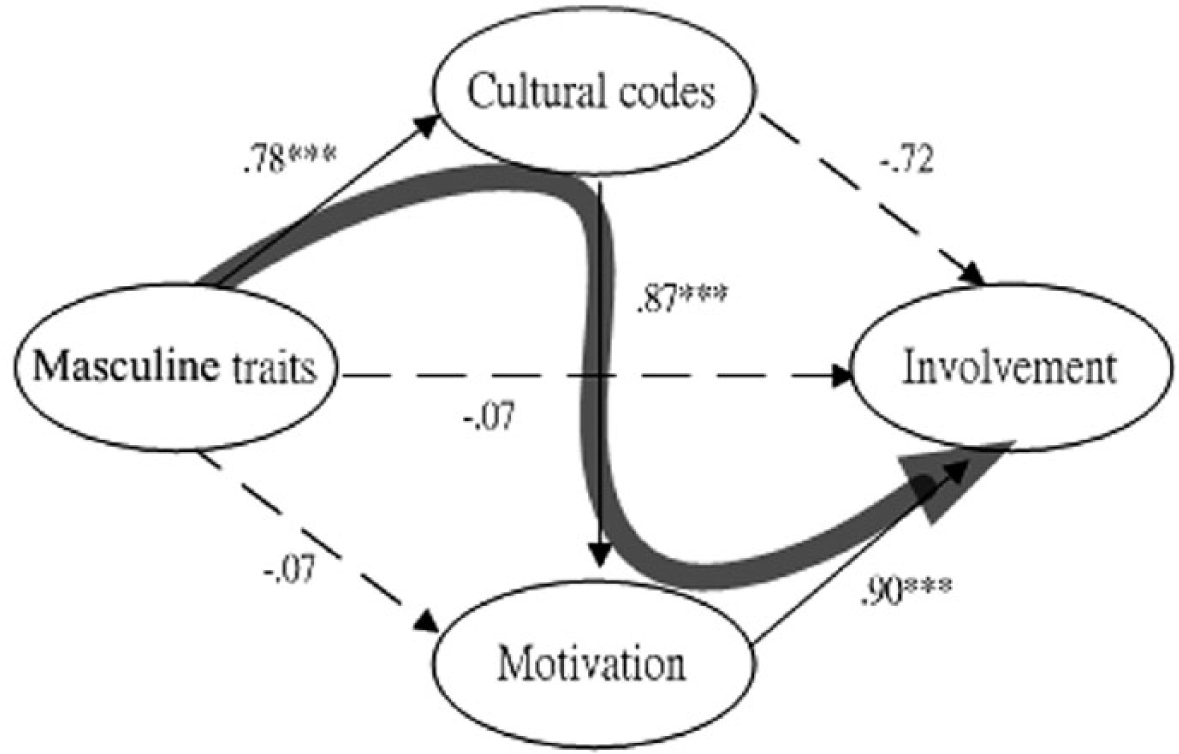
SEM hierarchical path analysis map (masculine, n = 92).
By contrast, Figure 3 shows that feminine-trait players are attracted by the cultural codes of online gaming (γFC = .92***, p < .001). However, this does not mediate motivation or involvement. This may be because feminine-trait players believe that online games were designed for masculine players by their employment of the exaggeration of muscles, utilization of weapons, or the display of sexualized female bodies. The map in Figure 3 also indicates that motivation of feminine-trait players’ online games play is decided by themselves (γFM = .69***, p < .001) and not cultural codes. Only if they believe the styles or contents of online games are suitable for them can the degree of commitment and the motivation of online gaming among feminine-trait primary school upper graders be executed (γMI = .71***, p < .001). Variables such as motivation play as intervening variables and lead to online games play involvement by feminine-trait primary school upper graders. Feminine traits enhance online games play involvement and have indirect influence through motivation. Online games play involvement results from significant changes in motivation. According to the article of Kelly, Pomerantz, and Currie (2006), girls’ learning regarding issues of femininity takes place while they are online and involves playing with gender and being gender rebellious. Thus, for feminine-trait players, higher motivation can easily lead to deeper online games play involvement. This finding supports the hypothesis that motivation for online gaming moderates the relationship between different gender traits of primary school upper graders and their online games involvement and, therefore, meets the conclusion of Yeh et al. (2007).

SEM hierarchical path analysis map (feminine, n = 256).
However, other hypotheses do not exhibit significant difference.
Conclusions and Implications
Theoretical Conclusions
As a result of increasing involvement of upper graders, the digital material world needs to change to help these students avoid excessively gaming online. Based on the study, different gender traits all have potential risks of immoderate online gaming through a variety of ways. This study reveals that masculine traits have positive and significant effects on cultural codes as well as supporting and confirming the mediator role of cultural codes between gender traits, motivation, and online games play involvement. More attention to the culture codes of the upper graders will increase the motivation of online games play and more involvement will occur. Masculine-trait–oriented online gaming can be a problem or a solution for upper graders, as long as the proper cultural codes are exhibited in online games for those masculine players. The redesign of culture codes of online gaming can be seen as the solution to online gaming addiction. The designer would be encouraged to submit the design proposal with the purpose of wit, leisure, and entertainment rather than gore, violence, or sexualized icons, while an interest in taking risks, or participating in exciting online games, may substitute the existing violent games. It can be expected that a better expression of online gaming cultural codes and a better quality of a student’s life may be achieved.
Second, feminine traits have positive and significant effect on online games play motivation. This study also supports and confirms the mediator role of motivation. In other words, motivation bridges the relationship between gender traits and online games play involvement. Kelly et al. (2006) argued that a large part of learning of feminine issues for girls takes place online and that they also enjoy experimenting with gender and being rebellious toward societal norms concerning gender. In contrast to masculine-trait players, feminine-trait players seem to focus on psychological aspects rather than physical aspects. Masculine-trait players typically only want to experience the physical act of playing online games. Feminine-trait players also have this same desire with an added psychological level of pursuing acts of revenge and developing emotional resilience. An appropriate motivation for playing online games is necessary for feminine-trait players. Teachers and parents have to be aware of the child’s probable addiction to online gaming, which may be due to issues in school or family life, for example, being bullied. Furthermore, these upper graders may bully their weaker peers, and it became evident that the victims were often alienated from parents and have less interaction with their peers, which resulted in self-isolation.
In summary, gender traits are perceived to be a key factor in online gaming cultural codes, motivation of games use, and level of involvement in games. Furthermore, according to the general consensus, the cultural codes of online gaming still leans more toward masculinity, that is, online games contain more of the masculine-oriented activities. Apparently, the cultural code seems to affect feminine-trait players much less. Worth and Book (2015) also came to similar conclusions. They observed that each Behavior subscale was significantly correlated with at least one personality trait with men reported to exhibit significantly more aggression, competitiveness, and a desire to help than women. However, the motivation of feminine-trait players receives less concern despite their problems being equally important based on the above study. The identified samples of feminine-trait players are much larger than masculine-trait players in the survey (256 > 92). The findings of this study reveal the need to explore the feminine-trait online games players further in future studies.
Overarching Conclusions
Current and previous studies on gender traits from the upper graders’ perspectives highlight the importance of cultural codes in motivated usage and its association with the level of online games involvement. This empirical study provides evidence to prove the substantial impact of gender traits and cultural codes on the involvement of playing online games. Hence, an overarching conclusion can be synthesized as follows: The research topic does inspire parents, teachers, and designers to be aware of the influence of online games, which are often ignored by the family, school, government, and industry at a macro level. The research issues that link the gender traits and cultural codes in the setting of upper graders were used for the first time in an empirical study in Taiwan. At a micro level, different gender traits of online games players demonstrate a discriminatory motivation for playing online games. Masculine-trait players exhibit the manners of competition, curiosity, and conquest when playing online games. In contrast, feminine-trait players express the mentality of love, friendship, escapism, and even revenge. Overall conclusions from this study suggested that teachers and parents must be aware of the effect of online games on their children. They also should adopt a proper reaction based on each specific situation and consider the standpoint of child. To sum up, the researchers would like that online games be a component in supporting education in the future. Through a careful educational method, it is possible to guide students to comprehend certain positive traits in games. For example, an educational competitive activity allows the online gaming to become a useful tool for human service.
Limitations
Although the authors have found several encouraging results, it is important to recognize that the current findings of this study include some limitations that suggest further empirical research would be useful. First, this study only examined gender traits, cultural codes, motivation, and online games involvement. An investigation of other variables, which are not included in this study, such as parenting styles, peer relationship, learning culture, and so on, might be beneficial. We hope follow-up studies with these additional variables can be conducted.
Another limitation of this study is related to the measurement of gender traits. This study does not take androgynous temperaments into consideration. However, participants may not reflect their true androgynous traits due to social expectations. Researchers can further explore this variable in future follow-up studies.
Third, the study allowed high-grade students to select known online games of cultural codes. Certain gaming attitudes and concepts may have already existed in the player’s mind to begin with. Therefore, in addition to attracting games users, games design should pay more attention to gaming cultural codes as it may pass erroneous messages and concepts while leading to “a repeated wrong becomes a right” type of cognition and attitude.
The final limitation is related to the self-report surveys. In this study, a self-report was used to measure the results, which could limit a socially desirable response. Mehta, McCullagh, and Burry (2011) argued that most surveys have a similar limitation to self-report surveys, which stems from the possible differences between stated and actual practice. Much like when physicians report what they practice in surveys often contrasts significantly with what they do in observational studies, as highlighted by the Canadian surveys conducted in 2002 and 2008. Therefore, possible future studies should expand the sample size. In addition, the sample selected in this study was upper graders from primary schools in central Taiwan. Future studies should expand the sample to include more research participants from different regions so they can be conducted with a collection of more samples of different levels and groups, for example, students and their parents. Such studies will then produce more persuasive results.
Conclusion
These limitations notwithstanding, the study adds to our knowledge about online gaming in several ways. First, the findings of this study show the concept of cultural codes did demonstrate a strong influence on masculine online gaming players. Future research that studies whether cultural codes in online gaming are necessary would be to identify the effects of different cultural codes on the online gaming players. Second, the findings of this study reveal the need to study the feminine-trait online games players, because those players have been largely ignored by previous studies and represent the majority of upper graders. Future research can build on this finding in the following way as it can be supposed that some of them may develop tendencies such as bullying weaker individuals in response to their gaming experiences, especially if they feel disillusioned with life outside the virtual sphere.
Footnotes
Declaration of Conflicting Interests
The author(s) declared no potential conflicts of interest with respect to the research, authorship, and/or publication of this article.
Funding
The author(s) received no financial support for the research, authorship, and/or publication of this article.