



Abstract
This aim of this article is to account for the resilience of adolescents who are challenged by structural disadvantage and to highlight that how adolescent resilience is accounted for depends on whether adolescent or adult views are foregrounded. To do so, I report a South African phenomenological study. I draw on a thematic content analysis of qualitative data and subsequent frequency count of the themes to contrast how 385 Black adolescents and 284 adults (who educate or provide services to youth) explain what enables adolescent resilience in the face of structural disadvantage. Adolescent and adult explanations differed substantially with regard to personal strengths, family support, and education pathways. These differences reflect conceptualizations of resilience, which are probably related to developmental stage and cultural fluidity and which caution that, despite adult perspectives being valuable, societies need to prioritize adolescent insights.
Keywords
This article reports on a study of how South African adolescents, who are vulnerable due to challenging socioeconomic circumstances, explain what enables their resilience and how these young people’s explanations compare with those of adults who educate or provide services to youth. In doing so, this article aims to add to the body of literature, which accounts for the resilience of youth who are challenged by structural disadvantage and to signpost that how resilience is accounted for is influenced by whose perspective is privileged. In juxtaposing adolescent and adult insights, this article also aims to further the case for prioritizing youth voices, as it were, in explanations of what supports resilience and subsequent application of this knowledge. The extant resilience literature is largely informed by quantitative studies that rely on measures, which reflect adult understandings of resilience, and so, this literature is not appreciative enough of youth insights (Liebenberg & Theron, 2015; Wright, Masten, & Narayan, 2013). The side lining of youth voices potentially threatens social–ecological initiatives to enable resilience (e.g., intervention programs, services for youth) because adult-directed initiatives are at risk of not matching how young people would prefer to be supported.
Social Ecological Enablers of Resilience to Structural Disadvantage
Structural disadvantage is characterized by chronic hardship and inequitable opportunities that are rooted in the social, economic, and political marginalization of specific individuals and/or groups of people (Boyden, 2007). Structural disadvantage predicts negative developmental outcomes, which marginalized individuals/groups generally have limited power to avoid (Young, 2015). Nonetheless, in the face of structural challenges, resilience processes have the potential to facilitate positive outcomes (Masten, 2014).
Current understandings of resilience favor social–ecological explanations (Cicchetti, 2013; Masten, 2014; Rutter, 2012; Ungar, 2015a). From a social–ecological perspective, resilience is a process that results in positive outcomes for young people who are vulnerable. This process is cofacilitated by the individual (e.g., the adolescent) and the social systems (e.g., family, school, or community) of which the individual is part (Ungar, 2011). In other words, the adolescent and the social ecology cocontribute to the process of resilience (Hart et al., 2016). They do so by collaboratively negotiating for, and engaging with, contextually relevant systemic resources (e.g., quality schooling or opportunities for employment) that heighten the chances of positive developmental outcomes (Ungar, 2015b). In high-risk contexts, there are nascent indications that formal systemic supports (e.g., accessible services or opportunities for excellent education) matter more for positive adolescent outcomes than individual resources (e.g., agency) or informal social supports (Ungar et al., 2015).
As originally explained by Kumpfer (1999), five individual resources support resilience. These include motivational factors (e.g., hopefulness, future orientation), cognitive competencies (e.g., executive function skills), emotional stability (e.g., positive emotions, emotional regulation), behavioral and social skill (e.g., agency, life skills, communication skills), and physical well-being (Masten, 2014; Tugade & Fredrickson, 2004). Subsequent resilience-focused work has clarified that hope is the only personality strength, which is a statistically significant predictor of adult resilience (Goodman, Disabato, Kashdan, & Machell, 2017).
The capacity for hope underpins adolescent resilience to structural disadvantage (Boyden, 2013; Maholmes, 2014). Much of this hope relates to dreams of a future, or possible, self, which are not limited by structural constraints (Markus & Nurius, 1986). Hopeful future orientation is often intertwined with agency. In contexts of structural disadvantage, agency is expressed as educational goals that potentiate upward mobility (Boyden, 2013; Schoon, Parsons, & Sacker, 2004), and so it is not surprising that disadvantaged South African adolescents view investment in education as a long-term solution to disadvantage (e.g., Lethale & Pillay, 2013; Mhlongo & O’Neill, 2013).
Redmond (2009) clarifies that hopeful agency is directed at escaping disadvantage or “getting out” (p. 546), but cautions that the realities of perennial privation might demand compromised aspirations. For example, young people might aspire toward a professional qualification but not have the financial (or other) capital needed to access and master tertiary education (Van Breda, 2010). This typically compels young people to downgrade their aspirations. The need to adjust agentive agendas links to what Béné, Newsham, Davies, Ulrichs, and Godfrey-Wood (2014) term “adaptive preference” (p. 607). Adapting what would have been preferred is about lowering expectations of the present and/or the future, or making compromises, to survive. South African studies of adolescent resilience have reported this adaptation as “acceptance, or equanimity” (Theron, Theron, & Malindi, 2013, p. 79) and “emotional stoicism” (Odendaal, Brink, & Theron, 2011, p. 534).
As emphasized by social–ecological explanations of resilience, individual-level resilience enablers are facilitated/sustained by supportive contexts (Ungar, 2011). For example, resilient Black South African adolescents tolerate current hardships and simultaneously envision an education-enabled future. They learn this via relationships with adults who adapt personal preferences to fit with perennial constraints but simultaneously urge youth to optimize the destiny-changing potential of education (Theron & Theron, 2013). Similarly, a qualitative U.S. study illustrated that adolescent capacity to envision the future was facilitated by caring adults who actively mentored what the adolescents expected and who modeled resilience-enabling actions and choices (Aronowitz, 2005). Indeed, relationships are pivotal to how adolescents negotiate the challenges of structural disadvantage (Anthony, 2008; Maholmes, 2014). Constructive relationships facilitate access to basic resources and emotional supports (Ungar et al., 2007), role models and opportunities to be mentored (Hurd & Sellers, 2013; Van Breda, 2017; Wesely, Dzoba, Miller, & Rasche, 2017), structured and/or meaningful activities that limit exposure to negative influences (Seidman & Pedersen, 2003), and cultural capital (Theron, 2016a).
The primacy of relationships to individual resilience in the face of structural disadvantage is particularly pertinent in Africa. Traditional African ways-of-being value interdependence (Ramphele, 2012). Interdependence is expressed in the tradition of a “family community” (Mkhize, 2006, p. 187), which is a relational network comprising caring and dependable others from the family and community. Qualitative studies, which advocate social–ecological explanations for the resilience of Sesotho- and Isizulu-speaking adolescents to poverty, violence, limited education opportunities, racial marginalization, and other South African markers of structural disadvantage, accentuate the contributions of family communities (e.g., Malindi, 2014; Theron, 2016a; Theron & Phasha, 2015). Typically, family communities enable access to basic resources, provide emotional encouragement, model stoicism, and teach resilience-enabling beliefs and culturally salient values.
Problem Statement
The above synopsis of the relevant literature offers a general understanding of what enables adolescent resilience in the face of structural disadvantage. Although this understanding acknowledges that adolescents cofacilitate the resilience process, it accentuates that adults are important role players in adolescent resilience and frequently have the power to determine which resources are made available to young people. For this reason, it is important to consider whether adolescent and adult accounts of resilience-enabling resources correspond and, if not, how their accounts diverge. A disconnect between adult and adolescent perspectives of what enables resilience could result in a social ecology offering resilience-enabling supports that are not a good fit with what adolescents consider useful and relevant and subsequent adolescent disengagement with available supports. Despite this risk, it appears that no previous study has compared adolescent and adult understandings of what enables resilience. Chapin’s (2015) study of the resilience of Mexican American boys included the perspectives of two staff members at a local community center, but did not report these adult perspectives (other than to comment that they were used “primarily for triangulation”; p. 1793). Thus, the following questions direct the current article:
Method
To answer the above questions, I worked from a social constructionist perspective and followed a phenomenological approach. This means that I invited adolescents from structurally disadvantaged communities and adults (who educate or provide services to youth challenged by structural disadvantage) to draw on their personal experience of what supports young people to adjust well to disadvantaged life circumstances. I interpreted their experiences to deepen understandings of what accounts for the resilience of adolescents who are challenged by structural disadvantage and to signpost that how resilience is accounted for depends on whose perspective is privileged.
Participants
The participants resided in the Vaal Triangle area of South Africa. Vaal Triangle residents are challenged by high levels of unemployment (i.e., 34.7%, Stats, n.d.), socioeconomic hardship, and food insecurity (Grobler, 2016). As in other parts of South Africa, Black residents are disproportionately disadvantaged. For example, Black children are most likely to live in households without an employed adult and/or, given Black adult labor migration trends, to be raised by a single mother or extended relative (Delany, Jehoma, & Lake, 2016). Black children from income-constrained households typically attend poor quality schools and/or make poor educational progress. Of the age-appropriate South African population, only 52% is enrolled for the final high school year (Weybright, Caldwell, Xie, Wegner, & Smith, 2017). Black adolescents are overrepresented in who drops out of school (Lam, Ardington, & Leibbrandt, 2011).
In total, 284 adults participated. Of these, 152 (54%) self-identified as White and 132 (46%) as Black/African. Postgraduate students who were completing a research course and who were willing to collaborate in my resilience research recruited the adult participants. They initially advertised the study by word-of-mouth, followed by snowball sampling. The criterion for adult participant inclusion was vocation/employment that entailed daily interaction with adolescents who are vulnerable (e.g., education; health, mental health, or social welfare or faith-based services; youth mentorship). Most participants (i.e., 60%) worked in education (e.g., teacher, principal, remedial therapist, sports coach). The participant age range was 21 to 69 years (average age = 40.9 years). The majority (i.e., 64%) were women.
A total of 385 adolescents participated. They were recruited by a postdoctoral fellow who visited school communities in the Vaal Triangle to advertise the study. The criterion for inclusion was attendance at a no-fee high school. No-fee high school attendance represented vulnerability (i.e., low socioeconomic status, because no-fee schools may only be attended by children from South Africa’s poorest families). It also indicated resilience (i.e., in structurally disadvantaged South African communities, high school attendance indicates constructive adjustment, particularly because so many adolescents from disadvantaged families leave school; see Lam et al., 2011).
The adolescent participants came from six no-fee high schools. Their age range was 11 to 18 years (average age = 13.8 years). The majority (i.e., 58.7%) were girls. All adolescent participants self-identified as Black/African. The majority (36%) lived with both biological parents. A similar number (32%) lived with their biological mother. Fewer (17%) lived with foster parents or guardians. The minority (5%) reported other living arrangements (e.g., living with biological father only, in a child-headed household, or alone). The remaining 10% did not disclose living arrangements.
Data Generation
Prior to data generation processes, the institutional review board granted ethical clearance (clearance numbers: NWU-00006-09-A2 and 00066-09-A2). Following detailed information about the study, adult participants and adolescents’ parents/legal guardians provided written consent. The adolescent participants provided written assent.
The research team (postdoctoral fellow, trained postgraduate students, and/or trained research assistants [RAs]) engaged participants in draw-and-write activities. Draw-and-write activities entail participants producing a hand-made drawing in response to a prompt/directive, and then writing an explanation of what the drawing means in relation to the prompt (Mitchell, Theron, Stuart, Smith, & Campbell, 2011). Such activities constitute a nonthreatening, participatory method of generating data that foregrounds participant insights into the researched phenomenon (Guillemin & Drew, 2010).
At each of the six schools, the adolescents completed the draw-and-write activities in groups. They did so outside of formal academic time. Following research lessons from prior South African studies with Black adolescents that pointed to group-based interactions being more successful than individual interviews (Theron, 2016c), the research team worked with groups of adolescents. The verbatim prompt to the adolescents was as follows: What has helped you to do well in your life so far (even though life is difficult)? Please draw what helped you to do well in your life so far? Then please help us to understand what your drawing means by writing a couple of sentences explaining it.
Research team members met with adult participants individually at a time and place that suited each adult. The adult prompt was as follows: What is the most important resource that has helped youth in your community to do well when they lead difficult lives? Please draw a representation of this. Then please help us to understand what your drawing means by writing a couple of sentences explaining what it means.
The research team provided adults and adolescents with sheets of A4 paper and HB pencils. The team did not time limit the draw-and-write activity. On average, participants took 30 minutes to complete the drawing and explanation. Adolescents and adults could choose in which language they wrote the explanation. All participants responded in English.
Data Analysis
To make meaning of the data, I inductively analyzed 10% of the adolescent-generated drawings and explanations and 10% of those generated by the adults. This means, I labeled any visual and narrative/written content that explained which resources supported resilience. For example, I assigned the label of “supportive neighbor” to a drawing of a woman and related explanation of how a neighbor enabled resilience by providing advice. I grouped similar labels (e.g., supportive neighbor, supportive community member, supportive elder) into broader summative codes (e.g., supportive community members). This process resulted in a list of nine broad thematic codes (i.e., personal strengths, agency, supportive relatives, supportive peers, supportive community members, faith-based supports, education, cultural heritage, services) and related inclusion and exclusion criteria. An RA then tested these codes on approximately 10% of the drawings. Her application of the codes confirmed that no additional codes were needed, but that agency was typically linked to education pathways. Accordingly, agency was renamed noneducation-related agency.
The RA and I used the nine thematic codes to independently code the remaining data. We then used a face-to-face consensus discussion (as recommended by Saldana, 2009) to compare our coding. With the exception of six small discrepancies in the adolescent data and seven in the adult data (e.g., a teacher offering advice was coded as “education” by one and “supportive community member” by the other), the codes matched. We noted the frequency of each code for each set of participants (i.e., we counted how many times a code was assigned in the adolescent data and repeated this with the adult data).
Following Creswell’s (2014) guidelines for how to advance trustworthiness, an experienced resilience researcher audited and confirmed the coding and frequency counts. Finally, I presented the results to seasoned researchers and practitioners attending a large North American conference (Theron, 2016d). Their positive comments further confirmed the credibility of the data analysis process.
Findings
In their accounts of what enables resilience, adolescents and adults reported individual-level resources (i.e., personal strengths and noneducation-related agency) as well as systemic supports (i.e., supportive family, supportive peers, supportive community, faith-based supports, education, cultural heritage, and mental health, welfare, and criminal justice services). What adolescents and adults reported as resilience enabling did not appear to relate to sex or age. Adult reports did not show race-related patterns.
Similar Adult and Adolescent Perspectives
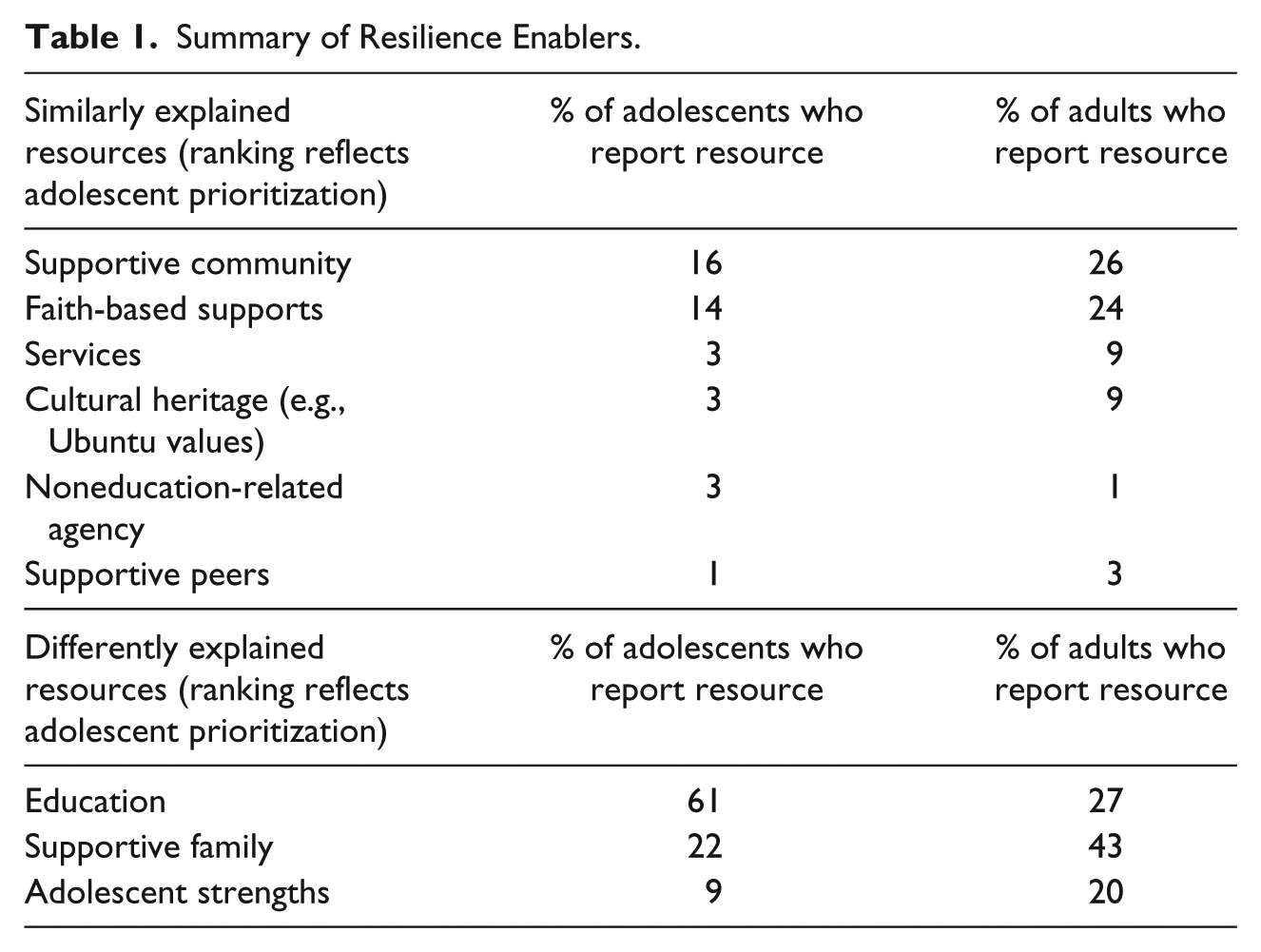
As summarized in Table 1, there were limited differences (10% or less) in how frequently adults and adolescents identified the following resources: supportive community, faith-based supports, services (mental health, welfare, and criminal justice), cultural heritage, noneducation-related agency, and supportive peers. Adults and adolescents also explained the protective function of these resources in similar ways. For example, both adults and adolescents commented that faith-based supports sustained adolescent hope and regulated behavior.
Summary of Resilience Enablers.
Divergent Adult and Adolescent Perspectives
As summarized in Table 1, there was a discrepancy (greater than 10%) in how frequently adults and adolescents identified education, supportive family systems, and adolescent strengths. As detailed next, what adults and adolescents included in their understanding of these resources differed. Allied to this, they explained the protective functions of each in divergent ways.
Education
Overall, most adolescents (i.e., 61% of the adolescent sample) identified education as crucial to resilience: “If you have education you have power in your hand.” In comparison, only 27% of the adult sample did so. Of the adolescents who identified education as a pathway to resilience, the majority (76%) reported that education’s resilience-enabling power lies in its potential to enable an improved future. As one young man put it, “I can imagine my future when I am at school.” This imagined future included employment-linked financial well-being, opportunity to make families and communities proud, and social standing. For example, another young man drew some buildings and labeled them “school.” When he explained his drawing, he emphasized his belief that education facilitates employment-related economic independence: “If you don’t have an education there is no job you can get. Education is the most powerful weapon.” Similarly an adolescent girl drew a young woman holding a report card. She explained, I drew this picture because education helped me to achieve many things in life. So, I participate in education because I want to live my dreams and become successful like [name] and make my own TV show named Dr. [own name].When we talk we say, “Education is the key to success.”
Among adults who identified education as a resilience enabler, only a minority (22%) linked education to potential for an improved future. Instead, twice as many of the adults (45%) remarked that schooling offered access to emotional and instrumental support. For instance, a 29-year-old White woman teacher drew a school and noted, “School is a place where learners can find help and guidance in many difficult situations.” Similarly, a 41-year-old Black soccer coach, who also drew a school, explained, School is the most important resource that helps the youth in my community to do well. At school they get to be children and forget about their challenges. They also see teachers as their parents and role models, especially for children who do not have parents or good role models. It is where they get their motivation and support to do well in life.
Some adults explicitly mentioned how school staff supported resilience by providing for adolescents’ basic needs. For example, a 30-year-old Black teacher commented that, “Teachers assist learners [by] taking care of their physical needs, e.g. feeding schemes.” In contrast, few (1%) adolescents associated education with access to emotional and/or instrumental support. Instead, there was some evidence that adolescents associated a completed education as an opportunity to provide emotional and/or instrumental support to their families or communities. For example, one girl commented, “I am hopeful that I will finish school and be what I want to be and buy my sisters cars and houses, and even my grandmother.” Another noted, “I want to be a businesswomen to run my company, to have own office, and to support other children to have better future by tomorrow like I want to.”
Supportive family
Adults credited family support as resilience enabling more often than adolescents did (i.e., 43% adults vs. 22% adolescents). Furthermore, adults and adolescents offered different explanations for why/how family enabled resilience. Adult accounts emphasized the resilience-enabling support of a “stable support system” that consisted of a network of helpful relatives and nonrelatives. This network was generally credited with enabling access to basic resources and providing emotional support. For example, a 52-year-old Black woman teacher drew people (labeled “elders”) and a house (labeled “neighbours”) and explained, “If young people struggle, their grandparents are usually the first to help. Neighbours usually lend a hand . . .” Similarly a 28-year-old Black man who was a local social worker drew concentric circles comprising multiple nested layers and explained that this system made the difference to the resilience of one of his adolescent clients: Family members helped him to succeed in life. These family members provided the immediate needs of the youth while the community served as the support system for the youth and kept on encouraging the youth to soldier on in his life.
Likewise, a 34-year-old White physiotherapist drew a group of people holding hands. She then reflected on the resilience of one of her patients who was challenged by poverty and disability. She explained that her drawing emphasized the resilience-enabling power of a supportive network of family and community: Her mum has to work fulltime and can’t look after her and her siblings . . . Ubuntu [i.e., traditional African values of interdependence and harmony] and community is close knitted. For example, when mum can’t, granny or aunt or someone will help out.
In comparison, adolescents made isolated references to a supportive family network (only 3% did so). When they did, they were more likely to identify specific members of their immediate family. Which family members adolescents identified often fitted with their living arrangements (e.g., only adolescents who lived with both parents/guardians identified parents; adolescents who lived with their mothers only were most likely to identify women relatives). Still, living arrangements did not prescribe which family members adolescents identified as resilience enabling (e.g., adolescents who lived with both parents/guardians identified women relatives as resilience enabling, albeit half as often as adolescents who lived with a mother only).
Women relatives—mostly mothers, grandmothers, and/or sisters—dominated adolescents’ accounts of what enabled resilience. Both male and female adolescents credited mother figures with continuously supporting their resilience because of the instrumental and or emotional support they provided. For example, a boy explained that his resilience related to his “mother’s help and rules . . . meaning my mother encourages me.” Similarly, an adolescent girl explained, The drawing describes my mother. It is all about how I am proud to be her daughter, she is so fascinating, fantastic, funny, friendly fabulous and intelligent. She always stands for her family. She always corrects me when I am wrong. She encourages me. She is the sun to me. She always helps me and she is always there when I need her. So I would say she is the light of my day and why I am doing OK.
Another young woman, who lived with her biological parents, provided an analogous account: The person I draw is my mum . . . She is the one who looks after me and she cares about my school work. She is the most important person in my life. She helped me to do well in life
Few adolescents (i.e., fewer than 1%) referred specifically to their fathers or father figures who enabled resilience. Those who did typically lived with both biological parents and explained that father figures urged them to be invested in education. For example, a girl drew a man and wrote, “There is my granddad who motivates me with my school work.” Likewise, a boy drew a man in a uniform and explained, “The picture I drew is my father . . . He made me go to school even I didn’t want to go to school. He made me realise the importance of school.”
Adolescent strengths
Adults identified innate strengths as important to adolescent resilience more often than adolescents did (i.e., 20% of the adult participants identified adolescent strengths as resilience enabling, whereas only 9% of the adolescent participants did so). Such strengths were typically character traits, dispositional attributes, or personal skills. For example, a 42-year-old Black nurse commented: “Some young people are prone to giving up when faced with challenges. Some have much stronger character and can endure difficult situations.” Similarly, a 49-year-old Black male teacher drew a picture of a smiling girl and explained, This is a picture of [name] with a smile that stands for her sense of humour. And the muscles that stand for her strong will and cheerfulness. This drawing is representative of her resilient spirit and big-heartedness despite the difficulties around her and the uncertainties of the future.
In comparison, adolescents recognized sporting talent and how using this talent kept them gainfully occupied and so out of harm’s way, or acknowledged their capacity to behave respectfully. For example, one young woman drew a girl in her school uniform and explained, “Sometimes you are a ‘clever’ girl or boy, but by not respecting you are not going anywhere. My life was improved after [I began] respecting”
Discussion
Two questions directed this article: (a) which resources do structurally disadvantaged adolescents identify as resilience enabling and (b) how do these compare with the resources identified by a sample of adults who educate or provide services to adolescents challenged by structural disadvantage? In response, adolescents and adults reported individual, familial, and community-based resources (see Table 1), all of which have been previously documented (see Werner, 2013). What was striking, however, is that adolescents and adults prioritized education, supportive family systems, and personal strengths differently. What they associated with these three resources and how they explained the resilience-enabling power of each also differed. As explained next, these differences reflect dissimilar theoretical resilience positions.
Compared with adult accounts of what enables resilience, personal strengths and family supports were less prominent in adolescent accounts. Instead, as in prior African (Lethale & Pillay, 2013; Mhlongo & O’Neill, 2013; Theron, 2016a) and other studies (Boyden, 2013; Schoon et al., 2004), adolescents envisioned education as the route to an improved future. In this way, adolescent perspectives align with more recent social–ecological claims (see Ungar, 2015a; Ungar et al., 2015), that formal systemic supports (such as quality education) matter more for resilience than the personal strengths and/or actions of individual adolescents, or family/social support. They also align with studies that show how systemic supports (e.g., mentors) have the potential to facilitate/sustain individual-level resources, such as hopeful agency (Aronowitz, 2005; Wesely et al., 2017). In comparison, adults’ greater attention to how adolescents’ character traits and disposition enable resilience echoes outdated, individual-centered theories of resilience (Masten, 2014). Worryingly, individual-centered resilience explanations allow societies to hold young people personally responsible for adjusting well to structural disadvantage. Societies can then disregard that adult mentorship influences adolescent resilience (Aronowitz, 2005) and excuse themselves from proactively changing structural issues that perpetuate risk for young people (Hart et al., 2016). Put differently, adolescent emphasis on education pathways and how these facilitate future-oriented agency underscores that resilience-enabling practice and policy need to be more about systemic initiatives to “change the odds” and less about individual actions to “beat the odds” (Seccombe, 2002).
Two arguments can be advanced to try and make sense of the disjuncture in adult and adolescent perspectives. The first is that given their diverse developmental stages and life experience, adults and adolescents probably define resilience dissimilarly and/or view resilience enablers differently. Adolescent prioritization of education pathways and their emphasis on education’s potential to support their “getting out” (Redmond, 2009, p. 546) fits with the adolescent task of identity development and dreams of a possible self that is different from the present self (Markus & Nurius, 1986). In contrast, the adult emphasis on schools as access points to support fits with the adult (African) task of being responsible for the well-being of the younger generation (Jithoo & Bakker, 2011). Accordingly, adults are more concerned with how schools can remediate the consequences of deprivation and less with how schools can support the realization of young people’s hopes. Related to this, many South African adults are aware of the obstacles (e.g., inadequate social and other capital), which characterize structural disadvantage and obstruct realization of hoped-for selves (Van Breda, 2010). They also know that schools are the most likely space in which South African adolescents will be supported to address said obstacles (Theron & Theron, 2014), and so promote school-based health- and well-being–focused interventions.
A second possible explanation for the divergences in adolescent and adult perspectives relates to the fluidity of culture (Panter-Brick, 2015). Even though the values and beliefs of a culture-sharing group are not monolithic, older people are more likely to endorse historic values and be disconnected from what younger generations expect and esteem (Rogoff, 2011). This is true in South Africa too. There is a growing tendency among younger Black people to adopt Westernized values, including more emphasis on the immediate family (Ramphele, 2012). This could explain why adolescents were less likely to refer to personal strengths as resilience enabling. Traditionally, relatives in the extended family modeled personal strengths and tolerance (Theron & Theron, 2013), but as the younger generation increasingly loosens ties with family networks, there are fewer opportunities to learn from elders (Jithoo & Bakker, 2011). Declining contact with family–community networks could also account for the adolescent inclination to favor specific family members in their explanations of resilience. Although there was overlap between adolescents’ living arrangements and the specific family members they identified as resilience enabling, whom adolescents lived with did not appear to prescribe their explanations of how family supported resilience (e.g., male and female youth who lived in two-parent households prioritized women relatives as resilience enabling). It would, therefore, be imprudent to use culture, or context (e.g., living arrangements), to predict what enables adolescent with resilience, without being guided by adolescents themselves.
Implications for Championing Resilience
Fundamentally, the results of this study should sensitize societies (including researchers, service providers, policy makers) to the importance of decentering adult perspectives in resilience promotion. The reality of life-stage influences and shifting cultural values implies that if societies wish to champion youth resilience, they need to interrogate how dominant, adultist perspectives might reflect developmental positioning and/or cultural values that younger generations do not associate with. Discrepant adolescent and adult explanations caution that resilience-enabling policy and practice are likely to have suboptimal impact if these initiatives are based solely/chiefly on adult constructions of resilience enablers. Dialoguing with young people about what they value is, therefore, a crucial and ongoing task for practitioners and policy makers alike. As part of this dialogue, it is important to explore how adolescents construct culture-laden phenomena such as family and to design resilience-enabling interventions and policy accordingly. For example, the fact that adolescents in this South African study prioritized supportive relatives (particularly women relatives) in their construction of family signposts that South Africa needs to redouble its policy and practice efforts to sustain family functioning in the face of hardship. In addition, there is a need to better understand why women relatives dominated adolescent accounts of supportive family. Is this still a throwback from Apartheid policies that forced men to leave their families in search of employment and women to sustain family functioning (Delany et al., 2016), or is there a different reason? A better understanding of adolescent emphases on women relatives will better inform how societies promote resilience in socioculturally relevant ways.
Decentered adult perspectives are not tantamount to discounted adult perspectives but rather to healthy respect for what resilience promotion can gain by including, and accentuating, adolescent insights. For example, school-based health- and well-being–focused interventions and policies abound (Fazel, Patel, Thomas, & Tol, 2014). This is despite the fact that the evidence base suggests that, relative to a number of variables (e.g., gender, age, type of risk, context), school-based interventions mostly have a small or modest impact (Hart & Heaver, 2012). Thus, continued school-based support agendas reflect the dominance of adult preoccupation with how schools can aid adolescents’ present selves. What is less well supported is adolescents’ valuing of education’s potential and how this can best be bolstered toward enabling adolescents’ future selves. In South Africa in particular, not enough is being done in structurally disadvantaged communities to ensure quality schooling that will facilitate young people’s realization of their aspirations (Theron, 2016a). Ironically, adults are powerfully situated to advocate for improved education policy and better quality education opportunities (along with other necessary structural changes) as part of how societies can disrupt the repeated cycles of risk that disadvantage young people (Hart et al., 2016). Failure to do so is likely to perpetuate the power of structural disadvantage to frustrate youth agency (Munford & Sanders, 2015; Redmond, 2009).
Simultaneously, it is important to acknowledge that adolescent insights can be overly idealistic (Van Breda, 2010). Thus, in tandem with respecting adolescent insights, adults have a responsibility to recognize mentorship as a viable strategy for enabling adolescent resilience (Wesely et al., 2017). Such mentorship needs to facilitate adolescent understanding of how structural disadvantage could challenge their preferred pathways of resilience (e.g., education-linked aspirations) and offer related interventions (e.g., support meaningful planning toward achievable future selves and/or advocate for improved education opportunities and access to higher education; see Aronowitz, 2005; Theron, 2016b; Van Breda, 2010).
Limitations
The adolescent and adult perspectives reported in this article represent insights at a particular point in time. It is possible that explorations of their perspectives over time would have shown changes. For example, it is possible that as the adolescents matured, they could have reported adjusted aspirations (as predicted by Béné and colleagues, 2014). In addition, although the adolescent and adult participants came from the same geographical area, the adult sample was limited to service professionals and educators. Cultural leaders and/or community elders, as well as adults engaged in youth-focused correctional services, would probably have extended the response repertoire. Similarly, inclusion of non–school-attending adolescents might have altered adolescent proclivity for education as a resilience enabler. Finally, the research team did not ascertain how participating adolescents and adults conceptualized resilience. Conceptual differences could have influenced their responses and should, ideally, have been accounted for.
Conclusion
Resilience is commonly regarded as a complex process that is context- and culture sensitive (Masten, 2014). This article adds to the aforementioned complexity by showing that how resilience is accounted for is likely to vary depending on whether adolescent or adult perspectives are prioritized. The differences in adolescent and adult explanations of what enables adolescent resilience are a cogent reminder that how resilience is accounted for should be inclusive of adolescent insights. Although adult perspectives remain valuable, if societies wish to champion adolescent resilience in optimal ways, then adolescent insights should be central to how resilience is promoted.
Footnotes
Declaration of Conflicting Interests
The author(s) declared no potential conflicts of interest with respect to the research, authorship, and/or publication of this article.
Funding
The author(s) disclosed receipt of the following financial support for the research, authorship, and/or publication of this article: The author(s) received financial support from the National Research Foundation, South Africa (Incentive Funding Grant: IFR2011041100058).
Author Biography
 .). She is lead editor of Youth Resilience and Culture: Complexities and Commonalities (Springer, 2015).