



Abstract
This study examined Marcia’s identity paradigm among Lebanese adolescents in relation to gender and academic achievement. Participants were 429 students in Grades 7 to 11, aged 12 to 17 years. The Ego Identity Process Questionnaire (EIPQ) was used to classify participants into the four identity statuses: Achievement, Moratorium, Foreclosure, and Diffusion. Results showed that females were mostly in Moratorium (37.4%) whereas males in Foreclosure (35.1%). The difference was statistically significant, χ2(3) = 20.40, p = .001. Also, females scored significantly higher on the Exploration subscale, t(425) = −2.68, p = .04, whereas males scored significantly higher on the Commitment subscale, t(426) = 4.19, p = .01. No significant achievement differences were found among students in the four identity statuses, F(3, 419) = .38, p = .13. These results suggest possible shifts in cultural norms with females developing identity through pathways believed to be males’ in traditional societies.
Context of the Problem
Adolescence is a critical developmental period, marked by significant physical, cognitive, social, and emotional changes. During this stage, young individuals attempt to resolve psychosocial concerns and examine their life goals, aspirations, and beliefs, away from adults’ expectations and impositions. Such is the process of identity formation, a process that Erikson (1968) argued is one of the most important life tasks.
Abundant research exists on the complex process of identity development, mostly originating from the work of Erikson and Marcia several decades ago. Erikson (1968) stipulated that adolescence ushers in the stage of “identity achievement versus role confusion” during which adolescents experience a crisis due to reassessment of their life goals and values; if well-resolved, the result is a well-integrated identity, otherwise confusion will ensue.
On the contrary, Marcia (1980) argued that adolescence marks neither the beginning nor the end of the identity formation process. Unlike Erikson, Marcia (1966) did not construe the outcome of identity crisis during adolescence as either identity achievement or confusion, but rather as one of four possible identity statuses: Achievement, Diffusion, Moratorium, and Foreclosure. What determines these identity statuses is the level of exploration and commitment the adolescent has made to an identity in various life domains, such as vocation, religion, relationships, gender roles, education, and values (Marcia, 1993).
According to Marcia (1980), “Exploration pertains to the exploration of alternatives with the intention of establishing a firm commitment in the near future” (p. 178). The outcome is typically new commitments made toward old or new values and beliefs. On the contrary, commitment “ . . . refers to a stable investment in one’s goals, values, and beliefs evidenced in supportive activity” (Archer, 1993, p. 181). The extent to which an adolescent adheres to these ideals, values, beliefs, plans, and targets determines his or her level of commitment. Thus, the level of the adolescent’s Exploration and Commitment in certain life domains, such as vocation, religion, and sex-role attitude, determines his or her identity status (Marcia, 1993). Adolescents with an Achieved identity have engaged in high exploration and made solid commitments whereas those with a Diffused identity did not engage in any exploration or made solid commitments. Adolescents in Foreclosure have made firm commitments without much exploration. Finally, adolescents in Moratorium are presently in the process of exploring various commitments in the different life domains.
The current study explores Marcia’s (1966) identity paradigm among Lebanese youth. The aim is to identify the identity statuses of Lebanese adolescents. Another purpose was to examine gender and academic achievement as correlates to identity statuses.
Rationale
Why investigate identity statuses among Lebanese youth? Lebanon is a small country in the Middle East where patriarchal norms dominate (Sarouphim, 2011). Research on identity development is scarce in the country as well as in the Arab world. A literature search on studies investigating Marcia’s identity paradigm in the Lebanese setting yielded only one study conducted on this topic that examined a group of college students with regard to identity statuses (Kaddoura & Sarouphim, 2016), but no research was found on identity statuses among Lebanese early and middle adolescents. Therefore, this study will contribute to the literature by highlighting an important, but neglected area of research on identity development in the Middle East.
Moreover, by identifying the identity statuses of young Lebanese individuals, researchers can begin to unveil the process of identity formation in the Arab world. The prevailing sociopolitical climate in the Middle East as well as the rise of religious fundamentalism in that part of the world warrants examination of this topic, as social and cultural influences play a significant role in identity development (Marcia, 1980). Young people are not removed from their environment and their development is directly influenced by distinct sociocultural and geographical contexts (Green, Kalvaitis, & Worster, 2016). Identity achievement has a great impact on the youth’s self-image, self-presentation, as well as their social functioning (Kumru & Thompson, 2003). Schwartz et al. (2011) argued that people who know who they are, what they want, and where they are heading tend to feel satisfied with themselves, share good rapport with their fellows, and are less likely to participate in harmful behavior. Such people are thought to have achieved identities that provide them with a sense of uniqueness and adequate future adjustment (Heidary, Roodbari, Naderi, Isanezhad, & Jalilvand, 2012). Accordingly, it is important to investigate identity development in Lebanese youth in an attempt to pave the way for research on social and psychological factors that influence identity formation specific to the Arab countries, especially in relation to the development of healthy and positive identities, as this region of the world continues to witness a rise in radicalized youth, without a clear understanding of the progression of this process.
In addition, examining gender differences in identity statuses within the context of a patriarchal society is of significance, as gender directly affects developmental outcomes. In Lebanon, gender inequalities prevail, especially in relation to social and cultural norms (Sarouphim, 2015). Thus, males and females are raised with different expectations, leading to different developmental trajectories (Sarouphim & Chartouny, 2017). For example, girls are expected to preserve the family’s honor by remaining virgins until marriage and men are expected to be providers for their family (Ayyash-Abdo, 2007). In early adolescence, menarche is associated with increased restrictions and decreased mobility for girls whereas puberty in males signals more freedom outside the home and within the community. However, in recent years, the gender gap seems to be narrowing, as Lebanese females are increasingly engaging in behaviors similar to those of males with regard to sex, vocation, and careers (Sarouphim & Chartouny, 2017). Therefore, examining the impact of gender on the identity statuses of Lebanese youth would determine whether young Lebanese males and females follow the same developmental patterns as their peers in the West or whether new patterns and developmental trajectories emerge in today’s patriarchal societies, such as Lebanon’s.
Finally, the last goal of this study was to investigate identity statuses in relation to school performance. Research has shown that academic achievement plays a central role in aspects related to development in early and middle adolescence (Lange & Byrd, 2002). Thus, adolescents with high academic achievement tend to have achieved identities and those with poor scholastic outcomes tend to be in diffusion (Berzonsky, 2004). In Lebanon, a great emphasis is placed on the scholastic achievement of young people to secure their admission to reputable colleges (Bahous & Nabhani, 2008). In addition, high achieving students have higher levels of psychological well-being and higher levels of self-esteem than low achieving students (Sarouphim, 2011). As such, examining academic achievement as a correlate to identity statuses might spark research on mediating factors that promote educational outcomes among youth in traditional societies (e.g., mentors, experiences, activities), and consequently contribute, albeit indirectly, to the development of a healthy identity.
Research on Marcia’s Paradigm
Abundant research conducted on Marcia’s paradigm has mostly validated the model (e.g., Berzonsky, 2004; Flores-Crespo, 2007; Kroeger & Marcia, 2011). According to Kumru and Thompson (2003), early adolescents are mostly in Diffusion due to their lack of abstract thinking and low reasoning capabilities, but as adolescents mature, they progress to the more advanced statuses of Moratorium and Achievement. This expectation is supported by evidence from both nature and nurture processes.
Biologically, as young people advance in age, their prefrontal cortex becomes more developed, thus increasing their logical and critical thinking as well as their overall cognitive capacities (Konrad, Firk, & Uhlhaas, 2013). Also, young people’s social circumstances become more complex as they prepare to leave adolescence and enter the adult world of work. Thus, as adolescents grow older, the frequency of Identity Diffusion and Identity Foreclosure Statuses are more likely to decrease, whereas the more complex identity statuses of Achievement and Moratorium increase; the significant movement from less sophisticated to more sophisticated identity statuses usually occurs in late adolescence (Archer & Waterman, 1983).
Correlates to Identity Formation
Several correlates to identity formation were examined in the context of Marcia’s paradigm, such as gender and academic achievement, the two variables investigated in this study. With respect to the scholastic domain, researchers have found a strong association between identity formation and academic achievement. For example, Berzonsky (2004) argued that identity achievement improves adolescents’ reasoning and their cognitive abilities; he posited that adolescents with achieved identities develop effective studying strategies for academic success. Along the same lines, Lange and Byrd (2002) posited that adolescents with formed identities, like Foreclosure and Achievement, develop skills for managing their lives and set plans that ensure their academic success, whereas those with Diffused or Moratorium identities have poor study skills and fail to manage their academic life successfully. Similarly, Flores-Crespo (2007) noted that identity formation may affect adolescents’ attitude toward school, classroom behavior, and school choice.
On the contrary, research on the relation between gender and identity statuses has yielded mixed results. For instance, Waterman (1993) argued that both males and females have similar experiences in exploration and commitment, with no differences in identity statuses. Similarly, Allison and Schultz (2002) found no gender differences in the Identity Achievement and Identity Moratorium statuses of males and females in early adolescence. However, in research where gender differences were found, most studies showed that adolescent females tend to be in Moratorium and Achievement and adolescent males tend to be in Foreclosure and Diffusion (Meeus, van de Schoot, Keijsers, Schwartz, & Branje, 2010).
Similar results were obtained in research investigating identity statuses in diverse cultural settings. For example, in a study on Turkish adolescents, Cakir and Aydin (2005) found that females were more likely to be in Moratorium and Achievement whereas males were more likely to be in Diffusion. Similarly, Bergh and Erling (2005) found that Swedish adolescent girls tended to be in Moratorium and adolescent males in Diffusion. Along the same lines, Solomontos-Kountouri and Hurry’s (2008) study on 1,038 Greek youth in Cyprus indicated that girls were mostly in Moratorium and boys in Moratorium and Diffusion. In Lebanon, the only study conducted on Marcia’s theory revealed that most participants between the ages of 18 and 21 years were either in Moratorium or Foreclosure without significant differences in either gender or academic achievement (Kaddoura & Sarouphim, 2016).
Identity in the Lebanese Context
The issue of identity formation among Lebanese youth is complex, for, in addition to experiencing the typical physiological and psychological changes that accompany the critical stage of adolescence, Lebanese youth have to cope with the peculiarity of the Lebanese society characterized by religious divisions, political instability, and cultural challenges. To complicate the matter further, Lebanese youth are constantly bombarded with mixed messages about Eastern and Western traditions, making them waver between the conservative values of their own culture and the more liberal values of the West. On one hand, they seem to melt into the “Global youth culture enriched by the intensive global communication networks and the mass media” (Faour as cited in El-Hassan, 2004, p. 14), and on the other hand, their need to uphold their unique values and traditions seems high (Issam Fares Institute for Public Policy & International Affairs, American University of Beirut, 2011).
Also, Lebanon’s long history of war and conflicts has affected the youth and the way they perceive their identity. Young people in the Lebanese society grow to be rather dependent individuals with no distinct identity of their own, because they are raised and seen as members of a greater denominational society (Rarrbo, 2009). Indeed, the Lebanese culture plays an undeniably great role in shaping adolescents’ identity. For the majority of the Lebanese people, the family is considered the basic social foundation, characterized by close ties, loyalty, and interdependence (Faour as cited in El-Hassan, 2004). In the same context, Ayyash-Abdo (2007) argued that although adolescents in Lebanon pursue independence and exhibit behavior that challenges authority, they rarely leave home before marriage or seek measures of independence and self-reliance outside the family realm. It is not known, however, the extent to which these contradictions affect the adolescents’ identity development, as research on this topic is almost nonexistent in the country.
Hypotheses
Based on the review of literature and the context of the study, the following three hypotheses were posited:
Method
Participants
Given that this study was exploratory in nature, a purposeful and small sample was used to assess feasibility and appropriateness of such inquiry in Lebanon. The sample consisted of 429 students (208 males, 221 females) in Grades 7 to 11 taken from intact classes at one private school in Sidon, the largest city in southern Lebanon. No attempt at sampling was made as all students in the school were included in the study. Participants’ mean age was 14.2 years and most were from middle socioeconomic status (SES), as evidenced by the school’s location and tuition fees as well as the students’ place of residence. The rationale for using a sample of adolescents belonging to a private rather than a public school is related to convenience and feasibility purposes. Access to public schools in Lebanon for research purposes is problematic and rarely granted by the ministry of education, hence the choice of a private school. This particular private school from which the sample was taken is the largest in the area and hosts students from diverse groups representative of adolescents in Lebanon (i.e., Christians and Muslims from different cultural backgrounds); thus, it was deemed adequate for an exploratory study of this kind.
Instrument and Procedure
Ego identity statuses
All participants were administered the Ego Identity Process Questionnaire (EIPQ; Balistreri, Busch-Rossnagel, & Geisinger, 1995). The instrument is a 32-item questionnaire that assesses the respondents’ levels of Exploration and Commitment across eight domains using a 6-point Likert-type scale ranging from strongly agree to strongly disagree. The domains are occupation, religion, politics, values, family, friendships, dating, and sex roles. Respondents receive one score on each of the Commitment and Exploration subscales ranging from 16 to 96 with higher scores indicating higher levels of exploration and commitment. In addition, participants receive one total score that places them in one of the four identity statuses. In this study, reliability as measured by Cronbach’s alpha was .69 and .66 for the Exploration and Commitment subscales, respectively.
As the participants’ native language is Arabic, the instrument was translated from English to Arabic and then back-translated into English to ensure the content validity of the Arabic version. A pilot study of 35 students matching the participants of this study in age and grade levels revealed that the Arabic Version of the EIPQ was not clearer or easier to understand for the participants; thus, the instrument was administered in its original English language form, although students had the choice to take the Arabic version of the EIPQ, but none did.
Academic achievement
Measures of academic achievement were collected from the students’ school records, given that standardized achievement data do not exist in Lebanon. In spite of this limitation, school grades do constitute a valuable indicator of students’ overall achievement as they are used as the chief index for students’ grade promotion or retention in Lebanon (Sarouphim & Chartouny, 2017). The participants’ overall average or grade point average (GPA) for the academic year 2014-2015 was considered academic achievement data. The overall average, as issued by the school and shown in the grade records was calculated on a metric scale of 100 (typical in the Lebanese schooling system), with higher grades indicating higher performance. The overall average is calculated based on students’ performance in the following subject matters: mathematics, English, Arabic, biology, physics, chemistry, civics, sociology, economics, history, geography, philosophy, and physical education.
Results
Instrument Validation
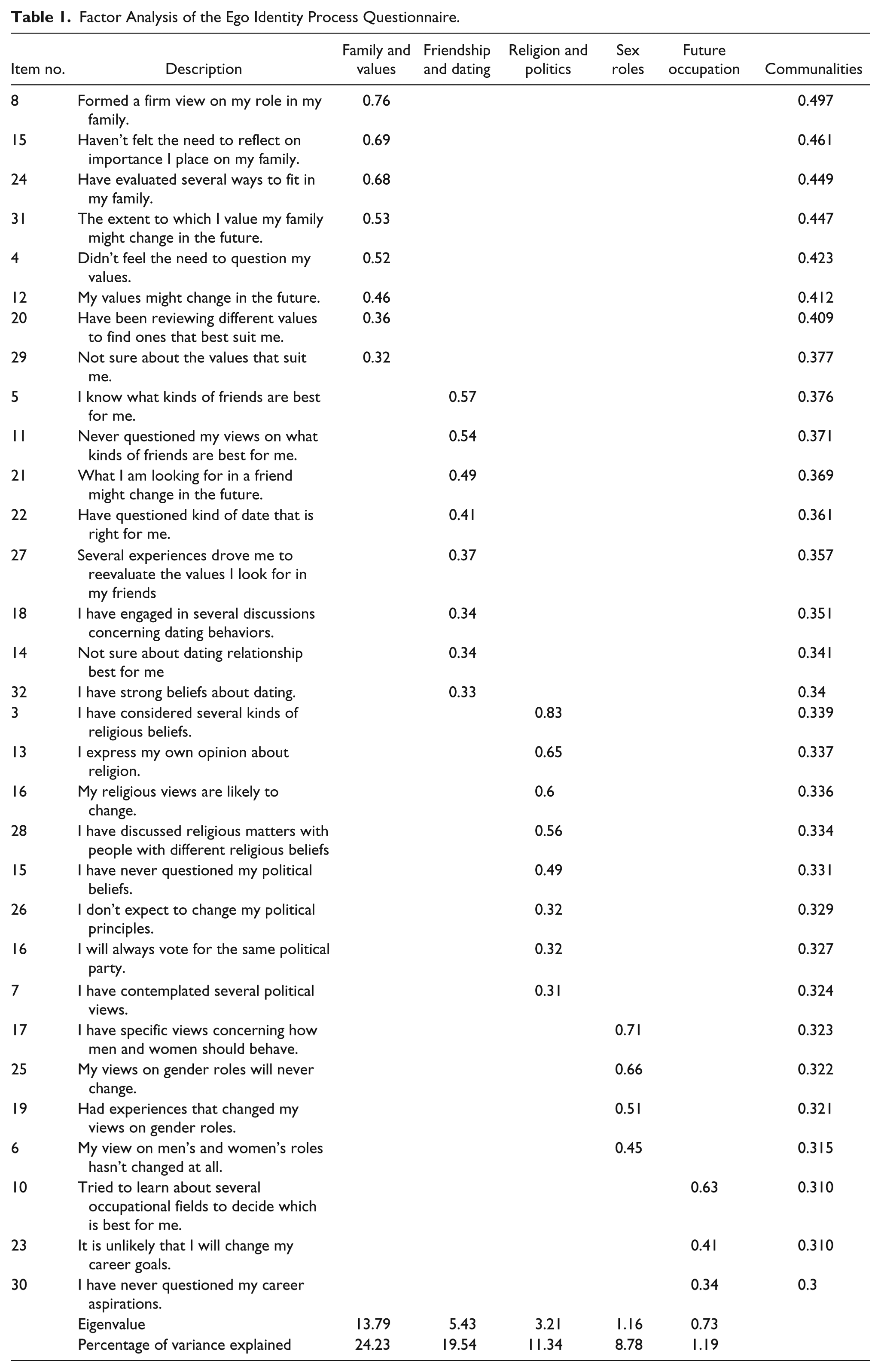
A principal components analysis with Varimax rotation was used to identify the nature of the factors or constructs underlying the items of the measure. Items that correlated .3 or above with at least one other item were retained, as this suggests reasonable factorability. All 32 items met this criterion and were all included in the analysis. The data yielded five factors, explaining 65.08 % of the variance for the entire set of variables (see Table 1). The factors were labeled as follows: family and values (24.23%), friendship and dating (19.54%), religion and politics (11.34%), sex roles (8.78%), and occupation (1.19%). The communalities were rather low overall, suggesting that the variables analyzed were only weakly related with one another. However, all communalities were above .3, confirming that each item shared some common variance with the other items. The Bartlett’s Test of Sphericity was significant, χ2(158) = 849.32, p = .04, indicating that the set of variables are adequately related for factor analysis. In sum, these analyses showed that all 32 items of the instrument are grouped around five distinct underlying factors with clear patterns of responding, a finding that validates the original factor structure of the EIPQ and supports the use of the instrument with the sample of the current study.
Factor Analysis of the Ego Identity Process Questionnaire.
Identity Statuses
As per the EIPQ manual instructions (Balistreri et al., 1995), the median split was used to determine participants’ cutoff scores. As such, participants with low Exploration and low Commitment scores were classified as Diffused, and participants with high Exploration and high Commitment scores were classified as Achieved. Moreover, participants with low Exploration and high Commitment were identified as Foreclosed and those with high Exploration and low Commitment were classified in the Moratorium status.
A chi-square test revealed that the difference in the number of participants in the four statuses was significant, χ2(3) = 23.61, p = .001, with the majority of participants being in Moratorium (n = 122, 28.6%), followed by Foreclosure (n = 119, 27.9%), and Achievement (n = 108, 25.3%). The lowest percentage of participants were in Diffusion (n = 79, 18.3%). Hence, the results did not support the first hypothesis of this study which stated that the Lebanese youth in early and middle adolescence will be classified mostly in the Diffusion Identity status.
Gender Differences
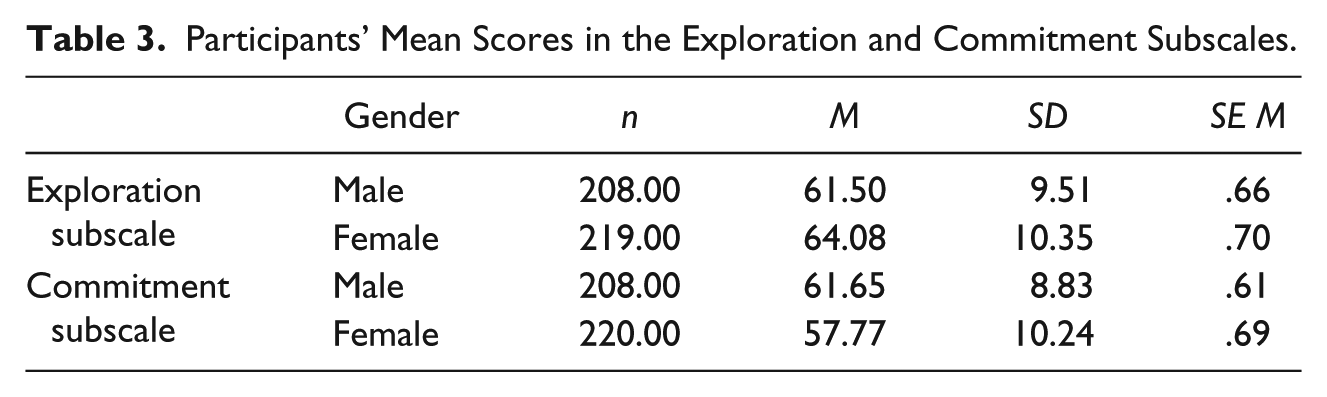
Different patterns of identity statuses were found for males and females. As seen in Table 2, females were found to be mostly in Moratorium (37.4%) whereas males were mostly in Foreclosure (35.1%). The difference was statistically significant, χ2(3) = 20.40, p = .001. Also, female participants scored significantly higher on the Exploration subscale, t(425) = −2.68, p = .04, with a small effect size r = .13, whereas males scored significantly higher on the Commitment subscale, t(426) = 4.19, p = .01, with a small to moderate effect size, r = .20 (see Table 3). Accordingly, the second hypothesis of this study which stated that a significantly higher percentage of males will be classified in either the identity Diffusion or Foreclosure statuses whereas significantly more females will be in either the Moratorium or Achievement statuses was supported and the null hypothesis of no differences was rejected.
Sample Distribution in Identity Statuses.

Participants’ Mean Scores in the Exploration and Commitment Subscales.
Academic Achievement
As shown in Table 4, the participants’ mean GPA were similar among the four identity statuses, revealing little differences. The participants in the Diffusion status had a mean GPA of M = 71.97 and SD = 9.83, and those in the Achievement status had a slightly, but not significantly, higher GPA of M = 72.10 and SD = 8.79. Also, in the Foreclosure group, the mean GPA was M = 73.16 and SD = 9.66, and in the Moratorium group, the mean GPA was M = 72.92 and SD = 10.0. Thus, no significant differences were found in the achievement of participants in the different identity statuses, F(3, 419) = .38, p = .13. Accordingly, the third hypothesis of this study, which stated that participants with a higher GPA will be classified in the Achievement status and those with a lower GPA in the Diffusion status, was not supported and the null hypothesis of no differences was not rejected.
Differences in GPA Across the Four Identity Statuses.
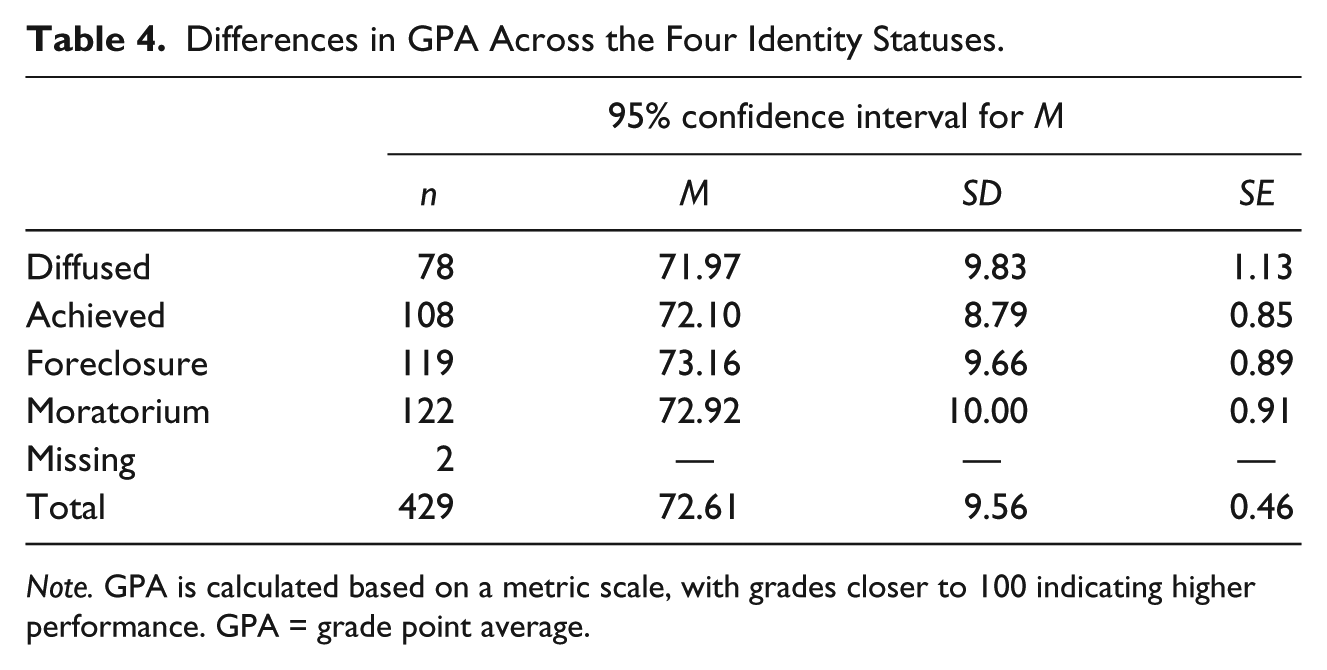
Note. GPA is calculated based on a metric scale, with grades closer to 100 indicating higher performance. GPA = grade point average.
Discussion
This study had three purposes. The main purpose was to examine Marcia’s ego identity statuses in a sample of early and middle Lebanese adolescents. Another purpose was to investigate gender differences among the participants in the different ego identity statuses. A third purpose was to explore the relation between individuals’ ego identity statuses and their academic achievement.
The results of this study showed that most participants were in Moratorium followed closely by Foreclosure, a finding incompatible with the literature (Kumru & Thompson, 2003; Schwartz, 2008), as the limited cognitive capabilities of early adolescents places them mostly in Diffusion (Archer & Waterman, 1983). One explanation for the current results might be related to the peculiarities of the Lebanese culture. Due to the constant turmoil and political instability in the country, adolescents are constantly challenged and forced to reflect at a young age on their values and options in life, which increases the likelihood of their being in the Moratorium status. On the contrary, the Lebanese culture is characterized by close family ties, loyalty, and interdependence. Lebanese adolescents value their relationship with their parents and overwhelmingly consider “their nuclear families the closest social group with which they identify” (Faour, as cited in El-Hassan, 2004, p. 14). Thus, young adolescents become committed to their parents’ values and accept their preset plans for them without much exploration of other alternatives. Consequently, the likelihood of a young Lebanese adolescent to be in Foreclosure is high. As such, although the findings of this study are incompatible with the literature, they are culturally appropriate and fit the Lebanese setting, which incites further research on how cultural variations may affect identity formation in adolescents.
An interesting finding is the significantly higher percentage of males in Foreclosure and the significantly higher percentage of females in Moratorium. This result is compatible with the literature on early adolescence (Meeus et al., 2010), but opposite results would not have been surprising given the patriarchal nature of the Lebanese culture. One explanation might be the changing Lebanese norms. Although the Lebanese society is predominantly male-oriented, Kaddoura and Sarouphim (2016) argued that women’s role has become more significant in recent years. Thus, to fit into the contemporary society, females are granted more opportunities for exploration, and encouraged to consider different pathways of development (Sarouphim, 2015). This might explain the higher scores of females on the Exploration subscale and their larger number in the Identity Moratorium status.
Furthermore, despite the changes occurring in the Lebanese society, male members in traditional patriarchal Lebanese families are usually viewed as superior to females (Ayyash-Abdo, 2007). In such context, males become more involved in the family issues and in the decision-making process. Consequently, more responsibilities and commitments might be imposed by the parents on their sons who are expected to show loyalty and obedience to the family values (Kazarian, 2005), which might explain the higher number of males in Foreclosure. However, further research on identity development in Lebanese adolescents is needed before the results of the current study could be interpreted with firm conclusions.
Contrary to the literature (Berzonsky, 2004; Flores-Crespo, 2007; Lange & Byrd, 2002), no achievement differences were found among participants in the different statuses. That is, the results showed similar academic performance of students in the different identity statuses. This finding might be tied to the achievement data used in this study. The results might have differed had standardized achievement test scores been used instead of school records. However, such data do not exist in Lebanon. A second explanation may be attributed to the high value Lebanese families place on education. According to the United Nations Children’s Fund (2005), Lebanon has the highest literacy rates, the finest universities in the Arab World (Haidar, 2002), and unmatched school attendance in the region (Abi-Khalil, 2004). Thus, the high value placed on education by the Lebanese might motivate students regardless of their identity status to achieve high and strive for academic success.
Limitations and Recommendations
This study has contributed to the literature by investigating identity formation in a patriarchal society. The results suggest possible shifts in cultural norms with females developing identity through pathways believed to be males’ in traditional societies. Further research must focus on examining the impact of globalization and the changing norms on identity formation among the youth in traditional cultures.
One limitation of this study is related to the sample. Although the sample was adequate for an exploratory inquiry such as the present one, participants were limited to 429 students taken from one private school. Therefore, the results cannot be generalized to the entire population of adolescents in Lebanon. In further research, larger samples taken from different areas across Lebanon should be used for more representative results of Lebanese youths.
There is identity activity taking place at the onset of adolescence (Erikson, 1968; Marcia, 1980). Hence, research on the development of ego identity statuses among early adolescents is significant. Based on the current study, an instrument specific to this age group should be developed or existing instruments may be revised to measure domains most relevant to young adolescents. For example, the domains of politics and religion might be replaced with others more fitting to young adolescents, such as “ . . . academic performance, family relationships, body image, and fitting in with peers” (Schwartz, 2008, p. 11). Archer and Waterman (1983) argued that the identity achievement process is age-related; thus, when studying identity formation, researchers must adapt instruments to match the interests and concerns of participants in the different age groups studied. As they observed, “Even early adolescents can be identity achievers if one uses the age appropriate criteria of exploration and commitment” (p. 212).
One recommendation for future research is to adopt an instrument with open-ended answers, such as Marcia’s (1966) semi-structured interview for participants to have the opportunity to elaborate on their answers. Such instruments might increase the accuracy of determining the level of exploration and commitment of participants, thus increasing the validity and reliability of the results.
Other areas for further investigation should include significant factors that affect adolescents’ life, such as SES and family dynamics and how these are related to identity formation. Accordingly, research in which parents’ education and occupation as well as parenting styles are investigated would shed further light on factors critically implicated in identity formation.
Finally, the last recommendation stems from the geographical location of this study. Further research must focus on identifying the role that hardship conditions play in identity development. For example, how war and political instability affect identity formation. Such studies could provide empirically driven data for designing effective programs for youth living in adverse conditions, as well as interventions for preventing the drifting of youth into radical ideologies by identifying and reinforcing factors associated with the development of positive identities. Thus, intervention programs that aim to assist youth in forming healthy identities could be developed and embedded in the school curricula. Such programs might include self-awareness and self-regulation to teach adolescents about the many facets of the self and increase their self-understanding (Kroeger & Marcia, 2011). The aim would be to provide the Lebanese youth with the skills and knowledge to generate and compare alternatives in several interpersonal and ideological domains for making positive choices and developing healthy identities.
Footnotes
Declaration of Conflicting Interests
The author(s) declared no potential conflicts of interest with respect to the research, authorship, and/or publication of this article.
Funding
The author(s) received no financial support for the research, authorship, and/or publication of this article.