




Abstract
The aim of this study was to explore Black South African adolescents’ sense of self as it emerges through their direct and indirect environments. Black African adolescents (N = 57; 52.63% male; 47.37% female) participated in eight focus groups, which were analyzed thematically. The emphasis fell on the interconnectedness and interdependency between individuals and social systems. The importance of family and peer relations, as well as the juxtaposed needs of belonging and separation, was also reiterated. This research highlighted adolescents’ awareness regarding the importance of reciprocity and interdependence in relationships. Not only was the need for having role models articulated, but also for being role models. They were acutely aware of the sacrifices made (especially by their parents) investing in their development, and were feeling responsible for “paying back” (to their family and community). Due to bearing this responsibility, education and scholarship were viewed as essential aspects of adolescents’ sense of self.
Keywords
During adolescence, individuals embark on the dynamic journey of exploring their sense of self within various increasingly differentiated and influential systems. Adolescents are often strongly influenced by social transitions, as they have to manage not only their internal transitions but also the changes in broader societal transformations. South African adolescents specifically form their sense of self in a context characterized by dramatic social, political, and economic transformation. With Bronfenbrenner’s ecological systems theory as a conceptual framework, the aim of this study was to explore Black South African adolescents’ sense of self as it emerged through their direct and indirect environments.
An Ecological Systems Perspective on Development
Bronfenbrenner’s ecological systems theory is a dynamic model that incorporates the multiple contexts individuals have direct and indirect contact with (Bronfenbrenner, 1979; Bronfenbrenner & Morris, 2006). The ecological system consists of nested subsystems offering an ever-growing variety of sources of growth, development, and possibility. The innermost layer, the microsystem, includes the patterns of activities, social roles, and interpersonal relationships in individuals’ immediate environments, comprising of the home, family, school, and peer groups. The mesosystem involves the interconnections and continuous interactions that occur between microsystems, such as interactions between schools, families, and religious organizations. The next layer, the exosystem, consists of social settings that do not necessarily include individuals directly but nevertheless influence experiences in the immediate setting of individuals, such as parents’ world of work, neighborhood and community contexts, school boards, and the mass media. The outermost layer, the macrosystem, also described as the societal blueprint, is not a particular context, but consists of a broad ideology of a specific culture or subculture. The final layer of this model, the chronosystem, broadens the environment into a third dimension, incorporating transformations and stabilities over time, including major life transitions and sociohistorical events (Bronfenbrenner, 1979; Bronfenbrenner & Morris, 2006).
According to Bronfenbrenner and Morris (2006), development occurs when individuals actively interact with their environments. These interactions have been described as reciprocal and as becoming progressively more complex as development continues. Individuals and environments form a system of interdependent effects; therefore, individuals are creations and creators of their circumstances (Bronfenbrenner, 2005).
Microsystemic and Mesosystemic Elements Affecting Adolescent Development
Adolescents’ most immediate environments (microsystems) are the fundamental settings for learning about the world (Bronfenbrenner, 2005). A family is regarded as the primary microsystem for the majority of adolescents, closely followed by peer groups and the school. Other microsystems include the social groups in which adolescents function (e.g., sports groups, neighbors, teachers, and church communities). The value of adolescents’ mesosystems, signified by connections between microsystems, rests on the amount and quality of interpersonal interrelations. Stronger and more diverse associations between microsystems result in a mesosystem having greater positive effects on the developing person (Nash, Munford, & O’Donoghue, 2005). Typical mesosystemic examples include the connection and cooperation of the family with the school environment, friends, church, and community.
Families
Family members are essentially and intricately interdependent, exercising constant and reciprocal influence on one another (Carter & Murdock, 2001). Family cohesiveness and affection (Wolfe, Jaffe, & Crooks, 2006), structure (parents’ marital status and the number of individuals in the family; Teachman, 2000), and processes (relationship variables and parenting styles) (Baumrind, 1991; Peterson, 2005) affect adolescent development. Parent–adolescent socialization involves complex, bidirectional, and even multidirectional relationships enabling parents and adolescents to share meanings. Due to the socialization process, adolescents emerge into society with norms and values that have been shaped by meanings, discussions, and shared experiences in the family (Denzin, 2009).
Besides parents, sibling relationships are often described as a source of support and intimacy, though also of conflict and competitiveness for adolescents (Peterson, 2005). Older siblings act as role models, teachers, and sources of advice for younger siblings and can facilitate positive adjustment, conflict-management skills, independence, and self-confidence. However, sibling relationships can also serve as avenues to learn more about substance abuse, early sexual behavior, and antisocial behaviors (Branje, Van Lieshout, Van Aken, & Haselager, 2008).
Peers
During adolescence, the peer microsystem becomes more differentiated and more influential. Peer groups are sources of shared interests, acceptance, and belonging, as well as important systems through which views of self and self-worth are negotiated (Arnett, 2001; Erikson, 1968; Tarrant, 2002). Adolescents often imitate the behavior they observe in friends, for the purposes of acceptance and social inclusion (Heaven, 2001). Positive peer group interactions and friendships have been associated with higher self-esteem (Berndt, 2002), happiness (Cheng & Furnham, 2002), and well-being (Tarrant, 2002). However, despite the peer group providing social benefits, it can also have negative influences, such as bullying, drug use, and rewarding cheating (Tarrant, 2002).
Exosystemic and Macrosystemic Influences on Adolescent Development
Adolescents’ exosystems consist of the larger community adolescents belong to, such as neighborhoods and mass media, while the macrosystem refers to the cultural values, customs, and laws that inform their development (Bronfenbrenner, 1979).
Neighborhoods
During adolescence, schools, communities, and adults outside of the family begin to influence adolescents more than during their younger years (Berndt, 2002; Bronfenbrenner, 1979; Ellen & Turner, 2003). Neighborhoods significantly affect the quality of local services and educational resources available to adolescents. The neighborhood and type of school adolescents attend also influence their exposure to extramural activities, which not only facilitate the discovery of talent and strengths but also direct adolescents’ attention and energy away from delinquent behavior and more toward investing in productive activities (Sampson, Morenoff, & Gannon-Rowley, 2002). In socially cohesive neighborhoods, neighbors share news and stand together in difficult times. In contrast to this, adolescents growing up in violent and crime-ridden societies are more likely to be victims of crime or become perpetrators (Ellen & Turner, 2003; Sampson et al., 2002). Through socialization, influential adults in the neighborhood have the opportunity to teach, discipline, and care for adolescents in their community.
The Media
Adolescent development is profoundly affected by the indirect, cumulative, and prolonged influence of the media, acting as a super peer (Strasburger, 2004). A large proportion of adolescents’ lives are spent interacting with the media. In addition to watching television, adolescents’ exposure to the media increases as they interact with media through music, movies, computer games, and the Internet (Buckingham, 2000). Adolescents are often exposed to sexuality, violence, and substance abuse through the media. As adolescents are still developing their critical thinking skills, they are vulnerable to media influences. Media provide adolescents with information which forms their attitudes and values (Strasburger, 2004).
Culture
Culture involves the social processes of shared actions, rituals and meanings, unspoken traditions, norms, and values transferred from one generation to the next (Triandis & Suh, 2002). An example of cultural nuance is found on the individualism–collectivism continuum (Cohen, 2009; Triandis & Suh, 2002). Some of the values that are respected and imparted in a collectivistic culture include interdependence, sociability, family integrity, responsiveness to the needs of others, and fulfilling duties and obligations. However, values respected and conveyed in an individualistic culture include self-reliance, competition, uniqueness, and emotional distancing from groups. Individuals in collectivistic cultures view themselves as flexible and are able to adjust to a stable environment, while individuals from individualistic cultures view themselves as stable in a changing environment (Cross, Bacon, & Morris, 2000; Triandis & Suh, 2002). The individualistic cultural notion of autonomy, independence, and self-sufficiency are contrasted by a more collectivistic strive toward dependence and relationship orientation (Diener, 2000). Value differences influence adolescent developmental outcomes (Cohen, 2009; Triandis & Suh, 2002).
Chronosystemic Elements and Adolescent Development
This time dimension element includes global/international trends and sociohistorical events that are more localized in adolescents’ development.
Global Trends
A global trend across societies worldwide is the lengthening of the adolescent period as a result of increased demands for higher education and the postponement of marriage (Arnett, 2001; Brown, Larson, & Saraswathi, 2002). Globalization, population growth, rapid societal changes, increased demands on resources, and improved technologies transform the concept and experience of adolescence (Mortimer & Larson, 2002). Globally, the youth population is becoming increasingly ethnically diverse, with urbanization and crowding forcing diverse groups to have closer contact. Cultural globalization affects adolescents’ tastes, lifestyles, values, and aspirations, which is most noticeable in the worldwide increase in consumption and in the promotion of a materialistic culture (Brown et al., 2002).
Transformation in South Africa
The vast changes which occurred in South Africa during the last two decades had dramatic chronosystemic effects on adolescent development, with far-reaching consequences on micro-, meso-, macro-, and exosystemic levels. South African adolescents need to explore their sense of self in a context characterized by social, political, and economic changes (Kamper & Badenhorst, 2010). Despite the redress of inequalities that has taken place since South Africa became a democracy in 1994, the consequences of apartheid continue to affect South Africans (Durrheim, 2003; Van Jaarsveld, 2000). Social problems such as crime, poverty, misconduct, and HIV/AIDS affect South African adolescents’ frame of reference, sense of self, future prospects, and expectations (Everatt, 2000; Ferns & Thom, 2001; Gaganakis, 2004).
South African families are challenged, with less than 50% of all adolescents living with both of their parents (Lam & Seekings, 2005), with children growing up in poorer households more likely to live with only one or neither of their parents (Bray, Gooskens, Kahn, Moses, & Seekings, 2010) and many Black African adolescents not residing in a single, stable home (Ross, 2009).
South African neighborhoods still differ vastly in terms of their infrastructure, socioeconomic opportunities, and forms of sociability (Bray et al., 2010). Real and perceived threats experienced in poor neighborhoods limit the lives of adolescents living there (Swart-Kruger & Chawla, 2002). A large majority of South African youth are exposed to crime and violence (Burton, 2006), leading to trauma, feeling unsafe, and interpreting violent behavior as typical and tolerable (Berthold, 2000; Bray et al., 2010; Ellen & Turner, 2003). Interpersonal relationships suffer, as individuals living in violent communities do not interact fully with their neighbors and social networks (Ellen & Turner, 2003). Furthermore, the lack of infrastructure and poor standards in the public schooling system are most prominent in colored and Black African communities (Bray et al., 2010; Ferns & Thom, 2001). Black African adolescents express a yearning to be self-governing and attain fulfillment, and have the perception that education is a means of overcoming the limitations of an oppression heritage (Everatt, 2000; Ferns & Thom, 2001).
From the above, it is clear that Black South African adolescents are engaged in the difficult task of finding their sense of self while facing dramatic changes in their social realities (Franchi & Swart, 2003; Thom & Coetzee, 2004). Currently, in South Africa, coming to grips with and maintaining who you are, remains a challenging task (Alberts, 2000).
Method
This qualitative study utilized a descriptive, exploratory and contextual design (Patton, 2002) and focused on meaning and understanding, as it is created in contexts from participants’ perspectives.
Participants and Sampling Procedures
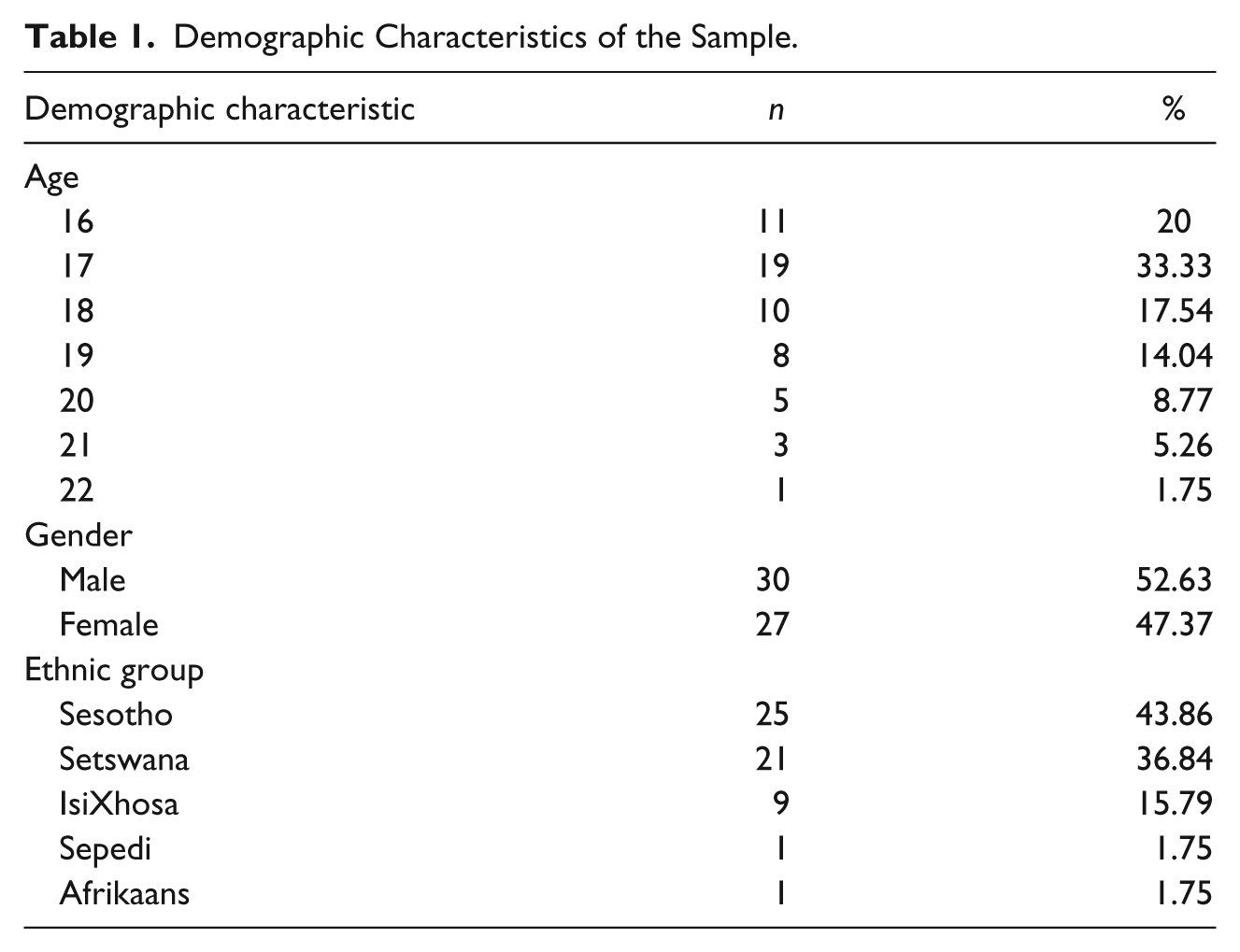
The population group of interest consisted of Black African adolescents from underresourced rural schools in the Motheo district of central South Africa. Purposive sampling was used, as the main concern was not proportionality of the sample, but rather recruitment of participants who aligned with the goal of the study, had characteristics and experiences of particular interest to the researchers, and were able to give rich information about the phenomenon being studied (Merriam, 2009). A total of 57 Black African adolescents of both gender and various ethnic groups in the age range between 16 and 22 were included in the study. Their demographic details are summarized in Table 1.
Demographic Characteristics of the Sample.
Data Collection Procedures
Authorization for conducting the research was obtained from the university where the study was conducted, the provincial Department of Education, and the principals of the respective schools. Informed consent was obtained from all the participants. Focus group discussions were used as it encourages participants to draw on each other’s ideas, leading to a rich construction of the topic (Patton, 2002). Eight focus group meetings, between 80 and 110 minutes each, were conducted during this study, with a Sesotho-/Setswana-speaking co-facilitator present. To provide a familiar and comfortable atmosphere for individuals, all the focus groups were held at the schools the participants attended. Each focus group was heterogeneous in terms of the gender and age of participants. The number of participants in each group was limited (less than eight) providing an intimate space where participants could feel free to voice their opinions. Participants were given the opportunity to share their perceptions, understandings, and experiences up to the point where data saturation was reached.
Data Analysis
Thematic analysis (Patton, 2002) was used to process the data. Participants’ accounts of their experiences were read and reread during an iterative and inductive data coding process. Phenomena were coded and grouped into themes reflecting the experiences the participants encountered. Codes and resultant themes were triangulated with researcher observations. Although each participant’s experience and focus group discussion was unique in its own right, a process of shared meaning evolved.
Results
Themes are presented in the following section. To increase the credibility of the data and ground the data in the authentic voices of the participants, direct quotes (with only minor technical editing to facilitate readability) are provided. An identifier is provided at the end of each quote indicating the participants’ gender and the focus group (FG) he or she attended.
Finding a Sense of Self in the Parental Microsystem
Many participants regarded their relationships with their parents as a major consideration in shaping their sense of self. In this microsystem, parents were often regarded as role models from whom they learned life lessons: “My mom is my mentor . . . She shows me how to do things and how to respect other people” (Male; FG8). Participants also admired their parents’ determination and indicated that their parents persevered, sacrificed and endured through numerous hardships and challenges: “Even though sometimes she [mother] has deep, deep problems, she will just say that . . . I will make it . . . She just keeps it inside and say I will make it” (Female; FG1). Aspects frequently emphasized were support: “They are always there for me . . . support me, encourage me, tell me what to do” (Male; FG8); guidance: “Sometimes the advice . . . given by your parents, it’s very important, in terms of building a future for yourself” (Female; FG6); and understanding: “My father that knows me better, cause I am living with him . . . he also know my background, where I come from” (Female; FG4). Despite appreciating parental advice and guidance, conflict regularly occurred between participants and their parents: “My mother wants me to live the way she wants me to live, but I . . . find it difficult . . . I have to take my own path” (Male; FG6) and “It don’t work for me . . . In my home, there is these rules that I have to follow” (Male; FG8).
Parents emphasized their children’s achievements and held high expectations for their children to transform the family situation. The effect of these expectations and participants’ sense of responsibility are illustrated in the following statements: “I am going to change my family life” (Female; FG2) and “I am going to work for her. I am going to give her everything . . . that she want in life. Everything that she can’t have when she was young” (Female; FG1).
Finding a Sense of Self in the Sibling Microsystem
The importance of direct contact through companionship and attachment in the microsystem consisting of sibling relationships is found in the following statements: “I take him [brother] as a friend” (Male; FG6) and “We talk everything, like everything” (Female; FG7). Numerous participants admired their older siblings, strived to be like them and regarded them as role models: He [brother] finished matric and he didn’t fail . . . my role model, . . . he didn’t have a baby while he was at school, he didn’t use drugs, now he is 30, he is now starting to date, he is having a baby and he is going to get married. Now that is what I like, I wish that I will be like him. (Female; FG2)
Participants also frequently mentioned wanting to be role models for younger siblings and monitored their own behavior to prevent negative modeling on their younger siblings.
Relationships with siblings regularly included elements of competition, specifically competition related to academic and/or occupational success: “I think I’d be happy just to show him I can beat him at things” (Male; FG5) and “I would love to be . . . better than her” (Male; FG4). However, participants also reported receiving encouragement, motivation, advice, and support from siblings. Participants and their siblings regularly shared similar experiences regarding academic disappointments: “ . . . when I failed Grade 11, well, she motivates me because she also failed in Grade 10, in high school. So she plays a very big role in my life. She motivates me” (Female; FG7). Many participants used their siblings’ negative behavior as motivation for better decision-making: “I wonder why would he tell me to do this, but then he goes and does the exact opposite, so he doesn’t have an influence in my life anymore” (Female; FG6).
Finding a Sense of Self in the Extended Family Microsystem
In addition to parental and sibling microsystems, participants revealed that relationships with extended family members (grandparents, stepparents, uncles, aunts, and cousins) were meaningful. Participants admired their relatives for raising them and taking care of them when their parents were unable to (numerous participants have experienced parental loss): “My grandmother was there for me in everything . . . She raised me with love and care and showed me lots of things” (Male; FG 3) and “He [grandfather] is the only man that I know who takes care of me” (Male; FG3). Extended family members provided support and encouragement: “He [uncle] influences me very much . . . because most of things he does . . . are good things. That is why I think he influences me to do right decisions” (Male; FG5) and “My grandmother is like everything to me, because every time I talk to her, she is the one who understands me” (Female; FG2). The meaning guidance and advice from extended family members held for participants is confirmed in the following statement: He looks at his own background, and he tells me what he’s been through and gives me advice. So I get to learn how to live my life in order to make sure that I don’t repeat the same mistakes as he made. (Female; FG6)
Finding a Sense of Self in the Peer Microsystem
Many participants highlighted the importance of the peer microsystem. Direct interaction and contact were marked by support, communication, understanding, motivation, and being nonjudgmental: “I like to chill with friends and talk much about life” (Male; FG3) and “My friend understands me best because she’s never judging me” (Female; FG6). Participants reported experiencing encouragement from their peers regarding school and career aspects. These shared experiences encouraged participants to succeed at school: “ . . . they [classmates] encourage me to do my schoolwork” (Female; FG7) and “ . . .we [school friends] discuss cool things about our dreams, what we want to be, what we wanna become someday” (Female; FG4).
Furthermore, in their attempts to fit in and belong, participants were pressured by friends to engage in destructive behavior such as substance abuse, visiting taverns, bullying, and teasing: “They will put pressure . . . [asking you] why must you be specific [different] from us, we are all the same” (Male; FG5). However, some participants resisted peer pressure by staying true to their personal beliefs. The importance of self-belief and confidence is illustrated in these statements: “I’m not that easily to influence by my friends, because I have my own backbone” (Female; FG5) and “Talking about peer pressure, I think it is easy to say no to your friends. As long as you know who you are and what you want in life. I don’t change myself so that I can please them” (Female; FG1).
Finding a Sense of Self in the Mesosystemic Scholarly Environment
All the participants placed a high value on school and education. Education was associated with empowerment and liberation: “Without education, there is no life” (Male; FG8) and “If you don’t have . . . education, you are nothing” (Male; FG6). Participants also stated that education was important in their desire for better-quality lives, improved family and community circumstances, as well as personal development: “Studying hard will make you a better person, one day and it will make your life better than you ever thought it would be” (Female; FG3).
Still, participants expressed a desire for greater independence, including resistance against authority in their school environment: “I don’t like school . . . I am trapped” (Female; FG1) and “ . . . I don’t like being told [to study], sometimes just like doing things at my own time” (Male; FG3).
Many participants indicated being the first members of their families to reach Grade 12, and this status was associated with both challenges and benefits: “As the first-born at home, I’m the first one to be in matric . . . It’s like I’m running the world in the house” (Female; FG7). The status of being a scholar was meaningful: “The whole community is looking at you; you are the mirror” (Male; FG2).
Finding a Sense of Self in the Community and Neighborhood Exosystem
While communities and neighborhoods usually act as exosystems, the participants in this study pointed to the sense of belonging and security they experienced in the direct company of community and neighborhood members (microsystem interaction) who provided understanding and acceptance: “For me there is another father in our street . . . Sometimes I spend my whole days with him” (Male; FG8). Community members often played a parental role and their guidance was instrumental in participants’ development: “ . . . even though it’s not their real parent, they can tell you . . . do this and do that – to show you the right ways. They can influence you to do good things. They can advise” (Female; FG3).
Many challenges and negative influences in communities and neighborhoods were also highlighted. These experiences included exposure to violence, crime, and substance abuse. It appeared that communities and neighborhoods encouraged and allowed such behavior: “I get to the tavern and get drunk . . . such bad thing” (Female; FG5) and “Now we have criminals with records and all that stuff” (Female; FG3).
Finding a Sense of Self in the Exosystem of Social Networks
Numerous participants reported belonging to several social networks to remain connected to others: “I chat [on social networks], I think it helps me in a way that when I’m at home, I feel like I’m still with my friends . . . as if they sitting right here next to me” (Male; FG7). Social networks were also used as a platform for sharing and expressing emotional experiences: “We share everything, how you feel, what you’re doing” (Female; FG1).
Many participants enjoyed the freedom to experiment with different personas with unfamiliar individuals in anonymous settings: “I enjoy chatting with these people I don’t know . . . I feel comfortable with chatting with them. . .” (Female; FG1). While participants conveyed the benefits of social networks, they were well aware of the inherent dangers: “The thing about social network, today is that it’s filled with predators instead of people who can build the society” (Male; FG2). Participants further mentioned the detrimental consequences social networking might have had on their school and educational success: You can be too into it [social networks], you wouldn’t focus at school, spend most of the time at home chatting [on the social networks] instead of chilling with the friends who actually advise you to focus on your books. (Male; FG3)
Discussion
Finding a sense of self is a priority task during adolescence (Erikson, 1968). This study provided ample evidence of the intricacies of this journey for a group of adolescents confronted with the strive toward individuation while interacting in various systems. In the following section, the influence of various systems in the context of a changing and challenging South African environment will be discussed. This discussion will also shed light on the materialization of prominent developmental themes during adolescence, such as opposing desires of belonging and autonomy, the admiration of role models, balancing a sense of responsibility with the self-focus usually seen in adolescents, and the importance of educational enhancement.
Systemic Influences on the Sense of Self
The current study confirmed the ecological systems principles of interaction, interconnectedness, and interdependency between individuals and their social systems (Bronfenbrenner, 2005). Participants’ sense of self was influenced through direct and indirect (including virtual) interactions with individuals, contexts, and systems, such as family members, peers, and the community, as well as schools, neighborhoods, media, and sociocultural aspects. Evidence was found regarding the role of various micro- meso-, macro-, exo-, and chronosystemic influences in adolescents’ experiences and meaning-making processes.
Family was regarded as one of the most important factors in these participants’ lives, as similarly reported in other research (Carter & Murdock, 2001; Wolfe et al., 2006). The important microsystemic role of community members, often fulfilling the role of extended family in the participants’ lives, concurs with other South African research (Bray et al., 2010) where guidance from adults in the community was also prioritized. Another important mesosystemic factor emphasized is the interaction between neighborhoods, community, and family life (Browning, Leventhal, & Brooks-Gunn, 2004). Participants’ home setting and family life were influenced by neighborhood and community aspects; for example, community violence often necessitated participants to reside with extended family members.
Belonging, Agency, and In(ter)dependence
Interactions in each of the systems discussed above were most influential and valued, when a sense of belonging, acceptance, and nonjudgment was experienced. While the majority of participants indicated their sense of belonging to their family was of the highest priority in their understanding of who they were, they articulated the importance of the sense of belonging they experienced in friendships, at school, and within the broader community. Adolescents’ social development is therefore characterized by an increasing and intense need to be accepted and belong (Rubin, Bukowski, & Parker, 2006). The importance of family and other social structures in Black African adolescents’ decision-making processes was also confirmed in South African research by Alberts, Mbalo, and Ackerman (2003). Shared histories, norms, values, and experiences (such as sharing academic pressures with school friends and older siblings, sharing experiences related to their upbringing with their siblings, and sharing developmental changes with peers) increased participants’ sense of belonging.
While the aforementioned aspects were important, an opposing desire, individualization, and becoming autonomous appeared to be equally significant in participants’ understanding of who they were. This supports Josselson’s (1987) notion of separation-individuation, which occurs when individuals express boundaries of the self, indicating separation from others, while functioning in the context of relationships. Adolescents aspire to be more self-sufficient and autonomous, as well as finding independence and emotional separation from parents and other authority figures (Arnett, 2001; Beyers & Goossens, 2008; Tarrant, 2002). In this study, the wish to live their own lives and the need for freedom caused conflict in participants’ relationships with their parents.
Having Role Models and Being Role Models
Both having role models and being role models played a role in participants’ sense of self. Participants viewed significant others and individuals they knew personally (such as parents, grandparents, older siblings, peers, and community members) as role models. Participants admired role models for overcoming hardships, persevering with determination, and making a success of their lives. Although participants disliked being controlled or being told explicitly what to do, the majority indicated they attempted to incorporate the characteristics they observed and admired in others. Concurring with previous research on the imitation power and social reinforcement of role models (Arnett, 2001; Heaven, 2001; Tarrant, 2002), this study illustrates the importance of interaction with supportive authority figures during meaning-making processes. Thom and Coetzee (2004) emphasized the emergence of stronger positive Black African role models who defeated obstacles and triumphed through perseverance, following the end of apartheid.
Responsibility in the Face of Adversity
Adolescents globally enter a moratorium state and are regarded as self-focused. However, the majority of participants in this study indicated a concern for family and community circumstances. Although they were engaged in various adolescent developmental tasks (such as finding their independence and forging meaningful social relationships), participants articulated a strong awareness of their responsibility to induce positive change (e.g., by improving their family of origin’s standard of living and by ensuring a better future). Participants expressed their knowledge of the high expectations being placed on them, as well as their willingness to accept those obligations. This signifies the importance of being in reciprocal relationships where their own responsibility is also acknowledged.
In the event of economic and social challenges, support from relatives and community members is crucial. However, this creates a relationship of indebtedness and a sense of obligation. Although it can be argued that collectivistic notions facilitate a sense of care and responsibility, this priority placed on community matters may also be associated with a heightened awareness of socioeconomic needs, and the desire to alleviate poverty and eradicate violence and crime (Alberts et al., 2003). According to Alberts and colleagues (2003), family and community matters were of greater concern among Black Xhosa-speaking participants than among White English- and Afrikaans-speaking participants.
The Importance of Education
Given the burden of responsibility, it is clear why education and academic success constitute a priority domain for participants. As in previous South African research (Everatt, 2000), participants in this study attached considerable meaning to being a scholar and indicated that education was viewed as a means to improve their own and their families’ situations. While political aspects were a priority domain in identity formation of Black African adolescents during the apartheid years, the current emphasis has shifted to academic and career development (Alberts et al., 2003).
Limitations of This Study
The findings of this study should be considered in the contexts of certain limitations. The researchers’ understanding of participants’ meaning-making processes may have been influenced by their own experiences (both researchers were White females). Cultural differences between the researchers and the participants could also have limited the information shared during discussions. The use of a Sesotho-/Setswana-speaking African co-facilitator was an advantage as she could clarify statements, assist when participants experienced difficulty with expression, and was knowledgeable about cultural nuances. Although the participants were proficient in English (all of them attended English-medium schools), it was not their home language. The participants’ language ability and their ability to articulate themselves in English might therefore have hindered their expressions.
Conclusion
In this research, the ecosystemic principles of interaction, interconnectedness, and interdependency between individuals and their social systems were emphasized. Various micro- meso-, macro-, exo-, and chronosystems (such as family members, peers, community, neighborhoods, schools, media, and sociocultural aspects) influenced adolescents’ experiences toward finding a sense of self. The unique contemporary South African context with its chrono- and macrosystemic challenges (such as the instability associated with the transformation from Apartheid to a democratic country) accentuates the importance of microsystemic support from family and peers and, in this study especially, members of the community.
While Bronfenbrenner’s ecological system theory provides a dynamic framework for understanding South African adolescents’ search for a sense of self, more research is needed to explore some of the findings of this study. For example, the educational system seems to be a particularly important mesosystemic factor adolescents regard as a mechanism to bring about change in their microsystems (such as families). Both the direct and indirect role of education to facilitate change from micro- to macro-level can be explored further. Furthermore, a greater understanding of the systemic influences of being the first in the family to achieve certain outcomes can shed light on the expectations of individuals to bring about systemic change.
Prominent aspects of the development of adolescents’ sense of self, such as the importance of family and peer relations, as well as the juxtaposed needs of belonging and separation, were reiterated in this research study. Moving beyond the traditional conceptualizations of adolescents as self-focused and striving toward independence, this research highlighted adolescents’ awareness of the importance of reciprocity and interdependence in relationships. They also articulated the need for not only having role models but also for being role models for others. Adolescents in this study were acutely aware of the sacrifices made (especially by their parents) to invest in their development, and they felt responsible for “paying back” (to their family and community). To bear this responsibility, education and scholarship was viewed as an essential aspect of adolescents’ sense of self.
Footnotes
Declaration of Conflicting Interests
The author(s) declared the following potential conflicts of interest with respect to the research, authorship, and/or publication of this article: This is work for hire for University of the Free State, Bloemfontein, Republic of South Africa.
Funding
The author(s) received no financial support for the research, authorship, and/or publication of this article.