



Abstract
The purpose of this study was to examine one interpersonal relationship—natural mentoring relationships—that may promote healthy development among young Black men who have sex with men (YBMSM), a population at disproportionate risk of multiple psychosocial health issues. We analyzed data from interviews with 168 YBMSM. We used content analysis to identify who participants cited as mentors, their personal characteristics, and the functions they played in youths’ lives. Participants frequently cited women and family members as mentors. Participants preferred as mentors people with whom they shared key attributes and who they considered successful and resilient. Mentors played roles in participant’s identity construction, cognitive development, and emotional development. Findings suggest that mentors have significant influence in the development of YBMSM. Incorporating natural mentors into health promotion interventions may be one means of enhancing the cultural relevance of interventions for this population.
Young Black men who have sex with men (YBMSM) experience numerous disparities including increased rates of HIV, trauma, incarceration, poverty, and mental health disorders (Wilson et al., 2014). These patterns suggest a need for emphasis on, and novel approaches to, health promotion efforts. Herrick and Colleagues (2011) call for a resilience-based approach to health promotion among young men who have sex with men (YMSM), arguing that harnessing their strengths and resources may increase the effectiveness of health interventions. However, there is a paucity of research attentive to protective factors and sources of resilience among YMSM (Savin-Williams, 2008; Saewyc, 2011) and YMSM of color in particular (Harper, Jernewall, & Zea, 2004). Interpersonal relationships with supportive others may hold potential for promoting well-being among YBMSM; understanding relationships that foster sexual minority youths’ resilience is imperative to laying the foundation for relationally based health promotion efforts. The purpose of this study is to examine one relationship—natural mentoring relationships—that may promote development and health among YBMSM.
Mentoring relationships are supportive interpersonal relationships that may foster youth development and well-being. Many young people establish natural mentoring relationships with proximal mentors such as parents, friends, extended family, and teachers (Baker & Maguire, 2005). Mentors serve as models of behavior, teach youth to regulate their emotions, provide social support, champion values, shape adolescents’ conceptions of their identities, and nurture self-esteem (Rhodes, Spencer, Keller, Liang, & Noam, 2006; Zimmerman, Bingenheimer, & Behrendt, 2005), all of which are processes related to psychosocial health. In these capacities, according to Rhodes et al. (2006), mentors catalyze a wide range of positive outcomes related to youths’ social, identity, and cognitive development. Given the potential benefits of mentors, they remain an overlooked resource in the lives of YBMSM, a population that typically has fewer providers of social support than White sexual minorities (Frost, Meyer, & Schwartz, 2016).
Limited research attests to the presence of natural mentors in sexual minority youth’s lives. Sexual minority youth are more likely than heterosexual youth to seek out mentors (Gastic & Johnson, 2009; Johnson & Gastic, 2015). Furthermore, the majority of YMSM establish mentoring relationships (Torres, Harper, Sanchez, & Fernandez, 2012). Lacking proximal mentors, sexual minorities may identify media entertainers, particularly those who are themselves sexual minorities, as role models (Bird, Kuhns, & Garofalo, 2012; Gomillion & Giuliano, 2011). Although studies attest to the presence of natural mentors in sexual minority youth’s lives, we know little about the composition and function of mentoring relationships specifically among YBMSM.
Mentors typically provide a number of protective qualities (Rhodes et al., 2006). Data from the National Longitudinal Study of Adolescent Health suggests that sexual minority youth may receive multifaceted forms of emotional and psychological support from their mentors. Yet, qualitative research on mentoring relationships among YMSM has focused on relationships whereby mentors provide sexuality-related social support (Torres et al., 2012). Torres et al. (2012) examined the presence of mentors among a multiethnic sample of YMSM men to identify influential people who helped youth with aspects of their sexuality. Although this type of support is especially important to the development of sexual minority youth (Doty, Willoughby, Lindahl, & Malik, 2010), YMSM are likely to receive multidimensional forms of support, including, but not limited to, sexuality-related support (Johnson and Gastic, 2015).
The composition of natural mentoring relationships may be unique among YBMSM in a variety of ways. As members of a group that often has small support networks, YBMSM may lack natural mentors. YBMSM who do maintain mentoring relationships may be likely to develop these relationships with peers, as YBMSM often rely more on peers, and less on family, for everyday forms of support (Frost et al., 2016). Natural mentoring relationships may also form through alternative families. Alternative families and gay families are exemplars of the Black cultural tradition to respond to marginalization through the development of communal forms of social support (Arnold & Bailey, 2009; Wilton, 2009). As it is important to understand the supports available to populations that are at risk for multiple negative health outcomes, we seek to understand the extent to which YBMSM establish mentoring relationships and the variety of types of people with whom they develop these relationships.
The Current Study
This study examines relationships YBMSM form with natural mentors. We examined the availability, composition, and function of YBMSM’s natural mentors. The following research questions are included.
We used Rhodes’ theoretical framework on mentoring relationships as a guide for identifying the particular influences mentoring relationships exerted on YBMSM’s well-being.
Method
These data were part of a larger statewide needs assessment that explored the HIV prevention needs and risk and protective behaviors of YBMSM in Michigan. This project was co-led by a 6-person team of YBMSM. These co-investigators participated in all phases of the study. The present study examined data from 168 participants who met the criteria for the larger study: 13 to 24 years of age, were Black/African American, assigned a male gender at birth, had sex with a male in the prior 2 years, and resided in Michigan. To create a more homogeneous sample, we excluded from analysis those participants from the larger study (n = 12) who identified with a gender identity other than male.
Procedure
We used four recruitment strategies. First, we sent interviewers to known hangout spots and events recommended by our YBMSM co-investigators to recruit participants. Second, we placed advertisements for a YBMSM’s health study in venues that were known to attract YBMSM. Third, we interviewed YBMSM referred to us by our co-investigators. Fourth, we asked each interviewee to refer up to three other YBMSM to participate. Potential interviewees completed a screening form to determine eligibility. We invited eligible YBMSM to participate in a face-to-face interview. Before each interview, interviewers obtained informed consent from each participant who was 18 years of age or older. Interviewers obtained informed assent from participants who were 17 years of age or younger. Interviews were conducted in locations such as libraries, social service agencies, and churches by one of 14 ethnically diverse research staff. We provided participants US$25 for their participation and up to an additional US$15 for referring other YBMSM. Interviews, which included a multitude of topics in addition to mentoring, lasted an average of 70 minutes (range: 36-138 minutes). Study procedures were approved by the Institutional Review Boards at Michigan State University and The Michigan Department of Community Health.
Interview Guide
We developed the interview protocol in collaboration with our YBMSM co-investigators. The content of the protocol was also informed by interviews we conducted with 21 key informants from health departments, the state health department, and representatives of the state HIV/AIDS Council regarding the kinds of information they needed to better meet the HIV prevention needs of YBMSM. Semi-structured, open-ended interviews inquired about participants’ sexual and ethnic identity, family, involvement in the gay community, experiences with religion, mentors, social support, health care use, knowledge of HIV and sexually transmitted infections (STIs), HIV testing experiences, sexual and substance use behavior, mental health, and exposure to trauma. For this analysis, we used the portions of the interviews in which participants discussed their mentoring relationships. We asked participants the following three questions pertaining to mentors: (1) Who are the mentors in your life? (2) What makes them your mentors? and (3) How do your mentors influence the choices you make or the things you do?
Qualitative Analysis
Audio-recorded interviews were transcribed verbatim. Transcripts were stored and coded using MAXQDA. The first author structurally coded questions pertaining to mentoring. Structural coding is a form of top-level coding whereby researchers divide the text into chunks of data that pertain to key topics of interest. Data were divided into three coding chunks: (a) text describing who participants identified as mentors, (b) descriptions of mentor characteristics, and (c) text indicating the influences mentors have in participants’ lives. This coding procedure allowed for the identification of excerpts to focus on during later analytic stages.
We used three coding processes to answer our three Research Questions. In the interviews, we systematically asked participants to list the people who they thought of as a mentor. Participants could describe as many mentors as they desired. To answer the first Research Question (e.g., who are YBMSM’s mentors), the first author developed topic codes, which are codes that require little interpretation. These codes reflected the relationship (e.g., mother, friend) participants had with their mentors. A second research assistant independently coded all 168 interviews. Coders discussed any disagreements until reaching consensus. The first author and research assistant then categorized mentors along various dimensions, indicating whether mentors were male or female or transgender, from participant’s family of origin, and/or described as being sexual minorities. As we systematically asked this question of each participant, we quantified the codes to portray the variety and frequency of mentors.
We answered the second Research Question (e.g., what qualities are associated with mentors?) using inductive analysis. Given the paucity of information on YBMSM’s mentors, inductive analysis allowed themes to emerge from the data. The first three authors, all of whom have experience working with YBMSM, examined the structural codes to identity themes related to qualities (e.g., successful, strong) associated with participants’ mentors. Due to the large number of interviews, we collapsed thematically comparable codes (e.g., similar values, similar hobbies) into higher order themes (e.g., similarity).
We answered the third Research Question (e.g., how do mentors influence YBMSM) using deductive analysis, an a priori coding process whereby codes are informed by existing frameworks. Rhodes and colleagues (2006) developed a model for examining the ways through which mentors influence youth development. Rhodes et al. (2006) theorized that mentors exert positive influence on youth development by (a) promoting identity development, (b) enhancing cognitive skills, and (c) promoting social and emotional growth. We used this framework as a typology to identify ways YBMSM described their mentors’ influence. If data proved not to fit these deductive codes, we allowed for the creation of emergent codes. However, primary and salient codes fit within these broad domains. Higher order codes (e.g., identity development) were then refined into subcodes (e.g., future selves, sexual identity development).
For Research Questions 1 and 3, we developed a codebook that was refined until we reached consensus on codes and code definitions. To ascertain code reliability, we double coded 30% of the interviews to ensure codes could be consistently applied across interviews. Coders discussed code application and disagreements, which resulted in code amendments. Once we reached consensus on code application and definitions, codes were applied to all interviews.
Results
Participants were 168 YBMSM, most of whom identified as gay (77%) or bisexual (22%). Participants were between the ages of 14 and 24 (M = 20.5; SD = 2.3) years. Most participants were in school (62%), employed (60%), and stably housed (91%).
Who Are YBMSM’s Mentors?
The majority of participants described at least one mentor (see Table 1), whereas only seven participants (3.88%) did not cite a mentor. Participants frequently mentioned family members. Community leaders were infrequently cited; community leaders included Black men working in the HIV prevention field, although participants also described businesspersons and pastors. The majority of role models who were nonfamily members and directly accessible were males. Only a small portion (14.4%) of participants cited inaccessible people such as political figures, motivational speakers, actors, and musicians as mentors. Of the accessible mentors, participants cited females as mentors more often than they cited males. Slightly more than one quarter of participants specified that their mentor was gay or lesbian, though sexual identity of mentors could not be discerned in all case. Participants described people from a broad range of ages, from a 90-year-old grandfather to peers.
Young Black Gay and Bisexual Men’s Relationships With Mentors.
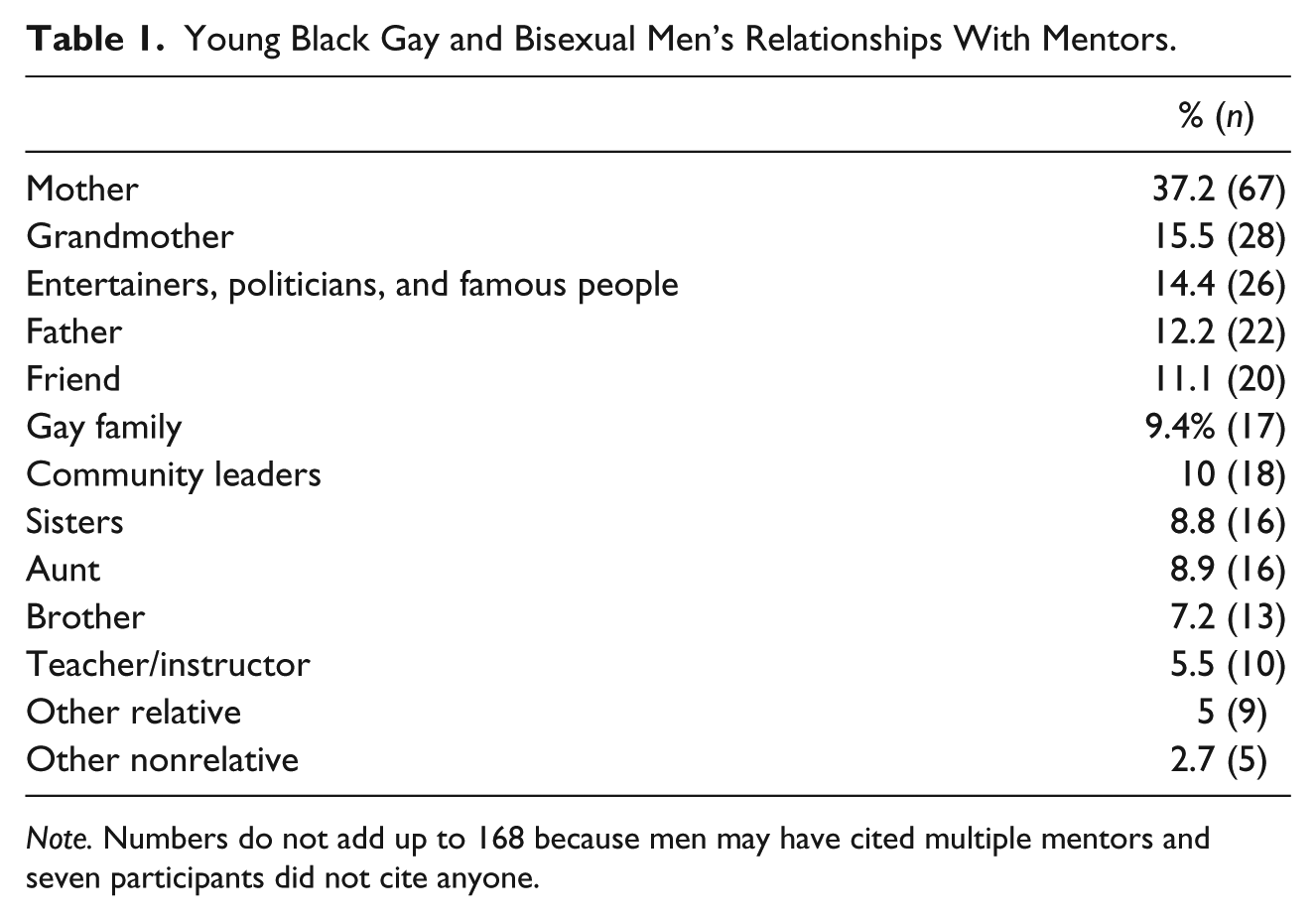
Note. Numbers do not add up to 168 because men may have cited multiple mentors and seven participants did not cite anyone.
What Qualities Distinguish Participants’ Mentors?
We asked participants what qualities make people their mentors. Responses fell into three primary thematic domains indicating that mentors are similar to participants, are considered successful, and exemplify strength. Low salience themes (×<10%) included wisdom, earning participants’ respect, and having a positive attitude.
Similarity
“I am her. I just have a penis,” said a participant indicating a perceived similarity to his mother whom he cited as a mentor. Participants and their mentors “are just so much alike.” Similarities mentioned included values, passions, hobbies, talents, life experiences, and identities. Most often, participants described mentors who had faced similar obstacles in life: “big people have a lot of haters. And I’ve had a lot of haters. And I’ve survived those haters. And she has too. And I just feel like we have that sort of common connection.” Only a small proportion of participants suggested it was important to them to have mentors of similar gender identity or sexuality: He became my role model and mentor ’cause he was also my house father so he ended up being my gay father. And also my best friend. He’s my role model and mentor. He became my role model and mentor because I saw a lot of myself in him and he saw a lot of himself in me.
Successful
Participants described mentors who exhibit facets of success they considered desirable. Mentors were: “goal oriented,” “talented,” “determined,” “driven,” “well-educated,” intelligent,” “professional,” and “business minded.” These were people participants thought “have everything in their life together” and are “doing stuff with their life.” Although many mentors were professionals or college educated (e.g., doctors, lawyers), participants also valued mentors who were “street smart” and “wise.” Many mentors had overcome adversity and were people “who pretty much had nothing and made something of themselves.” As one participant said of his grandparents, “They’re successful and they’re over 70 years old. Being Black in Southeast Michigan, that’s hard to reach.” Participants deemed as mentors people who succeeded despite adversity.
Strength
Participants perceived their mentors as strong individuals, people who “went through a lot,” “fight so hard” and “never let nothing stop them.” These people “triumph over adversity” are “very resilient” and “know how to get around obstacles.” Participants considered mentors strong for surviving despite structural barriers (e.g., racism, poverty), coping with grief, sacrificing for the sake of others, remaining positive despite illness, and not falling prey to drugs and alcohol: She’s really inspiring because she was a single mother, but with all her heart she overcame everything. She never got on drugs, became a drunk. She’s never been evicted out of none of her houses. She’s a very strong and dedicated worker.
Participants perceived mothers, grandmothers, and extended family members as strong for having raised and provided for their families on their own: My mom has raised three wonderful kids . . . I know my mom’s given up things, a lot of things, for us to have everything we need . . . She’s always put us first. And, if I can be half that, I’ll be happy. Now you’re going to make me start crying. As the quote above indicates, participants expressed deep reverence and love for their mothers and caretakers whom they cited as mentors.
For gay and transgender mentors, strength was also associated with authenticity and their willingness to be true to themselves: [Name] is my drag queen mother and she’s very intelligent and she’s been through a lot so she’s wise . . . She’s a very influential person to me because she is male-to-female and she lives her life as a woman . . . not that I want that or anything, but it takes a lot of integrity and bravery. I admire someone who can feel that they’re not comfortable with who they are and make themselves be comfortable in their own skin. I applaud that.
Mentors offered YBMSM, “a prime example of how to be strong and be able to conquer and overcome a lot of things.”
What Functions Do Mentors Play in Participant’s Lives?
Mentors exerted influence on youth through three processes: (a) promoting identity development, (b) enhancing cognitive skills, and (c) promoting social and emotional growth. We describe each of these themes, and the most frequently reported subthemes, below.
Identity development
Mentors facilitate positive identity development by serving as role models, shifting youths’ perceptions of their future, and providing positive appraisal (Rhodes et al., 2006). Mentors may also facilitate sexual identity development (Torres et al., 2012). The importance of mentors’ role in identity development was prominent.
Future selves
Mentors influenced participant’s conceptions of their future selves. Approximately a third of participants detailed ways in which their mentors served as role models who inspired them. Mentors gave YBMSM the desire to achieve, or perhaps more importantly, instilled in participants the belief they could make something of their lives: They started from nowhere and became something great and it gives me hope . . . I used to think that all these great people today have always been great at birth. Just all this goodness just fell from the sky. But no, they just started out like me. Like on the street. Poor. Whatever. They’ve been through struggle and they overcame it. And they’re not being a victim of it. So they’ve become a role model to me because I can look up to them and say, ‘if they can do it, I can do it.’ Mentors’ successes, coupled with their similarity to participants, gave participants hope for their futures. As one participant said, mentors are “the people that helped me believe in myself.”
Mentors also helped YBMSM identify traits they wished to cultivate. Mentors influenced participant’s identity development through instilling values of industriousness and perseverance. Participants admired mentors’ work ethic, respected their determination, and described how “those values have been passed onto me”: They influence me to keep going—to keep moving . . . that’s my main thing—keep it moving—try to deal with whatever is thrown your way and learn from it, grow from it, gain strength from it . . .
Sexuality and gender-specific identity support
Slightly less than one quarter of participants detailed how mentors influenced their sexual identity. Male mentors playing sexual identity–relevant roles were typically friends or gay family members who introduced participants to the gay community and who took participants “under the wing” when first coming out. Female mentors such as grandmothers, aunts, sisters, and mothers were described as influential in helping participants accept their sexual identities: I’ve actually been able to be happy in my skin because she [his aunt] told me to love myself first and don’t care what other people say. She was actually the first person I came out to. In addition to unconditional acceptance, females played sexual identity–relevant roles by providing sexuality-related emotional support in the face of discrimination or rejection, offering guidance on coming out and romantic relationships and voicing care and concern about participant’s sexual health.
Fewer than 10% of participants described how their mentors influenced their gender identity. Male mentors provided participants with positive images of Black masculinity, as exemplified by fathers and other male relatives who were deemed good providers, community leaders who were well respected and “making a positive change in the community,” and men who they thought had a good work ethic and were responsible. These were fathers who were participants’ “definition of a man” and brothers who were “always the full male influence in my life.” Although participants gave examples of how they wanted to emulate male mentors, a few also said that females were influential in their gender identity construction. Participants credited female relatives with helping them become “the man I am today.” As one participant said appreciatively of his mother, It’s so many reasons why my mom is a role model to me, you know, she taught me the difference between right and wrong, and you know, she taught me how to, you know, how I always say a woman can’t teach a young man how to be a man? I feel like my mom taught me how to be a man.
Cognitive development
Mentors may contribute to cognitive development by providing youth with advice, promoting positive attitudes toward education, and fostering the development of new skills (Rhodes et al., 2006). Only a handful of participants described mentors who advocated the importance of school (typically female family members) and/or taught them new skills (e.g., cooking). However, more than one third described mentors who provided informational support.
Informational support and guidance
Mentors provided advice on a diverse range of topics such as school and employment, sex and dating, coming out, mental health and substance abuse, and coping strategies for dealing with racism and heterosexism. Participants also discussed HIV and safer sex with mentors: They help educate me about safer sex and let me know HIV is here. Thank God I haven’t had HIV, but just to see the stuff they have to go through, that helped open my eyes up to safer sex.
These were people the participants trusted to “keep it real” or “keep it very authentic” with them. Participants were not merely passive recipients of advice. They actively sought mentors’ advice and consulted with them “about the decisions I make.” Mentors were people they “could talk to about anything” and who “have a big influence on my actions”: Anything I ever need to talk about I can always go to them three to, you know, count on them to listen to me. And they’ll give me advice on what to do. And they’ll steer me in the right direction.
A handful of participants insinuated that their mentors were the only people whom they trusted to provide advice in their best interest or were the only people with whom they felt comfortable talking: Like I said like some things you just don’t feel comfortable, you know, talking to, you know, someone who’s not really your family about, so yeah. If it’s related to like, the gay life, I would talk to him about it. If it’s related to my health I would probably talk to my family. Such statements affirm the important and unique role of mentors for some YBMSM.
Social and emotional development
Rhodes and Colleagues (2006) suggest that mentors promote youths’ social and emotional development by providing relationship templates characterized by empathy, genuine care, consistency, and stability.
Stability
Nearly one quarter of participants valued that mentors provided them with consistency and stability. Mentors “always been there from day one” and have “been there for me from point A up until now.” YBMSM raised by extended family or by foster parents were especially apt to cite caretakers as mentors for taking them in and providing for them: I was in foster care when I was nine, so she’s been raising me for almost ten years now. And she’s really been through a lot and she would put up with a lot from me as far as of who I was when I was younger and what I used to do.
Unconditional love and acceptance
Approximately one quarter of participants valued consistent support and unconditional love in mentors. Mentors were people who participants “can always, always count on”: She’s been one of the most consistent people in my life. She always showed me nothing but love and support. And not a lot of people have done that for me. As the quote suggests, participants valued mentors’ unwavering love because it was rare for them to receive such positive regard consistently. Mentors were important because participants had so few people in their lives with whom they could connect and trust: “don’t too many people have your back these days and if you have a few, you want to keep them in your corner and don’t let them down.” For a handful of YBMSM, mentors were the only people who offered acceptance when others had disowned them: I was put out of my mother’s house. I was so hurt. I was on my own. I didn’t have anywhere to go. And with them being there, keeping me in school, telling me I have a reason to be here. Because at the time it was like I didn’t want to be on this earth. They pretty much told me that I had a purpose. I’m here for a reason.
As the quote indicates, mentors were chief providers of emotional support who helped participants cope with adversity. In this capacity, mentors provided caregiving that influenced the quality of their lives. As one participant said appreciatively, “If it weren’t for them [my mentors], I’d probably be lost.”
Discussion
Our study contributes to the growing body of research demonstrating the significance of mentoring relationships among YMSM. Consistent with prior work, we observed that nearly all YBMSM had at least one mentor (Johnson & Gastic, 2015; Torres et al., 2012). Also in concert with prior work among sexual minorities, participants were more apt to cite female mentors (Johnson & Gastic, 2015). This finding may reflect the high esteem placed upon women in the Black community (Hill Collins, 2004), women’s greater likelihood to be open and accepting of sexual minorities (Garofalo, Mustanski, & Donenberg, 2008), or YMSM’s penchant for creating bonds with females (Harper, Brodsky, & Bruce, 2012).
Consistent with previous findings regarding sexual minorities of color, participants infrequently cited teachers (Gastic & Johnson, 2009). Infrequent discussion of school personnel as mentors may reflect the fact that only slightly more than 60% of the sample was currently in school. However, this finding may also indicate that school personnel infrequently hold esteemed roles in the lives of YBMSM. We echo Gastic and Johnson’s (2009) recommendation that the lack of teachers noted as mentors indicates a need to strengthen ties between YBMSM and educators.
Importantly, these data contrast with research suggesting that sexual minority youth infrequently identify family as mentors (Bird et al., 2012; Gastic & Johnson, 2009). Data from the National Longitudinal Study of Adolescent Health indicated that just more than one quarter of sexual minority youth cite family members as mentors (Gastic & Johnson, 2009). In our study, and similar to work with Black heterosexual youth, more than two thirds of participants described at least one family member as a mentor (Bryant & Zimmerman, 2003; Hurd & Zimmerman, 2010). This finding may be counterintuitive given the bleak picture that the literature paints about YBMSM’s experiences in their families of origin (Fields, Malebranche, Feist-Price, 2008; Graham, Braithwaite, Spikes, Stephens, & Edu, 2009; Warren et al., 2008). Whereas this finding may be an artifact of sampling differences across studies, in our data, it may also point to the cultural primacy of the family among Black youth (Hill Collins, 2004).
The frequency with which participants cited their mothers and caretakers as mentors, coupled with the extreme sense of love and reverence with which participants discussed them, indicates the importance of mothers and caretakers to YBMSM. Minimal research has focused on the positive and health promoting effects of YBMSM’s families (Wade & Harper, 2017). These data provide cause for future research exploring families of origin as a source of resilience in this population. For example, future research may examine the varied roles that family members, especially women, play in the lives of YBMSM or look explicitly at how families of origin provide mentorship to sexual minority youth. In addition, mentoring relationships often have varied types and degrees of influence over youth based on the youth’s relational history, the quality and longevity of the relationship, and the mentor’s background (Rhodes et al., 2006). It may be beneficial to assess whether family-based mentoring relationships are distinct from the relationships YBMSM establish with nonfamilial mentors.
Unlike previous research with Black heterosexual youth (Bryant & Zimmerman, 2003), few participants cited male family members, including fathers, as their mentors. These data only allow for speculation as to why so few participants described familial male mentors. First, some participants had strained relationships with men in their families. For some participants, it may have been more difficult to connect with men due to males’ attitudes toward their sexuality or participants’ beliefs as to how men would respond to their sexuality; living in a heteronormative world may well prove a barrier to the establishment and/or maintenance of mentoring relationships with heterosexual, or presumably heterosexual, males. Second, as is common among Black youth, participants primarily described being raised by their mothers and other extended family (McAdoo, 1998). Many participants alluded to their fathers being incarcerated, dead, or otherwise uninvolved in their lives. The absence of fathers and other male relatives among YBMSM may leave youth without proximal male mentors (Malebranche, Fields, Bryant, & Harper, 2009). Although our data do suggest a lack of familial male mentors available to YBMSM, they also point to the aspirational value of women and the agency of participants in seeking out nonfamilial male mentors.
Importantly, these findings contradict research by Bird and Colleagues (2012) who found that sexual minorities are likely to have role models that are inaccessible (e.g., entertainers, politicians). Participants were much more apt to cite mentors with whom they frequently interacted, suggesting that the majority of YBMSM do not lack access to supportive mentors. Though sexual minority youth of color often lack social support networks that facilitate optimal development (Frost et al., 2016), these data allude to the esteemed place that mentors play in YBMSM’s lives. Mentors embodied qualities such as trustworthiness, dependability, success, and strength. Many participants described relationships characterized by closeness, empathy, and affection, the attributes that Rhodes (2002) suggests are necessary for mentors to exert positive influence over youth.
A key strength of this analysis was our incorporation of a well-established framework outlining the processes through which mentoring supports positive outcomes among youth (Rhodes et al., 2006). These data showcase how this conceptual model is applicable to a sexual minority population. In terms of identity development, mentors did influence sexual and gender identity development for some youth; however, mentors were more likely to help youth focus on their future selves. Mentors also contributed to YBMSM’s cognitive development by offering informational support and guidance. This informational support was often tailored to the realities of YBMSM, whereby mentors taught youth about HIV prevention and strategies to navigate oppression. There were fewer examples of mentors who contributed to cognitive development through providing new learning opportunities, validating intellectual interests, or promoting educational attainment. In terms of social and emotional development, a sizable proportion of participants characterized mentoring relationships as providing stability, genuine care, and unconditional acceptance. These qualities and forms of emotional support are undoubtedly all the more meaningful for YBMSM who frequently contend with chronic forms of oppression and who are often made to feel unworthy of care. Use of this model to show the diversity of supports provided by natural mentors suggests that research on mentoring among sexual minorities not be confined to mentors’ influence on sexual identity development.
Limitations
First, we are only able to see a snap shot of the influence of natural mentors in these participants’ lives; however, this brief glimpse into their lives provides a fruitful starting point from which to consider additional research on mentoring among YBMSM. Future research may wish to longitudinally examine the development of mentoring relationships and the duration of such relationships through a more detailed examination of the roles that mentors play in young men’s lives. Second, due to the large sample, we did not describe an exhaustive list of natural mentors’ qualities or functions; rather, we discussed those functions that occurred most frequently within and across the interviews. Throughout the results, we briefly noted these infrequent subthemes of low salience (e.g., the importance of education under cognitive development). We viewed this approach as a way to best balance the depth and breadth needed to derive meaningful observations when working with such a large data corpus. To provide a more nuanced perspective on mentoring among YBMSM, we urge looking at mentoring relationships in more depth as but one of many relationships of importance, and sources of social support, to YBMSM. Third, where questions were systematically asked of all participants, we reported the frequency of themes based on the number of individual respondents who mentioned a particular theme, a coding strategy that is common in large qualitative data sets (Namey, Guest, Thairu, & Johnson, 2008). This strategy allowed us to show which themes were common and which rarely occurred, providing an indication of the salience of themes. Caution is warranted when interpreting frequencies relative to one another, given the open-ended nature of the interviews. Interview questions about youth mentors were asked in a way that does not allow us to consistently ascribe particular qualities and functions to mentors of particular types (e.g., mother). Future research should assess whether different types of mentors (e.g., family vs. nonfamily, male vs. female) are more likely to fulfill particular functions. Finally, it remains unknown if and how mentors may influence YBMSM’s health. Importantly though, this analysis suggests that natural mentors help YBMSM address barriers to health, facilitate identity development, provide sexuality-related social support, and give them hope in their future, all of which are functions logically linked to psychosocial well-being. Future research should more explicitly assess the influence and impact that natural mentoring relationships have on YBMSM’s health and well-being.
Practical Implications
Despite these limitations, this study adds to our knowledge about natural mentors and has practical implications. Mentors, varied though they may be, are ideally situated to help YBMSM mitigate barriers to health and positively mold their futures. YBMSM’s mentors may well be, as some participants implied, the only people they trust and whose advice they value. Given the extent to which participants voiced their relationships with mentors as important to their well-being, incorporating natural mentors into prevention interventions may prove a culturally relevant intervention strategy. Many traditional public health interventions involve newly created network members (e.g., peer navigators, key opinion leaders) as facilitators of health promotion (Bouris et al., 2013). Involving mentors would leverage the organic support networks of YBMSM. Involving people with whom YBMSM already have an established, trusting bond may be beneficial, especially given the “healthy skepticism” that members of marginalized groups tend to have of people they do not know (Wyatt, 2009).
Incorporating mentors into health promotion efforts would allow interventionists to build upon the natural bonds that YBMSM have already formed. Such an intervention approach recognizes, as these data show, that YBMSM have a diversity of influential, positive people in whom they love, trust, and confide and who play vital roles in their lives. Health promotion efforts might attempt to strengthen ties between YBMSM and their natural mentors. They might also ensure that natural mentors are equipped with accurate information about the myriad health and social issues that afflict YBMSM.
For the minority of youth who cannot identify accessible role models and mentors, the development of mentoring programs may be beneficial. A meta-analytic review of youth mentoring programs showed that formal mentoring relationships are most effective for youth who lack access to supportive adults and opportunities (DuBois, Holloway, Valentine, & Cooper, 2002). For these young people, formal programs could help YBMSM develop ties to people who can serve as mentors. These data suggest that mentors need not share a sexual or gender identity or even provide sexuality-specific types of support. The diversity of people participants described as mentors implies that there is no one type of person who may appeal to YBMSM (see also, Torres et al., 2012). Interventionists interested in developing mentoring programs for YBMSM may be wise to avoid the assumption that mentors must be of matched gender and sexual identity.
It is encouraging that a number of YBMSM pointed to family members as an influential source of mentoring. The frequency with which YBMSM cited family and extended family members as mentors suggests their promise as targets of intervention. These data also lend credibility to calls for the development of family-based health interventions for YMSM (Bouris et al., 2010; Garofalo et al., 2008; Harper & Riplinger, 2013; Mustanski & Hunter, 2012). Health promotion efforts among YBMSM may seek to enlist “strong,” “successful” familial mentors, particularly mothers and other caretakers. Indeed, family members, much like natural mentors, are a virtually untapped relational resource that these data encouragingly suggest may be a viable means through which to promote positive developmental and health-related outcomes among YBMSM.
Footnotes
Declaration of Conflicting Interests
The author(s) declared no potential conflicts of interest with respect to the research, authorship, and/or publication of this article.
Funding
The author(s) disclosed receipt of the following financial support for the research, authorship, and/or publication of this article: This study was funded by a contract from the Michigan Department of Community Health Division of Health, Wellness, and Disease Control HIV/AIDS Prevention and Intervention Section to Drs. Robin Lin Miller and Miles A. McNall. Study co-investigators are William Bowen, Dwain Bridges, Jerry Robinson, Charles “Shorty” Trammell, Ryan Keith Webster, and Terrell Wiggins.