




Abstract
The main purpose of this study is to broaden our understanding of the predictors of self-control. We test how two types of strain variables (bullying victimization and grade dissatisfaction) influence the level of self-control during adolescence using three-wave panel data collected from Korean adolescents ranging in age from 14 to 16. We estimated two-level random effects regression models using hierarchical linear model(ing; HLM) 7.0. The results revealed that these two strain variables have negative, significant within-individual and between-individual effects on adolescent self-control. In addition, adolescents who have experienced a higher level of mean grade dissatisfaction over 3 years showed a more decreasing trajectory in the development of self-control during the same period. The result indicates that strainful circumstances can account for within-individual self-control deterioration as well as between-individual differences in the developmental trajectory of self-control.
Since Gottfredson and Hirschi’s (1990) introduction of self-control to the criminology literature, that concept has become indispensable for explaining individual-level criminality. According to Hirschi (2004), self-control is the “tendency to consider the full range of potential costs of a particular act” (p. 543). The basic proposition of self-control theory is simple: The level of self-control that is established early in life by parental socialization explains a wide variety of life outcomes and behaviors including crime and delinquency. As Gottfredson and Hirschi (1990) predicted, research has demonstrated that self-control explains various types of crime and deviance including smoking (Stylianou, 2002), drinking (Arneklev, Grasmick, Tittle, & Bursik, 1993), drunk driving (Nagin & Paternoster, 1993), drug use (LaGrange & Silverman, 1999), intentions to shoplift (Piquero & Tibbetts, 1996), software piracy (Higgins & Makin, 2004), intimate violence (Sellers, 1999), using acts of force or fraud (Grasmick, Tittle, Bursik, & Arneklev, 1993), intentions to commit larceny and sexual assault (Nagin & Paternoster, 1993), and traffic violations (Forde & Kennedy, 1997).
These important consequences of low self-control have directed attention to its predictors. Many predictors have been considered, including victimization (Agnew et al., 2011), sleep deprivation (Meldrum, Barnes, & Hay, 2015), prenatal injuries (McCartan & Gunnison, 2007), peer association (Meldrum & Hay, 2012; Meldrum, Young, & Weerman, 2012), genetic factors (Beaver, Ratchford, & Ferguson, 2009), neighborhood situation (Teasdale & Silver, 2009), and school socialization (Turner, Piquero, & Pratt, 2005). This research contradicts Gottfredson and Hirschi’s (1990) assertion that parental socialization during the early stage of life is the sole source of self-control.
There still is much to learn, however, regarding the predictors of self-control, and we focus on two voids in particular. First, with few exceptions (Agnew et al., 2011; Meldrum et al., 2012), most studies are focused on testing whether individuals who have lower self-control are more delinquent than individuals who have higher self-control. This tendency is partially due to Gottfredson and Hirschi’s (1990) perspective that individual differences in self-control are fixed after the age of 8. Therefore, their perspective views self-control as a stable trait rather than a malleable entity that might be influenced by environmental factors after 8 years of age. Recent research on self-control, however, shows that one’s level of self-control can change across childhood and adolescence (see Burt, Simons, & Simons, 2006; Hay & Forrest, 2006). This leaves unaddressed the task of explaining changes in a given person’s self-control that may occur after the age of 8.
Second, there still remain unexplored predictors of self-control. One of them might involve the effect of strain. As we describe in more detail below, there are several compelling reasons to suspect that strain might reduce self-control, either by depleting existing levels of self-control or by interfering with the development of brain systems related to self-control (Agnew et al., 2011; Monahan, King, Shulman, Cauffman, & Chassin, 2015). Yet despite this, very few studies have tested whether strain is in fact associated with reduced self-control.
To fill these voids, this study examines the effect of two key strain-inducing variables, bullying victimization and grade dissatisfaction, on self-control with a South Korean sample. We chose bullying victimization and grade dissatisfaction as our main independent variables because these two factors are considered two of the most prevalent sources of adolescent strain, especially in the Korean context (Moon, Morash, & McCluskey, 2012). We conduct a series of analyses using multilevel modeling and three waves of data from the Korean Children and Youth Panel Survey (KCYPS). First, we examine whether changes in a given person’s exposure to strain are associated with changes in that person’s self-control. In addition, we examine if strain-inducing variables influence the developmental trajectory of adolescent self-control by testing the effect of these variables on that trajectory over 3 years. Thus, this study seeks to both broaden our understanding of the predictors of low self-control and examine self-control as a malleable entity that can fluctuate over time due to environmental factors. To begin with, we provide theoretical explanations on how strain may reduce self-control. We then discuss bullying victimization and grade dissatisfaction as sources of strain. Based on this literature review, we present our hypotheses, analytic strategy, and the results. Finally, the contributions and limitations of the current study are discussed with suggestions for future research.
Why Strain Might Influence Adolescent Self-Control
The research cited above indicates that the sources of low self-control are not limited to ineffective parental monitoring and discipline. Thus, although parental socialization affects self-control development, social experiences in other realms of life may do so as well. This invites inquiry into additional possible predictors. In considering that, our conceptual framework builds upon Agnew’s (1992, 2001) general strain theory and its conception of strain as instances in which others are not treating the individual “as he or she would like to be treated (Agnew, 1992, p. 48)” In general, strain involves events or conditions that are disliked. We propose that those strainful disliked circumstances could have contemporaneous effects on current levels of self-control, as well as influence the longer term development of self-control over time. In this sense, we are considering that self-control development is affected not simply by the presence or absence of positive efforts (such as those from parents) but also by negative aversive circumstances that are experienced by adolescents.
Indeed, prior scholarship suggests three possible explanations for why strain may reduce adolescent self-control. The first explanation (Agnew et al., 2011; Monahan et al., 2015) involves the “limited strength model of self-control,” which sees self-control as “a limited, consumable strength” that is similar to a muscle (Muraven & Baumeister, 2000). That is, the resource of self-control can be depleted when used but replenished by rest. Thus, strain might reduce self-control because coping with strain taxes self-control resources (Agnew et al., 2011; Monahan et al., 2015). In many cases, people suppress the desire to express negative emotions caused by strain; they are therefore exercising self-regulation. This could produce short-term or contemporaneous self-control reductions (Agnew et al., 2011). The limited strength model, however, leaves the door open for relatively long-term effects of strain if repeated failure to replenish self-control strength impairs long-term self-control development (Muraven & Baumeister, 2000). That is, cumulative exposure to chronic and sustained strain might undermine the recovery of self-control strength and, subsequently, reduce one’s fundamental level of self-control.
The second perspective focuses on the role of “anger” in mediating the effect of strain on self-control (Agnew et al., 2011). According to Agnew’s general strain theory, anger works as a mediator between strain and criminal behavior. Agnew et al. (2011) went beyond this to indicate that strain may operate through anger to affect self-control as well. Specifically, negative emotions such as anger that result from strain might be conducive to losing self-control because it reduces “awareness of or concern for the costs of possible actions” (Agnew et al., 2011, p. 170). Agnew et al. (2011) also pointed out that anger elicits a strong desire for revenge that may reduce tolerance for frustration. This would seem to suggest somewhat instantaneous effects of strain on impulse control, but Agnew et al. (2011) also argued that sustained, chronic strain can change long-term self-control development.
The last explanation derives from biological research on the effects of stress on the brain and endocrine systems. According to neuroscientific studies, stress can reduce self-control by impairing prefrontal functions (Arnsten, 2009) or altering the interactions between prefrontal cortex, amygdala, and endocrine systems (Maier, Makwana, & Hare, 2015). Monahan et al. (2015) argued that stress can be more consequential for adolescents because they experience rapid maturational changes in biological systems that are relevant to stress and self-regulation. That is, adolescents might be more sensitive or vulnerable to external stimuli like strain than other age groups. Specifically, the hypothalamic–pituitary–adrenal axis, involved in managing stress, undergoes a major change in adolescence (Romeo, 2005; Romeo & McEwen, 2006). Thus, adolescents are expected to show greater reactions to strainful situations than children and adults (Casey et al., 2010; Romeo, 2010). Moreover, strain during adolescence influences the development of the structural volume in the prefrontal cortex that serves attention and emotion control (Hanson et al., 2012). This biological perspective suggests that strain may be more consequential during adolescence than it is at other periods of life (Monahan et al., 2015).
A few psychological studies have tested the effect of stressful life events, a compatible concept with strain, on the level of self-control (King, Lengua, & Monahan, 2013; Monahan et al., 2015). For instance, Monahan et al.’s (2015) recent study tested whether “environmental stressors” affect the development of adolescents’ impulse control and future orientation. In the field of criminology, Agnew et al.’s (2011) study is the only direct empirical test that addressed the effect of strain on self-control. Using a sample of American students, they found that victimization predicted short-term reductions in self-control. One of the limitations of Agnew et al.’s (2011) study is that they tested only one type of strain-inducing variable, victimization. Although these studies are informative regarding the effect of strain on self-control, research needs to diversify the measure of strain-inducing variables for a more comprehensive understanding of this issue.
Bullying Victimization and Grade Dissatisfaction as Sources of Self-Control
In considering that strain may undermine self-control development, bullying victimization and grade dissatisfaction provide two particularly appealing sources of strain to examine. Both are good illustrations of an adolescent experiencing an undesired outcome and not being treated as he or she wishes to be treated (Agnew, 1992). Indeed, both bullying victimization and grade dissatisfaction satisfy the four key criteria described by Agnew (2001) as distinguishing the most consequential strains for adolescents. As Agnew (2001) emphasized, such strains are those that are (a) unjust (rather than merely unfortunate), (b) high in perceived magnitude, (c) likely to occur in conjunction with low social control, and (d) likely to occur with exposure to deviant role models. As Agnew (2001) argued, bullying victimization is an important priority in strain research because it directly satisfies these criteria. First of all, bullying victimization can be seen as unjust because it apparently violates justice norms. Second, given the importance of peer relationships among youth, bullying victimization can be seen as high in magnitude, especially to the extent that the bullying is frequent and is expected to continue in the future. Third, the fact that bullying victimization usually occurs when parents or teachers are absent means that conventional social control systems for dealing with this problem may not be available; indeed, the bullying may serve to isolate victims in ways that further undermine exposure to conventional social control. Finally, bullying victimization can create a victim’s pressure or incentive for crime in that offending peers are modeling criminal coping. Indeed, bullying victimization has received significant attention as a source of crime, with research consistently revealing significant bullying victimization–crime relationships (Agnew, 2002; Agnew, Brezina, Wright, & Cullen, 2002; Baron, 2004; Hay & Evans, 2006; Hay & Meldrum, 2010; Hay, Meldrum, & Mann, 2010; Hinduja & Patchin, 2009; Moon, Morash, McCluskey, & Hwang, 2009; Ybarra & Mitchell, 2004). In line with the arguments cited above, bullying victimization may be consequential for self-control as well. Indeed, it likely is a catalyst for the three mechanisms that were identified in linking strain to self-control: As a consequential and strain-inducing experience, bullying victimization likely will tax self-control resources when it occurs; it also is likely to induce anger, which in turn will limit concern for and awareness of the consequences of action; and bullying victimization certainly can be seen as a form of strain that could be problematic during periods of rapid neurocognitive development.
Similar dynamics may be in play for grade dissatisfaction. As Agnew (2001) noted, strainful and aversive experiences at school, including poor performance, should be consequential, and a number of studies support that argument (Bao, Haas, & Pi, 2004; Moon, Morash, McCluskey, & Hwang, 2009; Paternoster & Mazerolle, 1994). Grade dissatisfaction, therefore, may also trigger the key mechanisms cited: depletion of self-control strength, the evoking of anger, and the introduction of strain at critical moments in development. Indeed, there is some reason to think that this could be especially true for some samples, including those from East Asian societies in particular. Agnew (2015) pointed out that although the concept of strain has universality, the effect size of each type of strain might be different depending on the cultural background of each society. In East Asian societies, academic failure is a salient type of strain because such societies are rooted in a Confucian tradition that values social harmony, family, and education (Agnew, 2015). Academic failure not only results in individual failures related to financial problems, job opportunities, and social status, but it also is linked with family honor and solidarity (Agnew, 2015). In this atmosphere, East Asian adolescents may receive a high magnitude of pressure to achieve academic success. Based on this cultural feature, many empirical studies have addressed the effect of strain among East Asian adolescents, including grade dissatisfaction or similar concepts as a type of strain, and they have found significant effects (Bao et al., 2004; Cheung & Cheung, 2010; Moon et al., 2009; Morash & Moon, 2007). For example, Moon et al. (2009), who used a South Korean sample, found “examination-related strain” had a significant positive effect on violent and property crime. Thus, grade dissatisfaction in the East Asian context is likely to be a consequential strain, and those consequences may include reduced self-control.
The Present Study
The goal of this study is to extend research on the predictors of self-control by examining the effects of strain and by doing so with an analysis that is sensitive to developmental change over time in levels of self-control. We focus in particular on the effects of bullying victimization and grade dissatisfaction on self-control levels across three waves of data collected from youth as they age from roughly 14 to 16. We test two hypotheses. Our first hypothesis involves within-individual fluctuations in self-control across the three waves of data. We hypothesize that levels of bullying victimization and grade dissatisfaction at each age (wave) will explain within-individual fluctuations in self-control. The purpose of this test is to consider whether an individual’s self-control at any given wave—relative to his or her self-control at other waves—is influenced by exposure to bullying victimization and grade dissatisfaction at that same wave of data collection. The second hypothesis involves chronic strain and the development of self-control over time. We hypothesize that an adolescent who experienced a higher level of mean strain over three waves will experience a relative decrease in self-control over this period. This provides insight into the role that strain may play in producing time trend changes in self-control development during middle adolescence.
Method
Data
The data we use come from the KCYPS conducted by the National Youth Policy Institute. The KCYPS data include three-panel groups coming from these grades: the first grade in elementary school (7 years old), the fourth grade in elementary school (10 years old), and the first grade in middle school (13 years old) at the start point in 2010. The initial sample was selected through multilevel stratified sampling from all 16 provinces of South Korea. First, the 16 provinces were divided into 27 clusters. Next, schools that had more than two classes and 50 students were selected from each cluster with the probability proportional to the number of the students. Afterwards, one class was randomly selected from each selected school and the first wave’s data were collected from students in those selected classes and their parents or primary caregivers. In subsequent waves, surveyors contacted each student and his or her parents or primary caregivers and collected data each October until 2016.
For the current study, we use Waves 2 (14 years old), 3 (15 years old), and 4 (16 years old) for the first year of middle school panel group data because that panel provides the optimal set of measures for our variables. At Wave 1, the number of respondents in this group was 2,351. As with any longitudinal study, the KCYPS has panel attrition, but attrition was low—89.7% of Wave 1 respondents were retained by Wave 4. Specifically, we included 2,219 adolescents in the final analyses through listwise deletion of item-missing data. Respondents who participated in at least one wave were included in the analyses as our modeling strategy can accommodate such “unbalanced” data. Our final sample size is 6,238 observations on 2,219 respondents.
Dependent Variable: Self-Control
The present study measures self-control with a scale of seven items tapping the respondents’ attitude related to impulsivity, preference for simple tasks, temper, and level of concentration. Respondents provided their assessment of how much they agreed that a given statement was true of them by selecting from these response categories: 1 = strongly agree, 2 = somewhat agree, 3 = somewhat disagree, and 4 = strongly disagree. The questions were “I don’t want to do tasks that require a lot of effort,” “It is hard for me to sit calmly when I study,” “I tend to quarrel over trifles,” “I tend to be easily distracted even after being punished or praised,” “I tend to fight with others over trivial matters,” “I often make mistakes or cause accidents because of carelessness,” and “I cannot stand when something that I want to do is blocked.”
Given the original conceptualization of self-control and the measures of self-control used by prior studies (Beaver & Wright, 2005; Hay & Forrest, 2008; Na & Paternoster, 2012), the combination of these items has an acceptable face validity. Researchers have often used two types of self-control measures: behavioral measures and attitudinal measures. Critics of behavioral measures argue that using certain types of behavior to measure other types of behavior (i.e., delinquent behavior) introduces problems with tautology (Akers & Sellers, 2009). To address this issue, Grasmick et al. (1993) developed an attitudinal measure based on the elements of low self-control discussed by Gottfredson and Hirschi (1990). These elements include impulsivity, risk-seeking, a preference for simple tasks, a preference for physical activities, hot temper, and self-centeredness. However, attitudinal measures also have weaknesses as some researchers point out that self-reports may not adequately reflect the level of the respondent’s underlying self-control because of the possibility that those with low self-control might not answer honestly (Piquero, MacIntosh, & Hickman, 2000; Watkins & Melde, 2007). In this regard, no perfect measure of self-control exists. 1
To assess construct validity, we estimated correlations between our self-control measure and a combined measure of 13 types of delinquent behavior (e.g., smoking, drinking, truancy, bullying, gang fighting, threatening, and stealing) in the KCYPS. There was a significant correlation in the predicted direction between self-control and delinquency (r = −.16). In addition, as we later discuss, this self-control measure is significantly correlated (r = .27) with parenting quality in exactly the way Gottfredson and Hirschi (1990) would predict. Finally, we also investigated this measure with a principal component analysis, which revealed that all seven items loaded on the first component (with loadings ranging from 0.34 to 0.41), and the steepest decline in eigenvalues occurred between the first component and the second component. Taken together, these results suggest that this measure of self-control is operating much as one would expect of a valid and reliable indicator of self-control. We therefore used these items to calculate self-control scales for the three waves of data, averaging the items. The resulting scales have Cronbach’s alpha scores of .79 (Wave 2), .80 (Wave 3), and .77 (Wave 4). The items were reverse coded where necessary such that high values represent higher levels of self-control.
Focal Independent Variables
Bullying victimization
Bullying victimization was measured with five questions about experiencing distinct types of bullying victimization: being severely teased or made fun of, being targeted for intentional social exclusion by peers, being severely hit by peers, being physically threatened, and experiencing the taking of one’s own money and goods. For each question, those who had experienced each type of victimization during the past year were coded 1 and those who had not were coded 0. These items generally coincide with measures of bullying victimization used in other recent studies (Agnew et al., 2002; Hay & Meldrum, 2010). This scale in KCYPS has been widely used by prior studies as a valid and reliable measure of bullying victimization among Korean adolescents (Hong, Kim, & Piquero, 2017; Jennings, Song, Kim, Fenimore, & Piquero, 2017; Kim, Sung, & Kim, 2015). The index was created as the mean of the items’ raw scores (α = .55-.67).
Grade dissatisfaction
Grade dissatisfaction was measured with a single item that asks “Are you satisfied with the school grades that you generally received in the prior semester?” Although this measure consists of a single item, we believe it is an appropriate measure of school strain. First, it asks about respondents’ subjective satisfaction with their school grades, regardless of their actual grades. Thus, the focus of this question centers on subjective strain (see Agnew, 2001), which is assumed to have a more direct effect on crime or criminal propensity than objective strain (e.g., their actual grades). Thus, whatever the respondent’s grade goal is, the answer to this question may reflect the respondent’s perceived failure to achieve a positively valued goal that Agnew called an important source of strain (see Agnew, 1992). Second, as we discussed above, in the highly competitive atmosphere of Korean schools, grade dissatisfaction is directly connected to students’ fear of academic failure that is believed to be a decisive factor in determining their future lives. In this regard, this item is well suited for measuring a critical school-based source of strain. The responses ranged from 1 (very satisfied) to 4 (very unsatisfied). Thus, this variable was measured to represent that the higher the score, the more strain the respondent experiences from school grade.
Control Variables
Parenting
Parenting quality was included as a control variable to account for what Gottfredson and Hirschi (1990) presented as the central cause of self-control. It was measured with eight items pertaining to supervision, discipline, and involvement from parents (or primary caregivers). High scorers on this scale agreed with statements indicating, for example, that parents consider the child more important than their work or other jobs and that parents are concerned about the child’s school life. Conversely, they disagreed with statements indicating that their parents educate too harshly or use physical violence when something is done wrong. Respondents chose from responses that ranged from 1 (strongly agree) to 4 (strongly disagree), and answers were coded such that higher scores indicate higher levels of adequate parenting. The index was the mean of scores for the items, and alpha levels ranged from .73 to .78 across the three waves.
The number of deviant peers
The analysis also controls for association with deviant peers to account for the possibility that peer associations explain variations in both strain and self-control. The number of deviant peers was measured with an index of the questions tapping 12 types of deviant or delinquent behaviors. The questions include “How many friends do you have who have experienced each delinquent behavior during past 12 months: smoking tobacco; drinking alcohol beverage; truancy; runaway from home?” The index was created as the mean of scores (α = .60-.85).
Age
We also control for age, measured at wave of data collection, because levels of self-control may change as adolescents age. All adolescents had the same age at a given wave.
Female
Gender is also included as a control variable. Male is coded 0, and female is coded 1.
Analytic Strategy
We estimate two-level random effects regression models using hierarchical linear model(ing; HLM) 7.0. First, we estimate the effect of bullying victimization and grade dissatisfaction on adolescent self-control. To account for unmeasured time-stable sources of spuriousness, we group mean (individual mean) center each Level-1 variable, including bullying victimization and grade dissatisfaction. By group mean centering, we estimate the effect of the deviation score from each individual’s expected (mean) level of independent variables at each wave on one’s level of self-control at that wave. This design corresponds to a fixed-effects model within individuals (Allison, 2005; Raudenbush & Bryk, 2002) in that the effects of time-stable variables such as prenatal conditions and any predispositions are automatically controlled. Temporal order is established by the measurement of the variables themselves. That is, bullying victimization and grade dissatisfaction were measured based on past experience (e.g., past 12 months, past semester), whereas the level of self-control reflects individuals’ current condition at the time of the survey.
Second, we test whether the mean of each strain-inducing variable influences the within-individual change in self-control over the whole period of the study. We do this by estimating cross-level interactions between the mean level of the strain variables and age. To isolate the within-individual time trend, we add the individual mean of the age variable as a Level-2 control variable.
Results
Table 1 shows descriptive statistics for the Level-1 and Level-2 variables, doing so across the three waves of data for the time-varying variables. With respect to bullying victimization, its mean value declines as respondents advanced from one wave to the next. Grade dissatisfaction has mean values of 2.74 to 2.75, which indicate that respondents are closer to being very unsatisfied with grades than they are to being very satisfied.
Descriptive Statistics.

Denotes mean across waves; N = 6,409 (Level 1); 2,238 (Level 2).
Table 2 shows the effects of variables on self-control at a given wave. The effects of two types of strain, bullying victimization (−0.04) and grade dissatisfaction were statistically significant and in the predicted negative direction. The effect size indicates the degree of average change in one’s level of self-control when each strain variable increases one unit from wave to wave. The result, therefore, indicates that the within-individual increases in these two variables from wave to wave are significantly associated with the within-individual decreases in their self-control from wave to wave after controlling for other possible predictors of self-control. We estimated the effect size by group mean centering. This design allowed us to account for all unobserved between-individual differences.
Effects of Wave-to-Wave Change in Strain on Wave-to-Wave Change in Self-Control.

Note. The N of Level-1 units = 6,364; the N of Level-2 units = 2,202.
p < .05. **p < .01. ***p < .001.
In Table 3, the effects of mean variables represent the between-individual effects of the mean level of each variable during the whole study period on the mean level of self-control during the same period. The results indicate that adolescents with higher mean levels of the strain variables over waves have lower mean levels of self-control. The size of these between-individual effects is larger than that of within-individual effects shown in Table 3, which represent within-individual effects estimated after controlling for all possible between-individual differences.
Effects of Strain on the Age Trend in Self-Control.
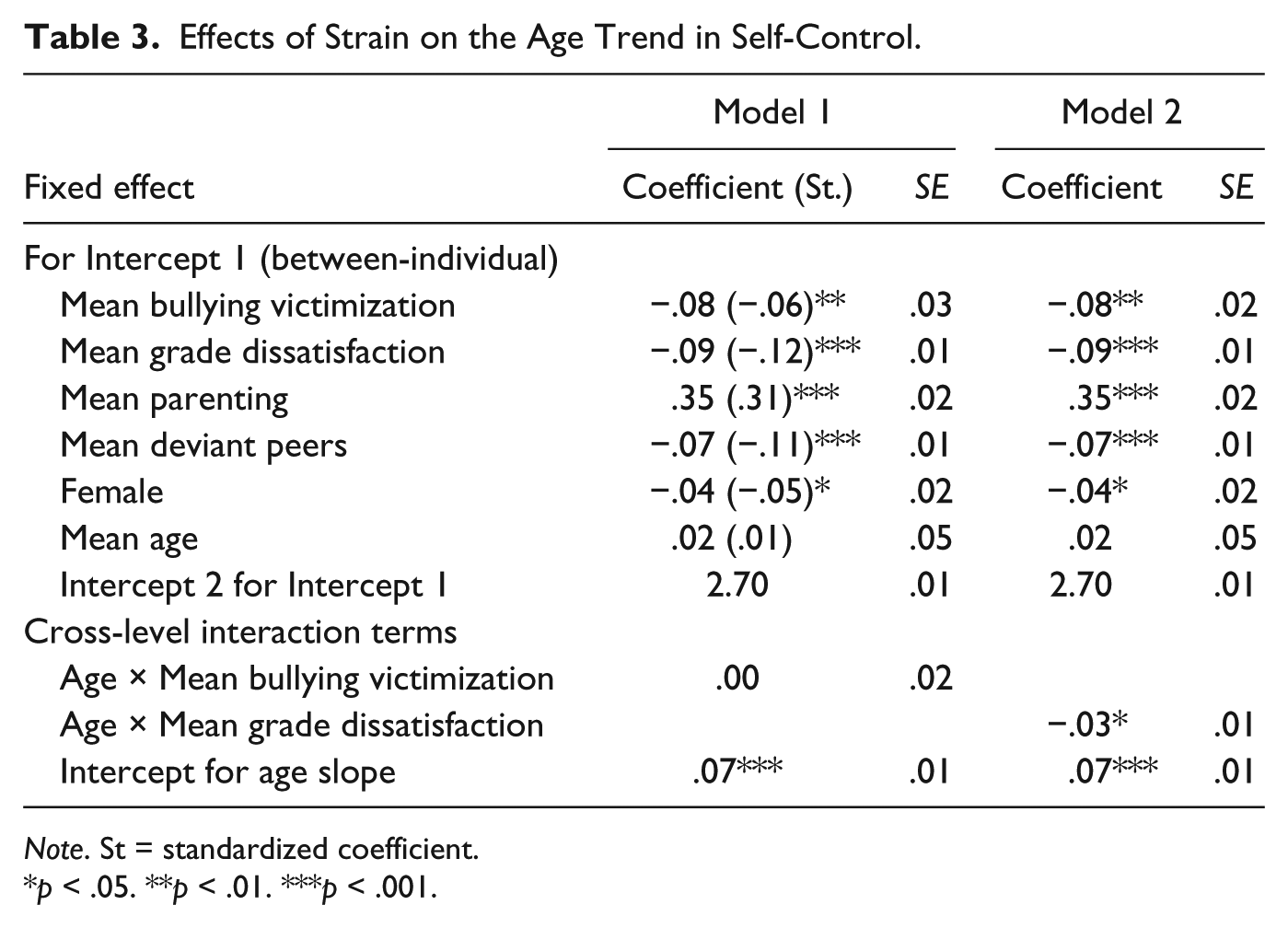
Note. St = standardized coefficient.
p < .05. **p < .01. ***p < .001.
Meanwhile, the result shows a significant, negative effect of individual mean grade dissatisfaction (−.03) on the time trend in self-control from 14 to 16 years of age. This means that adolescents who have a higher level of mean grade dissatisfaction over three waves experience a within-individual decrease in self-control over the three waves that differs from those who have a lower level of mean grade dissatisfaction. Figure 1 shows that the developmental change in self-control over three waves depends on the level of mean grade dissatisfaction. No such pattern emerged for individual mean bullying victimization—it had no influence on the developmental change in self-control over three waves.
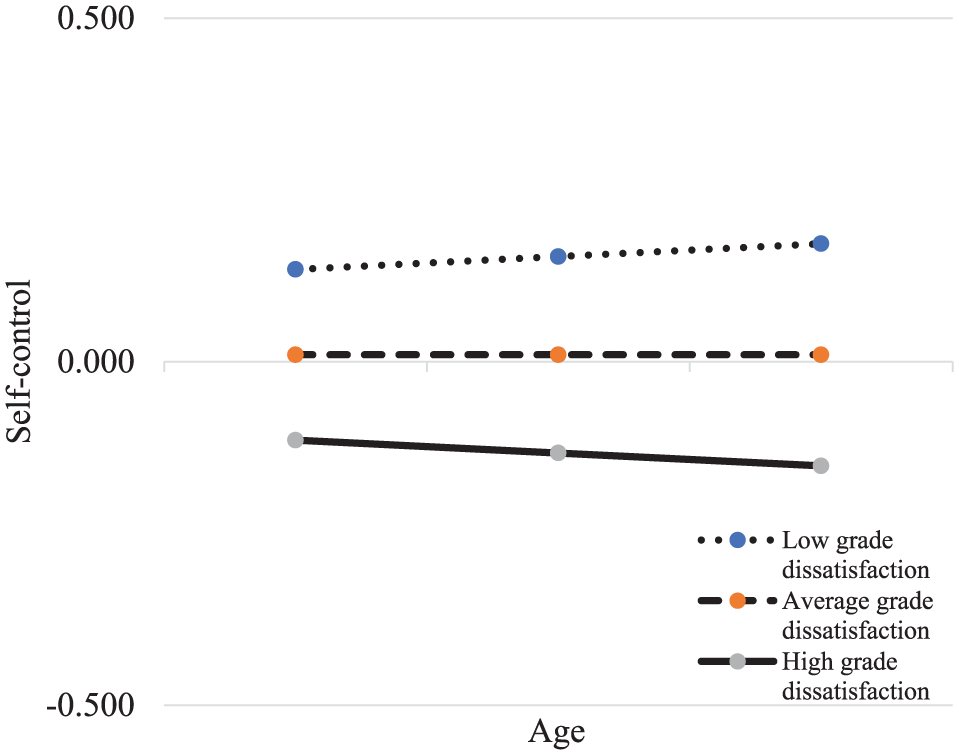
The effect of mean grade dissatisfaction on the time trend in self-control over three waves.
Discussion
In this study, we investigated the effects of two strain-inducing variables on adolescent self-control. We did so to address two voids in prior self-control research. First, although research on the etiology of self-control has become more common in recent years, few studies have examined the effects of strain in particular. Second, few studies on the predictors of self-control have sought to distinguish and separately analyze both within- and between-individual levels of analysis. In addressing these voids, we hoped to provide further insight on the etiology of self-control, and two key findings emerged from the analysis.
The first finding was that both strain variables—bullying victimization and grade dissatisfaction—were significantly associated with within-individual shifts in self-control. This is consistent with prior research indicating that self-control is malleable over time (Burt, Sweeten, & Simons, 2014; Hay & Forrest, 2006). Also, it supports prior research indicating that adolescent self-control is responsive to factors that go beyond the quality of parenting (Meldrum et al., 2012; Teasdale & Silver, 2009; Turner et al., 2005). This finding is somewhat novel, however, in suggesting the importance of strainful circumstances in particular, and this builds upon a similar empirical result from Agnew et al. (2011). Perhaps this occurs because self-control represents a resource that can be “used up” when a person must confront strainful experiences. Or it may be that strain induces anger that undermines self-control efforts. And still yet, it could be that the harmful experiences of strain during adolescence impair the biological developments that are the foundation of self-control. Our analysis could not specify which exact mechanism is operating, but the overall result is clear: Strainful circumstances can lead to within-individual self-control deterioration.
We see this finding as having an important theoretical implication for research in this area: It suggests that self-control can be undermined not merely by the absence of positive relationships (with parents, for example) but also by the presence of negative relationships. Agnew (1992) long ago pointed to this key distinction when describing the important niche that strain theories occupy in criminology. He emphasized that control theories were quite useful for drawing attention to how individuals vary in exposure to prosocial influences, but as important as this may be, it fails to capture the possible importance of truly negative associations—those that are aversive and actively unwanted because “the individual is not treated as he or she wants to be treated” (Agnew, 1992, p. 48). Agnew (1992) argued at that time that negative associations likely promote delinquency in ways that go beyond that expected from the mere absence of positive relationships; in this way, the incorporation of strain variables offered the possibility of a more complete understanding of delinquency. That argument was empirically supported (Agnew & White, 1992; Paternoster & Mazerolle, 1994) and our findings in this study point to a similar pattern for the development of self-control. True enough, positive relationships (as indicated by parenting quality) are important—they helped explain within- and between-individual variation in self-control. But even after accounting for that, negative associations—as indicated by bullying victimization and dissatisfaction with grades—also significantly shaped self-control. This points to an important possibility: Although typically neglected in prior research, strain variables may be an integral part of understanding self-control development during adolescence.
Our second key finding relates to differences between individuals—adolescents with higher levels of mean bullying victimization and grade dissatisfaction over three waves of data had lower levels of mean self-control. This is consistent with the patterns just emphasized, but it shows that they operate not just for explaining wave-to-wave fluctuations in self-control (that occur within individuals) but also for explaining the differences that exist between individuals over a lengthy period of time. Also, as part of this pattern, a significant cross-level interaction emerged between age and mean grade dissatisfaction such that grade dissatisfaction influenced the developmental trajectory of self-control. Specifically, higher grade dissatisfaction over three waves produced a within-individual decrease in self-control over the three waves that differs from those with lower grade dissatisfaction.
We also see this finding as having important theoretical implications. Most notably, it supports an emerging recognition that self-control development is notably dynamic during adolescence—as individuals advance into adolescence, they do not inexorably follow trajectories that were already underway. Moreover, they do not move in lockstep with one another (Burt et al., 2014; Hay & Forrest, 2006). Instead, change is possible in both absolute and relative ways, even if continuity is quite common. Our findings support this view, and in so doing, they promote the growing recognition that self-control should be approached with a life course developmental perspective in mind (see Hay & Meldrum, 2016; Pratt, 2016).
Although we focused on the idea that strain may influence self-control, it is also possible that low self-control increases strain-inducing situations including victimization (Schreck, 1999) and low grades in school (Tangney, Baumeister, & Boone, 2004). The fact that our strain measure was based on an earlier reference period than our self-control measure suggests that there is a prospective association in that direction between the two variables. Still, the possibility exists that the relationship instead, or also, runs in the opposite direction from self-control to strain. Future research should examine this possibility.
Our findings and implications should also be seen in the context of other study limitations. First, although we were able to measure self-control in a way that corresponds well to criminological conceptions of that variable, we did not have access to commonly used measures like the Grasmick et al. (1993) scale. Thus, some elements of self-control, including perhaps risk-seeking, may be underrepresented in our measure. Also, in considering strain as a predictor of self-control, we were able to examine just two sources of strain, and grade dissatisfaction was measured only with a single item. As Agnew (1992, 2001) has argued, strain can come in a variety of consequential forms, and future research ideally could use comprehensive measures to capture this complexity. Potentially important sources of strain that we were unable to consider but that could be examined in future research include economic strains, rejection or abuse from parents, and homelessness (Agnew, 2001). Finally, in using a sample of Korean school students, we cannot be certain that these findings are generalizable to other samples, including those in Western countries such as the United States.
Including these limitations, future research needs to address the mediating role of self-control between strain and delinquency, given that self-control is an important predictor of delinquency.
The main purpose of this study was to examine whether strain can be considered as a predictor of low self-control during adolescence. Overall, the results suggest that it can be. That is, the results indicate that future researchers need to pay more attention not only to the absence of positive social relationships but also to the presence of negative life experiences such as strain to explain reductions in adolescent self-control. These results also provide an important policy implication that stressful situations should be more carefully controlled during adolescence to prevent negative life outcomes that may be caused by reduced self-control. We hope this study can be a catalyst for research that examines the effects of various types of strain on self-control development over the life course.
Footnotes
Declaration of Conflicting Interests
The author(s) declared no potential conflicts of interest with respect to the research, authorship, and/or publication of this article.
Funding
The author(s) received no financial support for the research, authorship, and/or publication of this article.