



Abstract
In this article, we examine diverse forms of youth participation among Black girls through an analysis of 390 application responses for a leadership and empowerment conference. Using a counternarrative methodological approach and intersectional analytical lens, we illustrate how Black girls (a) view participation as an empowering avenue for countering harmful stereotypes that have individual and collective impacts, (b) utilize participation as an intervention for effecting change in their communities, and (c) draw upon their present participation experiences to imagine future selves and life trajectories. We contribute an expanded understanding of “youth participation” grounded in the lives of Black girls that draws from how they describe their daily lives across a diverse range of learning, religious, familial, and geographic contexts. Ultimately, we argue for studies of youth participation that are grounded in lived realities and extend beyond the limited forms of youth participation legible to society.
Introduction
On March 24, 2018, fifth-grader Naomi Wadler stood in front of marchers at the March for Our Lives event in Washington, D.C., and proclaimed, I am here to acknowledge and represent the African American girls whose stories don’t make the front page of every national newspaper, whose stories don’t lead on the evening news. I represent the African American women who are victims of gun violence, who are simply statistics instead of vibrant, beautiful girls full of potential.
Met with thunderous applause, Naomi listed the names of Black girls who lost their lives to gun violence: “I am here today to represent Courtlin Arrington. I am here today to represent Hadiya Pendleton. I am here today to represent Taiyania Thompson.” Explicitly identifying the victim’s names directly challenged the dehumanizing practice of obscuring the lives of Black women and girls behind statistics. Naomi exemplified the powerful Black feminist political act of naming (Browdy, 2017) when she insisted we see “vibrant, beautiful girls full of potential” rather than numbers.
Naomi’s actions represent a larger political, social, and cultural movement led by Black youth who are organizing to address the injustices impacting their communities. For instance, Black youth organized demonstrations to protest the acquittal of George Zimmerman, a man accused of murdering Trayvon Martin, an unarmed Black teenager on his way home from a convenience store. They founded community organizations like the Black Youth Project 100 and advocated for gun reform via social media campaigns like #BlackLivesMatter. Most importantly, through their active participation, they offered a counternarrative for the role that Black youth occupy in American society—one in which they have the power and resolve to lead political movements that speak clearly to the issues impacting their daily lives.
We begin with these events to highlight the transformative power of youth participation and to illustrate how Black youth tackle issues that disproportionately impact their communities. In this article, we examine diverse forms of youth participation among Black girls through an analysis of 390 leadership conference applications. We define youth participation as “a process of involving young people in the institutions and decisions that affect their lives” (Checkoway & Gutierrez, 2006). Rather than focus on how youth participation unfolds in a particular context, we purposely adopt a broad definition of youth participation that is inclusive of the diverse forms of participation that arose from girls’ descriptions of their lived experiences.
Furthermore, we argue that the limited forms of youth participation legible to society fail to acknowledge the pivotal roles that Black girls play in their communities. Majoritarian portrayals of Black girls continue to focus on harmful narratives that perpetuate gendered and racialized stereotypes. For example, Epstein, Blake, and González (2017) found that the “adultification” of Black girls in popular media results in the misperception that they are less innocent and less in need of protection than their White counterparts. These harmful narratives disenfranchise Black girls and necessitate the construction of narratives that challenge deficit perspectives and illuminate the important roles that Black girls play in their communities.
Black girls must enact change within historically oppressive social structures and institutional configurations (Hill Collins, 2009); working within these systems necessitates collective participation and alternative forms of action that are often not legible as “traditional” forms of youth participation, such as formalized activities associated with schools and organizations (Fredricks & Simpkins, 2012). However, as Checkoway (2011) argues, “differential participation” by Black girls and other youth of color does not mean they are disengaged from society; on the contrary, research has found that youth of color participate “in activities which are more appropriate to their situation, and which mainstream social scientists find difficult to document” (Checkoway, 2011, p. 342). For example, studies found that youth of color participate in educational reform by addressing the “broad structural issues of discrimination and poverty” that they confront in their everyday schooling experiences, including biased school suspension policies and the defunding of youth programming (Checkoway, 2011, p. 342; Checkoway & Richards-Schuster, 2006; Ginwright, Cammarota, & Noguera 2005).
This study contributes to research that challenges limited understandings of youth participation that exclude the contributions of youth of color. We contribute an expanded understanding of youth participation grounded in the lives of Black girls that draws from a large data set in which they describe their daily lives across a diverse range of learning, religious, familial, and geographic communities. We show the complexity and richness of Black girlhood through narratives of lived experiences that illustrate how Black girls (a) view participation as an empowering avenue for countering harmful stereotypes that have individual and collective impacts, (b) utilize participation as an intervention for effecting change in their communities, and (c) draw upon their present participation experiences to imagine future selves, life trajectories, and future engagements with society.
Contextualizing Youth Participation
Research on youth participation investigates how youth create societal change by organizing and addressing issues that impact their lives and communities (Checkoway & Gutierrez, 2006). For example, studies have focused on (a) designing programs that help youth learn to organize (Delgado & Staples, 2008; Ginwright & James, 2002), (b) identifying program outcomes for youth and communities involved in organizing, and (c) analyzing the environments that lead youth to participate in social movements (Noguera, Cammarota, & Ginwright, 2006; Stovall, 2006). Studies of youth participation highlight how youth organize to address issues that adults struggle to change; examples include historical moments like the lunch counter sit-ins organized by Black youth that helped end segregation in dining facilities (Chafe, 1981), and the more recent student walkouts organized by Latino youth to protest the Border Protection, Anti-terrorism, and Illegal Immigration Control Act of 2005 (Revilla, 2012; Vélez, Huber, Lopez, de la Luz, & Solórzano, 2008). These examples demonstrate how youth participation can be an effective avenue for community change that helps improve the lives of oppressed and marginalized groups.
In our work, we advocate for more nuanced understandings of “youth” that address diversity of experience along racialized and gendered lines. As such, we have focused on forms of youth participation that foreground how the intersections of race, gender, and age influence the ways youth of color garner visibility and achieve structural and institutional change. For example, Cohen (2012) illustrated how Black youth used social media to engage in forms of information dispersal that contributed to President Obama’s 2012 presidential win, creating a new way to participate in politics that fought against constraints faced by the Black community, such as voter suppression (Stringer, 2007).
However, while there is important research highlighting the contributions of youth of color more generally, studies specifically examining Black girls’ participatory experiences have been extremely limited. Previous studies have used gender as the single unit of analysis and have focused on how gender influences girls’ abilities to fully exercise their political ideologies (Gordon, 2008). Such studies found that parents constrain girls’ social activism and political participation to adult-supervised activities (Cicognani, Zani, Fournier, Gavray, & Born, 2012; Gordon, 2008). Additional studies found that teenage girls mitigate these constraints by engaging in civic participation online through anonymous activities (Keller, 2012). While such studies tackled gender, very little work has studied how the intersection of race, gender, and age impacts Black girls’ participatory experiences.
Methodology: Foregrounding Black Girls’ Experiences Using Counternarratives and Intersectional Analysis
To study the participatory experiences of Black girls, we drew from critical race theory and used a counternarrative methodology for centering the experiential knowledge of people of color (Solórzano & Yosso, 2002). Counternarratives are stories that challenge majoritarian stories constructed to explain the experiences of people of color and legitimize the status quo (Solórzano & Yosso, 2002). Counternarratives serve as powerful antitheses to dominant discourses by drawing on lived experiences that include storytelling, family histories, biographies, scenarios, parables, cuentos, testimonios, chronicles, and narratives (Carrasco, 1996; R. Delgado, 1989; Olivas, 1989).
Counternarratives are not always created for the sole purpose of challenging deficit narratives, or stories that portray people of color as culturally deficient (Solórzano & Yosso, 2002). Counternarratives can also be expressive avenues for groups to “strengthen traditions of social, political, and cultural survival and resistance” (Solórzano & Yosso, 2002). In this vein, we purposely selected data that invited self-identified Black girls to use personal storytelling to construct narrative accounts of their lived experiences. The data for this study were drawn from an application process for a leadership conference that included encouraging prompts such as “Tell us why you rock.” We position the girls’ responses as counternarratives because their stories represent experiential knowledge and illustrate the assets and strategies that Black girls use to navigate their daily lives. By centering Black girls’ voices, we hope to better understand how they “make sense of their lives by theorizing the present and imagining the future” (Cox, 2015, p. 25).
Finally, as researchers, we use counternarratives as a direct response to deficit-based research that distorts the epistemologies of people of color. By highlighting the experiential knowledge of people of color, this methodology elucidates perspectives that have been largely ignored and positions researchers as listeners who are receptive to seeing the world as someone else experiences it (Delgado, 1989; Delgado Bernal, 2002). As a methodological approach, counternarratives serve as a research tool that allows us to use our own experiential knowledge as women of color to “reinterpret, disrupt, or interrupt pervasive discourses” that paint communities of color in negative ways (Milner & Howard, 2013).
In addition, we utilized an intersectional analytical lens to examine how the intersection of race, gender, and age impacts Black girls’ participatory experiences. Intersectionality as a concept is grounded in critical legal studies and explains how the intersections of Black women’s identities render them invisible in the eyes of the law (Crenshaw, 1991). Hill Collins (2000) has powerfully revealed how stereotypical images of Black womanhood are created by systems of power “to make racism, sexism, poverty, and other forms of social inequality appear to be natural, normal, and inevitable parts of everyday life.” These systems of power perpetuate detrimental stereotypes of Black girls while ignoring their efforts to counter these images. We argue that understanding participation among Black girls “requires understanding not only one’s need to address one form of oppression, but the significance of how singular and multiple forms of oppression are organized” (Hill Collins, 2000). Thus, we utilized intersectionality as an analytical lens for examining how the girls frame their participatory activities within a larger societal context; we paid particular attention to how the intersections of race, gender, and age impacted how they described their positions and agency within their communities.
Method
Participant Demographics
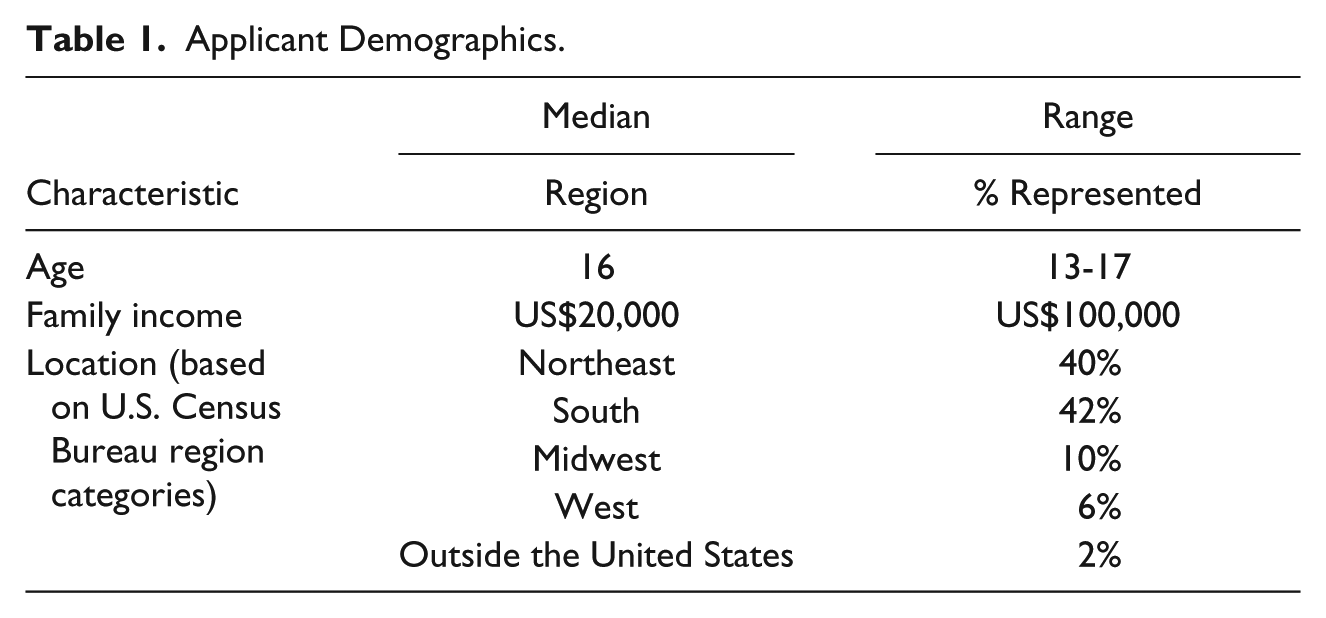
We collected data from 390 Black girls in spring 2017. The girls attended public, private, parochial, and home schools and came from 34 of the continental United States. A large majority of the girls (97%) reported their primary home language as English and 15% reported speaking a second, third, or even fourth language, including languages such as French, Spanish, Italian, American Sign Language, Creole, Japanese, Korean, Chinese, Arabic, German, Ihsan, Twi, Latin, Nuer, Yoruba, and Hausa. Self-reported family income data indicate that the applicants stemmed from a variety of social economic statuses (Table 1).
Applicant Demographics.
Data Collection
This study stemmed from a larger research project on creating a culturally responsive science curriculum using self-identified cultural markers. One of the study’s goals was to ensure that findings were grounded in the language and lives of Black girls (Maxwell, 1992). Neal-Jackson, (2018) encourages researchers to access the voice of young Black girls through multiple methods. Thus, we looked beyond traditional data collection forms (e.g., surveys) for artifacts that centered Black girls’ voices and formed a data-sharing initiative with a community organization that gave us access to application responses from a weeklong residential conference meant to “cultivate leadership skills” and “affirm Black girl brilliance.” The conference invites industry speakers to provide media, entrepreneurship, arts, social action, technology, and financial literacy workshops. A defining feature of the conference is the intentional creation of a space where Black girls can openly talk about how race and gender shape their school and home experiences.
The application process included a consent and assent clause that informed girls and legal guardians that data collected from program applications, including responses and demographic information, would be shared with researchers in aggregated and anonymized forms. Participation in the data-sharing initiative was voluntary and did not impact the applicant evaluation and selection process for the conference, which was conducted entirely by the community organization. The application included questions regarding their motivation for participating in the conference, their experience with leadership activities, and their future aspirations and goals. While not originally produced to serve as a data set, the free-response nature of the application questions, topics covered, and number of respondents created a rich data set and presented a unique opportunity to investigate how Black girls see the world and their position in it.
Data Analysis
The first stage of data analysis focused on determining self-identified cultural markers stemming from girls’ personal essays and eight semistructured application question responses. We defined cultural markers as factors that are salient to a person’s identity and integral to distinguishing social groups, as perceived by both the individual and others (Ibrahim & Heuer, 2016). These factors include individual identity categories such as ethnicity, class, race, gender, age, and shared community values, customs, and traditions (Martel & Brassard, 2008). We focused on markers that were perceived by the individual and studied how these markers gave meaning to how the girls interacted and participated within their communities (Rogoff et al., 2007). Based on this focus, we developed broad interest areas to guide our analysis, including (a) views on their professional, personal, and academic selves; (b) views on their leadership roles; (c) motivations for attending a leadership conference; (d) self-expressions related to confidence and power; (e) and views on mentorship and preferred characteristics of Black mentors and leaders. While analysis focused on identifying recurring cultural markers, we recognize that cultural identities undergo constant transformation (Hall, 1989); thus, we also noted instances of significant intragroup difference.
We developed a preliminary list of codes by selecting 50 responses using a systematic sampling method of every eighth application. Three research team members analyzed the data at the paragraph level. We used an inductive and emergent process to develop codes by directly examining the data in relationship to the broad interest areas previously identified (Lofland & Lofland, 1984). Through a verbal consensus-building process, we took an initial list of 30 codes and consolidated it to 23. After reaching an interrater reliability score of >0.72, we used the software Dedoose to apply the final code set to 390 applications.
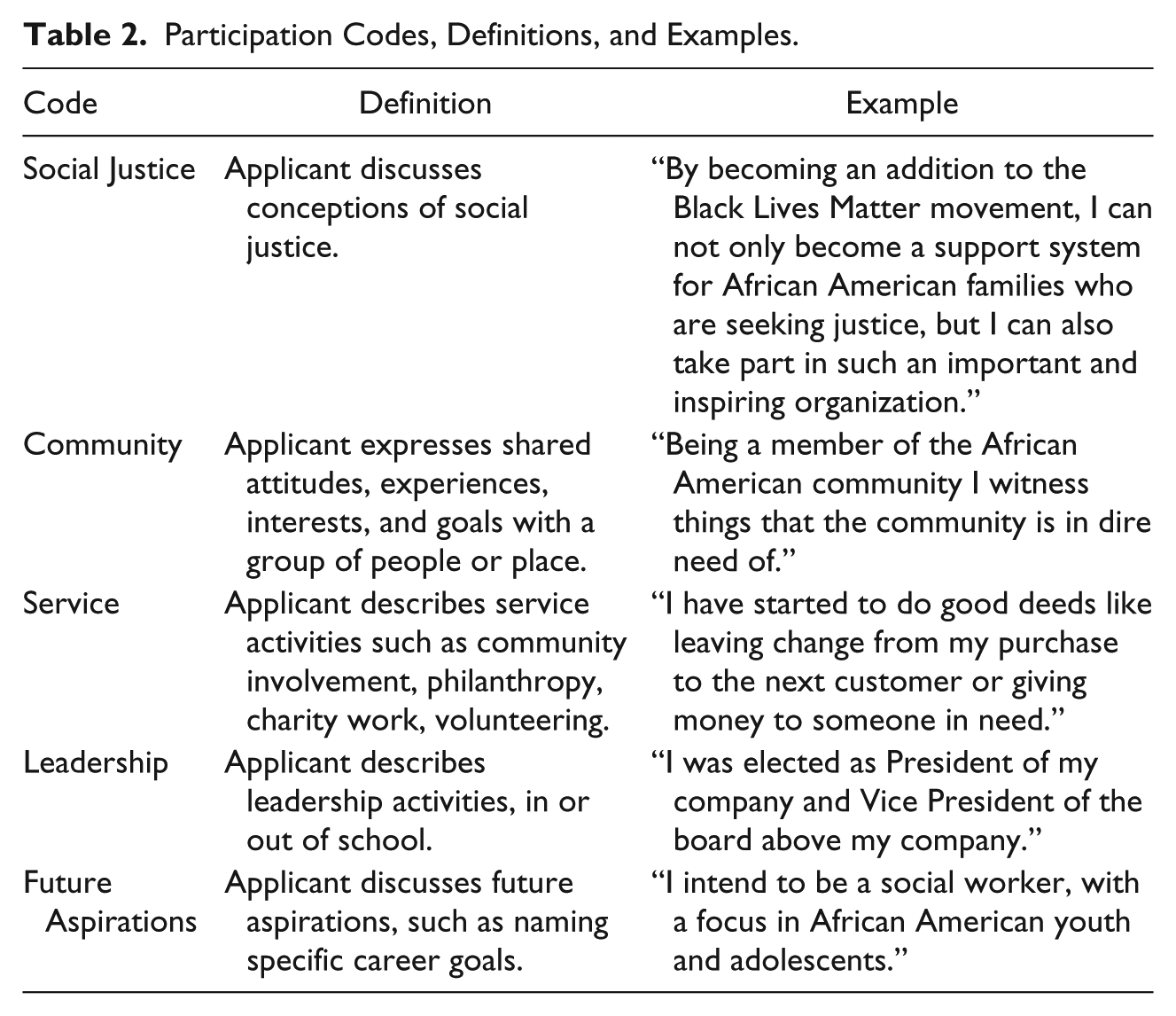
In the second stage of data analysis used for this study, we narrowed the focus to five codes that were most relevant to youth participation (Table 2) and selected excerpts that discussed (a) forms of youth participation, (b) descriptions of participation contexts (formal and informal), and (c) identification of community issues.
Participation Codes, Definitions, and Examples.
Positionality
Our respective theoretical sensitivities and cultural intuitions informed how we approached data analysis and constructed themes (Delgado Bernal, 1998; Strauss & Corbin, 1990). We utilized the data set, existing literature, and our personal and professional experiences to develop the counternarratives (Delgado Bernal, 1998). The data were analyzed with an intersectional lens that celebrated the girls’ experiences because the data originated from applications for conference aimed at empowering, affirming, and providing a safe space for Black girls. In addition, we drew from research on Black feminist theory and epistemology, youth participation, and critical race theory to inform our analytical framework, coding decisions, and data analysis.
Fernández’s professional experiences as a high school teacher, research experiences as an advocate for women of color in science, technology, engineering, and mathematics (STEM), and personal experiences as a first-generation Mexican American informed her interpretations of the girls’ stories. She connected with the girls’ community engagement experiences and the struggle of navigating spaces not meant for them. For Garcia, analyzing the data required reflective research practices that included raising questions about who gets to interpret and represent the girls’ stories. As a first-generation Mexican American researcher, she was acutely aware of how her own experiences of girlhood and womanhood intersected and diverged from those of the participants. Primarily, she was concerned with the ethics of sharing these stories and felt a great responsibility to ensure that the analysis did not perpetuate deficit narratives about Black girls’ lives. As a Black female researcher, Jackson felt the need to position Black girls as authorities on their lived experiences. At times she weighed the responsibility of sharing these stories. Does the academy deserve them? What is the reader going to do with this knowledge? Ultimately, Jackson felt that it was important to celebrate Black girls’ joy, accomplishments, and contributions to society.
Findings
In the following sections, we discuss how Black girls (a) view participation as an empowering avenue for countering harmful stereotypes that have individual and collective impacts, (b) utilize participation as an intervention for effecting change in their communities, and (c) draw upon their present participation experiences to imagine future selves, life trajectories, and future engagements with society.
Finding 1: Black Girls View Participation as an Empowering Avenue for Countering Harmful Stereotypes That Have Individual and Collective Impacts
Data analysis revealed that the Black girls in this study view participation as an effective mechanism for combating stereotypes that personally and collectively impact their lives. For example, they purposefully participated in activities that challenged group stereotypes about Black girls. As Amber (all names are pseudonyms) explained, “I want to break the stereotype that Black girls have the worst attitudes and aren’t good for much because that is way far from true.” Amber’s use of the phrase “break the stereotype” indicates her knowledge of group stereotypes that are perpetuated to construct harmful views of Black girls’ identities and, by extension, her own identity. In response, Amber provides a counternarrative that highlights her participation in community improvement efforts, “I was part of a group and our main focus was to improve the quality of our community. We planted a garden, cleaned up certain areas, picked up litter, etc.” Her detailed and concrete examples of community improvement initiatives simultaneously counter the majoritarian narrative that Black girls “have the worst attitudes” and also serve to communicate personal feelings of empowerment.
Amber finishes, “Being in this program made me realize how much of a difference I was making and how I wanted to continue.” The decision to “speak back” to stereotypes about Black girls through a community effort highlight the differential nature of Amber’s participatory actions; her descriptions reveal a recognition of how her personal and localized actions carry symbolic power. Amber feels the weight of the responsibility to “break” harmful stereotypes through her efforts. In this way, she positions her efforts to alleviate community issues as a larger counternarrative that directly challenges the idea that Black girls “aren’t good for much.”
The Black girls in this study also discussed how they navigated a world where their intersectional identities were in opposition with dominant societal structures and norms. For example, Victoria described her experience as a Black girl in the following way: “A Black girl is someone who is trying to find herself in a patriarchal society. A Black girl is someone trying to find herself in a society that heightens the European standard of beauty.” Victoria’s description reveals how oppression does not occur in mutually exclusive terrains (Crenshaw, 1991). She articulated how racism and gender discrimination intersect to produce a patriarchal society that privileges Eurocentric beauty standards. She described a lived experience where “trying to find [one’s self]” requires identifying and resisting forms of oppression stemming from the intersections of one’s race and gender.
However, rather than accepting the status quo, Victoria reclaimed her experience and presented herself in opposition to these oppressive forces by communicating a strong sense of self-worth, “I am a Black girl who rocks. I am powerful and beautiful.” Furthermore, like Amber, Victoria viewed her struggles and triumphs as simultaneously personal and collective; she stated, “I want to create a safe environment where [other] teens can be empowered and find themselves as an individual.” Her response revealed a drive to create positive societal change by participating in the development of safe spaces that combat “patriarchal” and “European” societal norms that impact her personal experiences, as well as those of other teens.
Amber and Victoria both utilized differential participation in their communities by focusing on broad structural issues of discrimination via racialized and gendered stereotypes. Their descriptions of community participation as an empowering avenue for individually and collectively countering deeply entrenched majoritarian stereotypes are in direct contrast to claims that youth of color are “disengaged” from society (B. Checkoway, 2011). By participating in existing community efforts and envisioning participation in future initiatives, both girls positioned participation as an avenue for expressing agency, reclaiming their lived experiences, and engaging with society in transformational ways.
Finding 2: Black Girls Utilize Participation as an Intervention for Effecting Change in Their Communities
The data analysis revealed that the Black girls in this study navigate multiple contexts in their daily lives. From schools to churches, the girls described forms of differential participation that were aimed at creating change within a wide range of contexts. As such, we advocate for expanding discussions of youth participation to consider how Black girls navigate and participate across communities—including learning, religious, familial, and geographic communities. Our analysis focused on identifying girls’ self-described community memberships and understanding how they described their participatory activities within these communities.
One of the most common communities identified by the girls was their learning community; these learning communities were primarily described within the context of their local schools and in relationship to various actors within those schools, such as other students, teachers, and administrators. Research has examined how participation in school extracurricular activities enriches students’ academic experiences and builds a sense of community among peers with similar interests (Darling, Caldwell, & Smith, 2005). However, a strong focus on traditional extracurricular activities, such as band and theater, often excludes the contributions of Black girls who are commonly portrayed as problematic students within school settings. Statistics reveal that Black girls are disproportionately disciplined and 6 times more likely to be suspended than their White counterparts (Crenshaw, Ocen, & Nanda, 2015).
Yet despite biased discipline policies, the Black girls in this study described actively seeking opportunities for participation in school activities, especially those that allowed them to shape the school culture in ways that matter to them. For example, when Gabrielle described her everyday duties as a student council member, she shared how she leveraged that position to change the school social studies curriculum: “[In] student council: We plan events such as prom, spirit week, and end of the year celebrations. We also go to administration with student problems like incorporating more Black history in the curriculum.” Gabrielle’s statement described how she participated in planning traditional American high school events such as prom and spirit week. However, rather than read her account as simply an example of how she engages with traditional high school social events, we contend that her efforts to work with administration to change school policies is representative of how youth of color confront biases in their everyday schooling experiences, including biased discipline policies and curricular content.
Gabrielle uses her position on the student council to push for curricular modifications such as incorporating more Black history; she described the lack of Black representation on the curriculum as a “student problem” and positioned herself as a leader who held the school administration accountable. By taking a position on the student council, Gabrielle counters the majoritarian narrative that Black girls do not participate in school activities and engages in efforts to create representational change through curricular amendments.
While Gabrielle’s experiences counter deficit narratives of Black girls within schooling contexts, it is important to recognize that the Black girls in this study described shaping their communities by participating in a wide range of out-of-school contexts. For example, Aida participated in local government to improve the conditions in her city. She shared how participating in the Mayor’s Youth Council allowed her to speak directly with the Mayor about “the problems in [her] city.” While she described her participation in the Mayor’s Youth Council as an opportunity to “find solutions” to problems that plagued her local community, she also viewed the opportunity as a way to strengthen personal skills: “I attend monthly meetings, which teach valuable lessons about leadership, self-awareness, and public speaking.” By proclaiming “I am in touch with my world, my city, and my future,” Aida positioned herself as someone with agency and the “ability to make an impact” in her local community. Through her participation, Aida empowered herself by learning skills she deemed “valuable” and by making her commitments to her future and her city visible to society.
While Gabrielle and Aida took on formal positions of power within their respective communities, other girls chose to effect change in their communities through participation in informal education efforts. Carmen described seeking information about the “struggles of the African American community, both past and present” to better understand her place in society. After learning about her heritage, she felt compelled to share her knowledge with others by working as a youth docent at a local African American history museum. She stated, “I am proud of my heritage, proud of who I am, and helping educate others and the responsibility accompanying this task is what has shaped me into the young woman I am.” Carmen used the words “proud” and “responsibility” multiple times to convey the central roles her history and heritage play in her own identity formation.
Notably, Carmen felt a personal responsibility to educate others about the issues faced by Black communities in the United States. She explained, A youth docent comes with a large deal of responsibility, as you must hold yourself accountable for the information you give to the public. Additionally, you must be able to communicate effectively with a diverse demographic, since the museums visitors range from small children to adults. Putting the harsh reality of our country’s past and present into terms a child will understand is a challenge, but it is my passion.
Similar to Gabrielle, Carmen yearned for increased representation in the historical record and sought opportunities to learn and share Black history, which is practically nonexistent in most K-12 social studies curricula (King, 2017). Different from prescribed forms of participation where youth are heavily supervised by adults, Carmen undertook a differential form of participation as a youth docent where she took agency over her own learning and occupied a societal role that gave her the power to frame or reframe what museum visitors learned about Black American history.
Finally, our study found that Black girls frequently participated in religious communities such as churches. Research has shown that church culture plays a central role in Black communities and that places of worship are often spaces where community members work together to catalyze community change (Moore, 1991). Lauren shared how she created a social space in her church that enabled her to express her creativity as a choreographer and allowed her to make connections with her peers: “At my church I created a praise dance team where I choreograph dances for the girls to perform . . . Together, we have truly grown as a family.” She viewed dance as an avenue for self-expression that also teaches “hard work, perseverance, sacrifice, and communication.” By participating in her praise dance team, Lauren utilized a creative outlet to form connections with her peers, many of whom she described as “tough” and different from herself. She described her religious community as a safe space that provided her peers with a place to seek refuge from “the street” and, perhaps problematically, positioned herself as a leader who could create positive change in the lives of other “impressionable” youth.
Schools, local government, museums, and churches are just a few examples of the diverse contexts where Black girls participate. Regardless of the context, the Black girls in this study positioned themselves as young women with agency and the ability to effect change in their learning, religious, familial, and geographic communities.
Finding 3: Black Girls Draw Upon Their Present Participation Experiences to Imagine Future Selves and Life Trajectories
Research has found that personal experiences and interests drive how people choose to participate in their communities; thus, participatory activities are reflective of one’s changing identity and contribute to the cultivation of a personal identity (Holland, Lachicotte, Skinner, & Cain, 2001; Lewis-Charp, Yu, & Soukamneuth, 2006). For example, participating in social movements enables youth to cultivate activist identities that garner visibility and allows them to publicly challenge others’ views of them (Kirshner, 2009). For the Black girls in this study, participating in their communities facilitated reflection on the relationship between their present and desired future selves, defined as a self-concept construct that describes “what we would like to become” in future oriented visions of ourselves (Markus & Nurius, 1986, p. 954). For this finding, we share Sofia’s personal visions of a future where she plays a pivotal role in fighting systematic racism and socioeconomic inequality.
Researchers have highlighted ways in which Black girls use digital media to challenge dehumanizing representations by creating and circulating hashtags such as #BlackGirlFearless and #AllBlackGirlsMatter (McArthur, 2016). Recognizing the power of digital media, Sofia “co-founded a blog for and by Black teenagers aim[ed] at addressing the pressing issues facing Black youth: social advocacy and a safe space for Black expression.” Her decision to participate in online forms of social advocacy by cofounding a blog is powerful given research demonstrating that media content produced by Black girls and their allies can serve to empower peers (Lindsey, 2013).
Furthermore, Sofia’s narrative is important because it illustrates how many of the Black girls in this study connected their present participation experiences to conceptions of future selves and life trajectories. Sofia drew on her current experiences of cofounding a blog to imagine a future self where she addresses the same critical issues through the founding of a nonprofit organization: Far too often people think those in low[-income] neighborhoods are victims of their own demise rather than a prevailing system of systemic racism and socio-economic/political inequality. My future philanthropic goals [are] the creation of a non-profit organization aim[ed] at working with local Black-owned businesses through a mentor[ing] program.
Too often Black youth are held to the behavioral, social, physical, and other norms of their White counterparts, making it difficult for Black youth to be themselves. By creating a safe space as a community service, Sofia empowered herself and other Black youth in the community to freely express themselves. Youth of color are often called upon to make a show of abjection as a way to highlight difference of experience and to define personal characteristics that should be avoided by White middle-class youth (Groenke et al., 2015; Lesko, 2012). The activities of youth of color are not recognized as appropriate, authentic, or even legitimate. Thus, the ability to occupy a space where one is not “othered” opens opportunities for the unburdened expression of joy and happiness.
In addition, Sofia uses her differential participation to create a figured world where she is able to explore her future role in dismantling the structural and institutional racism that strips many Black communities of the political and socioeconomic power needed to change their social situations (Holland et al., 2001). Sofia envisions creating a nonprofit that empowers the Black community by having Black business owners mentor Black youth. In her figured world, she counters the narrative that people from low-income neighborhoods are responsible for their disadvantaged social and economic positions. Sofia is able to clearly articulate her societal engagement and the connection between her present forms of participation, her future identity within her community, and a counternarrative that dispels the myth that “low[-income] neighborhoods are victims of their own demise.”
Limitations
As an interpretivist qualitative research project, we do not claim or aim to provide generalizable findings. Rather than support essentialist claims, we understand that this data set does not represent all Black girls. Instead, in line with other forms of counternarrative and intersectional research, the goal of this analysis is to highlight the experiences of this particular set of girls to further illustrate the nuances and diversity in Black girls’ lived experiences.
Our research design was motivated by looking beyond traditional data collection forms and searching for artifacts that centered Black girls’ voices; selecting girls’ personal essays as a data set may raise ethical concerns regarding privacy and disclosure in research processes and reporting. Thus, as a research team, we mindfully reflected on how to honestly represent aspects of the girls’ experiences and identities that might be deeply personal. We mitigated privacy and disclosure risks by using pseudonyms and carefully selecting excerpts that did not disclose potentially identifiable experiences.
In addition, scholars have successfully problematized the valorization of participation, including substantive critiques of the oversimplification of the needs and desires of marginalized communities based on presumed racial and ethnic similarities (Beebeejaun, 2006) and the rhetoric of superficial empowerment associated with narrow opportunities for participation in online and offline spaces (Kelty et al., 2015). While we recognize these critiques as valid, we intentionally chose to frame the girls’ participatory experiences as counternarratives that highlight their social, political, and cultural contributions. This study does not negate valid critiques of participation; instead, it leaves space for multiple truths—one in which we recognize the burden and costs of participation and another in which highlighting Black girls’ participatory experiences celebrates their joy, accomplishments, and contributions to society.
Finally, as researchers, we noted an underlying and significant tension regarding the responsibility that the girls felt to address societal ills and the need to make a show of abjection to communicate their strength. Wanzo (2016) has described how the lives of Black women have been defined in relationship to the history of White supremacy. Thus, the successes of Black girls are often defined against “the historical weight of black abjection” (Wanzo, 2016, p. 27). Furthermore, Harris-Perry (2011) has investigated how Black women respond to negative representations of their identity by “assuming a mantle of strength” and using community organizing and protest activities as avenues for securing recognition as citizens (p. 263). Thus, while we aim to celebrate the girls’ narratives and self-representations, we must also recognize that their work toward recognition, visibility, and agency is a burden foisted on them by systems and institutions that assert their “nothingness” while simultaneously critiquing their “loudness” (Fordham, 1993). We also believe it is worth noting that the girls’ responses to the application questions were primed to be positive due to the celebratory nature of the conference. We would like to acknowledge that Black girls engage in strategies of self-expression and authenticity within these historical contexts, and we present their narratives of Black girlhood, community engagement, and political participation as situated within these long histories.
Conclusion
Research has shown that forms of participation are often entangled and intertwined (Kelty et al., 2015); for the Black girls in this study, the forms of participation they engaged in were not mutually exclusive—educational forms of participation were simultaneously political actions. By adopting a broad interpretation of youth participation, we designed our study with a definitional openness that is inclusive of political, community, educational, civic, and economic forms of participation as described by the girls. We argue that their experiences are especially meaningful because they serve as counternarratives that explicitly work to challenge harmful stereotypes about themselves and their communities. The narratives they shared in their applications highlighted their rich experiential knowledge and significant contributions, as well as a keen awareness of structural racism and socioeconomic inequality.
Our study found that for Black girls, personal struggles are often political struggles, and, as such, youth participation is frequently framed in relation to issues that impact their lives and their communities. Acutely aware of damaging misperceptions about their communities and themselves, Black girls directly challenged structural and systemic racism by creating safe spaces in their schools, museums, local governments, churches, and even online spaces. Rather than wait for adults to create change, they enacted individual and collective agency by pursuing their interests and creating opportunities for their peers to engage in participatory activities that extend beyond the legible forms of youth participation often valorized within school contexts. While many did in fact hold traditional leadership positions in their schools, others chose to participate in community contexts where they felt safe to express and explore the complex intersections of their race, gender, and age.
Thus, the findings of this study have implications for how researchers study participation among youth and other communities that have been historically marginalized. The freedom to participate in public protests and the freedom to vote without fear are forms of political, civic, and community participation that are inherently laden with privilege—the privilege to take a stand without the risk of being assaulted, or worse, of losing one’s life. One has to look no further than the viral image of Ieshia Evans peacefully protesting during the Black Lives Matter protests in Baton Rouge, LA, with her long dress flowing in the wind, as three policemen in full riot gear arrest her. As such, it is important to consider ways in which youth from marginalized communities participate and create the change they deem necessary. From cofounding blogs for Black youth to organizing a praise dance team, these stories amplify the voices of Black girls and serve as counternarratives that expand our understanding of youth participation. As one of the girls so aptly put it, we wish to “acknowledge the Black Woman and place her back on the throne that she was born to have because she is powerful beyond imagination.”
Footnotes
Acknowledgements
We would like to thank Alice Schmitz, Syeda Mahmood, and Laura-Ann Jacobs for their help in preparing the data, as well as the feedback they provided. We would also like to thank Roderic Crooks and Cindy Cruz for their thoughtful feedback and commentary on the manuscript.
Declaration of Conflicting Interests
The author(s) declared no potential conflicts of interest with respect to the research, authorship, and/or publication of this article.
Funding
The author(s) disclosed receipt of the following financial support for the research, authorship, and/or publication of this article: This article was supported by funds from the National Science Foundation under grant #1651653. All analysis, interpretations, and conclusions reached are those of the authors and not NSF.