




Abstract
Little is known about parents’ motivations to engage in Internet mediation nor about how parents may influence each other’s Internet mediation practices. The present study uses triadic data, with reports from the mother, the father, and the adolescent child from the same family (N = 357). Structural equation modeling (SEM) is applied for testing the relationship between parents’ concerns over Internet risks, parents’ engagement in mediation practices, and the adolescent’s engagement in risk behavior on social network sites (SNSs). Parents’ risk perception was not related to mediation practices, but the mother’s risk perception had a positive effect on the father’s engagement in parental mediation. Parental mediation predicted less online contact with strangers by the adolescent. The results show that both parents contribute individually to their adolescent child’s safe Internet use, which stresses the importance of involving both parents in parental mediation research.
In the contemporary media environment, parents hope to find a balance for their children between the many advantages of the Internet and the potential risks that can be encountered online. One way to achieve this balance is by engaging with and monitoring their children’s Internet and social media use (Livingstone & Helsper, 2008). This type of parental behavior can be referred to as parental media mediation. Parental mediation, such as monitoring the child’s online behavior and imposing rules on Internet use (restrictive mediation), is generally found to reduce exposure to online risks (Ang, 2015; Lee, 2012; Navarro, Serna, Martínez, & Ruiz-Oliva, 2013). Note however that the box (Figure 1) in the second column below should be ‘rules on SNS usage (father). It is less clear what motivates parents to engage in such mediation practices. Former research found a positive relationship between parental concern and restrictive mediation (Lee, 2012) and between parental concern and monitoring (Sonck, Nikken, & de Haan, 2013). While counterintuitive, there might be a logical explanation for why increased parental concern does not necessarily translate into more parental mediation. Namely, a concerned parent may ask the other parent to intensify his or her efforts in this area. The present study investigates how parents’ concerns over Internet risks are linked to increased Internet mediation by both parents and how parental mediation in turn is linked to adolescent’s online risk behavior in terms of having contact with strangers. Therefore, triadic data are used with reports from a mother, a father, and a child aged 13 to 18, all within the same family.
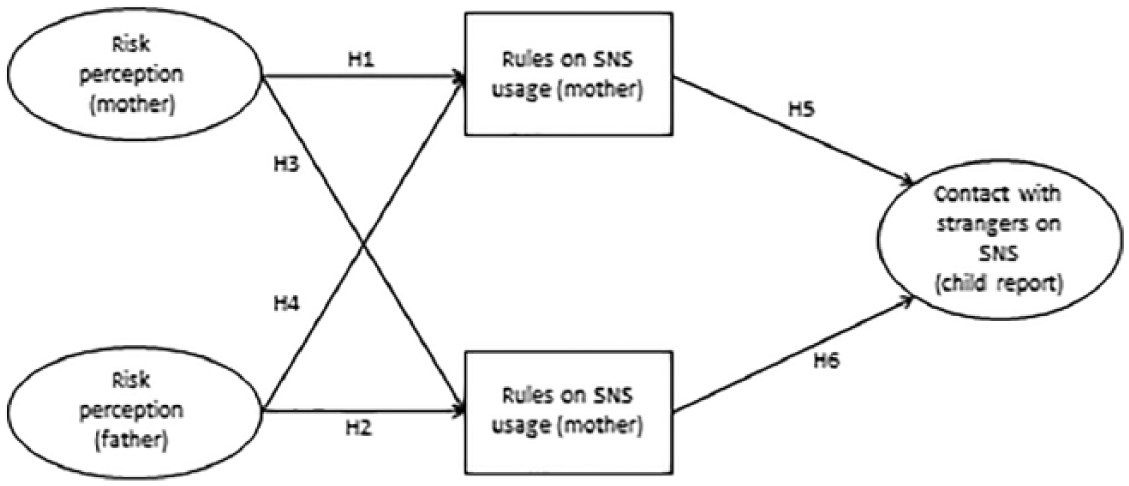
Proposed model.
Background
Although Internet use can provide children and adolescents with unparalleled benefits and opportunities, Internet and social media use can also be associated with certain risks. Current research indicates that most parents show at least some concern over these risks, such as privacy issues (i.e., sharing too much private information online), commercial risks, exposure to sexual content, or online bullying (Lim, 2013; Sorbring, 2014; Symons, Ponnet, Walrave, & Heirman, 2017). Unsurprisingly, setting rules and restrictions regarding the child’s behavior on social networking sites (SNSs) has become a popular parental mediation strategy. In the current study, we focus on interaction restriction, a specific type of restrictive parental mediation (Livingstone & Helsper, 2008; Sonck et al., 2013; Symons, Ponnet, Emmery, Walrave, & Heirman, 2017). Interaction restriction refers to rules on appropriate behavior on SNS (Livingstone & Helsper, 2008). Setting interaction restrictions as a strategy covers practices such as discussing what type of pictures can be shared online and which friends the child can add to its SNS profile. While often mentioned in the literature on parental mediation, empirical research on interaction restrictions is scarce.
As a behavioral outcome, this study explores the extent to which the adolescent has online contact with strangers. Adding strangers to one’s social network online is not an uncommon behavior, with about half of young people having done this (Livingstone & Smith, 2014). A study in the Dutch-speaking area of Belgium, where the current study took place, found that one in five young people aged 14 to 19 finds it acceptable to add complete strangers on SNS (Vandoninck, d’Haenens, De Cock, & Donoso, 2011). This behavior can be considered as a risk behavior and can be linked with problematic Internet use and problematic online experiences such as cyberbullying (Gámez-Guadix, Borrajo, & Almendros, 2016).
Father’s and Mother’s (Internet) Parenting
Traditionally, research on parenting focuses on the mother’s parenting practices, while the father is considered to be of lesser relevance. With changing societal roles of men and women—notably women’s participation in the labor market and evolving ideas on the father’s role in the household—increasingly more attention is devoted to parenting practices by the father as well (e.g., Barnett, Deng, Mills-Koonce, Willoughby, & Cox, 2008; McDermott Panetta, Somers, Ceresnie, Hillman, & Partridge, 2014; Van Holland De Graaf, Hoogenboom, De Roos, & Bucx, 2018). Research shows that mothers are more likely to adopt an authoritative parenting style, while fathers are more likely to adopt an authoritarian style (McKinney & Renk, 2008).
Specifically with regard to parental mediation of adolescents’ Internet use, it remains unclear whether and how mothers and fathers differ from each other. One study found that mothers report more engagement in mediation compared with fathers, and this is in terms of setting restrictions on Internet access and on the behavior that is allowed on SNS (Symons et al., 2017). Another study found that fathers were more likely than mothers to monitor which websites their child visited (Wang, Bianchi, & Raley, 2005). In a study by Sonck et al. (2013), fathers reported to be more engaged in monitoring the adolescent’s online behavior, while mothers reported to engage more in setting restrictions with regard to the content the child can access online. It is plausible that both parents will influence each other in terms of the parenting practices that they engage in. For example, one parent can engage in mediation because the other parent is urging to do so. There is a lack of empirical knowledge on how such interparental effects play out.
In conclusion, the current study investigates the link between parental concern over Internet risks, parents’ rule-setting regarding the behavior that is allowed on SNS, and the adolescent’s risk behavior on SNS (i.e., online stranger contact). Figure 1 presents the structural equation model that is tested in this study. It is predicted that the mother’s and the father’s concerns over Internet risks are positively related to their own (H1 & H2) as well as the other parent’s engagement (H3 & H4) in rule-setting regarding the child’s behavior on SNS. Furthermore, the model predicts that parental mediation of mothers (H5) and fathers (H6) is negatively related to the adolescent child’s online contact with strangers. The study made use of two-parent households only, including newly composed two-parent households.
Method
Participants
A multi-actor approach of data collection was used, where data were gathered from different members of the same family. Two-parent families were recruited to achieve a report from a mother, a father, and a child in the age group of 13 to 18 years. Given the high rate of nonresponse associated with the collection of multi-actor data (Kalmijn & Liefbroer, 2011), the study employed a non-probabilistic sampling design. Families were recruited in Flanders, the northern, Dutch-speaking region of Belgium, with assistance from undergraduate students from the Higher Education Institution where the researchers are based. With regard to newly composed families, it was requested that both partners shared the same house for at least 3 years prior to the survey. If there was more than one child in the family between 13 and 18 years, the parents were asked to keep one specific child in mind when completing the questionnaire.
Each recruited family received an envelope consisting of the three questionnaires for the participating family members, together with a plain-language statement and a written informed consent form. The first page of the questionnaire instructed the target participants to complete the booklets individually and not to discuss the content of the questionnaire with one another. To protect the respondents’ privacy, separate envelopes were provided which could be sealed and used for each completed questionnaire. After completion, the three questionnaires were sent back by mail, for which a (stamped) envelope was provided. By means of a code on the back of the questionnaires, it was ensured that the three questionnaires from the same household were linked in a correct manner when inputting the data. Data were gathered between December 2015 and February 2016. The study protocol was approved by the ethics committee of University of Antwerp.
A total of 357 valid triads were achieved. The sample consisted of 54.9% (n = 196) female adolescents. The child’s age ranged from 13 to 18 (M = 15.73; SD = 1.50), the mother’s age ranged from 31 to 59 (M = 44.19; SD = 4.72), and the father’s age ranged from 31 to 70 (M = 46.67; SD = 5.65). All respondents indicated that they had access to a device at home with Internet access. The majority of adolescents (98.9%, n = 351) possessed a personal smartphone and 92.1% (n = 257) had a profile on an SNS.
Measures
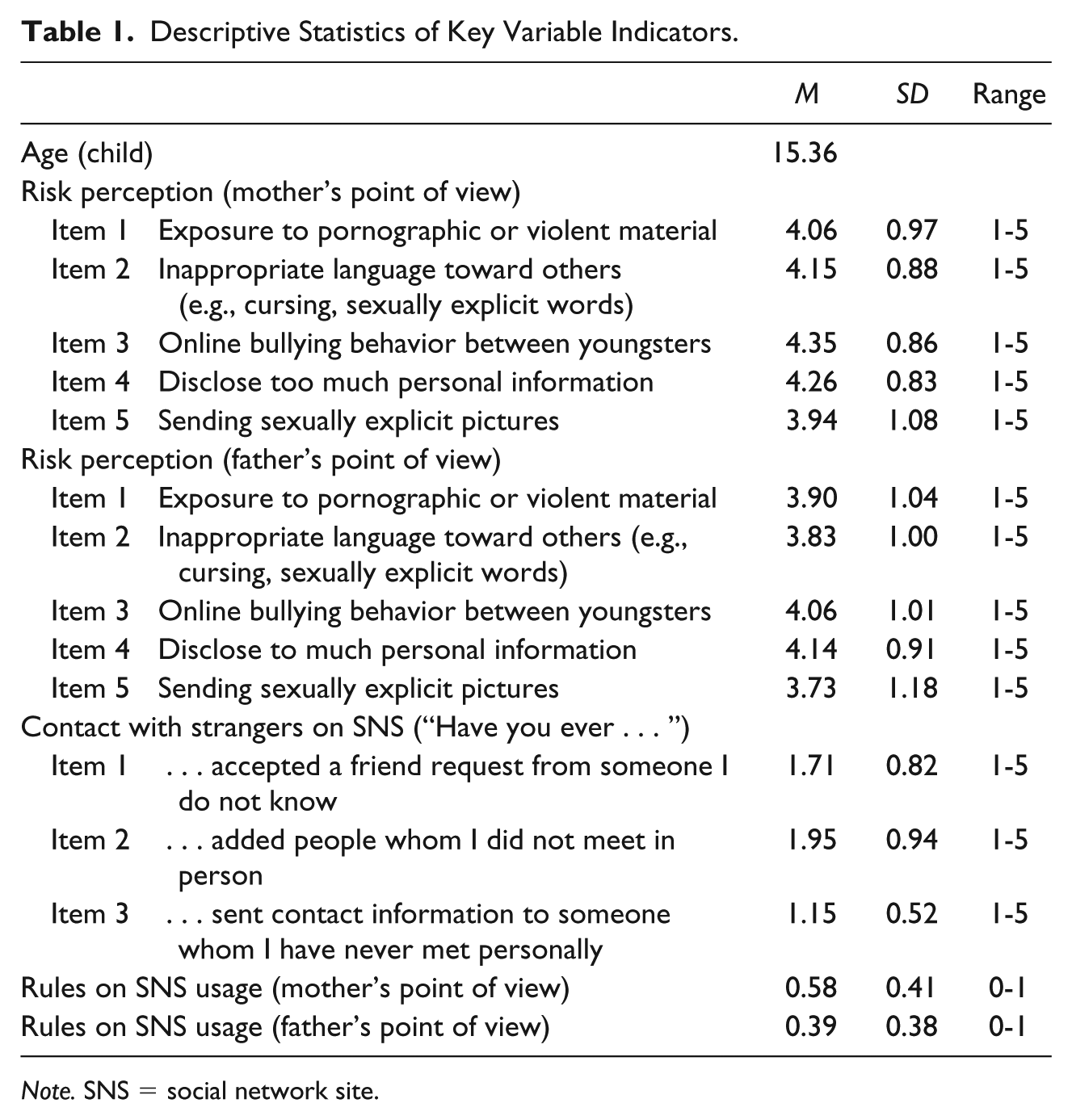
Table 1 provides an overview of the descriptive statistics of the variables.
Descriptive Statistics of Key Variable Indicators.
Note. SNS = social network site.
Parents’ risk perception
Adapted from previous research (Livingstone, Haddon, Görzig, & Ólafsson, 2011), a five-item scale was used. Parents were asked to indicate to what extent they considered five issues a potential risk for young people who make use of the Internet, going from “not a risk at all” (Score 1) to “definitely a risk” (Score 5). The internal consistency of the scale was good, as shown by Cronbach’s alphas of .89 for the fathers’ point of view and .89 for the mothers’ point of view.
Engagement in interaction restrictions
Adapted from previous research (Livingstone & Helsper, 2008; Sonck et al., 2013), four items were used to measure parents’ interaction restrictions. Parents were asked to indicate whether or not they applied rules with regard to the following social media interactions (yes/no): who your child can add to his or her social profile, with whom your child can chat, the information that your child can share via his or her profile, and the pictures that your child may post. For the analysis, the mean score was used, with a range from 0 to 1. A score close to 1 indicates that the parent sets a high number of interaction restrictions, while a score close to 0 indicates that the parent sets a low number of interaction restrictions.
Contact with strangers on SNS
In accordance with previous research (Lobe, Livingstone, Olafsson, & Vodeb, 2011), a three-item scale was used to measure whether they had contact with strangers. The child was asked to indicate on a 5-point Likert-type scale how often they engaged in three types of behavior on SNS, going from “never” (Score 1) to “very often” (Score 5). These behaviors refer to having accepted friend requests from someone they do not know, having sent such a request to someone they never met in person, and having sent contact information to someone they never met in person. The scale’s reliability value (Cronbach’s α = .69) was sufficient.
SNS frequency
To measure the frequency of SNS usage, the respondent was asked to indicate on an 8-point Likert-type scale how often they used an SNS, going from “never” (Score 1) to “more than seven times a day” (Score 5)
Analytic Strategy and Model Specification
To test the abovementioned model, we performed structural equation modeling (SEM) with maximum likelihood estimation in Mplus (Muthén & Muthén, 1998-2012). In the first step, we built a measurement model to examine whether the latent variables were indeed a reliable reflection of the observed variables. In the second step, we estimated the structural model with risk perception of both mother and father as predictor variables and with both mother’s and father’s engagement in interaction restrictions and stranger contact on SNSs as endogenous variables. Table 1 shows the descriptive statistics of the key variable indicators. Rules on SNS usage were included as an observed variable, which was calculated using the mean scores. This choice was made due to the dichotomous answering scale (yes/no) that was used in the questionnaire. In our structural model, age, gender, and SNS frequency were included as covariates.
Results
Measurement Model
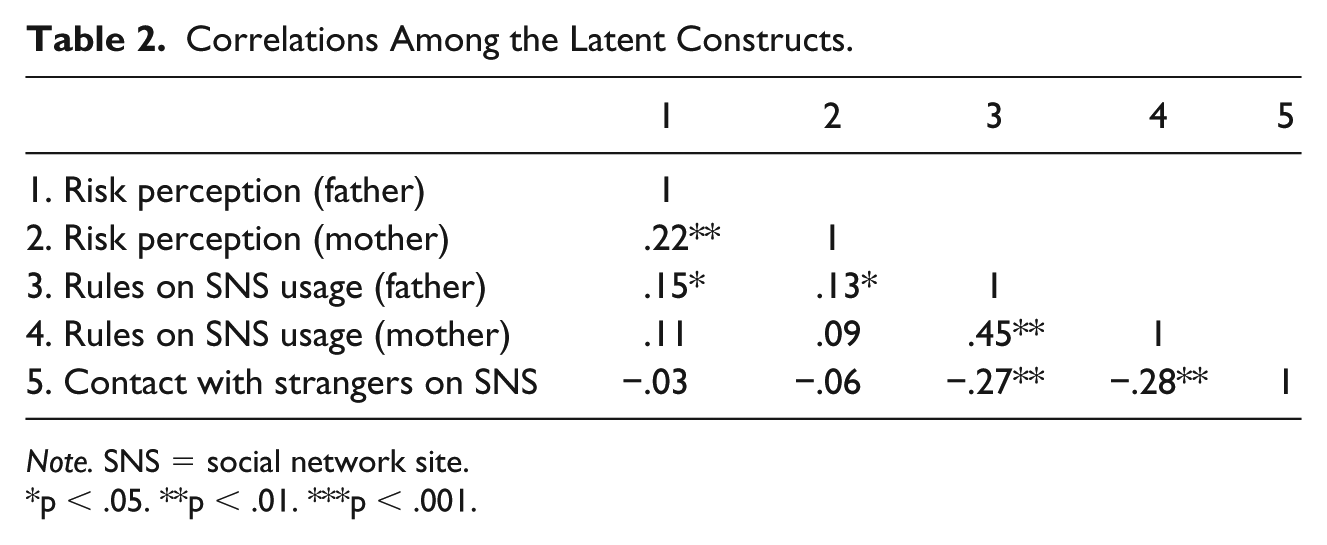
Our measurement model provided a good fit to the data: χ2(72): 164.66, p < .001, comparative fit index (CFI) = .95, root mean square error of approximation (RMSEA) = .071 (confidence interval [CI]: [.056, .084]), and standardized root mean square residual (SRMR) = .034. All factor loadings scored above .56. Table 2 provides the correlations of the study variables.
Correlations Among the Latent Constructs.
Note. SNS = social network site.
p < .05. **p < .01. ***p < .001.
Prior to building the structural model, we looked further into the following correlation that we found in our measurement model, between the mother’s risk perception and the father’s risk perception (r = .22, p < .01). Using the chi-square difference test, we wanted to establish whether it was valid to integrate these variables as separate variables into our structural model. We made a comparison between a model in which the mother’s risk perception and the father’s risk perception were modeled separately and a model in which both constructs were combined into one single construct. Results of the first chi-square difference test indicated that combining the mothers’ risk perception and the father’s risk perception into one construct decreased the fit significantly, χ2(1) = 833, p < .01. Therefore, these constructs were entered separately in our final model. Nevertheless, we allowed a correlation between the mothers’ risk perception and the fathers’ risk perception.
Structural Model
Our structural model provided a good fit to the data: χ2(105): 225.584, p < .001, CFI = .94, RMSEA = .062 (CI: [.050, .074]), and SRMR = .043. In H1 through H4, we assumed a relationship between parental risk perception and the parent’s application of online interaction restrictions. Our final model (see Figure 2) shows only one significant pathway between risk perception and online interaction restrictions. More specifically, the mother’s risk perception was positively significantly associated with the father’s application of online interaction restrictions (β = .13, p < .05), thereby confirming Hypothesis 3. There were no significant pathways between the father’s risk perception and the mother’s application of online interaction restrictions (β = .11, ns), between the mother’s risk perception and the mother’s application of interaction restrictions (β = .04, ns), and between the father’s risk perception and the father’s application of interaction restrictions (β = .08, ns).

Final model.
Furthermore, our model confirmed that there was a relationship between parents’ application of online interaction restrictions and whether a child adds strangers on SNSs. More specifically, both the mother’s interaction restrictions (β = −.20, p < .005) and the father’s interaction restrictions (β = −.16, p < .05) were negatively related to the child’s online contact with strangers. The results thus suggested that maternal and paternal Internet mediation contributes to the child’s safe online behavior, which is in line with our expectations in H5 and H6.
Age, as a covariate, was significantly related to several variables in the structural model. Age is negatively associated with both the mothers’ interaction restrictions (β = −.25, p < .001) and the fathers’ interaction restrictions (β = −.32, p < .001). The fathers’ risk perception was negatively related to age (β = −.15, p < .05), indicating that fathers perceive less online risk as their child grows older. For mothers, this was not the case. Finally, age was positively associated with having online contact with strangers (β = .16, p < .05). This suggests that older children are more likely to have contact on SNSs with people they do not know in real life. Gender was only associated with one variable, namely the mother’s application of online interaction restrictions (β = .11, p < .05). Mothers are more likely to restrict their daughter’s online behavior compared with their son’s. Frequency of social media usage, entered as the third covariate in the model, was significantly related to online contact with strangers (β = .11, p < .001).
Discussion
The current study offers empirical insight on the hypotheses that parents’ engagement in Internet mediation is motivated by their own as well as the other parent’s concerns over Internet risks and that parental mediation lowers the adolescent’s engagement in online risk behavior. Contrary to the expectations, parents’ concerns over Internet risks were not related to increased rule-setting on SNS. The mother’s increased concern predicted more rule-setting by the father, but this effect was only weak. Furthermore, it was confirmed that both the mother’s and the father’s mediation in terms of rule-setting in the area of SNS use contribute to less risk behavior on these websites by the adolescent, and this is in terms of having less contact with strangers. Overall, the results indicate that both the mother and the father contribute to enhancing safe Internet use by the adolescent child, hence underlining the importance of considering both parents in studies on parental mediation.
Despite conscientious preparation of this study, certain limitations need to be kept in mind when interpreting the data. First, the use of multi-actor data, which were used to further understand family processes in children’s social media usage, has led to the choice to only include two-parent families, including newly composed families. This family type is common in the Dutch-speaking area of Belgium, where the study was conducted (Pasteels & Mortelmans, 2015). However, this study did not take into account other family types, such as one-parent families, which might be interesting to do in future studies. Second, as an independent variable, our study focused on concerns with regard to general Internet usage and did not specifically measure parental concerns with regard to social media. Future empirical research should go further into detail, by focusing on concerns and rule-setting with regard to specific social media channels, such as Facebook and Instagram. Finally, the present study did not investigate the factors that may cause or influence parental concerns on SNS usage. For instance, the parents’ own social media usage is a factor that might influence parents’ concerns over Internet use and their engagement in Internet mediation. Therefore, it might be interesting for future research to look into the parents’ social media skill set.
In conclusion, rule-setting on the use of SNS is not predicted by the concerns parents have regarding Internet risks. It is possible that this type of parental practices has become a common practice and not a response to particular parental concerns. Furthermore, in two-parent households, traditional and newly composed households, both parents contribute to the adolescent child’s safe Internet use.
Footnotes
Declaration of Conflicting Interests
The author(s) declared no potential conflicts of interest with respect to the research, authorship, and/or publication of this article.
Funding
The author(s) disclosed receipt of the following financial support for the research, authorship, and/or publication of this article: The study was funded by the Research Fund of University College Odisee, and the authors gratefully acknowledge the support of the Research Fund. The work of Joris Van Ouytsel is supported by the Research Foundation—Flanders. The study design, data collection, analysis, interpretation of the data, writing of the report, and the decision to submit the article for publication were the sole responsibility of the authors and were in no way influenced by the funding institutions.
