




Abstract
Previous studies offer evidence that U.S. public and private high schools differentially influence volunteerism in adolescence. However, these studies are typically cross-sectional and only consider whether the individual volunteered or not. We address patterns of volunteering from adolescence into adulthood and the kind of volunteering activity in which individuals engage. We also theorize that distinctive civic values within public and private schools together with their respective organizational ties to other civic organizations channel students into particular volunteering activities. Relying on a longitudinal, nationally representative sample of U.S. adolescents, we track volunteering from adolescence into young adulthood and identify the types of volunteering activities in which respondents engage. Results demonstrate that the likelihood of volunteering changes through the life course, and students from different schooling backgrounds systematically sort into specific volunteering activities as our theories predict.
The apparent decline in quantity and quality of civic participation in the United States, particularly among youth and young adults, has generated calls for renewed attention to civic education (Bureau of Labor Statistics, 2016; Grimm, Dietz, Foster-Bey, Reingold, & Nesbit, 2006; Putnam, 2000; Smith, Christoffersen, Davidson, & Herzog, 2009). This call begs the question of whether and how civic education in secondary schools matters for civic engagement during adolescence and into young adulthood. In light of this, some research has explored the impacts of civic education programs on civic participation (Astin, Sax, & Avalos, 1999; Campbell & Niemi, 2016; Henderson, Brown, & Pancer, 2012; Planty, Bozick, & Regnier, 2006; Riedel, 2002). A second strand of research focuses on civic outcomes in private schools, investigating whether these schools strengthen or weaken civic engagement and values, given concerns that they may not necessarily share the civic mission of public schools to prepare students for common life (Campbell, 2001; Carlson, Chingos, & Campbell, 2017; Cheng, 2014; Fleming, Mitchell, & McNally, 2014; Marks & Kuss, 2001; Smith & Sikkink, 1999; Wolf, 2007).
Yet significant research gaps in both of these lines of research remain. Compared with what is known about student civic engagement during high school, the longer term impact of adolescent experiences on adult civic engagement is less well understood. Some research argues that student government participation and student volunteering during high school has a positive effect on adult voting, subsequent volunteering, and other forms of civic engagement (Gill et al., 2018; Hart, Donnelly, Youniss, & Atkins, 2007; Janoski, Musick, & Wilson, 1998; McFarland & Thomas, 2006; Planty et al., 2006). But not all studies find consistent associations between high school experiences and adult civic engagement (Henderson et al., 2012; Jones & Hill, 2003). Studies of the role of school sector in shaping adult civic engagement have also produced mixed results. Private school graduates are sometimes more likely to be civically engaged after secondary school than public school graduates (Wolf, 2007); in other cases, they are not (Dill, 2009; Fleming et al., 2014; Hill & Den Dulk, 2013; Marks & Jones, 2004; Sikkink, 2012). The research literature has also not explored connections between school experiences and particular types of civic involvement. That is, researchers have studied factors that influence the propensity to volunteer but have not widely considered which specific types of civic organizations and causes individuals commit to nor why they commit to them.
In this article, we address these research gaps by painting a detailed picture of volunteerism using longitudinal data to observe trends and specific volunteer activities among a nationally representative sample of U.S. individuals from adolescence through young adulthood. As with other research in this area, our ability to draw causal inferences between student volunteering and schooling is hampered by a lack of an experimental design and detailed measures of school-level characteristics, especially regarding their civic organizational networks. We instead present a theoretical case for differences in civic education between Catholic, Protestant, secular private, and public schools, and subject our hypotheses to an empirical test.
We propose that the organizational networks of these schools and the civic values that they espouse uniquely shape the types of civic organizations and causes taken up by their students from adolescence to early adulthood. The role of organizational networks and volunteer identities in fostering volunteerism has been widely considered in the civic engagement literature (Andolina, Jenkins, Zukin, & Keeter, 2003; Musick & Wilson, 2008; Sundeen & Raskoff, 2000; Wuthnow, 2004; Youniss, McLellan, & Yates, 1999) but not in the civic education literature. Analysis of our data reveals distinctive volunteering patterns across the separate school sectors, which are consistent with what our theories would predict. Identifying the particular types of volunteering activities in which individuals participate and exploring reasons behind these patterns are valuable for better understanding the nature of civic engagement broadly.
Literature Review
Theories of School Sector and Civic Engagement
Civic formation processes are complex, especially when considering the influences of youth experiences on longer-run adult civic engagement. Although there are a variety of civic outcomes such as voting or civic knowledge, we focus on volunteering defined as freely choosing to give one’s time and effort to support the work of a charity or other formal organizations without material compensation (Snyder & Omoto, 2008). Rather than testing the efficacy of a specific program or curriculum, as much of the prior research has done (Campbell & Niemi, 2016; Planty et al., 2006), we focus on the influence of more general social dynamics and cultures within school communities. We theorize that expectations, habits, and practices related to civic involvement and built within schools shape the formation of volunteering identities. Moreover, institutional ties between particular school communities and other civic organizations, whether they are established through familiarity, personal relationships, or positions in recruitment networks, also influence the propensity to volunteer (Jones & Hill, 2003; Marks & Jones, 2004; Omoto & Snyder, 2002; Snyder & Omoto, 2008).
Specifically, we develop theories about public schools and the three dominant types of private schools in the United States—Catholic, Protestant, and nonreligious—with respect to student volunteering and community service, explaining how civic socialization in each respective school sector should influence student commitments and practices related to volunteering. Civic socialization in schools depends on numerous factors that characterize the school community: school mission and authority, socialization messages, curriculum and pedagogy, social capital, and organizational networks between schools and civic organizations. The wide variation in these institutional characteristics across public, Catholic, Protestant, and nonreligious schools is well documented in the research literature (Bryk, Lee, & Holland, 1993; Campbell, 2001; Cheng, Trivitt, & Wolf, 2016; Mehta & Fine, 2019; Uecker, 2009). By taking a comparative approach that highlights key differences across these types of school institutions, we shed light on school characteristics and processes that influence civic engagement of students over time and the various types of organizations for which the students volunteered.
Public schools
Public schools in the United States, emerging out of the strong relationship between local communities and mid-19th-century Protestantism (Meyer, Tyack, Nagel, & Gordon, 1979), originated with a mission to form citizens for effective participation in democracy (Butts, 1980). At different points in history, civic education in public schools was driven by a concern to socialize and assimilate immigrants, especially Catholics, but on the whole the public school civic mission reflected the integral place of these schools in the life of the local community (Glenn, 2012). As highly visible institutions in communities, public schools are likely to continue to have a central place within the local civic ecology. While civic organizations attempt to reach needy families and children through public schools, schools attempt to link students to community service opportunities through the school’s ties to civic organizations.
The civic location of public schools, together with long-standing concerns about separation of church and state, may produce general patterns in volunteering that favor involvement in the nonreligious civic sphere (Justice & Macleod, 2016). For instance, a public school is more likely to form an organizational tie with the United Way rather than Catholic Relief Services—an overtly religious organization. To the extent that public schools provide frameworks for understanding civic obligations, prepare students for democratic participation, or channel students to organizations with established ties to the school, public school students would be more likely to be involved in civic organizations and causes that are in similar positions in the civic space as their schools. These organizations especially include nonreligious organizations such as political and community service groups that are local or even based within the school (Giles & Eyler, 1994).
A democratic governance structure that positions public education in relation to various political groups and forces (Moe, 2011) may also contribute to stronger bridges between public schools and political volunteering. We would similarly expect a natural connection to environmental causes and organizations as this involvement is closely linked to the political sphere. Moreover, the environmental cause fits well with the civic mission of public schools as recycling, conservation, and other environmental causes embed a moral dimension, a civic responsibility and obligation, without drawing directly on religious themes and motives (Chawla & Cushing, 2007).
We expect that public schools instill civic skills that influence students to continue volunteering beyond high school as well. This impact may be due to formal civic education found in the public school curriculum or related service-learning opportunities, though the effect likely diminishes over time (Campbell & Niemi, 2016; Jones & Hill, 2003; Marks & Kuss, 2001; Planty et al., 2006). A school that fosters volunteering during the high school years may form volunteering identities, enhance civic skills, and create ties to civic organizations that continue to facilitate volunteering during college or in early career and family life. But changing contexts across the life course, such as college, career, or family life, raise potential obstacles to the long reach of high school experiences and socialization. Thus, despite decreases in overall rates of volunteering, we suspect that the kind of volunteering performed does not change drastically as adolescents enter young adulthood. Organizational ties established during high school, especially particularly toward volunteering in the political, environmental, and nonreligious civic sector, may continue to shape volunteering into young adulthood (Sikkink, 2012).
Catholic schools
The religious mission of service to humanity generates strong cultural supports for volunteering in post-Vatican II Catholic schools. This is reflected in schooling practices, including an emphasis on integrating volunteering and civic engagement directly into classes and embedded in the school community (Bryk et al., 1993; Campbell, 2001; Marks & Kuss, 2001; Scanlan, 2008). Catholic schools have organizational networks that facilitate student volunteering and community service, particularly to areas of civic life where Catholic organizations are well represented. These opportunities include Catholic Relief Services, Catholic hospitals, and other civic institutions that are religious in orientation and mission. These organizations are often active in health care and poverty relief. Student volunteering through Catholic churches and church-related organizations is also likely common given that such activity is constitutive of the overlapping social capital that binds home, school, and parish together (Bryk et al., 1993; Campbell, 2001; Degeneffe, 2003).
Explicitly religious instruction and ties to Catholic civic organizations might sustain volunteering in poverty relief, international, and health care organizations and causes among Catholic school students (Planty et al., 2006; Scanlan, 2008). These forms of civic participation stem from the long-standing principles of duty toward serving God and humanity within the Christian tradition (Wilson & Janoski, 1995; Wuthnow, 1995, 1999). Moreover, as Catholic civic organizations have an interest in seeking out Catholic school graduates, which constitute a ready pool of volunteers, it seems more likely that the organizational ties to Catholic civic organizations would have staying power into young adulthood.
Yet the effectiveness of ties to Catholic dioceses and parishes, built in part through Catholic school experiences, are difficult to judge. Catholic parishes are generally not as effective in maintaining levels of commitment and involvement of young adults compared with Protestant churches (Smith, Longest, Hill, & Christoffersen, 2014; Wuthnow, 1999). Though ties to Catholic schools or parishes experienced during high school likely channel a good deal of Catholic student volunteering through Church activities, the impact of this tie on Catholic student volunteering may attenuate after high school graduation. Nonetheless, if Catholic schools focus on fostering commitment to particular volunteer activities, such as health care and poverty relief, one might observe higher rates of volunteering among adults who attended Catholic school in those areas but not overall.
Protestant schools
Protestant schools are typically marked by a robust, tight-knit school community and a strong sense of belonging and collective identity, binding students to the mission and socialization goals of the school (Vryhof, 2004). Even while formal ties to a particular congregation are decreasing in favor of independent school boards and nondenominational evangelical schools, conservative Protestant schools no doubt maintain strong organizational ties to local evangelical churches, in part as a strategy of student recruitment and as an effort to form students through cooperation and consistency across home, church, and school. Consistent with the average levels of involvement in bridging civic organizations of conservative Protestant churches, we expect that ties to other civic organizations, whether nonreligious or Catholic, are not strong among Protestant schools (Beyerlein & Hipp, 2006). Student volunteering may be funneled into and through religious congregations and other religious organizations active in civic life, given the lack of ties between Protestant schools and the nonreligious civic sphere. In contrast to Catholic schools, which tightly link spiritual formation and civic commitment and activity, Protestant orientations to spiritual formation in schools may not have a natural fit with volunteering outside the religious or school community.
Insofar as Protestant schools shape the pattern of civic volunteering, they are likely to facilitate or to encourage students toward international relief efforts as these schools are connected to and directly organize overseas mission trips that include social service volunteering. These trips have been associated with subsequent civic involvement in religious organizations (Beyerlein, Trinitapoli, & Adler, 2011). In addition, connections to civic organizations that have a religious orientation, such as Habitat for Humanity, may be stronger within Protestant schools and may prepare students for involvement in similarly religiously affiliated community and neighborhood improvement organizations later in life. We generally expect that the kind of volunteering that is encouraged within the cultural-structural environment of Protestant schools is focused on meeting human needs directly, such as poverty relief, the needs of the older adults, and perhaps health care services (Schwartz & Sikkink, 2017; Sikkink, 2012; Wuthnow, 2009).
Strong ties to those types of volunteering activities may steer Protestant school students away from other types of volunteering, such as those for political and environmental purposes. Civic volunteering focused on structural issues, especially related to political issues outside of prolife causes, are not common among evangelical churches (Beyerlein & Chaves, 2003), and this may be replicated within Protestant schools. Socialization messages in these schools focus on pursuing a religious calling and eschewing secular, worldly values, which generally refers to dominant cultural orientations toward money and power (Sikkink, 2014). Conceptions of politics as the self-interested pursuit of power, common in evangelical circles (Schwadel, 2005a; Smith, 2000; Wilson & Janoski, 1995; Wuthnow, 1999), set up conflicts between political engagement and the religious identity formation goals of the school. Some political groups, such as environmentalists, have found conflict with conservative religious views and groups, thereby reducing the likelihood of recruitment efforts and organizational ties to Protestant schools (J. H. Evans & Feng, 2013; Schwartz & Sikkink, 2017).
Student patterns of volunteering established in Protestant schools may persist into young adulthood because these schools instill religious commitments to meet direct human needs through personal sacrifice. That may continue to guide Protestant students in adulthood toward the kind of civic engagement they experienced in high school, such as community or neighborhood involvement in organizations such as Habitat for Humanity or other poverty relief and international social service organizations. The dominant way that Protestant schools shape adult civic engagement may be through enhancement of ties and commitments to religious congregations, which is both encouraged as a norm within evangelical schools and facilitated through numerous organizational ties between evangelical schools and congregational activities (Planty et al., 2006). Moreover, students in Protestant schools, insofar as they form strong ties and persist in high levels of involvement in a congregation, might also develop skills and behaviors conducive to the communal life of their local church (Wuthnow, 1999, 2004) Researchers have suggested that these skills and behaviors may transfer to broader forms of civic engagement outside their congregations (Djupe & Grant, 2001; Putnam & Campbell, 2010; Smidt, 2008; Verba, Schlozman, & Brady, 1995; Wuthnow, 2004). Thus, and in contrast to Catholic school students, for whom commitment and membership to local parishes is lower (Smith et al., 2014), Protestant school students should be more likely to organize their volunteering through churches or church-related organizations in young adulthood (Schwartz & Sikkink, 2017). This difference between Catholic and Protestant school students is widened by the greater religious diversity in Catholic schools, which makes it more difficult for them to maintain civic volunteering through religious organizations for all their graduates (Cheng et al., 2016).
Indeed, prior research suggests that higher volunteering rates among Protestant school students relative to their public school counterparts during secondary school persist into adulthood, whereas adults who attended Catholic schools are not any more or less likely to volunteer than are adults who attended public schools (Dill, 2009; Hill & Den Dulk, 2013). It is important to note, however, that this research does not test whether ties to religious congregations explain this pattern. Though the high-time demands of evangelical congregations can reduce civic engagement (Wuthnow, 1999), the organizational ties to religiously affiliated organizations active in civic life as well as the civic skills and sociability fostered in evangelical congregations (Verba et al., 1995; Wuthnow, 1999) should lead to higher levels of civic participation. Later, we test whether Protestant school students are more likely to maintain bridges to civic organizations that are religiously affiliated, which may be generated in part through involvement in evangelical congregations.
Nonreligious private schools
Nonreligious private schools are difficult to assess on civic engagement, given the relatively wider diversity in the sector. On one hand, the nonreligious private school sector comprises schools that operate in the Progressive tradition. These schools typically uphold a sense of civic purpose and obligation, which mobilizes students into community-oriented, political, and poverty relief causes and organizations (Broome, 2011; Dahlin, 2010). These dispositions will likely persist into adulthood, similar to what we have hypothesized about the public school student.
On the other hand, many nonreligious private schools are primarily oriented to admission to elite colleges and universities and may encourage their students to pursue volunteering opportunities to gain leadership experience and yield a favorable college admission application (Handy et al., 2010; Marks & Jones, 2004). An individualistic orientation to the school and competitive school climate may enhance an instrumental orientation to volunteering during high school (Campbell, 2001). Such an environment is unlikely to generate the kind of volunteer identities and commitments that would lead to higher levels of volunteering into young adulthood. To the extent that an increase in volunteering during high school is a strategy to gain admission to an elite college or university, nonreligious private schoolers would be unlikely to maintain civic engagement outside the structural supports of college or career. Moreover, unlike religious private schools, nonreligious private schools—whether elite or Progressive—may also lack natural and well-worn pathways between school and most religious organizations operating in the civic sphere that would sustain volunteering in such organizations into adulthood.
Summary and Research Hypotheses
The organizational locus and values of each school sector in the civic sphere should not only influence a general propensity to volunteer but also funnel students into particular types of volunteer activities in adolescence and into young adulthood.
Method
Data
We use data from the Education Longitudinal Study of 2002 (ELS:02) to examine volunteerism rates for students with different schooling backgrounds. ELS:02 consists of surveys administered in four waves by the U.S. Department of Education to over 15,000 U.S. 10th graders. Respondents were initially surveyed in 2002 and given follow-up surveys in 2004, 2006, and 2012. These data provide longitudinal information about U.S. adolescents as they progress through secondary education and move into postsecondary education and adulthood. Stratified random sampling procedures were used to select schools and respondents to ensure that the data are nationally representative of all 10th graders. Teachers, parents, and school administrators also provided additional information about the respondents’ background and school setting in the initial year of the survey. For further information about ELS:02, please see Ingels et al. (2014).
Students in the sample are asked about a series of items, including their family life, future aspirations, school experiences, employment outcomes as well as their demographic background. We use information that respondents provided about their volunteering activities. In each survey wave, respondents were asked whether they have participated in community service within the past 2 years. In the second through fourth waves, respondents who volunteered also indicated where they completed their volunteering: youth or community service organizations (e.g., Scouts, Little League, Big Brothers Big Sisters, Key Club, or other similar school-based service groups), political clubs or organizations, religious groups (not including volunteering at worship services), community centers or neighborhood improvement organizations, hospitals or nursing homes, or recycling, conservation, or environmental organizations. Table 1 provides rates of volunteering through these organizations for each wave and overall for each wave. Respondents may have volunteered through more than one of these organizations. We point out that volunteerism rates peak during the respondents’ 12th-grade year and decrease into young adulthood and that most volunteering occurs in youth or community service organizations, churches, and community centers.
Volunteerism Rates.

Note. Sampling weights used to compute percentages.
For example, Little League, Scouts, Big Brother/Big Sister, Key Club, and other community service groups based in schools or serving youth.
The ELS:02 data set also allows us to identify the type of high school that each respondent attended, our key independent variable. As shown in Table 2, about 92% of respondents attend public high schools. Four percent of respondents attend Catholic high schools while about 2% of respondents attend Protestant and nonreligious high schools, respectively. The remainder of Table 2 lists summary statistics for other demographic characteristics of the respondent, such as gender, race, school characteristics, mother’s educational attainment, family income, educational attainment, and cognitive skills in mathematics and reading.
Summary Statistics for Independent Variables.
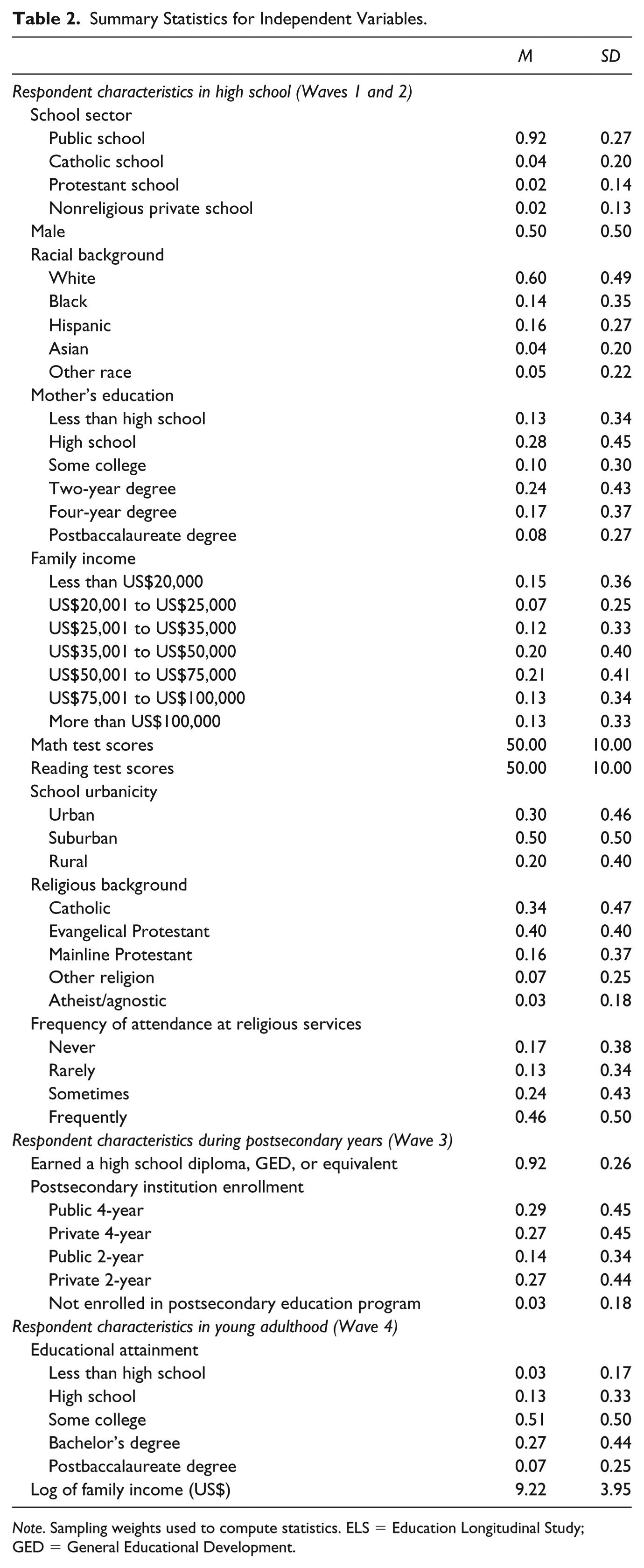
Note. Sampling weights used to compute statistics. ELS = Education Longitudinal Study; GED = General Educational Development.
Empirical Strategy
We run a series of logistic regressions to explore patterns between secondary schooling background and volunteerism behavior. Because we are interested in the types of activities that volunteers participate in, we limit the sample to respondents who reported some form of volunteering in each wave. We then examine the rates at which respondents participate in a particular type of volunteering work at each wave of the study, comparing them across students who attended public, Catholic, Protestant, and nonreligious high schools. We estimate the following model:

In Equation 1, Vi is an indicator for whether participant i completed a specific type of volunteer work within the past 2 years of the respective ELS wave.
Results
Overall Volunteerism Rates Over Time
We begin by presenting overall volunteerism rates over time by school sector. Figure 1 displays the estimated probabilities, with 95% confidence intervals, of participating in volunteer work for respondents in a given school sector, net of the control variables included in Table 2.

Overall volunteerism rates by school sector and ELS wave.
During the respondents’ 10th-grade year, students in Catholic schools are most likely to participate in volunteer work. Over 40% of respondents who attended Catholic schools in 10th grade state that they have completed volunteer work, whereas less than one third of respondents from Protestant and public schools report doing the same. These differences are substantively large and statistically significant at the .05 level as indicated by the nonoverlapping 95% confidence intervals. Volunteerism rates are similar among Protestant, nonreligious private, and public school students.
By 12th grade, volunteerism rates rise for all sectors, with respondents attending Catholic and Protestant schools leading the way, perhaps indicating a tendency for high schools to require or provide volunteering opportunities for older students. About 70% of students in religious schools report completing volunteer activity within the past 2 years while 58% of public school students report the same, a difference that is statistically significant at the 95% confidence level. Meanwhile, about 63% of students in nonreligious private schools report volunteering in 12th grade.
Volunteerism behavior across all school sectors decreases during the postsecondary years. Half of the students from Protestant high schools report having completed volunteer work since their 12th-grade year. Meanwhile, the rate for students in the other school sectors stands lower at about 40%. The drop in volunteerism rates is most pronounced for respondents from Catholic high schools, who are 6 and 12 percentages points less likely to volunteer than respondents from public and Protestant high schools, respectively. Both differences are statistically significant at the .05 level. Volunteerism rates for students who attended nonreligious private schools are similar to rates for students who attended public schools.
Finally, volunteering rates observed in the final wave of data collection are similar to those observed in the previous wave 6 years earlier in Wave 3. Students who attended Catholic, nonreligious private, and public schools still have volunteer rates of about 40%. Rates for students who attended Protestant secondary schools remain the highest at 45%. However, none of the rates across all school sectors are statistically distinguishable.
Types of Volunteering
We now turn to results that examine the type of volunteering activity in which respondents participate over time. Results for each wave of ELS:02 are presented in Table 3. We reiterate that these models are restricted to respondents who reported some volunteering in the respective wave because the aim is to describe the kinds of activities respondents do conditional on volunteering. The three panels in Table 3 show where students from each school sector volunteered during the 12th-grade year, 2 years after 12th grade, and 8 years after 12th grade, respectively. Estimated coefficients represent the likelihood of participating in a given type of volunteering activity, as marginal changes in probability relative to public school students who comprise the omitted category. No results are available for Wave 1 data because respondents were not asked the type of volunteering work that they completed in that data collection.
Type of Volunteering From Adolescence to Young Adulthood.
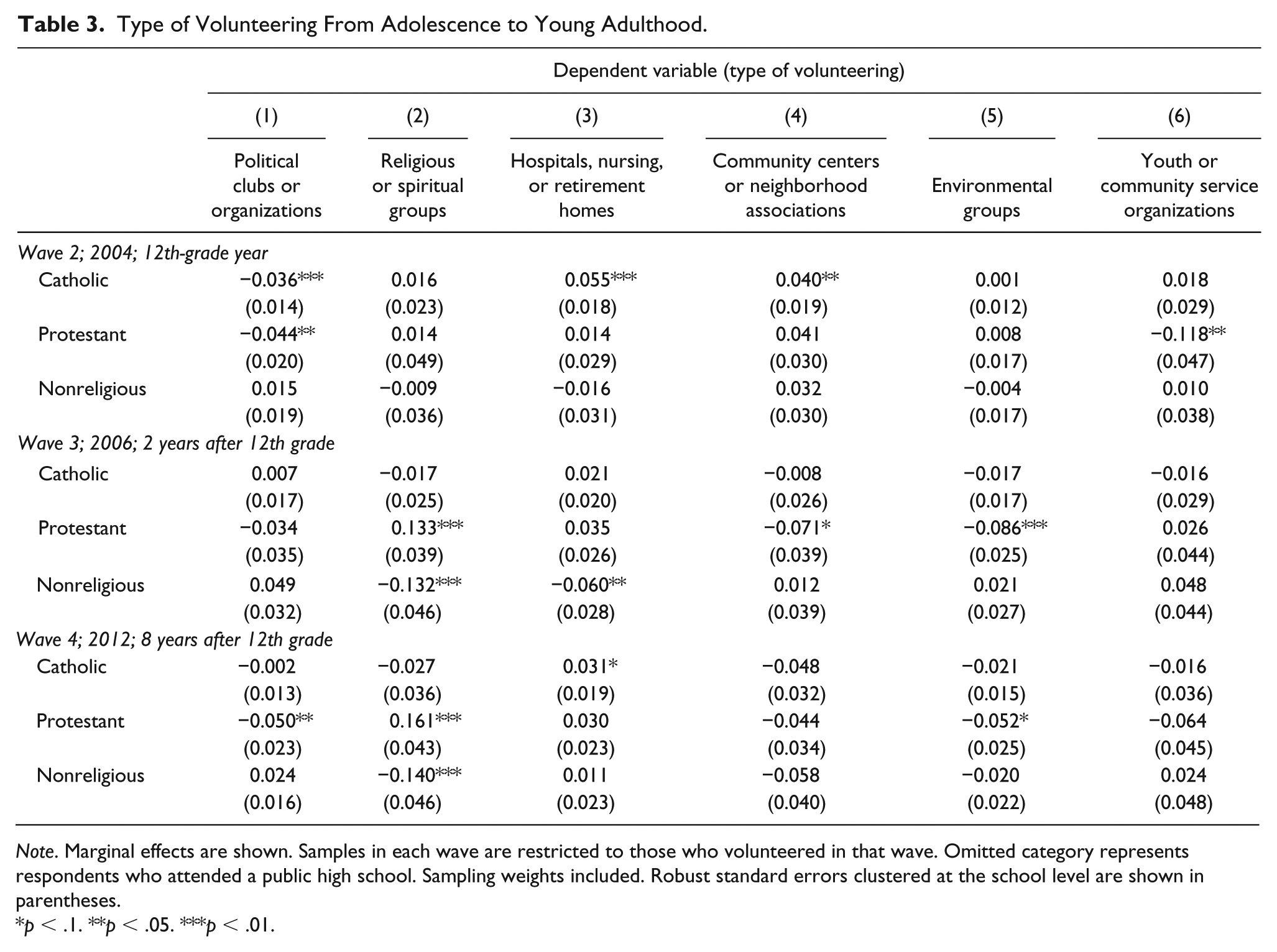
Note. Marginal effects are shown. Samples in each wave are restricted to those who volunteered in that wave. Omitted category represents respondents who attended a public high school. Sampling weights included. Robust standard errors clustered at the school level are shown in parentheses.
p < .1. **p < .05. ***p < .01.
Catholic school students
We begin by describing patterns for Catholic school students. Despite having much higher overall volunteering rates than public school students, Catholic school students were about 4 percentage points less likely to volunteer in political organizations, but were 6 and 4 percentage points more likely to volunteer in hospitals and community centers, respectively. As shown in the second panel, 2 years after the 12th-grade year, Catholic school students are no different from public school students in terms of the kinds of volunteering activities in which they participate. In other words, along with the overall drop in volunteering rates among Catholic school students (Figure 1), the higher rates of volunteering in hospitals and community centers that were observed during high school decrease among those who volunteer. Finally, little change is observed 8 years after high school among Catholic school students. The only exception is suggestive evidence that volunteers from among Catholic school students are about 3 percentage points more likely to serve through hospitals, relative to public school students.
Protestant school students
During high school, Protestant school students are 4 percentage points less likely to volunteer in political organizations and 12 percentage points less likely to volunteer in youth or community service organizations, relative to public school students. Otherwise, the kinds of activities that these students participate in are similar. However, we begin observing a greater divergence in the postsecondary and young adult years. Two years after high school, Protestant school students become more likely to volunteer through religious organizations and less likely through community centers and environmental groups, relative to public school students. Protestant school students are 13 percentage points more likely to volunteer through religious organizations and 7 to 9 percentage points less likely to volunteer in community centers and environmental groups, respectively. These distinctions continue to persist for 8 years after high school, although the lower likelihood of volunteering in community centers dissipates. On the contrary, the lower likelihood of volunteering in political clubs among Protestant school students relative to public school students—a difference of 5 percentage points—becomes substantively and significantly significant.
Nonreligious private school students
Turning to nonreligious private schools, we first point out that we do not observe any differences in volunteerism activity between students from public or nonreligious private schools, at least during high school. Distinctions begin to emerge 2 years after high school. Respondents who attended nonreligious private schools are noticeably less likely to serve through religious organizations or hospitals. They are 13 and 6 percentage points less likely than respondents who attended public schools to participate in volunteer activities through those two types of organizations, respectively. As nonreligious private school students enter young adulthood, we observe that volunteering in hospitals is no different relative to those of public school students, but the lower propensity to volunteer in religious organizations persists and remains of similar magnitude at 14 percentage points.
Discussion
Summary of Findings
Our aim has been to describe volunteerism behavior among individuals from different schooling backgrounds in the United States. We go beyond prior research in this area by investigating volunteerism longitudinally and detailing the particular kinds of volunteering activity in which people participate. We do not find any school-sector differences in the likelihood of volunteering by the time graduates are in their late 20s. However, when we more closely examine types of volunteerism activities among those who volunteer, some tendencies previously hidden in the overall volunteerism rates begin to emerge. The results provide evidence broadly supporting our hypotheses. For instance, the rates of volunteering are certainly high when student volunteering is organized by the Catholic high schools. Moreover, such volunteering typically happens in areas where Catholic organizations are well represented, such as health care and community centers. However, the Catholic school advantage in volunteering is difficult to sustain into young adulthood. Only Protestant schools are able to maintain relatively higher levels of volunteering into young adulthood. These activities are mainly tied to church and church-related organizations rather than secular organizations. In contrast, volunteerism among students from nonreligious private schools appear similar to those of public schools. Students from both of these sectors appear more likely to volunteer in secular organizations rather than religious organizations.
Interpretation of Findings
School sector may influence volunteering by connecting students to particular organizational volunteering networks that reflect institutional values and practices common to a sector. For example, the Catholic Church is well represented in health care and community centers, and neighborhood improvement organizations including Catholic worker houses. The missions of Catholic organizations in the civic sphere often concern the immediate needs of the poor or the sick, which has inspired the emergence of Catholic hospitals, Catholic Relief Services, and so forth (Degeneffe, 2003). Catholic school organizational ties combine with the strong role that Catholic schools play in facilitating student volunteering to shape student volunteering types. For many Catholic schools, the volunteering emphasis along with service-learning classes are a central expression of the religious mission of the school that is demonstrated by their students’ higher rates of overall volunteering in secondary school and volunteering in the health care sector during adulthood (Bryk et al., 1993; Campbell, 2001; Scanlan, 2008).
However, it appears that the Catholic school advantage in volunteering that is well-documented in the literature (Wolf, 2007) may not persist into adulthood, a finding consistent with other studies (Dill, 2009; Hill & Den Dulk, 2013; Schwartz & Sikkink, 2017; Sikkink, 2012). We suggest that this finding reflects the organization of volunteering during high school, in which Catholic schools play a strong role in facilitating student volunteering and integrating it into the curriculum. That approach may lead to volunteer fatigue, or a dependence on the school organization, including its social life, to motivate volunteering (Henderson et al., 2012; Jones & Hill, 2003; Planty et al., 2006). The lack of an avenue to civic life through commitment to other Catholic institutions, including parishes, may also affect overall levels of volunteering for Catholic school students after secondary school. These students may become disconnected from broader Catholic institutions and social networks that sustain volunteerism behavior (Musick & Wilson, 2008; Omoto & Snyder, 2002; Snyder & Omoto, 2008; Wuthnow, 2004). Indeed, many students in Catholic schools are not Catholic and it is not uncommon for Catholic students to become disconnected from the Church as they enter adulthood (Smith et al., 2014). The ending of secondary school is a significant time of transition among adolescents and volunteerism may dissipate, without norms and expectations in new communities to sustain those practices, amid other competing priorities and goals (Jones & Hill, 2003; Marks & Jones, 2004). If such norms and expectations of the communities that Catholic school students end up joining are weaker than those found in Catholic secondary schools from which they left, then it is not surprising that we observe a decrease in volunteerism.
Protestant school students show no tendency toward one volunteering sector, at least during high school. This is surprising given the expectation that strong ties between Protestant schools and churches would channel most volunteering opportunities through churches or church-related organizations. While students remain in Protestant school, we find no evidence for this claim. More likely, Protestant schools follow common models for student volunteering; volunteering in Protestant schools may simply follow scripts familiar to other types of schools, including norms that prioritize soup kitchens, senior citizens, poverty relief, and health care in student volunteering. The emphasis of Protestant schools, that students should experience direct meeting of human needs, can be expressed as well in several of the traditional civic sectors, not only the religious sector.
Most strikingly, we find that Protestant school students in young adulthood primarily volunteer in religious civic organizations—a result that may explain why volunteering rates are sustained into young adulthood (Hill & Den Dulk, 2013). Similar to Park and Smith (2000) and V. Evans, Curtis, and Cnaan (2013), we find evidence that the involvement of Protestant school students is particularly strong in the religious civic sphere. The strength of Protestant schools for longer-term effects on volunteering is likely an outcome of the mission and organizational ties of Protestant schools. Religious organizations in civic life quite possibly play a unique and important mediating role between civic life and those who select into Protestant schools. The overall level of civic participation, then, may not increase if Protestant schools and their networks were not available for families that are likely to choose them. The high rates of volunteering among Protestant school students may stem from the unique place of service and sacrifice in the school community and associated pathways to civic life through religious organizations. Ties to broader civil society and related prosocial behaviors may be fostered through ties to local churches (Driskell, Lyon, & Embry, 2008; Musick & Wilson, 2008; Schwadel, 2005b; Wuthnow, 2004). We suggest that high levels of involvement, social capital effective for mobilization, civic skills, and prosocial values built within evangelical congregations (Putnam & Campbell, 2010; Wuthnow, 1999, 2004, 2009), are effective in activating organizational ties to religiously affiliated organizations in the civic sphere.
As hypothesized, we also observed concurrent lower volunteerism rates through political or environmental groups for students from Protestant schools. The assumption of a boundary between spiritual and secular political life, together with fears of a potential controversy among parents should the religious mission of the school become closely tied to political engagement, ensures that these schools are not facilitating political volunteering and perhaps discouraging recruitment attempts by political organizations even if they are politically conservative. Yet unlike Protestant school students, it appears that Catholic school students are as equally likely to volunteer through political organizations as public school students in young adulthood. These results are consistent with documentation of higher rates of political engagement among Catholic parishes relative to Protestant congregations (Beyerlein & Chaves, 2003).
Meanwhile, there is little clear-cut evidence for distinctive patterns of volunteering between students from nonreligious private schools and public schools. In fact, differences between these sectors in volunteerism rates across different types of organizations are not only statistically indistinguishable but also substantively small during high school. After high school, it becomes more apparent that both nonreligious private and public schoolers place greater emphasis on volunteering and service through youth or community service organizations, environmental groups, and political groups—at least in comparison with Protestant schoolers. The nonreligious private schoolers’ lack of established ties to church and church-related civic organizations becomes more evident in the young adult years. Dominant orientations to civic life developed in public and nonreligious private schools favor the nonreligious civic sphere.
Limitations and Considerations for Subsequent Research
We reiterate that we lack the kind of data that could more definitively test causal relationships between school characteristics and practices, high school civic education, and later volunteering behavior. Taking advantage of opportunities of, for instance, an experimental evaluation of a private school voucher program where participants are randomly assigned to receive subsidies to attend private schools might provide sources of exogenous variation to make causal claims about school-sector attendance and civic outcomes (Carlson et al., 2017). Still, we underscore the value of conducting noncausal, descriptive work, especially because randomized controlled trials are not a viable means to study factors that mediate the relationship between school sector and civic outcomes. Descriptive empirical work, coupled with well-developed theory, offers clues to better understanding such a relationship and enhancing high school civic education programs and goals. We, specifically, have suggested that school effects on volunteering are channeled and sustained through unique ecologies of school networks, organizations, and cultures—a proposition for which we welcome more scrutiny.
More research into the unique practices of distinctive schools that are aimed at fostering specific civic dispositions—whether it is through requiring and organizing volunteering activities or by some other means—would be valuable as well. Indeed, requiring volunteering in high school does not necessarily lead to sustained volunteering in adulthood (Henderson et al., 2012; Jones & Hill, 2003; Planty et al., 2006). Perhaps other social norms, habits, and values are necessary to sustain and foster longer lasting civic dispositions. There may similarly be value in studying the types of industries and organizations that young adults enter during their early career stage, as civic values might direct them to professions that have strong social or civic-engagement practices or missions. In fact, there is some evidence that graduates of Protestant schools prioritize these values and tend to take jobs in the health care, social services, or education sectors (Sikkink, 2014). In general, we encourage further study of the extent and nature of school practices and organizational ties that may translate into durable links between students and civic and political life on a host of dimensions beyond volunteering, such as voting, charitable giving, membership in civic organizations, and social connectedness. Answering these questions will be valuable to understand how to promote volunteerism and respond to concerns about religious institutions as well as trends in volunteering and broader participation in civic life.
Footnotes
Declaration of Conflicting Interests
The author(s) declared no potential conflicts of interest with respect to the research, authorship, and/or publication of this article.
Funding
The author(s) received no financial support for the research, authorship, and/or publication of this article.
