




Abstract
Psychosocial risks can negatively affect adolescents’ physical, psychological, and social health. Grounded on the cumulative risk theory, the objective of this study was to analyze the differences in health-related quality of life (HRQoL) depending on the accumulation of several psychosocial risks (bullying, cyberbullying, cyberdating abuse, sexting, online grooming, and problematic Internet use). The participants were 3,212 Spanish adolescents (53.7% females) with a mean age of 13.92 ± 1.44, who completed self-report online questionnaires that assessed each of the aforementioned risks and HRQoL. Overall, 41.4% of the female participants and 36.8% of the males presented at least one risk, with significant differences between sexes. The percentage of participants who presented an accumulation of three or more risks was 8.2%. Risk accumulation was related to a lower HRQoL score than those who presented no risks. The scores in HRQoL decrease at up to four risks, point at which the differences ceased to be significant.
Keywords
Introduction
Psychosocial risks are problems that are highly likely to harm to people’s physical, psychological, and social health. Although these risks can occur offline (being bullying the most prevalent) and online (cyberbullying, sexting, etc.), this division is increasingly diffuse, as adolescents co-build their reality as the sum of offline and online experiences, with the latter being particularly prominent (Subrahmanyam & Smahel, 2010). Traditionally, the study of the role of psychosocial health risks has been conducted individually, as in the case of harassment (Analitis et al., 2009), cyberbullying (Zych, Ortega-Ruiz, & Del Rey, 2015), sexting (Gassó, Klettke, Agustina, & Montiel, 2019), cyberdating abuse (Borrajo, Gámez-Guadix, Pereda, & Calvete, 2015), grooming (Whittle, Hamilton-Giachritsis, Beech, & Collings, 2013), and problematic Internet use (Cerniglia et al., 2017). However, there is increasing evidence that these risks do not take place in a vacuum but tend to associate with each other (Gámez-Guadix, Almendros, Borrajo, & Calvete, 2015; Machimbarrena et al., 2018; Quesada, Fernández-González, & Calvete, 2018; Yudes-Gómez, Baridon-Chauvie, & González-Cabrera, 2018). According to the cumulative risk theory (Evans, Li, & Whipple, 2013), when risks accumulate, their effects on health and well-being increase. However, previous research has not examined these risks conjointly with an approach that integrates all these issues and its effect on adolescents’ health-related quality of life (HRQoL).
HRQoL approach has come to dominate consideration of quality of life (QOL) in children and adolescent. It is a widely studied construct, which is not only defined by the absence of diseases or conditions, but by a state of physical, mental, and social well-being, although its conceptualization is complex, and there is not yet a clear consensus about it (for a review, see Wallander & Koot, 2016). The KIDSCREEEN Project defines HRQoL as multidimensional (addressing physical, mental, emotional, social, and behavioral levels) and based on the person’s well-being. Thus, it presents a hybrid formulation of positive and negative aspects of HRQoL (Bullinger & Ravens-Sieberer, 1995; The Kidscreen Group Europe, 2006; Ravens-Sieberer et al., 2008). Likewise, this approach maintains a wider vision of HRQoL, by including dimensions of the psychosocial domain such as family, school or leisure (Wallander & Koot, 2016).
The study of HRQoL in adolescence is important because at this stage numerous biopsychosocial changes occur (Salmela-Aro, 2011). Hence, there is a need to address aspects such as autonomy, family, school, and leisure as HRQoL indicators (Ravens-Sieberer et al., 2006; Solans et al., 2008; Wallander & Koot, 2016). In addition, at this evolutionary stage, gender differences in HRQoL begin to emerge. Girls have been found to show lower physical and psychological aspects of HRQoL compared with boys (Michel, Bisegger, Fuhr, Abel, & The KIDSCREEN Group, 2009; Vélez-Galárraga, López-Aguilà, & Rajmil, 2009).
As mentioned, the negative effects of these risks can be accumulative (Evans et al., 2013). The study of the exposure to a single specific risk could underestimate its potential negative effects on HRQoL and other adjustment indicators such as life satisfaction, happiness, or subjective well-being because risk exposure does not take place in isolation; rather, risks can coexist. Exposure to multiple risk factors may generate overlap (e.g., bullying and cyberbullying) or be independent. Thus, the study of the combination of multiple risks is important to improve our knowledge about their role in health and QOL (Kraemer, Lowe, & Kupfer, 2005).
The importance of this vision in adolescence derives from the results of studies indicating that adolescents with multiple risks are more likely to have chronic or mental disease compared with those with one or no risk behaviors (Prochaska, Spring, & Nigg, 2008). In addition, from the models of cumulative risk, it is proposed that suffering one problem or psychosocial risk would have little or no impact, but that people who experience multiple problems would be more likely to present a psychological disorder over time (Evans et al., 2013). Although some studies have analyzed the effect of poly-victimization on HRQoL (Le, Holton, Nguyen, Wolfe, & Fisher, 2016; Schlack, Ravens-Sieberer, & Petermann, 2013), there are no studies that have examined the accumulation of several psychosocial risks—including online risks—conjointly and in adolescents (i.e., bullying, cyberbullying, cyberdating abuse, sexting, online grooming, and problematic Internet use and their impact on HRQoL). The present study aims to analyze differences in HRQoL as a function of risk accumulation reported by adolescents. In addition, it will establish the prevalence rates of low HRQoL as a function of risk accumulation. The hypothesis is that the more risks reported by adolescents, the lower the HRQoL will be (Le et al., 2016) and the higher its prevalence rate. Sex differences will be examined. It is considered that females, in general, will present a lower HRQoL in relation to the studied risks (Vélez-Galárraga et al., 2009).
Method
Design and Participants
An analytical and cross-sectional study was performed between December 2017 and April 2018. A convenience sampling method was carried out. The participants came from 22 high schools of seven Spanish regions (Asturias, Aragón, Basque country, Castilla-León, Castilla La Mancha, Madrid, and Valencia). The initial sample comprised 3,286 participants, but those who responded in less than 10 minutes were eliminated (this time was deemed as too short to read all of the items in the questionnaire), finally leaving a sample of 3,212 students.
Instruments
The participants provided information about demographic variables such as sex, school, and age. For the assessment of HRQoL and the diverse risks, we used several questionnaires, which had previously been validated in Spanish with school population with adequate indicators of reliability and validity in their adaptation to Spanish. The students were asked about the last 5 months approximately (since the beginning of the school year).
The Spanish version of the KIDSCREEN-10 for children and adolescents aged 8 to 18 years
This questionnaire is conceptually based on the definition of HRQoL as a multidimensional construct that covers the physical, emotional, mental, social, and behavioral components of well-being and the functions perceived by the participant (The Kidscreen Group Europe, 2006; Bullinger & Ravens-Sieberer, 1995). This version presents a single score on a global dimension of HRQoL through 10 items that were answered on a 5-point scale ranging from 1 (never) to 5 (always). It has appropriate levels of reliability and internal validity, and population norms for Spanish sample. The Cronbach’s alpha coefficient was .80 in this sample.
Victimization dimension of the European bullying intervention project questionnaire (EBIPQ)
This consists of seven items related to behaviors of physical, verbal, social, and psychological peer violence (Ortega-Ruiz, Del, Rey, & Casas, 2016). A 5-point response scale was used, ranging from 0 (never) to 4 (always). The alpha coefficient in this study was .85.
Victimization scale of the cyberbullying questionnaire (CBQ)
This contains nine items that reflect the most common behaviors, such as sending messages, impersonation, and so on (Calvete, Orue, Estévez, Villardón, & Padilla, 2010). The response format of the items was adapted to a 5-point Likert-type scale ranging from 0 (never) to 4 (almost every week). The alpha coefficient in this study was .80.
Victimization scale adapted from the cyberdating abuse questionnaire
This consists of 11 items referring to different types of cyberdating abuse, including behaviors of controlling the partner’s mobile and insulting through a 4-point response scale ranging from 0 (never) to 3 (almost always) (Borrajo et al., 2015). To complete this questionnaire, participants should have had a partner during the last 6 months. The alpha was .86 for the sample.
The questionnaire on sexting
This was an adaptation from the original questionnaire (Gámez-Guadix et al., 2015; Machimbarrena et al., 2018), and consists of three items related to sending information (pictures, videos, etc.) with intimate content to the partner, an acquaintance, or someone whom the respondent had met online, but still did not know in person. Items were rated on a 5-point response scale ranging from 0 (never) to 4 (7 or more times). The alpha coefficient in this study was .71.
Questionnaire for online sexual solicitation and interaction of minors with adults
This contains 11 items to evaluate the sexual interactions that are part of the initiation, process, or result of online grooming (Gámez-Guadix, De, Santisteban, & Alcazar, 2017). Items are rated on a 4-point response scale ranging from 0 (never) to 3 (6 or more times). The alpha coefficient in this study was .89.
Spanish version of the generalized and problematic Internet use scale (GPIUS2)
This presents 15 items referring to various aspects of problematic Internet use, such as Preference for online social interaction, Poor self-regulation, and Negative consequences (Caplan, 2010; Spanish version by Gámez-Guadix, Orue, & Calvete, 2013). Agreement with the items is rated on a 6-point Likert-type scale ranging from 0 (completely disagree) to 5 (completely agree). The alpha coefficient in this study was .91.
Evaluation Criteria
With regard to HRQoL, the development of the KIDCREEN was based on the probabilistic partial credit model (PCM), which belongs to the family of Rasch models. For the KIDSCREEN-10, the mean scores varied around 50 (SD = 10) due to t value standardization for Spanish population (The Kidscreen Group Europe, 2006). In the sample of this study, we obtained a mean value of 46.8 ± 8.3. Although several studies have considered one half a standard deviation as an indicator of a low QOL (The Kidscreen Group Europe, 2006; Norman, Sloan, & Wyrwich, 2003), this study chose a more rigorous cutoff point to indicate a significant deterioration in QOL. Therefore, for the dichotomous division (low vs. adequate), a reported decline of one standard deviation below the mean in the study sample (i.e., ≤ 38.54) was considered a significantly lower HRQoL (low), and above that score was considered adequate HRQoL (i.e., ≥ 38.55).
The different risks were dichotomized through a combination of statistical and an a priori approach, following the indications of Machimbarrena et al. (2018). The general statistical norms for bullying, cyberbullying, cyberdating abuse, sexting, and problematic Internet use are as follows: (a) No problem (a total score 1 standard deviation below the mean); (b) Problem (a total score equal to or above 1 standard deviation above the mean). The mean scores and standard deviations obtained for each test as well as each cutoff point are shown in Table 1. In the case of cyberbullying and bullying, an a priori theoretical approach was also followed, and we considered that a single behavior reported almost every week or always was a problem, as proposed by the bullying/cyberbullying definition (Olweus, 2013). Finally, due to its perniciousness and its reflection in the penal code, online grooming was considered a problem when a participant obtained a direct score of 1 or more.
Distribution of the Study Variables According to the Category, Means, Standard Deviation, and Chi-Square Analysis as a Function of Sex.

Note. n = frequency; HRQoL = health-related quality of life; GPIU = general problematic internet use.
Adjusted standardized residuals > 1.96.
Adjusted standardized residuals < –1.96.
The summation of these dichotomous risk values rendered an aggregated risk accumulation metric (Evans et al., 2013). The risk accumulation for each participant was then caculated by combining the number of risks in which a participant was classified within the problem category. This led to 64 mutually exclusive subsets. Subsequently, a transformation was performed to categorize the participants as a function of the number of risks presented, ranging from no risk up to the combination of five or more risks. If a participant presented three or more risks, this was considered poly-risks.
Procedure
The questionnaire battery was applied in online format through Qualtrics©. The participants responded in their school computer classrooms under the tutor’s supervision. The time needed to fill out the questionnaires ranged between 20 and 35 minutes, depending on students’ age and reading comprehension.
Collaboration was voluntary, anonymous, and disinterested. The study was carried out with the acceptance of the participants, their parents, and the schools, and the educational institution. Through the official communication channels (registered letter or online platform, etc.) with the families, the schools sent a passive consent form that informed the parents or guardians about the purpose of the study and its characteristics, its promoters, and their right not to participate. Those parents/guardians who did not wish to allow participation returned the signed form. This occurred in less than 2% of the sample. The project was approved by the Research Ethics Committee of the International University of Rioja (PI:004/2019) and by the Research Ethics Committee of the Principality of Asturias (Ref. 231/17). There were no exclusion criteria, except for refusal to participate by the legal guardians or by the students themselves.
Statistical Analyses
Statistical analyses were carried out using the Statistical Package for the Social Sciences (SPSS v23) and the EPIDAT 3.1. The statistical analyses performed were as follows: (a) analysis of frequencies and measures of central tendency and dispersion of the study variables, (b) chi-square analysis to contrast proportions and analysis of the adjusted standardized residuals (ASR), (c) analysis of variance with Cohen’s d effect size estimation between significant post hoc categories, and (d) prevalence rates were calculated as a function of the level of risk accumulation (“no risk” up to “five or more risks”) and whether or not there was a significant decrease of HRQoL scores. For this purpose, we used the Mantel–Haenszel method (adjusted for the variable sex). A value of p lower than .05 was considered statistically significant.
Results
Of the study sample, 46.3% were males (n = 1,487) and 53.7% were females (n = 1,725). The mean age and standard deviation was 13.92 ± 1.44, with a range of 11 to 18 years. Table 1 shows the dichotomous prevalence of the study variables and their analysis as a function of sex, as well as the mean and standard deviation of each of the evaluated constructs.
A detailed analysis of the individual variables of the study revealed a significantly higher frequency of females than expected who have had problems with cyberdating abuse (ASR = 2.3), grooming (ASR = 6.4), problematic Internet use (ASR = 2.0), and HRQoL (ASR = 6.5) compared with males.
Next, we analyzed the prevalence of risk accumulation in those cases in which the combination included at least 1% of the total sample. Among the possible risks, the most prevalent single risk or combination of risks were as follows: bullying (n = 197; 6.2%); problematic Internet use (n = 185; 5.8%); grooming (n = 165; 5.2%); cyberbullying (n = 81; 2.5%); cyberbullying and bullying (n = 81; 2.5%); grooming and problematic Internet use (n = 51; 1.6%); bullying and problematic Internet use (n = 49; 1.5%); grooming and bullying (n = 44; 1.4%); cyberbullying, grooming, and bullying (n = 40; 1.3%); and cyberbullying and grooming (n = 33; 1.0%).
Table 2 shows the prevalence of risk accumulation that each participant presented (ranging from none to five or more). The results showed that 39.3% of the sample presented at least one risk of those studied, and that risk accumulation decreased as new risks were added. In this sense, 8.2% could be considered poly-risks because they had three or more of the studied risks. In addition, significant differences were found in the number of males and females and risk accumulation, with higher frequency of boys who suffered no risk and higher frequency of girls who suffered three risks.
Distribution of the Variables of Risk Accumulation and Chi-Square Analysis as a Function of the Variable Sex.

Note. n = frequency.
Adjusted standardized residuals > 1.96.
Adjusted standardized residuals < –1.96.
The results of the comparison of these conditions and the mean score in HRQoL, and its distribution as a function of low and adequate HRQoL, are shown in Table 3 and Table 4, respectively. The comparison of means revealed differences in HRQoL between those who had not suffered risks and the rest of the groups, and the largest effect sizes were found among those who were not involved in any risk and those who were involved in three and four risks. Overall, HRQoL score decreased from that of the no risks group as the number of risks increased until reaching the accumulation of three or more risks, where no significant differences were found.
Analysis of Variance of the Total Score in HRQoL as a Function of the Level of Risk Accumulation.
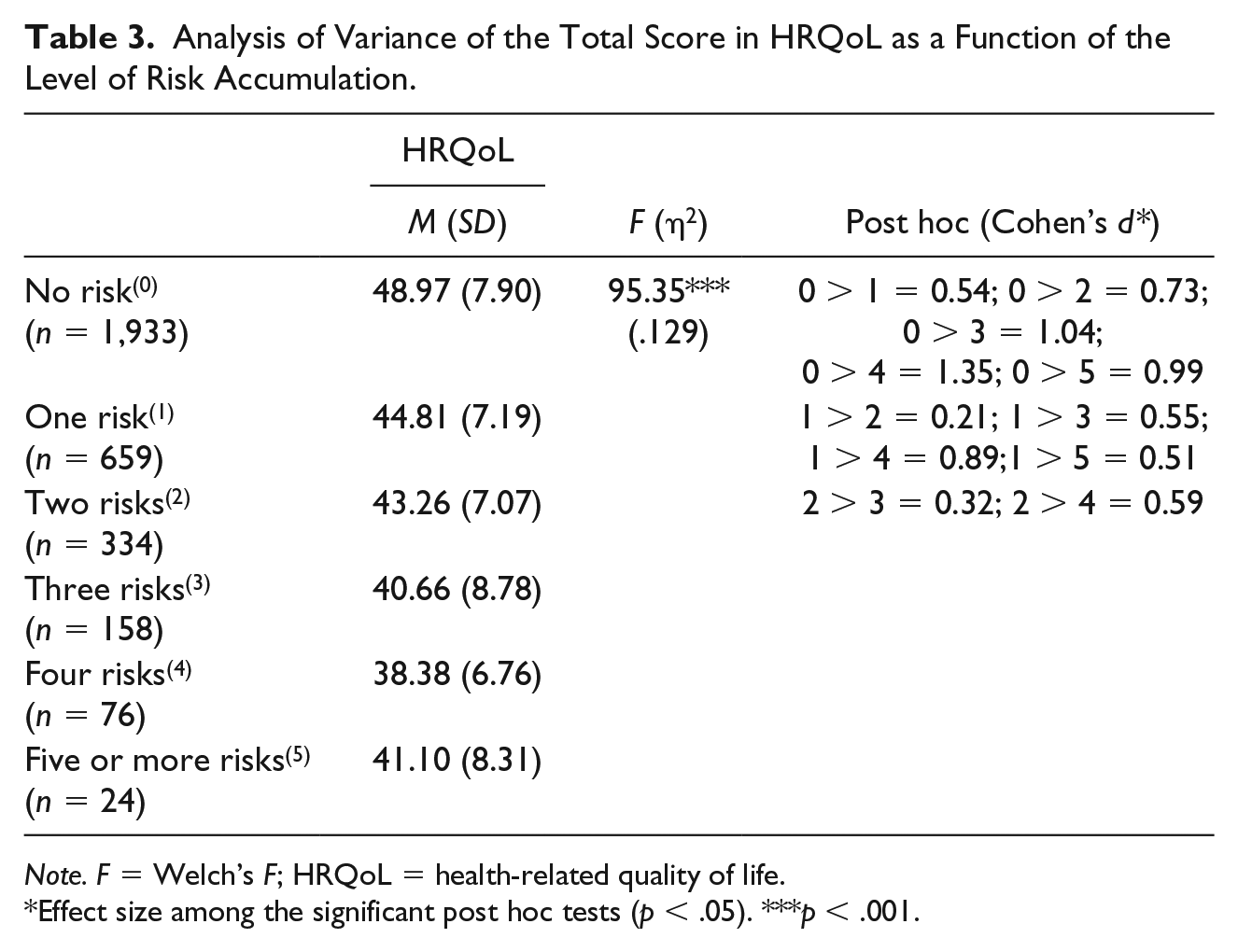
Note. F = Welch’s F; HRQoL = health-related quality of life.
Effect size among the significant post hoc tests (p < .05). ***p < .001.
Analysis of Adjusted Prevalence Rate of Problematic HRQoL as a Function of the Level of Risk Accumulation and the Variable Sex.
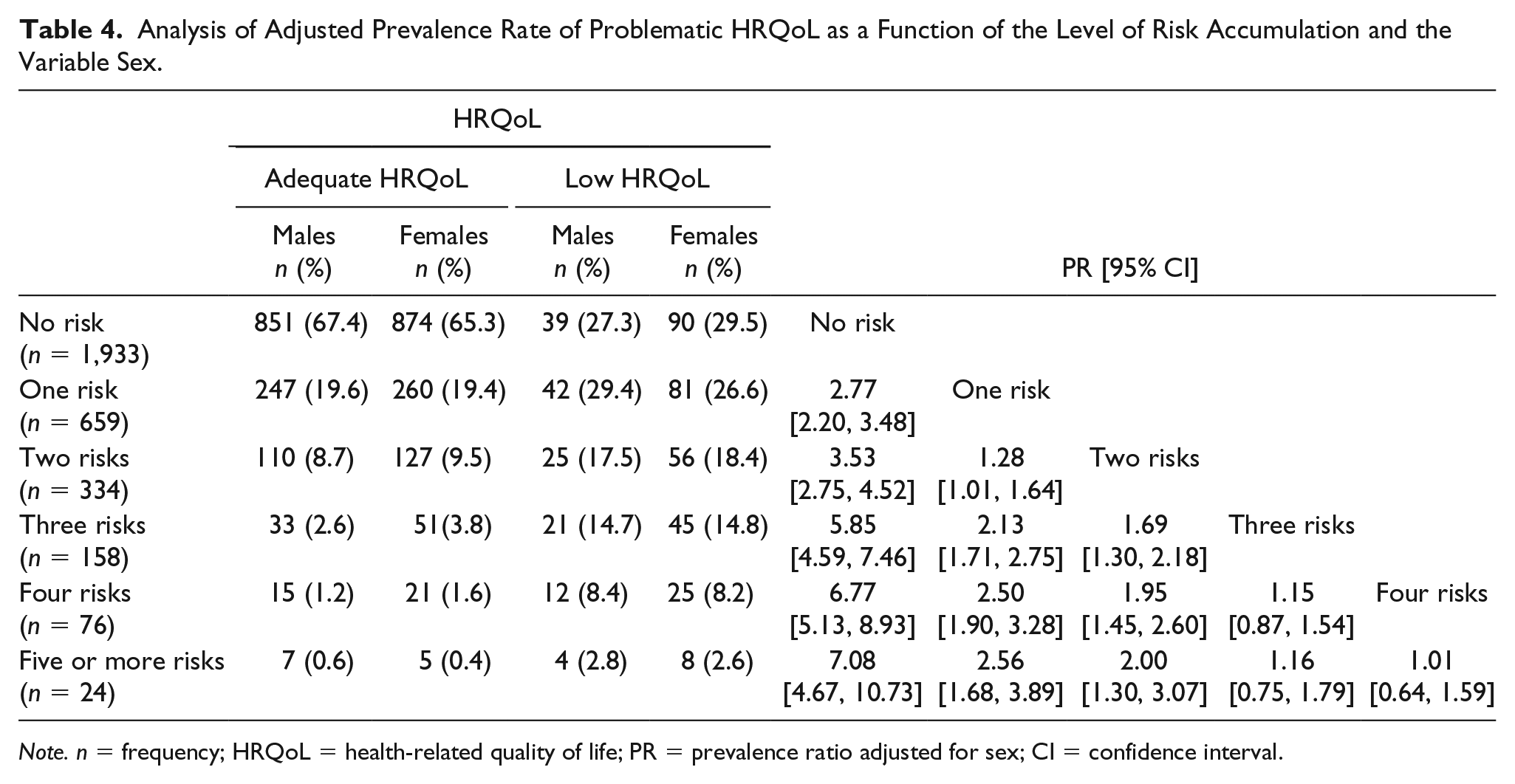
Note. n = frequency; HRQoL = health-related quality of life; PR = prevalence ratio adjusted for sex; CI = confidence interval.
However, adolescents who presented one risk had 2.77 times the prevalence of low HRQoL compared with those who did not present any risk, and this prevalence rose to 7.08 times when presenting five or more risks compared with no risk.
Discussion
The main objective of this study was to analyze differences in HRQoL as a function of the accumulation of psychosocial risks, as reported by adolescents. The results of the study reveal a relation between risk accumulation and lower score on HRQoL (than that of the reference population and of those who presented no risks). This score decreases as new risks are added, in line with other studies (Prochaska et al., 2008) although, according to our data, the decrease of HRQoL score ceases when five or more risks are suffered. Moreover, the prevalence rate of problematic HRQoL is no longer significant when comparing four risks with three risks. The fact that participants with five or more risks present a somewhat higher (but not significant) mean in HRQoL than the group with four risks is surprising. However, we hypothesize that this may be due to the lower number of participants who were included in that category (only 0.8% of the sample). All in all, those who suffer five or more risks still present a decrease of almost one standard deviation from the Spanish reference population (M = 50, SD = 10) (The Kidscreen Group Europe, 2006).
Overall, our results are related to those obtained by Le et al. (2016), who also found that the joint experiences of various victimizations were associated with lower HRQoL in the dimensions of physical, mental, social, and general health. However, our study extends those previous findings by the inclusion of several psychosocial risks, which were assessed by specific measures. They also point in the same direction as studies finding that individuals who present multiple risks are more likely to have psychological problems (Evans et al., 2013; Greenberg, Speltz, DeKlyen, & Jones, 2001; Prochaska et al., 2008), and suggest the usefulness of the cumulative risks theory when applied to other social constructs and problems (Evans et al., 2013).
The likelihood of a decrease in HRQoL is higher for adolescents who present one risk than for adolescents who are not exposed to any risks. This finding is in line with those of other studies finding a relationship between different risks and a decrease in HRQoL (Afifi et al., 2007; González-Cabrera et al., 2018; Hidalgo-Rasmussen et al., 2015). More importantly, this study indicates that the joint involvement in two or more psychosocial risks is related to a further decline in HRQoL. These psychosocial risks include both offline and online risks because the adolescents currently co-build their reality through offline and online experiences, granting prominence to the latter (Subrahmanyam & Smahel, 2010). In this way, the Internet can foment the concurrence of multiple risks (Machimbarrena et al., 2018) and the possibility of broader victimization processes (Le et al., 2016). In this manuscript, we have measured several constructs that share the definition of psychosocial risks, but which focus on processes of traditional victimization (bullying), online victimization (cyberbullying, cyberdating abuse, or grooming), risky behaviors (sexting), and the dysfunctional use of technology (problematic Internet use).
Regarding sex differences, we found a higher frequency than expected of boys who had not suffered any risk and a greater number of girls who had suffered three risks. In addition, females had a higher prevalence of low HRQoL compared with males. The data about sex differences partially support the conclusions of some previous studies (Hidalgo-Rasmussen et al., 2015; Le et al., 2016; Michel et al., 2009; Vélez-Galárraga et al., 2009). However, they contrast with the results of other studies where no sex differences were found (González-Cabrera et al., 2018). Differences have been suggested to be influenced by the way in which puberty changes (physical and psychological) affect perceived health, negatively influencing girls, mainly in their emotional well-being, but not in boys (Michel et al., 2009; Vélez-Galárraga et al., 2009)
The practical implications of this study are important because they show that the risks experienced by adolescents may overlap, increasing the magnitude of their consequences. Currently, many adolescents come to Primary Care Services with symptoms associated with these problems (stress, anxiety, somatization, loss of appetite, drowsiness, etc.). Thus, the existence of any of the risks should be a warning to professionals about the possible simultaneous incidence of other risks. A quick screening of HRQoL (as in the KIDSCREEN-10) would allow professionals to raise suspicions about certain problems. It is important to remember that many of these psychosocial risks per se have been associated with serious problems, such as the case of cyberbullying and perceived lower HRQoL (González-Cabrera et al., 2018), suicidal ideation (Iranzo, Buelga, Cava, & Ortega-Barón, 2019; Van Geel, Vedder, & Tanilon, 2014), or depressive mood (Gámez-Guadix, Orue, Smith, & Calvete, 2013). Moreover, this study shows that the simultaneous existence of several of these risks can have even more pernicious effects in those who suffer them. As there is evidence that psychosocial risks are connected (bullying, cyberbullying, sexting, grooming, etc.), the data from the study should encourage educational professionals to carry out comprehensive prevention-intervention programs rather than using specific programs that only address part of the problem.
This study has some limitations. First, the results are based exclusively on self-reports with the entailed response bias. This is important because the perspective of others has been considered relevant in the conceptualization of HRQoL (Ravens-Sieberer et al., 2008). Although the sample was extensive in the number of participants and geographical representation, sampling was not random, so the results should be interpreted with caution. The study is cross-sectional so it cannot demonstrate that the risks and their accumulation are predictors of a decrease in HRQoL. The nature of the risk of cyberdating abuse, whose evaluation required the participants to have a partner, has led to a reduction in the number of participants in some combinations of risks. The approach used to measure cumulative risk was to add all dichotomized values to a global aggregated metric (Evans et al., 2013), but this approach does not take into account the weight of each individual risk on the total. Finally, this study addressed many risks in adolescence, but it did not include others such as nomophobia, the fear of missing out, the Internet gaming disorder, and online gambling. Despite being limited, this study is the first to examine several psychosocial risks and their joint involvement in HRQoL in a large sample of adolescents.
In conclusion, findings reveal a relation between risk accumulation and lower HRQoL than those who presented no risks. Furthermore, HRQoL score decreases as new risks are added and ceases further reductions when five or more risks are suffered and, second, the importance of developing comprehensive programs of prevention-intervention.
Footnotes
Ethical Approval
The project was approved by the Research Ethics Committee of the International University of Rioja (PI:004/2019) and by the Research Ethics Committee of the Principality of Asturias (Ref. 231/17).
Declaration of Conflicting Interests
The author(s) declared no potential conflicts of interest with respect to the research, authorship, and/or publication of this article.
Funding
The author(s) disclosed receipt of the following financial support for the research, authorship, and/or publication of this article: This research was funded by Spanish Ministry of Economy, Industry and Competitiveness, RTI2018-094212-B-I00: (CIBER-AACC); and by the International University of la Rioja, Project “Cyberpsychology (Bienio 2017-19)”.
