




Abstract
The use of peer-to-peer approaches in health promotion interventions targeting youth seems to be a strategy with great potential. The aim of this study was to synthesize and assess the elements and conditions that contribute to the effectiveness of youth-led physical activity interventions. This was done using a scoping review addressing the following three research questions: What are the theoretical and intervention rationales behind peer-led physical activity interventions? What can be established regarding the effects of such interventions on participants and peer leaders? How can such interventions be strengthened? The review included 43 studies on the peer-to-peer approach, with youth in the role as peer leaders, in physical activity interventions. The identified studies suggest that youth peer leadership initiatives can increase physical activity for youth and children. However, the studies varied on a range of parameters and did not reveal any clear patterns of factors associated with impact.
Keywords
Introduction
Physical Activity Promotion in Children and Young People
Physical inactivity has been labeled “the Cinderella risk factor” of noncommunicable disease (NCD) prevention based on its importance for health and simultaneous lack of prominence in NCD prevention efforts, policy-making, and resource allocation (Bull & Bauman, 2011). Taking a life-course perspective on health promotion, childhood and adolescence are key periods in an individual’s life in which health trajectories can be influenced as a supplement to preconception and infancy health (Bundy et al., 2018; Hanson & Gluckman, 2011). In addition to its benefits to physical health outcomes, physical activity (PA) can positively affect mental health in adults (Bull & Bauman, 2011; Lee et al., 2012) and adolescents (Hallal et al., 2006). Moreover, PA interventions have been employed to reach outcomes beyond health, for example, in sport-for-development programs (Coalter, 2013). However, the transition from childhood to adolescence and youth is often associated with a decline in PA (Scheerder et al., 2005; Townsend et al., 2012). Therefore, identifying approaches to PA promotion that resonate with children and youth is an important challenge.
Peer-to-Peer Health Promotion Interventions With Young People
As children mature, settings and persons outside the family become increasingly important, with a major influence from the school and peers (Patton et al., 2016). Young people are especially susceptible to peer influence with regard to values, decision-making, and the emotional displays of others. Hence, at this age, peer influence on health and wellbeing is greater than at any other age (Patton et al., 2016). Therefore, using peer-to-peer approaches in health interventions targeting young people seems to be a health promotion strategy with great potential.
Peer-to-peer approaches have been employed in youth interventions within several areas and settings for health promotion with mixed results. Recent reviews of peer-to-peer approaches involving young people have focused on the effects of interventions in relation to tobacco, alcohol and drug use (MacArthur et al., 2016), nutrition education (Yip et al., 2015), and sexual health (Tolli, 2012). MacArthur et al. (2016) found weak-to-moderate evidence of lower odds of smoking, alcohol consumption, and cannabis use following intervention, although two studies observed a negative effect in higher-risk groups. A systematic review of school-based nutrition education programs showed increases in knowledge in all relevant studies. Health behavior changes were achieved in most studies (85%) immediately following the intervention, although these tended not to be maintained over time (Yip et al., 2015). A review of peer-led sexual health intervention studies generally found no significant intervention effects, although mixed results were found for knowledge and attitudes. The authors suggested that peer leader recruitment, involvement, and training influenced the effectiveness (Tolli, 2012).
Peer-to-peer approaches seem to have gained less attention in relation to PA. In their comprehensive review of peer-delivered health promotion for young people, Harden et al. (1999) categorized 20 reports out of a total of 271 (7%) as “general health promotion,” which included PA. A review of 10 peer-delivered PA intervention studies concluded that peer-delivered interventions showed positive effects on PA behavior. Only two of the 10 included studies had children and young people as the target group (Ginis et al., 2013).
To summarize, peer-to-peer approaches with young people are widely used in health promotion. Such interventions aim to harness the strong influence of peers through role modeling, utilizing existing peer networks, identification, and reinforcement (Turner & Shepherd, 1999). However, evidence from the previous research on youth-led health interventions is inconsistent, and peer-led PA interventions in youth have received little attention. Moreover, in peer-to-peer approaches to health promotion, it is unclear which elements contribute to an intervention’s efficacy (Simoni et al., 2011) and under which conditions the approach may be effective (Harden et al., 2001).
Research Aim and Questions
This study aimed to assess and synthesize the elements and conditions that contribute to the effectiveness of youth-led PA interventions. The scoping review was based on three research questions: What are the theoretical and intervention rationales behind peer-led PA interventions? What can be established regarding the effects of such interventions on participants and peer leaders? How can peer-led PA interventions with young people be strengthened based on this knowledge? To address the research questions, we first describe the methods used for literature search and analysis. Then, we present a synthesis of the results related to the first two research questions before turning to the latter question in the “Discussion” section.
Method
A Scoping Review Approach
Given the broad definition of peer-to-peer interventions and the diverse types of evidence relevant to the research questions, a scoping review approach was selected and applied (Levac et al., 2010). Both qualitative and quantitative studies were included to map the full range of youth-led PA intervention approaches. Due to the diversity and quality of the studies, it was not possible to conduct a full-scale systematic review, and some of the analyses were conducted on relevant subsets of studies as explained below.
Inclusion Criteria and Definitions
Included studies (a) reported on a peer-to-peer intervention, (b) involved young people in the role as peer leaders, and (c) included a peer-led, PA-related intervention component. Only peer-reviewed papers in English published between 1997 and 2017 were included. Studies were not excluded based on their quality; however, study quality is considered in the “Results” section.
We use the term peer-to-peer intervention as an umbrella term, in line with Shiner’s (1999) definition of peer education as “an umbrella term used to describe a range of interventions where the educators and the educated are seen to share something that creates an affinity between them” (p. 564). The relationship between participants and peer leaders should constitute genuine peerness, characterized by being tied to shared identity, for example, based on similarity in roles, group categories, or experiences (Shiner, 1999). Similar age alone does thus not constitute a peer relationship, if other characteristics significantly distort the peerness.
Interventions should distinguish between the roles of “educator” and “educated” and thereby make use of peer leaders as a distinct group, as opposed to mutual support groups that do not necessarily include persons in a leading role. Peer leaders should be young people aged 10 to 24 (Patton et al., 2016).
PA must be a key element in the intervention (although not necessarily the only issue addressed), either as an outcome of the intervention or an approach to reaching other outcomes, for example, enhancing social competences.
Search and Screening
The final search was conducted in November 2017 in five databases: Embase, PubMed, Scopus, SPORTDiscus, and Web of Science. Search terms within the categories: children or young people, peer-led, and PA were combined with Boolean operators. Two researchers assessed the abstracts, and disagreements were solved through consultation with a third reviewer. The search provided 2,237 hits of which 651 were duplicates. A total of 1,586 abstracts were thus screened and 153 papers were included for full text assessment. A team of three researchers conducted the full text screening. The papers were read by one reviewer who summarized the key points using a common template. All papers’ relevance was then discussed within the author team, and if the decision was not clear, a second reviewer read the paper in question. Levac et al. (2010) recommended that two reviewers independently conduct the full-text screening; however, we consider the approach of discussing all papers in the reviewer team, with a second reviewer assessing the paper if there was any doubt of inclusion, to similarly reduce selection bias. Reference lists of included papers were checked, providing nine additional relevant papers. Finally, 43 papers were included in the review.
Data Analysis
The initial mapping informed the decision to synthesize and analyze different subsets of the studies (Gough et al., 2012) within three areas of interest to the research questions: theoretical rationales and approaches used, intervention rationales for and approaches to involving peer leaders, and outcomes for participants and peer leaders.
Theoretical rationales
Applying theory in intervention research can provide an understanding of how and why an intervention leads to certain outcomes. Theory-based interventions should translate theoretical propositions into practical application (Bleijenberg et al., 2018). As such, the use of theory both illustrates the expected mechanisms of the intervention and may guide which effects are evaluated.
We used the Levels of Theoretical Visibility Typology to assess the use and articulation of theory in all included studies (Bradbury-Jones et al., 2014). The typology ranks the use of theory from Level 1 (“seemingly absent”) to Level 5 (“consistently applied”). Studies determined as Levels 1 or 2 (“implied”) were excluded from further analysis of the theoretical approach as they provided too little information on the theoretical foundation. Studies assessed as Levels 3 to 5 were included in this analysis. Level 3 (“partially applied”) studies provide some explanation of how theory influenced the study, beyond stating that it did so. Level 4 (“retrospectively applied”) studies introduce theory as an “afterthought” (Bradbury-Jones et al., 2014, p. 138). The studies were assessed based on the information available in the reporting of studies, and the grading is thus not necessarily an accurate rendering of the theory used (Bradbury-Jones et al., 2014).
Intervention rationales
The studies differed significantly in their approaches to peer-leader involvement. Considering peer-to-peer interventions an umbrella term, specificity is needed to understand “how peers operate and what contributes to their efficacy” (Simoni et al., 2011, p. 4). Shiner (1999) recommended that to distinguish peer-to-peer approaches, in an intervention, it is important to consider (a) what constitutes peerness, (b) its aims and methods, and (c) the nature of peer involvement. First, peerness builds on shared identity and requires identification; however, opinions of what constitutes peerness differ. Second, intervention aims and methods illustrate how peers are expected to function and the rationale behind using peer leaders. This is tightly linked to the third element, as the nature of peer involvement refers to the role of the peer leader in implementation. To characterize the included interventions and compare their approaches, a thematic analysis was conducted in relation to these three aspects.
Effects on participants and peer leaders
Studies were included in the summary of intervention effects if they reported effects on the participants related to PA behavior or psychological proximal measures of PA behavior such as self-efficacy. Measures with no direct or psychological link to PA, such as body mass index (BMI) and nutritional measures, were excluded. To avoid reporting severely underpowered studies, studies were excluded from this section if they relied on results from less than 50 participants in total. Some studies tested effects on all sub-categories of the questionnaire scales; however, where possible, for the sake of clarity, we only focused on the sum score of PA. Intervention effects were reported as significant if the p-value was under .05, and insignificant effects were summarized if reported. In addition, a summary of quantitative effects reported for peer leaders was conducted with the same inclusion criteria as described above. As few studies investigated quantitative effects on peer leaders, qualitative evaluations of peer leader outcomes were also summarized.
Results
A summary of the intervention and study characteristics is presented below, followed by a synthesis of the studies of relevance to the three analytical themes: theoretical rationales, intervention rationales, and effects on participants and peer leaders. Study numbers (#) refer to Table 1. Further information on intervention and study design, outcome measures, and reported effects is available upon request.
Study and Intervention Characteristics.
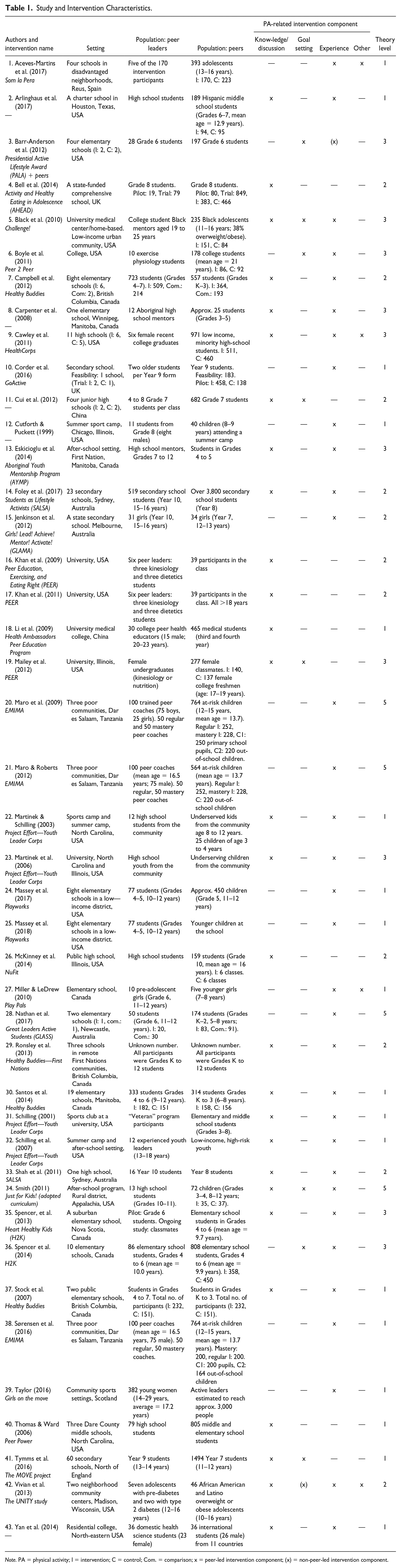
Note. PA = physical activity; I = intervention; C = control; Com. = comparison; x = peer-led intervention component; (x) = non-peer-led intervention component.
Intervention and Study Characteristics
Forty-three studies were included in the review. The majority were North American (29 studies), although studies from Australia (four studies), the United Kingdom (four studies), Tanzania (three studies), China (two studies), and Spain (one study) were also identified. Schools (ranging from primary school to university) were the most used settings (29 studies), supplemented by 14 studies in community settings, including homes, after-school settings, sports clubs, and summer sports camps. Diverse age groups were targeted, although most interventions involved adolescents as both participants and peer leaders. The ratio of peer leaders to participants ranged from one-on-one interactions (e.g., #37) to one mentor per school (#9). The type of PA components used in each intervention is illustrated in Table 1.
Theoretical Rationales: Approaches and Applications
Fourteen studies were assessed as adhering to Levels 3 or 5 in the Levels of Theoretical Visibility Typology (see Table 1). No studies were categorized as Level 4: theory retrospectively applied. Theory was primarily applied in the development and description of interventions by guiding the choice of intervention components (e.g., #35) or by providing justification for the peer leadership approach (e.g., #5). Six studies applied theory to inform the peer leader education (e.g., #28). Social cognitive theory (SCT) was the dominant theory used and is covered separately below.
Social cognitive approaches
Seven studies were based on SCT. In brief, SCT describes six core determinants of behavior change: knowledge, perceived self-efficacy, outcomes expectations, goals, and perceived facilitators and social and structural impediments. Self-efficacy is a key determinant because it has a direct influence on behavior while it also affects health behavior change through its influence on the other determinants (Bandura, 2004). SCT was mainly applied to intervention development. Several studies assessed as Level 2 mentioned SCT and its relevance to peer-to-peer interventions in general (e.g., #26) or commented that SCT informed the intervention without elaborating further (e.g., #11).
Four studies described the key elements of SCT and explained how the theory informed their studies. Black et al. (#5) applied principles of mentorship, participatory learning, and goal setting in the intervention, with peer leaders assisting participants with setting goals and assessing their progress. Similar principles of goal setting and assessment were applied in college settings (#6, #19) and in 6th grade classroom activities (#3). In addition to basing the intervention on theory (including SCT), Smith (#34) measured constructs of SCT (self-efficacy for engaging in PA). Achievement goal theory was applied in two studies in which the peer coaching focused on self-improvement and personal progress and rewarding effort rather than outcomes (#20, #21).
Other theoretical frameworks
Several studies reported on how a theory informed the intervention without describing further use of the theory. Cawley et al. (#9) remarked that the HealthCorps intervention was consistent with the theory of communal coping because it encouraged peer mentors and participants to collaborate in identifying challenges and solutions related to healthy living that were relevant to them as a group. Spencer et al. (#35, #36) applied the socio-ecological model, which posits that interventions should intervene on several levels (intrapersonal, interpersonal, institutional, community, and systems) that interact to shape behavior. The authors related intervention components to the model levels; however, effects were measured on individual level only. Martinek et al. (#23) drew on Maslow’s theory on self-actualization and Gilligan’s work on moral reasoning. Their qualitative analysis provided four stages of youth leadership development: needs-based leadership, focusing on planning and teaching, reflective leadership, and compassionate leadership. Two studies applied the circle of courage model with four values that foster positive youth development: belonging, mastery, independence, and generosity (#8, #13). The model informed a curriculum (#13) and was applied in the analysis of youth mentor training (#8). Finally, the Great Leaders Active Students (GLASS) intervention (#28) was based on transformational leadership theory. The four dimensions of the theory informed the training of peer leaders: idealized influence, inspirational motivation, individualized consideration, and intellectual stimulation. The teachers rated the youth leaders’ performance according to the transformational leadership model, whereas the questions posed to peer leaders to some degree covered the four themes.
Intervention Rationales: Peer-Leader Roles and Involvement
What constitutes peerness?
The “peerness” of participants and peer leaders derived from different characteristics. In school-based interventions, peerness was generally determined based on similarity in age, with peer leaders of the same age or slightly older than their peers. Within college settings, most interventions described health subject students acting as the peer leaders of other students (#6, #16, #17, #18, #19). Community interventions often matched peer leaders who had additional characteristics in common with the participants, for example, being Black (#5), coming from the same community (#23), or increased risk of developing an NCD in the future (#42).
Intervention aims and methods
The interventions engaged peer leaders differently and with different rationales. In school settings, peer leaders often passed on a curriculum that had previously been taught to them by adults. Buddy interventions with this type of one-on-one teaching were used with elementary school students in Healthy Buddies interventions (#7, #29, #30, #37) and with older students in the MOVE project (#41). Most often, peer leaders were given manuals with learning tasks and lesson plans to follow (e.g., #14). Eight interventions used peer leaders to support teachers’ activities. Peer leaders were involved as leaders of discussion and activities (#16, #17, #35, #36), team leaders in a PA challenge (#15), or as facilitators between teachers and their classmates (#3). Peer-leader responsibilities were to encourage students to take part in activities (#10) or included tasks beyond the classroom such as providing seminars and discussion clubs (#9) or referrals and screenings (#18). Two interventions engaged peer leaders in activating participants during school breaks by leading playing sessions (#27) or influencing the elementary school recess climate (#24). One intervention applied a diffusion strategy, expecting peer leaders to informally diffuse information to their peers (#4). Three community-based interventions took place in school settings after school hours. Two of these were guided by a curriculum with structured program activities (#34, #43) while one engaged peer leaders in planning and developing weekly sessions (#13). Several other community interventions prepared peer leaders to lead sports activities in their communities (#39, #22, #23, #31). Project Effort had peer leaders plan, teach and reflect on weekly activities, with their responsibilities increasing with their experience (#22, #23, #31).
Various strategies were employed to select peer leaders. In school-based interventions, peer leaders were most commonly selected or encouraged to participate by their teachers (#1, #2, #10, #14, #15, #33, #35, #36), for example, based on their organizational skills, influence in class and sense of responsibility (#11), or on academic achievement and maturity (#40). Two interventions conducted peer nomination processes to identify social leaders in the classroom (#3) or influential peers in the year group (#4). In college and university interventions, peer leaders were often selected based on their academic achievement (#9, #16, #17, #18). In Playworks, potential peer leaders were identified by adults and then observed and assessed by the research team (#24). In the community-based interventions, peer leaders volunteered (#13, #43) or were selected for their potential as positive role models to demonstrate behavior (#34). Two community interventions recruited participants who were already delivering or participating in the organizations’ programs (#22, #23, #39).
The nature of peer involvement
Significant differences were found in the role of peer leaders in the interventions. Particularly in school settings, peer leaders often took on a teaching role by practicing a predefined curriculum and its delivery before passing on the lesson to their peers (e.g., #11). Community interventions often allowed peer leaders more individual responsibility for content and delivery, for example, by preparing them to lead sports activities in their communities (#39). Community sports programs thus often had a strong focus on peer leader development rather than curriculum delivery.
Peer-leader training was a central element of most interventions, although the training duration varied between a 1-hour session (e.g., #10) and training programs that lasted several months (e.g., #38). One intervention expected peer leaders to apply learning from their own participation in similar activities and provided no training. The authors concluded that further training in teaching skills and the management of young children would have benefited the implementation (#12). Many curriculum-based interventions supplemented the training of health content with leadership skill development (#11, #14, #16, #17, #19, #28, #33, #40).
Quantitative Evaluations of Effects on Participants
Measures and study designs
This section summarizes the studies that included a quantitative investigation of the intervention effects on PA behavior or psychological proximal measures of PA behavior. Twenty-two studies included such analyses; however, four were excluded from the summary because they did not distinguish between the effects on participants and peer leaders (#29) or included less than 50 participants (#15, #16, #43).
Eighteen studies investigated intervention effects on PA measures (#1, #3, #4, #5, #6, #7, #9, #10, #11, #13, #19, #26, #28, #30, #34, #36, #37, #41). Some of these also investigated effects on measures of sedentary behavior (#1, #3, #9, #11, #19), self-efficacy (#10, #13, #19, #30, #34, #37), and effects on mental wellbeing (#10, #41). One study randomly assigned students to a mentor or a control condition (#5), and one study randomized classes within the schools (#41). Six studies were cluster randomized trials randomizing between schools (#1, #4, #10, #11, #19, #30, #41), and 10 had a non-randomized and/or uncontrolled design (#3, #6, #7, #9, #13, #26, #28, #34, #36, #37). Two studies included a follow-up measure (#5, #11). The interventions lasted between 1.2 and 12 months (M=7.2), and the number of participants included in the studies ranged from 123 to 1,391 (M = 476.3).
Intervention effects on PA behavior
Eight studies reported an intervention effect on PA measured objectively with devices such as accelerometers and pedometers (#4, #5, #10, #19, #28, #30, #36, #41). Three of these studies reported significant intervention effects (p < .05) on PA mean counts per minute (#4), average daily minutes of moderate to vigorous intensity PA (MVPA) (#10), and step counts per minute (#36). Six studies reported insignificant intervention effects on average daily minutes of MVPA (#4, #19, #41), average daily PA counts per minute (#5), play-equivalent PA (#5), and step counts during the school day (#28) and the whole day (#30). Four studies reported intervention effects on fitness and object control skills (an aspect of motor skills) measured with physical tests, for example, a shuttle run test (#6, #28, #36, #37). Two studies reported a significant intervention effect (p < .05) on fitness (#36) and object control skills (#28) while two studies reported insignificant intervention effects on fitness (#6, #37). Seven studies used self-report questionnaires (#1, #3, #6, #9, #10, #11, #26). Three studies reported a significant intervention effect on engagement in >6 hours/week of MVPA (#1), the number of 30-minute blocks of moderate PA (#3), and total PA (#6). Five studies reported insignificant intervention effects on the number of 30-minute blocks of hard and light PA (#3); days of the week participating in vigorous, light and strength-building exercise (#9); time spent in different physical activities (#10); minutes-per-day in MVPA (#11); and the number of days participating in exercise per week (#26).
Effects on proximal measures of PA behavior
Six studies reported intervention effects on sedentary behavior (#1, #3, #9, #11, #19, #26). These were measured with self-report questionnaires unless otherwise stated in the following. Three studies reported significant positive intervention effects on the percentages of participants engaging in screen time <2 hours/day (#1), sedentary time (#3), and overall sedentary score (#26). Three studies reported insignificant intervention effects on hours-per-day watching TV (#9), sedentary time (#11), and accelerometer measured sedentary behavior (#19). Six studies reported intervention effects on measures related to self-efficacy. Two studies reported significant intervention effects on self-efficacy (#30) and perceived self-confidence (#37). Four studies reported insignificant intervention effects on self-efficacy for PA measured with different validated questionnaires (#10, #13, #19, #34). Two studies reported significant intervention effects on mental wellbeing (#10, #41). One study also reported non-significant effects on attitude toward, perceived autonomy support for, and intention to be physically active (#34). Finally, one study reported a non-significant effect on PA knowledge (#13), and one study reported a non-significant effect on PA habits (#7).
Effects on Peer Leaders
Sixteen studies reported effects on peer leaders. Seven studies reported quantitative evaluations. Four studies reported improvements in health knowledge and attitudes toward health (#7, #30, #37, #43). One study found no effect on cardiorespiratory fitness or daily step counts (#30), whereas one study found no differences between peer leaders and other students on self-reported PA, sedentary behavior and computer usage (#11). Similarly, one study reported insignificant changes in the proportion of peer-leaders meeting recommendations for screen time and time spent in MVPA (#14).
Qualitative studies indicated that the peer leaders felt able to transfer their acquired skills into other domains of their lives (#18, #25), felt more valuable to other people and enjoyed being role models (#12, #25, #27, #33). Peer leaders, moreover, reported having a valuable experience teaching (#16) and felt enjoyment and confidence in teaching their peers (#33, #37, #39), which may have contributed to the development of leadership skills (#25). One study reported improvements in self-confidence and sense of pride, responsibility, and belonging (#8).
Discussion
This review synthesized knowledge of intervention characteristics to explore their relationship with reported effects as suggested by Ginis et al. (2013). Empirical investigation to determine which elements of a peer-to-peer approach are essential to its success is important to increase our knowledge of the active mechanisms in peer-led interventions for PA promotion and health promotion in general.
Comparing Rationales and Effects: Do Patterns Emerge?
Great diversity was found in the use and role of theory, peer-leader roles and engagement, and study designs and measures. Despite this diversity, we searched for patterns of factors associated with impact.
We found no consistency for interventions with significant effects on a PA-related measure in relation to the type of shared characteristics between peer leaders and participants (their “peerness”), the age groups engaged in the intervention, or the ratio of participants to peer leaders. The prominence of PA promotion relative to other intervention elements (e.g., healthy nutrition) varied considerably. We found no pattern between the prominence or types of PA intervention components and PA-related effects or between having several peer-led intervention components (as opposed to one component) and participant outcomes. Moreover, we found no clear relationship between the consistent application of theory and intervention effectiveness. However, we consider this a result of the diversity of studies and study designs, and the small number of studies consistently applying theory, rather than a conclusion related to the importance of applying theory. The two studies (#2, #36) in which the peer-led component was the only difference between intervention and control groups both reported significant intervention effects. Together, these studies suggest that youth peer leadership can increase intervention effects; however, further studies are needed to strengthen these findings, particularly in relation to PA promotion.
Peer-Leader Roles and Involvement: Who Sets the Agenda?
Our synthesis showed that young people have varying degrees of influence on and control of the intervention they deliver. Peer-to-peer approaches assume that peers can provide an alternative approach to intervention delivery compared with, for example, teachers, or health care professionals (Shiner, 1999). Peers are suggested to provide more credible information, to act as positive role models and to be able to reinforce behavior based on their shared characteristics with participants (Harden et al., 2001; Turner & Shepherd, 1999). When peer leaders deliver a curriculum developed by adults in adult-defined ways, it seems to run counter to the rationales of engaging youth as credible peers with whose actions participants identify, admire and strive to model. Harden et al. (2001) similarly concluded, “in the main, young people were delivering interventions based on adult agendas” (p. 348). The question can be raised of whether peers are particularly credible if they deliver an “adult” intervention, and whether they are perceived as role models if the activities they implement do not resonate with their previous or general behavior. Depending on the purpose of the intervention, it may be considered whether professional (adult-like) delivery is necessary or if “imperfect” delivery is a component of youth peer leadership that fosters identification and credibility. We suggest that comparison of standardized delivery methods for peer-led and teacher-led interventions should be carefully considered in relation to the intervention rationales and approach. Moreover, engaging youth in intervention development may increase interest and relevance. The involvement of intervention recipients is generally encouraged in health promotion (Frohlich & Potvin, 2008), and the meaningful engagement of younger target groups is important for health programs and positive youth development (Patton et al., 2016). Although peer leaders are an important target group themselves, we hold that peer-led interventions should benefit the participants, who are the largest group of beneficiaries.
Theoretical Approaches: How Are They Expressed in the Interventions?
No single theory provides an underpinning for peer-to-peer approaches and, given the diverse nature of the interventions that apply the approach, this may not be a possibility (Turner & Shepherd, 1999). Application of theory in intervention development is important to understand mechanisms and identify relevant components (Bleijenberg et al., 2018). It informs how we understand a phenomenon (Anfara & Mertz, 2006), in this case, the rationales that underpin the use of peer leaders. Almost two-thirds of the studies made no or little mention of theory.
The widespread use of SCT suggests that the concepts of role modeling and self-efficacy are central to many studies. This implies that participants can observe and practice a given behavior and receive positive reinforcement from role models (Turner & Shepherd, 1999). Observation and imitation require that peer leaders perform said behavior and that they have a certain status in the peer group. Nevertheless, the reviewed studies seemed to generally rely on youth volunteering for the task or selection based on academic achievement or skills rather than PA behavior or experience, or one’s position in the peer group. We propose that the selection of credible peers who can be positive role models for PA is important to harness the potential in peer-led PA interventions. The recruitment of suitable peer leaders, who differ from authoritative figures such as teachers or school sports coaches, seems particularly important to attract and engage vulnerable or difficult-to-reach youth in PA.
Strengths and Limitations
In the included studies, the peer-led element was often one of several intervention components, which limited the possibility of attributing effects specifically to peer leadership. The studies varied greatly in quality in terms of design, measurement, and statistical power. Consequently, it was not possible to make a summative conclusion about the general effects of peer-led interventions to increase PA or PA-related measures.
The review has limitations of its own. The term “peer-to-peer approach” lacks a clear definition and study inclusion and exclusion relied on the authors’ best judgment based on our working definitions and on the information available in the assessed papers. Although the broad inclusion criteria provided very diverse studies, by conducting the analyses on subgroups of studies, we were able to synthesize relevant studies in several areas. We consider it a strength that the review discusses youth peer leadership in PA interventions drawing on a broad range of studies and by synthesizing knowledge related to theoretical rationales, intervention rationales, and effects.
Implications for Practice and Research
As implementers, peer leaders highly influence intervention success. Nevertheless, practical arrangements and study design issues may have higher priority than recruiting peer leaders who should theoretically be best suited for intervention delivery. We suggest that intervention developers consider important peer-leader characteristics based on the intervention rationale and purpose. Although academic achievement and leadership skills are not irrelevant selection criteria, PA-related criteria should be considered in interventions that aim to increase PA through role modeling. Ginis et al. (2013) similarly concluded that studies provided little information on peer leaders’ PA levels despite their involvement in supporting a PA intervention.
Other theoretical approaches than SCT may hold promise in peer-led PA interventions, for example, diffusion of innovations theory, which was used in one reviewed study. However, the challenge of assessing the degree of implementation of informal diffusion should be addressed, and process evaluation can provide important information on implementation (Evans et al., 2015). Lack of knowledge of implementation degree was a limitation in several studies (e.g., #4, #19).
Conclusion
The studies identified in this review suggest that youth peer leadership can increase PA-related intervention outcomes for young people and children, although the findings were mixed. The studies varied on a range of parameters and did not reveal any clear patterns of factors associated with impact such as peer-leader characteristics, intervention components, or underlying theory. We recommend that future intervention studies clearly describe their intervention and explore which intervention components lead to effects in specific contexts. The theory most often adopted was SCT, which suggests that role modeling and self-efficacy are central to many studies. We argue that peer-leader selection criteria should be carefully considered in interventions that aim to increase PA through role modeling and should include PA-related criteria.
Footnotes
Acknowledgements
We thank Camilla Borch Jacobsen and Laura Kristine Bech for assistance in parts of the search process and colleagues at Steno Diabetes Center Copenhagen for valuable feedback on drafts of this paper.
Declaration of Conflicting Interests
The author(s) declared no potential conflicts of interest with respect to the research, authorship, and/or publication of this article.
Funding
The author(s) disclosed receipt of the following financial support for the research, authorship, and/or publication of this article: The research is supported by the Novo Nordisk Foundation (Grant NNF17SH0026986) and Innovation Fund Denmark (Grant 7038-00204B). The funders have not been involved in the study design, analyses, interpretation, writing, or the decision to submit this paper.
