




Abstract
Youth victimization and aggression are common in adolescents’ everday lives. This study examines relations between youth cognition and reasoning around bullying and possible responses to bullying, peer nominations related to youth roles in the bullying ecology and self-report experiences of perceived racial discrimination using latent class analyses. Participants included 6th (n = 423) and 9th (n = 392) grade adolescents in the United States (49.1% female). Five distinct classes emerged: Typical, Uninvolved, Challengers, Experiences Discrimination, and Experiences Discrimination and Involved. Furthermore, participants in these classes reasoned about the acceptability of youth aggression and about their likelihood of different responses to youth aggression in distinct ways. Findings document that the Challengers class was most likely to judge the aggression as wrong and the least likely to indicate that they would not respond if they observed aggression. Furthermore, both classes of youth who reported experiencing discrimination judged the aggression as more acceptable.
Introduction
Adolescents experience high rates of aggression, with recent estimates identifying the mean prevalence rate of youth victimization as 35% (Modecki et al., 2014). Much of this victimization is bullying, which is defined as aggression (physical, relational, etc.) that is both repeated over time and includes a power imbalance (Espelage & Colbert, 2016). Bullying negatively impacts all actors in the school bullying ecology, including victims, bullies, and witnesses (Lambe et al., 2017) and youth are often very aware of the role their peers play in the bullying ecology (Pellegrini & Long, 2004). Furthermore, findings suggest that much of this bullying is discriminatory on the basis of social identities, including race or ethnicity (Mulvey, Hoffman, et al., 2018). Prior research has not examined whether peer and individual perceptions of roles in youth bullying ecologies and experiences with perceived racial discrimination are related to youth social-cognition surrounding peer aggression, in particular, moral judgments and social reasoning. More specificially, how peers’ perceptions of roles in the bullying ecology align with youth moral judgments and reasoning has not yet been investigated.
Theoretical Framework
The social reasoning developmental (SRD) perspective posits that youth exhibit complex forms of social reasoning and actively balance information about morality with information about group loyalty when making social decisions, including decisions about when to engage in or challenge prejudicial behavior (Rutland et al., 2010). Youth may reason about peer behavior by referencing social domains such as the moral domain (issues of justice, rights, and welfare); the societal domain (societal customs, conventions, and traditions); and the psychological domain, (concerns with personal choice and autonomy) (Smetana et al., 2014). This research provides insight into cognition around peer aggression, documenting a strong aversion to harm and a recognition of the value of group loyalty and peer group conventions (Mulvey & Killen, 2016; Palmer et al., 2017). However, it is unknown whether peer perceptions accurately reflect adolescents’ cognition regarding how they will respond in bullying incidents.
Methods for Examining Youth Aggression
Vastly different approaches have been used to study youth peer aggression. Indeed, researchers have used peer nominations (Barhight et al., 2017; Dijkstra et al., 2008), self-report or both self- and peer-report measures of bullying involvement (Espelage et al., 2018; Merrin et al., 2018). Researchers also use hypothetical scenarios to assess bullying (Palmer et al., 2015). This study draws on the strengths of these methodological approaches, incorporating peer nominations, self-reports of experiences of perceived racial discrimination, and reasoning about scenarios involving aggression.
Perceived Racial Discrimination or Mistreatment
Other social experiences besides bullying may be important for understanding the bullying ecology. As noted by the social-ecological model, aggression should be understood as resulting from the interrelation of many social experiences and interactions within one’s environment (Espelage et al., 2010). The interplay between these social experiences and individual factors may account for the roles one plays in the bullying ecology (Merrin et al., 2018). One understudied, but important social experience is racial mistreatment, which, in a school environment, could come from peers, teachers, or both peers and teachers. Prior research has documented that perceived racial discrimination from either or both peers and teachers is associated with higher self-reported stress (Yang & Chen, 2018). Furthermore, perceived discrimination can shape social-cognition: adolescents who reported racial discrimination also reported aggressive behavior as less wrong than do those who do not report discrimination (Mulvey et al., 2019). Thus, more attention should be paid to youth who experience discrimination and how their experiences relate to their larger role in bullying and discrimination.
Some youth who report racial and weight discrimination also engage in bullying (Garnett et al., 2014). However, research shows that Black youth who experience discrimination are often highly motivated to foster social justice and engage in activism (Hope et al., 2019). While prior work on discrimination and activism in youth of color has primarily focused on civic behaviors and activism (Ballard, 2016), it may be that some youth who experience mistreatment on the basis of race are also empowered to stand-up for others who experience bullying and aggression. Furthermore, research on perceptions of discrimination has focused primarily on ethnic minority youth. However, both ethnic minority and ethnic majority youth, at times, report perceived racial discrimination and their experiences vary (Gutman et al., 2017). Less is known, however, about how perceptions of discrimination for both ethnic majority and minority youth are related to responses to bullying and aggression.
Bystander Intervention
One critical component of the bullying ecology is witnesses, those who observe the bullying and could intervene to stop the bullying. In fact, researchers found distinct profiles of youth characterized by how they responded to bullying incidents, with ~20% of youth falling into a Defender or Challenger cluster (youth who actively intervene) (Waasdorp & Bradshaw, 2018). Furthermore, bystanders will intervene on behalf of the victim only about 25% of the time (Bradshaw et al., 2007), though estimates suggest that someone else witnesses the bullying around 80% of the time (Polanin et al., 2012). Research has not yet documented if those youth who reason about bystander intervention and expect they will intervene if they observe bullying are also nominated as classmates who “stand-up” to bullying.
In this study, we attend to the role of witnesses in a few different ways. We asked peers to nominate those who are bullies, victims, leaders, and who challenge bullying. Participants evaluated hypothetical scenarios, making judgments about the acceptability of bullying and aggression, and about possible responses to the aggression, including active and passive responses.
Age-Related Differences in Cognition Around Youth Aggression
We expect youth will vary in their moral judgments and reasoning about aggression on the basis of classes of peer nominations and experiences of racial discrimination. As youth progress through adolescence, they become increasingly focused on group functioning and group loyalty (Rutland et al., 2015). This increased focus on the group leads adolescents to indicate that they would be less likely to intervene as a bystander, even if they view a situation as morally wrong (Mulvey et al., 2016, 2019). This lack of intervention likely stems from fears of repercussions of breaking peer norms as youth develop (Brown & Dietz, 2009; Rutland & Killen, 2015). As youth become aware of the repercussions of their behavior, their likelihood of intervening decreases, especially in contexts where social groups and dynamics are in play (Rutland & Killen, 2015). Thus, we expected that 6th-graders would find aggressive behavior to be less acceptable and bystander intervention more acceptable, compared to 9th-graders.
Current Study
No prior research has examined the relation between peer and self-perceptions of roles in the bullying ecology and youth cognition around bullying. We examine moral judgments and reasoning, with the goal of understanding whether experiences of discrimination and roles in the bullying ecology relate to judgments and reasoning about aggression. This study may provide insight into best practices for studying bullying in school contexts but also into whether encouraging youth to reason about youth aggression may be a useful approach to intervening to prevent bullying and promote bystanders to defend victims and challenge bullies.
This study focused on 6th and 9th grade, as key transition years for youth as they enter middle and high school. Furthermore, findings suggest that youth may be less likely to intervene as they age (Mulvey et al., 2016, 2019). In addition, research has shown shifts in moral reasoning across adolescence, with increased attention to group functioning and loyalty to the peer group as they age (Horn, 2003; Rutland et al., 2015).
Hypotheses
We expected to identify meaningful classes of participants based on peer nomination and discrimination data. In particular, based on prior Latent Class Analysis (LCA) research on bullying and discrimination (Garnett et al., 2014), we expected:
To identify both a class of youth who report discrimination, but no bullying involvement; as well as a class of youth who report discrimination as well as involvement in bullying.
To identify at least one class of youth who are leaders and challenge bullying, based on prior research documenting that approximately 25% of witnesses do intervene when they observe bullying (O’Connell et al., 1999).
That youth in the different classes would demonstrate distinct patterns of moral judgments and reasoning surrounding bullying and aggression, with youth in the challenging cluster being more likely to judge the aggression as not acceptable, more likely to report that they would engage in active intervention and more likely to use moral reasoning than those in the other clusters.
That the two hypothesized discrimination classes may show distinct patterns of reasoning and judgments. Although given prior research demonstrating that youth who report discrimination judge aggression to be more acceptable (Mulvey et al., 2019), we expected that youth in both discrimination classes may be more accepting of the aggression than youth in the other classes.
That older youth would be more likely to condone the aggression and expect to engage in inactive responses and less likely to indicate that they would engage in active forms of intervention compared to younger youth, based on prior research indicating reduced intervention expectations with age (Mulvey et al., 2016, 2019).
Method
Participants
Participants included 6th (n = 423, Mage = 11.28, SD = 0.51) and 9th (n = 392, Mage = 14.32, SD = 0.52) grade adolescents (N = 815; 49.1% female). Participants were recruited from five low- to middle-income public schools in the Southeastern United States. Participants were primarily White/European American (64.7%), with 22.0% Black/African-Americans, 3.7% Latinx, 7.2% multiracial participants, and .6% Other participants.
Procedure
Institutional Review Board (IRB) approved informed consent letters were sent home to families of all 6th and 9th graders, and all participants assented as well (78% participation rate). Participants completed a Qualtrics survey in the fall of 2017, in groups using school-provided laptops. Participants were reminded that there were no right or wrong answers, they could stop at any point, their responses were confidential and that they should keep responses private.
Measures
Responses to peer aggression
The task is based on prior research on adolescents’ evaluations of peer group aggression (Mulvey et al., 2016). Participants evaluated six scenarios (physical aggression, relational aggression, social exclusion, cyberbullying, relational aggression, and intimate partner aggression). Target characters were matched to the gender indicated by participants. An example scenario (social exclusion, female participant) is: “Let’s say that Kim is ignored and left out all the time by some of Kim’s classmates. No one talks to Kim and they act like Kim doesn’t even exist. Kim does not know what to do about it.” Following the scenario, participants completed a number of measures assessing their evaluation and response to the scenario.
Reliability analyses were conducted for each measure across the six scenarios. All Cronbach’s alpha estimates indicated good reliability for scores across the six scenarios (α > .70). Scenario scores for each measure were averaged, creating composite scores.
For each scenario, participants rated (a) acceptability of the aggressive act (How okay or not okay it is that [the aggressor] acts this way? 1 = Really not okay to 6 = Really okay; α = .83); (b) acceptability of bystander intervention (Let’s say you saw someone tell [the aggressor] it was not okay to treat [the victim] like that. How okay or not okay would this be? 1 = Really not okay to 6 = Really okay; α = .85); (c) likelihood of active bystander intervention in response to the aggression (How likely is it that you would: say something to them, get help from a teacher, family member or other adult, get help from a friend or talk to the victim about it after. 1 = Not Likely at All to 6 = Really Likely; α = .94) and (d) likelihood of inactive responses to the aggression (How likely is it that you would: not get involved and stay there or walk away 1 = Not Likely at All to 6 = Really Likely; α = .92).
Perceptions of racial discrimination
Self-report measures of perceptions of teacher and peer discrimination were used (see Eccles et al., 2006; Wong et al., 2003). The scale includes peer and teacher discrimination subscales. The teacher discrimination scale includes an average of five items evaluating students’ experiences of race-based discrimination in class settings by teachers in the past year (e.g., being disciplined more harshly, graded harder because of race; 1 = Never to 5 = Every day; α = .90). The peer discrimination subscale includes an average of three items that assess perceptions of negative peer treatment due to race (e.g., getting into fights, being picked on, and not being picked for teams or activities: 1 = Never to 5 = Every day; α = .87).
Peer nominations
Using best practices for peer nominations for adolescents (Poulin & Dishion, 2008), participants used free-recall to nominate up to three students in their grade for each of the following descriptors: (a) bullies others (This person bullies others. This person is often hurting or picking on others by pushing and hitting them.); (b) challenges bullying (This person stands up to bullies and others who are mean to others, and supports others.); (c) is bullied (This person gets bullied by others. This person often gets hit or pushed by others); and (d) is a leader (This person gets chosen by others as a leader. Other people like to have this person in charge.). For each participant, nominations were tallied and proportional z-scores were computed to reflect proportional nomination of all nominations for that descriptor.
Coding system
An established coding system based on Social Domain Theory was used for the open-ended responses (Killen et al., 2001; Mulvey, McMillian, et al., 2018). The four most commonly used coding categories were as follows: (a) Fairness (ensuring equal and fair treatment); (b) Empathy (the ability to share and understand the feelings and perspective of others); (c) Welfare of Others (protecting the welfare of others); and (d) Social Conventions (appeals to the expectations of the group, traditions, customs, or societal norms). Fairness, Empathy, and Welfare of Others fall within the moral domain, while Social Conventions falls within the Societal domain. Reasoning was coded as 1 = use of only that category; .5 = use of that category along with another category; and 0 = no use of that category. Inter-rater reliability was computed based on the first 25% of the interviews, with Cohen’s κ = .88. Data were transformed into continuous variables indicating proportional rates of reasoning.
Data Analytic Plan
First, LCA using Latent GOLD 5.1 (Vermunt & Magidson, 2016) was estimated to identify underlying clusters of discrimination and peer nominations. The four peer nominations variables (bully, victim, leader, and challenger) and the two discrimination variables (peer and teacher) were included and no covariates were entered.
Once classes were identified and individuals assigned using modal assignment, analysis of variance (ANOVA) analyses were conducted to examine differences in moral judgments and reasoning about the aggressive acts based on class, and age group. Missing data were minimal (10% or less) and Little’s (1988) MCAR test was not significant.
Results
Profiles of Discrimination, Bullying Involvement, and Leadership
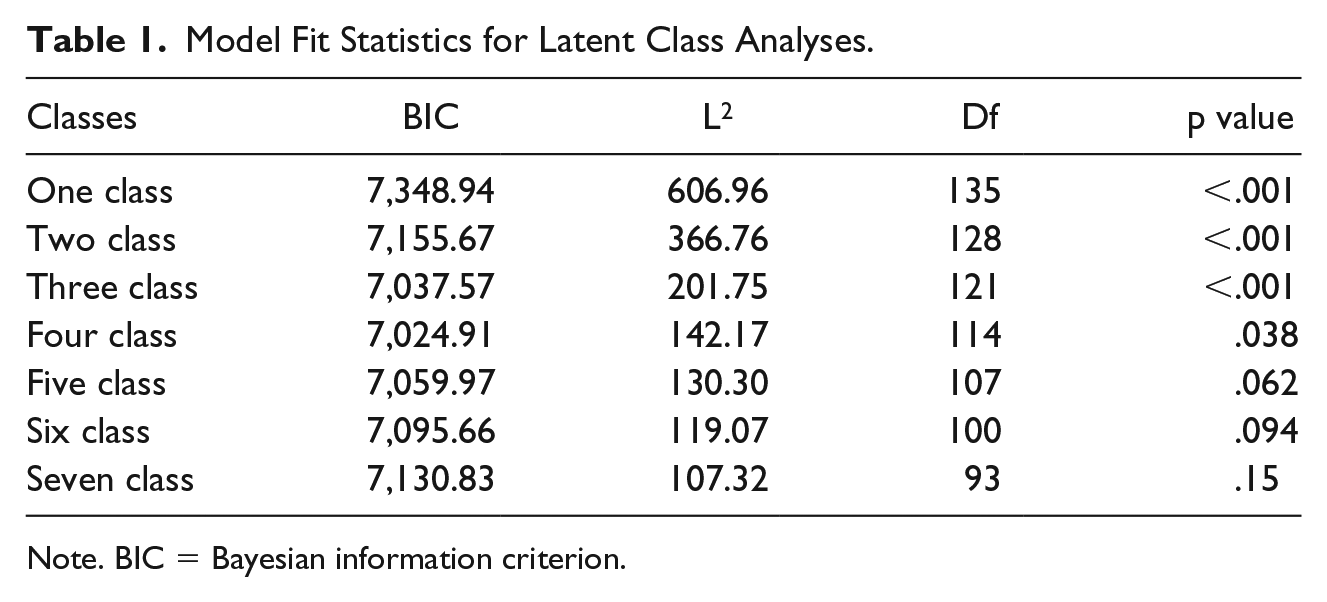
To test Hypothesis 1 and 2, we conducted a latent class analysis. We compared models with different numbers of classes (1–7) and assessed the comparative model fit in order to identify the most parsimonious model while also explaining the greatest amount of association among the variables. We assessed model fit by examining the Bayesian information criterion (BIC), and the likelihood ratio chi-squared statistic (L2), as well as a nonsignificant p value (p > .05). Models with lower BIC and L2 values indicate a better fit. Finally, the bivariate residuals were examined to ensure that all bivariate residuals are lower than 3.84 (Vermunt & Magidson, 2016).
All models tested converged. Model fit statistics are presented in Table 1. The five-class model had comparatively low BIC and L2 values, a nonsignificant p value, no bivariate residuals over 1.46 and classes that were theoretically justified.
Model Fit Statistics for Latent Class Analyses.
Note. BIC = Bayesian information criterion.
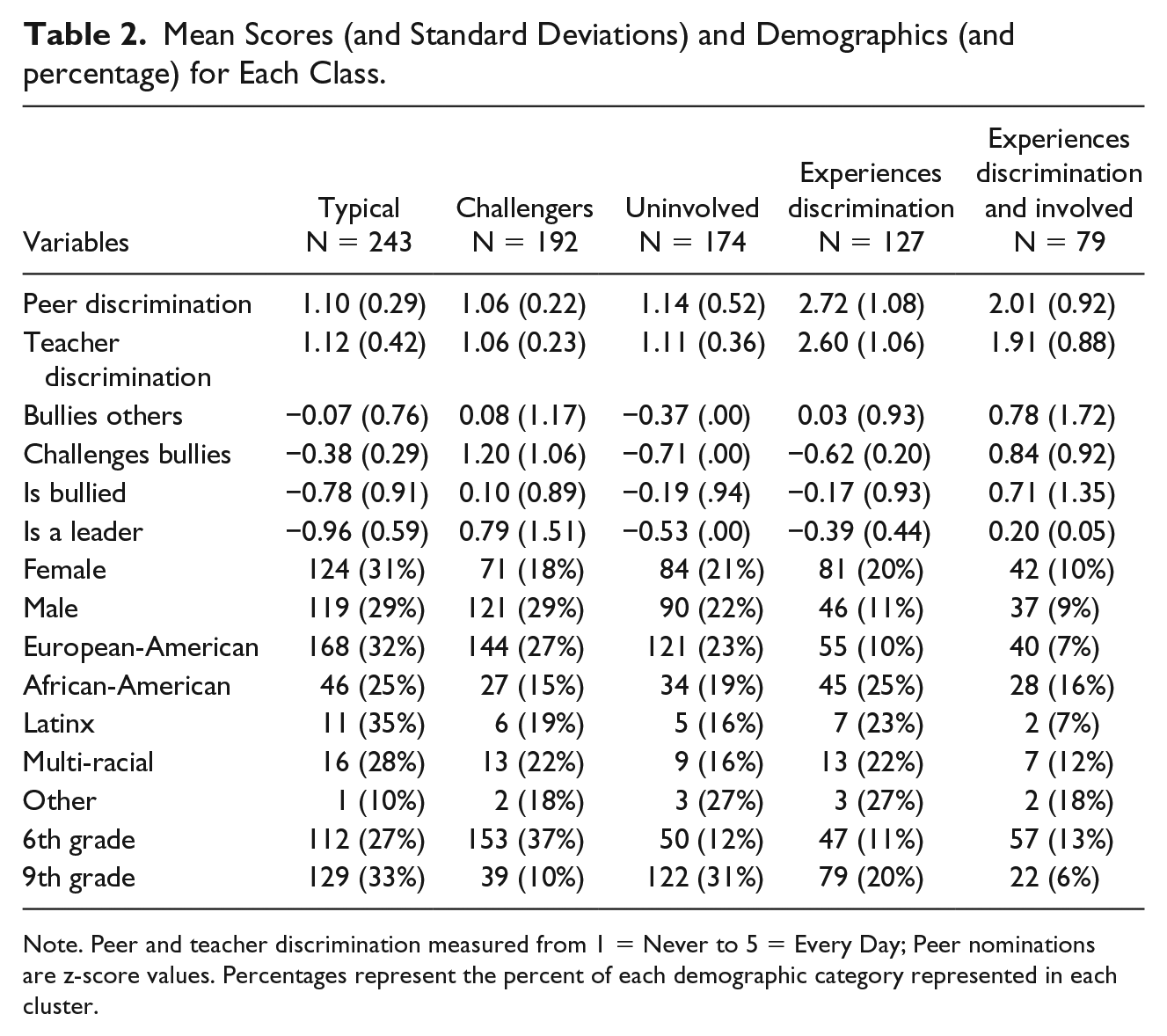
The first class in the five-class model (34.37%; n = 243) is the “Typical” Class. Participants in this class were in the mid-range for nominations as leaders, victims, challenging behavior, and bullying, see Table 2. The second class (22.39%; n = 192) reflects “Challengers” as this group was more likely to be nominated as challenging bullying and as leaders. The third class (16.09% n = 174) reflects participants who were “Uninvolved,” and who were rarely nominated for any of the roles. The fourth class (15.04%; n = 127) “Experiences Discrimination” and report high rates of teacher and peer discrimination. Finally, the fifth class, (12.11%; n = 79), “Experiences Discrimination and Involved” reported high rates of teacher and peer discrimination and were nominated as students who challenge bullying and who were involved in bullying as victims and bullies. Thus, we identified meaningful classes, including a class of youth who reports discrimination and bullying involvement and one who reports discrimination but lower rates of bullying as well as a class who reports challenging bullying.
Mean Scores (and Standard Deviations) and Demographics (and percentage) for Each Class.
Note. Peer and teacher discrimination measured from 1 = Never to 5 = Every Day; Peer nominations are z-score values. Percentages represent the percent of each demographic category represented in each cluster.
Acceptability of the aggressive act
To test the hypotheses (Hypotheses 3–5) that judgments of the acceptability of the aggressive act would vary based on class membership, and grade, a 2 (Grade: 6th, 9th) × 5 (Class: Typical, Uninvolved, Challengers, Experiences Discrimination, Experiences Discrimination, and Involved) ANOVA was conducted on acceptability responses. Results revealed a significant effect of grade, F (1, 798) = 9.139, p = .003, η p 2= .011, and of cluster, F (4, 798) = 22.854, p < .001, η p 2= .103. Confirming Hypothesis 5, these were qualified by an interaction between grade and class, F (4, 761) = 2.809, p =. 025, η p 2= .014. This interaction revealed that 6th grade participants in the Experiences Discrimination and Involved class (p < .001) judged the aggressive acts as less acceptable than did 9th grade participants in this class, see Table 3. Furthermore, partially confirming our Hypotheses, 6th grade Experiences Discrimination and Involved members judged the aggressive act as more acceptable than did 6th grade participants in other classes (p < .001). For 9th graders, participants in the Experiences Discrimination class and in the Experiences Discrimination and Involved class rated the aggressive act as more okay than participants in the Typical (p < .001), Challengers (p < .001), or Uninvolved classes (p < .001). 9th-grade participants in the Challengers class rated the aggression as less acceptable than did the participants in the Typical class (p = .010).
Means and Standard Deviations for Acceptability of the Aggressive Act by Class and Age Group.

Reasoning about acceptability of the aggressive act
To assess differences in use of reasoning (Hypotheses 3–5), a 2 (Grades: 6 and 9) × 5 (Class: Typical, Uninvolved, Challengers, Experiences Discrimination, and Experiences Discrimination and Involved) × 4 (Reasoning: Fairness, Empathy, Welfare of Others, and Social Conventions) repeated measures ANOVA was conducted on reasoning about the acceptability of the aggressive act, with repeated measures on the last factor. This revealed a main effect of reasoning, F (3, 2,376) = 129.184, p < .001, η p 2= .14, which was qualified by an interaction effect between reasoning and class, F (12, 2,376) = 2.062, p = .025, η p 2= .01, see Table 4. Confirming Hypothesis 4, for fairness reasoning, those participants in the Experiences Discrimination and Involved class referenced fairness less often than did those in the Typical class (p = .035) or those in the Challengers class (p = .045). For empathy reasoning, those in the Experiences Discrimination class made less reference to empathy than did those in the Typical (p = .008), Challengers (p = .016), Uninvolved (p = .016), or Experiences Discrimination and Involved (p = .004) classes. In terms of welfare of others’ reasoning, participants in the Experiences Discrimination class made less reference to others’ welfare than did those in the Typical (p = .031), Challengers (p < .001), Uninvolved (p = .005), or Experiences Discrimination and Involved (p = .002) classes. In addition, those in the Challengers class made more reference to harm than did those in the Typical class (p = .002). Finally, participants in the Experiences Discrimination class made less reference to social conventions than did those in the Typical (p = .016), Challengers (p = .004), and Uninvolved (p = .033) classes. In general, those who are in the Experiences Discrimination class are reasoning about the aggressive acts in different ways than are the rest of the participants.
Proportional Use of Reasoning by Class.

Acceptability of bystander intervention
To test the hypothesis that judgments of the acceptability of bystander intervention would vary based on class, and age group, a 2 (Age group: 6 and 9) × 5 (Class: Typical, Uninvolved, Challengers, Experiences Discrimination, and Experiences Discrimination and Involved) ANOVA was conducted on acceptability of bystander intervention responses. This revealed a main effect of class, F (4, 797) = 16.51, p < .001, η p 2= .015. The Experiences Discrimination class judged bystander intervention to be less acceptable (M = 4.21, SD = 1.21) than did the Typical (M = 5.12, SD = 1.09), Challengers (M = 5.17, SD = 1.20) or Uninvolved (M = 5.11, SD = 1.09) classes, all ps< .001. Furthermore, the Experiences Discrimination and Involved class (M = 4.71, SD = 1.24) judged the acceptability of bystander intervention to be less okay than the Typical (p = .048) or Challengers (p = .008) classes. Thus, although all participants were generally positive about bystander intervention, those who experienced discrimination were less supportive of bystander intervention than were members of the other classes.
Likelihood of active intervention
To test the hypothesis that the likelihood of active intervention would vary based on class, and age group, a 2 (Age group: 6 and 9) × 5 (Class: Typical, Uninvolved, Challengers, Experiences Discrimination, and Experiences Discrimination and Involved) ANOVA was conducted on likelihood of active intervention responses. This revealed a main effect of class, F (4, 800) = 6.90, p < .001, η p 2= .033, and of age group, F (1,800) = 8.81, p = .003, η p 2= .011. In terms of age group, findings revealed that 6th graders (M = 4.72, SD = .89) were more likely to expect that they would engage in the active intervention than were 9th graders (M = 4.46, SD = 1.11). The Experiences Discrimination class (M = 4.21, SD = 1.01) was less likely to expect that they would engage in active intervention than were the Typical (M = 4.61, SD = 1.09), Challengers (M = .82, SD = 4.84), or Uninvolved (M = 4.65, SD = 1.03) classes (p < .001). There were no differences between the likelihood for the Experiences Discrimination class and the Experiences Discrimination and Involved class (M = 4.48, SD = .92).
Likelihood of inactive responses
Finally, we tested the hypothesis that the likelihood of inactive responses to aggression would vary based on class, and age group, with a 2 (Age group: 6 and 9) × 5 (Class: Typical, Uninvolved, Challengers, Experiences Discrimination, and Experiences Discrimination and Involved) ANOVA on likelihood of inactive intervention responses. This revealed a main effect of class, F (4, 797) = 11.42, p < .001, η p 2= .054. The Challengers class (M = 2.18, SD = 1.15) reported that they are less likely to engage in inactive responses than the Uninvolved (M = 2.55, SD = 1.24, p = .019), the Experiences Discrimination (M = 2.98, SD = 1.14, p < .001), or the Experiences Discrimination and Involved classes (M = 2.72, SD = 1.25, p < .001). Furthermore, the Experiences Discrimination class reported a higher likelihood of inactive responses than the Uninvolved (p = .037) and the Typical class (M = 2.33, SD = 1.12, p < .001). Finally, the Experiences Discrimination and Involved class reported greater likelihood of inactive responses than the Typical class (p = .013). There were no differences by age group.
Discussion
This study documents that there are distinct typologies of middle and high school students within the bullying ecology, with a clear Challengers class as well as two distinct classes of youth who experience discrimination in school. Moreover, the findings confirm that participants within the distinct classes reason differently about bullying and how to respond to bullying. Finally, age-related differences were also found, with 6th graders judging aggression more wrong and expressing greater intentions to intervene if they observe bullying. Understanding the complexity of bullying ecologies during adolescence is critically important for informing interventions to reduce victimization. In many instances of peer aggression, someone else is present who could intervene on behalf of the victim. Moreover, when witnesses do intervene, the bullying tends to cease almost immediately (Nansel et al., 2001). While prior research has identified distinct profiles of types of witnesses (Waasdorp & Bradshaw, 2018), this study is the first to demonstrate distinct profiles based on bullying roles and experiences of discrimination, a related form of aggression.
Youth Who Report Perceived Racial Discrimination
First, our results indicated that there are two distinct classes of youth who report perceptions of racial discrimination. One class (Experiences Discrimination) reports racial discrimination, but is not involved in bullying in any form. The other class (Experiences Discrimination and Involved) reports racial discrimination, but is also involved in bullying, victimization, and even challenging bullying. While both of these classes include many ethnic minority youth, a small percentage (10% and 7%, respectively) of European American youth are also represented in these clusters. While this study cannot clarify exactly why this group of European-Americans report perceived racial discrimination, or what those particular experiences of perceived discrimination are, it may be that they perceive “reverse racism” or anti-White bias from teachers or peers (Mayrl & Saperstein, 2013; Norton & Sommers, 2011; Wilkins & Kaiser, 2014). As research indicates that ethnic minority and majority youth may not experience perceived racial discrimination in the same way (Gutman et al., 2017; Tropp et al., 2016; Yang & Chen, 2018), future research should further explore potential heterogeneity even within these groups. These two groups do not respond to bullying in the same way. In particular, although both classes who report discrimination generally judged bystander intervention in response to aggression to be less acceptable than did their peers in the other classes, they reported thinking about bullying in distinct ways. Namely, those in the Experiences Discrimination class indicated that they would be less likely to intervene than those in the other classes. Efforts to promote bystander intervention should also attend to reducing experiences of discrimination. It may be beneficial to explore interventions that target self-efficacy which may be needed to challenge or confront peers who engage in aggression, especially for those youth who experience discrimination already. Some youth who experience racial discrimination may disengage from intervening in fear of possible discriminatory consequences. Notably, these two groups also had the lowest means for likelihood of active intervention of all the classes. Thus, targeting climates of discrimination may help ensure that all youth are treated fairly and feel empowered to intervene. This is especially important as prior research highlights how critical bystander intervention is in stopping bullying and creating school climates that are welcoming for all students (Mulvey et al., 2019; Polanin et al., 2012; Salmivalli et al., 2011).
The Experiences Discrimination class also reasoned differently about bullying than the other classes. While prior research from an SRD perspective documents that youth reason about aggression, bullying, and exclusion by recognizing moral concerns (such as the welfare of others) as well as societal concerns (such as group conventions) (Mulvey, 2016; Rutland & Killen, 2015), the current results extend this work by clarifying that perceived discrimination can shape the reasons youth use to support or reject particular responses to bullying. This class was less likely to reference the welfare of others or social convention than were other participants. They may weigh different considerations that were not captured in the current coding system, suggesting the importance of additional work to understand how youth who report discrimination think about bullying and aggression. Qualitative interviews with youth who experiences discrimination may provide more insight into the social-cognitive lens used by these students.
It may also be important for future research to examine whether youth from different racial/ethnic backgrounds who experience racial discrimination reason differently about bullying and aggression. In the current analysis, we examined only perceptions of racial discrimination, but were not able to also explore differences by participant ethnicity, given the homogeneous nature of our sample. In fact, as noted, some youth in the discrimination clusters are ethnic majority youth. Future research should explore more closely whether the experiences of ethnic majority youth who perceive peer and teacher racial discrimination are similar or different in their cognition around bullying from ethnic minority you who perceive peer and teacher racial discrimination. While prior research from an SRD perspective highlights the importance of attending to reasoning (Rutland et al., 2010), this research is the first to explore reasoning differences by class membership. The findings indicate the importance of continuing to unpack these different reasoning profiles as youth may weigh different considerations or experiences garnered from their distinct social identities as well.
Challengers
Beyond those who report experiences of discrimination, three other meaningful classes emerged. Interestingly, these reflect two classes who were unlikely to be nominated by their peers as playing any role in the bullying ecology (Uninvolved and Typical) and one class who was identified as leaders and challengers of bullying and aggression. Although all classes tended to judge the aggression as wrong and to expect that they would engage in bystander intervention, the Challengers were the most likely to judge the aggression as wrong and the least likely to indicate that they would simply be inactive if they observed aggression. These findings confirm prior research that shows that youth recognize the role of peers who are trained to stand-up against discrimination and prejudice (Paluck, 2011). Thus, peers are attuned to who is standing-up when aggression occurs and these youth are especially aware of the wrongful nature of youth aggression. Prior research shows that peer leaders who challenge prejudice can impact the attitudes and behaviors of their close friends, as well (Paluck, 2011), suggesting that over time, our Challengers may be able to shift the reasoning and judgments (and perhaps class membership) of those in other classes, such as the Uninvolved and Typical class members. This is likely as, in general, participants were all judged aggression as wrong and indicate that they would like to engage in active forms of intervention, although only one class emerged that is really taking leadership for intervening (representing about 23% of participants). Why is that participants recognize aggression as wrong and indicate that they would like to intervene, yet, based on peer nominations less than a quarter of adolescents are seen as peers who will challenge bullies and stand-up for victims? Greater attention needs to be paid to empowering adolescents to actually intervene rather than only to support the idea of intervention.
Age-Related Differences
Findings also suggest that additional attention may need to focus on older adolescents, in particular. In concert with other findings (Mulvey et al., 2016, 2019), our results demonstrate that 9th graders, as compared to 6th graders are less likely to support intervention and also judge aggression as less wrong. Furthermore, the Challengers class was especially likely to include 6th graders (37% of 6th graders was classified as Challengers, while only 10% of 9th graders were Challengers) and the Uninvolved class included many more 9th graders (31%) than 6th graders (12%). As issues surrounding bullying do not diminish across the lifespan, future research should continue to attend to these consistently emerging developmental differences. Antibullying approaches with older adolescents may need to target different factors than those for younger adolescents.
Limitations
While this research provides novel insight into adolescent bullying ecologies, it is not without its limitations. Participants were drawn from a single school district in the United States. We cannot know how these results could translate to other school districts. In addition, this study is cross-sectional in nature. Understanding whether moral judgments and reasoning predict peer nominations at a later time (or if there are reciprocal relationships between these over time) would provide additional insight into best targets for intervention. Furthermore, the sample was primarily European-American/White, which leaves questions regarding what perceptions of discrimination based on race mean for students who may not experience structural or interpersonal racism.
However, this work provides novel insight into classes of youth around racial discrimination and bullying ecology and documents how membership in these clusters differentially explains reasoning and evaluations about peer aggression.
Implications
These findings may have important implications for the development of antibullying interventions. There have been successful interventions to foster bystander intervention in international contexts, most notably the KiVa program (Kärnä et al., 2011; Yang & Salmivalli, 2015). However, there has also been a call for attention to the diverse nature of U.S. schools, with a recent meta-analysis suggesting that antibullying programs may be ineffective because they do not attend to the heterogeneous nature of U.S. school populations (Evans et al., 2014). The findings confirm the importance of attending to the diverse nature of schools: namely, we document that youth who experience discrimination are not a homogeneous group in terms of their involvement in the bullying ecology, and these youth also think in distinct ways about instances of youth aggression and how to respond to such instances. This also suggests the importance of future work examining how these distinct classes develop or emerge developmentally. Future work should aim to identify what family or environmental factors may contribute to the development of an adolescent who will stand-up to bullying.
Footnotes
Acknowledgements
The authors thank the students who participated, the research assistants who aided in data collection, and the parents, teachers, and schools with whom they worked as part of this study.
Declaration of Conflicting Interests
The author(s) declared no potential conflicts of interest with respect to the research, authorship, and/or publication of this article.
Funding
The author(s) disclosed receipt of the following financial support for the research, authorship, and/or publication of this article: This project was supported by award no. 2016-R2-CX-0056, awarded by the National Institute of Justice, Office of Justice Programs, U.S. Department of Justice. The opinions, findings, and conclusions or recommendations expressed in this publication are those of the author(s) and do not necessarily reflect those of the Department of Justice.
