



Abstract
Parental relationship histories are associated with adolescents’ romantic and sexual relationships. However, no research examines the association between parents’ being in an on-again/off-again relationship (churning) and adolescent relationship outcomes, even though a substantial minority of youth experience this form of family instability. Using Fragile Families and Child Wellbeing Study data, the present study examines how parental relationship histories are associated with adolescents’ dating and sexual experiences. We find that differences in outcomes between adolescents who experience parental relationship churning and adolescents who experience other parental relationship histories are largely explained by variation in adolescent and parental characteristics. These findings suggest that adolescents who experience parental relationship churning are a distinctive group, but for reasons other than their parents’ tumultuous relationship histories.
Family instability is consistently associated with children’s relationship outcomes in adolescence and young adulthood, including the age at which teens begin having romantic and sexual relationships, their relationship quality, and their experience of intimate abuse (Amato & Booth, 2001; Amato & Patterson, 2017; Cavanagh et al., 2008; Cheshire et al., 2019; Cui et al., 2016; Goldberg et al., 2019). Although prior research has examined various forms of family instability (such as parental divorce), research has yet to attend to a distinct and potentially consequential form of family instability: parental relationship churning (i.e., parents having an on-again/off-again relationship, that is, breaking up and getting back together at least once). Failing to recognize adolescents who experience parental relationship churning may mean the association between instability and adolescent relationships is not properly estimated, as these adolescents could be improperly grouped with adolescents whose parents are stably together or separated. This is a substantial oversight because a sizeable minority of youth—approximately one in six in early childhood alone—experience parental relationship churning (Halpern-Meekin & Turney, 2016).
There are reasons to expect adolescents with churning parents have distinct orientations to romantic and sexual relationships from peers growing up in stable family forms or peers who experience their parents’ stable separation. Dynamics in churning families may affect adolescents’ romantic and sexual relationships via family stress and disruption, social learning, or social control. Alternatively, distinct demographic and socioeconomic characteristics among churning parents may mean their offspring select into distinct romantic and sexual relationship behaviors and quality. It is an empirical question whether adolescents who experience parental relationship churning have distinct patterns of romantic and sexual relationship involvement compared to their counterparts in other family structures.
In the present study, we use longitudinal data from the Fragile Families and Child Wellbeing Study to compare adolescents’ engagement in romantic and sexual relationships at age 15 by parental relationship instability, distinguishing adolescents who experience parental relationship churning from those with stably together parents, those with stably broken up parents who do not repartner, and those with stably broken up parents who repartner. We consider adolescent relationship experience (dating by age 15 and sex by age 15) and adolescent relationship characteristics (relationship quality and intimate partner abuse perpetration and victimization). This study contributes to our understanding of how family instability is related to adolescent wellbeing by bringing in a more nuanced view of instability (Cavanagh & Fomby, 2019).
Background
Adolescents’ Romantic and Sexual Relationships
Adolescent romantic relationship formation and experiences lay the groundwork for unions in adulthood (Collins, 2003; Collins et al., 2009; Furman & Shaffer, 2003). Having a positive romantic relationship in young adulthood follows a developmental process that unfolds over the course of adolescence (Seiffge-Krenke, 2003). Adolescent relationship experiences are predictive of health behaviors and outcomes in adulthood, including sexual risk behaviors, obesity, general health, and substance use (Epstein et al., 2018; Heywood et al., 2015; Sandfort et al., 2008). Adolescent romantic experiences also have short-term consequences. For example, relationship breakup is associated with depression among adolescents (Monroe et al., 1999). Therefore, more fully understanding the factors associated with adolescent relationship outcomes gives us greater insight into a key adolescent experience.
The transition to first romantic and sexual relationships is a part of the typical developmental trajectory in adolescence (Collins et al., 2009; Tolman & McClelland, 2011). In the present study, we examine whether adolescents transition to dating and sex prior to age 15. Around age 15 there is a substantive change in teen dating relationships (Meier & Allen, 2009); while only 20% of 13- and 14-year-olds report ever having had a romantic relationship, 44% of 15- to 17-year-olds have done so (Lenhart et al., 2015). Among ninth graders, only one in five has had intercourse; it is not until teens are in 12th grade that a majority have had sex (Witmer et al., 2018). We follow Dixon-Mueller (2008), who suggests that, before 15, individuals are likely too young to become sexually active without an increased risk of adverse outcomes (Epstein et al., 2018; Heywood et al., 2015; Sandfort et al., 2008). Additionally, we focus on characteristics of romantic relationships, such as quality, because they are associated with current wellbeing and later relationship experiences (Amato & Patterson, 2017; Collins et al., 2009; Cui et al., 2013; Goldberg et al., 2019).
Family Instability and Adolescent Outcomes
Several theoretical perspectives suggest family instability is associated with adolescent outcomes. These motivations are typically grounded in a family systems perspective, which maintains that changes in one dyadic relationship can have reverberating consequences throughout the family system; that is, changes between parents can affect relationships between parents and children (Kerr & Bowen, 1988). The most common perspectives posit that family instability leads to stress, altered access to resources, a disruption of parental social control, or children’s social learning of distinct relationship behaviors (for discussion, see Cavanagh et al., 2008; Fomby & Bosick, 2013; Fomby & Cherlin, 2007).
Although studies have yet to definitively support any of these theories (Bulanda & Manning, 2008; Donahue et al., 2010; Fomby & Cherlin, 2007; Hadfield et al., 2018), research establishing the association between family instability and adolescents’ outcomes is more consistent. Research regularly finds that family instability is associated with negative outcomes for adolescents, including socioemotional wellbeing, school achievement, and cognitive outcomes (Cavanagh 2008; Cavanagh & Fomby 2012, 2019; Cavanagh et al., 2006; Cooper et al., 2011; Dorius & Guzzo, 2013; Dush, 2009; Fomby, 2011; Fomby & Bosick, 2013; Fomby & Sennott, 2013; Heard, 2007; Osborne, Berger, & Magnuson, 2012; Sun & Li, 2009).
Family instability is associated with earlier transitions into romantic and sexual experiences among adolescents and young adults, including romantic relationship involvement in adolescence, nonmarital and first birth timing, and coresidential union entry and timing (Capaldi et al., 1996; Cavanagh et al., 2008; Cavanagh & Fomby, 2019; Donahue et al., 2010; Fomby & Bosick, 2013; Fomby et al., 2010; Hofferth & Goldscheider, 2010; Wu & Thomson, 2001). There are on-going questions about whether family instability itself has a causal effect on youth outcomes—through mechanisms such as changing family resources, disrupted family roles and routines, decreased parent-child closeness, or social learning—or whether these associations instead result from characteristics associated with experiencing family instability. Recent research suggests a causal relationship between family instability and youth outcomes, although this relationship varies depending on both the type of family transition and outcome considered (Amato & Anthony, 2014; Lee & McLanahan, 2015; for a review, see McLanahan et al., 2013). In addition, some findings regarding the link between family structure history and adolescent relationship outcomes vary by adolescent gender, although the direction of this variation differs across studies (Cavanagh et al., 2008; Ryan et al., 2009).
Churning as a Distinct Form of Family Instability
Although there is limited research on churning among parents, it is not uncommon, experienced by one in six children by age five (Halpern-Meekin & Turney, 2016). Churning parents are an economically vulnerable group, reporting lower educational attainment and higher material hardship than other parents (Halpern-Meekin & Turney, 2016). Churning parents also have distinct family dynamics, with higher levels of father involvement than other parents who separate (Turney & Halpern-Meekin, 2017), but also higher levels of parental stress (Halpern-Meekin & Turney, 2016).
None of this research on parental relationship churning has examined offspring romantic and sexual behaviors. These outcomes may be distinctive in that they are related quite directly to parents’ romantic relationships. Previous research suggests that—via social learning, role modeling, and the intergenerational transmission of values—parents’ romantic relationships directly shape their children’s romantic relationships. Additionally, this could occur indirectly, via the reduction in supervision and control of teen children stemming from parental relationship instability (Amato, 2005; Brown & Rinelli, 2010; Cavanagh, 2008; Mack et al., 2015). We compare adolescents who experience parental relationship churning to adolescents who have parents who are stably together, parents who experience dissolution without repartnership, and parents who experience dissolution with repartnership.
Churning versus stably together relationships
Adolescents with churning parents likely report significantly different outcomes than their counterparts with stably together parents given their exposure to a particular constellation of parental relationship dynamics. Previous research finds that those in churning relationships report more relationship conflict, lower quality relationships, and a greater likelihood of experiencing intimate abuse compared to those who are stably together (Dailey et al., 2009; Halpern-Meekin et al., 2013b; Halpern-Meekin & Turney, 2016). We test two competing hypotheses, interrogating whether these patterns of relationship outcomes in adults are mirrored in children with churning parents. On the one hand, adolescents from churning relationships may be less likely to get involved in romantic and sexual relationships than their counterparts with stably together parents (Hypothesis 1a). This could be because, in seeing and hearing about the repeated family disruptions caused by their parents’ separations and reunifications, they are put off romantic and sexual entanglements. On the other hand, adolescents from churning relationships may be more likely to be in romantic and sexual relationships than their peers with stably together parents (Hypothesis 1b). This could be because, as previous research on other forms of family instability, reviewed above, finds, increased family transitions are associated with earlier entrances into romantic and sexual relationships. Furthermore, conditional on adolescents having a romantic relationship, we expect parental relationship churning is associated with lower quality relationships and elevated reports of abuse, due to the turmoil in churning parental unions (Hypothesis 2).
Churning versus dissolution without repartnering relationships
From a family systems perspective, because churning is associated with elevated parenting stress compared to being broken up and not repartnered (Halpern-Meekin & Turney, 2016), we expect to see significant differences in the romantic and sexual relationship behaviors and characteristics between these two groups of adolescents, as parenting behaviors are linked with adolescent relationship outcomes (Auslander et al., 2009; Walper & Wendt, 2015). Therefore, as parallels to Hypotheses 1a and 1b above, we test if adolescents with churning (vs. stably broken up and not repartnered) parents are less (Hypothesis 3a) or more (Hypothesis 3b) likely to enter into romantic and sexual relationships. Further, we expect that adolescents with churning parents will be more likely than their counterparts from stably separated families to report lower relationship quality and higher rates of abuse (Hypothesis 4).
Churning versus dissolution with repartnering relationships
Churning might be distinct from parental relationship dissolution with repartnering in its association with adolescent outcomes, despite the fact that both may involve the same number of family transitions. For example, stepparents and stepchildren tend not to have the same quality and function in their relationships as biological parents and children (Buchanan et al., 1996; Coleman et al., 2000); this could suggest that parental churning, compared to dissolution with repartnering, is protective for adolescents. In support of this idea, Hernandez et al. (2016) found lower levels of depressive symptoms among teen girls from churning families compared to those from other unstable family forms. In contrast, other research finds similar behavioral outcomes among both groups of youth (Nepomnyaschy & Teitler, 2013; Turney & Halpern-Meekin, 2020). On this basis, we expect that adolescents from churning relationships are less likely to be involved in romantic and sexual relationships (Hypothesis 5) and more likely to be in lower quality or abusive relationships (Hypothesis 6) than their counterparts with repartnered parents.
Analytically distinguishing between adolescents experiencing parental relationship churning and adolescents experiencing other family types allows us to separate out the experiences of parental relationship dissolution and parental repartnering. Churning parents and parents who stably dissolve their unions and repartner with someone else may experience the same number of relationship transitions, but only the latter potentially experience the introduction of a new romantic partner into the household. For adolescents, undergoing multiple transitions and the introduction of a new parent-figure into the household may have distinct associations with relationship outcomes. To explore these possibilities, we empirically test Hypotheses 1 to 6.
Method
Data
We use data from the Fragile Families and Child Wellbeing Study, a cohort of 4,898 children born to mostly unmarried mothers in urban areas in the United States between 1998 and 2000 (Reichman et al., 2001). Children’s mothers and fathers were first surveyed shortly after the focal child’s birth. Parents were re-surveyed when children were approximately 1, 3, 5, 9, and 15 years old (with both parents surveyed at the first four follow-ups and the child’s primary caregiver surveyed at the last follow-up). Children were surveyed when they were approximately 9 and 15 years old.
These prospective longitudinal data provide an unparalleled opportunity to examine the association between parental relationship churning and adolescent romantic and sexual relationships. First, as described below, these data include direct indicators of parental relationship churning at the baseline, 3-year, and 5-year surveys. Second, these data contain adolescent reports of their relationships at the latest survey wave, when respondents were, on average, 15 years old, including indicators of both relationship experience and relationship characteristics. Third, these data include demographic and socioeconomic indicators that might render any observed association between parental relationship churning and adolescent relationships spurious.
The primary analytic sample comprises 3,314 of the 4,898 families who participated in the baseline survey. We first exclude the 1,454 observations in which the adolescent did not participate in the 15-year survey, as this is when the outcome variables are measured, and then we exclude the additional 101 observations missing data on one or both indicators of relationship experience (described below). We also exclude the additional 29 observations that do not fit into any of the four categories of parental relationship history (also described below). There are few statistically significant differences between the analytic and baseline samples. Mothers in the analytic sample, compared to mothers in the baseline sample, are significantly less likely to be Hispanic and more likely to be foreign-born, and have more education. Parents in the analytic sample are also significantly more likely to share a child in addition to the focal child.
The secondary analytic sample, used to estimate the three relationship characteristics outcomes (described below), comprises the 911 observations in the primary analytic sample wherein the adolescent reports currently being in a romantic relationship at the 15-year survey. Given that adolescents do not randomly select into romantic relationships, there are statistically significant differences in both adolescent and parent characteristics between observations in the primary and secondary analytic samples (results available upon request). Adolescents in the secondary analytic sample, compared to adolescents in the primary analytic sample, are more likely to be non-Hispanic Black and less likely to be Hispanic. They are less likely to identify as sexual minorities and, on average, are older. Their parents are less likely to married and more likely to be separated at baseline. Their mothers report lower educational attainment, more material hardship, lower income-to-poverty ratios, higher impulsivity, and lower cognitive ability.
Measures
Parental relationship churning
The key explanatory variable, parental relationship churning, is measured with direct and indirect reports of churning between the baseline and 9-year surveys. Direct reports of parental relationship churning include mothers’ reports of being in an “on-again, off-again” relationship with the child’s biological father. These direct reports are ascertained at the baseline, 3-year, and 5-year surveys (direct measures of churning are not available at the 1- or 9-year surveys). We supplement direct reports of churning with indirect reports of churning (both to capture direct churning we cannot measure at the 1- or 9-year surveys and to capture between-wave churning). Indirect measures of churning are constructed when a mother reports a romantic relationship with the father at one survey, no relationship with him at a subsequent survey, and a relationship with him at a following survey (or reports no relationship at one survey, a relationship at a subsequent survey, and no relationship at a following survey). We categorize adolescents as experiencing parental relationship churning if their mothers report either direct or indirect churning. We use mothers’ reports of churning rather than fathers’ because their survey response rates were far higher, and they may have differing interpretations of what relationship events count as churning (Halpern-Meekin & Tach, 2013); therefore, maintaining the same reporter across waves is important.
We compare adolescents who experience parental relationship churning to adolescents with three types of parental relationships: (1) stably together, when mothers report any romantic relationship (including a marital, cohabiting, or nonresidential romantic relationship) with adolescents’ fathers at the baseline, 1-year, 3-year, 5-year, and 9-year surveys (and no churning); (2) dissolution without repartnering, when mothers report dissolving any romantic relationship with adolescents’ fathers and no subsequent repartnering (and no churning); and (3) dissolution with repartnering, when mothers report dissolving any romantic relationship with adolescents’ fathers and also report (residential or nonresidential) repartnering (and no churning). About one-fifth (20.4%) of adolescents experienced parental relationship churning between birth and age 9. Over this time period, one-third (33.7%) of adolescents had parents in stably together relationships, 10.3% experienced parental dissolution without repartnering, and 35.6% experienced parental dissolution with repartnering.
Adolescent relationships
The dependent variables include two indicators of adolescent relationship experiences and, among adolescents in a romantic relationship, three indicators of adolescent relationship characteristics, all reported by the adolescent at the 15-year survey.
Relationship experience is measured by two variables: dating by age 15 and sex by age 15. First, adolescents are asked to respond to the following: “Have you ever dated someone? Remember, by dating we mean when you like someone and she or he likes you back. It doesn’t have to mean going on a ‘formal’ date.” Adolescents who answer this question affirmatively were asked to report their age when they first dated someone. We use this information to create a binary variable indicating the adolescent had dated someone by age 15. Second, adolescents in a romantic relationship were asked the following: “Some teens your age are sexually active and others are not. Have you ever had sexual intercourse with [PARTNER],—sometimes this is called ‘making love’, ‘having sex’, or ‘going all the way’?” Adolescents who answer non-affirmatively to the above and adolescents not in a romantic relationship are asked the following: “Some teens your age are sexually active and others are not. Have you ever had sexual intercourse with anyone, that is, made love, had sex, or gone all the way?” Adolescents who report sexual activity were then asked to report the month and year they had sex for the first time and, if the month and year is unknown, their age at first sex. We use this information to create a binary variable indicating that the adolescent had sex by age 15. With these measures of sexual activity, the adolescent respondents are defining what they consider to be sexual intercourse, rather than the survey defining it for them. This means intercourse is not necessarily limited to, for example, vaginal intercourse. Three-quarters of adolescents (75.4%) report dating by age 15 and 18.8% report sex by age 15.
Relationship characteristics are ascertained with three variables asked of adolescents who are currently in a romantic relationship at the 15-year survey: relationship quality, intimate partner abuse victimization, and intimate partner abuse perpetration. Lower relationship quality is a binary variable indicating the adolescent reports the quality of their relationship is good, fair, or poor (compared to excellent or very good). We construct a binary measure of relationship quality due to the overwhelmingly positive assessment most adolescents offer of their relationships (with 83.5% reporting excellent or very good quality relationships). Abuse victimization is a binary variable indicating the adolescent reports their partner often or sometimes (1) puts them down in front of other people and/or (2) pushes, hits, or throws something at them that could hurt. Abuse perpetration is a binary variable indicating the adolescent reports they often or sometimes (1) put down their partner in front of other people and/or (2) pushes, hits, or throws something at them that could hurt. In supplemental analyses, discussed below, we separate out physical and emotional abuse victimization and perpetration experiences, although small sample sizes limit our ability to draw conclusions with these measures. Among adolescents in a romantic relationship at the 15-year survey, 16.2% report lower relationship quality, 8.9% report abuse victimization, and 8.9% report abuse perpetration.
Control variables
The multivariate analyses adjust for adolescent and parent characteristics. Adolescent characteristics include race/ethnicity (a series of mutually exclusive variables reported by the adolescent including non-Hispanic White, non-Hispanic Black, Hispanic, non-Hispanic other race, and multiracial, with the latter two categories collapsed in the multivariate analyses due to small sample sizes), gender, childhood temperament (reported by the mother at the 1-year survey), and age at the 15-year survey. We also adjust for sexual minority status, a binary measure indicating the adolescent reports same-sex attraction at the 15-year survey (Mittleman, 2019).
Mother’s and father’s demographic characteristics include foreign-born status, age, family structure in childhood (1 = lived with both biological parents at age 15), relationship status at the child’s birth (married, cohabiting, non-residential romantic relationship, no relationship), the parents having additional shared children, and multipartnered fertility. Mother’s and father’s socioeconomic characteristics include educational attainment (less than high school, high school degree or GED, some college, college), income-to-poverty ratio, material hardship (a sum of binary variables indicating hardship in the past year [such as “did not pay full amount of rent or mortgage payments”]), and employment (1 = worked for pay in the last week). Additional measures include mother’s and father’s depression (measured by responses to the Composite International Diagnostic Instrument-Short Form [CIDI-SF; Kessler et al., 1998]), cognitive ability (Wechsler, 2001), and impulsivity (Dickman, 1990). All control variables from parents are measured when they are first available (either at the baseline or 1-year surveys, with the exception of mother’s impulsivity [first asked at the 3-year survey]).
Analytic Strategy
We first calculate the frequencies of adolescent romantic and sexual relationship outcomes across the four groups of parental relationships: relationship churning, stably together, dissolution without repartnering, and dissolution with repartnering. We use chi-square tests to examine whether the group differences are statistically significant. In these and subsequent analyses, examinations of adolescent relationship characteristic outcomes are necessarily restricted to the adolescents in the sample who were in a romantic relationship at the 15-year survey (n = 911).
We next use logistic regression models to estimate the association between parental relationship churning and adolescent relationships. In all models, we compare adolescents who experienced parental relationship churning to adolescents exposed to the other three types of parental relationships. The first model adjusts for adolescent characteristics. The second model further adjusts for parent characteristics, allowing us to consider if these characteristics explain observed differences between groups. The parent characteristics are measured when first available (generally at the baseline or 1-year surveys), as noted above, to facilitate temporal ordering between the control variables and the indicators of parental relationship churning (measured between the baseline and 9-year surveys).
Relatively few observations in the analytic sample are missing data on the key explanatory variables and the control variables. Control variables reported by mothers are missing an average of 3% of observations. Control variables reported by fathers are missing an average of 19% of observations. We impute these missing values, using the multivariate normal method and pooling results across the 20 imputed data sets.
Sample Description
Table 1 documents descriptive statistics of the primary analytic sample. In terms of demographic characteristics, 18.2% of adolescents identify as non-Hispanic White, 48.8% as non-Hispanic Black, 25.3% as Hispanic, and 7.7% as non-Hispanic other race or multiracial. Just over one-tenth (11.5%) of adolescents report sexual minority status. The majority of adolescents were born to parents living together at their birth (with 24.6% of parents married and 35.7% of parents cohabiting). See appendix tables A1 and A2 for further sample information.
Descriptive Statistics of Variables (N = 3,314).

Note. b = measured at baseline; y1 = measured at 1-year surveyl; y3 = measured at 3-year survey; y5 = measured at 5-year survey; y9 = measured at 9-year survey; y15 = measured at 15-year survey.
Results
Frequencies of Adolescent Relationship Outcomes
Table 2 presents the frequencies of the five indicators of adolescent romantic and sexual relationships by parental relationship history. For the two relationship experience outcomes (dating by age 15 and sex by age 15), there are some statistically significant differences between adolescents with churning parents and other adolescents. About four-fifths (79.0%) of adolescents with churning parents had dated by age 15, compared to 66.2% of adolescents with stably together parents (p < .001). Additionally, adolescents with churning parents are more likely to report sex by age 15 than adolescents with stably together parents (22.4% compared to 11.0% [p < .001]). See appendix table A3 for further sample information.
Descriptive Statistics of Outcome Variables, by Parent Relationship History (N = 3,314).

Note. Asterisks compare parent relationship history groups to churning. Subgroup Ns vary across multiply imputed data sets. Relationship quality outcomes necessarily restricted to adolescents in a romantic relationship at the 15-year survey (n = 187–210 for churning, n = 219–242 for stably together, n = 90–104 for dissolution and no repartnering, and n = 366–388 for dissolution and repartnering).
p < .10. *p < .05. **p < .01. ***p < .001.
Among adolescents in a romantic relationship at the 15-year survey, there are some statistically significant differences in relationship characteristics between those who experienced parental relationship churning and other adolescents. Adolescents who experienced parental relationship churning, compared to those with stably together parents, are more likely to report lower relationship quality (19.0% compared to 12.1%, p < .05), abuse victimization (10.0% compared to 5.6%, p < .05), and abuse perpetration (11.1% compared to 3.6%, p < .001). Adolescents who experienced parental relationship churning are marginally more likely to report abuse perpetration than adolescents who experienced parental relationship dissolution without repartnering (11.1% compared to 8.2%, p < .10). There are no statistically significant differences in relationship characteristics between adolescents with churning parents and adolescents who experienced parental relationship dissolution with repartnering.
Adolescent Relationship Outcomes as a Function of Parental Relationship Churning
Relationship experience outcomes
Table 3 presents results from logistic regression models estimating the two indicators of relationship experience: dating by age 15 and sex by age 15. We turn first to estimates of dating by age 15. Model 1, which adjusts for adolescent characteristics, shows that compared to adolescents with churning parents, adolescents with stably together parents are less likely to have dated by age 15 (b = −0.591, p < .001). Put another way, adolescents with stably together parents are about half as likely to have dated by age 15 than adolescents with churning parents (odds ratio [OR] = 0.55). There are no statistically significant differences between adolescents with churning parents and adolescents who experienced parental relationship dissolution without repartnering (b = −0.154, n.s.) or dissolution with repartnering (b = 0.129, n.s.).
Logistic Regression Models Estimating Relationship Experiences as a Function of Parental Relationship History (N = 3,314).

Note. ^p < .10. *p < .05. **p < .01. ***p < .001.
In Model 2, which adjusts for parent characteristics, the difference between adolescents with churning parents and adolescents with stably together parents falls from statistical significance and is reduced in magnitude by 85% (b = −0.091, n.s.); differences in coefficients between the other groups are not statistically significant. We separately examined how individual parent characteristics explained differences in the magnitude of coefficients across models, finding that the reduction in coefficient was primarily driven by parents’ baseline relationship status (explaining 51.1% of the association), mothers’ income-to-poverty ratio (27.9%), mothers’ educational attainment (24.4%), and fathers’ educational attainment (26.4%). In supplemental analyses (available upon request), we further adjust for parents’ current relationship status at the 15-year survey, as this may be associated with adolescent relationship outcomes. These estimates, which are conservative because current parental relationship status likely results from parents’ prior relationship history, show that parental relationship churning is not significantly associated with dating by age 15.
We next turn to estimates of sex by age 15. Model 1 shows that adolescents with stably together parents are less likely to have had sex by age 15 than those with churning parents n (b = −0.667, p < .001). There are no statistically significant differences between adolescents with churning parents and those whose parents dissolved their unions, whether or not they repartnered (b = −0.100, n.s. for dissolution without repartnering; b = 0.100, n.s. for dissolution with repartnering).
In Model 2, which adjusts for parent characteristics, the coefficient comparing adolescents with churning parents to adolescents with stably together parents is reduced in magnitude by 66% and is no longer statistically significant (b = −0.228, n.s.); differences in coefficients between the other groups are not statistically significant. Similar to the estimates of dating by age 15, the reduction in the coefficient across models was primarily driven by parents’ baseline relationship status (32.1%), mothers’ income-to-poverty ratio (31.9%), mothers’ educational attainment (26.5%), and fathers’ educational attainment (22.2%). Supplemental analyses adjusting for parents’ current relationship status are consistent with the results in Model 2.
Taken together, these results do not support Hypotheses 1a, 1b, 3a, 3b, or 5 once we include parent characteristics in Model 2, as there are then no significant differences in romantic or sexual relationship experiences between groups.
Relationship characteristic outcomes
Table 4 presents results from logistic regression models estimating the three indicators of relationship characteristics: lower relationship quality, abuse victimization, and abuse perpetration. These estimates show that, net of adolescent characteristics (Model 1), adolescents with stably together parents are significantly less likely than adolescents with churning parents to report abuse perpetration (b = −1.011, p < .05). This association remains in Model 2 (b = −1.285, p < .05), which additionally adjusts for parent characteristics. In this model, adolescents with stably together parents have about one-quarter the likelihood (OR = 0.27) of abuse perpetration than adolescents with churning parents. This partially supports Hypothesis 2. There are no statistically significant differences between churning adolescents and the other groups of adolescents with respect to the other two indicators of relationship characteristics, lower relationship quality and abuse victimization, consistent with the descriptive results in Table 2; differences in coefficients between the other groups generally do not reach statistical significance. These results do not support Hypotheses 4 or 6. Supplemental analyses that further adjust for current parental relationship status at the 15-year survey show results consistent with those in Model 2.
Logistic Regression Models Estimating Relationship Characteristics as a Function of Parental Relationship History (N = 911).
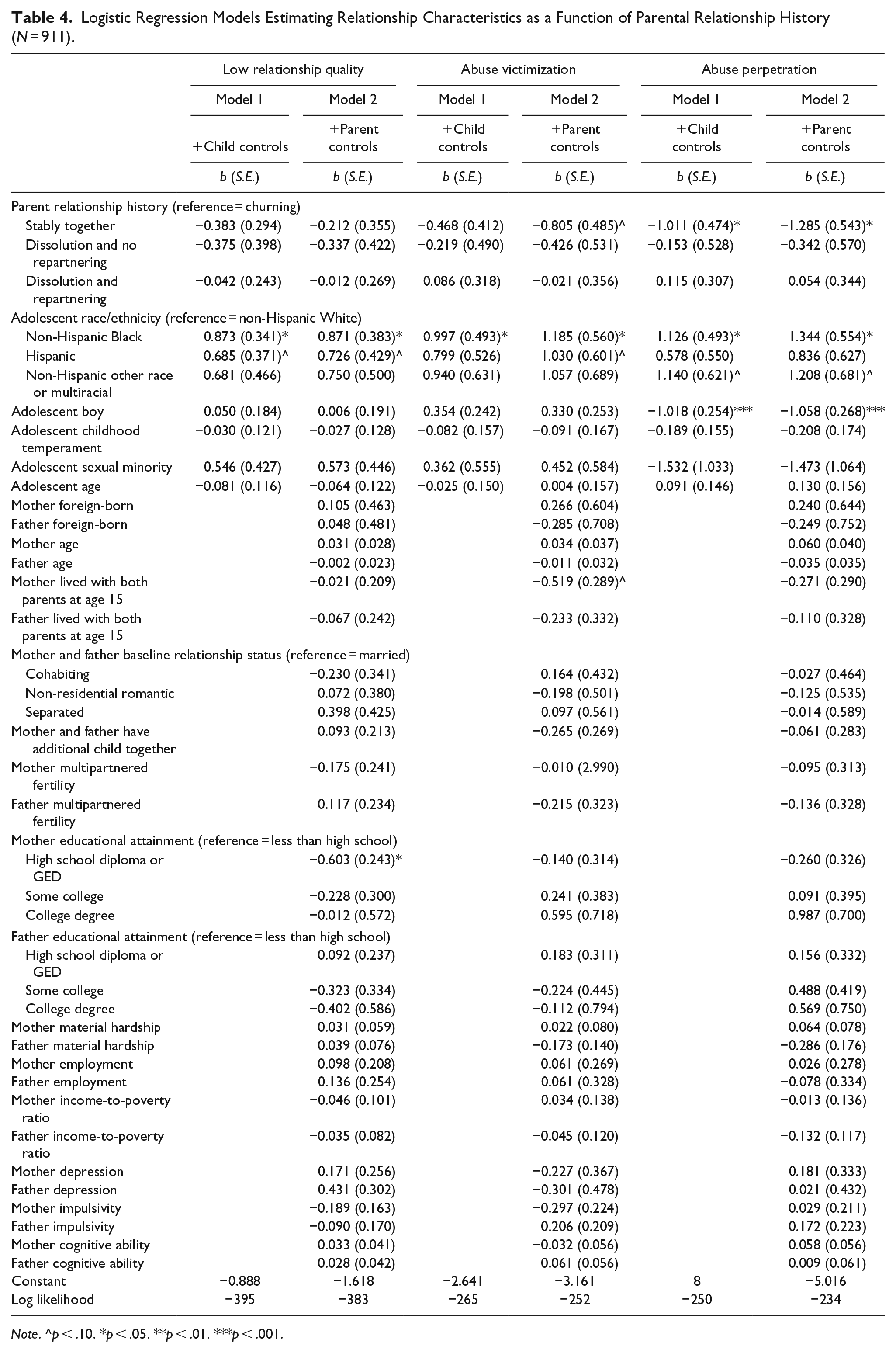
Note. ^p < .10. *p < .05. **p < .01. ***p < .001.
Supplemental Analyses
We conducted a number of supplemental analyses to interrogate the robustness of our findings (available upon request). First, we considered variation in direct and indirect churning, supplementing our four-category measure of parental relationship history with a five-category measure: direct churning (reference), indirect churning, stably together, relationship dissolution without repartnering, and relationship dissolution with repartnering. Results provide no evidence of statistically significant differences in direct churning compared to indirect churning.
Second, we considered variation in the timing of churning, supplementing our four-category measure of parental relationship history with a five-category measure: direct churning at baseline, direct churning beyond baseline (at the 3- or 5-year surveys), stably together, relationship dissolution without repartnering, and relationship dissolution with repartnering (and necessarily excluding those with indirect churning). Results provide no evidence of statistically significant differences in baseline and non-baseline churning.
Third, we estimate the association between parental relationship churning and adolescent relationships separately by adolescent gender, following previous research finding gender differences in the relationship between family instability and adolescent relationship outcomes (Cavanagh et al., 2008; Hernandez et al., 2016; Ryan et al., 2009). These analyses show no statistically significant differences in associations between parental relationship churning and relationship experience or characteristic outcomes for boys versus girls.
Fourth, we distinguished between physical and emotional abuse victimization. These analyses show some statistically significant differences between adolescents with churning parents and adolescents with stably together parents, as adolescents with stably together parents are significantly less likely than those with churning parents to report physical victimization (b = −1.648, p < .05). Sample size limitations preclude distinguishing between physical and emotional abuse perpetration.
Discussion
In this paper, we take a family systems perspective in examining the association between parental relationship churning and adolescent romantic and sexual relationships. Churning relationships are an understudied but common form of family instability, experienced in our sample by about one in five teens. Using data from the Fragile Families and Child Wellbeing Study, we consider five distinct outcomes to understand multiple facets of adolescents’ romantic and sexual relationships. Because relationships in adolescence are predictive of both short-term wellbeing and, over the long-term, relationship characteristics and stability in adulthood (Collins et al., 2009; Epstein et al., 2018; Heywood et al., 2015; Monroe et al., 1999; Sandfort et al., 2008), it is important to understand whether and how this particular form of family instability is predictive of these romantic and sexual outcomes in adolescence.
We find some statistically significant differences in the bivariate associations in relationship outcomes of adolescents with churning parents versus those with stably together parents and those whose parents separated but did not repartner. Adolescents with churning parents, compared to adolescents with stably together parents, are more likely to report having dated by age 15, had sex by age 15, lower relationship quality, abuse victimization, and abuse perpetration. However, our multivariate analyses reveal that these group differences result from adolescents’ characteristics (in comparing those with churning to separated but not repartnered parents) and parents’ characteristics (in comparing those with churning to stably together parents). This supports a selection interpretation, rather than indicating that parental relationship history causes these differences in adolescents’ romantic and sexual relationship outcomes (e.g., McLanahan et al., 2013). This accounts for the lack of support for our hypotheses, as they assumed a causal link between parental relationship history and adolescent relationship outcomes. The lack of differences between adolescents with churning versus separated and repartnered parents further suggests that a biological parent rather than stepparent figure reentering the family system is not necessarily protective (cf. Buchanan et al., 1996; Coleman et al., 2000).
These findings are broadly consistent with previous work in several ways. First, previous research has shown how churners have distinctive demographic, socioemotional, and behavioral characteristics (Dailey et al., 2009; Halpern-Meekin et al., 2013a; Halpern-Meekin & Turney, 2016; Turney & Halpern-Meekin, 2017). Second, some previous research on adolescents’ behavioral outcomes from churning versus other family types has found limited differences among groups (Nepomnyaschy & Teitler, 2013; Turney & Halpern-Meekin, 2020; but see Hernandez et al., 2016). Third, while our bivariate findings—with differences primarily between those with churning versus stably together parents—are consistent with the idea that more family transitions are associated with a higher risk of early relationship transitions or more negative relationship outcomes (Dush, 2009), these differences are explained by the characteristics of the adolescents and their parents, rather than being due to differences in family transition history per se. Similarly, in directly comparing the predictors of outcomes for the three groups of adolescents who do not have churning parents, we do not see a pattern of significant differences among the adolescents from these family types once we control for adolescent and parent characteristics, which aligns with a selection interpretation.
In contrast, some previous work has found there to be differences by family instability experience in adolescent socioemotional and school outcomes (see, Cavanagh & Fomby, 2019). While the differences between previous studies and the present one may be accounted for the distinct family instability experience of churning that we examine, the present study also raises interesting questions about what aspects of family instability may matter for adolescent outcomes. For example, we see here that there are no differences in outcomes, even in the bivariate results, between adolescents from churning versus repartnered families, even though the latter have experienced the introduction of a new adult into their family systems and the former have not. This is an area ripe for future exploration.
There was one outcome—abuse perpetration—for which adolescent and parent characteristics did not explain away the differences between youth with churning versus stably together parents. Previous research has documented, among churners, higher rates of intimate abuse (Halpern-Meekin et al., 2013b) and lower rates of desistance from intimate abuse (Halpern-Meekin & Turney, 2018). Lichter and McCloskey (2004) have found that adolescents who were exposed to intimate abuse in their parents’ relationship were more accepting of abuse in relationships, and those who were more accepting of abuse were more likely to experience it. The higher rate of intimate abuse among churning parents, therefore, may explain its elevated rate among their adolescent offspring.
Limitations
This study is not without its limitations. As described above, we do not have direct measures of relationship churning at each wave and our indirect churning measure may not capture all between-wave churning; therefore, our measure of churning is likely to be underestimated. Relatedly, we are not able to measure the frequency of parents’ on-again/off-again cycles, so we cannot estimate the number of family transitions to which adolescents are exposed. More extensive measures of parental relationship churning would allow us to more closely track whether exposure earlier versus later in childhood is differentially associated with adolescent outcomes. These limitations mean that our study is, if anything, underestimating the association between parental relationship churning and adolescent relationship outcomes; this gives us confidence that we are not falsely drawing conclusions on the basis of overestimates. Despite the limitations of these measures of churning, these are the best data that allow us to look at the relationship between parental churning and adolescent relationships in a large sample of urban youth.
Conclusion
The present study illustrates that future research should continue to recognize and measure parents’ history of relationship churning as it is a common experience for youth and a marker for distinctive outcomes in adolescence. However, this study’s findings underline the importance of properly controlling for the characteristics of adolescents and their parents in predicting adolescent outcomes by parental relationship history. This points to important next steps for the field, both in terms of samples, measures, and modeling. The extent to which differences in adolescent outcomes by family type might be induced by differences in personal or parental characteristics is essential to ascertain, especially given the limitations the field faces in being able to model and estimate the causal relationship between these variables. Therefore, it is necessary to continue to gather adequately powered samples—ideally longitudinal, with fairly frequent data collection intervals—that will allow future work to better analyze how particular characteristics select adolescents into divergent outcomes by family type.
Footnotes
Appendix
Frequencey of Outcome Variables, by Adolescent Race/Ethnicity and Gender.
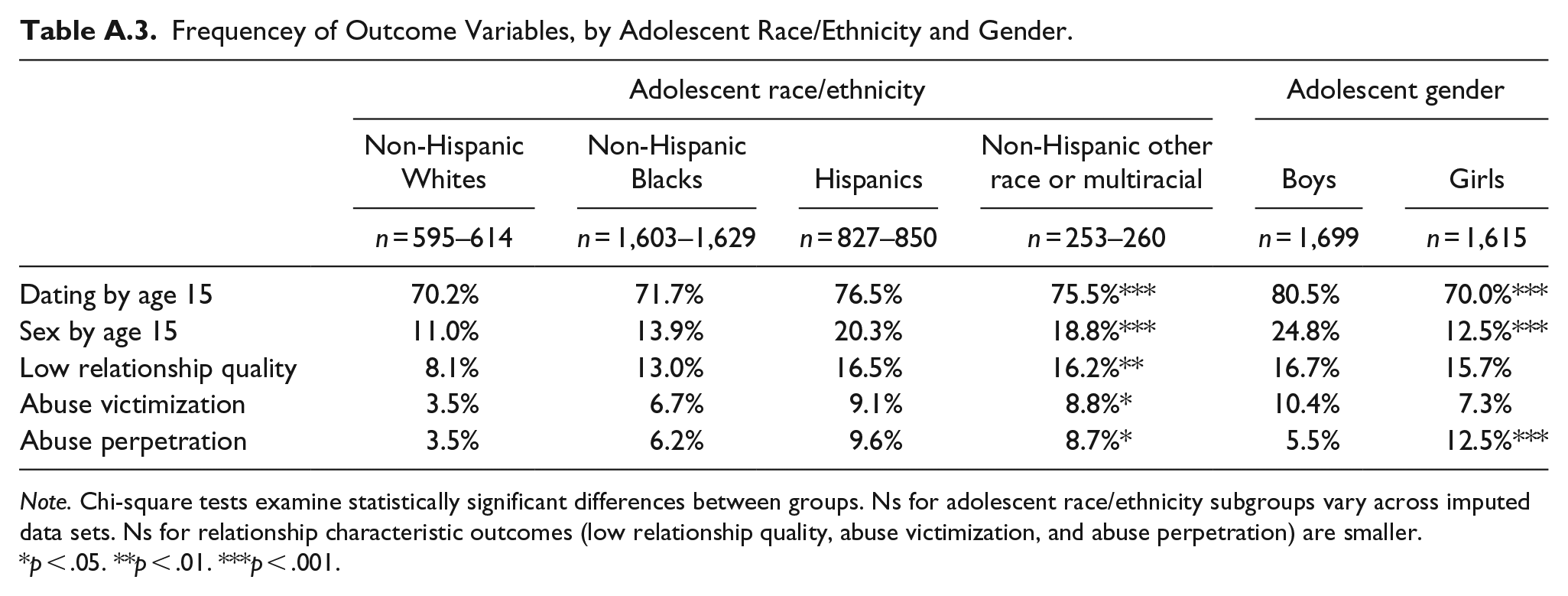
| Adolescent race/ethnicity | Adolescent gender | |||||
|---|---|---|---|---|---|---|
| Non-Hispanic Whites | Non-Hispanic Blacks | Hispanics | Non-Hispanic other race or multiracial | Boys | Girls | |
| n = 595–614 | n = 1,603–1,629 | n = 827–850 | n = 253–260 | n = 1,699 | n = 1,615 | |
| Dating by age 15 | 70.2% | 71.7% | 76.5% | 75.5%*** | 80.5% | 70.0%*** |
| Sex by age 15 | 11.0% | 13.9% | 20.3% | 18.8%*** | 24.8% | 12.5%*** |
| Low relationship quality | 8.1% | 13.0% | 16.5% | 16.2%** | 16.7% | 15.7% |
| Abuse victimization | 3.5% | 6.7% | 9.1% | 8.8%* | 10.4% | 7.3% |
| Abuse perpetration | 3.5% | 6.2% | 9.6% | 8.7%* | 5.5% | 12.5%*** |
Note. Chi-square tests examine statistically significant differences between groups. Ns for adolescent race/ethnicity subgroups vary across imputed data sets. Ns for relationship characteristic outcomes (low relationship quality, abuse victimization, and abuse perpetration) are smaller.
p < .05. **p < .01. ***p < .001.
Declaration of Conflicting Interests
The author(s) declared no potential conflicts of interest with respect to the research, authorship, and/or publication of this article.
Funding
The author(s) disclosed receipt of the following financial support for the research, authorship, and/or publication of this article: Funding for the Fragile Families and Child Wellbeing Study was provided by the NICHD through grants R01HD36916, R01HD39135, and R01HD40421, as well as a consortium of private foundations (see  for the complete list).