




Abstract
Juvenile recidivism is a serious public health concern. Using statewide administrative data, this study examined the independent predictive value of childhood maltreatment on repeat offending and compared risk factors for recidivism between 698 first-time juvenile offenders with maltreatment and their propensity score matched sample of 698 without maltreatment. For 3 years, 65.2% of maltreated offenders and 61.5% of their matched sample recidivated after their initial offense. The effect of childhood maltreatment on recidivism remained statistically significant beyond the inclusion of control variables. In both groups, being a youth of color and having a diagnosed emotional/behavioral disability increased risk for recidivism. Additional risk factors included being a male for maltreated offenders and out-of-school suspension, entry into the juvenile justice system at younger ages, and out-of-home placement only after their first offense or continuing placement for their matched sample without maltreatment. Preventive interventions must be responsive to such different risks.
Introduction
High rates of recidivism for juvenile offenders are a pressing public health concern. Although national recidivism rates for juveniles are unavailable, 45% to 72% of first-time juvenile offenders had new adjudication within 3 years after their release from correctional facilities in 39 states (The Annie E Casey Foundation, 2011). Youth who commit repeat offenses in adolescence may be exposed to additional risks that impinge on healthy development, such as gang affiliation, stigmatization, and social isolation. Negative effects on developmental outcomes associated with juvenile recidivism include mental health, educational and vocational challenges, and criminal involvement (Baglivio et al., 2014; Cottle et al., 2001; Moffitt, 1993; Vaughn et al., 2005).
There is a long tradition of research that has linked adverse childhood experiences (ACEs) with a wide range of negative outcomes at later stages in life, such as a chronic disease, lower education, higher employment, and criminal behavior in adulthood (Baglivio et al., 2015; Bellis et al., 2014; Felitti et al., 1998; Fox et al., 2015; Hillis et al., 2004). ACE is originally described as the seven categories of childhood exposure to abuse and household dysfunction: psychological abuse, physical abuse, sexual abuse, and household substance use, mental illness, violence, and history of incarceration within the household (Felitti et al., 1998). Beyond the initial focus on physical and mental health outcomes, recent research has established the relationship between ACEs and juvenile offending behavior (Baglivio et al., 2014, 2015; Fox et al., 2015; Wolff et al., 2017). Previous research has consistently indicated that juvenile justice system-involved youth with higher ACEs scores are more likely to be classified as higher risk for early onset of antisocial behavior and violent, serious, and persistent offending patterns than their counterparts with lower ACEs scores. To be specific, Baglivio et al. (2014) found that 96% of juvenile offenders in the Florida Department of Juvenile Justice reported at least one adverse childhood experience in their lifetime and 40% had experienced four or more. Baglivio et al. (2015) further found that higher ACE scores were associated with an earlier onset of delinquency and chronic offending patterns. Wolff et al. (2017) also found that higher ACE scores resulted in an increased likelihood of reoffending sooner. Furthermore, Fox et al. (2015) found that juvenile offenders having three or more felony referrals with higher ACE scores are 35 times more likely to become a serious, violent, and chronic offender than their non-violent comparison group of youth with lower ACE scores.
Previous studies collectively provide valuable insight into interventions, such as that recidivism can be significantly prevented when the interventions target youth’s previous or on-going traumatic experiences. However, repeat offending in relation to childhood maltreatment has not been thoroughly examined. Nevertheless, the prevalence of maltreated youth in the juvenile justice system is significantly associated with youths’ demographic characteristics such as race/ethnicity, gender, family socioeconomic status, and disability (Halemba et al., 2004; Herz & Ryan, 2008). Disadvantaged demographic characteristics are found to be more pronounced in maltreated youth populations of maltreated youth (Cicchetti & Toth, 2015; Ryan, Hernandez, et al., 2007). Those with pre-existing conditions prior to their juvenile justice system involvement may acquire more negative and long-lasting effects on their developmental outcomes, including repeat offending, than maltreatment alone. Although a majority of the previous studies consider the confounding effects of race, gender, poverty, and disabilities in their analyses, if there were large differences in the pre-existing conditions between the groups, a naïve estimation of the childhood maltreatment effect on recidivism could be biased. In addition, the negative effects observed among maltreated youth may be attributable to confounding bias from unobserved risks rather than maltreatment itself. For instance, Ryan, Herz, et al. (2007) found systemic bias by which maltreated youth are more likely to be placed at more restrictive placement settings such as juvenile justice group homes and secure residential facilities while juvenile justice processing. Such system involvement further increased the risk of secondary deviance as a result of labeling and social isolation (Liberman et al., 2014).
Previous studies employed various methods to measure justice system involvement including self-report surveys (Snyder & Smith, 2015), official arrest data (Herz et al., 2010; Hirsch et al., 2018; Ryan et al., 2016), and official delinquency petitions (Lee & Villagrana, 2015; Ryan, Marshall et al., 2008). Such measures likely overestimate juvenile delinquency because official statistics on juvenile delinquency report that many youths are formally or informally diverted from legal processing (Department of Public Safety Office of Justice Programs, 2010). In addition, the risk of recidivism is commonly studied based on the first-time re-offense data only in most studies (Huang et al., 2015; Ryan et al., 2013, 2014). The recurring re-offense records, which may provide more detailed information about recidivism, have been less examined. Thus, accounting for repeat reoffending will provide a more comprehensive understanding of delinquent trajectories that is crucial to developing effective interventions that prevent juvenile offenders from re-entry into the system.
Early identification and prevention program are of particular interest to policymakers and practitioners. Given the additional harm posed by repeated system involvements to developmental outcomes, it is important to understand the independent predictive value of childhood maltreatment on persistent reoffending as well as distinct risk factors between juvenile offenders with and without maltreatment histories for preventive intervention. Identifying risk factors can provide foundational knowledge for the development of a screening tool for youth at higher risk of persistent offending and thus focus our limited resources on supporting them to prevent their exposure to additional risks.
To fill these gaps, this study builds on the existing literature on childhood maltreatment and juvenile recidivism by using the matched sampling approach to separate the effect of childhood maltreatment from other confounding effects and identifying different risk factors between first-time juvenile offenders with and without childhood maltreatment. This study addresses the following research questions:
Are the rates of repeat offending for youth with a history of child maltreatment different from their counterparts who were not maltreated over a 3-year period?
What is the magnitude of the effect of childhood maltreatment on the likelihood of repeat offending over a 3-year period while controlling for a set of risk factors?
Is there any difference in factors associated with the likelihood of repeat offending between youth with and without a history of child maltreatment?
Methods
Data
An integrated data set was created by linking several sources of statewide administrative data from the Minnesota Department of Education and Human Services and the Juvenile Court. The data sharing agreements with each department allowed the first author to access to the data after all identifiable information was stripped out. This study was reviewed and approved as an exempt study using secondary data by the Institutional Review Board at the University affiliated with the first author.
Measures
Dependent variable
Repeat offending (recidivism) is a count measure constructed by counting the number of adjudicated offenses (i.e., a youth who has been found guilty by a judge of committing a delinquent act) over 3 years after a given youth’s first adjudicated offense. Recidivism was counted from the court disposition date of a given youth’s first offense.
Independent variable
As the primary independent variable, substantiated maltreatment (i.e., confirmed maltreatment) is measured as at least one substantiated report regardless of the type of maltreatment (e.g., neglect, physical abuse, sexual abuse, mental injury, and emotional harm). To assure temporal ordering of child maltreatment and recidivism, substantiated maltreatment was coded as (1) if a given youth had at least one substantiated record for child protection services only before their first adjudicated offense and (0) otherwise.
Control variables
We included demographics, system involvement-related information, and first offense characteristics as control variables. Demographic information was drawn from the Minnesota State Automated Report Student System (MARSS) including age, gender, race, special education status, emotional and behavioral disability, and family socioeconomic status. Gender was coded as (0) for male (reference group) and (1) for female. Race was coded into four categories: (0) for white (reference group), (1) for African American, (2) for Native American, and (3) for Hispanic. Emotional and behavioral disability (EBD) was coded into two groups: youth (0) without and (1) with an indicator of EBD as their primary disability in MARSS data. Family socioeconomic status was coded into two groups using youth’s eligibility for free or reduced school lunch: students who were identified as (0) being ineligible and (1) eligible for free or reduced lunch (FRL).
The school system involvement-related variable includes special education status which was coded into two groups: students who were (0) ineligible or (1) eligible for Individualized Education Plans (IEPs) at the time of their first adjudicated offense. Out-of-school suspension (OSS) was coded as (0) for students who had no OSS and (1) for those who had at least one official record from Disciplinary Incident Reporting System (DIRS) before their first adjudicated offense. Given the different natures of out-of-home placement (OHP) in child welfare system by its timing, we coded out-of-home placement as a mutually exclusive categorical variable by the placement time pattern: (0) for youth without OHP (reference group), (1) for youth who had OHP only before the initial adjudication of their offense, (2) for youth who had OHP only after their initial adjudication, and (3) for youth who had continued OHP before and after the initial adjudication. Among the characteristics of youth’s first adjudicated offense, age at first offense was defined as the youth’s age at the time of his/her first adjudicated offense recorded in the State Court Information System (MNSIS). The type of the first adjudicated offense was constructed as a binary variable for: (1) physical violence related offense, that is, the intentional use of physical force to cause, or threaten, injury, harm, or death to another person and (0) all other types of offense. The degree of the first adjudicated offense was coded into four categories, ranked in descending severity: (0) felony (reference group), (1) gross-misdemeanors, (2) misdemeanors, and (3) petty misdemeanors other than juvenile petty (status) offense or traffic offense. When the youth received multiple charges on the same offense date, the most serious charge was coded, for example, a felony was coded over a gross misdemeanor.
Sampling Procedures
In Minnesota, the youngest age at which a youth can be adjudicated delinquent is 10 years old (Minnesota Juvenile Court Jurisdiction, n.d.), so we limited the sample pool to students (n = 595,861) who were enrolled in Minnesota public schools between ages 10 and 15 in academic years 2010 and 2011 (i.e., September 1, 2009–August 31, 2011). This allowed us to follow each youth for at least 3 years based on their first adjudicated offense record (Supplemental Figure 1). Among 595,861 youth, we identified 4,194 students who had their first offense adjudicated at between ages 10 and 15 during the time period from September 1, 2009 to August 31, 2011. In this study, we excluded youth whose offenses resulted in juvenile justice correctional placement (n = 97) to rule out the effects of juvenile justice correctional placement and to circumvent the complexity of identifying lengths of stay at the placement over the study period of 3 years. Such exclusion criteria also ensured that the sample of this study did not include youth offenders who have been transferred from the juvenile court to the adult criminal court for prosecuting and sentencing. The final sample of first-time offenders (n = 3,977) consists of white, African American, Hispanic, and American Native youth after excluding youth identified as Asian due to the small sample size (n = 7). Finally, we identified 698 first-time juvenile offenders (17.5%) as having at least one official record for substantiated maltreatment incidents before their initial involvement in the juvenile justice system.
Analytic strategies
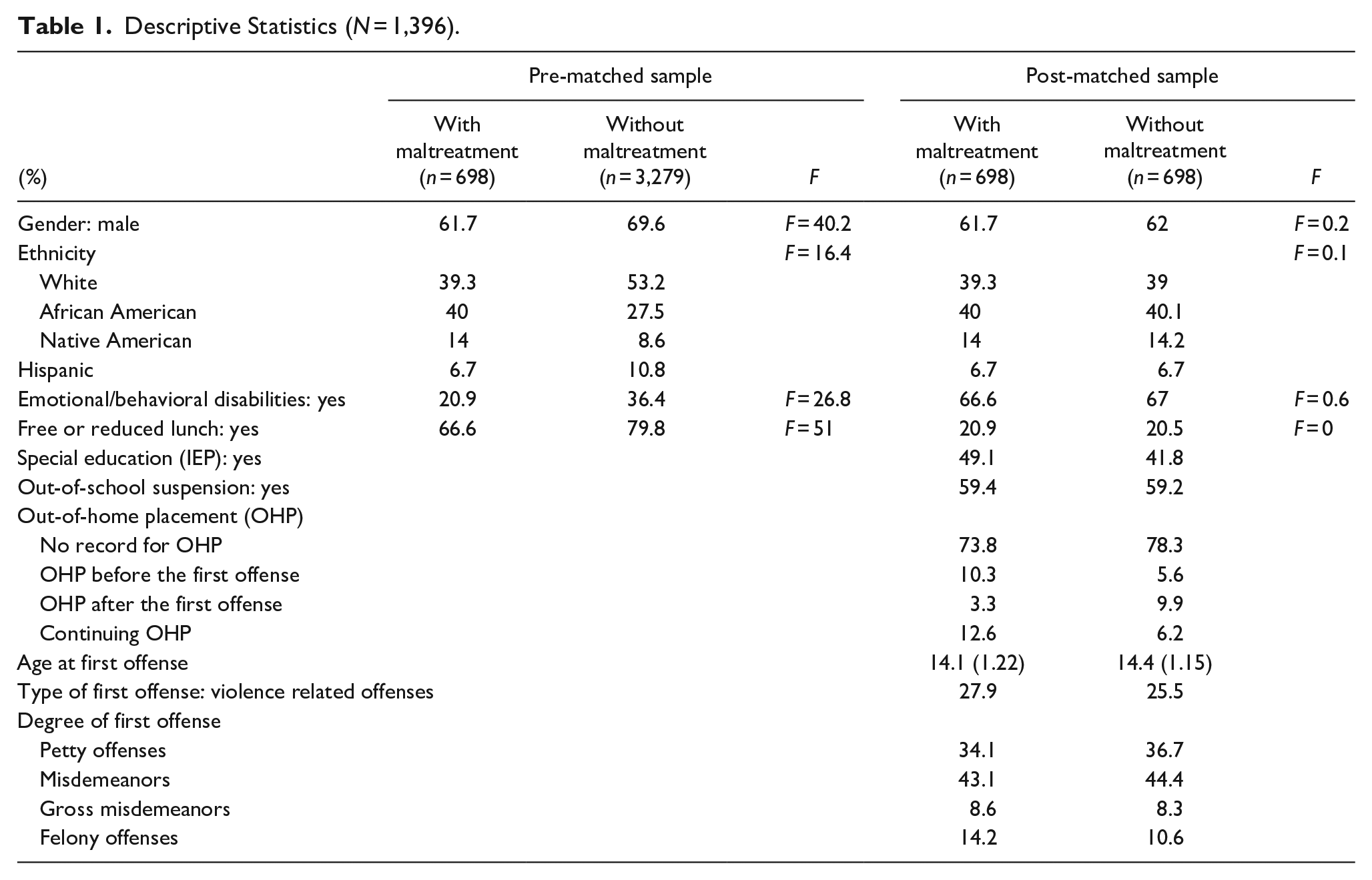
To compare the rates of repeat offending for youth with a history of maltreatment to those of their counterparts, we conducted an independent-sample t-test (research question #1). To examine the effects of maltreatment on repeat offending while accounting for the effects of demographics which may lead to confounding bias, we employed propensity score matching (PSM; Rosenbaum & Rubin, 1985). Demographic characteristics varied substantially between first-time juvenile offenders with and without maltreatment. For example, African American youth are disproportionately represented in first-time offenders with maltreatment (40%) compared to those in the latter group (27.5%). Youth from low-income families are overrepresented in first-time offenders without maltreatment (36.4%) than those with maltreatment (20.9%). The PSM was implemented to select the control group of juvenile offenders who were matched with the treated group on a set of background covariates using the statistical software R package “MatchIt” (version 3.0.2; Ho et al., 2013). The optimal matching method was used as a matching algorithm to find the matched samples with the smallest average absolute propensity score distance (Ho et al., 2013).
In this study, 3,279 first-time juvenile offenders without maltreatment histories were matched with 698 maltreated youth on gender, race, special education status, and family socioeconomic status. The PSM yielded a final sample of 1,396 first-time offenders with (maltreated offenders; n = 698) and without substantiated maltreatment (matched sample; n = 698). A crucial part of propensity matching procedure is to assess the balance in covariate distributions (Ho et al., 2013, p. 7); hence, the distributions of each covariate before and after matching were reviewed. We reviewed the percent balance improvement, the histogram of propensity scores, the quantile-quantile plot, and Love plot of standardized mean differences (Ho et al., 2013) to assess the balance across matching covariates between first-time offenders with and without maltreatment after matching (Supplemental Figure 2). The standardized mean differences in all variables between the matched samples were equal to zero when 1:1 matching was used. A multivariate analysis of variance (MANOVA) was conducted to test mean differences in covariates between the two groups before and after propensity matching (see Table 1). Statistically significant MANOVA effects were observed between the two groups before the PSM, Pallia = 0.04, F = 36.87, p < .001. After the PSM matching, results of the MANOVA test indicated no difference in the covariates between the two groups, Pallia = 0.000, F = 0.03, p = .999.
Descriptive Statistics (N = 1,396).
For the primary analyses, we employed a negative binomial regression model. Negative binomial regression is an appropriate statistical method when the dependent variable is a count variable and the variability of counts within a covariate group is not equal to the mean (Allison & Waterman, 2002). The assumption of equidispersion was not satisfied in this study as the data presented a mean-variance ratio of 2.5. We conducted a series of negative binomial regression analyses to examine the independent predictive value of child maltreatment on repeat offending in the entire sample (research question #2) and then identify potentially different risk factors for recidivism between maltreated offenders and their matched sample without maltreatment (research question #3). Multicollinearity was not present across the variables included in the final model with variance inflation factors of approximately 1. Data management and all statistical analyses were conducted with the statistical software R, version 3.6.2.
Results
Descriptive statistics
Sample characteristics and descriptive statistics before and after PSM are displayed in Table 1. The entire sample consisted of approximately 62% males, 39% white, 40% African American, 14% Native American, and 7% Hispanic youth. Approximately 21% were diagnosed with EBD and 67% came from low-income families eligible for FRL. Approximately 49% of maltreated offenders and 42% of their matched sample without maltreatment received individualized educational plans (IEPs). They were suspended from school at a similar rate (approximately 59%). Approximately 10% of maltreated offenders with maltreatment and 6% of their matched sample experienced OHP only before their initial offense. Nearly 13% of maltreated offenders and 6% of their matched sample had on-going OHPs. Approximately 3% of maltreated offenders and 10% of their matched sample experienced placements after their initial offense. Regarding first offense characteristics, the mean age of the initial offense was almost identical between the two groups (approximately the age of 14 years). Nearly 28% of maltreated offenders were charged with physical violence related offenses, which is slightly higher compared to 26% of their matched sample. Approximately 14% maltreated offenders were adjudicated for felony cases compared to 11% of their matched sample as a result of their first offense.
Recidivism rate
Over the 3-year period, 65.2% of maltreated offenders and 61.5% of their matched sample had subsequent adjudicated offenses after their initial offense. Of those who recidivated, approximately 31% of maltreated offenders and 23% of their matched sample had more than three adjudicated offenses. Results of an independent-sample t-test (t = −3.25, p = .001) indicated that the mean number of reports was significantly higher for maltreated offenders (M = 1.9, SD = 2.23, range: 0–13) than their matched sample (M = 1.5, SD = 1.9, range: 0–13).
Negative binomial regression analyses
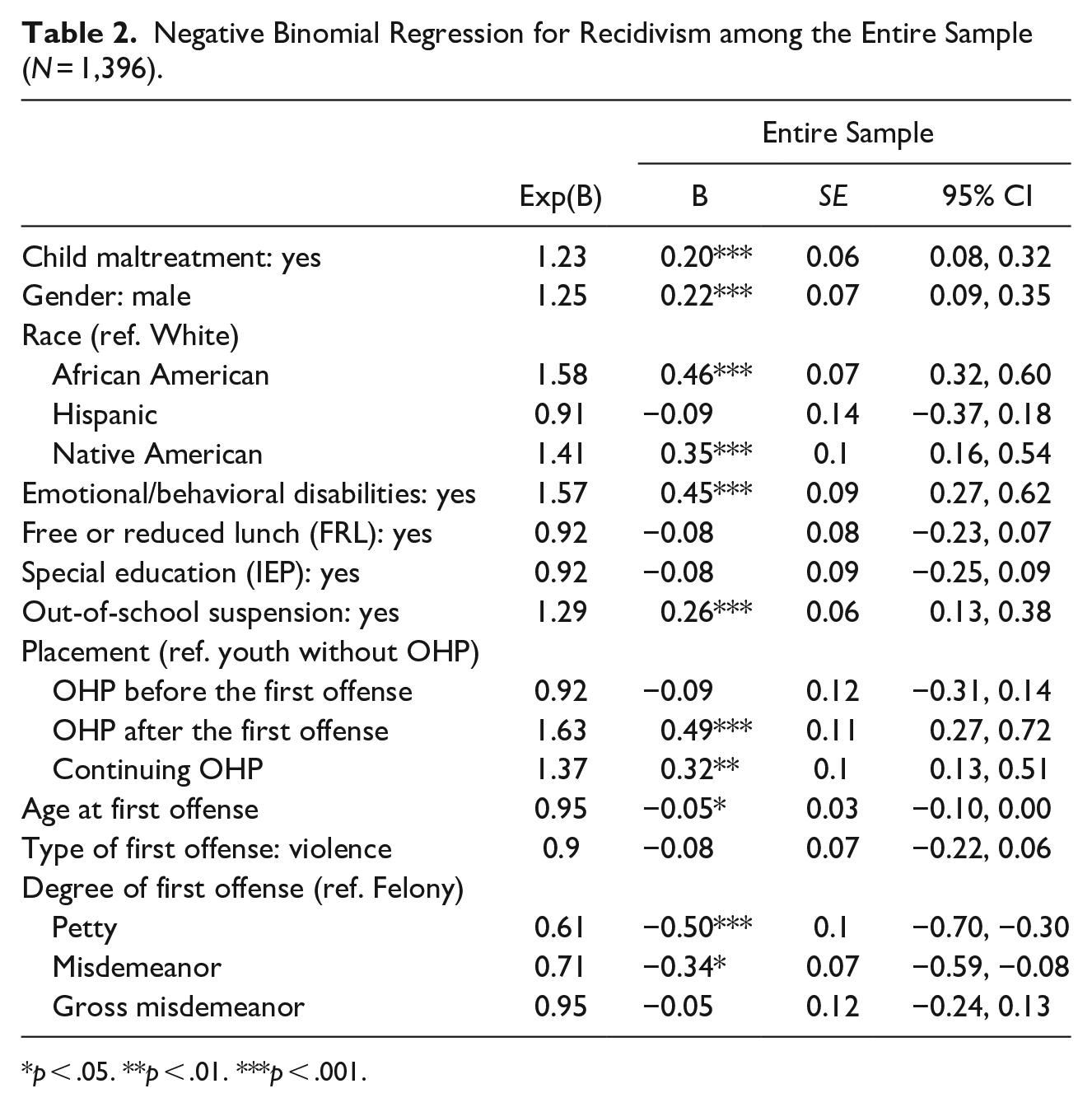
Table 2 presents the results from the negative binomial regression model for the entire sample. The association between child maltreatment and repeat offending was statistically significant and positive when confounding variables were included. To be specific, the expected number of subsequent adjudicated re-offenses among maltreated offenders increased by 1.23 times (Exp(B) = 1.23, p < .001) compared to their matched sample without maltreatment after their first adjudication. In terms of demographic characteristics, males were likely to engage in 1.25 times (Exp(B) = 1.25, p < .001) more subsequent re-offenses than females. African American and Native American youth would commit 1.58 (Exp(B) = 1.58, p < .001) and 1.41 times (Exp(B) = 1.41, p < .001) more re-offenses compared to white youth, respectively. Youth with EBD tend to commit 1.57 times (Exp(B) = 1.57, p < .001) more re-offenses than their counterparts without EBD. Regarding the placement experience, the expected numbers of subsequent re-offenses among youth who experienced OHP after their first offense and who had continuing placements were 1.63 (Exp(B) = 1.63, p < .001) and 1.37 times (Exp(B) = 1.37, p < .01) greater than youth with no OHP histories. There was no significant effect of OHP before the youth’s first offense. Youth who received suspensions from school prior to their initial offense were expected to commit 1.29 times (Exp(B) = 1.29, p < .001) more re-offenses than counterparts without suspension. Youth who were younger at their first offense have greater risk of recidivism. A year increase in age at first offense decreases the expected number of subsequent re-offenses by 5% (Exp(B) = 0.95, p < .05). The number of subsequent re-offenses among youth adjudicated for petty and misdemeanor cases was expected to be 39% (Exp(B) = 0.61, p < .001) and 29% (Exp(B) = 0.71, p < .05) less than felony cases after their first offense.
Negative Binomial Regression for Recidivism among the Entire Sample (N = 1,396).
p < .05. **p < .01. ***p < .001.
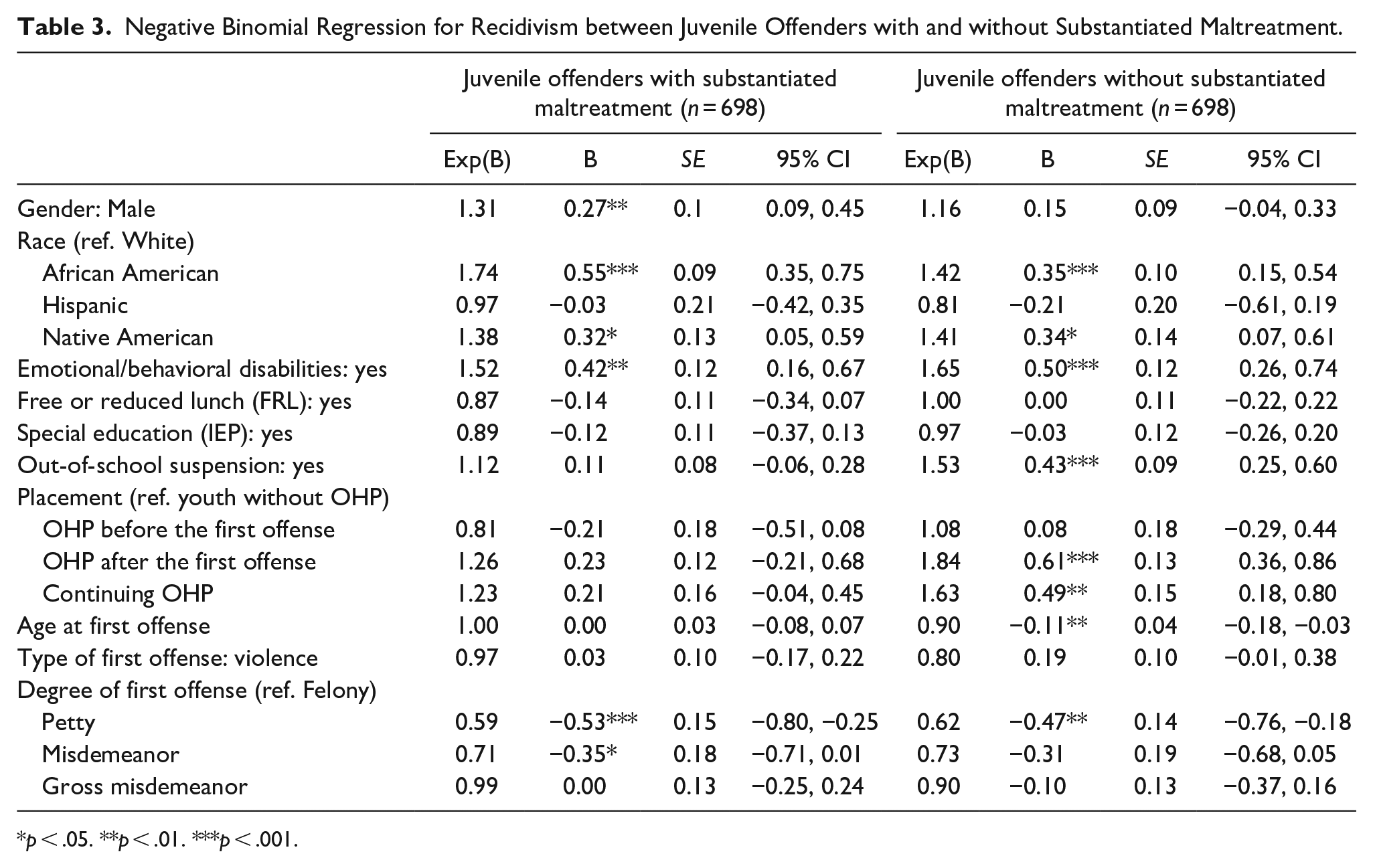
Next, we ran additional analyses to examine whether predictors for continuing reoffending differ by childhood maltreatment (see Table 3). In both groups, being a youth of color, especially African Americans (Exp(B) = 1.74, p < .001 for maltreated juvenile offenders and Exp(B) = 1.42, p < .001 for their matched sample) and Native Americans (Exp(B) = 1.38, p < .05 and Exp(B) = 1.41, p < .05, respectively) and having a diagnosis of EBD (Exp(B) = 1.52, p < .01 and Exp(B) = 1.65, p < .001, respectively) significantly increased the numbers of re-offenses. For maltreated offenders only, males had a 31% (Exp(B) = 1.31, p < .01) higher expected number of reoffending compared to females. We found more statistically significant predictors for their matched sample without maltreatment including entering into the juvenile justice system at younger ages (Exp(B) = 0.90, p < .01), having been suspended from school (Exp(B) = 1.53, p < .001) and OHP prior to their first offense (Exp(B) = 1.84, p < .001) or continuing OHP (Exp(B) = 1.63, p < .01).
Negative Binomial Regression for Recidivism between Juvenile Offenders with and without Substantiated Maltreatment.
p < .05. **p < .01. ***p < .001.
Discussion
The aim of this study is to expand existing literature on youth with adverse childhood experiences by examining the lingering effect of childhood maltreatment on juvenile recidivism and comparing the rates and risk factors for repeat offending between juvenile offenders with and without maltreatment histories. Prior research suggests that youth with adverse childhood experiences are at increased risk for delinquency than their counterparts without maltreatment (Barrett et al., 2014; Ryan et al., 2013, 2014) and they exhibit different sets of risk factors for recidivism (Goodkind et al., 2020; Lee & Villagrana, 2015). Such evidence directs us to compare maltreated juvenile offenders with their matched samples who were not maltreated for their repeat offending over a relatively longer period of follow-up than the previous research.
Based on the research questions of this study, three main findings can be discussed. First, consistent with prior research that has assessed the role of ACEs on delinquency (Baglivio et al., 2015; Fox et al., 2015; Wolff et al., 2017), first-time offenders with substantiated maltreatment exhibited significantly higher rates of repeat offending than their matched sample without maltreatment. Approximately one third of maltreated offenders had more than three adjudicated offenses compared with one fourth of their matched sample without maltreatment. The results of this study suggest that the quantity of re-offense is a more meaningful measure of recidivism, especially for juvenile offenders with a history of substantiated maltreatment. A simple comparison for recidivism as a dichotomous variable indicated that approximately 65% of maltreated offenders recidivated compared to 62% for their matched sample who were not maltreated. The gap in the recidivism rates between the two groups is smaller than that found in some previous studies. A study of Rhode Island administrative data reported a recidivism rate of 71% for juvenile probationers with maltreatment and 46% for those who had not been maltreated (Wiebush et al., 2001).
There may be two reasons for the relatively smaller gap found here. This study is distinctive in addressing potential bias from unobserved risks for recidivism. Unlike the previous studies, we created a comparison group of juvenile offenders without maltreatment histories who were similar to those with a history of substantiated maltreatment on a set of well-known demographic backgrounds associated with risk for delinquency including gender, race, emotional and behavioral disabilities, and poverty. Therefore, the impact of pre-delinquency characteristics of youth may be adjusted for the rates of recidivism. In addition, this study considered a relatively longer period of time to measure recidivism than the previous research. The longer follow-up period in the current study means a higher chance of observing re-offending among first-time juvenile offenders (Harris et al., 2009). Measuring time to the first re-offense in the previous studies only ranged from 6 months to 2 years (Baglivio et al., 2015, 2016; Craig et al., 2017; Lee & Villagrana, 2015). Given the additional risks posed by juvenile legal involvement for social functioning and developmental outcomes, their delinquent behavior may converge toward certain trajectories over time. Life course perspectives suggest that patterns of antisocial behavior change over the course of a lifetime depending on the level of neuropsychological and environmental deficits (Moffitt, 1993; Piquero & Chung, 2001). Theories from the life course perspectives identify two distinct offending trajectories in the age-crime curve: the life-course persisters and the adolescence-limiters. Future research is needed to understand various long-term trajectories between juvenile delinquents with and without maltreatment histories.
The second major findings of this study is that childhood maltreatment contributes to the prediction of persistent reoffending. In the entire sample, the expected number of re-offenses for first-time juvenile offenders with maltreatment is 1.23 times greater than the expected number of re-offenses for their counterparts without maltreatment when all other risk factors were held constant. Based on prior ACEs research, it is important to interpret the effect of childhood maltreatment on juvenile recidivism in their contextual differences. Most youth at risk for recidivism exhibit higher ACEs scores, meaning that they undergo persistent, multiple adverse experiences (Baglivio et al., 2014). We also identified various risk factors for juvenile recidivism including being a male, belonging to particular racial minority groups, being diagnosed with EBD, suspending from school, experiencing OHP, and committing first delinquency at younger ages and serious offense at the initial delinquency. Collectively, the findings of this study suggest that juvenile offenders experience multiple vulnerabilities in their developmental contexts. Presence of a risk factor can be aggravated by interactions with other risk factors. For instance, behavioral patterns in the child resulting in school suspension can be exacerbated by interactions with ongoing OHPs. In addition, involvement in the juvenile justice system may interfere with basic, psychosocial developmental processes as they undergo a time of transition during which enormous growth occurs in a wide range of interrelated developmental domains (Steinberg, 2017). Thus, these findings highlight the implications for prevention and control of delinquency among vulnerable youth at risk for recidivism who are exposed to adverse childhood experiences. For those youth, each of their system involvements before entering into the juvenile justice system can be a critical point of contact for moderating negative developmental outcomes by providing formal and informal services, such as parenting support, mental health service, and academic support that aim to create stable and caring environments.
Given the interrelatedness of multiple issues experienced by vulnerable youth, the findings of this study also point to the importance of comprehensive, integrated approaches for improving their outcomes. Those approaches typically involve multisystem collaborations, at the least child welfare and juvenile justice professionals, but also school, law enforcement, and behavioral health personnel, to utilize different community resources through coordinated case planning and supervision (Stewart et al., 2010). Multisystemic, integrated approaches have been reported as effective in reducing unnecessary detention of child welfare system-involved youth who are arrested for misdemeanors and less serious felonies (Haight et al., 2014, 2016). We found that youth who were formally adjudicated for petty and misdemeanor cases as a result of their first offense were less likely to continue re-offending than those with felony offenses. These results support that preventive and more individualized interventions for such youth could redirect their delinquency trajectories.
Lastly, the most compelling findings of this study are that first-time juvenile offenders with and without substantiated maltreatment differed as to which risk factors are predictive of repeat offending. We found some factors associated with risk of recidivism specific to each group of juvenile offenders with and without substantiated maltreatment. Consistent with prior research, for instance, this study provides strong support for gender-specific pathways from maltreatment to delinquency (Chiu et al., 2011; Topitzes et al., 2011; Widom et al., 2006). Our findings indicate that males with maltreatment histories are more likely to recidivate than females with maltreatment histories. Males tend to display externalizing reactions (e.g., aggression and violence) to trauma caused by maltreatment and thus more immediately engage in delinquency while females are more likely to internalize trauma (e.g., depression and suicidality) from maltreatment resulting in lagged initiation of delinquency (Chiu et al., 2011; Lee & Villagrana, 2015; Topitzes et al., 2011). The gender differences in the pathways may also be explained by the primary type of maltreatment experienced by each gender. Females are more likely to experience sexual abuse than males (May-Chahal, 2006) and victims of child sexual abuse are more likely to receive attention from the system interventions, which may serve as a protective factor for short term consequences among female (Herz et al., 2012; Kruttschnitt, 2016; Villagrana, 2010). Early interventions to prevent vulnerable youth from engaging into or entrenching into the juvenile justice systems must consider gender differences in trauma and delinquency.
Another highlight of the findings from this study is that important differences exist between juvenile offenders with and without maltreatment histories in the effect of out-of-home placement on repeat offending. Our findings indicate that OHP in the child welfare system after their first offense and continuing placement compared to no placement increased the risk for continued offending. This increased risk appeared specific to juvenile offenders who had no official record for substantiated maltreatment. The findings support previous research that the timing of placement and placement instability are critical factors predictive of increased juvenile justice system involvement (Coleman & Jenson, 2000; DeGue & Spatz Widom, 2009; Huang et al., 2015; Lemmon, 2006; Ryan & Testa, 2005). There is accumulating evidence indicating that age at placement entry matters in delinquency trajectories. Guided by developmental theories, many studies have found that later and continuing placements increase the risk for delinquency more than early occurring placement (Baskin & Sommers, 2011; DeGue & Spatz Widom, 2009; Ryan & Testa, 2005; Rayan, Testa, et al., 2008). These findings also direct our attention to reasons for placement. Entry in child welfare placement following the first offense likely occurs due to the youth’s delinquent behavior or multiple behavioral problems including aggression, delinquency, or drug use. Previous studies found that delinquent behavior increased risk for out of home placement (Nelson, 1990), and child welfare programs showed higher failure rates for children with multiple behavioral problems (Coleman & Jenson, 2000; DeGue & Spatz Widom, 2009). These results reflect that there is no overall positive or negative effect of child welfare placement itself on delinquency and crime. Further examination is needed to investigate variations in the outcomes of the child welfare placement across various reasons for the referral. In addition, results from this study suggest that the heterogeneity of the population in maltreatment or placement histories must be reflected in the child welfare and juvenile justice systems’ program models to address their unique behavioral challenges.
This study has some limitations that should be further addressed. The youth population in this study were from a single state. There is a wide variation in the youth population composition and policies and practices pertaining to maltreated children and juvenile delinquents across states. The findings from this study may have been influenced by some of these aspects and thus the generalization of the findings is limited to states with similar characteristics in the youth population as well as the relevant policies and practices. Second, the use of administrative data in this study has some limitations. We limited our sample to youth who were enrolled in public schools. Those who dropped out of school before their first offense may exhibit variations in risk factors and patterns of reoffending. In addition, based on the original conceptualization of ACE scores that consider its cumulative effect on outcomes later in life (BAglivio et al., 2014), child maltreatment can be measured in many different ways accounting for type, timing, chronicity, and severity of exposure to such victimization and trauma. Although such measures are not available in this study as we used an official record of child maltreatment, future research needs to include more comprehensive measures of these concepts. Lastly, there is no standard method to measure recidivism, which means that there may be potential bias in any measures of recidivism. Self-report data and arrest records have reported higher rates of delinquency or recidivism than adjudications (Cho et al., 2019; Haight et al., 2016; Snyder & Smith, 2015). Adjudication of delinquency provides a more conservative measure of recidivism. The use of the court data, however, excludes a certain portion of youth who are formally or informally diverted from legal processing. More research is needed to understand different delinquency trajectories between adjudicated youth and those who are arrested but diverted before they reach the juvenile justice system. Despite the limitations of this study, the findings from the comparison analyses between juvenile offenders with a history of substantiated maltreatment and their matched sample are meaningful to make valuable implications for policies and practices pertaining to vulnerable youth at risk of repeated offending.
Conclusion
Our findings suggest that first-time juvenile offenders are a diverse group of individuals who have different strengths and challenges regardless of whether they have a history of maltreatment. Preventive interventions must adapt to the unique needs of the diverse individual youth. Given their experience with multiple system involvements, they may be vulnerable to stigmatization and social isolation (Shapiro et al., 2010). Preventive interventions to alter the negative developmental trajectories of those youth should be sensitive to their previous adverse experiences. Additionally, multiple systems collaboration is necessary to mobilize and coordinate different community resources for supporting youth’s unique needs including mental health service, academic support, and stable placements.
Supplemental Material
sj-pdf-1-yas-10.1177_0044118X211001090 – Supplemental material for Childhood Maltreatment and Repeat Offending in Juvenile Delinquents: A Propensity Score Matched-Control Study
Supplemental material, sj-pdf-1-yas-10.1177_0044118X211001090 for Childhood Maltreatment and Repeat Offending in Juvenile Delinquents: A Propensity Score Matched-Control Study by Minhae Cho and Chi Hyun Lee in Youth & Society
Footnotes
Declaration of Conflicting Interests
The author(s) declared no potential conflicts of interest with respect to the research, authorship, and/or publication of this article.
Funding
The author(s) disclosed receipt of the following financial support for the research, authorship, and/or publication of this article: This research was supported by a grant from the National Science Foundation (SMA1338489) provided through the Minnesota Linking Information for Kids (MinnLInK) project..

Supplemental Material
Supplemental material for this article is available online.
Author Biographies
References
Supplementary Material
Please find the following supplemental material available below.
For Open Access articles published under a Creative Commons License, all supplemental material carries the same license as the article it is associated with.
For non-Open Access articles published, all supplemental material carries a non-exclusive license, and permission requests for re-use of supplemental material or any part of supplemental material shall be sent directly to the copyright owner as specified in the copyright notice associated with the article.
